Content Type: Article

  • TTB ramps up tax audits and enforcement

    TTB ramps up tax audits and enforcement

    ARTICLE

    TTB ramps up tax audits and enforcement

    Mar 19, 2024

    Read time: 5 min

    Key takeaways
    Overview

    The Alcohol and Tobacco Tax and Trade Bureau’s (TTB) Office of Field Operations is responsible for ensuring industry members comply with the Federal Alcohol Administration Act, the Internal Revenue Code and all related regulations. It is divided into three groups: the Trade Investigations Division (TID), the Tax Audit Division (TAD) and the Intelligence Division.

    Many industry members are most familiar with the TID, as it is comprised of investigators who are responsible for enforcing compliance with the trade practice laws and maintaining a level playing field. The TAD may be less familiar, however, as it is comprised of auditors who are responsible for ensuring payments of excise taxes and compliance with the laws and regulations in a manner that protects revenue and prevents unlawful activity in the commodities that the TTB regulates. The TAD works with other areas of the TTB and has the resources to assist in the investigations of underpayment of tax or other financial areas that relate to the laws and regulations enforced by the TTB. The TAD also performs random audits, which means that every industry member is susceptible to an audit.

    Over the past year, the TAD has issued tax-related citations for failure to timely file and/or pay taxes, use of inappropriate tax rates (largely stemming from the improper use of reduced tax rates under the Craft Beverage Modernization Act (CBMA) and failure to maintain adequate records, among other violations. In 2023, the TTB resolved these violations by accepting offer-in-compromise (OIC) settlement payments from the targeted industry members, collectively, to the tune of approximately $850,000.

    Based on a review of the OICs which are published on the TTB website, there were a wide range of tax-related violations last year, including:

    • Failure to timely file and/or pay taxes and reports. These failures accounted for nearly 70% of all OIC violations. In these common infringements, the permittee submits their reports or taxes late. The causes for a violation can range from (1) a simple late submission, even 1-2 days late; (2) filing the tax return without paying the taxes; (3) late payments due to processing times; or (4) a change in filing frequency. It is important to ensure that industry members’ reports are filed on time (even a day late is sufficient to warrant a violation) and that the taxes are paid promptly.
    • Use of inappropriate tax rates. There are two main categories of tax rate violations: (1) inappropriate use of reduced tax rates or credits, largely through improper use of the CBMA, and (2) inappropriate categorization of the product (commonly wine). An accurate determination of the product’s tax class is crucial to avoiding these violations, as is consideration of your eligibility (and continued eligibility) for CBMA-reduced rates or credits. We saw a significant increase in tax-related enforcement due to violations from acquisitions completed in the first half of 2023 which impacted eligibility of the reduced tax rates for the entity as a new member of a controlled group. See our prior posts on this topic.
    • Operating without a permit. The TTB accepts an offer in compromise one to two times a year from entities performing certain operations without the appropriate permit. For example, manufacturing, aging, warehousing or bottling products on non-permitted premises or importing products without the appropriate licenses.
    • Failure to maintain adequate records. This citation is frequently connected with removal of the product from the bonded premises without the appropriate records. The TTB has specific recordkeeping requirements for each commodity throughout the manufacturing, removal and distribution processes. Failure to maintain these records can result in financial penalties.
    • Failure to report a timely change in ownership, management or control. Reporting changes after initial qualification for licensure is a very important compliance requirement. Last year, we saw an increase in the TTB’s enforcement against industry members that fail to report changes in control or changes in proprietorship within 30 days of the change. The statutory consequence for failing to report a change is the automatic termination of the federal basic permit; therefore, the timely reporting of new ownership changes and due diligence of any prior changes is critical. All changes should be filed in a timely manner to keep your records updated and in compliance.
    • Failure to pay taxes via the appropriate method. The TTB requires that certain groups pay excise taxes through an electronic funds transfer. Occasionally, a change in ownership or in single taxpayer status can affect an entity’s required payment method. It is important to consider the impact that any organizational or operational changes may have on your entity’s payment requirements.

    Maintaining compliance with the applicable laws and regulations is important in order to avoid high financial penalties and costly administrative actions that could potentially put business operations in jeopardy. The TTB will continue to maintain a strong focus on tax audits for the near future. Our alcohol regulatory team is committed to helping you through an audit, consulting on any changes in your alcohol beverage operations or representing you in matters involving the TTB.

    Authors

    Alva C. Mather

    Partner

    Washington, DC

    Christine Dower

    Counsel

    Washington, DC

    Michelle L. Draper

    Senior Alcohol Regulatory Specialist

    Wilmington

    More insights
    Endnotes

  • HHS and FDA Seek Comments on Informed Consent Draft Guidance

    HHS and FDA Seek Comments on Informed Consent Draft Guidance

    ARTICLE / CLIENT ALERT

    HHS and FDA Seek Comments on Informed Consent Draft Guidance

    March, 19 2024

    Read time: 7 min

    Key takeaways
    Overview

    On March 1, 2024, the US Department of Health and Human Services (HHS) Office for Human Research Protections (OHRP) and the US Food & Drug Administration (FDA) released a draft guidance document entitled Key Information and Facilitating Understanding in Informed Consent (Draft Guidance). It represents the next step in HHS’s continued efforts to modernize and harmonize federal human subject protection requirements and guidance. It also provides sponsors, investigators and institutional review boards with recommendations for the content, organization and presentation of key informed consent information in FDA-regulated clinical investigations as well as HHS-supported or conducted nonexempt human subjects research.

    In depth

    When HHS finalized revisions to the Federal Policy for the Protection of Human Subjects (Common Rule) in 2017, it added a new requirement that – except for broad consent obtained in accordance with the Common Rule for certain secondary research activities – consent documents or other consent vehicles must begin with the key information most likely to assist a prospective research subject in understanding and determining whether to participate in a research study. Consistent with HHS’s mandate under the 21st Century Cures Act to harmonize differences between HHS and FDA human subject protection regulations, the FDA issued a proposed rule in September 2022 that, if finalized, will (among other things) add identical language to the FDA’s human subject protection regulations.

    In the Draft Guidance, OHRP and the FDA acknowledge that there are multiple strategies for providing key information to prospective research subjects that are consistent with the provisions of the revised Common Rule and the FDA’s proposed rule. It is up to interested parties to develop an approach that takes into account certain relevant factors when developing and providing key information for any given study, including the distinctive attributes and design of the study, the prospective subject population, and the disease or condition being examined. The agencies offer several overarching recommendations for presenting this key information.

    Identifying and Presenting Key Information

    The Draft Guidance opens with a general recommendation that the key information section of a consent form begin with an introductory statement to frame the key information included in the consent and serve as a roadmap for the entire consent document. The Draft Guidance is clear that each informed consent element does not need be included in the key information section, but elements that a prospective subject would consider “key” should be included, and the most important elements should appear at the beginning of the key information section. Even if an element is not selected for inclusion in the key information section, it must appear elsewhere in the informed consent form as required by the regulations.

    The agencies also recommend that, where appropriate, details in the key information section be repeated in other parts of the consent form to help reinforce important considerations regarding participation in the study, and that the key information section include page numbers or hyperlinks to cross-reference more detailed information later in the form. In addition, for minimal-risk or certain other studies, the agencies note that the key information section may be the majority or even the entire consent document, so long as it provides sufficient information for the prospective subject to make an informed decision.

    Specific Examples of Key Information

    While the key information section will vary from study to study, the agencies offer focused recommendations on specific informed consent elements that interested parties should consider including in the key information section. Among other information, parties should include:

    • A statement that participation in the research is voluntary and that the decision to not participate, or later withdraw from participation, will not result in a penalty or loss of benefits to the prospective subject to which the individual is otherwise entitled.
    • Information that provides a clear understanding of the purpose of the study and relevant details of the protocol (such as a description of the research and why it is being conducted, along with information about the study design, including expected duration, key procedures, the investigational product, any experimental procedures, and randomization and the use of placebos or sham procedures).
    • Risks and discomforts associated with participation in the research (this should appear on the first page of the key information section):
      • If the key information section includes a discussion of some, but not all, risks and discomforts, the key information section should note this and include a reference to the location of additional information later in the consent form. In addition, the information should clearly delineate between risks and discomforts associated with the investigational product or procedure itself, as well as risks and discomforts associated with other research interventions (e.g., additional imaging studies not part of ordinary clinical care).
    • Information about reasonably expected benefits from participating in the research, presented in simple and straightforward terms and without an inappropriate or overly optimistic representation of the facts.
    • A clear and concise description of alternative procedures or courses of treatment:
      • The agencies recommend that interested parties consider informing prospective subjects about care they would receive if they were not enrolled in the study, followed by information to help them understand differences in the care they would receive if they were to participate in the study.
    • An explanation of any medical treatments and compensation available to prospective subjects if an injury occurs as a result of participation.
    • Any costs prospective subjects may incur by participating in the study, or whether they will be reimbursed for any study-related expenses (e.g., travel, lodging, childcare).

    Additional Supplemental Information

    In addition to providing recommendations regarding which basic and additional consent elements to include in the key information section, the Draft Guidance also discusses other information interested parties might consider presenting to prospective subjects in the key information section. For example, the agencies suggest that interested parties may want to highlight risks, if any, to others not participating in the study (e.g., risks associated with radioactive interventions or shedding of a virus in gene therapy studies). The Draft Guidance also recognizes that determining which supplemental information to include can be complex and directs interested parties to recommendations from the Secretary’s Advisory Committee on Human Research Protections as one resource for making these determinations.

    Facilitating Understanding

    • The Draft Guidance concludes with a discussion of and recommendations for how consent forms can be organized and presented to better facilitate prospective subjects’ understanding of the reasons why they may or may not want to participate in the study. These recommendations include:
      Organizing information within a defined border (e.g., rounded boxes, or “bubbles,” that create distinct units of information) that separately addresses discrete topics and makes the content easy to read and understand.
    • Formatting text into two columns, using bullet points and including sufficient white space to improve readability.
    • Using visual aids and plain language techniques such as listing the most important points first, breaking complex information into smaller statements, using simple language, and providing background and context for technical terms or concepts.
    • Providing information in a tiered manner; for example, a first tier with only key information, a second tier with the remaining consent elements not covered in the first tier (and divided into different topics), and a third tier that addresses other supplemental information or describes required information in more detail.
    • Presenting information at a level that prospective subjects can comprehend, which may include an assessment of the needs and characteristics (e.g., age, English language proficiency, education level) of the prospective subject population or review by patient advocacy groups or other external parties.

    Next Steps

    Sponsors, investigators and research institutions, institutional review boards, and other interested parties should evaluate potential impacts of the Draft Guidance and submit comments by April 30, 2024. If you have questions about the Draft Guidance or are interested in submitting comments, please contact any of the authors or your regular McDermott lawyer.

    Authors

    Jiayan Chen

    Partner

    Washington, DC

    Jennifer S. Geetter

    Partner

    Washington, DC

    James R. Ravitz

    Partner

    Washington, DC

    Sam Siegfried

    Partner

    Chicago

    More insights

  • FinCEN Once Again Proposes Anti-Money Laundering Program Requirements for Investment Advisers

    FinCEN Once Again Proposes Anti-Money Laundering Program Requirements for Investment Advisers

    ARTICLE / CLIENT ALERT

    FinCEN Once Again Proposes Anti-Money Laundering Program Requirements for Investment Advisers

    March 18, 2024

    Read time: 23 min

    Key takeaways
    Overview

    On Feb. 15, 2024, the US Department of the Treasury’s Financial Crimes Enforcement Network (“FinCEN”) proposed its long-anticipated rule, which will subject certain investment advisers to significant anti-money laundering and counter-terrorist financing-related compliance obligations (“Proposed Rule”). Specifically, the Proposed Rule requires certain investment advisers to (i) establish and implement anti-money laundering and countering the financing of terrorism (“AML/CFT”) programs, (ii) file suspicious activity reports (“SARs”) with FinCEN, and (iii) fulfill recordkeeping, information sharing, investor due diligence and other AML/CFT-related obligations mandated by the Bank Secrecy Act (“BSA”).[1] The Proposed Rule applies to investment advisers registered with the Securities and Exchange Commission (“SEC”), also known as registered investment advisers (“RIAs”) and exempt reporting advisers (“ERAs”) (collectively, “Covered Advisers”). The public comment period will remain open until April 15, 2024.

    This Alert outlines the scope of the proposal and obligations that will be applicable to Covered Advisers and highlights areas where FinCEN has asked for public comment. It is anticipated that many industry participants and trade associations will submit comments on this proposal.

    Prior Rulemaking Attempts

    The Proposed Rule arrives nearly nine years after FinCEN last proposed similar AML regulations for RIAs in 2015,[2] which followed even earlier efforts by FinCEN in 2002 and 2003 to apply AML regulations to the asset management industry.[3] Although these proposed rules were never finalized, the asset management industry responded to them by implementing AML programs and investor due diligence measures on a voluntary basis. Over time, industry best practices developed that captured the requirements of the prior proposed rules. However, the Proposed Rule includes requirements that exceed prior proposed rules and industry best practices, as well as requirements that may be unfamiliar to many Covered Advisers—most notably the obligation to have a prescriptive AML/CFT program and report suspicious activity.

    Investment Advisers Covered by the Proposed Rule

    As noted above, while some investment advisers have voluntarily implemented certain AML/CFT measures, investment advisers are not presently included in the definition of “financial institution” under the BSA, which means that they, unlike banks, broker-dealers and certain other financial institutions, are not subject to BSA implementing regulations requiring an AML/CFT compliance program, recordkeeping and reporting. The Proposed Rule extends the BSA implementing regulations to two types of investment advisers:

    1. Those registered or required to be registered with the SEC under Section 203 of the Advisers Act of 1940 (“Advisers Act”); and
    2. Those that meet an exemption from SEC registration under Section 203(l) or Section 203(m) of the Advisers Act and report to the SEC as an exempt reporting adviser.[4]

    As FinCEN noted in the preamble to the Proposed Rule, even though RIAs and ERAs are presently subject to certain SEC rules that require an RIA or ERA to report certain kinds of illegal conduct or collect relevant information, these SEC rules do not provide a comprehensive AML/CFT regulatory framework or a process to assess and report suspicious activity to appropriate authorities. FinCEN requests comment on whether ERAs should be excluded from the definition of “investment adviser” and if any other types of advisers or entities should be included in the definition.

    Application to Non-US-Based RIAs and ERAs. The proposed definition of “investment adviser” would include non-US investment advisers (i.e., investment advisers located outside the US) that are RIAs or ERAs. The BSA permits FinCEN to regulate financial institutions located outside the US in certain circumstances.[5] FinCEN explains in the preamble to the Proposed Rule that “[c]onsistent with longstanding SEC practice and guidance interpreting investment adviser registration requirements under the Advisers Act, unless subject to an exemption, investment advisers located abroad generally must register with the SEC if they ‘make use of the mails or any means or instrumentality of interstate commerce in connection with [their] business as an investment adviser.’ . . . FinCEN has previously similarly defined certain financial institutions on the basis of SEC registration, regardless of their physical location.”[6] FinCEN requests comment on any challenges faced by non-US Covered Advisers under the Proposed Rule. FinCEN further seeks comment on any potential conflicts that the Proposed Rule potentially creates with domestic or foreign law.

    The preamble to the Proposed Rule describes illicit finance threats involving the investment adviser industry, including non-US investment advisers, such as the risks that: (1) in some instances, the investment adviser industry has served as an entry point into the US market for illicit proceeds associated with foreign corruption, fraud and tax evasion; (2) certain advisers manage billions of dollars ultimately controlled by Russian oligarchs and their associates who help facilitate Russia’s war against Ukraine; and (3) certain RIAs and ERAs and the private funds they advise are also being used by foreign states, most notably China and Russia, to access certain technology and services with long-term national security implications through investments in early-stage companies.

    Application to Other Investment Advisers and State-Registered Investment Advisers. The proposed definition of “investment adviser” would exclude state-registered investment advisers and advisers relying on the foreign private adviser exemption.[7] FinCEN notes that future rulemaking may include these other types of investment advisers. FinCEN requests comment on whether the “investment adviser” should include these other types of investment advisers in addition to Covered Advisers.

    Application to Dually-Registered Covered Advisers. For Covered Advisers that are dually-registered with the SEC as investment advisers and broker-dealers, the Proposed Rule allows for a single AML/CFT program so long as the program meets the requirements applicable to both the Covered Adviser and broker-dealer.

    Requirements of the Proposed Rule

    The Proposed Rule requires that Covered Advisers adopt and implement a written, risk-based AML/CFT program that has five main components as follows:

    1. Written policies, procedures and internal controls. The AML/CFT program must be based on a risk-assessment of the types of advisory services a Covered Adviser provides and the nature of the investors to which it provides advisory services. A Covered Adviser’s risk assessment would need to consider the types of accounts[8] offered (e.g., managed accounts), the types of investors opening accounts, the geographic location of investors and the sources of wealth for investor assets. FinCEN expects Covered Advisers will generally be able to adapt existing policies and procedures to meet this requirement.
    2. Designation of a compliance officer. Covered Advisers must designate a person or persons responsible for implementing and monitoring the operations and internal controls of their AML/CFT program, who is “knowledgeable and competent” regarding the regulatory requirements and the Covered Adviser’s money laundering risks. Depending on the size of the Covered Adviser and the type of services offered, the compliance officer need not be dedicated full-time to BSA compliance, but “should be an officer of the investment adviser” and someone who has “established channels of communication with senior management demonstrating sufficient independence and access to resources to implement a risk-based and reasonably designed AML/CFT program.”[9] FinCEN noted that RIAs could designate this responsibility to their chief compliance officer, a role that is required by the Advisers Act to administer an RIA’s compliance policies and procedures.[10]
    3. Ongoing training for appropriate persons. The Proposed Rule requires Covered Advisers to provide training to appropriate persons, such as employees whose duties bring them in contact with AML/CFT requirements or possible money laundering and terrorist financing (“ML/TF”) or other illicit finance. The training may be conducted through outside or in-house seminars and may include computer-based, in-person, or virtual training. The Proposed Rule does not dictate a one-size-fits-all approach. Rather, the nature, scope and frequency of training would be determined by the employees’ responsibilities and the extent to which their functions bring them into contact with the BSA’s requirements and possible money laundering. FinCEN notes that employees who need training must receive it at the start of their duties and receive “periodic updates and refreshers,” although it does not prescribe a minimum frequency.
    4. Independent testing. The Proposed Rule requires Covered Advisers to conduct independent testing of the AML/CFT program to ensure that the program is functioning as intended. The testing may be conducted by a qualified outside party or the adviser’s personnel, provided those employees are not involved in the operation or oversight of the program. The frequency of the testing would depend upon the ML/TF and other illicit finance risks of the Covered Adviser and the Covered Adviser’s overall risk management strategy. If a Covered Adviser delegates administration of any part of its AML/CFT program to a third-party service provider, such as a fund administrator, the Covered Adviser must undertake reasonable steps to assess whether the service provider carries out such AML/CFT procedures effectively. The preamble to the Proposed Rule notes that simply obtaining a “certification” from a service provider that the service provider has a satisfactory AML/CFT program is insufficient for meeting this independent testing requirement.
    5. Risk-based procedures for (i) understanding the nature and purpose of customer (which, for Covered Advisers, are investors) relationships for the purpose of developing an investor risk profile; and (ii) conducting ongoing monitoring to identify and report suspicious transactions and, maintain and update investor information. This requires Covered Advisers to gather information at the onset of the advisory relationship with an investor to develop a baseline against which investor activity is assessed for suspicious activity reporting and conduct ongoing monitoring to assess whether such information remains accurate.As described below, the Proposed Rule does not yet include a formal requirement to conduct investor identity verification or collect beneficial ownership information from legal entity investors, but parts of the Proposed Rule require Covered Advisers to collect certain information from investors through its investor due diligence obligations. The Proposed Rule also requires ongoing monitoring of investor information and transactions. This may be achieved by integrating investor information into a transaction monitoring system or utilizing the information sharing provisions under section 314(b) of the USA PATRIOT Act (as discussed below) to request relevant information from other financial institutions.

    Approval of the AML/CFT Program. The AML/CFT program must be approved, in writing, by the Covered Adviser’s board of directors or trustees (“Board”) or if there is no Board, then other persons that have functions similar to a Board, such as the general partner of the Covered Adviser. The Proposed Rule also requires that Covered Advisers make available their written AML/CFT program for inspection by FinCEN and the SEC.

    Application of AML/CFT Program to Activities of Covered Advisers. The Proposed Rule does not require Covered Advisers to extend their AML/CFT program to the non-advisory activities engaged in by the Covered Adviser, such as making managerial or operational decisions about portfolio companies.[11] But the Proposed Rule requires Covered Advisers to extend their AML/CFT program to cover sub-advisory activities even if the Covered Adviser is only engaged as a sub-adviser for a limited purpose. Accordingly, this is an area that may necessitate additional clarity from FinCEN in the final rule. Indeed, FinCEN requests comment on how a final rule should address sub-advisory and other advisory services that do not involve management of client assets. In addition, the Proposed Rule does not require RIAs that advise mutual funds to extend AML/CFT program requirements to the mutual funds they advise because mutual funds are already subject to AML/CFT program requirements.[12] Unlike mutual funds, registered closed-end funds do not have an existing AML/CFT program requirement and are not subject to the requirements imposed under the BSA implementing regulations. FinCEN expects that, absent other indicators of high-risk activity, an RIA could treat registered closed-end funds as lower-risk for purposes of their AML/CFT programs.[13]  

    Investor Identify Verification and Due Diligence

    The Proposed Rule requires Covered Advisers to adopt special due diligence for private banking and correspondent bank accounts involving high risk investors pursuant to the requirements of Section 312 of the USA PATRIOT Act.

    Private Bank Accounts. The Proposed Rule requires Covered Advisers to adopt due diligence measures, such as policies and procedures, which enable Covered Advisers to detect and report suspicious activity involving high net worth foreign persons with private bank accounts.[14] Those measures include ascertaining the identity of all nominal and beneficial owners of a private banking account; ascertaining whether any such nominal or beneficial owners is a senior foreign political figure (“SFPF”) or family member or close associate of a SFPF; ascertaining the source(s) of funds deposited into a private banking account and the purpose and expected use of the account; and reviewing the activity of the account to ensure that it is consistent with the information obtained about the investor’s source of funds, and with the stated purpose and expected use of the account. FinCEN requests comment on whether the private bank account rules should apply to Covered Advisers.

    Correspondent Accounts. The Proposed Rule would amend the definitions for “correspondent account”[15] and “covered financial institution”[16] to align the existing rule to the activities conducted by Covered Advisers. The term account, in the phrase “correspondent account,” would include “any contractual or other business relationship established between a person and an investment adviser to provide advisory services.” Covered Advisers would be required to establish due diligence requirements to monitor correspondent accounts for foreign financial institutions (“FFIs”). Those diligence requirements include obtaining and considering information relating to the FFI’s AML program; obtaining the identity of any person with authority to direct transactions through any correspondent account that is a payable-through account, and the sources and beneficial owner of funds or other assets in the payable-through account; determining whether the FFI in turn maintains correspondent accounts for other FFIs; and determining, for any correspondent account established or maintained for a FFI whose shares are not publicly traded, the identity of each owner of the FFI and the nature and extent of each owner’s ownership interest. FinCEN requests comment on the extent to which Covered Advisers provide advisory services or enter into advisory relationships that are similar to a “correspondent account” relationship.

    Nominee Arrangements. While FinCEN identified nominee arrangements as a potential area of concern, FinCEN did not discuss how to address the common industry practice for Covered Advisers to rely on the AML/CFT practices of other regulated financial institutions in connection with nominee arrangements. Under the Proposed Rule, it is unclear whether FinCEN would permit nominee arrangements to continue to be used by Covered Advisers where the identity of underlying principals is not known to the Covered Adviser. FinCEN is silent on whether the practice of obtaining an AML representation letter from a nominee will be permitted or whether it is expected that Covered Advisers will no longer rely on nominees to conduct due diligence and identity verification of underlying principals.

    Customer Identification Program (“CIP”) Rule and Customer Due Diligence (“CDD”) Rule. The Proposed Rule does not yet extend formal CIP and CDD beneficial ownership information collection requirements (“CDD Rule”) to Covered Advisers, requiring them to conduct investor identity verification and collect beneficial ownership information of legal entity investors. FinCEN expects to address CIP requirements in a joint rulemaking with the SEC. FinCEN is in the process of revising the CDD Rule to conform it with the requirements of the Corporate Transparency Act implementing regulations[17] and has indicated it will require Covered Advisers to comply with the CDD Rule once it is revised.

    Delegation of AML/CFT Compliance to Third-Parties

    The Proposed Rule will allow a Covered Adviser to delegate the implementation and operation of aspects of its AML/CFT program to an agent or service provider, but the Covered Adviser would remain responsible and legally liable for the program’s compliance with regulations, as well as responding to requests from regulators like FinCEN and the SEC. The preamble to the Proposed Rule notes that for Covered Advisers that currently implement AML/CFT policies and procedures, it is common practice to delegate the administration of such AML/ CFT policies and procedures to a fund administrator. FinCEN requests comment on how Covered Advisers currently delegate AML/CFT compliance measures and the extent to which delegation should be permitted. While delegation is permitted under the Proposed Rule, the processes that Covered Advisers use in connection with delegation may change, as may the types of activities delegated. For example, Covered Advisors are expected to assess the procedures of any third parties to which they delegate AML/CFT responsibilities. In addition, it is unclear whether SAR monitoring and filing responsibilities will be delegated to third parties. Effective delegation will require Covered Advisers to have sufficient resources to manage such relationships appropriately.

    Location of Service Provider. While FinCEN recognized that some Covered Advisers utilize service providers located outside the US, the Proposed Rule does not make clear the extent to which delegation to non-US service providers is permitted. Under the Proposed Rule, the duty to establish, maintain and enforce an AML/CFT program must be the responsibility of persons in the US who are accessible to, and subject to oversight by, the Secretary of the Treasury and the appropriate federal regulator.[18] FinCEN requests comment on any challenges that Covered Advisers may face in implementing the proposed requirement to have persons in the US responsible for maintaining and enforcing an AML/CFT program.

    Special Information Sharing Procedures

    The Proposed Rule subjects Covered Advisers to FinCEN’s rules implementing the special information-sharing procedures of Section 314 of the USA PATRIOT Act. Under the Proposed Rule, Covered Advisers would be required, upon request from FinCEN, to search their records to determine whether the Covered Adviser maintains any account for, or has engaged in any transaction with, a party named in FinCEN’s request. Covered Advisers would also, under Section 314(b), be able to participate in voluntary information sharing arrangements with other financial institutions, including other Covered Advisers, which would enable broader understanding of investor risk and inform potential suspicious activity reporting.

    Special Measures

    Pursuant to Section 311 of the USA PATRIOT Act and Section 9714(a) of the Combatting Russian Money Laundering Act, Covered Advisers would be required to implement certain “special measures” if the Secretary of the Treasury determines that a foreign jurisdiction, institution, class of transaction, or type of account is a “primary money laundering concern.” Special measures include additional recordkeeping, information collection and reporting requirements as well as prohibitions or conditions on the opening or maintenance of certain correspondent accounts.

    Reporting Requirements

    Suspicious Activity Reports. Under the Proposed Rule, Covered Advisers will be required to file SARs, which are reports that provide tips to law enforcement regarding transactions that could suggest ML/TF or other criminal activity. The proposed SAR requirements provide that a Covered Adviser will be required to file a SAR for transactions involving at least $5,000 conducted or attempted by, at or through the Covered Adviser where the Covered Adviser knows, suspects or has reason to suspect that the transaction:

    • Involves funds derived from illegal activity or is intended or conducted to hide or disguise funds or assets derived from illegal activity;
    • Is designed to evade the BSA or its implementing regulations;
    • Has no business or apparent lawful purpose or is not the sort of transaction the investor would normally be expected to engage in, and the Covered Adviser knows of no reasonable explanation for the transaction after examining the available facts; or
    • Involves use of the Covered Adviser to facilitate criminal activity.

    Under the Proposed Rule, a Covered Adviser must file a SAR no later than 30 calendar days after the date of the initial detection by the Covered Adviser that may constitute a basis for filing a SAR. This language mirrors the SAR filing requirement for other financial institutions. Covered Advisers would also be subject to the safe harbor shielding Covered Advisers from civil liability for filing a SAR.

    As proposed and consistent with the SAR requirements of other financial institutions, Covered Advisers would be required to maintain the confidentiality of SARs. Disclosing a SAR, or even information that would reveal the existence of a SAR, would constitute a crime under federal law except in limited circumstances.[19] Notably, the Proposed Rule is silent on whether information sharing among Covered Advisers and their funds or administrators would be permitted. FinCEN has requested comment on any other entities or activities where the sharing of SARs would further the purpose of the BSA.

    The Proposed Rule allows for a Covered Adviser to delegate the responsibility for SAR reporting to a third-party service provider, but the Covered Adviser would remain responsible for maintaining SAR confidentiality. The Proposed Rule permits Covered Advisers that are dually registered or affiliated with another financial institution to file a single joint SAR provided that the joint SAR contains all relevant facts, and that each institution maintains a copy of the SAR and any supporting documentation.

    These SAR filing obligations are likely to impose a significant burden on Covered Advisers that do not yet have procedures for monitoring transactions for suspicious activity and preparing and filing reports with FinCEN. FinCEN estimates that Covered Advisers will file an average of approximately 60 SARs per year.

    Currency Transaction Reports (“CTRs”). Covered Advisers would be required to file CTRs for transactions involving more than $10,000 in currency (i.e., cash or coin transactions). In an effort to avoid duplicative requirements, the Proposed Rule removes the requirement for Covered Advisers to report certain currency transactions relating to their trade or business on a Form 8300. CTR-filing is not likely to be a significant burden for Covered Advisers as Covered Advisers do not typically engage in currency transactions.

    Recordkeeping

    Transaction Records Under Funds Transfer Travel Rule. The Proposed Rule requires Covered Advisers to comply with the funds transfer recordkeeping and travel rules, which require financial institutions to obtain and retain records, such as originator and beneficiary information, for each transmittal of funds in excess of $3,000.[20] Covered Advisers would also be required to pass on this information to the next financial institution in the payment chain.

    Retention Period. Covered Advisers would be required to maintain copies of AML/CFT-related records for five years. These records include, but are not limited to, AML program documents, training logs, audit reports, SARs and SAR supporting documentation, and certain transaction records.

    Delegation of Examination Authority to the SEC

    The Proposed Rule delegates FinCEN’s examination authority for Covered Advisers’ AML/CFT regulatory compliance to the SEC. FinCEN highlights that the SEC has expertise in regulating RIAs and ERAs. FinCEN has previously delegated to the SEC examination authority for broker-dealers in securities and certain investment companies, which are BSA-defined financial institutions subject to FinCEN’s regulations. The Proposed Rule does not impact FinCEN’s authority to impose civil penalties for violations of the BSA and its regulations.

    Effective Date

    Under this Proposed Rule, the obligation to develop and implement an AML/CFT program discussed herein would be required 12 months from the effective date of the final rule.

    Takeaways

    Covered Advisers should review the Proposed Rule carefully because it proposes to add significant compliance obligations. Some of the requirements discussed herein may be unfamiliar to Covered Advisers, such as suspicious activity monitoring and reporting, information sharing with FinCEN and law enforcement, and prescriptive measures for conducting investor due diligence. Covered Advisers that use administrators should pay particular attention as the Proposed Rule will impact the manner in which AML/CFT functions can be delegated and outsourced to administrators. FinCEN requests comment on many facets of the Proposed Rule, which will inform FinCEN’s final implementing regulations. Particularly, Covered Advisers should consider commenting on the definition of “investment adviser,” including any challenges for non-US Covered Advisers, the procedures for delegating to service providers, confidentiality of SARs, including where non-US service providers or fund administrators are involved, and the appropriateness of applying the private bank, correspondent account, fund transfer recordkeeping and travel rules to Covered Advisers.

    Authored by Melissa G.R. Goldstein, Betty Santangelo, Michael S. Didiuk, Kyle B. Hendrix and Jonice Q. Jackson.

    If you have any questions concerning this Alert, please contact your attorney at Schulte Roth & Zabel or one of the authors.


    [1] Proposed Rule, Anti-Money Laundering/Countering the Financing of Terrorism Program and Suspicious Activity Report Filing Requirements for Registered Investment Advisers and Exempt Reporting Advisers, 89 Fed. Reg. 12108. (Feb. 15, 2024).

    [2] FinCEN, Anti-Money Laundering Program and Suspicious Activity Report Filing Requirements for Registered Investment Advisers, 80 Fed. Reg. 52680 (Sept. 1, 2015). In issuing the current Proposed Rule, FinCEN is withdrawing the 2015 Proposed Rule.

    [3] On Sept. 26, 2002, FinCEN issued a proposed rule requiring unregistered investment companies, including private funds, to establish AML programs. See FinCEN, Anti-Money Laundering Programs for Unregistered Investment Companies, 67 Fed. Reg. 60617 (Sept. 26, 2002). On May 5, 2003, FinCEN issued another proposed rule requiring certain investment advisers to establish AML programs. See FinCEN, Anti-Money Laundering Programs for Investment Advisers, 68 Fed. Reg. 23646 (May 5, 2003). In June 2007, FinCEN announced that it was reviewing the broader AML regulatory framework and, as part of that review, rescinded these proposed rules on November 4, 2008. See FinCEN, Withdrawal of the Notice of Proposed Rulemaking; Anti-Money Laundering Programs for Investment Advisers, 73 Fed. Reg. 65568 (Nov. 4, 2008).

    [4] In general, an ERA relying on (1) Section 203(l) is an adviser solely to one or more “venture capital funds” (as defined in Rule 203(l)-1 under the Advisers Act) and (2) Section 203(m) is an adviser solely to private funds with less than $150 million in assets under management in the United States.

    [5] Proposed Rule, 89 Fed. Reg. at 12130.

    [6] Id.

    [7] The proposed definition does not include entities excluded from the definition of investment adviser under Section 202(a)(11) of the Advisers Act, such as family offices.

    [8] The Proposed Rule does not provide a definition of “account” in this context.

    [9] Proposed Rule, 89 Fed. Reg. at 12127-28.

    [10] See Rule 206(4)-7 under the Advisers Act, otherwise known as the Compliance Rule, which requires an RIA to designate a chief compliance officer (“CCO”) to administer its compliance policies and procedures. FinCEN clarified an RIA may designate its current CCO to oversee the AML/CFT program required under the Proposed Rule, but is not required to do so.

    [11] Proposed Rule, 89 Fed. Reg. at 12123 (“The requirements of the proposed rule would not apply to non-advisory services. One example of this would be in the context of private equity funds: fund personnel may play certain roles with respect to the portfolio companies in which the fund invests. Activities undertaken in connection with those roles (e.g., making managerial/operational decisions about portfolio companies) would not be “advisory activities”).

    [12] A mutual fund is an open-end investment company that is registered with the SEC under the Investment Company Act of 1940. Mutual funds are subject to comprehensive AML/CFT obligations under the BSA and are required to establish AML/CFT and customer identification programs, conduct CDD, and report suspicious activity. 31 CFR Part 1024. Because of this, the Proposed Rule would not require Covered Advisers that advise mutual funds to include those mutual funds within the Covered Advisers’ own AML/CFT program. This exemption is permissive and not mandatory; a Covered Adviser could include the mutual funds it advises within the Covered Advisers’ AML/CFT program.

    [13] While registered closed-end funds are subject to comprehensive SEC regulation and oversight and typically trade in the secondary market through broker-dealers who have AML/CFT obligations, unlike mutual funds, registered closed-end funds do not have an existing AML/CFT program or SAR filing requirement.

    [14] 31 CFR § 1010.610 through § 1010.620.

    [15] 31 CFR § 1010.605(c).

    [16] 31 CFR § 1010.605(e).

    [17] 31 CFR §§ 1010.380, 1010.955.

    [18] 31 USC 5318(h)(5).

    [19] The Proposed Rule authorizes disclosure in these instances: (1) where an “investment adviser, or any director, officer, employee or agent of an investment adviser, to disclose a SAR, or any information that would reveal the existence of a SAR, to various authorities”; (2) “disclosures of underlying facts, transactions, and documents upon which a SAR was based in connection with (i) preparation of a joint SAR or (ii) certain employment references or termination notices” and (3) “sharing of a SAR within an investment adviser’s corporate organizational structure for purposes consistent with the BSA as determined by regulation or in guidance.” Proposed Rule, 89 Fed. Reg. at 12133.

    [20] 31 CFR § 1010.410(e).


    This communication is issued by Schulte Roth & Zabel LLP for informational purposes only and does not constitute legal advice or establish an attorney-client relationship. In some jurisdictions, this publication may be considered attorney advertising. © 2024 Schulte Roth & Zabel LLP. All rights reserved. SCHULTE ROTH & ZABEL is the registered trademark of Schulte Roth & Zabel LLP.

    In depth
    Authors

    Melissa G.R. Goldstein

    Partner

    New York – 919 Third Avenue

    Betty Santangelo

    Counsel

    New York – 919 Third Avenue

    Kyle B. Hendrix

    Associate

    Washington, DC

    Jonice Q. Jackson

    Associate

    Washington, DC

    More insights

  • Microsoft Scores Massive Win in California, Opens the Door for Others Nationwide

    Microsoft Scores Massive Win in California, Opens the Door for Others Nationwide

    ARTICLE

    Microsoft Scores Massive Win in California, Opens the Door for Others Nationwide

    Mar 15, 2024

    Read time: 4 min

    Key takeaways
    Overview

    The Office of Tax Appeals (OTA) handed Microsoft an enormous win in its controversy with the California Franchise Tax Board (FTB) over the inclusion of qualifying dividends in the sales factor denominator for which it also claimed a dividends received deduction (DRD).

    Microsoft filed a water’s-edge combined report for the years at issue and deducted 75% of qualifying dividends received from foreign affiliates outside its water’s-edge group. Initially, Microsoft only included the 25% net amount of dividends received in its sales factor denominator. Subsequently, Microsoft filed a refund claim asserting that the gross amount of dividends received should be included in the sales factor denominator, which would have resulted in a nearly $100 million refund.

    The FTB argued that its own legal ruling (Ruling 2006-01) limiting the denominator to net dividends was dispositive of the issue. In its opinion, qualifying dividends should be excluded like eliminated intercompany dividends that were previously reported as income. The FTB also argued that a “matching principle” should apply to exclude the dividends like other items expressly excluded for allegedly not contributing to the tax base.

    However, the OTA did not defer to FTB’s legal ruling because it was not a formal regulation. It was interpreting a statute, and its interpretation was inconsistent with the law. The OTA also disagreed with the comparison to eliminated intercompany dividends as there is no similar express exclusion in the DRD statute. Furthermore, the OTA found that “the legislative history” did not support the FTB’s “matching principle” because if the legislature intended the list of exclusions to be non-exhaustive, it would have used language like “such as” or “and other similar transactions.”

    In its petition for rehearing, the FTB raised new arguments that the legislative history supported its interpretation and that qualifying dividends should be excluded from the denominator because they are qualitatively different from Microsoft’s main line of business. The OTA again rejected “the same or similar arguments that were considered and rejected in the Opinion” and stated that “new theories that could have been raised, but were not, is not one of the causes that permits a new hearing.” Accordingly, the OTA found that Microsoft was entitled to the nearly $100 million refund.

    *          *          *

    Corporate taxpayers should consider this decision as the basis for similar claims both in California and nationwide. While the Microsoft case involved dividends resulting from the Section 965 inclusion regime, it should apply to any type of dividend. The position is not conceptually different from including the factors of a unitary business entity that is in a loss while simultaneously using the loss for a net operating loss deduction. Therefore, in states where taxpayers are including only dividends in the denominator to the extent included in the base, there may be a position to instead include all dividends – even those subject to a deduction from the base. Depending on the statutory language in any given state, this could be true even if 100% of the dividends are deducted. Taxpayers should look at the statutory language to determine whether the income is excluded, exempted or deducted as that could be an important factor in determining what is included in the denominator.

    Authors

    Stephen P. Kranz

    Partner

    Washington, DC

    More insights
    Endnotes

  • US Insurers: Climate Change Disclosure Litigation and Data Calls Await

    US Insurers: Climate Change Disclosure Litigation and Data Calls Await

    ARTICLE / CLIENT ALERT

    US Insurers: Climate Change Disclosure Litigation and Data Calls Await

    March 15, 2024

    Read time: 10 min

    Key takeaways
    Overview

    The climate change landscape for insurers has changed dramatically this past month. There are multiple developments insurers should keep in mind – and not just the US Securities and Exchange Commission’s (SEC) recent adoption of climate-related risk disclosure rules. A climate change strategy shift at the National Association of Insurance Commissioners (NAIC), federal and state regulators pursuing a significant residential property insurance data call, various climate change-related litigation developments and SEC enforcement activity with respect to sustainability are all worth noting.

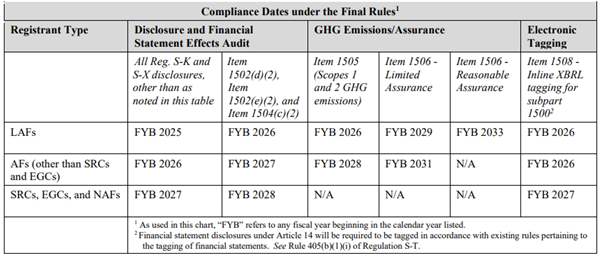
    The SEC’s “long-awaited” release of its climate-related risk disclosure rules was by no means a unanimous decision. Its 3-2 split vote foreshadowed litigation challenges to the release of the rules. As expected by many, the SEC dropped its original proposed requirement that registrants must provide information about Scope 3 greenhouse gas (GHG) emissions (i.e., from suppliers and customers of their products and services). As to Scope 1 GHG emissions (i.e., the registrant’s own) and Scope 2 GHG emissions (i.e., indirect, arising from production/delivery of energy used by registrant) disclosures, the SEC has proposed that those be disclosed by the largest companies only if material.

    In depth

    As noted above, opponents of the SEC’s decision have already launched multiple legal challenges, with one suit brought by West Virginia and nine other states being filed the same day the SEC published its rules. More suits have already been filed by other states (e.g., Texas), and it seems likely that some will be filed by individual companies and/or industry trade groups like recent industry challenges to California’s climate disclosure laws that were enacted last year. All challenges to the SEC’s rules are likely to assert that the rules violate the “major questions” doctrine established by the Supreme Court of the United States in its 2022 West Virginia v. EPA decision. The major questions doctrine holds that absent clear congressional authority (via legislation), a government agency cannot make regulations that have significant political or economic consequences.

    There may also be litigation initiated by environmental activist organizations (e.g., Sierra Club) seeking the SEC to rewrite its rules, presumably to reinsert disclosure requirements with respect to Scope 3 GHG emissions.

    While the litigation experts will determine whether (and how quickly) these disparate suits might be combined to facilitate judicial consideration, it seems clear that these challenges may take years to conclude and require at least one trip to the Supreme Court.

    Hypothetically speaking, let’s say the litigation challenges fail to enjoin the SEC’s implementation of the proposed rules and fail to invalidate them altogether. How might US insurers be impacted? Since it was last counted, there are slightly more than 100 insurers who are SEC registrants. Think of all the privately owned stock insurers in the country and the large mutual insurers owned by policyholders. Last time we checked, the total number of US insurers – i.e., by property/casualty, life/health and title) – amounted to nearly 5,000. So, if the SEC’s rules go into effect, the direct impact will not be massive. That said, a significant number of US insurers are already filing Task Force on Climate-Related Financial Disclosures (TCFD)-compliant climate-related risk disclosures on an annual basis in states that have decided their domestic insurers must file such disclosures. Those disclosures do not currently come with any insurance regulatory teeth, however.

    Regardless of whether insurers are SEC registrants, there are other climate-related regulatory developments to consider.

    The NAIC Decides Against Certain ESG Policy Development Activities

    On February 21, 2024, the NAIC issued the following policy statement on environmental, social and corporate governance (ESG):

    The NAIC does not anticipate developing regulatory policy to require or prohibit insurance companies from adopting ESG policies that govern insurers’ underwriting, investing, or other business decisions. However, we have extensive work underway on climate risk, race and insurance, corporate governance, and other related factors to the extent they directly pertain to our responsibility to protect policyholders and supervise the financial health of insurers.

    The NAIC encourages insurers, regulatory bodies, standard setters, and policymakers to consider the reliability of metrics and the impact of ESG policies on the financial condition of insurers and the availability and affordability of insurance products and services, if adopting such policies.

    For many climate change activists and some state insurance regulators this policy statement will be unsatisfactory. However, we have yet to see any public expressions of disappointment. Some may be offered during the NAIC’s upcoming Spring National Meeting, but after an unsuccessful effort by some regulators at the last national meeting in December 2023 to have the full NAIC adopt a “National Climate Resilience Strategy,” it became clear there was opposition to having the NAIC announce any grand climate change (or ESG) strategies or policies. Nevertheless, there is a new version of the National Climate Resilience Strategy that will be considered by the NAIC’s Climate and Resiliency Task Force on March 18.

    The NAIC’s above statement is unlikely to deter ESG policymaking, including those that impact (if not govern) “insurers’ underwriting, investing, or other business decisions” by individual states (e.g., California, New York and Washington State have already started down that path). Roughly 20 states require their domestic insurers to file TCFD-compliant climate-related risk disclosures and are likely to continue to require such filings.

    Given the Climate and Resiliency Task Force’s continuing work to develop a National Climate Resilience Strategy, it seems unlikely that the NAIC will cease working on loss prevention and mitigation initiatives that many regulators and others appreciate offer significant returns on investment and that will support future adaptation efforts and expenditures. In a March 13 Geneva Association webinar that addressed the potential impact of climate change on life and health insurers, one speaker made the point that there can be no climate change adaptation without mitigation. Helping policyholders help themselves to reduce the impact of severe weather events (regardless of whether they are due to climate change) would seem to qualify as both “protecting policyholders” and promoting the “financial health of insurers.” Despite any other climate change “policy” initiative, the industry and regulators ought to be spearheading adoption and funding local loss mitigation efforts, such as “Fortify Homes” programs, following the lead of Alabama and other southeastern states (and Connecticut). Finally, the NAIC’s policy statement does not mean regulators will turn away from trying to understand the market impact of recent industry cutbacks in and exits from multiple catastrophe-exposed jurisdictions (i.e., actions that clearly go toward preserving individual companies’ financial health, regardless of negative impact of availability and affordability on consumers).

    Combined State and Federal “Property and Casualty Market Intelligence Data Call”

    In other recent climate change-related developments, on March 8, 2024, both the NAIC and the US Department of the Treasury’s Federal Insurance Office (FIO) made announcements about a massive residential property insurance data call that will require approximately 400 (admitted) property insurers “to submit ZIP-code-level data across the U.S. on premiums, policies, claims, losses, limits, deductibles, non-renewals, and coverage types. In all, state insurance regulators seek more than 70 data points. All homeowners’ insurers subject to the data call will have 90 days to submit their information.”

    Working jointly with the NAIC and the states represents an about-face for the Treasury/FIO. The Treasury/FIO planned to administer their own data call. The NAIC will now conduct the data call and share the results with the Treasury/FIO. Regulators and legislators (at both federal and state levels) continue to seek reliable market data on admitted insurers’ well-publicized cutbacks and withdrawals from catastrophe-exposed states around the country, as well as on the impact of availability and affordability on consumers. We should be hearing more about this during the upcoming Spring National Meeting and in the months to come.

    State and Federal Climate Change Litigation Activity

    Insurers should be monitoring the expanding array of climate-related litigation. Suits brought by states and municipalities against fossil fuel giants first started years ago. Last year, with the Supreme Court’s rejection of energy companies’ arguments that these suits belonged in federal court and not state courts, at least one such suit brought by Massachusetts has now progressed to the discovery stage. However, in February 2024, energy companies sought Supreme Court review of an October 2023 Hawai’i Supreme Court decision that allowed the city and county of Honolulu to proceed with its claims that oil companies misrepresented and concealed the contribution their products made to global warming and climate change. The defendants contend that “…federal law precludes state-law claims seeking redress for injuries allegedly caused by the effects of interstate and international greenhouse-gas emissions on the global climate.”

    Assuming the Supreme Court agrees to hear the case, briefing and oral argument will likely take place later this year, with a decision to come in 2025. How much discovery will have occurred in the Massachusetts case (and perhaps in others) and how impactful the results of that discovery will be remains to be seen. If discovery uncovers smoking guns, will that prompt others – insurers included (potentially in subrogation actions to be filed following the next major natural catastrophe) – to sue energy companies?

    New York AG Sues Beef Company for Deceptive Acts and Advertising

    Additionally, in February 2024, New York Attorney General Letitia James sued the world’s largest beef processing company for making false claims that it would be “Net Zero by 2040.” The lawsuit alleges violations of two consumer protection statutes – General Business Law §§ 349 and 350 – and New York Executive Law §63(12). Persons who engage in “repeated fraudulent or illegal acts or otherwise demonstrate persistent fraud or illegality in the carrying on, conducting or transaction of business” may be enjoined from so doing.

    While this litigation may be peculiar to New York (and putting aside the question of whether Attorney General James can succeed in proving that a company with a GHG footprint that is the same size as Ireland’s cannot become net zero within the next 16 years), there is no shortage of other greenwashing suits. Insurers that have significant Scope 1, 2 and/or 3 GHG emissions and are making net zero claims should continue to be vigilant. And if the insureds are publicly traded and making climate change disclosures, there is the SEC to worry about.

    SEC Enforcement Activity

    In another development from February 2024, Director of the SEC’s Division of Enforcement Gurbir Grewal delivered a speech in Ohio in which he reminded the audience that the SEC continues to look at companies’ ESG disclosures to ensure they are not materially false or misleading (just as they do with other disclosures). Director Grewal also reminded the audience of the SEC’s lengthening track record of successfully pursuing companies that either made false statements or failed to mention information that would have made disclosures not misleading.

    It’s tempting to conclude that the general lack of consensus among insurance regulators as to climate change regulation means there is something like a “safe harbor” available to insurers who avoid making any bold claims as to sustainability or achieving net-zero status in the near future. Should insurers keep a low profile with respect to the advisability of climate change disclosure generally or for the protection of investors? Perhaps. But should more insurers have an active role in searching for and publicizing ways to help insureds prevent and mitigate severe weather and catastrophe losses? Almost certainly. Should regulators and legislators be prepared to help shrink protection gaps with well-funded education/outreach efforts and meaningful financial incentives to encourage property owners to fortify homes and other structures? Absolutely. Public and private sectors have so much work to do to ramp up loss prevention and mitigation efforts in preparation for future political and legal battles as to funding adaptation efforts domestically and globally.

    Authors

    Thomas M. Dawson

    Partner

    New York – One Vanderbilt Avenue

    More insights

  • US Department of Labor Issues Final Rule on Independent Contractor Classification

    US Department of Labor Issues Final Rule on Independent Contractor Classification

    ARTICLE / CLIENT ALERT

    US Department of Labor Issues Final Rule on Independent Contractor Classification

    March 15, 2024

    Read time: 5 min

    Key takeaways
    Overview

    On Jan. 10, 2024, the US Department of Labor (“DOL”) published its final rule on employee or independent contractor classification under the Fair Labor Standards Act (“FLSA”) for purposes of minimum wage and overtime. The final rule became effective March 11, 2024.

    The final rule formally rescinds the prior more-business-friendly independent contractor rule published by the DOL weeks before the end of the Trump Administration in 2021. The DOL and the courts have historically applied a test, the ultimate inquiry being whether, as a matter of economic reality, the worker is economically dependent on the employer for work, or is self-employed. The final rule returns to the pre-2021 totality-of-the-circumstances analysis of economic realities when classifying worker status under the FLSA. The final rule provides that a worker who is economically dependent on an employer is not an independent contractor. Economic dependance is determined through a flexible, multifactor totality-of-the-circumstances analysis, considering the following factors:

    1. Nature and degree of control. This factor considers an employer’s degree of control over the performance of work and the economic aspects of the working relationship. A higher level of employer control over the performance of the work, including whether the employer sets the worker’s schedule, supervises performance or places restrictions on outside work, weighs in favor of employee status.
    2. Opportunity for profit or loss depending on managerial skill. This factor considers whether the worker uses managerial skills that impacts the worker’s ability for profit or loss. Relevant considerations include whether the worker can determine or meaningfully negotiate their pay, whether the worker has discretion in declining or choosing certain jobs and whether the worker can make business decisions such as creating their own marketing, hiring, procurement or renting space. Lack of opportunity for profit and loss indicates employee status.
    3. Investments by the worker and the potential employer. This factor considers whether investments made by a worker are entrepreneurial in nature. Investments by a worker that serve a business-like function and increase a worker’s ability to do different types of work and extend market reach indicate independent contractor status.
    4. Degree of permanence of the work relationship. This factor weighs in favor of employee status when the work relationship is indefinite in duration, continuous and is exclusive of work for other employers. Work relationships that are fixed in duration, non-exclusive, project-based or sporadic weigh in favor of independent contractor status.
    5. Extent to which the work performed is an integral part of the potential employer’s business. This factor considers whether the function a worker performs is an integral part of an employer’s business. A worker whose function is critical, necessary or central to the business weighs in favor of employee status.
    6. Skill and initiative. This factor considers whether a worker uses specialized skills in performing work and whether those skills contribute to a business-like initiative. Whether or not a worker has specialized skills is not indicative of status. Rather, the worker’s use of specialized skills in connection with a business-like initiative indicates independent contractor status.

    The factors do not carry a predetermined weight and no one factor is dispositive. Additional factors that may indicate a worker is in business for themself, rather than being economically dependent on an employer, may be relevant to determining worker status.

    While the final rule is already subject to multiple legal challenges, employers should analyze their independent contractors to ensure proper classification. The final rule will only apply to interpretation of worker status under the FLSA, and does not affect other federal laws, or state specific laws and tests for independent contractor classification. For example, the IRS has its own test. State laws may be more stringent and should be reviewed for individuals working in those states and possibly others. For example, California and New Jersey utilize the “ABC test” which provides that individual workers are presumed to be employees, unless the employer can demonstrate (A) the work is done without the direction and control of the employer, (B) the work is performed outside the usual course of the employer’s business and (C) the work is done by someone who has their own independent business or trade doing that kind of work. This analysis should take into account the key consideration promulgated by the final rule, as well as other federal and state tests for whether a worker is properly classified.

    If an independent contractor is properly classified, employers also should ensure compliance with applicable state and local laws that are being enacted to protect gig workers. For example, New York City’s Freelance Isn’t Free Act, discussed in this Alert, and the New York State Freelance Isn’t Free Act, which is effective May 20, 2024.

    Authored by Mark E. Brossman, Ronald E. Richman, Donna K. Lazarus, Ian L. Levin, Martin L. Schmelkin and Scott A. Gold.

    If you have any questions concerning this Alert, please contact your attorney at Schulte Roth & Zabel or one of the authors.


    This communication is issued by Schulte Roth & Zabel LLP for informational purposes only and does not constitute legal advice or establish an attorney-client relationship. In some jurisdictions, this publication may be considered attorney advertising. © 2024 Schulte Roth & Zabel LLP. All rights reserved. SCHULTE ROTH & ZABEL is the registered trademark of Schulte Roth & Zabel LLP.

     

    In depth
    Authors

    Mark E. Brossman

    Partner

    New York – 919 Third Avenue

    Ronald E. Richman

    Partner

    New York – 919 Third Avenue

    Donna K. Lazarus

    Partner

    New York – 919 Third Avenue

    Ian L. Levin

    Partner

    New York – 919 Third Avenue

    Martin L. Schmelkin

    Partner

    New York – 919 Third Avenue

    More insights

  • Introducing Euro Lit Insights

    Introducing Euro Lit Insights

    ARTICLE

    Introducing Euro Lit Insights

    March, 2024

    Read time: 2 min

    Key takeaways
    Overview

    The Euro Lit Insights blog showcases the latest in landmark commercial litigation court judgments and the regulatory and procedural updates influencing the European judicial landscape, with a particular focus on the United Kingdom, France, Germany and Italy.

    In depth
    Authors

    Jack Thorne

    Partner

    London – 22 Bishopsgate

    Fabio Cozzi

    Partner

    Milan

    Dr. Thomas Hauss

    Partner

    Düsseldorf

    Nicolette Kost De Sèvres

    Partner

    Washington, DC, Paris

    More insights

  • The AI Act: The EU’s Bid to Set the Global Standard for AI Regulation

    The AI Act: The EU’s Bid to Set the Global Standard for AI Regulation

    ARTICLE / CLIENT ALERT

    The AI Act: The EU’s Bid to Set the Global Standard for AI Regulation

    March 13, 2024

    Read time: 12 min

    Key takeaways
    Overview

    In a groundbreaking move, the European Union has launched its bid to set the new comprehensive standard for the regulation of artificial intelligence (AI) with the European Parliament passing the EU AI Act on March 13, 2024. This pioneering legislation, set to come into effect in the coming years, ushers in a new era in AI regulation and stands as a testament to the EU’s commitment to ensuring a subtle balance between safe, ethical, and innovative use of AI.

    In this article we will first explore the eleven key aspects of the EU AI Act, offering an in-depth look at its broad scope and essential requirements, including its interplay with the EU General Data Protection Regulation (GDPR), and how businesses can leverage their existing GDPR compliance programs to meet the EU AI Act’s requirements.

    We will then dive into five key takeaways focusing on the key points and actionable steps you can take to navigate the evolving landscape of AI regulation and the EU AI Act in particular.

    In depth

    Eleven Key Aspects of the EU AI Act

    The EU AI Act introduces several pivotal provisions that will significantly impact the regulatory framework of AI. Most significantly these include:

    1. Broad Scope and Specific Exclusions: The EU AI Act is intended as a horizontal regulation and provides a comprehensive definition of AI systems, applicable to a wide array of applications in sectors such as healthcare, finance, public administration, and consumer technologies. Drawing from the OECD’s definition, the Act describes an AI system as “a machine-based system designed to operate with varying levels of autonomy and that may exhibit adaptiveness after deployment and that, for explicit or implicit objectives, infers, from the input it receives, how to generate outputs such as predictions, content, recommendations, or decisions that can influence physical or virtual environments”. As inclusive as the GDPR in order to ensure the highest level of protection possible, this definition aims to encompass the diversity in AI systems’ levels of autonomy and adaptability after their initial deployment.

    At the same time, the Act makes it clear that it does not apply to areas outside the scope of EU law, including national security and defense, and excludes AI models and systems used solely for research, innovation, or for non-professional purposes.

    2. Extraterritorial Effect: The AI Act will apply not only within the EU but also to entities outside its borders. This includes non-EU providers placing AI systems or models on the EU market, those putting AI systems into service within the EU, and cases where the output of an AI system located outside the EU is used within its borders. In this respect, the AI Act aligns with both GDPR and the other acts included in the new EU digital package that it belongs to, although with quite a special angle notably as the only one directly governing technologies in contrast with the others which merely focus on data usage.

    3. Risk-Based Approach: The Act employs a structured, risk-based approach to AI regulation, organizing AI systems into four categories based on their potential risk levels: Prohibited AI, High-Risk AI, Limited Risk AI, and Minimal Risk AI. This system ensures that stricter regulatory measures are applied to AI applications with higher potential risks, particularly those used in critical areas such as healthcare or infrastructure. Conversely, AI systems with minimal risk are subject to less rigorous requirements. This tiered model is designed to balance the necessity of safeguarding user safety and privacy rights with the goal of fostering innovation in lower-risk AI technologies.

    4. Prohibited AI and Law Enforcement Exemptions: The EU AI Act sets clear boundaries by prohibiting certain AI applications that pose risks to privacy, ethics, and fundamental rights. Again following the GDPR quite closely these include:

    • Subliminal Techniques: The use of manipulative or deceptive techniques that significantly distort behavior and impair informed decision-making.
    • Exploiting Vulnerabilities: AI systems that exploit vulnerabilities related to age, disability, or socio-economic circumstances.
    • Biometric Categorization: Systems inferring sensitive attributes from biometric data, such as racial or ethnic origin, political opinions, religious beliefs, or sexual orientation.
    • Social Scoring: Evaluation or classification of individuals based on social behavior or personal characteristics, leading to detrimental treatment of individuals.
    • Predictive Policing: Assessing the risk of an individual committing criminal offenses based solely on profiling or personality traits.
    • Facial Recognition Databases: Compiling databases through untargeted scraping of facial images from the internet or CCTV footage.
    • Emotion Inference: Inferring emotions in workplaces or educational institutions, except for AI systems used for medical or safety reasons.

    In the context of law enforcement, the Act generally restricts the use of real-time biometric identification in public spaces, allowing it only under limited, pre-authorized circumstances.

    5. High-Risk AI Systems and Key Requirements: The EU AI Act identifies high-risk AI systems as those critical to sectors such as healthcare, transportation, HR management, education, essential public services, and systems influencing democratic processes. It categorizes these into two main groups:

    • Annex II Systems: AI systems acting as safety components of products or as standalone products, which are subject to EU laws already requiring a conformity assessment. These are typically associated with high-risk and regulated products (medical devices, machinery, protective equipment, etc.).
    • Annex III Systems: AI systems designed for specific purposes such as biometrics (excluding banned types), critical infrastructure, educational and vocational training tools, employment and workers’ management systems, essential services access (including credit scoring and insurance pricing), law enforcement, migration and border control, and the administration of justice and democratic processes.

    The Act mandates comprehensive obligations for providers and deployers of these systems, covering governance measures and technical interventions necessary from the design stage through the entire lifecycle. This includes ensuring CE marking, transparency, accountability, technical documentation, data governance, human oversight, and maintaining accuracy, robustness, and cybersecurity. Providers of these systems will have to report serious incidents to market surveillance authorities.

    Despite recent efforts to refine the scope and introduce exemptions for certain AI systems, ambiguities in classification remain. To address this, companies are advised to maintain high governance standards for all AI systems in use. The EU Commission will provide further classification guidelines within 18 months of the Act’s entry into force, aiming for clarity and consistency in high-risk AI system regulation.

    Interestingly, the AI Act also allows, where strictly necessary and under additional conditions, the processing of special categories of personal data, such as ethnicity, for the purpose of ensuring bias detection and correction in relation to high-risk AI systems. As feeding such systems, this processing will also remain subject to the GDPR, under which it will be allowed for purposes of substantial public interest within the meaning of Article 9(2)(g).

    6. Limited/Minimal Risk AI: Under the EU AI Act, AI systems categorized at the lower risk level are subject to specific transparency and identification requirements. This primarily targets AI technologies that engage directly with users, mandating that any synthetic content produced—be it audio, visual, or textual—must be clearly labeled in a way that machines can recognize as artificially created or altered. Providers are responsible for the efficacy, compatibility, and dependability of these labeling mechanisms. Additionally, the Act imposes obligations on AI functionalities like emotion detection, biometric sorting, AI-generated content, deep fakes, or the alteration of significant textual content to ensure they are transparently marked and made detectable to uphold transparency and prevent misinformation. Regarding Generative AI applications specifically, individuals must be clearly informed when they are interacting with such as chatbots and content generation tools. For AI systems deemed to pose minimal risk, the Act envisages the adoption of voluntary best practices through future codes of conduct.

    7. General Purpose AI: The EU AI Act introduces specific requirements for General Purpose AI (GPAI) Models, generally known as Foundation Models, which are defined as those “capable to competently perform a wide range of distinct tasks regardless of the way the model is placed on the market and that can be integrated into a variety of downstream systems or applications”. GPAI was not expressly considered in the initial draft AI Act, while the risk-based approach based on the AI intended purposes and applications created the risk of leaving underlying foundation models uncovered. GPAI became a bone of contention, discussed until the last stages of negotiation of the Act, because of the specific risks it presents for users’ fundamental rights and safety. The Act thus focuses on GPAI transparency and accountability. All GPAI models, such as those used for broad applications, are required to provide extensive technical documentation, summaries of training data, and adhere to copyright and intellectual property safeguards. Models released under open-source license are considered as already insuring high levels of transparency and benefit from exemptions. For high-impact GPAI models, i.e., that pose systemic risks, the Act mandates additional stringent requirements, including thorough model evaluations, comprehensive risk assessments, adversarial testing, and incident reporting.

    8. Innovation-Friendly Ecosystem: To nurture innovation, the Act introduces measures such as regulatory sandboxes and provisions for real-world testing. These initiatives intend to benefit SMEs and startups, offering them the flexibility to experiment and refine their AI systems within a controlled environment before wider deployment. This approach recognizes the dynamic nature of AI development and seeks to provide a supportive ecosystem for emerging AI innovations.

    9. The interplay between the EU AI Act and the GDPR: AI systems that process personal data will be subject to both the GDPR and the EU AI Act (and respective fines in case of violations). Both acts lay down some requirements that have strong commonalities. A key question is whether it is possible to leverage compliance efforts, and if so, how. For instance, under the GDPR, data controllers are required to carry out a data protection impact assessment (DPIA) in certain circumstances, whereas under the EU AI Act, providers/users of high-risk AI systems have to carry out DPIAs, which, among others, need to consider privacy risks. In line with the effective explainability and transparency principles – which are the cornerstones of trustworthy AI systems – the EU AI Act imposes requirements to inform individuals when they interact with AI systems (e.g., chatbots and content generation tools).

    10. Penalties and Enforcement: The EU AI Act establishes a comprehensive framework for penalties and enforcement. Fines for violations are scaled, with up to 7% of global annual turnover or EUR 35 million for prohibited AI violations, up to 3% for other breaches, and up to 1.5% or EUR 7.5 million for supplying incorrect information, including specific caps for SMEs and startups. Enforcement will be coordinated through a newly established central ‘AI Office’ and ‘AI Board’ at the EU level, complemented by market surveillance authorities in each EU country, ensuring a balanced and effective application of the Act across all member states.

    11. Entry into force: The AI Act will start applying gradually: prohibited AI will be banned six months from the Act entering into force, while the Act will start applying to GPAI one year after entry into force; two years for high-risk AI systems of Annex III and three years for high-risk AI systems already covered by other EU regulations mandating a third-party conformity assessment.

    Five Takeaways on the EU AI Act

    The above compilation of key aspects is intended to serve as a useful starting point to inform proactive steps legal and compliance managers as well as DPOs can take to position their companies and their teams for success. Below, we are sharing five key takeaways for businesses to prepare for the rapidly evolving risks and challenges posed by AI:

    1. Comprehensive Impact Assessment and Compliance Evaluation: Businesses should conduct a thorough assessment to understand how the AI Act will affect their operations. This evaluation should cover not just mapping and identifying high-risk AI systems but also the wider range of entities involved in AI deployment, distribution, or usage. It’s important to review existing governance frameworks to ensure they align with the Act’s requirements. Additionally, organizations should proactively examine how the AI Act might impact their daily operations and specifically, systems already covered by other EU mandatory conformity assessments (medical devices, machinery, protective equipment, etc). This requires gaining a comprehensive understanding of the legal, technological, and ethical aspects of AI to facilitate responsible integration and usage within the organization.

    2. Developing a Robust AI Governance Program: It’s essential for organizations to develop an AI governance program that integrates the AI Act’s requirements with broader business strategies and objectives. This program should cover risk management, privacy, ethics, data governance, intellectual property, safety, and security, among others, and adapt existing policies and procedures to meet the new standards. Any types of organizations, more specifically businesses in tech- and data-driven industries, should assess how to leverage their existing GDPR compliance programs to also meet most, if not all, of the AI Act’s requirements. The role of the board in overseeing AI use within the organization is also a critical consideration.

    3. Global Coordination and Voluntary Initiatives: Businesses, above all, should pay close attention to international efforts to harmonize AI regulations, including the EU’s collaborations with global bodies and initiatives. In this regard, the EU Commission has initiated an ‘AI Pact’, encouraging organizations to anticipate the AI Act by voluntarily sharing their internal guidelines, processes and concrete actions carried out to address the AI Act requirements, and by testing their solutions within the community. Participating in such voluntary commitments to implement the AI Act’s requirements ahead of deadlines can position organizations as leaders in ethical AI use and governance.

    4. Proactive Adaptation and Compliance Strategy: With the regulatory landscape rapidly evolving, businesses need to be agile, ready to update their AI strategies and compliance programs as new guidelines and requirements emerge. Starting early on this adaptation process will help mitigate risks and liabilities and ensure compliance. Keeping an eye on regulatory developments in the EU (including the AI Act delegated / implementing acts and guidance), the UK, the US, and other regions further along in AI regulation is vital for a comprehensive compliance effort.

    5. Engagement and Transparency: Collaboration with regulators, transparent communication, and fostering global harmonization are critical for successful AI governance. Businesses should also consider public engagement and transparency in their AI operations as part of their compliance and risk management strategies. This includes clear communication about AI’s role and impact within the organization and ensuring that AI technologies are deployed in a way that is ethical, responsible, and aligned with societal values. On a more operational standpoint, it would also make a lot of sense to combine as much as possible information to individuals respectively required under GDPR and the EU AI Act.

    Authors
    More insights

  • Top Takeaways | FTC Hosts Workshop, Solicits Public Comments on Private Equity in Healthcare

    Top Takeaways | FTC Hosts Workshop, Solicits Public Comments on Private Equity in Healthcare

    ARTICLE

    Top Takeaways | FTC Hosts Workshop, Solicits Public Comments on Private Equity in Healthcare

    March 6, 2024

    Read time: 2 min

    Key takeaways
    Overview

    On March 5, 2024, the Federal Trade Commission (FTC) hosted “Private Capital, Public Impact: An FTC Workshop on Private Equity in Health Care” to examine the role of private equity investment in healthcare markets. The same day, the FTC, US Department of Justice (DOJ) and US Department of Health and Human Services (HHS) issued a Request for Information (RFI) seeking public comments on the effects of transactions involving healthcare providers and ancillary services by private equity funds, health systems and payors.

    Read on for our top 10 takeaways from the workshop and RFI that private equity investors and healthcare organizations need to know.

    In depth
    Authors

    Ashley M. Fischer

    Partner

    Chicago

    Claire E. Danberg

    Associate

    Washington, DC

    More insights

  • SEC Adopts Climate-Related Risk Disclosure Rules: What Public Companies, Executives and Investors Need to Know

    SEC Adopts Climate-Related Risk Disclosure Rules: What Public Companies, Executives and Investors Need to Know

    ARTICLE / CLIENT ALERT

    SEC Adopts Climate-Related Risk Disclosure Rules: What Public Companies, Executives and Investors Need to Know

    March 12, 2024

    Read time: 17 min

    Key takeaways
    Overview

    The US Securities and Exchange Commission (SEC) adopted new climate-related risk disclosure rules on March 6, 2024, two years after the SEC proposed new climate-related disclosure rules and three years after the SEC first formally sought public input on new rules. As with the proposed rules issued in 2022, the final rules draw heavily on concepts of the Greenhouse Gas Protocol with respect to quantitative disclosure of greenhouse gas (GHG) emissions and on the “four pillar” narrative climate disclosure framework relating to governance, risk oversight, strategy, and goals and metrics that was developed by the Task Force on Climate-Related Financial Disclosures (TCFD).  (The TCFD was formally disbanded as an independent disclosure framework in 2023 but incorporated into climate disclosure standards of the new International Sustainability Standards Board (ISSB).)

    As in the case of climate risk disclosure rules adopted in October 2023 by California and applicable to certain private and public companies doing business in California, the new SEC rules are expected to be subject to litigation by one or more general business and industry groups, likely seeking to stay the effectiveness of the new rules and eventually vacate them. On the same day the rules were adopted, 10 Republican-led states sued to challenge them, and other litigation is anticipated, including by activists who believe the rules do not go far enough. Several aspects of the proposed rules were significantly scaled back after a lengthy and voluminous comment process – more than 24,000 comment letters were received, including more than 4,500 unique non-form letters.

    Most significantly, unlike the proposed rules, the final rules will not require disclosure by public companies of their so-called “Scope 3” emissions. Scope 3 emissions are GHG emissions relating to indirect upstream and downstream value chains from sources that the reporting entity does not own or directly control, including (but not limited to) purchased goods and services, business travel, employee commuting, and production and use of products. Sustainability disclosure rules under the EU Corporation Sustainability Reporting Directive and those recently adopted by California and the ISSB will require disclosure of Scope 3 emissions in certain circumstances, and many investors will continue to expect companies to provide such disclosure on a voluntary basis. Thus, many companies will continue to collect and report such emissions even without an SEC mandate. The final rules will require disclosure of material Scope 1 emissions (a company’s direct emissions) and Scope 2 emissions (indirect emissions that come from the production of energy that a company acquires to use in its operations).

    The final rules also significantly scaled back a proposed disclosure requirement to add a note to financial statements providing disaggregated metrics and related disclosure concerning climate-related impacts included in all affected line items of the financial statements required under existing financial statement requirements. As adopted, the final rules will require only disclosure of disaggregated capitalized costs, expenditures expensed, charges and losses incurred as a result of severe weather events and other natural conditions. Registrants will not be required to make an assessment on whether any such events or conditions are related to climate change.

    Numerous other details of the rules were substantially modified to make them less prescriptive, more dependent on materiality, and for the other reasons set forth in the 886-page adopting release. View a “redline” comparison of the text of the rules themselves as proposed and as adopted.

    The rules apply to disclosures by domestic and foreign companies that file periodic reports or registration statements with the SEC (collectively, registrants). Among other key features, when effective, the rules will require the following:

    • Climate-related risks that have had or are reasonably likely to have a material impact on the registrant’s business strategy, results of operations or financial condition
    • Disclosures regarding a registrant’s activities to mitigate or adapt to a material climate-related risk, including the use of transition plans, scenario analysis or internal carbon prices
    • Oversight by the board of directors of climate-related risks and the role of management in assessing and managing the registrant’s material climate-related risks
    • Information about a registrant’s climate-related targets or goals, if any, that have materially affected or are reasonably likely to materially affect the registrant’s business, results of operations or financial condition
    • For certain issuers, information about material Scope 1 emissions and/or Scope 2 emissions, together with an assurance report
    • The capitalized costs, expenditures expensed, charges and losses incurred as a result of severe weather events and other natural conditions.

    The rules, which were approved for issuance by a 3 – 2 partisan vote, will become effective 60 days after their date of publication in the Federal Register. The transition periods for compliance with various aspects of the rules by certain companies are summarized below.

    In depth

    Background

    The issuance of the SEC’s long-awaited final climate-related risk rules is a notable landmark in the trend in capital markets worldwide for more and standardized corporate sustainability disclosures. Investors have sought information about the present and possible future impacts of climate change on companies, leading many registrants to significantly increase their disclosure of information – often outside of SEC filings – regarding climate risks, uncertainties, impacts and opportunities. Investors have questioned, however, whether current voluntary climate-related disclosures are adequate. The new rules are intended to increase the sufficiency, reliability, consistency and comparability of material climate-related disclosures by registrants.

    The SEC previously provided guidance on climate-related disclosures in an interpretative letter issued in 2010 (2010 guidance), advising registrants on how the SEC’s existing disclosure requirements apply to climate change matters in periodic reports and registration statements. The 2010 guidance focused on two issues: the impact of climate change regulations and the impact of changing climate conditions. The 2010 guidance also noted that the SEC’s regulations provided a framework for disclosures concerning these two topics, and that, depending on the circumstances, information about climate change-related risks and opportunities might be required in a registrant’s disclosures related to its description of Business (Regulation S-K, Item 101), Legal Proceedings (Regulation S-K, Item 103), Risk Factors (Regulation S-K, Item 105[1]), and Management’s Discussion and Analysis of Financial Condition and Results of Operations (Regulation S-K, Item 303). The SEC has cited a review of S&P 500 registrants’ filings, which found that in the years after the 2010 guidance was issued, registrants did not quantify risks or past impacts relating to climate change, and stated that registrants tended to use “boilerplate language of minimal utility to investors.”

    Since the issuance of the 2010 guidance, both the science and law regarding climate change have evolved significantly. Scientifically, there is even greater and more widely accepted information about the potential harmful impacts of changing climate conditions. In the December 2015 Paris Climate Agreement, more than 190 countries agreed on climate change targets, including limiting increases in the global average temperature to less than 2° Celsius from pre-industrial levels and achieving by the end of this century a balance between human-caused GHG emissions by sources and removals by sinks of GHG. By some accounts, however, the reported threat of dire climate change in this century remains stark. Even when accounting for existing national pledges to mitigate carbon emissions, Earth is on track to warm by about 2.5° Celsius (4.5° Fahrenheit), according to a report from United Nations scientists.

    Legally, there are now many more programs regulating climate change in the United States and globally. In December 2009, the US Environmental Protection Agency (EPA) issued an “endangerment and cause or contribute finding” for GHG emissions under the Clean Air Act, which enabled the EPA to craft rules to directly regulate GHG emissions. On January 1, 2010, for the first time, the EPA began requiring large emitters of GHG to collect and report data with respect to their GHG emissions. In parallel to these regulatory changes, a robust market for carbon offsets has developed as most larger companies (e.g., 92% of the S&P 100) have or plan to set GHG emission reduction goals, often including “net zero” commitments and other climate pledges.

    Additionally, since the issuance of the 2010 guidance, the Financial Stability Board – at the request of the G20 finance ministers and central bank governors – convened the TCFD to address physical, liability and transition risks of climate change. In 2017, the TCFD released recommendations for climate change disclosures, organized under four broad thematic categories: governance, strategy, risk management, and metrics and targets. The TCFD framework reflects a belief that disclosing climate-related risks, opportunities and financial impacts is critical for a company’s reputation, ensures compliance with regulations, and promotes the management and assessment of potential business strategy effects. The SEC’s rules do not adopt or incorporate the TCFD’s disclosure recommendations, but portions of the rules are closely modeled on them.

    The SEC noted that the TCFD and the GHG Protocol have developed concepts and vocabulary that companies commonly use when providing climate-related disclosures in their sustainability and related reports. Although the SEC’s new rules do not adopt the TCFD framework or GHG Protocol wholesale, they incorporate some of their concepts and vocabulary, which the SEC believes are familiar to many registrants and investors.

    Detailed Summary of the Final Rules

    The final rules amend the SEC’s Regulation S-K and Regulation S-X to add the following disclosure requirements (as summarized by the SEC):

    • Any climate-related risks identified by the registrant that have had or are reasonably likely to have a material impact on the registrant, including on its strategy, results of operations or financial condition in the short term (i.e., the next 12 months) and in the long term (i.e., beyond the next 12 months)
    • The actual and potential material impacts of any identified climate-related risks on the registrant’s strategy, business model and outlook, including, as applicable, any material impacts on a non-exclusive list of items
    • If, as part of its strategy, a registrant has undertaken activities to mitigate or adapt to a material climate-related risk, a quantitative and qualitative description of material expenditures incurred and material impacts on financial estimates and assumptions that, in management’s assessment, directly result from such mitigation or adaptation activities
    • If a registrant has adopted a transition plan to manage a material transition risk, a description of the transition plan and updated disclosures in the subsequent years describing the actions taken during the year under the plan, including how the actions have impacted the registrant’s business, results of operations or financial condition, and quantitative and qualitative disclosure of material expenditures incurred and material impacts on financial estimates and assumptions directly resulting from such plan
    • Any oversight by the board of directors of climate-related risks and any role by management in assessing and managing the registrant’s material climate-related risks
    • Any processes the registrant has for identifying, assessing and managing material climate-related risks and, if the registrant is managing those risks, whether and how any such processes are integrated into the registrant’s overall risk management system or processes
    • If a registrant has set a climate-related target or goal that has materially affected or is reasonably likely to materially affect the registrant’s business, results of operations or financial condition, certain disclosures about such target or goal, including material expenditures and material impacts on financial estimates and assumptions as a direct result of the target or goal, or actions taken to make progress toward meeting such target or goal
    • If a registrant is a large accelerated filer (LAF), or an accelerated filer (AF) that is not otherwise exempted, and its Scope 1 emissions and/or its Scope 2 emissions metrics are material, certain disclosure about those emissions
    • The capitalized costs, expenditures expensed, charges and losses incurred as a result of severe weather events and other natural conditions, such as hurricanes, tornadoes, flooding, drought, wildfires, extreme temperatures and sea level rise, subject to applicable 1% and de minimis disclosure thresholds
    • The capitalized costs, expenditures expensed and losses related to carbon offsets and renewable energy credits or certificates if used as a material component of a registrant’s plans to achieve its disclosed climate-related targets or goals
    • If the estimates and assumptions a registrant uses to produce the financial statements were materially impacted by risks and uncertainties associated with severe weather events and other natural conditions, such as hurricanes, tornadoes, flooding, drought, wildfires, extreme temperatures and sea level rise, or any disclosed climate-related targets or transition plans, a qualitative description of how the development of such estimates and assumptions was impacted.

    Under the final rules, a registrant that is required to disclose Scope 1 and/or 2 emissions and is an LAF or AF also must file an attestation report in respect of those emissions subject to phased-in compliance dates. An AF must file an attestation report at the limited assurance level beginning the third fiscal year after the compliance date for disclosure of GHG emissions. An LAF must file an attestation report at the limited assurance level beginning the third fiscal year after the compliance date for disclosure of GHG emissions and file an attestation report at the reasonable assurance level beginning the seventh fiscal year after the compliance date for disclosure of GHG emissions. The final rules also require a registrant that is not required to disclose its GHG emissions or to include a GHG emissions attestation report pursuant to the final rules to disclose certain information if the registrant voluntarily discloses its GHG emissions in an SEC filing and voluntarily subjects those disclosures to third-party assurance.

    Presentation Requirements

    The final rules provide for detailed presentation requirements under which registrants would have to adhere to the following mandates:

    • File the climate-related disclosure in its registration statements and Exchange Act annual reports
    • Include the climate-related disclosures required under Regulation S-K, except for any Scope 1 and/or 2 emissions disclosures, in a separate, appropriately captioned section of its filing or in another appropriate section of the filing, such as Risk Factors, Description of Business, or Management’s Discussion and Analysis of Financial Condition and Results of Operations, or, alternatively, by incorporating such disclosure by reference from another SEC filing as long as the disclosure meets the electronic tagging requirements of the final rules
    • If required to disclose its Scope 1 and 2 emissions, provide such disclosure:
      • If a registrant filing on domestic forms, in its annual report on Form 10-K, in its quarterly report on Form 10-Q for the second fiscal quarter in the fiscal year immediately following the year to which the GHG emissions metrics disclosure relates incorporated by reference into its Form 10-K, or in an amendment to its Form 10-K filed no later than the due date for the Form 10-Q for its second fiscal quarter
      • If a foreign private issuer not filing on domestic forms, in its annual report on Form 20-F, or in an amendment to its annual report on Form 20-F, which shall be due no later than 225 days after the end of the fiscal year to which the GHG emissions metrics disclosure relates
      • If filing a Securities Act or Exchange Act registration statement, as of the most recently completed fiscal year that is at least 225 days prior to the date of effectiveness of the registration statement
    • If required to disclose Scope 1 and 2 emissions, provide such disclosure for the registrant’s most recently completed fiscal year and, to the extent previously disclosed, for the historical fiscal year(s) included in the filing
    • If required to provide an attestation report over Scope 1 and Scope 2 emissions, provide such attestation report and any related disclosures in the filing that contains the GHG emissions disclosures to which the attestation report relates
    • Provide the financial statement disclosures required under Regulation S-X for the registrant’s most recently completed fiscal year, and to the extent previously disclosed or required to be disclosed, for the historical fiscal year(s) included in the filing, in a note to the registrant’s audited financial statements
    • Electronically tag both narrative and quantitative climate-related disclosures in Inline XBRL.

    Compliance Dates and Accommodations for Certain Issuers

    The final rules will be phased in for all registrants with the compliance date dependent upon the status of the registrant as an LAF, AF, non-accelerated filer (NAF), smaller reporting company (SRC) or emerging growth company (EGC). The rules provide several accommodations, including:

    • Additional phase-in periods for disclosures pertaining to material expenditures, GHG emissions, the assurance requirement and the electronic tagging requirement if the registrant is an LAF (see compliance date table below)
    • An exemption from the GHG emissions disclosure requirement for SRCs and EGCs
    • An accommodation that allows Scope 1 and/or Scope 2 emissions disclosure, if required, to be filed on a delayed basis as follows:
      • If a domestic registrant, in its Form 10-Q for the second fiscal quarter in the fiscal year immediately following the year to which the GHG emissions disclosure relates
      • If a foreign private issuer, in an amendment to its annual report on Form 20 F, which shall be due no later than when such disclosure would be due for a domestic registrant
      • If filing a Securities Act or Exchange Act registration statement, as of the most recently completed fiscal year that is at least 225 days prior to the date of effectiveness of the registration statement.

    As set forth in the table below, which was provided in the adopting release, an LAF will be required to make its first disclosure under the new rules in reports following its fiscal year ending in 2025 (for example, an LAF with a January 1 fiscal year start and a December 31 fiscal year end date will not be required to comply with the climate-related disclosure rules, other than certain disclosures pertaining to GHG emissions and the discrete other new SK items if applicable, until its Form 10-K for fiscal year ended December 31, 2025, due in March 2026). AFs (other than SRCs and EGCs), would have an additional year to make the new disclosures while NAFs, SRCs and EGCs would have two additional years.

    Emissions Calculations

    Many large industrial companies in the US are already required to report their GHG emissions to the EPA. There is no perfect overlap between the EPA’s reporting requirements and the SEC’s new disclosure requirements. Most importantly, the EPA’s GHG reporting rule (40 C.F.R. Part 98) is generally facility-specific with some limited exceptions. The SEC’s rule focuses instead on each registrants’ emissions, which may include emissions from many separate facilities. Thus, a registrant that collected all the information necessary to comply with the EPA’s requirements might have to collect additional emissions-related information to comply with the SEC’s GHG emission disclosure requirements.

    Materiality

    In the new rules, to a greater extent than in the proposal, certain disclosures are required only when “material.” In that regard, the SEC reaffirmed adherence to the definition of materiality set forth in both its rules and past Supreme Court of the United States opinions: Information is material if there is a substantial likelihood that a reasonable investor would consider it important in deciding how to vote or in making an investment decision – or, put another way, if the information would significantly alter the total mix of available information to investors.[2] Accordingly, as materiality for purposes of the new rules (as with SEC disclosures generally) is to be viewed from the perspective of reasonable investors in the registrant, the final rules reject the request of some commenters to expand the definition of materiality to encompass company-induced impacts occurring external to the company, including those in the economy, the environment, people, the so-called “double materiality” standard adopted in Europe and other jurisdictions for corporate sustainability disclosures. The SEC did emphasize the dynamic nature of materiality determinations that registrants must make under US securities laws, particularly with regard to potential future events.

    Liability Issues

    The final rules do not provide a broad liability safe harbor for the new climate-related disclosures, but they do extend the safe harbor from private liability under the Private Securities Litigation Reform Act for forward-looking statements (i.e., other than historic facts) to certain disclosures required under the new rules: those pertaining to a registrant’s transition plan, scenario analysis, internal carbon pricing, and targets and goals. The adopting release notes that the existing safe harbors for forward-looking statements under the Securities Act and Exchange Act also will be available for other aspects of the climate-related disclosures.

    Continuing SEC Climate-Related Disclosure Guidance

    Many commenters in the 2021 input process suggested that the SEC simply expand upon its 2010 guidance. In September 2021, the SEC referenced the 2010 guidance in providing a sample comment letter to illustrate comments it might make regarding climate change disclosures, or lack thereof, in SEC filings. Prior to their phase-in compliance date for the new rules, registrants should continue to carefully consider the 2010 guidance, as augmented by the discussion in the release of the new rules, and the 2021 sample comment letter in preparing climate change-related disclosure. Additionally, the adopting release for the final rules notes in a footnote that even after adoption of the final rules, the 2010 guidance is still relevant because it discusses existing SEC rules, such as those pertaining to a registrant’s description of its business and certain legal proceedings, which require disclosure regarding, among other things, compliance with environmental laws and regulations that are only tangentially covered in the new rules. The release advises registrants to continue to consider the 2010 guidance as they evaluate their disclosure obligations in their Description of Business, Risk Factors, Legal Proceedings and Management’s Discussion and Analysis.

    Authors

    David A. Cifrino

    Counsel

    Boston

    Jacob Hollinger

    Partner

    New York – One Vanderbilt Avenue

    Stephen Aber

    Law Clerk

    Boston

    More insights