












ARTICLE
Where MedTech is attracting PE attention with less FDA burden
September 25, 2026
Read time: 11 min
MedTech investment trends: Part 2 (Read Part 1, “Where private equity is finding value in MedTech.”)
PE is getting into component manufacturing and device servicing opportunities, where US Food and Drug Administration (FDA) distinctions are creating a compelling case for MedTech investment – if those regulatory advantages hold post-close.
Not every MedTech business carries the same regulatory obligations. Two MedTech companies can serve the same customers and markets but face very different levels of FDA scrutiny depending on their role in the medical device supply chain – a distinction that is creating attractive opportunities for private equity.
Component manufacturers and companies that service or refurbish medical devices are emerging as particularly appealing targets. They benefit from demand across the MedTech market without necessarily facing the same direct FDA requirements as finished-device manufacturers or remanufacturers. For sponsors, that combination can offer a compelling way to capture MedTech growth with less regulatory complexity.
The key for investors is understanding where those regulatory distinctions apply and how they can affect the investment over time.
What’s happening
Medical device companies can rely on outside suppliers for everything from basic parts to highly specialized technology. When those suppliers manufacture components that on their own cannot function as finished devices, they generally sit outside of direct FDA regulation. On the other hand, a contract manufacturer that provides a finished device based on another company’s specifications must register with the FDA and is subject to FDA regulation including inspections, among other things.
Component manufacturers can operate more like traditional industrial businesses, with heightened quality focus, while supplying a highly regulated industry. Specialized components used in high-value medical devices can also command premium pricing.
Why it matters for PE firms
The regulatory distinction depends in part on whether the manufactured product is itself a finished device. A supplier that provides components – even according to specifications set by the finished-device manufacturer – is in a different position than one that produces a finished device according to manufacturer specifications or controls design, tolerances, software, or other features affecting the device’s safety or performance.
That makes scope creep an important diligence issue. Sponsors should understand who controls key decisions, how customer agreements divide responsibilities, and whether the supplier’s product is independently regulated by the FDA. Further, a component manufacturer that has gradually taken on more responsibility from its customers under their supply agreements may carry regulatory obligations that are not obvious from its business model or financials. Finally, indemnification and insurance coverage with customers should be carefully monitored.
The proof is in the deals
PE investment is already following this opportunity. Sponsors are targeting specialized suppliers with established original equipment manufacturer (OEM) relationships, differentiated manufacturing capabilities, and opportunities to build scale through acquisition.
- KKR agreed to acquire Integer Holdings, a major supplier of components and finished products to medical device companies, in a $5.7 billion take-private.
- MCM Capital Partners acquired Octex, a manufacturer of highly engineered thermoplastic components for medical device and life sciences customers.
- Montagu and Kohlberg’s $1.5 billion acquisition of Teleflex Medical OEM, a global leader in custom-engineered solutions for extrusions, tubing, catheters, balloons, sutures, and more.
- Avista’s acquisition of Bentec Medical, a manufacturer of complex silicone components and finished goods for medical device OEMs.
The activity underscores growing sponsor interest in the businesses behind finished medical devices – particularly where specialized capabilities and opportunities for consolidation can support a broader MedTech investment thesis.
Component manufacturing is not the only area where regulatory classification can shape investment decisions. The same principle is at work in the medical device servicing and refurbishment market.
What’s happening
The FDA draws a distinction between servicing a medical device and remanufacturing it. Under the agency’s May 2024 Remanufacturing of Medical Devices guidance, servicing generally returns a device to the safety and performance specifications established by the OEM without changing its intended use. Remanufacturing, however, involves activities that significantly change a finished device’s performance, safety specifications, or intended use.
Why it matters for PE firms
The FDA states that an entity solely performing servicing activities is not required to register and list with the agency and is not subject to most manufacturing-related requirements. Remanufacturers, by contrast, are subject to applicable device requirements, including registration and listing, adverse-event reporting, the Quality Management System Regulation (QMSR), and premarket submissions, where applicable.
Preserving that distinction depends on the exact work being performed. The FDA focuses on activities, not how a company describes its business, so sponsors should independently test a target’s classification against the FDA’s framework. Using substitute, more cost-effective components does not necessarily trigger FDA regulation, whereas making software or specification changes, even if inadvertent, can push servicing toward remanufacturing and bring additional FDA requirements. This highlights the importance of upstream vendor qualification, proper release testing, and identification of appropriate safety and performance standards against which the serviced products are to be evaluated.
Regulatory classification is not the only consideration for independent servicers. Their ability to operate and grow can also depend on relationships with OEMs. Restrictions on proprietary parts, software, or technical information can limit which devices a third party can service, making these dependencies important to the investment case.
The proof is in the deals
PE interest is also extending into device servicing. Recent investments reflect the opportunity sponsors see in businesses that repair, maintain, and refurbish medical equipment.
- Healthcare-focused private investment firm BPOC invested in both Master Medical Equipment and ReNew Biomedical, which provide equipment distribution, refurbishment, rental, repair, and preventive maintenance services.
- NMS Capital-backed Surplus Solutions acquired Boston Industries, expanding its technical repair and refurbishment capabilities for laboratory instruments.
- Frazier Healthcare-backed DirectMed acquired Tri-Imaging Solutions to create a scaled aftermarket diagnostic imaging platform spanning parts, systems, repair, and service.
The activity highlights a fragmented market where recurring demand for critical equipment servicing can support platform growth through expanded technical capabilities, geographic reach, and customer relationships.
Sponsors must consider how a company’s growth plans could change its FDA requirements and the economics of the investment. The question for them is not whether to avoid growth that brings additional regulation, but whether the opportunity justifies the regulatory investment needed to support it.
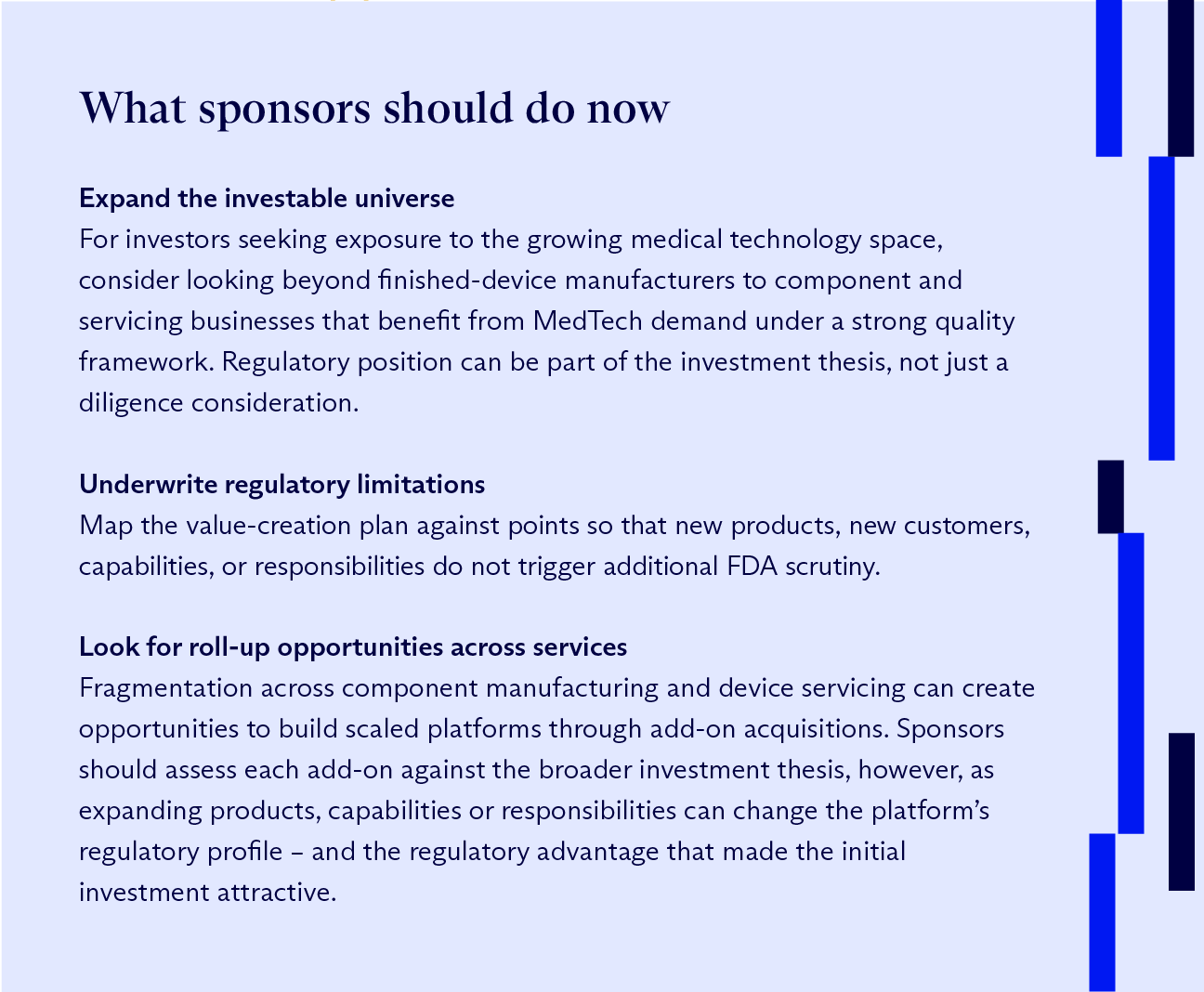
For private equity investors, component manufacturing and device servicing can offer a distinct path to identifying investments in the MedTech industry without the regulatory exposure of device manufacturers and OEMs – but sponsors should diligence scope creep and underlying contractual obligations closely.
To learn more about these trends and their implications for MedTech investors, contact the authors or your McDermott lawyer. We will also be discussing these developments and more at our upcoming Healthcare Private Equity NYC and Life Sciences Investment Forum.