
ARTICLE
Financing law firm MSOs: Structuring deals for growth and managing lender risk
November 20, 2026
Read time: 10 min
- Three considerations should remain at the forefront of PE investment in this space:
- The investment thesis must consider potential variability in future revenue streams and should not be unduly tied to the implementation of concerted growth or the timeline upon which such growth is realized.
- A lender’s most important collateral is the contracts between an MSO and its client, the law firm, and the restrictions or enforcement rights contained therein.
- How a change in law or regulatory challenge will be handled, and the importance of aligning regulatory representations and covenants with the structure in place, by jurisdiction.
Private equity (PE) investment into law firm management services organizations (MSOs) continues growing into an emerging asset class. Debt financing sources are now willing to lend against these platforms, with a premium put on identifying financing partners with the flexibility to be initial movers. Even with an emphasis on deploying capital in the space, the floodgates have yet to burst, likely because the credit risk financing sources are underwriting is unlike a typical services business: the cash flow belongs to a law firm the borrower does not own, the collateral sits on one side of a regulatory line, and conventional remedies may not work as expected.
What started mostly with personal injury firms now reaches a wider range of practices, and a growing group of direct lenders is offering financing at pricing comparable to other sectors, or at a modest premium. Although this is welcome news for PE investors whose returns depend on leverage, it also raises the stakes. A financing package that is simply a standard leveraged buyout credit agreement with “law firm” substituted for “company” is likely to misprice risk, leave lenders with weaker protections, miss the unique challenges of alignment of interest, and box in the sponsor when the platform tries to grow.
Our view is straightforward; In a law firm MSO, the financing must be part of the structure. The same principles on which regulators are focused on (i.e., keeping investors out of lawyers’ professional judgment, protecting client confidences, and avoiding impermissible fee sharing) shape what a lender can take as collateral, what it can see, what it can control, and what it can do if things go wrong.
Underwrite for growth and plan for stress (before either arrives)
In any PE investment, a primary consideration is the speed and efficiency through which investors can execute on the investment thesis and the ability of a financing partner to scale as that thesis is actualized.
The debt capital markets have largely addressed this issue through the availability of delayed draw term loan facilities and “club” deals to reduce any individual lender’s perceived concentration concerns and avoid individual hold size concerns.
One threshold consideration is whether growth will come from capturing state or local market share within the law firm’s or MSO’s existing primary practice and geographic areas or if the MSO or the law firms will need to expand into new practice areas or jurisdictions. Recent state-legal legislation in California, Colorado and Illinois, among others, has put a spotlight on interstate platform expansion. While such legislation should not kill a deal, it may impact a lender’s underwriting of the overall transaction and should be discussed early in the process.
Potential financing partners prioritize planning for stress and understanding the business in the borrower’s downside case (i.e., grasping the quality and stickiness of future revenue streams if the implementation timeline of an investment thesis faces unforeseen headwinds and performance flattens or regresses).
In a law firm MSO structure, central credit issues include key-person risk and concentration by partner, case, referral source, geography, and practice area. Lenders are underwriting the MSO’s fee-based earnings; however, the creditworthiness and collectability of these earnings depend on both the fee structure with the firm and the predictability of that firm’s revenue at a level sufficient to generate the cash necessary to pay the required MSO fees. The interdependency of revenue necessitates a larger focus on performing due diligence on future revenue streams. Lender diligence of this type is not unique to financing law firm MSOs; however, the nascent stage of the asset class does require caution.
Much of the PE investor activity has focused on “buy and build” consolidation or platform optimization strategies for specialized contingent-fee litigation firms, such as personal injury. Based on the firm’s current book of clients and cases, these platforms offer, on a relative basis, a higher floor on future revenue when using the historical performance on similar lawsuits adjusting for additional factors such as risk of adverse rulings and likelihood of settlement. On the frontier (with some deals having closed) are PE investments in business-to-business firms that offer a panoply of billable hour legal services and, as a result, the implicit concern that legal work will travel with the relationship partner instead of the law firm’s nameplate. These are not uncharted waters for financing partners involved in other business professional services sectors. However, it remains a risk with which many financing providers are not yet comfortable.
To assuage concerns, it is important that the investment thesis considers potential variability in future revenue streams and is not unduly tied to the implementation of concerted growth or the timeline upon which such growth is realized. The most fruitful relationships in this asset class are those where the financing partner is supportive of the growth narrative and, in turn, the sponsor is cognizant of managing downside risk. Without a proven track record in the law firm MSO space, lenders may use a higher debt-to-equity percentage than investments in other asset classes. The healthier balance sheet at closing and alignment of incentives with the PE investor should allow law firm MSOs to withstand challenges.
Strong documentation increases the “finance-ability” of a law firm MSO
In a law firm MSO structure, the firm is separately owned and controlled by its lawyers and connected to the MSO by contract, typically a management services agreement, a succession agreement, an intellectual property license, a deficit funding agreement, and potentially other service arrangements. The MSO’s revenue is generated by the fees it earns under those agreements – and those fees are paid out of cash generated by the firm – the practical result of which is that a lender’s most important collateral in MSO financing is the contracts between the MSO and its client, the law firm, and the restrictions or enforcement rights contained therein. Those documents therefore need to be drafted with financing in mind.
State ethical rules almost uniformly prohibit restrictions on a lawyer’s ability to practice law. In contrast, and as demonstrated with certain high-profile full-service law firms recently, the loss of certain “rainmakers” or a material portion of a law firm’s revenue stream has the potential for catastrophic results. The primary line of defense against partner attrition in a law firm MSO model is the alignment of incentives between the PE investor at the MSO and the legal professionals providing service at the law firm, typically through equity rollover at the MSO (or parent level) and other forms of deferred compensation. Other contractual methods by which the documentation disincentivizes a defection, whether through restrictions on the use of a law firm partner’s (or group of partners’) name, image and likeness; non-solicitation provisions focused on key nonlegal functions such as paraprofessional services, accounting and collections, or business development and marketing teams; or other structural enhancements, are collectively paramount in getting a law firm MSO financing transaction that has the right pricing and investment thesis through a potential financing partner’s investment committee.
Similarly, loose documentation may raise concerns regarding “up-tiering” debt transactions or “asset-stripping” reorganizations at the firm level. Recent trends in leveraged lending focus on closing loopholes used in liability management transactions (LMTs) through the introduction of so-called “LMT blockers” or restrictions that target offensive use of flexibility to the detriment of an existing lender. Like contractual restrictions on partner departures, LMT blockers do not kill a deal, however, they can stymy progress when speed and certainty to closing may be a deciding factor in a competitive auction process. Tailoring the deficit funding agreement’s restrictions on the firm’s ability to consummate asset sales, make investments, or incur additional indebtedness (or signaling the willingness to do so) is a powerful tool to align incentives and reduce uncertainty between a PE investor and its financing partner. Arrangements that focus on flexibility for “good transactions” such as law firm acquisitions in a personal injury “roll-up” strategy or litigation funding in a firm specializing in mass tort litigation are less likely to create last-minute hiccups in lender LMT blocker diligence.
Build regulatory risk into the loan documents
Regulation of law firm investment is evolving, and the rules differ by jurisdiction. That uncertainty belongs in the credit agreement, not just the diligence memo. Lenders will typically look for representations that the structure complies with applicable professional conduct rules; covenants to maintain that compliance; and prompt notice of regulatory inquiries, bar complaints, or changes in law that affect the MSO relationship. The difficult question is what happens if a rule changes or a regulator challenges the structure. Like lender diligence on a law firm MSO financing opportunity, lenders should give equal attention to regulatory downsides.
Many law firm MSO deals include regulatory put mechanics or obligations to restructure the arrangement if the MSO structure is in jeopardy of becoming noncompliant. Lenders need to understand how those provisions work, who pays, and whether a forced restructuring could reduce the fee stream or trigger payments that drain liquidity. In turn, PE investors should push for a reasonable cure and restructuring period before a regulatory development becomes an event of default, so that a fixable problem does not turn into an acceleration.
Multistate platforms add another layer. Expansion into a new state should come with a compliance review of that state’s rules, and the credit agreement should address whether entry into new jurisdictions is permitted freely, subject to conditions, or subject to lender consent.
Before financing a transaction in this space, it is important to negotiate how changes in law or regulatory challenges will be handled, including cure and restructuring rights rather than an automatic default. Parties should also review regulatory put and unwind provisions to assess their effects on cash flow and lender priority. Finally, regulatory representations and covenants should align with the structure in place in each jurisdiction.
In a law firm MSO, a lender (or a buyer at foreclosure) can step into the MSO but cannot take control of the law practice, direct legal decisions, or step into the lawyers’ shoes. The value of the collateral depends on the law firm continuing to perform and use the MSO’s services. That makes continuity agreements, step-in and transition provisions, and the enforceability of the services agreement in a distressed scenario critical. The same regulatory flexibility needed for loan documentation is also necessary for continuity agreements and other documents at the forefront in an exercise of remedies.
Looking ahead
Within these structures, professional independence should be genuine; economics should be defensible; key lawyers should remain aligned; financing considerations must be addressed from the outset; and transaction architecture should be prepared to accommodate growth, multistate expansion, and an eventual exit.
McDermott was an early pioneer in developing the MSO structure. Contact the authors or your regular McDermott lawyer to learn more about how we can draw on our experience with law firm MSOs to drive your success.







7 life sciences investment trends to watch in 2027
ARTICLE
7 life sciences investment trends to watch in 2027
Read time: 14 min
Life sciences investing will enter 2027 on firmer footing than a few years ago, despite regulatory uncertainty and evolving drug development challenges. Pharma mergers and acquisitions (M&A) remain strong in 2026, following 2025’s robust activity; biotech financing is emerging from a multiyear winter; and artificial intelligence (AI) is changing what drug discovery looks like. Pricing pressure and geopolitical risk are shaping how investors evaluate these opportunities, while the US midterm election results add another layer of uncertainty.
At our recent Life Sciences Investment Forum, speakers examined how these trends are shaping pharma and biotech investment and identified seven themes influencing the market’s trajectory.
1. Strategic M&A leads the liquidity outlook
In an audience poll, 83% of respondents identified strategic M&A as the expected primary source of liquidity over the next 12 to 24 months. Speakers credited M&A as the main value generator over the past five years, particularly as public markets remained challenging. They also highlighted how M&A activity supports the broader financing market by returning capital to investors, who can then redeploy those proceeds into new investment opportunities, including initial public offerings (IPOs).

For companies with a credible IPO path, speakers favored preparing for a public listing while also pursuing a strategic sale. Running these tracks in parallel allows boards to keep both options open as market conditions evolve and weigh a concrete acquisition offer against the IPO valuation and dilution, and follow-on capital needs post-IPO.
2. The biotech funding recovery is bifurcated
Panel discussions revealed that biotech financing is recovering unevenly. Later-stage companies with compelling clinical data are raising capital more readily, while early-stage company formation remains below its late-2010s pace. Established venture funds are also continuing to raise money and form new companies, even as investors digest what public-market developments may mean for related private programs.
Mixed clinical results and shifting investor experience are complicating financing decisions, according to speakers. Recent clinical readouts have caught some investors off guard, prompting greater scrutiny of companies pursuing similar therapeutic pathways. This heightened selectivity is also affecting IPO activity, as investors reassess risk and become more cautious about backing companies with uncertain clinical prospects.
Speakers also pointed to opportunities in medtech, where historically low valuations are offering attractive entry points for buyers with the appetite and expertise to make operational improvements.
3. Deal structures are broadening as capital becomes more selective
Forum discussions highlighted how companies and investors are increasingly tailoring transactions to the risks they are willing to assume. In M&A, earnouts and contingent value rights can bridge valuation gaps by tying part of the price to development or commercial milestones. A license can offer comparable economics when a credible partner is positioned to deliver downstream payments, and the company can retain rights to other programs.
Speakers also noted the growing pool of royalty investors in the market, giving life sciences companies more options to fund drug development or finance a launch. Selling an existing royalty stream or a share of future net sales can limit equity dilution but requires companies to give up a portion of the asset’s future proceeds.
When assessing a carve-out, speakers asserted that buyers should factor the cost of separation and the need for ongoing seller support into what they are willing to pay. A spinout can give an individual program access to dedicated funding while allowing the originating company to focus its resources on advancing earlier-stage assets to proof of concept.
4. R&D spending is shifting toward defined programs and partnerships
Rising development costs are prompting companies to concentrate research and development (R&D) spending on specific programs, marking a shift from the broader platform investments favored during the biotech boom. For early-stage platform companies, this places greater emphasis on the lead program. Speakers noted that a clear path to proof of concept helps investors assess the platform’s potential and the capital required. An academic collaboration or licensing arrangement can help generate the data needed to raise an institutional round, while a target-specific partnership can provide upfront, nondilutive capital and preserve the potential for milestone payments and royalties.
Speakers noted how pharma companies face a related capital deployment choice, with the timing of expected returns shaping the type of deal they pursue. In-licensing an earlier-stage program can replenish the pipeline over time, while acquiring a near-market asset can help bridge a revenue gap and support growth over the next three to four years.
5. AI partnerships are putting a premium on data and development expertise
As AI models become more widely available, forum speakers pointed to high-quality proprietary data and drug development expertise as key investment differentiators. They also urged pharma companies to consider whether a prospective AI partner’s business model and exit plans align with the program’s development timeline and ensure collaboration agreements detail how each party can use project data, including how they will document human contributions to inventions.
Audience polling reinforced the importance of tangible results, with 73% of respondents identifying demonstrated clinical or operational outcomes as the most important factor in determining the long-term success of AI partnerships in life sciences.

Speakers highlighted joint principles from the US Food and Drug Administration (FDA) and European Medicines Agency for evaluating AI models used to generate regulatory evidence. They also pointed to the European Union’s AI Act and General Data Protection Regulation as considerations for model deployment and use of personal data.
6. Chinese biotech is reshaping the economics of pipeline sourcing
Global pharma is increasingly looking to China to replenish its drug pipelines, with forum speakers flagging that Chinese biotech firms have narrowed the gap with global peers in terms of clinical data quality, intellectual property, and regulatory pathways. Speakers cited two transactions in which Chinese clinical data supported direct entry into US registrational studies, potentially shortening development timelines.
In-licensing from China can still cost less than sourcing comparable US or European assets, even as the pricing gap narrows. Speakers noted how developers with differentiated programs are gaining bargaining power, while buyers retain leverage in crowded targets. For licensees, a deal’s value depends on how much development the existing evidence can support and what additional studies will cost.
7. Policy uncertainty is moving into deal underwriting
Regulatory risk is playing an increasingly significant role in how life sciences deals are evaluated and structured, as the recent US midterm elections add another layer of uncertainty to the policy outlook. In an audience poll, 73% of respondents said regulatory risk weighs more heavily on valuations and deal terms than it did two years ago, underscoring the growing importance of policy considerations in investment decisions.

Despite this uncertainty, speakers identified drug affordability and US competitiveness with China as bipartisan priorities for the sector. With higher rebates already pressuring net revenue, speakers emphasized to buyers the importance of determining how Medicare drug price negotiations under the Inflation Reduction Act of 2022 and most-favored-nation pricing initiatives could affect expected cash flows and upfront valuations.
Panelists also discussed leadership transitions at the FDA. Where a launch forecast assumes accelerated review under the FDA’s Commissioner’s National Priority Voucher pilot program, investors should test whether the company has enough cash to reach launch on a standard review timeline.
Discussions also focused on the impact of tariffs on imported components, which can squeeze margins for medtech suppliers even when final assembly takes place in the United States. Qualifying an alternative supplier takes time, where buyers should assess how long higher costs could weigh on margins and whether the company can pass them through to customers.
Looking ahead: Positioning for the next cycle
Forum speakers pointed to a life sciences market with a myriad of ways to fund and advance promising assets, but investors are placing greater emphasis on evidence support. For operators planning the next stage of development, that means identifying the clinical or regulatory milestone most likely to attract a buyer or partner, then working backward to determine how much capital it will take to get there. That funding need gives companies a basis for weighing equity dilution against the future economics they might give up in a licensing or royalty deal.
For investors, the same milestone can anchor the decision about how much to commit upfront. A longer development timeline can increase funding needs, while lower net pricing can reduce the asset’s value even if it reaches the market on schedule. Tying further investment to specific milestones can give operators the capital to advance a program and investors a clear basis for deciding when to fund the next stage.
Continue the conversation at the 2027 J.P. Morgan Healthcare Conference in San Francisco. Join us at our annual SPIN reception on January 12 and meet with the McDermott Will & Schulte team January 11–12 in our private space at The Ritz-Carlton.




EU foreign investment screening: Implications for Japanese investors
ARTICLE
EU foreign investment screening
Implications for Japanese investors
November, 2026
Read time: 5 min
The EU has adopted Regulation (EU) 2026/1386 (published 26 June 2026, in force 16 July 2026), replacing the 2019 framework. From 17 January 2028, every EU Member State must operate a mandatory, approval-before-closing foreign investment screening regime covering a minimum set of sensitive sectors. Japanese investors are directly affected, as Japan was one of the six main source countries of cases notified to the EU cooperation mechanism in 2024, and France has just extended its 10% listed-company threshold to the Japan Exchange. Deal teams should build the new requirements into every European acquisition signed from now on.
The New EU Regulation in Five Points
- Mandatory screening is everywhere. All 27 Member States must screen acquisitions in defense/dual-use, AI, quantum, semiconductors, strategic raw materials, energy/transport/digital infrastructure, financial-system entities (CCPs, CSDs, payment systems, financial messaging), and electoral infrastructure. Member States may add sectors. Greenfield and most intra-group restructurings are excluded from the minimum scope.
- EU subsidiaries do not avoid filing. Investments by EU-incorporated entities controlled by non-EU parents are expressly covered. An EU holding company or SPV will not avoid screening.
- Call-in power for 15 months. Authorities can call in non-notified deals for at least 15 months after closing, creating post-completion regulatory risk.
- Harmonized two-phase procedure. Phase I will be within 45 calendar days (national), and Phase II is to be set by each Member State. Investors must endeavor to file in all relevant Member States on the same day.
- Mandatory investor risk factors and a track-record database. Authorities must assess: links to third-country governments, sanctions exposure, foreign information-sharing obligations without due process, opaque ownership, and prior non-compliance with FDI conditions. A new EU database records screening outcomes and compliance history across the bloc. The cooperation mechanism is narrowed to higher-risk cases (e.g., state-controlled or sanctioned investors, deals in projects of Union interest).
Why This Matters Specifically for Japanese Investors
- Japan is already in scope. Japan was one of the six main countries of origin of cases referred to the EU cooperation mechanism in 2024, alongside the US, UK, China (incl. Hong Kong), Canada, and the UAE. Japan accounted for 8% of Belgian FDI notifications in 2024-25.
- France: new 10% threshold covers Japan Exchange. From 17 August 2026 (Decree 2026-718), the 10% voting-rights threshold for non-EU/EEA investors in French companies applies when shares are listed on the Japan Exchange. A fast-track 10-working-day procedure is available.
- Japan cooperation may trigger the EU mechanism. Commentary suggests “projects or programmes of Union interest” may include Japan-EU cooperation initiatives, which could bring Japan-linked Phase II deals into the cooperation mechanism, adding time.
- Watch your group structure. Japanese groups with Chinese shareholders, JV partners, state-linked co-investors, or data/technology flows to third countries should expect questions under the new investor risk factors.
Key Jurisdictions at a Glance
| Jurisdiction | Filing Trigger / Thresholds | Review Timeline | What to Watch | Authority |
|---|---|---|---|---|
| Belgium | ≥10% (defense/energy/cyber if turnover >EUR 100m) ≥25% (broader sensitive list, turnover >EUR 25m) Or control |
Phase I: 30 days Phase II: 28 days EU coop: +25 days |
191 filings in 2025–26 First prohibition (Aug 2026) 45 info requests; 27 non-notified enquiries |
Interfederal Screening Committee (ISC) |
| Finland (PROPOSAL) |
10%, 33.3%, 50%, 66.6%, 90% All non-Finnish investors incl. EU Certain greenfield (energy/data centers ≥100 MW, ports, raw materials) |
Stage 1 (NESA): 45 days Stage 2 (MEAE): no fixed deadline |
Expected spring 2027 Penalties: up to 10% worldwide turnover Voluntary filing removed |
National Emergency Supply Agency / Min. of Econ. Affairs |
| Italy | From 10% minority (some sectors, non-EU; indicative—verify) Broad sectors: defense, 5G, energy, health, tech, data, finance |
45 days (suspensions possible) Pre-notification: 30 days EU coop: ~20 days |
1,081 filings in 2025; 2 blocked | Presidency of Council of Ministers |
| France | Control (all foreign) 25% voting rights (non-EU/EEA) 10% listed co. (non-EU/EEA)—now incl. Japan Exchange |
Phase 1: 30 working days Phase 2: +45 working days Opinion procedure: 2 months |
418 filings in 2025 49% of authorizations with conditions 10% threshold expanded Aug 2026; further reforms by end-2026 |
Minister of Economy / DG Trésor |
Action Checklist for Japanese Deal Teams
- Map target activities against both the EU minimum-scope list and each national sector list.
- Review your own group’s shareholders, JV partners, state links, data-sharing obligations, and any past FDI conditions across EU jurisdictions.
- Do not rely on EU/European subsidiaries or SPVs to avoid filing obligations.
- For French companies listed on the Japan Exchange: check the 10% voting-rights threshold before acquiring stakes in sensitive sectors.
- For deals signed now but expected to close after 17 January 2028: apply the new EU rules to your timeline and conditions precedent.
- Plan multi-state filings and set long-stop dates generously (Phase I: 30–45 days; Phase II: weeks to months; EU cooperation can add 20-25 days). Make FDI approval a condition precedent and allocate the risk of conditions or refusal.
- Prepare mitigation offers early: data localization, governance changes, supply-continuity commitments, cybersecurity measures.
- Use pre-filing tools where available: Italy pre-notification (30 days), France binding opinion request (2 months).
- Keep full records of compliance with any conditions – the EU database will track your record.



Disclaimer: This briefing is general information, not legal advice. Finnish rules are a proposal and may change. All thresholds and timelines should be independently verified before reliance in any specific transaction.

Changes to the transparency register in Germany effective July 2027
ARTICLE / CLIENT ALERT
Changes to the transparency register in Germany effective July 2027
November 13, 2026
Read time: 8 min
The German transparency register is set to undergo far-reaching changes, effective as of July 2027. In particular, a revised definition of the ‘beneficial owner’ and a new calculation method for indirect ownership structures will require the review of all existing entries in the transparency register.
The Federal Ministry of Finance (Bundesministerium der Finanzen) has published the draft bill for the Act Implementing the Sixth EU Anti-Money Laundering Directive and Strengthening Anti-Money Laundering Measures.
The draft bill notably includes a new Anti-Money Laundering Act (Geldwäschebekämpfungsgesetz, GwBG), which is set to replace the current Anti-Money Laundering Act (Geldwäschegesetz, GwG) as of 10 July 2027. At the same time, the EU Anti-Money Laundering Regulation (EU) 2024/1624 (AMLR) will become directly applicable on 10 July 2027.
Notable updates in the new regulations pertain to the definition of the beneficial owner, the scope of transparency register disclosures, and the verification of the reported information.
1. New definition of the beneficial owner
Lowering of the ownership threshold and new method for calculating indirect ownership
Under current law, a beneficial owner is, among others, any person who directly or indirectly holds more than 25% of the capital shares or voting rights or exercises control via other means (Section 3(2) of the GwG). In the future, a holding of 25% or more will suffice (Article 52(1) AMLR). The regulation also expressly covers other ownership interests, such as rights to profit shares or liquidation balance in the aforementioned amount.
Of particular relevance is the future calculation of indirect holdings. Under the current (and still applicable) legal framework, control is generally determined based on control over intermediate entities. In the future, Article 52 of the AMLR (Beneficial Ownership through Ownership Interest) will require the multiplication of ownership percentages along an ownership chain and the aggregation of various ownership chains (i.e., ‘calculating the chains’). In addition, the independent control criteria set forth in Article 53 (Beneficial Ownership through Control) and Article 54 (Coexistence of Ownership Interest and Control in the Ownership Structure) must still be examined.
As a result, significantly more individuals may be considered beneficial owners in the future, including those who, under the previous legal framework, were not covered due to a lack of controlling influence over an intermediate entity.
Duty to provide explanations when relying on notional beneficial owners
If no beneficial owners can be identified despite exhausting all investigative options, the new regulations require a justified explanation and the registration of the members of the reporting entity’s senior managing officials. The justification must be submitted to the transparency register.
The previous practice of reporting senior managing officials as ‘notional beneficial owners’ without providing a detailed justification is thus replaced by a more nuanced procedure
2. Expanded reporting requirements to the transparency register
Additional personal information and disclosure of the ownership structure
In implementing the 6th Anti-Money Laundering Directive (EU) 2024/1640 and in conjunction with the AMLR, the draft bill significantly expands the scope of information to be recorded in the transparency register (Section 14 of the GwBG-E).
In addition to all names, dates of birth, nationalities, and details regarding economic interests, the following information must be recorded in the future: place of birth, full residential address, number of identity document, and, where applicable, a unique personal identification number – in each case including the country of issuance.
In the case of multi-tiered ownership structures, a description of the ownership and control structure must also be prepared and submitted. This overview must clearly illustrate the entities involved, their connections, and the respective ownership and control relationships. Until now, such documents were only required to be submitted to the transparency register in connection with a report of discrepancies.
Reports must be submitted electronically. A planned pre-population feature based on existing registry data may simplify the reporting process; however, it does not relieve entities of their obligation to conduct their own review or of their responsibility for the completeness and accuracy of the information (Section 18 GwBG-E).
In addition, a person expressly designated as such and authorized to represent the entity must be notified to the transparency register, and proof of such authorization must be provided in order to utilize the option of pre-population (Section 20 GwBG-E). According to the recitals to Section 18 of the GwBG-E, the pre-population also covers information that is already contained in the transparency register, so that this information can be updated by the registry administrator. However, the specific process of transferring data from the existing transparency register to the ‘new’ transparency register, including any obligations on reporting entities, as well as transition periods, remains unclear.
3. Updating and verifying registry information
The obligation to continuously update transparency register information already exists under current law. In the future, these requirements will be specified in greater detail by the directly applicable EU legal provisions of the AMLR and supplemented by additional verification mechanisms.
According to the draft bill, incoming reports are to be reviewed on a risk-based approach for accuracy, completeness, and timeliness. In addition, the registry administrator is required to conduct a regular review of the registry information at least once a year (Section 21 of the GwBG-E). In cases of doubt, additional documents may be requested, and entries may be deferred until the matter is clarified.
For entities, this means that the ongoing documentation of their ownership and control structures is becoming even more important. Relevant changes to shareholdings, control rights, or personal information must be reliably recorded and promptly reported to the transparency register.
4. Reports of discrepancies and practical consequences
Entities subject to anti-money laundering regulations continue to be obliged to report discrepancies between their own assessment and the information available in the transparency register. In the future, this obligation will be governed in particular by Article 24 of the AMLR and Section 28 of the GwBG-E.
Discrepancies must generally be resolved within 30 business days. This would represent a material reduction in the average processing time currently observed in practice (where a period of 30 business days is regularly granted simply for an affected entity to respond to the registry administrator). During the review, a corresponding notice will continue to be included in the transparency register. If the affected entity fails to provide the necessary cooperation, this may – as has been the case to date – lead to the initiation of administrative offense proceedings.
5. Key actions and next steps
Before the changes come into effect, affected entities should:
- Use the remaining time until the upcoming effective date to review existing transparency register entries and, if necessary, carefully prepare any required change notifications in advance;
- Reassess indirect holdings in accordance with EU requirements;
- Identify relevant control relationships;
- Collect any additional required personal data; and
- Prepare meaningful ownership and control structure descriptions.



How bank regulatory issues can impact healthcare PE deals
ARTICLE
How bank regulatory issues can impact healthcare PE deals
November 6, 2026
Read time: 27 min
Look beyond the initial acquisition.
If the thesis depends on add-ons, geographic expansion, or new payment functionality, consider whether the platform’s licensing and compliance infrastructure can scale with it.
Issues left unresolved at acquisition can resurface during the next financing, add-on, or exit.
As healthcare platforms embed financial services functionality into their offerings, private equity investors should treat money transmission, anti-money laundering (AML), sanctions, and consumer protection exposure as core diligence items rather than ancillary considerations.
Identifying gaps early can be the difference between a manageable compliance fix and a problem that alters deal economics. With appropriate structuring, investors can identify exposure early, manage it effectively, and protect their investment.
Layer 1 in deal diligence: Money transmission licensing
The threshold question in any healthcare transaction involving payment functionality is whether the target is licensed as a money transmitter and, if not, whether it needs to be. Money transmission generally occurs when a business receives funds from one person for transmission to another, and in healthcare, that occurs more often than many investors expect.
The following activities can implicate money transmission laws. Depending on the funds flow and available exemptions, each may require state money transmission licenses, federal money services business (MSB) registration with the Financial Crimes Enforcement Network (FinCEN), or both*:
- Collection and disbursement of third-party funds in connection with patient payment plans and financing
- Stored-value accounts and patient wallets
- Revenue cycle management that aggregates payments
- Third-party payment processing for provider networks
- Collection and disbursement of payments to research participants, including stipends, reimbursements, and prepaid cards
*These are illustrative examples. None of these activities is automatically regulated; the analysis turns on the specific facts and funds flow.
During diligence:
When a target is unlicensed: Assess whether licensing is required and, if so, what mitigation steps are available. Where appropriate, contract provisions can be restructured, funds flows rerouted, and bank account ownership and control modified to satisfy an available exemption or otherwise address licensing requirements. Restructuring how money moves, however, could disrupt a healthcare platform’s reimbursement operations, payor arrangements, billing workflows, or the flow of revenue between the platform and providers. Any money transmission fix should therefore be evaluated against the broader healthcare regulatory and reimbursement model before implementation.
Size the potential exposure: Determine how much revenue, transaction volume, customer activity, and future growth depend on potentially regulated payment functionality. A licensing gap that affects a small ancillary service may present a very different investment risk than one embedded in the platform’s core revenue model.
When a target is licensed: Analyze the adequacy of the compliance program and confirm that target operates in accordance with applicable tangible net worth, permissible investment, and surety bond requirements (and will continue to meet such requirements on a pro forma basis, giving effect to the transaction). Also consider the implications of acquisition financing, particularly to ensure that any applicable security interest excludes permissible investments and whether any guaranty should be limited or subordinated to preserve compliance with money transmission requirements, including as potentially applied by regulators in their safety and soundness review of the transaction. This latter issue can become a point of negotiation with lenders. To increase regulatory approval prospects and timing efficiencies in certain highly leveraged transactions, it is often a provision worth insisting on.
Layer 2 in deal diligence: Anti-money laundering and sanctions compliance
Any entity that qualifies as a money transmitter or other MSB under FinCEN’s regulations is subject to the Bank Secrecy Act (BSA). That status brings a set of federal obligations, including FinCEN registration, a written AML program, suspicious activity reporting, and certain recordkeeping and reporting requirements. Federal MSB status is a separate question from state licensing status: a target may be exempt from state licensing yet still be an MSB under federal law, or vice versa.
Many healthcare platforms rely on FinCEN’s “integral exception,” which excludes from money transmitter status funds handling that is integral to a business’s own goods or services. The exception is narrower than it is often assumed to be. Platforms that collect payments on behalf of unaffiliated providers, hold balances in patient wallets, or move funds as a standalone service may fall outside it, so a target’s reliance on the exception is an issue worth flagging.
Sanctions obligations apply independently of MSB status. The Office of Foreign Assets Control (OFAC) administers US economic sanctions, which generally prohibit US persons from dealing with sanctioned individuals and entities (including entities majority-owned by them) and with sanctioned jurisdictions. Some programs also reach US persons who “facilitate” prohibited activity by foreign affiliates or vendors. Because OFAC liability is strict and the limitations period for many sanctions violations is now 10 years, historical issues at a target can carry meaningful exposure for an acquirer.
Healthcare transactions also warrant heightened scrutiny. FinCEN has identified healthcare fraud as a significant illicit finance risk, and enforcement authorities frequently pursue parallel healthcare fraud, False Claims Act, and money laundering theories where fraud proceeds are involved. Additionally, OFAC has stressed the importance of risk-based sanctions compliance programs, and its enforcement actions have highlighted compliance deficiencies arising from inadequate sanctions due diligence and integration following acquisitions.
During diligence:
Issues to be aware of: Whether the target has a clear basis for its federal MSB status, including any reliance on the integral exception; whether it has a functioning BSA/AML program; whether its OFAC screening extends to customers, payees, vendors, and ownership; and how it has handled past screening alerts or blocked transactions.
Cross-border dimensions: Non-US operations, offshore vendors, international clinical trial sites, and foreign payees can introduce sanctions risk tied to specific locations and counterparties. US-person involvement in foreign activity may raise facilitation questions, and EU and UK sanctions regimes do not always align with US requirements. OFAC authorizations for certain medical and humanitarian activity exist, but they come with conditions. These are issues best surfaced during diligence rather than after closing.
Deal implications: AML and sanctions findings can affect representations and warranties, indemnities, escrows, closing conditions, and post-closing obligations. Questions about voluntary self-disclosure to OFAC may also arise. Representations and warranties insurance often excludes known compliance issues and, in some cases, sanctions matters altogether.
A broad net in deal diligence: Patient financing and consumer protection
Healthcare payment models create risks beyond traditional money transmission. Patient financing, billing, and collections can also have healthcare-specific requirements, including financial assistance obligations, patient privacy and, depending on the arrangement, fraud-and-abuse considerations.
During diligence:
Examine: How the target communicates with patients about financial obligations, whether collections practices comply with applicable state laws, and whether marketing claims about financing or payment plans could expose the business to unfair or deceptive practices claims. Where the platform extends or arranges patient credit, you should assess applicable licensing requirements, interest and fee limitations, and credit disclosure obligations.
For platforms supporting hospitals and health systems: Understand how financing interacts with financial assistance and charity care requirements, including whether patients are screened for available assistance before being directed to financing products.
Follow the patient and the money: Map who bills the patient, receives and holds the funds, extends financing, conducts collections, accesses patient information, and ultimately bears financial risk. That can uncover overlapping bank regulatory, consumer protection, and healthcare regulatory obligations that may not be apparent when each function is reviewed separately.
The challenge for investors: Bank regulatory gaps and enforcement can seriously impact deals
Change-of-control triggers in money transmission licenses frequently require advance regulatory approval, which can extend deal timelines if they are not identified early. Map those requirements before signing and account for regulatory notices, consents, and approvals in the transaction timeline and deal documents. Lender diligence has become more sophisticated and increasingly flags money transmission requirements and licensing gaps as a reason to reprice, hold back proceeds, or condition closing.
The enforcement landscape adds another dimension. Federal law, including the federal prohibition on unlicensed money transmitting businesses, and state enforcement mechanisms create exposure for unlicensed activity. FinCEN may also impose penalties for BSA violations. Bank partners may reassess account relationships when licensing questions arise, and state regulators can issue cease-and-desist orders that disrupt operations in specific markets.
Critical banking and payment relationships are therefore a further diligence point. Investors should understand whether a change of control, licensing issue, or compliance finding could trigger consent requirements, enhanced due diligence, restrictions, or termination rights under the agreements with partners on which the business relies.
The cumulative effect can be a deal that looks clean on the healthcare side but carries hidden bank regulatory exposure that changes the underwriting, erodes value, or delays closing.
The solve: Smart structuring strategies and regulatory positioning
Money transmission regulatory risk is manageable when addressed proactively.
Deal structuring can minimize licensing obligations through strategies such as the agent-of-payee exemption and bank partnership arrangements, both of which can reduce or eliminate the need for state money transmission licenses in appropriate circumstances. These arrangements require jurisdiction-specific analysis; a bank relationship alone does not establish that the platform is exempt. Post-closing integration plans can incorporate remediation steps and design compliance programs to align acquired platforms with regulatory expectations.
Diligence findings should also inform the transaction itself. Depending on the issue, investors may need to address regulatory approvals, pre-closing remediation, representations and warranties, closing conditions, or other appropriate risk-allocation mechanisms in the deal documents.
For targets with pre-existing licensing gaps, the key is engaging issues early enough to shape outcomes rather than reacting to them under deal pressure. For example, where appropriate, voluntary disclosure and remediation planning can position the business favorably with regulators before any enforcement action materializes. Prospective restructuring alone does not resolve exposure for past activity. Regulatory relationship management with state examiners and federal agencies, along with no-action letters and exemption strategies, can further reduce the licensing burden where available.
Recap: What investors can do
As healthcare platforms continue to integrate financial services functionality, private equity investors should consider the following steps:
- Assess payment functionality early in diligence. Before pricing is finalized, identify every activity that could constitute money transmission: third-party payments related to patient financing, stored-value products, revenue cycle aggregation, clinical trial payments, and third-party processing. Determine whether the target is licensed or needs to be. Evaluate against the laws of the jurisdictions where senders or receivers are located (including US and non-US jurisdictions).
- Map AML and sanctions exposure. Be aware of the basis for the target’s federal MSB status, including any reliance on the integral exception; the state of its BSA/AML program and OFAC screening; and sanctions risk arising from cross-border activity, foreign locations, and vendors under US, EU, and UK regimes, where applicable.
- Conduct consumer protection risk mapping. Review patient-facing communications, billing and collections practices, and marketing claims against both federal UDAP/UDAAP standards and applicable state laws.
- Build regulatory positioning into the deal structure. Explore agent-of-payee and bank partnership structures to minimize licensing obligations. If potential remediation may include licensing, negotiate financing terms with money transmission requirements (including a security interest carve-out for permissible investments and any necessary guaranty limitations or subordination) in mind and run the target’s pro forma financial statements, giving effect to the deal to ensure the target can meet applicable financial metrics.
- Plan for pre- and post-closing remediation. Identify issues requiring pre-closing action. Develop integration plans that address remaining licensing gaps through voluntary disclosure where appropriate, compliance program design, and regulatory relationship management, rather than deferring these issues until they become enforcement risks.
Bank regulatory, AML, and sanctions considerations in healthcare private equity do not necessarily require walking away from a deal, but they warrant early and careful attention. Investors should determine whether an issue is a straightforward fix or one that changes the economics of the investment and adjust their approach accordingly.








HPE Europe 2026: Tracking deal trends, policy shifts, and leadership insights
ARTICLE
HPE Europe 2026: Tracking deal trends, policy shifts, and leadership insights
Oct 21, 2026
Read time: 6 min
On 24 September 2026, hundreds of investors, operators, and advisors gathered for McDermott Will & Schulte’s annual Healthcare Private Equity (HPE) Europe conference at The Peninsula London.
Keynote speaker and former Chancellor of the Exchequer, the Rt Hon George Osborne kicked off a lively discussion about the future of artificial intelligence (AI) and how economic and policy shifts are shaping today’s investment landscape. Multiple panels throughout the day further explored European healthcare investment trends, capturing industry leader insights on the hottest focus areas in health and life sciences, geopolitics and policies affecting dealmaking, and the increasing role of the strategic buyer.
As HPE Europe’s knowledge partner, McKinsey & Company brought the numbers behind the market to life, sharing fresh data on private capital in 2026 and the macro trends influencing where, when, and how deals are getting done.
Below are key takeaways from the event.

Trends influencing investor appetite in European healthcare
Dealmaking resilience and activity. In Europe, private equity fundraising has proved more resilient than in other regions, and healthcare deal activity has been relatively stable despite global volumes declining since 2021. The most active healthcare and life sciences sub-sectors have been pharmaceuticals, medtech, and healthcare services.
More challenging processes. In the last few years, standard deal processes have come under pressure, with less visibility over who else is at the table, broken auctions, and exclusivity either not forthcoming or proving meaningless. To work around that, buyers should prioritise building strong relationships with sellers and management teams. Conviction is key.
Increasing role for strategic buyers. In a tough exit environment, strategic buyers accounted for 51% of exits in the first three quarters of 2026. Healthcare services and pharma services have attracted particular strategic interest as corporate acquirers seek to enter new segments via mergers and acquisitions. Strategics can bring a lower cost of capital and benefit from synergies, but for sellers it is important to keep a range of exit routes open.
The geopolitics and policy shifts shaping dealmaking into 2027
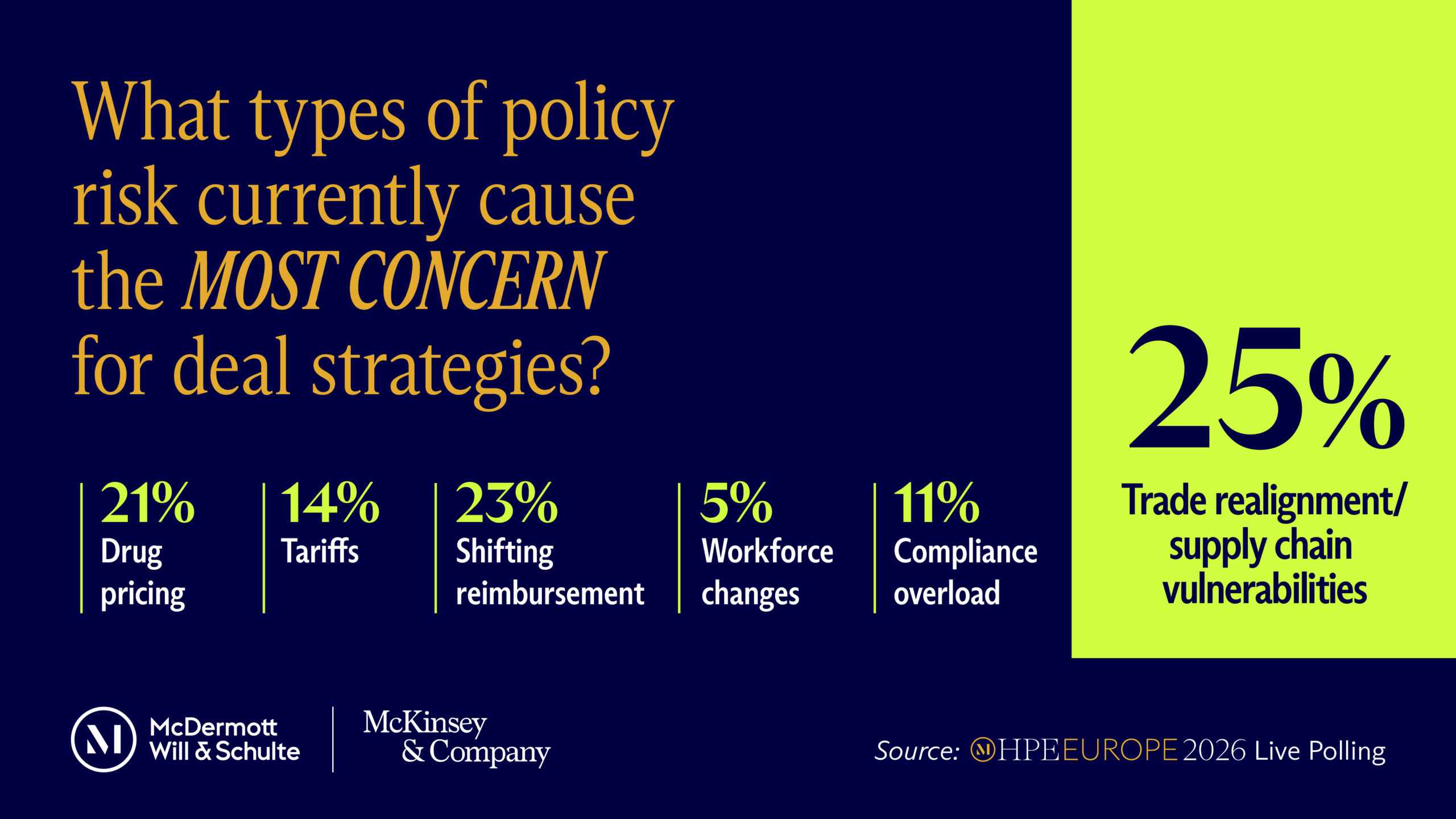
Adapting due diligence. Given the pace of geopolitical and policy change in recent years, due diligence processes have shifted. Where policy used to be one separate workstream within due diligence, policy and “stroke of pen” risk is now across all workstreams, and a key part of commercial and operational levers of a deal. Policy and regulatory risk is a tier-one consideration on transactions.
More clarity in most-favoured nation (MFN) pricing environment. MFN, the US policy to benchmark domestic drug prices against select reference countries, is now crystallising. Some 17 companies have signed confidential deals granting tariff exemptions in exchange for MFN pricing in Medicaid, new launches, and direct-to-patient offerings. The deals are time limited, and it remains to be seen what the US administration may do regulatorily on drug pricing, and how global pharma companies may rethink pricing architecture, launch sequencing, and portfolio prioritisation.
Global trends in life sciences private equity
AI shifts in the landscape. The majority of life sciences companies are now developing AI tools to aid drug discovery and development, with significant progress being made. Many are using new technologies to lower manufacturing costs and make processes faster and more efficient, but the focus has now shifted to shortening the time spent on clinical trials, and driving efficiencies across drug development. Personalised medicine is also becoming more prominent.
Deal dynamics and drivers. A bifurcation of bid-ask spreads continues to impact sponsor-to-sponsor deal activity in the past year although good assets continue to trade. Another theme has been the highly structured nature of some deals. Given this, Private equity has also focused on take privates and carve-outs. The medtech sector continues to be active, and Pharma services is one subsector that is showing signs of recovery.
Subsectors offering opportunity. In light of the growing focus on drug pricing, constrained healthcare budgets, and looming patent expirations, generics will remain a focus for European life sciences with some of the biggest opportunities likely to be found in oncology, immunology, and GLP-1s.

“European healthcare private equity had a strong year in 2025, but so far 2026 has been more mixed. Against that backdrop, execution is more important than ever. The advantage lies in sector knowledge, regulatory insight, and operational expertise put to work across the investment cycle. Headwinds are there, but deals are getting done and we are excited to see what’s next.” –
Ira Coleman, Chairman, McDermott Will & Schulte
Conclusion
The mood at HPE Europe was upbeat and the discussions were wide-ranging, reflecting the resilience of the healthcare and life sciences sectors and the breadth of opportunity available to investors.
We look forward to continuing these conversations in the months ahead with our clients and partners. Please do not hesitate to get in touch if there is anything you would like to explore further.

Plenty of capital, fewer easy wins in healthcare PE
ARTICLE
Plenty of capital, fewer easy wins in healthcare PE
Oct 29, 2026
Read time: 6 min
Healthcare private equity investors are seeing a new phase of opportunity, with substantial capital available for deployment, improving deal prospects, and accelerating AI adoption reshaping the investment thesis. But growth prospects vary considerably across healthcare sectors, and generating returns will require greater discipline around deal selection, operational execution, and technology investment.
At McDermott Will & Schulte’s Healthcare Private Equity (HPE) Conference in New York City (HPE NYC 2026), investors, executives, lawyers, and other industry leaders examined where capital is flowing, what’s driving the next wave of deal activity, and how AI is fundamentally changing healthcare business models while shifting how deals get done. McKinsey & Company, the official knowledge partner of HPE series, shared an analysis of emerging trends across the industry at the event. Here, McKinsey and McDermott Will & Schulte share key takeaways.
Fastest-growing profit pools are in healthcare services and tech
Healthcare sectors are seeing continued EBITDA growth, with performance varying significantly by segment. The healthcare services and technology sector represents the largest and fastest-growing sector, with investor interest concentrated in data analytics, software, and tech-enabled platforms as payors and providers seek solutions to mounting financial and operational pressures.
Panelists noted how companies demonstrating measurable return on investment (ROI) are continuing to have the biggest competitive advantage – especially as AI adoption accelerates, creating opportunities for margin expansion and growth even as competition and pricing pressures intensify.
Other areas attracting investor interest include specialty pharmacy, infusion, and other pharmaceutical services. Speakers pointed to key growth drivers in these areas, including strong specialty drug pipelines, payor pressure to move care into lower-cost settings, and growing patient preference for home- and ambulatory-based treatment.
Panelists also expressed cautious optimism as biotech funding improves and buyer-seller valuation expectations begin to converge. However, opportunities vary across subsectors, with investors focused on companies demonstrating differentiated capabilities, durable demand, operational resilience, and a deeper level of AI integration.
Panelists noted that healthcare-focused private equity (PE) firms hold approximately $400 billion in “dry powder,” giving investors more capital to deploy than in recent years.
AI’s value creation depends on level of tech integration
As discussions reiterated, the more deeply AI is embedded into a platform’s core products, services, and business model, the greater its potential to create lasting value. Panelists noted how companies are moving beyond standalone productivity tools and “table stakes” AI capabilities to integrate AI into customer-facing solutions and develop new revenue streams, which is helping to command higher valuations.
In an audience poll, attendees ranked AI-enabled solutions as the most promising investment opportunities. For investors evaluating AI-enabled healthcare businesses, the challenge is distinguishing sustainable competitive advantages from easily replicated technology.
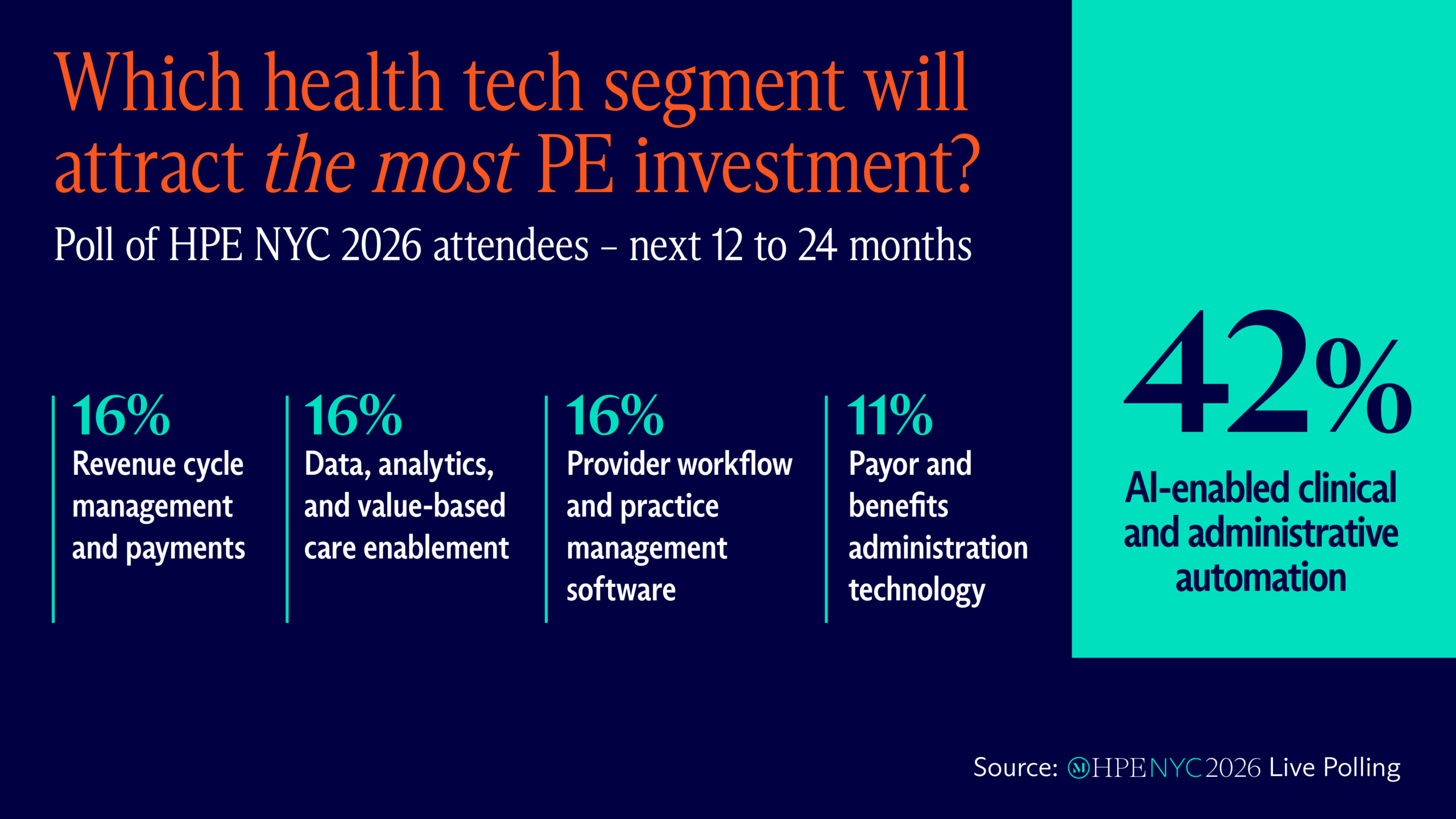
Speakers also emphasized the importance of proprietary data, deeply embedded systems, and technology that fundamentally improves workflows rather than simply adding new features. Discussions noted how companies must also demonstrate that they can successfully commercialize their solutions and drive customer adoption.
AI is similarly transforming how healthcare transactions are being evaluated and executed, and what it means to effectively manage post close. As diligence becomes more complex, investors are facing an expanding range of regulatory, operational, financial, and strategic risks. They’re also having to identify issues that could affect valuation, change deal terms, impact integration, or shift post-closing performance expectations.
But deep AI integration alone does not guarantee higher deal valuations, where speakers underscored the importance of having strong business fundamentals and the ability to translate AI investments into sustainable growth.
Creative structures are getting deals done
While there are signs of improvement, the healthcare dealmaking environment remains highly selective. Panelists described a bifurcated market in which high-quality, A+ assets in attractive sectors are driving both competition and premium valuations. This is while less differentiated companies face longer holding periods and more limited exit opportunities.
Panelists reinforced the importance of operational execution in driving returns. Participants agreed they would not pursue an investment without identifying three to five actionable operational improvement opportunities. While AI is increasingly part of that strategy, speakers emphasized that technology investments must support broader operational goals rather than serve as standalone initiatives.
Creative transaction structures are also becoming more important as sponsors prioritize liquidity and work to bridge valuation gaps. Speakers discussed growing interest in mergers of equals, carve-outs, earn-outs, and other alternative arrangements that can help facilitate transactions when traditional sale processes prove challenging.
Liquidity pressures are similarly influencing investment decisions. In an audience poll, attendees identified disagreement over valuations as the leading reason PE-backed healthcare companies are being held longer than expected. Panelists highlighted continuation vehicles and other secondary transactions as options for sponsors seeking to provide liquidity while retaining exposure to high-performing assets. These structures can also provide additional time and capital to execute growth strategies.
For businesses that lack the scale or differentiation to command premium valuations, speakers noted that operational improvements, strategic combinations, and alternative transaction structures can provide a path forward.
The bottom line
Healthcare private equity continues to offer compelling investment opportunities, but as discussions reflected, success will require greater discipline in capital deployment and value creation. Strong sector fundamentals and continued innovation support investment, while uneven performance, valuation gaps, and execution challenges prioritize a more tailored approach to dealmaking.
AI is emerging as both an investment opportunity and a tool to strengthen portfolio operations and transaction execution. For sponsors, the focus is on identifying businesses with strong competitive advantages and clear opportunities to improve financial and operational performance.


Beyond growth: New priorities for healthcare private equity
ARTICLE
Beyond growth: New priorities for healthcare private equity
Oct 28, 2026
Read time: 7 min
Healthcare private equity (PE) remains a compelling market for sponsors and operators that can turn growth opportunities into durable earnings and measurable value. Tech advances and increased AI adoption, evolving care models, and creative dealmaking structures offer companies new pathways to scale and avenues to performance improvement. To capture this potential, businesses and investors should increasingly prioritize strong operational execution, while relying on deep sector expertise and disciplined investment strategies for success.
For both PE investors and healthcare company operators, six priorities should guide investment and business strategies heading into 2027:
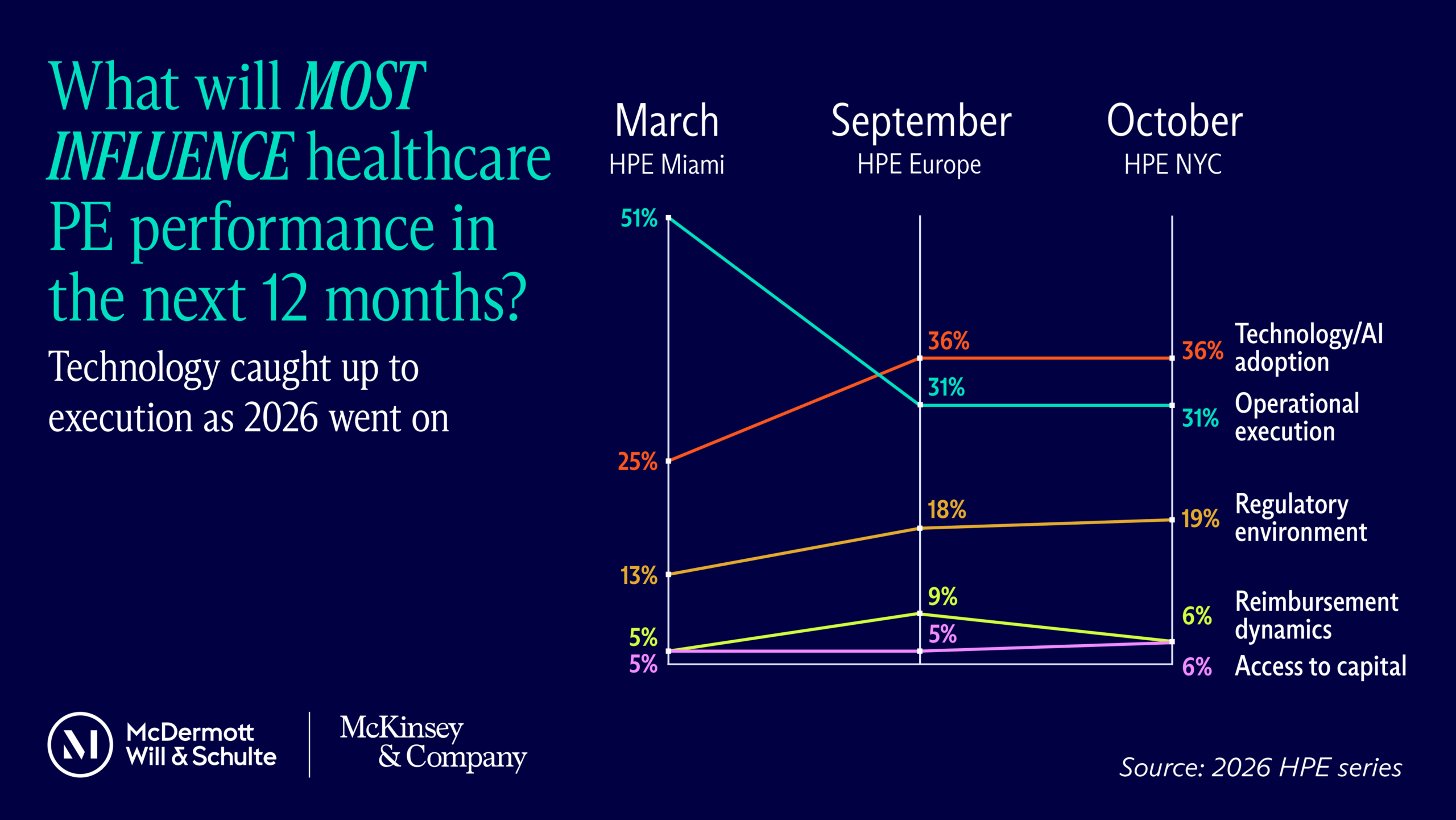
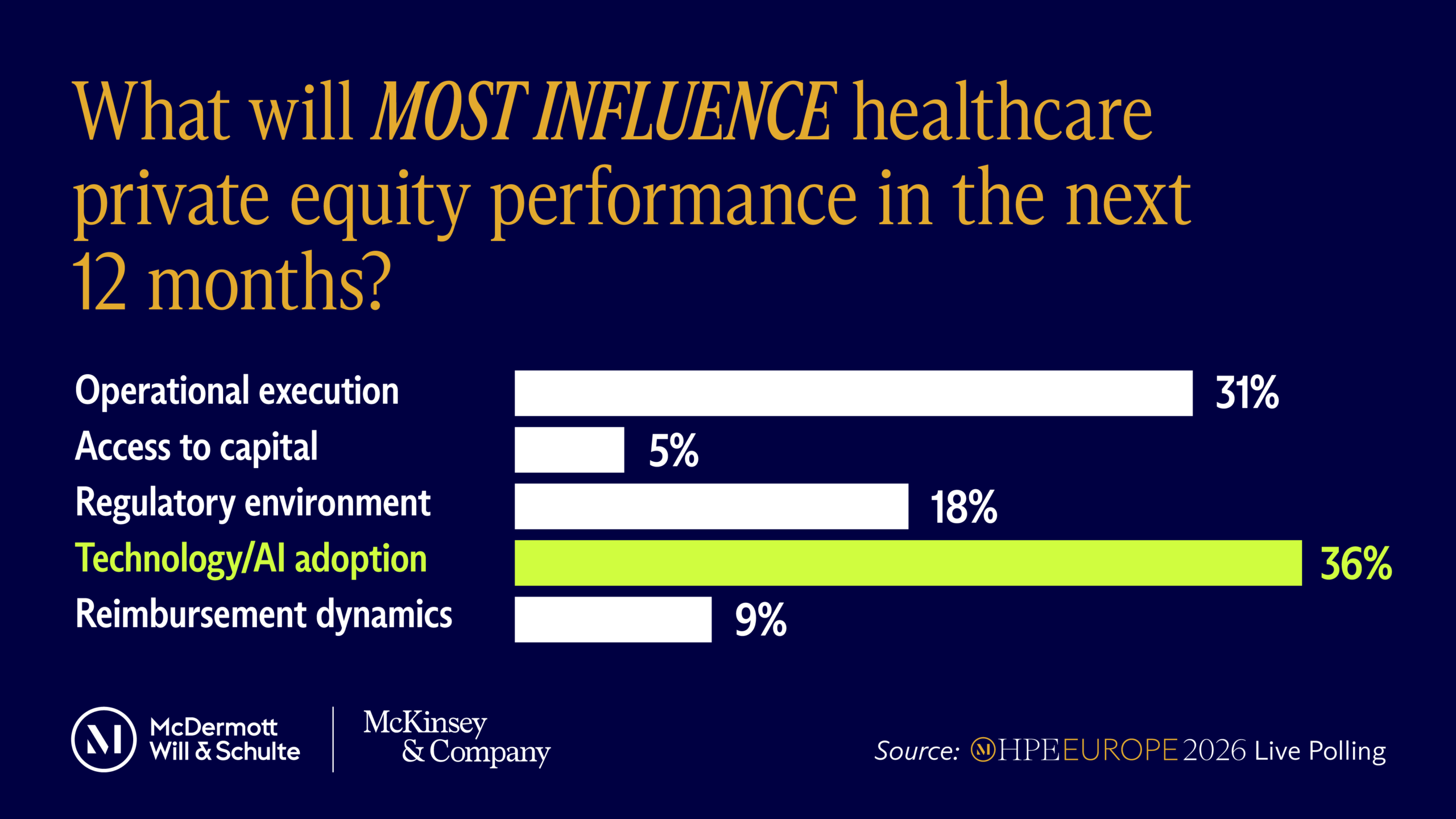
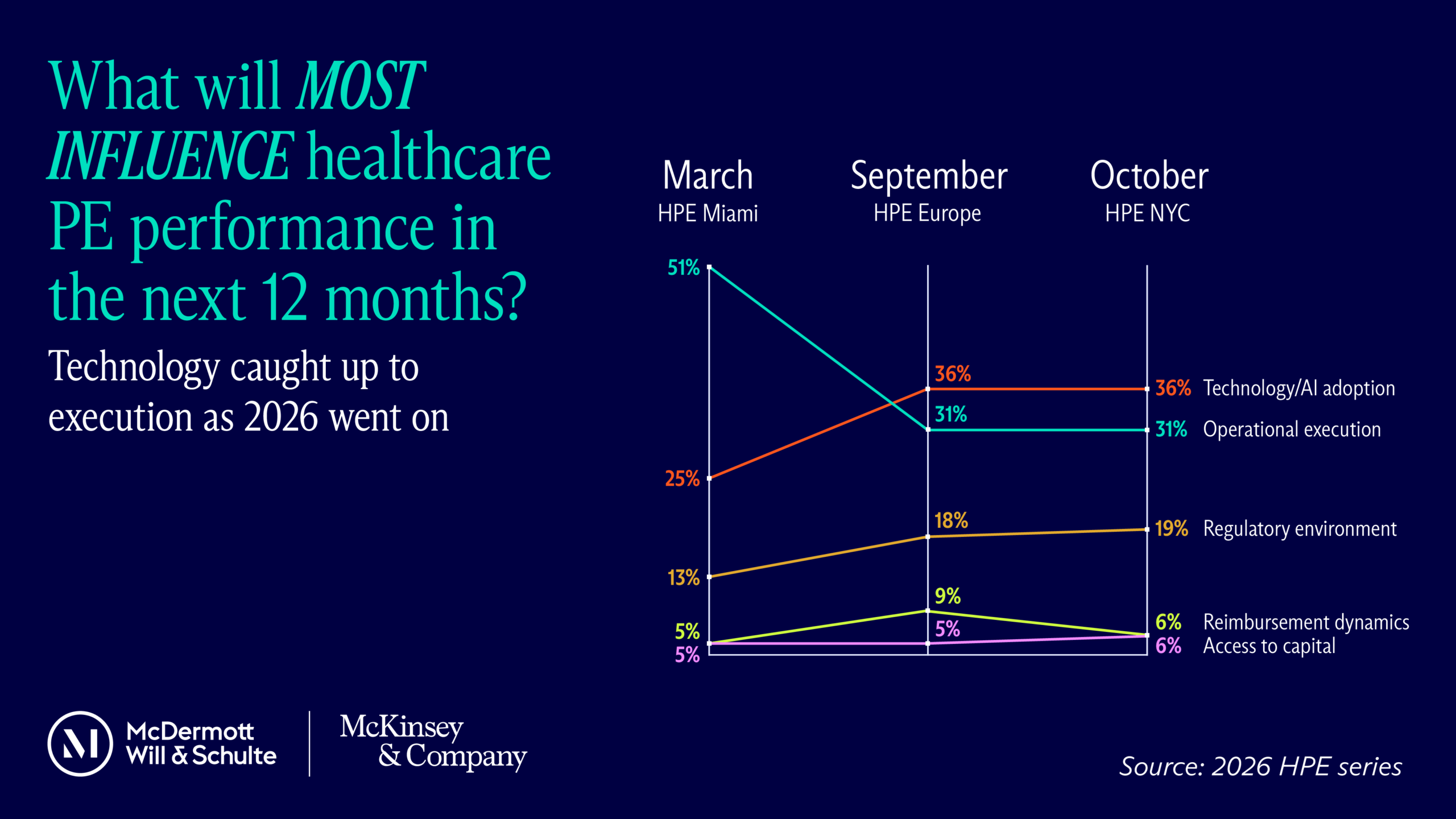
Across the 2026 HPE series, polling sentiment shifted from operational execution as the top influence on PE performance (51% in March) to technology and AI adoption (36% in September and October).
1. Underwrite the value-creation plan before signing
Transaction design matters, and value-creation planning can be one of the most effective ways to ensure earnings and expansion continues throughout the hold period. The most compelling value-creation plans identify timely improvements investors can influence and execute directly. With favorable financing conditions and higher exit multiples less dependable, the value-creation plan should be examined as rigorously as the asset itself. If anticipated returns or improvements depend on new capabilities, contracts, regulatory approvals, or operating changes that cannot realistically be delivered, projected upside may never materialize.
For buy-and-build platforms, expansion can introduce additional costs and complexities and affect expected returns. Acquiring additional businesses does not necessarily create value if management capacity, technology systems, or compliance infrastructure cannot support integration.
Take action: Sponsors should pressure-test key assumptions before signing, identify operational and financial dependencies, and establish a realistic post-close execution roadmap. Operators should demonstrate which initiatives are producing measurable results and build the infrastructure needed to support growth, acquisitions, and expansion needs.
2. Look for sector durability
Sector durability matters as much as a business’s growth potential. Operators in sectors seeing steady demand and more predictable cash flows with favorable reimbursement conditions are commanding returns.
Specialty pharmacy and infusion are prime examples of a subsector seeing incredible tailwinds. Expanding pipelines of complex therapies, recurring patient needs, and the shift toward outpatient and home-based care are supporting investment interest. Pharmaceutical services and technology-enabled healthcare companies are also attracting capital, as demand for specialized capabilities and more efficient care delivery channels creates opportunities for differentiated, scalable business models.
Yet strong market fundamentals can mask risks that may undermine returns. For specialty pharmacy and infusion businesses, access to therapies, payor contracting strategies, patient demand, and reimbursement terms can determine whether projected growth is achievable – and whether the economics of an acquisition hold up after closing.
Take action: Sponsors should test the durability of demand, reimbursement, and cash flow throughout the anticipated hold period and beyond. Operators should demonstrate what drives measurable growth, as well as address any concerns related to customer concentration, reimbursement exposure, and scalability weaknesses before going to market.
3. Make AI prove its value
AI is becoming a growth and scalability conduit across all sectors of the healthcare industry. Early, measurable gains in finance operations, the revenue cycle, human resources, administration, and procurement offer practical starting points. More deeply embedded AI solutions – including those that are customer facing, proven to deliver financial and productivity gains, and available enterprise wide – are also seeing increases in demand and improved efficacy as adoption continues.
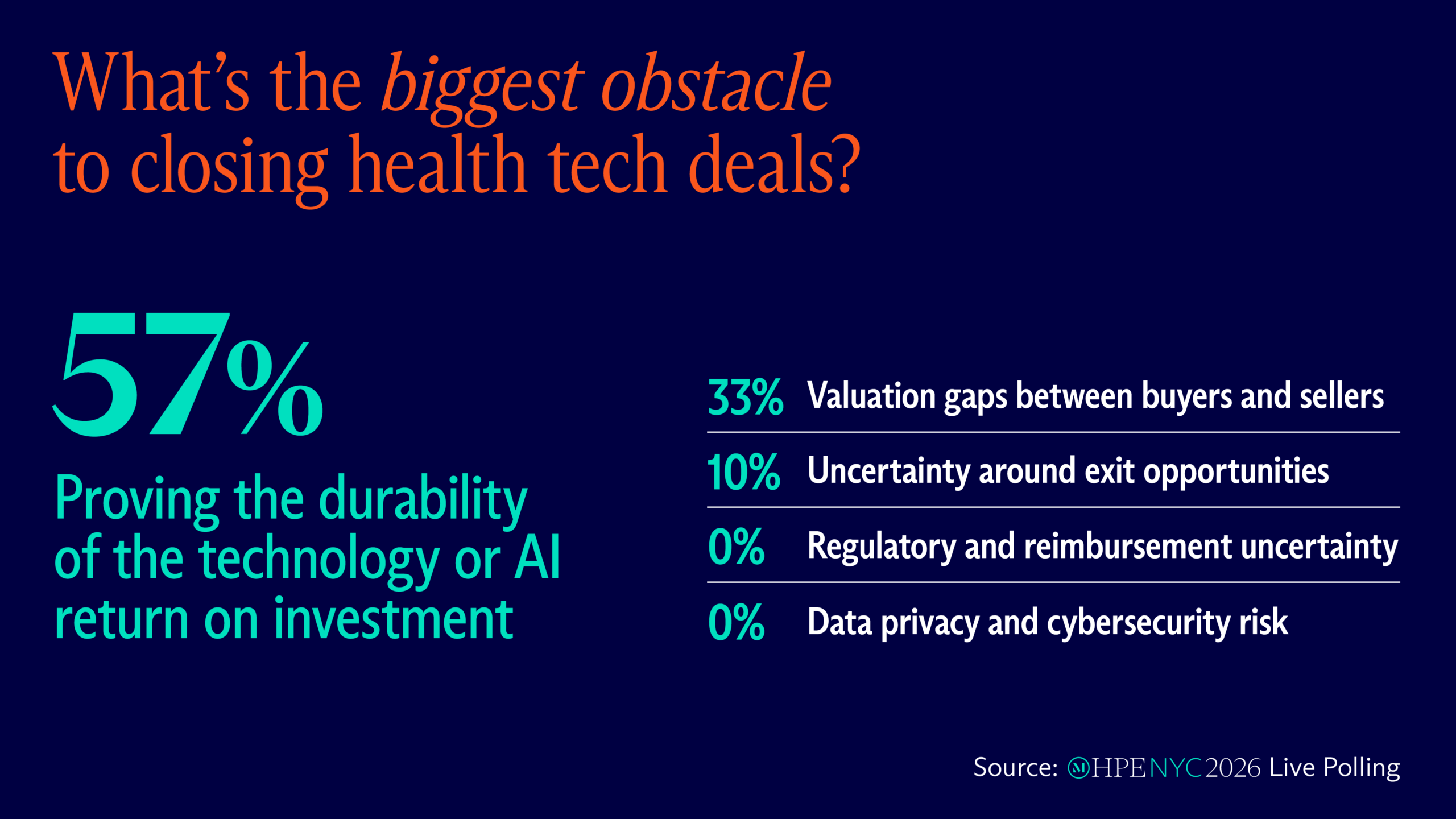
At HPE NYC, 57% of attendees said proving the durability of technology or AI return on investment is the biggest obstacle to closing health tech deals, well ahead of valuation gaps (33%).
But adoption alone does not create value: investors should assess whether those gains are sustainable and whether AI could disrupt the underlying business model. Businesses that depend on labor-intensive processes and services increasingly susceptible to automation may face margin compression or declining valuations. AI-driven opportunities must also be weighed against implementation costs and risks. Companies with defensible assets, established customer relationships, and the ability to pivot as technical requirements change will be better positioned to strengthen competitive advantage.
Take action: Sponsors should demand evidence of measurable AI gains while evaluating disruption risk, data rights, governance models, and regulatory exposure. Operators should connect technology investments to financial outcomes, strengthen governance alongside adoption, and identify where AI could threaten – and strengthen – their competitive position.
4. Rethink strategic partnerships and capital strategies
Creative deal structures and strategic partnerships are becoming increasingly attractive for operators and investors focused on expansion, liquidity, and transaction results – ones that conventional acquisitions may not offer. By aligning interests and combining complementary capabilities, sponsors, sellers, and strategic buyers can unlock value even when valuation expectations differ.
Strategic-PE partnerships, for example, are gaining traction. Corporate buyers may seek access to businesses that sponsors have already developed and de-risked, creating opportunities for collaboration that combines capital, operating experience, and commercial relationships. Health systems may similarly find opportunities to partner with sponsors to expand services or specialized capabilities, although differences in governance and financial priorities can complicate alignment.
Meanwhile, mergers of equals, carve-outs, earn-outs, structured equity, and continuation vehicles offer ways to bridge valuation gaps, build scale, or provide liquidity when conventional transactions are difficult to execute.
Take action: Sponsors should assess potential strategic partners, alternative capital sources, and transaction structures early, including their implications for control, returns, and exit options. Operators should evaluate whether proposed partnerships support their financial and operational objectives while preserving long-term flexibility.
5. Make regulatory and reimbursement diligence part of the investment thesis, not simply validate it
Regulatory and reimbursement expertise can help sponsors identify resilient business models, anticipate changes, and structure investments with greater confidence. Bringing these considerations into the investment thesis early also makes it easier to address challenges such as expanding state transaction oversight, uncertain reimbursement, and longer deal timelines. Drug-pricing reforms, pharmacy benefit manager (PBM) and payor contracting structures, and efforts to shift treatment into lower-cost settings – including in-home care options – are also changing the economics of healthcare investments. Growth strategies that appear attractive today may create new regulatory exposure or require operating changes that affect projected returns.
Take action: Sponsors should bring regulatory and reimbursement analysis forward, translate material findings into valuation and deal terms, and assess how planned expansion could change the risk profile. Operators should identify vulnerabilities before a transaction and ensure their infrastructure can support new markets, services, and acquisitions.
6. Prepare for the exit from the beginning
Sponsors can increase exit optionality by building the qualities future buyers prize: durable earnings, operational discipline, scalable infrastructure, and manageable risk. Planning for those outcomes from acquisition creates a clearer roadmap for management and helps demonstrate progress throughout the hold period, even when buyer demand is uneven.
Take action: Sponsors should establish what a successful exit requires at acquisition, identify potential buyers and exit paths early, and monitor progress against the investment thesis. They should resolve issues likely to surface in buyer diligence. Operators should maintain reliable financial reporting, demonstrate measurable value creation, and address compliance or operational weaknesses well before going to market.
The next phase of healthcare investment: 2027 and beyond
Healthcare private equity continues to offer meaningful opportunities for investors and operators with the means, expertise, and operational foundation to properly execute. Sponsors that combine disciplined underwriting, operational expertise, and creative investment strategies will be well positioned to build resilient businesses that attract capital, realize value at exit, and create long-term value.
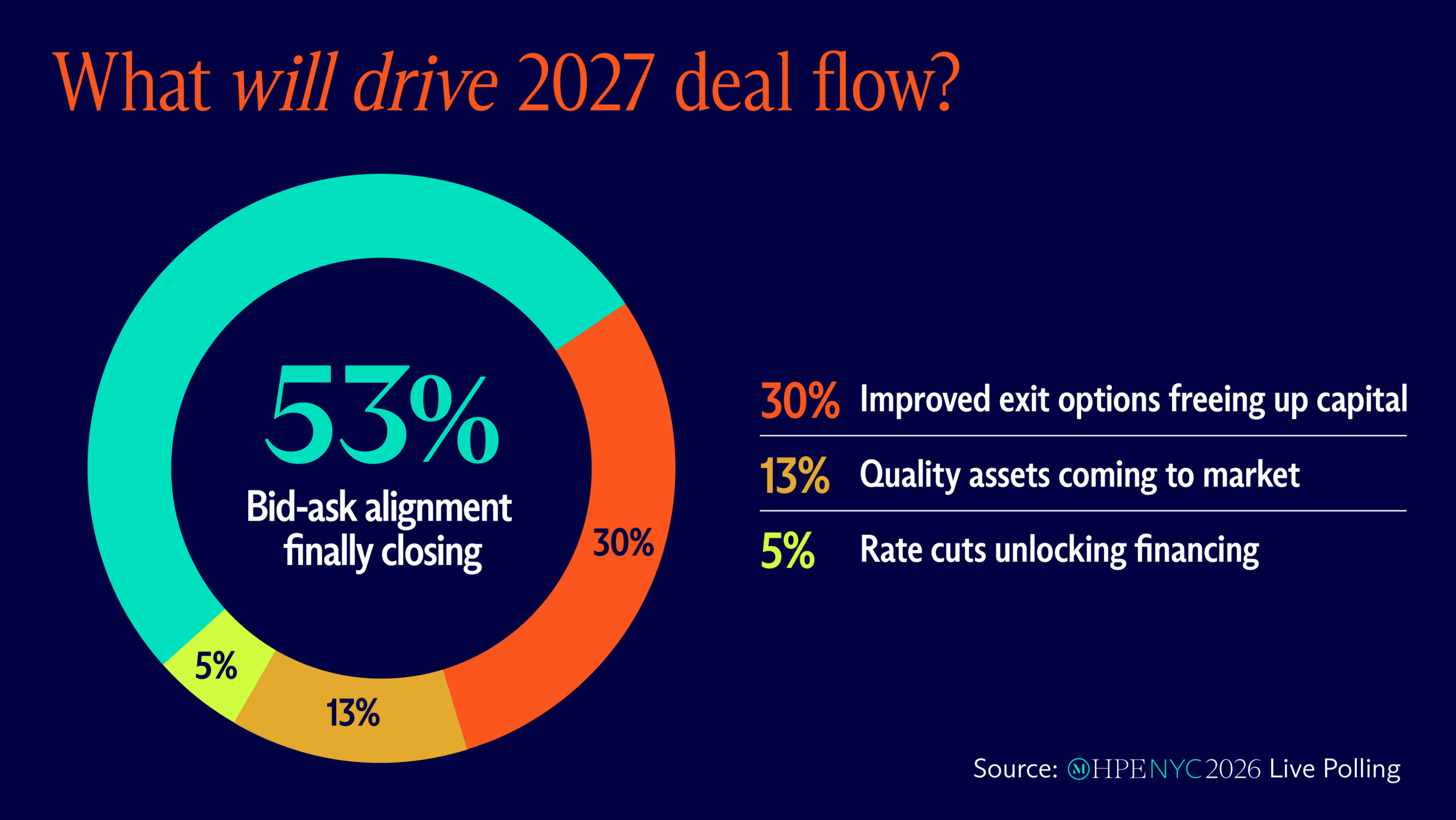
More than half of HPE NYC attendees (53%) expect bid-ask alignment to finally close and drive 2027 deal flow, with improved exit options freeing up capital next at 30%.
Continue the conversation at HPE Miami 2027, March 3 – 4 at The Ritz-Carlton South Beach.

Top healthcare litigation, compliance, and investigation concerns going into 2027
ARTICLE
Top healthcare litigation, compliance, and investigation concerns going into 2027
October 22, 2026
Read time: 6 min
The enforcement and regulatory landscape facing healthcare and life sciences organizations has never been more volatile, or more consequential. During Health Litigation, Compliance, and Investigation Forum 2026 in October, we cut through the noise to offer practitioners and policymakers space to discuss what’s next. Here are ten takeaways from the event.
1. Enforcement is aggressive but increasingly unpredictable under the current administration.
False Claims Act (FCA) enforcement remains “very hot,” with civil investigative demands and subpoenas arriving swiftly. At the same time, the second Trump administration has also introduced significant enforcement unpredictability. Massive turnover at the US Department of Justice (DOJ) has disrupted the trajectory of investigations. Matters can lie fallow for long stretches without resolution, and personnel shakeups might happen mid-case. This uncertainty can create challenges for organizations trying to make decisions about transactions, board communications, and investor relations.
2. The definition of “fraud” is expanding beyond traditional billing and kickback schemes.
Government enforcers are increasingly including nontraditional issues under the “fraud” umbrella, such as diversity, equity, and inclusion; gender-affirming care; and cybersecurity. To assess new certifications and policy changes that can trigger FCA exposure, healthcare organizations must now track a broader and shifting set of enforcement priorities; follow executive orders closely; and mobilize rapid-response teams that include legal, compliance, government relations, and communications.
3. CMS has emerged as a more active and powerful enforcement player, sharing exclusion authority with the OIG.
The Centers for Medicare & Medicaid Services (CMS) is exercising its suspension and revocation authority earlier, more often, and on less complete information. The agency has openly stated a willingness to “act faster with less” and work through mistakes later. CMS also has been granted shared exclusion authority with the Office of Inspector General (OIG), which held that power exclusively for the last three decades. CMS’s expanded role creates significant new complexity in settling FCA matters. Organizations must now seek comfort regarding CMS exclusion risk even when negotiating with DOJ and OIG, because it remains unclear how CMS and OIG will interact on corporate integrity agreements.
4. Data mining and AI play a central role in the government’s identification of enforcement targets.
CMS and OIG meet weekly to review “heat maps” generated from claims data, using artificial intelligence (AI) to process millions of claims daily and flag outliers (e.g., spikes in specific Current Procedural Terminology code utilization). Organizations should proactively monitor their billing data and analyze anomalies quickly. Elevating physician leadership in revenue integrity is also paramount. When the government comes knocking, the ability to promptly and clearly explain why the organization bills certain codes at certain volumes can steer an investigation onto the right track.
5. Effective investigations require early decisions on scope, ownership, and the in-house/outside counsel divide.
Determining whether an investigation is needed, and who should run it, should happen at the outset. Reputational risk and the sensitivity of internal dynamics (e.g., investigating a peer or C-suite member) drive the decision to engage outside counsel. Outside counsel can bring objectivity, especially in politically charged or multi-stakeholder environments. Meanwhile, in-house counsel provides institutional context: company culture, reporting relationships, the “who’s who,” and key subject matter experts. Setting clear expectations on scope, budget, and communication cadence early prevents surprises for both the legal team and the CFO.
6. Privilege should be built, taught, and actively maintained.
Organizations should conduct formal privilege training for executive teams and business stakeholders, not just ad hoc education in the moment. Upjohn warnings should be delivered clearly and documented in interview memos, and they should name all individual counsel in the room, both inside and outside, rather than simply naming the law firm. Work product doctrine requires a substantial and significant threat of litigation. The general counsel/CCO dual-hat structure can create privilege and personal-liability risks.
7. Compliance programs should be operationalized, not just documented.
A compliance program that lives in a binder on a shelf is a fictitious program. True effectiveness requires understanding the business deeply, integrating compliance into workflows, and following through on corrective action promptly. Audit functions that identify problems but never fix them can be dangerous, because they may demonstrate to the government that an organization knew about a problem and did nothing. Private equity sponsors are increasingly being targeted for exactly this pattern: identifying diligence findings, sitting on boards, and taking no corrective action.
8. Compliance should be a strategic enabler, not a “no” function.
When compliance is perceived as the department that always says no, the business often finds workarounds, and a culture of mistrust can take root. Effective compliance leaders position themselves as business partners who help find the path to “yes” by understanding the business objectives and integrating compliance into decisions early. Compliance can be a tool for creating and protecting enterprise value, including deal multiples, not just a cost center. The most effective compliance professionals combine legal or clinical training with deep business understanding, enabling them to issue-spot and partner strategically.
9. AI is ubiquitous and can create liability the organization ultimately owns.
Use of AI tools, including ambient scribes, claims-processing algorithms, and even workforce members copying and pasting protected information into ChatGPT, is already pervasive in healthcare. From a litigation and enforcement perspective, the organization is responsible for AI output just as it is for a human employee’s work. “We didn’t know how the tool worked” is not a defense. Key risk areas include anything that touches money, hiring and human resources, or patient care. Effective governance requires a multidisciplinary committee, approved-tool inventories, technical blocking of unapproved tools, contract re-review to catch AI add-ins in existing vendor agreements, and stratified risk assessment based on reversibility (e.g., incorrectly scheduling an appointment versus discarding an embryo based on a flawed predictive model).
10. AI risk creates new uncertainty in insurance, vendor liability, and regulatory patchwork challenges.
Cyber insurance is new and not designed to absorb AI-related professional liability risk, yet vendors routinely demand to be added to cyber policies without understanding the mismatch. Organizations should proactively work with brokers on AI-specific coverage questions and be careful about representations made during policy renewals (e.g., attesting that no AI was used when a third party used it on an organization’s behalf). Meanwhile, AI regulation is emerging primarily at the state level, creating a patchwork of varying rules. Multi-state organizations face the difficult task of determining which state laws apply, and definitions are often unclear. Vendor data-use terms have grown more creative, with increasing demands for de-identified, aggregated, or “feedback” data rights that carry significant downstream privacy and intellectual property risk, making data governance a first-order concern in any AI contracting review.










EXPO REAL 2026: A reflection point
ARTICLE
EXPO REAL 2026: A reflection point
October 21, 2026
Read time: 8 min
While EXPO REAL 2026 did not signal any dramatic shift in sentiment to deliver short-term adrenalin to the market, it still illustrated the depth and size of the industry and its ability to evolve.
That the event drew 42,000 attendees from 74 countries shows that the industry is ready to do business – with a mindset driven by realism and pragmatism.
This approach indicates that the industry no longer views geopolitical instability, climate change, and uncertainty around the impacts of AI as short-term pains before a return to the predictable market of the past – but as an enduring reality that must be embraced, priced, and managed as a condition of doing business effectively in the future.
The Enduring Power Connection
We dubbed EXPO REAL 2025 ‘a time to get personal’. Our verdict from the 2025 conference was that personal connection and trust were the bedrock of investment, and that understanding your partners cannot be outsourced or automated.
Feedback from EXPO 2026 continued to endorse this sentiment – in short, more of the same. Feedback was unequivocal: “This isn’t actually a bad market, but it’s definitely a complicated one.” People want (and need) to do deals, but ever-present macro headwinds, pricing gaps, and longer timelines make deal execution more challenging.
The solution was universally lauded: You deal with complexity through a return to familiarity, proven structures, and assets that investors know inside out. With infrastructure now centre stage, the message was simple: everything is connected.
‘Everything’ does not mean that the coalescence of infrastructure and real estate into a real assets strategy is confined to data centers, even with the AI-fuelled explosion of interest in this asset class. ‘Everything’ really does mean everything: Real estate development and investment cannot exist without infrastructure, and the recognition of infrastructure as a key participant within the halls at EXPO 2026 is very welcome as a sign of increasingly holistic recognition of that fact across all asset classes.
Residential remains attractive, but with an emphasis on viability and affordability
Within that ‘return to familiarity’ mantra, two familiar faces were in the spotlight this year: retail, on a positive trajectory, and private residential, as present as ever.
Residential continues to benefit from long-term demand drivers, including constrained supply in many major European cities and structural demand associated with demographic change.
The investment proposition, however, is not uniform across Europe and the UK. The scale of investment required can also vary significantly between the UK and individual EU markets, with implications for project feasibility, financing options, and overall returns.
A residential strategy that relies on undersupply should therefore be tested against the legal conditions that determine whether supply can actually be delivered. This includes land-use restrictions, affordable housing obligations, infrastructure contributions, construction procurement risk, and restrictions on rent setting or lease termination.
However, the biggest influence on performance in this sector is the impact of high inflation and a constrained labour market on construction costs. As an investor put it: “Land value accounts for 5% – 10% of overall project costs; certainty on construction cost changes the needle.” Without that certainty, investors face volatility on exit yields and reduced confidence, leading to a reduced pipeline despite the compelling driver of undersupply. This uncertainty cannot be approached on a thematic basis and requires granular, city-by-city market analysis. Capital will need to work harder and smarter to deliver an acceptable return.
Retail back in favor
Retail has spent a sustained period in the wilderness in certain investment circles, yet in Munich it was firmly back on the agenda.
In this complex and dislocated market, there was plenty of talk in the halls and restaurants of Munich about deals ‘feeling too forced or overstructured’, and about an over-reliance on fashionable ‘new’ asset classes as investors and managers chase returns in untapped markets. Against that backdrop, investors, and, particularly, the new wave of capital coming into Europe for the first time, want something they can understand. The message was clear: retail can deliver that clarity.
Of course, the retail story requires nuance. Retail interest will stay focused on prime assets backed by high-quality tenants, and on retail warehouse parks in well-located, well-connected areas – which brings us back, once again, to connection and the importance of the right locations, the right tenants, and the right partners.
Office and logistics: Improved outlook?
These asset classes remain hugely significant, and barometers of investor confidence.
Within offices, occupier demand continues to manifest itself in rental growth for prime offices. Investment volumes are increasing and, within the UK market, will be tested with a number of trophy sales recently launched in the market.
The bid-ask spread remains wide, with rental growth set against high debt costs. Comfort can be taken in the continued appetite for brown-to-green funds designed to take advantage of mispriced assets and liquidity pressures. Q4 2026 – Q1 2027 will be a true test of the market temperature.
In the logistics sector, further yield compression is unlikely, and it is predicted that there will be some valuation pressure on older assets. Despite this, the sector continues to evolve and bifurcate creatively, with the rise of industrial open storage and increased automation likely to drive future allocations.
Facing the headwinds with a new mindset: The outlook for three key markets
Across Europe, investors now face a market defined by repriced assets, constrained development pipelines, uneven liquidity, and persistent structural demand in selected sectors. The result is not a return to the pre-rate-rise investment model. It is a more discriminating market in which reliable income, operational capability, regulatory readiness, and unconditional access to power and other critical infrastructure increasingly determine whether an asset is investable and capable of sustaining value.
Germany remains a major institutional market, but transaction activity is selective and investor sentiment remains cautious in particular for high street retail properties. With regard to the office sector, EXPO REAL showcased some renewed interest in high-quality investment opportunities in selected core markets, namely Hamburg, Munich, and Berlin, as well as in Düsseldorf and Cologne. Repriced core assets may offer predictable cash flows, while value-add strategies may benefit from cyclical weakness and changing demand patterns. At the same time, reduced participation by certain domestic capital sources may create openings for international investors able to move with discipline.
The UK continues to offer market depth, transparent transaction processes, and a broad range of sector opportunities. Yet investors should not assume that the UK and continental Europe can be approached through a single underwriting model. Differences in leasing practices, planning systems, tax treatment, security structures, insolvency regimes, and regulatory expectations can materially affect risk allocation and execution.
Italy is attracting renewed interest from investors, supported by a relatively stable political environment and improving market confidence. Logistics and hospitality remain among the most attractive asset classes, while data centres are increasingly drawing investor attention. Although planning and permitting uncertainties have posed significant challenges to development projects, recent regulatory initiatives offer grounds for cautious optimism, particularly in the data centre sector.