Content Type: Article

  • 2022 IP Outlook Report: The Developments Shaping Trademark Law

    2022 IP Outlook Report: The Developments Shaping Trademark Law

    ARTICLE / REPORT

    2022 IP Outlook Report: The Developments Shaping Trademark Law

    February 15, 2022

    Read time: 2 min

    Overview

    While Gen Z taught us all on TikTok how not to be “cheugy,” or out of touch with pop culture, similarly, trademark law in 2021 ushered in new and changed regulations, provided further guidance on traditional legal concepts and gave us a peek into how brands may help shape the future in the “metaverse”—and beyond. Trademarks (like Gen Z), keeping us all hip.

    In depth
    Tabs

    Sarah Bro

    Partner

    Orange County, Los Angeles

    Eleanor B. Atkins

    Partner

    Washington, DC

    Joshua Revilla

    Associate

    Washington, DC

    More insights
    Endnotes

  • New for 2022: More COVID-19 Supplemental Paid Sick Leave for California Employees

    New for 2022: More COVID-19 Supplemental Paid Sick Leave for California Employees

    ARTICLE / CLIENT ALERT

    New for 2022: More COVID-19 Supplemental Paid Sick Leave for California Employees

    February 14, 2022

    Read time: 13 min

    Key takeaways
    Overview

    On February 9, 2022, California Governor Gavin Newsom signed SB-114 into law to reimplement a version of California’s COVID-19 Supplemental Paid Sick Leave. This 2022 version of California’s COVID-19 Supplemental Paid Sick Leave is similar but not identical to the 2021 leave of the same name.

    As we previously detailed in our client alert, “California to renew COVID-19 supplemental paid sick leave for 2022,” the 2022 version of California’s COVID-19 Supplemental Paid Sick Leave obligations affects employers with more than 25 employees. The law takes effect on February 19, 2022, and will apply retroactively from January 1, 2022 through September 30, 2022. Below is an in-depth FAQ regarding what the new 2022 COVID-19 Supplemental Paid Sick Leave requires for California employers and employees.

    In depth

    What are the reasons an employee can take 2022 COVID-19 Supplemental Paid Sick Leave?

    An employer shall provide COVID-19 Supplemental Paid Sick Leave to each covered employee if that covered employee is unable to work or telework due to any of the following reasons:

    1. Quarantine/Isolation:
      1. The covered employee is subject to a quarantine or isolation period related to COVID-19 as defined by an order or guidance of the California Department of Public Health (CDPH), the federal Centers for Disease Control and Prevention (CDC) or a local public health officer who has jurisdiction over the workplace. If the covered employee is subject to more than one of the foregoing, the covered employee shall be permitted to use COVID-19 Supplemental Paid Sick Leave for the minimum quarantine or isolation period under the order or guidance that provides for the longest such minimum period.
      2. The covered employee has been advised by a healthcare provider to isolate or quarantine due to COVID-19.
      3. The covered employee is caring for a family member who is subject to an order or guidance or who has been advised to isolate or quarantine, as described in the items above.
    2. Vaccination:
      1. The covered employee is attending an appointment for themselves or a family member to receive a vaccine or a vaccine booster for protection against COVID-19.
      2. The covered employee is experiencing symptoms, or caring for a family member experiencing symptoms, related to a COVID-19 vaccine or booster that prevent the employee from being able to work or telework.
      3. For each vaccination or booster, an employer may limit the total COVID-19 Supplemental Paid Sick Leave to three days or 24 hours unless the employee provides verification from a healthcare provider that the covered employee or their family member is continuing to experience symptoms related to a COVID-19 vaccine or booster. The three-day or 24-hour limitation applied to each vaccine or vaccine booster includes the time used to get the vaccine or vaccine booster.
    3. Symptoms:
      1. The covered employee is experiencing symptoms of COVID-19 and seeking a medical diagnosis.
    4. Childcare:
      1. The covered employee is caring for a child whose school or place of care is closed or otherwise unavailable for reasons related to COVID-19 on the premises.

    What is a “child” or “family member”?

    For purposes of this leave:

    “Child” means a biological, adopted, or foster child, stepchild, legal ward or a child to whom the employee stands in loco parentis regardless of age or dependency status of the child.

    “Family member” means any of the following:

    • A child;
    • A biological, adoptive, or foster parent, stepparent or legal guardian of an employee or the employee’s spouse or registered domestic partner, or a person who stood in loco parentis when the employee was a minor child;
    • A spouse;
    • A registered domestic partner;
    • A grandparent;
    • A grandchild; or
    • A sibling.

    How much paid sick leave are California employees entitled to take under the new 2022 COVID-19 Supplemental Paid Sick Leave?

    The amount provided depends on whether the employee is full-time, part-time or a firefighter, and whether the employee provides proof of COVID-19 for themselves or a family member.

    INITIAL BANK OF PAID SICK LEAVE: NO PROOF OF POSITIVE COVID-19 TEST REQUIRED

    1. Employees who (a) are considered by the employer to be “full time” or (b) worked or were scheduled to work, on average, at least 40 hours per week in the two weeks preceding the date the employee took the COVID-19 Supplemental Paid Sick Leave receive:
      1. Up to 40 hours of flexible paid leave for full-time workers who are sick or caring for an ill loved one.
    2. Employees who are part-time/do not work on average at least 40 hours per week (in the two weeks before taking the leave) and are not firefighters receive the following:
      1. If the covered employee has a normal weekly schedule, the total number of hours the covered employee is normally scheduled to work for the employer over one week.
      2. If the covered employee works a variable number of hours, seven times the average number of hours the covered employee worked each day for the employer in the six months preceding the date the covered employee took COVID-19 supplemental paid sick leave. (If the covered employee has worked for the employer over a period of fewer than six months but more than seven days, this calculation shall instead be made over the entire period the covered employee has worked for the employer.)
      3. If the covered employee works a variable number of hours and has worked for the employer over a period of seven days or fewer, the total number of hours the covered employee has worked for that employer.
    3. Employees who are firefighters scheduled to work more than 40 hours for the employer in one workweek preceding the date the covered employee took COVID-19 Supplemental Paid Sick Leave receive an amount equal to the total number of hours that the covered employee was scheduled to work for the employer in that workweek.

    ADDITIONAL BANK OF PAID SICK LEAVE: PROOF OF POSITIVE COVID-19 TEST REQUIRED

    In addition to the amount of paid sick leave noted above, the employee is entitled to additional COVID-19 Supplemental Paid Sick Leave in an amount not to exceed that which the covered employee was entitled above, if the covered employee or a family member for whom the covered employee is providing care, tests positive for COVID-19. In other words, the employee may double their paid sick leave entitlement (for full-time employees, this means up to 80 hours total of paid sick leave).

    To access this additional bank of COVID-19 Supplemental Paid Sick Leave, proof of COVID-19 is required as follows:

    • If the employee tested positive for COVID-19, an employer may require the employee to submit to a diagnostic test on or after the fifth day after the initial positive COVID-19 test was taken and provide documentation of those results. The employer shall make such a test available at no cost to the employee.
    • If the employee requests to use this additional leave because a family member for whom they are providing care tests positive for COVID-19, the employer may require that the employee provide documentation of that family member’s test results before paying the additional leave.

    While the employer must provide the initial bank of paid sick leave without proof of COVID-19 (i.e., 40 hours for a full-time employee, less for a part-time employee), the employer has no obligation to provide this additional COVID-19 Supplemental Paid Sick Leave under this subparagraph for an employee who refuses to provide documentation of the results of the test noted above upon the request of the employer.

    The employee does not need to exhaust the initial bank of leave to which they are entitled before using this additional leave.

    Does the employee have to provide advance and/or written notice prior to taking COVID-19 Supplemental Paid Sick Leave?

    For the first 40 hours (or first half of leave entitlement for non-full-time employees), the employer must make COVID-19 Supplemental Paid Sick Leave available for immediate use by the covered employee upon the oral or written request of the covered employee to the employer.

    For use of the second half of leave entitlement (up to an additional 40 hours for full-time employees), additional documentation may be required by the employer; see the Q&A above for more details.

    Can an employer require a covered employee to use their COVID-19 Supplemental Paid Sick Leave first, before using other paid leave banks or entitlements? Can an employer require a covered employee another type of leave (paid or unpaid) before using their COVID-19 Supplemental Paid Sick Leave?

    Generally, no—the employee has the right to choose which type of leave(s) they use and in which order.

    An employer must not require a covered employee to first exhaust their COVID-19 Supplemental Paid Sick Leave under this section before satisfying any requirement to provide paid leave for reasons related to COVID-19, such as under the Cal/OSHA COVID-19 Emergency Temporary Standard, including, but not limited to, Sections 3205 to 3205.4, inclusive, of Title 8 of the California Code of Regulations or the Cal/OSHA Aerosol Transmissible Diseases Standard at Section 5199 of Title 8 of the California Code of Regulations.

    Note: This is different from the 2021 version of this COVID-19 Supplemental Paid Sick Leave that expired on September 30, 2021, which version provided: “in order to satisfy the requirement to maintain an employee’s earnings when an employee is excluded from the workplace due to COVID-19 exposure under the Cal-OSHA COVID-19 Emergency Temporary Standards at Sections 3205 through 3205.4, inclusive, of Title 8 of the California Code of Regulations or the Cal-OSHA Aerosol Transmissible Diseases Standard at Section 5199 of Title 8 of the California Code of Regulations, an employer may require a covered employee to first exhaust their COVID-19 supplemental paid sick leave under this section.” (emphasis added)

    In addition, under this 2022 version, an employer may not require a covered employee to use other paid or unpaid leave, paid time off or vacation time provided by the employer to the covered employee before that employee uses COVID-19 Supplemental Paid Sick Leave or in lieu thereof, except in certain circumstances in which the employer provides another supplemental benefit for leave for COVID-19, as prescribed.

    Should the 2022 COVID-19 Supplemental Paid Sick Leave be displayed on the employee’s wage statement?

    Yes, COVID-19 supplemental paid sick leave must be set forth on the wage statement, and it must be set forth separately from the regular California paid sick days.

    Specifically, under the new law, the employer must provide an employee with written notice that sets forth the amount of COVID-19 supplemental paid sick leave that the employee has used through the pay period in which it was due to be paid on either the employee’s itemized wage statement or in a separate writing provided on the designated pay date with the employee’s payment of wages. The employer must list zero hours used if a worker has not used any COVID-19 supplemental paid sick leave.

    This wage statement requirement is not enforceable until the next full pay period following the date that this law takes effect.

    What is the proper rate of pay to compensate an employee taking COVID-19 Supplemental Paid Sick Leave?

    Each hour of COVID-19 Supplemental Paid Sick Leave must be compensated at a rate equal to the following, subject to a cap of $511 per day and $5,110 in the aggregate:

    • For a non-exempt employee, either:
      • Calculated in the same manner as the regular rate of pay for the workweek in which the employee uses the paid leave; or
      • Calculated by dividing the employee’s total wages, not including overtime premium pay, by the employee’s total non-overtime hours worked in the full pay periods occurring within the prior 90 days of employment; provided that, for non-exempt employees paid by piece rate, commission or other method that uses all hours to determine regular rate of pay, total wages, not including overtime premium pay, shall be divided by all hours, to determine the correct amount of leave.
    • For exempt employees, calculated in the same manner as the employer calculates wages for other forms of paid leave time.
    • For firefighters, each paid leave hour shall be compensated at the regular rate of pay to which the employee would be entitled as if the employee had been scheduled to work those hours, pursuant to existing law or an applicable collective bargaining agreement.

    An employee may utilize other paid leave that is available to the employee to fully compensate the employee for leave taken, to the extent the time taken under this leave caps the employee below their full compensation rate. The caps stated above are subject to adjustment if the federal dollar caps applicable to the federal Families First Coronavirus Response Act are increased.

    How does this 2022 COVID-19 Supplemental Paid Sick Leave interact with other paid sick leaves like California’s paid sick leave under Labor Code Section 246, local required paid sick leaves or employer-provided paid sick leaves intended for this purpose?

    The 2022 COVID-19 Supplemental Paid Sick Leave is an additional paid leave, separate and in addition to California employer obligations to provide paid sick leave pursuant to Labor Code Section 246.

    However, if an employer pays an employee another supplemental benefit for leave taken on or after January 1, 2022, that is payable for the reasons enumerated in this law and that compensates the employee at least as much as required under this law, then the employer may count the hours of those other paid benefits or leaves toward the total number of hours of COVID-19 Supplemental Paid Sick Leave that the employer is required to provide to an employee under this law, including paid leave provided by the employer pursuant to any federal or local law in effect or that may become effective on or after January 1, 2022.

    How does the retroactive feature of this law work? Do employers have to automatically pay any amounts owed, or does the employee have to request it?

    In sum, the employee must request the payment.

    For any covered leave taken on or after January 1, 2022, but before the effective date of this law, if the employer did not compensate the employee in an amount equal or greater than the amount of compensation for COVID-19 Supplemental Paid Sick Leave to which the employee is entitled under the law, then upon the oral or written request of the employee, the employer shall provide the retroactive payment providing for such compensation on or before the payday for the next full pay period after the employee’s request.

    For any such leave taken where the employee was compensated in an amount equal or greater to the amount the employee would have been entitled under the COVID-19 Supplemental Paid Sick Leave law, then upon oral or written request of the employee, such employee should be credited for any leave hours used for COVID-specific leave purposes, and the employer should be credited for providing those hours as COVID-19 Supplemental Paid Sick Leave in the next wage statement.

    What happens if an employee is in the middle of taking COVID-19 Supplemental Paid Sick Leave when it expires on September 30, 2022?

    An employee taking this leave at the time of expiration of this law shall be permitted to take the full amount of the paid leave to which that employee would otherwise have been entitled to under the law.

    * * *

    At the time of this article, the state has not yet issued any FAQs regarding further interpretation of the law; however, it is expected that further guidance will be forthcoming.

    If you have any questions, please reach out to your McDermott Will & Emery lawyer.

    Authors
    More insights

  • SEC Proposes New Rules for Private Fund Advisers

    SEC Proposes New Rules for Private Fund Advisers

    ARTICLE / CLIENT ALERT

    SEC Proposes New Rules for Private Fund Advisers

    February 14, 2022

    Read time: 6 min

    Key takeaways
    Overview

    US Securities and Exchange Commission (SEC) Chairman Gary Gensler has ramped up an aggressive regulatory agenda that zeroes in on advisers to private funds. On February 9, 2022, the SEC commissioners approved several proposed rules under the Investment Advisers Act of 1940 (the Proposed Rules) which, if passed, would have significant effects on the operation of private funds. The Proposed Rules will include new requirements for investor quarterly statements, private fund audits, adviser-led secondaries, side letter practices and annual reviews, and the outright prohibition of certain activities. Several of the Proposed Rules will also apply to investment advisers not registered with the SEC, including venture capital fund advisers, smaller private fund advisers and many non-US advisers.

    Below is a summary of the significant changes under the Proposed Rules. Comments to the Proposed Rules are due on the later of (a) 30 days after the Proposing Release is published in the Federal Register or (b) April 11, 2022.

    In depth

    PROHIBITED ACTIVITIES

    Under the Proposed Rules, advisers to private fund managers (including SEC-registered and unregistered advisers) would be subject to the following:

    • Carried interest or incentive fee clawback requirements cannot be reduced by tax distributions;
    • Advisers cannot seek reimbursement, indemnification, exculpation or limitation of liability by the private fund or its investors for a breach of fiduciary duty, willful misfeasance, bad faith, negligence or recklessness in providing services to the private fund;
    • Advisers cannot charge private funds for certain accelerated monitoring fees and similar unearned fees and regulatory and compliance expenses of the adviser (including for SEC examinations and investigations);
    • Advisers cannot borrow from a private fund; and
    • Advisers cannot charge or allocate fees and expenses related to a portfolio investment (or potential portfolio investment) on a non-pro rata basis among multiple private funds and other clients.

    Some of prohibited activities appear to be items the SEC and its staff have highlighted in past OCIE risk alerts, while others represent a significant departure from negotiated market terms in the private fund industry.

    PREFERENTIAL TREATMENT: SIDE LETTER PRACTICE

    SEC-registered and unregistered advisers, if providing preferential treatment for certain investors through side letters or otherwise, would be required to:

    • Disclose to investors prior to investing in a private fund any preferential treatment the adviser provides to any other investor; and
    • Annually provide disclosure of such treatment to all investors.

    Advisers to private funds would be prohibited from providing preferential terms to certain investors in connection with fund withdrawals/redemptions and current portfolio/investment holding information if the adviser reasonably expects that providing the information would have a material, negative effect on other investors.

    QUARTERLY STATEMENTS

    The Proposed Rules would require SEC-registered investment advisers to prepare a quarterly statement that includes certain information regarding fees, expenses and performance for any private fund that it advises; advisers would have to distribute the quarterly statement to the private fund’s investors within 45 days after the end of each calendar quarter. While most private funds may already follow quarterly reporting practices, the Proposed Rules would require the report to be presented in a specific manner, such as requiring:

    • A fee and expense table which includes:
      • Compensation, fees and other amounts allocated or paid to the adviser or any of its related persons by the private fund during the reporting period (e.g., management, advisory, sub-advisory, or similar fees or payments, and performance-based compensation);
      • All fund fees and expenses paid by the private fund during the reporting period (e.g., organizational, accounting, legal, administration, audit, tax, due diligence and travel expenses); and
      • The amount of any offsets or rebates carried forward during the reporting period to subsequent quarterly periods to reduce future payments or allocations to the adviser or its related persons.
    • A table with detailed accounting of all compensation allocated or paid to the adviser or its related persons by each portfolio company, including origination, management, consulting, monitoring, servicing, transaction, administrative, advisory, closing, disposition, directors, trustees, or similar fees or payments.
    • Specific performance information and metrics, which are different for liquid and illiquid private funds.

    REQUIRED FAIRNESS OPINIONS FOR SPONSOR-LED SECONDARY TRANSACTIONS

    Under the Proposed Rules, any sponsor/adviser-led secondary transaction of private fund interests would require an SEC-registered adviser to obtain a fairness opinion from a third-party firm. The adviser must also prepare and distribute to the private fund investors a summary of any material business relationships the independent opinion provider has or has had within the past two years with the adviser or any of its related persons.

    REQUIRED PRIVATE AUDITS AND SEC REPORTING BY AUDITOR

    Although most private funds distribute audited financial statements to investors pursuant to Rule 206(4)-2 under the Advisers Act (the custody rule), the Proposed Rules would mandate that all private funds managed by SEC-registered advisers be subject to a financial statement audit. More importantly, the auditor would be required to notify the SEC promptly upon the auditor’s termination or issuance of a modified opinion.

    The SEC’s press release and the proposing release are available at the following link: https://www.sec.gov/news/press-release/2022-19


    The Investment Funds Group at McDermott is a global leader in representing investment fund sponsors and institutional investors and provides sophisticated counsel to its clients across the full spectrum of investment fund issues and transactions. The Investment Funds Group is embedded in McDermott’s global private equity practice with attorneys who serve as lead counsel to institutional investment funds and investors through their full lifecycle. The individuals below can assist or can refer you to one of our many other lawyers who can help with a specific question:

    Ian Schwartz, Min Lee, Erica Moscarello and David Nestler

    Authors
    More insights

  • An Overview of OECD Pillar 2

    An Overview of OECD Pillar 2

    ARTICLE / CLIENT ALERT

    An Overview of OECD Pillar 2

    February 14, 2022

    Read time: 15 min

    Key takeaways
    Overview

    The Organisation for Economic Co-operation and Development (OECD)/G20 Global Anti-Base Erosion (GloBE, Pillar 2) Model Rules, published in December 2021, intend to address perceived challenges to long-standing international taxation principles from the increasing digitalization of the economy. If implemented, these rules (Model Rules) would significantly impact the taxation of multinational groups, introducing new complexity to international taxation and nullifying the benefit of tax incentive regimes employed by many countries to attract foreign investment.

    Addressing the tax challenges raised by digitalization has been a priority of the OECD/G20 Inclusive Framework on base erosion and profit shifting (BEPS) since 2015. Inclusive Framework members agreed to examine proposals in the two pillars forming the basis for a long-term solution to these tax challenges. In mid-2019, a program of work to be conducted on Pillars 1 and 2 was adopted and finally endorsed by the G20 finance ministers in July 2021. As of 4 November 2021, 137 OECD/G20 countries and jurisdictions—out of the 140 members of the OECD/G20 Inclusive Framework on BEPS—representing more than 90% of global gross domestic product (GDP) agreed to join the official statement of the Two-Pillar Solution. Pillar 1 foresees reallocating international taxing rights and stabilizing the international system of tax law. Pillar 2, which was introduced jointly by the (at that time) Vice Chancellor and Finance Minister of Germany Olaf Scholz and his French counterpart Bruno Le Maire, imposes a global minimum 15% tax rate for certain multinational enterprises (MNEs) from 2023 onwards.

    The OECD illustrated the most relevant aspects of Pillar 2 in a blueprint published in 2020. The Model Rules published in December 2021 add significant detail but offer limited indication as to how the rules might apply in practice. A commentary on the Model Rules to be published in the first quarter of 2022 is expected to provide additional guidance in this regard.

    In depth

    PILLAR 2 AT A GLANCE

    Pillar 2 rules apply to multinational groups with global revenues exceeding a €750 million threshold, in line with current Country-by-Country Reporting (CBCR) obligations. A group is defined as a collection of enterprises that are consolidated for financial accounting purposes. Pillar 2 applies to the constituent entities (CEs), i.e., subsidiaries included in the consolidation and permanent establishments (PEs), including branch operations and entities that are disregarded for US income tax purposes.

    Pillar 2 includes two proposals that operate almost independently of each other:

    1. A global anti-base erosion regime (GloBE rules) applies through an income inclusion rule (IIR) and an undertaxed payments rule (UTPR) with support from a switchover rule (SOR) as required; and
    2. A minimum level of tax on certain payments between connected parties, which are deemed as having a heightened base eroding potential (subject to tax rule (STTR)).

    The interaction between the two is that the top-up tax imposed under the STTR is taken into consideration for the purpose of calculating the effective tax rate (ETR) under GloBe rules. Thus, the STTR operates in priority to GloBe rules.

    The different elements of the GloBe rules can be described as follows:

    1. The IIR requires the ultimate parent entity (UPE) to pay a top-up tax on its proportionate share of the income of any low-taxed CE in which the UPE has a direct or indirect ownership interest. The tax is the top-up amount required to bring the overall tax on the profits up to the 15% ETR. The IIR is a residence-based income tax rule. However, further to the OECD Model Rules, the amount of the top-up tax payable under the IIR and the UTPR are net of any Qualified Domestic Minimum Top-Up Tax (QDMTT), i.e., of minimum tax included in the domestic law of a jurisdiction and shaped consistently with GloBE rules. This ensures that source countries retain the primary right to tax profits sourced in their territory at the 15% rate (if they choose to do so). The UPE is given priority for applying the IIR. If the UPE is located in a jurisdiction that has not implemented the IIR, then responsibility for applying the IIR falls on the CE that is directly owned and controlled by that UPE, and so on, down the chain of ownership.
    2. The IIR is complemented by a tax treaty-based SOR that allows a jurisdiction to override the exemption method and switch to the credit method to the extent necessary to apply the IIR to the profits of a PE. This ensures equality of treatment of exempt PEs and foreign subsidiaries under GloBe rules.
    3. The UTPR serves as a backstop to the IIR and is aimed at dealing with cases in which the IIR is unable to bring low tax jurisdictions in line with the 15% minimum ETR. The UTPR allocates the taxing rights over the under-taxed income (deriving from a low tax jurisdiction) to jurisdictions different from the UPE residence.

    The STTR complements GloBE rules. It is a tax treaty rule that specifically targets intragroup payments, which benefit from low nominal tax rates in the jurisdiction of the payee. As mentioned above, the STTR operates before the IIR and confers a primary taxing right to the source jurisdiction. Thus, being “de facto” a priority rule under GloBE rules. To a certain extent, the STTR constitutes a counterweight for source jurisdictions against the IIR, which is a residence-based tax rule. It is activated where intragroup payments are made by an entity in one contracting state to a group entity in another contracting state that is subject to an adjusted nominal tax rate below the 15% minimum ETR. In that case, the source state may levy a withholding tax equal to the top-up tax on the gross payment.

    PILLAR 2—A MORE IN-DEPTH VIEW OF GLOBE RULES

    In-Scope Entities

    GloBE rules apply to taxpayers who: (1) are members of a multinational group and (2) its multinational group had an annual revenue of €750 million or more in the consolidated financial statements of at least two of the four fiscal years preceding the tested fiscal year. A group will not be subject to GloBE rules if it: (1) does not have at least one subsidiary or PE located in a jurisdiction different from the one of the UPE or (2) does not meet the indicated revenue threshold.

    Some specific exclusion rules are provided. The most relevant exclusions are: (1) pension funds, (2) investment funds or real estate investment vehicles qualifying as UPE, (3) nonprofit organizations and (4) governmental entities and international organizations.

    Application of GloBE Rules

    GloBE rules should be applied in the following steps:

    1. Calculation of the ETR
    2. Calculation of the top-up tax
    3. Determination of the liability for the top-up tax

    Calculation of the ETR

    First, each CE should determine its GloBE income or loss. The CE income or loss as reported in the UPE’s consolidated financial statements (before the elimination of intragroup transactions) constitutes the starting point.

    Then, the CE’s accounting income or loss must be adjusted to remove specific book-to-tax differences (e.g., excluded dividends, excluded equity gains or losses, asymmetric foreign currency gains or losses, prior period errors and changes in accounting principles). GloBE income includes tax credits refundable within four years (Qualified Refundable Tax Credits (QRTC)), while tax credits that do not meet such requirement are excluded. International shipping income is also excluded for GloBE purposes. Further details and rules are laid under Chapter 3 of the OECD Model Rules.

    Chapter 4 of the OECD Model Rules provides the calculation of the tax attributable to the GloBE income. Covered taxes include all income taxes, including taxes on distributed profits and deemed profit distributions, accrued for financial statements purposes. Taxes due by the CE’s owners and resulting from the application of a controlled foreign company (CFC) regime are allocated to the CE for GloBE purposes. As far as temporary differences are concerned, OECD Model Rules rely on deferred tax accounting concepts with some specific adjustments (e.g., credit for deferred tax liabilities are capped at 15%; a recapture mechanism applies for deferred tax liabilities that have not been reversed within five years). Alternatively and with respect to losses, a taxpayer may elect to utilize a simplified GloBE loss carryforward mechanism.

    The ETR is calculated on a jurisdictional basis as a result of the covered taxes divided by the net GloBE income referred to the relevant jurisdiction (i.e., GloBE income of all CEs located in the jurisdiction minus the GloBE losses of all CEs located in the jurisdiction). Because tax incentives granted in the CE jurisdiction reduce covered taxes but may not affect the denominator of the ETR calculation, such incentives can reduce the ETR (and, if the relevant conditions are met, they could be totally or partially offset by the top-up tax)1 .

    Calculation of the Top-Up Tax

    The top-up tax rate is equal to the difference, if any, between the 15% minimum rate and the ETR of the relevant jurisdiction. It is then multiplied by the group’s jurisdictional excess profit, which is defined as the group’s GloBE income minus a substance-based income exclusion (SBIE) equal to 5% of the carrying value of tangible assets plus 5% of total payroll costs in the jurisdiction. The group’s jurisdictional top-up tax is equal to the resulting value minus the amount of any QDMTT imposed by the relevant jurisdiction. Further details are provided under Chapter 5 of the OECD Model Rules.

    Determination of the Liability for the Top-Up Tax

    After computing the group’s top-up tax for each jurisdiction in which it has a CE, the entity liable for the top-up tax should be determined. The IIR constitutes the primary rule and results in the application of the top-up tax to the UPE. The UPE pays the top-up tax in proportion to its ownership interests in the CEs that have low-taxed income. If the jurisdiction of the UPE does not apply an IIR, the income inclusion applies to the highest intermediate parent entity in the group’s ownership structure that is subject to an IIR.

    Exceptions to this top-down approach are provided under split ownership rules, whereby the IIR must be applied by an intermediary company instead of its parent if minority shareholders outside the group hold an equity interest that represents more than 20% of that intermediary company. However, this split ownership rule does not apply if the intermediary company is entirely owned directly or indirectly by shareholders who are subject to the IIR.

    As mentioned above, the IIR is complemented by a tax treaty-based SOR that allows a jurisdiction to override the exemption method and switch to the credit method to the extent necessary to apply the IIR to the PE profits.

    If any top-up tax liability remains after applying the IIR, OECD Model Rules apply the UTPR as a backstop mechanism. The UTPR would be triggered, for example, where: (1) CEs are located in low tax jurisdictions, which are owned directly and indirectly by entities resident in jurisdictions that have not implemented the IIR, or (2) the UPE is resident in a low tax jurisdiction (so that there are no entities in the chain of ownership that can apply the IIR).

    The UTPR operates through an adjustment (such as a denial of a deduction for otherwise deductible expenses or an equivalent adjustment provided under domestic law) that increases the tax at the level of the subsidiary. The share of the top-up tax is allocated among jurisdictions based on the value of the group’s tangible assets and the number of its employees in jurisdictions that have implemented the UTPR, with both factors given equal weight.

    Further details on the IIR and the UTPR are provided under Chapter 2 of the OECD Model Rules.

    Carve Outs and Transition Rules

    Chapter 9 of the OECD Model Rules lays down a few transition rules.

    Among them, an exclusion from the UTPR for groups in the initial phase of their international activity is provided. Such groups are defined as those that have a maximum of €50 million worth of tangible assets in all jurisdictions different from the one in which it has the highest amount of tangible assets and operates in no more than six jurisdictions. This exclusion is limited to a five-year period after the group comes into the scope of the GloBE rules for the first time. For groups that are in the scope of the GloBE rules when they go into effect, the five-year period will start at the time the UTPR rules go into effect.

    Furthermore, as said above, a SBIE equal to 5% of the value of tangible assets plus 5% of total payroll costs in the jurisdiction is provided. In a transition period of 10 years, the amount of income excluded will be 8% of the carrying value of tangible assets and 10% of payroll, declining annually by 0.2% for the first five years (for both tangible assets and payroll) and by 0.4% for tangible assets and by 0.8% for payroll for the last five years.

    GloBE rules also provide for a de minimis exclusion for jurisdictions where the group has revenues of less than €10 million and profits of less than €1 million.

    GILTI Coexistence

    US global intangible low-taxed income (GILTI) rules and other income inclusion regimes are currently being examined to determine if they meet the objectives of GloBE rules. In that context, the OECD has indicated that consideration will be given to the conditions under which the GILTI regime will coexist with GloBE rules to ensure a level playing field. The GILTI rules might not be considered a qualifying IIR unless US Congress modifies the GILTI regime so that it applies a 15% minimum ETR on a country-by country basis—currently an uncertain prospect. If the existing regime is not amended, US-parented groups may be subject to application of UTPRs to top-up tax amounts of their CFCs.

    Additionally, regardless of whether GILTI is modified, other countries’ UTPRs may apply to top-up tax calculated with respect to the US parent company and any disregarded entities or foreign branches it owns.

    A NUMERIC EXAMPLE

    Let’s assume the following scenario:
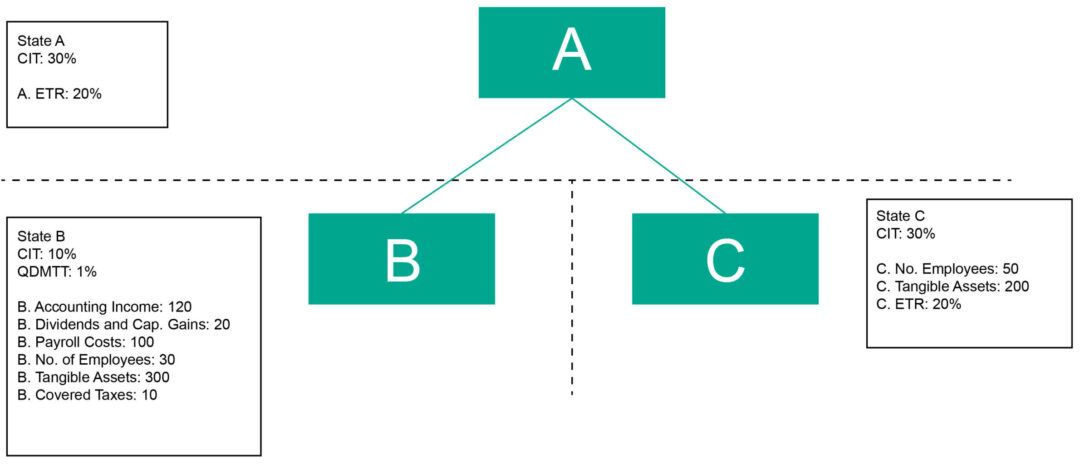
    Company A qualifies as UPE and Companies B and C are wholly-owned by Company A.

    1. Calculation of the ETR in State B

    • GloBE Income in State B: 100 (120-20 → B Accounting Income – B Excluded Dividends and Cap. Gains)
    • Covered Taxes in State B: 10
    • ETR in State B: 10% (10/100 → Covered Taxes in State B/GloBE Income in State B)

    2. Calculation of the Top-Up Tax

    • Top-up tax rate: 5% (15%-10% → GloBE Minimum Rate – ETR in State B)
    • SBIE in State B: 20 (5%*100 + 5%*300 → 5% of B Payroll Costs + 5% of B Tangible Assets)
    • Group Excess Profit in State B: 80 (100 – 20 → GloBE Income in State B – SBIE in State B)
    • Top-up tax (without QDMTT2 ): 4 (5%*80) → Top-up tax rate * Group Excess Profit in State B
    • Final amount of top-up tax (with QDMTT): 3.2 [4-(1%*80)] → [Top-up tax – QDMTT]3

    3. Determination of the Liability for the Top-Up Tax

    The company liable for the top-up tax will be determined in the following order:

    • If State A implemented the IIR → Company A is liable for the top-up tax (3.2) on the basis of IIR
    • If State A has not implemented the IIR → Company C or Company B and C are liable for the top-up tax on the basis of the UTPR (see below).

    4. UTPR Mechanism

    • Scenario A —> State C is the only state that implemented the UTPR
      • Company C is liable for the top-up tax (3.2)
    • Scenario B —> Both State B and State C implemented the UTPR

    UTPR percentage of State B: 48.75% (50%*30/80 + 50%*300/500 50% * Number of employees in State B/Number of Employees in all UTPR States + 50% * Value of Tangible Assets in State B/Value of Tangible Assets in all UTPR States)

    UTPR Percentage of State C: 51.25% (50%*50/80 + 50%*200/500)

    • Company B liability for the top-up tax: 1.56 (3.2*48.75%)
    • Company C liability for the top-up tax: 1.64 (3.2*51.25%)

    NEXT STEPS

    As mentioned above, in the first quarter of 2022, the OECD should adopt and publish a commentary on OECD Model Rules. Further work and elaborations by the OECD are expected throughout the course of 2022 with the goal of first applying Pillar 2 rules (together with Pillar 1 rules) as from 2023.

    In parallel with OECD elaborations, in December 2021, the European Commission proposed the adoption of a directive with regard to the EU area (COM 2021 823). The draft directive closely follows the OECD Model Rules but extends their scope to large-scale purely domestic groups (meaning that in the EU area, GloBE rules would also apply to groups that do not have subsidiaries/PEs in more than one jurisdiction). While the European Commission officially stated that the extension is provided “in order to ensure compliance with the EU fundamental freedoms,” a few scholars raised some doubts on the compliance of the directive with those freedoms.

    The draft directive also exercises an option set out in the OECD’s commentary for the Model Rules to require an EU Member State of an in-scope multinational enterprise applying the IIR (as said above, usually the jurisdiction of the UPE) to ensure effective taxation at the minimum agreed level (15%) for not only foreign subsidiaries but all CEs resident in that Member State and the PEs of the group established in that Member State.

    Provided that the draft directive is approved by EU institutions (remarkably, a unanimous agreement of EU Member States at the Council level is required), the relevant rules should be implemented in the domestic tax systems by the end of 2022 and should apply as from 2023.

    In this respect, we also note that Spanish Budget Law for 2022 has already provided a 15% minimum tax applicable as from 1 January 2022. The minimum tax applies to taxpayers with a net turnover of at least €20 million and those subject to the tax consolidation regime (thus having a scope of application wider than both the OECD rules and the proposed EU directive).


    1 We are assuming that State B adopts a 1% QDMTT for purely illustrative reasons (i.e. in order to allow the applicability of the IIR and UTPR mechanism). We are aware that, in case a given State decides to adopt a QDMTT, the rate of the QDMTT would likely be determined in way that the overall tax rate of the State reaches 15%.

    2 Please note that OECD Model Rules do not encompass separate steps for the calculation of the ‘Top-up tax (without QDMTT)‘ and ‘Final amount of Top-up tax (with QDMTT)‘ and include the deduction of the QDMTT in the step named ‘Jurisdictional Top-up Tax‘ under Art. 5.2.3.

    3 This point should be further analysed and checked also on the basis of the Commentary to OECD Model Rules to be adopted in next weeks.

    Authors

    Brian H. Jenn

    Partner

    Washington, DC, Chicago

    Annette Keller

    Partner

    Munich

    Dr. Dirk Pohl

    Partner

    Munich

    Antoine Vergnat

    Partner

    Paris

    Romain Desmonts

    Partner

    Paris

    More insights

  • OECD Pillar 2 Q&A

    OECD Pillar 2 Q&A

    ARTICLE / CLIENT ALERT

    OECD Pillar 2 Q&A

    February 14, 2022

    Read time: 4 min

    Key takeaways
    Overview

    WHAT IS THE AIM OF PILLAR 2 RULES?

    The aim of the Organisation for Economic Co-operation and Development (OECD) Inclusive Framework’s project is to ensure that multinational groups of companies pay a minimum level of tax on income arising in each jurisdiction in which they operate. This minimum level of tax is set at 15%.

    IF MOST COUNTRIES HAVE CORPORATE TAX RATES OF MORE THAN 20%, WHY IS THE MINIMUM TAX SET AT 15%?

    A large portion of corporate profit is subject to an effective tax rate (ETR) that is lower than 15%—despite the fact that the home jurisdiction of some multinational groups imposes a corporate tax at a much higher rate. Furthermore, the OECD Inclusive Framework includes jurisdictions that have corporate tax rates that are lower than 15%.

    WHICH ARE THE IN-SCOPE ENTITIES?

    Your group qualifies as an in-scope entity if:

    1. It has companies or permanent establishments (PE) in more than one jurisdiction, and
    2. It had an annual revenue of €750 million (or more) in the consolidated financial statements of at least two of the four fiscal years preceding the tested year.

    With respect to the EU territory, please note that the European Commission just proposed a directive aimed at extending the scope of Pillar 2 rules to domestic groups (i.e., to groups that do not meet the first requirement listed above but meet the €750 million threshold).

    IF MY GROUP IS IN-SCOPE, WHAT SHOULD I DO TO BE PREPARED FOR PILLAR 2?

    1. Calculate the ETR of your group on a jurisdictional basis
    2. Calculate the top-up tax (i.e., the amount due to reach an ETR of 15% in each jurisdiction)
    3. Identify the entity liable for the top-up tax. As a general rule, it should be the top parent company of the group, but in some cases a backstop rule applies and the subsidiaries are liable for the top-up tax.

    Simplified modeling can be run to have a general idea of the impact and consider any restructurings accordingly.

    MY GROUP IS BASED IN THE UNITED STATES AND IS SUBJECT TO GILTI RULES. DOES PILLAR 2 ALSO APPLY IN THIS CASE?

    Yes, Pillar 2 also applies in this case. From a technical standpoint, the coexistence between Pillar 2 and global intangible low-taxed income (GILTI) rules has not been determined yet, although the OECD is willing to ensure a smooth coordination and a level playing field. As of today, GILTI rules might not be deemed fully in line with Pillar 2 rules as they do not provide an application of the GILTI regime on a country-by-country basis.

    WHAT ARE THE NEXT STEPS?

    In the first quarter of 2022, the OECD is expected to publish a commentary on Pillar 2 Model Rules, providing further details on the application of Pillar 2. As of today, the first application of Pillar 2 rules is set at year 2023. However, the implementation of the 15% minimum tax rules at the domestic level of each State is required and this may well cause a delay.

    In depth
    Authors

    Brian H. Jenn

    Partner

    Washington, DC, Chicago

    Annette Keller

    Partner

    Munich

    Dr. Dirk Pohl

    Partner

    Munich

    Antoine Vergnat

    Partner

    Paris

    Romain Desmonts

    Partner

    Paris

    More insights

  • Proposed Rule Changes to SEC Beneficial Ownership Reporting

    Proposed Rule Changes to SEC Beneficial Ownership Reporting

    ARTICLE / CLIENT ALERT

    Proposed Rule Changes to SEC Beneficial Ownership Reporting

    February 11, 2022

    Read time: 5 min

    Key takeaways
    Overview

    On Feb. 10, 2022, the Securities and Exchange Commission (“SEC”) proposed amendments to the rules governing beneficial ownership reporting (“Proposal”)[1]. The Proposal seeks to:

    • Tighten filing deadlines for Schedule 13D and Schedule 13G;
    • Require inclusion of certain cash-settled derivative securities (other than cash settled swaps) in determining beneficial ownership for Schedule 13D filers and require disclosure of all cash settled derivative securities in Item 6 of Schedule 13D;
    • Clarify when persons form a “group”; and
    • Require that Schedules 13D and 13G be filed using a structured, machine-readable data language.

    The following is an overview of the Proposal.

    Initial Filing Deadlines

    • Schedule 13D. The Proposal shortens the Schedule 13D filing deadline from 10 days to 5 days following the acquisition of beneficial ownership of more than 5% or losing eligibility to file a Schedule 13G.
    • Institutional/Exempt Schedule 13G. The Proposal requires an initial Schedule 13G filing for institutional investors and exempt investors by the 5th business day after month-end in which their beneficial ownership exceeds 5% (in place of the current 45 days after the calendar-year-end in most circumstances).
    • Passive Schedule 13G. The Proposal shortens the initial Schedule 13G filing deadline for passive investors from 10 days to 5 days after acquiring beneficial ownership of more than 5%.

    Amendments

    • Schedule 13D. The Proposal requires Schedule 13D amendments to be filed one business day following a material change (in place of the current “prompt” requirement).
    • Schedule 13G. The Proposal requires amendments to Schedule 13G filings within 5 business days after the month-end of a material change (in place of the current 45 days after year-end if there is any change in the reported information). The Proposal also shortens the amendment requirement for exceeding 10% beneficial ownership and thereafter, increasing or decreasing beneficial ownership by more than 5%, from the current 10 days after month-end to 5 days after crossing the relevant threshold for institutional investors and one business day for passive investors (in place of the current “prompt” requirement).

    Filing Day Deadline

    The Proposal extends the deadline for filings from the current 5:30 p.m. eastern time to 10 p.m. eastern time.

    Reporting of Cash-Settled Derivatives

    Under the Proposal, the holder of a cash-settled derivative security (other than security-based swaps which disclosure is the subject of a separate rulemaking proposal from the SEC[2]), will be deemed to be the beneficial owner of the shares referenced by the derivative security if such holder would be a Schedule 13D filer, even absent an express right to direct the voting, acquisition or disposition of such shares.

    Groups

    • The Proposal expands the definition of a group for reporting purposes from an agreement to act together to also include, depending on the particular facts and circumstances, concerted actions by two or more persons for the purpose of acquiring, holding or disposing of securities of an issuer.
    • Additionally, a group will exist where in advance of filing a Schedule 13D a filing person discloses to any other person that such filing will be made if the other person acquires securities subject to the Schedule 13D.
    • The Proposal exempts certain actions taken by two or more persons from forming a group if those actions do not have the purpose or effect of changing or influencing the control of an issuer and are not made in connection with or as a participant in any transaction having such purpose or effect.
    • Under the Proposal, no group is formed solely by virtue of an agreement governing the terms of a derivative security, provided that the agreement is a bona fide purchase and sale agreement entered into in the ordinary course of business and provided that such persons do not enter into the agreement with the purpose or effect of changing or influencing control of the issuer, or in connection with or as a participant in any transaction having such purpose or effect.

    Disclosure of Derivative Securities

    The Proposal amends Item 6 of Schedule 13D to clarify that disclosure of all derivative securities that use the issuer’s equity security as a reference security is required, including disclosure of cash-settled security-based swaps and other cash-settled derivatives.

    Structured Data Requirement

    The Proposal requires Schedules 13D and 13G to be filed using a structured, machine-readable data language.

    Section 16

    The proposed changes of the beneficial ownership and group formation rules discussed above will also apply when determining if a shareholder is subject to Section 16 as a greater than 10% beneficial owner or part of a group that is over 10%.

    Authored by Eleazer Klein, Adriana Schwartz and Clara Zylberg.

    If you have any questions concerning this Alert, please contact your attorney at Schulte Roth & Zabel or one of the authors.


    [1] “SEC Proposes Rule Amendments to Modernize Beneficial Ownership Reporting,” SEC Press Release, Feb. 10, 2022, available here.

    [2] “SEC Proposes Rules to Prevent Fraud in Connection With Security-Based Swaps Transactions, to Prevent Undue Influence over CCOs and to Require Reporting of Large Security-Based Swap Positions,” SEC Press Release, Dec. 15, 2021, available here.


    This communication is issued by Schulte Roth & Zabel LLP for informational purposes only and does not constitute legal advice or establish an attorney-client relationship. In some jurisdictions, this publication may be considered attorney advertising. ©2022 Schulte Roth & Zabel LLP.

    All rights reserved. SCHULTE ROTH & ZABEL is the registered trademark of Schulte Roth & Zabel LLP.

    In depth
    Authors

    Ele Klein

    Partner

    New York – 919 Third Avenue

    More insights

  • FinCEN Commences Rulemaking Process to Implement AML Reporting Requirements for Real Estate Sector

    FinCEN Commences Rulemaking Process to Implement AML Reporting Requirements for Real Estate Sector

    ARTICLE / CLIENT ALERT

    FinCEN Commences Rulemaking Process to Implement AML Reporting Requirements for Real Estate Sector

    February 11, 2022

    Read time: 8 min

    Key takeaways
    Overview

    On Dec. 8, 2021, the U.S. Department of the Treasury’s Financial Crimes Enforcement Network (“FinCEN”) issued an Advance Notice of Proposed Rulemaking (“ANPRM”)[1] soliciting public comment on a proposal to extend the Bank Secrecy Act (“BSA”) compliance and reporting requirements to certain persons or entities involved in real estate transactions. The ANPRM solicits public comment on the scope of those requirements and the persons or entities to which they should apply. Affected parties may include title insurance companies, real estate agents and brokers, real estate attorneys, law firms and settlement and closing agents, among others.[2] Comments on the ANPRM are due to FinCEN by Feb. 21, 2022.[3]

    Real Estate Transactions and Persons Presently Subject to FinCEN Requirements

    The BSA implementing regulations administered by FinCEN currently require banks, non-bank residential mortgage lenders and originators (“RMLOs”) and housing-related Government Sponsored Enterprises (“GSEs”), entities typically involved in financed real estate transactions, to establish and implement certain anti-money laundering (“AML”) controls, such as maintaining an AML program and filing suspicious activity reports with FinCEN (“SARs”).[4] Other persons involved in real estate closings and settlements are currently exempted from the requirement to establish an AML program,[5] although FinCEN has used its geographic targeting order (“GTO”) authority[6] to impose specific transaction recordkeeping and reporting requirements on title insurance companies involved in “all-cash” or “non-financed” transactions of certain residential real estate, such as the purchase of residential real property in excess of $300,000 in limited geographic areas, such as Manhattan and Miami, Florida.[7] Accordingly, certain real estate transactions, such as “non-financed” or “all-cash” real estate purchases outside of these limited areas and not involving title insurance companies, are not currently subject to the BSA’s requirements.[8]  

    The ANPRM defines “non-financed” and “all-cash” transactions to refer to “any real estate purchase or transaction that is not financed via a loan, mortgage, or other similar instrument, issued by a bank or non-bank [RMLO], and that is made, at least in part, using currency or value that substitutes for currency (including convertible virtual currency (CVC)), or a cashier’s check, a certified check, a traveler’s check, a personal check, a business check, a money order in any form or a funds transfer.”[9]

    The ANPRM Proposals

    The ANPRM emphasizes the need for enhanced regulation to address the “systemic vulnerability of the U.S. real estate market to money laundering,”[10] echoing the recurring criticism by the Financial Action Task Force (“FATF”) that the U.S.’s failure to regulate real estate transactions in accordance with FATF standards constitutes a significant deficiency in the U.S. AML regime.[11] In the ANPRM, FinCEN attributes the U.S. real estate market’s vulnerabilities to a lack of transparency in real estate funds transfers, the attractiveness of the U.S. real estate market as an investment vehicle and the lack of industry regulation.[12]

    In order to best address these vulnerabilities while minimizing compliance burdens for industry participants, the ANPRM solicits public comment on the scope of any proposed rulemaking as follows:

    • Nature of Recordkeeping and Reporting Requirements. The ANPRM proposes two avenues to potential rulemaking in this area. One approach would be to add new requirements similar to those in the GTO regulation to also permanently “require certain persons to collect, report and retain information about specified non financed purchases of real estate.”[13] The ANPRM notes that this approach “may be an appropriately tailored way to increase the transparency of the non-financed sector of the real estate market and provide law enforcement, national security agencies, and financial institutions with highly useful information.”[14] The alternative approach would entail FinCEN issuing BSA-implementing regulations to “certain persons involved in non-financed real estate closings and settlements,” which would likely require such persons to adopt and implement an AML/CFT program and file SARs with FinCEN.[15] FinCEN seeks comments on whether one approach is preferred over the other and whether to extend the customer due diligence requirements, which address the identification of beneficial owners of certain legal entities, to the real estate industry.[16]
    • Type of Real Estate. FinCEN requests comment on whether to address both commercial and residential real estate transactions in the same rulemaking or to “take an iterative approach, starting first with residential transactions and then later addressing commercial transactions.”[17]
    • Scope of Persons Subject to a Reporting Requirement. FinCEN seeks comment on which persons involved in non-financed real estate closings should be subject to a proposed rule, such as title insurance companies, title or escrow companies, real estate agents or brokers, real estate attorneys or law firms or settlement or closing agents.[18]
    • Geographic Scope and Transaction Threshold. Although FinCEN stresses that adequately addressing money laundering vulnerabilities in real estate transactions requires a rule with nationwide application, it nevertheless requests input on the geographic scope of any potential rule.[19] For example, short of a nationwide application, rulemaking could be limited to jurisdictions already covered by existing GTOs.
    • Purchases by Certain Entities. FinCEN seeks comment on whether any future rulemaking should require reporting of other types of legal entities purchasing real estate, such as shell companies and trusts. The ANPRM notes that, to date, GTO reporting requirements have only covered corporations, limited liability companies, partnerships or other similar business entities not listed on an exchange regulated by the Securities and Exchange Commission.[20]

    In addition to the broader topics outlined above, FinCEN poses certain specific questions, including: (1) what due diligence is presently conducted regarding the parties to a transaction and source of funds for a transaction, prior to a real estate closing; (2) what recordkeeping requirements are currently in place for real estate transactions; and (3) how to best address in any future rulemaking the use of natural persons in money laundering schemes involving real estate transactions.[21]

    Conclusion

    The ANPRM signals FinCEN’s increased focus on the prevention of money laundering through the U.S. real estate market. Consequences for the real estate sector could include additional compliance costs and heightened exposure to regulatory action.

    Authored by Betty Santangelo, Julian Wise, Melissa G.R. Goldstein and Hadas A. Jacobi.

    If you have any questions concerning this Alert, please contact your attorney at Schulte Roth & Zabel or one of the authors.


    [1] Advanced Notice of Proposed Rulemaking, Anti-Money Laundering Regulations for Real Estate Transactions, 86 Fed. Reg. 69,589 (Dec. 8, 2021) (to be codified at 31 C.F.R. Chapter X) [hereinafter ANPRM].

    [2] Id. at 69,597.

    [3] See News Release: FinCEN Announces Extension of the Comment Period for its Real Estate Advance Notice of Proposed Rulemaking (Feb. 3, 2022).

    [4] 31 C.F.R. Parts 1020, 1029, and 1030, respectively.

    [5] ANPRM, 86 Fed. Reg. at 69,592.

    [6] FinCEN recently issued a final rule clarifying its authority to issue GTOs under 31 U.S.C. § 5326(a), which went into effect on November 15, 2021. See Final Rule, Orders Imposing Additional Reporting and Recordkeeping Requirements, 86 Fed. Reg. 62,914 (Nov. 15, 2021) (codified at 31 C.F.R. § 1010.370). The Final Rule clarifies that FinCEN’s authority to issue GTOs extends to “nonfinancial trade[s] or business[es]” within a specific geographic area, and tracks updated language in the BSA to reflect that FinCEN’s GTO authority extends to all transactions involving the “transfer of funds (as the Secretary may describe in such order),” thereby clarifying that covered transactions are not limited to the transfer of U.S. currency. Final Rule, 86 Fed. Reg. at 62,915.

    [7] The existing GTOs require title insurance companies to identify the natural persons behind the legal entity used to purchase residential real estate without a bank loan or similar form of external financing (e.g., the individual responsible for representing the legal entity and the 25% or more beneficial owners of such legal entities), and cover the following geographic areas: California (San Diego, Los Angeles, San Francisco, San Mateo and Santa Clara Counties); Florida (Miami-Dade, Broward and Palm Beach Counties); Hawaii (City and County of Honolulu): Illinois (Cook County); Massachusetts (Suffolk and Middlesex Counties); Nevada (Clark County) New York (Boroughs of Brooklyn, Queens, Bronx, Staten Island and Manhattan): Texas (Bexar, Tarrant and Dallas Counties); and Washington (King County). See, e.g., Geographic Targeting Order (Nov. 15, 2018); Geographic Targeting Order (Aug. 22, 2017); Geographic Targeting Order (July 27, 2016).

    [8] ANPRM, 86 Fed. Reg. at 69,595.

    [9] Id. at 69,589 n.1.

    [10] Id. at 69,591.

    [11] ANPRM, 86 Fed. Reg. at 69,590-91. See also FATF, Anti-Money Laundering and Counter-Terrorist Financing Measures in the United States: Mutual Evaluation Report at 39 (Dec. 2016). Although FinCEN first issued an ANPRM on AML/CFT program requirements in 2003 for “persons involved in real estate closings and settlements,” FinCEN never finalized this rulemaking. See Advanced Notice of Proposed Rulemaking, Anti-Money Laundering Program Requirements for Persons Involved in Real Estate Closings and Settlements, 68 Fed. Reg. 17,569 (Apr. 10, 2003).

    [12] ANPRM, 86 Fed. Reg. at 69,593.

    [13] Id. at 69,597.

    [14] Id.

    [15] Id.

    [16] FinCEN is currently in the rulemaking process to implement the new beneficial ownership reporting requirements imposed pursuant to the Corporate Transparency Act, enacted into law as part of the National Defense Authorization Act for Fiscal Year 2021. See Advanced Notice of Proposed Rulemaking, Beneficial Ownership Information Reporting Requirements, 86 Fed. Reg. 17,557 (April. 5, 2021); Notice of Proposed Rulemaking, Beneficial Ownership Information Reporting Requirements, 86 Fed. Reg. 69,920 (Dec. 7, 2021).

    [17] ANPRM, 86 Fed. Reg. at 69,599.

    [18] Id. at 69,597.

    [19] Id. at 69,598.

    [20] Id.

    [21] ANPRM, 86 Fed. Reg. at 69,599.


    This communication is issued by Schulte Roth & Zabel LLP for informational purposes only and does not constitute legal advice or establish an attorney-client relationship. In some jurisdictions, this publication may be considered attorney advertising. ©2022 Schulte Roth & Zabel LLP.

    All rights reserved. SCHULTE ROTH & ZABEL is the registered trademark of Schulte Roth & Zabel LLP.

    In depth
    Authors

    Betty Santangelo

    Counsel

    New York – 919 Third Avenue

    Julian M. Wise

    Partner

    New York – 919 Third Avenue

    Melissa G.R. Goldstein

    Partner

    New York – 919 Third Avenue

    More insights

  • New York State Lifts Indoor Mask Mandate for Most Locations

    New York State Lifts Indoor Mask Mandate for Most Locations

    ARTICLE / CLIENT ALERT

    New York State Lifts Indoor Mask Mandate for Most Locations

    February 11, 2022

    Read time: 5 min

    Key takeaways
    Overview

    On Feb. 9, 2022, New York State Governor Kathy C. Hochul issued a press release announcing that New York State’s Determination on Indoor Masking (“Mask Mandate”) was lifted effective Feb. 10, 2022. The Governor explained that the Mask Mandate was intended to be only a temporary measure to combat the winter surge in COVID-19 cases and the rise of the Omicron variant. With COVID-19 cases and hospitalizations plummeting in New York State, the Governor determined that the Mask Mandate is no longer necessary at this time.

    Pursuant to the Mask Mandate, which was detailed in a previous SRZ Alert, masks were required to be worn in all indoor public places, including business and office spaces, unless all individuals, including visitors, were required to provide proof of vaccination as a condition of entry. Beginning on Feb. 10, indoor public places covered by the Mask Mandate are no longer required to enforce the mask requirement, though they may choose to continue to do so. All schools and all health care settings regulated by the New York State Department of Health and other related state agencies, however, must continue to require masks.[1]

    Mask Requirements for Schools

    Governor Hochul also announced plans to reevaluate the mask requirement in schools in the first week of March. Currently, all schools, including public, nonpublic and charter schools, must require any person over the age of two (including all students, teachers, administrators, other staff, contractors and visitors) to wear a well-fitting mask over their nose and mouth at all times when indoors in school buildings, regardless of vaccination status, except while actively eating or drinking. The Governor plans to distribute two at-home COVID-19 test kits to every K-12 student in the coming weeks. These test results, along with a variety of public health data, including cases per 100,000 residents, hospital admission rates, vaccination rates, global trends and pediatric hospitalizations, will be reviewed to determine whether to lift the mask requirement for schools. The New York State Department of Health will develop preliminary guidance with input from educators and parents.

    Other COVID-19 Prevention Measures

    While New York City employers will no longer be required to enforce the Mask Mandate, they continue to be bound by New York City’s COVID-19 vaccine mandate for private-sector workers (the “NYC Vaccine Mandate”). The NYC Vaccine Mandate requires employers to: (i) prohibit unvaccinated workers from entering their workspaces, with limited exceptions, and (ii) obtain and confidentially maintain records of COVID-19 vaccinations for each of their workers. New York City’s newly-inaugurated Mayor, Eric Adams, has expressed his intent to keep the NYC Vaccine Mandate in place. More information on the NYC Vaccine Mandate can be found in a previous SRZ Alert.

    Additionally on Feb. 10, 2022, the New York State Department of Labor updated its Model Airborne Infectious Disease Exposure Prevention Plan under the New York State Health and Essential Rights Act (“HERO Act”). This model plan was adopted by most employers to comply with the HERO Act’s requirements. The updated model plan relaxed its masking requirements, providing that: “Employees will wear appropriate face coverings in accordance with guidance from State Department of Health or the Centers for Disease Control and Prevention, as applicable. Consistent with the guidance from the State Department of Health, if indoor areas do not have a mask or vaccine requirement as a condition of entry, appropriate face coverings are recommended, but not required. It is also recommended that face coverings be worn by unvaccinated individuals, including those with medical exemptions, in accordance with federal CDC guidance.”

    The New York State Commissioner of Health has designated COVID-19 as a “highly contagious communicable disease” under the HERO Act, triggering the HERO Act’s requirement that each employer implement and enforce its airborne infectious disease exposure prevention plan. On or before Feb. 15, 2022, the Commissioner will extend or rescind this designation. If the designation is not renewed, employers will no longer be required to implement and enforce their prevention plans. As discussed in a previous SRZ Alert, certain of the HERO Act’s requirements will continue even when there is no designation by the Commissioner of Health. Employers, for example, will still need to routinely review and update their prevention plans as necessary, distribute their prevention plans to each of their employees, including newly hired employees, post their plans in a visible and prominent location within their work sites, and include the plans in their employee handbooks. The designation of COVID-19 under the HERO Act does not affect the HERO Act’s workplace safety committee provision, which is currently in effect and discussed here.

    Please contact Mark E. Brossman, Ronald E. Richman, Max Garfield, Scott A. Gold, Donna K. Lazarus or Abdulrahman Alwattar if you have any questions about these orders.


    [1] Masks will continue to be required in public transit and transportation hubs, nursing homes, adult care facilities, correctional facilities, detention centers, homeless shelters, and domestic violence shelters.


    This communication is issued by Schulte Roth & Zabel LLP for informational purposes only and does not constitute legal advice or establish an attorney-client relationship. In some jurisdictions, this publication may be considered attorney advertising. ©2022 Schulte Roth & Zabel LLP.

    All rights reserved. SCHULTE ROTH & ZABEL is the registered trademark of Schulte Roth & Zabel LLP.

    In depth
    Authors

    Mark E. Brossman

    Partner

    New York – 919 Third Avenue

    Ronald E. Richman

    Partner

    New York – 919 Third Avenue

    Max Garfield

    Partner

    New York – 919 Third Avenue

    Donna K. Lazarus

    Partner

    New York – 919 Third Avenue

    Abdulrahman Alwattar

    Associate

    New York – 919 Third Avenue

    More insights

  • SEC Proposes Cybersecurity Risk Management

    SEC Proposes Cybersecurity Risk Management

    ARTICLE / CLIENT ALERT

    SEC Proposes Cybersecurity Risk Management

    February 10, 2022

    Read time: 9 min

    Key takeaways
    Overview

    On Feb. 9, 2022, the Securities and Exchange Commission (“SEC”) proposed new cybersecurity risk management rules and amendments (the “Proposed Cyber Rules”)[1] intended to enhance cybersecurity preparedness of registered investment advisers (“RIAs”) and registered investment companies and business development companies (together, “Regulated Funds”) and to require more disclosure regarding cyber risks and incidents. 

    Specifically, the Proposed Cyber Rules seek to: (1) require RIAs and Regulated Funds to adopt and implement written policies and procedures that are reasonably designed to address cybersecurity risks; (2) require advisers to report significant cybersecurity incidents to the SEC on proposed Form ADV-C; (3) enhance adviser and fund disclosures related to cybersecurity risks and incidents; and (4) require advisers and funds to maintain certain cybersecurity-related books and records. 

    Cybersecurity Policies and Procedures

    The proposed new risk management rules would require RIAs and Regulated Funds to adopt and implement cybersecurity policies and procedures, which can be tailored to the individual cybersecurity risks for the business but at a minimum must incorporate the following general elements:[2]

    • Risk Assessment – periodic assessments (1) to identify “cybersecurity risks”[3] to “Information Systems”[4] (a term “designed to be broad enough to encompass all the electronic information resources owned or used” by an RIA or Regulated Fund) and Information (defined to encompass any electronic information related to the firm’s business)[5] and (2) to identify cybersecurity risks to applicable service providers that handle Information;
    • User Security and Access – controls designed to minimize user-related risks and prevent unauthorized access to Information Systems and Information, including on personal mobile devices or when remote work is conducted through unsecured or less secure WiFi;
    • Information Protection – measures designed to monitor Information Systems and protect Information from unauthorized access or use. Firms would be required to oversee any service provider that handles Information (including, for example, through due diligence and periodic reviews of the service providers) and have written contracts with service providers requiring them to have appropriate measures in place;
    • Threat and Vulnerability Management – measures designed to detect, mitigate and remediate any cybersecurity threats and vulnerabilities relating to Information Systems and Information as well as role-specific cybersecurity threat and vulnerability response training; and
    • Cybersecurity Incident Response and Recovery – measures designed to detect, respond to and recover from a cybersecurity incident,[6] including policies and procedures that are reasonably designed to ensure: (1) the firm’s continued operations; (2) protection of Information Systems and Information; (3) external and internal cybersecurity incident information sharing and communications; and (4) reporting of significant cybersecurity incidents to the SEC on proposed Form ADV-C.

    The broad definition of Information puts all business-related electronic communications in scope and, among other things, adds to the challenges firms face when unapproved messaging platforms are used for conducting firm business. The Proposing Release notes that firms should consider issuing firm-issued mobile devices or installing a mobile device manager on employees’ personal phones to control work-related content. The SEC also seeks comments regarding what user measures RIAs currently have for mobile devices. Further, as proposed, the rules could impose a significant burden on RIAs and Regulated Funds to vet and monitor the cybersecurity programs of many different types of service providers.[7]

    Annual Review

    RIAs and Regulated Funds would be required to conduct an annual review that assesses the effectiveness of the cybersecurity policies and procedures, including identification of any changes in cybersecurity risk over the time period covered by the review, and prepare a written report that describes the review, assessment and any control tests performed, explains the results, documents any cybersecurity incident that occurred since the date of the last report and discusses any material changes to the policies and procedures since the date of the last report. While the expertise of cybersecurity consultants could be leveraged in conducting the annual review, the SEC expects the review to be overseen by the person responsible for administering the firm’s cybersecurity policies. Regulated Funds also would be required to provide the written report to their boards of directors.

    Reporting of Significant Cybersecurity Incidents

    RIAs and Regulated Funds would be required to report significant cybersecurity incidents to the SEC by submitting a proposed Form ADV-C within 48 hours after having a reasonable basis to conclude that a significant cybersecurity incident has occurred or is occurring. A “significant cybersecurity incident” is a cybersecurity incident, or a group of related incidents, that (1)  significantly disrupts or degrades an RIA’s or Regulated Fund’s ability to maintain critical operations or (2) leads to the unauthorized access or use of Information that results in: (a) substantial harm to the RIA or Regulated Fund or (b) substantial harm to an advisory client or investor whose Information was impacted.    

    The Proposed Cyber Rule also would require an adviser to amend any previously filed Form ADV-C within 48 hours:

    • After information on the form becomes materially inaccurate;
    • If new material information about a previously reported incident is discovered; and
    • After resolving a previously reported incident or closing an internal investigation pertaining to a previously disclosed incident.

    Form ADV-Cs would be confidential.

    In the wake of a cyber-incident, it can often take forensic experts some time to assess the extent of the harm and the Information impacted, making it difficult in the first instance to determine when the 48-hour initial notification period has been triggered. Further, a firm could be required to make repeated amendments over the course of a forensic investigation as new information is discovered. The Proposed Cyber Rules also raise the possibility that a cyber-incident that occurred at a service provider may create a significant cybersecurity event for a firm.

    Additionally, the recent proposal for amendments to Form PF requires large hedge fund advisers to report within one business day a cyber-incident that results in a significant disruption or degradation of key operations. Taken together, the proposed changes to Form PF and the Proposed Cyber Rules could result in some managers being subject to different reporting requirements (on different timelines) for the same incident.

    Disclosure of Cybersecurity Risks and Incidents

    An RIA would be required to disclose cybersecurity risks that could materially affect its advisory services and how the RIA assesses, prioritizes and addresses such risks on proposed Form ADV Part 2A Item 20. Item 20 also would require an RIA to provide a detailed description of any cybersecurity incident that has occurred within the last two fiscal years that has significantly disrupted or degraded its ability to maintain critical operations, or has led to the unauthorized access or use of Information, resulting in substantial harm to the firm or its clients. The Proposed Cyber Rules also would require an RIA to deliver interim brochure amendments to existing clients promptly if they add disclosure of a cybersecurity incident or materially revise a prior disclosure regarding the incident.

    Recordkeeping

    The Proposed Cyber Rules would require RIAs and Regulated Funds to maintain records of:

    • Written cybersecurity policies and procedures that are in effect or at any time within the past five years were in effect;
    • Written reports documenting the firm’s annual reviews of such policies and procedures within the last five years;
    • A copy of any Form ADV-C and amendments filed by the adviser in the last five years;
    • Records documenting the occurrence of any cybersecurity incident occurring within the last five years, including records related to any response and recovery from such an incident; and
    • Records documenting any cybersecurity risk assessments conducted in the last five years.

    Authored by Marc Elovitz, Kelly Koscuiszka, Meghan Carey, Christopher Avellaneda and Tarik Shah.

    If you have any questions concerning this Alert, please contact your attorney at Schulte Roth & Zabel or one of the authors.


    [1] “Cybersecurity Risk Management for Investment Advisers, Registered Investment Companies, and Business Development Companies,” Release No. 33-11028 (Feb. 9, 2022), available at https://www.sec.gov/rules/proposed/2022/33-11028.pdf?utm_medium=email&utm_source=govdelivery (the “Proposing Release”).

    [2] For a Regulated Fund, the board of directors would have to approve cybersecurity policies and procedures. If the Regulated Fund is a unit investment trust, the Proposed Cyber Rules provide that a Fund’s principal underwriter or depositor must approve the Fund’s policies and procedures and receive the written report describing the Fund’s annual cybersecurity review described above.

    [3] The Proposed Cyber Rules define “cybersecurity risk” as financial, operational, legal, reputational and other adverse consequences that could result from cybersecurity incidents, threats and vulnerabilities.

    [4] The Proposed Cyber Rules define “information systems” to mean the information resources owned or used by the RIA or Regulated Fund, including physical or virtual infrastructure controlled by such information resources, or components thereof, organized for the collection, processing, maintenance, use, sharing, dissemination or disposition of Information to maintain or support the firm’s operations.

    [5] “Information” is defined in the Proposed Cyber Rules as any electronic information related to the RIA’s or Regulated Fund’s business, including personal information received maintained, created or processed by the RIA or Regulated Fund.

    [6] The Proposed Cyber Rules define a  “cybersecurity incident” as an unauthorized occurrence on, or conducted through, Information Systems that jeopardizes the confidentiality, integrity or availability of Information Systems or Information.

    [7] Current SEC rules require RIAs and Regulated Funds to address cybersecurity measures in certain circumstances. For example, firms subject to Regulation S-P are required to adopt written policies and procedures that address administrative, technical and physical safeguards for the protection of customer records and information. They must be reasonably designed (1) to protect the security and confidentiality of customer records and information and (2) to protect against any anticipated threats or hazards, unauthorized access to or use of customer records or information that could result in substantial harm or inconvenience to any customer. Additionally, firms subject to Regulation SID must develop and implement a written identity theft program that includes reasonable policies and procedures to identify and detect relevant red flags, as well as respond appropriately to red flags so as to prevent and mitigate identity theft.


    This communication is issued by Schulte Roth & Zabel LLP for informational purposes only and does not constitute legal advice or establish an attorney-client relationship. In some jurisdictions, this publication may be considered attorney advertising. ©2022 Schulte Roth & Zabel LLP.

    All rights reserved. SCHULTE ROTH & ZABEL is the registered trademark of Schulte Roth & Zabel LLP.

    In depth
    Authors

    Marc E. Elovitz

    Partner

    New York – 919 Third Avenue

    Kelly Koscuiszka

    Partner

    New York – 919 Third Avenue

    Christopher S. Avellaneda

    Partner

    New York – 919 Third Avenue

    Tarik M. Shah

    Partner

    New York – 919 Third Avenue

    More insights

  • SEC Seeks to Shorten the Standard Settlement Cycle to T+1

    SEC Seeks to Shorten the Standard Settlement Cycle to T+1

    ARTICLE / CLIENT ALERT

    SEC Seeks to Shorten the Standard Settlement Cycle to T+1

    February 10, 2022

    Read time: 7 min

    Key takeaways
    Overview

    Yesterday, the U.S. Securities and Exchange Commission (“SEC” or the “Commission”) proposed new rules to shorten the standard securities-settlement cycle to one business day after the trade date (“T+1”).[1] Specifically, if implemented, the new proposals would, inter alia:

    • Reduce the standard settlement cycle for securities from the current two business days after trade date (“T+2”) window to T+1 by March 31, 2024;
    • Eliminate the four business days after trade date settlement cycle (“T+4”) that currently applies to firm commitment offerings priced after 4:30 p.m.;
    • Impose new requirements for broker-dealers and registered investment advisers to improve the rate of same-day affirmations; and
    • Impose new requirements for central matching service providers (“CMSPs”) to facilitate straight-through processing.

    Background and Current Regulatory Framework

    The SEC views shortening the settlement cycle for securities transactions as a key tool to promote investor protection, reduce risk and increase operational efficiency of the securities markets. In 1993, the SEC adopted Rule 15c6-1[2] under the Securities Exchange Act of 1934, as amended (“Exchange Act”) to shorten the then-existing five business day settlement cycle to three business days (“T+3”) and then reduced it again in 2017 to the current T+2 cycle.[3] The SEC’s latest proposal would further amend Rule 15c6-1, adopt new Exchange Act Rule 15c6-2 and amend Rule 204-2 under the Investment Advisers Act of 1940, as amended (the “Advisers Act”), in order to institute a standard T+1 cycle, with an implementation deadline of March 31, 2024, and the goal of ultimately moving towards same day settlement (“T+0”).

    Proposed SEC Rules/Amendments

    Standard T+1 Settlement/Elimination of T+4 Settlement for Certain Firm Commitment Offerings

    Currently, absent an express agreement of the parties to the transaction, Exchange Act Rule 15c6-1(a)[4] sets forth a standard T+2 settlement cycle for most types of securities transactions. Under the Proposing Release, Rule 15c6-1(a) would be amended to change standard settlement from T+2 to T+1. The Proposing Release otherwise leaves intact the existing enumerated exclusions, including the exempted securities listed therein and the ability for parties to a transaction to negotiate alternative settlement arrangements. In an effort to enable industry participants sufficient time to transition their processes and systems, the Proposing Release provides for a March 31, 2024, compliance date.

    The Proposing Release will also eliminate Exchange Act Rule 15c6-1(c),[5] which currently establishes a separate T+4 settlement cycle for firm commitment offerings priced after 4:30 p.m.

    Same-Day Allocation, Confirmation and Affirmation Process

    The SEC also proposed new Exchange Act Rule 15c6-2, which would require broker-dealers engaging in allocation, confirmation and affirmation processes to enter into written agreements with their customers requiring such activities to be completed “as soon as technologically practicable and no later than the end of the [trade date].”[6] The Proposing Release does not define “technologically practicable” or otherwise provide specific guidance on the factors to be used in evaluating when allocation, confirmation and affirmation activities completed on trade date may be deemed untimely.

    Investment Advisers Recordkeeping Changes

    The Proposing Release also seeks to amend Advisers Act Rule 204-2 (the “Recordkeeping Rule”) to require registered investment advisers that are parties to contracts under Rule 15c6-2 to make and keep time stamped records of confirmations received and allocations and affirmations sent.

    Central Matching Service Providers

    Finally, the Proposing Release seeks to require CMPSs to “establish, implement, maintain and enforce policies and procedures that facilitate straight-through processing” (that is, the automation of the entire trade process).[7] Rule 17Ad-27 would also institute a reporting requirement whereby CMSPs would have to submit annual reports to the Commission describing their policies, procedures, efforts and plans to facilitate straight-through processing.

    New Requirements for Broker-Dealers

    If the Proposing Release is adopted in its current form:

    • Broker-dealers would need to ensure that their agreements for the purchase or sale of securities provide for payment of funds or delivery by T+1.
    • Where parties have agreed to engage in an allocation, confirmation or affirmation processes, broker-dealers would need to ensure that their written agreements require the completion of those processes as soon as “technologically practicable” and no later than the end of the day on the trade date.
    • Broker-dealers would need to assess their current systems, operations, policies and procedures to ensure that they are aligned with the new T+1 settlement dates, as well as the new allocation, confirmation or affirmation processes.
    • Broker-dealers would also need to assess their systems and operations with an eye towards implementing the necessary changes to accommodate any new operational requirements that will be instituted by CMSPs under new Rule 17Ad-27.

    New Requirements for Registered Investment Advisers

    • While existing Advisers Act Rule 204-2(a)(7)(iii) requires that registered investment advisers keep and maintain originals of all written communications relating to “[t]he placing or execution of any order to purchase or sell any security,”[8] the proposed change would expand this requirement to include retaining allocation, confirmation and affirmation information.
    • Specifically, the proposed amendments to the Recordkeeping Rule would require registered investment advisers to record “each confirmation received, and any allocation and each affirmation sent [or] given to a broker-dealer with a date and time stamp for each allocation (if applicable) and affirmation that indicates when the allocation or affirmation was sent to the broker or dealer.”[9]
    • Additionally, if the proposed Exchange Act Rule 15c6-2 is adopted, registered investment advisers would be contractually obligated to complete their allocation, confirmation and affirmation processes as soon as “technologically practicable and no later than by the end of the trade date.”

    Groundwork for Additional Settlement Cycle Shortening

    Expectedly, the Proposing Release makes clear that the current move to a T+1 settlement cycle is an intermediate step as the SEC attempts to chart a path to T+0. Noting that it is already assessing the challenges and benefits of further decreasing the settlement cycle, the Commission seeks feedback from industry participants on potential frameworks and implementation for T+0, and any comments to inform future proposals therewith.  

    If you have any questions concerning this Alert, please contact Julian Rainero, Derek N. Lacarrubba, William J. Barbera, Tarik Shah, J. Eric Prather or your attorney at Schulte Roth & Zabel.

    Further, we are gathering feedback from our clients about the impact of the SEC’s proposed rules as we prepare a comment letter. You can submit comments to CommentLetters@srz.com or discuss them directly with one of the authors or your attorney at Schulte Roth & Zabel.


    [1] “Shortening the Securities Transaction Settlement Cycle”, Exchange Act Release No. 34-94196, Investment Advisers Act Release No. IA-5957 (Feb. 9, 2022) (“Proposing Release”).

    [2] Exchange Act Release No. 33023 (Oct. 6, 1993), 58 FR 52891 (Oct. 13, 1993); see also 17 CFR § 240.15c6-1.

    [3] Exchange Act Release No. 80295 (Mar. 22, 2017), 82 FR 15564, 15601 (Mar. 29, 2017).

    [4] 17 CFR § 240.15c6-1(a).

    [5] 17 CFR § 240.15c6-1(c).

    [6] Proposing Release at 64.

    [7] Proposing Release at 66-67.

    [8] 17 CFR § 275.204-2(a)(7)(iii).

    [9] Proposing Release at 235.


    This communication is issued by Schulte Roth & Zabel LLP for informational purposes only and does not constitute legal advice or establish an attorney-client relationship. In some jurisdictions, this publication may be considered attorney advertising. ©2022 Schulte Roth & Zabel LLP.

    All rights reserved. SCHULTE ROTH & ZABEL is the registered trademark of Schulte Roth & Zabel LLP.

    In depth
    Authors

    William J. Barbera

    Partner

    New York – 919 Third Avenue

    Tarik M. Shah

    Partner

    New York – 919 Third Avenue

    J. Eric Prather

    Associate

    New York – 919 Third Avenue

    More insights