ARTICLE / REPORT
2021 Healthcare Private Equity Year in Review
February 24, 2022
Read time: 3 min
Private equity (PE) saw record-breaking numbers in 2021, with healthcare as one of the leading industries in both deal value and deal volume. As PE investment in healthcare continued to both expand and become more sophisticated, investors had to grapple with significant competition. Heading into 2022, investors and target companies will have to remain adaptable with various potential changes on the horizon, including legislative actions.
Read McDermott’s overview of the trends that shaped healthcare PE in 2021 and the issues that may impact the market in 2022, including:
- New financing structures
- Pricing challenges
- Evolving insurance markets
- Regulatory developments impacting operations of your deal targets
- And more.
The past year saw record valuations, innovative financing tools, and rigorous healthcare and life sciences innovation in the face of the evolving COVID-19 pandemic. Moving into 2022, investors are keeping an eye on the legislative horizon to see if Congress will act to make telehealth waivers permanent, and are preparing for another wave of potential market challenges as new variants emerge. Adaptability remains key for investors and target companies alike.
Here, our health private equity team explores the trends that shaped the sector in 2021 and looks ahead to the issues that may influence markets and drive deals in 2022.





The Insolvency Avoidance of Conversion Measures
ARTICLE
The Insolvency Avoidance of Conversion Measures
December 12, 2021
Read time: 2 min
Dr. Benedikt Schulz authored the article “Die Insolvenzanfechtung von Umwandlungsmaßnahmen”, featured in Der Sanierungsberater, p. 120 in December, 2021.



Insolvency Germany 2021
ARTICLE
Insolvency Germany 2021
November 23, 2021
Read time: 2 min
Matthias Kampshoff, Uwe Goetker, Marc Oberhardt and Benedikt Schulz authored this chapter on the latest German legal information on the various types of voluntary and involuntary restructurings, reorganisations, insolvencies and receiverships; out-of-court restructurings and consensual workouts; secured and unsecured creditor rights; international/cross-border issues and processes; and the duties and personal liability of directors and officers.



Sanctions Update: US Begins to Roll Out Sanctions Against Russia
ARTICLE / CLIENT ALERT
Sanctions Update: US Begins to Roll Out Sanctions Against Russia
February 23, 2022
Read time: 7 min
On Feb. 22, 2022, President Biden announced sanctions on Russia in the wake of Russia’s decision to recognize and deploy troops to the so-called Donetsk People’s Republic (“DNR”) and Luhansk People’s Republic (“LNR”) regions of Ukraine. This announcement follows the issuance of an executive order on Feb. 21, 2022, imposing sanctions on the DNR and LNR regions. The announced sanctions target Russian sovereign debt, two major Russian state-owned financial institutions and five Kremlin-connected members of the Russian elite.[1]
Russian Sovereign Debt
First, the U.S. Department of the Treasury’s Office of Foreign Assets Control (“OFAC”) has expanded and superseded Directive 1, a directive previously issued on April 15, 2021, under Executive Order 14024 (“Directive 1”). Directive 1 prohibited U.S. financial institutions from participating in the primary market for ruble or non-ruble bonds issued by, or from lending ruble or non-ruble denominated funds to, the Central Bank of the Russian Federation, the National Wealth Fund of the Russian Federation, or the Ministry of Finance of the Russian Federation.[2] Directive 1A expands those prohibitions to now additionally prohibit U.S. financial institutions from participating in the secondary market for ruble or non-ruble bonds issued by the same entities after March 1, 2022.[3] Directive 1A does not prohibit other financial transactions with these entities, and OFAC’s “50 Percent Rule” does not apply (i.e., transactions with entities owned or controlled by the Central Bank of the Russian Federation, the National Wealth Fund of the Russian Federation, or the Ministry of Finance of the Russian Federation are still permitted). Directive 1A is designed to cut off a core method through which Russia has raised money.
Directive 1A defines “U.S. financial institution” to include “any U.S. entity (including its foreign branches) that is engaged in the business of accepting deposits, making, granting, transferring, holding, or brokering loans or credits, or purchasing or selling foreign exchange, securities, futures or options, or procuring purchasers and sellers thereof, as principal or agent.”[4] The definition covers a broad range of financial institutions, including “depository institutions, banks, savings banks, money services businesses, operators of credit card systems, trust companies, insurance companies, securities brokers and dealers, futures and options brokers and dealers, forward contract and foreign exchange merchants, securities and commodities exchanges, clearing corporations, investment companies, employee benefit plans, dealers in precious metals, stones, or jewels, and U.S. holding companies, U.S. affiliates, or U.S. subsidiaries of any of the foregoing.”[5] Foreign financial institutions are covered by the prohibition only with respect to their branches, offices and agencies located in the United States (and specifically excluding the above institutions’ foreign branches, offices or agencies).
Financial Institution Designations
Second, President Biden has designated Russian financial institutions Corporation Bank for Development and Foreign Economic Affairs Vnesheconombank (“VEB”) and Promsvyazbank Public Joint Stock Company (“PSB”) as Specially Designated Nationals (“SDNs”), along with each of their 42 subsidiaries.[6]
These designations cut off VEB and PSB from the U.S. financial system, and “constrain[ ] Russia’s ability to finance defense-related contracts and raise new funds to finance its defense-related contracts and raise new funds to finance its campaign against Ukraine.”[7] These designations are intended to target Russia’s ability to finance aggression and should immediately impair each institution’s ability to access the international financial system.
VEB is “crucial to Russia’s ability to raise funds,” because it services Russia’s sovereign debt, finances exports and serves as a $20 billion funding source for investment projects.[8] VEB and its subsidiaries are a critical part of Russia’s national economic development, financing large-scale projects related to domestic infrastructure and other revenue-generating industries.[9] PSB is “critical to Russia’s defense sector,” servicing “nearly 70 percent of Russia’s defense contracts” and providing financial services to Russian military personnel.[10] The Government of Russia “has also tasked PSB with providing credit to entities under U.S. and partner nations’ sanctions so that other lenders . . . can offload the risk of conducting business with sanctioned entities.”[11]
In connection with the designation of VEB, OFAC issued General License No. 3, which authorizes a wind-down period for otherwise prohibited transactions involving VEB, or an entity 50% or more owned by VEB, directly or indirectly, until midnight on March 24, 2022.[12]
In addition, OFAC has issued General License No. 2, which permits certain bond servicing transactions involving VEB related to bonds issued before March 1, 2022 by the Central Bank of the Russian Federation, the National Wealth Fund of the Russian Federation or the Ministry of Finance of the Russian Federation.[13]
Russian Individual Designations
In addition to the Russian financial institutions described above, OFAC has designated five Russian elites close to Putin and their families. The list includes: (1) Denis Aleksandrovich Bortnikov, Deputy President of Russian-state owned financial institution VTB Bank Public Joint Stock Company and a Chairman of the VTB Bank Management Board and son of (2) Aleksandr Vasilievich Bortnikov, the Director of the Federal Security Service of the Russian Federation and permanent member of the Security Council of the Russian Federation; (3) Petr Mikhailovich Fradkov, Chairman and CEO of PSB and son of Mikhail Efimovich Fadkov, former Prime Minister of Russia and former Director of the Russian Foreign Intelligence Service; and (4) Vladimir Sergeevich Kiriyenko, current CEO of VK Group, the parent company of Russia’s top social media platform, son of (5) Sergei Vladilenovich Kiriyenko and the First Deputy Chief of Staff of the Presidential Office.[14] Aleksandr Bortnikov and Sergei Kiriyenko were previously designated and have been re-designated.[15]
Takeaways
Tuesday’s sanctions, as well as the DNR and LNR sanctions, are just the first sanctions to be issued in connection with rising tensions with Russia. President Biden has promised swift and continued action if Russia continues to be an aggressor against Ukraine. U.S. persons who transact with Russia or its citizens should be mindful of the prohibitions already imposed, as well as the potential for stronger sanctions, in examining current and contemplated business arrangements.
Other governments and supranational organizations, including the United Kingdom and European Union have also been rolling out their own sanction programs targeted at Russia. Persons (including non-U.S. persons) operating in these markets should keep abreast of these developments and assess their implications on their trading activities and investor base.
Authored by Gary Stein, Betty Santangelo, Melissa Goldstein, Anna Maleva-Otto, Angela Garcia and Hannah Thibideau.
If you have any questions concerning this Alert, please contact your attorney at Schulte Roth & Zabel or one of the authors.
[1] Press Release, U.S. Dep’t of Treasury, “U.S. Treasury Imposes Immediate Economic Costs in Response to Actions in the Donetsk and Luhansk Regions” (Feb. 22, 2022), available here (“Economics Cost Press Release”).
[2] FAQ No. 965 (Feb. 22, 2022), available here; see also U.S. Dep’t of Treasury, “Directive 1A Under Executive Order 14024” (Feb. 22, 2022), available here (“Directive 1A”).
[3] Economics Cost Press Release.
[4] Directive 1A at 1.
[5] Id.
[6] Economics Cost Press Release.
[7] Economics Cost Press Release.
[8] Id.
[9] Id.
[10] Id.
[11] Id.
[12] GL 3 (Feb. 22, 2022), available here.
[13] See GL 2 (Feb. 22, 2022), available here.
[14] Economics Cost Press Release.
[15] Id.
This communication is issued by Schulte Roth & Zabel LLP for informational purposes only and does not constitute legal advice or establish an attorney-client relationship. In some jurisdictions, this publication may be considered attorney advertising. ©2022 Schulte Roth & Zabel LLP.
All rights reserved. SCHULTE ROTH & ZABEL is the registered trademark of Schulte Roth & Zabel LLP.





Finalization of Foreign Tax Credit Rules on Disregarded Payments (Effective Retroactively)
ARTICLE
Finalization of Foreign Tax Credit Rules on Disregarded Payments (Effective Retroactively)
February 22, 2022
Read time: 9 min
On January 4, 2022, the U.S. Department of the Treasury and the Internal Revenue Service (IRS) published its third set of final regulations on foreign tax credits (the “Final Regulations”) since the enactment of the Tax Cuts and Jobs Act. The Final Regulations include final regulations on the allocation and apportionment of foreign income taxes imposed with respect to disregarded payments (the “Final Disregarded Payment Rules”). As described below, the Final Disregarded Payment Rules are effective retroactively to tax years beginning after December 31, 2019, and that end on or after November 2, 2020. Thus, for calendar-year taxpayers, the Final Disregarded Payment Rules are effective starting in tax year 2020. This column describes the Final Disregarded Payment Rules.
Background on the Allocation and Apportionment ofForeign Income Taxes
As background, a foreign income tax is generally allocated and apportioned to the statutory and residual groupings that include the items of foreign gross income included in the base on which the tax is imposed under the following three-step process:
Step 1: Assign the items of foreign gross income to statutory and residual groupings,
Step 2: Allocate and apportion the deductions that are allowed under foreign law to the foreign gross income in the groupings, and
Step 3: Allocate and apportion the foreign income tax by reference to the foreign taxable income in the statutory and residual groupings.
Thus, in order to allocate and apportion foreign income tax to the statutory and residual groups (in step 3), items of foreign gross income must first be assigned to statutory and residual groupings (in step 1).
With respect to step 1, each item of foreign gross income is assigned to a statutory or residual grouping. The amount of the item is determined under foreign law. However, Federal income tax law applies to characterize the item and the transaction or other realization event from which the item arose, and to assign it to a grouping. If a “corresponding U.S. item” exists in the same year, foreign gross income is assigned to the same grouping as the corresponding U.S. item. If a corresponding U.S. item is not recognized, or is recognized in a different U.S. taxable year, foreign gross income is assigned to the grouping to which the corresponding U.S. item would be assigned as if the event giving rise to the foreign gross income resulted in the recognition of gross income or loss under U.S. Federal income tax law in the U.S. taxable year to which the foreign income tax is paid or accrued. A corresponding U.S. item is the item of U.S. gross income or U.S. loss, if any, that arises from the same transaction or other realization event from which an item of foreign gross income also arises. Special rules apply regarding the assignment of the item of foreign gross income in particular circumstances.
New Rules on Disregarded Payments
The Final Regulations add paragraph (d)(3)(v), which applies to assign to a statutory or residual grouping a foreign gross income item that a taxpayer includes by reason of the receipt of a disregarded payment (i.e., the Final Disregarded Payment Rules). The Final Disregarded Payment Rules generally follow the 2020 proposed regulations on allocating and apportioning foreign income tax imposed with respect to disregarded payments but make some adjustments. The Final Disregarded Payment Rules provide specific rules for the following disregarded payments: (1) “reattribution payments” (which are generally disregarded payments that are deductible under foreign law), (2) remittances, (3) contributions, and (4) disregarded sales or exchanges of property.
Reattribution Payments
Determination of Reattribution Payment
The amount of a “reattribution amount” received by the recipient taxable unit must first be determined by applying attribution rules. In the case of a taxpayer that is an individual or a domestic corporation, the attribution rules in Reg. §1.904-4(f )(2) apply to determine the reattribution amount received by a taxable unit. In the case of a taxpayer that is a foreign corporation, the attribution rules in Reg. §1.951A-2(c)(7)(iii)(B) apply to determine the reattribution amounts received by a taxable unit.
Effect on Recipient Taxable Unit
The statutory or residual grouping of a reattribution amount received by a taxable unit is the grouping that includes the U.S. gross income attributed to the taxable unit by reason of its receipt of the gross reattribution amount (regardless of whether, after taking into account disregarded payments made by the taxable unit, the taxable unit has an attribution item as a result of its receipt of the reattribution amount).
Effect on Payor Taxable Unit
For the payor of a reattribution payment, the statutory or residual grouping to which an item of foreign gross income of a taxable unit is assigned is determined without regard to reattribution payments made by the taxable unit (and without regard to whether the taxable unit has one or more attribution items after taking into account such reattribution payments).
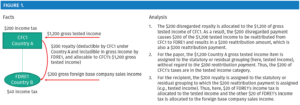
Example
Figure 1 illustrates the reattribution rule with a controlled foreign corporation (CFC) taxpayer.
Remittance
The term remittance means the excess of a disregarded payment, other than an amount that is treated as a contribution, made by a taxable unit to a second taxable unit (including a second taxable unit that shares the same owner as the payor taxable unit) over the portion of the disregarded payment, if any, that is a reattribution payment. Thus, the term remittance generally means disregarded distributions. To the extent an upstream, downstream, or sideways payment is a reattribution payment, the payment is a reattribution
payment. In addition, the term remittance is a catch-all, such that if the payment is not a contribution or a reattribution payment, the payment is a remittance.
An item of foreign gross income that a taxpayer includes by reason of the receipt of a remittance by a taxable unit is assigned to the statutory or residual groupings of the recipient taxable unit that correspond to the groupings out of which the payor taxable unit made the remittance. A remittance paid by a taxable unit is considered to be made ratably out of all of the accumulated after-tax income of the taxable unit. The accumulated after-tax income of the taxable unit that pays the remittance is deemed to have arisen in the statutory and residual groupings in the same proportions as the proportions in which the tax book value of the assets of the taxable unit are (or would be if the owner of the taxable unit were a U.S. person) assigned for purposes of apportioning interest expense under the asset method in Reg. §1.861-9 in the taxable year in which the remittance is made. If the payor taxable unit is determined to have no assets, then the foreign gross income that is included by reason of the receipt of the remittance is assigned to the residual grouping. The assets of a taxable unit are determined in accordance with Reg. §1.987-6(b), except that for purposes of applying Reg. §1.987-6(b)(2), a taxable unit is deemed to be a Code Sec. 987 QBU (within the meaning of Reg. §1.987-1(b)(2)). Assets of the taxable unit include stock held by the taxable unit, the portion of the tax book value of a reattribution asset that is assigned to the taxable unit, and the taxable unit’s pro rata share of the assets of another taxable unit.
Thus, an item of foreign gross income on a remittance by a taxable unit is assigned to the statutory or residual groupings based on the tax book value of the assets of the remitting taxable unit, and for this purpose, the assets of the remitting taxable unit include stock and assets of other taxable units owned by the remitting taxable unit. Note that assets of other taxable units that are resident in the same foreign country, as well as assets of other taxable units owned by that same-country taxable unit, might be taken into account. Also, because the groupings are based on the tax book value of the assets, there could be situations where assets have a basis that is disproportionate to the income produced by the assets, such as low-basis intangible property or interest-bearing cash deposits.
Contribution
A contribution is the excess of a disregarded payment made by a taxable unit to another taxable unit that the first taxable unit owns over the portion of the disregarded payment, if any, that is a reattribution payment. An item of foreign gross income that a taxpayer includes by reason of the receipt of a contribution by a taxable unit is assigned to the residual grouping. Thus, where the taxpayer is a CFC, taxes on a contribution would not be creditable under Code Sec. 960 and those taxes are permanently lost. However, taxes on certain “foreign branch group contributions” are assigned to the foreign branch category for purposes of applying Code Sec. 904 as the operative section.
Disregarded Sales
Generally, an item of foreign gross income attributable to gain recognized under foreign law by reason of a disregarded payment received in exchange for property is characterized and assigned under the rules of Reg. §1.861-20(d)(2) (which generally assigns income as if the event giving rise to foreign gross income occurred from a Federal income tax perspective in the U.S. taxable year in which the foreign income tax is paid or accrued).
Effective Date
As noted above, the Final Disregarded Payment Rules are effective retroactively to tax years beginning after December 31, 2019, and that end on or after November 2, 2020. Thus, for calendar-year taxpayers, the Final Disregarded Payment Rules are effective starting from tax year 2020. Taxpayers who have already filed the 2020 tax return may not be required to amend the filed tax returns. However, interactions with the IRS should be accurate (e.g., if the 2020 return were amended for another reason).
Conclusion
Taxpayers should consider how the Final Disregarded Payment Rules impact their foreign tax credit calculations, including the fact that the regulations are retroactive.


2022 IP Outlook Report: The Developments Shaping Copyright Law
ARTICLE / REPORT
2022 IP Outlook Report: The Developments Shaping Copyright Law
February 22, 2022
Read time: 2 min
Like so many things in 2021, a few long-awaited copyright developments have spilled into 2022, with anticipated amendments to key provisions in the Digital Millennium Copyright Act topping the list of legislation to watch.




Alleged Trademark Infringer Remains Hog-Tied After Appeal
ARTICLE
Alleged Trademark Infringer Remains Hog-Tied After Appeal
February 21, 2022
Read time: 2 min
Neha Khandhadia wrote this bylined article in World Trademark Review where she discusses the case, “The Trial Lawyers College v Gerry Spence Trial Lawyers College at Thunderhead Ranch” and the 10th Circuit’s difficult decision after both party sued one another.




What to Do if Your PPP Forgiveness Application Is Denied (in Full or in Part)
ARTICLE / CLIENT ALERT
What to Do if Your PPP Forgiveness Application Is Denied (in Full or in Part)
February 18, 2022
Read time: 11 min
The Small Business Administration’s (SBA) public data indicates that more than 98% of the total Paycheck Protection Program (PPP) loan value requested to be forgiven by borrowers has been forgiven by the SBA (approximately $692 million was forgiven out of the $700 million requested). However, over the past month, there has been an uptick in the number of forgiveness applications denied by the SBA. Borrowers should be aware that such denials are appealable and consider challenging forgiveness denials if they believe the SBA’s decision was in error.
For borrowers receiving a full or partial denial of their PPP forgiveness application, below are six things to keep in mind:
1. Do not assume that the SBA has carefully reviewed its documentation or correctly applied its rules and guidance.
Given that there were more than 11 million PPP loans issued in 2020 and 2021, it was inevitable that a substantial number of forgiveness applications would be denied. Similarly, it was inevitable that the SBA would make errors when reviewing such an influx of loans and forgiveness applications. The SBA appears to be denying PPP forgiveness applications at a greater pace in 2022, and many of these denials seem contrary to the SBA’s own rules and guidance. Borrowers have received denial letters based on the SBA’s misapplication of its own Interim Final Rules (IFRs), improper application of the SBA’s affiliation rules, communication issues between the SBA and lenders, and even the SBA mixing up one borrower’s information with an unrelated borrower’s information. Accordingly, borrowers should not simply accept the SBA’s decision if there is a chance it was made in error.
2. There is a 30-day timeframe to appeal denials of forgiveness to the SBA’s Office of Hearings and Appeals (OHA).
If the SBA elects to deny—in full or in part—a borrower’s forgiveness application, the SBA will send the borrower’s lender a Final Loan Review Decision. Lenders must then pass this decision along to the borrower within five business days. The SBA’s Final Rule on “Borrower Appeals of Final SBA Loan Review Decisions Under the Paycheck Protection Program” stipulates that a borrower has 30 calendar days after “receipt of the final SBA loan review decision” to appeal the SBA’s decision to the OHA. See 13 CFR § 134.1202(a). Accordingly, the 30-day clock begins to run from the date a borrower receives the decision from its lender, rather than from the date listed on the Final Loan Review Decision.
3. Appeals of the SBA’s final decisions are submitted through the OHA’s Case Portal and must include specific information.
Borrowers that elect to appeal the SBA’s Final Loan Review Decision must do so by submitting an appeal through the OHA’s Case Portal. There is no set format for the appeal, so borrowers or their lawyers can prepare a letter or written narrative outlining the grounds for the appeal. However, the appeal must meet the following minimum requirements:
- Contain a full, specific statement as to why the SBA’s Final Loan Review Decision is erroneous, together with all factual information and legal arguments supporting the statement;
- Be no longer than 20 pages (not including attachments). A table of authorities is required only for appeals citing more than 20 cases, regulations, or statutes; and
- All exhibits and attachments must be clearly labeled.
Along with the appeal, borrowers must upload the SBA’s Final Loan Review Decision and provide the name, address, telephone number, email address, and signature of the borrower or the borrower’s lawyer.
4. The appeals process should take approximately 90 days but could take much longer.
After a borrower submits an appeal, the OHA will issue a Notice & Order, which establishes a deadline for the SBA’s production of the administrative record and specifies a date by which the SBA may respond to the appeal. The SBA’s “Borrower’s Guide” estimates that the Notice & Order should be issued within three days; however, the issuance of the Notice & Order is likely to take much longer. Pursuant to 13 CFR § 134.1207, the SBA has 20 calendar days after issuance of the Notice & Order to produce an administrative record—unless additional time is requested and granted.
Borrowers should review the administrative record and generally must make objections to its contents within 30 days after the filing of the Notice & Order. For example, the borrower may object to the omission of certain documentation or request that documentation be corrected.
In addition to filing the administrative record, the SBA has 45 days after the issuance of the Notice & Order to respond to the appeal, but the agency is not required to do so. Typically, the borrower will not have the opportunity to reply to a response from the SBA but may do so under certain circumstances.
Unless the OHA extends the deadline, the record will close 45 calendar days from the issuance of the Notice & Order. The OHA then has 45 days from the close of the record to review the merits of the appeal and issue a decision through its Case Portal. If the OHA’s decision is not favorable, borrowers have 30 calendar days to request a reconsideration by the OHA. Alternatively, borrowers can file an appeal in the appropriate federal district court.
5. If a borrower appeals to the OHA, then repayment of the loan continues to be deferred.
Once a borrower has submitted a timely appeal of the SBA’s denial of forgiveness, payment of the PPP loan is deferred until the OHA issues a final decision. The borrower must provide its lender with a copy of the timely appeal petition in order for the lender to extend the deferment period. However, borrowers should note that interest will continue to accrue on the loan during the deferment period.
6. If a lender, rather than the SBA, makes the decision to deny forgiveness, the borrower can appeal the lender’s decision to the SBA.
In a January 27, 2022, Procedural Notice entitled “SBA Loan Reviews of Paycheck Protection Program Lender Partial Approval Forgiveness Decisions,” the SBA set forth the process for appeals when the lender—not the SBA—makes a decision to deny forgiveness. In such cases, the borrower has 30 days to submit a request, via the lender, for the SBA to review the lender’s decision. Unlike an appeal to the OHA, borrowers are required to make payments on the remaining balance of the PPP loan while the SBA reviews the appeal. If the SBA ultimately grants full forgiveness, the lender will be required to refund those payments.
***
McDermott’s regulatory team has extensive experience advising clients on issues relating to PPP appeals, SBA affiliation rules, PPP loan eligibility, PPP loan forgiveness, mergers and acquisitions involving PPP loans and government investigations and audits. If you have any questions or need assistance regarding the denial of a PPP forgiveness application or any PPP-related issue, please contact the authors of this article or your regular McDermott lawyer.




Ministerial Draft for the Introduction of the Virtual Annual General Meeting
ARTICLE / CLIENT ALERT
Ministerial Draft for the Introduction of the Virtual Annual General Meeting
February 17, 2022
Read time: 8 min
Up to now, the virtual Annual General Meeting has been a provisional solution due to the exceptional situation caused by the pandemic, with an end date of August 31, 2022 set in the so-called COVID-19 Act. The German Federal Ministry of Justice has now presented a ministerial draft on the “Introduction of Virtual Annual General Meetings of Stock Corporations”, which could also open up a permanent alternative to holding the Annual General Meeting in person for the period after the corona pandemic. We have summarized the main provisions of the draft.
1. Main Provisions of the Ministerial Draft
1.1 Provision by the Articles of Association or authorization of the Executive Board in the Articles of Association
The possibility for stock corporations to continue to choose the format of the virtual Annual General Meeting in the future is created in the draft by introducing a new section 118a German Stock Corporation Act-Draft (Aktiengesetz-Entwurf – „AktG-E“). The proposed standard regulates the basic requirements for holding the Annual General Meeting in virtual form as well as issues relating to attendance, time limits and documents to be made available at the meeting. Accordingly, the option of a virtual shareholders’ meeting can be chosen either directly by a provision in the Articles of Association or by an authorization of the Executive Board provided for in the Articles of Association (“opt-in”). If the Executive Board is authorized by a corresponding provision in the Articles of Association, then – unlike under the COVID-19 Act – no approval of the Supervisory Board is required for the decision to hold the virtual meeting.
However, a corresponding provision of the Articles of Association or the authorization of the Board of Management in the Articles of Association must be limited in time and may apply for a maximum period of five years after registration of the company, or after registration of the amendment to the Articles of Association.In order to avoid companies being forced to move in view of the expiry of the COVID-19 Act on August 31. In order to prevent companies from being forced to move in view of the expiry of the COVID-19 Act on August 31, 2022 and the future requirement to amend the Articles of Association, the draft bill provides as a transitional arrangement that for shareholders’ meetings convened up to and including August 31, 2023, the Executive Board may decide, with the consent of the Supervisory Board, that the meeting is to be held as a virtual meeting pursuant to Section 118a AktG-E.
1.2 Prerequisites
Holding the meeting in virtual format requires – in this respect, there are no deviations from the pandemic-related provisional arrangement – complete video and audio transmission of the meeting. The draft bill also retains the requirement for shareholders to exercise their voting rights via electronic communication (electronic participation or electronic postal voting) and the granting of proxies.
According to the draft, shareholders are also to be given the opportunity to object to the resolution of the Annual General Meeting by means of electronic communication.
It is noteworthy that the draft bill also deliberately refrained from regulating hybrid forms of participation, i.e., a mixed form of face-to-face and virtual event that goes beyond enabling electronic participation pursuant to Section 118 (1) sentence 1 AktG.
1.3 Strengthening shareholder rights in the virtual shareholders’ meeting
However, compared to the pandemic transitional solution provided by the COVID-19 Act, the draft provides for a more comprehensive regulation of shareholders’ rights in the case of the virtual shareholders’ meeting, including during the meeting.
The explicit aim of the draft bill is to streamline the Annual General Meeting by bringing forward information and decision-making processes. Whereas the day of the Annual General Meeting continues to be the decisive point in time for exercising a large number of shareholders’ rights in the face-to-face event, in the draft bill these are predominantly located in the period before the Annual General Meeting in the virtual format.
Previously, under the COVID-19 Act, shareholders had the right to ask questions in the run-up to the Annual General Meeting. The draft bill now specifies as a prerequisite for holding in virtual form both a right of shareholders to information pursuant to Section 131 AktG and a right to speak by way of video communication during the meeting. Questions, comments and video statements must be registered or submitted up to four days before the Annual General Meeting. The shareholders’ right to information in the draft only includes a right to ask questions in the run-up to the meeting, but also a right to ask questions in electronic form during the Annual General Meeting on the answers given by the Executive Board at the meeting.
The new provision in the draft thus goes beyond the right to ask questions under the COVID-19 Act and standardizes a fully-fledged right to information for shareholders, which is again accessible to the information enforcement procedure under Section 132 AktG. Shareholders may submit statements in advance as well as exercise their right to speak in the form of the video statement. However, the speeches may not contain questions. During the meeting, meeting-related motions (motions that are not counter-motions pursuant to § 126 AktG) are possible; i.e. in particular motions on points of order or on the removal of the chairman of the meeting. Counter-motions to proposed resolutions, on the other hand, can only be made before the meeting. Mit Einberufung der Versammlung kann der Vorstand hiervon abweichende – die Rechte der Aktionäre erweiternde – Bestimmungen treffen.
In order to improve the information base of shareholders, the management board report or its main content must be made available to shareholders no later than six days before the meeting.
1.4 Further Regulations
The ministerial draft also provides for a number of adjustments of a technical nature, including, for example, requirements for the inclusion of connected shareholders in the list of participants and the dispensability of specifying a meeting location.
In addition, the draft stipulates an obligation to attend at the location of the Annual General Meeting for the members of the Board of Management and the Supervisory Board (for the latter not in the case of participation via video and audio transmission permitted under Section 118 (3) sentence 2 AktG), the chairman of the meeting and, in the cases of Section 176 (2) sentence 1, 2 AktG, also for the auditor. If, in addition, notarization is required in accordance with Section 130 (1) AktG, the presence of the notary public at the location of the Annual General Meeting is also mandatory in the case of a virtual Annual General Meeting. If a proxy has been appointed, the proxy should also be allowed to attend the meeting, but is not obliged to do so.
1.5 Risks of rescission
Like the COVID-19 Act, the draft bill provides for an exclusion of avoidance in the event of a violation of shareholders’ rights in the virtual shareholders’ meeting due to technical malfunctions. This is intended to prevent the Company from being exposed to increased risks of rescission when choosing the virtual format.
Under the COVID-19 Act, however, the exclusion of rescission does not apply in the event of intentional violations by the Company. The draft bill does not adhere to this restriction to intentional violations; the exclusion of avoidance is now also not to apply in the case of gross negligence. However, according to the explanatory memorandum to the draft, it will not be possible to assume intent or gross negligence if a professional service provider has been commissioned with the technical implementation of the event.
The exclusion of avoidance due to violation of formal requirements for notifications pursuant to Section 125 AktG, which was still regulated in the COVID-19 Act, is not reflected in the draft bill.
In addition, the draft bill does away with the requirement under the COVID-19 Act that shareholders must have exercised their voting rights in order to file an objection. In the draft, the right to contest is linked to the shareholder’s electronic connection to the virtual shareholders’ meeting.
In fact, the right to information and the obligation to allow follow-up questions at the Hauptversammlung, which will once again apply in full, will again increase the risks of challenge for the companies compared with the relief provided by the provisional provisions of the COVID-19 Act.
2. Forecast
During the current four-week application period, the federal states and associations can submit requests for changes to the draft bill. It therefore remains to be seen in what form the virtual shareholders’ meeting will ultimately find its way into the law. Irrespective of this, however, it can already be said that the permanent inclusion of the virtual shareholders’ meeting in the German Stock Corporation Act means that it represents a genuine alternative to the face-to-face meeting, which goes far beyond the provisional model of the COVID-19 Act, in particular due to the comprehensive regulation of shareholders’ rights.
The draft represents a welcome processing of the experience with virtual shareholders’ meetings by the legislator, which, however, is still clearly influenced by the model of the presence shareholders’ meeting. The regulations on the right to speak and ask questions at the Annual General Meeting reflect the practice that has developed for large companies, but represent a major challenge for small listed companies.


Updates on New York Employment Laws
ARTICLE / CLIENT ALERT
Updates on New York Employment Laws
February 18, 2022
Read time: 6 min
Notice Released for Amendment to the New York Whistleblower Protection Law
Pursuant to the amendment to the New York Whistleblower Protection Law (“Whistleblower Law”), which became effective on Jan. 26, 2022, the New York Department of Labor released the Notice of Employee Rights, Protections, and Obligations Under Labor Law Section 740 (“Notice“) on Feb. 11, 2022. The amended Whistleblower Law requires employers to post the Notice conspicuously in easily accessible and well-lit places in their workplaces that are customarily frequented by employees and job applicants.
As discussed in a previous SRZ Alert, the amendment greatly increases whistleblower protections for employees, including by (i) expanding the definition of employees to include former employees and individual independent contractors (collectively with current employees, “Employees”); (ii) protecting Employees who reasonably believe their employer has a policy or practice that violates the law, or poses a substantial and specific danger to public health or safety; (iii) allowing Employees to make a “good faith effort” to first notify their employer of the asserted violation before making a report and, in certain circumstances, not requiring notification to their employer; (iv) expanding the definition of “Retaliatory action”; (v) extending the statute of limitations, increasing possible remedies and granting Employees the right to a jury trial; and (vi) requiring employers to post notice of the amended law, which can be satisfied by posting the Notice.
Extension of the HERO Act Designation
On Feb. 15, 2022, the New York State Commissioner of Health extended the designation of COVID-19 as a “highly contagious communicable disease” under the New York State Health and Essential Rights Act (“HERO Act”) until Mar. 17, 2022. Therefore, employers must continue to implement and enforce their airborne infectious disease exposure prevention plans until at least Mar. 17,[1] as discussed in previous SRZ Alerts “New York State Employers Must Activate Exposure Prevention Plans Under the NY HERO Act” and “What Employers Need to Know About the NY HERO Act.” In the event the designation is not renewed, employers will still have certain obligations, which are discussed in a previous SRZ Alert.
Please contact Mark E. Brossman, Ronald E. Richman, Max Garfield, Scott A. Gold, Donna K. Lazarus, Abdulrahman Alwattar, or Andrew B. Lowy if you have any questions about these updates.
[1] As discussed in a previous SRZ Alert, the New York State Department of Labor recently updated its Model Airborne Infectious Disease Exposure Prevention Plan to relax its masking requirements, providing that: “Employees will wear appropriate face coverings in accordance with guidance from State Department of Health or the Centers for Disease Control and Prevention, as applicable. Consistent with the guidance from the State Department of Health, if indoor areas do not have a mask or vaccine requirement as a condition of entry, appropriate face coverings are recommended, but not required. It is also recommended that face coverings be worn by unvaccinated individuals, including those with medical exemptions, in accordance with federal CDC guidance.”
This communication is issued by Schulte Roth & Zabel LLP for informational purposes only and does not constitute legal advice or establish an attorney-client relationship. In some jurisdictions, this publication may be considered attorney advertising. ©2022 Schulte Roth & Zabel LLP.
All rights reserved. SCHULTE ROTH & ZABEL is the registered trademark of Schulte Roth & Zabel LLP.