ARTICLE
Relief from payroll taxes
November 6, 2023
Read time: 1 min
Key takeaways
Overview
Dr. Gero Burwitz with an article about “Relief from payroll taxes”, published in Markt und Mittelstand.
In depth

More insights




ARTICLE
November 6, 2023
Read time: 1 min
Dr. Gero Burwitz with an article about “Relief from payroll taxes”, published in Markt und Mittelstand.

ARTICLE
September 2023
Read time: 2 min
Michael Darowski and Romilly Holland authored the chapter, Civil Unrest and Investor–State Claims in the Telecommunications Sector, in the Global Arbitration Review’s Guide to Telecoms Arbitration, Second Edition.

ARTICLE / CLIENT ALERT
November 3, 2023
Read time: 12 min
On October 16, 2023, the Council of Ministers approved, in preliminary examination, the first two drafts of legislative decrees implementing the new “Italian Tax Reform” (Law No. 111/2023).
One of these legislative decrees ushers in significant change to international taxation.
The draft decrees will now need to acquire the opinions of the relevant parliamentary committees. They are expected to be fully approved and published by the end of this year (December 31, 2023). The provisions contained therein will apply as of January 1, 2024.
In our latest alert, we analyze the new definitions of residency for both individuals and corporations.
1. Individual Tax Residency
Article 1 of the draft decree, which concerns international taxation, changes the wording of Article 2(2) of the Italian Income Tax Code (D.P.R. n. 917/1986, the “IITC”), reformulating it as follows: “For the purposes of income tax, persons who for the greater part of the tax period, also considering fractions of a day, have their domicile or residence in the territory of the State or who are present therein are considered residents. For the purposes of applying this provision, domicile shall mean the place where the person’s personal and family relations are primarily developed. Unless proven otherwise, persons registered for the greater part of the tax period in the registers of the resident population are also presumed to be resident”, whereas the current rules provide that “For the purposes of income tax, persons who for the greater part of the tax period are registered in the registers of the resident population or have in the territory of the State their domicile or residence pursuant to the Civil Code are considered residents.”
This provision modifies the connecting factors for the purposes of determining the tax residence of individuals, replacing the civil law criterion of domicile (principal seat of affairs and interests of a person) with a substantive and tax-specific definition of domicile understood as the place where the person’s personal and family relations are primarily developed. As a new connecting factor, tax residence is also defined as the place where the person is physically present for the greater part of the tax period. The other alternative criterion, namely the place where the person has their habitual abode (definition of residence pursuant to the Civil Code) remains unchanged. Pursuant to the new provision, therefore, an individual will be considered a tax resident in Italy who, for the greater part of the tax period and also considering fractions of a day, alternatively or cumulatively: (i) is physically present in the territory of the State; and/or (ii) has in it their habitual abode; and/or (iii) has in it their primary personal and family relations.
It is important to note that the former criterion of considering tax resident an individual who is registered as a member of the resident population remains as a relevant connecting criterion for tax residence, albeit only as a rebuttable presumption.
This new provision also introduces a new and innovative way to calculate the time spent in the territory of the State. According to the draft bill, in assessing whether a person is resident in Italy for the greater part of the tax period, relevance must also be attached to fractions of a day.
These changes, pursuant to the framework Law No. 111/2023 are intended to be adjustments to international practice and Double Tax Conventions(DTCs), and are aimed at providing greater legal certainty.
The connecting factor represented by mere physical presence in Italy, however, does not seem to be in line with the principles adopted in the OECD and international practice. As such, it appears that this connecting factor conflicts with the stated purpose of standardizing the residency criteria dictated by national regulations and international provisions.
In any event, the application of the criterion of physical presence should be of limited practical relevance. This is because in most cases, its application will lead to a residence conflict. According to the “tie breaker rules” contained in most treaties, the criteria to resolve such a conflict of residence are, in order: 1) permanent home; 2) the place where personal and economic relations are closer to the individual (centre of vital interests); 3) if the Contracting State in which that person has the centre of their vital interests cannot be determined, or if they do not have a permanent home available in any of the Contracting States, they are deemed to be a resident of the Contracting State in which they have an habitual abode; 4) nationality; 5) mutual agreement between the two Contracting States.
It would therefore appear that the criterion of “presence” in the territory of the State does not align with the ranking of criteria set out by the treaty tie breaker rule.
With respect to the new definition of “domicile”, there is some doubt as to whether the definition truly aligns to international practice and double taxation conventions. The draft provision makes reference to personal and family relations, while the conventional tie breaker rule refers to personal and economic relations also defined as the centre of vital interests. It would follow that economic relations which are considered in the current domestic law definition of domicile (principal seat of affairs) and in the conventional rule, would no longer be relevant for domestic law purposes if the language of the draft provision is confirmed as such in the law. The exclusive relevance of personal/family relations would overcome the historical dilemma of whether economic or personal relations should prevail for residency purposes under domestic law. This is a question that the Supreme Court recently answered, stating that when personal and economic relations do not coincide in the same place, precedence should be given to the latter (Cass. N. 16954, May 25, 2022).
In other cases, both the courts and tax administration seem to have given a reverse precedence. In this respect, the proposed new provision certainly has the merit of mitigating uncertainty. A definition limited to personal/family relations may, however, create a mismatch with the conventional rule which still makes reference also to economic relations. One possible interpretation is that the wording “personal and family relations” is intended to reinforce the exclusive relevance of the personal sphere. Under this approach, Italy should no longer claim an individual to be Italian resident based on their economic relations and would only refer to their personal relations for the purpose of applying domestic law. However, when applying the DTC, Italy would be required to respect economic relations as a relevant factor when applying the “tie breaker rule”, with the possible result that the individual would be considered a resident of the other contracting State based on their economic relations. Another possible interpretation is to consider the word “personal” as inclusive of the economic sphere. In this case, the new domestic definition would in essence coincide with the conventional definition. However, given the aim of aligning domestic rules with conventional rules, why use different language? Any such interpretation therefore appears less grounded.
Finally, the amendment which lessens the significance of mere registration as part of the resident population (a factor already of limited importance when a DTC exists) is to be welcomed.
2. Corporation Tax Residency
According to the current wording of Article 73, paragraph 3 of the Italian Income Tax Code (IITC), companies and entities that either have their registered office or seat of administration or main purpose of business in Italy for the greater part of the annual tax period shall be considered resident of Italy.
While the location of the registered office is an objective criterion, the criteria of the seat of administration and the main purpose of business lend themselves to qualitative assessments with an uncertain outcome and indeed over time have given rise to a number of disputes.
In particular, the criterion of the main purpose of business represents a peculiarity of the Italian tax system and has led to tax disputes especially for companies with a passive type of income or that merely own assets in the Italian territory, without also carrying out an effective management activity.
With the express aim of ensuring greater legal certainty Article 2 of the draft decree under review repeals the two latter connecting criteria (seat of administration and main purpose), replacing them with the place of effective management and the place of routine management. This repeal is intended to take into consideration international practice and the criteria to determine tax residence provided by the DTCs.
According to the new draft provision which amends article 73, paragraph 3, of the IITC, “for income tax purposes, companies and entities that have their registered office or place of effective management or place of routine management in the territory of the State for the greater part of the tax period are considered resident”.
The draft provision specifies that “place of effective management” (POEM) is defined as the place of the continuous and coordinated taking of strategic decisions concerning the company or entity as a whole, while “routine management” means the place of continuous and coordinated performance of day-to-day management acts concerning the company or entity as a whole.
No change is introduced with respect to the current criterion of the “registered office”.
The reference to POEM uses the same wording which we typically see in DTCs. This choice of wording aligns with the goal of ensuring the new provisions are concomitant with international and conventional standards stated by the framework Law No. 111/2023.However, some uncertainty still remains as cross-jurisdictionally it has historically been impossible to provide a comprehensive definition of the term POEM based on the language of the OECD Model Convention and on the Commentary, since it remains unclear when interpreting and applying the Conventions which level of management is relevant.
Meaning that academics and court systems have attached to POEM across a number of jurisdictions is indeed variable and heavily influenced by the corporate governance models in force. It is also, with the progressive expansion of remote working, more and more affected by the use of technology. Last but not least, the nature of the business of the company may suggest a case-by-case approach. For instance, companies having a routine functional profile may suggest that importance should be attached to day-to-day management.
The different views taken across jurisdictions on the meaning of POEM and the fact that case law is not conclusive on the matter were probably the catalyst for the OECD to introduce a new tie-breaker standard in the 2017 Model Convention (2017 MC) by deferring dual residence cases to the Competent Authority procedure (MAP). In this respect, the attempt of aligning the new law provision to international and conventional rules may be frustrated by the adoption of a standard (POEM), which the OECD MC is progressively abandoning or at the very least questioning.
While Italy made a reservation on the new tie-breaker rule (which defers dual residence cases to the MAP procedure), when it signed in 2017 the Multilateral Convention (MLI) to Implement Tax Treaty Related Measures to Prevent Base Erosion and Profit Shifting (BEPS), on the other hand it did adopt such new standard in recently executed DTC (e.g. Jamaica, Colombia, Uruguay, Romania).
Italy may yet align to the new standard within the ratification of the MLI. In any event, for the time being, most of the DTC that Italy currently has in force refer to POEM as a tie-breaker rule. While in the majority of cases, consensus has been reached that prevalence should be given to the place where the board of directors meet to discuss the strategy of the company and take key decisions, and that a company can have only one POEM, there are cases (also under Italian case law) where, in interpreting the treaty concept of POEM, prevalence was given to the day-to-day management. This was especially true for companies whose activity is limited and/or simple, as those that provide routine services, for instance toll manufacturers.
The draft law currently under discussion provides a definition of POEM making clear reference to the place of the continuous and coordinated taking of strategic decisions concerning the company or entity as a whole. Accordingly, it appears reasonable to expect that in the future from an Italian perspective the same meaning should be given to the concept of POEM for both domestic law and treaty purposes: POEM would thus be considered the place where strategic decisions are taken in a continuous and coordinated fashion.
As a consequence, while the proposed domestic provision also attaches residence to the place of continuous and coordinated performance of day-to-day management acts, conflicts of residence to be addressed under a POEM treaty clause should be resolved by giving exclusive relevance to the place where the strategic decisions are taken, no matter where the day-to-day management is carried out.
The analysis for new DTCs (and for several additional jurisdictions, in the case that Italy aligns to such new standard within ratification of the MLI) is different, as these defer to the MAP the resolution of dual residence of companies and legal entities. In such cases, pursuant to the new standard of article 4§3 of the MC, for the purposes of the MAP, the competent authorities should have regard to the place of effective management, the place where the company is incorporated or otherwise constituted and “any other relevant factors”, which according to the OECD Commentary should include, among others, “where the senior day-to-day management of the person in carried on”. It should therefore be expected that day-to-day management will still play a role in the application of those DTC which do not exclusively rely on the POEM for the resolution of dual residence.





ARTICLE
Nov 2, 2026
Read time: 5 min
The US Court of Appeals for the Fifth Circuit revived a hotel group’s federal trade secret suit against two former employees, finding that the district court did not have enough information to conclude that the hotel group improperly split claims between federal and state actions. Armadillo Hotel Group, LLC v. Harris, Case No. 22-50945 (5th Cir. Oct. 20, 2023) (Smith, Southwick, Higginson, JJ.)
Armadillo Hotel Group is a buyer and operator of modular and mobile structures throughout North America. According to Armadillo, it hired Todd Harris and Jason McDaniel to oversee Armadillo’s construction operations and its hotel, food and beverage operations. The relationship deteriorated after a few years, leading to Harris and McDaniel’s resignations.
Harris and McDaniel subsequently sued Armadillo Hotel Group Management (AHG Management) in Texas state court alleging that they entered employment agreements with AHG Management as part of the joint venture, but AHG Management breached these agreements by failing to pay the agreed upon salary, bonuses and profit-sharing interests. The precise relationship between Armadillo and AHG Management is unclear. AHG Management filed counterclaims, agreeing that it hired Harris and McDaniel but arguing that they breached their fiduciary duties by failing to devote their full attention to their responsibilities and diverted business opportunities to their own companies, which allegedly competed with AHG Management.
The parties conducted discovery in state court, after which AHG Management filed an amended counterclaim in state court, removing its claim against Harris and McDaniel for improper expropriation of proprietary and confidential documents. That same day, Armadillo filed a complaint in federal district court against Harris, McDaniel and several new parties, including Southeastern Disaster Relief Services (SDRS), a business affiliated with McDaniel; Battlement Mesa Consulting, LLC (BMC), a business affiliated with Harris; and Grand Majestic Lodge (GML), a competitor of Armadillo. Armadillo’s complaint alleged that Harris and McDaniel misappropriated trade secrets that they shared with SDRS, BMC and GML during and after their employment with Armadillo. The complaint also included claims under the federal Defend Trade Secret Act (DTSA), alleging that the five defendants conspired to misappropriate the trade secrets.
Harris, McDaniel, SDRS and BMC moved to dismiss the federal complaint for impermissible splitting of claims relating to Harris and McDaniel’s employment between the state court proceedings and this new federal lawsuit. The district court granted the motion with prejudice. While acknowledging the “apparent difference between Defendant AHG Management LLC in the state-law action and Plaintiff Armadillo in [the district court] case,” the district court found that the prohibition against claim splitting applied because the same claims were first removed from AHG Management’s counterclaim in the state court proceedings and then asserted by Armadillo in the federal action. The district court also found that the claims arose out of the same nucleus of operative facts—Harris and McDaniel’s employment—and shared a common factual predicate. Armadillo appealed.
The rule against claim splitting prohibits a party or parties in privity from simultaneously prosecuting multiple suits involving the same subject matter against the same defendants. In situations where a prior suit is pending, courts look to two factors: whether “the same claim or cause of action” is “involved in both suits,” and whether the parties in the current action are the same or “in privity with the parties in the prior action.”
Addressing the first factor, the Fifth Circuit found that the district court correctly concluded that Armadillo’s claims against Harris and McDaniel arose out of the same nucleus of operative facts as AHG Management’s claims. In the state counterclaim, AHG Management asserted misappropriation of confidential information, including “AHG financial information, accounts payable information, listings of AHG assets, vendor pricing proposals, and information regarding AHG construction budgets and timelines.” This was similar to the federal claim, which asserted misappropriation of trade secrets, including “vendor pricing and proposals,” “construction line-item costs and budgets,” “asset listings” and other confidential information.
Turning to the second factor, the Fifth Circuit found that the district court did not have sufficient information or assertions about the relationship between Armadillo and AHG Management, and therefore improperly found that Armadillo and AHG Management were in privity. The Court noted the district court’s acknowledgement of the “apparent difference” between Armadillo and AHG Management but found that the district court improperly dismissed this apparent lack of identity because of the similarity in the claims (i.e., factor one). The Court explained that privity exists in three narrowly defined circumstances, all of which focus on the relationship of the parties and not the relationship of the claims:
The Fifth Circuit concluded that the record did not include sufficient information to decide if Armadillo and AHG Management were in privity with each other. The Court reversed the district court’s dismissal and remanded with instructions that the district court determine the relationship between the two parties so that it could properly apply the claim splitting test.





ARTICLE / CLIENT ALERT
November 2, 2023
Read time: 32 min
On Jan. 1, 2024, the first final rule (“BOI Rule”) implementing the Corporate Transparency Act (“CTA”)[1] will take effect requiring certain legal entities formed or registered to do business in the US (each, a “Reporting Company”) to file a beneficial ownership information (“BOI”) report with the US Department of the Treasury’s Financial Crimes Enforcement Network (“FinCEN”).[2] Each Reporting Company will be required to disclose on its BOI report identifying information of the Reporting Company and each individual who directly or indirectly exercises substantial control or owns or controls 25 percent or more of the ownership interests of a Reporting Company (each, a “Beneficial Owner”), and, in certain cases, the individuals involved in the Reporting Company’s formation and/or registration to do business in the US (each, a “Company Applicant”). Any individual, Reporting Company or other entity that willfully provides, or attempts to provide, false or fraudulent BOI to FinCEN, or willfully fails to report complete or updated BOI to FinCEN, may be liable for civil or criminal penalties.
According to FinCEN, the BOI Rule is intended to help prevent and combat money laundering, terrorist financing, corruption, tax fraud and other illicit activity. The information in the BOI report will not become public, but FinCEN is authorized to share the information with certain government agencies, such as law enforcement agencies and financial regulators. It may also be shared with financial institutions with a Reporting Company’s consent.
In this Alert, we provide an overview of the BOI Rule, discuss key terms and compliance dates, and offer key considerations and takeaways.
Key Dates:
The BOI Rule will have significant implications for US and foreign entities. Determining the applicability of the BOI Rule, whether an entity has any reporting obligations or is eligible for an exemption is a fact-specific analysis, which should be determined on an entity-by-entity basis. Companies should begin evaluating which legal entities in their organizational structure are within the scope of the definition of Reporting Company (i.e., those legal entities formed or registered to do business in the US by the filing of a document with a secretary of state or similar office) and which of those entities may qualify for an exemption. Preparing an organizational structure chart which identifies each entity (depicting any up-stream entities that directly or indirectly own or control it, and any down-stream entities that it may directly or indirectly own or control), is necessary to have all the information needed to conduct this analysis, including to assess any changes to their existing structures that might be appropriate. After identifying which entities in their organizational structure will be Reporting Companies, companies should begin gathering information required to be reported on a BOI report for each Reporting Company.
In addition, companies should consider developing systems to keep track on an ongoing basis of ownership structures, and any information disclosed on a BOI report or any application to obtain a unique identifying number that FinCEN will issue to an individual upon request (“FinCEN Identifier”). Such systems are necessary to ensure that if there is any change to a Reporting Company’s Beneficial Owners or disclosed information (e.g., address change or passport expiration), that such change is identified and an updated or corrected report is timely filed.
The BOI Rule identifies two types of Reporting Companies:[5]
The applicability of the BOI Rule and the information included on a BOI report is determined on an entity-by-entity basis.
Exemptions. Entities must file a BOI report only if they meet the definition of Reporting Company and do not qualify for an exemption. The BOI Rule exempts 23 specific types of entities from the reporting requirements (each, an “Exempt Entity”), which are discussed in more detail below.
Reporting Company. An entity that meets the definition of Reporting Company and is not otherwise an Exempt Entity, must report information on itself and the personal information of each Beneficial Owner and, for new entities created or registered on or after Jan. 1, 2024, information regarding all individuals identified as “Company Applicants” to FinCEN.
Beneficial Owners. The BOI Rule defines a Beneficial Owner broadly as any individual, who directly or indirectly:
Substantial Control. An individual exercises substantial control over a Reporting Company if the individual meets any of the following four general criteria:
Ownership Interests. In calculating an individual’s 25 percent direct or indirect ownership interest in a Reporting Company, Reporting Companies should consider the following five ownership interest types, which notably include contingent interests:
Exclusions to the Definition of Beneficial Owner. The BOI Rule contains five exceptions to the Beneficial Owner: (1) a minor child, provided that a parent’s or guardian’s information is reported; (2) an individual acting as nominee, intermediary, custodian or agent on behalf of another individual; (3) an individual acting solely as an employee of a Reporting Company in specified circumstances (provided that the employee is not a Senior Officer); (4) an individual whose only interest in a Reporting Company is a future interest through a right of inheritance; and (5) a creditor of a Reporting Company.
Company Applicants. The BOI Rule defines Company Applicant as the individual(s) who: (1) directly files the document (physically or electronically) with a secretary of state or similar office that forms or registers the entity to do business in the US; and (2) is primarily responsible for directing or controlling the filing of the formation document or first registration document. If more than one individual is involved in the filing of the document that created or first registered the entity, then two individuals (but no more) must be reported as Company Applicants.
A Reporting Company must report the following: (1) full legal name; (2) any trade name or “doing business as” name; (3) the street address of its principal place of business or the primary location in the US where the foreign Reporting Company does business; (4) the jurisdiction of formation; (5) for any foreign Reporting Company, the US state where the entity first registers to do business; and (6) taxpayer identification number and name of jurisdiction.
For certain Reporting Companies, there is a special rule which will provide some relief in identifying Beneficial Owners. This rule provides that where a Reporting Company is owned, directly or indirectly, by an Exempt Entity, and there is an individual that is a Beneficial Owner of the Reporting Company exclusively by virtue of the individual’s ownership interest in such Exempt Entity, the Reporting Company’s BOI report will include the name of the Exempt Entity in lieu of the identifying information regarding that individual.[11]
Each Beneficial Owner and Company Applicant must report the following information:(1) full legal name; (2) date of birth; (3) residential street address;[12] (4) unique identifying number and issuing jurisdiction from their government-issued identification document (e.g., US driver’s license or US or foreign passport); and (5) the image of the document that shows the unique identifying number.
To the extent that a Reporting Company’s Beneficial Owners or Company Applicants choose to obtain a FinCEN Identifier, such individuals may provide their FinCEN Identifier in lieu of the identifying information required to be disclosed on the BOI report.
As noted above, the BOI Rule exempts from the definition of “Reporting Company” 23 specific types of entities, many of which are already subject to substantial federal and/or state regulation or already have to provide their BOI to a governmental authority, such as public companies, banks, securities brokers and dealers, SEC-registered investment companies and SEC-registered investment advisers. Examples include the following:
Please see Schulte’s high-level summary of exempt entities on Appendix A of this Alert, which provides an overview of each of the 23 Exempt Entities.
Given the complexity of the BOI Rule, and because FinCEN is continuing to issue guidance in the form of frequently-asked-questions[14] and, most recently, a Small Business Compliance Guide[15] to aid the public in complying with the BOI Rule, companies should carefully evaluate the appropriate filing requirements.[16] Schulte is continuing to monitor FinCEN guidance, which could differ or add nuance to the information discussed above. The information in this Alert should be considered in conjunction with any applicable guidance that FinCEN may issue.
In addition, the CTA is being implemented in two additional rulemakings to (i) establish who is permitted to access BOI reports filed with FinCEN, for what purposes BOI reports can be accessed and what safeguards will be put into place to protect and secure BOI; and (ii) revise FinCEN’s CDD rule to align with the BOI Rule.[17]
Authored by Michael S. Didiuk, Melissa G.R. Goldstein, Betty Santangelo, Jessica Romano and Kyle B. Hendrix.
If you have any questions concerning this Alert, please contact your attorney at Schulte Roth & Zabel or one of the authors.
[1] The CTA was enacted in January 2021 as part of the National Defense Authorization Act for Fiscal Year 2021 (“NDAA”) (CTA §§ 6401–03), available here. For more information regarding the CTA and the Anti-Money Laundering Act of 2020, both enacted as part of the NDAA, please see our prior Alert “Passage of Anti-Money Laundering Act of 2020 Includes Comprehensive BSA/AML Reform Measures,” available here.
[2] 31 C.F.R. § 1010.380; Final Rule, Beneficial Ownership Information Reporting Requirements, 87 Fed. Reg. 59498 (Sept. 30, 2022), available here (hereinafter, “BOI Rule”). For more information regarding the BOI Rule, please see our prior Alert “FinCEN Issues Final Rule Requiring Reporting of Beneficial Ownership Information.”
[3] FinCEN has recently issued a proposed rule extending this 30 day deadline to 90 days for Reporting Companies formed or registered on or after Jan. 1, 2024 and before Jan. 1, 2025. Such proposed rule has not yet been adopted. Notice of Proposed Rulemaking, Beneficial Ownership Information Reporting Deadline Extension for Reporting Companies Created or Registered in 2024, 88 Fed. Reg. 66730 (Sept. 28, 2023), available here.
[4] Reporting Companies are not required to update previously reported information about their Company Applicants, but are required to correct any inaccurate information previously reported about their Company Applicants.
[5] Other types of legal entities, including certain trusts, are excluded from the definitions to the extent that they are not created by the filing of a document with a secretary of state or similar office.
[6] This would exclude individuals performing ministerial functions like a corporate secretary or treasurer, unless such individual otherwise exercises substantial control under any of the other criteria.
[7] Not all board members may be viewed as having substantial control. See FinCEN, Beneficial Ownership Information Reporting, Frequently Asked Questions, FAQ D.9 (last updated September 2023) (“Whether a particular director meets [the definition of Beneficial Owner] is a question that the reporting company must consider on a director-by-director basis.”), available here.
[8] Creditors are excluded from the definition of Beneficial Owner.
[9] Note that the trustee of a trust or similar arrangement can be deemed to exercise substantial control.
[10] Where a Reporting Company is owned by a trust or similar arrangement, the following individuals may hold ownership interests in the Reporting Company: (i) a trustee of the trust or other individual (if any) with the authority to dispose of trust assets; (ii) a beneficiary who is the sole permissible recipient of trust income and principal from the trust, or who has the right to demand a distribution of or withdraw substantially all of the trust assets; or (iii) a grantor or settlor who has the right to revoke or otherwise withdraw trust assets.
[11] Unlike the exemption from the definition of Reporting Company for subsidiaries of certain Exempt Entities, this special rule applies to any Exempt Entity. A Reporting Company may choose whether to take advantage of this special rule by including the name of the Exempt Entity in lieu of the identifying information regarding that individual or may report the Beneficial Owner’s full information. Where a Beneficial Owner’s interest is held through multiple Exempt Entities, all such Exempt Entities may be reported in lieu of the identifying information regarding that individual.
[12] Company Applicants may disclose their business address instead of their residential street address.
[13] As used in this exemption, the term “pooled investment vehicle” means any (i) any investment company, as defined in section 3(a) of the Investment Company Act of 1940; or (ii) any company that: (A) would be an investment company under Section 3(a) but for the exclusion provided by Section 3(c)(1) or Section 3(c)(7); and (B) is identified by its legal name by the applicable investment adviser in its Form ADV filed with the SEC or will be so identified in the next annual updating amendment to Form ADV required to be filed by the applicable investment adviser pursuant to Rule 204–1 under the Advisers Act.
[14] FinCEN, Beneficial Ownership Information Reporting, Frequently Asked Questions (last updated September 2023), available here.
[15] FinCEN, Small Entity Compliance Guide, Beneficial Ownership Information Reporting Requirements (Version 1.0, September 2023), available here.
[16] Such guidance is available on FinCEN’s webpage dedicated to compliance with the BOI Rule, available here.
[17] FinCEN issued a notice of proposed rulemaking to address access to and safeguarding of BOI. See 87 Fed. Reg. 77,404 (Dec. 16, 2022), available here.
This communication is issued by Schulte Roth & Zabel LLP for informational purposes only and does not constitute legal advice or establish an attorney-client relationship. In some jurisdictions, this publication may be considered attorney advertising. © 2023 Schulte Roth & Zabel LLP. All rights reserved. SCHULTE ROTH & ZABEL is the registered trademark of Schulte Roth & Zabel LLP.





ARTICLE / CLIENT ALERT
November 2, 2023
Read time: 23 min
On Jan. 1, 2024, the first final rule (“BOI Rule”) implementing the Corporate Transparency Act (“CTA”)[1] will take effect that requires certain legal entities formed or registered to do business in the US (each, a “Reporting Company”) to file a beneficial ownership information (“BOI”) report with the US Department of the Treasury’s Financial Crimes Enforcement Network (“FinCEN”).[2] Each Reporting Company will be required to disclose on its BOI report identifying information of the Reporting Company and each individual who directly or indirectly exercises substantial control or owns or controls 25 percent or more of the ownership interests of a Reporting Company (each, a “Beneficial Owner”), and, in certain cases, the individuals involved in the Reporting Company’s formation and/or registration to do business in the US (each, a “Company Applicant”).
A Reporting Company formed or registered to do business in the US before Jan. 1, 2024 must file its initial BOI reports by Jan. 1, 2025. A Reporting Company created on or after Jan. 1, 2024 must file its initial reports within 30 calendar days of receiving notice that the formation or registration has become effective.[3] Failure to file a BOI report could subject a Reporting Company to civil and criminal penalties.
In this Alert, we provide an overview of the implications of the BOI Rule on the private fund industry.[4] Please note, Schulte summarizes the general requirements of the BOI Rule in a separate Alert available here that includes a discussion of key terms and each of the 23 exemptions to the definition of Reporting Company.[5]
The BOI Rule exempts from the definition of Reporting Company 23 specific types of entities. Of particular relevance for private fund advisers and sponsors and the private funds they advise are the following entities that are excluded from the definition of “Reporting Company” and therefore exempt from the reporting requirements of the BOI Rule:
Exempt Pooled Investment Vehicles
As explained above, a “pooled investment vehicle” is exempt if it is operated or advised by an RIA or VC Adviser, among others. For purposes of this exemption, a “pooled investment vehicle” means a private fund formed in the US relying on Section 3(c)(1) or Section 3(c)(7) of the Company Act; and (B) is identified by its investment adviser in its Form ADV filed with the SEC (or will be identified in the next annual updating amendment). Notably, pooled investment vehicles that are formed in the US and operated or advised by investment advisers who (i) rely on the “Private Fund Adviser” exemption from SEC registration under Section 203(m) of the Advisers Act because they advise solely private funds that have a total of less than $150 million in assets under management in the United States (“PFAs”),[9] (ii) state-registered investment advisers; or (iii) foreign investment advisers are not expressly exempt from the definition of Reporting Company (see discussion below). Further, since the definition of “pooled investment vehicle” does not capture investment vehicles that rely on exemptions other than Section 3(c)(1) or Section 3(c)(7), vehicles relying on, for example, Section 3(c)(5)(C) of the Company Act, such as certain real estate funds, would not be expressly exempt from the definition of Reporting Company and may be required to file a BOI report. Similarly, vehicles that only trade and invest in commodity interests or other asset classes not treated as securities and are not relying on an exemption under the Company Act would not be expressly exempt from the definition of Reporting Company and may be required to file a BOI report.[10]
Limited Exemption for Foreign Pooled Investment Vehicles. A foreign pooled investment vehicle that is not registered to do business in the US is not a Reporting Company. It is typically the case that foreign pooled investment vehicles are not registered to do business in the US. As such, most foreign pooled investment vehicles will not be subject to the BOI Rule. Where a foreign pooled investment vehicle is registered to do business in the US, it is a Reporting Company, notwithstanding that it may qualify for the exemption for Exempt Pooled Investment Vehicles (e.g., it is operated or advised by an RIA and identified on the RIA’s Form ADV). Unless another exemption applies, such foreign pooled investment vehicle would need to file a BOI report, but would only need to disclose information relating to one individual who exercises substantial control over such foreign pooled investment vehicle (and would not be required to identify those individuals who own or control 25 percent or more of the ownership interests of the foreign pooled investment vehicle). If more than one individual exercises substantial control, only the individual who has the greatest authority over the strategic management is required to be disclosed on the BOI report.
SEC Registered Investment Advisers and Holding Companies
RIAs are exempt from the definition of Reporting Company and not required to file a BOI report.[11] A holding company or other similar upper tier entity, however, that owns or controls an RIA or a separate vehicle set up by an RIA to serve as the general partner of an Exempt Pooled Investment Vehicle (or managing member, in the case of an Exempt Pooled Investment Vehicle structured as a limited liability company) would not be automatically exempt from the definition of Reporting Company based on the exempt status of the RIA.[12] As such, a holding company would be subject to the reporting requirements of the BOI Rule unless another exemption applies.
Relying Advisers
Investment advisers to private funds may be organized as a group of related advisers, including private funds’ general partners or managing members, that are separate legal entities but effectively operate as — and appear to investors and regulators to be — a single advisory business. In 2016, the SEC adopted amendments to Part 1A of Form ADV to provide a more efficient way for the registration on one Form ADV of multiple private fund advisers operating a single advisory business (“Umbrella Registration”).[13] The 2016 amendments codified guidance the SEC staff provided to private fund advisers regarding Umbrella Registration in a 2012 SEC Staff Letter to the American Bar Association (“2012 ABA Letter”).[14] The 2012 ABA Letter provided conditions under which one adviser (“filing adviser”) could file a single Form ADV on behalf of itself and other advisers that were controlled by or under common control with the filing adviser (each, a “relying adviser”), provided that they conducted a single advisory business. One of the conditions was that the relying adviser be independently eligible to register with the SEC. By taking advantage of Umbrella Registration, the filing adviser and each relying adviser are registered with the SEC but only require one Form ADV. Therefore, a filing adviser and each relying adviser included on an Umbrella Registration would qualify for the RIA exemption and be exempt from the reporting requirements of the BOI Rule.
General Partner or Managing Member of an Exempt Pooled Investment Vehicle
In some fund structures, an RIA may establish a separate vehicle to serve as the general partner of an Exempt Pooled Investment Vehicle (or managing member, in the case of an Exempt Pooled Investment Vehicle structured as a limited liability company). In the 2012 ABA Letter, the SEC staff also granted relief to enable a special purpose vehicle that acts as a private fund’s general partner or managing member (a “Fund GP”) to rely on its related SEC investment adviser’s registration with the SEC rather than separately register as long as it meets the conditions of the 2005 ABA Letter and 2012 ABA Letter.[15] Notably, even though a Fund GP relies on a related investment adviser’s registration, the SEC staff in the 2012 ABA Letter highlights that the Fund GP is an investment adviser registered with the SEC and subject to the Advisers Act.[16] Fund GPs may also be relying advisers (see discussion above). Therefore, a Fund GP would qualify for the RIA exemption and be exempt from the reporting requirements of the BOI Rule.[17]
Subsidiaries of Exempt Pooled Investment Vehicles
Under the Subsidiary Exemption, subsidiaries of certain exempt entities whose ownership interests are controlled or wholly owned, directly or indirectly, by one or more specified types of exempt entities, including RIAs, are exempt from the reporting requirements of the BOI Rule. Importantly, Exempt Pooled Investment Vehicles are excluded from the list of entities whose subsidiaries are automatically exempt from the reporting requirements of the BOI Rule. As such, the availability of an exemption for entities down-stream from an Exempt Pooled Investment Vehicle, including any entities created for purposes related to the administration of the Exempt Pooled Investment Vehicle, such as for tax purposes or to acquire and hold specific investments and onboard new capital (the downstream legal entities, collectively, “PIV-related entities”) is not automatic based on the exempt status of the Exempt Pooled Investment Vehicle.
Despite acknowledging that PIV-related entities may be integrally related to the administration of an Exempt Pooled Investment Vehicle, FinCEN declined to extend the express exemption for Exempt Pooled Investment Vehicles to cover PIV-related entities. FinCEN stated that “whether [PIV-related entities] are exempt from the reporting requirements of the CTA depends on whether they…meet the criteria of an exemption.” Therefore, the status of each PIV-related entity must be analyzed on a case-by-case basis to evaluate whether one of the other 23 exemptions may be available to the PIV-related entity, including the Subsidiary Exemption (i.e., whether the PIV-related entity’s ownership interests are controlled or wholly-owned, directly or indirectly, by an entity that is itself an Exempt Entity (e.g., an RIA)). Where a PIV-related entity is wholly owned by an Exempt Pooled Investment Vehicle and the RIA has sole control over the Exempt Pooled Investment Vehicle and the PIV-related entity, including with respect to important decisions of each entity, there is a reasonable basis to conclude that the PIV-related entity would meet the Subsidiary Exemption. We note that where a PIV-related entity is created as a joint venture with an unaffiliated manager (i.e., sponsor) that manages the entity, the Subsidiary Exemption may not apply unless there are facts to support that the joint venture’s ownership interests are controlled or wholly-owned, directly or indirectly, by an entity or entities that themselves are Exempt Entities (e.g., an RIA). FinCEN may issue additional guidance on the definition of “control” as used in the Subsidiary Exemption that may affect how the Subsidiary Exemption is applied to PIV-related entities.
A PIV-related entity that is a Reporting Company that is owned by individuals that also own an Exempt Pooled Investment Vehicle, would only need to report the name of the Exempt Pooled Investment Vehicle that owns it rather than the identifying information of the individuals indirectly owning it; the PIV-related entity would also need to report the identifying information of the individuals exercising substantial control over the PIV-related entity.[18]
SEC Exempt Reporting Advisers and State Registered Investment Advisers
SEC Exempt Reporting Advisers. As noted above, PFAs (investment advisers who sponsor solely private funds that have a total of less than $150 million in assets under management in the United States that rely on the private fund adviser exemption under Section 203(m) of the Advisers Act) are not expressly exempt from the definition of Reporting Company and are subject to reporting requirements under the BOI Rule unless another exemption applies (e.g., large operating company).[19] As noted above, the pooled investment vehicles that PFAs operate and advise that are identified on the PFA’s Form ADV are also not expressly exempt from the definition of Reporting Company and would be required to submit a BOI report unless another exemption applies. As such, these new requirements may more heavily impact certain emerging managers, or managers who are otherwise ineligible to register with the SEC on the basis of regulatory assets under management. RIAs that are considering de-registration will also need to keep these requirements in mind given that de-registration may remove it and the funds they operate and manage from their exempt status and trigger a BOI filing requirement.[20]
State Registered Investment Advisers. Investment advisers registered with state supervisory authorities and subject to state supervision are also not expressly exempt from the reporting requirements under the BOI Rule.[21] Further, the pooled investment vehicles that state-registered investment advisers operate and advise are also not expressly exempt from the definition of Reporting Company and would be required to submit a BOI report unless another exemption applies.
Foreign Investment Advisers
If a foreign investment adviser does not register to do business in the US by the filing of a document with a secretary of state or similar office, then it is not a Reporting Company and would not be required to submit a BOI report. To the extent a foreign investment adviser does register to do business in the US by the filing of document with the secretary of state or similar office, then it would meet the definition of Reporting Company and would need to conduct an analysis to determine if an exemption applies. Note, foreign investment advisers that are PFAs (as defined above) are not expressly exempt from the definition of Reporting Company under the BOI Rule (see discussion of PFAs above).
Family Offices
The BOI Rule does not contain an exemption from the definition of Reporting Company for “family offices” (and nor does it contain one for other closely-held enterprises). Certain of these entities, however, may be eligible for the exemption available to RIAs, or large operating companies or subsidiaries of large operating companies (i.e., Subsidiary Exemption).
Where a family office is a Reporting Company and not eligible for an exemption, identifying information of its Beneficial Owners will need to be disclosed on a BOI report. In addition, where a family office invests in a Reporting Company and either has substantial control over the Reporting Company (direct or indirect) or owns or controls 25 percent or more of the ownership interests of the Reporting Company, the Reporting Company may request information regarding the family office’s Beneficial Owners so that the Reporting Company can submit a BOI report.
Trusts
Unless a trust is formed or registered to do business in the US by a filing with a secretary of state or similar office (such as a business trust, which includes statutory trusts), it is not a Reporting Company and is not required to file a BOI report. Where a trust holds 25 percent or more of the ownership interests of a Reporting Company (direct or indirect), any of the following individuals may by Beneficial Owners of a Reporting Company: (i) a trustee of the trust or other individual (if any) with the authority to dispose of trust assets; (ii) a beneficiary who is the sole permissible recipient of trust income and principal from the trust, or who has the right to demand a distribution of or withdraw substantially all of the trust assets; or (iii) a grantor or settlor who has the right to revoke or otherwise withdraw trust assets. In addition, the trustee of a trust can be deemed to exercise substantial control over a Reporting Company and, if so, would be a Beneficial Owner of a Reporting Company.
Given the complexity of the BOI Rule, and because FinCEN is continuing to issue guidance in the form of frequently-asked-questions[22] and, most recently, a Small Business Compliance Guide[23] to aid the public in complying with the BOI Rule, private fund advisers should carefully review the requirements in making a determination of whether a BOI report is required to be filed with FinCEN.[24] Schulte is continuing to monitor FinCEN guidance, which could differ or add nuance to the information discussed above. The information in this Alert should be considered in conjunction with any applicable guidance that FinCEN may issue.
Authored by Michael S. Didiuk, Melissa G.R. Goldstein, Heather N. Wyckoff and Jessica Romano.
If you have any questions concerning this Alert, please contact your attorney at Schulte Roth & Zabel or one of the authors.
[1] The CTA was enacted in January 2021 as part of the National Defense Authorization Act for Fiscal Year 2021 (“NDAA”) (CTA §§ 6401–03), available here. For more information regarding the CTA and Anti-Money Laundering Act of 2020, both enacted as part of the NDAA, please see our prior Alert “Passage of Anti-Money Laundering Act of 2020 Includes Comprehensive BSA/AML Reform Measures,” available here.
[2] 31 C.F.R. § 1010.380; Final Rule, Beneficial Ownership Information Reporting Requirements, 87 Fed. Reg. 59498 (Sept. 30, 2022), available here. For more information regarding the BOI Rule, please see our prior Alert “FinCEN Issues Final Rule Requiring Reporting of Beneficial Ownership Information.”
[3] Notice of Proposed Rulemaking, Beneficial Ownership Information Reporting Deadline Extension for Reporting Companies Created or Registered in 2024, 88 Fed. Reg. 66730 (Sept. 28, 2023), available here.
[4] The application of the BOI Rule is a fact-specific analysis and requires review of the facts and circumstances of each particular entity. FinCEN may issue additional guidance with respect to the application of the BOI Rule which may further affect the application of the BOI Rule to these entities.
[5] Schulte Alert .
[6] Only Reporting Companies formed or registered to do business in the US on or after Jan. 1, 2024, will be required to identify their Company Applicants. Company Applicants will be required to disclose the same information as Beneficial Owners with the exception that Company Applicants may disclose their business address instead of their residential street address.
[7] Reporting Companies will not be required to update previously reported information about their Company Applicants, but will be required to correct any inaccurate information previously reported about their Company Applicants.
[8] To the extent a pooled investment vehicle is not identified on a Form ADV, the pooled investment vehicle will need to conduct an analysis to determine if it is a Reporting Company, whether an exemption may apply or whether it could be listed on the Form ADV of the RIA or VC Adviser.
[9] A PFA must annually calculate the amount of private fund assets it manages to determine if it continues to be exempt from SEC-registration requirements.
[10] Commodity pool operators and commodity trading advisors registered with the Commodities Futures Trading Commission, however, are expressly exempt from the definition of Reporting Company.
[11] RIAs that deregister, however, would meet the definition of “Reporting Company” and would need to file a BOI report within 30 days of deregistration, unless the RIA could rely on another exemption. The pooled investment vehicles that it operates or advises would also no longer be Exempt Pooled Investment Vehicles and may be required to file a BOI report. Therefore, an RIA that transitions to relying on the PFA exemption would need to file BOI reports for itself and the funds it advises, absent another available exemption.
[12] FinCEN rejected requests that the exemption for “Depositary Institution Holding Companies” be “expanded to take into account… holding companies of other types of financial institutions or of exempt entities.” BOI Rule, 87 Fed. Reg. at 59540. In addition, FinCEN dismissed a recommendation to broadly interpret the subsidiary exemption to include “holding companies owning only … exempt entities.” BOI Rule, 87 Fed. Reg. at 59543.
[13] Form ADV and Investment Advisers Act Rules,” Investment Advisers Act Release No. 4509 (Aug. 25, 2016), available here. Form ADV: General Instructions, Question 5, available here; Form ADV, Part 1A, Schedule R, Section 2.A, available here.
[14] See American Bar Association, Business Law Section, SEC Staff Letter (Jan. 18, 2012), available here; see also American Bar Association Subcommittee on Private Investment Entities (Dec. 8, 2005), available here (“2005 ABA Letter”) (the Division of Investment Management provided no-action relief to enable a special purpose vehicle that acts as a private fund’s general partner or managing member to essentially rely upon its parent adviser’s registration with the SEC rather than separately register).
[15] See 2012 ABA Letter; see also SEC, Division of Investment Management, Form ADV and IARD Frequently Asked Questions, Schedule R (June 12, 2017), available here.
[16] See footnote 3 of the 2012 ABA Letter (“the staff agrees, that such [a Fund GP] is an investment adviser registered with the [SEC] and, as such, is required to comply with all of the provisions of the Advisers Act and the rules thereunder that apply to registered advisers”).
[17] Although FinCEN declined to extend the RIA exemption to “vehicles used by an investment adviser that serve as general partners or managing members of pooled investment vehicles advised by the investment adviser”, it acknowledged that if “an entity used by an exempt [RIA] satisfies the criteria for … [an] exemption[ ], it is exempt.” BOI Rule, 87 Fed. Reg. at 59544-45.
[18] 31 C.F.R. § 1010.380(b)(2)(i); see also FinCEN, Beneficial Ownership Information Reporting, Frequently Asked Questions D.7 (last updated September 2023), available here (hereinafter, “BOI FAQs”).
[19] As noted above, VC Advisers, however, are expressly exempt from the definition of Reporting Company. With regard to the pooled investment vehicles they operate or advise that are listed on the VC Adviser’s Form ADV, US funds are expressly exempt and the foreign funds that are registered to do business in the US are subject to limited reporting (unless another exemption applies).
[20] See supra n.11.
[21] FinCEN noted that because the extent of state supervision varies significantly it did not believe a blanket exemption for state-registered investment advisers is warranted.
[22] BOI FAQs, supra n.16.
[23] FinCEN, Small Entity Compliance Guide, Beneficial Ownership Information Reporting Requirements (Version 1.0, September 2023), available here.
[24] Such guidance is available on FinCEN’s webpage dedicated to compliance with the BOI Rule, available here.
This communication is issued by Schulte Roth & Zabel LLP for informational purposes only and does not constitute legal advice or establish an attorney-client relationship. In some jurisdictions, this publication may be considered attorney advertising. © 2023 Schulte Roth & Zabel LLP. All rights reserved. SCHULTE ROTH & ZABEL is the registered trademark of Schulte Roth & Zabel LLP.

ARTICLE / CLIENT ALERT
November 9, 2023
Read time: 5 min
The Internal Revenue Service (IRS) recently announced the cost-of-living adjustments to the applicable dollar limits for various employer-sponsored retirement and welfare plans for 2024.
Most of the dollar limits that are subject to adjustment for cost-of-living increases will increase for 2024. The Social Security Administration released separate adjustment amounts.
Recently, the IRS and the Social Security Administration announced the cost-of-living adjustments to the applicable dollar limits on various employer-sponsored retirement and welfare plans and the Social Security wage base for 2024. The table below compares the applicable dollar limits for certain employee benefit programs and the Social Security wage base for 2023 and 2024.*
| RETIREMENT PLAN LIMITS (guidance link) | 2023 | Δ | 2024 |
| Annual compensation limit | $330,000 | ↑ | $345,000 |
| 401(k), 403(b) & 457(b) before-tax contributions | $22,500 | ↑ | $23,000 |
| Catch-up contributions (if age 50 or older) | $7,500 | = | $7,500 |
| Highly compensated employee threshold | $150,000 | ↑ | $155,000 |
| Key employee officer compensation threshold | $215,000 | ↑ | $220,000 |
| Defined benefit plan annual benefit and accrual limit | $265,000 | ↑ | $275,000 |
| Defined contribution plan annual contribution limit | $66,000 | ↑ | $69,000 |
| Employee stock ownership plan (ESOP) limit for determining the lengthening of the general five-year distribution period | $265,000 | ↑ | $275,000 |
| ESOP limit for determining the maximum account balance subject to the general five-year distribution period | $1,330,000 | ↑ | $1,380,000 |
| HEALTH AND WELFARE PLAN LIMITS (guidance links here and here) | 2023 | Δ | 2024 |
| Health Flexible Spending Accounts | |||
| Maximum salary reduction limit | $3,050 | ↑ | $3,200 |
| Health FSA Carryover Limit | $610 | ↑ | $640 |
| Dependent Care Flexible Spending Accounts± | |||
| If employee is married and filing a joint return or if the employee is a single parent | $5,000 | = | $5,000 |
| In employee is married but filing separately | $2,500 | = | $2,500 |
| Excepted Benefit Health Reimbursement Arrangements (EBHRAs) | $1,950 | ↑ | $2,100 |
| Qualified Transportation Fringe Benefit and Qualified Parking (monthly limit) | $300 | ↑ | $315 |
| High-Deductible Health Plans (HDHP) and Health Savings Accounts (HSA) | |||
| HDHP – Maximum annual out-of-pocket limit (excluding premiums): | |||
| Self-only coverage | $7,500 | ↑ | $8,050 |
| Family coverage | $15,000 | ↑ | $16,100 |
| HDHP – Minimum annual deductible: | |||
| Self-only coverage | $1,500 | ↑ | $1,600 |
| Family coverage | $3,000 | ↑ | $3,200 |
| HSA – Annual contribution limit: | |||
| Self-only coverage | $3,850 | ↑ | $4,150 |
| Family coverage | $7,750 | ↑ | $8,300 |
| Catch-up contributions (age 55 or older)± | $1,000 | ═ | $1,000 |
| SOCIAL SECURITY WAGE BASE (guidance link) | 2023 | Δ | 2024 |
| Social Security Maximum Taxable Earnings | $160,200 | ↑ | $168,600 |
Plan sponsors should update payroll and plan administration systems for the 2024 cost-of-living adjustments and incorporate the new limits in relevant participant communications, like open enrollment materials and summary plan descriptions.
For further information about applying the new employee benefit plan limits for 2024, contact your regular McDermott lawyer or one of the authors below.
* The dollar limits are generally applied on a calendar year basis; however, certain dollar limits are applied on a plan-year, tax-year or limitation-year basis.
± Not indexed for cost-of-living adjustments, with the exception of limited guidance issued for certain years.






ARTICLE / CLIENT ALERT
October 31, 2023
Read time: 4 min
On October 27, 2023, the Federal Trade Commission (FTC) finalized an amendment to the Safeguards Rule that will impose data breach reporting requirements on nonbanking financial entities subject to the Gramm-Leach-Bliley Act (GLBA). The amended Safeguards Rule will come into effect 180 days after publication in the Federal Register, or at some point in 2024. For many nonbanking financial entities, the reporting requirements will be new, and preparing for them now will be a critical compliance and control step.
APPLICABILITY
The Safeguards Rule applies to financial institutions that fall under the FTC’s jurisdiction and are not subject to the authority of another regulator under the GLBA (subject to certain, specific exceptions). These in-scope institutions may engage in the following types of activities:
Some examples listed in the Safeguards Rule of entities that would fall under the FTC’s umbrella include:
If you are not sure whether your organization is subject to the Safeguards Rule, please contact the authors or your McDermott contact.
NEW BREACH REPORTING REQUIREMENTS
Many US state data breach reporting laws expressly exempt from their reach entities that are subject to the GLBA. As a result, historically, when a GLBA entity experienced a data security breach, its notification obligations may have been limited. The FTC’s recent amendments to the Safeguards Rule change that.
Under the amendments, GLBA-covered entities subject to the FTC’s jurisdiction must report to the FTC within 30 days after discovery of an incident impacting more than 500 consumers. Discovery means the first day on which the event is known to any employee, officer or other agent of the institution. Entities will file the notification electronically through a form located on the FTC’s website and include the following information:
The initial reporting can—and should be—updated once additional information is discovered.
ENCRYPTION SAFE HARBOR
The amended rule creates a safe harbor for encrypted data. Notification is required only when unencrypted customer information is acquired (though unauthorized acquisition will be presumed to include unauthorized access unless there is reliable evidence showing that the information was not actually, or could not have reasonably been, acquired). The amended rule states that customer information is considered unencrypted if the encryption key was accessed by an unauthorized person.
CONCLUSION
These new requirements create new compliance and corporate control mechanisms that nonbanking financial institutions will need to follow to remain in compliance with the Safeguards Rule. If you have questions or need assistance in readiness work for the new state consumer laws, please contact your regular McDermott lawyer or the authors.
The authors thank James Mann for his invaluable input on this article.



ARTICLE / CLIENT ALERT
October 31, 2023
Read time: 14 min
On October 30, 2023, the White House released a long-awaited Executive Order (EO) on the “Safe, Secure, and Trustworthy Development and Use of Artificial Intelligence.” The EO acknowledges the transformative potential of AI while highlighting many known risks of AI tools and systems. It directs a broad range of actions around new standards for AI that will impact many sectors, and it articulates eight guiding principles and priorities to govern the development and use of AI (outlined below). This summary highlights directives in the EO that impact the use of AI in healthcare.
The timeline below and its accompanying table outline the tasks and deadlines that implicate AI in health as they stand today.*
Click the image to enlarge.
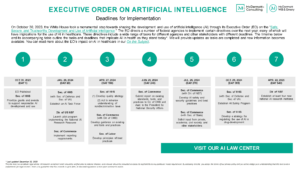
All stakeholders across the AI lifecycle (developers, deployers, users, auditors, etc.) should review the directives in the EO. While several directives significantly impact technology companies developing “foundation models,” along with government contractors and others developing advanced AI systems, the EO also directs action, reevaluation and potential changes in existing regulatory and enforcement schemes that could affect a variety of organizations. Additionally, the EO highlights a range of opportunities for formal and informal engagement to shape AI policy and standards, including through new task forces.
EO’S EIGHT GUIDING PRINCIPLES AND PRIORITIES FOR DEVELOPMENT AND USE OF AI
HEALTHCARE-SPECIFIC DIRECTIVES IN THE EO
Section 8. Protecting Consumers, Patients, Passengers and Students
Section 8.b.i. Within 90 days of the EO’s publication, the secretary of the US Department of Health and Human Services (HHS), in consultation with the secretary of defense and the secretary of veterans affairs, is required to establish an HHS AI Task Force. Within one year of establishment, the task force is required to develop a strategic plan that includes policies and frameworks—possibly including regulatory action, as appropriate—on responsible deployment and use of AI and AI-enabled technologies in the health and human services sector (including research and discovery, drug and device safety, healthcare delivery and financing, and public health), and identify appropriate guidance and resources to promote such deployment, including in the following areas:
Section 8.b.ii. Within 180 days of the EO’s publication, the secretary of HHS is required to develop a strategy, in consultation with relevant agencies, to determine whether AI-enabled technologies in the health and human services sector maintain appropriate levels of quality. This work is to include developing AI assurance policy—to evaluate important aspects AI-enabled healthcare tools’ performance—and infrastructure needs for enabling pre-market assessment and post-market oversight of AI-enabled healthcare-technology algorithmic system performance against real-world data.
Section 8.b.iii. Within 180 days of the EO’s publication, the secretary of HHS, in consultation with relevant agencies as the secretary of HHS deems appropriate, is required to consider appropriate actions to advance the prompt understanding of, and compliance with, federal nondiscrimination laws by health and human services providers that receive federal financial assistance, as well as how those laws relate to AI. Such actions may include:
Section 8.b.iv. Within 365 days of the date of this order, the secretary of HHS, in consultation with the secretary of defense and the secretary of veterans affairs, is required to establish an AI safety program that, in partnership with voluntary federally listed patient safety organizations:
Section 8.b.v. Within 365 days of the date of this order, the secretary of HHS is required to develop a strategy for regulating the use of AI or AI-enabled tools in drug-development processes. The strategy must, at a minimum:
Section 5.2 Promoting Innovation
Section 5.2.a.i. Within 90 days of the EO’s publication, in coordination with the heads of agencies that the director of the US National Science Foundation (NSF) deems appropriate, launch a pilot program implementing the National AI Research Resource (NAIRR), consistent with past recommendations of the NAIRR Task Force.
Section 5.2.a.iii. Within 540 days of the EO’s publication, the director of NSF should establish at least four new national AI research institutes, in addition to the 25 that are currently funded.
Section 5.2.e. To advance responsible AI innovation by a wide range of healthcare technology developers that promotes the welfare of patients and workers in the healthcare sector, the EO requires the secretary of HHS to identify and prioritize grantmaking and other awards, as well as undertake related efforts, to support responsible AI development and use, including:
NON-HEALTHCARE-SPECIFIC DIRECTIVES IN THE EO
Section 4. Ensuring the Safety and Security of AI Technology
Section 4.1.a. Within 270 days of the EO’s publication, the secretary of commerce is required to develop guidelines, standards and best practices for AI safety and security. Specifically, the secretary of commerce is required to work through the director of the National Institute of Standards and Technology (NIST), and in coordination with the secretary of energy, the secretary of homeland security and the heads of other relevant agencies as the secretary of commerce may deem appropriate, to:
Section 4.2.a. Within 90 days of the EO’s publication, to ensure and verify the continuous availability of safe, reliable and effective AI in accordance with the Defense Production Act, the secretary of commerce will require:
Section 4.5.a. Within 240 days of the date of this order, the secretary of commerce, in consultation with the heads of other relevant agencies as the secretary of commerce may deem appropriate, is required to submit a report to the director of the Office of Management and Budget (OMB) and the assistant to the president for National Security Affairs identifying the existing standards, tools, methods and practices, as well as the potential development of further science-backed standards and techniques, for:
Section 4.5.b. Within 180 days of submitting the abovementioned report, the secretary of commerce, in coordination with the director of OMB, will develop guidance regarding the existing tools and practices for digital content authentication and synthetic content detection measures.
Section 4.6.a. Within 270 days, the secretary of commerce, in consultation with the secretary of state, is required to solicit input from the private sector, academia, civil society and other stakeholders through a public consultation process on potential risks, benefits, other implications, and appropriate policy and regulatory approaches related to dual-use foundation models for which the model weights are widely available.
Section 6. Supporting Workers
Section 6.b.i. Within 180 day of the EO’s publication, the secretary of labor, in consultation with other agencies and with outside entities (including labor unions and workers) as the secretary of labor deems appropriate, is required to develop and publish principles and best practices for employers that could be used to mitigate AI’s potential harms to employees’ well-being and maximize its potential benefits. The principles and best practices shall include specific steps for employers to take with regard to AI, and shall cover, at a minimum:
Section 12. Implementation
Section 12.a. The EO creates the White House Artificial Intelligence Council, which will coordinate the activities of agencies across the Federal Government to ensure the effective formulation, development, communication, industry engagement related to, and timely implementation of AI-related policies, including policies set forth in this EO.
IMPORTANT DEFINITIONS IN THE EO
CONCLUSION
The order is a consequential landmark document that sets the stage for the responsible governance of AI in the United States. By laying down guiding principles and a broad range of policy directives, the administration has created a roadmap for a coordinated, multi-stakeholder approach to AI across numerous industry sectors. This is a pivotal moment for AI governance, and while this EO is historic in its approach, the execution of its many directives depends heavily on the agencies and companies that have been called to action. Many of the key, material details and AI governance standards will be developed during the next six months to one year. For organizations interested in developing or using AI or machine learning tools in healthcare, there will be far-reaching implications as new standards, compliance expectations and other guidelines emerge.
Notably, this EO comes on the heels of increased attention on AI by senior lawmakers in the House and Senate. Senate Majority Leader Chuck Schumer (D-NY) is leading a bipartisan group in holding a series of roundtables and listening sessions to help educate members and staff on the benefits and risks of AI across various sectors. Similarly, a primary committee of jurisdiction on the House side, the Energy and Commerce Committee, has begun a series of hearings on AI to help inform policymakers of potential legislative and regulatory needs around the use of AI. For the administration’s part, there is a recognition that Congress may be slow to act and meaningful federal agency action is needed in the meantime. There is also an eagerness to make progress heading into an election year.
We will continue to unpack and provide analysis on the directives in the EO, including as federal agencies work to implement the policies described in the EO. Note that the administration also published a fact sheet about the EO. If you have questions about the EO or other AI regulatory, legal or policy developments, reach out to one of the authors below or your regular McDermott lawyer.
Visit our AI in Healthcare Resource Center for more health AI updates, and register for our November 8 webinar, “AI and the Next Frontier: Understanding What’s Ahead in Health Policy, Regulatory Oversight and Market Access.”






ARTICLE / CLIENT ALERT / US POLICY
October 31, 2023
Read time: 11 min
On Oct. 16, 2023, the Division of Examinations (“Division” or “Exam Staff”) released its 2024 Examination Priorities (“Priorities”),[1] months before these have typically been published to more closely align the release with the start of the SEC’s fiscal year, which began Oct. 1. This approach is consistent with the Division’s goal of more transparency, including with a risk alert it issued in September regarding how it selects examination targets.[2] Much like in the 2023 Examination Priorities, the Priorities combine a specific focus on private funds with other priorities highly relevant to private fund managers. The Division has continued to conduct thematic sweeps of various types of advisers, including private fund managers (e.g., newly registered advisers and those with their principal office and place of business outside of the United States, particularly in the United Kingdom). Areas of focus during thematic sweeps have included marketing rule compliance and use of artificial intelligence, among many others.
In terms of frequency of examinations, the Division indicated that, as in prior years, priorities for being selected for an examination include advisers that have never before been examined (many of which are examined 12 months after registration) and advisers that have been registered for a number of years but have not been examined in recent years.
Noting that advisers to private funds continue to be a significant portion of the SEC-registered investment advisers, the Division stated that it will again focus examinations on private fund advisers and identified the following topics as priorities:
Private fund managers should also be prepared for the examination topics the Exam Staff has identified in connection with examinations of all types of registered investment advisers. For example:
Private fund managers can expect that the Exam Staff will continue its work assessing compliance with Rule 206(4)-7 (“Compliance Rule”). The Priorities reiterate the core compliance areas where the SEC has long articulated its expectation that registered investment advisers adopt and implement compliance policies and procedures appropriately tailored to the specific risks of their business, investment strategies and actual practices. The Priorities’ citation to, and incorporation of, the specific topics referenced in the Compliance Rule’s 2003 Adopting Release[9] signals that the Exam Staff still has its eyes on an adviser’s compliance with their long-standing core compliance obligations and is also consistent with increased enforcement activity related to policy failures.
If the Division’s two risk alerts[10] on Rule 206(4)-1 (“Marketing Rule”) had not put advisers on sufficient notice, the Priorities make clear that there will be a continued focus on compliance with the not-so-new-anymore Marketing Rule. The Exam Staff will continue to examine whether registered investment advisers have adopted reasonably-designed policies and procedures, can substantiate material facts in advertisements, and disclose their marketing practices accurately on Form ADV (e.g., Item 5.L. of Part 1A). The Division notes that reviews of marketing practices will “assess whether disseminated advertisements include any untrue statements of a material fact, are materially misleading, or are otherwise deceptive and, as applicable, comply with the requirements for performance (including hypothetical and predecessor performance), third-party ratings, and testimonials and endorsements.” This confirms what we have seen on many examinations already, where the Staff has sought back-up files from advisers to support material facts including in advertisements and identified circumstances where advisers utilized a marketing practice (e.g., predecessor performance), but did not appropriately reflect that in Form ADV.
The Division will continue its focus on certain services provided by investment advisers, including automated investment tools, artificial intelligence and trading algorithms or platforms, and the risks associated with the use of emerging technologies and alternative sources of data. We have already seen this year a targeted (and ongoing) examination sweep of advisers regarding their potential use of artificial intelligence in the research and investment process.
Additional examination topics the Exam Staff will focus on include: Material Nonpublic Information Controls; Accuracy of Regulatory Filings; Supervision of Multiple Offices of the Adviser; Consent to Changes in Governing Documents; and Cybersecurity Risks and Controls.
Given the continued volatility of, and activity around, the crypto markets, the Division will continue to monitor and, when appropriate, conduct examinations related to crypto investing activities. With respect to crypto assets that the SEC believes are funds or securities, the Division emphasized that it will consider whether advisers are complying with the Custody Rule with respect to those assets. In addition, the Division will assess whether any technological risks associated with the use of blockchain and distributed ledger technology have been addressed, including whether compliance policies and procedures are reasonably designed, accurate disclosures are made, and the risks pertaining to the security of crypto asset securities are addressed.
The Priorities also highlight that the Division will review whether advisers are monitoring for and complying with the sanctions laws administered by the US Department of the Treasury’s Office of Foreign Assets Control, which is consistent with some of the sanctions-focused examinations that started in 2022 at the outset of the recent Russia-Ukraine war.
The Priorities highlight that the Division has directed resources to continue focusing on issues specific to private fund managers. This is consistent with the Division of Enforcement’s expanded efforts directed at private fund managers and the adoption of amendments to Form PF and the Private Fund Advisers Rules, which represent the most comprehensive set of new rules affecting private fund managers since the Dodd-Frank Act (not to mention the myriad other proposed rules applicable to advisers). Accordingly, preparing for examination requires careful attention, review and reconsideration of important aspects of a private fund manager’s compliance program and business practices.
Authored by Christopher S. Avellaneda, Allison Scher Bernbach, Michael S. Didiuk, Marc E. Elovitz, Kelly Koscuiszka, Tinika M. Brown, Tarik M. Shah, and Jarret A. Roby.
If you have any questions concerning this Alert, please contact your attorney or one of the authors.