
ARTICLE / CLIENT ALERT
Investment Opportunities in 2024
January 2024
Read time: 6 min
In November, McDermott Will & Emery was pleased to host our annual European Health & Life Sciences Symposium in Paris. Welcoming a large crowd of healthcare professionals, investors and dealmakers for a programme of insightful panel discussions on various topics, it was a wonderful opportunity to capture the views of market participants on where investment might focus in the year ahead.
After a challenging 2023 for many in the industry, the overwhelming mood was a positive one as we approached the new year. There was broad agreement that 2024 is likely to see a surge in deals, albeit with some choppiness remaining, with more activity likely around those assets that relate to manufacturing capacity at a time when approvals of new drugs will create a need for additional capacity.
In 2022, a lot of the deals that got done had a focus on manufacturing but that activity slowed in the past year, creating something of a backlog on both the demand and supply side. At the same time, a strong pipeline of new advanced therapy medicinal products coming through approval is driving demand for manufacturing capacity and shining a spotlight on opportunities for pan-European consolidation.
From a geographical perspective, many of our attendees spoke of the ongoing opportunity for consolidation in healthcare services across Europe, particularly in areas such as clinical care, radiology, dental practices and veterinary surgeries. Several observers talked about those opportunities being evident across the DACH region, while others flagged an expectation that we will see more cross-border deals in the medtech space as US players look to acquire European assets.
There are also signs of an opportunity emerging for distressed investors. Grégoire Andrieux, partner with McDermott Will & Emery in Paris, says: “We do see distressed becoming very interesting to certain investors right now. There are situations where you have great companies with strong value in them and good IP assets, but because of market circumstances their immediate cash needs are creating distress. Investors with strong insights into the sector will be able to seize opportunities to add some of those assets to their portfolios.”
Elsewhere, some investors are focusing on new delivery models, including prioritising value-based care where efficiencies might be created through the use of technology and data analytics. There are currently two bottlenecks holding back progress on that score: the availability of good, standardised data sets; and the availability of human resources in healthcare authorities to evaluate and service new models, our panellists said.
Advances in Data, AI, and Health IT
Despite the challenges, the year ahead will undoubtedly see investors focusing much more heavily on assets underpinned by innovation or addressing the need to increase efficiencies in the system. These will include digital health startups, innovative care delivery models and businesses harnessing the power of big data or embracing cutting-edge AI algorithms.
Technological integration is becoming increasingly important when assessing healthcare investment opportunities. Holger Ebersberger, partner with McDermott in Munich, says: “There was some discussion on our panel about the different ways tech can factor into deals. Broadly those fall into three categories: the applications where digital is improving processes in clinics and the way operations are planned, for example; those where the use of data is accelerating diagnostics; and then digital therapeutics where digital is a key element of treatment for conditions like mental health. The latter is still very much developing, whereas adoption is already high for digital in clinical processes. In all these situations though, it is integration of the technology that is key.”
One of our speakers said that “technology moves at the speed of trust”, pointing out that adoption can be slower in the health and life sciences industry because of the critical concerns about patient safety. The era of personalised medicine and the increased adoption and integration of technology into drug discovery, diagnostics and therapeutics will require investors to think carefully about risk mitigation as valuations and cost of capital remain challenging.
Looking in more depth at the current trends in digital health, several themes emerged. Anne France Moreau, partner with McDermott in Paris, says: “Clearly there has been some troubles in the digital health sector over the past year or two. But our speakers told us that they still see a lot of origination in the digital health space around AI, data analytics and tools to improve patient care.”
She adds: “Probably the biggest trend for our panellists was around pharma tech, with personalized medicine involving diagnosis, genomics, drug discovery, and treatment tools. A lot of companies are seizing opportunities there.”
One of the biggest challenges around adoption of new technologies in the healthcare space relates to regulatory scrutiny, particularly in relation to the development and deployment of AI.
Daniel Gottlieb, McDermott partner in Chicago, says: “Everyone is very focused on the risks around invasion of privacy that come with artificial intelligence solutions, and that is key when applied to digital health solutions. Another key concern is bias or discrimination in the way that AI tools are developed and deployed, which can put businesses at risk of inaccurate and discriminatory outcomes.”
He adds: “Then of course in health and life sciences patient safety is always front of mind. Unfortunately we do not yet have a common global approach to AI governance. We have seen the AI Act pass in the EU, which reflects a focus on risk assessment and the acceptance of a common set of guiding principles. We are waiting for US regulation, which is more likely on the US state level and is likely to reflect many of the principles reflected in the AI Act in the EU.”
There is a hope that the regulatory backdrop will become clearer over the coming year, opening up the potential for much more deployment of AI tools in a safe and compliant way so that the industry can start reaping the many possible rewards.








Unified Patent Court Procedural Timeline
ARTICLE / REPORT
Unified Patent Court Procedural Timeline
January 2024
Read time: 2 min
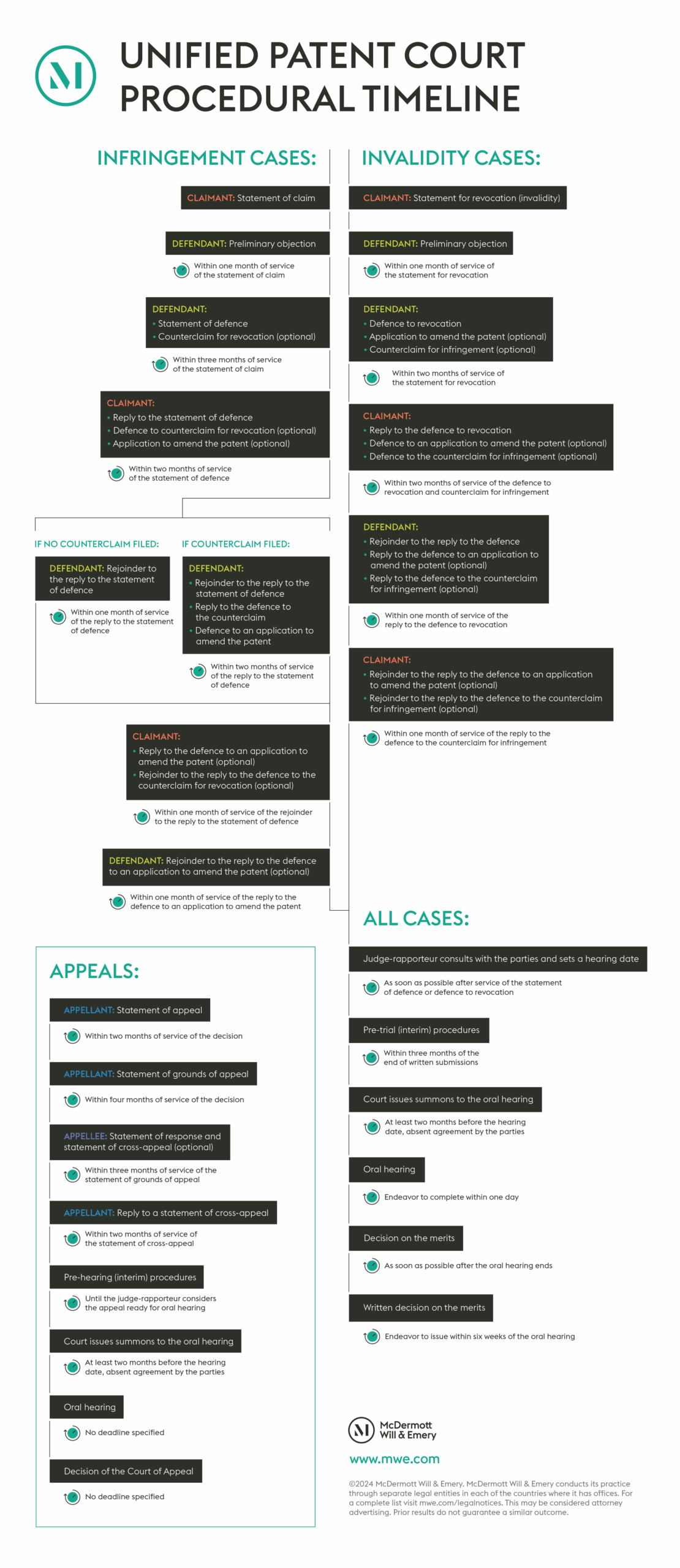
The new Unified Patent Court (UPC) proceedings are structured to be fast and efficient. The goal is to conclude final oral hearings on infringement and validity issues within one year, while recognizing that complex cases may require more time. The full procedural timeline of a UPC case from filing through appeal can be seen below or downloaded here.







Third Circuit Mandates Appointment of Examiner in FTX Bankruptcy
ARTICLE / CLIENT ALERT
Third Circuit Mandates Appointment of Examiner in FTX Bankruptcy
January 22, 2024
Read time: 7 min
The Third Circuit reversed the Bankruptcy Court explicitly, holding that the Bankruptcy Code “mandates the appointment of an examiner to investigate FTX’s management.” The Court of Appeals rejected the Bankruptcy Court’s ruling that the Bankruptcy Code, by permitting the Court to appoint an examiner “as is appropriate,” gives the Court the flexibility to appoint no examiner in this case, holding that the Code mandates that the Court “shall” appoint an examiner provided the case at hand meets certain minimal conditions. We expect the Bankruptcy Court to appoint an examiner consistent with the United States Trustee’s request for an examiner to review the Debtors’ prepetition management. In re FTX Trading Ltd., et al. v. Andrew R. Vara, ECF No. 66 (3d Cir. Jan. 19, 2024) (Case No. 23-2297).
Background
FTX Trading Ltd. and its affiliates filed for bankruptcy in late 2022 after a precipitous crash in the value of various crypto assets and in the company. Shortly after the bankruptcy filing, the United States Trustee filed a motion seeking appointment of an examiner to investigate FTX’s collapse and the role of pre-bankruptcy management in that collapse. The US Trustee sought appointment of an examiner under section 1104(c) of the Bankruptcy Code, which states:
If the court does not order the appointment of a trustee under this section, then at any time before the confirmation of a plan, on request of a party in interest or the United States trustee . . . the court shall order the appointment of an examiner to conduct such an investigation of the debtor as is appropriate, including an investigation of any allegations of fraud, dishonesty, incompetence, misconduct, mismanagement, or irregularity in the management of the affairs of the debtor of or by current or former management of the debtor, if —
- such appointment is in the interests of creditors, any equity security holders, and other interests of the estate; or
- the debtor’s fixed, liquidated, unsecured debts, other than debts for goods, services, or taxes, or owing to an insider, exceed $5,000,000. (emphasis added)
The US Trustee argued that the Bankruptcy Code mandates the appointment of an examiner here because FTX’s debts exceed $5 million and the US Trustee made the motion, which under the plain terms of the statute state that the court shall appoint an examiner in these circumstances.
The Debtors, the UCC and others opposed the motion. They argued that the phrase “as is appropriate” (italicized above for reader ease), allowed the Court “to deny the US Trustee’s motion to appoint an examiner . . . .”
Analysis
The Court ruled decisively that “the plain text of section 1104(c)(2) requires a bankruptcy court to appoint an examiner if requested by the US Trustee or a party in interest” and the debtors’ total debt exceeds $5 million.
The Third Circuit stated that “Congress made plain its intent to mandate the appointment of an examiner by using the word ‘shall’, as in the Bankruptcy Court ‘shall’ appoint an examiner if the terms of the statute have been met . . . The meaning of the word ‘shall’ is not ambiguous. It is a word of ‘command.’”
The Court rejects the Bankruptcy Court’s ruling that the use of the phrase “as is appropriate” to moderate the appointment of an examiner means “the Bankruptcy Court appoints an examiner only if it decides an investigation would suit the circumstances.” (emphasis added). The Court notes that the US Trustee argued that the Bankruptcy Court’s interpretation would apply only if Congress had given the court authority to appoint an examiner “if appropriate.” By contrast the phrase “as is appropriate” therefore must refer to the “nature of the investigation, not the appointment of the examiner.” The Court held that “this interpretation . . . is further bolstered by the context. Immediately after the phrase “as is appropriate”, the statute provides the word “including” and a list of topics that merit investigation: “allegations of fraud, dishonesty, incompetence, misconduct, mismanagement or irregularity in the management of the affairs of the debtor of or by current or former management of the debtor.”
The Court of Appeals further held that “reading subsection (c)(2) as discretionary would require disregarding direct evidence of Congress’s intent.” The Court notes that the legislative history includes a statement that chapter 11 “ensures ‘special protection for the large cases having great public interest’” in the form of a “provision guaranteeing an ‘automatically appointed’ examiner in large cases, a measure designed to ‘preserve and enhance’ debtors and creditors interests, ‘as well as the public interest.’”
While Congress mandates the appointment of an examiner, it grants the Bankruptcy Court judge discretion to determine the “scope, degree, duration and cost of the examiner’s investigation.” By setting these parameters the court can “ensure that the examiner is not duplicating other parties’ efforts” or disrupting the bankruptcy process.
On appeal the appellees, including the Debtors, argued that an investigation would duplicate the efforts of the Debtors’ post-petition management and Creditors’ Committee to review the Debtors’ prepetition activities. The Court of Appeals rejected these arguments for several reasons. First, under the Bankruptcy Code, an examiner must be “disinterested.” The Court held that the Bankruptcy Code “forbids a debtor in possession, the quintessential ‘insider’, from performing the duties of an examiner and investigating itself.” The Court states that this requirement “of disinterest is particularly salient here, where issues of potential conflicts of interest arising from debtor’s counsel serving as prepetition advisors to FTX have been raised repeatedly.”
Second, the Court held that an examiner must make its finding “public, an obligation neither a creditor committee nor a debtor in possession shares.” The Court states that a public report “seems particularly appropriate here” and that the report would also “ensure that the Bankruptcy Court will have the opportunity to consider the greater public interest when approving the FTX Group’s reorganization plan.”
The Court ultimately remanded the matter to the Bankruptcy Court “with instructions to order the appointment of an examiner.”
Takeaways
- The Third Circuit’s ruling conforms with rulings from other circuits on this matter. See, e.g., Morgenstern v. Revco D.S., Inc. (In re Revco D.S., Inc.), 898 F.2d 498, 22 C.B.C.2d 841 (6th Cir. 1990) (when the statutory requirements of section 1104(b)(2) (now 1104(c)(2)) are present, the court has no discretion but to order the appointment of an examiner; the statute is clear on its face); Walton v. Cornerstone Ministries Invs., Inc., 398 B.R. 77, 78 (N.D. Ga. 2008).
- The Third Circuit expressly directs the bankruptcy Court to appoint an examiner. We expect the bankruptcy Court to do so soon. The Third Circuit particularly emphasizes the need for the Examiner to be independent.
- The Third Circuit is clear that the Bankruptcy Court maintains discretion over the scope of the examiner’s role. However, the Court of appeals also focuses on the need for the public to understand what transpired in the run up to the bankruptcy through the public-facing examiner report. Moreover, the Court of Appeals urges the Bankruptcy Court to consider the public interest in confirming a plan in FTX. Therefore, we expect the bankruptcy Court to give the examiner authority to investigate the downfall of the company prior to the bankruptcy with some degree of breadth.
- The next FTX Bankruptcy Court hearing is slated for January 31.
Authored by Douglas S. Mintz, Robert D. Brown and Reuben E. Dizengoff.
If you have any questions concerning this Alert, please contact your attorney at Schulte Roth & Zabel or one of the authors.
This communication is issued by Schulte Roth & Zabel LLP for informational purposes only and does not constitute legal advice or establish an attorney-client relationship. In some jurisdictions, this publication may be considered attorney advertising. © 2024 Schulte Roth & Zabel LLP. All rights reserved. SCHULTE ROTH & ZABEL is the registered trademark of Schulte Roth & Zabel LLP.



Report | AI and the Next Frontier: Understanding What’s Ahead in 2024
ARTICLE / REPORT
Report | AI and the Next Frontier: Understanding What’s Ahead in 2024
January 2024
Read time: 2 min
The increased availability and rapid advancement of AI and machine learning technologies creates an imperative for organizations to consider the operational impacts and navigate the evolving legal and regulatory developments.
We’ve compiled the top takeaways and recordings from our nine-part webinar series, held September – November 2023. These should serve as a useful starting point to inform proactive steps leaders can take to position their companies and their people for success in the year ahead. You’ll find:
- Summaries of AI’s implications across business and transactions, privacy and cybersecurity, intellectual property, antitrust and consumer protection, employment, healthcare and insurance
- Governance and policy considerations to guide AI use within your organization and effectively engage in the regulatory process
- Practical breakdowns of AI technology, risks and organizational responsibilities to help deepen your understanding and plan for the future
Dig deeper into AI with McDermott:




Partner








Real Estate Update: Changes in Real Estate Law – Changes in 2024: GEG, CO2 LEVY, MOPEG, AFA, etc.
ARTICLE / CLIENT ALERT
Real Estate Update: Changes in Real Estate Law – Changes in 2024: GEG, CO2 LEVY, MOPEG, AFA, etc.
January 18, 2024
Read time: 8 min
The new year 2024 brings with it some important legislative changes for the real estate industry across Germany. In our Real Estate Update, we take a look at selected legislative changes that have already come into force or are likely to do so.
Read the full alert in German.
1. Änderung des Gebäudeenergie-Gesetz
Die Änderung des Gesetzes zur Einsparung von Energie und zur Nutzung erneuerbarer Energien zur Wärme- und Kälteerzeugung in Gebäuden (Gebäudeenergiegesetzes (GEG)) ist am 1. Januar 2024 in wesentlichen Teilen in Kraft getreten und sieht unter anderem vor, dass jede neu eingebaute Heizung zu 65 % mit erneuerbaren Energien betrieben werden muss. Diese Vorgabe gilt zunächst ausschließlich für Neubauten in einem Neubaugebiet. Für Bestandsgebäude und Neubauten außerhalb von Neubaugebieten gibt es im GEG definierte Übergangsfristen. Hierbei ist der Stand der kommunalen Wärmeplanung entscheidend (siehe hierzu unten Ziffer 2).
Funktionierende Gas- und Ölheizungen im Bestand können generell weiter betrieben werden. Das gilt auch, wenn eine Heizung ausfällt, aber noch repariert werden kann. Für den Fall, dass eine Heizung ausgetauscht werden muss, weil sie irreparabel beschädigt oder zerstört ist, gibt es mehrjährige Übergangsfristen. Bis zum Ablauf der Fristen für die Wärmeplanung dürfen weiterhin neue Öl- und Gasheizungen eingebaut werden, die jedoch ab 2029 mit einem wachsenden Anteil an erneuerbaren Energien wie Biogas oder Wasserstoff zu betreiben sind. Hat die Kommune bereits einen Wärmeplan, ist der Einbau von Heizungen verbindlich, die mit 65 % erneuerbarer Energie betrieben werden. Nur in Härtefällen können Eigentümer von dieser Pflicht befreit werden.
Mit der Novelle zum GEG wurde im Mietrecht mit § 559e BGB eine neue Modernisierungsumlage eingeführt. Vermieter können seit dem 1. Januar 2024 eine Mieterhöhung verlangen, wenn sie eine alte Heizung durch eine solche ersetzen, die den GEG-Vorgaben entspricht. Zulässig ist ein Aufschlag von 10 % der für die Wohnung aufgewendeten Kosten abzüglich der erhaltenen Drittmittel, sofern eine staatliche Förderung in Anspruch genommen wurde; im Übrigen von 8 %. Die Kappungsgrenze des § 559 Abs. 3a Satz 3 BGB muss jedoch berücksichtigt werden.
2. Kommunale Wärmeplanung
Das Gesetz für die Wärmeplanung und zur Dekarbonisierung der Wärmenetze (Wärmeplanungsgesetz) ist parallel zu den Änderungen des GEG am 1. Januar 2024 in Kraft getreten.
Erst wenn die kommunale Wärmeplanung gemäß Wärmeplanungsgesetz vorliegt, sind Eigentümer von Bestandsgebäuden verpflichtet, mit mindestens 65 % erneuerbaren Energien zu heizen, sofern die alte Gas- oder Ölheizung irreparabel ausfällt. Zu beachten sind auch die darüber hinaus im GEG enthaltenen Übergangsfristen, siehe §§ 71i ff. GEG.
Großstädte mit mehr als 100.000 Einwohnern haben bis zum 1. Januar 2026 eine kommunale Wärmeplanung zu verabschieden, alle anderen Kommunen bis zum 30. Juni 2028. Für kleinere Gemeinden mit weniger als 10.000 Einwohnern können die Länder ein vereinfachtes Verfahren ermöglichen. Außerdem ist vorgesehen, dass mehrere Gemeinden eine gemeinsame Planung vorlegen können. Die Kommunen müssen in den Plänen angeben, in welchen Straßen eine Fernwärme-Versorgung geplant ist, wo Nahwärme beispielsweise über Biomasse verfügbar sein wird oder wo ein Wasserstoffnetz aufgebaut werden soll.
3. Auslaufen der Energiepreisbremsen
Ab dem 1. März 2024 kehrt die Mehrwertsteuer auf Gas und Fernwärme zu ihrem ursprünglichen Prozentsatz von 19 % zurück. Die staatlichen Preisbremsen für Gas, Fernwärme und Strom liefen bereits zum 31. Dezember 2023 aus.
Zu beachten ist weiterhin, dass die staatlichen Entlastungen für Gas und Fernwärme aus den Energiepreisbremsen für den Nebenkosten-Abrechnungszeitraum bis Ende 2023 noch zu berücksichtigen sind. Eigentümer sind verpflichtet, diese an die Mieter weiterzugeben. Dasselbe gilt für den Dezember-Abschlag aus dem Jahr 2022, den der Bund damals vollständig für Gas- und Fernwärmekunden übernommen hat.
4. Erhöhung der CO2-Abgabe
Der Preis für den Ausstoß klimaschädlichen Kohlenstoffdioxids (CO2) mit fossilen Energien ist zum 1. Januar 2024 von EUR 30 pro Tonne CO2 auf EUR 45 Euro pro Tonne CO2 erhöht worden. Eine weitere Erhöhung auf EUR 55 pro Tonne CO2 soll im Jahr 2025 erfolgen. Die erhöhten Kosten sind unter anderem im Rahmen der gesetzlich verpflichtenden Aufteilung der Kosten für den Kohlendioxidausstoß eines Gebäudes zwischen Mieter und Vermieter zu berücksichtigen.
5. Immobilien-GbRs
Das Gesetz zur Modernisierung des Personengesellschaftsrechts (MoPeG) trat im Wesentlichen am 1. Januar 2024 in Kraft. Ist im Grundbuch als Eigentümerin eines Grundstücks eine Gesellschaft bürgerlichen Rechts (GbR) als sogenannte Außen-GbR (vgl. die neu eingefügte Definition in § 705 Abs. 2 BGB) eingetragen oder enthält die Eintragung der Eigentümer den Zusatz „in Gesellschaft bürgerlichen Rechts“, besteht möglicherweise Handlungsbedarf:
Künftige Eintragungen in das Grundbuch im Falle einer GbR sind nur noch zulässig, wenn die Gesellschaft im neuen Gesellschaftsregister eingetragen ist. Das Gesellschaftsregister ist vergleichbar zum Handelsregister und wird bei den Registergerichten geführt. Änderungen im Grundbuch, also z.B. die Eintragung von Grundschulden, von Dienstbarkeiten, die Änderung von Nutzungsrechten, Erbbaurechten wie auch Änderungen im Gesellschafterbestand (im Veräußerungs- oder Todesfall) sind nur noch möglich, wenn die GbR bereits im Register geführt wird.
Zur Eintragung der GbR im Gesellschaftsregister bedarf es einer Anmeldung durch alle Gesellschafter in notariell beglaubigter Form, die der Notar elektronisch zum Registergericht einreicht. Im Gesellschaftsregister werden als Mindestangaben eingetragen:
Firma der Gesellschaft (mit Zusatz „eingetragene GbR“ oder „eGbR“),
- Sitz und Anschrift,
- Daten der Gesellschafter,
- Angaben zur Vertretungsbefugnis nach außen.
Zu beachten ist, dass die Eintragung je nach Auslastung der Registergerichte einige Zeit in Anspruch nehmen kann. Wenn Änderungen anstehen, ist es ratsam, frühzeitig für die Eintragung zu sorgen.
Für die GbR als eingetragene Personengesellschaft gelten zukünftig auch die Regeln des Transparenzregisters. Das bedeutet, dass die wirtschaftlich Berechtigten im Sinne des Geldwäschegesetzes elektronisch zum Transparenzregister zu melden sind. Der Eintrag muss stets aktuell gehalten werden. Verstöße können Bußgelder zur Folge haben.
6. Wachstumschancengesetz
Mit dem Gesetz zur Stärkung von Wachstumschancen, Investitionen und Innovation sowie Steuervereinfachung und Steuerfairness (Wachstumschancengesetz) soll die Liquiditätssituation von Unternehmen verbessert und so Raum für Investitionen geschaffen werden. Daneben bezweckt das Gesetz eine Vereinfachung des Steuersystems sowie eine Entlastung kleinerer Betriebe durch Bürokratie durch die Anhebung von Schwellenwerten und Pauschalen. Außerdem sollen Maßnahmen ergriffen werden, die dazu beitragen, unerwünschte Steuergestaltungen aufzudecken und abzustellen.
Der Bundesrat hat am 24. November 2023 den Vermittlungsausschuss angerufen, das Gesetzgebungsverfahren dauert daher noch an.
Bislang vorgesehene und für die Immobilienbranche besonders relevante Änderungen sind unter anderem:
- Befristete Wiedereinführung einer degressiven AfA von bis zu 25 %, maximal dem 2,5-fachen der linearen Abschreibung, für bewegliche Wirtschaftsgüter des Anlagevermögens, die ab dem 1. Oktober 2023 und vor dem 1. Januar 2025 angeschafft oder hergestellt werden,
- Einführung einer degressiven AfA für Wohngebäude mit 6 % mit Baubeginn ab 1. Oktober 2023 mit Befristung auf 6 Jahre.
7. Umsatzsteuerfreiheit von Verwaltungsleistungen für alternative Investmentfonds
Verwaltungsleistungen an alternative Investmentfonds sind ab 2024 umsatzsteuerfrei. Hiermit erfolgt eine Angleichung an die bislang günstigeren Umsatzsteuerregelungen europäischer Fondsstandorte wie Luxemburg. In der Schnittstelle zwischen Steuerrecht, Investmentfonds und Immobilienrecht ergeben sich wichtige Änderungen. AIFs, Fonds-Manager/KVGen (AIFM), Anlageberater und auch Vermieter sollten sich aufgrund der seit dem 1. Januar 2024 geltenden Änderungen kurzfristig mit den Auswirkungen befassen.
Auswirkungen aus der Sicht des Immobilienwirtschaftsrechts ergeben sich insbesondere bei angemieteten Büros durch den AIFMs bzw. des Anlageberaters, da für diese Mietverträge aus Vermietersicht ggfs. die Berechtigung zur umsatzsteuerpflichtigen Vermietung entfällt, sog. Umsatzsteueroption. Für eine wirksame Umsatzsteueroption muss der Mieter grundsätzlich mindestens 95 % seiner Umsätze umsatzsteuerpflichtig erbringen. Der Vermieter hat ein Interesse an der umsatzsteuerpflichtigen Vermietung, wenn laufende Vorsteuerberichtigungszeiträume in Bezug auf die Immobilie bestehen und bei Erhöhung der umsatzsteuerfreien Vermietung auf den Vermieter Vorsteuerberichtigungen oder eine anteilige Versagung des Abzugs laufender Vorsteuer zukommen können (sog. Vorsteuerschaden).
Der Wegfall der Umsatzsteueroption führt dazu, dass die Miete zukünftig ohne Umsatzsteuer geschuldet wird, also umsatzsteuerfrei erfolgt. Der Mieter kann jedoch – je nach Regelung im Mietvertrag – verpflichtet sein, dem Vermieter einen entstehenden Vorsteuerschaden zu ersetzen.
Bestehende Mietverträge mit AIFMs und Anlageberatern sollten aus Mieter- und Vermieter-Sicht auf Relevanz, potenzielle Informations- und Schadensersatzpflichten sowie Anpassungsmöglichkeiten überprüft werden.
Für weitere Informationen zur Umsatzsteuerfreiheit von Verwaltungsleistungen für alternative Investmentfonds empfehlen wir Ihnen unseren Newsletter vom 18. Dezember 2023 „UPDATE TAX, INVESTMENT FUNDS UND REAL ESTATE – DIE UMSATZSTEUERBEFREIUNG FÜR ALTERNATIVE INVESTMENTFONDS KOMMT“, der das Thema detailliert behandelt.
8. Unser Fazit
Wie bereits im vergangenen Jahr sind auch im Jahr 2024 viele für die Immobilienbranche relevante gesetzgeberische Änderungen von dem Ziel eines stärkeren Klimaschutzes geprägt. Insbesondere die Änderung des GEG hat die Debatte im Hinblick auf Sanierungspflichten von Bestandsgebäuden und deren Kosten verstärkt. Weitreichende Impulse für eine Belebung der Bautätigkeit wie etwa eine Vereinheitlichung der verschiedenen Landesbauordnungen für eine Beschleunigung und Vereinfachung von Bauvorhaben sind demgegenüber bislang unterblieben. Es bleibt abzuwarten, ob und inwieweit der Gesetzgeber im Jahr 2024 insofern noch tätig wird.


EU Regulators Confirm that Cookie Consent Rules Apply to Much Broader Range of Tracking Technologies
ARTICLE / CLIENT ALERT
EU Regulators Confirm that Cookie Consent Rules Apply to Much Broader Range of Tracking Technologies
January 18, 2024
Read time: 8 min
Article 5(3) of the EU ePrivacy Directive (ePD) requires consent for tracking cookies (unless exceptions apply). Although this rule is best known as the reason behind ‘cookie’ banners, it is technology neutral and applies to other tracking technologies as well.
- At the end of 2023, the European Data Protection Board (EDPB) issued draft Guidelines explaining how the rule applies to a broad variety of tracking solutions, ranging from tracking URLs/pixels and IoT devices reporting, to other unique identifiers, e.g., obtained from hashed email addresses (‘Guidelines’). If a technology is subject to the consent requirement, this has significant implications for all stakeholders involved, ranging from the AdTech industry/advertisers, which heavily rely on such technologies, to every website (publisher) and B2C/B2B companies using them. Guidelines also analyze key elements of the rule, such as the notions of ‘terminal equipment’, ‘gaining access’, and ‘storing’.
- The EDPB findings present a mixed bag, with some outcomes expected (e.g., prior consent requirement for pixels tracking email opens) and others, less so (e.g., storage through “caching on the client-side software” alone triggers the rule).
After the EDPB considers the comments submitted in a public consultation, it will adopt the Guidelines in their final form.
This article analyzes the key elements when applying Article 5(3) ePD, differentiating between novel and previously established conclusions (e.g., from the past guidance) (‘Key Elements for Applicability of Article 5(3) ePD‘). Subsequently, it discusses specific use cases where consent pursuant to Article 5(3) ePD will be necessary (‘Selected Use Cases‘). It concludes by suggesting actions companies and organizations may consider while awaiting the final version of the Guidelines and potential future enforcement.
Key Elements When Applying Article 5(3) ePD
Under Article 5(3) ePD, anyone storing information or gaining access to information already stored in the terminal equipment of a subscriber or user is allowed to do so only if the subscriber or user has consented, unless an exception applies. This OTS focuses on the following four of the key elements analyzed by the EDPB:
A. Information
This term includes any information, whether it constitutes personal data or not. This aligns with past guidance and has been confirmed by the Court of Justice of the European Union in the Planet49 case. The rule aims to protect the private sphere of users, regardless of the nature of the data. The interpretation of this element is undisputed.
B. Gaining Access to Information Already Stored
This typically involves the accessing entity proactively sending instructions to the terminal equipment to retrieve information. Examples include cookies where the accessing entity instructs the browser on the terminal equipment to transmit information (e.g., the originating website) to a server. Another case is when software distributed on a user’s terminal equipment actively calls an application programming interface (API) to send data back to the server. An example is the use of JavaScript code, instructing the browser to send information. The EDPB explains that the entity instructing the terminal to send back the targeted data and the entity receiving information might not be the same. These are new clarifications which were not specifically provided by regulators in the past.
C. Storing Information/Storage
Refers to placing information on the user’s terminal equipment. A typical example is the storage of cookies. The EDPB provides new clarifications on the term ‘storing’ by including storage resulting from a third-party instructing software on the user’s equipment to generate specific information (e.g., through various protocols and customized software) or to provide pre-existing information. Furthermore, there is no defined time limit for how long information must be on the equipment to be considered as ‘stored’. Storage, even if brief, can occur in different parts of a device (e.g., Central Processing Unit (CPU) cache, or Random-Access Memory (RAM)).
D. Terminal Equipment
Defined in Directive 2008/63/EC as equipment directly or indirectly connected to the interface of a public telecommunications network for sending, processing, or receiving information. The connection can be made via wire, optical fiber, or electromagnetically, and is considered indirect if equipment is placed between the terminal equipment and the network interface. Examples provided by the EDPB include smartphones, laptops, connected cars, connected TVs, and smart glasses.
New technical details include:
- Any combination of hardware pieces can collectively constitute terminal equipment.
- The specific way in which a device (such as a computer or a smartphone) connects to its storage system, whether it’s built-in, external (e.g., connected via USB), or accessed over a network, does not matter as long as the storage system works as effectively as if it were directly part of the device.
- The consent rule aims to cover endpoint devices. A device which only acts as a communication relay (i.e., conveys information without modification) would not be considered terminal equipment subject to the rule. However, if an endpoint device is only connected to public communication network using a relay device, EDPB notes that such information stored on the relay device should nevertheless be subject to the consent rule.
- The Guidelines interpret the old ‘cookie’ consent rule broadly. Technologies fall within its scope even if they merely instruct the terminal equipment (directly or through any technology) to produce/export information, and the recipient of such information does not actually access it on the device.
Selected Use Cases
The draft Guidelines present a non-exhaustive list of tracking technologies (beyond cookies) that require prior consent, including:
1. Tracking Pixels with Identifiers
Commonly referred to as marketing pixels/web beacons, these are embedded in emails or websites via small code snippets and typically include identifiers. They enable pixel’s host to receive information about the user. For instance, conveying details about when and how they opened an email or interacted with a website. The EDPB notes that tracking pixels are covered under Article 5(3) ePD as they constitute ‘gaining access’ to such information. While the inclusion of tracking pixels is not new, as noted by several data protection authorities, the EDPB provides a more detailed technical explanation for this inclusion.
2. Tracking Uniform Resource Locators (URLs)
These are unique hyperlinks embedded with an identifier. They are typically shared/ included in social media accounts, blog posts, emails, newsletters, and advertisement. When the user clicks on them, the destination website collects certain information about the user (e.g., the website where the user clicked on the URL, or the search engine they used, and the search terms used). They are used to measure success of advertising campaigns, or to know from which websites users are coming from. Data protection authorities had not prominently asserted that tracking URLs fall under Article 5(3) ePD’s scope until now. The EDPB clarifies that tracking URLs involve both storing information in the user’s terminal equipment (within the caching mechanism) and ‘gaining access’ to the data transmitted to the URL host.
3. Tracking Based on IP Addresses Only
This use case revolves around tracking technologies instructing the terminal equipment to disclose its IP address for cross-domain tracking. The EDPB explains that the transmission of the IP address, which originates from the terminal equipment (alone or together with other related identifiers in the communications protocol) to a third party is categorized as ‘gaining access’ to information stored in the terminal equipment.
4. Unique Identifiers
Also called persistent identifiers, these are generated from personal data hashed within the user’s terminal equipment (e.g., email addresses), which are then shared between various stakeholders to identify the individual (e.g., to serve them an ad). The EDPB considers that instructing the browser to forward this information to a third party constitutes ‘gaining access’ to the data in the terminal equipment.
5. Intermittent and Mediated Internet of Things (IoT) Reporting
This pertains to IoT devices transmitting information to a third party over time, such as a smart home device sending data to a service provider. The information may be processed locally before transmission. The EDPB views the act of sending data to a remote server upon instruction (e.g., from the service provider) as ‘gaining access’.
What Does This Mean for Your Company or Organization?
The Guidelines are currently still in a draft form.
Although their content may still undergo changes, they provide an insight into the EDPB’s perspective on more modern non-cookie-based tracking technologies and inclination to interpret the scope of application of Article 5(3) ePD broadly. Therefore, despite some uncertainty regarding the final version of the Guidelines, we recommend companies and organizations to:
- Evaluate the range of tracking technologies, beyond cookies, they currently use.
- Determine if they need additional consent mechanisms/their ability to collect required consents.
- Assess whether they need to improve disclosures in their current website/app cookie/privacy notices.
- Stay informed about ongoing developments in this field, including those at the national level.
We follow these developments closely and will continue to provide relevant updates. For inquiries about digital marketing, cookies and other tracking technologies, please contact any of the authors of this OTS or your regular McDermott lawyer.




Update 3.0: Future Financing Act – Focus on Employee Participation
ARTICLE / CLIENT ALERT
Update 3.0: Future Financing Act – Focus on Employee Participation
January 5, 2024
Read time: 6 min
With the start of the new year on January 1, 2024, the majority of the Future Financing Act (“ZuFinG”) – highly anticipated by the German start-up scene in particular —came into force. One of the ZuFinG’’s legislative objectives was to simplify the tax framework for granting equity investments to employees (Mitarbeiterbeteiligungen) (“Employee Participation”).
The German Bundesrat approved the law on November 24, 2023, after the German Bundestag passed the draft law on November 17, 2023. We reported in detail on the draft bill of April 12, 2023 (“Referenten-E”), and the government bill of August 17, 2023 (“Regierungs-E”). Read the report on the Referenten-E and the report on the Regierungs-E.
The version of the ZuFinG that is now in force contains significant adjustments compared to the Referenten-E. The changes relate in particular to the tax framework for granting Employee Participation in sec. 3 no. 39 EStG and sec. 19a EStG. The key elements of the legislative amendments that have come into force are summarized below.
Significant Changes Due to the Zufing
Increase in Tax Allowance for Employee Participations
Instead of the increase in the tax-free allowance for granting eEmployee Participations to EUR 5,000 per year and per employee envisaged in the Regierungs-E, the allowance has only increased to EUR 2,000 (previously EUR 1,440). As a result, it will be necessary in many cases to sell shares to cover the wage tax for the tax advantage not covered by the tax-free amount (so-called sell to cover). In practice, such a sell to cover can only be realized with significant effort, especially for companies with low trading volumes.
In the final version of the law, however, regulations to avoid windfall gains were omitted. The Regierungs-E had stipulated that the tax-free non-cash benefit in accordance with sec. 3 no. 39 EStG should only be taken into account as acquisition costs if the shares granted are sold after the lapse of a 3-year period. The requirement to grant Employee Participation in addition to salary already owed was also removed in order to avoid the targeted conversion of compensation (Entgeltumwandlung).
Facilitation of Tax Deferral for Granting Employee Participations
In addition to increasing the tax-free amount, the ZuFinG extended the options for tax deferral when granting Employee Participations in sec. 19a EStG. This is intended to further mitigate the problem of so-called dry income (i.e., tax burden due to a non-cash benefit when shares are granted without a receipt of liquidity) and in an ideal case to defer taxation until the shares are sold.
ZuFinG considerably extended the scope of application of sec. 19a EStG:
1. Instead of the previous link to the “simple” threshold for small and medium-sized enterprises (fewer than 250 employees, maximum annual turnover of EUR 50 million and maximum annual balance sheet total of EUR 43 million), the following thresholds now apply for classification as a beneficiary employer:
- Fewer than 1,000 employees;
- Maximum annual turnover of EUR 100 million; and
- Maximum annual balance sheet total of EUR 86 million.
Sec. 19a EStG does not apply if the above thresholds have been exceeded in the year in which the Employee Participation was transferred and/or the previous six calendar years. Previously, only the year of granting and the previous calendar year had to be taken into account.
2. The company may not have been founded more than 20 years ago (previously 12 years).
3. In future, Employee Participations granted to employees by their employer’s shareholder will also be eligible. This considers the common market practice where Employee Participations in the employer company are not granted by the employer company itself but by the (founding) shareholders. However, the corporate group clause envisaged in the legislative process, according to which the transfer of Employee Participations to employees of affiliated companies should also be covered by sec. 19a EStG, was not implemented.
In line with the previous system, taxation of the non-cash benefit is deferred until one of the following events occurs:
- Transfer of the Employee Participations by the employee against payment or free of charge;
- Expiry of 15 years since the Employee Participations was granted (previously 12 years), compared to the 20 years planned in the legislative process; or
- Termination of the employment relationship with the employee.
In addition, at the end of the 15-year period and in the event of termination of the employment relationship, taxation may be deferred until the employee transfers the Employee Participations against payment or free of charge if the employer irrevocably declares that it is liable for the wage tax without being able to avoid liability by notifying the tax office pursuant to sec. 38 no. 4 sent. 2 EStG. The ZuFinG adds a corresponding provision in sec. 19a no. 4a EStG.
A different calculation of the tax benefit in the event of the repurchase of shares granted has also been implemented. In the event of the repurchase of an Employee Participation by the employer, its shareholder or an affiliated company within the meaning of sec. 18 AktG, the subsequent taxable monetary benefit will be determined according to the remuneration granted for the retransfer. This takes into account the common market practice in which (bad) leaver regulations provide for a valuation for the repurchase that differs from the fair market value.
Outlook
The ZuFinG has significantly improved the tax framework for granting Employee Participations.
However, some parts of the law’s final version fall short of the simplifications envisaged in the legislative process. These include, in particular, the increase in the tax-free amount in sec. 3 no. 39 EStG to just EUR 2,000 (instead of EUR 5,000) and the deletion of the corporate group clause in sec. 19a EStG. However, at least for the corporate group clause, a legislative adjustment has already been promised as part of the Annual Tax Act 2024.





The Practitioner’s Guide to Global Investigations | 8th Edition
ARTICLE
The Practitioner’s Guide to Global Investigations | 8th Edition
January 2024
Read time: 3 min
McDermott have contributed two chapters to the latest edition of The Practitioner’s Guide to Global Investigations, including the in-depth country overview for the United Kingdom.
(1) The Practitioner’s Guide to Global Investigations – United Kingdom
In this chapter, Simon Airey, James Dobias and William Merry provide an in-depth analysis of the landscape for investigations and white collar work in the United Kingdom, answering 78 questions covering a number of topics, including:
- cyber-related issues
- cross-border issues and foreign authorities
- sanctions
- dawn raids and search warrants
- whistleblowing and employee rights
- attorney-client privilege
- witness interviews
- reporting to the authorities
- prosecution, settlements and penalties
- duty to the market
- environmental, social and corporate governance (ESG)
(2) Beginning an Internal Investigation: the UK Perspective
Whether, when and how to begin an internal company investigation are often decisions that must be made at speed, from a position of limited information and at a time when the business, and the individuals involved, may be under significant pressure or scrutiny. Just a few key initial issues include:
- how to determine what is in scope
- how to conduct the document preservation, collection and review exercise
- whom to interview and in what order
- whether to involve external legal counsel
- whether to notify any relevant authorities
- how to structure governance and reporting
- how to maximise privilege
Choices made at this early stage, and a failure to take into account the full context (including potential cross-jurisdictional issues), can have far-reaching repercussions.
In this chapter, Simon Airey and James Dobias identify the key factors for companies to consider when grappling with these difficult issues.




ONC’s HTI-1 Final Rule Adopts New Health IT Certification Requirements
CLIENT ALERT / INTEROPERABILITY
ONC’s HTI-1 Final Rule Adopts New Health IT Certification Requirements
January 12, 2024
Read time: 14 min
On December 13, 2023, the US Department of Health and Human Services (HHS) Office of the National Coordinator for Health Information Technology (ONC) issued the Health Data, Technology, and Interoperability: Certification Program Updates, Algorithm Transparency, and Information Sharing (HTI-1) final rule to update ONC Health IT Certification Program requirements and amend the information blocking regulations that ONC issued under the 21st Century Cures Act (Cures Act). The HTI-1 final rule substantially finalizes policies ONC set forth in the HTI-1 proposed rule but does not finalize the controversial proposal on patient-requested restrictions for certain data uses and disclosures (sometimes referred to as data segmentation).
This On the Subject discusses the final rule’s updates to select standards, criteria and requirements of the Health IT Certification Program that apply to health IT developers of certified health IT (certified health IT developers), including:
- Adoption of the United States Core Data for Interoperability (USCDI) Version 3 to replace USCDI Version 1 as the baseline USCDI standard beginning January 1, 2026
- New requirements for the standardized application programming interface (API) for patient and population services certification criterion, including requirements for issuing refresh tokens and revoking access privileges
- Implementation of the Cures Act’s EHR Reporting Program provisions to require certain health IT developers to report on interoperability metrics through the new Insights Condition and Maintenance of Certification
- Requirements for new privacy functionality that enable an internet-based method for a patient to request a restriction on the use and disclosure of their electronic health information (EHI)
We will release a separate publication summarizing the algorithmic transparency framework and the revised decision support interventions certification criterion. We also separately published a summary of the final rule’s information blocking provisions, which includes a discussion of new and expanded exceptions to the information blocking prohibition. Note that the HTI-1 final rule includes other updates and additions to the Health IT Certification Program that are not discussed in this On the Subject.
Discontinuing Year-Themed Editions for ONC Certification Criteria for Health IT
One noteworthy structural change to the Health IT Certification Program finalized by HTI-1 is that ONC will no longer maintain an edition naming convention for its health IT certification criteria. Previously, ONC bundled updates to certification criteria into editions and required certified health IT developers to test and certify health IT modules to applicable certification criteria. ONC last released a new edition in 2020, when it updated the 2015 Edition certification criteria with the Cures Update.
Following the HTI-1 final rule, ONC may now update individual certification criterion through notice and comment rulemaking. As a “Condition of Certification,” certified health IT developers must commit to rolling out updated versions of health IT modules that meet ONC’s adopted changes to applicable certification criteria. Failure to do so would result in the certified health IT developer losing its certification for non-updated health IT modules.
Without editions, all certification criteria within the Health IT Certification Program are renamed to “ONC Certification Criteria for Health IT.” ONC believes that maintaining a single set of certification criteria will create more stability for healthcare providers and other users of health IT and Health IT Certification Program stakeholders, such as the Centers for Medicare and Medicaid Services, as well as make it easier for certified health IT developers to maintain product certification over time. Some certified health IT developers noted in their comment letters, however, that edition-less certification could increase the frequency of burdensome certification updates. Certified health IT developers and healthcare providers will need to stay up to date on future ONC rulemakings that update certification criteria and should consider participating in ONC-facilitated public forums to provide input on the development and implementation timeframes for such updates.
Key Revised Standards and Certification Criteria
USCDI Version 3 Updates
USCDI is the standard for data required to be accessible through certified health IT for numerous certification criteria. In the industry, USCDI is also considered the minimum data set required for interoperability. The data set is updated on an annual cycle with federal agency and industry input. In the HTI-1 final rule, ONC finalized, as proposed, USCDI Version 3 (USCDI v3) as the new baseline standard of data classes and constituent data elements for certified health IT but changed the effective date from January 1, 2025, to January 1, 2026. This change requires health IT modules certified to criteria that reference USCDI to update to USCDI v3 by the new deadline. (See the chart below for certification criteria that reference USCDI.) The USCDI v3 standard incorporates data elements on patient demographics (e.g., sexual orientation and gender identity) that were not included in prior USCDI versions and social determinants of health. Expanding the data elements and data classes included in the required version of USCDI increases the amount of data available to be used and exchanged for patient care. However, a significant number of the data elements included in USCDI v3 lack a vocabulary standard. Note that ONC has already published USCDI Version 4 and is now reviewing public comments on USCDI Version 5.
| Certification Criteria Referencing USCDI | |
|---|---|
| § 170.315(b)(1): Transitions of care | § 170.315(g)(6): Consolidated CDA creation performance |
| § 170.315(b)(2): Clinical information reconciliation and Incorporation | § 170.315(g)(9): Application access—all data request |
| § 170.315(b)(9): Care plan | § 170.315(g)(10): Standardized API for patient and population service |
| § 170.315(e)(1): View, download, and transmit to 3rd party | |
Standardized API for Patient and Population Services
The HTI-1 final rule also includes revisions to the standardized API for patient and population services certification criterion aimed at improving the security of patient APIs by requiring quicker expiration of the tokens issued to applications when a patient or provider enters a correct username and password. Specifically, certified health IT modules must ensure that:
- Their authorization server issues a refresh token according to a new implementation specification
- For health IT modules that allow short-lived access tokens to expire, such access tokens must be permitted to expire within one hour of the request (instead of immediate revocation)
Additionally, ONC finalized amendments to the API Condition and Maintenance of Certification requirements by specifying that certified health IT developers that have adopted a certified API must meet the publication requirements associated with service base URLs according to a specified format. This change is aimed at making it easier for patient-facing apps to access certified health IT developer APIs through more predictable service base URLs.
ONC also adopted the Substitutable Medical Apps, Reusable Technologies (SMART) App Launch Implementation Guide Release 2.0.0 (SMART v2 Guide), which replaces the SMART Application Launch Framework Implementation Guide Release 1.0.0 (SMART v1 Guide). ONC’s adoption of the SMART v2 Guide impacts the standardized API for patient and population services certification criterion. The SMART v2 Guide includes new features and technical revisions based on industry consensus, including features that reflect security best practices. Beginning January 1, 2026, the SMART v2 Guide will replace the SMART v1 Guide as the only version of the implementation guide available for use in the Certification Program.
Electronic Case Reporting
In the HTI-1 proposed rule, ONC proposed to replace the functional requirements of the existing electronic case reporting certification criterion with industry standards. ONC finalized revisions to the “transmission to public health agencies — electronic case reporting” criterion to require health IT modules to adopt consensus-based, industry-developed standards for electronic case reporting. Specifically, the revised certification criterion requires health IT modules to create a case report for electronic transmission, consume and process a case report response, and consume and process electronic case reporting trigger codes. Previously, the electronic case reporting criterion did not have a named standard associated with these functions. Under HTI-1, certified health IT developers will now need to implement certain HL7 electronic case reporting standards to obtain certification.
Patient-Requested Restrictions
ONC finalized a requirement for health IT modules certified to the “view, download, and transmit to 3rd party” certification criterion to support an internet-based method for a patient to request that a restriction be applied for electronic protected health information contained in the data elements in the required version of USCDI. Health IT modules certified to this criterion must comply by January 1, 2026.
Notably, in the HTI-1 proposed rule, ONC proposed a certification criterion that would have required support for the right of an individual to request restrictions on uses and disclosures of certain electronic protected health information. Many commenters raised concerns about implementation feasibility, patient safety and potential provider burden associated with ONC’s proposal. Based on the feedback received, ONC decided not to finalize the bulk of its proposals for patient-requested restrictions at this time. ONC’s certification criterion does not specify that a patient’s request for a restriction must be accommodated.
Requirement for Certified Health IT Developers to Update Certified Health IT
ONC finalized a requirement for certified developers with technology certified to any of the current certification criteria to update their previously certified health IT modules to meet revised certification criteria. Certified developers must also provide updated health IT to customers using their previously certified health IT according to the dates established for that criterion and any applicable standards.
Assurances Condition and Maintenance of Certification
ONC strengthened the Assurances Condition and Maintenance of Certification requirement to require certified health IT developers to provide an assurance that they will not interfere with a customer’s timely access to interoperable certified health IT. This Condition of Certification also includes two accompanying Maintenance of Certification requirements that require certified health IT developers to:
- Update a health IT module, once certified to a certification criterion, to all applicable revised certification criteria including the most recently adopted capabilities and standards in the revised certification criterion
- Provide all health IT modules certified to a revised certification criterion to their customers of such certified health IT, all within timeframes established and specified in the final rule, with a 12-month timeframe for new customers
Insights Condition and Maintenance of Certification
Section 4002 of the Cures Act required ONC to establish an electronic health record (EHR) reporting program to provide transparent reporting on certified health IT in certain categories, including interoperability, usability and user-centered design, security, and conformance to certification testing. The Cures Act directed ONC to develop reporting criteria for certified health IT developers to submit responses with respect to their certified health IT. The HTI-1 final rule partially implements this Cures Act requirement through the new Insights Condition and Maintenance of Certification (Insights Condition), which requires certified health IT developers to report on certain interoperability metrics with respect to their certified health IT. ONC opted not to use the Cures Act term “EHR reporting program” for this new certification requirement. ONC intends for the Insights Condition’s reporting requirements to:
- Provide transparency through reporting
- Address information gaps in the health IT marketplace
- Provide insights on the use of specific certified health IT functionalities
- Provide information about the use of certified functionalities by end users
Which Certified Health IT Developers Must Report on the New Measures?
The finalized Insights Condition requires a certified health IT developer to report on a measure if it has each of the following:
- At least 50 hospital sites or 500 individual clinician users across its certified health IT
- Any health IT certified to the certification criteria specified in each measure
- Any users using the certified health IT associated with the measure
Certified health IT developers that do not meet the qualifications above must submit a response (an attestation) to indicate that they do not meet the minimum reporting qualifications for a measure.
What Are the Reporting Measures and When Is Reporting Required?
The HTI-1 final rule adopts seven reporting measures across four topic areas related to interoperability: individuals’ access to EHI, public health information exchange, clinical care information exchange, and standards adoption and conformance. ONC will require implementation of the Insights Condition requirements in three phases over three years.
Insights Condition Reporting Measures and Metrics
| Topic Area | Measure | Related Certification Criteria | Metrics | Initial Data Collection Year / Reporting Deadline |
|---|---|---|---|---|
| Individual Access to EHI | Individuals’ Access to Electronic Health Information Through Certified Health IT |
Standardized API for patient and population services – 45 C.F.R. § 170.315(g)(10) View, download, and transmit to 3rd party – 45 C.F.R. § 170.315(e)(1) Standardized API for patient and population services – 45 C.F.R. § 170.315(g)(10) OR View, download, and transmit to 3rd party – 45 C.F.R. § 170.315(e)(1) |
|
Year 1 January to December 2026 / July 2027 |
| Clinical Care Information Exchange | Consolidated Clinical Document Architecture (C-CDA) Problems, Medications, and Allergies Reconciliation and Incorporation Through Certified Health IT | Clinical information reconciliation and incorporation – 45 C.F.R. § 170.315(b)(2) |
|
Year 2 January to December 2027 / July 2028 |
|
Year 3 January to December 2028 / July 2029 |
|||
| Standards Adoption & Conformance | Applications Supported Through Certified Health IT | Standardized API for patient and population services – 45 C.F.R. § 170.315(g)(10) |
|
Year 1 January to December 2026 / July 2027 |
| Standards Adoption & Conformance | Use of FHIR in Apps Through Certified Health IT | Standardized API for patient and population services – 45 C.F.R. § 170.315(g)(10) |
|
Year 1 January to December 2026 / July 2027 |
|
Year 2 January to December 2027 / July 2028 |
|||
| Standards Adoption & Conformance | Use of FHIR Bulk Data Access Through Certified Health IT | Standardized API for patient and population services – 45 C.F.R. § 170.315(g)(10) |
|
Year 2 January to December 2027 / July 2028 |
| Public Health Information Exchange | Immunization Administrations Electronically Submitted to Immunization Information Systems Through Certified Health IT | Transmission to immunization registries – 45 C.F.R. § 170.315(f)(1) |
|
Year 1 January to December 2026 / July 2027 |
|
Year 2 January to December 2027 / July 2028 |
|||
| Public Health Information Exchange | Immunization History and Forecasts Through Certified Health IT | Transmission to immunization registries – 45 C.F.R. § 170.315(f)(1) |
|
Year 2 January to December 2027 / July 2028 |
|
Year 3 January to December 2028 / July 2029 |
Certified health IT developers must also provide a percentage of their total customers (e.g., hospital sites and individual clinician users) represented in the data provided for each response. In addition, they must submit documentation on the data sources and the methodology used to generate the data. Responses and submitted documentation will be made publicly available via ONC’s website.
While the finalized reporting measures focus on interoperability, ONC indicated it intends to explore the other Cures Act reporting categories (e.g., security, usability and user-centered design, and conformance to certification testing) in future years. ONC published specification sheets with additional details about the metrics associated with each Insights Condition measure on its website (also linked in the table above).
If you have questions about how the final rule affects your organization, contact your regular McDermott lawyer or any of the authors of this On the Subject.




The New Minimum Tax Law
ARTICLE
The New Minimum Tax Law
January 11, 2024
Read time: 2 min
Dr. Gero Burwitz authored the article”Das neue Mindeststeuergesetz”, featured in Neue Zeitschrift für Gesellschaftsrecht (NZG), p. 11 et seq. in Janaur 2024.