














ARTICLE / CLIENT ALERT / US POLICY
Biden Administration Proposes New Framework for Exercising March-In Rights on Government-Funded Inventions; Drug Pricing May Be Considered
January 11, 2024
Read time: 10 min
Under the University and Small Business Patent Procedures Act of 1980 (35 U.S.C. §§ 200-212), commonly referred to as the Bayh-Dole Act, the federal government can exercise “march-in” authority in certain circumstances to license an invention to a third party for effective commercialization if the invention is made using taxpayer funds. The Trump administration had proposed a rule preventing the government from exercising march-in authority based only on a drug’s high price. Rather than finalize the proposed rule, on December 7, 2023, the Biden administration released a proposed framework that specifies for the first time that price can be a factor in considering whether an invention is sufficiently accessible to the public. March-in rights have never been used as a tool to regulate drug pricing, but this proposed framework would potentially enable exactly that result.
This proposal comes as another incremental step in US President Joe Biden’s “Bidenomics agenda,” which seeks in part to crack down on price gouging and lower healthcare costs for American families. The US Department of Commerce and the US Department of Health and Human Services invite public input on how the proposed framework can promote access to government-funded inventions, including patient treatments, while promoting innovation.
Background: The Bayh-Dole Act and March-In Rights
The Bayh-Dole Act was intended to promote utilization of inventions arising from federally supported research efforts and to encourage the progression of inventions from the lab to the marketplace. It applies to any grant, contract, or cooperative agreement from a federal agency for experimental, developmental or research work. Under the Bayh-Dole Act, the funding recipient (i.e., the contractor) has the right to retain ownership of inventions conceived or first reduced to practice under the federal funding agreement.
Among the rights and obligations laid out in the Bayh-Dole Act are “march-in rights,” which allow a federal funding agency to require a Bayh-Dole contractor to issue a license to the invention (if the contractor refuses, the agency can issue the license). Under 35 U.S.C. § 203, march-in rights may only be exercised in four circumstances:
- Action is necessary because the contractor or assignee has not taken, or is not expected to take within a reasonable amount of time, effective steps to achieve practical application of the subject invention in such field of use
- Action is necessary to alleviate health or safety needs that are not reasonably satisfied by the contractor, assignee or their licensees
- Action is necessary to meet requirements for public use specified by federal regulations and such requirements are not reasonably satisfied by the contractor, assignee or licensees
- Action is necessary because the agreement required by 204 has not been obtained or waived or because a licensee of the exclusive right to use or sell any subject invention in the United States is in breach of its agreement obtained pursuant to § 204
To date, no federal agency has exercised march-in rights under the Bayh-Dole Act. However, the National Institute of Standards and Technology (NIST) reports that it has repeatedly been asked to provide clarity on whether price may be considered as a factor when deciding march-in rights.[1] As discussed below, the proposed guidance on statutory criteria 1 and 2 most plainly reflect the inclusion of pricing as a potential basis for exercising march-in rights.
The New Draft Framework
The new draft framework asks federal agencies to consider three questions when deciding whether to exercise march-in rights:
- Does the Bayh-Dole Act apply to the invention(s) at issue?
- It only applies when the invention was conceived of or first reduced to practice pursuant to a federal funding agreement.
- Are any of the four statutory criteria met for exercising march-in rights?
- This is broken down into four subsections with one for each statutory criterion.
- The draft framework provides facts that the agency may gather, questions to ask and factors for considering whether any of the statutory criterion are met.
- Would exercising march-in rights support the policy and objectives of the Bayh-Dole Act considering the specific case and broader context?
The draft framework goes on to provide eight example scenarios that illustrate how an agency may use the framework in considering whether to exercise march-in rights.
The draft framework provides the below helpful infographic to assist with working through these three primary questions. We will provide an overview of each throughout this article but will primarily focus on the second question: Is a statutory criterion met?
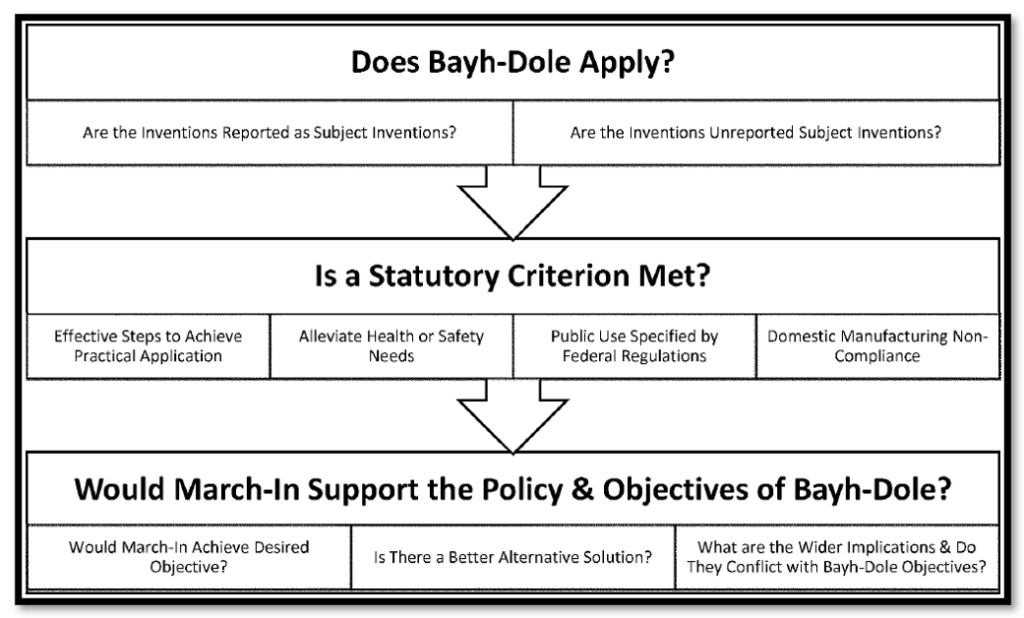
Does the Bayh-Dole Act Apply?
When considering march-in rights, agencies must consider the threshold question of whether the Bayh-Dole Act applies. This is a fact intensive inquiry that requires agencies to evaluate whether the inventions are subject to the Bayh-Dole Act (i.e., whether the invention was conceived of or first reduced to practice pursuant to a qualifying federal funding agreement). The proposed framework sets out a series of questions to guide agencies through this assessment. After reaching an affirmative, agencies may move on to assessing which (if any) of the four statutory criteria support the exercise of march-in rights.
Statutory Criterion One: Effective Steps to Achieve Practical Application
This criterion focuses on the steps a contractor has taken to develop and commercialize the subject invention(s). For example, if a contractor stopped working on the invention, refused to restart work, and refused offers to license it, that suggests limited opportunities to commercialize it into new products and further signals a potential conflict with the Bayh-Dole Act’s objective to encourage utilization and commercialization of federally funded inventions. It may support exercising march-in rights if the contractor has not licensed the invention or if no product embodying the invention exists on the market.
The proposed framework further provides that if the contractor has commercialized the product but the price (or other terms) is unreasonable, agencies may need to further assess whether march-in is warranted to meet the needs of the government or protect the public against nonuse or unreasonable use of the invention.
These examples of scrutinizing pricing when considering effective commercialization of government-funded inventions reflects the Biden administration’s position that high pricing can limit public availability and therefore supports exercising march-in rights.
Statutory Criterion Two: Health or Safety Needs
This criterion focuses on the nature of any health or safety need that is not being reasonably satisfied and allows agencies to assess what would be required to meet the need and to evaluate how march-in rights could affect that need. The draft framework includes questions to guide an agency’s assessment, which focus on identifying unmet health or safety needs, how the subject invention or product at issue addresses any such needs, and drilling into what is necessary to resolve said needs.
The draft framework also includes questions that focus on pricing, particularly:
- Is the contractor or licensee exploiting a health or safety need to set a product price that is extreme and unjustified given the totality of circumstances?
- For example, has the contractor or licensee implemented a sudden steep price increase in response to a disaster that is putting people’s health at risk?
The draft framework includes a note that says, “the agency is not limited to reviewing price increases; the initial price may also be considered if it appears that the price is extreme, unjustified, and exploitative of a health or safety need.”
These examples of scrutinizing pricing when considering existing health or safety needs that are not reasonably satisfied by the contractor again reflect the Biden administration’s position that high pricing can limit public availability of subject invention(s) and may therefore support exercising march-in rights.
Statutory Criterion Three: Federal Regulations for Public Use
This criterion focuses on whether action is necessary to meet requirements for public use specified by any relevant federal regulations. Agencies are directed to evaluate whether any federal regulations relate to use of products commercialized from the subject invention and assess whether the contractor has taken reasonable steps to address any needs related to the federal regulations. This includes making the subject invention available to those who require it.[2]
Statutory Criterion Four: Preference for the US Industry
This criterion relates to 35 U.S.C. § 204 and requires that exclusive licenses to use or sell the subject inventions in the US include an agreement that products embodying subject inventions shall be manufactured substantially in the US. This requirement may be waived by the agency that granted the funding. Generally, agencies will consider this criterion by evaluating if § 204 applies, requesting information on where products are manufactured and determining if a manufacturing waiver is required or if a waiver of the US industry preference has been granted.
Would March-In Support the Policy and Objectives of the Bayh-Dole Act?
Finally, the proposed framework directs agencies to consider whether exercising march-in rights would support the policy and objectives of the Bayh-Dole Act, incentivizing innovation and promoting access to the fruits of that innovation in the US.
The proposed framework compiles questions to guide agency consideration, which target whether:
- March-in would achieve the desired results of increasing availability of the subject invention, e.g.,
- Is there a willing or able licensor or a likelihood one can be found?
- Would additional intellectual property rights be needed to make the product?
- There are other alternatives that would address the issue, e.g.,
- Are there other technologies that could be used? If so, how effective are they?
- Could another government action (antitrust activity, bankruptcy, etc.) better address the problem?
- The broader implications of using march-in rights are supported, e.g.,
- Would exercising march-in here promote competition without unduly encumbering future research and development?
- Would exercising march-in here impact utilization of subject inventions more broadly?
Specific Questions From NIST
NIST published the draft framework in the form of a Request for Information (RFI) in the Federal Register. The RFI asks for public feedback on five particular questions, listed below.
- After reading through the framework and example scenarios, if needed, how could the guidance about when an agency might want to exercise march-in and the factors that an agency might consider be made clearer?
- The framework contains many terms which have specific meanings under Bayh-Dole or in technology development and commercialization. Are the definitions provided at the beginning of the framework easy to understand? Do they aid in your ability to interpret the framework?
- How could the framework be improved to be easier to follow and comprehend?
- Does this framework sufficiently address concerns about public utilization of products developed from subject inventions, taking into account the fact that encouraging development and commercialization is a central objective of the Bayh-Dole Act?
- The framework is not meant to apply to just one type of technology or product or to subject inventions at a specific stage of development. Does the framework ask questions and capture scenarios applicable across all technology sectors and different stages of development? How could any gaps in technology sectors or stages of development be better addressed?
The public comment period closes on February 6, 2024. If you would like to provide comments in response to this new proposed framework or would like further information on its implications to inform your business operations or strategic decision-making, please contact one of the authors for further guidance.






And We’re Back: New Jersey Kicks Off 2024 With New Consumer Privacy Law
ARTICLE / CLIENT ALERT
And We’re Back: New Jersey Kicks Off 2024 With New Consumer Privacy Law
January 10, 2024
Read time: 7 min
On January 8, 2024, the New Jersey Legislature passed the New Jersey Data Privacy Act (NJDPA). The bill, SB 332, will soon head to Governor Phil Murphy’s desk for signing. Assuming the bill is signed quickly, it will go into effect in early 2025.
The NJDPA largely tracks the consumer privacy laws in Connecticut and Virginia, continuing a trend among new state privacy laws. However, there are nuances in the NJDPA that make it a bit different. Businesses subject to the NJDPA will have to take steps above and beyond existing or planned compliance activities in order to comply with the new law.
Below is an overview of the key aspects of the NJDPA. You can access information about all of the state consumer laws that have been enacted by consulting our interactive state privacy law map.
Who Does the NJDPA Apply To?
The NJDPA does not include a revenue threshold. Rather, the bill mirrors the applicability thresholds of Colorado’s consumer law. To be subject to the NJDPA, a business must do business in New Jersey or target products or services to New Jersey consumers, and either:
- Control or process the personal data of 100,000 or more New Jersey consumers (excluding data controlled or processed solely for the purpose of completing a payment transaction), or
- Control or process the personal data of 25,000 or more New Jersey consumers and derive revenue or receive a discount on the price of any good or service from the sale of data.
Who Is a “Consumer”?
In the NJDPA, a consumer is a natural person who is a resident of New Jersey acting in a personal context. This means that employees and business-to-business contacts are excluded.
What Is “Personal Data”?
Personal data is defined as “information that is linked or reasonably linkable to an identified or identifiable individual.” It excludes, however, de-identified data and publicly available data. The limitations for de-identified data and publicly available data closely track those of Virginia (i.e., de-identification requires a public commitment to keep data de-identified, and public data encompasses both data from government files and data that is generally available through mass media sources).
Who Can Enforce?
The New Jersey attorney general has exclusive enforcement authority, and there is an express provision asserting that the NJDPA does not create any private right of action. For the first 18 months that the law is in effect, the attorney general can provide companies with 30 days’ notice and a cure period prior to commencing any enforcement actions. Violations of the NJDPA can accrue at a rate of up to $10,000 per violation.
Who Is Exempt?
The NJDPA’s exemptions are significantly narrower than exemptions in other states’ laws. There are the more typical exemptions for Gramm-Leach-Bliley Act-regulated entities and state-regulated insurance companies, but otherwise the exemptions are limited. There is no Health Insurance Portability and Accountability Act-entity exemption, though protected health information itself is exempt. Personal information handled by a consumer reporting agency is also exempt, as is information used in connection with human subject research under federal law.
In addition, the NJDPA does not apply to government entities.
The NJDPA will apply to nonprofit organizations that otherwise meet the applicability thresholds.
The NJDPA does have broad exemptions for certain routine use cases such as compliance with law, preventing fraud or injury to others, and defending legal claims.
What Obligations Are Imposed?
The NJDPA imposes the following obligations on data controllers, which mirror those we see in other state privacy laws:
- Limit the purpose of processing personal data to what is adequate, relevant and reasonably necessary in relation to the purposes for which the data was processed
- Take steps to implement reasonable safeguards for the personal data within their control
- Refrain from discriminating against consumers for exercising their rights and from processing personal data in violation of federal laws that prohibit discrimination
- Be transparent in their reasonably accessible, clear and meaningful privacy notice
- Ensure contracts control relationships with their processors (note: The law itself details the minimum necessary provisions of these contracts)
The NJDPA does include two new explicit disclosure requirements for online privacy policies that are not found in other laws: (1) a description of the process by which the business will notify consumers of material changes to the privacy policy and (2) an active email address or other online mechanism that the consumer can use to contact the business.
What Consumer Rights Are Created by the NJDPA?
Controllers must provide a standard set of consumer rights to New Jersey consumers:
- Opt-out rights related to the sale of personal data, targeted marketing and profiling, and automated decision-making that could have significant legal effects (such as those related to housing, drinking water, credit, etc.)
- Deletion rights (with respect to the data provided by or about the consumer)
- Rights to know and access data held by the business
- Correction rights
- Appeal rights
- Data portability rights (limited to data the consumer previously provided)
- Controllers are given the option to respond to a data portability request with a “representative summary” of the personal data held rather than the data itself
In addition, beginning six months after the NJDPA’s effective date, controllers will be required to recognize user-selected universal opt-out mechanisms when opting out of targeted advertising and the sale of data.
Sensitive Data
The NJDPA will frustrate some companies because it introduces yet another definition of sensitive data, mixing and matching from the definitions in Delaware, California and other states.
The definition of sensitive data includes data on racial or ethnic origin; religious beliefs; mental or physical health conditions, treatment or diagnosis; financial information (e.g., account number and the required passcode or PIN); sex life or sexual orientation; citizenship or immigration status; status as transgender or nonbinary; genetic or biometric data that may be used for unique identification; personal data about a child (under the age of 13); and precise geolocation (within a radius of 1,750 feet).
A controller may not process (including collect) sensitive data without obtaining the consumer’s consent (or a parent’s consent, in the case of a known child under the age of 13).
Respond to Consumer Inquiries
Controllers must respond to a consumer personal data request within 45 days of receipt of the request, with a 45-day extension available. If a consumer appeals a decision of the controller to deny a consumer request, the appeal response must be delivered within 45 days. If the appeal is denied, controllers must provide the consumer with a method for contacting the New Jersey Division of Consumer Affairs in the Department of Law and Public Safety.
Data Protection Assessments
Controllers will need to conduct and document privacy assessments before they engage in certain processing activities, including:
- Processing personal data for targeted advertising
- Selling personal data
- Processing personal data for profiling if the profiling presents a reasonably foreseeable risk of legal, deceptive, discriminatory, financial, reputational or physical harms
- Processing sensitive data (as defined above)
The required assessment must analyze the benefits of the processing to the company, consumer and public while weighing the harms and potential mitigants. The NJDPA allows for the use of impact assessments done under other state laws to count toward the requirements of the NJDPA.
When Does the NJDPA Take Effect?
The NJDPA will come into effect 365 days after its effective date.
***
Creating a successful, effective and comprehensive privacy program for your organization requires a thorough understanding of both the relevant legal obligations and the personal data subject to compliance. Setting up a program that is prepared to respond to various state privacy laws as they come into effect will save organizations time in the long run, especially as many of these laws reflect one another.
If you have questions or need assistance in readiness work for the new state consumer laws, please contact your regular McDermott lawyer or reach out to David Saunders.



Preparing for Change: 2024 Brings Bevy of New Privacy Laws
ARTICLE / CLIENT ALERT
Preparing for Change: 2024 Brings Bevy of New Privacy Laws
January 10, 2024
Read time: 3 min
Several new state privacy laws take effect in 2024 that will require changes to existing programs. McDermott’s Global Privacy & Cybersecurity Group highlights some of the biggest changes below.
California
On March 29, 2024, the amended California Consumer Privacy Act (CCPA) regulations will take effect. These regulations were originally slated to take effect in 2023, but a court ruling (that is being appealed) delayed the effective date by 12 months. Our prior alert summarized these soon-to-be enforceable regulations, which cover topics ranging from data subject requests to dark patterns. Companies that have not yet addressed these regulations should do so as soon as possible.
The California Privacy Protection Agency (CPPA) also proposed regulations covering major new topics, including:
- Privacy risk assessments
- Cybersecurity audit
- Artificial intelligence and automated decisionmaking technology
- Changes to the existing CCPA regulations
- Rules for insurance companies
Formal rulemaking technically has not yet started on these topics but likely will in the next few months. The regulations would impose significant operational burdens, so companies should start assessing how they will comply now.
Colorado
On December 29, 2023, the Colorado Attorney General announced that it selected the Global Privacy Control (GPC) as the first universal opt-out mechanism that it will prioritize for enforcement. This means companies subject to the Colorado Privacy Act must recognize GPC signals by July 1, 2024.
Other Significant Updates
A number of new state laws will come into effect in 2024:
- Washington State’s My Health My Data Act (additional requirements effective March 1, 2024)
- The Texas Data Privacy and Security Act (July 1, 2024)
- Florida Digital Bill of Rights (July 1, 2024)
- Oregon Consumer Privacy Act (July 1, 2024)
- Montana Consumer Data Privacy Act (October 1, 2024)
These laws have nuanced differences from state privacy laws already in effect (in California, Colorado, Connecticut, Virginia and Utah) that will require a gap analysis from current practices in order to ensure compliance.
As an increasing number of states continue to bring privacy laws and regulations into effect, compliance will become even more complex. Companies should expect increased regulatory scrutiny and activity in this field over the course of the upcoming year. Indeed, New Hampshire is close to enacting the next state privacy law.
For a visual representation and quick reference guide to the ever-growing patchwork of state privacy laws, visit our state privacy law map.
If you have questions about the upcoming state privacy law requirements or other privacy concerns, please reach out to your McDermott lawyer or contact the authors.



Fourth Circuit Holds Per-Se Rule Does Not Apply in Bid-Rigging Case
ARTICLE
Fourth Circuit Holds Per-Se Rule Does Not Apply in Bid-Rigging Case
Jan 10, 2024
Read time: 6 min
WHAT HAPPENED
A three-judge panel from the US Court of Appeals for the Fourth Circuit overturned an executive’s bid-rigging antitrust conviction, holding that the district court erred in applying the per se standard to the executive’s alleged bid-rigging conduct.
The executive, Brent Brewbaker, rigged bids between his former employer, Contech, and its distributor, Pomona Pipe Products. The Fourth Circuit found that while Contech and Pomona both submitted competing bids for North Carolina Department of Transportation (NCDOT) projects, and Contech coordinated with Pomona to make Contech’s bids slightly higher priced, this conduct could not be deemed inherently unlawful under prior precedent because the entities had a manufacturer-distributor arrangement and were not simply direct competitors. In particular, the Fourth Circuit noted that manufacturer-distributor relationships such as the one between Contech and Pomona do not inherently lead to anticompetitive harm and may enhance competition.
Therefore, given the kind of relationship Contech and Pomona had, the Fourth Circuit held that the district court should have analyzed the conduct under the rule of reason to weigh the competitive implications of the parties’ agreement and conduct.
BACKGROUND
- Contech manufactured and sold aluminum products.
- Pomona distributed Contech’s aluminum products and was Contech’s exclusive dealer in North Carolina.
- NCDOT used a bidding process for aluminum structure projects throughout the state. These projects required both the aluminum product and the services to install the aluminum structures.
- Contech, Pomona and a third company were the consistent bidders for the NCDOT projects.
- When either Contech or Pomona won a bid for a project, each would fulfill its contract using the other’s supply or services. Pomona, therefore, served as Contech’s “dealer” with Contech supplying Pomona the aluminum it needed to use in the projects Pomona eventually won; vice versa, Pomona provided necessary services to Contech when Contech won a bid. Neither Contech nor Pomona could win a bid without the products or services of the other.
- In 2019, Brewbaker took charge of Contech’s bidding for these NCDOT projects and began intentionally submitting losing bids to enable Pomona to win by first asking for Pomona’s total bid price and then adding a markup to Contech’s bid price before submitting the bid to NCDOT.
- DOJ alleged that Contech and Pomona engaged in bid rigging because they directly competed against each other’s separate bids. Brewbaker and Contech were indicted for violating Section 1 of the Sherman Act and conspiracy to commit mail and wire fraud.
- Contech pleaded guilty to bid rigging and one fraud count.
- Brewbaker proceeded to trial, and the district court convicted him of bid rigging and five other fraud-related counts (which were not overturned by the Fourth Circuit), upon concluding that Contech and Pomona’s conduct fell squarely within the definition of antitrust “bid rigging” under Section 1 of the Sherman Act.
HOW THE DECISION WAS REACHED
- The Fourth Circuit explained that the rule of reason standard is the default framework used to scrutinize most business practices under the antitrust laws. It weighs the full extent of the practice in question—such as the specific business relationships, the market in question, and any potential negative harm or procompetitive benefits—to decide whether a practice should be prohibited as imposing an unreasonable restraint on trade.
- In the Fourth Circuit’s view, rule of reason will apply unless “demonstrable economic evidence” is presented to show the act in question “always or almost always” has “manifestly anticompetitive effects,” in which case the act itself is inherently illegal—known as a per se violation—and all that must be shown is that the act occurred.
- According to the Fourth Circuit, therefore, per se acts are narrowly construed to include only agreements among direct competitors (a horizontal relationship) to fix prices or divide markets because the US Supreme Court has instructed that agreements among companies at different levels of the supply chain (a vertical relationship) are subject to the rule of reason.
- Thus, in considering the specific conduct related to the bids, Contech and Pomona’s broader relationship was relevant. Contech and Pomona’s relationship included both horizontal and vertical elements, so the Fourth Circuit determined that the hybrid arrangement should have been analyzed under the rule of reason.
- Importantly, the Fourth Circuit faulted the district court for excluding an expert report opining on the procompetitive benefits of a distribution agreement like the one between Pomona and Contech. The court explained that the economic report demonstrated that there are clear questions undermining the use of a per se standard because it is not clear that this kind of manufacturer-distributor arrangement would “always or almost always” have “manifestly anticompetitive effects.”
WHAT THIS DECISION MEANS FOR FUTURE ENFORCEMENT
- This decision potentially narrows the application of the per se rule in the Fourth Circuit to business relationships involving purely horizontal dealings. Thus, companies with horizontal and vertical relationships with others—such as manufacturers and distributors or producers of branded and private label goods and their customers—may have more flexibility in how they interact, such as exchanging information or entering agreements about resale prices. Likewise, companies facing investigations or litigation for bid rigging and price fixing should carefully consider the full extent of the relationship between the entities involved and not just the sale opportunity in question because it may impact whether the per se rule or rule of reason applies.
- However, the DOJ has indicated it is likely to appeal the Fourth Circuit’s decision. Thus, entities should not rely solely on the Fourth Circuit’s decision when assessing the antitrust risks of joint-bidding and pricing strategies.
- Both the DOJ and the Procurement Collusion Strike Force (PCSF) are carefully scrutinizing procurement processes to fight against collusion, bid rigging and related crimes that “threaten to subvert the competitive process.” Contractors and other entities can expect that the DOJ and PCSF will continue to investigate and challenge the type of conduct that Contech and Pomona were alleged to have engaged in.







Contracts corner: sponsorship agreements
ARTICLE
Contracts corner: sponsorship agreements
Jan 10, 2024
Read time: 6 min
Sponsorships continue to be one of the alcohol beverage industry’s primary methods of promoting brands to drinkers. In professional sports alone, alcohol beverage brands contributed $480 million in sponsorship revenue across the four major professional sports leagues during the 2022–2023 season, according to a SponsorUnited study. As suppliers look to better target audiences via sponsorships, it’s important for industry members looking to enter into a sponsorship relationship, as well as those hoping to engage an alcohol beverage brand as a sponsor, to understand how the regulation of the alcohol industry impacts these relationships and the contracts that solidify them.
The Federal Alcohol Administration (FAA) Act prohibits an industry member (a supplier or wholesaler of alcohol beverages) from inducing a retailer to purchase a particular product to the exclusion of competitive products. See 27 U.S.C. § 205. An “inducement” may include a partial ownership stake in a retailer, money, free goods or other “things of value” provided to a retailer. The “exclusion” element requires the Alcohol and Tobacco Tax and Trade Bureau to show a potential real-world impact (i.e., the inducement results in a retailer purchasing less of a competing product than it otherwise would have, and the inducement places or threatens to place a retailer’s independence at risk) before a violation is found.
Sponsorships in other industries often involve a commitment that the brand paying sponsorship dollars will be the exclusive offering of a team, venue or event, or at a minimum, require that a particular brand be offered or available to consumers as part of the sponsor benefits. In the alcohol space, an industry member paying a retailer in exchange for the retailer’s commitment to serve the supplier’s brand(s) of alcohol beverages, often called “pouring rights,” typically satisfies both elements necessary to find a violation of the FAA Act: that the sponsorship fee is a thing of value, and it leads to the exclusion of competitive products.
Sponsor benefits should not include a commitment that a retailer purchase or not purchase a particular brand or brands of alcoholic beverages. Because of restrictions on the flow of money from suppliers to retailers, most sponsorship agreements involving an alcohol brand are between an industry member and a third-party unlicensed entity, not the entity holding the license to sell or serve alcohol at an event or within a venue. However, conduct that is prohibited for an industry member to engage in directly is also prohibited if undertaken indirectly using a third party as a pass-through entity. Accordingly, the entity selling sponsorship rights should represent and warrant the following:
- It does not hold a license to sell alcohol at retail.
- The funds paid under the terms of the agreement will not be passed on to a retailer.
- Nothing contained in the agreement is intended to require or prohibit any retailer or concessionaire from purchasing or not purchasing a particular brand or brands of alcoholic beverages.
As we support clients in negotiating sponsorship agreements and understanding the scope of sponsor benefits available to industry members, we’ve noted key regulatory and contractual considerations that brands should take into consideration:
- A few states have created exceptions or carveouts to general trade practice rules that allow alcohol beverage suppliers to pay a retailer for certain sponsorship rights where the retailer is affiliated with a professional sports organization or situated in a government-owned or public entertainment venue. Understanding whether those exceptions apply will impact the terms of a sponsorship agreement. For example, your standard template may require the party on the other side of the sponsorship agreement to make a host of commitments about their relationship with licensed retailers (e.g., that they are “unaffiliated” with a retailer or that they won’t pass money to a retailer) that may need to be reworked.
- As industry members well know, although a sponsorship cannot include a commitment from an event to only serve or sell a certain alcoholic beverage, brands may purchase exclusivity for marketing or advertising purposes. Typically, the purchase of marketing or advertising exclusivity gives a brand the right to use a certain sponsorship designation (e.g., the “Official Beer Sponsor”). While the sponsorship designation itself must be carefully crafted to ensure trade practice compliance, from a contractual perspective, you should ensure that the entity with whom you are contracting can represent and warrant that the designation and associated sponsorship rights can freely be granted without violating the contractual rights of another. As alcohol brand sponsorships become more common and the categories of alcoholic beverages continue to expand, explicitly specifying in the contract what rights you are (or are not) purchasing is critical. For example, if you contract to be the “Official Vodka Sponsor” of an event, does that mean the official full-proof vodka sponsor? Does it include vodka-based ready-to-drink cocktails? Has the event already sold sponsorship exclusivity to a vodka-based ready-to-drink brand such that your purchase of the right to use the “Official Vodka Sponsor” could give rise to a dispute with that preexisting sponsor? The representation and warranty that each party can enter into a contract without violating the rights of another party or breaching another agreement is a standard but often overlooked term in a template contract, and it can be incredibly important in a sponsorship agreement.
- Alcohol suppliers continue to innovate not only within the alcohol category, but in the non-alcohol space as well. Should a supplier wish to have its non-alcoholic brand sponsor an event, a team or a venue, both parties should understand and agree contractually about what rules and restrictions may govern the sponsor benefits and any activations that the parties wish to hold as part of the sponsorship. For example, if a non-alcoholic brand in your portfolio is sponsoring an event that is held in multiple states, the parties should align on whether it is worthwhile to take advantage of relaxed trade practice rules in one state (i.e., a state where conduct requires a nexus to the sale of alcohol in order for it to be prohibited). Alternatively, the parties may agree on a uniform nationwide policy to better mitigate regulatory risk, accommodating the laws of states where the usual alcohol beverage trade practice rules apply regardless of the alcohol content of the brand being sold or promoted (i.e., the states that prohibit an entity from engaging in certain conduct solely because it holds an alcohol license, regardless of whether the entity’s conduct touches or involves alcoholic beverages).
Sponsorships continue to be a valuable tool for alcohol beverage marketers. Ensuring that the contracts solidifying a sponsorship relationship are carefully crafted in light of our heavily regulated industry is critical to both mitigate risk to industry members and see the greatest return on a sponsorship investment.
For questions about sponsorship agreements in the alcohol industry, please contact Alva Mather or McDermott’s alcohol team.



SEC Approves NYSE’s Amended Stockholder Approval Rules Providing Companies With Increased Flexibility to Raise Capital From Passive Related Parties
ARTICLE / CLIENT ALERT
SEC Approves NYSE’s Amended Stockholder Approval Rules Providing Companies With Increased Flexibility to Raise Capital From Passive Related Parties
January 9, 2024
Read time: 3 min
On Dec. 26, 2023, the US Securities and Exchange Commission approved, on an accelerated basis, an amended proposal by the NYSE to amend certain of its stockholder approval rules to limit the applicability of stockholder approval rules on sales of securities to passive Related Parties. Prior to this change, any issuance to a Related Party over one percent required stockholder approval. Now, only issuances to Active Related Parties (as defined below) over one percent require such approval, subject to compliance with any other rule requiring stockholder approval.
Rule 312.03(b) — As amended, the Related Party Stockholder Approval Rule provides that:
- Shareholder approval is no longer required for issuances to substantial security holders (i.e. holders of five percent of company’s stock or voting power) that are not Active Related Parties (as defined below).
- An “Active Related Party” is a director, officer, controlling shareholder or member of a control group[1] or any other substantial security holder of the company that has an affiliated person who is an officer or director of the company.
For purposes of 312.03(b)(ii), the definition of “Related Party” remains unchanged and any listed company selling securities in a private placement below the Minimum Price (as defined in Section 312.03(c)), including a sale to a passive Related Party, will remain subject to the shareholder approval requirement of Section 312.03(c) if such transaction relates to 20 percent or more of the issuer’s common stock. In addition, any issuance to a Related Party would still be subject to stockholder approval under any other applicable rule, such as in connection with a change of control.
Authored by David A. Curtiss, Ele Klein, Adriana Schwartz and Nikoleta Nikova.
If you have any questions concerning this Alert, please contact your attorney at Schulte Roth & Zabel or one of the authors.
[1] As amended, “group” will mean a group as determined under Section 13(d)(3) or Section 13(g)(3) of the Securities Exchange Act of 1934, as amended (the “Exchange Act”) and “control” will have the same meaning as defined in Rule 12b-2 of Regulation 12B under the Exchange Act.
This communication is issued by Schulte Roth & Zabel LLP for informational purposes only and does not constitute legal advice or establish an attorney-client relationship. In some jurisdictions, this publication may be considered attorney advertising. © 2023 Schulte Roth & Zabel LLP. All rights reserved. SCHULTE ROTH & ZABEL is the registered trademark of Schulte Roth & Zabel LLP.






Illinois Healthcare Transaction Notice Update: Attorney General’s Form Now Available
ARTICLE / CLIENT ALERT
Illinois Healthcare Transaction Notice Update: Attorney General’s Form Now Available
January 8, 2024
Read time: 5 min
The Illinois attorney general (IL AG) has released its much-anticipated Healthcare Transaction Notice Form (the Form), which parties must submit before undertaking certain “Covered Transactions” that are not otherwise reportable under the Hart-Scott-Rodino (HSR) Act or Illinois Health Facilities and Services Review Board (IL HFSRB) requirements. Parties involved in Covered Transactions that will close after January 30, 2024, will be required to submit the Form and comply with related timing restrictions.
Background
Effective January 1, 2024, healthcare facilities and provider organizations are required to provide notice to the IL AG of certain proposed mergers, acquisitions and contracting affiliations (Covered Transactions) at least 30 days prior to the Covered Transaction closing or effective date.
To facilitate the notice process, the IL AG released the Form that transaction parties must complete for Covered Transactions that are not (1) reportable under the HSR Act or (2) the subject of a change of ownership application with the IL HFSRB. Similar to the HSR filing process, each party to a Covered Transaction (each a Filing Party) must separately complete and submit a Form to the IL AG. The Form is available on the IL AG’s website, which also provides a direct link to contact the IL AG with questions and to make submissions via email.
HSR-Reportable Covered Transactions
Parties to Covered Transactions that are reportable to the federal government under the HSR Act need not complete the Form. However, each party is required to provide a copy of its HSR Act filing to the IL AG via email at HealthTransactions@ilag.gov.
IL HFSRB-Reviewable Covered Transactions
Parties to Covered Transactions that are subject to a change of ownership review by the IL HFSRB need not complete the Form. The IL HFSRB will provide the IL AG with a copy of the change of ownership filing it receives, as required by the Illinois Antitrust Act (Antitrust Act).
All Other Covered Transactions
As we previously reported in April 2023 and August 2023, the newly effective changes to the Antitrust Act require notice of a broad swath of Covered Transactions to be submitted to the IL AG, including those that are not reportable under the HSR Act and not reviewable by the IL HFSRB.
According to the IL AG’s website, responsive information provided in the Form is exempt from disclosure under the Freedom of Information Act (FOIA) and will be treated as confidential as if produced pursuant to a subpoena. The Form instructions provide a reminder to the Filing Party that the IL AG may request additional information within 30 days of receipt of the Form and that the transaction closing will be tolled for 30 days after the parties “substantially comply” with the IL AG’s requests.
Chief of the Antitrust Bureau at the IL AG Elizabeth Maxeiner has commented that parties will not hear anything back from the IL AG if the IL AG does not have any concerns that arise during its 30-day review of the Covered Transaction. Accordingly, for Filing Parties, “no news is good news” 30 days after submission of the Form.
The Form
The Form solicits the following information from each Filing Party, which must be completed in Acrobat Reader:
- Names and business addresses of all parties to the Covered Transaction
- Anticipated effective date of the Covered Transaction
- Brief description of the nature and purpose of the Covered Transaction
- List of all locations where healthcare services are currently provided by the Filing Party
- Space for the Filing Party to provide additional information
- Filing Party’s contact information
- Whether the Filing Party is represented by an attorney, and if so, that attorney’s contact information
- Wet signature of the Filing Party
Applicants are permitted to submit additional information with the Form.
Transaction Planning
The IL AG has the authority to enforce the Antitrust Act. For transactions that appear to raise questions regarding anti-competitive effects, parties should consider submitting additional information addressing those issues in their Form. Parties should build time into their transaction timelines to gather the information to address those questions. Parties should also consider requesting a dialogue with the IL AG in advance of submitting the Form, potentially streamlining review time by previewing the Covered Transaction before the mandatory preclosing notice date. (The office of the IL AG has indicated that it would be open to addressing requests for dialogue in advance of parties providing the written notice.) Healthcare facilities and provider organizations should also consult with legal counsel to determine the best approach to reply to any request from the IL AG for additional information to increase the likelihood of achieving substantial compliance and timely closing of a Covered Transaction.
For more information, or for assistance with the Form, please contact one of the authors.






IRS Leans “Green”: Much-Awaited Section 45V Guidance Creates New Opportunities for Hydrogen Markets
ARTICLE / CLIENT ALERT
IRS Leans “Green”: Much-Awaited Section 45V Guidance Creates New Opportunities for Hydrogen Markets
January 5, 2024
Read time: 18 min
On December 22, 2023, the Internal Revenue Service (IRS) published long-awaited proposed regulations for hydrogen tax credits under Internal Revenue Code (Code) Sections 45V and 48. The proposed regulations address many gating questions, including providing rules for determining lifecycle greenhouse gas (GHG) emissions rates resulting from hydrogen production processes and the introduction of qualified “energy attribute certificates” (EACs) to ensure feedstock electricity source eligibility. Of note, the proposed regulations adopt a stringent approach to feedstock electricity source eligibility, raising important considerations for hydrogen producers, developers and investors.
The proposed regulations also provide guidance on the verification of the production and sale or use of clean hydrogen, modifying or retrofitting existing hydrogen production facilities, electing the Section 48 investment tax credit in lieu of the Section 45V production tax credit, and the interaction between Section 45Q and Section 45V tax credits.
These regulations are proposed to apply to taxable years beginning after December 26, 2023. Taxpayers may generally rely on these proposed rules for taxable years beginning after December 31, 2022, and until the date the final regulations are published. The US Department of the Treasury and the IRS are accepting written comments on the proposed regulations until February 24, 2024.
In this article, we begin by sharing key takeaways from the proposed regulations as they apply to taxpayers who are hydrogen producers, developers and investors. Then, we provide a brief overview of Section 45V and a high-level summary of the proposed regulations’ substantive content.
Key Takeaways From the Proposed Regulations
The proposed regulations provide a step forward in structuring eligible feedstock source criteria for the hydrogen production process. Yet, the regulations also display incompleteness as evidenced by the IRS’s requests for comments across several material areas, providing time for taxpayers to interpret the rules and respond accordingly.
Despite the need to further flesh out the guidance, these current rules will impact the hydrogen and energy markets, which may require significant rethinking of the existing development and infrastructure of hydrogen energy production projects. As such, we outline some key considerations for hydrogen producers, developers and investors alike:
- The IRS has interpreted the statutory emissions requirements very conservatively. Many industry players were hoping for more flexibility regarding temporal matching and additionality. The IRS’s preamble makes clear that it seeks to avoid inducing additional emissions-producing electricity through hydrogen production. Still, the IRS presented myriad questions and requests for comments where it is open to interpretive flexibility—presumably so long as it aligns with the policy against inducing emissions. While an initial review of the proposed regulations may be disappointing to some developers, a deeper read of the remaining unanswered questions suggests that the final regulations may be more favorable in some of the details.
- The proposed regulations do not provide any meaningful guidance on the emissions rate determination from hydrogen production pathways that may use renewable natural gas (RNG) or other fugitive sources of methane (such as from a coal mine). However, the proposed regulations’ preamble states that the IRS anticipates that biogas or biogas-based RNG must originate from the first productive use of the relevant methane for purposes of Section 45V tax credit eligibility. Also in the preamble, the IRS presented a significant number of questions and comments regarding these feedstocks without incorporating them into the proposed regulations. Affected taxpayers, especially those who contemplate or utilize derivative uses of RNG, should carefully review their current positions and provide relevant comments to the IRS.
- The IRS is soliciting comments on the mechanisms used to verify emissions related to hydrogen production, specifically for fossil fuel-powered electricity generation with carbon capture and sequestration (CCS) and biomass-powered electricity generation. The IRS has delineated these types of electricity generating units as having highly variable or uncertain GHG emissions. Affected taxpayers should fully consider the requested comments and provide feedback as necessary.
- The three-pronged “pillars” test (discussed below) is arguably incomplete. Taxpayers should closely examine the three prongs, consider their many implications and seek to supply comments as necessary. Some notable considerations include the following:
- The IRS seeks comments on how existing higher-emitting electricity generating facilities (pertinently, an existing fossil fuel electricity generating facility after the addition of CCS) that make upgrades to subsequently deliver minimal-emitting electricity can qualify under the incrementality prong and the modification requirement as a new clean power source. Affected taxpayers, especially those involved in the capture and sequestration of carbon dioxide emissions in the hydrogen production or reformation process, should take note and consider providing comments.
- The incrementality prong would effectively ignore feedstock generation from existing clean power sources. The IRS seeks comments via three potential pathways[1] in which to properly consider such existing clean power sources for satisfaction of the incrementality prong. All three pathways concern avoiding the retirement or curtailment of existing clean power sources, with pertinent regards to nuclear generating facilities given the identified risk of nuclear fleet retirement. Affected taxpayers, especially nuclear producers, should carefully reassess their positions on asset retirements and infrastructure development in light of the proposed regulations and provide comments.
- The proposed definition of “facility” and guidance on the interaction between Section 45Q and Section 45V provide welcomed clarity. Taxpayers should review their positions with respect to potential claims of both the Section 45Q and Section 45V tax credits, especially as it pertains to co-located equipment.
- The proposed regulations would impose significant recordkeeping requirements, including verification and attestation mandates that would involve tracking raw emissions data in accordance with either the Greenhouse Gases, Regulated Emissions, and Energy Use in Transportation (GREET) model or the provisional emissions rate (PER) petition, tracing placed-in-service dates, substantiating the hourly matching method and documenting past credits claimed pursuant to Section 45Q, among other things.[2] Taxpayers should closely examine such requirements and structure their plans accordingly.
Background: Section 45V Clean Hydrogen Production Tax Credit
With the enactment of the Inflation Reduction Act of 2022 (IRA) came the genesis of Code Section 45V. Section 45V provides a production tax credit for the production of “qualified clean hydrogen” during the 10-year period commencing on the date the qualified clean hydrogen facility is placed in service. The Section 45V tax credit is a four-tiered incentive credit offering up to $3 per kilogram of qualified clean hydrogen produced.[3] The credit rate is tied to the GHG emissions rate from the production of hydrogen and is most generous where the emissions rate is less than 0.45 kilograms of CO2e per kilogram of hydrogen, eventually phasing out when the emissions rate is greater than 4 kilograms of CO2e.
The allure of such a generous incentive, in conjunction with the unanswered questions and ambiguity surrounding Section 45V, has generated great controversy and debate since enactment of the IRA. For background, the production of energy from hydrogen requires another energy input (i.e., a feedstock) to power the hydrogen energy production. The core of the tension lies in accounting for the feedstock electricity source used in the hydrogen production. How “green” must the feedstock source be? The market assumed the statute would not be interpreted to require on-site newly built renewable energy as the sole feedstock electricity source directly powering the hydrogen facility. Beyond that, there has been much discussion about, for instance, whether the tax credit would require “additionality” (i.e., construction of new on- or off-site renewable energy generation facilities), geographic proximity between the hydrogen facility and the renewable energy facility, and/or time matching requirements between the energy used at the hydrogen facility and the energy generated at the renewable energy facility. Without answers from the IRS, the domestic hydrogen development market has mostly been in a holding pattern. The IRS’s approach to these questions was necessary for hydrogen developers and investors to determine prospective project economics to move forward with (or elect to abandon) hydrogen production in the United States.
Acknowledging the need for comprehensive guidance, the IRS’s long-awaited proposed regulations aim to quell any ambiguity.
Proposed Regulations: Adapting the Clean Hydrogen Production Tax Credit Rules
Defining “Facility”
For purposes of Section 45V, the proposed regulations would define “facility” to mean a single production line that is used to produce qualified clean hydrogen, including all components of property that function interdependently to produce qualified clean hydrogen. “Facility” would not include equipment that is used to condition or transport hydrogen beyond the point of production, or electricity production equipment used to power the hydrogen production process.
“Facility” would also not include any carbon capture equipment associated with the electricity production process. Therefore, carbon capture equipment used in the hydrogen production process that is not associated with the electricity production process could be within the meaning of “facility” if such equipment was functionally interdependent with the hydrogen production equipment and results in net emissions from the “facility” within the permitted range.[4]
Determination of Emissions Rates: The GREET Model
The proposed regulations would require the determination of gas emissions rates, specifically lifecycle GHGs, in the hydrogen production process to be calculated in accordance with the most recent GREET model from the US Department of Energy’s (DOE) Argonne National Laboratory. The GREET model only includes emissions associated with feedstock growth, gathering, extraction, processing and delivery to a hydrogen production facility. The model would also include any other emissions associated with the hydrogen production process, including electricity and any capture and sequestration of carbon dioxide used or generated by the hydrogen production facility (but not the capture and sequestration of carbon dioxide emissions from the electricity production process).[5]
The current GREET model incorporates eight hydrogen production pathways:
- Steam methane reforming (SMR) of natural gas with potential CCS
- Autothermal reforming (ATR) of natural gas with potential CCS
- SMR of landfill gas with potential CCS
- ATR of landfill gas with potential CCS
- Coal gasification with potential CCS
- Biomass gasification with corn stover and logging residue with no significant market value with potential CCS
- Low-temperature water electrolysis using electricity
- High-temperature water electrolysis using electricity and potential heat from nuclear power plants
For hydrogen production technology or feedstock not accounted for in the GREET model (such as biomass feedstock or geologic hydrogen production), an alternative avenue is provided to allow the taxpayer to petition for a PER determination. The PER process is only available when the production technology or feedstock is not covered by the most recent GREET model and is not available solely where the taxpayer disagrees with the underlying assumptions (i.e., background data) or calculation approach used in the GREET model.
Importantly, taxpayers would need to continually ensure that the most recent GREET model is used. If a version of the GREET model becomes publicly available after the first day of the taxable year of production (but still within such taxable year), the proposed regulations grant discretion to the taxpayer to select either version as the “most recent” model.
Eligible Feedstock Electricity Sources: The Three-Pronged “Pillars” Test
The proposed regulations would significantly limit the feedstock electricity source in the hydrogen production process to be from new renewable or low-emissions sources. This would be enforced through EACs, which essentially are tradeable instruments that certify that the associated unit of energy production meets the feedstock requirements of Section 45V.
An EAC would be defined to mean a tradeable contractual instrument that is issued through a qualified EAC registry and represents the energy attributes of a specific unit of energy produced. Pertinently, the proposed regulations provide that renewable energy certificates are forms of EACs. The proposed regulations also provide a non-exhaustive list of existing qualified EAC registries.
Because the EAC is tradeable, it may be acquired with or separately from the underlying energy it represents. The EAC would be retired by or on behalf of its owner in connection with the claiming of the underlying attributes represented by the EAC. In simplified terms, when energy is generated that meets the requirements of Section 45V and the proposed regulations, the associated EAC can be traded on a qualified EAC registry. Taxpayers producing hydrogen energy could buy and sell EACs and retire the EAC as appropriate when the underlying energy is intended to be applied toward the hydrogen production. Application of the EAC against the hydrogen production facility thus allows the facility to meet the relevant GHG emissions rate for purposes of establishing the relevant tax credit rate.
EACs must be “qualifying” to properly substantiate the feedstock electricity input in the hydrogen production process from renewable or other zero-emissions sources. A qualifying EAC must be verifiable by an unrelated “qualified verifier.” The requirement would apply regardless of whether the electricity generating facility is grid connected, directly connected or co-located.
A qualifying EAC must meet the three-pronged “pillars” test of incrementality, temporal matching and deliverability. The IRS noted that these requirements are important guardrails to ensure that the hydrogen production energy usage reasonably reflects the related emissions. The IRS further noted that without these requirements, there is significant risk that hydrogen production would significantly increase induced grid emissions beyond the allowable levels required to qualify for the tax credits.
Incrementality
In a broad sense, incrementality for the purposes of the proposed regulations means that the feedstock source must be “new clean power.”
Under this meaning, the incrementality prong would provide that the electricity generating facility supplying electricity feedstock must be “new” or “uprated” with a commercial operations date no earlier than (and within) 36 months of the hydrogen production facility’s placed-in-service date. An uprate essentially means an increase in the nameplate capacity so that the generation resulting from any clean power generator’s newly added capacity would be considered new sources of clean power.
Notably, the incrementality prong would preclude powering hydrogen production from most existing electricity generating facilities, regardless of whether such facilities currently exist as renewable or “zero-emissions” sources. However, the IRS noted that it is requesting comments on whether electricity generated by existing facilities dedicated to hydrogen production may be treated as satisfying the incrementality requirement.
Temporal Matching
The temporal matching prong would require that the electricity input consumption be strictly matched to the hydrogen production output on an hourly basis (the hourly matching method).
The proposed regulations would provide a transitional phase-in approach to allow taxpayers to use annual matching for electricity generated before January 1, 2028.[6] For electricity generated after December 31, 2027, the taxpayer must use the hourly matching method. The purpose of the transition rule is to give the EAC market time to develop hourly tracking capability.
Deliverability
The deliverability prong would provide that the electricity generated by the electricity generating facility must be sourced in the same “region” as the hydrogen production facility. A “region” means a US region derived from the National Transmission Needs Study that was released by the DOE on October 30, 2023. For example, electricity sourced from a solar facility in California could not be directly applied to a hydrogen production facility in Louisiana.
Related to the three pillar requirements, the IRS is seeking comments related to minimal-emitting electricity generation that is used for hydrogen production, as well as input on highly variable emissions technology (fossil fuel-powered electricity generation with carbon capture equipment and biomass power electricity generation). The IRS is also seeking comments on how to treat upgraded energy generation equipment and on the addition of carbon capture equipment to existing facilities as it relates to the incrementality requirement. Finally, the IRS is requesting comments on circumstances where the diversion of existing clean emissions generating facilities to hydrogen production is unlikely to result in increased emissions. In short, the EAC requirement and the related three pillars are likely to be included in the final regulations but seem ripe for further clarification in future guidance.
“Sale” or “Use” of Hydrogen in the Ordinary Course of Trade or Business
The proposed regulations would provide that qualifying hydrogen must be produced in the ordinary course of trade or business of the taxpayer for the purposes of production and sale or use verifiable by an unrelated “qualified verifier.” Sale or use would mean for the primary purpose of making ready and available for sale or use. Storage of hydrogen following production is expressly included in this meaning. The sale or use of the hydrogen can occur outside the US.
The Section 45V credit arises in the year of hydrogen production notwithstanding that the sale or use, or verification of the sale or use, may occur in a later tax year. However, the credit may only be claimed on a tax return upon satisfaction of all verification requirements for the hydrogen production and subsequent sale or use, among other requirements.
The various verification requirements are comprehensively laid out in the proposed regulations and generally would need to be made under penalties of perjury. The verifier cannot have received a fee based on the value of the tax credits nor be related to the hydrogen producer or otherwise connected to the surrounding transactions.
Placed-in-Service Date for Existing Facilities That Are “Modified” or “Retrofitted”
The proposed regulations would provide possibilities to “adjust” the placed-in-service date for certain existing facilities.
An existing facility originally placed in service before January 1, 2023, but modified to enable the production of qualified clean hydrogen (among other stipulated requirements), will be deemed to have a placed-in-service date on the date the property required to complete the modification is placed in service.
Explicitly excluded from the meaning of facility modification, however, is the mere changing of fuel inputs to the hydrogen production process, such as switching from conventional natural gas to RNG.
Similarly, retrofits to existing property may also establish an adjusted placed-in-service date as of the date on which the new property added to the facility is placed in service, provided that the fair market value of the used property is not more than 20% of the retrofitted facility’s total value (i.e., the established 80/20 test).
Section 48 Investment Tax Credit Election
The proposed regulations provide guidance on the election to take the Section 48 investment tax credit for hydrogen in lieu of the Section 45V production tax credit. For taxpayers that are partnerships, the proposed regulations require that the election be made at the partnership level.
The Section 48 credit is subject to potential recapture for a five-year period. For purposes of the energy percentage used to calculate the Section 48 credit, the proposed regulations would introduce the specific term “designed and reasonably expected to produce” qualified clean hydrogen. In essence, the specified clean hydrogen production facility must produce clean hydrogen through a process that results in the lifecycle GHG emissions rate specified in the annual verification report for the applicable tax year. If actual emissions would push the facility into a different emissions threshold (and correspondingly lower the credit rate), this is a recapture event.
Accordingly, failure to properly obtain and submit an annual verification report or breach certain emissions rate requirements may result in the recapture of the Section 48 credit.[7] Recapture, however, appears to be limited to 20% of the difference between the credit actually claimed and that which would have been available based on actual emissions.
Stacking Section 45Q and Section 45V Tax Credits
The proposed regulations follow the statutory prohibition on the stacking of the Section 45Q and Section 45V credits. This means for any Section 45Q credit taken by the taxpayer, no Section 45V credit is allowed regarding claims on the same facility, and vice versa.
With respect to carbon capture equipment that may be located on the hydrogen production facility, the proposed regulations would provide that a taxpayer could perceivably claim a Section 45V credit on such equipment so long as the equipment is (i) a retrofitted carbon capture equipment deemed to be an “independently functioning process train”[8] satisfying the 80/20 rule under Treasury Regulation § 1.45Q-2(g)(5), and (ii) no new Section 45Q credit has been allowed or claimed for such carbon capture equipment.
Anti-Abuse Provision
The proposed regulations embody a view that the purpose of Section 45V is to provide taxpayers an incentive to produce qualified clean hydrogen for a productive use. In accordance with this view, the proposed regulations would prohibit the Section 45V credit if it is determined that the primary purpose of the production, sale or use of qualified clean hydrogen is to obtain the benefit of the credit in a manner that is “wasteful” or generally inconsistent with the purpose of Section 45V.
The determination of whether a taxpayer is engaged in a wasteful manner of hydrogen production will depend on the particular facts and circumstances. Notably, the proposed regulations would provide an example of “wasteful” use where the taxpayer knows or has reason to know that the production of qualified clean hydrogen will be vented, flared or used to produce hydrogen. The IRS requested comments on whether there are additional anti-abuse safeguards that should be adopted.
Effective Date and Commentary Period
The regulations are proposed to apply to taxable years beginning after December 26, 2023. However, taxpayers may rely on these proposed rules in taxable years beginning after December 31, 2022, so long as they consistently follow the proposed regulations in their entirety and in a consistent manner for all taxable years through the applicability date of the final regulations.
Comments must be received by February 24, 2024. A public hearing has been scheduled for March 25, 2024.
Conclusion
While our discussion provides a high-level overview of the substantive content in the proposed regulations, the many potential consequences and implications resulting from them merit additional attention. We plan to follow the development of the proposed regulations and provide relevant updates as necessary.
If you have questions about the tax implications of the proposed regulations or other Section 45V concerns, including project development or related investment structuring, McDermott lawyers are available to assist. Please do not hesitate to contact the authors of this article or your regular McDermott lawyer(s).







Transaction Trends in Life Sciences
ARTICLE / CLIENT ALERT
Transaction Trends in Life Sciences
January 2024
Read time: 5 min
In November, we were delighted to once again host our annual European Health & Life Sciences Symposium in Paris. The event attracted a large number of healthcare professionals, investors and dealmakers to the Shangri-La Hotel for a series of insightful panel discussions, the first of which focused on transaction trends in our industry over the past 12 months.
It was noted that the year 2023 began with great promise, as dealmakers looked forward to significant levels of M&A across the healthcare and life sciences landscape and predicted the return of capital markets activity. That did not materialise, however, and the depressed transactional environment continued through the year, with just a few interesting deals involving large pharma in the second half and signs of potential green shoots of recovery in licensing deals for pharma, medtech and biotech trading assets.
Higher interest rates led to increased costs of capital and to some difficulties obtaining capital which, along with delays to R&D programmes, challenged biotech valuations. That, in turn, caused many earlier-stage companies to focus inward rather than prioritising transactions, leaving just the large pharma businesses with their own cash hunting for deals. Such buyers were looking for smaller strategic acquisitions where they could extract synergies, and companies that fit that criteria were able to attract higher purchase prices.
Several regulatory developments also impacted deal activity in our industry through 2023, most notably the threat of new drug pricing controls in the US. For the first time in the history of the United States, the passage of the Inflation Reduction Act saw Congress shortlist 10 drugs to become subject to significant price regulation from 2026, with that number rising to 60 by 2029.
Emily Cook, partner with McDermott Will & Emery in Los Angeles, says: “There is currently litigation in the United States by large drug manufacturers over new government pricing controls, which creates a lot of uncertainty as to the outlook for drug pricing. There is the spectre of significant price regulation coming relatively soon, even though what the actually negotiated rates might look like remains to be seen.”
She adds: “We are going to see significant changes to the way drugs are priced in the US market, with those that are particularly popular and being used heavily by the Medicare population no longer presenting the same opportunity to recoup costs over as long of a period as has been available.”
The companies that produce the 10 drugs currently in scope have seen an impact on their valuations given the likely outlook for their future profits, but we expect that impact on valuations to diminish over time as companies gain more clarity and can build future pricing models.
Despite the uncertainty, several large pharma transactions did get done towards the end of 2023, including Pfizer’s $43 billion acquisition of oncology business Seagen, and some of the valuations at the top of our industry remain strong. But with the costs of discovering and developing therapeutics and biologics continuing to grow just as venture funding scales back, large pharma increasingly recognises it has a role to play, not just as buyers of new drugs and innovative companies.
For biotechs struggling to raise funding for development programmes and to keep their businesses going until they start generating revenues, we have seen a growing appetite for out-licensing deals and we expect that trend to continue.
Similarly, another area where we are seeing some transactional activity is from private equity, which has not historically been interested in taking molecule risk or binary outcome risk around drug approvals but is now showing growing appetite for life sciences.
Kristian Werling, partner with McDermott Will & Emery in Chicago, says: “We are seeing the large private equity asset managers setting up dedicated life sciences funds and looking much more closely at this opportunity. Those investors are looking for growth and there is real potential for them to increase allocations into this space.”
Pricing controls in the US are not the only regulatory challenge currently facing dealmakers, as governments around the world increasingly consider biotech and pharma as strategic industries and ramp up their scrutiny on the foreign direct investment side.
Antitrust regulation also remains a key consideration in any sizeable M&A transaction, with some uncertainty around the US Federal Trade Commission’s recent behaviour with respect to large pharma. In May the FTC sued to block Amgen’s acquisition of Horizon Therapeutics, arguing Amgen might bundle its existing blockbuster drugs with Horizon’s rare disease products in reimbursement talks as a means to disadvantage competitors. That was a new argument from the FTC, which they eventually settled allowing the deal to go ahead, but it highlights another area of concern for those attempting to complete sizeable transactions.
Moving into 2024, therefore, we continue to see an array of new and emerging challenges shaping the life sciences transactional landscape. While we hope that valuations will strengthen in light of stabilising interest rates and recovering capital markets, the need for innovative new funding models and the requirement to overcome a variety of regulatory hurdles will mean the dealmaking climate remains somewhat uncertain.
We expect the interesting activity seen from large pharma in the second half of 2023 to carry on into 2024 and we are excited about the potential for private equity to become more active, both trends that should help drive a more active 12 months than those we have just seen.



The MHPAEA proposed rule: Scalability and the plight of the small(er) self-funded plan
ARTICLE
The MHPAEA proposed rule: Scalability and the plight of the small(er) self-funded plan
January 4, 2024
Read time: 6 min
After a brief hiatus to discuss the pleading standards adopted by the US Court of Appeals for the Tenth Circuit in E.W. v. Health Net Life Insurance Company, we return to our examination of the comments submitted in response to the proposed regulations under the Mental Health Parity and Addiction Equity Act (MHPAEA). The US Departments of Labor, Health and Human Services and the Treasury (the Departments) issued the proposed regulations in 2023.
In this post, we examine the impact of the proposed regulations on small and medium-sized self-funded plans through the lens of a National Association of Benefits and Insurance Professionals (NABIP) comment letter.
The MHPAEA governs the conduct of group health plans and health insurance issuers. This structure works fine in the case of fully insured group health plans, since compliance by the issuer or carrier generally results in compliance by the plan. The former acts on the latter’s behalf. The calculus is different, however, in the case of self-funded plans that typically rely on third-party administrators for their MHPAEA compliance. Often, the third-party administrator is also a licensed carrier that is providing services on an “administrative services only” basis. Here, the group health plan alone bears the responsibility for MHPAEA compliance even though, as a practical matter, the plan will rely heavily, if not entirely, on its administrative services only provider to comply.
One of the attractions of self-funding is that the plan has the ability (in theory) to customize plan design features and strategies, including mental health benefits. In practice, only large employers have the bargaining leverage to modify their group health plan’s design features, however. Other employers are essentially beholden to their service provider(s) for their mental health benefits and other plan designs. To date, that compliance has been less than robust. See, e.g., a comment letter submitted by the state attorneys general of New York, California, Colorado, Delaware, the District of Columbia, Illinois, Maine, Maryland, Massachusetts, Michigan, Minnesota, Nevada, New Jersey, Oregon, Pennsylvania, Rhode Island, Vermont, and Washington addressing their efforts to enforce their mental health and substance use parity laws against carriers. In this sense, then, it can be said that MHPAEA compliance does not “scale.” As a plan’s leverage over its service providers decreases, so does its design flexibility and options.
There is another, perhaps more basic, sense in which the MHPAEA rules do not scale. The cost of compliance can be substantial. That cost may be manageable when spread over hundreds of thousands of covered lives but not so much when spread over hundreds of lives. The net effect of this disparity is that small plans will likely be forced to adopt far simpler, prepackaged and potentially less effective nonquantitative treatment limitation (NQTL) design strategies.
The NABIP’s comment letter addressed the following issues, principally from the perspective of self-funded plans:
The need for a compliance safe harbor
The NABIP comment letter captures the problems described above succinctly, imploring the Departments to:
[A]cknowledge that individual group plan sponsors have little to no direct recourse against plan service providers that have operational issues with regard to the direct application of NQTLs to mental health/substance use disorder benefits as compared to medical/surgical benefits.
Particular attention is given to the issue of a group health plan’s need to obtain the data necessary for a complete NQTL analysis from plan service providers. Because plan sponsors must rely on their administrative services only provider for their substantive MHPAEA compliance, the NABIP asks for a compliance safe harbor for plans that are in the process of collecting relevant operational data related to NQTLs being administered by new issuers or service providers.
Focus on cooperation from service providers
Continuing with the theme of ensuring that employers and their self-funded group health plans have access to the data that they need to comply, the NABIP comment letter asks that rules be applied on a group-specific basis (e.g., prior authorization, step therapy, concurrent review). The NABIP comment letter addresses head-on the issue of access to and ownership of plan data, asking the regulators to explicitly recognize that service providers have a fiduciary responsibility to provide their clients with access to their own data as needed for NQTL and QTL testing. While such an approach would be welcome, it assumes that the service provider is also a fiduciary, which is not always the case.
MHPAEA Self-Compliance Tool
The NABIP comment letter complains that the “2020 MHPAEA Self-Compliance Tool” referred to in the preamble to the proposed rule is out of date. This complaint pervades the MHPAEA comments so much so that it would shocking to us if we did not see an updated compliance tool issued concurrently with or shortly after a final rule. Given that the Departments have examined hundreds of NQTL analyses without finding one that complies, it would be useful to see an example of an analysis that they think passed muster.
While the NABIP comment letter nowhere uses the term “scalability,” the concept is at the heart of their comment. The largest plans will have access to the data they need, when and in the form that they need it simply because they have the leverage to demand it. Smaller plans lack this leverage. For these latter plans, the above-described compliance safe harbor, and a regulatory mandate providing data access, would be welcome. And, for employers of all sizes, an up-to-date compliance tool would also be welcome.


