













ARTICLE / CLIENT ALERT
IRS Confirms Same Hours-Counting Rules Still Add Up for Long-Term, Part-Time Employees
January 23, 2024
Read time: 6 min
In this series of articles, we explore the implications of the long-term, part-time employee rules under the SECURE Act and SECURE 2.0 and the impact those rules have on employers and their workforces.
Following the SECURE Act and the SECURE 2.0 Act, employers must now offer employees who work at least 500 hours within three (reduced to two beginning January 1, 2025) consecutive 12-month periods an opportunity to make elective deferrals to their 401(k) plans and, beginning in 2025, their 403(b) plans. This new long-term, part-time employee rule modifies rules that previously allowed employers to exclude employees from plan participation until the employees completed 1,000 hours of service in a single 12-month measurement period.
In doing so, the new rule has generated questions about whether all employers will now be required to track the actual hours all employees work to ensure compliance with this rule. The recently proposed regulations released by the Internal Revenue Service (IRS) confirm, in what should be a relief to many employers, that the answer is no. Employers do not need to change how they count periods of service toward plan eligibility. However, employers should revisit how such service is currently counted under their plans and consider the impact that may have on if and how the long-term, part-time employee rules apply.
Methods for Tracking Service
At a high level, plans have historically used one of two methods for calculating eligibility service:
- The hours-count method. In its simplest form, under this method, an employer counts the actual hours an employee works during a given period, usually with the help of the employer’s human resources information system provider or plan recordkeeper. Alternatively, to avoid the need to count actual hours worked, employers may adopt a modified version of hours counting based on daily, weekly, semimonthly or monthly equivalencies. In doing so, employers credit employees with a certain number of hours—10 hours per day, 45 hours per week, 95 hours per semimonthly period or 190 hours per month—for any time they work during the designated measurement period selected by the employer, regardless of the time worked during that period.
- For example, let’s assume an employer uses actual hours worked to track service. Let’s also assume that an employee’s timesheet indicates that the employee worked four hours per day, five days per week during the first month of the year. Because the employer is using the actual hours count to track service, the employee would be credited with 80 hours of service for the month. In contrast, let’s assume the same facts, but the employer uses a monthly equivalency under which the employer is required to credit an employee with 190 hours of service per month, regardless of how many hours of work the employee performed. In that case, the same employee would be credited with a full 190 hours of service for the first month of the year, rather than only 80 hours.
- The result—i.e., the fact that the employee is credited with more service for the same period of work using the monthly equivalency—would be similar under other equivalency methods. This is because equivalencies are designed to ensure that, where employers do not track actual hours worked, employees always receive the benefit of the doubt in how service is credited to them for purposes of satisfying minimum hours-based service requirements. As a result, by design, equivalences tend to overstate the hours worked by employees. In addition, because equivalencies are based on the anticipated time worked by a full-time employee—plus that benefit-of-the-doubt bump—the difference between the time credited under the actual-hours count and equivalency methods is further magnified for employees who are working less than full-time.
- The elapsed-time method. As the name suggests, under this method, an employer counts service based on time that has elapsed—in days, weeks, months and years—between an employee’s date of hire or rehire through the employee’s termination date. Consequently, the actual hours worked by an employee during that period do not matter.
- For example, if an employee is hired on May 1, 2024, and is terminated two years later, on April 30, 2026, the employee will be credited two years of service. This is true regardless of whether the employee works eight hours per day, five days per week during that period or only works a vastly reduced part-time schedule (e.g., two hours per day, three days per week).
Impact of New Rules on Methods for Tracking Service
The new long-term, part-time employee rules under the SECURE Act and the SECURE 2.0 Act do not change these rules. Employers can still use either the hours-count or elapsed-time method to track eligibility service under their plans.
However, the recently proposed regulations issued by the IRS make clear that the new long-term, part-time employee rules do not apply to plans that use elapsed time to track eligibility service. Instead, the rules only apply to plans that use the hours-count method. Fortunately, most employers whose plans use the hours-count method reviewed their eligibility-tracking processes some time ago in anticipation of the initial effective date of the new rule in 2024. But with that new rule now effective, it is essential that employers review those processes as soon as possible to determine if further changes are needed. Some employers may also want to continue exploring design changes that would help reduce the administrative burden associated with complying with the new rules.
For any questions regarding the proposed regulations or SECURE 2.0, please contact your regular McDermott lawyer or one of the authors.
***
Read First Article: A Long-Term, Part-Time Employee or Not a Long-Term, Part-Time Employee, That Is the Question
Read Second Article: A Long-Term, Part-Time Employee or a Former Long-Term, Part-Time Employee, That Is the Question
Read Third Article: Under Long-Term, Part-Time Employee Rules, Some Things Change, and Some Things Stay the Same
Read Fifth Article: When It Comes to Vesting, IRS Says Once a Long-Term, Part-Time Employee, Always a Long-Term, Part-Time Employee
Read Sixth Article: This Is Not a Test! IRS Confirms Long-Term, Part-Time Employees Excludible From Certain Nondiscrimination Testing
Read Seventh Article: New Rules Make Tracking Long-Term, Part-Time Employee Service a Full-Time Job






Under Long-Term, Part-Time Employee Rules, Some Things Change, and Some Things Stay the Same
ARTICLE / CLIENT ALERT
Under Long-Term, Part-Time Employee Rules, Some Things Change, and Some Things Stay the Same
January 23, 2024
Read time: 6 min
In this series of articles, we explore the implications of the long-term, part-time employee rules under the SECURE Act and SECURE 2.0 and the impact those rules have on employers and their workforces.
Together, the SECURE Act and the SECURE 2.0 Act require employers to offer employees who work at least 500 hours within three (reduced to two beginning January 1, 2025) consecutive 12-month periods an opportunity to make elective deferrals to their 401(k) and, beginning in 2025, their 403(b) plans. In doing so, the new rule raises numerous questions about how the new service requirement should be tracked. This includes questions about what 12-consecutive month period (often referred to as a “computation period”) employers should use to determine if an employee has completed the requisite service to begin participating in the plan.
The recently proposed regulations released by the Internal Revenue Service (IRS) provide that answer by clarifying that employers can use one of two eligibility computation periods:
- A computation period based on the anniversary of an employee’s date of hire. Under the anniversary method, the employer tracks how many hours the employee works starting on the employee’s date of hire or rehire and ending on the anniversary of that date each year.
- For example, assume an employee is hired on March 18, 2024. Under the anniversary method, the employee’s first eligibility computation period runs from March 18, 2024, through March 17, 2025. Then, the second eligibility computation period begins March 18, 2025, the day after the first computation period ends, and all subsequent eligibility computation periods start on the next March 18 (i.e., the anniversary of the employee’s date of hire).
- A computation period based on the plan year. Under the plan-year method, which is somewhat more common, the employer tracks how many hours the employee works starting on the employee’s date of hire or rehire through the first anniversary of that date. Then, the employer shifts its hours counting to a plan-year measurement period that runs from the first day of the plan year to the last day of the plan year. In other words, this method tracks hours in the same way as the anniversary-date-based computation period during an employee’s first year with the business before shifting to a uniform measurement period for all employees (the plan year). For many employers, the plan year coincides with the calendar year or, less frequently, their fiscal year.
- For example, let’s again assume an employee is hired on March 18, 2024. Under the plan-year method, the employee’s first eligibility computation period also runs from March 18, 2024, through March 17, 2025. But the plan defines subsequent computation periods as the plan year (here, let’s further assume the plan year is the calendar year). This means the employee’s second eligibility computation period is the plan year beginning January 1, 2025, and ending December 31, 2025. In other words, for the period between January 1, 2025, through March 17, 2025, the first and second computation periods overlap, and any hours the employee is credited with during that overlapping period count toward satisfying a year of service for both computation periods. Following the 2025 plan year, it gets easier, as the employee’s future eligibility computation periods are simply consecutive, measured beginning on the first day of each succeeding plan year (i.e., beginning January 1, 2026, January 1, 2027, etc.)
If these methods for counting service sound familiar, there’s a reason for that. Although the new long-term, part-time employee rules necessitate numerous changes to how employers track service for their employees, this isn’t one of those changes. Instead, the eligibility computation period rules are the same rules employers have always used to track eligibility service under their plans. This means employers will not need to change their computation periods to comply with the new rules. However, they will need to track service over longer periods—i.e., over consecutive 12-month periods, rather than only over a single 12-month period—to satisfy the new rule, which will complicate service counting and tracking.
Therefore, it is important for employers to continue reviewing and refining their existing eligibility-tracking processes to confirm that hours are accurately aggregated over relevant periods to ensure timely plan entry. Most employers reviewed these processes some time ago in anticipation of the initial effective date of the new rule. Now that the rule is effective, though, it will be important to establish procedures for periodically reviewing eligibility data and test files to ensure that tracking systems are working as anticipated and, where that doesn’t occur, to timely correct any related errors. Given the added complexity around hours counting and tracking under the new rules, employers that have historically tracked hours and eligibility themselves may also want to talk with their human resources information system providers and recordkeepers to see if those providers offer additional services that might make tracking under the new rules easier.
For any questions regarding the proposed regulations or SECURE 2.0, please contact your regular McDermott lawyer or one of the authors.
***
Read First Article: A Long-Term, Part-Time Employee or Not a Long-Term, Part-Time Employee, That Is the Question
Read Second Article: A Long-Term, Part-Time Employee or a Former Long-Term, Part-Time Employee, That Is the Question
Read Fourth Article: IRS Confirms Same Hours-Counting Rules Still Add Up for Long-Term, Part-Time Employees
Read Fifth Article: When It Comes to Vesting, IRS Says Once a Long-Term, Part-Time Employee, Always a Long-Term, Part-Time Employee
Read Sixth Article: This Is Not a Test! IRS Confirms Long-Term, Part-Time Employees Excludible From Certain Nondiscrimination Testing
Read Seventh Article: New Rules Make Tracking Long-Term, Part-Time Employee Service a Full-Time Job
A Long-Term, Part-Time Employee or a Former Long-Term, Part-Time Employee, That Is the Question
ARTICLE / CLIENT ALERT
A Long-Term, Part-Time Employee or a Former Long-Term, Part-Time Employee, That Is the Question
January 23, 2024
Read time: 5 min
In this series of articles, we explore the implications of the long-term, part-time employee rules under the SECURE Act and SECURE 2.0 and the impact those rules have on employers and their workforces.
Under the SECURE Act and SECURE 2.0 Act, employers must provide long-term, part-time employees the opportunity to make elective deferrals under their 401(k) plans and, beginning in 2025, their 403(b) plans. Under the new rules, long-term, part-time employees include those employees who complete at least 500 hours of service in three consecutive years (reduced to two years in 2025), are at least 21 years old and enter the plan solely because they satisfy this requirement.
When this occurs, certain special rules apply to such employees, including rules that impact when employees become vested and whether such employees must be included in annual nondiscrimination testing or must receive top-heavy vesting and benefits. As a result, many employers have asked whether employees who enter the plan as long-term, part-time employees are always treated like long-term, part-time employees or if that can change throughout the course of their careers. The answer is, well, complicated, and the impact differs depending on whether the employer is applying the special vesting or nondiscrimination and top-heavy rules to such employees.
The amount of time employees—especially hourly-paid or part-time employees—work for their employers each year may vary, at times considerably. As a result, over the course of their careers, some employees may shift between working just enough to meet the 500-hour eligibility requirement to enter the plan as long-term, part-time employees, later working more full-time schedules and then returning to more periodic, part-time service. This has always been true; that is, certain industries and positions have always involved working hours of service that vary from year to year.
Historically, the rules governing how long all employees could be asked to wait before joining an employer’s retirement plan generally aligned with the rules used to determine when employees were required to be credited with vesting service and which employees were required to be included in nondiscrimination testing or receive top-heavy vesting or benefits. The new long-term, part-time employee rules change that by creating special vesting, nondiscrimination testing and top-heavy rules for employees who enter the plan as long-term, part-time employees. As a result, it is important to understand when an employee who enters the plan as a long-term, part-time employee ceases to be one and what the impact is when that occurs.
The Internal Revenue Service (IRS) answers this question in its recently proposed regulations. There, the IRS explains that an employee will stop being a long-term, part-time employee on the first day of the first plan year beginning after the year in which the employee either (1) completes 1,000 hours of service in a 12-month period or (2) becomes an ineligible employee.
Importantly, employees who become former long-term, part-time employees because they transition to ineligible positions can return to long-term, part-time employee status. The proposed regulations explain that, in such cases, employees will again be considered long-term, part-time employees as of the first day of the first plan year during which the employees again become eligible employees. However, similar rules do not apply where employees become former long-term, part-time employees because they eventually complete 1,000 hours of service in a 12-month period. Instead, in those cases, the employees will never return to long-term, part-time employee status.
These rules are, at best, complicated, to put it mildly. They introduce a host of new issues that are expected to impact plan administration. As a result, sifting through all those potential issues and the related considerations can be a bit daunting. But, to start, it is important for employers to be sure they understand (1) if the new rules even apply to their employees, (2) how they are tracking service under the rules that do apply and (3) when those rules cease to apply to certain employees.
In doing so, it will be equally important for employers to distinguish between how long-term, part-time employees and former long-term, part-time employees must be treated under the new eligibility rules, as compared to how they must be treated under the vesting, nondiscrimination testing and top-heavy rules. This is because while all the new long-term, part-time employee rules are related, they are not the same, and long-term, part-time employees and former long-term, part-time employees may be treated differently for different purposes under the plan.
For any questions regarding SECURE 2.0 changes, please contact your regular McDermott lawyer or one of the authors.
***
Read First Article: A Long-Term, Part-Time Employee or Not a Long-Term, Part-Time Employee, That Is the Question
Read Third Article: Under Long-Term, Part-Time Employee Rules, Some Things Change, and Some Things Stay the Same
Read Fourth Article: IRS Confirms Same Hours-Counting Rules Still Add Up for Long-Term, Part-Time Employees
Read Fifth Article: When It Comes to Vesting, IRS Says Once a Long-Term, Part-Time Employee, Always a Long-Term, Part-Time Employee
Read Sixth Article: This Is Not a Test! IRS Confirms Long-Term, Part-Time Employees Excludible From Certain Nondiscrimination Testing
Read Seventh Article: New Rules Make Tracking Long-Term, Part-Time Employee Service a Full-Time Job
A Long-Term, Part-Time Employee or Not a Long-Term, Part-Time Employee, That Is the Question
ARTICLE / CLIENT ALERT
A Long-Term, Part-Time Employee or Not a Long-Term, Part-Time Employee, That Is the Question
January 23, 2024
Read time: 5 min
In this series of articles, we explore the implications of the long-term, part-time employee rules under the SECURE Act and SECURE 2.0 and the impact those rules have on employers and their workforces.
Under the SECURE Act and the SECURE 2.0 Act, employers must provide long-term, part-time employees the opportunity to make elective deferrals under their 401(k) plans and, beginning in 2025, their 403(b) plans. This new rule is fraught with complexity and has generated numerous questions about how the requirements apply. But in talking about the new rule, we often do so in simpler terms by focusing on the anticipated impact on employees working more than 500 hours (often thought of as the new eligibility threshold) but less than 1,000 hours (often thought of as the old eligibility threshold).
For the most part, that’s fine. In fact, doing so provides a helpful and, in some cases, necessary shorthand for discussing the primary differences between the long-understood old eligibility rule and the more complicated new one. However, because certain special rules apply to employees who enter an employer’s plan as long-term, part-time employees, it is important for all employers to understand when an employee is a long-term, part-time employee.
The recently proposed regulations issued by the Internal Revenue Service answer the question of who is a long-term, part-time employee in some detail. Those proposed regulations explain that an employee will be a long-term, part-time employee only if the employee becomes eligible to make elective deferrals under a plan solely as a result of completing at least 500 hours of service in three consecutive years (reduced to two years in 2025) and reaching age 21 by the end of that period. Put another way, an employee who might otherwise qualify as a long-term, part-time employee by meeting the minimum service requirements will not be considered one if the employee enters the plan after first satisfying other minimum eligibility criteria.
This may seem like an odd distinction, but it is a distinction that makes a meaningful difference in how employees are treated under the rule. This is in part because the new long-term, part-time employee rule does not actually eliminate the old eligibility rule under which employers were required to allow employees to enter their plans after completing at least 1,000 hours of service in a designated 12-month period. Instead, the new rule is integrated with that requirement, such that an employee must be allowed to enter the plan—at least for purposes of making elective deferrals—on the earlier of the date the employee first satisfies either the old 1,000-hour-eligibility rule or the new 500-hour-eligibility rule.
Importantly, if an employee enters a plan under the old rule, then the employee will not be considered a long-term, part-time employee. This is because even though working 1,000 hours per year may necessarily result in the employee also satisfying the lesser 500-hour requirement in consecutive years, the employee will not enter the plan solely because the employee satisfied the new long-term, part-time employee rule. For similar reasons, no employee would be considered a long-term, part-time employee under a plan that provides immediate entry for all employees, even if some of those employees might also complete 500 hours of service in several consecutive years. The same is true of other plans that include shorter waiting periods for plan entry.
Understanding this distinction is important because long-term, part-time employees are subject to special vesting, nondiscrimination testing, top-heavy vesting and benefit rules that do not apply to other employees. Of course, this begs the question: If employees are only long-term, part-time employees if they enter the plan in a certain way (i.e., because they worked on a very part-time basis for their employers in consecutive years), do they ever cease to be treated that way if, for example, they start to work more?
For any questions regarding SECURE 2.0 changes, please contact your regular McDermott lawyer or one of the authors.
***
Read Second Article: A Long-Term, Part-Time Employee or a Former Long-Term, Part-Time Employee, That Is the Question
Read Third Article: Under Long-Term, Part-Time Employee Rules, Some Things Change, and Some Things Stay the Same
Read Fourth Article: IRS Confirms Same Hours-Counting Rules Still Add Up for Long-Term, Part-Time Employees
Read Fifth Article: When It Comes to Vesting, IRS Says Once a Long-Term, Part-Time Employee, Always a Long-Term, Part-Time Employee
Read Sixth Article: This Is Not a Test! IRS Confirms Long-Term, Part-Time Employees Excludible From Certain Nondiscrimination Testing
Read Seventh Article: New Rules Make Tracking Long-Term, Part-Time Employee Service a Full-Time Job

FTC Announces Annual Merger Notification Threshold and Filing Fee Adjustments
ARTICLE
FTC Announces Annual Merger Notification Threshold and Filing Fee Adjustments
Jan 23, 2024
Read time: 3 min
On January 22, 2024, the Federal Trade Commission (FTC) announced increased jurisdictional thresholds, increased filing fee thresholds and filing fee amounts for merger notifications made pursuant to the Hart-Scott-Rodino Antitrust Improvements Act of 1976 (HSR Act).
Merger Notification Threshold Changes
The HSR Act compels transacting parties to notify the FTC and US Department of Justice (DOJ) of their intent to consummate a transaction if such a transaction meets or exceeds certain jurisdictional thresholds, barring an exemption. The adjusted thresholds apply to all transactions that close on or after the effective date, which will be 30 days after the notice is published in the Federal Register.
The FTC amends the merger notification jurisdictional thresholds on an annual basis based on changes in the gross national product (GNP).
- The base statutory size-of-transaction threshold, the lowest threshold requiring notification, will increase to $119.5 million.
- The upper statutory size-of-transaction test, requiring notification for all transactions that exceed the threshold (regardless of the size-of-person test being satisfied), will increase to $478 million.
- The statutory size-of-person lower and upper thresholds (which apply to deals valued above $119.5 million but not above $478 million) will increase to $23.9 million and $239 million, respectively.
Merger Filing Fee Increases
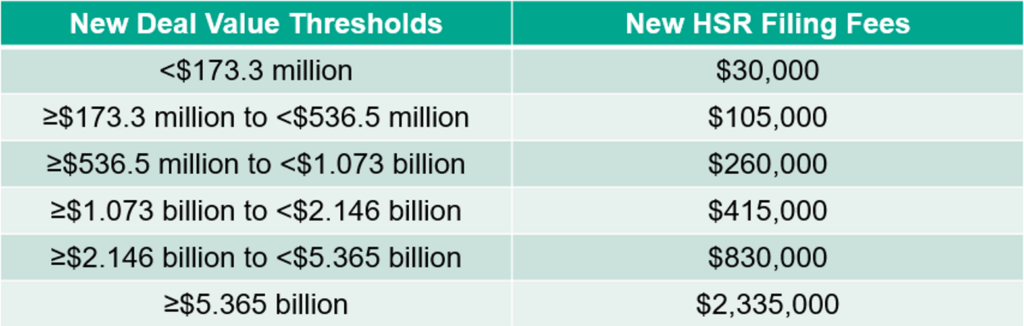
Following the passage of the Merger Filing Fee Modernization Act, the FTC is required to revise filing fee thresholds and filing fee amounts each year. Filing fee threshold changes are based on the percentage change in GNP, and filing fee amounts are based on the percentage increase, if any, in the Consumer Price Index (CPI). As with the merger notification thresholds, the filing fee threshold and filing fee amount adjustments take effect 30 days after publication of the notice in the Federal Register.
The revised filing fee thresholds and filing fee amounts are provided in the table below.







McDermott submits amicus brief to the US Supreme Court in United Behavioral Health
ARTICLE
McDermott submits amicus brief to the US Supreme Court in United Behavioral Health
January 23, 2024
Read time: 4 min
On January 2, 2024, McDermott filed an amicus curiae brief on behalf of the ERISA Industry Committee (ERIC) and the United States Chamber of Commerce (Chamber) in United Behavioral Health v. David K., No. 23-586, in the US Supreme Court. The case presents two questions of broad public importance concerning the requirements under the Employee Retirement Income Security Act (ERISA) for denials of health benefits. But underlying the two questions is an even more fundamental Administrative Procedure Act (APA) issue: May a court, at the invitation of an agency in an amicus brief, effectively amend regulations by judicial fiat, providing the agency with an end run around the APA’s notice-and-comment rulemaking procedures?
The answer to that question should be an obvious no. But that is precisely what happened in the court of appeals in this case. After the plaintiffs filed their response brief, the US Department of Labor (DOL) filed an amicus brief urging a radically new interpretation of regulations the agency had promulgated to implement ERISA’s procedural protections. In essence, the DOL argued that its disability- and health-benefit regulations should be read to contain the same procedural requirements, despite clear regulatory language specifying that some requirements only apply in one context and not the other. The US Court of Appeals for the Tenth Circuit adopted the DOL’s position, decreeing a new regulatory requirement for health-benefit denials that the DOL, in dual 2015 and 2016 rulemakings, expressly considered and chose to adopt only for disability-benefit denials and not for health-benefit denials.
If not corrected by the Supreme Court, the decision will stand as an invitation to agencies to file amicus briefs in the courts of appeals, advocating for substantial changes to their regulations without the bother (or transparency) of APA rulemaking. When so much lawmaking today is undertaken by unaccountable federal bureaucrats, that is a deeply troubling prospect. ERIC and the Chamber supported the petition, explaining the legal and practical issues with the approach the DOL and Tenth Circuit mutually took. Agency interpretations that defy clear regulatory text are entitled to no deference because they are invalid (especially after the Court’s decision in Kisor v. Wilkie). Ignoring this basic proposition of administrative law undercuts the core values served by the APA, including transparency and accountability. Most directly, however, an agency’s decision to seek backdoor revisions to its rules through interpretations announced in litigation deprive the agency of the benefit of public comment that can provide critical data and analysis to inform the agency’s policymaking. Had the DOL engaged in notice and comment, as it should have done, commenters would have presented key distinctions between the disability- and health-benefit contexts; without that information, the DOL’s decision was not fully informed.
ERIC and the Chamber are frequent amici in cases concerning ERISA and the APA’s interpretation and requirements. While the Supreme Court grants only a tiny fraction of the petitions it receives each term, the amici are hopeful that this brief will help focus the Court’s attention on this important case.




FTC Increases 2024 Thresholds for HSR Filings and Interlocking Directorates
ARTICLE / CLIENT ALERT
FTC Increases 2024 Thresholds for HSR Filings and Interlocking Directorates
January 23, 2024
Read time: 6 min
On Jan. 22, 2024, the Federal Trade Commission (“FTC”) announced increased reporting thresholds under the Hart-Scott-Rodino Antitrust Improvements Act of 1976, as amended (“HSR Act”); the revised HSR thresholds will become effective 30 days after their publication in the Federal Register. The minimum size-of-transaction threshold was increased from $111.4 million to $119.5 million. Acquisitions below this threshold will not be reportable.
The FTC also raised the thresholds for interlocking directorates under Section 8 of the Clayton Act, effective as of Jan. 22, 2024, and increased the maximum civil penalty for HSR violations to $51,744 per day of noncompliance, effective as of Jan. 10, 2024.
Revised HSR Act Thresholds
Generally, the HSR Act requires parties to acquisitions of voting securities, assets or non-corporate interests meeting certain thresholds to make a premerger notification to the FTC and the Antitrust Division of the Department of Justice (“DOJ”) unless an exemption applies. The parties to a reportable transaction must observe a waiting period (generally 30 days) before closing. The HSR Act thresholds are adjusted annually in accordance with changes in US gross national product (“GNP”).
Under the revised thresholds, transactions valued up to and including $119.5 million are not reportable under the HSR Act. Transactions valued at more than $119.5 million may be reportable if they meet the following criteria and no exemption applies:
|
Size-of-transaction test |
The acquiring person will hold voting securities, non-corporate interests or assets of the acquired person valued at more than $478 million; or The acquiring person will hold voting securities, non-corporate interests or assets of the acquired person valued at more than $119.5 million but less than $478 million, and the size-of-person test is met. |
|
Size-of-person test* |
One party has at least $239 million in total assets or annual sales, and the other has at least $23.9 million in total assets or annual sales. If the acquired party is “not engaged in manufacturing,” then the test applied to the acquired person specifies annual sales of $239 million or total assets of $23.9 million. |
*For the size-of-person test, a “party” includes its ultimate parent entity (“UPE”) and the UPE’s controlled subsidiaries.
HSR notification thresholds for acquisitions of voting securities. After an HSR filing has been made, and the applicable waiting period has expired or been terminated, any additional acquisitions by the same acquiring person of the same issuer’s voting securities will be exempt from HSR notification, so long as:
- The acquiring person’s holdings crossed the notification threshold with respect to which the premerger notification was made within one year of the expiration or early termination of the HSR Act waiting period; and
- The subsequent acquisition is consummated within five years following the expiration or early termination of the HSR Act waiting period; and
- The subsequent acquisition will not meet or exceed a higher notification threshold (based on the adjusted thresholds in effect at the time of consummation).
The following adjusted notification thresholds take effect 30 days after publication in the Federal Register:
|
HSR Act Original Threshold |
2024 Adjusted Threshold |
|
$50 million |
$119.5 million |
|
$100 million |
$239 million |
|
$500 million |
$1.195 billion |
|
25 percent if value of voting securities to be held |
25 percent if value of voting securities to be held is greater than $2.39 billion |
|
50 percent if value of voting securities to be held |
50 percent if value of voting securities to be held is greater than $119.5 million |
HSR filing fees. The current filing fee schedule, which becomes effective 30 days after publication in the Federal Register, is as follows:
|
Filing Fee |
Size-of-Transaction Tiers |
|
$30,000 |
Greater than $119.5 million but less than $173.3 million |
|
$105,000 |
$173.3 million or more but less than $536.5 million |
|
$260,000 |
$536.5 million or more but less than $1.073 billion |
|
$415,000 |
$1.073 billion or more but less than $2.146 billion |
|
$830,000 |
$2.146 billion or more but less than $5.365 billion |
|
$2,335,000 |
$5.365 billion or more |
The filing fees will be increased annually (and rounded to the nearest $5,000) if the percentage increase in the Consumer Price Index (“CPI”) since the last fiscal year is greater than one percent. The size-of-transaction tiers are adjusted annually based on the percentage change in GNP compared to the prior fiscal year.
HSR penalties. Any person (including the company and any of its officers, directors or partners) failing to comply with the HSR Act may be subject to a civil penalty for each day during which such person is in violation of the Act. The maximum civil penalty was increased from $50,120 per day to $51,744 per day of noncompliance, effective as of Jan. 10, 2024. The civil penalty amounts are adjusted by the FTC annually based on the percentage change in the CPI.
Revised Thresholds for Interlocking Directorates
The FTC also revised the thresholds for evaluating interlocking directorates, effective as of Jan. 22, 2024. Under certain circumstances, Section 8 of the Clayton Act prohibits one person from simultaneously serving as a director or officer of two competing corporations if each corporation has capital, surplus and undivided profits aggregating more than $48,559,000 (up from $45,257,000).
The Clayton Act does not prohibit the interlock if: (1) the competitive sales of either corporation are less than $4,855,900 (up from $4,525,700); (2) the competitive sales of either corporation are less than two percent of that corporation’s total sales; or (3) the competitive sales of each corporation are less than four percent of that corporation’s total sales.
Although Section 8 technically applies only to corporations, both the DOJ and the FTC have taken the position that their broader antitrust authority allows them to enforce the same concept against non-corporate entities.
Authored by Peter Jonathan Halasz and Ngoc Pham Hulbig.
If you have any questions concerning this Alert, please contact your attorney at Schulte Roth & Zabel or one of the authors.
This communication is issued by Schulte Roth & Zabel LLP for informational purposes only and does not constitute legal advice or establish an attorney-client relationship. In some jurisdictions, this publication may be considered attorney advertising. © 2024 Schulte Roth & Zabel LLP. All rights reserved. SCHULTE ROTH & ZABEL is the registered trademark of Schulte Roth & Zabel LLP.


Legal Lens on the Unified Patent Court | January 2024
ARTICLE
Legal Lens on the Unified Patent Court | January 2024
January 2024
Read time: 2 min
The Unified Patent Court (UPC) is revolutionizing the way patents are enforced in Europe, and McDermott’s intellectual property team is here to help you navigate this dynamic landscape. Our Legal Lens on the Unified Patent Court newsletter is designed to keep patent holders and legal departments well-informed of the latest updates and strategic insights on the new patent court.







SDNY Announces Whistleblower Pilot Program to Spur Voluntary Self-Disclosure of Criminal Misconduct
ARTICLE / CLIENT ALERT
SDNY Announces Whistleblower Pilot Program to Spur Voluntary Self-Disclosure of Criminal Misconduct
January 22, 2024
Read time: 6 min
On January 10, 2024, the US Attorney for the Southern District of New York (SDNY) announced a new whistleblower pilot program designed to encourage voluntary self-disclosure of certain, nonviolent criminal misconduct. In announcing the pilot program, US Attorney Damian Williams noted that SDNY seeks to “incentivize individuals and their counsel to provide actionable and timely information” regarding criminal misconduct. SDNY’s rollout of the Whistleblower Pilot Program follows several recent policy pronouncements by the US Department of Justice (DOJ) seeking to incentivize companies and individuals to voluntarily self-report misconduct in exchange for more lenient prosecution.
The announcement marks a significant departure from how SDNY has historically approached cooperation by those involved in criminal conduct and likely signals broader support within DOJ for extending to individuals programs that were previously aimed at corporate self-disclosure.
Whistleblower Pilot Program
Under the Whistleblower Pilot Program, SDNY will enter into a non-prosecution agreement (NPA) and agree not to prosecute an individual who discloses information regarding certain criminal misconduct and meets other program criteria. Specifically, the pilot program applies to conduct “undertaken by or through public or private companies, exchanges, financial institutions, investment advisers, or investment funds involving fraud or corporate control failures or affecting market integrity, or criminal conduct involving state or local bribery or fraud relating to federal, state or local funds.” In such cases, SDNY will offer an NPA in exchange for the whistleblower’s cooperation where all the following conditions are satisfied:
- The misconduct is neither already public nor already known to federal prosecutors.
- The self-disclosure is made voluntarily and not in response to a government inquiry or reporting obligation.
- The whistleblower is able and prepared to provide substantial assistance and fully cooperate in the investigation and prosecution of “one or more equally or more culpable persons.”
- The whistleblower truthfully and completely discloses all prior criminal conduct.
- The whistleblower is not a federal, state or local official, law enforcement official or agent, a person who is (or is expected to become) of major public interest, or the chief executive officer, chief financial officer or equivalent of a public or private company.
- The whistleblower has not engaged in any violent criminal conduct or any sex offense or offense involving terrorism or implicating national security and does not have any previously felony convictions or any convictions involving fraud or dishonesty.
Notably, while the pilot program targets misconduct involving fraud or corporate control failures or affecting market integrity, criminal conduct involving state or local bribery, and fraud relating to federal, state or local funds, the program does not extend to certain types of criminal misconduct, namely violations of the Foreign Corrupt Practices Act (FCPA), violations of federal or state campaign finance laws, federal patronage crimes, corruption of the electoral process or bribery of federal officials.
Where an individual whistleblower discloses information regarding such misconduct but does not satisfy the requirements outlined above, SDNY may nevertheless exercise its discretion to extend an NPA in exchange for the individual’s cooperation, subject to supervisory approval. In determining whether such an agreement is necessary and in the public interest in such circumstances, SDNY will consider the following, among other factors:
- Whether the criminal conduct was already public or previously known to SDNY
- Whether the whistleblower disclosed the criminal conduct voluntarily or in response to a government inquiry or reporting obligation
- The extent of the whistleblower’s substantial assistance with SDNY’s investigation and prosecution of other culpable persons
- Whether the whistleblower has truthfully and completely disclosed all criminal conduct
- The extent to which the individual holds any official or leadership position or other position of public or private trust
- The adequacy of noncriminal sanctions
- The whistleblower’s criminal history.
Key Takeaways
- The Whistleblower Pilot Program offers eligible whistleblowers an enticing carrot: the ability to avoid criminal prosecution entirely, provided they meet the criteria set forth in the program announcement. Historically, SDNY has required all would-be cooperators, with very limited exceptions, to plead guilty to all criminal conduct as part of a cooperation agreement. Moreover, SDNY has signaled its willingness to offer an NPA to even those whistleblowers who fall short of strictly meeting all program requirements.
- Implementation of the Whistleblower Pilot Program may reveal potential pitfalls, and those considering self-reporting should be aware of the inherent risks. For example, while the program by its terms applies only to those reporting criminal conduct unknown to SDNY, a potential whistleblower or her counsel may not know whether SDNY is already aware of information until after self-disclosure. Similarly, the program only applies to those reporting conduct involving “equally or more culpable persons,” a subjective standard as to which a prospective whistleblower and SDNY may not agree. Potential whistleblowers and their counsel should carefully consider these and related issues prior to making any decisions about voluntarily providing information to SDNY.
- While it remains to be seen whether the Whistleblower Pilot Program will lead to additional voluntary self-disclosures, and in turn, criminal prosecutions, the pilot program is noteworthy as a first-of-its-kind attempt by a US attorney’s office to establish the sort of self-reporting incentives for individuals that have long been in place for corporations. Moreover, given SDNY’s stature within DOJ, other US attorneys’ offices nationwide are likely to watch carefully how SDNY’s program works in practice in determining whether to apply similar programs.
For additional information regarding related DOJ efforts, please see our prior client alerts on this topic: “DOJ unveils voluntary self-disclosure safe harbor for M&A deals” and “DOJ formalizes guidelines, incentives for corporate self-disclosure through new policy directive for US Attorneys’ Offices.”


Tips for alcohol suppliers utilizing social media
ARTICLE
Tips for alcohol suppliers utilizing social media
Jan 22, 2024
Read time: 4 min
In light of the Federal Trade Commission’s (FTC) 2023 revisions to its Endorsement Guides, it is essential to ensure that your business is compliant. While the alcohol industry is known for product innovation, the industry is also embracing innovation on the marketing and advertising front, most notably with the use of social media. Given the FTC’s recent announcements and enforcement actions, any business marketing their products via social media, influencers or endorsements, including alcohol advertisers, should be aware of basic requirements. Below are recommendations based on that guidance to help ensure your company keeps its social media activity compliant.
- Third-Party Media Content: Endorsement Requirements
- The endorser is subject to the same rules and obligations as the industry member. In other words, the alcohol rules that apply to suppliers advertising alcohol also apply to the endorser.
- Endorsements cannot convey expressed or implied claims that would be deceptive if the advertiser made them directly.
- For example, a post can be false or misleading if an influencer presents health claims associated with consuming the product.
- All claims made through endorsements (express or implicit) must have adequate substantiation.
- Endorsements must reflect the honest opinions, findings, beliefs or experience of the endorser.
- If the ad represents that the endorser consumed the product, they must have been a genuine user.
- The endorser’s audience should be at least 73.8% 21 years of age or older.
- Third-Party Media Content: Disclosure Requirements
- Material connections must be adequately disclosed on all social media endorsements.
- Material connections include any financial, employment, personal or family relationship with a brand (e.g., receiving free product, free admission to an event, swag or anything of value).
- Note posts from employees and the requirements that may be triggered in the event they post about your product.
- Adequate disclosure includes the following:
- It requires the connection to be clear and conspicuous (i.e., it “can’t be missed”).
- It can be satisfied with “#ad” or other hashtags that sufficiently convey the material connection (such as #advertisement, #sponsored, #paid ad, #promotion).
- You must display it before “clicking more” on the post, which is typically within the first two or three lines. However, a best practice is to place the disclosure at the beginning of the post.
- It requires the disclosure to be “standing alone” in the endorsement (i.e., not buried within the post and not buried in a string of hashtags).
- Material connections must be adequately disclosed on all social media endorsements.
- Tips When Drafting Endorser/Influencer Agreements
- Incorporate appropriate provisions in agreements with influencers and celebrities.
-
- Include a description of the content the influencer will be creating, including timing, mentions and aesthetics. Ensure you understand not just what the endorser or influencer plans to say but also what they plan to do (actions).
- Include the type, form and frequency of the posting and compensation.
- Include legal requirements (i.e., compliance with policies, applicable alcohol industry advertising codes (the Distilled Spirits Council of the United States Code of Responsible Practices; the Beer Institute’s Advertising and Marketing Code; and the Wine Institute’s Code of Advertising Standards), FTC requirements and indemnification).
-
- Be mindful of posts that include elements such as sweepstakes or giveaways, and ensure the endorser follows the applicable alcohol rules and regulations associated with running those programs.
- Incorporate appropriate provisions in agreements with influencers and celebrities.
For questions about how to keep your social media activity compliant, please contact Lesli Esposito or Nichole Shustack.


