














ARTICLE
Capital Markets & Public Companies Quarterly
April 2019
Read time: 10 min
Although the SEC was closed during the first few weeks of the year, they came back strong to close out the quarter with a flurry of final and proposed rulemakings. Over the first quarter of 2019, the SEC adopted additional amendments to modernize and simplify the public company disclosure regime.
The SEC also proposed the expansion of the “test the waters” accommodations to all companies seeking to access the public markets. In addition, companies should note new amendments to NASDAQ and NYSE rules and platforms, which may affect both listed companies and companies seeking to list in the future.
SEC Adopts More Rules under Modernization and Simplification Mandate
On March 20, 2019, the US Securities and Exchange Commission (SEC) adopted amendments that simplify and update certain disclosure requirements intended to improve the readability and navigability of disclosure documents and discourage repetition and disclosure of immaterial information. The amendments illustrate the SEC’s continued efforts to implement its mandate under the Fixing America’s Surface Transportation (FAST) Act, which requires the SEC to identify disclosure requirements that are redundant, outdated or excessive in that they require the disclosure of immaterial information. The amendments were first proposed in October 2017 and they follow on the heels of last year’s adoption of the Disclosure Update and Simplification Amendments.
One of the significant changes in the amendments is the elimination of the requirement to submit a confidential treatment request to the SEC when a company chooses to omit certain confidential information contained in material agreements filed as exhibits to an applicable reporting document. While a company no longer needs to submit a confidential treatment request in connection with the omission, the location of the redacted information in the agreement must be clearly identified in such filings. Similar to the current procedures for submitting a confidential treatment request, omitting information from an agreement is permitted only to the extent that the information is not material and that it would likely cause competitive harm if publicly disclosed. An unredacted version of the material agreement must be made available to SEC staff upon request. The amendments also permit companies to omit schedules to material agreements, if such schedules do not contain material information and the information therein has not otherwise been disclosed.
Other changes include amendments to Item 303 of Regulation S-K, covering the Management’s Discussion and Analysis of Financial Position and Results of Operations, that allow companies to omit discussion of the earliest of the three years covered by their financial statements, provided that such discussion was included in a prior filing with the SEC, the information is no longer material and the company references the location of the omitted information within the prior filing. The SEC also adopted amendments to Item 601(b)(4) of Regulation S-K requiring companies to attach as an exhibit a description of the class, characteristics and rights of all company securities that have been registered under the Exchange Act.
The amendments relating to the redaction of confidential information in material agreements filed as exhibits are effective April 2, 2019. All other amendments are effective May 2, 2019.
For additional commentary on the SEC’s Modernization and Simplification Amendments, see our On the Subject.
Phase-In Inline XBRL Starting with Large Accelerated Filers’ First Form 10-Q after June 15
In addition to the revised disclosure requirements listed above, the SEC’s adopting release further amended the requirements for a public company to tag data on the cover page to its EDGAR filings using Inline XBRL. The SEC aligned the phase-in periods for adoption of Inline XBRL in cover pages with the phase-in periods for adoption of Inline XBRL in operating company financial statement information, which the SEC adopted in 2018.
Both requirements are phased-in based upon the company’s filer status as follows:
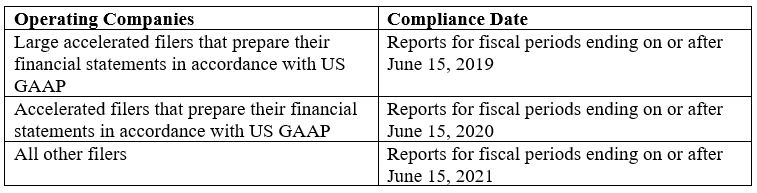
In both adopting releases, the SEC clarifies that companies that are domestic filers will be required to comply with Inline XBRL requirements beginning with their first Form 10-Q (not the first form) for a fiscal period ending on or after the applicable compliance date. For example, a company with a calendar fiscal year end that files a Form 10-Q for the period ending June 30, 2019, must tag data on the cover page and within the financial statement information included therein in Inline XBRL. A domestic company with a June 30 fiscal year end will be required to tag cover page and financial statement information starting in its Form 10-Q for the period ending September 30, 2019.
SEC Proposes Rule to Expand “Test-the-Waters” to All Companies
On February 19, 2019, the SEC proposed a new rule, Rule 163B, as well as related amendments to existing rules, that would allow all companies to engage in “test-the-waters” communications with certain qualified investors. Under the proposed rule, either prior to or following the filing of a registration statement related to a contemplated offering, issuers would be permitted to engage in oral or written communications with investors that are Qualified Institutional Buyers, as defined by Rule 144A, or Institutional Accredited Investors, defined as an institutional investor that is an “accredited investor” under Rule 501 of Regulation D.
Such communications, commonly known as “test-the-waters” communications, would be exempt from the gun-jumping restrictions imposed by Sections 5(b)(1) and 5(c) of the Securities Act of 1933 (the Securities Act), which prohibit written or oral offers prior to the filing of a registration statement and without a prospectus meeting the requirements of the Securities Act. “Test-the-waters” communications that comply with the proposed rule would not need to be filed with the SEC and would not need to include cautionary legends. However, issuers subject to Regulation FD who may wish to engage in “test-the-waters” communications prior to conducting follow-on and other registered offerings would need to evaluate if they would trigger disclosure obligations. In addition, communications made in reliance on the proposed rule would still be considered “offers” subject to Section 12(a)(2) of the Securities Act in addition to the anti-fraud provisions of the federal securities laws.
The public comment period proposed Rule 163B ends on April 29, 2019. For additional commentary on proposed Rule 163B, see our On the Subject.
SEC Issues Guidance Regarding Board Diversity Disclosure
On February 6, 2019, the SEC Division of Corporation Finance (the Division) issued two identical Compliance and Disclosure Interpretations (the C&DIs) regarding director and director nominee diversity disclosure under Items 401 and 407 of Regulation S-K. The C&DIs encourage public companies to be more forthcoming in their public filings regarding the extent to which self-identified diversity characteristics play a role in the director nomination process.
Under Item 401(e), public companies are directed to disclose in any proxy statement distributed for the purpose of electing directors of the company “the specific experience, qualifications, attributes or skills that led to the conclusion that the [director or nominee] should serve as a director.” Additionally, Item 407(c)(2)(vi) requires public companies to “[d]escribe the nominating committee’s process for identifying and evaluating nominees for director.” Item 407(c)(2)(vi) further instructs public companies to describe whether—and if so, how—the nominating committee considers diversity in identifying nominees for director, including how the nominating committee implements and assesses any policy it may have with regard to the consideration of diversity in identifying director nominees.
The new C&DIs clarify how public companies may satisfy these disclosure obligations in circumstances in which a director or nominee voluntarily provides self-identified diversity characteristics, such as their race, gender, ethnicity, religion, nationality, disability, sexual orientation or cultural background, and such director or nominee consents to the company’s public disclosure of these characteristics. The C&DIs state that, if a board or nominating committee considers the self-identified diversity characteristics in determining a person’s suitability for board membership, then the company’s response required by Item 401(e) should, at minimum, disclose the characteristics identified and explain the manner in which they were considered. The company’s discussion of its diversity policies required under Item 407(c) also should include “how the company considers the self-identified diversity attributes of nominees as well as any other qualifications its diversity policy takes into account, such as diverse work experiences, military service, or socio-economic or demographic characteristics.” In other words, when a nominating committee follows a specific policy, which considers diversity during the director nomination and selection process, the explanation required pursuant to Item 407 should sufficiently discuss how the self-identified diversity attributes, among other qualifications, are weighed.
The C&DIs are in line with increasing investor demands to promote board diversity and bring transparency to the board selection process. As discussed in our prior quarterly update, proxy advisors, large institutional shareholders and state governments have taken action in recent years to place increased emphasis on gender diversity in the boardroom. In their guidelines for 2019, both Institutional Shareholder Services and Glass Lewis adopted policies stating that adverse voting recommendations may be issued against nominating committee chairs for public companies that have no female members on their boards. Following on the heels of California’s board gender diversity law, the Illinois General Assembly and other state legislatures are taking up legislation to require public companies with headquarters in their state to have at least one female director on their boards.
With an upcoming proxy season likely to focus heavily on initiatives surrounding environmental, social and governance disclosure, the C&DIs are in harmony with growing shareholder calls for greater disclosure on board diversity.
NASDAQ Follows NYSE in Amending Rules for Direct Listings
On February 15, 2019, NASDAQ filed an immediately effective rule proposal to permit and clarify the listing requirements for listings on the Nasdaq Global Select Market exchange without conducting a traditional initial public offering, otherwise known as a “direct listing.” Under the rule changes, NASDAQ requires that a company conducting a direct listing to have an effective registration statement filed with the SEC that registers the resale of shares held by the company’s current shareholders. In addition, the company must comply with initial listing requirements and the corporate governance requirements set forth in the NASDAQ Rule 5600 Series, subject to applicable exemptions. Additionally, the NASDAQ rules require a company conducting a direct listing on the Nasdaq Global Select Market to provide NASDAQ with an independent third-party valuation to determine whether the company has met the market value requirements. Interest in direct listings has increased in recent years, with companies such as Spotify Technology S.A. seeking direct listings and these changes to Nasdaq listing rules follow on the heels of similar rule changes adopted by the New York Stock Exchange last year.
NYSE Decommissioned EGovDirect Website, Migrated Functions to Listing Manager
On March 29, 2019, the NYSE decommissioned its eGovDirect website and migrated functions to its Listing Manager portal. Functions that were previously available on the eGovDirect site, including updates to company officers, directors and contacts, submission of annual and interim written affirmations and confirmation of record and meeting dates, can now exclusively be performed on the Listing Manager portal. NYSE-listed companies should update their Listing Manager and account administrators should update their teams to ensure that all relevant personnel have access to the Listing Manager platform.










SEC Adopts Modernization and Simplification of Regulation S-K
ARTICLE / CLIENT ALERT
SEC Adopts Modernization and Simplification of Regulation S-K
April 15, 2019
Read time: 9 min
On March 20, 2019, the SEC adopted amendments to existing rules that, among other provisions, permit the omission of certain confidential information from material contracts without separately requesting confidential treatment, permit the exclusion of prior year financial performance in MD&A disclosure and facilitate the use of hyperlinks and Inline XBRL in EDGAR filings. The amendments are a continuation of the SEC’s mandate under the FAST Act to modernize and simplify disclosure requirements while ensuring that investors retain access to all material information.
On March 20, 2019, the US Securities and Exchange Commission (SEC) adopted amendments that simplify and update certain disclosure requirements intended to improve the readability and navigability of disclosure documents and discourage repetition and disclosure of immaterial information. The amendments illustrate the SEC’s continued efforts to implement its mandate under the Fixing America’s Surface Transportation (FAST) Act, which requires the SEC to identify disclosure requirements that are redundant, outdated or excessive in that they require the disclosure of immaterial information. The amendments were first proposed in October 2017 and they follow on the heels of the adoption last year of the Disclosure Update and Simplification Amendments.
While last year’s amendments seemed to focus on redundant requirements that appear both in US GAAP and SEC disclosure rules, the amendments in the adopting release, and discussed below, appear to shift the administration of the SEC’s disclosure regime away from outdated filing requirements and toward modern technologies that offer improved search functionalities.
The amendments relating to the redaction of confidential information in material agreements filed as exhibits are effective April 2, 2019. All other amendments are effective May 2, 2019.
Confidential Treatment Request Not Required for Certain Omissions
The SEC adopted amendments to Item 601(b)(10) of Regulation S-K, which requires companies to attach material agreements entered into within the last two years as exhibits to an applicable filing document. The amendments allow companies to omit certain confidential information contained in such agreements, provided that the omitted information is not material and that it would likely cause competitive harm if publicly disclosed. The amendments also permit companies to omit schedules, exhibits or other attachments to their material agreements if such attachments do not contain material information and the information therein was not otherwise disclosed.
Prior to the amendment, companies were required to follow strict procedures for obtaining confidential treatment of such information included in exhibits filed under the Exchange Act and Securities Act. Under these procedures, outlined in Exchange Act Rule 24b-2 and Securities Act Rule 406, companies were required to submit a detailed application (CTR) identifying the specific text for which confidential treatment is sought, the applicable exemption and the legal requirements thereunder, and an explanation of why, under the circumstances, disclosure of the information is unnecessary for the protection of investors.
Companies are still required to comply with other requirements of the rule as amended, including marking the exhibit index to indicate that information has been omitted from a particular exhibit, prominently displaying a legend on the first page of the exhibit to indicate that information has been omitted and indicating with brackets sections in the exhibit where information has been omitted. Further, companies are still limited to redacting no more information than necessary to prevent competitive harm.
Upon review by the SEC staff and a formal request, companies are expected to promptly provide as supplemental materials to the staff the unredacted copies of the material agreements and legal reasoning for the confidential treatment in a manner that is similar to what was previously required in a CTR. The SEC staff may also request information similar to the detailed information previously required under the CTR.
In addition to the amendments related to confidential treatment, the SEC also amended Item 601(b)(10)(i) of Regulation S-K by limiting the scope of companies subject to the requirement to file material contracts that were entered into within two years of the applicable registration statement or report. This requirement will only apply to newly reporting registrants. The SEC notes in their adopting release that reporting companies will still be required to file material contracts that are performed in whole or in part at or after the filing of the registration statement or report.
Three-Year Lookback in MD&A Disclosure May Be Omitted
The SEC adopted amendments to Item 303 of Regulation S-K, covering the Management’s Discussion and Analysis of Financial Position and Results of Operations (MD&A), that allow companies to omit discussion of the earliest of the three years covered by their financial statements, provided that such discussion was included in a prior filing with the SEC and the company references the location of the omitted information within the prior filing. Item 303(a) of Regulation S-K generally requires companies to disclose their financial condition, changes in financial condition, and results of operations. Before the amendments, the MD&A disclosure, subject to certain exceptions, was to address the three-year period that is covered in the company’s financial statements provided with the filing.
In its adopting release, the SEC emphasized that the amendment permitting the omission of discussion of the financials of the earliest year does not relieve management from identifying material trends in the company’s business, which may extend back to that year or earlier periods. Instead, the goal of this amendment is to discourage repetition of information that was previously included in an SEC filing and that is no longer material. Therefore, references to material elements of the prior year’s financials should be included in subsequent disclosures, while reiterations of the entirety of the prior year’s discussion and analysis are not required. Similar amendments were adopted regarding the disclosure requirements under Item 5 of Form 20-F used by foreign private issuers.
The amendment also removes the instruction that information should be presented in a year-by-year format, and replaces this instruction with a statement that the presentation may take any form that, in the company’s judgment, “enhances a reader’s understanding” of the company’s financial condition, changes in financial condition and results of operations.
Description of Registered Securities as an Exhibit to Form 10-K
The SEC adopted amendments to Item 601(b)(4) of Regulation S-K requiring companies to attach as an exhibit a description of the class, characteristics and rights of the company securities that have been registered under the Exchange Act. Prior to the amendments, companies were required to attach instruments—such as forms of specimen stock certificates, indentures or certificates of designation—that defined the rights these securities. The amendments would require companies to summarize the material terms of these securities in one exhibit. The goal of the amendment is to facilitate access to such information rather than requiring investors to piece together the information themselves. The amendments do not affect other disclosure requirements, such as filing updated articles of amendment and bylaws, or filing a current report on Form 8-K to disclose modifications to the rights under company securities.
Delinquent Section 16 Filing Disclosure
The SEC adopted amendments to Item 405 of Regulation S-K, covering the disclosure of directors, executive officers and other persons required to file reports disclosing their beneficial ownership of company equity securities under Section 16 of the Exchange Act, but who fail to file such reports in a timely manner. The SEC adopted amendments changing the disclosure heading required under Item 405 to “Delinquent Section 16(a) Reports.” The amendments encourage companies to exclude this section if there are no delinquent filings to report. Further, the amendments eliminate the requirement that persons reporting under Section 16 furnish a duplicate of their Section 16 report to the company. After the amendments, companies are permitted to rely solely on the reports electronically filed on EDGAR.
Form Cover Pages
The amendments also revise the cover pages of Forms 10-K, 10-Q and 8-K. Form 10-Q and Form 8-K to include disclosure of the national stock exchange or principal US market for the company’s registered securities. The amendments also revise the cover page of Form 10-K by requiring disclosure of the trading symbol for the company’s securities, if listed on an exchange, and by removing a checkbox that would indicate whether during the most recent fiscal year any person filing reports under Section 16 of the Exchange Act was delinquent in filing such reports.
Inline XBRL
The SEC’s adoption release further amended the requirements for a public company to tag data on the cover page to its EDGAR filings using Inline XBRL. The SEC aligned the phase-in periods for adoption of Inline XBRL in cover pages with the phase-in periods for adoption of Inline XBRL in operating company financial statement information, which the SEC adopted in 2018.
Both requirements are phased-in based upon the company’s filer status as follows:
In both adopting releases, the SEC clarifies that companies that are domestic filers will be required to comply with Inline XBRL requirements beginning with their first Form 10-Q (not the first form) for a fiscal period ending on or after the applicable compliance date. For example, a company with a calendar fiscal year end that files a Form 10-Q for the period ending June 30, 2019, must tag data on the cover page and within the financial statement information included therein in Inline XBRL. A domestic company with a June 30 fiscal year end will be required to tag cover page and financial statement information starting in its Form 10-Q for the period ending September 30, 2019.
Other Amendments
Other notable amendments include limiting the requirements of Item 102 of Regulation S-K to the disclosure of physical property only to the extent that it is material to the registrant and removing the requirement to file as an exhibit any document or part thereof that is incorporated by reference in a filing, and requiring that companies provide hyperlinks to documents incorporated by reference.
For additional information about McDermott’s Capital Markets and Public Companies practice, please see our practice group page.
The Art of Using Preemption to Defend Wage-And-Hour Cases
ARTICLE
The Art of Using Preemption to Defend Wage-And-Hour Cases
April 12, 2019
Read time: 1 min
Michael Giambona authored this bylined article on the use of preemption as a defense in wage-and-hour litigation.


Part V: Section 965 Transition Tax
ARTICLE
Part V: Section 965 Transition Tax
April 11, 2019
Read time: 2 min
Jay Singer authored this bylined article about Internal Revenue Code Section 965, which taxes earnings held offshore by controlled foreign corporations.


Booking.Com is Not Generic: Fourth Circuit Addresses Protection for ‘.com’ Trademarks
ARTICLE
Booking.Com is Not Generic: Fourth Circuit Addresses Protection for ‘.com’ Trademarks
April 10, 2019
Read time: 2 min
Sarah Bro authored this bylined article summarizing the US Court of Appeals for the Fourth Circuit decision affirming the district court’s summary judgment ruling on the protectability of “.com” trademarks.





Blockchain Tokens: The SEC Staff Issues Its Framework for Determining Whether an ICO is an Issuance of Securities
ARTICLE / CLIENT ALERT
Blockchain Tokens: The SEC Staff Issues Its Framework for Determining Whether an ICO is an Issuance of Securities
April 10, 2019
Read time: 14 min
In its long-awaited guidance, the Staff of the Securities and Exchange Commission recently provided a lengthy list of factors to consider when determining whether an initial coin offering (ICO) is a security. While the Framework provides insight into how the Staff views ICO structures and will likely guide both enforcement actions and future ICO security determinations, we note that additional guidance, enforcement actions and court decisions will be needed to further clarify the issue.
On April 3, 2019, the Staff of the Securities and Exchange Commission (the Staff) published its long-awaited guidance for analyzing whether a virtual currency is offered and sold as an investment contract and therefore is a security, titled “Framework for ‘Investment Contract’ Analysis of Digital Assets” (Framework). While, unsurprisingly, the Staff did not set forth a specific test, it did provide a long list of factors to consider when determining whether an initial coin offering (ICO) is a security.
On the positive side for those hoping to launch an ICO without registering as a security, the Framework leaves open the possibility of non-security ICOs and provides guidance as to what factors will be considered by the Staff. It also reaffirms that the Staff will continue to rely on the “investment contract” analysis first enunciated by the Supreme Court in SEC v. Howey, 328 U.S. 293 (1946), to determine whether an ICO constitutes a security. Additionally, following the suggestions set forth in Director Hinman’s speech on June 14, 2018, the November 16, 2018 Statement on Digital Asset Securities Issuance and Trading, and the March 7, 2019 letter written by Chairman Jay Clayton, it appears that the Staff agrees that “a digital asset previously sold as a security” could be “reevaluated at the time of later offers or sales.”
On the negative side, many of the factors that would lean in favor of determining that an ICO is a security are prevalent in the vast majority of ICOs. It remains to be seen how this guidance will impact possible SEC enforcement actions against past ICOs, but we anticipate that many of the factors set forth in the guidance will be paramount in SEC enforcement actions with regard to future ICOs.
Note that for purposes of this article, the terms “virtual currency”; “digital asset”; “token” and “cryptocurrency” will be used interchangeably. Similarly, while we have used the term “ICO,” that term is used interchangeably with a “token sale”; “token offering” or any other term commonly used to describe the launch or issuance of a new virtual currency.
1. The Staff Quickly Determines That Most ICOs Satisfy the First and Second Prong of the Howey Test
The Howey test, interpreted in the light of many subsequent cases, determines whether an investment will be considered a security. While there are various forms of securities, at issue in Howey and in the Framework is whether an investment constitutes an “investment contract” and therefore is a security. Under the Howey test, an “investment contract” exists when there is (1) an investment of money (2) in a common enterprise (3) with a reasonable expectation of profits to be derived from the efforts of others. As noted in the Framework, and in a legion of decisional authority, whether an investment constitutes an “investment contract,” and therefore a security, “depends on the specific facts and circumstances.”
The Framework quickly passes on whether most ICOs would satisfy the first two prongs—(1) an investment of money into (2) into a common enterprise—stating that most ICOs meet those first two prongs.
2. The Staff Unloads 65 Overlapping Factors to Consider When Determining Whether an ICO Satisfies the Reasonable Expectation of Profits Deriving from the Efforts of Others Prong of the Howey Test
However, the Framework sets forth a long list of factors to determine whether an ICO meets the third prong—“reasonable expectation of profits derived from the efforts of others.” It states that “usually, the main issue in analyzing a digital asset under the Howey test is whether a purchaser has a reasonable expectation of profits (or other financial returns) derived from the efforts of others.” According to the Staff, “[w]hen a promoter, sponsor, or other third party (or affiliated group of third parties) (each, an Active Participant or AP) provides essential managerial efforts that affect the success of the enterprise, and investors reasonably expect to derive profit from those efforts, then this prong of the test is met.” Id. The inquiry, therefore, is an objective one, focused on the transaction itself and the manner in which the virtual currency is offered and sold.
But the SEC did not set forth a specific test. Instead, it lists no less than 65 factors (inclusive of sub-factors)—a number of which overlap—to consider when determining whether an ICO constitutes an investment contract. The application of these factors is not straightforward, and there is no indication as to whether certain factors weigh more heavily to the SEC than others. However, certain the factors should be highlighted when examining typical ICOs.
For example, to the extent APs are involved in distributing or promoting the virtual currency, according to the Staff, the following factors weigh in favor of an ICO being considered an investment contract:
- Determining who will receive additional digital assets and under what conditions.
- Purchasers reasonably would expect that an AP’s efforts will result in capital appreciation of the digital asset and therefore to be able to earn a return on their purchase.
- The availability of a market for the trading of the digital asset, particularly where the AP implicitly or explicitly promises to create or otherwise support a trading market for the digital asset.
Certain characteristics of the virtual currency itself are listed as relevant factors, primarily whether the virtual currency can actually be used to purchase goods or services and the transferability of the virtual currency:
- With respect to a digital asset referred to as a virtual currency, it can immediately be used to make payments in a wide variety of contexts, or acts as a substitute for real (or fiat) currency [which would make the sale of such a virtual currency less likely to be considered an investment contract].
- The digital asset gives the holder rights to share in the enterprise’s income or profits or to realize gain from capital appreciation of the digital asset [which would make the sale of such a virtual currency more likely to be considered an investment contract].
- The digital asset is transferable or traded on or through a secondary market or platform, or is expected to be in the future [which would make the sale of such a virtual currency more likely to be considered an investment contract].
- The ready transferability of the digital asset is a key selling feature [which would make the sale of such a virtual currency more likely to be considered an investment contract].
Also, as one might expect, the manner in which the ICO is marketed plays a key role in determining whether it is an investment contract. Some of the factors pertaining to the marketing of an ICO that would lean in favor of determining that the ICO is an investment contract are:
- The digital asset is marketed in terms that indicate it is an investment or that the solicited holders are investors.
- The intended use of the proceeds from the sale of the digital asset is to develop the network or digital asset.
- The potential profitability of the operations of the network, or the potential appreciation in the value of the digital asset, is emphasized in marketing or other promotional materials.
- The availability of a market for the trading of the digital asset, particularly where the AP implicitly or explicitly promises to create or otherwise support a trading market for the digital asset.
In addition, the Framework appears to indicate that if APs receive virtual currency and can benefit from the increase in value of that virtual currency, that weighs in favor of the ICO being considered an investment contract:
- The AP has the ability to realize capital appreciation from the value of the digital asset. This can be demonstrated, for example, if the AP retains a stake or interest in the digital asset. In these instances, purchasers would reasonably expect the AP to undertake efforts to promote its own interests and enhance the value of the network or digital asset.
- The AP is able to benefit from its efforts as a result of holding the same class of digital assets as those being distributed to the public.
- The AP owns or controls ownership of intellectual property rights of the network or digital asset, directly or indirectly.
- The AP monetizes the value of the digital asset, especially where the digital asset has limited functionality.
These factors are somewhat concerning, given that most APs retain some of the virtual currency and related intellectual property, such that they would benefit if the virtual currency becomes popular and increases in value.
There are also a number of factors indicating that an ICO is more likely to be considered an investment contract if the APs are involved (and they usually are) in the development and improvement of the operation of a particular virtual currency:
- An AP is responsible for the development, improvement (or enhancement) operation, or promotion of the network, particularly if purchasers of the digital asset expect an AP to be performing or overseeing tasks that are necessary for the network or digital asset to achieve or retain its intended purpose or functionality.
- Where the network or the digital asset is still in development and the network or digital asset is not fully functional at the time of the offer or sale, purchasers would reasonably expect an AP to further develop the functionality of the network or digital asset (directly or indirectly). This particularly would be the case where an AP promises further developmental efforts in order for the digital asset to attain or grow in value.
- An AP creates or supports a market for, or the price of, the digital asset. This can include, for example, an AP that: (1) controls the creation and issuance of the digital asset; or (2) takes other actions to support a market price of the digital asset, such as by limiting supply or ensuring scarcity, through, for example, buybacks, “burning,” or other activities.
- An AP has a lead or central role in the direction of the ongoing development of the network or the digital asset. In particular, an AP plays a lead or central role in deciding governance issues, code updates, or how third parties participate in the validation of transactions that occur with respect to the digital asset.
The Staff also refers to a series of managerial responsibilities that many APs are tasked with as factors weighing in favor of an ICO being considered an investment contract:
- Determining whether and how to compensate persons providing services to the network or to the entity or entities charged with oversight of the network.
- Making or contributing to managerial level business decisions, such as how to deploy funds raised from sales of the digital asset.
- The AP distributes the digital asset as compensation to management or the AP’s compensation is tied to the price of the digital asset in the secondary market. To the extent these facts are present, the compensated individuals can be expected to take steps to build the value of the digital asset.
The list of factors the Staff identifies is long and inclusive. It is very likely that a vast majority of the ICOs launched in the past few years maintain at least some of the factors listed by the Staff weighing in favor of a determination that the ICO is an investment contract.
3. Subsequent Sales of Virtual Currency Can be Reassessed
Interestingly, the Staff appears to countenance the possibility that a virtual currency launched in an ICO could be “reevaluated at the time of later offers or sales” even if it originally would have considered an investment contract. In determining whether there should be such a “reevaluation,” the Staff will consider additional factors as they relate to efforts of others and separate factors as they relate to the “reasonable expectation of profits.” The Staff provided the following factors to consider in determining whether a reevaluation is appropriate: (1) whether purchasers no longer reasonably expect that continued development efforts of an AP is a key factor in determining the value; (2) the value of the virtual currency comes to have a direct and stable correlation to the value of the good or service being exchanged; (3) the volume of trading corresponds to the demand for the good or service being exchanged; (4) whether holders can use the virtual currency for its intended functionality, such as to acquire goods and services; (5) whether the economic benefit of the virtual currency is incidental to obtaining the right to use it for its intended functionality; and (6) no AP has access to material, non-public information or could otherwise be deemed to hold material inside information about the digital asset. This is of particular importance to ICOs that have been launched in the last few years. According to the Framework, even if the initial ICO should have been registered as a security, the Staff leaves open the possibility that subsequent sales of that virtual currency will not be considered an investment contract.
4. The Staff Provides an Example and a “No Action” Letter Indicating that Retail-Only ICOs Are Not Securities
The Staff also provides some helpful examples of ICOs that would not constitute securities. As one example, the Staff refers to the case of an online retailer with a fully developed operating business where that retailer “creates a digital asset to be used by consumers to purchase products only on the retailer’s network, offers the digital asset for sale in exchange for real currency, and the digital asset is redeemable for products commensurately price in that real currency.” Importantly, the “digital assets are not transferable; rather, consumers can only use them to purchase products from the retailer or sell them back to the retailer at a discount to the original purchase price.” According to the Staff, such “digital asset[s] would not be an investment contract.” However, the Staff does list some limitations to the retailer example, stating that even in the retailer scenario the sale of virtual currency may constitute an investment contract if the virtual currency is offered or sold at a discount to the value of the good or service, sold in quantities that exceed reasonable use on the retailer’s platform and there are no restrictions on reselling the virtual currency, “particularly where an AP is continuing its efforts to increase the value of the digital assets or has facilitated a secondary market.”
Similarly, together with the Framework, the Staff issued a “no action” letter to a company called TurnKey Jet, Inc. (TKJ). TKJ sought to offer a virtual currency directly tethered to the US dollar, where each TKJ token is worth one USD. TKJ tokens can only be used to purchase air charter services, can only be used within the TKJ marketplace and cannot be transferred to external wallets. Also, if a user wants to convert its TKJ token into USD, it can only do so at a discount to the face value of the TKJ (less than $1 per TKJ token). In addition, TKJ agreed to not use any of the funds from the sale of TKJ tokens to develop the TKJ platform, network or apps. Under those circumstances, the Staff stated that it “will not recommend enforcement action to the Commission, if, in reliance on [TKJ’s] opinion as counsel that [TKJ tokens] are not securities, TKJ offers and sells [TKJ tokens] without registration under the Securities Act and the Exchange Act.”
Viewing the example in the Framework and the TKJ no action letter, it appears that the Staff has become comfortable with the concept that if virtual currency is only used to purchase goods or services on an existing platform and cannot be sold for a profit, then such a sale of virtual currency is not an investment contract. It remains to be seen how this retail-only ICO concept will be adopted in the marketplace. We anticipate that APs and others in the virtual currency marketplace will test the boundaries of this retail-only concept. We also anticipate that APs will be looking at the TKJ no action letter as a model of sorts on how to conduct an ICO without concern for securities registration issues.
* * *
While we have listed a number of prominent factors above, the Framework lists many more. Despite listing 65 overlapping factors to consider, the Staff still takes the position that the Framework specifies only “some of the factors market participants should consider in assessing whether a digital asset is offered or sold as an investment contract and, therefore, is a security.” While the ICO marketplace has been seeking guidance from the SEC, the Framework may not be viewed as greatly clarifying which ICOs constitute securities and which do not. However, the Framework does give an insight as to how the Staff views ICO structures and will likely guide both enforcement actions and future ICOs. We anticipate that additional guidance, enforcement actions or decisional authority will further clarify the regulatory requirements for ICOs.



SEC Publishes First-Ever No-Action Letter for a Cryptocurrency Enterprise and a Framework for when a Cryptocurrency Is a Security
ARTICLE / CLIENT ALERT
SEC Publishes First-Ever No-Action Letter for a Cryptocurrency Enterprise and a Framework for when a Cryptocurrency Is a Security
April 10, 2019
Read time: 27 min
On April 3, the U.S. Securities and Exchange Commission published a framework aimed at assisting in determining whether a digital asset is a security (the “Framework”).[1] Alongside the Framework, the SEC also published a no-action letter for TurnKey Jet, Inc., the first ever no-action letter for a digital asset enterprise.[2]
This is an important development for any parties interested in developing, selling or investing in digital assets, as it is the most robust analysis yet published on how the SEC sees these assets and finally provides concrete information on how to avoid an SEC enforcement action in an industry that has recently suffered from regulatory uncertainty. The Framework and the conditions the SEC notes in advising TurnKey that it will not recommend an enforcement action, however, lead to the conclusion that, in the eyes of the SEC, digital assets cannot be used to raise capital without implicating U.S. securities laws. Furthermore, many of the Framework’s considerations go beyond the traditional test for determining whether an asset is a security. A thorough understanding of the SEC’s position as reflected in these documents is essential for any party interested in dealing with digital assets.
Background
The question of whether a cryptocurrency is a security has a significant impact on the regulatory implications of dealing in digital assets or conducting an initial coin offering (“ICO”). The SEC has previously acknowledged that the sale of digital assets may not implicate U.S. securities laws and may be an efficient way to raise proceeds.[3] Nevertheless, prior to April 3, the SEC had provided only limited guidance as to how to sell an unregistered digital asset or conduct an ICO without risking an SEC enforcement action.
Before the Framework, the most robust SEC analysis of when a digital asset was a security was published in July 2017, when the SEC released a Report of Investigation on an offering of digital tokens by an entity called The DAO.[4] In this report, the SEC analyzed The DAO’s digital tokens under the test established in SEC v. Howey, which holds that an asset is an investment contract, and therefore a security, when there is (1) an investment of money (2) in a common enterprise (3) with the reasonable expectation of profits derived from the efforts of others.[5] The SEC concluded that The DAO tokens were securities under the Howey test, noting that holders of The DAO’s digital tokens had limited control over The DAO and stood to receive a share from the profits of The DAO’s enterprises.[6]
For more than two years following the release of The DAO Report, the SEC largely only took action against digital asset ventures that it accused of actually defrauding purchasers, such as two ICOs that purported to be backed by real estate and diamonds.[7] In December 2017, however, the SEC began taking action against digital asset ventures that it did not allege attempted to mislead customers.[8] The SEC’s expanded focus included digital asset ventures where the only apparent wrongdoing was failing to register their ICOs as security offerings, even where those ventures did not offer digital asset holders a share of the ventures’ profits.[9] The cryptocurrency venture Paragon Coin Inc., represented by Schulte Roth & Zabel before the SEC’s Enforcement Division, was the subject of one such action.[10] Paragon had to pay a civil money penalty but was given the opportunity to pursue registration of its digital assets as a class of securities, which appears, based on the Framework, to be the way of the future for many digital asset ventures.[11]
In the wake of the SEC actions targeting cryptocurrency ventures where the only wrongdoing was failing to register their digital assets, there was significant uncertainty in the digital asset industry as to how to design a digital asset that would not run afoul of the SEC’s prohibition of the sale of unregistered securities. Many believe that this regulatory uncertainty has had a chilling effect on the digital asset industry.[12] The amount raised through ICOs, for instance, has dropped significantly in the past year.[13] Now, with its publication of the Framework, the SEC has attempted to address this uncertainty with the most robust presentation yet of its perspective as to when a digital asset is a security.
The Framework
As with The DAO Report, the Framework centers on the Howey test.[14] The SEC quickly disposes of the first two prongs of the test, stating that the sale of a digital asset typically is an investment of money in a common enterprise, so the majority of the Framework concerns when the sale of a digital asset satisfies the final Howey test element of a reasonable expectation of profits from the efforts of others.[15] The SEC lists a myriad of characteristics to consider in analyzing this element of the Howey test, with the Framework broken down into subsections on (1) reliance on the efforts of others, (2) reasonable expectation of profits and (3) other considerations.[16]
Some key takeaways from the “Reliance on the Efforts of Others” subsection are that the more important and involved the promoter, sponsor, or other third party (defined by the Framework as an “Active Participant”) in the continuing success of the underlying venture, the greater the likelihood that the digital asset holder is relying on the efforts of others.[17] To reduce the chances that a digital asset holder will be relying on the efforts of others, tasks, responsibilities, and decision making should be performed by a decentralized network, not an Active Participant.[18] Where the Active Participant can profit from the appreciation of the digital asset, by distributing the digital asset to itself, or by owning the intellectual property affiliated with the digital asset, the Framework states that a digital asset purchaser would reasonably expect the Active Participant to be putting in effort to enhance the value of the digital asset or affiliated network.[19] Many of these specified considerations are beyond those typically considered when analyzing an asset under the Howey test. Regarding reevaluating digital assets previously sold as securities, the Framework states that it should be considered whether the Active Participant is still important to the digital asset’s value, or whether the Active Participant no longer impacts the enterprise’s success.[20]
The Framework goes on to state in the “Reasonable Expectation of Profits” subsection that the expectation of profits is more reasonable where the digital asset is able to appreciate and is transferable through a secondary market, or is expected to be in the future. [21] The Framework further states that there is a more reasonable expectation of profits when the digital asset is offered to a wider swath of potential purchasers rather than those that are expected to actually use the asset’s functionality, where the digital asset is offered or purchased in quantities larger or smaller than what a purchaser would reasonably need to take advantage of the asset’s functionality, and where the Active Participant raised more funds than what may be needed to establish the digital asset or associated platform.[22] These listed considerations again suggest that the SEC’s Framework goes beyond the traditional Howey analysis. Regarding reevaluating digital assets previously sold as securities, the Framework includes as considerations whether the Active Participant’s involvement is still key, the stability of the digital asset value at a level correlated to the functionality offered, the trading volume of the digital asset, and whether the digital asset can be used for its intended functionality.[23]
The “Other Relevant Considerations” subsection distills much of the Framework and states that the chances of a digital asset being a security decrease when the digital asset and any affiliated platform are fully developed and operational, where holders of the digital asset can use it for its intended functionality immediately, where the digital asset’s creation and structure focuses on user functionality rather than feeding value speculation, and where the prospects for the digital asset appreciating are limited.[24] Marketing of the digital asset should be consistent with these factors to minimize the chance that the digital asset is a security.[25]
The end of the Framework provides a concrete example where a digital asset would not constitute a security: In a pre-existing retail business, where the business markets a non-transferrable digital asset to its existing customer base, and that digital asset can be immediately used in that retail business upon receipt to purchase products at prices commensurate to the prices for those items in real currency, that digital asset would not be a security in the eyes of the SEC.[26] The retail venture in this example is substantially different from the vast majority of digital asset ventures. The example also emphasizes the Framework’s position that, to help ensure a digital asset is not a security, the digital asset must be sold in the context of an already established and operational venture that has functional utility at the time of sale, not sold in the context of a capital raise so as to establish a venture offering utility in the future.
The Framework establishes that whether a venture is fully functional and able to provide utility is not just crucial in the analysis of digital assets going forward, but will also be central in the SEC’s reevaluation of digital assets previously sold as securities.[27] It is important to note, however, that the Framework is not a formal set of rules or regulations, that the Commission has not approved its contents, and that it is not binding on the SEC.[28]
TurnKey No-Action Letter
In its first-ever no-action letter for a digital asset, issued in response to a letter by TurnKey, the SEC reiterates the key factors set forth in its Framework: To avoid a possible enforcement action, the platforms for using a digital asset should already be fully developed and operational prior to the digital asset being sold, and the digital asset should have immediate functionality on those platforms at the time of sale.[29]
TurnKey is a private aircraft charter service that has not yet launched a digital token but already operates multiple business jets and has had over 140 customers.[30] TurnKey’s proposed token would allow holders to redeem those tokens for air charter services at an exchange rate of one token to one U.S. dollar, and the tokens would be fully backed by an equal amount of U.S. dollars in a U.S. escrow account.[31] Furthermore, TurnKey can only repurchase the tokens for less than one U.S. dollar, and token purchasers would have to agree that they are not acquiring the tokens to resell or distribute them.[32] TurnKey agents and employees will furthermore not mention profits or investment opportunities when selling its tokens.[33] The SEC found the pre-existing nature of TurnKey’s business as well as the aspects of TurnKey’s plan that would prevent the TurnKey token from being used or perceived as a profit vehicle, particularly noteworthy in deciding that it would not recommend an enforcement action if TurnKey carried out its token sales plan.[34]
The TurnKey No-Action Letter does not address whether TurnKey would be subject to other regulatory regimes for engaging in the described activity, such as federal anti-money laundering (“AML”) regulations administered by the U.S. Department of the Treasury’s Financial Crimes Enforcement Network (“FinCEN”) or state money transmitter laws. Under FinCEN guidance, administrators and exchangers of convertible virtual currency are money transmitters and are subject to federal AML regulations such as the requirement to maintain a written AML program and file suspicious activity reports with FinCEN.[35] Additionally, depending on how the service is structured, and the particular facts and circumstances, state money transmission laws may be implicated,[36] or the business could be engaged in federally regulated activity as a “provider” or “seller” of prepaid access.[37]
Many of the digital assets that have already been developed and sold through ICOs also raise additional complications not presented by TurnKey, and it remains unclear whether the structure proposed by TurnKey would even be viable for the majority of cryptocurrency enterprises. Even with TurnKey appearing to be relatively straightforward in satisfying the SEC’s Framework, securing this no-action letter took substantial time and effort on the part of TurnKey, with TurnKey’s attorney reporting that the process took over 10 months and required an estimated 50 phone calls between counsel and the SEC.[38]
Implications
The Framework finally provides clear guidance on how to design and distribute a digital asset that does not implicate securities laws in the view of the SEC. However, following the guidance essentially prohibits such digital assets from being sold for the purposes of raising capital to fund the development of new ventures or future functionality, the typical reasons that ICOs were conducted in the digital asset industry. To lower the likelihood that the SEC will conclude that a digital asset is a security, the digital asset venture must already be up and running before any digital asset sale. This is without even addressing the large number of other characteristics listed in the Framework that a digital asset venture would have to consider and adhere to so as to minimize the chance that the SEC will consider the asset a security, many of which go beyond the Howey test.
What is left, then, when the SEC’s Framework is adhered to? TurnKey and the retail business example provided in the SEC’s Framework have digital assets operating with close similarities to fiat currency, though with even more restrictions in some respects. These additional restrictions may well dissuade some businesses from exploring the creation of digital assets. The Framework has thus provided certainty in the digital asset industry, but it remains to be seen if its publication will thaw the chill that the industry is currently suffering. It also remains to be seen whether courts will agree with the analysis proposed by the SEC’s Framework and endorse the considerations it lists, or if the courts will have a different view of when a digital asset is not a security.
Authored by Charles J. Clark, Stephanie R. Breslow, Marc E. Elovitz, Donald J. Mosher, Howard Schiffman and Melissa G.R. Goldstein.
If you have any questions concerning this Alert, please contact your attorney at Schulte Roth & Zabel or one of the authors.
[1] Framework for ‘Investment Contract’ Analysis of Digital Assets, U.S. Securities and Exchange Commission (April 3, 2019), available here.
[2] TurnKey Jet, Inc., SEC No-Action Letter (April 3, 2019), available here.
[3] Jay Clayton, Statement on Cryptocurrencies and Initial Coin Offerings, U.S. Securities and Exchange Commission (Dec. 11, 2017), available here.
[4] See Report of Investigation Pursuant to Section 21(a) of the Securities Exchange Act of 1934: The DAO, Release No. 81207 (July 25, 2017), available here.
[5] SEC v. W.J. Howey Co., 328 U.S. 293, 301 (1946).
[6] Id.
[7] SEC Exposes Two Initial Coin Offerings Purportedly Backed by Real Estate and Diamonds, U.S. Securities and Exchange Commission (Sept. 29, 2017), available here.
[8] Press Release, Company Halts ICO After SEC Raises Registration Concerns, U.S. Securities and Exchange Commission (Dec. 11, 2017), available here.
[9] See In the Matter of Munchee Inc., File No. 3-18304 (Dec. 11, 2017).
[10] See Two ICO Issuers Settle SEC Registration Charges, Agree to Register Tokens as Securities, U.S. Securities and Exchange Commission (Nov. 16, 2018), available here.
[11] See Press Release, Paragon Reaches Settlement with the U.S. Securities and Exchange Commission, Paragon Coin Inc. (Nov. 16, 2018), available here.
[12] See Mike Orcutt, Blockchain boosters warn that regulatory uncertainty is harming innovation, The Technology Review (March 8, 2019).
[13] See Paul Vigna, Raising Money in the Crypto World Has Gotten a Lot Harder, The Wall Street Journal (March 31, 2019), available here.
[14] Framework for ‘Investment Contract’ Analysis of Digital Assets, U.S. Securities and Exchange Commission (April 3, 2019), available here.
[15] Id.
[16] Id.
[17] Id.
[18] Id.
[19] Id.
[20] Id.
[21] Id.
[22] Id.
[23] Id.
[24] Id.
[25] Id.
[26] Id.
[27] Id.
[28] Bill Hinman and Valerie Szczepanik, Statement on “Framework for ‘Investment Contract’ Analysis of Digital Assets,” U.S. Securities and Exchange Commission (April 3, 2019), available here.
[29] TurnKey Jet, Inc., SEC No-Action Letter (April 3, 2019).
[30] See Letter from James P. Curry to the Division of Corporate Finance (April 2, 2019), available here.
[31] Id.
[32] Id.
[33] Id.
[34] TurnKey Jet, Inc., SEC No-Action Letter (April 3, 2019).
[35] FIN-2013-G001, Application of FinCEN’s Regulations to Persons Administering, Exchanging, or Using Virtual Currencies (March 18, 2013), available here.
[36] See, e.g., Texas Supervisory Memorandum 1037, Regulatory Treatment of Virtual Currencies Under the Texas Money Services Act (Jan. 2, 2019).
[37] 31 C.F.R. §§ 1010.100(ff)(4) and (7).
[38] Brady Dale, SEC’s First Crypto ‘No Action’ Letter Took 11 Months to Secure, Coindesk (April 3, 2019).
This communication is issued by Schulte Roth & Zabel LLP for informational purposes only and does not constitute legal advice or establish an attorney-client relationship. In some jurisdictions, this publication may be considered attorney advertising. ©2019 Schulte Roth & Zabel LLP.
All rights reserved. SCHULTE ROTH & ZABEL is the registered trademark of Schulte Roth & Zabel LLP.







Regulation of Medicare Part D Plans, 2019 Ed.
ARTICLE
Regulation of Medicare Part D Plans, 2019 Ed.
April 2019
Read time: 2 min
Kate McDonald and Mimi Alexandre contributed to the 2019 edition of Regulation of Medicare Part D Plans, which covers the fundamental elements of the Part D legal and regulatory scheme as it pertains to Part D plan sponsors.





China’s New Foreign Investment Law: What’s New and What’s Next
ARTICLE / OTHER
China’s New Foreign Investment Law: What’s New and What’s Next
April 9, 2019
Read time: 12 min
On 15 March 2019, the Second Session of the 13th National People’s Congress approved the Foreign Investment Law of the People’s Republic of China to go into effect on 1 January 2020. With it, China’s legal framework surrounding foreign investment enters a new era.
The Foreign Investment Law is positioned as the foundational law in the field of foreign investment, and as such will replace the Law of the People’s Republic of China on Wholly Foreign-Owned Enterprises, the Law of the People’s Republic of China on Sino-Foreign Equity Joint Ventures, and the Law of the People’s Republic of China on Sino-Foreign Cooperative Joint Ventures (the three previous foreign investment laws). The Foreign Investment Law will apply uniformly across all foreign investment in China. It is expected that the relevant authorities will take this opportunity to systematically evaluate and revise the current foreign investment system and rules in order to form a unified legal system for foreign investment.
The adoption and implementation of the Foreign Investment Law will add several new features to foreign investment legal practice in China. This article provides a preliminary review of key aspects of the new law.
A Series of Basic Legal Systems for Foreign Investment
The Foreign Investment Law establishes a series of basic legal systems for foreign investment, including the following:
- Pre-establishment national treatment and negative list system. “Pre-establishment national treatment” means that foreign investors and their investments will be granted treatment no less favourable than that granted to Chinese domestic investors and their investments at the initial entrance stage of the investment. Foreign investors may not invest in fields where a “negative list” prohibits foreign investment, unless the investor meets certain conditions stipulated in the list.
- Foreign investment information reporting system. The Foreign Investment Law proposes the establishment of a foreign investment information reporting system for the first time. Foreign investors or foreign-invested enterprises must submit investment information to the competent department of commerce through the enterprise registration system and the enterprise social credit information publicity system. The contents and scope of foreign investment information reporting is determined by necessity, and requests for re-submission are not permitted for investment information that can be obtained through interdepartmental information-sharing.
- Foreign investment national security review system. The Foreign Investment Law establishes a national security review system to determine whether a foreign investment may affect national security. Subsequent legislation will clarify the scope, content, procedure, time limit and legal consequences of the review process.
Unified Law for Organisational Structure and Governance Structure
Article 31 of the Foreign Investment Law stipulates that the organisational structure and activities of foreign-invested enterprises will be governed by the Company Law of the People’s Republic of China or the Law of the Partnership Enterprise of the People’s Republic of China (Partnership Law), as applicable. Foreign-invested enterprises established pursuant to the three previous foreign investment laws may retain their original organisational structure for five years starting from 1 January 2020 according to Article 42 of the Foreign Investment Law. This implies that the corporate organisational structures stipulated by the previous foreign investment laws (especially Sino-foreign joint ventures) will gradually be phased out. At the same time, foreign-invested enterprises (especially Sino-foreign joint ventures) will need to make substantial adjustments to their corporate governance structures to meet the requirements of the Company Law or the Partnership Law.
The three previous foreign investment laws were promulgated in the early days of China’s economic reform. At the time, China’s legal system was not yet established, and the Company Law and the Partnership Law had yet to be promulgated. There were significant differences between the provisions of the three previous foreign investment laws and the subsequent Company Law regarding corporate governance structures, particularly with respect to shareholder meetings and the authority of the board of directors for Sino-foreign equity joint ventures and Sino-foreign cooperative joint ventures. After the Company Law was revised in 2005, the relevant government agencies issued executive opinions to coordinate their efforts and require joint foreign-owned limited companies, solely foreign-owned limited companies and foreign-invested joint-stock companies to establish shareholder meetings as their governing authorities (while the authority of a solely foreign-owned company is its shareholder) and install a board of directors (or executive director) in accordance with the provisions of the Company Law. However, Sino-foreign equity joint ventures and Sino-foreign cooperative joint ventures have continued to use the board of directors as the highest authority in their corporate governance structure and have not set up shareholder meetings since 2005 because of the restrictions of the Law of the People’s Republic of China on Sino-Foreign Equity Joint Ventures and the Law of the People’s Republic of China on Sino-Foreign Cooperative Joint Ventures.
After the Foreign Investment Law goes into effect, many Sino-foreign joint ventures will face requirements to revise the relevant provisions of their articles of association (and/or joint venture contracts). While revising, Chinese and foreign parties are likely to face a new round of negotiation. As for the specific timeframe for carrying out these revisions, the registration authorities generally require foreign-invested enterprises to revise the relevant provisions according to the Company Law while registering any routine changes (such as increasing the registered capital or changing the registered address of the company) to meet the requirements of the Foreign Investment Law. Foreign-invested enterprises and their Chinese and foreign shareholders should begin preparing for this process.
Emphasis on Free Transfer of Monetary Funds
Article 21 of the Foreign Investment Law stipulates that foreign investors may freely remit into or out of China their capital contributions, profits, capital gains, income from asset disposal, intellectual property royalties, lawfully acquired compensation, and indemnity or liquidation income in renminbi or any foreign currency within the territory of China. Under China’s current legal system, this provision is subject to foreign exchange regulations. However, against the backdrop of the national treatment of foreign investors and the principle of equal protection, various regulatory measures for foreign exchange supervision should not be an obstacle to the normal commercial arrangements of foreign investors in investment activities. In past cross-border transactions, foreign investors often found that certain internationally common deal arrangements (such as purchase price adjustments, earn-outs, etc.) were difficult to implement in China. This is in stark contrast to the flexible arrangements available for purely domestic transactions in China. It remains to be seen whether the Foreign Investment Law and its implementation rules will provide more flexibility for foreign investors to conduct cross-border transactions involving China, especially for cross-border M&A activities.
Intellectual Property Protection and Technology Transfer
Intellectual property protection has always been a key focus for foreign investors in China. In recent Sino-US economic and trade negotiations, intellectual property rights and compulsory technology transfers were primary points of contention. This topic was also likely a focal point for PRC legislators while preparing and deliberating the Foreign Investment Law. Article 22 stipulates that the State protects the intellectual property of foreign investors and foreign-invested enterprises, as well as legitimate rights and interests in intellectual property and other relevant obligations. Under that same article, any intellectual property infringement will be investigated for legal liability, and the State will encourage technical cooperation in the process of foreign investment on the basis of free will and business rules. It also provides that conditions for cooperation between Chinese and foreign investors concerning technology shall be negotiated by following the principle of fairness for all investment parties. The principles of voluntariness and commerce established by the Foreign Investment Law provide a flexible space for cross-border technology licensing and transfer arrangements. Foreign investors as licensors also will have more avenues to protect their technology, which should help ease the concerns of foreign investors.
Article 22 of the Foreign Investment Law also clarifies that administrative agencies and their staff members may not use administrative means to force the transfer of technology. The provisions of the current regulations on cross-border technology transfer and licensing are likely to require corresponding amendments. For example, Article 27 of the Regulations of the People’s Republic of China on the Administration of the Import and Export of Technology, promulgated by the State Council, requires that the results of any improvements in the technology belong to the party that makes the improvements. Article 29 of the same regulations provides that the following restrictive clauses are prohibited in a technology import contract:
- Clauses requiring that the assignee accept incidental provisions that are not essential to the importation of technology, including the purchase of unnecessary technology, raw materials, products, equipment or services
- Clauses that require the assignee to pay fees or take on related obligations for the use of technology where the patent rights have expired or have been declared invalid
- Clauses that restrict the assignee from improving the technology provided by the assignor, or that restrict the assignee from using the improved technology
- Clauses that restrict the assignee from obtaining from other sources technology similar to, or that competes with, the technology provided by the assign
or
- Clauses that unreasonably restrict the channels or sources from which the assignee may procure raw materials, parts, products or equipment
- Clauses that unreasonably restrict the quantity, type or sale price of the assignee’s products
- Clauses that unreasonably restrict the assignee’s export channels for products that are produced using the imported technology
Subject to anti-monopoly laws and regulations, the above restrictions may also need to be amended or relaxed in accordance with the principles set out in the Foreign Investment Law.
Other Issues to Be Clarified
The Foreign Investment Law establishes basic macro principles and systems. There are still issues to be clarified with respect to the specific system design and requirements, including the following topics.
Definition of Foreign Investment in Specific Situations
Article 2 of the Foreign Investment Law defines “foreign investment” as direct or indirect investment in China by foreign natural persons, enterprises and other organisations (foreign investors). This includes:
- A foreign investor establishing a foreign-invested enterprise within the territory of China, either alone or together with any other investor
- A foreign investor acquiring shares, equities, property shares, or any other similar rights and interests of an enterprise within the territory of China
- A foreign investor investing in any new project within the territory of China, either alone or together with any other investor
- A foreign investor investing in any other way stipulated under laws, administrative regulations or provisions of the State Council
The last provision catches various forms of foreign investment that are not listed. In China’s current practice, however, when laws and regulations are not clearly defined, it often leads to a failure to operate in practice because there is no clear legal foundation. Therefore, some issues concerning how to define foreign capital in practice are still subject to clarification by subsequent implementing regulations or interpretations.
Questions requiring clarification include:
- Is investment made by foreign investors in a VIE structure formally recognised?
- How does one determine “direct” and “indirect” investment, particularly where the explosive growth of global M&A and investment by Chinese investors in recent years means that some shareholders (including controlling shareholders) of foreign investors engaged in investing in China are actually from China?
- If Chinese citizens transfer to a foreign nationality, will their investment in China be recognised as foreign investment?
Review and Approval of Affiliated Mergers and Acquisitions
Under the current legal system, domestic companies, enterprises or natural persons must report to the Ministry of Commerce for approval to acquire or merge with domestic companies that are affiliated with companies legally established or controlled abroad. After the Foreign Investment Law implements the “pre-establishment national treatment and negative list” system, approval requirements will focus on foreign investment in specific areas on the negative list. The question of whether affiliated mergers and acquisitions would be included in the scope of approval by the Ministry of Commerce, and the legal basis for such approval, deserves further attention and exploration.
A Few Additional Special Concepts
In the current foreign investment legal system, foreign-invested enterprises have certain special features in accordance with provisions of the three previous foreign investment laws. For example, foreign-invested enterprises have “total investment”, and they can borrow foreign debts within the amount of the difference between the total investment and the registered capital without obtaining additional approval from relevant PRC authorities. When establishing Sino-foreign joint ventures, joint ventures partners need to sign joint venture contracts. After the three previous foreign investment laws have been abolished, further clarification will be necessary as to whether the above concepts and corresponding practices will continue to exist or whether they will be adjusted.
Since the three previous foreign investment laws were promulgated in 1979, decades of development and foreign investment have resulted in complicated laws, regulations and rules, as well as a judicial interpretation system. Some of these laws and regulations involve special types of foreign-invested enterprises (such as the Provisions of the Ministry of Commerce on the Establishment of Foreign-Invested Investment Companies), some involve specific forms of investment (such as the Provisions on Merger and Acquisition of Domestic Enterprises by Foreign Investors), and some involve foreign investment activities in specific industries (such as the Administrative Provisions on Foreign-Invested Telecommunications Enterprises). In conjunction with the promulgation of the Foreign Investment Law, the relevant authorities are expected to summarise, amend and update current foreign investment rules in accordance with the requirements of the new law, and successively promulgate laws, regulations and regulatory documents that implement and enforce rules that accord with the Foreign Investment Law. We will pay close attention to this progress to ensure timely, accurate and effective services to our clients.


FTC Hearing on Broadband
ARTICLE
FTC Hearing on Broadband
April 8, 2019
Read time: 2 min
Steven Vaughn authored this bylined article on the tenth of the FTC’s Hearings on Competition and Consumer Protection in the 21st Century, which focused on recent developments in US broadband markets, technology and law.