Content Type: Article

  • INSIGHT: Pass-Through Deduction Regulations and Partnership Basis Adjustments—Further Revisions Needed

    INSIGHT: Pass-Through Deduction Regulations and Partnership Basis Adjustments—Further Revisions Needed

    ARTICLE

    INSIGHT: Pass-Through Deduction Regulations and Partnership Basis Adjustments—Further Revisions Needed

    May 7, 2019

    Read time: 2 min

    Key takeaways
    Overview

    David Sherwood and Kevin Hall authored this bylined article on the treatment of Section 743(b) adjustments with respect to partnership property under the final Section 199A “pass-through deduction” regulations. They discuss the unexpected results of the current formulation and offer recommendations for further revisions.

    In depth
    Authors

    Kevin Hall

    Partner

    Miami

    David D. Sherwood

    Counsel

    Washington, DC

    More insights

  • CMS Releases Long-Awaited Guidance on Hospital Co-Location Arrangements

    CMS Releases Long-Awaited Guidance on Hospital Co-Location Arrangements

    ARTICLE / CLIENT ALERT

    CMS Releases Long-Awaited Guidance on Hospital Co-Location Arrangements

    May 7, 2019

    Read time: 8 min

    Key takeaways
    Overview

    The Centers for Medicare and Medicaid Services has issued long-awaited draft guidance addressing the use of shared space and contracted services. Though aiming to increase transparency into the scope and interpretation of its co-location expectations, the guidance fails to address many common co-location concerns. Stakeholders are invited to submit comments on the draft guidance by July 2, 2019.

    In depth

    On May 3, 2019, the Centers for Medicare and Medicaid Services (CMS) issued guidance to State Survey Agencies addressing hospital co-location arrangements (Draft Guidance) under the Medicare hospital Conditions of Participation (CoPs). The Draft Guidance addresses use of shared space and contracted services. Stakeholders may submit comments on the Draft Guidance through July 2, 2019.

    Background

    In recent years, hospital surveys for compliance with Medicare CoPs have increasingly focused on arrangements where a hospital is co-located with another entity that is separately enrolled in Medicare. CMS considers a hospital to be co-located with another entity when the hospital and other entity are located in the same building or on the same campus (i.e., within 250 yards of each other) and share space, staff or services. Such arrangements may prevent a hospital from demonstrating separate and independent compliance with the hospital CoPs.

    Previous sources of co-location guidance were limited to informal presentations by CMS staff to private organizations (memorialized in written slide decks and widely distributed within the stakeholder community) and ad hoc interpretations made by CMS or state agencies at the time of survey. This approach resulted in inconsistent interpretations and confusion regarding the permissibility of even long-standing (and often previously surveyed) co-location arrangements. In the Draft Guidance, CMS seeks to provide clarity about how space, services and staff can be co-located in a manner that permits hospitals to demonstrate independent compliance with the CoPs.

    Distinct Space and Shared Space

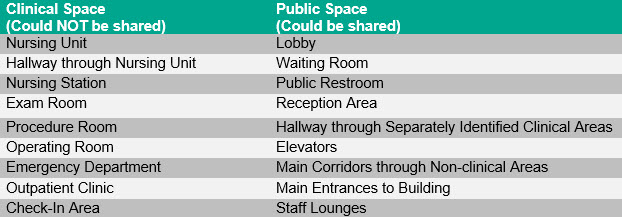
    CMS has long stated that a hospital is expected to have defined and distinct spaces of operation and to maintain control over such spaces at all times. Given the inconsistent survey interpretation, hospitals have struggled to identify which spaces could be shared. The Draft Guidance reiterates CMS’s historical position that co-location poses a threat to patient safety and right to privacy, while taking steps to distinguish between spaces that constitute “clinical space” and may not be shared and those that are “public space” and may be shared without presenting such risks. The Draft Guidance generally describes clinical space as non-public space where clinical care occurs, and public space as those spaces or paths of travel used by the public and both co-located entities.

    The chart below provides examples from the Draft Guidance of each category of space.

    The Draft Guidance confirms CMS’s position that a path of travel to reach one co-located provider that requires travel through the clinical space of a co-located hospital, such as an inpatient unit or other clinical department, would violate the co-location rules. The Draft Guidance distinguishes between an impermissible path of travel through a clinical space and a permissible path of travel through public space, such as through the main hospital lobby, or a hospital corridor with clearly labeled, distinct entrances to hospital departments (e.g., outpatient medical clinic, laboratory, pharmacy, radiology).

    The Draft Guidance specifies that surveyors must request and review floor plans that clearly distinguish the space used by the hospital from the space used by any co-located entity. While review of floor plans has been a common feature in surveys, adding the specific requirement for review of plans for co-location issues ensures that surveyors will continue to focus on this area. Accordingly, it remains advisable for hospitals to maintain current, clear floor plans that identify which entities are using space, and carefully monitor instances of co-location as part of survey readiness activities. Surveyors are also advised to request and review a full list of the hospital’s contracted services. While maintaining such a list has been a CoP and accrediting organization requirement for many years, its inclusion in the Draft Guidance makes it clear that hospitals need to remain vigilant in maintaining such lists in an updated and complete form. Non-compliance found in surveyed space could be considered non-compliance for both entities and surveyors may initiate a complaint for the other entity not being surveyed.

    Contracted Services / Staffing Contracts / Clinical Services Contracts

    The Draft Guidance specifies that a hospital is responsible for providing all of its services in compliance with the hospital CoPs, and acknowledges that services may be provided under contract or arrangement with another co-located hospital or entity. The list of “example” contracted services includes the often recited laboratory, dietary, food preparation, housekeeping and utilities, as well as pharmacy services. The Draft Guidance does not specify which services may not be contracted, which is a frequent question.

    Each hospital is responsible for independently meeting its staffing requirements, regardless of whether it provides the services directly or under arrangement with another entity, which may be the entity co-located with the hospital. The Draft Guidance notes that contracted staff must be assigned solely to work for one entity during any given shift; staff may not “float” back and forth between entities or perform services simultaneously for two co-located entities. Medical staff are exempt from this limitation, provided that they hold privileges at both co-located providers. The Draft Guidance does not confirm whether contracting for intermittent services provided by non-physicians, such as specialty nurse consults for wound care, peripheral placed central lines or other services would be permitted even in circumstances where those professionals are providing services at only one provider at a time on an intermittent basis. What constitutes a “shift” is currently open to interpretation, as hospitals may schedule staff on varying shifts and for varying lengths of time per shift.

    The Draft Guidance specifies that a hospital’s governing body must be prepared to confirm that any contracted clinical services are not being simultaneously “shared” with another hospital or entity, describe how the hospital monitors the performance of its contracted services, and demonstrate how the hospital ensures that all individuals providing services under contract have been oriented and trained in accordance with hospital policies and procedures. Accordingly, the Draft Guidance places ultimate responsibility for co-location matters on the hospital governing body. As a result, a survey finding of non-compliance related to co-location will result in a deficiency under the governing body CoP as well as any other relevant CoPs.

    Emergency Services

    The current CoPs provide that hospitals without emergency departments must nonetheless have appropriate policies and procedures in place to address patient emergencies. The Draft Guidance specifies that hospitals may contract with another hospital or entity for the appraisal and initial treatment of patients experiencing an emergency, but only if the contracted staff are not working/on duty simultaneously at another hospital or health care entity. Under the Draft Guidance, it may be appropriate for a hospital to transfer a patient to the co-located entity for continuation of care after appraisal and initial treatment (e.g., between a rehabilitation hospital and an acute care hospital for a patient suffering a heart attack).

    However, the Draft Guidance calls into question the ability of co-located hospitals to contract with the other hospital or provider for the provision of “code team” or “rapid response team” services, which has been a frequent co-location question. For co-located hospitals, especially where one hospital is significantly smaller, or the co-located operations are limited to outpatient care, it is impractical and burdensome to maintain such teams. Restricting the ability to contract for these services from the larger co-located hospital may present access challenges for patients who may need such care, without an articulated safety rationale.

    The Draft Guidance also states that hospitals without emergency departments that contract for emergency services with another hospital’s emergency department are considered to provide emergency services and must meet the requirements of EMTALA. It is not clear whether this provision is intended to apply where a hospital without an emergency department contracts for a co-located hospital to actually provide it with staffing for an emergency department, or if the intent is that by virtue of contracting for some level of emergency services beyond appraisal and initial treatment, the hospital is expected to comply with EMTALA. Clarification is needed to fully understand the extent of this provision.

    * * *

    While the Draft Guidance represents CMS’ desire to increase transparency into the scope and interpretation of its co-location expectations, the Draft Guidance, continues to leave open many common co-location concerns such as the manner in which co-located providers may each use a common and interoperable electronic medical record system. The Draft Guidance also fails to address separateness requirements of any other Medicare-participating entity, such as psychiatric or long-term care hospitals or units, independent diagnostic testing facilities, durable medical equipment suppliers, ambulatory surgery centers or rural health clinics.

    Comments to the Draft Guidance are due by July 2, 2019. If you would like assistance in preparing comments, or in analyzing a co-location arrangement in light of the Draft Guidance, please contact one of the authors or your regular McDermott lawyer.

    Authors

    Emily Jane Cook

    Partner

    Los Angeles, Washington, DC

    Sandra M. DiVarco

    Partner

    Chicago

    Monica Wallace

    Partner

    Chicago

    More insights

  • Involuntary Bankruptcy: Limited Remedy and Strong Sanctions for Abuse

    Involuntary Bankruptcy: Limited Remedy and Strong Sanctions for Abuse

    ARTICLE / CLIENT ALERT

    Involuntary Bankruptcy: Limited Remedy and Strong Sanctions for Abuse

    May 7, 2019

    Read time: 15 min

    Key takeaways
    Overview

    The remedy of involuntary bankruptcy “exists as an avenue of relief for the benefit of the overall creditor body…. [I]t was not intended to redress the special grievances, no matter how legitimate, of particular creditors….” In re Murray, 900 F.3d 53, 59-60 (2d Cir. 2018). The courts of appeals have been consistent. In re Edgar A. Reyes-Colon, 2019 WL 1785039 *1 (1st Cir. Apr. 24, 2019) (affirmed dismissal of involuntary petition filed by only two creditors; at least three petitioners required; parties engaged in “twelve years of litigation concerning the number of [debtor’s] creditors and whether he might… be placed in bankruptcy involuntarily for ‘equitable’ reasons.”); In re 8 Speeds 8 Inc., 2019 WL 1891802, *3 (9th Cir. Apr. 29, 2019) (dissent) (“Involuntary bankruptcy is a drastic course of action that carries significant consequences, and ‘[f]iling an involuntary petition should be a measure of last resort’…. The fee-shifting and damages provision of [Bankruptcy Code] § 303(i) are intended to deter frivolous filings…. The Majority holds that… a third party who appears for a debtor and successfully defends against an involuntary petition can never request that the debtor be awarded costs, a reasonable attorney’s fee, or damages.”).

    A bankruptcy court decision recently detailed how courts applying Bankruptcy Code (“Code”) § 303(i) can sanction creditors who “abuse… the power given to [them]… to file an involuntary bankruptcy petition.” In re Anmuth Holdings LLC, 2019 WL 1421169, * 1 (Bankr. E.D.N.Y. Mar. 27, 2019). Because the three involuntary petitions against corporate entities in Anmuth admittedly “lacked any merit,” Id. at *12, the court ultimately awarded the debtors attorneys’ fees, punitive damages, retroactive dismissal of the involuntary petitions to the dates on which they were filed, and an injunction against future filing by the petitioning creditors. Id., at *27. The decision shows why the filing of an involuntary bankruptcy requires careful pre-filing legal judgment.

    Legal Background

    A law professor stated 25 years ago that “[i]nvoluntary cases make up quite a small percentage of the bankruptcy filings each year, which shows how far the emphasis has moved from bankruptcy as a creditors’ remedy.” Brian A. Blum, Bankruptcy and Debtor/Creditor, § 15.5.1, at 216 (Little, Brown & Co. 1993). The Second Circuit confirmed in Murray that “far fewer [cases] are initiated as involuntary petitions by creditors, much less a single creditor,” citing statistics from the Administrative Office of the United States Courts, and, quoting the bankruptcy court, “less than 1/10 of 1% of all bankruptcy cases” are involuntary. 900 F.3d at 590.

    Qualifications for Filing an Involuntary Petition: Bankruptcy Code §§ 303(a), (b) and (c). Petitioning creditors must first show that the debtor is eligible for involuntary relief. Section 303(b) bars the filing of such a petition against a farmer or charitable corporation. Section 303(a) also makes involuntary relief available only under Chapters 7 (liquidation) and 11 (reorganization).

    Section 303(b)(1) requires that each petitioning creditor hold non-contingent, undisputed, unsecured claims totaling at least $16,750. If the debtor has 12 or more creditors, at least three petitioning creditors must join in the petition. But if the debtor has 11 or fewer creditors, the Code requires only one petitioning creditor. Excluded from the eligible class of petitioned creditors are employees, the debtor’s insiders or any recipient of a voidable pre-bankruptcy transfer. Creditors with contingent claims or claims subject to a bona fide dispute are also ineligible. Requiring three eligible petitioning creditors in most cases protects the debtor from the involuntary bankruptcy risk at the instance of a single creditor.

    Grounds for Involuntary Relief — § 303(h). Section 303(h) requires the petitioning creditors to prove one of two alternative grounds for involuntary relief: (a) the debtor is generally not paying its debts as they become due; or (b) a custodian (e.g., receiver, assignee, liquidator) was appointed or took possession of the debtor’s property within the 120-day period prior to the filing of the petition. A custodian who takes “charge of less than substantially all” of the debtor’s property (e.g., one parcel of real estate) does not meet this requirement. In sum, these two grounds for relief limit the power of creditors to force a debtor into bankruptcy, requiring that the alleged debtor have serious financial problems.

    Whether a debtor is generally not paying its debts as they become due is ordinarily a fact question. Courts look at the extent of the debtor’s default and the relative value of the defaulted debt. But unpaid debts subject to a good faith dispute are excluded from this analysis.

    The alternative “custodian” ground in § 303(h)(2) enables federal bankruptcy law to supersede state law receiverships or assignments for the benefit of creditors. In the latter case, the debtor usually picks the assignee, which can lead to collusion or other forms of abuse.

    Anmuth: When Sanctions Are Warranted

    The three petitioning creditors in Anmuth, “A,” “B” and “C,” filed involuntary Chapter 7 petitions against Anmuth and two affiliates within hours “after receiving an adverse decision in state court” that had denied their request for a stay of a draw on letters of credit. When the debtors moved to dismiss the involuntary petitions and sought sanctions, including legal fees, costs, compensatory damages and punitive damages under Code §§ 303(i) and 105, the petitioning creditors “conceded that their purported claims against…the Debtors were subject to a bona fide dispute and that as such, they were ineligible to file the Involuntary Petitions.” Anmuth, 2019 WL 1421169, at *1.

    The original attorney for A, B and C testified that he explained the requirements for filing an involuntary petition, warning each of them “of the risks, including potential sanctions, associated with filing an involuntary petition.” Id. at *6. Both B and C denied speaking with that counsel, but they all agreed that A was authorized to make decisions on their behalf. A testified that “the purpose of the filings… was to prevent [a bank] from transferring the Cash Collateral.” Id. Although the original counsel had “refused to sign or file” a later fourth involuntary petition, A “filed the petition in person at the Bankruptcy Court,” signing all petitions on his own behalf and, with authorization, on behalf of B. Id. B testified “that he ‘never saw’ the petitions before they were filed, did not consult an attorney, and that the ‘case is run… by [C] and [A].’ C “testified that while he signed the Involuntary Petitions, he never consulted with an attorney, and he, ‘relied on [A], what [A] told me to do, I did’.” Id. at *7.

    The three involuntary petitions list identical claims, all “subject to a bona fide dispute,” based on loans, the proceeds of which secured a letter of credit. These claims were the same as those litigated in the state court, making the petitioning creditors admittedly ineligible. Id., at *7.

    Post-Petition Conduct of A. A texted the debtor’s principal, “X,” “threatening to file an involuntary petition against [him] individually,” after the filing of the involuntary petitions. Id. When the three debtors moved to dismiss the involuntary petitions, seeking sanctions, A wrote to X: “[w]ant to just let you know Monday I am filing in bankruptcy against [you] personal and that means [you] can’t do any more Bussiness [sic] for a long time not playing around not going to waste more time….” Id. Before A was to be deposed, he threatened, “it will become very dirty” and “very [sic] ugly for [X].” A also “made multiple efforts to compel [X] to litigate their issues in rabbinical court…. A posted [a] letter on street signs and poles and in synagogues in Brooklyn…. Additionally, [A] hired a company to print leaflets denouncing [X] that were disseminated in synagogues throughout Brooklyn.” Id.

    The petitioning creditors, when their original counsel resigned, “consented to the dismissal of the involuntary petitions with newly retained counsel.” Id. at *8.

    Legal Standard for Sanctions. After hearings on the debtors’ sanctions motion, the court quoted § 303(i) as follows:

    If the court dismisses a petition under this section other than on consent of all petitioners and the debtor, and if the debtor does not waive the right to judgment under this subsection, the court may grant judgment… (1) against the petitioners and in favor of the debtor for (A) costs; or (B) a reasonable attorney’s fee; or (2) against any petitioner that filed the petition in bad faith, for (A) any damages proximately caused by such filing; or (B) punitive damages.

    11 U.S.C. § 303(i) (emphasis added). Id.

    The court had admittedly dismissed the involuntary petitions and the debtor had not waived its right to the sanctions under the statute. But the petitioning creditors argued that their consent to dismissal precluded an award. According to the court, “the motion to dismiss [the involuntary petitions] was not filed by the Petitioning Creditors, nor was it a joint motion.” Id. at *10. Instead, the debtors had moved to dismiss and the “petitioning creditors did not oppose.” Id. Because the debtors “were forced to make a motion to dismiss,” the court’s “dismissal of the Involuntary Petitions was not ‘on consent.’” Id. “Consent under § 303(i) is not found where a petitioning creditor merely capitulates to a debtor’s request for dismissal.” Id. In fact, at “every stage of this case, the [debtors] have expressly reserved their rights to pursue § 303 damages. The egregious acts of the Petitioning Creditors, which persisted post-filing, coupled with their failure to offer consent until the [Debtors] filed a motion to dismiss, render the argument that their ‘consent’ to dismissal precludes a § 303(i) award wholly without merit.” Id.

    Attorneys’ Fees and Costs. “When an involuntary petition is dismissed, ‘there is a presumption that costs and attorneys’ fees will be awarded to the alleged debtor.’” In re TPG Troy LLC, 793 F.3d 228 (2d Cir. 2015). “Section 303(i)(1) is a fee-shifting provision that requires no showing of bad faith and aims to keep the putative estate whole.” Id., at 235. According to the court in Anmuth, “the fee award … may include fees incurred in all phases of the litigation before this Court.” 2019 WL 1421169, at *12.

    The bankruptcy court in Anmuth relied on the “totality of the circumstances” to justify its award. It considered “(1) the merits of the involuntary petition; (2) the role of any improper conduct on the part of the alleged debtor; (3) the reasonableness of the actions taken by the petitioning creditors; and (4) the motivation and the objectives behind the filing of the petition.” Id., quoting TPG Troy 793 F.3d 228, 235 (2d Cir. 2015). Not only did the involuntary petitions here lack any merit, but the petitioning creditors had also “not offered any evidence to rebut the presumption that the … Debtors are entitled to an award of attorneys’ fees.” Id.

    The petitioning creditors had assumed certain risks, including the reimbursement of legal fees. As a result, the debtors had to incur legal fees to prepare for trial on their sanctions motions, including four depositions. Id.

    The petitioning creditors also acted unreasonably before and after they filed the involuntary petitions. They “acted with blatant disregard for the appropriateness of their actions,” continuing “to threaten and harass” X and ignoring warnings from the debtors’ counsel. The court therefore awarded attorneys’ fees and costs of about $115,000. Id. at *13.

    Damages. Code § 303(i)(2) requires a finding of bad faith for damages, with the debtor “having the burden of proving bad faith.” In re Bayshore Wire Prods., 209 F.3d 100, 105 (2d Cir. 2000). A “debtor may only recover actual and punitive damages upon a finding of bad faith.” 2019 WL 1421169, at *14.

    A, B and C filed the involuntary petitions in response to an adverse state court ruling, “within hours of receiving” that decision, “as a litigation tactic.” Moreover, held the Anmuth court, “the timing of the filing demonstrates ‘egregious bad faith and an improper use of the bankruptcy system.’” Id. at *15-*16, quoting In re Silverman, 230 B.R. 46, 52 (Bankr. D.N.J. 1998).

    The petitioning creditors in Anmuth also tried to coerce a settlement when they filed the involuntary petitions. A’s trial testimony confirmed that fact, as did the testimony of the petitioning creditors’ original counsel. Their “admitted purpose in filing the petitions to pressure” a settlement thus constituted “manifest bad faith.” Id. at *16.

    The Anmuth court further found “ample evidence to support a finding that” A, B and C filed the involuntary petitions “with ill will, malice and desire to embarrass and harass the [debtors] and [X].” Id., at *17. A’s testimony showed “the type of ‘personal antipathy’ to be considered when determining whether a filing was motivated by ill will.” Id. After the filing against the corporate entities, A “sent repeated messages threatening to file an involuntary petition against [X] personally,” testifying that his threats “were intended to ‘put pressure’ on [X] to participate in arbitration in rabbinical court.” Id. at *18. In short, A’s “threatening messages… reveal his intent to use bankruptcy as a weapon to force [X] to terminate” his claims for sanctions.

    A “appreciated,” yet disregarded, the serious consequences an involuntary petition inflicts on the alleged debtor. He told X that he would not be able to “do any more Bussiness [sic] for a long time not playing around not going to waste more time….” Id. In response to his lawyer’s warnings, A said that he “was not worried about it” and “continued to threaten additional involuntary filings, texting that ‘it will become very dirty’ and ‘very ugly’ for X.” A’s additional public denunciations of X in local synagogues were intended not only “to embarrass and harass” X,” but “were [also] part of the Petitioning Creditors’ general litigation strategy to… coerce a settlement,” confirming the “bad faith” of the filing.” Id. at *19.

    A, B and C even failed to make a reasonable inquiry before filing the baseless involuntary petitions. They knew, “at all relevant times,” that their claims were disputed. They litigated for more than four years in the state court and had participated in an arbitration, admittedly filing the involuntary petitions to force a settlement. A, B and C falsely “stated under oath in the Involuntary Petitions that their claims were undisputed and that the … debtors were not paying their debts.” Id., at *19. They “made no effort of any kind to investigate” whether the allegations were true. Id. at *20.

    The court further rejected the petitioning creditors’ asserted “advice of counsel” defense. Their “testimony was contradictory and lacked credibility.” Id. Regardless of what their counsel might have told them, they knew “that the [asserted] claims were subject to a hotly contested dispute, given that, hours earlier, the [state] court had ruled against them.” A’s testimony confirmed that he had “entered [his counsel’s] office with his improper purpose already formed.” Id. at *22.

    Compensatory and Punitive Damages. Although the debtors could not make a record sufficient “to determine the amount of any compensatory damages,” the court did award them $600,000 in punitive damages. This award, said the court, was “especially appropriate in light of the Petitioning Creditors’ egregious bad faith conduct”; their “lack of remorse and threats of future involuntary petitions…”; and their “knowingly false statements” made in the involuntary petitions. Id. at *25. A, B and C also undertook their actions “as an intertwined group,” enabling the court to assess damages against all of them. Id. at *26. B and C had given A permission to act on behalf of the group and had to bear the responsibility for allowing A “to file and prosecute” the “irresponsible, abusive involuntary petition[s] in [their] name.” Id., quoting In re Meltzer, 535 B.R. 803, 818 (Bankr. N.D. Ill. 2015).

    Comments

    1. Anmuth is consistent with case law from the courts of appeals. In re Murray, 900 F.3d 53, 61-63 (2d Cir. 2018) (bankruptcy court properly “declined to serve as a ‘rented battlefield’ or ‘collection agency’” for a single creditor; “bankruptcy is not a judgment enforcement device.”; involuntary petition “was part of a long-running two-party dispute, there were no other creditors to protect, and it had been brought solely as a judgment enforcement device for which adequate remedies existed in state law”; debtor neither wanted nor needed a bankruptcy discharge, and there were no “competing creditors.”); In re TPG Troy LLC, 793 F.3d 228, 235 (2d Cir. 2015) (affirmed bankruptcy court’s award of $513,427 in attorney’s fees and costs to vindicated debtor under 303(i)(1); fee award “serves to discourage the filing of involuntary bankruptcy petitions to force debtors to pay a disputed debt.”); In re Forever Green Athletic Fields Inc., 804 F.3d 328, 334 (3d Cir. 2015) (“[B]ad faith provides an independent basis for dismissing an involuntary petition,” despite the creditors’ having met all of the “statutory requirements”; “. . . Congress intended bad faith to serve as a basis for both dismissal and damages.”; “the equitable nature of bankruptcy. . . [imposes] this general good faith filing requirement in the context of involuntary petitions. . . .”], citing In re U.S. Optical Inc., 991 F.2d 792 (4th 1993); In re Nordbrock, 772 F.2d 397, 400 (8th Cir. 1985) (“A creditor does not have a special need for bankruptcy relief if it can go to state court to collect a debt.”).
    2. These cases illustrate the risks for creditors in filing an involuntary bankruptcy petition. What they do not do, however, is explain why and when eligible creditors would be justified in filing an involuntary petition. Bankruptcy is a collective process for the entire group of creditors. “Involuntary bankruptcy petitions help ensure the orderly and fair distribution of an estate by giving creditors an alternative to watching . . . as assets are depleted, either by the debtor or by rival creditors . . . .” Murray, 900 F.3d at 59. Eligible creditors may thus force a financially troubled debtor into bankruptcy to enable a trustee to recover fraudulent transfers and preferences, to challenge a defective lien on the debtor’s assets, or to pursue third parties who have caused the debtor’s downfall. As all of these cases show, though, involuntary bankruptcy is not a way to resolve a two-party dispute.

    Authored by Michael L. Cook.

    If you have any questions concerning this Alert, please contact your attorney at Schulte Roth & Zabel or the author.


    This communication is issued by Schulte Roth & Zabel LLP for informational purposes only and does not constitute legal advice or establish an attorney-client relationship. In some jurisdictions, this publication may be considered attorney advertising. ©2019 Schulte Roth & Zabel LLP.

    All rights reserved. SCHULTE ROTH & ZABEL is the registered trademark of Schulte Roth & Zabel LLP.

    In depth
    Authors
    More insights

  • The Family Foundation as a Family Holding Company

    ARTICLE

    The Family Foundation as a Family Holding Company

    May, 2019

    Read time: 2 min

    Key takeaways
    Overview

    Securing the long-term existence of family assets – who wouldn’t want that? Is a family foundation a suitable legal form for this? For whom is a family foundation interesting? These and other questions are explained by Dr. Nils Wighardt in this article featured in Unternehmeredition, Special Edition “Steuern & Recht” 2019.

    In depth
    Authors
    More insights

  • Congress Discusses Veterans’ Access to Medical Marijuana

    Congress Discusses Veterans’ Access to Medical Marijuana

    ARTICLE

    Congress Discusses Veterans’ Access to Medical Marijuana

    May 2, 2019

    Read time: 2 min

    Key takeaways
    Overview

    Robert Kline and Jeff Miller authored this bylined article on the House Veterans’ Affairs Subcommittee on Health’s legislative hearing on three separate bills concerning veterans’ access to cannabis.

    In depth
    Authors

    Robert M. Kline

    Counsel

    Miami

    More insights

  • New NFA Proficiency Requirements for Hedge Fund Managers

    New NFA Proficiency Requirements for Hedge Fund Managers

    ARTICLE / CLIENT ALERT

    New NFA Proficiency Requirements for Hedge Fund Managers

    May 2, 2019

    Read time: 6 min

    Key takeaways
    Overview

    The National Futures Association, the self-regulatory organization for the commodity futures and swaps industry, recently updated its rules[1] to impose “swaps proficiency requirements” on associated persons of NFA members that engage in swaps-related activities. These requirements are likely to be applicable to a significant number of hedge fund advisers (i.e., advisers that are, or are required to be, registered with the Commodity Futures Trading Commission and to be NFA members). While most private equity sponsors are not likely to fall within the scope of any NFA licensing requirement, they should take this opportunity to confirm that the basis for any exemption remains valid.

    Effective Dates

    Compliance with the new NFA swaps proficiency requirements will be required as of Jan. 31, 2021, and online access to the new training modules is targeted for Jan. 31, 2020.

    Fees

    A fee schedule for completing the swaps proficiency requirements has not yet been published.

    Covered Individuals

    The new swaps proficiency requirements will apply to associated persons of all managers registered with the NFA as commodity pool operators (“CPOs”) or commodity trading advisors (“CTAs”) that engage in activities involving swaps.

    No Grandfathering

    Individuals with existing exemptions (e.g., a “Series 3 waiver”) will not be grandfathered in; all individuals seeking to act as swap associated persons for registered CPOs or CTAs will be required to satisfy the new swaps proficiency requirements in a timely fashion.

    Also, the existing Series 3 licensing requirement will remain a separate requirement, and that requirement is not affected by these new swaps proficiency requirements.

    “Short Track” and “Long Track” Proficiency Requirements

    The NFA’s new rules establish two different tracks, a “Long Track”[2] and a “Short Track,”[3] for achieving swaps proficiency by the compliance date. Associated persons of covered CPOs and CTAs (e.g., hedge fund managers with swaps activity that are NFA members) will only need to complete the Short Track requirements (in other words, fewer modules will be required). In both cases, the requirements will be satisfied through training modules administered online (see below).

    Tutorials, Not Examinations

    The format of the swaps proficiency program differs from the traditional Series 3 examination requirements imposed on associated persons who engage in solicitation activities in several ways:

    • The swaps proficiency requirement is not an “examination” per se. It is, rather, a set of online instructional modules that must be completed in order to claim proficiency in the related subject matter.
    • While a module may have a quiz that must be passed to complete it, the material for the quiz is drawn from the module itself, and not from a syllabus or study guide.
    • The modules may be taken from any internet-accessible computer — it is not necessary to report to a testing center to sit for an examination.
    • The modules may be taken in any order and completed at different times.

    Next Steps

    Compliance officers at NFA members should take advantage of the ample lead time provided by the NFA to prepare for this new licensing requirement. Among other things, legal and compliance personnel should:

    • Confirm whether the firm itself falls within the scope of this new requirement (i.e., is there swaps activity?);
    • Read the NFA’s updated rules, the related interpretive notice, and the associated “frequently asked questions”;
    • If the firm falls within scope (or if it is possible or likely that it will fall within scope), determine which individuals will be engaged in associated person activities and therefore will be required to demonstrate swaps proficiency;
    • Identify which supervisors of those associated persons will be required to demonstrate swaps proficiency;
    • Begin the educational effort and provide a description of the process to forestall panicked responses to a “new examination requirement”;
    • Include a summary of progress in satisfying this new obligation to the firm’s 2019 annual compliance review; and
    • Add Jan. 31, 2020 (the target date for exam material availability on the NFA website) and Dec. 31, 2020 (a month in advance of the Jan. 31, 2021 compliance deadline) to the firm’s compliance calendar.

    Impact and Implications

    In the past few months, the NFA has taken several significant steps to solidify its role as an active and effective regulator of private fund managers active in the commodity futures and swaps markets. In addition to this swaps proficiency requirement, the NFA recently announced[4] new requirements for segregation of financial responsibilities within a manager, as well as enhanced cybersecurity obligations. The NFA also continues to actively examine managers and conduct on-site examinations in the United States, the United Kingdom and Hong Kong, underscoring the need for timely adoption of policies and procedures required by any new rulemaking.

    Legal and compliance officers at private fund managers that are NFA members who have not made NFA and CFTC compliance a priority in their overall compliance programs should use the remainder of 2019 as an opportunity to catch up.

    Authored by Brian T. Daly and Joshua B. Wright.

    If you have any questions concerning this Alert, please contact your attorney at Schulte Roth & Zabel or one of the authors.


    [1] See NFA Interpretive Notice 9075: NFA Bylaw 301 and Compliance Rule 2-24: Proficiency Requirements for Swap APs, available here; see also Swaps Proficiency Requirements FAQs, available here.

    [2] The Long Track will consist of eight modules: (i) Swap Products and Applications; (ii) Regulation of the Swaps Market; (iii) Onboarding; (iv) Transactional Disclosures; (v) Anti-Fraud and Ethical Practices; (vi) Trade; Execution/Clearing/Margin; (vii) Risk Management; and (viii) Supervision.

    [3] The Short Track will consist of four modules: (i) Swaps Products and Applications; (ii) Regulation of the Swaps Market; (iii) Supervision; and (iv) Compliance, Anti-Fraud, and Other Requirements.

    [4] See “NFA Update: New Supervision and Cybersecurity Obligations for Private Fund Managers Registered with the National Futures Association,” SRZ Alert, Feb. 1, 2019, available here.


    This communication is issued by Schulte Roth & Zabel LLP for informational purposes only and does not constitute legal advice or establish an attorney-client relationship. In some jurisdictions, this publication may be considered attorney advertising. ©2019 Schulte Roth & Zabel LLP.

    All rights reserved. SCHULTE ROTH & ZABEL is the registered trademark of Schulte Roth & Zabel LLP.

    In depth
    Authors
    More insights

  • CFPB Issues Request for Information Regarding Potential Changes to Remittance Rule

    CFPB Issues Request for Information Regarding Potential Changes to Remittance Rule

    ARTICLE / CLIENT ALERT

    CFPB Issues Request for Information Regarding Potential Changes to Remittance Rule

    May 1, 2019

    Read time: 5 min

    Key takeaways
    Overview

    On April 23, 2019, the Consumer Financial Protection Bureau (“CFPB”) issued a notice and request for information (“RFI”) on its remittance transfer rule (“Remittance Rule”) that implements Electronic Fund Transfer Act protections for consumers sending international money transfers. Due to the impending expiration of the temporary exception to the Remittance Rule’s general disclosure requirement, and in order to hopefully mitigate the negative effects of the expiration on applicable financial institutions, the CFPB is requesting information regarding (1) the expiration of the temporary exception that allows certain institutions to estimate the exchange rate and certain fees they are required to disclose when sending remittance transfers; and (2) whether to propose changing the remittance transfer providers the Remittance Rule covers (and whether an exception for small financial institutions may be appropriate). The RFI includes a list of 18 questions and requests relating to these items, and is available for your reference here. Comments must be received on or before June 28, 2019.

    Background

    The Remittance Rule imposes requirements on companies which send international money transfers, or remittance transfers, on behalf of consumers “in the normal course of business.” Among its requirements, the Remittance Rule mandates that providers generally must disclose (both prior to and at the time the consumer pays for the transfer) the exact exchange rate, the amount of certain fees and the amount to be delivered to the recipient. Insured depository institutions and credit unions (“Insured Institutions”) that are unable to know, for reasons beyond their control,[1] the exact exchange rate or covered third-party fees may estimate such amounts and thereby disclose an estimated amount of currency that will be made available to the designated recipient (“Temporary Exception”). The Temporary Exception is not available for non-bank remittance transfer providers. Unless Congress changes the law, the Temporary Exception is set to expire on July 21, 2020. The Remittance Rule also contains a safe harbor whereby a person that provides 100 or fewer remittance transfers in the previous and current calendar years would be deemed not to meet the “normal course of business” definition, and therefore be outside of the Remittance Rule’s coverage.

    Information Requested

    The CFPB believes the expiration of the Temporary Exception may affect a large number of remittance transfers — specifically wire transfers — thereby restricting consumer choice and accessibility. In an effort to reduce negative externalities, the CFPB is requesting specific data on the industry’s current utilization of the Temporary Exception. In general, the CFPB is interested in learning about the:

    1. Characteristics of transactions for which Insured Institutions are relying on the Temporary Exception;
    2. Circumstances under which Insured Institutions are consistently able to provide exact amounts;
    3. Currencies for which a specific exchange rate applicable to a remittance transfer cannot be provided at the time a consumer requests a transfer because foreign laws or obstacles bar the purchase of that currency in the United States;
    4. Specific destinations for which Insured Institutions cannot disclose fees charged by third parties due to a lack of contractual relationships with financial institutions in those destinations;
    5. Foreign financial institutions that cannot, or will not, provide information about the fees they impose on a remittance transfer; and
    6. Challenges to the further reduction of need to provide estimates rather than actual amounts in disclosures.

    The CFPB will use the information in determining potential next steps.

    Additionally, the CFPB is interested in potentially adjusting the Remittance Rule’s coverage of certain remittance transfer providers that provide remittance transfers “in the normal course of business,” even though they account for a relatively small number of transfers overall. To this aim, the CFPB is interested in learning about, among other details, (1) what factors, in addition to the total number and frequency of remittance transfers provided, should be considered in determining whether a person is providing remittance transfers “in the normal course of business”; and (2) any information that could help inform the CFPB as it considers the burden of the Remittance Rule on providers that provide more than 100 remittance transfers per year but account for a relatively small number of remittance transfers overall. With this information, the CFPB will assess whether the threshold “in the normal course of business” safe harbor should be raised and whether an exception for small financial institutions may be appropriate.

    Authored by Kara A. Kuchar, Donald J. Mosher and Adam J. Barazani.

    If you have any questions concerning this Alert, or would like assistance in engaging with the CFPB regarding the RFI, please contact your attorney at Schulte Roth & Zabel or one of the authors.


    [1] The Remittance Rule provides that an Insured Institution cannot determine exact amounts “for reasons beyond its control” when “a person other than the insured institution or with which the insured institution has no correspondent relationship sets the exchange rate . . . or imposes a covered third-party fee. . . .”  Official Interpretation Comment 32(a)(1)–1.


    This communication is issued by Schulte Roth & Zabel LLP for informational purposes only and does not constitute legal advice or establish an attorney-client relationship. In some jurisdictions, this publication may be considered attorney advertising. ©2019 Schulte Roth & Zabel LLP.

    All rights reserved. SCHULTE ROTH & ZABEL is the registered trademark of Schulte Roth & Zabel LLP.

    In depth
    Authors

    Donald J. Mosher

    Partner

    New York – 919 Third Avenue

    Adam J. Barazani

    Partner

    New York – 919 Third Avenue

    More insights

  • Treasury Issues Proposed Regs on Opportunity Zones

    ARTICLE

    Treasury Issues Proposed Regs on Opportunity Zones

    April 30, 2019

    Read time: 2 min

    Key takeaways
    Overview

    Steven Hadjilogiou and Elizabeth Glasgow authored this bylined article on the second set of proposed regulations to the Tax Cuts and Jobs Act’s opportunity zone provisions, which provide additional clarity for qualified opportunity zone funds and investors.

    In depth
    Authors
    More insights

  • International Trade: London, Future Capital of Arbitration?

    ARTICLE

    International Trade: London, Future Capital of Arbitration?

    April 30, 2019

    Read time: 2 min

    Key takeaways
    Overview

    Jacob Grierson authored this bylined article on the global perception of arbitration, its use in Paris and the potential benefits to its growth in London.

    In depth
    Authors
    More insights

  • International News: Private Client & Wealth Management

    International News: Private Client & Wealth Management

    INTERNATIONAL NEWS / REPORT

    International News: Private Client & Wealth Management

    April 2019

    Read time: 2 min

    Key takeaways
    Overview
    In depth
    Authors
    More insights