Content Type: Article

  • Representatives to Debate Cannabis Research and Veterans’ Access to Medical Marijuana

    Representatives to Debate Cannabis Research and Veterans’ Access to Medical Marijuana

    ARTICLE

    Representatives to Debate Cannabis Research and Veterans’ Access to Medical Marijuana

    April 29, 2019

    Read time: 2 min

    Key takeaways
    Overview

    Robert Kline authored this bylined article on the House Veterans’ Affairs Subcommittee on Health’s legislative hearing on three separate bills concerning marijuana and veterans.

    In depth
    Authors

    Robert M. Kline

    Counsel

    Miami

    More insights

  • District Court Bars Fraudulent Transfer Claims Against Shareholders in Tribune Fraudulent Transfer Litigation

    District Court Bars Fraudulent Transfer Claims Against Shareholders in Tribune Fraudulent Transfer Litigation

    ARTICLE / CLIENT ALERT

    District Court Bars Fraudulent Transfer Claims Against Shareholders in Tribune Fraudulent Transfer Litigation

    April 29, 2019

    Read time: 9 min

    Key takeaways
    Overview

    The U.S. District Court for the Southern District of New York, on April 23, 2019, denied the litigation trustee’s motion for leave to file a sixth amended complaint that would have asserted constructive fraudulent transfer claims against 5,000 Tribune Company (“Tribune”) shareholders. In re Tribune Co. Fraudulent Conveyance Litigation, 2019 WL 1771786 (S.D.N.Y. April 23, 2019). The safe harbor of Bankruptcy Code (“Code”) § 546(e) barred the trustee’s proposed claims, held the court. Id., at * 12. Based on undisputed facts, it reasoned that the debtor, Tribune, “was a ‘customer’ of CTC” [Computershare Trust Company N.A.]; CTC was “acting as Tribune’s ‘agent or custodian’… ‘in connection with a securities contract’”; and that both entities were a “financial institution” as defined by the Code. Id., at * 9. Also, held the court, “at this stage of the litigation,” allowing the trustee to amend his complaint “would result in undue prejudice to the [defendant] Shareholders.” Id., at * 12.

    This decision means, as a practical matter, that (a) the trustee cannot assert federal constructive fraudulent transfer claims against the shareholders; (b) the court has now resolved all of the trustee’s other claims in the action; and that (c) separate individual creditor suits asserting state law constructive fraudulent transfer claims will also probably be barred. In any event, the court has now effectively dismissed all of the trustee’s claims against the shareholder defendants.

    Relevance

    Code § 546(e), the so-called “safe harbor” defense, “shields from [a bankruptcy trustee’s] avoidance proceedings [e.g., fraudulent transfer, preferential transfers]” based on “transfers by or to financial intermediaries effectuating settlement payments in securities transactions or made in connection with a securities contract, except through an intentional fraudulent [transfer] claim.” In re Tribune Co. Fraudulent Conveyance Litigation, 818, F.3d 98, 105 (2d Cir. 2016).

    Section 546(e) “is a very broadly-worded safe harbor provision that was enacted to minimize the displacement caused in the commodities and securities markets in the event of a major bankruptcy affecting those industries.” In re Bernard L. Madoff Inv. Sec. LLC, 773 F.3d 411, 416 (2d Cir. 2014) (citation omitted). “The safe harbor limits this risk by prohibiting the avoidance of ‘settlement payments’ made by, to, or on behalf of a number of participants in the financial markets.” Enron Creditors Recovery Corp. v. Alfa, S.A.B. de C.V., 651 F.3d 329, 334 (2d Cir. 2011). Accord, Peterson v. Somers Dublin Ltd., 729 F.3d 741, 748 (7th Cir. 2013); Grede v. FC Stone, LLC, 746 F.3d 244, 252 (7th Cir. 2014).

    The Tribune trustee relied on the Feb. 27, 2018 decision of the U.S. Supreme Court in Merit Management GRP, LP v. FTI Consulting, Inc., 138 S. Ct. 883, 893 (2018), which held that “the relevant transfer for purposes of §546(e) safe-harbor inquiry is the overarching transfer,” rejecting the argument that a bank or trust company acting as a “mere conduit” can be sufficient ground to invoke the safe harbor provision. According to the trustee, “reading the [Code’s] definition of “financial institution” to cover an entity like Tribune would [also] run counter to the spirit of the Supreme Court’s decision in Merit Management. . . .  ” 2019 WL 1771786, at * 12.

    Facts

    The suit against Tribune shareholders arose out of a 2007 leveraged buyout (“LBO”) of Tribune. As part of the LBO, Tribune purchased its outstanding stock from the defendant shareholders for about $8 billion. It first sent to CTC, which had agreed to act as “Depository,” the required cash to repurchase its shares as part of a tender offer. CTC received tendered shares on Tribune’s behalf, paying out $34 per share to the tendering shareholders. When the tender offer was oversubscribed, Tribune repurchased more shares, engaging CTC as an “Exchange Agent” to perform essentially the same function as before.

    The bankruptcy court confirmed Tribune’s reorganization plan in 2012. That plan transferred the claims asserted here to a litigation trust after several rounds of litigation begun by the trust’s predecessor, the Tribune creditors’ committee. The district court consolidated about 40 state law actions against the shareholders across the country. After several rounds of litigation, in separate actions brought by Tribune’s creditors with bankruptcy court permission, the Second Circuit held that individual creditors’ “state law, constructive fraudulent [transfer] claims . . . are pre-empted by . . . Code Section 546(e).” 818 F.3d at 105. In response to the creditors’ petition for certiorari, the Supreme Court deferred its consideration of the petition to “allow the [Second Circuit] or the District Court to consider whether to recall the [Second Circuit’s] mandate, entertain a . . . motion to vacate the earlier judgment, or provide any other available relief in light of [the Supreme Court’s] decision in Merit Management.” Deutsche Bank TR. Co. Americas v. Robert R. McCormick Found., 138 S. Ct. 1162, 1162-63 (2018).

    The district court later resolved all outstanding motions in the trustee’s litigation and dismissed claims against various remaining defendants. After noting settlements with other defendants, the district court here was left with “only the Trustee’s request to amend” his complaint to add constructive fraudulent transfer claims under Code § 548(a)(1)(B) against former Tribune shareholders. 2019 WL 1771786, at * 4.

    Analysis

    The court rejected the defendants’ arguments based on judicial estoppel, bad faith, undue delay by the trustee and the statute of limitations. Id., at * 5-* 6. As noted earlier, though, it found that “[s]tanding alone, undue prejudice to the shareholders provides a sufficient basis upon which to deny the Trustee’s motion” to add the constructive fraudulent transfer claim. Id., at * 6. More significant, the court held that the “Trustee’s proposed amendment would be futile because his [federal constructive fraudulent transfer claims] are barred by Section 546(e) notwithstanding the Supreme Court’s holding in Merit Management.” Id., at * 7. The relevant language in § 546(e), said the court, “bars a Trustee from asserting a claim for constructive fraudulent [transfer] with respect to a ‘settlement payment . . . made by . . . [a] financial institution [or] financial participant’ or ‘a transfer made by . . . [a] financial institution [or] financial participant . . . in connection with a securities contract . . . .’ Id.

    The parties agreed that the transfers here were “settlement payments” and in connection with a securities contract and that the transfers were made “by” Tribune. Id. at * 8. They disagreed, though, as to whether Tribune was an entity covered by Code § 546(e), namely, that it was “either a financial institution or a financial participant.” Id. Because a financial participant had to be “an entity” that “entered into a covered transaction with “the debtor or any other entity,” Tribune, the debtor, could not fall within the definition of “financial participant,” held the court. Id., at * 9.

    But the court found Tribune to be a “customer” of CTC. Although the court did not define the term, the court relied on current dictionary definitions of “customer” as “a buyer or purchaser of goods or services” and “a person having an account with a bank or for whom a bank has agreed to collect items.” Id., at * 9, quoting Black’s Law Dictionary (10th ed. 2014).

    “Tribune was CTC’s customer in connection with the LBO transactions at issue here,” found the court. Id., at * 10. Rejecting the trustee’s reliance on the narrow definitions of “customer” in the Code’s sub-chapter that deals with stockbroker and commodity broker liquidations, these limited definitions, said the court, did not apply here. The “transactions addressed in Section 546(e) are not so limited and the express disclaimer of a limited definition is both appropriate and understandable.” Id., at * 10.

    CTC was also Tribune’s “agent.” Id. Code § 101(22)’(s) definition of “financial institution” includes an agent. “CTC was entrusted with billions of dollars of Tribune cash and was tasked with making payments on Tribune’s behalf to Shareholders upon the tender of their stock certificates to CTC. . . . [—] a paradigmatic principal-agent relationship.” Id., at * 11.

    Finally, ruled the court, “CTC acted ‘in connection with a securities contract.’” Id. Because Tribune used CTC to repurchase Tribune stock from Shareholders at both steps of the LBO, that fact confirmed “CTC’s involvement in these LBO transactions…‘was in connection with a securities contract,’” consistent with § 546(e). Id.

    The court rejected the trustee’s argument based on the “independent legal significance doctrine” to call the LBO a “merger.” Id. According to the court, the LBO was “a securities transaction” and the trustee was “not free to define the transfer it seeks to avoid in any way it chooses.” Id., quoting Merit Management, 138 S.Ct. 1894.

    Most important, the court stressed that the Supreme Court in Merit Management had “specifically declined to address the scope of the definition of ‘financial institution,’” and had declined to “address what impact, if any, § 101(22)(A) would have in the application of the § 546(e) safe harbor.” Id., at * 12, quoting Merit Management, 138 Ct. at 890 n.2. Because the “text of Section 101(22)(A) compels a conclusion that Tribune itself was a ‘financial institution,’ it “would be futile” to allow the trustee to assert federal constructive fraudulent transfer claims. Id., at * 12.

    Comment

    The court’s ruling “is consistent with Section 546(e)’s goal of promoting stability and finality in securities markets and protecting investors from claims precisely like” those sought to be asserted by the trustee here. Id. Although the trustee argued that Tribune was not a “systemically important” institution, the court stressed that Tribune had been “a publicly traded, Fortune 500 company” and that the trustee had sued “over 5,000 Shareholders of Tribune.” Id. The shareholders’ “only involvement in this transaction was receiving payment for their shares.” Id. On these facts, the trustee’s attempt “to unwind securities transactions” of this kind “is precisely the sort of risk that Section 546(e)” was intended to minimize.” Id.

    Authored by Michael L. Cook. 

    If you have any questions concerning this Alert, please contact your attorney at Schulte Roth & Zabel or the author.


    This communication is issued by Schulte Roth & Zabel LLP for informational purposes only and does not constitute legal advice or establish an attorney-client relationship. In some jurisdictions, this publication may be considered attorney advertising. ©2019 Schulte Roth & Zabel LLP.

    All rights reserved. SCHULTE ROTH & ZABEL is the registered trademark of Schulte Roth & Zabel LLP.

    In depth
    Authors
    More insights

  • FinCEN Assesses Civil Money Penalty Against P2P Currency Exchanger for BSA Violations

    FinCEN Assesses Civil Money Penalty Against P2P Currency Exchanger for BSA Violations

    ARTICLE / CLIENT ALERT

    FinCEN Assesses Civil Money Penalty Against P2P Currency Exchanger for BSA Violations

    April 26, 2019

    Read time: 6 min

    Key takeaways
    Overview

    On April 18, 2019, the Financial Crimes Enforcement Network (“FinCEN”) of the U.S. Department of the Treasury announced the assessment of a civil money penalty against Eric Powers for willfully violating the registration, program and reporting requirements of the Bank Secrecy Act and its implementing regulations (“BSA”).[1] Between December 2012 and September 2014, Mr. Powers acted as a peer-to-peer (“P2P”) currency exchanger of convertible virtual currency, conducting activities that qualified as money transmission, as defined in 31 C.F.R § 1010.100(ff)(5), and were therefore subject to BSA obligations. This is FinCEN’s first enforcement action against a P2P virtual currency exchanger and the first time FinCEN has penalized a virtual currency exchanger for failure to file Currency Transaction Reports (“CTRs”).

    FinCEN determined that Mr. Powers failed to (1) register as a money services business (“MSB”) with FinCEN; (2) implement and maintain a written anti-money laundering (“AML”) program; (3) detect and report suspicious transactions with Suspicious Activity Reports (“SARs”); and (4) file CTRs for transactions involving the transfer of over $10,000 in currency.

    In 2013, FinCEN issued guidance[2] providing that any virtual currency “exchanger” (i.e., a person engaged as a business in the exchange of virtual currency for real currency, funds or other virtual currency) is a money transmitter (i.e., a person engaged in the business of accepting and transmitting funds or other value that substitutes for currency) under the BSA and is therefore required to register as an MSB with FinCEN within 180 days of beginning operations.

    Mr. Powers failed to register his business as an MSB. He conducted over 1,700 transactions as an unregistered P2P exchanger. He advertised his services, i.e., the purchasing and selling of Bitcoin, on the internet, and completed transactions in person, via mail, and by coordinating wire transactions.

    MSBs are additionally required to develop, implement and maintain an effective, written AML program. Mr. Powers had no AML program in place and could not produce written policies, procedures and internal controls upon FinCEN’s request. Yet, in multiple online discussions, Mr. Powers demonstrated his awareness of relevant BSA requirements. In one online forum, he explicitly stated that he would assist customers in circumventing AML obligations.

    An MSB is obligated to report transactions that it “knows, suspects, or has reason to suspect” are suspicious by filing SARs. This applies to transactions involving or aggregating to at least $2,000 in funds or other assets. While Mr. Powers processed many transactions over $2,000 bearing strong indicia of illicit activity, he never filed an SAR. His Bitcoin wallet addresses were associated with over 100 transactions with customers conducting business on the online black market, Silk Road. These transactions aggregated over $12,000. Other transactions aggregating well over $2,000 were conducted with customers using email addresses with the “@tormail.org” suffix. These emails used The Onion Router (commonly known as “TOR”), an anonymizing torrent service used to access the darknet. While the use of TOR is not proof of a crime, it warrants additional due diligence to rule out any illegal activity.

    In one instance, after the FBI shut down Silk Road, Mr. Powers processed transactions for a customer who publicly commented in news media on alternate ways to access darknet marketplaces. This individual’s identifying information could be found by a basic internet search, but Mr. Powers did not list that information in his records. In another instance, Mr. Powers offered to exchange convertible virtual currency for fiat currency, knowing that the fiat currency was illegally sourced.

    Lastly, any transaction “by, through, or to” an MSB involving the physical transfer of more than $10,000 in currency (alone or in aggregate) must be reported by filing a CTR. Mr. Powers processed many such transactions, without filing a single CTR. For example, on behalf of one client, he purchased $19,000 worth of Bitcoin from a business and mailed the payment in cash. In another instance, he conducted roughly 160 purchases of Bitcoin for approximately $5 million through in-person cash transactions, 150 of which required the filing of a CTR.

    Mr. Powers will pay a $35,350 fine. In imposing the penalty, FinCEN considered the severity and duration of his actions, the size and sophistication of his operation, his ability to pay, penalties imposed by other state or federal agencies (including civil or criminal forfeitures imposed in the amount of $100,000 and 237.53575 Bitcoin) and Mr. Powers’ extensive cooperation with the investigation. FinCEN also considered its recent enforcement actions against other exchangers of convertible virtual currency and the likely impact of their action against Mr. Powers on compliance measures in the industry. Mr. Powers has also agreed to an industry bar that prohibits him from providing money transmission services or engaging in any other activity that would make him an MSB for the purposes of FinCEN regulations.

    FinCEN Director Kenneth A. Blanco emphasized that “[o]bligations under the BSA apply to money transmitters regardless of their size.” He added, “It should not come as a surprise that we will take enforcement action based on what we have publicly stated since our March 2013 Guidance — that exchangers of convertible virtual currency, such as Mr. Powers, are money transmitters and must register as MSBs. In fact, there were indications that Mr. Powers specifically was aware of these obligations, but willfully failed to honor them. Such failures put our financial system and national security at risk and jeopardize the safety and well-being of our people, as well as undercut responsible innovation in the financial services space.”

    Authored by Donald J. Mosher, Kara A. Kuchar, Betty Santangelo, Marc E. Elovitz and Stephanie R. Breslow.

    If you have any questions concerning this Alert, please contact your attorney at Schulte Roth & Zabel or one of the authors.


    [1] The Assessment and News Release summarizing the assessment are available on FinCEN’s website.

    [2] See FIN-2013-G001, “Application of FinCEN’s Regulations to Persons Administering, Exchanging, or Using Virtual Currencies,” March 18, 2013.


    This communication is issued by Schulte Roth & Zabel LLP for informational purposes only and does not constitute legal advice or establish an attorney-client relationship. In some jurisdictions, this publication may be considered attorney advertising. ©2019 Schulte Roth & Zabel LLP.

    All rights reserved. SCHULTE ROTH & ZABEL is the registered trademark of Schulte Roth & Zabel LLP.

    In depth
    Authors

    Donald J. Mosher

    Partner

    New York – 919 Third Avenue

    Betty Santangelo

    Counsel

    New York – 919 Third Avenue

    Marc E. Elovitz

    Partner

    New York – 919 Third Avenue

    Stephanie R. Breslow

    Partner

    New York – 919 Third Avenue

    More insights

  • Part 2: Is There an App for This? Reviewing and Producing Mobile Data

    ARTICLE

    Part 2: Is There an App for This? Reviewing and Producing Mobile Data

    April 24, 2019

    Read time: 2 min

    Key takeaways
    Overview

    Martha Louks co-authored this bylined article on the types of information encountered from mobile devices and things to consider when analyzing, reviewing and producing this data.

    In depth
    Authors

    Martha K. Louks

    Director of Technology Services

    Washington, DC

    More insights

  • Congress Can Open Financial Institutions to Legal Cannabis Industry with SAFE Banking Act

    ARTICLE

    Congress Can Open Financial Institutions to Legal Cannabis Industry with SAFE Banking Act

    April 24, 2019

    Read time: 2 min

    Key takeaways
    Overview

    Robert Kline and Anthony DeMaio authored this bylined article on the proposed SAFE Banking Act that that would protect banks from punishment by federal regulators for providing financial services to cannabis businesses.

    In depth
    Authors

    Robert M. Kline

    Counsel

    Miami

    More insights

  • DOL Proposes Changes to Federal Overtime Laws

    DOL Proposes Changes to Federal Overtime Laws

    ARTICLE / CLIENT ALERT

    DOL Proposes Changes to Federal Overtime Laws

    April 24, 2019

    Read time: 6 min

    Key takeaways
    Overview

    The Fair Labor Standards Act (“FLSA” or the “Act”) is the federal wage and hour law that generally requires covered employers to pay overtime (at time-and-one-half of employees’ regular hourly wage rates) to employees who work more than 40 hours in a workweek. The FLSA, however, contains certain exemptions. If an employee is “exempt,” the employer is not required to pay the employee overtime pay.

    The U.S. Department of Labor (“DOL”) has recently proposed several important updates to the regulations governing overtime under the FLSA. The proposed regulations are now in a public comment period.

    Update of Salary Level for Exemptions

    On March 7, 2019, the DOL announced a proposed rule to increase the salary threshold used to determine whether an employee qualifies as exempt from the FLSA’s overtime laws under the “salary level test.” Under current law, employees with an annual salary level below $23,660 must be paid overtime if they work more than 40 hours per week, regardless of their job duties. Employees with annual salaries of more than $23,660 may be exempt from overtime if they also meet the “job duties test.” The proposed rule boosts the threshold annual salary level to $35,308. Note, however, that various states also have wage and hour laws, which may require higher salary thresholds to qualify for exemption. For example, New York’s current salary threshold to qualify for the executive or administrative exemption is between $43,264 and $58,500 (depending on the location and size of the employer). Accordingly, an employee may be considered exempt under federal law but be required to receive overtime pay pursuant to state law.

    The DOL also proposed an increase in the salary threshold to qualify for the “highly compensated employee” exemption from $100,000 to $147,414. To qualify for the exemption, an employee must be guaranteed $147,414 in total annual compensation, including non-discretionary bonuses, and perform just one — rather than all — of the standard duties that are required for the other “white collar exemptions” to apply.

    Regular Rate Clarification

    On March 28, 2019, the DOL announced a proposed rule to clarify and update the “regular rate” requirements of the FLSA. The FLSA requires overtime pay of at least one and one-half times the regular rate of pay for hours worked in excess of 40 hours per workweek. The regular rate is not necessarily the hourly rate of pay — it means an employee’s total remuneration for employment (minus statutory exclusions) in any workweek divided by the total number of hours actually worked by that employee in that workweek for which compensation was paid. The DOL issued the proposed rule asserting that current rules discourage employers from offering more perks to employees because employers have been unsure whether to include the value of those perks when calculating an employee’s regular rate of pay. The proposed rule seeks to clarify the regulations to confirm that employers may exclude the following from an employee’s regular rate of pay:

    1. The cost of providing wellness programs, onsite specialist treatment, gym access and fitness classes and employee discounts on retail goods and services;
    2. Payments for unused paid leave, including paid sick leave;
    3. Reimbursed expenses, even if not incurred “solely” for the employer’s benefit;
    4. Reimbursed travel expenses that do not exceed the maximum travel reimbursement permitted under the federal regulations;
    5. Discretionary bonuses;
    6. Benefit plans, including accident, unemployment and legal services; and
    7. Tuition programs, such as reimbursement programs or repayment of educational debt.

    In addition, the proposed rule includes clarifications about other forms of compensation, including payment for meal periods and “call-back” pay.

    Joint Employer Status

    The FLSA has been interpreted to hold joint employers jointly and severally liable for an employee’s wages due under the Act. Under the DOL’s existing regulations, multiple employers can be joint employers of an employee if they are “not completely disassociated.” On April 1, 2019, the DOL proposed a four-factor test to replace the “not completely disassociated” standard. The four-factor test considers whether the other employer’s actions in relation to the employee merit joint and several liability under the FLSA. The four-factor test would consider whether the potential joint employer actually exercises the power to:

    1. Hire or fire the employee;
    2. Supervise and control the employee’s work schedules or conditions of employment;
    3. Determine the employee’s rate and method of payment; and
    4. Maintain the employee’s employment records.

    If the potential joint employer exercises power with respect to the factors above, the potential employer would be considered a joint employer. The proposed regulation provides that only actions taken with respect to the employee’s terms and conditions of employment, rather than the theoretical ability to do so under a contract, are relevant to joint employer status under the Act. In conducting the analysis, no one factor is dispositive, but the focus on the four factors above should provide more certainty for employers. The DOL also explained in the proposed regulation that additional factors may be relevant to the joint employer analysis but only if they are indicative of whether the potential joint employer is exercising significant control over the terms and conditions of the employee’s work, or otherwise acting directly or indirectly in the interest of the employer in relation to the employee.

    Although the proposed regulations may change when issued in final form, employers should be proactive and review their classifications of employees as exempt or non-exempt. Employers also should review vendor contracts to determine if they may be held jointly liable for potential overtime and other wage claims. Class action lawsuits for overtime violations have become increasingly common and are likely to continue. These lawsuits can be extremely costly as they can result in back pay of up to six years (under New York law), double damages and attorneys’ fees.

    Authored by Mark E. Brossman, Ronald E. Richman, Holly H. Weiss and Scott A. Gold.

    If you have any questions concerning the proposed regulations or your current overtime pay practices, please contact one of the authors.


    This communication is issued by Schulte Roth & Zabel LLP for informational purposes only and does not constitute legal advice or establish an attorney-client relationship. In some jurisdictions, this publication may be considered attorney advertising. ©2019 Schulte Roth & Zabel LLP.

    All rights reserved. SCHULTE ROTH & ZABEL is the registered trademark of Schulte Roth & Zabel LLP.

    In depth
    Authors

    Mark E. Brossman

    Partner

    New York – 919 Third Avenue

    Ronald E. Richman

    Partner

    New York – 919 Third Avenue

    Holly H. Weiss

    Retired Partner

    New York – 919 Third Avenue

    More insights

  • Interstate Hemp Transportation: A Cautionary Tale

    ARTICLE

    Interstate Hemp Transportation: A Cautionary Tale

    April 22, 2019

    Read time: 2 min

    Key takeaways
    Overview

    Robert Kline authored this bylined article on uncertainty around the application of interstate commerce laws to hemp transportation.

    In depth
    Authors

    Robert M. Kline

    Counsel

    Miami

    More insights

  • Mechanisms of Accountability Fundamental to an Independent Judiciary

    Mechanisms of Accountability Fundamental to an Independent Judiciary

    ARTICLE

    Mechanisms of Accountability Fundamental to an Independent Judiciary

    April 22, 2019

    Read time: 2 min

    Key takeaways
    Overview

    Robert Cordy authored this essay detailing the four mechanisms required to increase judicial accountability and ensure public trust and confidence in the judiciary.

    In depth
    Authors
    More insights

  • The Question: To Claim (or Not to Claim) the CHP Federal Tax Credit?

    The Question: To Claim (or Not to Claim) the CHP Federal Tax Credit?

    ARTICLE

    The Question: To Claim (or Not to Claim) the CHP Federal Tax Credit?

    April 18, 2019

    Read time: 2 min

    Key takeaways
    Overview

    Joel Hugenberger, Heather Cooper and Philip Tingle authored this bylined article on the rules and eligibility requirements for federal tax credits for combined heat and power plant owners.

    In depth
    Authors

    Philip Tingle

    Partner

    Miami

    Joel A. Hugenberger

    Partner

    New York – One Vanderbilt Avenue

    Heather Cooper

    Partner

    Miami

    More insights

  • UK Employment Rate and Compensation Increases Now in Effect

    UK Employment Rate and Compensation Increases Now in Effect

    ARTICLE / OTHER

    UK Employment Rate and Compensation Increases Now in Effect

    April 16, 2019

    Read time: 2 min

    Key takeaways
    Overview

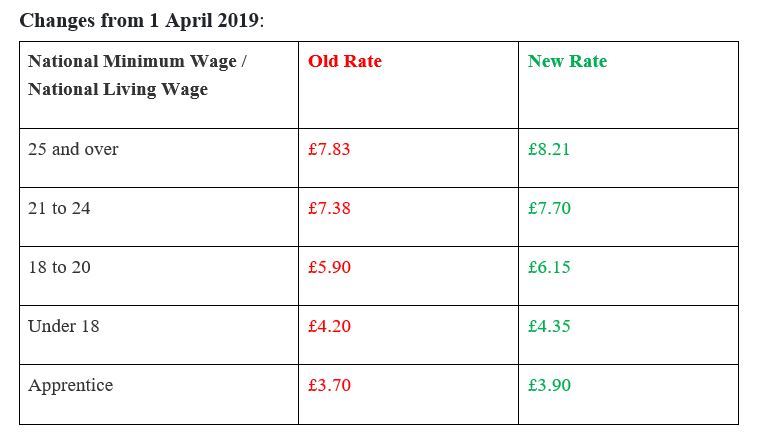
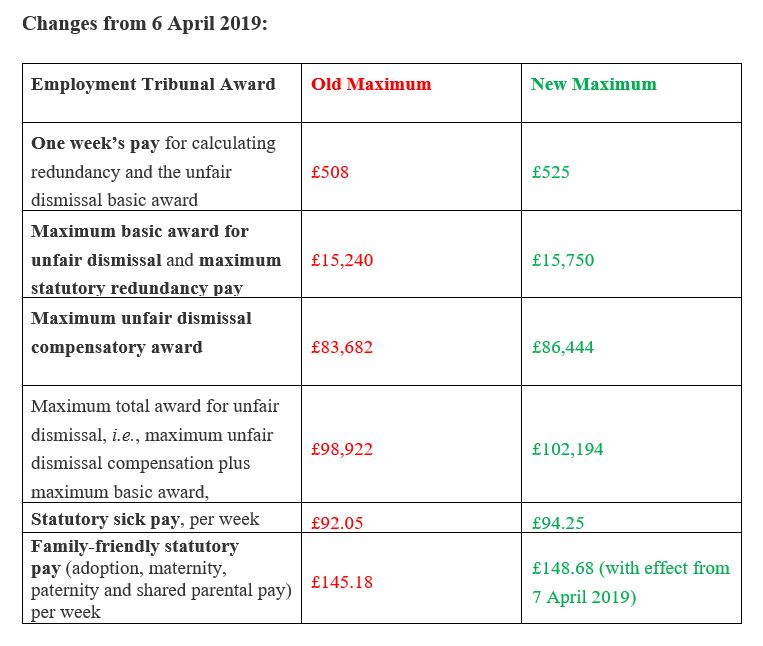
    In case you have been distracted by other recent events in the UK, here is a reminder that the compensation limits on Employment Tribunal awards and certain other amounts payable under UK employment legislation increased as of the first week of April 2019.

    This alert sets out the changes in full and highlights important consequences for employers.

    In depth

    Key Points for Employers

    The changes relating to redundancy and unfair dismissal payments, as set out in the table below, took effect on 6 April 2019, and will apply to dismissals occurring on or after that date.

    It is important for employers to note:

    • If an employee was given notice prior to 6 April 2019, but the notice period expires on or after 6 April, the new limits will apply.
    • If an employee’s employment is terminated by means of a payment in lieu of notice, the effective date of termination (EDT) is the actual date the dismissal takes effect, plus the amount of statutory notice applicable to the employee, e., one week per year of employment, up to a maximum of 12 weeks. If the statutory notice would take the EDT to or beyond 6 April 2019, the new limits will apply.

    Itemised Payslips

    Employers should also be aware that, with effect from 6 April 2019, the right to receive a written, itemised pay statement extended to include ‘workers’ as well as ‘employees’. ‘Workers’ includes agency workers and zero hours workers.

    Authors
    More insights