













ARTICLE
McDermott HealthEx takeaways: Operational capabilities hold the key to capital
June 8, 2026
Read time: 6 min
Healthcare remains one of the most resilient sectors in the US economy, supported by strong long-term demand drivers, growing investment in new modes and models of care, and rapid technological advancement across the ecosystem. But as discussions at McDermott HealthEx 2026 underscored, healthcare leaders are facing a more demanding operating environment than they were even a few years ago.
For provider systems and platform operators, achieving growth is no longer the hard part. It’s the ability to translate that growth into stronger margins, scalable operations, and long-term value that has become the greater challenge. And this shift is influencing how health systems and platforms pursue growth, along with what investors and strategic buyers are looking for during diligence and underwriting.

From the conference, here are six factors to watch:
Margin squeeze reshapes strategic priorities
Hospital and health system margins are stretched thin, as they face rising labor costs, inflationary operating expenses, and growing uncertainty surrounding government funding programs. Medicaid policy has become an enterprise-level strategic consideration, while Medicare Advantage reimbursement dynamics continue to influence growth strategies, transaction evaluations, and long-term capital planning.
In reaction to these challenges, the traditional healthcare value-creation playbook is evolving. Revenue growth, acquisition activity, and multiple expansion only tell part of the growth-potential story. Markers like margin expansion, workforce productivity, physician alignment, payor strategy, and revenue cycle optimization are becoming increasingly important as organizations seek to demonstrate value via a strong set of operational capabilities.
Operational capabilities create value
Scale, density, and market position are no longer sufficient measures to support premium valuations or drive sustainable returns. As reimbursement pressures, labor challenges, regulatory complexity, and longer hold periods reshape the market, platform operators are being asked to demonstrate a deeper set of capabilities that strengthen health system positioning and support performance both before and after a transaction.
Those same capabilities have become central to investor underwriting and diligence efforts, with buyers placing greater emphasis on:
- Physician alignment
- Revenue cycle effectiveness
- Workforce management
- Technology infrastructure
- Compliance maturity
- Ability to successfully integrate acquisitions
As financial engineering and acquisition-driven growth become less reliable sources of value creation, organizations that have a deep bench of proven operational and technical capabilities will be best positioned to differentiate themselves in a competitive market.
Outpatient capabilities drive massive growth
The continued care migration into outpatient settings is one of today’s biggest investment opportunities. Hospital outpatient revenue is growing at roughly double the rate of inpatient revenue, reinforcing long-term tailwinds for ambulatory surgery centers (ASCs), physician practice management (PPM) platforms, and other outpatient care models.
Access to the system is also a growing strategic differentiator. Organizations are rethinking how patients enter and navigate the healthcare system, with an emphasis on primary care, ambulatory networks, and consumer-centered access models.
The implications of this shift extend beyond site-of-care migration alone, with outpatient capabilities becoming increasingly important to establish market relevance and long-term enterprise resilience for health systems, physician groups, ASCs, and other outpatient providers.
AI and data infrastructure are critical – but have growing pains
Artificial intelligence has rapidly moved from innovation initiative to a core component of enterprise strategy. At the same time, AI and digital enablement have not yet fundamentally transformed provider and ASC operations at scale. Organizations remain in the early stages of moving from pilots and point solutions to enterprise-wide deployment.
Healthcare leaders may be starting to view AI less as a standalone initiative and more as a core infrastructure affecting future operating models, but this shift in perspective comes with its own set of challenges. Organizations are grappling with the non-technical aspects of AI integration (governance, workforce adoption, data quality, and compliance oversight, etc.) as much as the implementation of the technology itself.
Successful AI deployment requires a well-defined governance framework that’s clearly communicated and consistently reinforced. Strong cross-functional leadership alignment is also paramount, as is having a clear strategy for integrating AI into existing clinical and operational workflows.

Medicaid: What’s ahead for health systems
Strategic partnerships expand the growth playbook
Partnerships have long been a core vehicle for health system growth and strategic differentiation. What is changing is the breadth of organizations involved and the role these arrangements play in enterprise planning.
Health systems are increasingly looking beyond traditional hospital affiliations and pursuing partnerships with physician groups, ASCs, PPM platforms, behavioral health providers, home health organizations, post-acute operators, technology companies, employers, and payors. Increasingly, health systems are using these partnerships to strengthen market position, expand access points, broaden outpatient capabilities, and create new avenues for growth beyond traditional hospital-based models.
As partnership models become even more integrated and strategically important, diligence must extend beyond financial and legal considerations. Governance structures, decision-making authority, cultural compatibility, data-sharing arrangements, and operational alignment are all critical components of partnership fit and value creation. Change management also remains one of the most important, though frequently underestimated, determinants of long-term partnership success, especially as new technologies get rolled out across sites of care.
Regulatory review starts earlier in transaction planning
Healthcare transactions face increasing scrutiny at both the state and federal levels. State transaction review laws, antitrust enforcement, ownership transparency requirements, and broader public-interest are all influencing transaction timelines and deal structures, including what a more comprehensive diligence process should look like.
To account for shifting policy – including Medicaid funding uncertainty, Medicare Advantage changes, and evolving value-based reimbursement models – investors and buyers must start the diligence and underwriting processes earlier. Regulatory preparedness and reimbursement resilience are not downstream considerations, but rather part of the original investment thesis itself.
Bottom line: Investment priorities have changed
For health system leaders and platform operators, the challenge is no longer identifying growth opportunities, but building out the operational capabilities to capitalize on them. Investors and strategic buyers are now evaluating organizations through that same lens, placing greater emphasis on execution, resilience, and long-term performance than on growth potential alone.
McDermott HealthEx returns to Nashville in 2027. Join us on May 11-12 at the JW Marriott for even more opportunities to connect, collaborate, and engage with leaders shaping the future of healthcare.




Trade secret owner may pursue unjust enrichment damages despite licensing history
ARTICLE
Trade secret owner may pursue unjust enrichment damages despite licensing history
Jun 4, 2026
Read time: 4 min
The US Court of Appeals for the Federal Circuit affirmed in part, reversed in part, and vacated in part a district court’s post-trial rulings in a trade secret and contract dispute, finding that a trade secret plaintiff may pursue unjust enrichment damages under both the Defend Trade Secrets Act (DTSA) and the Michigan Uniform Trade Secrets Act (MUTSA) even where the parties have a prior licensing relationship. The Court also reinstated the jury’s breach-of-contract damages award and rejected the defendant’s attempt to impose a heightened knowledge requirement for combination trade secrets. Versata Software, LLC v. Ford Motor Co., Case No. 24-1140 (Fed. Cir. May 22, 2026) (Moore, Taranto, Hughes, JJ.)
Ford licensed Versata’s automotive configuration software under a Master Subscription and Services Agreement. When the agreement was about to expire, the parties failed to agree on renewal terms, and Ford released its own software, which it had developed while still licensing Versata’s software. Versata alleged that Ford misappropriated several combination trade secrets embodied in Versata’s software and breached the parties’ agreement. A jury found Ford liable for misappropriating three trade secrets and for breach of contract, awarding more than $22 million in trade secret damages and $82.26 million in contract damages.
Before trial, the district court had limited Versata to a reasonable royalty theory based on the parties’ licensing history and had excluded damages models that measured the value Ford allegedly derived from using the trade secrets. After trial, the district court reduced the trade secret damages award to $0 and the contract award to $3. Versata appealed.
The Federal Circuit found that the district court had legally erred by categorically precluding unjust enrichment damages. The Court explained that the plain language of both the DTSA and the MUTSA permits recovery of unjust enrichment caused by misappropriation that is not accounted for in actual loss. While prior licensing history may be relevant to damages, it does not foreclose unjust enrichment as a matter of law. The Court therefore vacated the zeroed-out trade secret damages judgment and remanded for a new damages trial, instructing the district court to reconsider the reasonable royalty models it had previously excluded because they were not based solely on licensing history.
On the contract award, the Federal Circuit reversed the district court’s decision and reinstated the jury’s $82 million award. Applying Michigan law, the Court concluded that Versata had given the jury a reasonably certain damages path in the form of three annual license figures ($17 million, $14.95 million, and $10.95 million) multiplied by seven and a half years. The jury’s $82.26 million award equated to about $10.97 million per year, which fell within the range supported by the evidence and did not shock the conscience.
The Federal Circuit also affirmed liability for trade secret misappropriation. Ford argued that Versata had to show that Ford knew the specific elements of each combination trade secret at the time of use or disclosure. The Court rejected that proposed heightened requirement, concluding that neither the DTSA nor the MUTSA requires proof of knowledge of each specific element of a combination trade secret. Evidence that Versata disclosed the combination trade secrets through user guides, presentations, manuals, technical documents, emails, onsite discussions, and the software itself was sufficient to sustain the verdict.
Practice note: A prior license can be powerful damages evidence, but it is not a damages ceiling. Where the alleged misappropriator gained business value beyond avoided license fees (e.g., productivity gains, development cost savings, or other retained benefits), plaintiffs should preserve unjust enrichment theories and build record evidence tying those benefits to the asserted trade secrets.





NSA IDR overhaul: What stakeholders need to know
ARTICLE / CLIENT ALERT
NSA IDR overhaul: What stakeholders need to know
June 4, 2026
Read time: 9 min
On May 28, 2026, the US Departments of Health and Human Services, Labor, and the Treasury, along with the Office of Personnel Management (collectively, the Departments), released a final rule addressing operational aspects of the federal No Surprises Act (NSA) independent dispute resolution (IDR) process. The final rule is intended to improve transparency, reduce eligibility disputes, and streamline the handling of claims that proceed through the IDR process.
Background
The NSA was enacted under the first Trump administration as part of the Consolidated Appropriations Act, 2021 (Public Law No: 116-260). The Departments jointly implemented provisions of the NSA by issuing two interim final rules in July 2021 and October 2021.
In relevant part, the NSA prohibits out-of-network (OON) providers from balance billing patients for certain services furnished at an OON facility (in the case of emergency services) or in-network facility (in the case of non-emergency services provided by OON providers). The NSA protects patients from receiving these “surprise” bills, effectively limiting patient responsibility for some services to no more than patients’ in-network cost-sharing amounts.
Per the NSA and as further implemented in the October 2021 interim final rule, plans and issuers are required to determine whether claims for items or services submitted by an OON provider or facility and subject to the NSA are covered under the plan or coverage, and must send an initial payment or notice of denial of payment to the OON provider or facility no later than 30 calendar days after the provider or facility submitted the claim to the plan or issuer.
To the extent the claim is covered, the NSA also sets forth a methodology by which plans or issuers must calculate the OON rate for OON providers or facilities that rendered items or services subject to the NSA. Plans and issuers must pay the provider or facility an amount determined by an applicable all-payer model agreement or, if none exists, an amount determined by applicable state law. If state law does not set forth a mechanism by which the OON rate should be determined, the plan or issuer may negotiate the rate with the provider or facility through an “open negotiation” process, which lasts 30 days. If the parties are unable to agree to an OON rate by the expiration of the open negotiation period, either party may initiate a dispute under the federal IDR process established by the NSA. The IDR process comprises several steps.
Since publication of the interim final rules in 2021, the Departments have issued additional rulemaking and a series of frequently asked questions related to certain aspects of the federal IDR process. However, stakeholders have continued to raise concerns regarding operational elements of the IDR process, including questions about determining claims eligibility for the process as a threshold matter. As a result, the Departments issued a proposed rule on November 3, 2023, that sought comments from stakeholders on the IDR process. After much anticipation, the Departments issued this final rule almost two years later.
Overview of significant clarifications and modifications to the IDR process
The final rule provides several significant operational clarifications of, and modifications to, the IDR process, including with respect to the disclosure of information plans and issuers must furnish to OON providers and facilities, the initiation of and dispute eligibility analysis related to the IDR process, and the imposition of IDR-related fees. The final rule also provides clarity with respect to bundled payment arrangements and batched items and services, modifies extensions of timeframes due to extenuating circumstances, and imposes requirements upon plans and issuers to register in a federal IDR registry.
A high-level overview of the most significant aspects of the final rule is set forth below.
Disclosure of information to OON providers and facilities
In the proposed rule, the Departments identified communication gaps between plans and issuers that contribute to inefficiencies in resolving disputes through the IDR process, including:
- Whether the NSA balance billing prohibitions apply to a particular item or service
- How cost sharing amounts and OON rates are determined
- How and with whom to initiate the open negotiation process.
To address these concerns, the final rule imposes several information disclosure requirements on plans and issuers.
For example, plans and issuers will be required to use claim adjustment reason codes (CARCs) and remittance advice remark codes (RARCs) with the initial payment or notice of denial of payment via the electronic or paper remittance advice that provides, in a standardized manner, information enabling providers to:
- Understand how and whether the NSA applies to the claims for OON items and services
- Determine if the claim is subject to a specified state law or all-payer model agreement for purposes of determining the OON rate
- Determine whether disputes are eligible for the IDR process.
The Departments will issue future guidance specifying the use of CARC and RARC codes.
The final rule also provides clarity regarding when plans and issuers must provide disclosures pertaining to the qualified payment amount. However, the Departments declined to require disclosure of additional information about the methodology and data used for calculating the qualified payment amount, indicating that these additional disclosures “would not assist parties in determining whether a payment dispute is eligible for the Federal IDR process and would be difficult to implement.”
Initiation of IDR process and dispute eligibility determinations
The final rule modifies the open negotiation process that is currently required during the 30 business days after the provider or facility receives an initial payment or denial and before the parties can pursue the IDR process. Under the final rule, notices and supporting documentation must be submitted via the federal IDR portal, and the receiving party must respond no later than the 15th business day of the 30-business-day negotiation period. These changes are intended to streamline the efficiency and effectiveness of the open negotiation process and, hopefully, reduce the number of claims that are ultimately adjudicated through the IDR process.
While simple in concept, identifying claims that are eligible for IDR is often complicated in practice, given that many states have their own surprise billing laws and only certain plans within each state are subject to those laws. To help alleviate confusion, in addition to imposing requirements pertaining to the use of CARCs and RARCs, the Departments finalized a requirement that plans and issuers subject to the IDR process register with a searchable federal IDR portal and provide certain data elements, including relevant contact information. The registry is intended to reduce the number of ineligible disputes initiated through the IDR process, as it will enable providers and facilities to identify the type of payer against which they are initiating a dispute, identify whether a specified state law or the federal IDR process applies to the determination of the OON rate, and reduce the number of disputes incorrectly initiated against the wrong payer.
IDR administrative fees
The final rule significantly reduces the federal administrative fee for IDR disputes from $115 to $15 per party per dispute (an 85% reduction). The Departments declined to finalize several earlier proposed changes related to the fee (e.g., timing of payment, the party that collects the fee), some of which they viewed as obviated by the lower fee.
Bundled payment arrangements and batching requirements
The final rule codifies the definition of “bundled payments” as set forth in the proposed rule, which incorporated the definition the Departments originally provided in federal IDR guidance issued in August 2022. A “bundled payment arrangement” is an arrangement under which:
- A provider, facility, or provider of air ambulance services bills for multiple items or services furnished to a single patient under a single service code that represents multiple items or services (e.g., a diagnostic related group (DRG) code); or
- A plan or issuer makes an initial payment or notice of denial of payment to a provider, facility, or provider of air ambulance services under a single service code that represents multiple items or services furnished to a single patient (e.g., a DRG code).
Notably, this definition allows disputes to be bundled by a single CPT code, DRG code, or Healthcare Common Procedure Coding System code. The final rule clarifies that bundled payment arrangements are subject to the rules for batched disputes.
For batched disputes, the Departments finalized a 50-line-item cap per batch, clarified when items and services may be deemed related to the treatment of a similar condition, and confirmed that batching for self-insured plans must be tied to the same group health plan (i.e., even where a third-party administrator is involved). The final rule shortens the “cooling off” period following a determination in a dispute consisting of multiple items and services batched by patient encounter or CPT code ranges to 30 business days. The Departments will also eliminate the current ability to resubmit improperly batched disputes, after a transition period.
Implementation of the final rule
Implementation of the final rule will occur in stages. For example, the $15 IDR administrative fee becomes effective shortly after Federal Register publication while certain disclosure requirements will take effect 60 days after publication. Certain other operational changes (such as the batching, open negotiation updates, and federal IDR registry requirements) will depend on future guidance. The Departments anticipate rolling out implementation over an extended period.
* * * *
For further reading on the final rule, please see this update from our McDermott+ colleagues, with whom we coordinate closely on NSA updates. For more background, and to review our prior thought leadership on the NSA, visit our No Surprises Act Resource Center.




Fair wages and pay transparency in Italy: Key changes
ARTICLE / CLIENT ALERT
Fair wages and pay transparency in Italy: Key changes
June 4, 2026
Read time: 5 min
The Fair Wages Decree-Law No. 62 of April 20, 2026 introduced several changes regarding “fair wages.” The government’s goal is to ensure that employees receive economic compensation which is appropriate to the quantity and quality of the work performed, giving effect to the constitutional provision contained in Article 36. Below are the key elements of the new law:
- Decree-Law No. 62/2026 does not introduce a statutory minimum wage.
- The “fair wage” is helped to define by the overall economic compensation set out in the national collective bargaining agreements (CCNL) signed by the majority of representative organizations at the national level.
- Different criteria apply depending on the sector, the production category, the employer’s main activity, size, and legal form.
- CCNLs other than the “representative” ones may not provide an overall economic compensation lower than the applicable benchmark.
- For sectors not covered by collective bargaining, reference must be made to the CCNL closest to the nature of the activity carried out.
As already noted, the decree does not introduce a statutory minimum wage but rather aims to combat wage dumping by discouraging the application of marginal or weakly representative collective agreements that provide lower economic compensation than the CCNLs most widespread and established in the relevant sector. The stated objective is to strengthen the role of “leading” collective bargaining as the benchmark for identifying the so-called “fair wage.”
Alongside this approach, however, several interpretive issues are already emerging. The decree does not clarify the objective criteria for identifying the reference CCNL, nor does it clearly define how to measure the representativeness of the trade union organizations called upon to sign the “benchmark” agreement. Additional uncertainty also arises: there is no statutory definition of “overall economic compensation,” a concept central to the entire reform. In the absence of universally applicable legislative guidelines, there is a risk of leaving room for differing interpretations among various collective agreements, even within the same production sector.
Pay transparency in hiring
Legislative Decree No. 96 of May 7, 2026 implements Directive (EU) 2023/970 on pay transparency. The main provisions, in force from June 7, 2026, are as follows.
- Candidates will have the right to know (either in advertisement or call for applications), the starting salary or the salary range for the open position. It will therefore be important to review job postings carefully.
- Employers will be prohibited from asking candidates about the remuneration received in current or previous employment relationships.
- Selection procedures must be gender-neutral.
Employees’ right to information
- Employees may request information on average pay levels, broken down by gender of employees performing the same work or work of equal value. It is therefore important to inform employees of this right.
- The employer must respond in writing within two months of the request.
- Clauses preventing employees from disclosing their pay will be prohibited.
Gender pay gap reporting differentiated by company size
- Employers with at least 100 employees will be subject to reporting obligations on pay gaps.
- For companies with at least 250 employees and for those with 150 to 249 employees, the first data collection is due by June 7, 2027.
- For employers with 100 to 149 employees, the first data collection is due by June 7, 2031.
Joint pay assessment
- If an average gender pay gap of at least 5% emerges within a category of employees, which is not justified by objective criteria and is not corrected within six months, the employer must carry out a joint assessment of that gap with employees’ representatives.
Protections and sanctions
- Employees may take legal action to protect their rights and, in cases of discrimination, the protections under the Equal Opportunities Code will apply.
The lack of clarity arising from the wording of Legislative Decree No. 96/2026 gives rise to several considerations. First, it is not clear whether the contractual “superminimo” (individual pay supplement above the contractual minimum) must be included in what the implementing legislation refers to as the “pay level.” While the Directive clearly includes this pay component, the Legislative Decree in question appears to exclude it when it is based on “objective individual criteria.” Furthermore, to determine whether two jobs are of “equal value,” the Legislative Decree refers exclusively to the contractual job classification provided by the CCNLs applied in the relevant sector, whereas for the purposes of the Directive, contractual classification alone is not sufficient and the substance of the activities performed must be taken into account.
That said, although the new EU and national rules do not introduce a strict obligation of equal pay between women and men, their goal is clear: to nudge the labor market toward greater pay transparency. The idea is to enable employees, and more broadly, labor market stakeholders to know and compare the average pay levels applied within companies, making any disparities easier to identify. In this scenario, companies may be called upon to justify, in concrete and objective terms, existing pay differences between female and male colleagues performing the same work or work of equal value.
*Trainees Francesco Cannavina and Rachele Miotello also contributed to this article.




IRS roundup: May 18 – May 26, 2026
ARTICLE
IRS roundup: May 18 – May 26, 2026
Jun 3, 2026
Read time: 5 min
Check out our summary of significant Internal Revenue Service (IRS) guidance and relevant tax matters for May 18, 2026 – May 26, 2026.
May 19, 2026: A Treasury Inspector General for Tax Administration (TIGTA) report warned that the IRS’s efforts to transition to a “zero-paper” processing system faces significant obstacles related to funding, staffing shortages, and contractor readiness. The report noted that the IRS relied heavily on contractors for paper-processing modernization efforts, spending approximately $9 million between May 2025 and December 2025, but the contractors were not fully prepared to handle filing-season return volumes, requiring the IRS to shift additional processing work back in-house.
TIGTA further highlighted that the IRS workforce remains substantially reduced (approximately 17% smaller than in 2021) while previously authorized modernization funding under the Inflation Reduction Act of 2022 has been significantly reduced via subsequent legislative rescissions. According to TIGTA, these resource constraints could undermine the IRS’s ability to achieve its paperless processing and modernization objectives.
May 19, 2026: The US Department of the Treasury and the IRS finalized regulations (T.D. 10048) modifying the reporting requirements for certain sales or exchanges of partnership interests involving inventory items or unrealized receivables under Internal Revenue Code § 751. The regulations removed a prior rule that effectively required partnerships to provide transferor partners with information by January 31 of the following year and instead permit partnerships to furnish the information within 30 days after receiving notice of the transfer, if later than January 31.
The final regulations adopt proposed regulations issued in 2025 without substantive change and are intended to address concerns that partnerships often lack sufficient information to comply with the earlier deadline. The IRS also updated the instructions to Form 8308 to clarify the revised reporting requirements for transfers of partnership interests.
May 19, 2026: The US House of Representatives passed bipartisan legislation (H.R. 6506) expanding taxpayer protections in refund and collection disputes with the IRS by suspending the statute of limitations for refund claims during certain levy disputes and broadening the US Tax Court’s jurisdiction in those cases. The bill responds to the Supreme Court of the Unites States’ 2025 decision in Commissioner v. Zuch, which held that the Tax Court lost jurisdiction after the IRS applied a taxpayer’s refund to an outstanding liability.
Supporters of the legislation argue that the measure prevents the IRS from effectively mooting Tax Court challenges by offsetting refunds against disputed liabilities while litigation is pending. The bill, which has bipartisan support and backing from several taxpayer advocacy and practitioner groups, is intended to preserve taxpayers’ ability to obtain meaningful judicial review of disputed assessments and collections.
May 21, 2026: The IRS issued Notice 2026-32 concerning certain carrying broker-dealers (i.e., a broker-dealer that carries customer accounts and receives or holds funds or securities for those customers). Such broker-dealers may satisfy the Individual Retirement Account nonbank trustee “adequacy of net worth” requirement under Treas. Reg. § 1.408-2(e)(5)(ii) by demonstrating compliance with the US Securities and Exchange Commission’s (SEC) Net Capital Rule and Customer Protection Rule instead of separately proving satisfaction of the IRS’s net worth standards. The guidance reflects the IRS’s conclusion that the SEC regulatory framework provides substantially similar protections regarding solvency and safeguarding customer assets.
The notice also outlines procedures for existing and prospective nonbank trustees that rely on this alternative compliance method and requests public comments on implementation issues, including documentation requirements and circumstances under which a broker-dealer would no longer qualify for the alternative approach.
The IRS also released its weekly list of written determinations (e.g., Private Letter Rulings, Technical Advice Memorandums, and Chief Counsel Advice).
Recent court decisions
May 18, 2026: In United States v. Gainey, a federal district court denied the taxpayers’ motion for partial judgment on the pleadings, holding that the government plausibly alleged fraudulent transfer claims related to unpaid federal income tax liabilities exceeding $1.8 million. The case involved a transfer of the couple’s residence to the wife shortly after the IRS filed federal tax liens against the husband, with the government seeking to set aside the transfer and foreclose the liens.
The court rejected the taxpayers’ argument that the husband never held an ownership interest in the property, concluding that the complaint plausibly alleged he acquired enforceable property rights under state law by signing the mortgage as a co-borrower. The court further found that the timing of the transfer, the insider nature of the transaction, and allegations regarding the husband’s continued possession and control of the property supported a plausible inference of intent to hinder creditors sufficient to survive dismissal
May 19, 2026: In Menge v. Commissioner, the Tax Court sustained the IRS’s proposed levy action for tax years 2015 – 2018, holding that the IRS Office of Appeals (IRS Appeals) did not abuse its discretion in rejecting collection alternatives after the taxpayer failed to provide requested financial information, including Form 433-A. The Court also held that the taxpayer failed to properly raise challenges to the underlying liabilities during the collection due process (CDP) hearing, instead continuing to assert previously rejected arguments regarding an alleged 2013 overpayment credit.
The Court concluded that IRS Appeals properly verified compliance with all applicable legal and administrative requirements and appropriately balanced the need for efficient tax collection against the taxpayer’s concerns regarding intrusiveness. Because the taxpayer failed to submit supporting documentation or participate meaningfully in the CDP proceedings, the Court upheld the Notice of Determination sustaining the proposed levy action.





Transfer pricing, MAP, and Fast Track: The forces reshaping tax controversy
ARTICLE
Transfer pricing, MAP, and Fast Track: The forces reshaping tax controversy
June 3, 2026
Read time: 6 min
One message stood out during our Tax Symposium 2026 session, Tax controversy: What’s hot and what’s not: The Internal Revenue Service (IRS) is becoming more strategic in how it pursues audits and disputes in today’s resource-constrained environment.
During the interactive session, Alex Jupp, Susan Ryba, and Shawn O’Brien explored how the IRS and global revenue authorities are adapting after years of staffing disruptions, budget uncertainties, and procedural slowdowns. While many organizations expected enforcement activity to weaken, the reality looks different: Authorities are prioritizing narrowing examinations to focus on high-value targets and pushing taxpayers toward faster resolution pathways.
The result is a controversy environment where preparation, documentation, and execution are critical differentiators.
High-risk areas face mounting audit pressure

Transfer pricing continues to dominate controversy activity because it is one of the most fact-intensive and subjective areas of tax enforcement, leaving room for disagreement on economics, valuation, and characterization.
Cost-sharing arrangements; intellectual property (IP) migration structures; and challenges related to development, enhancement, maintenance, protection, and exploitation are particularly difficult to resolve, especially where multiple jurisdictions approach the same transaction from different perspectives.
Simultaneously, valuation disputes are becoming more common across industries, including in renewable energy transactions and IP structures. Revenue authorities are revisiting assumptions driving pre-COVID-19 valuations while taxpayers face growing scrutiny over their methodologies, comparables, and projected business outcomes.
Tax authorities are not auditing more issues, necessarily. Rather, they are auditing more selectively, prioritizing areas where they have technical familiarity, established playbooks, and the potential for large adjustments.
Sharper IRS enforcement demands early preparation
Despite the resource constraints, IRS exam teams are operating with clearer priorities and added pressure to resolve cases. That approach is changing how audits unfold.
The panelists noted a more disciplined approach from IRS exam teams that is characterized by:
- Narrower issue selection
- Greater focus on resolving legacy cases
- Wider use of standardized information requests
- Harsher penalty assessments
- Longer statute of limitations extension requests earlier in the audit
The practical implication for taxpayers is clear: Controversy management requires earlier strategic planning.
Companies that proactively develop supporting documentation, preserve evidence, and clearly articulate technical positions before an audit are often better positioned to reduce the number of disputes and accelerate resolution.
Fast Track Settlement is gaining momentum
One of the most significant procedural developments discussed during the session was the IRS’s increased push toward Fast Track Settlement.

Fast Track allows taxpayers and IRS exam teams to enter a mediation-style process facilitated by the IRS Independent Office of Appeals (IRS Appeals), with the goal of resolving disputes within approximately 120 days.
Senior IRS leadership is actively encouraging Fast Track as part of a wider effort to move disputes through the system more efficiently. Fast Track’s advantages include accelerated timelines compared to traditional appeals, earlier insight into the IRS’s substantive positions, added pressure on both sides to engage meaningfully in settlement discussions, and opportunities to resolve penalties alongside substantive issues.
However, success with Fast Track depends heavily on preparation. Taxpayers must enter the process with a fully developed factual and legal record because introducing new information later can delay or derail settlement discussions.
The focus on Fast Track may also have broader implications for traditional appeals timelines. As more experienced IRS Appeals personnel are diverted toward mediation programs, taxpayers in the standard appeals queue may face even longer resolution periods.
Cross-border controversy and MAP remain critical yet complex
Cross-border controversy continues to create some of the most challenging dynamics for multinational businesses.
When asked how they would prefer to resolve cross-border disputes involving double taxation risk, nearly half of session attendees selected Mutual Agreement Procedure (MAP).
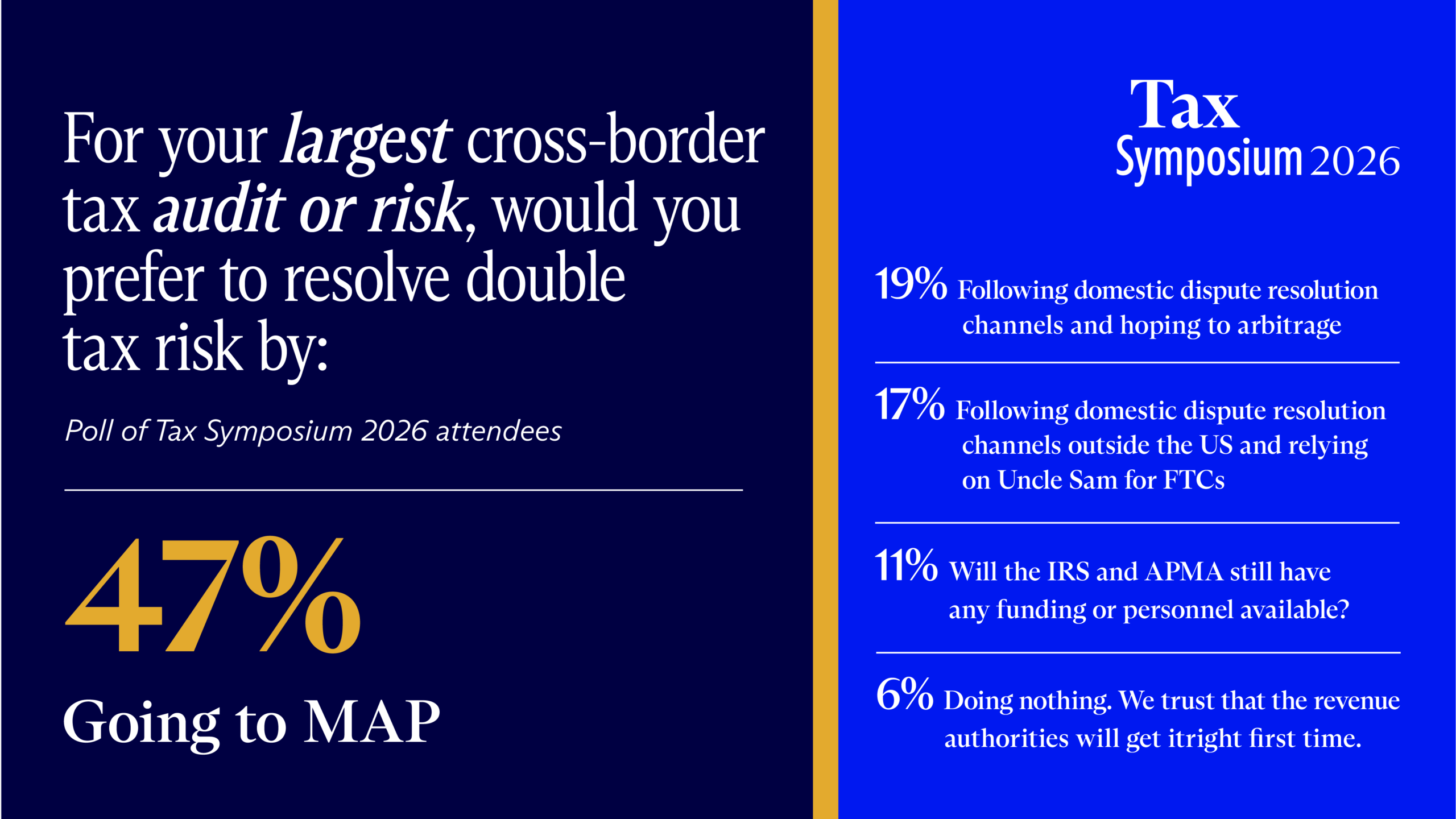
MAP is an important tool for disputes involving transfer pricing adjustments between jurisdictions. However, attendees also acknowledged growing frustrations with the process, including extended timelines, limited transparency into competent authority negotiations, jurisdictional inconsistencies, and a narrow procedural scope in certain countries.
MAP works best when jurisdictions are effectively addressing the same underlying issue. Cases involving different legal characterizations, valuation disputes, or complex IP structures can be harder to resolve through competent authority processes. The follow-on from MAP is equally important, with multinationals increasingly considering wrapping MAP outcomes into an APA.
Taxpayers who choose not to pursue MAP may face questions from the IRS about whether they exhausted all remedies before claiming foreign tax credits in the United States. As a result, companies must evaluate their controversy strategies globally and earlier in the dispute life cycle.
Preparation is becoming the defining advantage
With controversy strategies shifting upstream, companies are placing greater focus on building audit-ready documents, aligning their tax planning with defensible operational substance, evaluating controversy risk during transaction structuring, managing cross-border positions consistently across jurisdictions, and developing proactive engagement strategies with revenue authorities.
As tax authorities become more targeted and resolution timelines accelerate, taxpayers who enter audits organized, documented, and strategically aligned are often best positioned to manage risks and the outcome.
Looking ahead: What tax authorities should prioritize
With the tax controversy landscape rapidly evolving, our panelists identified several priorities for tax authorities:
- Expect continued focus on transfer pricing, valuation, and cross-border substance
- Prepare for faster procedural timelines and earlier settlement discussions
- Consider Fast Track Settlement as a potential strategic tool
- Build documentation with penalties and privilege in mind
- Coordinate global tax controversy strategy across jurisdictions earlier in the process
- Treat controversy readiness as part of broader tax planning and governance
The environment may still be resource constrained, but tax authorities are becoming more efficient in how they deploy those resources. For taxpayers, that means controversy preparedness is no longer reactive but a core part of risk management.




From data to deals: AI’s impact on life sciences investing
ARTICLE
From data to deals: AI’s impact on life sciences investing
June 2026
Read time: 5 min
At our recent European Health & Life Sciences Symposium in Paris, panellists on our “From data to deals: AI’s impact on life sciences investing” session lost no time debating whether AI would have an impact on healthcare and life sciences. AI is already having an impact. The conversation focused somewhere more practical and more interesting. What will the adoption of AI look like across the sector, and is regulation able to keep up with the pace of change?
There was a noticeable shift in tone compared with a similar discussion at our symposium held just 12 months ago.
Previous audience polling at McDermott events indicated some hesitation about the future impact of AI.
But at this year’s session, prior hesitation seemed to have vanished – around 40% of attendees described AI as already embedded throughout their organisations.
This acceleration, and whether regulation has a realistic chance of keeping up with the pace of change, became one of the defining themes of the panel.
Historically, healthcare organisations have not adopted technology quickly in the past, even when the case for doing so was obvious. Indeed, the healthcare industry has often been good at developing products and technologies, but less good at real adoption. Based on our discussion, AI feels like a very different case.
To take one example raised in our panel: electronic medical records took seven years to achieve 50% penetration across US healthcare systems, despite regulatory pressure and government incentives. AI scribes reached the same level in roughly 18 months. The explanation is not complicated. Most clinicians immediately understood the value proposition because it addressed something painfully familiar: administrative overload.
The panel recognized that a key driver for this adoption is the operational pressure facing businesses, and the need to find efficiencies.
Against that backdrop, AI can serve as a practical tool for reducing friction in systems that already feel overstretched.
Whilst some discussions tend to focus on most futuristic use cases, the panel concentrated on the fact that the technologies with most traction are often those that speed up “behind the scenes” support, such as workflow automation, scheduling, patient communication, documentation, data extraction and operational support.
One distinguishing feature in the fast adoption is that usage appears to be driven from the ground up. One panellist observed that, depending on the jurisdiction, somewhere between 25% and 75% of healthcare practitioners may already be using these tools to help understand patient histories, clinical questions or treatment pathways.
Clinicians are using these systems because they find them useful, not because healthcare institutions have necessarily completed lengthy procurements or usage validation exercises. In many ways, that is what distinguishes this moment from previous waves of healthcare technology adoption, and should be a key focus for boards.
At the same time, the panel noted that many aspects of healthcare and life sciences companies remain inefficient and that there are challenges with the large volumes of unstructured data For all the excitement around the opportunities of AI, including from drug discovery to clinical trial efficiencies, the reality is that huge volumes of healthcare data remain effectively unusable. One panellist observed that around 80% of critical medical data remains unstructured, sitting in PDFs, free text and fragmented hospital systems.
This gap between ambition and infrastructure may create opportunities for companies focused on structuring, cleaning and contextualising healthcare data so it can be used effectively by AI systems downstream.
The discussion also looked at investment strategy and defensibility, given AI developments in AI including agentic AI.
The last few years has seen significant investment in single-purpose radiology models. Now, with the potential of large foundation models, it seems feasible that AI tools may develop models that perform across multiple pathology areas.
This has obvious implications for investors. The challenge is no longer as simple as proving that a model works. Increasingly, companies need to demonstrate how and why they will remain relevant in an environment where underlying capabilities are evolving so quickly.
Ultimately, differentiated datasets, integration into healthcare systems and the ability to build reliable, auditable AI ecosystems may matter more than standalone point solutions.
The panel predicted a shift from isolated models toward ecosystems of agentic systems where future differentiation depends on how effectively businesses orchestrate within complex healthcare environments.
The panel also recognised that AI requires meaningful overside and regulation but had concerns that law may have a dampening effect on innovation. There was concern that the pace of legislation enactment lags behind technological change so that law is out of date before it is in force.
The EU AI Act, which is not yet fully in force, received some scrutiny. Questions were raised about the risk of trying to regulate technologies that are already evolving beyond the categories legislators originally had in mind, not least because the EU AI Act imposes a double layer of regulation on software (including AI) as a medical device. This additional layer of cost and certification might provide comfort to users and legislators but risks deterring innovators and delaying efficiencies in healthcare systems.
A key takeaway is that AI is no longer at the edge of healthcare strategy. The challenge is not persuading the market that AI matters. It is determining where sustainable value will sit in an ecosystem evolving so quickly that many of the assumptions underpinning today’s technology, regulation and business models may look very different again within a remarkably short period of time.


Anti-Money Laundering Insights
ARTICLE
Anti-Money Laundering Insights
June 3, 2026
Read time: 2 min
McDermott Will & Schulte’s multidisciplinary anti-money laundering (AML) team – comprising lawyers with deep experience in regulatory, litigation, criminal, and transactional matters – advises banks, broker-dealers, investment advisors, private funds, and other financial institutions. Beyond compliance counseling, the team represents clients in high-stakes government investigations, enforcement actions, and regulatory examinations, drawing on the experience of former federal prosecutors and SEC lawyers. Recognized by regulators and industry groups alike, McDermott serves as a trusted partner in managing AML risk both domestically and globally.

Read insights from our experienced AML lawyers and learn more about our capabilities.
FinCEN proposes fundamental reform of AML/CFT program requirements, May 28, 2026
FinCEN imposes record $80 million penalty on Canaccord Genuity, April 23, 2026
FinCEN issues proposed rule to enhance whistleblower incentives and protections, April 22, 2026
Federal court vacates FinCEN real estate reporting rule obligations, March 25, 2026
FinCEN rule requiring AML reporting for real estate sector takes effect, March 2, 2026
FinCEN, OFAC intensify efforts targeting Mexican cartel money laundering, February 20, 2026
The new sheriff is in town – AMLA officially received supervisory powers from EBA, January 20, 2026
FinCEN Postpones Effective Date of AML/CFT Program Rule for Investment Advisers to 2028, July 21, 2025
FinCEN prohibits fund transfers involving three Mexico-based financial institutions under FEND Off Fentanyl Act, July 14, 2025
New AML Requirements for Investment Advisers: Lessons from Recent Enforcement Actions, April 4, 2025






ICC 2026 arbitration rules: A new three-month route to a final ICC award
ARTICLE / CLIENT ALERT
ICC 2026 arbitration rules: A new three-month route to a final ICC award
June 2, 2026
Read time: 8 min
The 2026 International Chamber of Commerce (ICC) Rules of Arbitration entered into force on June 1, 2026. The revisions modernize ICC arbitration while preserving its core architecture, with updates addressing arbitrator disclosure, expedited proceedings, emergency arbitration, electronic communications, early determination, and case management.
The headline development is the new Highly Expedited Arbitration Provisions (HEAP), an opt-in procedure under which the tribunal must render its final award within three months of the initial case management conference, unless that time limit is extended.
For businesses, the appeal is clear. HEAP offers a route to an ICC award within three months, an exceptionally compressed timetable for international arbitration. Used in the right case, it can provide a prompt determination of discrete commercial disputes while preserving the key advantages of arbitration, including the potential for cross-border enforcement under the New York Convention.
That speed comes with procedural trade-offs. Parties choosing HEAP should expect a sole arbitrator, front-loaded submissions, limited scope for extensions, close control over evidence, and the possibility of a documents-only determination. HEAP is likely to be valuable where the issue in dispute is narrow and the record is ready, but it will be less suitable for disputes requiring broader procedural space.
Highly expedited arbitration
HEAP applies only when all parties agree. This is a key distinction from the ICC Expedited Procedure Provisions, which may apply automatically by reference to the amount in dispute and the date of the arbitration agreement. HEAP has no monetary threshold. Its suitability depends not on claim value, but on the complexity of the issues and the parties’ interest in rapid final resolution. Parties can therefore agree to HEAP for a high-value dispute over sufficiently narrow and discrete issues. Conversely, HEAP may be inappropriate for a low-value dispute if the case is factually complex, document-heavy, or dependent on witness and expert evidence.
The ICC identifies lower-complexity commercial disputes, claims with a simple factual matrix, and discrete issues requiring swift resolution, such as technology disputes, sports-related disputes, or purchase price adjustments, as likely candidates.
This distinction may be particularly important in construction and infrastructure disputes. A project dispute may be high-value but still turn on a narrow, document-based issue such as whether a certified sum is payable, retention should be released, a milestone payment has been triggered, liquidated damages are due under a defined contractual mechanism, or a discrete variation or price-adjustment issue can be decided on an existing record. Those issues may be suitable for HEAP if they are severable from the wider project dispute and the evidence is readily available. By contrast, claims involving delay, disruption, defects, prolongation costs, or complex final accounts will often be poor candidates because they typically require document production, factual witnesses, expert evidence and, in some cases, related parties or related contracts.
Front-loaded case preparation
The most significant practical feature of HEAP is front-loading. The claimant’s request must include the statement of claim, setting out the legal grounds, facts, relief sought, relevant agreements, arbitration agreement, proposals on the sole arbitrator, and observations on the place, applicable law, and language of the arbitration. To the extent possible, the claimant must also submit the evidence and legal authorities on which it relies.
The respondent then faces a compressed timetable. Within 20 days of receiving the request and statement of claim, it must provide threshold information, including its observations on the sole arbitrator, place of arbitration, applicable law, and language. Within 30 days, it must submit its answer and statement of defence, together with any counterclaim and, to the extent possible, the evidence and legal authorities relied upon. Those time limits are not extended unless the parties agree.
HEAP may reduce overall duration and cost, but it increases the burden at the outset. A claimant should not commence HEAP unless it can file a developed case immediately. A respondent should assume that, once served, there will be little room for prolonged internal investigation, slow document collection, or extended settlement positioning before its detailed defense is due.
Sole arbitrator and compressed timetable
All HEAP cases are decided by a sole arbitrator. If the parties do not jointly nominate the sole arbitrator within 20 days of the respondent’s receipt of the request and statement of claim, or a longer period agreed by the parties, the ICC court will directly appoint a suitable arbitrator. Challenges to the sole arbitrator must be brought within seven days of notification of appointment or confirmation, or within seven days of learning the relevant facts.
Procedural flexibility and evidentiary limits
Under HEAP, the initial case management conference must take place within seven days of the tribunal receiving the file, unless extended by the secretary general. At that conference, the tribunal will consult the parties on procedural measures and establish the timetable.
That first procedural meeting will likely determine the shape of the entire arbitration. The tribunal has broad discretion to adopt measures necessary to meet the timetable. It may decide not to allow document production, limit the number, length, and scope of written submissions, and restrict written witness and expert evidence. After consulting the parties, it may also decide the dispute solely on the documents, without a hearing or examination of witnesses or experts.
This is both HEAP’s strength and its limitation. For discrete contractual, accounting, or payment disputes, these powers may eliminate unnecessary procedural steps and deliver a quick merits determination. For disputes involving credibility issues, extensive technical evidence, allegations of fraud, multiple factual witnesses, or significant document asymmetry, the same compression may create strategic and due-process concerns.
There is also an important safety valve. If the dispute proves unsuitable for HEAP as it develops, the parties may agree that HEAP should no longer apply. The ICC court may also decide, on its own motion or at the request of a party or the tribunal, that the case should continue under the Expedited Procedure Provisions or the ordinary ICC rules. That safeguard may be especially relevant in construction disputes, where an apparently narrow issue can expand into a wider dispute over delay, technical performance, or valuation.
No joinder or consolidation
HEAP is designed for contained disputes. Joinder and consolidation are unavailable.
That limitation is important, particularly in construction, infrastructure, energy, shareholder, joint venture, finance, and supply-chain arrangements, where related parties and related contracts often play a central role. In those contexts, parties may wish to reserve HEAP for defined bilateral claims rather than applying it across the contract as a whole.
A fast award with cross-border enforcement
A HEAP award remains an ICC arbitral award, which is significant in international disputes. International arbitral awards benefit from the New York Convention, which provides a widely adopted framework for the recognition and enforcement of awards across borders.
This can make a HEAP award more useful than a domestic court judgment, particularly where the counterparty, assets, or business operations are located in multiple jurisdictions. Enforcement is not automatic, and national courts may still refuse recognition on established grounds, including jurisdiction, due process, arbitrability, and public policy. Even so, the New York Convention gives award creditors a recognized and generally reliable route to enforcement.
The commercial advantage lies in the combination of speed and enforceability: a fast ICC award with a credible path to enforcement abroad. In construction, this may make HEAP an interesting complement to dispute boards or adjudication mechanisms. Unlike many project-level dispute board or adjudication decisions, a HEAP award is intended to be a final ICC arbitral award, with the potential for recognition and enforcement under the New York Convention. That may be valuable where the parties need not only a quick answer, but a final and enforceable determination. HEAP should not, however, be treated as a wholesale substitute for dispute boards or adjudication processes designed to keep a project moving during performance. It is better understood as an additional tool for defined disputes where finality and enforceability are more important than procedural breadth.
Key takeaways
HEAP gives businesses a new ICC arbitration option where speed is the priority and the dispute is ready for prompt determination.
It is likely to work best where the dispute is bilateral, document-based, and narrow; the relevant evidence is already available; the parties can accept a sole arbitrator; and a final award within three months has real commercial value.
Parties should use HEAP cautiously where they expect a dispute may require joinder, consolidation, extensive document production, expert evidence, multiple witnesses, or a three-member tribunal.
When drafting ICC clauses, parties should consider whether HEAP should apply to all disputes or only to defined categories. Parties should also specify the seat and language of the arbitration and decide whether to preserve the default position that the HEAP award will include reasons or, instead, agree that no reasons are to be given (recognizing that this latter option may create enforcement challenges in some jurisdictions).
As with any dispute resolution provision, the key is to draft deliberately; language meant to create strategic advantage should not inadvertently create procedural traps, enforcement obstacles, or uncertainty over the very arbitration rights it was designed to protect.



IRS announces 2027 HSA, HDHP, excepted benefit HRA, DPCSA limits
ARTICLE / CLIENT ALERT
IRS announces 2027 HSA, HDHP, excepted benefit HRA, DPCSA limits
June 1, 2026
Read time: 3 min
The Internal Revenue Service (IRS) recently announced (see Revenue Procedure 2026-24) cost-of-living adjustments to the applicable dollar limits for health savings accounts (HSAs), high-deductible health plans (HDHPs), and excepted benefit health reimbursement arrangements (HRAs) for 2027. In addition, this year’s guidance includes inflation-adjusted limits for the aggregate fees that can be made available under direct primary care service arrangements (DPCSAs), which were first made available under the One Big Beautiful Bill Act (OBBBA) (see our client alert here). Most of the dollar limits currently in effect for 2026 will change for 2027.
The table below compares the applicable dollar limits for HSAs, HDHPs, and excepted benefit HRAs for 2026 and 2027.
| HEALTH AND WELFARE PLAN LIMITS | 2026 | Δ | 2027 |
|---|---|---|---|
| HDHP – maximum annual out-of-pocket limit (excluding premiums) | |||
| Self-only coverage | $8,500 | ↑ | $8,700 |
| Family coverage | $17,000 | ↑ | $17,400 |
| HDHP – minimum annual deductible | |||
| Self-only coverage | $1,700 | ↑ | $1,750 |
| Family coverage | $3,400 | ↑ | $3,500 |
| HSA – annual contribution limit | |||
| Self-only coverage | $4,400 | ↑ | $4,500 |
| Family coverage | $8,750 | ↑ | $9,000 |
| Catch-up contributions (ages 55 and older) | $1,000 | ═ | $1,000 |
| Excepted benefit HRA | |||
| Annual contribution limit | $2,200 | ↑ | $2,250 |
| DPCSA | |||
| Aggregate monthly fees for DPCSA that covers one individual | $150 | ═ | $150 |
| Aggregate monthly fees for DPCSA that covers more than one individual | $300 | ═ | $300 |
Next steps
Plan sponsors should update payroll and plan administration systems for the 2027 cost-of-living adjustments and incorporate the new limits in relevant participant communications, such as open enrollment and communication materials, plan documents, and summary plan descriptions.
For further information about applying the new HSA, HDHP, excepted benefit HRA, and DPCSA plan limits for 2027, please contact your regular McDermott lawyer or one of the authors below.
xxxxx
| HEALTH AND WELFARE PLAN LIMITS | 2026 | Δ | 2027 |
|---|---|---|---|
| HDHP – maximum annual out-of-pocket limit (excluding premiums) | |||
| Self-only coverage | $8,500 | ↑ | $8,700 |
| Family coverage | $17,000 | ↑ | $17,400 |
| HDHP – minimum annual deductible | |||
| Self-only coverage | $1,700 | ↑ | $1,750 |
| Family coverage | $3,400 | ↑ | $3,500 |
| HSA – annual contribution limit | |||
| Self-only coverage | $4,400 | ↑ | $4,500 |
| Family coverage | $8,750 | ↑ | $9,000 |
| Catch-up contributions (ages 55 and older) | $1,000 | ═ | $1,000 |
| Excepted benefit HRA | |||
| Annual contribution limit | $2,200 | ↑ | $2,250 |
| DPCSA | |||
| Aggregate monthly fees for DPCSA that covers one individual | $150 | ═ | $150 |
| Aggregate monthly fees for DPCSA that covers more than one individual | $300 | ═ | $300 |

