Content Type: Article

  • Three financing themes emerging across energy and data centers

    Three financing themes emerging across energy and data centers

    ARTICLE

    Three financing themes emerging across energy and data centers

    May 29, 2026

    Read time: 3 min

    Key takeaways
    Overview

    During the 2026 ACORE Finance Forum, McDermott’s co-head of Energy & Project Finance, Ed Zaelke, moderated a panel on “Making Markets: Sources of Capital to Meet the Challenge” with Alain Halimi of Nomura, Dwayne McNicholas of J.P. Morgan, and Ines de Almeida Serrao of CIBC. Over the course of the discussion, several themes emerged around how capital providers are approaching today’s energy and infrastructure markets.

    A few key takeaways from the panel included:

    1. High-yield debt continues to expand beyond traditional use cases. Panelists noted the growing role of high-yield bonds in financing contracted data center projects and other infrastructure assets, reflecting continued investor appetite for scaled, cash flow-oriented opportunities.
    2. Renewable energy financing remains available, but capital structures are evolving. While financing activity in the renewable sector continues, panelists discussed how concerns around FEOC and other regulatory and supply chain issues are creating additional diligence considerations for some projects. In that environment, corporate-level and holdco financings may provide greater flexibility, particularly for sponsors with diversified operating portfolios and existing cash flow-generating assets.
    3. Data center financings continue to favor conventional construction-to-term structures, but development risk remains a gating issue. Traditional project finance structures are still the predominant approach for financing data centers; however, lenders remain focused on resolving key development risks—particularly zoning, permitting and power-related issues—before capital is deployed.

    Overall, the discussion highlighted that, despite ongoing market and policy uncertainty, capital remains available for well-structured projects and sponsors that can effectively navigate execution and development risks.

    In depth
    Authors

    Edward Zaelke

    Partner

    Los Angeles

    More insights

  • New SEC “qualified client” thresholds take effect June 29

    New SEC “qualified client” thresholds take effect June 29

    ARTICLE / CLIENT ALERT

    New SEC “qualified client” thresholds take effect June 29

    May 29, 2025

    Read time: 3 min

    Key takeaways
    Overview

    The US Securities and Exchange Commission (SEC) issued its periodic inflation adjustment to the “qualified client” dollar amount tests under Rule 205-3, with the new thresholds taking effect on June 29, 2026. The assets-under-management test will increase to $1.4 million (from $1.1 million) while the net worth test will increase to more than $2.7 million (from $2.2 million). These revised thresholds are particularly relevant for funds offered pursuant to Section 3(c)(1) of the Investment Company Act of 1940 and for separately managed accounts serving high-net-worth individuals.

    In depth

    Background

    Section 205(a)(1) of the Investment Advisers Act of 1940 generally prohibits an investment adviser from entering into or performing an advisory contract that provides compensation based on a share of capital gains or capital appreciation (i.e., performance compensation/fees).

    In scope: For many advisers, clients subject to the qualified client requirement will include private funds offered under Section 3(c)(1) – the exemption for funds with 100 or fewer beneficial owners – and separately managed accounts for high-net-worth individuals.

    Out of scope: Private funds offered under Section 3(c)(7) are excluded from the qualified client requirement and the requirement does not apply to non-US clients or investors.

    The qualified client requirement is satisfied where:

    • The investor or client has $1.4 million in assets managed by the adviser immediately after investing in the fund or entering into the advisory agreement;
    • The adviser reasonably believes that the investor or client has a net worth greater than $2.7 million at the time of investing in the fund or entering into the advisory agreement (including assets held jointly with a spouse but excluding the value of the primary residence and related debt); or
    • The investor or client is a qualified purchaser or a knowledgeable employee.

    Timing and immediate next steps

    The new thresholds do not apply to investment advisory agreements or subscriptions to funds made before June 29, 2026. New subscriptions, new investors, and certain transfers occurring on or after June 29, 2026, will be evaluated under the new thresholds.

    • Advisers to Section 3(c)(1) funds should update subscription materials and investor questionnaires to reflect the new dollar thresholds.
    • Advisers to separately managed accounts with high-net-worth individuals should update their advisory agreements and client questionnaires to reflect the new dollar thresholds.
    • Advisers permitting transfers of fund interests should update their transfer documentation to reflect the new dollar thresholds as applicable.
    • All advisers should review policy, procedure, and any other documents reflecting the qualified client thresholds and update them accordingly.

    If you have questions about how the revised “qualified client” thresholds may affect your business, please contact McDermott’s Investment Management Group.

    Authors
    More insights

  • The Maine event: Two new laws reshape healthcare transaction oversight and reporting

    The Maine event: Two new laws reshape healthcare transaction oversight and reporting

    ARTICLE / CLIENT ALERT

    The Maine event: Two new laws reshape healthcare transaction oversight and reporting

    May 29, 2026

    Read time: 7 min

    Key takeaways
    Overview

    Maine Governor Janet Mills recently signed two bills into law, House Paper (HP) 1480 and HP 1481, establishing notice and approval requirements for certain healthcare transactions and expanding state antitrust oversight.

    HP 1480 creates a notice and approval process for material transactions between healthcare entities in Maine and private equity companies, hedge funds, or management services organizations (MSOs). The law becomes effective on January 1, 2027. While the law bears some similarity to other healthcare transaction notice laws, it has several key distinctions as noted below.

    HP 1481 creates a “mini HSR” law in Maine that will require healthcare entities to concurrently submit their federal filings under the Hart-Scott-Rodino Act (HSR) to the Maine attorney general if certain conditions are met.

    In depth

    HP 1480

    What is a material change transaction?

    Under this new rule, material change transactions require 180 days’ pre-closing notice to be submitted to the Maine Department of Health and Human Services (DHHS).

    A “material change transaction” occurs when a private equity company, hedge fund, or MSO owned or controlled by either a private equity company or a hedge fund acquires either a majority interest in or operational control of a healthcare entity in Maine. Covered healthcare entities include healthcare providers (i.e., individuals or entities qualified to provide healthcare services, including medical practices), licensed healthcare facilities (including hospitals, ambulatory surgery centers, outpatient clinics, labs, and imaging centers), and provider organizations (including accountable care organizations, physician-hospital organizations, independent practice associations, and MSOs). The law expressly excludes:

    • Licensed nursing facilities
    • Dental services providers and dental service organizations (DSOs)
    • Independent provider organizations with fewer than seven providers that lack ownership or control by another entity.

    Unlike other states, Maine’s new rule does not include a threshold requirement relating to healthcare services revenues or value of assets held by the provider. Any transaction involving a private equity, hedge fund, or MSO acquirer and a Maine healthcare facility, provider, or provider organization that is not otherwise exempt must make a filing.

    Notice requirements

    The covered healthcare entity must give written notice to DHHS at least 180 days prior to closing a material change transaction.

    The notice must include:

    • Transaction agreements between the parties.
    • The goals and anticipated effects of the transaction.
    • The geographic service area of any hospital to be affected.
    • The groups or individuals expected to be affected.
    • A summary of healthcare services to be added, reduced, or eliminated.

    All submitted information will be treated as public unless the submitter requests confidentiality and DHHS approves that designation. Within 10 days of receipt, DHHS must publish a summary of the transaction on its website.

    The statute directs DHHS to set filing fees between $2,000 and $10,000.

    Preliminary review

    DHHS, in coordination with the Office of Affordable Health Care (OAHC), has 60 days from receipt of the notice to conduct a preliminary review. A notice is considered received on the first business day after DHHS deems it complete. At the conclusion of the 60-day review period, DHHS must either approve the transaction with or without conditions, or decide to perform a comprehensive review.

    Comprehensive review

    A comprehensive review is required if the transaction is expected to:

    • Involve the transfer of assets valued at more than $100 million
    • Lessen competition
    • Materially affect the cost, quality, or access to healthcare services.

    As part of the comprehensive review, DHHS must hold a public hearing or meeting to hear comments from interested parties. DHHS may then request that OAHC conduct a cost and market impact review (CMIR) and produce a corresponding report, which must be completed within 150 days of DHHS’s request.

    DHHS may recover the costs of conducting the comprehensive review and CMIR from the transacting parties.

    Approval and post-transaction oversight

    No more than 60 days after receiving the CMIR report, DHHS must approve the transaction with or without conditions or deny approval.
    Following closing, the acquiring entity must submit reports to DHHS after years one, two, and five demonstrating compliance with any conditions, analyzing cost and cost growth trends, and assessing the transaction’s impacts. DHHS retains discretion to require additional reporting beyond the fifth year.

    Enforcement

    The Maine attorney general has enforcement authority, including the power to subpoena records and seek equitable relief such as an injunction or specific performance. Noncompliance may result in administrative penalties of $10,000 per day, and DHHS can refer noncompliant entities to the attorney general.

    HP 1481

    By passing HP 1481, Maine joins a growing number of states that have adopted so-called “mini-HSR” laws. Currently, just Colorado and Washington have mini-HSR laws in effect, but California’s mini-HSR law becomes effective January 1, 2027. However, unlike these other states, whose mini-HSR regimes apply across all industries, Maine’s law is limited to transactions involving healthcare entities.

    HP 1481 requires a healthcare entity to concurrently submit a copy of its HSR filing (both the HSR form and all documentary attachments) to the Maine attorney general if either:

    • The healthcare entity’s principal place of business (i.e., the headquarters address of the healthcare entity making the HSR filing) is in Maine; or
    • The healthcare entity (or a person or entity controlled directly or indirectly by the healthcare entity) had annual revenue in Maine in the most recent calendar year of at least 20% of the HSR filing threshold for the “goods or services involved in the transaction.”

    The HSR size-of-transaction threshold for 2026 is $133.9 million, and therefore the HP 1481 revenue threshold is currently $26.78 million. The HSR threshold changes each year (typically in February and usually increasing). The revenues figure refers to sales in, into, and from Maine. Washington has published guidance on how HSR filing parties should interpret the meaning of the same phrase “goods or services involved in the transaction” in its mini-HSR law, and this guidance can be applied to interpret the same language in other state mini-HSR laws, including the new Maine law. For a seller, the determination is based on the sales of the target. For a buyer, the determination is based only on the buyer’s sales of products that overlap with what it is acquiring from the target (i.e., healthcare services that derive revenue in overlapping North American Industry Classification System codes used in HSR filings).

    Failure to provide this notice could result in civil penalties of up to $10,000 per day of noncompliance.

    Key takeaways

    • Unlike other material change notices, HP 1480 focuses only on acquisitions (as opposed to a broader range of contractual and clinical affiliations) and only targets transactions where a private equity, hedge fund, or MSO is involved.
      • While the number of healthcare entities subject to the law is large, dental providers and DSOs are explicitly carved out, unlike in certain other states.
    • The timeframe for reporting (180 days) is significantly longer than most material change notices, with a preliminary review concluded within 60 days of the filing. Additionally, if regulators determine that a transaction warrants a CMIR review process, such review is likely to extend transaction timelines even further.
    • DHHS and the attorney general are granted significant enforcement authority, including authority to impose monetary penalties and equitable remedies.
    • HP 1481 defines “healthcare entities” broadly to include healthcare providers, provider organizations, and healthcare facilities. Such entities with any nexus to Maine that make HSR filings should assess whether submitting their filing to the Maine attorney general is now required. This law, like other state mini-HSR laws, does not require entities to observe a separate waiting period or obtain approval from the Maine attorney general. The only requirement is to submit the HSR filing if the thresholds are met, and everything submitted to the Maine attorney general under this law is kept confidential.
    • Parties contemplating transactions involving Maine healthcare entities should conduct an early analysis to determine any applicable notice requirements or mini-HSR filing obligations.
    Authors

    Sarah Kitchell

    Partner

    Boston

    Olivia Andrews

    Associate

    New York – One Vanderbilt Avenue

    Noah Feldman Greene

    Partner

    Washington, DC

    More insights

  • Deals still get done – but only with a new playbook

    Deals still get done – but only with a new playbook

    ARTICLE / CLIENT ALERT

    Deals still get done – but only with a new playbook

    May 29, 2026

    Read time: 7 min

    Key takeaways
    Overview

    Ahead of SuperReturn Berlin 2026, private equity faces an execution environment where structure, financing, and judgment are the real differentiators.

    Execution has become the defining capability

    As we are approaching the third quarter of this year, one theme stands out. Across private equity, transactions are progressing, but they are taking different paths to the finish line. Timelines are longer, due diligence is more extensive, structures are more complex, and risks are harder to price. In many cases, deals only close because the parties involved are willing to rethink the conventional approach.

    The question is no longer whether capital is available or whether assets are attractive. The real question is whether deals can be executed – and how they can be successfully brought to completion in today’s challenging market environment.

    The investors that succeed are not necessarily those with the most capital or the strongest pipeline. They are the ones that can navigate complexity without losing momentum.

    There is no longer a “standard” deal

    Expectations of a traditional buyout model with clean pricing and straightforward leverage are increasingly out of step with market reality.

    Today’s transactions are bespoke by necessity. Valuation gaps persist, sellers want certainty, and buyers want protection. Bridging that tension requires flexibility.

    As a result, the market is seeing a clear shift towards:

    • Earnouts and deferred consideration to align expectations on future performance;
    • Minority positions and staged acquisitions where conviction exists but certainty does not;
    • Joint ventures and co-investment structures to share risk and unlock opportunities;
    • Rollover equity and seller financing to keep stakeholders invested in the outcome; and
    • More complex capital structures covering the full spectrum from senior loans to PIK structures and structured equity.

    These tools are not new. What has changed is how frequently they are used, how they interplay and how central they have become to getting deals signed.

    For investors, this means structure is no longer a secondary consideration. It is often the mechanism that determines whether a deal happens at all.

    Financing is shaping the deal as much as the asset

    Financing used to follow the deal. Now it often defines it.

    While traditional lenders remain active, they have become more selective, and the terms are getting tighter. In response, private equity has leaned more heavily into alternative capital, including private credit, hybrid instruments, and structured equity.

    That shift brings flexibility, but also complexity.

    Different capital providers come with different expectations on control, return, and downside protection. Intercreditor arrangements are more nuanced. Covenant packages are more tailored. And in many cases, financing terms directly influence how the transaction is structured.

    For dealmakers, this means financing strategy must be embedded early. Leaving it too late introduces execution risk that is increasingly difficult to unwind.

    Diligence is broader, deeper, and harder to compress

    One of the most significant shifts is in diligence.

    Financial and legal fundamentals remain critical, but ticking the boxes is no longer sufficient, as stakeholders increasingly expect to understand a target’s exposure to a wider set of risks that can affect both value and viability.

    Two areas consistently rise to the top:

    • Environmental, social, and governance considerations are now seen as a core part of the deal analysis – and not a box-ticking exercise – affecting valuation, structure, and exit planning. This shift is driven by regulation, investor expectations, and reputational considerations.
    • Cybersecurity and data risk have also moved to the center. Decision-makers are interested not only in whether issues exist, but also in how resilient the business is, how data flows across jurisdictions, and how regulatory regimes apply.

    In addition, several other areas are becoming more critical for decision-makers:

    • AI resilience is emerging as both an opportunity and a source of fragility. Stakeholders want to know whether target companies have control over their data, models, and dependencies, and whether they are exposed to third-party risk, weak governance, and unproven use cases.
    • Geopolitical exposure can also directly impact value. The focus is on vulnerability to regulatory shifts, trade restrictions, and supply chain disruption, as well as the ability to reconfigure operations if conditions change.
    • Market resilience is increasingly central to underwriting the investment case, as pricing power, customer concentration, and cyclicality determine how quickly performance deteriorates under stress.

    These factors are no longer peripheral, as they directly affect downside protection, valuation, and the credibility of the investment thesis. This shift requires sponsors to manage a significantly broader and more interconnected diligence scope – without slowing down the deal to a point where opportunity is lost.

    Cross-border deals carry more friction than before

    Europe remains a highly attractive market, but cross-border execution is more complex than it was even a few years ago.

    Foreign investment screening regimes, antitrust reviews, and sector-specific regulations are evolving quickly; approval processes can be unpredictable in both timing and outcome; and political considerations can also influence decision-making in ways that are difficult to model.

    At the same time, differences in legal systems, tax frameworks, and business culture continue to shape negotiations and integration.

    For investors, this means jurisdictional strategy is no longer a late-stage workstream. It needs to be built into the deal from the outset, with clear planning around approvals, conditions, and fallback positions.

    The deals that close are the ones that adapt

    Despite all of this, deals are still getting done, but they close because the parties involved are willing to adapt – sometimes significantly – from their initial positions.

    In practice, that means:

    • Designing structures that can flex if conditions change between signing and closing;
    • Sequencing steps to manage financing and regulatory timelines more effectively;
    • Using conditionality in a targeted way to balance protection with certainty; and
    • Keeping stakeholders aligned as terms evolve.

    What distinguishes successful execution today is not just technical precision, it is judgment: knowing where to push, where to compromise, and how to keep a transaction moving forward when the path is no longer straightforward.

    Execution has become a real source of value

    As conversations in Berlin will reflect, the market has not disappeared. It has simply become more demanding.

    A well-structured deal can preserve value in a volatile environment. A poorly executed one can erode it quickly, regardless of the underlying asset. As a result, returns are increasingly influenced by how well deals are executed, not just what is acquired.

    In a market defined by complexity, execution is no longer the final step in the process. It is the strategy.

    For private equity, this is a shift worth recognizing.

    The McDermott difference

    Private equity transactions are not getting simpler, but with the right approach, they are still getting done.

    McDermott Will & Schulte works alongside investors to navigate this complexity with a clear focus on execution. That means aligning structure, financing, and risk allocation with your commercial objectives from the outset and maintaining momentum through each stage of the deal. When challenges arise, the focus is on resolving them quickly and pragmatically, so the transaction keeps moving.

    With an integrated, cross-border team, McDermott brings together the legal, regulatory, tax, and financing perspectives that modern deals demand. From first thesis to exit, our goal remains consistent: to help you manage risk, unlock opportunity, and deliver transactions that close with certainty in an increasingly complex market.

    Learn more about our private equity capabilities, and feel free to reach out to us.

    Our team will be attending the SuperReturn 2026 in Berlin and looks forward to discussing the latest developments shaping the private equity market. If you will be in Berlin as well, feel free to reach out to us to connect during the conference.

    In depth
    Authors
    More insights

  • FinCEN proposes fundamental reform of AML/CFT program requirements

    FinCEN proposes fundamental reform of AML/CFT program requirements

    ARTICLE / CLIENT ALERT

    FinCEN proposes fundamental reform of AML/CFT program requirements

    May 28, 2026

    Read time: 9 min

    Key takeaways
    Overview

    On April 7, 2026, the US Department of the Treasury’s Financial Crimes Enforcement Network (FinCEN) announced a notice of proposed rulemaking (the FinCEN Proposed Rule) that would fundamentally reform the anti-money laundering and countering the financing of terrorism (AML/CFT) program requirements applicable to financial institutions under the Bank Secrecy Act (BSA) as amended by the USA PATRIOT Act and the Anti-Money Laundering Act of 2020 (AML Act). The FinCEN Proposed Rule, which implements key provisions of the AML Act of 2020. The FinCEN Proposed Rule includes proposed rules revising the AML/CFT program requirements for each type of financial institution with a BSA program obligation, including banks, casinos, money services businesses (MSBs), broker-dealers, mutual funds, insurance companies, and futures commission merchants (FCMs), introducing brokers in commodities (IBCs); dealers in precious metals, precious stones, or jewels; operators of credit card systems; loan or finance companies; and housing government-sponsored enterprises. The FinCEN Proposed Rule does not yet apply to investment advisers.

    On the same day, the Office of the Comptroller of the Currency, the Federal Deposit Insurance Corporation, and the National Credit Union Administration (collectively, the Agencies) issued a companion notice of proposed rulemaking (the Federal Banking Agencies’ Proposed Rule) that proposes conforming amendments to their respective BSA program rules. Both proposed rules are open for public comment through June 9, 2026.

    In depth

    Background on the FinCEN Proposed Rule

    The FinCEN Proposed Rule implements the AML Act’s directive that AML/CFT programs be risk-based. It also builds on FinCEN’s prior modernization efforts, including the AML Act’s mandate that FinCEN establish government-wide AML/CFT priorities – first issued on June 30, 2021 – for financial institutions to review and, as appropriate, incorporate into their risk assessment processes. The FinCEN Proposed Rule supersedes and withdraws FinCEN’s July 3, 2024, proposed rulemaking on AML/CFT program requirements and reflects FinCEN’s BSA modernization priorities, including reducing unnecessary compliance burdens, enabling institutions to concentrate resources on higher-risk activities, and elevating FinCEN’s role in bank AML/CFT supervision.

    FinCEN’s key proposed changes

    The FinCEN Proposed Rule introduces a two-part framework that distinguishes between establishing an AML/CFT program and maintaining one. An AML/CFT program is deemed effective if it (1) establishes a program meeting the requirements of the FinCEN Proposed Rule and (2) maintains that program by implementing it in all material respects. What does this mean for financial institutions?

    • Establishing an effective AML/CFT program requires designing a risk-based framework that incorporates four core pillars: (1) internal policies, procedures, and controls, including risk assessment processes and, for certain institutions, ongoing customer due diligence ; (2) independent program testing; (3) designation of a US-based AML/CFT compliance officer; and (4) an ongoing employee training program. Establishment of an AML/CFT program includes an ongoing obligation to update the program to reflect significant changes to the financial institution’s risk profile, such as new products or services, geographic markets, or customer types.
    • Maintaining an effective AML/CFT program means implementing it in all material respects. FinCEN identifies circumstances that would reflect a material AML/CFT program failure, including (1) consistently failing to execute internal controls because of resource inadequacy, (2) gaps in risk assessment processes that leave higher money laundering and terrorist financing (ML/TF) risks inadequately covered, and (3) data-related issues that materially impair the institution’s ability to mitigate ML/TF risks. Minor AML/CFT program deficiencies would not automatically constitute a failure to maintain an effective program. For banks, a properly established program will not be subject to an AML/CFT enforcement action or significant supervisory action from FinCEN or the federal banking agencies, absent a significant or systemic failure to maintain such a program.

    Internal risk-based policies and risk assessment: The FinCEN Proposed Rule requires financial institutions to establish and maintain risk assessment processes as part of their internal policies, procedures, and controls. These processes must (1) evaluate the AML/CFT risks of the institution’s business activities, including products, services, distribution channels, customers, and geographic locations; (2) review and, as appropriate, incorporate the AML/CFT priorities; and (3) be updated promptly upon any change the institution knows or has reason to know significantly alters its AML/CFT risk profile.

    The FinCEN Proposed Rule requires institutions to direct more resources toward higher-risk customers and activities than lower-risk ones. The risk assessment process should evaluate the ML/TF risks of the financial institution’s business activities, including evaluating the risks from the institution’s products and services, distribution channels, customers, and geographic locations. The internal risk-based policies should be promptly updated if the financial institution knows or has reason to know of significant changes to its ML/TF risks. FinCEN does not prescribe any particular methodology and acknowledges that community banks may use more streamlined, qualitative approaches commensurate with their size, structure, and complexity.

    AML/CFT compliance officers: The FinCEN Proposed Rule requires that an institution’s AML/CFT compliance officer be located in the United States and accessible to FinCEN and the appropriate federal regulators to coordinate and monitor day-to-day compliance with the requirements and prohibitions of the BSA and FinCEN’s implementing regulations. Personnel outside the US may continue to perform certain AML/CFT functions. The FinCEN Proposed Rule does not alter existing guidance prohibiting the sharing of suspicious activity reports (SARs) with overseas personnel except in limited circumstances, such as sharing with a bank’s foreign head office or controlling company for purposes of enterprise-wide AML program management.

    Independent program testing: The FinCEN Proposed Rule retains the BSA requirement for an independent audit function to test AML/CFT programs but clarifies that auditors should not substitute their own subjective judgment for the institution’s risk-based program design decisions. Testing must focus on AML/CFT program effectiveness, be conducted by parties truly independent of the AML/CFT function, and avoid conflicts of interest.

    Ongoing employee training: The FinCEN Proposed Rule standardizes the AML/CFT training requirement across all financial institutions subject to AML/CFT program rules by adopting the BSA’s statutory language requiring an “ongoing employee training program,” with frequency and content tailored to the institution’s risk profile and personnel roles.

    Written AML/CFT program and approval: The written AML/CFT program must be approved by a financial institution’s board of directors, equivalent governing body, or appropriate senior management and made available to FinCEN or its designee upon request. This is a new obligation for casinos and MSBs, which currently have no explicit AML/CFT program approval requirement.

    Enforcement and supervisory policy: The FinCEN Proposed Rule indicates that a financial institution with a properly established AML/CFT program, if maintained in all material respects, would generally not be subject to related enforcement action, absent a significant or systemic failure to maintain the program. This limitation does not apply to failures to establish an AML/CFT program or comply with other BSA violations, such as SAR filings or criminal violations of the BSA. The FinCEN Proposed Rule defines “significant AML/CFT supervisory action” broadly but expressly excludes examiner observations, suggestions, and other informal comments.

    FinCEN notice and consultation for banks: The FinCEN Proposed Rule requires that, before initiating a significant AML/CFT supervisory action under delegated authority, the federal banking agencies must each give FinCEN’s director at least 30 days’ written notice, accompanied by relevant examination workpapers, the draft supervisory report or proposed public enforcement disclosure, and AML/CFT information submitted by the bank. In determining whether to take enforcement or supervisory action or in reviewing a proposed action, FinCEN’s director must consider (1) the four core pillars of an AML/CFT program; (2) whether the bank has advanced the AML/CFT priorities by providing highly useful information to law enforcement authorities or national security officials, conducting proactive analytics, or performing other innovative activities that demonstrate the effectiveness of the bank’s AML/CFT program; and (3) any other factor the director deems appropriate, including the bank’s size, complexity, and risk profile. No similar FinCEN consultation or advance notice framework applies to supervisory or enforcement actions involving other financial institutions.

    The Federal Banking Agencies’ Proposed Rule

    The Federal Banking Agencies’ Proposed Rule is designed to align with FinCEN’s Proposed Rule and to eliminate any confusion regarding prior differences in requirements and expectations. The Federal Banking Agencies’ Proposed Rule consolidates various requirements and long-standing expectations into a single written rule. While they generally do not intend to make substantive changes to existing requirements, some new requirements, including that the AML/CFT officer be located in the US, are noteworthy. Like FinCEN’s Proposed Rule, the Federal Banking Agencies’ Proposed Rule adopts a two-pronged framework distinguishing between establishing an AML/CFT program (program design) and maintaining the program (implementation in practice) and identifies achieving effective outcomes as the overarching goal. To that end, the agencies emphasize the importance of appropriate resource allocation – including funds, personnel, and technology – based on the institution’s risk assessment. They also expect more resources to be directed toward higher-risk customers and activities to achieve the purposes of the BSA. Consistent with FinCEN’s approach, a bank with a properly established AML/CFT program would only be subject to enforcement action or significant supervisory action based on the program rule for a “significant or systemic failure” to implement the program – not for isolated, technical, or immaterial deficiencies. The outcome-based rule puts more of the onus on the institutions to effectively identify and manage their risks than check-the-box requirements.

    Considerations for financial institutions

    While both proposed rules have been described as a sweeping overhaul of the AML/CFT framework, it is not clear whether it will have that effect in practice. As drafted, the proposed rules do not appear to fundamentally change the US AML/CFT regime or materially reduce financial institutions’ compliance burdens. Although it would appear to raise the threshold for AML/CFT supervisory actions – and perhaps enforcement actions – it does not eliminate any BSA obligations, and the standards largely track existing regulatory expectations and guidance. We expect there will be a significant review of the factors considered in risk assessments. But the real significance of the proposed rules will likely turn on how they are applied once they are finalized and implemented.

    Authors

    Melissa G.R. Goldstein

    Partner

    New York – 919 Third Avenue

    Donald J. Mosher

    Partner

    New York – 919 Third Avenue

    Leel Sinai

    Partner

    New York – 919 Third Avenue

    Betty Santangelo

    Counsel

    New York – 919 Third Avenue

    Kyle B. Hendrix

    Associate

    Washington, DC

    Luke De Mott

    Associate

    New York – 919 Third Avenue

    More insights

  • Privacy in the bayou: Louisiana to debut new data privacy law

    Privacy in the bayou: Louisiana to debut new data privacy law

    ARTICLE / CLIENT ALERT

    Privacy in the bayou: Louisiana to debut new data privacy law

    May 28, 2026

    Read time: 7 min

    Key takeaways
    Overview

    On May 21, 2026, the Louisiana State Senate passed Senate Bill 386, which if signed by Louisiana’s governor, will become the Louisiana Data Privacy Act (the LDPA) and come into effect January 1, 2027. The LDPA, although the latest entrant in the ongoing waltz of state privacy laws, thankfully does not introduce any novel privacy compliance obligations. The LDPA is, however, an interesting mix of California- and Connecticut-style laws. Companies doing business in Louisiana should assess the applicability of the LDPA and, if necessary, prepare for LDPA compliance before the end of this year.

    In depth

    Who does the LDPA apply to?

    The LDPA applies to a person or entity that conducts business in Louisiana and meets at least one of the following thresholds, which are borrowed from the California Consumer Privacy Act:

    • Has an annual gross revenue greater than $25 million;
    • Annually buys, receives, sells, or shares for commercial purposes the personal information of 75,000 or more consumers, households, or devices; or
    • Derives 50% or more of its annual revenue from selling consumers’ personal information.

    As with other state laws, “sale of personal data” means “the exchange of personal data for monetary or other valuable consideration” to a third party. A sale does not include disclosure of personal data to a processor, a third party for the purposes of providing a product requested by the consumer, or an affiliate, nor does a sale include the disclosure of information made publicly available by the consumer or made as part of a corporate transaction, such as a merger or acquisition.

    Who is a consumer?

    A consumer is a resident of Louisiana acting in an individual or household context. A consumer is not an individual acting in a commercial or employment context.

    What is personal data?

    The definition of “personal data” under the LDPA is a familiar one. Personal data is “information that is linked or can be reasonably linked to an identified or identifiable individual.” Deidentified data or publicly available information does not constitute personal data under the LDPA.

    What is sensitive data?

    The LDPA’s definition of sensitive data is also familiar, following other state privacy laws:

    • Personal data revealing racial or ethnic origin, religious beliefs, mental or physical health diagnosis, sexuality, or citizenship or immigration status;
    • Genetic or biometric data processed for the purpose of uniquely identifying an individual;
    • Personal data collected from a known child; or
    • Precise geolocation data.

    As in many recent state privacy laws, “precise geolocation data” means information derived from technology that directly identifies the specific location of an individual with precision and accuracy within a radius of 1,750 feet.

    Who can enforce the LDPA?

    The Louisiana attorney general has exclusive enforcement authority. There is a 30-day cure period requirement that will sunset on July 31, 2027. Under the LDPA, the attorney general may bring a civil action under Louisiana’s Unfair Trade Practices and Consumer Protection Law for up to $5,000 per violation.

    Who is exempt?

    The LDPA provides for entity-level and data-level exemptions, both of which are generally standard for state privacy laws.

    At the entity level, the LDPA exempts, among others, state agencies and political subdivisions, financial institutions subject to the Gramm-Leach-Bliley Act (GLBA), covered entities and business associates regulated by the Health Insurance Portability and Accountability Act (HIPAA), nonprofit organizations, and institutions of higher education.

    At the data level, the LDPA exemptions include but are not limited to personal data subject to the Gramm-Leach-Bliley Act, the Health Insurance Portability and Accountability Act, federal research laws, the Fair Credit Reporting Act, the Driver’s Privacy Protection Act, and the Farm Credit Act.

    What obligations are imposed?

    The obligations imposed by the LDPA on controllers should look familiar:

    • The controller’s processing must be reasonably necessary, as well as adequate, relevant, limited, and necessary to the controller’s purpose for processing the data;
    • The controller must maintain reasonable administrative, technical, and physical measures to protect the confidentiality, integrity, and accessibility of the personal data it processes;
    • The controller must refrain from processing personal data for a purpose that is neither reasonably necessary to nor compatible with the disclosed purpose unless the controller first obtains the consumer’s consent;
    • The controller must provide consumers with a reasonably accessible and clear privacy notice that includes information on how consumers may exercise their rights;
    • The controller must comply with authenticated consumer requests to exercise their rights and respond without undue delay;
    • The controller must conduct data protection assessments for certain enumerated processing activities involving the processing of personal data, as described below; and
    • The controller cannot process (or sell) sensitive data without consent. In the case of sensitive data of a known child, a controller must process such data in accordance with parental consent requirements under the Children’s Online Privacy Protection Act.

    Data protection assessments

    The LDPA requires controllers to conduct data protection assessments for:

    • The processing of personal data for the purposes of targeted advertising;
    • The sale of personal data;
    • The processing of sensitive data;
    • The processing of personal data for the purposes of profiling, where such profiling presents a reasonably foreseeable risk of
      • Unfair, abusive, or deceptive treatment of consumers;
      • Financial, physical, or reputational injury to consumers;
      • Intrusion to the private affairs of consumers if it would be offensive to a reasonable person; or
      • Other substantial injury to consumers; or
    • Any processing activities involving personal data that present a heightened risk of harm to consumers.

    The LDPA’s data protection assessment requirements mirror those of other state privacy laws: The assessment must identify and weigh the benefits and risks of the processing, taking into account the use of deidentified data, reasonable consumer expectations, the context of the processing, and the controller–consumer relationship. Also similarly, a single assessment may address comparable processing operations, and an assessment prepared for another law may satisfy the LDPA if that assessment has a reasonably comparable scope and effect.

    Assessments under the LDPA are confidential, although they may be requested by the Louisiana attorney general pursuant to a civil investigation demand. Finally, data protection assessments are required for applicable processing activities as of January 1, 2027, and are not retroactive.

    What consumer rights are created by the LDPA?

    The LDPA mirrors other state privacy laws in providing consumers rights regarding their personal data, including the right to:

    • Confirm whether a controller is processing their personal data and access their personal data;
    • Correct inaccuracies in their personal data;
    • Delete their personal data maintained by the controller;
    • Obtain a copy of their personal data;
    • Opt out of their personal data being processed for targeted advertising, sale, or profiling in furtherance of solely automated significant decisions; and
    • Appeal the controller’s refusal to take action on any of the rights enumerated above. A parent or legal guardian of a known child may exercise these rights on the child’s behalf.

    Response to consumer requests

    A controller must respond to a consumer request within 45 days. This response period can be extended once by an additional 45 days if necessary, as long as the controller informs the consumer of the extension within the initial 45-day response period. If a controller declines to act on a consumer’s request, the controller must inform the consumer within 45 days of receiving the consumer’s request. In the controller’s notice to the consumer, the controller must state the justification for refusal and provide instructions for how to appeal the controller’s decision.

    When does the LDPA take effect?

    The LDPA will take effect on January 1, 2027.

    * * *

    While the LDPA may not introduce entirely novel compliance requirements in terms of US data privacy laws, organizations should be cognizant that the patchwork of such privacy laws is likely to expand by one patch and should prepare accordingly. If you have questions or need assistance with readiness work for new state consumer privacy laws, please contact your regular McDermott lawyer.

    Authors

    Phoebe Hebson

    Associate

    Chicago

    David P. Saunders

    Partner

    Chicago

    More insights

  • FDA refuses to be ghosted on clinical trial data

    FDA refuses to be ghosted on clinical trial data

    ARTICLE / CLIENT ALERT

    FDA refuses to be ghosted on clinical trial data

    May 26, 2026

    Read time: 5 min

    Key takeaways
    Overview

    On April 13, 2026, the US Food and Drug Administration (FDA) announced that it recently sent messages to more than 2,200 medical product companies and researchers reminding them to submit overdue clinical trial results information to ClinicalTrials.gov before the agency considers taking further regulatory action. The campaign follows an internal FDA analysis finding that nearly 30% of clinical trials that are likely subject to mandatory ClinicalTrials.gov reporting have no results on file. The announcement signals a heightened enforcement posture and should prompt sponsors and researchers to review their reporting obligations.

    In depth

    The FDA Amendments Act of 2007 and its implementing regulations at 42 CFR Part 11 require sponsors and other responsible parties for certain clinical trials of FDA-regulated products to submit trial results information to ClinicalTrials.gov. On March 30, 2026, FDA sent the messages to companies and researchers following an internal FDA analysis that determined nearly 30% of studies identified as likely to be subject to mandatory reporting requirements have not submitted any results information to ClinicalTrials.gov.

    These mandatory reporting requirements generally apply to interventional studies of FDA-regulated products (drugs, biologics, and devices) that meet one of the following conditions:

    • The trial has one or more sites in the United States.
    • The trial is conducted under an FDA investigational new drug application or investigational device exemption.
    • The trial involves a drug, biological, or device product that is manufactured in the US or its territories and is exported for research.

    Phase 1 clinical trials and medical device feasibility studies are exempt from the mandatory reporting requirements. The clinical trial results information that must be reported includes primary and secondary outcome measures, adverse events, and certain administrative data. Typically, results must be submitted within a year after the primary completion date of a clinical trial.

    In the press release, FDA claims that the missing clinical trial results information presents a serious gap in the public record and that such gap may create a distorted perception of the safety and efficacy of medical products. FDA described the March 30 messages as seeking “voluntary compliance” and characterized them as “an extra step” to give sponsors and responsible parties the opportunity to comply before the agency considers further regulatory action. However, the agency made it clear that additional enforcement tools remain available. FDA stated that it may issue pre-notices of noncompliance and formal notices of noncompliance as part of risk-based compliance efforts.

    The messages to clinical trial sponsors and researchers clearly signal FDA’s heightened enforcement posture with respect to clinical trial reporting obligations. Under the FDA Amendments Act of 2007, responsible parties that fail to submit required trial results information may be subject to a public notice of noncompliance on ClinicalTrials.gov, civil monetary penalties of up to $10,000 for all violations adjudicated in a single proceeding, and the withholding of federal grant funding. If the responsible parties fail to submit the required clinical trial results within 30 days of the notice of noncompliance, the responsible parties could face additional penalties of $10,000 per day for each additional day the violation goes uncorrected. Responsible parties may also face injunctions and criminal prosecution. In the past, FDA has largely relied on pre-notices of noncompliance to prompt responses by clinical trial sponsors or other responsible parties. Since 2013, FDA has issued 232 pre-notices of noncompliance. FDA has only escalated to issuing a notice of noncompliance eight times but has not yet assessed civil monetary penalties for noncompliance.

    The heightened enforcement posture could increase the risks to sponsors submitting marketing applications that require sponsors to certify compliance with ClinicalTrials.gov registration and reporting obligations. Mandatory disclosure of missing clinical trial results, especially negative clinical trial results, may increase volatility in the life sciences marketplace, particularly for smaller companies with narrow pipelines. The enforcement escalation also creates new securities fraud exposure where sponsors made positive pipeline statements while withholding unfavorable results. In the mergers and acquisitions context, small biotechnology companies often rely on positive clinical trial data to attract acquisition interests. With more complete reporting of clinical trial results, the signaling value of positive clinical trial data may increase as the background rate of visible clinical trial failures rises. Greater visibility into the full clinical trial history of targets, including prior failure that may not have been previously disclosed, could result in more conservative bids for targets.

    Next steps

    In light of the increased enforcement risks for noncompliance, clinical trial sponsors and responsible parties should conduct a review of completed and ongoing clinical trials to determine whether all reporting obligations have been satisfied. As part of this process, sponsors and responsible parties should confirm that the designated responsible party for each clinical trial is accurate and up to date in the ClinicalTrials.gov system, especially where organizational changes, mergers, or investigator transitions may have created ambiguity. Entities responsible for conducting and reporting the results of clinical trials should also assess whether internal policies and governance frameworks adequately address the timely reporting of clinical trial results and update such policies and compliance trainings as necessary.

    The McDermott difference

    McDermott Will & Schulte will continue to monitor the FDA’s enforcement of clinical trial results reporting obligations. If you have questions about how these developments may affect your business, please contact the authors or a member of our Food, Drug & Medical Device Group.

    Authors

    James R. Ravitz

    Partner

    Washington, DC

    Jiayan Chen

    Partner

    Washington, DC

    Monica R. Chmielewski

    Partner

    Miami, Chicago

    Kyle Y. Faget

    Partner

    Boston

    Paul S. Gadiock

    Partner

    San Francisco

    Nathan Gray

    Associate

    Washington, DC

    More insights

  • IRS roundup: May 7 – May 18, 2026

    IRS roundup: May 7 – May 18, 2026

    ARTICLE

    IRS roundup: May 7 – May 18, 2026

    May 22, 2026

    Read time: 4 min

    Check out our summary of significant Internal Revenue Service (IRS) guidance and relevant tax matters for May 7, 2026 – May 18, 2026.

    May 13, 2026: The IRS announced a time-limited settlement initiative for eligible conservation easement and historic preservation easement cases, offering taxpayers an opportunity to resolve disputes on terms the agency described as more favorable than recent US Tax Court outcomes. Under the initiative, taxpayers generally must concede the charitable contribution deduction but may receive an “other deduction” approximating out-of-pocket costs, with reduced gross valuation misstatement penalties of 10% (or 20% after 90 days) instead of the 40% penalties frequently sustained in litigation.

    The IRS stated that recent Tax Court decisions have, on average, allowed only about 6% of claimed deductions while often sustaining 40% penalties and emphasized that the initiative is intended to resolve a substantial backlog of easement cases. The settlement program applies only to eligible cases and includes special procedures for both Tax Equity and Fiscal Responsibility Act of 1982 and Bipartisan Budget Act of 2015 partnership proceedings.

    May 15, 2026: The IRS issued Notice 2026-31, providing updated corporate bond yield curves, segment rates, and Treasury rates used for pension funding and minimum present value calculations under §§ 417, 430, and 431. The notice sets the April 2026 spot segment rates at 4.27%, 5.34%, and 6.22% and provides adjusted 24-month average segment rates applicable for May 2026 plan years.

    The notice also provides the 30-year Treasury rate for April 2026 (4.91%) and the weighted average Treasury rate used for multiemployer plan funding calculations, along with the full monthly corporate bond yield curve derived from April 2026 data.

    The IRS also released its weekly list of written determinations (e.g., Private Letter Rulings, Technical Advice Memorandums, and Chief Counsel Advice).

    Recent Tax Court decisions

    May 7, 2026: In Sanders Creek Owner, LLC v. Commissioner, pursuant to a stipulated Tax Court decision, the IRS disallowed a $43.8 million charitable contribution deduction claimed in connection with a conservation easement transaction that resulted in an imputed underpayment of approximately $16.2 million. The Court also sustained a 10% gross valuation misstatement penalty under § 6662(h) while declining to impose other asserted accuracy-related penalties.

    May 12, 2025: In Stokey v. Commissioner, T.C. Memo. 2025-44, the Tax Court dismissed a taxpayer’s deficiency petition as untimely, holding that the taxpayer failed to establish entitlement to equitable tolling under the US Court of Appeals for the Third Circuit’s decision in Culp v. Commissioner. Although the taxpayer asserted that he did not receive the notice of deficiency until after the filing deadline because he had moved, the Court found that the IRS properly mailed the notice to the taxpayer’s last known address and that the taxpayer failed to demonstrate either diligent pursuit of his rights or extraordinary circumstances preventing timely filing.

    The Court emphasized that equitable tolling applies sparingly and requires taxpayers to show both diligence and circumstances beyond their control. Even assuming delayed receipt of the notice, the taxpayer waited approximately 95 days after allegedly receiving the notice before filing his petition and failed to provide supporting evidence or a declaration explaining the delay.

    Case to watch: McKesson Corp. v. United States

    May 8, 2026: In McKesson Corp. v. United States, the plaintiff filed a motion for summary judgment in federal district court that the IRS’s transfer pricing regulations requiring inclusion of stock-based compensation costs in cost-sharing agreements are invalid under the Supreme Court of the United States’ 2024 Loper Bright decision. McKesson contends that the regulations conflict with the arm’s-length standard under § 482 because unrelated parties would not share such costs and asserts that courts are no longer required to defer to the US Department of the Treasury’s interpretation of the statute following the end of Chevron deference.

    The challenge revisits the holding in Altera Corp. v. Commissioner, where the Court of Appeals for the Ninth Circuit upheld IRS regulations as valid under Chevron and under the Administrative Procedure Act. McKesson argues that the Supreme Court’s Loper Bright decision fundamentally changes the standard of review and permits courts to independently evaluate whether the Treasury’s regulations improperly impose a non-arm’s-length result “by regulatory fiat.”

    A threshold issue raised by the government is whether McKesson’s lawsuit is timely under the general six-year statute for claims against the United States. 28 U.S.C. § 2401. McKesson’s motion for summary judgment also addresses this issue.

    In depth
    Authors

    Kai M. Fenty

    Associate

    Chicago

    Edward L. Froelich

    Counsel

    Washington, DC

    More insights
    Endnotes

  • To win in health tech: Prove ROI or fall behind

    To win in health tech: Prove ROI or fall behind

    ARTICLE

    To win in health tech: Prove ROI or fall behind

    May 18, 2026

    Read time: 7 min

    Key takeaways
    Overview

    If you’re investing and scaling in health tech, the playbook has changed.

    At McDermott Will & Schulte’s Health Tech Investment Forum, investors, operators, and capital providers emphasized that provable ROI has surpassed innovation as the key to securing capital and getting deals done. In today’s environment, that shift is reflected in how investors underwrite value, how companies scale, and how exits are ultimately achieved.

    Dive into key takeaways from the Forum and action items for the months ahead:

    In depth

    The shift to ROI is reshaping the market

    Healthcare IT remains one of the most attractive areas for investment, sitting at the intersection of healthcare and technology – two of the highest-returning sectors over the past decade, according to SPI by StepStone. Even amid broader market volatility, healthcare IT deal activity has remained strong, reaching record levels of volume and value in 2025.

    In 2026, the market is still active, but more complex. The “SaaSpocalypse,” driven in part by AI uncertainty, is beginning to influence private valuations. Sellers are more cautious, buyers are more selective, and the traditional drivers of return are shifting.

    Multiple expansion, historically responsible for a significant portion of value creation, has become a less reliable lever. Investors now need mid-teens EBITDA growth to achieve target returns, putting greater pressure on execution. At the same time, AI is raising the bar. It’s creating new opportunities for efficiency and growth, while forcing investors to rethink which business models are truly durable and defensible. The result is a market where proof of business outcomes – not the promise of innovation – is driving deal decision-making.

    Live audience polling at the Forum reinforced this shift: Respondents said the primary drivers of valuation are scalable revenue growth (34%), AI-driven efficiency (31%), and demonstrated ROI (20%), highlighting a convergence between growth and measurable performance.

    Graphic depicting data from live audience polling during the Health Tech Investment Forum 2026 event on the number one factor driving health tech valuations today (source: McDermott Will & Schulte)

    What wins funding now is workflow ownership and measurable value

    To meet the higher bar for ROI, capital is concentrating around durable business models that can demonstrate clear economic value.

    What distinguishes the most attractive assets is not their use of technology, but where they sit within the workflow. Infrastructure-layer and tech-enabled services businesses remain at the center of deal activity because they operate within core healthcare workflows (such as revenue cycle, billing, staffing, care navigation, and administrative operations). These are areas where inefficiencies are persistent and measurable improvement is highly valued.

    Companies that own decision-making processes, control critical data, and integrate deeply into customer operations are better positioned to retain customers and expand over time, and AI is reinforcing this trend with more discipline than expected.

    While interest in AI-native companies remains high, many investors are becoming more selective, particularly where differentiation relies on shared underlying models. Instead, there is growing focus on companies that use AI to enhance workflows, reduce labor costs, and drive measurable outcomes, especially within tech-enabled services models that control the end-to-end customer experience.

    Companies are being built and financed for execution, not just growth

    To meet the increasing demand to deliver provable ROI, companies are now being built differently from the ground up.

    Capital efficiency is increasingly critical. Investors expect companies to demonstrate how each dollar spent translates into growth, margin expansion, or customer value. Early-stage companies face higher growth and ROI thresholds, while growth-stage businesses are expected to scale efficiently with clear paths to profitability.

    For private equity, value creation strategies are evolving. Without multiple expansion as a tailwind, returns are increasingly driven by execution: pricing and packaging, go-to-market optimization, add-on acquisitions, workflow expansion, and AI-driven efficiency gains.
    Financing markets reflect this change. Capital remains available, but companies with strong growth, recurring revenue, and clear AI readiness are more likely to secure it. Lenders are underwriting more rigorously, with increased focus on cash flow, operational resilience, and long-term viability.

    Importantly, regulatory complexity – long viewed as a barrier – is increasingly treated as table stakes. Operational execution has become a differentiator, with a sharper focus on the ability to scale, sell, and deliver outcomes in a fragmented and demanding healthcare environment.

    Valuation and diligence now center on proof, not narrative

    Valuation in today’s market is grounded in evidence, but proving value can be a challenge.
    Even companies with strong performance face skepticism around ROI, particularly where attribution is complex. Investors are increasingly looking beyond modeled ROI and focusing on observable commercial signals, such as bookings, revenue per customer, and retention, as the clearest indicators of value.

    Simplicity is also becoming a differentiator. Companies that present multiple, complex ROI frameworks often dilute their credibility. Those that anchor their story around a small number of clear, defensible metrics tend to resonate more strongly.

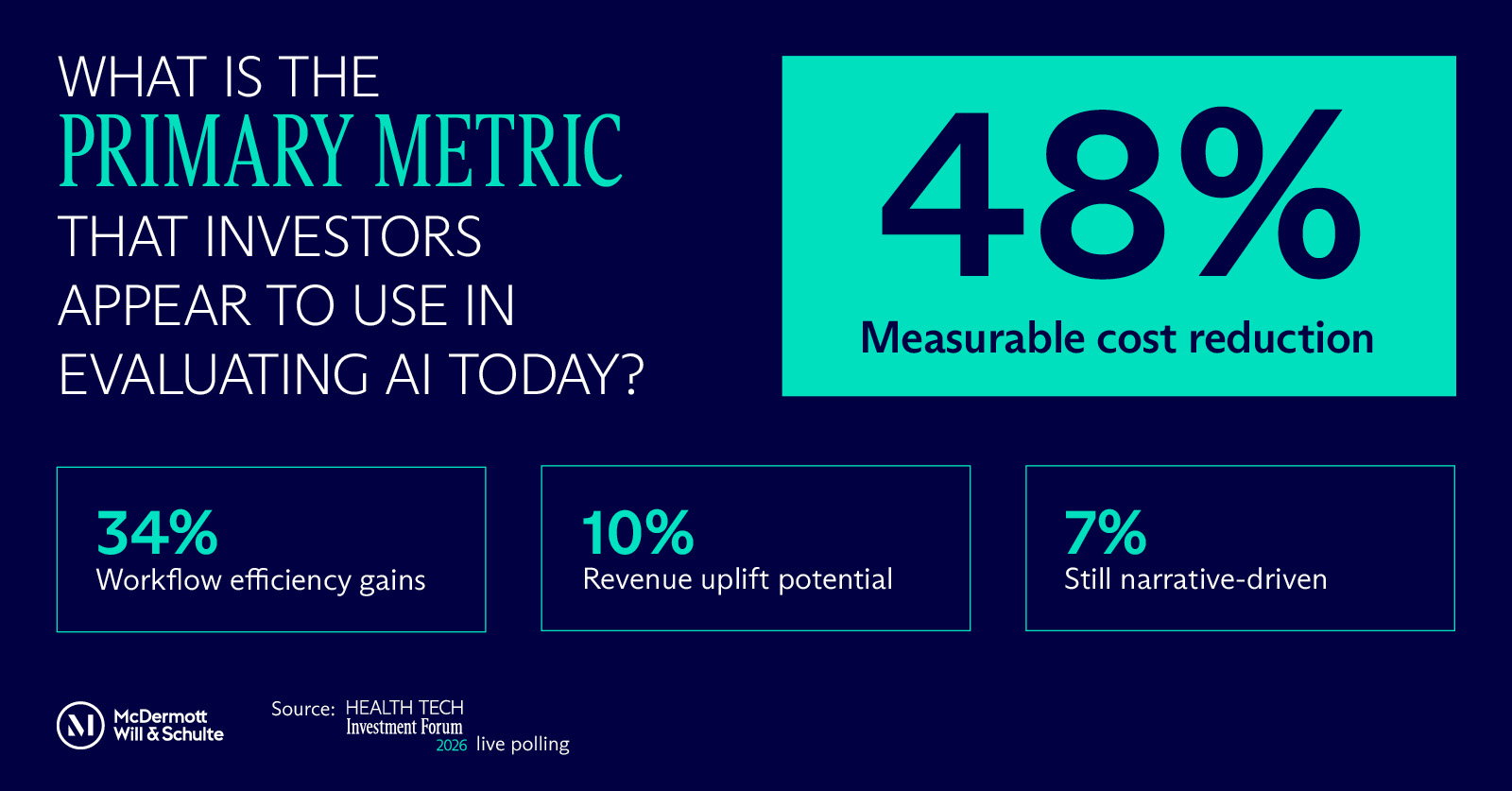
    This is especially true for AI. Live polling showed that investors primarily evaluate AI through measurable cost reduction (48%) and workflow efficiency gains (34%). AI is no longer rewarded for narrative – like other products, it is evaluated on its ability to deliver quantifiable outcomes.

    Graphic depicting data from live audience polling during the Health Tech Investment Forum 2026 event on the primary metric that investors use in evaluating AI today (source: McDermott Will & Schulte)

    Crucially, AI is creating value by completing workflows, driving decisions, and producing measurable results – not with consumer interfaces and insights. Solutions that can execute (closing care gaps, automating administrative tasks, or improving revenue cycle performance) are far more defensible than those that generate recommendations alone.

    Diligence has followed suit. Investors are examining:

    • Data usability, interoperability, and legal rights
    • Depth of workflow integration
    • Retention and revenue quality
    • Operational readiness and change management
    • Credibility and attribution of ROI

    Data has become a critical risk factor. It must be usable, compliant, and properly governed, not just accessible. Weak data infrastructure or unclear data provenance can undermine both AI performance and investment outcomes.

    Exit outcomes are determined early and earned through execution

    Exit outcomes are increasingly determined long before a sale process begins.
    Buyers are prioritizing companies that demonstrate durable growth, operational maturity, and proven ROI. Assets with strong retention, embedded workflows, and clear value creation pathways continue to transact, while others face longer timelines and valuation pressure.

    The exit environment remains discerning. IPOs remain limited, so most liquidity comes from strategic buyers and PE-backed M&A, often with creative structures (such as carve-outs, continuation vehicles, and take-privates).

    The result is a clear bifurcation, where companies with strong revenue growth enjoy market advantages, while those lacking growth face challenges accessing capital. Exits are being earned over time through execution and measurable impact, not narrative.

    Looking ahead: What investors should know

    Health tech remains one of the most compelling investment opportunities in the market. But success in this next phase will depend less on identifying the right idea and more on executing the right model.

    In the coming months, investors should consider:

    • Focusing on where value is most defensible and provable
    • Prioritizing businesses with embedded workflows, strong data foundations, and clear ownership of outcomes
    • Scrutinizing AI for measurable impact
    • Pressure-testing growth durability
    • Underwriting execution risk more rigorously, as capital concentrates around assets that can demonstrate repeatable ROI and sustained performance

    Across the Forum, the throughline was unmistakable: What you build, how you finance it, and how you prove value are no longer separate decisions. They are tightly interconnected and ultimately determine exit outcomes.

    Authors
    More insights

  • The Compliance Clinic: A cross-disciplinary look at healthcare compliance risk

    The Compliance Clinic: A cross-disciplinary look at healthcare compliance risk

    ARTICLE

    The Compliance Clinic: A cross-disciplinary look at healthcare compliance risk

    May 18, 2026

    Read time: 7 min

    Key takeaways
    Overview

    Dental spotlight: Billing, audit risk, and enforcement trends

    The Compliance Clinic examines key Medicare, Medicaid, and government enforcement developments across the healthcare industry. Each edition focuses on a specific sector and provides an integrated view of compliance risk across the full enforcement life cycle, from billing and coding practices to audit exposure, enrollment consequences, and government investigations.

    In depth

    Dentistry’s quiet risk: What investors and operators are missing

    Dentistry has historically operated within a different billing and coding environment than the broader medical industry, as the sector is driven largely by commercial payers and Medicaid, not Medicare. Over time, this has shaped a general perception that billing risk in dentistry is more contained and predictable.

    However, recent enforcement actions and regulators’ increasing reliance on data analytics and artificial intelligence (AI) are challenging that assumption. This is particularly true in the context of Medicaid, where reimbursement is concentrated among pediatric patients and other vulnerable populations, drawing heightened scrutiny and enforcement interest.

    For dental practices, the risk of investigation often stems from high-volume services, such as routine cleanings, where a single billing error repeated over time can result in broad exposure. Regulators evaluate outcomes, not intent, and ignorance of billing requirements is not a defense.

    “Because dental billing relies on a relatively small number of repeatable codes, even minor documentation errors can scale quickly,” said Angela Martin, senior vice president of billing, coding, auditing, and compliance at Farragut Square Group. “From an investor perspective, the priority is catching those errors upfront and making sure documentation and coding practices are clean and consistent going forward.”

    Common risk areas in the dental sector

    High-volume billing: Imaging and repetitive error risk

    When it comes to high-volume services, imaging is a hard hitter in dental billing, and because imaging is performed routinely across patient populations, errors tend to repeat rather than appear in isolation. An occasional documentation omission may be overlooked, but those same omissions repeated over extended periods can translate into audit exposure and repayment demands.

    Rita Ratner, managing director at Farragut Square Group, noted that billing and coding audits are often less about fault-finding and more about equipping practices with the structure necessary to implement best practices at scale. “An audit can surface hidden repeat errors that may not be visible day to day. This gives practices a roadmap to implement changes that meaningfully reduce their exposure over time.”

    Coding precision and “low-dollar” errors at scale

    Another recurring risk in dentistry stems from the use of incorrect or imprecise codes. In many cases, practices apply codes that differ only slightly from the correct selection. Individually immaterial errors, such as miscoding a fluoride application, can aggregate quickly in high-volume billing environments, creating meaningful exposure over multiple billing cycles.

    Kickbacks and referral arrangements in a multi-payor environment

    A common misconception in the dental sector is that limited participation in Medicare reduces fraud and abuse risk. In reality, exposure often persists, and in some cases expands, because of state Medicaid requirements and all-payor antikickback laws, regardless of Medicare program involvement.

    As a result, financial relationships involving referrals, marketing arrangements, or patient steering can present significant risk even for practices that do not routinely bill Medicare, as demonstrated by recent state-level enforcement activity. For example, the Connecticut attorney general announced a settlement with a group of dentists following allegations that certain practices and referral relationships violated the Connecticut False Claims Act. Similarly, in Texas, the attorney general brought suit against a dental network alleging Medicaid fraud tied to illegal kickback arrangements designed to generate patient referrals, highlighting continued scrutiny of growth-driven referral models.

    Credentialing, enrollment, and who is actually billing

    Credentialing and enrollment issues are also garnering increased enforcement attention, particularly as dental organizations scale. Misalignment between the rendering provider, the billing provider, and enrollment status can create significant compliance gaps, especially where services are billed under an individual or entity that is not properly credentialed or authorized.

    Recent enforcement activity highlights how these issues arise in practice. Multiple dental entities agreed to pay $540,000 to resolve allegations involving claims submitted for services performed by providers who were not properly credentialed. Some claims were billed using national provider identifiers of credentialed dentists who did not perform the services, and others were billed even though rendering providers lacked appropriate credentials.

    These issues often result from operational breakdowns, not intentional misconduct, but they can still trigger overpayment liability and False Claims Act risk. Enforcement in this area typically focuses on whether the entity’s billing structure aligns with program requirements, underscoring the need for coordination across credentialing, operations, and billing functions.

    DSOs and structural compliance risk

    Dental service organizations (DSOs) introduce additional regulatory complexity, as they can create scenarios where nonclinical entities interact closely with clinical operations and revenue streams. While DSO models are widely used, they remain subject to scrutiny under corporate practice doctrines, fee-splitting prohibitions, and fraud and abuse laws, especially where financial incentives may influence utilization.

    US Department of Health and Human Services Office of Inspector General (OIG) guidance reinforces the importance of carefully structuring these relationships. In a recent advisory opinion addressing a management support model, the OIG analyzed whether certain compensation and operational arrangements could present risk under the federal Anti-Kickback Statute. For a detailed analysis of this advisory opinion, please see our client alert.


    Medicaid: Vulnerable populations drive scrutiny

    Medicaid coverage in dentistry is heavily concentrated among children and adolescents, often in high-volume practices serving underserved communities. The combination of government dollars, vulnerable patients, and standardized services creates a natural target for increasing enforcement intensity, particularly as detection tools improve.

    Recent enforcement trends in states such as Texas show increased focus on pediatric dental and orthodontic providers, with actions targeting billing for services not rendered, inadequate documentation, overutilization, and medically unnecessary care. Authorities have also examined “paper-only” visits (where the practice bills for an exam that never actually occurred), use of unlicensed personnel, and insufficient supervision models, all of which tend to emerge as organizations scale faster than their compliance infrastructure.

    Key takeaways

    For investors and operators, the takeaway is straightforward: dentistry’s historically lighter oversight does not eliminate risk. As enforcement agencies deploy AI to proactively identify billing outliers, disciplined coding and documentation practices contribute to defensible, institutional-grade operations and are increasingly central to maintaining enterprise value in a consolidating market.

    Healthcare compliance and enforcement risk continue to evolve alongside changes in care delivery and reimbursement. The McDermott Will & Schulte healthcare regulatory and white-collar teams, in collaboration with Farragut Square Group, bring together deep experience in billing and coding, healthcare regulatory, and white-collar enforcement to help clients navigate complexity, mitigate risk, and strengthen compliance in an increasingly scrutinized environment.

    Farragut Square Group’s Alana Zangl, Rita Ratner, Alina DiDonato, and Shira Klapper also contributed to this article.

    Authors

    Monica Wallace

    Partner

    Chicago

    Abygail Hoey

    Associate

    New York – One Vanderbilt Avenue

    More insights