ARTICLE
Want health system transformation? Here’s what leaders say it takes
Jul 15, 2026
Read time: 7 min
The question is no longer whether to build, buy, or partner. The question is which approach best advances the organization’s long-term strategy.
This theme surfaced repeatedly in discussions among hospital and health system leaders at McDermott HealthEx 2026. In the face of market pressures, they are increasingly evaluating a broader range of options and deal structures to drive real system transformation – from partnerships and joint ventures (JVs) to acquisitions, affiliations, technology investments, and alternative capital structures.
Rather than pursuing isolated transactions or incremental improvements, healthcare delivery organizations are looking at how strategy, capital constraints, and new care delivery channels fit together to help them stand out in the market and sustain operations for the long-term.
Additional guidance and key takeaways from event discussions include:
Build strategic clarity into enterprise planning
Strategic clarity has become increasingly important as health systems balance growth against financial and operational constraints.
CEOs emphasize the importance of staying grounded in mission, community needs, and long-term enterprise priorities. As site-of-care migration accelerates and care delivery models evolve, organizations are evaluating opportunities through a broader enterprise lens rather than focusing on individual service lines or isolated growth initiatives. The discussion is shifting from where to grow to how growth supports long-term organizational objectives.
That perspective is also shaping transaction and investment decisions. Leadership teams are applying a more risk-adjusted framework when evaluating partnerships, acquisitions, and other strategic opportunities – considering not only financial returns, but also reimbursement exposure, capital requirements, execution risk, workforce implications, and long-term strategic fit. And as uncertainty surrounding Medicaid funding and regulatory policy persists, preserving flexibility has become just as important as pursuing growth.
Develop the right portfolio of partnerships
For hospitals and health systems, achieving growth is coming down to building the right portfolio. Organizations are increasingly investing in platforms and forging partnerships with outpatient service providers. These partnerships are vital for health systems looking to strengthen ambulatory networks, secure or improve physician alignment, expand behavioral health capabilities, improve patient access, and address other operational challenges that must be solved as a collective.
Health system leaders note that successful partnerships are rarely defined by transaction structure alone. Governance, cultural alignment, physician engagement, integration planning, and execution readiness frequently determine whether organizations achieve the value they envisioned at signing.
As transaction outcomes come under greater scrutiny, leadership teams are spending more time evaluating strategic fit and implementation risk before moving forward with major combinations or partnerships.
In a telling poll response at McDermott HealthEx, when we asked our audience where they expected to see the most M&A activity over the next 12 to 24 months, 100% of respondents chose outpatient services and ambulatory surgery centers (ASCs). Other response options had included platform-scale PPM, hospital/health system divestitures or carve outs, strategic partnerships/minority investments/JVs, and tech-enabled or services adjacent businesses.
Grow resilience through alignment strategies and creative financing
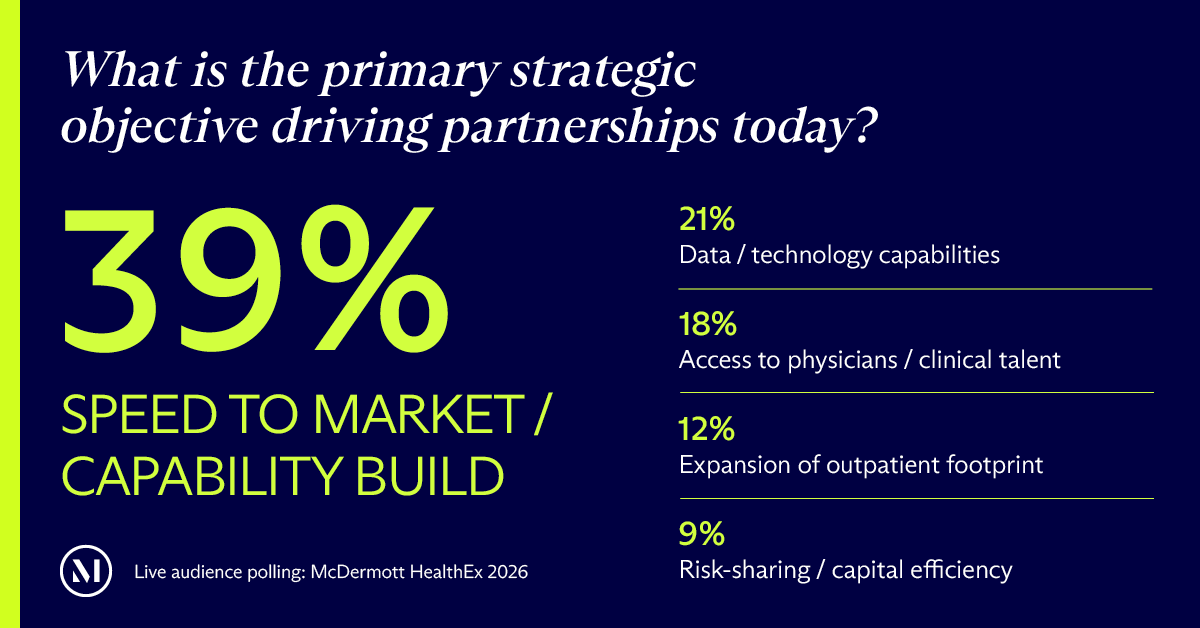
Health systems must deploy capital in ways that strengthen long-term sustainability, support revenue diversification, and maintain the flexibility needed to respond to a rapidly changing healthcare environment.
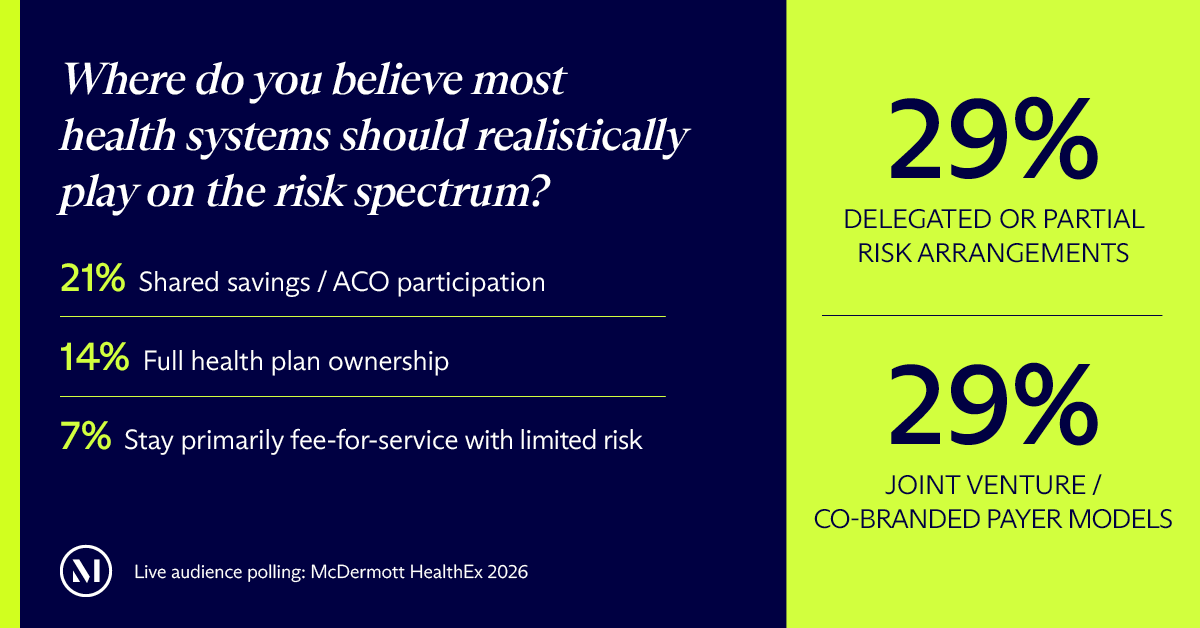
Revenue pressure is also accelerating conversations around value-based care and risk-bearing arrangements. As organizations strive to move closer to the premium dollar through payor partnerships, employer relationships, and population health strategies, success depends less on appetite for risk than on organizational readiness. Physician alignment, care management infrastructure, analytics capabilities, and operational discipline remain foundational requirements for organizations seeking to assume greater financial accountability.
When it comes to physician alignment, many effective approaches can be implemented with little to no incremental financial investment. Key strategies include leveraging clauses linking compensation to attaining in-network referral thresholds, developing an outpatient-focused growth strategy through innovative ambulatory surgery center (ASC) compensation models, and rethinking physician clinic compensation structures to better align incentives. In addition, the Stark Law’s value-based care exceptions provide greater flexibility in physician compensation design, enabling organizations to more effectively incentivize quality, outcomes, and care coordination. Collectively, these strategies can strengthen network integrity, improve care delivery, and drive better patient outcomes.
To go further in addressing budget challenges, hospital and health system leaders have shown growing interest in nontraditional financing approaches. Those options include JVs, monetizing non-core assets, off-balance-sheet financing structures, and other creative capital solutions designed to support strategic priorities while preserving balance-sheet flexibility, although ASC partnerships are still a priority focus.
AI implementation for a new operating model
Conversations around AI have shifted from exploring possibilities to implementing solutions that deliver measurable value. The challenge for health system leaders is no longer identifying use cases, but determining how to deploy AI safely and effectively at scale.
Generative AI continues to gain traction across administrative and clinical workflows. Much of the initial interest centers on automating time-intensive tasks, allowing clinicians and staff to spend less time on documentation and administrative work and more time on patient care and high-value activities.
As organizations move beyond pilots, leaders must be focused on both operational and governance questions: Who is accountable for AI-generated outputs? How should tools be validated before deployment? What level of human oversight is required? How can organizations ensure that patient data is protected and used appropriately?
Health systems must carefully evaluate vendor contracting terms, data ownership and use rights, privacy and cybersecurity safeguards, and the potential for inaccurate or biased outputs to affect clinical or administrative decision-making. Governance structures that define approval processes, monitoring requirements, and manage accountability for AI-related risks as adoption expands across the enterprise are vital components of any transformation strategy.
Playing the long game: Action items for health system leaders
Strategic clarity is a must, along with taking a portfolio approach to growth and transformation. Other key considerations for health system leaders seeking transformation include:
Reevaluate strategic assumptions:
- Reassess whether current growth, access, and care delivery strategies reflect where patients, providers, and reimbursement models are headed. Look ahead, not back.
- Identify which capabilities are most critical to building a competitive advantage, and determine where partnerships or organizational redesign can close gaps.
- Ensure major strategic decisions are grounded in a clear view of the organization’s long-term role within its market and communities. Healthcare is local, and it’s important for healthcare providers to be deeply familiar with the markets they serve.
Apply greater rigor to partnership and transaction decisions:
- Evaluate potential partnerships and transactions based on their ability to advance enterprise strategy, strengthen capabilities, and improve long-term sustainability, instead of focusing solely on size, scale, or financials.
- Incorporate governance, cultural alignment, physician engagement, integration readiness, and execution risk into diligence processes early.
- Establish clear success metrics and accountability structures before entering strategic partnerships or pursuing transformational transactions.
Pressure-test capital and risk strategies:
- Model multiple reimbursement, Medicaid, and regulatory scenarios when evaluating growth initiatives, capital investments, and operating plans.
- Assess organizational readiness before pursuing greater participation in risk-based arrangements, including physician alignment, care management capabilities, analytics infrastructure, and performance measurement.
- Evaluate whether current capital structures provide sufficient flexibility to fund strategic priorities while maintaining resilience in a volatile environment.
Build an infrastructure capable of transformation:
- Move beyond technology pilots and establish enterprise-wide governance frameworks for AI, digital transformation, and other tech modernization initiatives.
- Evaluate whether leadership structures, decision-making processes, and organizational incentives support execution at scale, along with physician alignment.
- Prioritize change-management capabilities as aggressively as technology investments.
Looking ahead
The conversations at McDermott HealthEx reflected a healthcare industry safeguarding for the future and preparing for what comes next. Healthcare organizations that combine strategic clarity, disciplined capital stewardship, operational readiness, and thoughtful partnership strategies will be better positioned to navigate uncertainty while advancing their mission over the long term.
Learn more about hospitals and health systems and find more resources in our Healthcare Transactions Law Center.




Beyond ownership: How health systems are rethinking partnership and outpatient strategy
ARTICLE
Beyond ownership: How health systems are rethinking partnership and outpatient strategy
Jul 10, 2026
Read time: 6 min
Health system executives are reimagining how they grow, partner, and compete. For many organizations, full integration or acquisition is no longer the preferred or available path. Instead, leaders are turning to a broader range of partnership models while accelerating investment in outpatient and ambulatory infrastructure. McDermott Will & Schulte examines the evolving partnership landscape, outlines the strategic imperatives driving ambulatory growth, and explores how physician alignment, payor strategy, and AI adoption are reshaping what it means to build a durable, high-performing health system.
The rules of healthcare growth have changed. For years, health system development strategy was largely synonymous with mergers and acquisitions. That model hasn’t disappeared, but it has shifted to become more flexible and durable in the face of today’s challenges. The current healthcare environment is marked by reimbursement uncertainty, rising costs, capital constraints, and a more complex antitrust landscape. In response, many hospital and health system executives are rethinking what growth means, what partnership looks like, and where care should be delivered.
Evolving partnerships to meet today’s challenges
Growth strategies are moving away from aggressive external acquisitions and toward a more varied and organic range of partnerships. These newer relationships extend well beyond traditional hospital-to-hospital models to encompass technology companies, post-acute care providers, and myriad nontraditional collaborators.
Today’s growth structures are also more diverse, featuring affiliations, joint operating agreements, service-line partnerships, ambulatory joint ventures, payor-provider arrangements, technology collaborations, and shared services platforms. Unlike previous strategies that relied on ownership, today’s partnership models prioritize alignment via shared economics, governance, clinical integration, and operational control.
The impetus for many of these arrangements independence. As financial pressure mounts, affiliation models allow community and regional hospitals to access scale, technology, and management expertise without relinquishing autonomy. But this requires careful upfront work. Governance design, exclusivity terms, antitrust considerations, community commitments, and exit rights all need to be addressed before the ink dries.
Perhaps most importantly, today’s successful partnerships are not solely transactional. Health system leaders are consistent on this point: the most effective relationships are personal and grounded in shared values. Early alignment on culture and outcomes is often a reliable predictor of whether the partnership will deliver.
Outpatient strategy is now a competitive imperative
If partnership structure is evolving, the direction of growth is increasingly clear: outpatient and ambulatory services are the growth engines for health systems today. Ambulatory surgery centers, imaging, urgent care, specialty clinics, home-based care, and virtual care are increasingly central to a system’s economic performance and competitive positioning. In fact, many health system leaders will tell you candidly: if they were building their organization from scratch today, they would design it to be far more outpatient- and ambulatory-centric, prioritizing easier access and seamless integration across the care continuum.
In a compressed market, systems with limited ambulatory infrastructure risk losing commercially attractive services and patient access points to competitors who move faster. As a result, many health systems are redesigning care pathways, evaluating site-of-service economics, aligning physicians around ambulatory models, and making deliberate decisions about which services should remain hospital-based and which should move into distributed or home settings.
Patient access has emerged as a major strategic differentiator. The most forward-thinking systems are embracing a mindset shift by making access the system’s responsibility, not the patient’s burden. That reorientation has significant implications for how systems deploy technology, design referral pathways, and structure partnerships.
Physician and payor alignment: A strategy you can’t separate
Outpatient strategy and partnership strategy both depend on durable physician relationships and increasingly sophisticated payor arrangements. Specialist access, referral stability, and ambulatory growth all hinge on physician alignment, an area requiring dedicated attention and investment. At the same time, health system leaders are expanding their thinking around payor strategy. Provider-sponsored health plans, Medicare Advantage partnerships, delegated risk arrangements, bundled payments, and population health infrastructure are all part of the conversation.
These models offer meaningful opportunities for economic diversification and growth, particularly as traditional reimbursement models face ongoing pressure, but they also introduce complexity. Compensation structures, fraud and abuse considerations, insurance regulatory requirements, and governance design all merit careful attention.
Managing AI and digital infrastructure thoughtfully
No strategic conversation in healthcare today is complete without a discussion of artificial intelligence (AI). AI touches nearly every operational domain in health systems, from clinical documentation, ambient listening, and scheduling, to revenue cycle optimization, prior authorization, and care management. The potential is undeniable: AI tools are already reducing documentation burden, improving provider productivity, and expanding patient access. The trajectory points toward AI becoming embedded in both healthcare operations and clinical care in a fundamental way. As a result, many systems are seeking out ways to support broad adoption and practitioner-level capability across the organization, not just in IT departments.
A key lesson from early adopters is the importance of a people-centered focus. Change management, not the technology itself, is often the biggest barrier to realizing AI’s benefits. Deploying AI effectively necessitates governance structures that can move quickly, organizational cultures that can adapt, and leadership willing to prioritize and sequence implementation thoughtfully given finite resources.
AI also introduces risks that executives must actively manage. Privacy, data rights, vendor oversight, bias, auditability, and cybersecurity implications all demand rigorous attention alongside the operational upside.
What the moment requires
Health system executives today are navigating genuine complexity amid Medicaid shifts, labor shortages, historic financial and payor pressures, and the demands of organizational transformation at scale. Health systems that will thrive are those building differentiated ambulatory infrastructure, forming partnerships grounded in shared values rather than transactional convenience, aligning physicians and payors around durable economic models, and deploying technology through a lens of change management as much as capability.
Scale still matters, but size alone won’t solve challenges if the right capabilities are absent. The mission remains local even as strategies become increasingly sophisticated. And in that tension between community commitment and the imperative to innovate lies the defining leadership challenge of this moment in health system strategy.
Additional resources
Mark your calendar: McDermott HealthEx heads back to Nashville on May 11 – 12, 2027. Click here to save the date and here to be notified when registration opens.
In the meantime, catch up on key insights from HealthEx 2026. To access our HealthEx 2026 event recordings, please contact our Health and Life Sciences Business Development team.

Latest tax updates: Section 7508A refund claims, whistleblower award eligibility, and court restrictions on IRS collection
ARTICLE
Latest tax updates: Section 7508A refund claims, whistleblower award eligibility, and court restrictions on IRS collection
Jul 14, 2026
Read time: 6 min
This roundup covers key Internal Revenue Service (IRS) developments from June 23 to July 2, 2026, including a notable executive nomination, new electronic filing procedures for COVID-19 disaster relief refund claims, and three significant court decisions shaping tax controversy.
June 23, 2026: US President Donald Trump nominated Jim Gadwood, a tax controversy partner at Miller & Chevalier, to serve as IRS chief counsel. The agency’s top legal official, the chief counsel is responsible for advising IRS leadership, issuing legal guidance, and overseeing the development of US Department of the Treasury regulations, including implementation of the One Big Beautiful Bill Act. Gadwood has focused his practice on federal tax controversies; transfer pricing; tax accounting; and representing large corporations, partnerships, and high-net-worth individuals before the IRS.
June 26, 2026: The IRS issued PLR 202626001, granting a limited liability company 120 days of § 9100 relief to file a late Form 8832 for electing to be treated as an association taxable as a corporation under the entity classification regulations. The IRS concluded that the taxpayer acted reasonably and in good faith and that granting relief would not prejudice the interests of the government after the taxpayer inadvertently failed to timely file its entity classification election despite intending corporate tax treatment from the desired effective date.
The taxpayer must file Form 8832 within 120 days and file all required federal income tax and information returns, including amended returns, consistent with the requested classification. The IRS emphasized that its ruling does not address the taxpayer’s eligibility to make the election or provide relief from any interest or penalties that may otherwise apply, and, as with all private letter rulings, the decision may not be cited as precedent.
July 2, 2026: The IRS announced an electronic filing option for taxpayers seeking to preserve potential claims for COVID-19 disaster relief refunds pending the government’s appeal in Kwong v. United States. Taxpayers with an IRS online account may electronically submit Form 843 before the July 10, 2026, deadline by identifying the claim as relating to Kwong. The IRS stated that it will process the claims only if the government is ultimately unsuccessful in its appeal. The Kwong decision held that the COVID-19 pandemic automatically postponed certain federal tax deadlines until July 10, 2023, potentially entitling taxpayers to refunds of penalties and interest previously assessed for late filing or payment. The IRS continues to challenge that ruling, but the new filing procedure allows taxpayers to preserve potential refund claims while the appeal remains pending.
The IRS also released its weekly list of written determinations (e.g., Private Letter Rulings, Technical Advice Memorandums, and Chief Counsel Advice).
Recent court developments
June 29, 2026: In White v. Commissioner, T.C. Memo. 2026-56, the US Tax Court held that the IRS abused its discretion by sustaining a proposed levy to collect restitution-based assessments (RBAs) under § 6201(a)(4) because the collection action conflicted with a prior US Department of Justice (DOJ) settlement resolving the taxpayer’s underlying income tax liabilities. The taxpayer had pleaded guilty to tax evasion for tax years 2000 – 2011, was ordered to pay $1.2 million in criminal restitution, and later entered into a DOJ settlement allowing him to satisfy his $1.89 million civil tax liability by paying $1.6 million in installments through July 2027. Although the IRS argued that the RBAs were separate liabilities not covered by the settlement, the Court concluded that the restitution assessments were identical to the taxpayer’s underlying tax liabilities and merely provided a different collection mechanism.
The Court emphasized that permitting the IRS to immediately levy the unpaid restitution assessments would effectively accelerate payment obligations that the government agreed could be satisfied over several years under the DOJ settlement. While recognizing that RBAs and return-based tax assessments are legally distinct, the Court held that they cannot result in double collection and that the IRS Independent Office of Appeals (IRS Appeals) failed to adequately balance efficient tax collection against the taxpayer’s contractual rights under the settlement agreement. Accordingly, the Court denied the IRS’s motion for summary judgment, granted summary judgment for the taxpayer, and declined to sustain the proposed levy.
June 29, 2026: In Besicorp Group, Inc. v. Commissioner, the Court of Appeals for the Second Circuit held that the IRS may not sustain federal tax liens or levies in a Collection Due Process proceeding without verifying compliance with the written supervisory approval requirement of § 6751(b)(1). Reversing the Tax Court, the Second Circuit concluded that § 6330(c)(1) requires IRS Appeals officers to verify compliance with all applicable legal requirements, including supervisory approval of penalties, even where the underlying tax liabilities and penalties had already been adjudicated.
The Court rejected the IRS’s arguments that res judicata excused verification because the taxpayers’ liabilities were previously determined, emphasizing that verification under § 6330(c)(1) is a separate procedural requirement governing collection actions rather than a challenge to the underlying liability. Although the decision does not invalidate the underlying tax deficiencies or penalties, it prevents the IRS from collecting the penalties through liens or levies absent the required verification. The Court remanded the case for further proceedings, leaving open the possibility that the IRS could cure a verification defect if supervisory approval had been timely obtained.
July 2, 2026: In Dee v. Commissioner, 167 T.C. No. 1, the Tax Court held that it had jurisdiction to review the IRS Whistleblower Office’s denial of an award where the whistleblower’s information was forwarded to an open IRS examination, even though the examination team already identified and addressed the relevant issues before receiving the information. Relying on recent Court of Appeals for the DC Circuit precedent, the Tax Court concluded that an examination remains “open” until it is closed under the standards of Revenue Procedure 2005-32, making jurisdiction dependent on the existence of an ongoing administrative action rather than on whether the whistleblower ultimately contributed to the IRS’s recovery.
On the merits, however, the Court upheld the Whistleblower Office’s denial of an award, finding no abuse of discretion because the taxpayer’s submission – based on publicly available US Securities and Exchange Commission filings – did not cause the IRS to initiate a new examination, expand the scope of the existing audit, or continue pursuing issues it otherwise would have abandoned. The examination team had independently identified and resolved the same issues before receiving the whistleblower’s submission, and the Court declined to supplement the administrative record with additional materials offered by the petitioner.





Government drops statute of limitations defense in McKesson cost-sharing challenge
ARTICLE
Government drops statute of limitations defense in McKesson cost-sharing challenge
Jul 10, 2026
Read time: 3 min
We previously reported on McKesson Corporation’s motion for summary judgment on the grounds that the US Department of the Treasury’s stock-based compensation cost-sharing regulations under Internal Revenue Code (IRC) § 482 were invalid as exceeding its delegated authority and invalid based on procedural violations of the Administrative Procedure Act. On June 5, 2026, the government filed its opposing brief, arguing that the regulations fall “well within the bounds” of the statute and are necessary to ensure arm’s-length results in cost-sharing arrangements between related parties.
Defending the Treasury’s regulatory authority
The government contended that IRC § 482 does not require the Internal Revenue Service to rely exclusively on comparable uncontrolled transactions. It argued that the statute grants the Treasury broad authority to allocate income and deductions to clearly reflect income and prevent tax avoidance. Responding to McKesson’s reliance on the Supreme Court of the United States’ 2024 Loper Bright decision, the government argued that the ruling does not undermine the regulations and, if anything, reinforces Congress’s ability to delegate discretionary authority to agencies.
The government also cited to the US Tax Court’s 2025 decision in Facebook v. Commissioner and the US Court of Appeals for the Ninth Circuit’s 2019 ruling in Altera. It argued that these cases support the proposition that the Treasury may define arm’s-length outcomes where no comparable third-party transactions exist and that including stock-based compensation in cost-sharing arrangements is consistent with IRC § 482’s statutory objectives.
Six-year statute of limitations defense no more
Notably, the government chose to drop the affirmative defense it raised in its answer based on the six-year statute of limitations for civil actions against the United States. Under 28 U.S.C. § 2401(a), such suits must be filed within six years of when the right of action first accrues. While the government did not concede that McKesson’s procedural challenge was timely, it explicitly declined to advance the six-year limitations argument. The practical effect is that the merits of McKesson’s regulatory challenge will proceed without a threshold timeliness barrier. The government’s decision may reflect a strategic decision to avoid unfavorable precedent on whether the six-year statute ever applies in a tax refund action.

Key takeaways from the Emerging Manager and Independent Sponsor Forum
ARTICLE
Key takeaways from the Emerging Manager and Independent Sponsor Forum
Jul 8, 2026
Read time: 5 min
The lower middle market has quietly become the most dynamic corner of private equity, and 2026 looks set to accelerate the trend. While most of private equity chases a tiny slice of large companies, the smaller end of the market remains structurally under-capitalized, creating exactly the supply-and-demand imbalance that disciplined investors look for. For emerging managers and independent sponsors, that imbalance is the opportunity.
The independent sponsor model has matured into a legitimate, scalable path to building a firm. Capital providers are actively looking to back sharp, specialized teams early, and the line between an independent sponsor and a fund manager is increasingly a question of infrastructure and ambition rather than capability.
At our Emerging Manager and Independent Sponsor Forum, we uncovered exactly what it takes to succeed in today’s fund environment. What follows are the practical, forward-looking takeaways for fund professionals navigating this market.
Hunt where capital is scarce
Roughly 95% of buyout capital targets about 4% of US companies, leaving only a sliver aimed at businesses valued at $200 million or below. The enduring thesis for emerging managers is to fish where the water is less crowded—markets where the supply of opportunities outweighs the supply of capital, tilting pricing in the buyer’s favor. The lower middle market remains the clearest example, and it is where new managers can build differentiated track records without competing head-to-head with mega-funds.
Specialize deeply – generalists no longer stand out
There are now more private equity funds than ever, and undifferentiated strategies struggle to raise. The market rewards deep, niche experience: teams that have worked together for years in a sector and can credibly claim domain knowledge others lack. Specialization also shapes economics. Capital partners will accept tiered “super carry” for a specialist at a lower return hurdle (around 2–2.5x) because the edge is real, while expecting a generalist to clear a higher bar (3x or more) before outsized splits kick in and so that gains are genuinely earned.
Use AI as both a tool and a moat
Artificial intelligence (AI) is evolving on a weekly basis, and the smartest approach is twofold. First, treat it as a tool for creating value by identifying where it can fix inefficiencies across the portfolio. Second, recognize that the lower middle market is unusually defensible against AI disruption: physical services and manufacturing, businesses gated by certification processes, and companies that don’t feed proprietary data into large language models are structurally harder to disrupt. The deeper the specialization—and the less data shared with the major AI platforms—the more protected the business.
Treat the independent sponsor model as a real firm-building path
The independent sponsor space is crowded with new players, and that’s a good thing. Co-investment appetite is surging, particularly among family offices, and highly qualified groups working alongside credible capital providers have made the model legitimate. Because each deal needs to be a home run, returns can outpace commingled funds, and the deal-by-deal approach lets managers build the track record limited partners (LPs) will later underwrite, with more investor influence over individual deals along the way.
Build an institution, not a deal machine
The single biggest differentiator is whether a manager is building a firm or simply chasing transactions. The most fundable independent sponsors look like private equity funds without a pool of capital: they invest their own money, focus on carried interest rather than transaction fees, and build infrastructure—finance, reporting, compliance, and investor relations (IR)—before they technically need it. Capital partners want a repeatable strategy rather than a one-off spin-out, a team that has been “in the trenches” together, and a credible plan to scale. A decade ago, replacing management teams and hiring a CFO were differentiators; today they are table stakes. The most compelling managers acknowledge that everyone does the basics, then articulate why their approach systematically creates equity value on a repeatable basis—and they don’t confuse great gross returns with the net returns that actually matter.
Win capital by being a partner, not a counterparty
Alignment and trust win commitments. LPs increasingly want to be genuine partners rather than extract pieces of the carry, and managers build trust by keeping side letters lean as it is, ultimately, an IR relationship. Relationships are the currency of fundraising: go back to the capital providers who show up when you need them, while keeping enough diversity that you’re never forced to start over, and engage them early because trust compounds slowly. Expect the raise itself to be harder and longer than it looks—often two years or more of travel, follow-up, and persistence. Placement agents help, but so does consistent networking and, above all, listening. For those graduating from independent sponsor to funded sponsor, staying disciplined about size matters too; not every firm needs to double.
Conclusion
The throughline of the forum is that capability and discipline now define who wins in the lower middle market, not capital alone. The managers who scale will be those who specialize deeply, treat the independent sponsor model as genuine firm-building, use AI as both a lever and a moat, and cultivate trusted, long-term capital relationships. For 2026, the edge belongs to managers who are institutional in everything but size.





Bulletin Concurrence XVII
ARTICLE
Bulletin Concurrence XVII
July 2026
Read time: 10 mins
We are delighted to share the seventeenth Bulletin Concurrence which aims to keep you up to date with the key developments in competition law over the first quarter of 2026.
Read the full Bulletin Concurrence XVII (in French).



Navigating FEOC restrictions to keep energy deals moving forward
ARTICLE
Navigating FEOC restrictions to keep energy deals moving forward
July 1, 2026
Read time: 5 min
Foreign Entity of Concern (FEOC) restrictions introduced by the One Big Beautiful Bill Act (OBBBA) have upended clean energy tax credit compliance, adding a demanding layer to energy project development. And even as the industry works through the full implications, the IRS continues to refine FEOC guidance.
In combination with US tariff policies, FEOC rules are increasing scrutiny of foreign ownership, supply chains, and sourcing – and are reshaping the energy sector.
Stakeholders face complexities that reach beyond the formalities of narrow compliance. Treating FEOC developments as strategic business considerations will better position you to adapt in the evolving market.
FEOC compliance as business strategy
Adhering to highly technical FEOC constraints is essential for energy project developers because tax credits are significant economic drivers of these business models. When tax credits can represent 50% or more of a project’s capital investment, FEOC restrictions are a core business concern – and compliance is an essential business strategy.
To deliver projects, developers need more than their own commitments to FEOC compliance. They need buy-in from investors, lenders, insurers, and other stakeholders to move any future energy project forward. And to commit to a project, stakeholders need confidence that the developer’s structures and strategies will secure the anticipated tax credits. Compliance with FEOC rules, then, is not only a legal requirement. It is a prerequisite for financing an energy project.
As you absorb tax credit challenges, you can look to clearly defined statutory language and subsequent FEOC guidance from the IRS. Some companies have already begun to successfully incorporate those directives into business activities. Gaps still exist, and further guidance to address those gaps is anticipated. In the meantime, you can take steps to position energy projects for future success.
Drafting with compliance in mind
As the energy markets move forward through fluctuating tariffs and shifting regulatory dynamics, preparation is more than a best practice. Proactive, precise contract drafting is key to navigating FEOC restrictions and positioning energy projects for long-term success.
Market participants who address technicalities now can avoid future situations where inadequately drafted contracts jeopardize tax credit eligibility – and unravel a project’s finances. This is especially true in areas where the industry is awaiting additional IRS guidance. Developers and other stakeholders who build conservative contractual frameworks that can withstand evolving regulatory demands will set themselves up to execute energy projects in what is becoming an increasingly protectionist and compliance-driven environment.
Over time, certain issues have consistently emerged as concerns that you can document and protect against – either in revising preexisting contracts or in negotiating new ones. For example:
- Intellectual property licensing provisions must be considered. What appears to be a standard licensing agreement may, under a conservative interpretation of the statute, jeopardize tax credit eligibility if it crosses the line into “effective control” by a “specified foreign entity” as defined by the statute. Reviewing and revising intellectual property provisions in every agreement that touches your projects, even those associated with projects already under development, is prudent given the current FEOC regulatory framework.
- Standard business practices could trigger potential debt obligation concerns. FEOC’s framework restricts tax credit eligibility for any company with 15% or more of its total debt issued to “prohibited foreign entities.” However, the statute does not define “debt.” In a conservative interpretation, routine corporate borrowing arrangements that are unrelated to the specific energy project in question, or even trade payables, could trigger the limit and bar an otherwise compliant project from obtaining tax credits. With additional guidance, those concerns may not materialize; in the meantime, the safer course is for companies to review debt obligations across the board, ensuring that exposure to the 15% threshold does not go undetected.
- Supply chain challenges are a critical concern. When Congress enacted FEOC restrictions, it raised questions about how far down the supply chain you must go to ensure that problematic foreign entities are not involved in equipment manufacturing. Tracing components all the way through the supply chain requires diligencing sub-suppliers and sources of raw materials. And if you go far enough in any supply chain, you will find parts originating from China, which is a FEOC jurisdiction. Developers awaiting further guidance on FEOC supply chain constraints should reexamine procurement relationships and identify suppliers that are unable or unwilling to properly meet sufficient transparency and certification requirements.
To find a competitive foothold in this environment, it’s important to manage risk with strategic contracting. Tackling FEOC-related concerns up front will allow you and other stakeholders to move forward confidently in current projects and future endeavors.
Moving forward
Despite FEOC challenges, energy deals continue to move forward. The months after the OBBBA passed were initially marked by uncertainty; market participants struggled with highly technical FEOC constraints that created a slowdown in project development through the fall and winter of 2025 and early 2026. An initial lack of regulatory guidance compounded industry hesitation to move energy projects forward.
The IRS has since offered some guidance, although more is needed (and expected). The energy industry has developed a clearer understanding of the compliance landscape and is actively working toward incorporating regulatory necessities. Those companies that treat current challenges as forward-looking strategies will be better able to adapt and thrive in the increasingly geopolitically sensitive energy market. They will find themselves operating from a position of strength, ready for the future, while others will be playing catch-up.
Currently, energy projects are moving forward with momentum. Compelling incentives and opportunities do exist, and with proper planning, offer real potential for meaningful success.




Aligning with your investors: Why product innovation is becoming a competitive advantage
ARTICLE
Aligning with your investors: Why product innovation is becoming a competitive advantage
July 1, 2026
Read time: 4 min
As part of London Hot Topics 2026, Josh Dambacher and Lee Smith explored how investment managers are adapting to changing investor expectations through product innovation, customised solutions and alternative capital-raising strategies.
In an increasingly competitive fundraising environment, managers face a simple challenge: how do you stand out when capital is harder to secure and investors have more choice than ever?
The discussion highlighted a growing trend across the industry. Increasingly, successful fundraising is not simply about performance. It is about alignment.
Managers that understand investor needs and are willing to adapt their product offering accordingly are often finding greater success in attracting and retaining capital.
Investor expectations are changing
Today’s investors are looking for more than attractive returns.
They are increasingly seeking:
- Greater flexibility
- Enhanced transparency
- More tailored investment solutions
- Better alignment with their specific objectives
As a result, conversations are moving beyond traditional discussions around fees and liquidity.
Investors are increasingly engaging with managers on product design, governance and portfolio construction, influencing how investment products are structured and delivered.
Product innovation is accelerating
One of the clearest themes from the discussion was the increasing willingness of managers to develop products around their highest-conviction investment ideas.
A notable example is the growing interest in dislocation funds.
Designed to capitalise on periods of market disruption, these vehicles seek to address some of the challenges managers have historically faced during periods of stress, including redemption pressure and limited access to capital.
More broadly, managers are increasingly developing structures that provide greater flexibility while preserving their ability to execute investment strategies effectively.
As market conditions continue to evolve, product innovation is becoming a key tool in differentiating investment offerings.
Customisation is becoming mainstream
Alongside the creation of entirely new products, managers are increasingly looking for ways to customise existing offerings.
Side letters continue to grow in both volume and complexity as investors seek bespoke arrangements covering areas such as:
- Transparency
- Expense allocations
- Tax considerations
- Portfolio exclusions
At the same time, managers are making greater use of customised share classes to accommodate different investor requirements without fundamentally altering the core investment strategy.
This trend reflects a broader shift towards providing investors with greater choice while maintaining operational efficiency.
New sources of capital are emerging
The discussion also highlighted growing interest in alternative investor channels.
Managers are increasingly exploring opportunities to access:
- Family offices
- Private wealth platforms
- Seed and acceleration capital providers
For many managers, these sources of capital offer an opportunity to diversify investor bases and reduce reliance on traditional institutional allocators.
At the same time, expanding into these markets requires careful consideration of marketing strategies, operational processes and investor onboarding requirements.
The ability to access new pools of capital is becoming an increasingly important component of growth strategies.
Alignment builds confidence
Ultimately, the discussion returned repeatedly to a simple principle: alignment builds confidence.
Investors are more likely to allocate capital, increase commitments and maintain long-term relationships when they believe that managers understand and support their objectives.
In a more challenging fundraising environment, alignment is no longer simply a relationship-management tool. It is becoming a strategic advantage.
Managers that successfully balance innovation, flexibility and operational discipline are increasingly distinguishing themselves from their competitors.
Looking ahead
Fundraising conditions may remain challenging, particularly in Europe, but the opportunities for growth remain significant.
As investor expectations continue to evolve, managers that embrace product innovation, customisation and new capital sources are likely to be best positioned to attract and retain capital.
The future may belong not necessarily to those with the simplest offerings, but to those that can most effectively align their strategies with the needs of their investors.
Continue the conversation
If you would like to discuss any of the issues highlighted above, please reach out to Josh Dambacher, Lee Smith or your usual McDermott contact.


Regulatory update: Why governance is becoming the defining theme for investment managers
ARTICLE
Regulatory update: Why governance is becoming the defining theme for investment managers
July 1, 2026
Read time: 4 min
Watch your panel video here, if helpful.
As part of London Hot Topics 2026, Christopher Avellaneda and Karen Butler explored the regulatory developments expected to shape the investment management industry over the coming year, including valuations, conflicts of interest, sanctions, cryptoassets and retailisation.
While regulatory priorities continue to evolve across jurisdictions, one theme emerged consistently throughout the discussion: governance remains firmly at the centre of regulatory expectations.
As regulators increasingly focus on outcomes rather than technical compliance alone, investment managers are being challenged to demonstrate not only that policies exist, but that they operate effectively in practice.
A changing regulatory landscape
Across both the UK and US, regulators are signalling a desire to simplify certain aspects of the regulatory framework.
In the UK, proposed reforms to the Alternative Investment Fund Manager regime, changes to the Senior Managers and Certification Regime and adjustments to the short selling framework all point towards a more proportionate and streamlined approach.
Similarly, in the United States, regulators have indicated a willingness to reduce reliance on regulation through enforcement and focus resources on areas where investor harm is most likely to occur.
For managers, these developments are broadly positive. However, they should not be mistaken for a reduction in regulatory expectations.
Valuations remain under the spotlight
One of the clearest themes to emerge from the discussion was the continued focus on valuations.
As private markets continue to grow and managers increasingly invest in illiquid and difficult-to-value assets, regulators are paying close attention to valuation methodologies, governance arrangements and conflicts management.
Firms should ensure that valuation processes are appropriately documented, subject to challenge and supported by robust governance structures.
The ability to demonstrate independent oversight and effective decision-making is likely to become increasingly important in both regulatory reviews and investor due diligence processes.
Governance and conflicts continue to matter
Regulators are placing growing emphasis on how firms identify, manage and monitor conflicts of interest.
This extends beyond traditional conflict management frameworks and increasingly encompasses areas such as allocation decisions, expense allocations, valuation inputs and broader governance arrangements.
The discussion highlighted that firms should avoid relying solely on disclosure as a solution. Instead, regulators increasingly expect managers to demonstrate that conflicts are actively managed through practical governance processes and oversight mechanisms.
As investor expectations continue to evolve, strong governance is becoming both a regulatory and commercial imperative.
New opportunities bring new challenges
The discussion also explored several areas of rapid market evolution, including cryptoassets, tokenisation and retailisation.
Regulators in both the UK and US continue to develop frameworks designed to support innovation while maintaining appropriate investor protections.
For managers, these developments create significant opportunities but also introduce new operational, compliance and governance considerations.
Whether exploring digital assets, tokenised products or broader access to private markets, firms will need to ensure that systems, controls and oversight frameworks evolve alongside their strategies.
Sanctions remain a critical consideration
Geopolitical developments continue to create challenges for globally active investment managers.
The discussion highlighted the ongoing complexity of sanctions regimes relating to Russia, Venezuela and China, as well as the practical implications for fund operations, investor onboarding, portfolio management and transaction execution.
Managers should continue to assess sanctions issues early in the investment lifecycle and remain mindful of the increasingly global nature of sanctions compliance.
Failure to identify issues at an early stage can result in delays, operational challenges and unexpected restrictions on investment activity.
Looking ahead
While the regulatory landscape continues to evolve, one message remains clear: governance matters.
Managers are operating in an environment where regulators, investors and counterparties increasingly expect transparency, robust oversight and evidence of effective decision-making.
Those firms that invest in governance, valuation frameworks and conflict management processes are likely to be best positioned to navigate future regulatory developments while continuing to pursue growth opportunities.
Continue the conversation
If you would like to discuss any of the issues highlighted above, please reach out to Christopher S. Avellaneda, Karen Butler or your usual McDermott contact.


UK Tax Update: Why the UK remains open for business for investment managers
ARTICLE
UK Tax Update: Why the UK remains open for business for investment managers
July 1, 2026
Read time: 4 min
Watch your panel video here, if helpful.
As part of London Hot Topics 2026, Nick Fagge and Elizabeth Spencer explored some of the most significant tax developments affecting investment managers and discussed what recent reforms tell us about the UK’s continued commitment to supporting the asset management industry.
Over the past year, investment managers have closely monitored a series of tax developments that have prompted questions about the UK’s long-term competitiveness as a global asset management hub.
While several of the changes have attracted significant attention, the overall message emerging from recent reforms is clear: the UK continues to position itself as an attractive jurisdiction for investment managers, even as it seeks to modernise and refine its tax framework.
The challenge for managers is understanding where simplification has occurred, where complexity remains and how best to position themselves for the future.
Carried interest reforms: evolution rather than revolution
The changes to the taxation of carried interest have undoubtedly been among the most closely watched developments in the sector.
While the new rules represent a significant structural shift in how carried interest is taxed, the practical impact may be less dramatic than many initially feared.
The new regime moves away from treating carried interest as a capital gain and instead taxes it as the profits of a deemed trade. However, qualifying carried interest continues to benefit from favourable treatment, meaning that the effective tax burden remains broadly comparable to previous arrangements for many managers.
The more significant change may be operational rather than economic. Managers will need to pay closer attention to holding periods, reporting obligations and the application of the new qualifying tests.
Simpler rules for investment managers
One of the more welcome developments has been the simplification of the Investment Manager Exemption (IME).
Historically, the regime contained a number of complex requirements that often created administrative burdens without necessarily serving a clear policy objective.
Recent reforms have removed some of these complexities, including the abolition of the long-debated 20% test and changes to the treatment of qualifying investment transactions.
For many managers, these changes should provide greater certainty and flexibility while reducing the need for detailed monitoring and record-keeping.
International businesses should remain vigilant
While the broader direction of travel is positive, managers operating internationally will still need to navigate a range of practical considerations.
The new carried interest rules place greater emphasis on where investment management activities are performed, creating additional considerations for internationally mobile teams and individuals operating across multiple jurisdictions.
Managers should ensure that they maintain appropriate records and understand how cross-border working arrangements may affect their tax position.
As businesses become increasingly global, workforce mobility continues to be an area requiring careful attention.
A more supportive environment, but not a lighter touch
An important theme emerging from the recent reforms is that support for the industry does not necessarily mean less scrutiny.
While policymakers appear committed to maintaining the UK’s attractiveness as a centre for investment management, managers should expect continued focus on transparency, reporting and compliance.
The proposed registration requirements for certain tax advisory activities serve as a reminder that simplification and oversight are likely to continue side by side.
For managers, this means maintaining robust governance and documentation processes even as certain rules become easier to navigate.
Looking ahead
The UK asset management industry remains one of the country’s great success stories and recent developments suggest that policymakers recognise its importance.
While managers will need to adapt to a number of new rules, the overall direction of travel points towards a more practical and competitive framework that supports investment management activity while preserving appropriate safeguards.
The result is a regulatory and tax environment that continues to evolve, but one that remains firmly open for business.
Continue the conversation
If you would like to discuss any of the issues highlighted above, please reach out to Nick Fagge, Elizabeth Spencer or your usual McDermott contact.