









ARTICLE / CLIENT ALERT
DOL Issues Final Electronic Disclosure Rule for Retirement Plans
May 27, 2020
Read time: 7 min
Under the final rule published by the US Department of Labor on May 21, 2020, retirement plan administrators can choose to deliver required disclosures electronically by complying with the conditions of a new safe harbor. The final rule represents an opportunity for retirement plans to save costs and enhance participant access to disclosure documents.
Finishing an initiative to expand use of electronic media that began in 2018, the US Department of Labor (DOL) announced on May 21, 2020, publication of a final rule aimed at reducing burdens and costs associated with delivery of retirement plan disclosures required by the Employee Retirement Income Security Act (ERISA). The DOL final rule responds to an Executive Order calling for improved effectiveness and reduced cost of retirement plan disclosures, and is accompanied by a fact sheet and news release.
Retirement plan administrators must deliver required disclosures using methods that are reasonably calculated to ensure actual receipt of documents by participants and other recipients. The final rule, which describes a new voluntary safe harbor, permits electronic delivery of required disclosures using a “notice-and-access” method or via email. The notice-and-access method requires posting disclosures on a website and participant notice as described below. While the final rule emphasizes electronic delivery, participants can globally opt out of electronic delivery and receive paper copies of all disclosures. The safe harbor described in the final rule is expected to reduce costs while expanding participants’ access to disclosure documents through online and mobile-based technology. The rule does not apply to health and welfare plans.
Electronic Disclosure Under the New Safe Harbor
While retaining a 2002 safe harbor for electronic disclosures, the new safe harbor allows retirement plan disclosures to be posted on an internet website if certain requirements are met. The new safe harbor applies to certain information and documents that are required to be furnished (other than only upon request) to “covered individuals.” A covered individual is a participant, beneficiary or other individual entitled to plan documents who is assigned an electronic address for employment-related purposes or who furnishes an electronic address to the employer, plan administrator or plan sponsor. An electronic address could include, for example, a phone number for a smartphone or an email address. Following a participant’s severance from employment, the plan administrator must take steps to confirm whether the participant’s electronic address remains valid.
To satisfy the safe harbor, participants and other covered individuals must receive both of the following:
1.An initial paper notice stating that some or all disclosure documents will be furnished electronically to an electronic address, describing the right to opt out of electronic disclosure and meeting several content requirements
2.For each disclosure posted on an internet website, an electronic notice of internet availability (NOIA) with a brief description of the document(s), instructions on how to access information on the website and other prescribed contents.
Certain disclosures can be listed in a combined annual NOIA. A combined annual NOIA can notify participants of the delivery of summary plan descriptions and documents that are furnished annually. To satisfy the safe harbor, documents that are not furnished annually (such as quarterly benefit statements) must be accompanied by a separate NOIA.
Furnishing the NOIA
In addition to an annual NOIA, a NOIA must be provided to covered individuals each time a disclosure is made available on an internet website. A NOIA may be delivered to electronic addresses using a variety of technologies, including by email or text message. A “website” that hosts retirement plan disclosures may be an internet website or other internet or electronic-based repository, such as a mobile application. The system for furnishing a NOIA must alert the plan administrator of invalid addresses so that corrective action can be taken.
Additional Safe Harbor Requirements
The safe harbor also includes a minimum duration requirement (at least one year) applicable to documents posted on an internet website. A document that is superseded can be replaced by the subsequent version after one year. Several requirements apply to the maintenance of an internet website for retirement plan disclosures. Those requirements address the availability of documents, searchability, confidentiality and understandability of contents, among other things.
Alternative Method for Email Disclosure
Instead of posting disclosure documents on an internet website and furnishing participants with a NOIA, plan administrators may choose to send an email to a covered individual that includes the disclosure in the body of the email or as an attachment. The email must satisfy several content requirements, including a brief description of the document and a statement of the right to request a paper copy.
Preservation of Prior Disclosure Rules
The DOL previously issued rules and guidance regarding electronic delivery of disclosures required by ERISA. Under prior DOL guidance, acceptable delivery methods for these documents includes hand delivery, first class mail, or electronic delivery under a 2002 safe harbor for participants with access to electronic media at work or who consent to electronic delivery. The new safe harbor is in addition to DOL’s prior disclosure rules, including the 2002 safe harbor.
Temporary Relief During COVID-19 National Emergency
In ERISA Disaster Relief Notice 2020-01 (summarized in our On the Subject), the DOL announced an extension of deadlines for furnishing required notices to participants, beneficiaries and other persons, so that plan fiduciaries and plan sponsors have additional time to meet their obligations under ERISA during the Coronavirus (COVID-19) outbreak. Until 60 days after the end of the COVID-19 national emergency, plan fiduciaries won’t be responsible for delays in furnishing documents, notices and disclosures if fiduciaries act in good faith and furnish the information as soon as administratively practicable under the circumstances. Good faith includes use of electronic communications if a fiduciary reasonably believes participants and beneficiaries have effective access, including email, text messages and websites. This relief was also made available to disclosures for health and welfare plans (see our On the Subject).
Interaction with Other Disclosure Rules
Both ERISA and the Internal Revenue Code require delivery of notices, disclosures and other documents to participants and beneficiaries. The Internal Revenue Service (IRS) and DOL have each promulgated regulations on electronic disclosure of retirement plan information. The IRS regulations do not apply to disclosures regulated by the DOL, and vice versa. While the DOL rules do not govern disclosures regulated by the IRS, supplementary information accompanying the final rule says that the US Department of the Treasury and the IRS intend to issue additional guidance on electronic delivery of participant notices.
Next Steps
The final rule will become effective on July 27, 2020, but the DOL will not take enforcement action if plan administrators start to use the new safe harbor before that date.
For retirement plans, the final rule represents an opportunity for cost savings and enhanced participant access to disclosure documents. The new safe harbor may be a more efficient method for information delivery compared to the method currently used. Considering that the new safe harbor may reduce plan costs and benefit participants, plan administrators should review this new safe harbor and consider its suitability. Because the final rule does not apply to ERISA-required notices for health and welfare plans, plan sponsors that adopt the new safe harbor will be required to use different disclosure methods for their various benefit plans.
For further information on the new safe harbor regulation, please contact your regular McDermott lawyer or one of the authors.





FTC Continues to Zero in on Problematic M&A Noncompetes
ARTICLE
FTC Continues to Zero in on Problematic M&A Noncompetes
May 27, 2020
Read time: 1 min






International News: COVID-19
INTERNATIONAL NEWS / REPORT
International News: COVID-19
May 2020
Read time: 3 min
These extraordinary times are prompting an exceptional response from every field of business across every sector. There is often talk of constantly evolving regulatory and commercial landscapes, but there has never been a pace of change as rapid as this, with daily updates being made to what was previously considered immutable legislation. The European Commission has confirmed that the Coronavirus (COVID-19) crisis justifies derogation from normal conformity assessment procedures for certain items, the Medical Device Regulation has been postponed by a year, and EU antitrust and State aid rules have been relaxed.
Businesses are responding and adapting to the most immediate challenges, while also keeping an eye on longer term issues, such as data security when employees are working from home. There is, however, light at the end of the tunnel and, of course, there are other developments that have nothing to do with the current health crisis but still need to be understood and acted upon.
We explore all these issues and more, in our latest International News.



Automotive Finance Update: The EuGH’s Decision to Cascade Referral – The Return of the Revocation Joker?
ARTICLE / CLIENT ALERT
Automotive Finance Update: The EuGH’s Decision to Cascade Referral – The Return of the Revocation Joker?
May 27, 2020
Read time: 2 min
The article deals with the decision of the German Federal Court of Justice and the European Court of Justice on the often used reference technique in revocation instructions.
Read the full article, “Automotive Finance Update: Die Entscheidung des EuGH zum Kaskadenverweis – Die Rückkehr des Widerrufsjokers?,” in German.


Patent Ruling Begs the Question—What Is a Natural Person?
ARTICLE
Patent Ruling Begs the Question—What Is a Natural Person?
May 26, 2020
Read time: 1 min



Key Takeaways | Preparing Your Responses: How to Tackle Opening Day Obstacles
ARTICLE
Key Takeaways | Preparing Your Responses: How to Tackle Opening Day Obstacles
May 26, 2020
Read time: 7 min
The COVID-19 pandemic has put unprecedented strain on organizations of all sizes across all industries. The uncertainty of the “new normal” is leading some employers to consider extreme, and often unnecessary, new policies in anticipation of the eventual return to work. To properly navigate the complexities of these novel COVID-19 employment issues, you need innovative but practical solutions.
In response to the challenges that employers now face, McDermott developed a six-part webinar series that will take a deep dive into all of the issues at stake–from workplace safety to employee privacy, as well as strategies to mitigate risk and respond to the inevitable surge in litigation. By the end of our program, you will possess the tools necessary to bring actionable solutions back to your organization and protect your most critical assets: people and reputation.
The fourth module in our toolkit focuses on preparedness for the opening-day obstacles you are likely to face as you bring your employees back to work.
Watch the “How Employers Should Prepare for the End of the COVID-19 National and Public Health Emergencies” webinar recording to learn more.
1. As you plan for opening day at the workplace, remember that there is no one-size-fits-all solution. Be rational and purposeful as you put together your preparedness plan and have clear documentation and a communication plan ready. Your reopening will depend on a number of factors, including industry, geography and number of locations, and company culture. Some employers are taking the most conservative approach and applying it across the board to multiple locations, while others start with a baseline and then make local adaptations to comply with specific guidance from the state or local government. Whatever approach you take for your business, communicate any policy changes in advance to both your workforce and your customers to ensure transparency, and do so in a clear and concise way. Explain the new policies and why you are implementing them, as well as how they will be enforced and any disciplinary action for non-compliance so there is no confusion on Day 1. It may also be helpful to designate someone within your organization to be a conduit of information from the EEOC, CDC, OSHA and state and local governments to better prepare for any changes that need to be made to your policies due to updated safety guidelines or changes to state and local phased opening guidance.
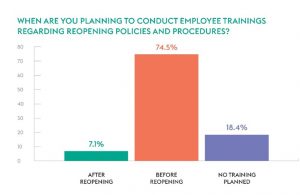
2. Training employees before they return to work on any new COVID-related policies and protocols is a critical step in the reopening process. Information and communication are key to ensuring a safe and smooth return. In an informal poll of our webinar audience, almost 75% of respondents indicated that they are planning to conduct employee training prior to reopening. Leverage technology to hold virtual training sessions, or record training videos to distribute via email. In some cases, you may be able to host an in-person training for a small group but follow appropriate social distancing guidelines and remember that any training time is compensable. Training should be customized to address different audiences, for example, separate sessions for HR, managers/supervisors, and frontline non-exempt employees. Managers should be trained on how to handle employee complaints, respond to employees with COVID-19 symptoms and handle employees who were diagnosed with COVID-19 when they are ready to return to work. All employees should be trained on new safety protocols and requirements, including social distancing, face coverings, temperature, symptom screenings in addition to revised sick leave and attendance policies, and the process to report any safety issues. Consider creating an acknowledgement or consent form requiring employees to affirm notice and compliance with these new policies as well.
3. Be flexible when handling ADA disability accommodation requests upon reopening. These are unique times, which require unique and creative solutions. The typical accommodations you may have made for an employee may not work in the current work environment because of safety or hardship reasons. Accommodations may also be temporary—communicate clearly if there is a specific end date. Under the ADA, only “qualified individuals with disability” are covered, so employees only have the right to request reasonable accommodation for their own disability (e.g., not covered as caregiver for sick parent or child at home, though they may be eligible for leave under FFCRA or FMLA). The ADA covers a wide range of disabilities, and the effects of the virus could exacerbate some mental health issues such as anxiety, obsessive-compulsive disorder and PTSD. If an employee requests an accommodation, employers must engage in an interactive process. The first step is to ask questions. How does the disability limit the employee’s ability to perform his or her job function? If not obvious from the description, you may need to request medical documentation or rely on alternatives, such as a prior doctor visit, or previous accommodation documentation if not outdated, or even a telemedicine consult. Discuss the requested accommodation with the employee and explore your options to allow him/her to continue to effectively perform the essential functions of the job. Accommodation requests may vary and depend on industry, work environment and individual job responsibilities. Some common COVID-19 related accommodations include additional PPE, workplace changes like plexiglass and one-way aisles, temporary restructuring of marginal job duties, modified work schedules, location changes and remote work. In some instances, if no accommodation is feasible, you may need to consider placing the employee on leave, often as a last resort.
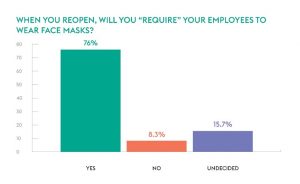
4. One of the more important issues for employers and a common request is an exception to wearing a mask. Many state and local governments are requiring the use of face coverings, including within the workplace. More than 75% of our webinar poll respondents indicated they will require employees to wear face masks upon returning to work. When addressing requests for an exception to wearing a mask, whether due to respiratory issues, anxiety, claustrophobia or another disorder, it is important to balance accommodating a medical need with safety concerns for your workforce. Consider the work environment and conduct an individualized assessment of the facts (including an employee’s limitations). Use the interactive process to find alternatives to accommodate the request, whether you have the employee telework or change job duties to avoid coming into contact with others.
5. Due to the COVID-19 pandemic, OSHA is more important than ever across all industries, not just those at high risk (e.g., healthcare, manufacturing). Under federal OSHA guidelines, employers must provide a workplace free of known health and safety hazards that complies with OSHA standards and employees may report potential violations without fear of retaliation. OSHA also requires that employers report a case of COVID-19 if confirmed and is work-related and involves one or more of the general recording criteria, such as medical treatment beyond first-aid, days away from work or death. In addition, there are local state OSHA rules that employers should consider as they establish new policies and protocols upon reopening their workplace. Thirty states currently require COVID-19 preparedness plans, outbreak plans and/or hygiene training. Some features of state requirements include a site plan, protocols re: masks and physical distancing, screening, sanitizing and cleaning, training of employees and posting of plans. As employees return to the workplace, employers should continue to train managers and supervisors on how to address any safety-related complaints. Complaints should be taken seriously and addressed directly with the employee to better understand the issues or concerns. Employers should then communicate the results and let the employee know how the issue was resolved. In all cases, there should be no retaliation and management should apply policies consistently to mitigate the risk of further claims.



Invalidity of a Bond Condition with Unrestricted Permission for Creditors to Pass Resolutions on the Rights and Obligations of Investors
ARTICLE
Invalidity of a Bond Condition with Unrestricted Permission for Creditors to Pass Resolutions on the Rights and Obligations of Investors
May 2020
Read time: 2 min
The requirement of transparency is not satisfied if, when a registered bond is issued, a clause allows creditors to pass resolutions on the rights and obligations of investors without any restrictions.

Belt Fastener Trade Dress Conveyed as Invalid for Being Functional
ARTICLE
Belt Fastener Trade Dress Conveyed as Invalid for Being Functional
May 22, 2020
Read time: 1 min



COVID-19 Impact on Statutes of Limitations and Timing for Other Filings
ARTICLE / CLIENT ALERT
COVID-19 Impact on Statutes of Limitations and Timing for Other Filings
May 22, 2020
Read time: 21 min
To help potential litigants evaluate how various executive orders may impact their filing deadlines, we examine executive orders in New York, and other select states, tolling the statute of limitations. This article also provides ideas for how litigants can obtain relief with respect to the timing of their filings in the wake of COVID-19.
In response to the COVID-19 pandemic, many states have instituted orders dramatically restricting the normal course of business, or nearly shutting it down altogether. Courts around the United States typically have not been excluded from the scope of these orders, thereby preventing judges and other court personnel from coming to work. New York, in particular, determined that it would shut its doors to new case filings, as well as all other filings in pending non-essential civil matters, while the state deals with one of the world’s largest outbreaks of COVID‑19.
While most states have kept courts open to new case filings and motion practice, potential litigants are often still burdened by stay-at-home orders that could impede or prevent parties from bringing an action or making timely filings. As a result, many potential litigants must now evaluate whether and to what extent various executive orders have impacted (or may continue to impact) their filing deadlines. On May 25, 2020, New York’s courts will be re‑opened for e-filing—including the filing of new non-essential matters. Because new matters can now begin again, below we analyze New York’s executive orders tolling the statute of limitations and provide ideas for how litigants in other states can obtain relief with respect to the timing of their filings in the wake of COVID-19. In addition, because some other states around the country similarly tolled their statutes of limitations, we provide an overview of select states to assist in analyzing statutes of limitations in jurisdictions other than New York.
I. New York
In New York, on March 20, 2020, Governor Andrew M. Cuomo issued Executive Order No. 202.8, which, among other things, directs that:
…any specific time limit for the commencement, filing, or service of any legal action, notice, motion, or other process or proceeding as prescribed by the procedural laws of the state, . . . or by any other statute, local law, ordinance, order, rule, or regulation, or part thereof, is hereby tolled from [March 20, 2020] until April 19, 2020.
On March 22, 2020, Chief Administrative Judge Lawrence Marks issued administrative order AO/78/20, which implemented the executive order and curtailed the receipt of filed papers by Unified Court System courts and county clerks in litigation matters. The administrative order applies to both paper and electronic filings, and extends to all trial courts.
The executive order has a widespread effect on the due dates for civil filings in New York state courts. First, the executive order applies to the commencement of new cases, thereby tolling the statute of limitations for the effective time of the executive order. This aspect of the order has garnered attention—and rightfully so—as the tolling of the statute of limitations has significant impact on the legal rights of litigants.
Second, the executive order applies to pending actions, because it tolls the “specific time limit for the . . . service of any . . . motion, or other process or proceeding,” including by an “order.” Accordingly, the executive order should be interpreted to toll any deadlines in any particular court’s scheduling orders for the period prescribed by the executive order.
Since the original issuance of Executive Order No. 202.8, Governor Cuomo extended the order two times. On April 7, 2020, through Executive Order No. 202.14, the tolling period was extended from April 19, 2020, until May 7, 2020. On May 7, 2020, through Executive Order No. 202.28, Governor Cuomo extended the tolling period from May 7, 2020, until June 6, 2020.
On May 20, 2020, Administrative Judge Marks circulated a memorandum stating that starting on May 25, 2020, “e-filing through the NYSCEF system—including the filing of new non-essential matters—will be restored in those counties of the state that have not yet met the benchmarks required to participate in the Governor’s regional reopening plan. Those counties include the five New York City counties, Nassau and Suffolk counties, and Dutchess, Orange, Putnam, Rockland, Ulster, and Westchester counties.” In other words, when coupled with the counties that met Governor Cuomo’s metrics for Phase I reopening, all New York courts are now open for filing new cases through the state e-filing system.
As of the publication date of this article (May 22, 2020), the tolling period created by these executive orders totals 78 days[OE1] . The question now becomes how this tolling period should be applied in practice, particularly now that New York courts are re-opened for e-filing. For statute of limitations questions, the analysis is fairly straightforward:
- For causes of action that accrued prior to March 20, 2020, and could have been timely filed as of that date, the litigant’s statute of limitations period is tolled for 78 days[OE2] .
- For causes of action that accrued during the March 20, 2020, to June 6, 2020, time period, the litigant’s statute of limitations period will be tolled for the number of days between the claim accrual date and June 6, 2020. For example, if a party’s cause of action accrued on May 6, 2020, then the litigant’s statute of limitations will be tolled for 31 days.
Although the effect of these extensions of the executive order are clear with respect to their impact on various statutes of limitations, there is tension between the extensions provided by the executive order and the May 1, 2020, administrative order issued by Chief Administrative Judge Marks (AO/87/20). In AO/87/20, Administrative Judge Marks detailed the expansion of New York’s virtual court operations, including the acceptance of filings in currently pending actions, as of May 4, 2020. As a result, although the executive orders direct that the tolling period on motion practice is extended until June 6, 2020, the administrative order opened the New York court system’s doors to filings that would otherwise have been tolled under the executive order.
This leaves many questions for litigants. Clearly, parties may file new motions in currently pending actions in accordance with the procedures outlined in the May 1 administrative order. But, suppose that a litigant’s opposition papers to a motion for summary judgment pursuant to CPLR 3212 were due on March 31, 2020. Does that litigant get the benefit of the entire tolling period provided for in the executive orders, such that its time to file the opposition starts counting down again on June 6, 2020? Or, because courts are now open for filings in pending actions, did that same litigant’s filing clock resume as of May 4, 2020, because the litigant can comply with a court’s scheduling order by filing papers? Further, if a party’s deadline to file a note of issue was April 15, 2020, does that litigant’s filing clock resume on May 4, 2020, or June 6, 2020?
In light of the ambiguity created by the executive orders and the May 1 administrative order, litigants should attempt to reach agreement with opposing counsel as to the appropriate deadline and file a stipulation with the applicable court. If an agreement cannot be reached, then litigants should seek guidance from the judges presiding over their matters.
We do not believe the same ambiguities are present with respect to the statute of limitations analysis discussed above, even though Administrative Judge Marks has allowed for the e-filing of new, non-essential matters as of May 25, 2020—a week before the statute of limitations tolling expires pursuant to Governor Cuomo’s executive orders. Any accrued but not filed matters are not subject to any court order, and thus, there is no possibility of tension between a court’s scheduling order and the executive and administrative orders detailed above. That said, in the event that there was less than a week left in the time prescribed by a statute of limitations when New York’s courts closed their doors to new filings, litigants would be wise to file and serve their complaints soon after May 25, 2020, to avoid any potential motion practice regarding the timeliness of the complaint.
II. Other States
Other states have responded to the COVID-19 pandemic in other ways that will impact the statute of limitations for the filing of new actions, rendering it imperative that litigants determine the impact of any COVID-19 order or other action on their deadlines. A few examples are below:
A. California
On April 6, 2020, the Judicial Council of California approved 11 emergency rules to respond to the pandemic.[OE3] (See: Emergency Rules 1, 2, 3, 4, 5, 6, 7, 8, 9, 10 and 11 of the California Rules of Court (Apr. 6, 2020), https://jcc.legistar.com/View.ashx?M=F&ID=8234474&GUID=79611543-6A40-465C-8B8B-D324F5CAE349.) Emergency Rule 9 tolls the statute of limitations for civil actions from April 6, until 90 days after Governor Gavin Newsom declares that the state of emergency related to COVID-19 is lifted. (Id.) Given the lack of dates in Emergency Rule 9, litigants will need to wait until Governor Newsom takes action to calculate the tolling period provided by the emergency rules.
B. Delaware
On May 14, 2020, the Delaware Supreme Court issued an administrative order that, among other things, provides that the statutes of limitations and statutes of repose that would otherwise expire during the period between March 23, 2020, and June 13, 2020, are extended through July 1, 2020. (See: Supreme Court of the State of Delaware, Administrative Order No. 6 (May 14, 2020), https://courts.delaware.gov/rules/pdf/COVIDOrderCJS3.pdf.) The order does not apply to deadlines, statutes of limitations and statutes of repose that are not set to expire between March 23, 2020, and June 13, 2020. (Id.)
C. Georgia
On March 14, 2020, the chief judge of the Supreme Court of Georgia issued an order tolling all deadlines or filings requirements—including statutes of limitations—through April 13, 2020. As of the date of this publication, the tolling date has been extended twice and most recently extended through June 12, 2020. (See: Supreme Court of Georgia, Second Order Extending Declaration of Statewide Judicial Emergency (May 11, 2020).) However, judges are granted authority to, on a case-by-case basis, re-impose specific deadlines that would otherwise be tolled by the order.
D. Massachusetts
On April 27, 2020, the Massachusetts Supreme Judicial Court issued an order tolling all statutes of limitation from March 17, 2020, through May 31, 2020, effective May 4, 2020. (See: Massachusetts Supreme Judicial Court, Order in re: COVID-19 (coronavirus) pandemic (Apr. 27, 2020). The order repealed and replaced the prior court order regarding the COVID-19 pandemic.)
E. Texas
On April 27, 2020, the Texas Supreme Court issued an order extending all service and filing deadlines—including statutes of limitations—in civil cases between March 13, 2020, and June 1, 2020, until July 15, 2020. (See: Supreme Court of Texas, Twelfth Emergency Order Regarding the COVID-19 State of Disaster (Apr. 27, 2020).) The extension does not apply to statutes of limitation that are not scheduled to expire between March 13, 2020, and June 1, 2020. In addition, the order does not affect filing deadlines for appeals or other appellate proceedings but notes that requests for relief from existing deadlines should be directed to the presiding court and “generously granted.” (Id.)
F. Illinois and Florida
Although the highest state courts in Illinois and Florida issued orders in response to COVID-19, the orders do not toll or extend statutes of limitations.
III. Additional Considerations
It is an understatement to say that COVID-19 and the government’s response to it creates uncertainty with respect to the administration of justice. As just one example, it is unclear whether a federal court sitting in diversity would consider tolling orders controlling substantive state law in the absence of binding state case law. There is even more uncertainty about how state courts will evaluate the effect of another state’s COVID-19 tolling order. Moreover, any tolling orders issued by states only apply to state law causes of action, so statutes of limitations for federal claims never stopped running, as they are still subject to federal rules and statutes. Further, the impact of these orders is murky with respect to the fact that contracts that include the parties’ negotiated limitations periods and procedures may fall outside the scope of the tolling orders, even with the broad language.[OE4]
Finally, in states that have not enacted tolling orders in response to COVID-19, litigants should still be mindful to assert their claims in a timely fashion. Although courts may consider applying the traditional doctrine of equitable tolling in these circumstances, the doctrine is rarely applied in practice, and there has been no clear indication that complications created by the pandemic will be enough for litigants to win the argument that equitable tolling can save an otherwise stale claim. (See, e.g., Halstrom v. Dube, 481 Mass. 480, 485 (2019) (explaining that courts apply equitable tolling “sparingly” and listing cases outlining the criteria); Aguilera v. Heiman, 174 Cal. App. 4th 590, 598, 95 (2009) (“Equitable tolling requires . . . (1) timely notice to the defendant . . . (2) lack of prejudice to defendant in gathering evidence to defend against the second claim; and, (3) good faith and reasonable conduct by the plaintiff in filing the second claim.’”)
IV. Conclusion
We will all be living with the effects of the COVID-19 pandemic for years to come. One small issue—but highly relevant to litigators and their clients—will be the impact this pandemic has on how we calculate statutes of limitation in the future. Litigants should ensure that they are up to date on orders that may impact those calculations.


Five Takeaways: Navigating President Trump’s Executive Order on US Bulk Power System Electric Equipment
ARTICLE
Five Takeaways: Navigating President Trump’s Executive Order on US Bulk Power System Electric Equipment
May 21, 2020
Read time: 4 min
President Trump’s May 1, 2020 Executive Order prohibiting certain transactions involving bulk-power system electric equipment developed, manufactured or supplied by a foreign adversary could have far-reaching implications for both the renewable and conventional power industries. It has also raised a high level of uncertainty and risk while the industry awaits the actual implementation of the Executive Order. This interim period, as well as the breadth of the Executive Order, raises key questions and concerns for sponsors and developers of energy projects, construction contractors and energy project investors. Read our latest On the Subject for more in-depth information.
Five takeaways from this week’s webinar below:
- The Bulk Power System is defined broadly as the system necessary to maintain interconnected transmission systems and to maintain reliability. Bulk Power System electrical equipment, in turn, is an enumerated list of 20 types of equipment mentioned in the Executive Order that are used in the bulk power system. Even if a piece of equipment fits within the defined terms, though, the equipment needs to be sourced from a foreign adversary and cause an “undue risk” to US national security, US critical infrastructure, or US persons to be subject to the Executive Order’s implementing regulations.
- There are a number of questions about what types of equipment are included under the Executive Order. The Executive Order does not apply to distributed generation facilities (such as residential solar). However, the Executive Order’s use of the undefined terms “generating power stations” and “large generators” raises questions about the inclusion of utility scale solar, wind and battery storage equipment and projects. The Department of Energy has stated that for equipment already incorporated in the bulk-power system, there is nothing owners or operators need to do at this time, but for new orders of bulk-power equipment, the industry must navigate the interim period between the Executive Order and the implementing regulations to be issued at the end of September.
- As a risk mitigation strategy for new orders of bulk-power system equipment, whether specifically cited in the Executive Order or omitted, it is important to do a holistic analysis of the equipment to determine whether the components are captured by the Executive Order and, if so, whether such equipment or project as a whole is sourced or travels through a foreign adversary (which many consider to be China and Russia, amongst potentially others). This analysis must be completed within a matrix of risk factors and across a spectrum of risk levels to ensure you can show a good faith effort not to cause an “undue risk” to US national security, US critical infrastructure, or US persons.
- Despite the temporal connection between the Department of Commerce Section 232 investigation on imported electrical transformers and certain components of transformers, the Department of Energy has emphasized in a number of forums that the Executive Order was issued to address cybersecurity risks.
- Tax rules are clear that for projects that intend to usesafe harbor/physical work equipment that is later prevented from being installed in a project by reason of the Executive Order, taxpayers will not be able to rely on such equipment for the beginning of construction rules. Tax rules are unclear as to the implications for equipment that has already been placed in service, but which must later be removed.
Have follow-up questions?
“Off the Clock” Discussion: We are working with our clients on risk assessments and strategies to address the issues presented by the Executive Order. If you would like to discuss your particular equipment, project or transaction, we would be happy to arrange a 20-minute discussion with our team. Request a meeting.
Commenting Period: We are working with others on a strategy and framework for providing comments during the Order’s comment period. If you would like to discuss joining a group of like-minded individuals in this endeavor, we would welcome speaking with you. Request a meeting.
Access past webinars in this series.