













ARTICLE
‘Like a Game of Jenga’: Return of E-Filing Will Start Crowded Period for New York Courts, Lawyers Say
May 21, 2020
Read time: 1 min
Key takeaways
Overview
In depth

More insights



ARTICLE
May 21, 2020
Read time: 1 min
ARTICLE
May 21, 2020
Read time: 5 min
The COVID-19 pandemic has put unprecedented strain on organizations of all sizes across all industries. The uncertainty of the “new normal” is leading some employers to consider extreme, and often unnecessary, new policies in anticipation of the eventual return to work. To properly navigate the complexities of these novel COVID-19 employment issues, you need innovative but practical solutions.
Learn key takeaways from our third webinar in our Return to Work Virtual Toolkit series that focuses on how to avoid legal landmines as you prepare to bring your employees back to work.
Watch the “How Employers Should Prepare for the End of the COVID-19 National and Public Health Emergencies” webinar recording to learn more.
1. As businesses reopen, all employment-related decisions will be subject to heightened scrutiny, particularly those that only impact a portion of the workforce. It is critical to have clear policies and communication detailing how employees will be brought back to work and to ensure such policies are based on non-discriminatory criteria. If objective criteria were utilized in making hiring/furlough/termination decisions when stay-at-home orders were initially implemented, consider utilizing similar framework for return to work decisions while also being mindful of eliminating unconscious bias. To the extent requests for accommodations are made, follow EEOC guidance and ensure engagement in the interactive process.
2. Many employers are only able to bring back a portion of the workforce in the initial phase of reopening. Consider whether your return to work policies or protocols, including deciding who returns and when, may create a disparate impact on certain protected workers. While a formal impact analysis following EEOC guidance does not necessarily need to be done, an informal “gut check” of employment decisions can help avoid unconscious bias, and ensure that returning employees reflect the diverse workforce many businesses have worked hard to maintain. Return to work protocols must be implemented consistently for all employees, and without discrimination, harassment and retaliation.
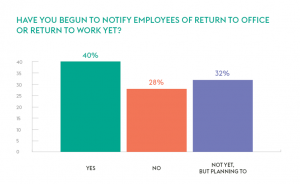
3. 40% of our webinar attendees indicated they have already begun to notify employees of return to office or return to work plans. When bringing employees back to the office or back from a furlough, employers should send a written notice of recall and/or return to office, addressing the date of recall and/or return, any changes related to PPE requirements, policies and economics. If considering salary reductions, remember that employers are not permitted to reduce wages below the federal and applicable state minimum wage, and for exempt employees, salaries cannot be reduced below federal and any applicable state threshold. It is important to evaluate the job duties and responsibilities of employees who are classified as exempt but who may have had changes in their role because of COVID-19 to ensure that their return to work duties still meet the requirements of the applicable exemption. Ensure that systems and policies are in place to track hours for non-exempt employees and also follow applicable state meal and rest break requirements.
4. As employees return to work, you have an obligation as an employer to prevent workplace harassment and discrimination. Remain familiar with anti-harassment and anti-discrimination policies and communicate to all employees that harassment and discrimination are illegal and will not be tolerated in the workplace. For example, while fear of COVID-19 is valid, it should not and cannot be misdirected against an individual because he/she falls into a protected category. This applies to both employees working physically in the office and those who continue to work remotely. Training supervisors of the policies and employees on available reporting channels is also advisable.
5. Under the federal Worker Adjustment and Retraining Notification (WARN) Act, most employers with 100 or more full-time employees are required to provide 60 calendar days advance notification of plant closings and mass layoffs. There are exceptions to the federal WARN notice requirement in the event (i) the closing or mass layoff is caused by business circumstances that were not reasonably foreseen at the time notice would have been required, (ii) for a faltering company, or (iii) because of a natural disaster. However, even if an exception applies, any event that triggers WARN still requires notice to affected employees. Some states also have mini WARN acts that may have different notice requirements. Employers should work with counsel to ensure they are fully complying with federal and state laws.




ARTICLE / CLIENT ALERT
May 20, 2020
Read time: 2 min
In response to the COVID-19 public health emergency (PHE), legislators and regulatory agencies provided significant flexibility around telehealth services delivered to Medicare beneficiaries. And, while CMS has the authority to make certain permanent modifications to telehealth reimbursement, other modifications require congressional action. This analysis from McDermott is designed to help you evaluate which policies would be beneficial to extend beyond the expiration of the PHE.
Mara McDermott, Jessica Roth and Rachel Stauffer co-authored this analysis.




ARTICLE / CLIENT ALERT
May 20, 2020
Read time: 6 min
A proposed ballot initiative in California known as the California Privacy Rights Act, which is likely to pass if placed on the 2020 ballot, would both clarify and expand the existing California Consumer Privacy Act. Companies doing business in the state should closely monitor these developments and prepare for compliance, as we outline in this article.
A California ballot initiative known as the California Privacy Rights Act (CPRA) would clarify and expand the California Consumer Privacy Act (CCPA), granting significant new rights to consumers and imposing additional liability risks on companies doing business in the state. The CPRA is an update to the California Privacy Rights and Enforcement Act (CPREA) ballot initiative, which was proposed in late 2019 by the Californians for Consumer Privacy, which also sought to broadly amend and prevent changes to the CCPA that would undermine its consumer protections.
The proposed ballot initiative, submitted by the architects of the CCPA, garnered 900,000 signatures, far more than the roughly 625,000 necessary for certification on the 2020 ballot. Early polling reportedly shows strong support for the measure, so assuming the signatures are approved and the CPRA is placed on the ballot, it is considered likely to pass and to take effect on January 1, 2023.
The CPRA proposes a myriad of changes, and this article will not address them all. What follows is a discussion of the most significant changes for businesses and consumers in California, followed by enforcement and implementation considerations.
New Clarifications, Rights and Responsibilities
In a number of areas, the CPRA would modify the current CCPA in ways that are likely to be welcomed by companies grappling with the often ambiguous and unclear obligations under the current law:
However, these changes are largely overshadowed by the initiative’s imposition of significant new rights for consumers and responsibilities for businesses subject to the CCPA. These include the following requirements:
Enforcement and Amendments
In addition to its substantive changes, the proposed initiative would significantly alter the way the CCPA is enforced and implemented. Although the proposal would not create a new private right of action, it would create a new administrative agency, the California Privacy Protection Agency (Agency), which would be governed by a five-member board appointed by a combination of the California governor, attorney general, Senate Rules Committee and speaker of the assembly. Once the CPRA goes into effect, the attorney general may still bring civil actions for violations of the CCPA; however, the Agency would be vested with full administrative power, authority and jurisdiction to implement and enforce the CCPA and adopt regulations to further the purpose of the CCPA.
Unlike the original CCPA ballot initiative, which would have required a supermajority to amend, the new initiative would be subject to amendment by the California legislature through the normal legislative process, with one major caveat: the laws must be “consistent with and further the purpose” of the initiative. Should the initiative pass, this provision could significantly limit further amendments to the CCPA, and is likely to engender debate over what changes do or do not “further the purposes” set out in the initiative.
If passed, the CPRA will have significant impact on companies doing business in California. As companies continue to evaluate their compliance posture with the CCPA, they should also closely monitor developments with the CPRA and begin preparations for compliance.


ARTICLE / CLIENT ALERT
May 20, 2020
Read time: 7 min
The final debt-equity regulations issued on May 13, 2020, finalize proposed section 385 regulations issued in 2016 without any substantive changes to the existing debt-equity regulations, and withdraw the temporary section 385 regulations issued in 2016. Taxpayers should consider the impact of these regulations on related party debt transactions to avoid recharacterization of debt into equity.
On May 13, 2020, the US Department of the Treasury and the Internal Revenue Service (IRS) issued final debt-equity regulations under section 385 (2020 Final Regulations). The 2020 Final Regulations finalize proposed section 385 regulations issued in 2016 without any substantive changes to the existing debt-equity regulations, and withdraw the temporary section 385 regulations issued in 2016.
Section 385 authorizes the IRS and the Treasury to issue regulations to determine whether an interest in a corporation may be treated as debt or equity for US federal income tax purposes. If a debt instrument is recharacterized as equity, then the interest expense associated with the debt would be disallowed. Taxpayers should consider the impact of these regulations on related party debt transactions to avoid recharacterization of debt into equity.
2016 Section 385 Regulations
On October 21, 2016, the Treasury and the IRS published final and temporary regulations under section 385 (2016 Final Regulations and 2016 Temporary Regulations, respectively). On the same day, the Treasury and the IRS issued proposed regulations that incorporate by reference the 2016 Temporary Regulations (the 2016 Proposed Regulations). Both the 2016 Final Regulations and the 2016 Temporary Regulations recharacterized certain “covered debt instruments” as stock. Although the 2016 Temporary Regulations expired on October 13, 2019, taxpayers have been able to rely on the 2016 Proposed Regulations if they consistently applied the regulations in their entirety.
The 2016 Final and Temporary regulations set forth two sets of rules that significantly affected taxpayers, particularly multinationals: the documentation rules in Treas. Reg. section 1.385-2, and the distribution rules set forth in Treas. Reg. sections 1.385-3, 1.385-3T and 1.385-4T (Distribution Regulations). In November 2019, the Treasury and IRS withdrew the documentation rules, but indicated that they may introduce a modified, simpler documentation requirement in the future. The 2020 Final Regulations finalize the distribution rules set forth in the 2016 Temporary Regulations, which primarily relate to short-term debt instruments, controlled partnerships and consolidated groups.
Overview of the Distribution Regulations
Under the Distribution Regulations, if a covered member of an expanded group issues a covered debt instrument to another member of the expanded group in connection with a distribution, or an economically similar acquisition transaction, the covered debt instrument may be recharacterized as stock. An “expanded group” generally includes all domestic and foreign corporations connected through one or more 80% stock ownership chains with a common parent where (i) the common parent owns directly or indirectly at least 80% of the vote or value of at least one such corporation, and (ii) one or more of such corporations own directly or indirectly at least 80% of the vote or value of each such corporations. The term “expanded group” excludes S corporations, regulated investment companies and real estate investment trusts. A “covered member” is a member of an expanded group that is a domestic corporation. A “covered debt instrument” is generally a debt instrument issued after April 4, 2016, by a covered member that is not an excepted regulated financial company or a regulated insurance company. The term “covered debt instrument” does not include certain debt instruments issued by a dealer in its ordinary course of business and certain contractual arrangements that are treated as debt instruments under other provisions of the Internal Revenue Code or Treasury regulations.
Special rules apply to the treatment of covered debt instruments in the case of controlled partnerships and consolidated groups. For example, the distribution regulations generally treat a controlled partnership as an aggregate of its expanded group partners. Thus, a debt instrument issued by a controlled partnership is treated as issued by the expanded group partners in proportion to their partnership interest. Also, members of a consolidated group are generally treated as one corporation, and a debt instrument issued by a member to a non-member is treated as issued by the consolidated group.
The Distribution Regulations further provide, pursuant to a funding rule, that a covered debt instrument is recharacterized as stock if it is (i) issued by one member to another member of the same expanded group in exchange for cash or property, and (ii) under the “per se funding rule” or “principal purpose rule,” treated as funding certain distributions to a member of the expanded group or certain acquisitions of property or stock of a member of the same expanded group. The principal purpose rule applies where a covered debt instrument is issued by a funding member outside of the per se funding period (as described below) with the principal purpose of funding such a distribution or covered acquisition transaction. Whether a covered debt instrument is issued with a principal purpose of funding a distribution or covered acquisition is determined based on all the facts and circumstances. “Qualified short-term debt instruments,” such as certain short-term funding arrangements, ordinary-course loans, interest-free loans and cash-pooling arrangements, are excluded from these distribution provisions.
Future Withdrawal of the Per Se Funding Rule
Under the per se funding rule, a covered debt instrument is automatically treated as funding one of the above distributions or acquisitions if the covered debt instrument is issued in exchange for property within a 72-month window, beginning 36 months before and ending 36 months after the date of the distribution or acquisition. Since its issuance, the per se funding rule has been highly criticized because it would result in harsh consequences regardless of taxpayers’ actual use of the proceeds from the covered debt instrument. On November 4, 2019, the IRS issued an advance notice of proposed rulemaking that announced that the Treasury and the IRS intended to propose streamlined and targeted recast rules under section 385, including by withdrawing the per se funding rule. According to the IRS, the new proposed regulations would not treat a debt instrument as funding a distribution or economically similar transaction solely because of their temporal proximity. Rather, the new proposed regulations would apply the funding rule to a debt instrument only if there is sufficient factual connection between the issuance of the debt instrument and the distribution or economically similar transaction.
Importantly, the 2020 Final Regulations simply finalized the 2016 Proposed Regulations and did not simplify the distribution rules or withdraw the per se funding rule. Instead, the IRS and the Treasury continue to study all appropriate modifications to the recharacterization rules under section 385 and “intend to issue proposed regulations modifying the Distribution Regulations to make them more streamlined and targeted, including by withdrawing the per se rule.”
Commentators speculated that the Treasury and the IRS would greatly limit the section 385 regulations once the guidance relating to the interest expense limitation under section 163(j) was finalized, or when the stricter interest expense limitation under section 163(j) takes effect. However, in response to the pandemic, the Coronavirus Aid, Relief, and Economic Security (CARES) Act temporarily lightened the interest expense limitation under section 163(j) by, among other things, increasing the limitation from 30% to 50% of a taxpayer’s adjusted taxable income for years beginning in both 2019 and 2020. The CARES Act also temporarily suspended the 80% limitation on net operating loss (NOL) carryforwards under section 172 for years beginning before 2021, and generally allows five-year NOL carrybacks. It is possible that the Treasury and the IRS decided to not scale back the Distribution Regulations at this time because the temporary modifications under the CARES Act already eased the restrictions on interest expense deduction and NOL usage. It is evident that the Treasury and IRS will finalize the Distribution Regulations in the future based upon their statements in the 2020 Final Regulations and other recent pronouncements, but the timing is unknown.
Taxpayers should continue to be mindful of the section 385 regulations’ impact on related party debt transactions. While the documentation rules have been withdrawn, the distribution rules may still recharacterize certain related party debt instruments as equity in a variety of contexts, particularly where a domestic corporation borrows from a related foreign or domestic corporation that is not a member of the same consolidated group.





ARTICLE
May 19, 2020
Read time: 4 min
The US Court of Appeals for the Sixth Circuit affirmed that a state court’s finding of “willful and malicious injury” in connection with the misappropriation of trade secrets entitled the plaintiff, in the defendant’s subsequent bankruptcy proceeding, to summary judgment of nondischargeability on collateral estoppel grounds. In re Hill, Case No. 19-5861 (6th Cir. May 4, 2020) (Donald, J.).
Aaron Hill and the other principals of First Meridian Mortgage Corporation agreed to sell First Meridian to CMCO Mortgage, where the former principals would build and manage an internet division. After the sale, Hill accepted an offer to work for CMCO’s competitor, Peoples Bank. CMCO later terminated Hill, alleging that he had breached his contract, provided trade secrets to Peoples and unlawfully recruited CMCO employees to Peoples. CMCO sued Peoples and Hill in Kentucky state court on a variety of theories, including misappropriation of trade secrets and tortious interference. Peoples originally funded Hill’s defense, but it stopped after it settled with CMCO. Hill then proceeded pro se.
After Hill failed to attend a pretrial conference, the state court entered default judgment against him, including a finding that Hill had “caused a willful and malicious injury” to CMCO. Hill then failed to appear for the damages trial, and the state court entered a money judgment of almost $3.5 million against him.
Between the damages trial and the entry of final judgment, Hill filed for bankruptcy. CMCO filed a proof of claim in the bankruptcy court, which lifted the automatic stay with respect to the money judgment. CMCO then filed an adversary proceeding against Hill and sought summary judgment that the judgment was nondischargeable in Hill’s Chapter 7 bankruptcy proceeding because it arose from “willful and malicious injury by the debtor.” The bankruptcy court granted the motion on collateral estoppel grounds. Hill appealed to the district court, which affirmed, and then to the Sixth Circuit.
On appeal, Hill contended that collateral estoppel did not apply because he had been denied an opportunity to be heard and the elements of collateral estoppel were not satisfied. The Sixth Circuit held that the state court had satisfied any procedural requirements. The Court then reviewed each of the four elements of collateral estoppel under Kentucky law, finding:
Practice Note: Only after the entry of judgment against him, Hill expended enormous resources appealing the state court judgment all the way to the Kentucky Supreme Court and the bankruptcy judgment to the Sixth Circuit. All of that—and the adverse result—might have been avoided had he appeared in the state court action. To paraphrase Benjamin Franklin, sometimes an ounce of prevention can be worth much more than a pound of cure.




ARTICLE
May 20, 2020
Read time: 2 min
This Governing Health series examines how traditional governance practices may change and how boards of directors can position themselves to proactively support their organizations now and as they recover from the COVID-19 shutdown. Throughout the series, we’ll take increasingly closer looks at important aspects of corporate governance that will be shaped by this global crisis.
Are you prepared to re-evaluate your governance policies and procedures? Our team explores 10 areas boards should review in a post-COVID-19 world.
Watch our video breakdown of the ways corporate governance may change. View the video here.


ARTICLE
May 19, 2020
Read time: 1 min





ARTICLE
May 19, 2020
Read time: 1 min

ARTICLE
May 2020
Read time: 1 min


