ARTICLE
Five Takeaways: Early Moves and Current Trends in Energy Storage
May 29, 2020
Read time: 6 min
McDermott continues its dialogue with renewable industry leaders to provide the latest market updates on the disruption, challenges and opportunities COVID-19 presents to the industry. This week, we focused on the energy storage market and hosted Chris McKissack, CEO at GlidePath Power Solutions. Glidepath was an early mover in energy storage. GlidePath is now one of the largest energy storage developers and independent power producers in the US, with over 100MW of commercially operating battery projects, 445 MW of battery storage and renewable energy projects, and 2.1 GW of greenfield development pipeline of battery storage projects across the US. We had an engaging discussion spanning the benefits of being an early mover in the storage space, the current state of the dynamic energy storage market, and successful strategies you can use to approach the opportunities and challenges stemming from COVID-19.z
1. Batteries Can Now Serve as “Shock Absorbers” for the Grid
Batteries are capable of doing much more than just “energy shifting,” where a developer simply stores energy from a solar project from one time of day and dispatches it onto the grid at another time of day. For instance, we are now able to place stand-alone batteries closer to load than most large-scale wind and solar projects. This provides an opportunity for frequency response and regulation in that it allows grid operators to dispatch generators more efficiently. This is important to today’s market. 60 years ago, we had an unpredictable load, but very predictable generation. You could ramp-up and ramp-down generation by turning a dial. Today, we have more and more intermittent resources and renewables dispatching the grid resulting in more demand response. We now have both unpredictable load and unpredictable generation, making it much more difficult for the operators of the grid to balance the two. There is an opportunity for batteries act like shock absorbers for the grid and keep things stable.
2. Batteries Remain Key to Energy Shifting and Financial Energy Arbitrage
Despite the versatility of batteries, energy shifting remains an important use for batteries, particularly for financial energy arbitrage. Batteries provide an opportunity for load customers to marry their purchase of energy with their load and shape it to a particular financial profile. We see a lot of this usage by datacenters today and this trend will continue.
3. Early Movers in Energy Storage Will Likely Emerge from COVID-19 Even Stronger
The battery energy storage market was poised for a period of sustained growth in 2020 and 2021, but it is unlikely to emerge totally unscathed from COVID-19. According to some forecasts, market growth is now forecast to decline for 2020. The pace of the recovery will depend how quickly the COVID-19 crisis is resolved. However, depending on the agility of the company’s management and the status of the development of its projects going into COVID-19, some battery storage companies may come out of COVID-19 even better positioned in the market. Some will not skip a beat. Those that are late movers in storage likely have early stage development requirements such as town hall meetings and local permitting processes that have been placed on hold due to stay-at-home orders. Early movers in energy storage, however, have the advantage of mature portfolios where much of the early stage development requirements are out of the way and they can instead focus on positioning themselves in the market. One example is Glidepath’s ability to successfully go to market during the pandemic to sell its portfolio of energy storage projects in New York, each of which is fully developed, shovel-ready, and past the permitting and interconnection processes. It helps that Glidepath’s management and development team have been headquartered in Illinois, but working remotely for years due to the need to be spread out across the country on 18 different projects.
4. Versatile Energy Storage Products Require Bespoke Offtake Products and Arrangements.
Over time, we have seen an evolution in the types of offtake agreements that are being signed up for energy storage projects, ranging from traditional power purchase agreements (PPAs) to tolling arrangements. There is no one-size fits all arrangement for energy storage. Depending on the merchant components, who the buyers may be, and the type of project the buyer is looking for will determine what is, in most, cases a custom tailored offtake arrangement to meet the buyer’s needs and the use of technology. For instance, what may work for a stand-alone storage project will differ from a solar plus storage project, and that will differ from a project where you are placing storage at a wind farm. There are now a variety of offerings to make to customers, and it really takes a lot of creativity to put together the appropriate offtake agreements. Gone are the 90’s where you simply had a bus bar PPA for a wind farm with no shaping and where the offtaker essentially just took whatever MW hours you produced. Early movers in energy storage like Glidepath now have a strong set of power marketing and quantitative people on their teams that really look into how systems operate, how systems get dispatched and, in many cases, how to craft an offtake agreement to accompany the product that is best for their buyers.
5. Quality Control in the Energy Storage Supply Chain is Especially Critical
There continues to be a lot of disparity among battery producers in regards to what those companies look like, how the manufacturing is done, what technological advancements they are making. It is essential for a developer to get to know how their suppliers are ensuring quality control, advancing their products, and properly packaging their products for their end-users, including meeting all of the codes that continue to change and evolve. It is important for the developer to really have its finger on the pulse of all of these things. For example, Chris has personally visited over 200 GW hours of facilities both domestically and overseas to personally observe battery manufacturing and operations. There is an advantage for a developer being more deeply involved in the supply chain and not just writing a check to a large integrator.
To begin receiving Energy updates, including invitations to the Renewables Roundtable and Q&A Webinar Series, please click here.






Highest German Court Rules on Cookie Consent (Planet49)
ARTICLE / CLIENT ALERT
Highest German Court Rules on Cookie Consent (Planet49)
May 29, 2020
Read time: 5 min
Although the German parliament has failed to transpose the Cookie Directive into German law, operators of websites must require explicit consent before setting cookies on users’ computers, the German Federal Court of Justice ruled. The judgment can also affect website operators and app providers outside of Germany.
Cookies are small pieces of information that are stored on the device of an end-user when they visit a website. In the European Union, the “Cookie Directive”, or more precisely Article 5(3) of Directive 2002/58/EC (ePrivacy Directive) sets out the rules for website operators and other providers of information society services who want to remotely store or access information on end-user devices. As of the latest amendment by Directive 2009/136/EC, providers are required to obtain informed consent (“opt-in”) unless the cookie is strictly necessary for providing the website or service (functional cookies).
Germany, however, has failed to correctly transpose this requirement into German law. Instead, Section 15 of the German Telemedia Act (Telemediengesetz; TMG) allows website operators to create pseudonymous user profiles for advertising, market research and usability purposes. For that, the text of the TMG does not require opt-in but only that the user be informed and be allowed to object (“opt-out”).
As Directives are, in general, not directly applicable in the Member States, website operators in Germany would often not implement the strict EU cookie requirements, pointing out that German law is more permissible.
Decision of the Court
The German Federal Court of Justice (Bundesgerichtshof; BGH) decided (judgment of 28 May 2020, Cookie Consent II, I ZR 7/16 , not yet published) that websites in Germany must follow the European cookie rules. Instead of applying Section 15(3) TMG literally, the highest German court in private law matters pointed out that the German legislators intended the provision to comply with the ePrivacy directive. Consequently, the lack of valid consent should be equivalent to an “objection” under the TMG. With this flexible interpretation of the TMG, the court thus avoided a ruling that would be contrary to the EU directive.
Regarding the requirements for consent under the ePrivacy Directive, the BGH had already referred (decision of 5 October 2017, Cookie Consent I, I ZR 7/16, ECLI:DE:BGH:2017:051017BIZR7.16.0) to the Court of Justice of the EU (CJEU) for a preliminary ruling (judgment of 1 October 2019, Planet49, C-673/17, ECLI:EU:C:2019:801). In line with the EU court’s judgment, the German court confirmed that website operators cannot use pre-checked checkboxes to obtain consent. Furthermore, the requirements apply regardless of whether the information contained in the cookie is personal data subject to the GDPR (Regulation (EU) 2016/679).
Implications
The decision confirms that website operators in Germany are subject to the same cookie rules as their peers in other Member States of the European Union (EU) and the European Economic Area (EEA). If they relied on the text of the German TMG, they will now need to implement the means to obtain cookie consent on their website – unless they do not use cookies at all or only use functional cookies.
Compared to other countries in the EU/EEA, however, operators of websites in Germany are at a higher risk of litigation. In Germany, consumer protection laws are not enforced by potentially understaffed authorities but by competitors under the German Act Against Unfair Competition (Gesetz gegen den Unlauteren Wettbewerb; UWG) as well as private consumer protection associations under the Prohibitory Injunction Act (Unterlassungsklagengesetz; UKlaG). Furthermore, even the legal costs for the initial cease-and-desist letter must be paid by the losing party. There is thus virtually no cost and risk for a competitor or association taking action against a website operator who fails to obtain proper consent.
However, it is not just website operators in Germany who may be affected by this ruling of the BGH.
It is likely that the courts will apply German law to website operators outside of Germany, including those outside the EU/EEA, if their website is targeted at an audience in Germany and thus affects consumers or competitors in Germany (this follows from Article 6 of Regulation (EC) No 864/2007). Such targeting may be implied inter alia by the use of the German language, the listing of offices in Germany, the mentioning of customers in Germany, or other special arrangements for customers in Germany.
Many of these website operators were, in theory, already required to implement the EU cookie rules as they were already targeting audiences in other member states but in practice, this was rarely enforced. The BGH’s decision increases the risk for those website operators as consumer associations and competitors in Germany can now rely on this decision in order to take action under the UKlaG or UWG.
Consequently, website operators outside of Germany – in particular outside the EU/EEA – who target a German audience should now bring their website in line with the EU cookie requirements.
——–
For more information, please contact your regular McDermott Will & Emery lawyer or an author.





How Energy Co. Buyers Can Limit Environmental Liability Risk
ARTICLE
How Energy Co. Buyers Can Limit Environmental Liability Risk
May 29, 2020
Read time: 1 min



Preparing for Tax Rises on the Horizon – Who Will Pay for the UK Government’s COVID-19 Relief Measures?
ARTICLE / CLIENT ALERT
Preparing for Tax Rises on the Horizon – Who Will Pay for the UK Government’s COVID-19 Relief Measures?
May 29, 2020
Read time: 6 min
It is no secret that the Coronavirus (COVID-19) pandemic is having a significant impact on the economy. Chancellor Rishi Sunak recently stated that “it is now very likely that the UK is facing a significant recession at the moment and this year”. But the question remains: who will pay for the COVID-19 relief measures? Below we examine the possibility of tax changes on the horizon and suggests steps that can be taken now.
UK gross domestic product is estimated to have fallen by 2% the first quarter of 2020, the largest quarterly contraction in the UK economy since the 2008 financial crisis, with a 5.8% fall in March 2020 alone. VAT receipts dropped to £2.4 billion in March 2020 compared to £7.9 billion in March 2019. Following the recent Government announcements, including the extension of the Coronavirus Job Retention Scheme, the budget deficit is now expected to be more than £337 billion this year.
While the Chancellor has indicated that the majority of the deficit will be paid by borrowing, tax changes are likely. The question is where the changes will be. We have considered what indications are already available, and it seems that the potential areas for reform may include:
- Income tax – The leaked Treasury document from 5 May 2020 indicates that an increase in income tax is being considered. The Institute of Fiscal Studies has previously estimated that adding one percentage point to all income tax rates would raise roughly £6-7 billion. With only £1.3 billion of that coming from an increase to the higher rate of income tax, however, the Chancellor may look to scale up the increase to 3% and 5% for higher and additional rate payers. The 2019 Conservative Party manifesto promised not to increase income tax, national insurance or VAT, but the pandemic situation, and in particular the extraordinary financial support offered to the economy, may provide a justification for departing from manifesto promises.
- National insurance contributions – Given the stress the pandemic has put on the NHS, changes to national insurance contributions (NICs) seem like an uncontroversial option. Removing the NICs upper earnings limit would have a more significant impact for higher earners, and introducing contributions for working people over the pension age would add additional funding. The Chancellor has also hinted at increasing NICs for the self-employed to 12%.
- Capital gains tax – The Government reduced the lifetime allowance for Entrepreneurs’ Relief from £10 million to £1 million in the recent Budget, indicating an appetite for capital tax reform. Further reform may come by way of abolition of the personal allowance, the main residence relief, a flat CGT rate of 28%, or changes to the uplift to date of death on assets that qualify for business property relief (BPR) and agricultural property relief (APR), two inheritance tax reliefs discussed further below.
- Inheritance tax – Despite widespread anticipation, there were no changes to inheritance tax (IHT) in the recent Budget, so this may well be an area of potential reform. Last summer, the Office of Tax Simplification suggested reform of lifetime gifting rules, including the replacement of various gift exemptions with one larger personal gift allowance, reduction of the seven-year period for potentially exempt transfers to five years, and the removal of the CGT uplift to date of death on assets that qualify for BPR and APR. The All-Party Parliamentary Group on Inheritance and Intergenerational Fairness went a step further in its report and recommended abolishing potentially exempt transfers, subject only to an annual exemption of £30,000; abolishing BPR and APR; and removing the CGT uplift on death on all assets. These reports are an indication of direction of reform and also a growing momentum or pressure in favour of reform.
- State pensions – The leaked Treasury document indicates that the pension triple lock on state pension rises may be replaced with a double lock. The triple lock mechanism currently allows the state pension to increase each year by the highest of average earnings, inflation or 2.5%. It appears likely that the 2.5% guarantee will be removed, a move that would save the Government £2.9 billion in 2021 and up to £4.7 billion a year by 2025.
- VAT and corporation tax – A 2% increase in VAT would raise around £11 billion per annum, while increasing the corporation tax rate back to 20% would raise £2.5 billion per annum. With the current Government emphasis on supporting business survival and growth, however, these changes seem unlikely.
What You Can Do Now – Possible Tax and Estate Planning Opportunities
Whatever the changes may be, they likely will have a greater impact for higher and additional rate payers, and so it is worthwhile revisiting your estate plan to consider whether any action should be taken on the current rates and reliefs. Potential actions may include:
- Lifetime gifting – Making a gift whilst asset values are reduced is an efficient way to pass on the asset and manage IHT and CGT. If you make a gift and do not survive the seven-year period, the value of the asset at the date of gift is the value that will be used to calculate the IHT due. Similarly, the disposal value for CGT purposes is the asset’s market value at the date of gift (subject to any CGT reliefs available), and so the level of gain will be reduced, resulting in a smaller CGT charge.
- Making use of BPR – If you wish to retain control of the assets that you are giving away, then you may wish to make a gift to a trust. Transferring assets into a trust triggers a 20% IHT charge if more than £325,000 is contributed. Exemptions and reliefs are available for certain types of businesses or AIM listed shares. Where a gift gives rise to a capital gain, you may be able to claim holdover relief so that you pass on the gain to the gift recipient.
- Triggering capital losses – Like many investors, you may be facing losses in your investment portfolio, so now may be the time to crystallise those losses at the current market values to offset against any recent or future gains.
- Taking distributions from non-UK trusts – Now may be a good time to take capital distributions from an offshore trust in order to pay tax at current CGT rates and utilise the allowance.
The McDermott Difference
If the COVID-19 pandemic has prompted you to think about making or updating your estate plan, or if you have concerns about tax rises on the horizon, we can help guide you to a solution. If you have a question on the above, or would like to discuss possible tax planning opportunities, please contact Simon Goldring or Simon Gibb.



Tenth Circuit Applies State Law to Resolve Debtor’s Claimed Ownership of Tax Refund
ARTICLE / CLIENT ALERT
Tenth Circuit Applies State Law to Resolve Debtor’s Claimed Ownership of Tax Refund
May 29, 2020
Read time: 6 min
The bankruptcy trustee of a bank holding company was not entitled to a consolidated corporate tax refund when a bank subsidiary had incurred losses generating the refund, held the U.S. Court of Appeals for the Tenth Circuit on May 26, 2020. Rodriguez v. FDIC (In re United Western Bancorp, Inc.), 2020 WL 2702425(10th Cir May 26, 2020). On remand from the U.S. Supreme Court, the Tenth Circuit, as directed, applied “Colorado law to resolve” the question of “who owns the federal tax refund.” Id., at *2. The court had initially held for the FDIC, the bank subsidiary’s receiver, but, according to the Supreme Court, mistakenly failed to apply state law and relied instead on a Ninth Circuit decision, In re Bob Richards Chrysler Plymouth Corp., 473 F.2d 262,265 (9th Cir 1973). Id. The Supreme Court rejected Bob Richards as inappropriate federal “common lawmaking,” and remanded the case back to the Tenth Circuit. Id.
Relevance
Federal courts often have to resolve consolidated corporate tax refund issues in bankruptcy cases. They have not only relied on written tax sharing agreements, but have also implied such agreements based on the actions of a group member. Capital Bancshares, Inc., v. FDIC, 957 F, 2d 203, 207 (5th Cir. 1992) (“[C]ourts will not question an allocation which results from an express agreement which is clearly implied”); Bob Richards, 473 F.2d at 265 (9th Cir. 1973) (. . . where an agreement can be fairly implied, as a matter of state corporation law the parties are free to adjust among themselves the ultimate tax liability.”); In re First Financial Corp., 269 B.R.481 490 (Bankr. E. D. N.Y. 2001) (same); In re All Prods. Co., 32 B.R. 811, 814 (Bankr E.D. Mich. 1983) (same). But see In re Coral Petroleum, Inc., 60 B.R. 377, 388, 390 (Bankr. S. D. Tex. 1986) (rejected claim by consolidated group member against parent to be compensated for use of its losses to offset group taxable income when no tax sharing agreement existed; held, no implied contract to compensate subsidiary group member; bookkeeping alone is insufficient to establish a duty to compensate for the use of the losses; also, “in absence of fraud or goverreaching,” decision to compensate group member “for tax savings is a matter of business judgment not to be disturbed by the court,” even when parent dominates subsidiary).
Banks and sophisticated lenders often require written tax sharing agreements that are favorable to the group member borrowing funds, but trade creditors usually lack that leverage. As a result, a bankruptcy court may misread or imply a tax sharing agreement when confronting the entitlement issue in the case of a group member under the court’s protection, as happened in Rodriguez.
Facts
The Internal Revenue Service (IRS) in Rodriguez paid a tax refund to the bank holding company, although the tax refund had resulted from losses incurred by its bank subsidiary. The bankruptcy trustee of the holding company sued the FDIC, as receiver for the bank, claiming ownership of the refund. The bankruptcy court granted summary judgment for the trustee, finding that the parent owned the refund, but the district court reversed. In its original decision, the Tenth Circuit, applying Bob Richards, affirmed the district court’s judgment that the tax refund belonged to the FDIC (the subsidiary’s receiver), finding that the parties’ tax allocation agreement was “ambiguous.” Still, the parent holding company had an agency relationship “with respect to federal tax refunds,” held the Tenth Circuit, and had agreed to an “equitable allocation of tax liability.” In re United Western Bancorp, Inc., 914 F.3d 1262, 1274 (10th Cir 2019). According to the allocation agreement, tax benefits would be computed “on a separate entity basis for each” member of the affiliated corporate group. Id., at 1270.
Analysis
Ambiguous Agreement. Despite the Supreme Court’s holding, the Tenth Circuit said that it had “not ignore[d] Colorado law in [its] original decision.” 2020 WL 270 2425, at *2. Reviewing the affiliates’ tax sharing agreement, it first found it to be “at best, ambiguous regarding the nature of the relationship that [the parent holding company] and the Bank intended to create with one another.” Id. On one hand, certain provisions suggested that the parent was the bank’s agent in collecting the refund, but other provisions suggested “something other than an agency relationship.” Id. The court stressed that the relevant provision of the tax sharing agreement was “poorly drafted and ambiguous.” Id., at *6.
Clear Resolution Provision. But the group’s tax sharing agreement, held the court, explicitly “provides a method for resolving the ambiguity.” Id. “Any ambiguity in the interpretation hereof shall be resolved, with a view to effectuating such intent [i.e., to provide an equitable allocation of the tax liability of the Group among [the parent] and the Affiliates], in favor of any insured depository institution.” Id. (quoting agreement). Thus, instead of a debtor-creditor relationship that would give “ownership of federal tax refunds to” the parent, the court construed the tax sharing agreement in favor of the bank subsidiary — an agency relationship “affording ownership of the tax refund to the Bank.” Id. In the end, Colorado contract law governed the outcome here.
Comment
This dispute arose in a bankruptcy case. But “the determination of property rights” in a debtor’s assets is governed by state law. Butner v. United States, 440 U.S. 48, 54 (1979). See also Wellness International Network Ltd. v. Sharif, 135 S. Ct. 1932, 1952 (2015) (“Identifying property that constitutes the estate has long been a central feature of bankruptcy adjudication.”) (dissent on other grounds) (Roberts, Ch. J.), citing Stern v. Marshall, 131 S. Ct. 2594, 2619 (2011).
Authored by Michael L. Cook.
This communication is issued by Schulte Roth & Zabel LLP for informational purposes only and does not constitute legal advice or establish an attorney-client relationship. In some jurisdictions, this publication may be considered attorney advertising. ©2020 Schulte Roth & Zabel LLP.
All rights reserved. SCHULTE ROTH & ZABEL is the registered trademark of Schulte Roth & Zabel LLP.
Key Takeaways | Preparing for the Unknown: How to Anticipate and Address Future Workplace Problems
ARTICLE
Key Takeaways | Preparing for the Unknown: How to Anticipate and Address Future Workplace Problems
May 28, 2020
Read time: 8 min
The COVID-19 pandemic has put unprecedented strain on organizations of all sizes across all industries. The uncertainty of the “new normal” is leading some employers to consider extreme, and often unnecessary, new policies in anticipation of the eventual return to work. To properly navigate the complexities of these novel COVID-19 employment issues, you need innovative but practical solutions.
In response to the challenges that employers now face, McDermott developed a six-part webinar series that will take a deep dive into all of the issues at stake–from workplace safety to employee privacy, as well as strategies to mitigate risk and respond to the inevitable surge in litigation. By the end of our program, you will possess the tools necessary to bring actionable solutions back to your organization and protect your most critical assets: people and reputation.
The fifth module in our toolkit focuses on strategies to anticipate and address future workplace problems once your employees return to work.
View the full webinar here.
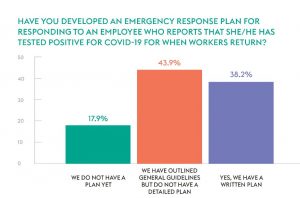
1. As businesses begin to reopen and employees return to the workplace, it is a good time to revisit your emergency response plan to handle any employee who reports that he/she has tested positive for COVID-19. In our informal webinar poll, more than 80% of respondents indicated they had general guidelines or a written plan in place. An emergency response plan should consider seven things. First, the employee should be asked to stay home, or go home if he/she reported to work, and then follow the directives of healthcare providers and CDC guidelines. You should then interview the employee on any close contacts during the 14-day period prior to the positive test or presumption of a positive test, and identify all areas within the workplace where the employee was physically present. Second, implement emergency cleaning and sanitation of those workspaces. Shut down those areas for 24 hours or as long as possible to minimize the risk to those cleaning the area. Third, follow your communication plan to contact those employees, customers, vendors and guests who were or may have been directly exposed. Any employee that was directly exposed should also be required to self-isolate for 14 days before he/she is allowed to return to work. It is also advisable to communicate to the general workforce—this is an opportunity to showcase that your organization takes these matters seriously and has an emergency response plan in place specifically for situations like this. Fourth, when communicating with employees, avoid disclosing the identity of the employee diagnosed or presumed to have COVID-19 and remind your staff that medical information is private. Fifth, administer leave for employees who have tested positive for COVID-19 or are presumed to have COVID-19 appropriately. Consider developing an internal checklist of all possible ways the leave can be classified (FFCRA paid sick leave, FMLA, leave as a reasonable accommodation to disability under the ADA, and/or under company sponsored sick leave benefits). Sixth, employees who tested positive or who were presumed to be COVID-19 positive should not be reinstated until they meet the criteria to discontinue home isolation as enumerated by CDC guidelines. Seventh, considerwhether this is a reportable offense.
2. In the context of workers’ compensation claims, employers should follow best practices for reporting and if an employee alleges that he/she was infected at work, follow the standard approach and report the case to your insurance carrier. If the employee does not claim that he/she was infected at work, review all circumstances to reach a reasonable conclusion. It is advisable to report a positive case if an employee works in a job where there is a high risk of transmission or if additional employees at the workplace also test positive and there is direct evidence they came into contact with the first sick employee. There are also OSHA requirements for recording workplace exposure. Effective May 19, 2020, OSHA announced that a confirmed case of COVID-19 is a recordable illness if it involves death, days away from work, restricted work, medical treatment beyond first aid, loss of consciousness, or significant injury or illness diagnosed by a licensed health care professional. OSHA will expect employers to make a “reasonable and good faith inquiry” if it is a work-related event, and employers will not be expected to record a positive case unless the employer determines it is more likely than not that exposure in the workplace caused a causal role.
3. The COVID-19 pandemic is an unprecedented event and caught many employers and employees off guard. Employers should take steps now to ensure they can mobilize quickly and make decisions in the event of another shutdown. During this reopening phase, there are many opportunities for businesses to evolve and adapt in preparation for a potential “second wave” or future pandemic/crisis. Employers may want to designate a primary lead for COVID-19 issues in the workplace, to aid in delivering a consistent message to the workforce and to field general Q&A from employees on the company’s plans to address COVID-19 exposure, handle OSHA issues and update guidelines/policies/procedures. Also consider whether you are equipped to have employees telework in order to permit essential business functions to continue should there be a second wave or shutdown. This will require employers to be cognizant of rules and regulations, such as tax and paid sick leave laws, in jurisdictions where your employees perform work from home. Determine what infrastructure and technology investments might be needed—for example, invest in electronic timekeeping so employees can record hours outside of the office, or have a system in place to provide all employees the technology equipment necessary to do their jobs (e.g., laptops, etc.). Employers may also want to review their data security policies in the event someone loses a workplace device with sensitive information and consider whether to outsource or hire IT support to handle the influx of inquiries if the entire workforce must telework. In addition to addressing a future outbreak, preparing these options for your workforce can also help you respond to reasonable accommodation requests from employees.
4. Employers should prepare for potential audits by the government and the Plaintiffs’ Bar related to compliance with the Families First Coronavirus Response Act (FFCRA). Audits typically follow an employee complaint, so employers should prepare now by documenting compliance. The FFCRA provides for paid leave to employees who are unable to work or telework for qualifying COVID-19 related reasons, along with expanded family and medical leave to care for a child In turn, employers benefit from the allowed tax credits. The DOL (and Plaintiffs’ Bar) could audit:
- Required posters and notice to employees: notices were to be posted by April 1 through December 31, 2020—an employer may satisfy this requirement by emailing or mailing this notice to employees or posting on its intranet.
- Coverage: is your business covered by the Act because you have 500 or fewer employees? Are you an integrated employer that has more than 500 or more employees across interrelated entities? If you have any concerns about whether your business is a covered entity, you should consult outside counsel for written guidance to fend off any future claims that you willfully violated the statute.
- Compliance with leave provisions: did you provide the benefits you were required to under the statute
- Recordkeeping: The DOL provided some guidance on information you can seek from an employee requesting leave, but the FFCRA does not expressly provide that you may request certification, including a doctor’s note. The IRS indicated that in order to receive the tax credits, employers can seek a written statement supporting the need for leave. Best practice is to use a form for leave requests and note that “additional documentation may be required” in the event further clarity is needed. Also remember to follow DOL and IRS record retention requirements and state paid leave recordkeeping requirements.
Employers should be aware that company-wide violations could involve significant liability, including liquidated/double damages for willful violations, criminal prosecution with fines and possible imprisonment. And employers run the risk of class action litigation and retaliation claims from employees who must generally to be returned to substantially similar positions after taking leave.
5. Many businesses who took loans under the Paycheck Protection Program (PPP) have been working to ensure they have the procedures and mechanisms in place so that those loans can be forgiven. PPP loan compliance will be audited by the SBA, the DOJ, the SEC and the IRS. Any business receiving more than $2M in PPP loans will be fully audited, and smaller loans may be spot-checked. SBA and DOJ will audit your borrowing eligibility, and employers may want to obtain written guidance from outside counsel to show they applied for the loan in good faith. They will also audit loan amounts and use of proceeds to ensure compliance. In addition, the SBA has made it clear that employers must certify (and provide supporting documentation) that the uncertainty of the current economic conditions made the loan request necessary to support the ongoing operations of the business. Be sure to preserve all documents, including payroll records, financials and expense payment records, applicable tax forms and proof of restoring FTEs and/or salary. All documents should be retained for six years after the loan is fully forgiven or fully repaid.



Republicans and Democrats Introduce Competing Privacy Bills to Protect Consumers’ Health Information Related to the COVID-19 Pandemic
ARTICLE / CLIENT ALERT
Republicans and Democrats Introduce Competing Privacy Bills to Protect Consumers’ Health Information Related to the COVID-19 Pandemic
May 28, 2020
Read time: 10 min
As the federal government, state governments, businesses and other entities continue their response efforts related to the COVID-19 pandemic, the privacy and security of consumers’ personal health information remains a top concern of lawmakers. Recently, Republicans and Democrats in the US Senate and House of Representatives released competing bills that aim to address some of the concerns surrounding COVID-19 contact tracing and related technologies. This article examines the two bills, identifying points in common as well as key differences.
Senate Republicans and Democrats in the House and Senate recently introduced competing bills aimed at protecting consumers’ personal health information during the Coronavirus (COVID-19) pandemic.
Senate Commerce Committee Chairman Roger Wicker (R-MS) introduced the Republican bill (the “COVID-19 Consumer Data Protection Act of 2020”) on May 7, 2020. Senators John Thune (R-SD), Debra Fischer (R-NE), Jerry Moran (R-KS) and Marsha Blackburn (R-TN) co-sponsored the bill. The bill was referred to the Senate Committee on Commerce, Science, and Transportation.
On May 14, 2020, House and Senate Democrats—including Representatives Suzan DelBene (D-WA), Anna Eshoo (D-CA) and Jan Schakowsky (D-IL), and Senators Richard Blumenthal (D-CT) and Mark Warner (D-VA)—introduced a competing bill (the “Public Health Emergency Privacy Act”). Senators Michael Bennet (D-CO), Elizabeth Warren (D-MA), Richard Durbin (D-IL), Edward Markey (D-MA), Tammy Baldwin (D-WI), Kamala Harris (D-CA), Mazie Hirono (D-HI) and Amy Klobuchar (D-MN) also joined as co-sponsors. The bill was referred to the Senate Committee on Health, Education, Labor and Pensions.
The competing bills are introduced against the backdrop of various critically important efforts to help governments track the spread of COVID-19 through various technological solutions. These tools can be deployed to alert users who have been in close proximity to someone who has tested positive for the virus and for contact tracing efforts.
Purpose
Both bills focus on privacy considerations believed to be presented by the current national pandemic. As further described in the table below, the two bills exclude from their regulatory scope information that is already subject to protection under the Health Insurance Portability and Accountability Act of 1996 (HIPAA). Both bills seek to prevent the collection, use and disclosure of consumers’ personal information for coronavirus response efforts, such as contact tracing, without consumers’ consent to the collection, use and/or disclosure of their Covered Data (described in the table below).
Both bills also require Covered Organizations (described in the table below) to permit individuals to revoke their consent to the collection, use and/or disclosure of their Covered Data, to implement and publish privacy policies, and to periodically issue public reports. These public reports must describe the number of individuals whose data has been collected, used and/or disclosed by the Covered Organization, the categories of information collected, the purposes for which each data category is used and the categories of recipients to whom the data is disclosed.
Key Differences
Despite the common elements present in both bills, there are some key differences in their scope and approach. The table below provides a summary of these differences.
The Democrats’ proposal generally covers a broader scope of data and regulated entities, contains additional reporting requirements and includes express prohibitions on the use of Covered Data for discriminatory purposes, including interference with voting rights and employment opportunities. The Democrats’ proposal also creates a private right of action that allows consumers to bring lawsuits for alleged violations and preserves states’ ability to legislate additional consumer protections. The Republicans’ proposal, in contrast, does not provide consumers with a private right of action. The Republican proposal also expressly preempts state legislation with a similar purpose.
Recent Attempts at Passing Federal Privacy Protections
In late 2019, Congressional efforts to pass a federal privacy bill stalled after Chairman Wicker circulated a draft of the United States Consumer Data Privacy Act of 2019 for discussion, and Senate Democrats introduced the Consumer Online Privacy Rights Act. If last year’s attempts presage the outcome of the newly introduced coronavirus-related privacy bills, disagreements between the parties about a private right of action and state pre-emption could be stumbling blocks. These key differences will likely be the central focus of negotiations if the bills progress and could serve as a blueprint for resolving the thorny issues that have hindered the advancement of national consumer privacy legislation.
| Key Provisions | Republican Proposal “COVID-19 Consumer Data Protection Act of 2020” |
Democrat Proposal “The Public Health Emergency Privacy Act” |
| Covered Data | Includes precise geolocation data, proximity data, persistent identifiers (such as IP addresses) and personal health information.
Excludes aggregated data, business contact information, de-identified data, employee screening data and publicly available information. The definition of “personal health information” excludes information included in certain education records (e.g., FERPA records) and information regulated by HIPAA. |
Includes geolocation data, proximity data, personal health information, demographic data, contact information for identifiable individuals (such as an address book or call log) and “any other data collected from a personal device.” |
| Covered Organizations | Includes entities under the jurisdiction of the Federal Trade Commission (FTC) Act, common carriers, and nonprofit organizations that (i) collect, process or transfer covered data or (ii) determine the means and purposes for the collection, processing or transfer of covered data.
Covered Organization’s employees, owners, directors, officers or staff members (among others) who are permitted to enter a physical site of operation of the Covered Organization are not included as protected individuals. Excludes service providers that process or transfer covered data for the purpose of performing services on behalf of a Covered Organization, and that are not related to the Covered Organization. |
Includes any person (including a government entity) that collects, uses or discloses covered data, or that develops or operates a website, web application, mobile application, mobile operating system feature or smart device application for the purpose of tracking, screening, monitoring, contact tracing or mitigation, or otherwise responding to the COVID-19 public health emergency.
Excludes health care providers, service providers or public health authorities; generally does not apply to “covered entities” and “business associates” under HIPAA. |
| Consent Requirements | Makes it unlawful for a Covered Organization to collect, process or transfer an individual’s covered data to track the spread, signs or symptoms of COVID-19, to measure compliance with social distancing guidelines or to conduct COVID-19 contact tracing, without the individual’s affirmative express consent.
“Affirmative express consent” means an affirmative act by an individual that clearly communicates the individual’s authorization of the collection, use or disclosure of covered data, and is taken after the individual has been presented with a clear and conspicuous description of the collection, use or disclosure of covered data. Consent may not be inferred from inaction on the part of the individual. Requires Covered Organizations to provide an effective mechanism to revoke consent. After a Covered Organization receives a revocation request, it must stop collecting, processing or transferring the covered data for the previously consented-to purposes within 14 days. |
Makes it unlawful for a Covered Organization to collect, use or disclose covered data without obtaining the individual’s affirmative express consent.
“Affirmative express consent” means an affirmative act by an individual that clearly and conspicuously communicates the individual’s authorization of the collection, use or disclosure of covered data, and there must not be any mechanism in the user interface that is intended to, or has the substantial effect of, “obscuring, subverting, or impairing decision making or choice to obtain consent.” Consent may not be inferred from inaction on the part of the individual. Requires Covered Organizations to provide an effective mechanism to revoke consent. After a Covered Organization receives a revocation request, it must stop collecting, using or disclosing covered data from the individual within 15 days. The Covered Organization must also destroy or de-identify that individual’s data within 30 days of the revocation. |
| Use and Disclosure Limitations | Requires the Covered Organization to provide prior notice to the individual, and requires the Covered Organization to publicly commit not to collect, process or transfer the covered data for other purposes (unless required by law, the use is necessary to carry out the consented-to purposes, or the individual separately consents to the other purposes). | Covered Organizations can only collect, use or disclose covered data that is necessary, proportionate and limited for a good-faith public health purpose.
Prohibits the use of covered data for discriminatory and unauthorized purposes, such as screening individuals from employment, insurance and housing opportunities, and using data for commercial advertising (among other things). Prohibits the use of the covered data to deny, restrict or interfere with the right to vote. |
| Data Integrity and Security | Covered Organizations must take reasonable measures to ensure the accuracy of the covered data and cannot use the data beyond what is reasonably necessary to carry out the consented-to purposes.
Covered Organizations must establish, implement and maintain reasonable administrative, technical, and physical data security policies and practices to protect against risks to the confidentiality, security and integrity of the covered data. Covered Organizations must delete or de-identify covered data when the data is no longer being used for the consented-to purposes and is no longer necessary to comply with legal obligations or to support legal claims. |
Covered Organizations must take reasonable measures to ensure the accuracy of the covered data and must adopt reasonable safeguards to prevent unlawful discrimination on the basis of the covered data.
Covered Organizations must establish and implement reasonable data security policies, practices and procedures to protect the security and confidentiality of the covered data. Requires data destruction or de-identification 60 days after the termination of the national public health emergency; 60 days after the termination of a public health emergency declared by a governor or chief executive of a state in which the individual resides; or 60 days after the initial collection (whichever date is latest). |
| Transparency | Requires Covered Organizations to publish a privacy policy that is disclosed to individuals before (or at the point of) data collection, is made publicly available, states whether the Covered Organization transfers the data to other recipients, and includes a general description of data retention and data security practices. | Requires Covered Organizations to provide the individual with a privacy policy that is conspicuously disclosed, is in the language the individual typically uses to communicate with the entity, and that describes the data collection purposes, recipients of the data, data retention and security policies, the procedures for exercising individual rights under the Act, and the procedures for filing a complaint with the FTC. |
| Reporting Requirements | Requires Covered Organizations to submit a report within 30 days of enactment (and at least once every 60 days after that).
The report(s) must state how many individuals the Covered Organization has collected, processed or transferred data from, must describe the categories of covered data the Covered Organization has collected, must identify the specific purposes for which each data category is used and must disclose the recipients to whom the data is transferred. |
Requires Covered Organizations that collect data on 100,000 individuals (or more) to issue a public report at least once every 90 days.
The report(s) must include the number of individuals the Covered Organization has collected, used or disclosed data from, must describe the categories of data collected and how those categories of data were used, and must describe the categories of third parties to which the Covered Organization disclosed the data. Requires the Secretary of Health and Human Services to consult with the United States Commission on Civil Rights and the FTC to prepare and submit to Congress a report on the civil rights impact of the covered data collection. |
| State Law Preemption | Expressly preempts state legislation enacted for a similar purpose. | Expressly does not preempt any state or other federal laws. |
| Enforcement | Enables the FTC and state attorneys general to enforce the Act. | Enables the FTC and state attorneys general to enforce the Act.
Provides a private right of action. Generally invalidates pre-dispute arbitration agreements and pre-dispute joint action waivers regarding disputes that arise under the Act. |





COVID-19 – Country-By-Country Guide to Tax Measures
ARTICLE / REPORT
COVID-19 – Country-By-Country Guide to Tax Measures
May 28, 2020
Read time: 2 min
The Coronavirus (COVID-19) has governments across Europe, Asia, Africa, Australia, North and Latin America quickly evaluating and issuing modified tax-related measures to help support business investments and providing options for employers to support their employees and communities. We break down more than 40 jurisdictions, in an easy to digest guide, that outlines the latest measures each country is taking related to items including deductibility of gifts, direct tax credits, indirect tax incentives, suspension or extension of tax filings, tax payments and tax controversy terms, and individual tax incentives.




LIBOR Transition Update: ARRC Publishes Best Practices
ARTICLE / CLIENT ALERT
LIBOR Transition Update: ARRC Publishes Best Practices
May 28, 2020
Read time: 5 min
On May 27, 2020, the Alternative Reference Rates Committee (“ARRC”) published best practices[1] which outline a set of key, recommended transition milestone dates that market participants should aim to achieve across different categories of financial products.
The ARRC underscores that the milestone dates (and its suggested recommendations) are all based upon its guidance for preparing for the transition from LIBOR. Below are the ARRC’s general recommendations for best practices.
Recommendation 1. To the extent not already utilized, new USD LIBOR cash products should include ARRC-recommended, or substantially similar, fallback language as soon as possible.
Recommendation 2. Relevant third-party technology and operations vendors should complete all necessary enhancements to support the Secured Overnight Financing Rate (SOFR) by the end of 2020.
Recommendation 3. New use of USD LIBOR should stop:
- For new issuances of floating rate notes with maturities after Dec. 31, 2021 (excluding securitizations), by Dec. 31, 2020;
- For new business loans, including renewals and refinancings, by June 30, 2021;
- For consumer loans that are mortgages, no applications for mortgages using USD LIBOR and maturing after 2021 should be accepted after Sept. 30, 2020;
- For securitizations other than collateralized loan obligations, by June 30, 2021, and for collateralized loan obligations, by Sept. 30, 2021; and
- For derivatives, market participants should refrain from initiating new LIBOR derivatives trades that increase LIBOR risk (unless such trades are for risk or default management of legacy LIBOR positions) after June 30, 2021.
Recommendation 4. For contracts specifying that one or more parties will select a replacement rate following a LIBOR-transition event, the determining party (or parties) should disclose the planned selection at least six months prior to the date the replacement rate will become effective.
The ARRC notes that as the timing of official-sector statements about the end of LIBOR is uncertain, and absent any statements (before June 30, 2021) by the FCA that LIBOR will continue past 2021, market participants should assume that LIBOR will end as of Dec. 31, 2021.[2]
In addition, the ARRC recommends that derivatives market participants should adhere to the ISDA Fallback Protocol for Interbank Offered Rates within the four-month period after it is published and before the amendments to embed the fallbacks in legacy transactions take effect. Dealers should seek to promote liquidity and client access to SOFR derivative products by offering electronic market-making and execution of SOFR swaps by Sept. 30, 2020, making markets in SOFR-linked interest rate volatility products (including swaptions, caps and floors) by Dec. 31, 2020 and changing the market convention for quoting USD derivatives contracts from LIBOR to SOFR by March 31, 2021.
The ARRC also recommends that institutions have clear internal programs in place to prepare for a transition away from USD LIBOR across all of their relevant activities, including a rigorous assessment of exposures. The ARRC suggests that institutions refer to the ARRC’s “Practical Implementation Checklist for SOFR Adoption”[3] for additional guidance.
Finally, the ARRC suggests that institutions be aware of additional ARRC recommendations, such as the ARRC’s selection of SOFR as a replacement rate for USD LIBOR, and incorporate ARRC-recommended conventions into new contracts in order to support robust contract language in the event USD LIBOR is no longer usable. Institutions should have an ongoing dialogue with their key stakeholders to promote awareness of the transition and their preparedness for it.
One of the many lessons that can be learned from the COVID-19 crisis is that the time to prepare for anticipated material changes, like the discontinuation of LIBOR, is sooner rather than later. The ARRC’s best practices and recommendations are a helpful resource to assist market participants as they prepare for the transition.
Authored by Phillip J. Azzollini, Taleah E. Jennings, Douglas I. Koff, Craig Stein and Atul Joshi.
If you have any questions concerning this Alert or would like assistance with the transition from LIBOR, please contact your attorney at Schulte Roth & Zabel or one of the authors.
[1] See “ARRC Recommended Best Practices for Completing the Transition from LIBOR,” available here.
[2] The ARRC has proposed legislation designed to address LIBOR discontinuation in legacy financial agreements governed by New York law that do not have adequate fallback language. See “Proposed Legislative Solution to Minimize Legal Uncertainty and Adverse Economic Impact Associated with LIBOR Transition,” available here. The proposed legislation has not yet been submitted for consideration by the New York legislature.
[3] See “Practical Implementation Checklist for SOFR Adoption,” available here.
This is a fast-moving topic and the information contained in this Alert is current as of the date it was published.
This communication is issued by Schulte Roth & Zabel LLP for informational purposes only and does not constitute legal advice or establish an attorney-client relationship. In some jurisdictions, this publication may be considered attorney advertising. ©2020 Schulte Roth & Zabel LLP.
All rights reserved. SCHULTE ROTH & ZABEL is the registered trademark of Schulte Roth & Zabel LLP.





COVID-19 Ate My Homework – Recent Extensions and Relief for Retirement Plans
ARTICLE
COVID-19 Ate My Homework – Recent Extensions and Relief for Retirement Plans
May 27, 2020
Read time: 1 min