













ARTICLE
To win in health tech: Prove ROI or fall behind
May 18, 2026
Read time: 7 min
If you’re investing and scaling in health tech, the playbook has changed.
At McDermott Will & Schulte’s Health Tech Investment Forum, investors, operators, and capital providers emphasized that provable ROI has surpassed innovation as the key to securing capital and getting deals done. In today’s environment, that shift is reflected in how investors underwrite value, how companies scale, and how exits are ultimately achieved.
Dive into key takeaways from the Forum and action items for the months ahead:
The shift to ROI is reshaping the market
Healthcare IT remains one of the most attractive areas for investment, sitting at the intersection of healthcare and technology – two of the highest-returning sectors over the past decade, according to SPI by StepStone. Even amid broader market volatility, healthcare IT deal activity has remained strong, reaching record levels of volume and value in 2025.
In 2026, the market is still active, but more complex. The “SaaSpocalypse,” driven in part by AI uncertainty, is beginning to influence private valuations. Sellers are more cautious, buyers are more selective, and the traditional drivers of return are shifting.
Multiple expansion, historically responsible for a significant portion of value creation, has become a less reliable lever. Investors now need mid-teens EBITDA growth to achieve target returns, putting greater pressure on execution. At the same time, AI is raising the bar. It’s creating new opportunities for efficiency and growth, while forcing investors to rethink which business models are truly durable and defensible. The result is a market where proof of business outcomes – not the promise of innovation – is driving deal decision-making.
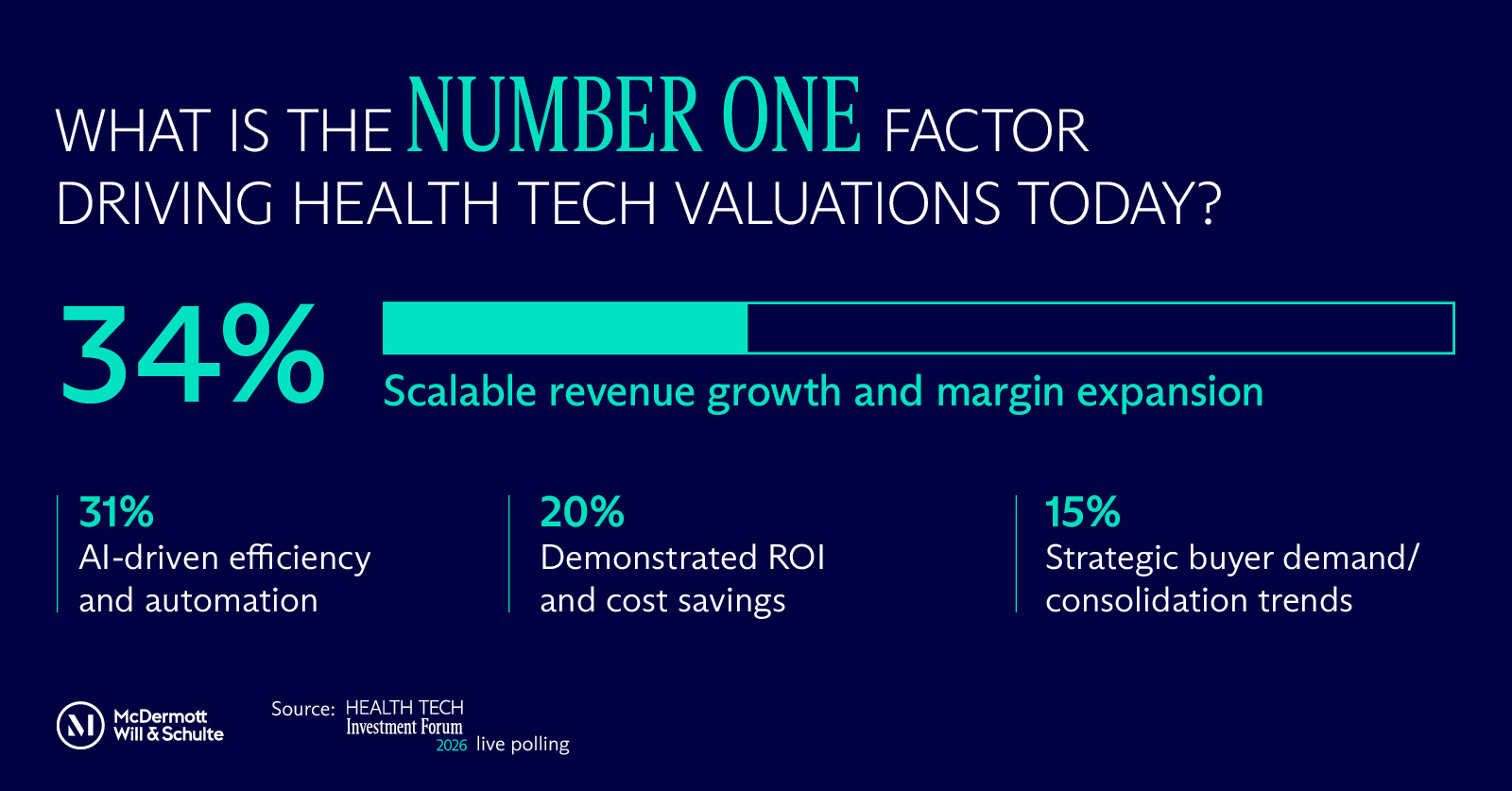
Live audience polling at the Forum reinforced this shift: Respondents said the primary drivers of valuation are scalable revenue growth (34%), AI-driven efficiency (31%), and demonstrated ROI (20%), highlighting a convergence between growth and measurable performance.
What wins funding now is workflow ownership and measurable value
To meet the higher bar for ROI, capital is concentrating around durable business models that can demonstrate clear economic value.
What distinguishes the most attractive assets is not their use of technology, but where they sit within the workflow. Infrastructure-layer and tech-enabled services businesses remain at the center of deal activity because they operate within core healthcare workflows (such as revenue cycle, billing, staffing, care navigation, and administrative operations). These are areas where inefficiencies are persistent and measurable improvement is highly valued.
Companies that own decision-making processes, control critical data, and integrate deeply into customer operations are better positioned to retain customers and expand over time, and AI is reinforcing this trend with more discipline than expected.
While interest in AI-native companies remains high, many investors are becoming more selective, particularly where differentiation relies on shared underlying models. Instead, there is growing focus on companies that use AI to enhance workflows, reduce labor costs, and drive measurable outcomes, especially within tech-enabled services models that control the end-to-end customer experience.
Companies are being built and financed for execution, not just growth
To meet the increasing demand to deliver provable ROI, companies are now being built differently from the ground up.
Capital efficiency is increasingly critical. Investors expect companies to demonstrate how each dollar spent translates into growth, margin expansion, or customer value. Early-stage companies face higher growth and ROI thresholds, while growth-stage businesses are expected to scale efficiently with clear paths to profitability.
For private equity, value creation strategies are evolving. Without multiple expansion as a tailwind, returns are increasingly driven by execution: pricing and packaging, go-to-market optimization, add-on acquisitions, workflow expansion, and AI-driven efficiency gains.
Financing markets reflect this change. Capital remains available, but companies with strong growth, recurring revenue, and clear AI readiness are more likely to secure it. Lenders are underwriting more rigorously, with increased focus on cash flow, operational resilience, and long-term viability.
Importantly, regulatory complexity – long viewed as a barrier – is increasingly treated as table stakes. Operational execution has become a differentiator, with a sharper focus on the ability to scale, sell, and deliver outcomes in a fragmented and demanding healthcare environment.
Valuation and diligence now center on proof, not narrative
Valuation in today’s market is grounded in evidence, but proving value can be a challenge.
Even companies with strong performance face skepticism around ROI, particularly where attribution is complex. Investors are increasingly looking beyond modeled ROI and focusing on observable commercial signals, such as bookings, revenue per customer, and retention, as the clearest indicators of value.
Simplicity is also becoming a differentiator. Companies that present multiple, complex ROI frameworks often dilute their credibility. Those that anchor their story around a small number of clear, defensible metrics tend to resonate more strongly.
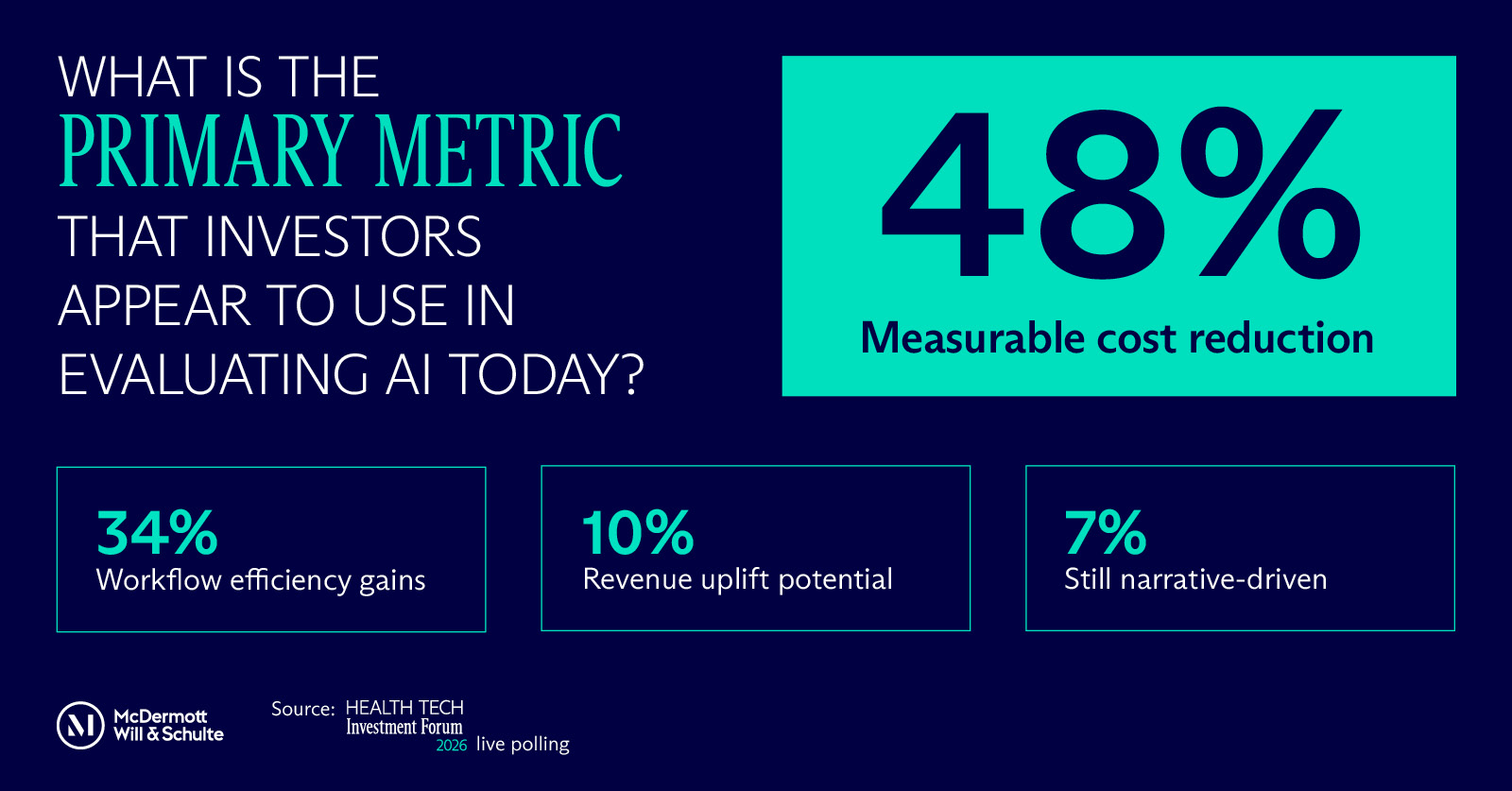
This is especially true for AI. Live polling showed that investors primarily evaluate AI through measurable cost reduction (48%) and workflow efficiency gains (34%). AI is no longer rewarded for narrative – like other products, it is evaluated on its ability to deliver quantifiable outcomes.
Crucially, AI is creating value by completing workflows, driving decisions, and producing measurable results – not with consumer interfaces and insights. Solutions that can execute (closing care gaps, automating administrative tasks, or improving revenue cycle performance) are far more defensible than those that generate recommendations alone.
Diligence has followed suit. Investors are examining:
- Data usability, interoperability, and legal rights
- Depth of workflow integration
- Retention and revenue quality
- Operational readiness and change management
- Credibility and attribution of ROI
Data has become a critical risk factor. It must be usable, compliant, and properly governed, not just accessible. Weak data infrastructure or unclear data provenance can undermine both AI performance and investment outcomes.
Exit outcomes are determined early and earned through execution
Exit outcomes are increasingly determined long before a sale process begins.
Buyers are prioritizing companies that demonstrate durable growth, operational maturity, and proven ROI. Assets with strong retention, embedded workflows, and clear value creation pathways continue to transact, while others face longer timelines and valuation pressure.
The exit environment remains discerning. IPOs remain limited, so most liquidity comes from strategic buyers and PE-backed M&A, often with creative structures (such as carve-outs, continuation vehicles, and take-privates).
The result is a clear bifurcation, where companies with strong revenue growth enjoy market advantages, while those lacking growth face challenges accessing capital. Exits are being earned over time through execution and measurable impact, not narrative.
Looking ahead: What investors should know
Health tech remains one of the most compelling investment opportunities in the market. But success in this next phase will depend less on identifying the right idea and more on executing the right model.
In the coming months, investors should consider:
- Focusing on where value is most defensible and provable
- Prioritizing businesses with embedded workflows, strong data foundations, and clear ownership of outcomes
- Scrutinizing AI for measurable impact
- Pressure-testing growth durability
- Underwriting execution risk more rigorously, as capital concentrates around assets that can demonstrate repeatable ROI and sustained performance
Across the Forum, the throughline was unmistakable: What you build, how you finance it, and how you prove value are no longer separate decisions. They are tightly interconnected and ultimately determine exit outcomes.