














ARTICLE / CLIENT ALERT
EMIR 3: Active Account, Clearing Threshold and Exemptions
December 5, 2024
Read time: 4 min
On December 4, 2024, EU Regulation 2024/2987 (EMIR 3), amending EU Regulation 648/2012 on the European Market Infrastructure (EMIR), was published in the EU Official Journal. EMIR 3 will enter into force on December 24, 2024, although certain provisions will remain subject to the Regulatory Technical Standards that will be published by the European Securities and Markets Commission (ESMA).
EMIR 3 introduces a requirement for certain EU counterparties to open and maintain an account with a central counterparty (CCP) established in the EU, and makes targeted amendments relating to the clearing thresholds and certain exemptions.
Origins of EMIR 3
EMIR 3 responds to the concerns raised by the European Commission and EU Member States about the fact that, despite Brexit, EU counterparties continue to clear their trades in CCPs established in the UK.
Initially, to incentivise EU counterparties to instead clear their trades in CCPs established in the EU, the European Commission intended to require all financial counterparties (FC) and non-financial counterparties (NFC) that are subject to the clearing obligation under EMIR to clear their trades in accounts held with CCPs established in the EU.
This proposal, however, drew considerable criticism from EU market associations, which argued that such a broad requirement would put EU counterparties at a competitive disadvantage compared to their UK or U.S. counterparties. As a result of these critiques, the final requirement has been significantly watered down, and will only apply to certain FCs and NFCs.
Active Account Requirement
EMIR 3 imposes a requirement to open and maintain an ‘active’ account with a CCP established in the EU on FCs and NFCs that are subject to the clearing obligation under EMIR and exceed the clearing threshold in any of the following derivatives: (i) interest rate derivatives denominated in EUR or PLN or (ii) short-term interest rate derivatives denominated in EUR (In-Scope Counterparties). Contrary to the initial proposal, credit default swaps denominated in EUR have been excluded from the scope of this requirement.
In-Scope Counterparties that hold a clearing volume of at least EUR 6 billion in open positions will additionally be required to clear in their ‘active’ accounts at least 5 trades per class of derivatives during the relevant reference period. The details of this requirement will be further specified by ESMA.
Targeted Amendments
In connection with the ‘active’ account requirement, the European Commission introduced a number of targeted amendments to EMIR. These relate to, among other things, the calculation of the clearing thresholds and the exemptions from clearing, margin or reporting requirements.
Clearing Threshold Calculation
EMIR requires FCs and NFCs to clear their over-the-counter (OTC) derivatives if their average positions exceed certain clearing thresholds. For the purposes of calculating these thresholds, EMIR defined OTC derivatives as derivatives that are not traded on an EU regulated market or an equivalent non-EU trading venue.
This calculation mechanism has, however, proven to be problematic for the derivatives industry following Brexit as UK trading venues are no longer considered as EU-regulated markets and have not been, in the meantime, declared as equivalent to EU trading venues.
EMIR 3 responds to this issue by amending the definition of OTC derivatives, which shall now refer to derivatives not cleared in EU- or EU-equivalent CCPs, instead of those not traded on an EU trading venue (noting that the EU has already recognized UK CCPs as EU-equivalent).
Exemptions
In addition, EMIR 3 introduces a number of changes to the EMIR exemptions landscape:
- Clearing: EMIR 3 has extended the existing EU pension scheme exemption to also cover transactions with non-EU pension schemes that are authorised under national law and have been exempted from the clearing obligation under that law. In addition, EMIR 3 has introduced a new exemption from the clearing obligation relating to market neutral post-trade risk reduction transactions.
- Margin: EMIR 3 has permanently exempted uncleared single-stock options and equity index options from the requirement to exchange initial and variation margin.
- Reporting: EMIR 3 has narrowed the scope of the existing exemption from the reporting requirement for NFCs in relation to intra-group trades. The revised exemption no longer applies to so-called NFC+ (i.e., NFCs that are subject to the clearing obligation).





Update U.S. Transparency Act
ARTICLE / CLIENT ALERT
Update U.S. Transparency Act
December 4, 2024
Read time: 5 min
Need for companies to take action by the end of the year
Now that the transparency register has been in place in Germany and Europe for several years and its reporting obligations have been fully complied with in practice, a transparency register has also been in place in the USA for several months.
An important reporting deadline now expires at the end of the year:
Companies that were founded before January 1, 2024 only have until January 1, 2025 to comply with their reporting obligations.
Following the decision of a U.S. District Court in Texas (U.S. District Court for the Eastern District of Texas) on preliminary injunctive relief, enforcement of the Transparency Act is expected to be stayed nationwide, but as a precautionary measure, we advise compliance with the deadline, as the court’s decision could be overturned.
If you have not already done so, you should therefore check now whether your company is subject to a reporting obligation or whether one of the exemptions applies.
Read the full client alert, “Update zum US-Transparenzregister.”
1. Einführung des Transparenzregisters in den USA: Was Unternehmen wissen müssen
Seit dem 1. Januar 2024 gilt in den USA eine neue gesetzliche Verpflichtung zur Offenlegung wirtschaftlich Berechtigter (beneficial owner) von Unternehmen. Diese Regelung, eingeführt durch den Corporate Transparency Act (CTA), zielt darauf ab, finanzielle Straftaten wie Geldwäsche, Steuerhinterziehung und Terrorismusfinanzierung effektiver zu bekämpfen. Die Neuerung betrifft eine Vielzahl von Unternehmen, sowohl innerhalb der USA als auch ausländische Gesellschaften mit Geschäftstätigkeit in den Vereinigten Staaten.
2. Was regelt der Corporate Transparency Act?
Der CTA schreibt vor, dass Unternehmen dem U.S. Financial Crimes Enforcement Network (FinCEN) Informationen zu ihren wirtschaftlich Berechtigten übermitteln. Als wirtschaftlich berechtigt gelten natürliche Personen, die entweder:
- wesentliche Kontrolle über das Unternehmen ausüben oder
- mindestens 25 % der Anteile/Stimmrechte kontrollieren.
Zudem können auch Geschäftsführer oder andere Personen mit maßgeblichem Einfluss auf Geschäftsentscheidungen meldepflichtig sein.
Für die Eintragung müssen auch allgemeine Unternehmensinformationen sowie Daten derjenigen Personen bereitgestellt werden, die das Unternehmen gegründet oder angemeldet haben (sog. company applicants). Die übermittelten Daten werden zentral in einem Transparenzregister gespeichert, das jedoch – im Gegensatz zu deutschen Registern – nicht öffentlich zugänglich ist. Einblick in die Informationen erhalten nur ausgewählte US-Behörden auf Anfrage.
3. Wer ist von der Meldepflicht betroffen?
Grundsätzlich meldepflichtig sind:
1. Gesellschaften, die nach US-Recht gegründet wurden, wie Corporations oder Limited Liability Companies (LLCs).
2. Ausländische Unternehmen, die in einem US-Bundesstaat für ihre Geschäftstätigkeit registriert sind.
Ausgenommen sind unter anderem:
- Sog. große Unternehmen (large operating companies), die alle folgenden Kriterien erfüllen:
- mehr als 20 Vollzeitangestellte in den USA (d.h. Angestellte mit durchschnittlich 30 Wochenstunden),
- mehr als USD 5 Mio. Bruttoeinnahmen/-umsätze laut US-Steuererklärung und
- eine physische Betriebsstätte in den USA (sog. operating presence at a physical office),
- Tochtergesellschaften von Unternehmen, für die spezifische Ausnahmen gelten,
- Investmentgesellschaften und Banken, sowie
- Unternehmen, die inaktiv sind.
4. Meldefristen und Sanktionen
Die Meldefristen variieren je nach Gründungsdatum des Unternehmens:
- Unternehmen, die vor dem 1. Januar 2024 in den USA gegründet wurden oder (bei Unternehmen außerhalb der USA) in den USA registriert wurden, haben bis zum 1. Januar 2025 Zeit, ihre Daten zu melden.
- Für nach dem 1. Januar 2024 gegründete Firmen gilt eine 30-tägige Frist, die für Gründungen in 2024 auf 90 Tage verlängert wurde.
Veränderungen in der Unternehmensstruktur oder den Eigentumsverhältnissen müssen ebenfalls binnen 30 Tagen gemeldet werden. Unternehmen, die ihre Meldepflichten nicht rechtzeitig oder fehlerhaft erfüllen, drohen empfindliche Strafen, darunter:
- Geldstrafen von USD 500 pro Tag der Verzögerung,
- Pauschalstrafen von bis zu USD 10.000 oder
- strafrechtliche Verfolgung.
5. Bedeutung für deutsche Unternehmen
Auch deutsche Unternehmen mit geschäftlicher Präsenz in den USA können von den neuen Meldepflichten betroffen sein. Die Erhebung und Aufbereitung der erforderlichen Informationen kann besonders bei komplexen Eigentümerstrukturen aufwendig sein. Unternehmen sollten daher frühzeitig beginnen, die notwendigen Daten zu sammeln und bereitzustellen, um die Fristen einzuhalten und Sanktionen zu vermeiden.
6. Vergleich mit Transparenzregistern in Europa
Größter Unterschied zum Transparenzregister nach europäischem Verständnis ist sicher die Bereichsausnahme für sog. große Unternehmen. Anders als in Deutschland, wo inzwischen alle Gesellschaften grundsätzlich meldepflichtig sind, führen diese und andere Ausnahmen in den USA dazu, dass weite Teile der Unternehmen im Ergebnis nicht meldepflichtig sind.
7. Fazit und Ausblick
Mit der Einführung des Transparenzregisters schaffen die USA erstmals eine zentrale Datenbank, die die Nachverfolgbarkeit wirtschaftlich Berechtigter ermöglicht. Während dies einen Schritt im Kampf gegen finanzielle Straftaten darstellt, erhöht es zugleich den Verwaltungsaufwand für viele Unternehmen, der allein für die Prüfung des Anwendungsbereichs des Transparency Acts anfällt. Eine frühzeitige und sorgfältige Vorbereitung ist daher entscheidend, um mögliche Konsequenzen zu vermeiden.
Schließlich hat die Entwicklung in Europa gezeigt, dass zunächst geltende Bereichsausnahmen geändert oder abgeschafft werden können, was zu einer schrittweisen Erweiterung des Anwendungsbereichs führt. Ob eine solche Entwicklung unter dem U.S. Transparency Act ebenfalls einsetzt, bleibt abzuwarten.




Upcoming Deadline for New Structured Data Requirement for Schedule 13G and 13D Filings
ARTICLE / CLIENT ALERT
Upcoming Deadline for New Structured Data Requirement for Schedule 13G and 13D Filings
December 4, 2024
Read time: 2 min
As part of the SEC’s 2023 amendments to the rules governing beneficial ownership reporting on Schedules 13G and 13D, the SEC adopted rules that require these filings to be made using a structured, machine-readable data language (XML) in order to make it easier for market participants to access, compile and analyze the information in Schedule 13G and 13D filings. Filers need to comply with this requirement starting on Dec. 18, 2024.
While there are no changes to the substantive disclosure requirements, the new structured data requirement may necessitate certain formatting and other technical changes.
If you are using an outside printer or third-party software to make your filings, we recommend contacting your printer or vendor to ensure that the filings will be made in compliance with the new structured data requirement no later than Dec. 18, 2024.
Authored by Ele Klein, Adriana Schwartz, Clara Zylberg, Brandon S. Gold and Arelys Reyes.
If you have any questions concerning this Alert, please contact your attorney at Schulte Roth & Zabel or one of the authors.
This communication is issued by Schulte Roth & Zabel LLP for informational purposes only and does not constitute legal advice or establish an attorney-client relationship. In some jurisdictions, this publication may be considered attorney advertising. © 2024 Schulte Roth & Zabel LLP. All rights reserved. SCHULTE ROTH & ZABEL is the registered trademark of Schulte Roth & Zabel LLP.


Corporate Transparency Act Update: Nationwide Preliminary Injunction Enjoining Enforcement
ARTICLE / CLIENT ALERT
Corporate Transparency Act Update: Nationwide Preliminary Injunction Enjoining Enforcement
December 4, 2024
Read time: 6 min
On Dec. 3, 2024, Judge Amos L. Mazzant of the US District Court for the Eastern District of Texas issued a nationwide preliminary injunction prohibiting the government from enforcing the Corporate Transparency Act (“CTA”) and its implementing regulation (31 C.F.R. §1010.380 (“Reporting Rule”)) and enjoining enforcement of the filing deadlines thereunder. The CTA, which was enacted on Jan. 1, 2021, and the Reporting Rule require certain legal entities (known as “Reporting Companies”) to file a beneficial ownership information report (“BOI Report”) with the US Department of the Treasury’s Financial Crimes Enforcement Network (“FinCEN”).[1] This ruling is noteworthy in light of the upcoming reporting deadlines under the CTA and Reporting Rule, which require that Reporting Companies formed or registered to do business in the US: (1) before Jan. 1, 2024, are required to file their initial BOI Report by Jan. 1, 2025; or (2) in 2024 are required to file their initial BOI Report within 90 days of formation or first registration.
Judge Mazzant’s 79-page Memorandum Opinion and Order (the “Order”): (1) found that, for the purposes of a preliminary injunction, the CTA and the Reporting Rule are “likely unconstitutional as outside of Congress’s power”[2]; and (2) enjoins enforcement of the CTA and the Reporting Rule and stays compliance deadlines. The Court explained that it “has not made an affirmative finding that the CTA and Reporting Rule are contrary to law or that they amount to a violation of the Constitution” leaving final adjudication of that issue to a later stage of the litigation given that the Court’s ruling was issued early in the case. The Order specifically provides that neither the CTA nor the Reporting Rule “may be enforced, and reporting companies need not comply with the CTA’s January 1, 2025, BOI reporting deadline pending further order of the Court.”
Constitutional challenges to the CTA are also pending before the Eleventh and Ninth Circuits. On March 1, 2024, Judge Liles C. Burke of the US District Court for the Northern District of Alabama found the CTA unconstitutional because “the CTA exceeds the Constitution’s limits on the legislative branch and lacks a sufficient nexus to any enumerated power to be a necessary or proper means of achieving Congress’ policy goals.” [3] Judge Burke permanently enjoined the US Government from enforcing the CTA but only against the plaintiffs in that case: Isaac Winkles; reporting companies for which Isaac Winkles is the beneficial owner or applicant; the National Small Business Association; and members of the National Small Business Association (as of March 1, 2024). The government appealed that ruling to the US Court of Appeals for the Eleventh Circuit and oral argument was held on Sept. 27, 2024. The Eleventh Circuit has not yet issued an opinion. Conversely, on Sept. 20, 2024, Judge Michael H. Simon of the US District Court for the District of Oregon denied a request for a preliminary injunction that challenged the constitutionality of the CTA.[4] The case is on appeal to US Court of Appeals for the Ninth Circuit.
The government may appeal Judge Mazzant’s ruling to the US Court of Appeals for the Fifth Circuit or seek direct review by the Supreme Court (thereby bypassing the Fifth Circuit) and may seek a stay of his Order. If an appellate court issues a stay of Judge Mazzant’s Order, the government would be permitted to enforce the CTA and the Reporting Rule, including the Jan. 1, 2025, deadline to file BOI Reports, pending a final decision by an appellate court on the constitutionality of the CTA. We will continue to monitor any developments related to this case and whether the Justice Department, the Treasury Department or FinCEN issues any guidance clarifying the impact this ruling has on Reporting Companies that have not yet filed their BOI Reports. Clients who have not yet filed BOI Reports may wish to consider refraining from filing any BOI Reports until additional guidance is issued by the government or an appellate court decides whether or not to stay, narrow or limit the nationwide preliminary injunction issued by Judge Mazzant. Clients who defer filing BOI Reports should nonetheless continue to prepare for anticipated BOI Report filings in the event the preliminary injunction is lifted, stayed or altered by an appellate court, in which case Reporting Companies may still be required to meet the Jan. 1, 2025, deadline for filings with regard to entities formed or registered prior to Jan. 1, 2024.
Authored by Melissa G.R. Goldstein, Michael S. Didiuk, Betty Santangelo, Jessica Romano and Kyle B. Hendrix.
For assistance in navigating the the CTA’s reporting requirements, please contact one of the authors or your attorney at Schulte Roth & Zabel.
[1] For more information on the beneficial ownership information reporting obligation under the CTA, please see our prior Alerts: (1) “FinCEN Issues Final Rule Requiring Reporting of Beneficial Ownership Information”; (2) “The Corporate Transparency Act: Key Considerations for Compliance With the Beneficial Ownership Reporting Rule” and (3) “The Corporate Transparency Act: The Private Funds Guide to Compliance With the Beneficial Ownership Reporting Rule.”
[2] Texas Top Cop Shop, Inc. v. Garland, No. 4:24-cv-00478 (E.D. Tex. May. 28, 2024).
[3] Nat’l Small Bus. United v. Yellen, No. 5:22-cv-01448 (N.D. Ala. Nov. 15, 2022).
[4] Firestone v. Yellen, No. 3:24-cv-01034 (D. Or. June. 26, 2024).
This communication is issued by Schulte Roth & Zabel LLP for informational purposes only and does not constitute legal advice or establish an attorney-client relationship. In some jurisdictions, this publication may be considered attorney advertising. © 2024 Schulte Roth & Zabel LLP. All rights reserved. SCHULTE ROTH & ZABEL is the registered trademark of Schulte Roth & Zabel LLP.






Key Takeaways | State of the Market – Still Looking for an Exit
ARTICLE
Key Takeaways | State of the Market – Still Looking for an Exit
November 26, 2024
Read time: 3 min
During this session, the panelists discussed notable developments within the life sciences industry with a specific focus on the GLP-1 drug market and its opportunities for improvement in patient satisfaction and dosage. They also focused on recent increased deal activity and creativity within the MedTech industry while monitoring mid-tier deals in other areas of biopharma.
Session panelists:
- Rick Aldridge, Managing Director, Healthcare M&A, Lazard
- Ellen Baron, Managing Director, Outcome Capital
- Dennis Crowley, Vice President, Solventum
- Nicholas Downing, MD, Managing Director, Life Sciences, Bain Capital
- Jimmy Zhuang, Assistant General Counsel, Novo Nordisk
- Moderator: Byron Kalogerou, Partner, McDermott Will & Emery
Top takeaways included:
- Innovation Is Not Cyclical. Even though markets may come and go, the life sciences industry always maintains a steady stream of creative ideas. Despite other market fluctuations, life sciences consistently enters new marketplaces, such as investments in weight loss drugs, marking the “GLP-1 era.”
- Consider Investing in the GLP-1 Market. When determining what product or service to develop or whether to invest, consider current notable developments within the GLP-1 drug market. GLP-1 medications are used to treat diabetes and obesity and are relied upon in numerous medical fields. Notably, the GLP-1 market is accompanied by a large venture capital investor backing. Despite the quickening pace of the GLP-1 market, however, competitors are vying for venture funds on a global scale. Future venture funding may focus on GLP-1 developments that align with patient feedback and remedy potential side effects. For example, an overview of current GLP-1 patient satisfaction indicates patients desire a reduction in dosage of GLP-1 injections at less frequency.
- Stay Updated on Market Developments Within Biopharma. In comparison to 2023, there is accelerated dealmaking activity in the mergers and acquisitions (M&A) life sciences sector. Notwithstanding increased deal activity, 2024 deals have been mid-tier with less money and without any major-tier acquisitions. The MedTech field, however, has experienced greater M&A and venture capital activity with more financing and major-tier acquisitions.
- Buyers Discover Good Business When the Time Is Right. Deals are opportunistic. Therefore, the challenge becomes how to discern what creates value in the long term. Although a buyer exiting a deal may initially experience disappointment, it can also open opportunities for continued relationships.




Key Takeaways | Market Access and Reimbursement – Opportunities and Challenges
ARTICLE
Key Takeaways | Market Access and Reimbursement – Opportunities and Challenges
November 26, 2024
Read time: 3 min
During this session, the panelists discussed the role of market access in making investment decisions within the healthcare sector. The conversation covered various aspects, including the importance of early market access planning, the impact of reimbursement mechanisms, and the strategic considerations for investors when evaluating new technologies. The panelists shared their insights on the challenges and opportunities in market access, emphasizing the need for thorough due diligence and strategic alignment.
Session panelists:
- Rich Trezza, Executive Director, Market Access Strategy, Commercialization & Field Reimbursement, Vertex Pharmaceuticals
- Maria Stewart, Vice President, Health Economics and Market Access, AF Solutions and CRMDx, Boston Scientific
- Paul LaViolette, Managing Partner and Chief Operating Officer, SV Health Investors; Director, numerous private MedTech companies
Top takeaways included:
- Companies Must Recognize and Understand Market Access Risks. Capital deployment depends on the timing of return potential, business velocity, and business certainty. Additionally, buyers must analyze the access risks of new markets when considering targets.
- Novel Products May Face De Novo Market Risks. Companies should consider how long to bring their products to market. If the product is novel, companies may have to take on de novo market risks. Companies must assess market risks correctly at the outset and quantify them before entering the market.
- The More Innovative the Technology, the More Novel the Market Space. Some ventures are pre-founded to have risks because of the nature of the venture. Also, when bringing a product to market, there are many associated fees that are true gross net variables.
Key Takeaways | Alternative Capital-Raising Strategies in Challenging Times
ARTICLE
Key Takeaways | Alternative Capital-Raising Strategies in Challenging Times
December 3, 2024
Read time: 4 min
During this session, the panelists shared alternative capital-raising financing strategies, including venture capital (VC), accelerators, spin-outs, bridge financing, licensing, and government agency support. They also discussed the competitive environment facing life sciences companies when trying to secure traditional investor-backed financing. Lastly, the panelists explored methods for developing a strong management team and how to raise valuation through financing strategies.
Session panelists:
- Ayah Hamdan, Head of Health, Plug and Play Tech Center
- Partha Paul, PhD, MBA, Director, Business Development & Licensing, Cleveland Clinic Innovations
- David Soria, Senior Vice President, Biotech & Pharma Investment Banking, Jefferies LLC
- Brad Stewart, Life Sciences National Leader, BDO USA
- Moderator: Todd Kornfeld, Partner, McDermott Will & Emery
Top takeaways included:
Life Sciences Companies Are Seeking Cheaper Alternative Financing Methods.
Life sciences companies are increasingly relying on alternative capital-raising methods instead of pure equity financing. Moreover, great scientific work does not necessarily equate to raising capital. Life sciences developers and entrepreneurs continue to face a difficult financing climate, longer deals, and less equity financing to go around. While traditional methods of equity and debt financing are tight in the current market, alternative financing methods driven by reliable clinical data can attract investment opportunities. For example, investors are looking for a step-up in value at the pre-initial public offering stage. Reliable clinical data at this stage justifies higher valuations in the market and can expedite access to traditional and alternative financing methods. Alternative financing may be available when traditional financing is not. Additionally, companies can use a mix of traditional equity financing and nondilutive funding to raise capital.
Contemplate Using VC Incubators and Accelerators Early On.
VC incubators and accelerators can aid early-stage companies in securing capital while increasing valuation for future investment opportunities through more traditional financing methods. First, when assessing whether to partner with a VC incubator or accelerator, outline what the company’s strategic value will be when choosing between accelerators. Certain accelerators can provide lab space and equipment while others can assist in later development stages. Second, continue to push toward company milestones to raise asset value and convince accelerators to partner with the company. Strong partnership opportunities provide access to the accelerator’s client book and raise valuation in the investor-backed financing market.
Adapting a Company Strategy to Particular Investors Raises Valuation.
Investor appetite for particular indications and mechanisms of action can mean the different between success and failure in capital raising. At any given time, some indications are more, and some are less, popular with investors. Companies should consider positioning themselves so that their indications and mechanisms of actions are in an areas with strong investor appetite. Expense Control and Cash Reserves Provide
Advantages Within the Market.
Cash is essential for market control and valuation. A greater focus on consistently raising a cash reserve while also investing the cash and limiting expenses accelerates partnerships and investment interest. Companies should enter the deal market before their cash reserve is depleted. Waiting for a superior deal raises the potential for drastic changes in the market or to the company’s cash flow. Often, a six-month cash reserve is insufficient, so companies should consider a long-term plan in addition to more immediate goals to achieve greater cash value.
Geography Influences a Company’s Success.
The right ecosystem, board of directors, and scientific advisory board are more likely to survive in certain geographic locations. Opportunities, however, exist everywhere and avoiding major life sciences hubs can save costs.


What a Second Trump Term Means for Antitrust Enforcement
ARTICLE / CLIENT ALERT / US POLICY
What a Second Trump Term Means for Antitrust Enforcement
December 3, 2024
Read time: 8 min
On January 20, 2025, President-elect Donald J. Trump’s administration will come into power. The McDermott antitrust and competition team has analyzed the first Trump term, compared it to the Biden administration’s actions, and reviewed statements from those involved in the upcoming Trump administration. While it appears that the new administration will be good for business, especially for companies planning to expand through mergers and acquisitions, this client alert takes a closer look at what is likely to change and what is likely to stay the same in antitrust enforcement throughout the next four years.
What Will Change
Merger policy is likely to be much more pro-business than during the Biden era.
- Enforcement agencies are likely to abandon the 2023 merger guidelines. In 2023, the Federal Trade Commission (FTC) and the US Department of Justice (DOJ) released revised merger guidelines.[1] These new guidelines lowered market share and concentration levels at which a merger would be presumed illegal. It is anticipated that the Trump administration will abandon enforcement of the presumption at these lower concentration levels and restore enforcement under the prior guidelines.[2] This means that the Trump administration is likely to allow deals to proceed if there are a number of significant competitors to the merging firms, although “3 to 2” and “4 to 3” mergers will still likely be blocked. Furthermore, early termination of the Hart-Scott-Rodino Antitrust Improvements (HSR) Act waiting period is expected to be granted for non-problematic deals. However, it is still important to avoid “bad documents” and customer complaints.
- Antitrust analysis is likely to focus solely on traditional economics. While the Biden administration sought to expand the scope of analyzing a transaction’s effect on labor, the Trump administration will likely focus squarely on a transaction’s impact on prices and innovation, dismissing labor effects when analyzing mergers.[3] Although a win for the Biden-era FTC, in FTC v. Tapestry, Inc., the US District Court for the Southern District of New York applied a traditional horizontal merger analysis and found a narrow market definition.[4] Even though this helped the FTC block the merger, this narrow market definition could be a powerful offensive tool. This is especially true for consumer products mergers, indicating that deals can proceed if the merging parties’ products in the same category are meaningfully differentiated by price, quality, or brand image.
- “Fixable” deals are likely to return. The Biden administration has all but disallowed merging parties from fixing problematic aspects of their deals to avoid regulatory challenge. However, under the second Trump administration, enforcement agencies are likely to permit more deal fixes through divestitures and consent orders, paving the way for more mergers, as they did during the first Trump term.
- Vertical deals are likely to be allowed more frequently. Similar to the return of fixable deals, the Trump administration is expected to be more open to considering behavioral remedies in vertical mergers that would otherwise be problematic. This is a departure from the Biden administration’s policy, which largely foreclosed the possibility of such settlements. The Biden administration lost its vertical merger challenge in the merger of UnitedHealth and Change Healthcare,[5]bwhere the court accepted the merging parties’ behavioral commitments and rejected the government’s challenge. In addition, the Trump administration is less likely to scrutinize vertical deals and is more likely to recognize the cost savings generated by many vertical transactions.
Premerger procedure changes face an uncertain future, but firms should plan for the new rules to take effect as scheduled.
The new rules for premerger notification under the HSR Act are set to go into effect on February 10, 2025,[6] less than a month after Trump will enter office. These rules could be blocked by Congress, delayed by the president, or rescinded or changed by the new DOJ and FTC. However, current FTC staff assumes the new rulemaking will go into effect in February 2025, and we suggest merging parties prepare to comply with the new rules for deals filed after February 10, 2025. Furthermore, even if current FTC Chair Lina M. Khan steps down on day one of the Trump administration, the FTC will still comprise two Republican and two Democratic commissioners, making it unlikely they will reach a majority required to delay the rule.
Agency appointees are expected to endorse a more predictable mainstream antitrust policy.
- Pam Bondi, the former attorney general of Florida from 2011 to 2019, has been nominated for US attorney general. During her tenure as Florida’s attorney general, she joined other states in bringing antitrust suits against generic drugmakers and optical disk drive manufacturers. Along with five other states, Bondi settled with the National Football League in a resale ticket price floor case. Furthermore, she investigated the broiler chicken industry. She does not appear to favor progressive antitrust enforcement as the original attorney general nominee, Matt Gaetz, does.
- Most candidates being rumored for senior antitrust and competition roles in the DOJ and FTC have corporate or law firm experience.
The FTC is likely to roll back many initiatives from the Biden era.
Once Trump nominates a new member of the FTC to bring its composition to three Republicans and two Democrats, the Commission is likely to withdraw the FTC’s rule significantly restricting employee noncompetes and the very aggressive and broad-reaching 2022 Policy Statement on FTC Act Section 5 enforcement.[7] The 2022 Statement has been strongly criticized by current Republican FTC commissioners and Project 2025.[8] In its place, the FTC could readopt the more moderate 2015 Policy Statement on Section 5, which limited the application of Section 5 to conduct that came close to violating the Sherman Act.[9]
Patents are likely to receive greater protection.
Like the first Trump term, where there was little antitrust challenge to standard essential patents, the second Trump term is expected to be pro-patent in antitrust matters, too.
Companies in the political crosshairs could see renewed scrutiny.
In Trump’s first term, the DOJ challenged the merger of Time Warner and AT&T. Trump expressed opposition to the merger under the belief that it would give greater influence to CNN, which had been critical of him and his administration. Similarly, companies that are critical of or disfavored by the second Trump administration could face similar scrutiny and investigation.
What Will Likely Stay the Same
State attorney general enforcement is likely to remain steady or even increase.
State attorneys general, particularly from states with Democratic attorneys general, are likely to step in to fill the void left by a reduction in FTC and DOJ antitrust enforcement. For example, in Trump’s first term, the DOJ settled a telecommunications merger, but states sought an injunction to block the deal in court. Most states have pending antitrust investigations and suits against “Big Tech” companies. Additionally, several state attorneys general are challenging a major grocery merger, supporting the FTC appeal of its noncompete rule, pushing legislation to stop price-gouging, and considering broader premerger notification requirements.
The focus on Big Tech is likely to persist.
The first Trump administration filed cases against and investigated prior acquisitions by several major technology companies. Project 2025 recommends that the FTC continue to investigate Big Tech for potential antitrust violations. However, there may be some departure from the Biden administration’s approach to remedies. The Biden DOJ asked for a remedy that would force Google to sell its Chrome browser, while Trump has expressed potential for settling the Google case short of a breakup.
Criminal enforcement is likely to continue its current trajectory.
The first Trump administration filed a similar number of cases as the Biden administration, as shown in the chart below. It is likely that this trend will continue.
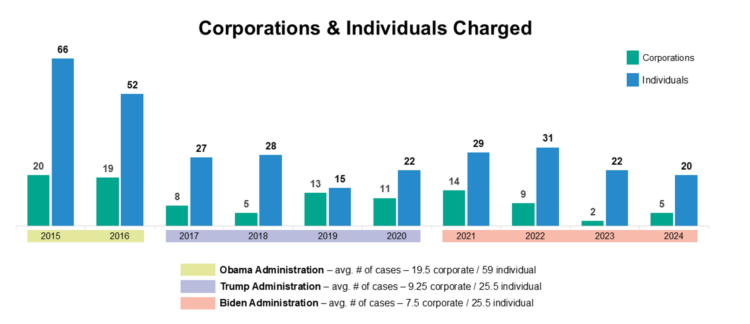
Overall, we expect the Trump administration to be much more favorable to transactions as compared to the Biden administration. The Trump administration is likely to be less willing to challenge vertical transactions or transactions under novel theories, such as bundling, and we expect more merger settlements. We believe the Trump administration will not scrutinize private equity transactions to the same extent as the Biden administration and will focus on challenging traditional horizontal transactions. From a conduct perspective, we expect the Trump administration to continue scrutinizing Big Tech and maintain criminal antitrust enforcement at a moderate level.





Key Takeaways | Outcome of the 2024 Election and State of the Market
ARTICLE
Key Takeaways | Outcome of the 2024 Election and State of the Market
November 26, 2024
Read time: 3 min
During this session, Keynote Speaker John Maraganore shared business lessons from a startup perspective and how to create an impactful commercial business plan that anticipates industry risks while prioritizing innovation and client engagement. He also outlined how to raise capital considering the 2024 US presidential election and the impact of clinical data on investor valuation.
Session panelist:
John Maraganore, PhD, Founding CEO, Alnylam Pharmaceuticals, Inc.; CEO and Principal, JMM Innovations, LLC
Top takeaways included:
- Clinical Data Is the Key to Valuation. Quality clinical data is essential to investment-backed success. Not only does clinical data build confidence in the company, but it also raises capital and connects patients with products or services. To produce high-quality clinical data, it is important to first have a well-defined business culture and plan. Further, to access capital from an equity sale to investors or through other deals within the life sciences industry, higher quality science is a requirement to ensure investors of a company’s success and future security.
- Double Down on a Commercial Business Plan. A quality commercial business plan strengthens market success. When building one, consider how to solve for known-knowns, known-unknowns, and unknown-unknowns at all stages of business development. Early-stage companies can solve for both known-known and known-unknown industry risks or claims affecting buy-side deals with experience and preparation. As for unknown-unknowns, a well-managed culture focused on patients, innovation, and stakeholders can mitigate risk. Additionally, management should consider tightening hybrid business models to encourage in-person engagement and innovation.
- The Intersection of Social Media and Life Sciences Requires Active Lobbying to Protect Public Trust in Science. The life sciences industry’s greatest risk in a digital age is social media. While social media can positively impact certain areas of the industry from an awareness and patient connectivity perspective, it may also confuse the inviolability of scientific evidence and developments. Therefore, following the 2024 US presidential election in which digital activism and social media use was at its highest, the life sciences industry must lobby the incoming Trump administration to protect itself via any necessary regulations.
Life Sciences Dealmaking Symposium 2024
ARTICLE
Life Sciences Dealmaking Symposium 2024
November 26, 2024
Read time: 2 min
The Life Sciences Dealmaking Symposium 2024 brought together leaders across life sciences to make invaluable connections and hear from key players within the industry on the state of the market and the latest trends and regulatory developments affecting investors and companies.
Check out the key takeaways below for insights from the symposium.
Click on the links below to view key takeaways from the Life Sciences Dealmaking Symposium 2024. Key takeaways will be posted as they become available.
- Outcome of the 2024 Election and State of the Market
- The Morning After – Impact of the US Presidential Election on the Deal Environment
- State of the Market – Still Looking for an Exit
- Alternative Capital-Raising Strategies in Challenging Times
- Market Access and Reimbursement – Opportunities and Challenges