CLIENT ALERT / US POLICY
Treasury Finalizes DPL Rules, Extends Transitional DCL Relief for Pillar Two Taxes
March 10, 2025
Read time: 9 min
Since the proposed dual consolidated loss (DCL) and disregarded payment loss (DPL) rules were released in August 2024, taxpayers have been wondering whether these controversial regulations would be finalized before the end of the Biden administration. Less than one week before the second inauguration of President Donald Trump, Treasury Decision 10026 was published in the Federal Register on January 14, 2025, finalizing the DPL rules and certain rules that apply to DCLs and DPLs. Although the overall structure of the DPL regulations was left intact, the US Department of the Treasury (Treasury) helpfully delayed their applicability date and made a few, generally taxpayer-friendly, modifications. Treasury also extended the transitional relief for rules addressing the treatment of Pillar Two taxes for DCL purposes and stated that it will finalize the DCL rules in upcoming guidance.
Background
The DCL regulations under section 1503(d) focus on preventing US corporations from using the same loss in both the United States and a foreign jurisdiction (or “double-dipping”). In August 2024, Treasury and the Internal Revenue Service (IRS) released proposed DCL regulations that addressed how the DCL rules interact with Pillar Two taxes and the intercompany transaction rules, and included an anti-avoidance rule. At the same time, they surprised taxpayers with an entirely new set of disregarded payment loss (DPL) rules. Under the proposed DPL rules, domestic corporations would have income inclusions with respect to certain disregarded payments. Read the client alert, “Proposed Disregarded Payment Loss Rules Create Traps for the Unwary,” for additional discussion of the proposed DCL/DPL rules.
Validity
Many taxpayers submitted comments challenging the authority of Treasury and the IRS to issue the DPL rules. Unsurprisingly, Treasury and the IRS vehemently defend their authority to issue the DPL regulations. The preamble to the final regulations notes that the DPL rules are intended to prevent taxpayers from circumventing the DCL rules through an inappropriate use of check-the-box elections and asserts that the rules are consistent with other provisions that “regard” disregarded entities for certain purposes. In contrast, the proposed regulations emphasized that the DPL rules were intended to prevent “deduction/no-inclusion” outcomes. The preamble notes this change in emphasis as a “clarification.”
Delayed DPL Applicability Date
The applicability date of the DPL regulations is delayed to taxable years of disregarded payment entity (DPE) owners (i.e., domestic corporations that directly or indirectly own disregarded entities) beginning on or after January 1, 2026. Calendar-year taxpayers now have almost one year to assess the risk of being subject to the DPL rules and take any remedial steps before the rules apply. The final regulations further simplify the applicability date by removing the proposed regulations’ references to “consent” and “deemed consent” in the DPL regime. Also, effective August 6, 2024, the 60-month limitation on changing an entity classification election is turned off for disregarded entities that elect to be treated as corporations before the DPE owner’s 2026 tax year. As a result, taxpayers can currently elect to treat first-tier disregarded entities as corporations without regard to the 60-month limitation.
Calculation of Disregarded Payment Income (DPI) and DPL
The final regulations clarify that items incurred in the portion of a foreign taxable year that an entity or foreign branch is not a DPE are not taken into account for purposes of calculating DPI or DPL. This means that if a DPE inbounds by migrating to become a US entity on, say, February 15, 2026, then only interest and royalties accrued through February 15 will be included in calculating DPI and DPL. In other words, there is no cliff effect in case an entity is a DPE for part, but not all, of a taxable year.
Deduction for DPL Inclusions
Under the proposed regulations, a taxpayer could suffer a DPL income inclusion without any offsetting deduction. This treatment differs from the treatment of DCLs, which are allowable as deductions to the extent that the relevant separate unit recognizes income from a US tax perspective.
In response to comments, and perhaps to better align the DPL rules with the structure of the DCL rules, the final regulations provide the DPE owner a deduction (not to exceed the DPL inclusion) to the extent that the DPE derives DPI in a year following the year of the DPL inclusion. This deduction has the same character and source as the DPL inclusion to which it relates.
Deemed Ordering Rule
A DPE that has a DPL may also earn income that is regarded from a US tax perspective, or disregarded income that is excluded from the calculation of DPI. The proposed regulations provided that “foreign use” of the DPL was determined under the principles of the DCL rules for foreign use in Treas. Reg. § 1.1503(d)-3. Under these rules, a DCL is presumed to first offset income that does not give rise to a foreign use before giving rise to a foreign use (the “Deemed Ordering Rule”). Applying the Deemed Ordering Rule, taxpayers could reasonably treat DCLs as first offsetting foreign law income that is disregarded for US tax purposes, therefore preventing a foreign use. Comments requested clarification on how the Deemed Ordering Rule applied in the DPL context.
The final regulations modify the Deemed Ordering Rule for DPLs and, notably, also for DCLs. Under the final regulations, the Deemed Ordering Rule is applied separately for each regime, with items of income or gain taken into account only to the extent such items are or would be taken into account in determining the amount of income or loss under the relevant regime. Thus, in determining foreign use for a DCL, only regarded income of the separate unit is taken into account, and in determining foreign use for a DPL, only DPI is taken into account. This change applies for DCLs and DPLs arising in tax years beginning on or after January 1, 2026.
Anti-Avoidance Rule
The final regulations retain the DCL and DPL anti-avoidance rule for transactions engaged in “with a view” to avoiding the purposes of section 1503(d) and the regulations thereunder. The final regulations clarify that the purpose of section 1503(d) and the regulations thereunder is to prevent double deductions and similar outcomes. This means that the rule does not apply if the arrangement does not give rise to the potential for both a US and a foreign tax deduction. The final regulations identify specific exceptions to the anti-avoidance rule.
For example, the final regulations state that the anti-avoidance rule “does not apply to a reduction or elimination of a DCL solely by reason of … items of income arising from the ownership of stock…” This is a particularly welcome clarification for taxpayers who were caught off-guard by the provision in the proposed DCL regulations that removes taxpayers’ ability to include income from the ownership of stock – including dividends and global intangible low-taxed income (GILTI) and subpart F inclusions – in their DCL calculations. However, the preamble notes that these exceptions would be removed or modified if the proposed DCL regulations are finalized.
The final regulations also retain from the proposed regulations an example (Example 43) that shows that the anti-avoidance rule would apply where a taxpayer avoids having a DCL by contributing US branch assets to a disregarded entity. The final regulations add two further examples illustrating the anti-avoidance rule.
Partnerships and DPEs
The final rules “clarify” that a foreign branch owned indirectly through a partnership can be a DPE. Additionally, in certain circumstances an entity that is a foreign tax resident and is treated as a partnership for US tax purposes can be a DPE.
Other Comments
The general structure of the rules, including the “all or nothing” rule for foreign use of a DPL, has not changed. However, a few helpful provisions were added. A new de minimis rule creates an exception for a DPL if it is less than the lesser of $3 million or 10% of the aggregate amount of the DPE’s deductible items under foreign law. A grandfathering rule applies to royalties paid on license arrangements in existence before August 6, 2024, provided that the license arrangement has not be significantly modified within the meaning of the final regulations. Finally, a mirror legislation rule provides that the denial of a deduction for a disregarded payment under foreign hybrid mismatch rules does not give rise to a DPL or a foreign use of a DPL.
Transitional Relief for Pillar Two Taxes Extended
Significantly, the transitional relief for Pillar Two taxes for the DCL rules was extended further. The regulations state that the DCL rules, when finalized, will provide that the DCL rules will apply without taking into account qualified domestic minimum top-up taxes (QDMTTs) and top-up taxes collected under an income inclusion rule (IIR) or undertaxed profits rule (UTPR) incurred in taxable years beginning before August 31, 2025.
Proposed DCL Rules Not Finalized
Treasury notes its intention to finalize the other proposed DCL rules at some point in the future. These rules include:
- Modifications to the intercompany transaction rules in Treas. Reg. § 1.1502-13.
- The Pillar 2 and DCL foreign use rules and related updates to the separate unit definition.
- Removal of items of income arising from stock, such as subpart F and GILTI inclusions, from the computation of a DCL or cumulative register.
- Clarification of separate unit books and records adjustments to “conform to U.S. tax principles”
- Modification of “certification period” and “foreign use” definition to include prior taxable years.
It remains to be seen whether the new administration will continue to focus on finalizing these rules, or whether it will shift to other priorities; we will know more once the priority guidance plan is released.
Conclusion
Taxpayers now have more time to consider whether to modify structures that may give rise to income inclusions under the DPL rules, or whether they are interested in challenging the validity of the final regulations.








Corporate Transparency Act Update: Penalties Paused & Significant Reduction in Scope Expected in Forthcoming Rulemaking
ARTICLE / CLIENT ALERT
Corporate Transparency Act Update: Penalties Paused & Significant Reduction in Scope Expected in Forthcoming Rulemaking
March 10, 2025
Read time: 5 min
On March 2, 2025, the US Department of the Treasury (“Treasury”) issued a press release clarifying that Treasury will not enforce any penalties or fines associated with the Corporate Transparency Act’s (“CTA”) implementing regulation (“Reporting Rule”)[1] under the existing deadlines and will “not enforce any penalties or fines against U.S. citizens or domestic reporting companies or their beneficial owners after the forthcoming rule changes take effect.”[2] In the press release, Treasury also stated that it will be “issuing a proposed rulemaking that will narrow the scope of the [Reporting Rule] to foreign reporting companies only.”[3]
The latest Treasury press release follows a Feb. 27, 2025, announcement by Treasury’s Financial Crimes Enforcement Network (“FinCEN”) that “it will not issue any fines or penalties or take any other enforcement actions against any companies based on any failure to file or update” beneficial ownership information (“BOI”) reports “until a forthcoming interim final rule becomes effective and the new relevant due dates in the interim final rule have passed.”[4] FinCEN explained its intent to issue an interim final rule no later than March 21, 2025, that extends the Reporting Rule deadlines and to solicit public comment on potential revisions to existing BOI reporting requirements.
In light of these developments, there is no urgency to file BOI reports by March 21, 2025, as it is safe to assume that BOI report filings will not be required by that date. The forthcoming interim final rule is expected to extend the Reporting Rule’s BOI report filing deadlines. Treasury’s and FinCEN’s statements have also put the public on notice to expect further modifications to the Reporting Rule to significantly narrow its scope for domestic reporting companies and US citizens. Such rulemaking could take several months or longer to finalize and the BOI reporting obligations for foreign reporting companies and non-US citizen beneficial owners may not be known during this time.[5]
Although Treasury and FinCEN have announced their intention not to impose penalties or fines for failure to report BOI under the CTA and Reporting Rule at this time, neither has been repealed or amended. Reporting companies that have not filed BOI reports should consider if this posture impacts any contractual agreements to comply with the CTA and/or Reporting Rule (this point may become moot if and when FinCEN extends the BOI reporting deadlines and/or narrows the scope of the Reporting Rule through rulemaking).
We will continue to monitor for developments relating to the CTA and Reporting Rule, including any legislation further affecting the CTA or the Reporting Rule.
Authored by Melissa G.R. Goldstein, Betty Santangelo, Michael S. Didiuk, Jessica Romano, Kyle B. Hendrix and Bryson Kern.
For assistance in navigating the CTA and Reporting Rule’s reporting requirements, please contact one of the authors or your attorney at Schulte Roth & Zabel.
[1] For more information, please see our prior Alerts: “Corporate Transparency Act Update: Reporting Requirements Reinstated With March 21 Deadline”; “Corporate Transparency Act Update: Supreme Court Stays Nationwide Injunction but Reporting Still Voluntary”; “Corporate Transparency Act Update: Preliminary Injunction Reinstated and Reporting Voluntary Once Again”; “Important Update – Corporate Transparency Act: Reporting Reinstated by Appellate Court and FinCEN Extends Deadline to Jan. 13”; “Corporate Transparency Act Update: Government Challenges Nationwide Preliminary Injunction & FinCEN Clarifies That Reports Are Voluntary”; and “Corporate Transparency Act Update: Nationwide Preliminary Injunction Enjoining Enforcement.”
[2] Treasury, “Treasury Department Announces Suspension of Enforcement of Corporate Transparency Act Against U.S. Citizens and Domestic Reporting Companies” (Mar. 2, 2025).
[3] It is not clear whether and to what extent these changes will impact state law requiring entities to file reports on beneficial ownership, including the New York LLC Transparency Act. That New York law is much narrower in scope than the CTA and Reporting Rule, but, notably, requires exempt entities to file an attestation of exemption. For more information, please see our prior Alert: “A Guide to the New York LLC Transparency Act.”
[4] FinCEN, “FinCEN Not Issuing Fines or Penalties in Connection with Beneficial Ownership Information Reporting Deadlines” (Feb. 27, 2025).
[5] Reporting companies that have already submitted BOI reports to FinCEN may wish to raise in comments to the forthcoming proposed rulemaking how FinCEN will store and use their and their beneficial owners’ BOI.
This communication is issued by Schulte Roth & Zabel LLP for informational purposes only and does not constitute legal advice or establish an attorney-client relationship. In some jurisdictions, this publication may be considered attorney advertising. © 2025 Schulte Roth & Zabel LLP. All rights reserved. SCHULTE ROTH & ZABEL is the registered trademark of Schulte Roth & Zabel LLP.






Will it (puff, puff) pass? Cannabis reform under the Trump administration
CLIENT ALERT / US POLICY
Will it (puff, puff) pass? Cannabis reform under the Trump administration
March 7, 2025
Read time: 9 min
The Trump administration’s approach to cannabis reform will significantly impact the industry. As the proposed rulemaking to reschedule cannabis unfolds and nominees to critical agencies are confirmed, it is crucial for stakeholders to stay informed about these pivotal changes. This article provides an in-depth analysis of the implications of these developments.
On May 21, 2024, the US Department of Justice (DOJ) published a notice of proposed rulemaking to reschedule marijuana (cannabis) as a Schedule III controlled substance under the Controlled Substances Act, loosening federal restrictions on its medical use. A hearing to assess the Biden administration’s rescheduling proposal was initially scheduled for January 21, 2025. However, only eight days before the hearing was set to take place, a US Drug Enforcement Administration (DEA) administrative law judge cancelled the hearing, pending appeal. This delay means that the issue of marijuana rescheduling will be addressed by a DOJ and DEA helmed by the Trump administration.
The hearing’s cancellation resulted from the denial of a motion to reconsider, which was filed by Village Farms International, Hemp for Victory, and the Connecticut Office of the Cannabis Ombudsman (the movants) in late November 2024 in response to an order regarding alleged ex parte communications. The DEA administrative law judge granted the movants leave to file an interlocutory appeal to the DEA administrator. Because of the pending appeal, the January 21 hearing on the merits was cancelled, and the movants and the government were ordered to provide the tribunal with a joint status update every 90 days from the issuance of the order.
On February 6, 2025, the Connecticut Office of the Cannabis Ombudsman and The Doc App filed a notice with the tribunal indicating their intent to withdraw from these administrative proceedings. On February 7, 2025, the withdrawal request was granted. This leaves Hemp for Victory and Village Farms International as the only remaining designated participants serving as proponents of the interlocutory appeal.
See our previous On the Subject for more information about the implications of the rescheduling proposal.
Legal Background
As the US government has removed certain restrictions on the use and distribution of specific aspects of the cannabis plant, the cannabis-derived products marketplace has expanded.
The Agricultural Act of 2014 defined “industrial hemp” as any part of the Cannabis sativa L. plant with a delta-9 tetrahydrocannabinol concentration of not more than 0.3% on a dry weight basis. This allowed it to be used for research purposes only in limited situations. The Agricultural Improvement Act of 2018 (also known as the 2018 Farm Bill) again relaxed federal restrictions on hemp by removing hemp from the Controlled Substances Act statutory definition of marijuana, resulting in interstate commerce of hemp. The 2018 Farm Bill also preserved the US Food and Drug Administration’s (FDA’s) authority to regulate products containing cannabis and cannabis-derived products under the Federal Food, Drug, and Cosmetic Act and § 351 of the Public Health Service Act.
To this point, the FDA has approved one cannabis-derived drug product and three synthetic cannabis-related drug products for humans. There are currently no FDA-approved, conditionally approved, or indexed animal drugs that contain cannabidiol (CBD). Under the Animal Medicinal Drug Use Clarification Act of 1994 and its implementing regulations, however, veterinarians can prescribe approved human drugs for use in animals in an extralabel manner under certain conditions.
The FDA may be trying to change this. On January 16, 2025, the FDA’s Center for Veterinary Medicine (CVM) under the Biden administration released a request for information (RFI) soliciting comments from the public, with a focus on practicing veterinarians, related to the use of cannabis-derived products in veterinary medicine. The RFI is focused primarily on CBD products and other hemp-derived products. The FDA also stated in the RFI that regulation of the CBD market is a priority and thus the information gathered will guide the FDA in its future regulatory action. Stakeholders have until April 16, 2025, to submit comments to CVM. However, as discussed below, the change in administration may result in updated priorities.
Implications of Administration Change
The recent change in presidential administration has created some uncertainty regarding agencies’ current cannabis-related positions and priorities.
President Donald Trump became the first major-party presidential nominee to endorse a state adult-use legalization campaign when he voiced his support for Amendment 3 to Florida’s constitution in September 2024. President Trump also stated his intention to “focus on research to unlock medical uses of marijuana to a Schedule 3 drug, and work with Congress to pass common sense laws.” However, President Trump has not addressed the issue since his September 2024 statement.
Trump’s selections to lead relevant agencies such as the DOJ and DEA will likely have a sizable impact on the future of marijuana rescheduling. Cannabis was not a topic of discussion at the confirmation hearings for Attorney General Pam Bondi. On February 11, 2025, Trump announced his nomination of Terrance C. Cole for DEA administrator. Cole has expressed opposition to cannabis reform. The current acting administrator of the DEA, Derek Maltz, has similarly voiced opposition to cannabis reform.
The topic received little attention at newly confirmed US Department of Health and Human Services Secretary Robert F. Kennedy Jr. (RFK)’s nomination hearings, with RFK Jr. stating that he would defer to the DEA on marijuana rescheduling. Although RFK has previously called for cannabis decriminalization, he has recently been silent on rescheduling efforts and instead has said that he will defer to the DOJ and DEA in the allocation of their resources and development of their priorities.
Next Steps
Given the mixed signals offered by current and future members of the Trump administration, it remains difficult to predict exactly where cannabis-related reform is headed in the near future. However, as federal cannabis regulations undergo significant changes, stakeholders should stay informed and involved in the rulemaking process, and businesses should continue to adapt to the evolving landscape to remain competitive and compliant.
If you would like to submit comments to the CVM or require guidance on navigating cannabis regulation, please contact one of the authors or any other member of McDermott’s Cannabis Regulatory Practice Group and Food, Drug & Medical Device Regulatory Practice Group. McDermott will continue to monitor cannabis regulation as it develops.










HHS Signals Action on Gender-Affirming Care
CLIENT ALERT / US POLICY
HHS Signals Action on Gender-Affirming Care
March 7, 2025
Read time: 4 min
On March 5, 2025, the Center for Clinical Standards and Quality (CCSQ) within the Centers for Medicare & Medicaid Services (CMS) released a Quality & Safety Special Alert Memo for hospitals related to President Trump’s executive order (EO) “Protecting Children from Chemical and Surgical Mutilation.”
In the memo, CMS notes that it “may begin taking steps in the future to align policy, including CMS-regulated provider requirements and agreements, with the highest-quality medical evidence in the treatment of the nation’s children in order to protect children from harmful, often irreversible mutilation, including sterilization practices.” CMS says that it will “follow any applicable substantive and procedural requirements in taking any future action.”
The memo does not call for any immediate change in action, but it strongly suggests that hospitals will see future action from CMS on this topic to enforce the terms of the EO.
The next day, the Health Resources and Services Administration (HRSA) sent a letter to hospital administrators and others noting the CCSQ memo and stating that HRSA would review its policies, grants, and programs in light of the concerns CMS identified in the CCSQ Memo and may take steps in the future to update its policies to comply with the EO. HRSA also stated that it would review its Children’s Hospitals Graduate Medical Education (CHGME) Payment Program that awarded $367.2 million in fiscal year (FY) 2024 to 59 free-standing children’s hospitals nationwide and that it may consider re-scoping, delaying, or potentially canceling new grants in the future depending on the nature of the work and any future policy change(s) HRSA may make.
The gender-affirming care EO has been subject to litigation, and federal judges in PFLAG v. Trump and Washington v. Trump have issued preliminary injunctions against Section 4, which directs agencies that provide grants to medical institutions to “immediately take appropriate steps to ensure that institutions receiving Federal research or education grants end the chemical and surgical mutilation of children.” It is questionable whether these actions – particularly the HRSA letter – comply with the terms of the preliminary injunctions insofar as they may be viewed to threaten federal research and education grants. However, Section 5 of the EO remains in effect and may be the section upon which the US Department of Health and Human Services (HHS) would claim to be acting. Section 5 directs HHS to take actions to “end the chemical and surgical mutilation of children, including regulatory and sub-regulatory actions,” including “Medicare or Medicaid conditions of participation or conditions for coverage, clinical-abuse or inappropriate-use assessments relevant to State Medicaid programs, and quality, safety, and oversight memoranda.”
CCSQ serves as the focal point for all quality, clinical, and medical science issues and policies for CMS programs. It oversees the planning, policy, coordination, and implementation of the survey, certification, and enforcement programs for all Medicare and Medicaid providers and suppliers, and develops requirements of participation for providers and plans in Medicare and Medicaid. HRSA is a separate agency within HHS that administers an extensive federal grant program. In FY 2024, HRSA awarded more than $12.2 billion in grants, making more than 6,000 grant awards focused on improving healthcare services.
McDermott continues to monitor developments surrounding the EO, including the ongoing litigation. We are in the process of updating our FAQs to provide additional analysis of the issues the EO presents. If you have any questions, please contact the authors of this article or your regular McDermott lawyer.


Antitrust Under Trump: Initial Policies and Actions
ARTICLE / CLIENT ALERT / US POLICY
Antitrust Under Trump: Initial Policies and Actions
March 6, 2025
Read time: 7 min
As the Trump administration’s approach to antitrust takes shape through political appointments, policy statements, speeches, and enforcement actions, our team is tracking new developments and will provide important updates on issues pertinent to clients. This client alert is not intended to be a comprehensive review of specific actions or cases, but rather an at-a-glance review of relevant policies as they are being created.
Nominations and Confirmations
Appointment of Federal Trade Commission (FTC) Chairman
- President Donald Trump appointed FTC Commissioner Andrew Ferguson as the new chairman of the FTC on January 20, 2025.
- Ferguson views antitrust enforcement as a facilitator of innovation and believes that because markets are not self-correcting, government intervention on behalf of human flourishing and the protection of workers is necessary.
- Despite his intention to “reverse” former Chair Lina Khan’s war on mergers and anti-business agenda, Ferguson has expressed concern with the market power of Big Tech and other large companies being leveraged to gain social or political control.
Confirmation Hearing for AAG Nominee Gail Slater
- President Donald Trump nominated Gail Slater as the Assistant Attorney General (AAG) of the US Department of Justice’s (DOJ) Antitrust Division on December 4, 2024.
- On February 12, 2025, Slater appeared before the Senate Judiciary Committee for her nomination hearing. The committee advanced her nomination on February 27 with a vote of 20-2.
- Slater has expressed a desire to continue enforcement actions against Big Tech and to return to using merger remedies in the form of consent decrees and settlements to address competitive harm.
Confirmation Hearing for FTC Commissioner Nominee Mark Meador
- President Trump appointed Mark Meador to the FTC on December 10, 2024.
- On February 25, 2025, Meador appeared before the Senate Committee on Commerce, Science, and Transportation for his confirmation hearing.
- He echoes Slater’s view that pursuit of Big Tech should remain a priority for the agencies, as should combatting noncompete agreements that overly burden workers and prevent employees from leaving to work for a competitor.
General Updates
Musk Supports Consolidating Antitrust Enforcement Agencies
- Responding to a comment by Sen. Mike Lee (R-Utah), who expressed hope that the new administration would consider consolidating the FTC and DOJ, Elon Musk said, “Sounds logical,” appearing to agree with the idea.
- Lee referenced the One Agency Act, a bill he proposed in 2021 that would strip the FTC of its antitrust authority and transfer it to the DOJ. When discussing the bill, Lee has compared the current two-agency system to having two presidents.
Agencies Keep 2023 Merger Guidelines
- FTC Chairman Ferguson and Omeed Assefi, Acting Assistant Attorney General of the DOJ’s Antitrust Division, announced on February 18, 2025, that the FTC and DOJ will continue to use the 2023 Merger Guidelines as the framework for their merger review process.
- Ferguson cited the time and expense associated with creating new guidelines, as well as his desire to create stability for the parties and the agencies, as the rationale for adhering to the 2023 Guidelines. He did note that “no Guidelines are perfect” and indicated portions could be revisited later.
Ferguson Supports New Hart-Scott-Rodino (HSR) Rules
- FTC Chairman Ferguson expressed his support for the new HSR rules, stating that “updates were long overdue” and would “prevent unlawful deals from slipping through the cracks.”
- He has previously stated his approval of the new rules, calling them a “lawful improvement over the status quo” in his concurring statement accompanying the rules’ announcement.
Holyoak Sets Out FTC Goals for New Administration
- In remarks at the GCR Live conference on January 30, 2025, FTC Commissioner Melissa Holyoak outlined three areas of focus for antitrust under the Trump administration. She explained that the FTC will focus on (i) making the merger review process better and more predictable, (ii) ensuring that antitrust concerns will not impede artificial intelligence innovation, and (iii) fighting against Big Tech censorship.
- In later remarks, Holyoak said that she expects the return of early termination, improving staff communication and transparency with the parties in the merger review process, bringing back remedies as a method of resolving merger issues – as well as continuing enforcement actions against Big Tech – and abandoning FTC rulemaking authority.
Meador Targets Anticompetitive Effects of Vertical Mergers
- At his confirmation hearing on February 25, 2025, FTC Commissioner nominee Meador indicated that he would address the consumer welfare issues raised by vertical mergers. He noted that vertical integration can allow for increased prices, a reduction in quality, and market foreclosure. He went onto say that he would address these concerns where they arise.
FTC Will Continue to Fight Anticompetitive Behavior in Labor Markets
- FTC Chairman Ferguson has emphasized a continuing priority of protecting workers using antitrust laws.
- He cited no-poach, wage-fixing, and noncompete agreements, as well as deceptive or misleading hiring practices, as examples of conduct the FTC will fight against to combat labor monopsonies and general harm to workers.
- The FTC will approach these issues based on individual cases, not rulemaking (like the Biden administration’s noncompete ban).
Agencies Indicate Return of Merger Remedies
- Statements from FTC Commissioner Holyoak and AAG nominee Slater indicate that both the FTC and DOJ will become more open to evaluating merger remedies under the new administration.
- Holyoak has stated that the agencies should consider remedies like divestitures when such remedies can successfully preserve competition lost by a merger. Similarly, Slater has stated that when merger remedies are “done right,” they can remove competitive harm from a merger.
FTC Issues Policy to Avoid Staff Participation in the American Bar Association (ABA) Antitrust Section Activities
- In response to the ABA’s criticism of the new Trump administration’s recent actions, on February 14, 2025, FTC Chairman Ferguson prohibited FTC political appointees from holding leadership positions in the ABA, participating in or attending ABA events, and renewing ABA memberships.
- Ferguson pointed to several historical examples of what he asserts have been ABA political partisanship and leftist advocacy to support his decision, as well as views on the ABA’s loyalty to the interests of Big Tech.
Ferguson Intends to Pursue Diversity, Equity, and Inclusion (DEI), Environmental, Social, and Governance (ESG) Collaborations as Section One Violations
- In a document laying out his policy priorities created prior to his appointment to chairman, FTC Chairman Ferguson explained he intends the FTC to “investigate and prosecute collusion on DEI, ESG, advertiser boycotts, etc.,” suggesting the agency may focus its investigations on companies participating in industry groups or other collaborative ventures intended to address social issues or manage industry risks associated with environmental, labor, or diversity issues.
Uncertainty Prevails Over Future FTC Enforcement of the Robinson-Patman Act
- FTC Commissioner nominee Meador has written favorably of federal enforcement of the Robinson-Patman Act, a statute prohibiting discriminatory pricing which was largely ignored until the last years of the Biden administration.
- Meador suggested that the law should be enforced, particularly in the grocery and consumer packaged goods industries. Ferguson and Holyoak have written in recent FTC dissents that the FTC’s resources would be better served by enforcing the law in appropriate cases where the alleged price discrimination harms competition (e.g., involving actors with market power using price discrimination to monopolize).
- Until Meador is confirmed, it is uncertain whether and how Robinson-Patman will be enforced.






NIH’s Mandatory 15% Indirect Rate – Next Steps Following Preliminary Injunction
CLIENT ALERT / US POLICY
NIH’s Mandatory 15% Indirect Rate – Next Steps Following Preliminary Injunction
March 6, 2025
Read time: 13 min
In partnership with BDO USA, P.C.
On March 5, 2025, a US district court in Massachusetts issued a preliminary injunction blocking the National Institutes of Health (NIH) from implementing a February 7, 2025, “Supplemental Guidance” notice that would establish “a standard indirect rate of 15% across all NIH grants for indirect costs in lieu of a separately negotiated rate for indirect costs in every grant.” Notice No. NOT-OD-25-068, Supplemental Guidance to the 2024 NIH Grants Policy Statement: Indirect Cost Rates (Feb. 7, 2025). The preliminary injunction enjoins the Government from taking any steps to implement, apply, or enforce the February 7 “Rate Change Notice,” extending the prohibition in the temporary restraining orders that the same court issued on February 10, 2025.
The district court’s 76-page memorandum and order finds that the plaintiffs challenging the Rate Change Notice are likely to succeed on their principal claims that the Rate Change Notice violates existing statutes and regulations and is arbitrary and capricious. But although the preliminary injunction prevents NIH from implementing a blanket 15% indirect rate across all NIH grants for the time being, the Government’s actions and arguments in this and other litigation strongly indicate that the Government will pursue a variety of alternative avenues to limit indirect cost recovery in NIH grants and achieve the same bottom-line result. In fact, the court’s analysis may provide NIH with a roadmap to achieving key parts of its intended result, albeit with respect to a narrower class of grants and recipients. For these reasons, recipients with existing negotiated indirect cost rate agreements (NICRAs) – particularly NICRAs that will expire in the near future – should consider taking the following steps:
- Immediately gather relevant documents and accounting data and prepare for a fight, whether under an existing NICRA or the negotiation of a new NICRA.
- Quickly challenge any refusal by NIH to reimburse costs under existing grants in accordance with negotiated indirect rates, as well as any attempt by NIH to unilaterally modify existing grants to reduce indirect cost recovery.
- Carefully consider the benefits and risks of changing accounting practices and understand the limits on your ability to do so.
Background
Context is critical here. In 2017, the first Trump administration attempted to reduce indirect cost rates for all NIH grants to 10%, which was the “de minimis” rate at the time under the Uniform Administrative Requirements, Cost Principles, and Audit Requirements for Federal Awards (the “Uniform Guidance) at 2 C.F.R. Part 200, and Department of Health and Human Services (HHS) Supplement to the Uniform Guidance at 45 C.F.R. Part 75. Congress responded by including language in the 2018 Consolidated Appropriations Act requiring that HHS’s regulations relating to indirect costs, “including with respect to the approval of deviations from negotiated rates, shall continue to apply to [NIH] to the same extent and in the same manner as such provisions were applied in the third quarter of fiscal year 2017.” Pub. L. No. 115-141 § 226, 132 Stat 348, 740. The 2018 appropriations rider prohibited HHS and NIH from spending appropriated funds “to develop or implement a modified approach to” HHS’s regulations on indirect rates. Id. Subsequent appropriations, including the 2024 Further Consolidated Appropriations Act, contained the same prohibition. See Pub. L. No. 118-47, div. D, tit. II, § 224, 138 Stat. 460, 677.
Fast forward to 2025. On February 7, NIH published Notice No. NOT-OD-25-068, Supplemental Guidance to the 2024 NIH Grants Policy Statement: Indirect Cost Rates (the “Rate Change Notice”). The Rate Change Notice applies to both new and existing grants and was set to become effective on February 10, 2025 (one business day after it was published). Twenty-two states, the Association of American Medical Colleges, the Association of American Universities, and other plaintiffs immediately filed lawsuits in the US District Court for the District of Massachusetts challenging the Rate Change Notice. See Commonw. of Mass. et al. v. NIH et al., No. 1:25-cv-10338; Ass’n of Am. Med. Colls. et al. v. NIH et al., No., 1:25-cv-10340; Ass’n of Am. Univs. et al. v. HHS et al., No. 1:25-cv-10346. All three suits challenged the Rate Change Notice as contrary to the 2024 Further Consolidated Appropriations Act and HHS’s regulations, and invalid under the Administrative Procedure Act (APA), 5 U.S.C. §§ 701-706. On February 10, 2025, Judge Kelley issued a temporary restraining order (TRO) in Commonwealth of Massachusetts, enjoining NIH from implementing the Rate Change Notice in any of the 22 plaintiff states. The next day, Judge Kelley issued a separate TRO in Association of American Medical Colleges, enjoining NIH from implementing the Rate Change Notice nationwide.
Legal Shortcomings of the Rate Change Notices
The court’s memorandum and order identifies numerous substantive and procedural defects in the Rate Change Notice, which the plaintiffs had emphasized to varying degrees in each of the three lawsuits. This article focuses on the three defects that the Government will likely seek to rectify – and, indeed, may have already begun to rectify – to attempt to achieve substantially similar results as the Rate Change Notice through other means.
1. The Rate Change Notice Is Inconsistent With the Uniform Guidance’s Indirect Rate Provisions, as Well as HHS’s Supplement to the Uniform Guidance
The Rate Change Notice recognizes that, “[i]n issuing grants, NIH generally uses the indirect cost rate negotiated by an agency with cognizance for F&A/indirect cost rate (and other special rate) negotiation.” Notice No. NOT-OD-25-068; accord 45 C.F.R. § 75.414(c)(1) (“The negotiated rates must be accepted by all Federal awarding agencies.”); 2 C.F.R. § 200.414(c)(1) (verbatim). The Rate Change Notice, however, purports to rely on the authority in these regulations to “use a rate different from the negotiated rate for a class of Federal awards or a single Federal award,” in 45 C.F.R. § 75.414(c)(1) (italics added for emphasis). That authority, however, may only be used “when required by Federal statute or regulation, or when approved by a Federal awarding agency head or delegate based on documented justification as described in paragraph (c)(3) of this section.” Id. Section 75.414(c)(3), in turn, requires NIH and other HHS awarding agencies to “implement, and make publicly available, the policies, procedures and general decision making criteria that their programs will follow to seek and justify deviations from negotiated rates.”
The court’s memorandum and order recognizes the obvious fact that the Rate Change Notice is not a “deviation” from negotiated rates for “a class of Federal awards or a single Federal award.” It is a refusal by NIH to accept negotiated rates for any award, despite Section 75.414(c)’s explicit default requirement that “negotiated rates must be accepted by all Federal awarding agencies.” See also 45 CFR § 75.352(a)(4) (requiring pass-through entities to similarly use a subrecipient’s negotiated cost rates in subawards). Moreover, NIH has not published “the policies, procedures and general decision-making criteria” that will be used “to seek and justify deviations from negotiated rates,” whether in the Rate Change Notice or otherwise. The Rate Change Notice does not contain or contemplate “decision making criteria” because it does not allow for further decision making – the Rate Change Notice itself is a blanket decision for all NIH awards. See generally Mem. & Order at 18-22.
Section 75.414(c) recognizes that, once a cognizant awarding agency negotiates rates with a recipient, those rates should be honored by other awarding agencies. This is because the negotiated rate has already been found to reflect a reasonable causal/beneficial relationship between the costs in the indirect expense pool, on the one hand, and the costs in the allocation base for that pool, on the other. Section 75.414(c) recognizes that it may be appropriate to deviate from these negotiated rates for individual awards or classes of awards where, for one reason or another, that causal/beneficial relationship does not hold – e.g., where the individual grant or class of grants receives a substantially greater or lesser benefit from indirect costs than is reflected in the negotiated rates. Any such deviation, however, can only be made on a recipient-by-recipient basis, for an individual grant or a class of grants. To our knowledge, the authority in Section 75.414(c) has only ever been used on a case-by-case basis.
The Rate Change Notice is inconsistent with the Uniform Guidance and HHS’s supplement for other reasons, as well :
- The Rate Change Notice reflects a determination by NIH that any indirect rate above 15% is too high, which turns the Uniform Guidance’s entire approach to indirect rates on its head. Fifteen percent is the “de minimis rate” that recipients are allowed to use as a matter of default – i.e., without negotiating indirect rates or provisional rates and submitting the cost data supporting the proposed rate. 2 C.F.R. § 200.414(f).[1] The Uniform Guidance allows recipients to elect to use the de minimis rate in lieu of a negotiated or provisional rate, but the Rate Change Notice effectively makes the election immaterial for NIH awards, as the Notice prevents NIH from negotiating a higher rate.
- Similarly, the entire purpose of negotiated indirect rates is to avoid agency-specific rates. The Uniform Guidance therefore generally requires agencies to honor the rates negotiated by other agencies. 2 C.F.R. § 200.414(c)(1); 45 C.F.R. § 75.414(c)(1). The Rate Change Notice creates an NIH-specific rate that necessarily will conflict with virtually every existing indirect rate agreement, as no recipient will have an agreement for a 15% rate, because no agreement is necessary to apply the de minimis rate.
The Government may have been expecting the court to rule against it on these grounds. On February 28, 2025, HHS issued a “Policy Statement” that its regulations regarding grants and contracts would no longer be subject to the APA’s notice and comment rulemaking process, which allows members of the public an opportunity to participate in the rulemaking process by reviewing proposed rules and offering an agency their views on the wisdom of rules before they go into effect. (See Policy on Adhering to the Text of the Administrative Procedure Act 90 Fed. Reg. 11029 (Mar. 3, 2025).) Although the APA does exempt matters involving grants and contracts from APA’s notice and comment requirements, HHS in 1971 established a policy of employing notice and comment rulemaking, which courts have held binding on HHS.
Based on HHS’s February 28 Policy Statement, the Government may quickly seek to eliminate the principal barrier that the court identified to the Rate Change Notice by amending Section 75.414(c) without public notice and an opportunity to comment. Although any such amendment would itself be subject to judicial review under the APA, that review would focus on whether the amended rule is arbitrary, capricious, an abuse of discretion, or not in accordance with some other law.[2]
2. The Rate Change Notice Violates the Further Consolidated Appropriations Act of 2024
The court agreed with the plaintiffs that the Rate Change Notice seeks to do exactly what the first Trump administration attempted to do in 2017, and what Congress explicitly prohibited HHS and NIH from doing in each appropriations bill since. Mem. & Order at 22-28. The Rate Change Notice violates Congress’s riders in three ways: (1) by disregarding the deviation process in Section 75.414(c); (2) by spending appropriated funds to “develop or implement a modified approach” to HHS’s existing indirect rate regulations; and (3) by “substantially expand[ing]” the fiscal effect of the deviation in negotiated rates from the fiscal effect of prior deviations.
As with Section 75.414(c), this statutory obstacle may also be short-lived. A final appropriations bill for 2025 has not yet been passed; however, the Trump administration may be able to work with Congress to remove or revise this language in a final 2025 bill.
3. The Rate Change Notice Is Arbitrary and Capricious
The court also agreed with the plaintiffs that the Rate Change Notice fails to provide any meaningful justification or rationale for an across-the-board standard indirect rate for all grants, existing and new, regardless of the terms and conditions, type of grant, or other nuances in grant administration. (Mem. & Order at 30-37.) The court specifically rejected as conclusory and unsupported the Rate Change Notice’s assertion that a 15% indirect rate will allow more funds to be allocated to “direct scientific research costs rather than administrative overhead.” (Notice No. NOT-OD-25-068.) The court ruled that NIH “fails to address how the money will actually be directed to cover direct costs and how that research will be conducted absent the necessary indirect cost reimbursement provided by the Federal Government.” (Mem. & Order at 33.) Similarly, the court faulted NIH’s unsupported premise that there is a “market” for funded research, disregarding key differences between how the Federal Government funds research and how private foundations fund research, and the types of research that these organizations fund. Id. at 34. More fundamentally, the court faulted the Rate Change Notice for not considering whether aligning Federal indirect rate reimbursement with reimbursement by private foundations “is actually a good thing.” Id. at 35.
The Rate Change Notice also focuses entirely on indirect costs, even though the total cost that NIH will reimburse in a given grant is a combination of direct and indirect costs 45 C.F.R. § 75.402, and even though HHS’s regulations recognize that “[t]here is no universal rule for classifying certain costs as either direct or indirect (F&A) under every accounting system” id. § 75.402. See also id. § 75.414(b) (“Because of the diverse characteristics and accounting practices of nonprofit organizations, it is not possible to specify the types of cost which may be classified as indirect (F&A) cost in all situations.”). The Rate Change Notice therefore arbitrarily focuses on only one side of the incurred cost coin and punishes recipients that hold multiple grants and have invested in facilities and other administrative capabilities that support those multiple grants, even if those same recipients’ overall costs are relatively inexpensive and efficient for the research they perform and the science they advance.
Ultimately, however, this aspect of the court’s order may provide NIH and HHS with a roadmap for the development of a new rule that achieves the same result. As noted above, HHS’s February 28 policy statement signals that HHS believes it can enact rules without notice and comment rulemaking, eliminating a potentially time-consuming obstacle to revising Section 75.414(c). Although any new or amended rule would itself be subject to judicial review under the APA, NIH and HHS now have a checklist of considerations that they could seek to address to support a new regulatory approach to indirect rates.
Next Steps
Although the preliminary injunction prevents NIH from implementing a blanket 15% indirect rate across all NIH grants, the Government’s arguments and actions in this litigation and in litigation involving other funding freezes strongly suggest that the Government will seek to achieve the same result through other means. If and when Congress passes an appropriations bill for 2025, Congress may remove or relax the statutory prohibition on changing HHS’s indirect rate rules. And the Government may seek to issue a new deviation under Section 75.414(c) for something fewer than all NIH grants, or it may seek to do away with Section 75.414(c) altogether. Either way, the Government may move quickly to position itself to nominally argue that it is making individualized deviation decisions consistent with law. Other district courts have criticized the Government’s efforts to “simply search for and invoke new legal authorities as a post hoc rationalization for the enjoined agency action,” but have struggled to draw the line between post hoc rationalizations and “undertaking a good-faith, individualized assessment of a contract or grant and, where the terms or authority under law allows, taking action with respect to that particular agreement consistent with any procedures required.” ECF No. 28 at 2, 6, Global Health Council et al. v. Trump et al., ECF No. No. 25-00402 (D.D.C. Feb. 20, 2025). The Government will likely test the location of that line here. Finally, the Government will almost certainly appeal the preliminary injunction and may receive an appellate ruling that vacates or relaxes the injunction.
Given this uncertainty, recipients with existing NICRAs – particularly NICRAs that will expire in the near future – should consider taking the following steps:
1. Immediately gather relevant documents and accounting data and prepare for a fight, whether under an existing NICRA or the negotiation of a new NICRA.
Recipients should gather their indirect rate proposals and agreements, along with all supporting information provided to the cognizant Federal agency that negotiated those indirect rates. Recipients should also gather all grant proposals and applications documenting their reliance on the negotiated indirect rates, as well as any correspondence or submissions regarding indirect costs for individual awards. The goal is to establish a history of agreement with the Federal Government that the negotiated indirect rates reflect the recipients’ actual, allowable indirect costs for all grants. These documents and data will be critical not only in the event that the Government refuses to honor negotiated rates under existing grants, but also will be important for negotiating rates for future years not covered by an existing agreement, and for responding to future attempts by the Government to justify deviations for particular grants. This information will also be critical to defending against efforts to adjust negotiated rates under existing regulations, which generally require the Government to demonstrate that the recipient’s cost proposal for those rates included unallowable costs. 45 C.F.R. § 75.411.
2. Quickly challenge any refusal by NIH to reimburse costs under existing grants in accordance with negotiated indirect rates, as well as any attempt by NIH to unilaterally modify existing grants to reduce indirect cost recovery.
The preliminary injunction in Massachusetts v. NIH and other lawsuits under the Administrative Procedure Act will provide a vehicle to challenge attempts by NIH to create post hoc rationalizations for a blanket mandatory 15% indirect rate. As the court recognized, however, the Tucker Act 28 U.S.C. § 1491 provides a vehicle for a monetary judgment against a Federal agency under a grant. Recipients should consider carefully whether a particular action by NIH reflects the implementation of a broader effort to effectuate some arbitrarily low cap on indirect costs, or instead reflects a refusal by NIH to honor the terms of a particular grant. Because these are not mutually exclusive scenarios, recipients will need to carefully select the appropriate forum for ensuring that they receive the reimbursements to which they are entitled. In any case, it is important for recipients to assert their rights quickly, before the Government can backfill the record with additional post hoc explanations and arguments.
3. Carefully consider the benefits and risks of changing accounting practices and understand the limits on your ability to do so.
As noted above, both the Uniform Guidance and HHS’s regulations recognize that “[t]here is no universal rule for classifying certain costs as either direct or indirect (F&A) under every accounting system.” 2 C.F.R. § 200.412; 45 C.F.R. § 75.412. These regulations also recognize that the “diverse characteristics and accounting practices of nonprofit organizations” allow for a variety of approaches to classifying costs as direct or indirect. 2 C.F.R. § 200.414(b); 45 C.F.R. § 75.414(b). Although these regulations provide recipients with discretion to reasonably select a particular classification, the regulations repeatedly emphasize the need to consistently follow the selected approach. 2 C.F.R. §§ 200.403(d), 200.412; 45 C.F.R. §§ 75.403(d), 75.412. The requirement consistently applies even if a recipient elects to use the de minimis rate. 2 C.F.R. § 200.414(f); 45 C.F.R. § 75.414(f).
NIH’s standard rate agreements typically provide that NIH’s acceptance of the recipient’s rates is subject to several conditions. In addition to the condition that costs included in the recipient’s rate proposal are allowable, the agreement requires that the same costs that have been treated as indirect costs are not claimed as direct costs, and that similar types of costs have been accorded consistent accounting treatment. Violation of these conditions could provide a basis for NIH to rescind the rate agreement and potentially assert a claim for payments made pursuant to the agreement.
Further, the consistent treatment of costs as either direct or indirect, but not both, is a key factor regarding the adequacy of an organization’s accounting system. The Government requires grantees or contractors to maintain adequate accounting systems when receiving and disbursing Government funds. The Government may, and does, perform its own audits and assessments of grantee or contractor accounting systems to determine if such systems are capable of accounting for Federal funds received on a consistent, fair, and equitable basis. If the Government determines that accounting system deficiencies exist, the Government may determine the accounting system to be inadequate, thereby potentially negatively affecting a grantee’s or contractor’s ability to receive additional Federal funding opportunities.
Any change in accounting practices must therefore be done carefully and transparently, and in most cases should only be done prospectively. Recipients considering such a change should consult with experienced accounting and legal professionals to ensure that the change is appropriate and does not hand NIH a basis to achieve a unilateral rate reduction for a particular grant that achieves the same or a similar result that NIH sought to achieve through the Rate Change Notice.



California AB 1415 Aims to Expand OHCA’s Healthcare Transaction Review Authority
ARTICLE / CLIENT ALERT
California AB 1415 Aims to Expand OHCA’s Healthcare Transaction Review Authority
March 5, 2025
Read time: 7 min
On February 21, 2025, Assembly Member Mia Bonta introduced AB 1415, a bill that aims to bring healthcare investments by private equity groups and hedge funds more fully into the scope of the California Office of Health Care Affordability (OHCA) transaction review process. The proposed amendments to the OHCA statute would expand the definition of “health care entity” to include management service organizations (MSOs) and would impose a reporting obligation on private equity groups and hedge funds (and their downstream affiliates) that enter into certain transactions with health care entities.
Stakeholders entering into healthcare transactions should be aware of the proposed expansion of the OHCA healthcare transaction review process and continue to monitor changes to AB 1415. If signed into law, AB 1415 would likely take effect on January 1, 2026
Since Governor Newsom’s veto of AB 3129 during the prior legislative session, California legislators have introduced two bills containing provisions similar to those included in AB 3129. The first, SB 351, is intended to reinforce California’s corporate practice of medicine and corporate practice of dentistry restrictions. The second bill, AB 1415, seeks to expand the scope of OHCA’s healthcare transaction review process to include transactions involving MSOs, health systems, and nonoperational providers. AB 1415 also would impose a reporting obligation on private equity groups, hedge funds, and their respective downstream affiliates entering into certain healthcare transactions in California.
Background
OHCA’s healthcare transaction review process came into effect on April 1, 2024, requiring certain “health care entities” to report certain material transactions to OHCA at least 90 days’ prior to the closing of the transaction. For more information, see our previous client alerts: “California Publishes Draft Regulations on Filing Requirement for Healthcare Entity Transactions” and “OHCA Updates Draft Regulations on California Healthcare Transaction Notice Requirement.” Not all healthcare transactions are reportable to OHCA; there are a few statutory exemptions for transactions reviewable by other agencies, as well as certain revenue, asset, and change-of-control percentage thresholds that further limit the scope of OHCA’s review authority. While OHCA does not have the ability to approve a transaction or impose conditions on the transactions, it has the ability to conduct a cost and market impact review that can significantly delay the closing of a transaction.
Proposed Additional Transaction Notice Requirement
OHCA currently only requires select “health care entities” to provide notice of certain material transactions. AB 1415 would expand the notice requirement to apply to private equity groups and hedge funds (or their respective downstream affiliates), and to new business entities created for the purpose of entering into agreements or transactions with a health care entity.
Proposed Revisions to Definition of “Health Care Entity”
If passed, AB 1415 would expand the definition of “health care entity” as follows:
- AB 1415 would add MSOs to the definition of health care entity. MSOs are defined as entities that provide administrative services or support for a provider, not including the direct provision of healthcare services. Administrative services include utilization management, billing and collections, customer service, provider rate negotiation, and network development.
- AB 1415 would add health systems as a type of provider and therefore a type of health care entity. Health systems include the following entities:
- Hospital systems.
- A combination of one or more hospitals and one or more physician organizations.
- A combination of one or more hospitals, one or more physician organizations, or one or more healthcare service plans or health insurers.
- AB 1415 would change the definition of provider from an exhaustive list (“any of the following that delivers or furnishes health care services”) to a more open-ended set of providers (“a private or public health care provider, including all of the following”).
- AB 1415 would change the definition of provider to include nonoperational entities, entities with pending or suspended licenses, and entities that do not provide healthcare services, if they otherwise own, operate, or control another entity that is a provider.
Key Takeaways
- Comparisons with AB 3129. In his explanation for the veto of AB 3129, Governor Newsom stated that AB 3129 was duplicative of OHCA’s transaction review process and that OHCA should be the agency tasked with reviewing healthcare transactions. California legislators seem to have taken that message to heart in introducing AB 1415 to expand OHCA’s review authority. While AB 1415 seems to be inspired by AB 3129, there are several key differences between AB 1415 and AB 3129:
- AB 3129 would have allowed the California attorney general to approve, deny, or impose conditions on transactions. AB 1415 does not include any approval right for OHCA or the California attorney general.
- AB 3129 had lower transaction reporting thresholds and applied to smaller groups of providers, even implicating groups with only two non-physician providers. AB 1415 would not change the definition of “provider organization,” which includes medical groups consisting of at least 25 physicians.
- AB 3129 specifically would have applied to transactions involving dentists, optometrists, pharmacists, and nonphysician mental health professionals. AB 1415 remains ambiguous as to whether these types of providers would be included in the definition of “provider.”
- MSOs. While OHCA’s initial draft regulations included MSOs as health care entities, they were removed from subsequent drafts. Current OHCA statutes and regulations do not include MSOs as a type of entity subject to the reporting requirement. If AB 1415 is signed into law, the inclusion of MSOs as a healthcare entity may result in additional transactions becoming reportable to OHCA. The definition of MSO is currently very broad and may inadvertently capture entities that do not have the ability to substantially influence healthcare operations, such as outsourced billing or collection vendors or customer service staffing companies.
- Private Equity Group and Hedge Fund Reporting Requirement. Under the existing OHCA statutes and regulations, certain transactions involving private equity or hedge funds are already reportable to OHCA if the counterparty in the transaction is a health care entity. The “submitter” in a transaction has the obligation to report a significant amount of information to OHCA. The proposed amendments set forth in AB 1415 would specifically require the private equity group or hedge fund to submit notice to OHCA, which would involve the submission of a substantial amount of information regarding the private equity group or hedge fund, including financial statements, organizational charts, and information regarding past healthcare transactions consummated by the private equity group or hedge fund.
- Nonoperational Entities. Under current law, entities that do not currently have healthcare operations or licensure are not considered health care entities. AB 1415 would require certain nonoperational providers and entities that do not provide healthcare services to report transactions if they own or operate another provider, which may substantially increase the types of entities subject to OHCA’s reporting requirements.
- Future Amendments. Future amendments to AB 1415 may help to clarify ambiguities introduced by the bill:
- It is unclear why the bill would add a “health system” to the definition of “provider” when the components of the definition of health system – hospitals, physician organizations, healthcare service plans, and health insurers – are already considered health care entities and are subject to OHCA’s requirements.
- It is unclear what types of entities would be considered providers, as the bill’s definition of “provider” is somewhat circular and includes “private or public health care providers.”



How alcohol exporters can use FDII and IC-DISC to maximize tax savings
ARTICLE
How alcohol exporters can use FDII and IC-DISC to maximize tax savings
Mar 5, 2025
Read time: 4 min
For US alcohol exporters – whether crafting bourbon, brewing craft beer, or bottling fine wines – selling to international markets is a significant opportunity for growth. Two US federal income tax regimes, the foreign-derived intangible income (FDII) deduction and the interest charge-domestic international sales corporation (IC-DISC), offer valuable ways to reduce tax liability and boost profits. Each has unique benefits and trade-offs, making them suited to different business needs. This blog post compares FDII and IC-DISC, helping alcohol exporters decide which tool – or combination – best fits their global ambitions.
Note that all discussions of tax rates are limited to US federal income tax. Additional state and local taxes and excise taxes may also apply.
FDII for Export Income
Introduced under the 2017 Tax Cuts and Jobs Act (TCJA), FDII incentivizes US C corporations to earn income from foreign sales while keeping operations stateside by providing a reduced effective tax rate on eligible export income derived from US-based corporations. It targets “intangible” income – profits exceeding a routine return on tangible assets – and applies a deduction directly on the exporter’s tax return.
How FDII Works
- Eligible income comes from selling alcohol (e.g., whiskey or wine) to foreign buyers for use outside the United States.
- The FDII deduction is 37.5% of qualifying income (dropping to 21.875% after 2025), reducing the effective corporate tax rate from 21% to 13.125% on that portion of income.
- No separate entity is required. Claims are made on the existing C corporation’s Form 1120.
Example: A winery exporting $2 million in Pinot noir with $400,000 in net profit might qualify $300,000 as FDII. A 37.5% deduction ($112,500) lowers the tax from $63,000 to $39,375, saving $23,625.
IC-DISC: A Classic Deferral and Rate Reduction Tool
The IC-DISC, a legacy export incentive from the 1970s, operates as a separate “paper corporation” that earns commissions on export sales. It is available to any US business structure (e.g., C corporations, S corporations, and LLCs) and shifts income to shareholders at a lower tax rate or defers it entirely.
How IC-DISC Works
- The exporter forms an IC-DISC and pays the entity a commission (up to 4% of export gross receipts or 50% of net export income).
- The commission is deductible for the operating company, reducing its taxable income.
- The IC-DISC pays no federal tax; instead, its income is distributed to shareholders as qualified dividends (taxed at 20% capital gains rate) or retained for deferral.
Example: A distillery owned by a closely held pass-through entity with $2 million in export sales and $400,000 in net profit pays a $200,000 commission to its IC-DISC. The operating company saves $74,000 in income tax (37%), while shareholders pay $47,600 in capital gains tax (20% plus 3.8% net investment income tax) on the dividend, netting a $27,600 savings.
Comparing Tax Benefits: FDII vs. IC-DISC
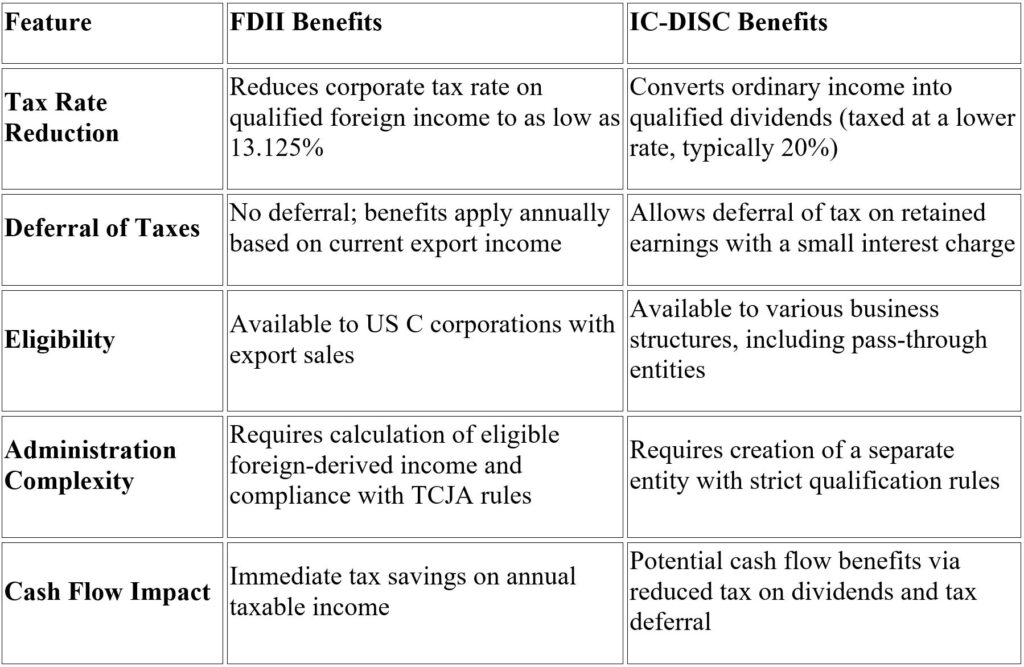
Combining FDII and IC-DISC?
For alcohol manufacturers and distributors, using both FDII and IC-DISC is possible. FDII reduces the corporate tax rate on export income, while an IC-DISC could shift additional income to shareholders at the capital gains rate or defer it.
Conclusion
FDII and IC-DISC are potent tools for alcohol exporters, each with distinct strengths. FDII delivers a lower tax rate with minimal effort, ideal for C corporations riding the wave of global demand for American products. IC-DISC offers flexibility, deferral, and broader eligibility, suiting a wider range of businesses with an eye on cash flow. As the craft beer, spirits, and wine industries expand abroad, choosing the right regime – or blending them – can uncork significant savings. Consult a tax professional to tailor the choice to your operation.




Current Developments in Life Sciences Law in Germany
ARTICLE
Current Developments in Life Sciences Law in Germany
March 5, 2025
Read time: 2 min
Learn from Jana Grieb, Christian Lebrecht, Monika Richter, Lea Hachmeister and Henrik Holzapfel about the latest legal and regulatory frameworks shaping the pharmaceutical, biotechnology, and medical technology sectors in Germany. From research and development to market approval and digital health solutions – stay informed about the key trends and legislative changes that are shaping the future of healthcare.
Read the full article from Lexology, “Life Sciences Law: Germany.”




SB 1998 Would Add Consent Requirement for PE, Hedge Fund Healthcare Transactions in Illinois
ARTICLE / CLIENT ALERT
SB 1998 Would Add Consent Requirement for PE, Hedge Fund Healthcare Transactions in Illinois
March 4, 2025
Read time: 6 min
On February 6, 2025, the Illinois state legislature introduced Senate Bill (SB) 1998, aiming to implement an additional layer of scrutiny to covered transactions that are financed by private equity groups or hedge funds. The bill is pending with the Senate Assignments Committee.
Background
On January 1, 2024, Illinois Public Act 103-0526 went into effect to amend the Illinois Antitrust Act, the State Finance Act, and the Illinois Health Facilities Planning Act. As discussed in a previous On the Subject, Public Act 103-0526 granted the Illinois attorney general (IL AG) oversight over a broad array of transactions that involve healthcare facilities and provider organizations. This oversight includes a requirement that healthcare facilities and provider organizations provide notice to the IL AG at least 30 days prior to a covered transaction closing or taking effect, as defined by the Illinois Antitrust Act. The IL AG can also request additional information, as it deems necessary, within 30 days of receiving notice of a covered transaction. If the IL AG requests additional information, the covered transaction may not proceed until 30 days after the parties have substantially complied with the request, but the IL AG does not currently have an approval right for covered transactions. For a more detailed description of the requirements under Illinois Public Act 103-0526, please see our prior On the Subjects:
- “Effective January 2024: Illinois Joins Growing List of States that Require Attorney General Notice of Healthcare Transactions.”
- “Illinois House Passes Legislation to Increase State Oversight of Healthcare Consolidation.”
Key Takeaways
SB 1998 would add a requirement that if a hedge fund or private equity group provides any financing to a covered transaction, the IL AG must give written consent before the transaction can take effect. SB 1998 would add definitions to clarify what is considered a hedge fund and a private equity group under the Illinois Antitrust Act.
SB 1998 does not provide a clear timeframe for the IL AG to issue its consent, nor does SB 1998 provide any criteria according to which consent would be issued or denied. If SB 1998 is passed, the IL AG’s oversight on such transactions would likely cause delays and add expense. SB 1998 would also make Illinois the first state to require an attorney general’s consent before healthcare facility covered transactions involving hedge fund and private equity groups can close.
McDermott will continue to monitor the bill’s progression through the state legislature and update this On the Subject as developments arise.
Key Definitions
- “Acquisition” means an agreement, arrangement, or activity the consummation of which results in a person acquiring directly or indirectly the control of another person.
- It includes the acquisition of voting securities and noncorporate interests, such as assets, capital stock, membership interests, or equity interests.
- “Contracting affiliation” means the formation of a relationship between two or more entities that permits the entities to negotiate jointly with health carriers or third-party administrators over rates for professional medical services or permits one entity to negotiate on behalf of the other entity with health carriers or third-party administrators over rates for professional medical services.
- “Contracting affiliation” does not include arrangements among entities under common ownership.
- “Covered transaction” means any merger, acquisition, or contracting affiliation between two or more healthcare facilities or provider organizations not previously under common ownership or contracting affiliation. Covered transactions also include transactions between an Illinois healthcare entity and an out-of-state healthcare entity when the out-of-state entity generates $10 million or more in annual revenue from patients residing in Illinois.
- “Healthcare facility” means the following facilities, organizations, and related persons:
- Ambulatory surgery treatment centers.
- Hospitals and other locations or operations licensed under the Hospital Licensing Act.
- Outpatient surgery centers.
- Kidney disease treatment centers.
- Any other institution, place, building, or room used for the provision of a healthcare category of service defined under the Illinois Health Facilities Planning Act, including cardiac catheterization and open-heart surgery.
- “Hedge fund” means a pool of funds managed by investors for the purpose of earning a return on those funds, regardless of the strategies used to manage the funds. “Hedge fund” includes, but is not limited to, a pool of funds managed or controlled by private limited partnerships.
- “Hedge fund” does not include natural persons or other entities that contribute funds to hedge funds but otherwise do not participate in the management or in any change of control of the hedge fund or the fund’s assets.
- It further does not include entities that solely provide or manage debt financing secured in whole or in part by the assets of a healthcare facility.
- “Merger” means the consolidation of two or more organizations, including through a common parent organization or by forming a new organization.
- “Merger” does not include a corporate reorganization.
- “Private equity group” means an investor or group of investors that primarily engages in the raising or returning of capital and invests, develops, or disposes of specified assets.
- “Private equity group” does not include natural persons or other entities that contribute or promise to contribute funds to the private equity group but otherwise do not participate in the management of the private equity group or the group’s assets or in any change in control of the private equity group or the group’s assets manner, including but not limited to lease, transfer, exchange, option, receipt of a conveyance, creation of a joint venture, or any other manager of purchase, by a private equity group or hedge fund of a material amount of the assets or operations, or a change of control, of a healthcare facility in Illinois.
- “Provider organization” means a corporation, partnership, business trust, association, or organized group of persons, whether incorporated or not, in the business of healthcare delivery or management that represents 20 or more healthcare providers in contracting with health carriers or third-party administrators for the payment of healthcare services.
- “Provider organization” includes physician organizations, physician-hospital organizations, independent practice associations, provider networks, and accountable care organizations.