Content Type: Article

  • SEC Marketing Rule Update: What Private Fund Advisers Should Be Thinking About as the November 4 Compliance Date Approaches

    SEC Marketing Rule Update: What Private Fund Advisers Should Be Thinking About as the November 4 Compliance Date Approaches

    ARTICLE / CLIENT ALERT

    SEC Marketing Rule Update: What Private Fund Advisers Should Be Thinking About as the November 4 Compliance Date Approaches

    September 20, 2022

    Read time: 7 min

    Key takeaways
    Overview

    By Nov. 4, 2022 (the “Compliance Date”), registered investment advisers (“RIAs”) must comply with the requirements of amended Rule 206(4)-1 (the “Amended Marketing Rule”).[1] The Amended Marketing Rule will significantly impact RIAs’ marketing materials and other investor communications, performance calculations and related disclosures as well as existing and new placement agent arrangements. In addition, RIAs will need to review and likely revise their Form ADV, compliance policies and procedures, and recordkeeping practices.

    Just yesterday, the SEC Division of Examinations Staff released a Risk Alert[2] reminding RIAs of their obligations under the Amended Marketing Rule and offering steps that advisers should take to ensure they meet their obligations by the Compliance Date. Notably, the Staff indicated that it intends to “conduct a number of specific national initiatives, as well as a broad review through the examination process, for compliance with the Marketing Rule.”[3] The Risk Alert noted that these initiatives and examinations will focus on, but not be limited to, the following areas: adoption and implementation of policies and procedures, compliance with the substantiation requirement, compliance with the various performance advertising requirements and compliance with the books and records requirements.

    In light of this Risk Alert and with only a few weeks until the Compliance Date, RIAs should currently be taking steps to:

    (i) Finalize marketing policies and procedures to reflect the requirements of the Amended Marketing Rule;

    (ii) Confirm all “advertisements” disseminated on or after the Compliance Date comply with the requirements of the Amended Marketing Rule and in particular the substantiation requirement;

    (iii) Confirm all “advertisements” that include performance comply with the various performance reporting requirements, as applicable (e.g., net performance, related performance, extracted performance, hypothetical performance and predecessor performance);

    (iv) Confirm that recordkeeping policies and procedures as well as recordkeeping practices are updated to reflect the requirements of the Amended Marketing Rule and related amendments to Rule 204-2;

    (v) Confirm that endorsement or testimonials, including placement agent and other solicitation agreements, comply with the requirements of the Amended Marketing Rule; and

    (vi) Consider whether and when Form ADV amendments will need to be made in order to reflect new disclosure requirements under the Amended Marketing Rule.

    While many RIAs have been preparing to comply with the Amended Marketing Rule for some time now, as the Compliance Date approaches, RIAs should consider several key items:

    • The scope of marketing materials subject to the Amended Marketing Rule is broad. The Amended Marketing Rule includes a two-prong definition of “advertisement.” The first prong includes “any direct or indirect communication an investment adviser makes to more than one person, or to one or more persons if the communication includes hypothetical performance, that offers the investment adviser’s investment advisory services with regard to securities to prospective clients or investors in a private fund advised by the investment adviser or offers new investment advisory services with regard to securities to current clients or investors in a private fund advised by the investment adviser. . . .”[4] Extemporaneous, live oral communications, information contained in statutory or regulatory notices and filings and certain one-on-one communications are excluded from this definition.

    The second prong generally includes “any endorsement or testimonial for which an adviser provides compensation, directly or indirectly. . . .”[5] This prong expands coverage of solicitation arrangements to include placement agent arrangements for private fund investors.

    RIAs should inventory all investor communications and assess which now meet the definition of “advertisement.” RIAs also should evaluate current and future placement agent agreements and other similar investor referral or solicitation arrangements to ensure compliance with the Amended Marketing Rule.

    • Marketing materials may need significant revisions and enhanced disclosures. RIAs should assess what changes need to be made to their marketing materials prior to the Compliance Date in order to comply with new requirements. Relevant updates can include changes and/or additions to disclosures, content and structure of materials, including performance-related information. For funds in the market prior to the Compliance Date, RIAs should consider what changes need to be made to marketing materials if fundraising efforts will continue after the Compliance Date. Similarly, RIAs should assess what marketing materials have been made available to prospective investors prior to the Compliance Date and whether, under the Amended Marketing Rule, such materials may need to be revised if they continue to be made available to prospective investors after the Compliance Date (e.g., prior letters to investors).
    • Performance calculations may need to be revised. The Amended Marketing Rule sets forth specific requirements with regard to the presentation of performance, including, among other things, requirements with respect to the presentation of gross and net performance, hypothetical performance, related performance and extracted performance. RIAs should be reviewing how they present various performance metrics in their marketing materials, including the underlying performance calculation methodologies and related disclosures, to ensure such performance presentations comply with the requirements of the Amended Marketing Rule.
    • Material statements of fact are now subject to substantiation. The Amended Marketing Rule prohibits advertisements that include a material statement of fact that the adviser does not have a reasonable basis for believing it will be able to substantiate upon demand by the SEC. RIAs should evaluate the material statements of facts included in their marketing material and how such statements are substantiated.
    • Compliance policies and procedures will need to be revised. The Amended Marketing Rule will require policies and procedures to be updated and revised, as appropriate, to ensure they are reasonably designed to prevent violations of the Amended Marketing Rule. In most cases, marketing policies will require substantial changes addressing the content of advertisements, the use of performance information (including hypothetical performance) and placement agent arrangements, among other changes. RIAs should be reviewing and updating their compliance policies and procedures accordingly.
    • Form ADV will need to be amended. Firms should evaluate when and how their Form ADV needs to be amended. New disclosures with respect to an adviser’s marketing materials are included in Part 1A of Form ADV, and changes made to comply with the Amended Marketing Rule may be responsive to items in Part 2A as well.
    • Recordkeeping policies and practices will need to be revised. The Amended Marketing Rule adds certain recordkeeping obligations, which require updates to an RIA’s recordkeeping policies and procedures and, in some cases, changes to an RIA’s recordkeeping practices. RIAs should review these requirements now to ensure they will be able to comply with them by the Compliance Date.
    • Training should be undertaken to assist relevant personnel with understanding the requirements of the Amended Marketing Rule. Due to the significant impact that the Amended Marketing Rule will have on an RIA’s marketing materials, investor communications, performance calculations and placement agent arrangements, training sessions for relevant personnel (e.g., investor relations, marketing and other investor-facing personnel as well as finance and compliance personnel) can be helpful for ensuring that such personnel understand how the requirements of the Amended Marketing Rule will impact their day-to-day activities.

    Authored by Allison Scher Bernbach, Marc E. Elovitz, Kelly Koscuiszka, Tinika M. Brown, Meghan J. Carey, Christopher S. Avellaneda and Tarik M. Shah.

    If you have any questions concerning this Alert, please contact your lawyer or one of the authors.


    In depth
    Authors

    Allison Scher Bernbach

    Partner

    New York – One Vanderbilt Avenue

    Marc E. Elovitz

    Partner

    New York – 919 Third Avenue

    Kelly Koscuiszka

    Partner

    New York – 919 Third Avenue

    Christopher S. Avellaneda

    Partner

    New York – 919 Third Avenue

    Tarik M. Shah

    Partner

    New York – 919 Third Avenue

    More insights

  • President Biden Signs Executive Order Directing CFIUS to Focus on Specific National Security Risks

    President Biden Signs Executive Order Directing CFIUS to Focus on Specific National Security Risks

    ARTICLE / CLIENT ALERT

    President Biden Signs Executive Order Directing CFIUS to Focus on Specific National Security Risks

    September 19, 2022

    Read time: 4 min

    Key takeaways
    Overview

    On September 15, 2022, US President Joe Biden signed an Executive Order (EO) aimed at increasing the federal government’s review of foreign investment in US businesses deemed critical to US national security interests.[1] For the first time since the Committee on Foreign Investment in the United States (CFIUS) began reviewing foreign acquisitions of US businesses in 1988, under its authority to review and block such transactions if they threaten to impair US national security, the President has provided formal instruction on a number of risk areas that CFIUS should consider when reviewing transactions within its jurisdiction (covered transactions).[2]

    In depth

    Specifically, recognizing that some countries use foreign investment to obtain access to sensitive data and technologies for purposes that are detrimental to US national security, the EO directs CFIUS to consider the impact of covered transactions on the following:

    • Critical US supply chains that may have national security implications: The EO directs CFIUS to consider a covered transaction’s effect on supply chain resilience and security, both within and outside of the defense industrial base. In its evaluation, CFIUS is directed to consider the degree of diversification through alternative suppliers across the supply chain, supply relationships with the US government and the concentration of ownership or control by the foreign person in each supply chain.
    • US technologies in areas affecting national security: The EO specifically identifies sectors that are fundamental to US technological leadership and therefore national security, including (but not limited to) microelectronics, artificial intelligence, biotechnology and biomanufacturing, quantum computing, advanced clean energy, climate adaptation technologies and elements of the agricultural industrial base that have implications for food security. The EO instructs CFIUS to consider whether a covered transaction involves manufacturing capabilities, services, critical mineral resources or technologies in such fields.
    • Investment trends in the aggregate: The EO instructs CFIUS to consider prior investments by foreign persons in a single sector or related technologies.
    • Cybersecurity risks that threaten to impair national security: This directive demonstrates the Biden administration’s concern for future malicious cyber-enabled activity. The EO instructs CFIUS to consider whether a covered transaction may provide foreign persons, or their relevant third-party ties, with access to systems or technology that would enable them to conduct malicious cyber intrusions or other malicious cyber activities.
    • The personal sensitive data of US citizens: The EO directs CFIUS to consider whether a covered transaction involves a US business with access to US persons’ sensitive data and whether the foreign investor or its related parties have sought or could exploit such information.

    The EO builds on existing statutory and regulatory factors[3] ; it emphasizes certain acute concerns in the current environment, but it does not change CFIUS’s current jurisdiction or alter the way it conducts its investigations.[4] One can expect, however, that the five areas highlighted by the EO will receive even greater scrutiny in the CFIUS review process. Accordingly, parties to transactions that involve any of these five areas should factor this into their analysis of whether to notify CFIUS of a transaction and how they might address concerns that CFIUS may raise in the review process.

    Authors

    David J. Levine

    Senior Counsel

    Washington, DC

    Raymond Paretzky

    Counsel

    Washington, DC

    More insights

  • SEC Custody Rule Update: Takeaways from Recent Enforcement

    SEC Custody Rule Update: Takeaways from Recent Enforcement

    ARTICLE / CLIENT ALERT

    SEC Custody Rule Update: Takeaways from Recent Enforcement

    September 19, 2022

    Read time: 6 min

    Key takeaways
    Overview

    On Sept. 9, 2022, the U.S. Securities and Exchange Commission (“SEC”) settled enforcement actions against nine private fund advisers for their failure to: (1) timely disseminate audited financial statements to private fund investors in violation of SEC Rule 206(4)-2 (the “Custody Rule”)[1], and/or (2) timely update their Form ADV disclosures to reflect their receipt of audited financial statements for private funds they advise.[2] These actions follow a targeted sweep by the SEC’s Division of Examinations and Division of Enforcement.

    These settlements, which included combined civil penalties of over $1 million[3], serve as a strong reminder to private fund managers that the SEC does not view violations of the Custody Rule as mere technical deficiencies.

    Key Takeaways

    • Aggressive Enforcement. The SEC is aggressively enforcing custody rule violations even where there are no allegations of theft or loss of any client assets or any other potential wrongdoing by the adviser. This approach can be expected to continue, with the Director of the Division of Enforcement describing the resolution of these cases arising out of the SEC sweep as a “unique circumstance” and indicating that “counsel should not assume the Division will recommend similar resolutions going forward.”[4]
    • Focus on Late Audits. The SEC cited late delivery of audited financial statements to investors in eight of the nine settlement orders. Existing Staff guidance provides some comfort where an adviser reasonably believed the audited financial statements would be delivered timely, but they were not due to unforeseeable circumstances.[5] The settlement orders do not indicate specific facts and circumstances with respect to late delivery in these cases. Advisers faced with potential delays in delivering the audited financial statements should promptly assess the specific facts and circumstances and take appropriate action.
    • Strict Timing of ADV Updates. The SEC faulted six of the advisers for failing to timely update their Form ADVs to reflect the receipt of the audited financial statements.[6] When an adviser checks “Report Not Yet Received” in response to Form ADV, Part 1A, Schedule D, Section 7.B.23.(h), the instructions for that item require the adviser to promptly file an amendment to Form ADV when the audit is received. The advisers in these settlements did not update their Form ADVs for several months or until they filed their next annual amendments.

    Custody Rule Violations

    Six of the firms charged by the SEC failed to timely deliver annual audited financial statements to the investors in their private fund clients in accordance with the Audit Exception. As a reminder, the Custody Rule requires all advisers with custody of client assets to, among other things: (1) ensure that a qualified custodian maintains the client’s assets; (2) notify the client in writing of accounts opened by the adviser at a qualified custodian on the client’s behalf; (3) have a reasonable basis for believing that the qualified custodian sends account statements at least quarterly to clients (or in the case of private funds, a fund’s limited partners); and (4) ensure that client funds and securities are verified by a surprise examination conducted by an independent public accountant at least once every calendar year.[7]

    The Custody Rule provides private fund advisers with an exception from complying with the Rule’s notification, account statements delivery and surprise examination requirements so long as the private fund advisers: (1) ensure annual audited financial statements for any private fund client are prepared in accordance with U.S. GAAP by an independent public accountant that is registered with, and subject to inspection by, the PCAOB; and (2) distribute the audited financial statements to each fund’s investors within 120 days of the fund’s fiscal year end (180 days for funds of funds) (the “Audit Exception”).[8]

    Because the advisers failed to timely deliver audited financial statements to the fund investors, they could not rely on the Audit Exception. Those firms therefore were obligated to comply with the Custody Rule’s notification, delivery and surprise examination requirements, which they failed to do.

    Form ADV Violations

    Six of the firms had checked “Report Not Yet Received” on their annual Form ADV amendments and subsequently received audit opinions for their private fund clients, but failed to file amended Form ADVs for several months or in certain instances until they filed their next annual updating amendments in violation of Section 204(a) and Rule 204-1(a).

    As a reminder, Advisers Act Section 204(a)[9] and Rule 204-1(a)[10] thereunder require an adviser to amend its Form ADV at least annually, and more frequently as required by the Form ADV instructions. Form ADV, Part 1A, Schedule D, Section 7.B.23.(h) requires an adviser to report whether all of the audit reports prepared by the auditing firm for the relevant private fund since the adviser’s last annual amendment, contain unqualified opinions, with the option to check “Yes,” “No,” or “Report Not Yet Received.” When an adviser files its annual Form ADV amendment and has checked “Report Not Yet Received,” the instructions for that item state that the adviser must promptly file an amendment to Form ADV to update this response once the auditor’s report is available.

    Next Steps

    Private fund managers relying on the Audit Exception should consider confirming that their policies and procedures:

    • Are reasonably designed to ensure that audited financial statements are prepared and delivered in a timely manner and otherwise consistent with the Custody Rule’s requirements; and
    • Effectively address the requirement to promptly and accurately amend Form ADV filings when required, including with respect to Form ADV, Part 1A, Schedule D, Section 7.B.23.(h).

    Authored by Allison Scher Bernbach, Marc E. Elovitz, Kelly Koscuiszka, Tinika M. Brown, Meghan J. Carey, Christopher S. Avellaneda, and Tarik M. Shah.

    If you have any questions concerning this Alert, please contact your lawyer or one of the authors.

    In depth
    Authors

    Allison Scher Bernbach

    Partner

    New York – One Vanderbilt Avenue

    Marc E. Elovitz

    Partner

    New York – 919 Third Avenue

    Kelly Koscuiszka

    Partner

    New York – 919 Third Avenue

    Christopher S. Avellaneda

    Partner

    New York – 919 Third Avenue

    Tarik M. Shah

    Partner

    New York – 919 Third Avenue

    More insights

  • New York Schools Subject to New State Healthcare Worker Bonus Program

    New York Schools Subject to New State Healthcare Worker Bonus Program

    ARTICLE / CLIENT ALERT

    New York Schools Subject to New State Healthcare Worker Bonus Program

    September 19, 2022

    Read time: 5 min

    Key takeaways
    Overview

    As part of the 2022-2023 enacted New York State Budget, $1.2 billion in funding has been allocated for the payment of bonuses to certain frontline healthcare workers through the newly created New York State’s Healthcare Worker Bonus Program (“HWB Program”). Under the HWB Program, “school districts, charter schools, nonpublic schools, approved preschool programs for students with disabilities…and private institutions of higher education” are among the educational institutions that must provide bonuses to eligible employees who meet the requirements set forth below.

    Eligible Employees

    Many schools employ front-line healthcare workers who may be eligible for the bonus, including, but not limited to, nurses, speech-language pathologists and occupational and physical therapists. To be eligible, employees:

    • Must have a job title that is included on the list of “Eligible Worker Titles” provided by the New York State Department of Health (“DOH”).[1]
    • Must be continuously employed by an eligible employer for at least one vesting period, which is defined as a series of specific six-month periods between the dates of Oct. 1, 2021, through March 31, 2024 (i.e., Oct. 1, 2021 to March 31, 2022; April 1, 2022 to Sept. 30, 2022; Oct. 1, 2022 to March 31, 2023; April 1, 2023 to Sept. 30, 2023; and Oct. 1, 2023 to March 31, 2024).
    • Can be full-time, part-time or temporary employees, as well as independent contractors.
    • Cannot exceed an annualized base salary of $125,000 (excluding any bonuses or overtime pay).

    Bonus Amounts

    Bonuses will be paid to eligible employees based on the number of hours worked during the relevant vesting period. Eligible employees who work:

    • Less than 20 hours during the relevant vesting period are not eligible to receive a bonus.
    • At least 20 hours but no more than 30 hours per week are eligible for a bonus of $500.
    • At least 30 hours but no more than 35 hours per week are eligible for a bonus of $1,000.
    • At least 35 hours per week are eligible for a bonus of $1,500.

    An eligible employee is eligible for a bonus for only two vesting periods per eligible employer, up to a $3,000 maximum across all eligible employers.

    Bonus Claiming Process

    Eligible employers must claim the bonus on behalf of their eligible employees, as employees are not able to claim bonuses independently. To claim such bonuses, eligible educational institutions will need to use their Statewide Financial System ID (“SFS ID”) to access an online web portal. This portal will open for all eligible educational employers on Oct. 1, 2022.

    As part of the claim submission process, eligible employers must electronically sign an attestation that acknowledges they have determined that each employee the employer included in the claiming process is eligible to receive the bonus. Additionally, all eligible employees must sign an attestation that confirms their wages from all sources in connection with their eligibility for the bonus, which must be maintained by their employer.

    Further, eligible employers must submit claims for bonus payments within 30 days after the completion of each vesting period as defined by the schedule published by the DOH. Such employers are then required to pay bonuses within 30 days of receipt of payment on a claim for each eligible employee. Although eligible employees may be eligible for vesting periods worked in the past (e.g., Oct. 1, 2021 to March 31, 2022), the bonuses are not payable until the employer claims and receives payment. Advance payments are not permitted. For the first vesting period, Oct. 1, 2021 to March 31, 2022, the DOH had requested employers submit claims by Sept. 2, 2022 (30 days from the posting of the vesting schedule), but will now permit claims from that period to be submitted during the second vesting period, beginning Oct. 1, 2022 and ending Oct. 31, 2022. However, as the bonus portal does not open for eligible educational employers until Oct. 1, 2022, it is unclear what deadline will be set for schools submitting first vesting period claims.

    Eligible employers must maintain contemporaneous records tracking all submitted claims (including related information and documents required to substantiate such submitted claims) for six years.

    The Medicaid inspector general, in coordination with the DOH, is responsible for conducting audits and investigations of eligible employers. An eligible employer may be subject to sanctions and penalties where they: (i) claim a bonus not due to an employee or a bonus amount in excess of the correct bonus amount, (ii) claim and receive a bonus, but fail to pay any part of it to the respective employee, or (iii) fail to claim a bonus due to an employee. An eligible employer that fails to identify, claim and/or pay any bonus for more than 10 percent of bonus eligible employees may be subject to additional penalties of up to $1,000 per violation of the HWB Program.


    Authored by Mark E. Brossman, Scott A. Gold, Donna K. Lazarus, Michelle M. Orge, and Laura R. Horowitz.

    If you have any questions concerning this Alert, please contact your lawyer or one of the authors.

    In depth
    Authors

    Mark E. Brossman

    Partner

    New York – 919 Third Avenue

    Donna K. Lazarus

    Partner

    New York – 919 Third Avenue

    Michelle M. Orge

    Associate

    New York – 919 Third Avenue

    More insights

  • DOJ Revamps Corporate Criminal Enforcement Policies with Continued Emphasis on Compliance

    DOJ Revamps Corporate Criminal Enforcement Policies with Continued Emphasis on Compliance

    ARTICLE / CLIENT ALERT

    DOJ Revamps Corporate Criminal Enforcement Policies with Continued Emphasis on Compliance

    September 16, 2022

    Read time: 9 min

    Key takeaways
    Overview

    At a September 15, 2022, speech at New York University School of Law, US Deputy Attorney General (Deputy AG) Lisa Monaco announced several new policies intended to further the aggressive stance the US Department of Justice (DOJ) has taken under the Biden administration to corporate criminal enforcement.

    The DOJ’s landmark new policies are focused on encouraging and enticing companies to self-report criminal violations and cooperate in DOJ investigations. They include:

    • First, for the first time, every DOJ component that prosecutes corporate crime will have to develop a formal program to incentivize voluntary self-disclosure. Importantly, the DOJ will not seek a guilty plea when a company has voluntarily self-disclosed, cooperated in the DOJ’s investigation and remediated misconduct.
    • Second, companies seeking cooperation credit need to come forward and disclose important evidence to the DOJ quickly. Companies—and prosecutors evaluating those companies—will now be “on the clock.” Undue or intentional delay in providing information and documents will result in a reduction or outright denial of cooperation credit.
    • Third, the DOJ will now formally encourage companies to hold in escrow or claw back compensation from executives and employees responsible for wrongdoing.

    Deputy AG Monaco provided additional guidance with respect to significant changes announced in October 2021, including on how prior criminal, civil and regulatory misconduct by companies will be evaluated when deciding an appropriate resolution, and how and when monitors should be imposed.

    Deputy AG Monaco also announced that the DOJ would seek an additional $250 million in targeted resources for corporate criminal enforcement and other corporate crime initiatives.

    In depth

    While Deputy AG Monaco continued to emphasize—as she did in speeches in October 2021 and March 2022—that the DOJ’s No. 1 priority remains individual “accountability” and prosecutions, the recent announcement is the latest in a series of ambitious steps taken by the DOJ under the Biden administration to further the Department’s ongoing and increasing emphasis on misconduct at the corporate level. Taken collectively, the mixture of carrots, sticks and potential additional resources demonstrates the DOJ’s continued focus on pursuing corporate wrongdoing and the need for companies to proactively assess their compliance programs and ensure they are well-positioned to respond to the DOJ’s boundary-shifting approaches.

    NEW DOJ-WIDE VOLUNTARY SELF-DISCLOSURE PROGRAM

    Among the more significant changes, every DOJ component that prosecutes corporate crime will, for the first time, be required to have a documented policy that incentivizes voluntary self-disclosure. Deputy AG Monaco highlighted the success of a handful of self-disclosure programs that several DOJ components have already developed, such as the long-standing Antitrust Division Leniency Program and the Foreign Corrupt Practices Act (FCPA) unit’s self-reporting program. She also stated that if a DOJ component does not have such a formal, documented policy, they must draft one. In support of this policy, she noted that the DOJ’s “goal is simple: to reward those companies whose historical investments in compliance enable voluntary self-disclosure and to incentivize other companies to make the same investments going forward.”

    Deputy AG Monaco also announced several broad principles that will apply to each component’s voluntary self-disclosure policies. Most notably, voluntary self-disclosure will, in many cases, allow companies to avoid criminal prosecution altogether. “Absent aggravating factors, the Department will not seek a guilty plea when a company has voluntarily self-disclosed, cooperated and remediated misconduct.” Deputy AG Monaco also foreshadowed that in the coming months the DOJ would announce resolutions that demonstrate the benefits of corporate self-disclosures, as opposed to companies that chose not to self-disclose and cooperate with the DOJ.

    VOLUNTARY SELF-DISCLOSURE: SPEED IS OF THE ESSENCE

    In another significant change, Deputy AG Monaco declared that DOJ will now put companies seeking cooperation credit “on the clock” and that companies seeking to cooperate—including those that have voluntarily self-disclosed information or documents—must come forward with that evidence more quickly. Noting that “speed is of the essence,” she added that if a “cooperating company discovers hot documents or evidence, its first reaction should be to notify the prosecutors.” Any undue or intentional delays in production of information or documents to the DOJ will result in a reduction or outright denial of cooperation credit.

    CORPORATE COMPENSATION SYSTEMS REFLECTING CORPORATE VALUES

    DOJ prosecutors will now consider a company’s compensation structure when evaluating the strength of its compliance program. Specifically, Deputy AG Monaco instructed prosecutors to consider whether a company’s compensation system rewards compliance-promoting behavior and imposes financial sanctions on employees or executives who direct or supervise acts and/or omissions that contribute to a criminal violation. Further, prosecutors must consider a company’s actions relating to compensation after learning of the misconduct, including whether “a company actually claws back compensation or otherwise imposes financial penalties.” She indicated that the Department’s Criminal Division will develop further guidance on rewards for companies that employ clawback or similar arrangements by the end of 2022.

    HISTORY OF A COMPANY’S MISCONDUCT

    Noting that between 10% and 20% of large corporate criminal resolutions involve “repeat offenders,” Deputy AG Monaco announced additional guidance about how prior criminal, civil and/or regulatory records will now be considered by prosecutors when deciding how to resolve a criminal violation. Prior misconduct that led to US criminal resolutions and wrongdoing that involves the same personnel and/or management as the misconduct currently under review will be considered highly relevant and significant. Importantly, older conduct—criminal resolutions occurring more than 10 years before the current conduct under investigation and civil or regulatory resolutions occurring more than five years before the current conduct under investigation—will be afforded less weight. The nature and circumstances of prior misconduct, as well as a company’s history when compared to others similarly situated in the same industry, will also be important considerations. Lastly, Deputy AG Monaco remarked that the DOJ “will disfavor multiple, successive non-prosecution or deferred prosecution agreements with the same company.”

    COMPLIANCE MONITORS

    After the DOJ signaled its intentions to expand the use of independent compliance monitors earlier this year, Deputy AG Monaco acknowledged that there remains a need to clarify the monitorship process in a number of ways. The DOJ is taking a number of steps that will make the monitor process more transparent, including by providing clear factors that prosecutors will consider in determining whether a monitor is appropriate and to establish consistent standards for the process of selecting a monitor. Most notably, the DOJ is focused on improving efficiency and ensuring that every monitorship is appropriately tailored in scope and duration. The DOJ will confirm that the monitor, the DOJ and the company subject to the monitorship are in agreement on the monitor’s scope and work plan at the outset of the process. Prosecutors may also consider reducing the length of monitorships in response to prompt compliance improvements, in addition to the option to extend a monitorship. The DOJ plans to be more hands-on in “monitoring the monitor,” which will likely help keep monitorship engagements on track and within scope.

    KEY TAKEAWAYS

    • The DOJ’s new policies reflect an attempt to both incentivize and pressure companies to self-report criminal violations and cooperate in DOJ investigations. Importantly, the new policy seems to incentivize quick cooperation not just in DOJ investigations but against a company’s own executives. These are often complex cases and take time to develop facts and defenses, but Deputy AG Monaco affirmed that the DOJ will insist that voluntary self-disclosures happen quickly and that speed is of the essence.
    • It remains unclear what practical impact these ambitious policies will have. Although additional DOJ resources have been directed at pursuing these time-intensive and complex investigations, we have yet to see the resulting increase of actual corporate criminal enforcement activity from the Department. Without that, some companies may still decide that quick voluntary disclosures are not in their best interests. In addition, until there is a demonstrated track record or predictability that cooperating companies are receiving a meaningfully more favorable resolution, the new guidance may not cause many more companies to rush to cooperate. And companies will still have to carefully weigh the costs and benefits of voluntary self-disclosure.
    • The devil will be in the details. The offered carrot in the new DOJ leniency program is significant—a no-plea deal for a corporate criminal violation—but questions still remain. How much self-reporting and cooperation is needed to cross the threshold to earn this benefit from the DOJ? And if the threshold is crossed, it remains uncertain how much credit a company will actually receive. In addition, while the Antitrust Division’s leniency and FCPA unit’s voluntary disclosure programs were highlighted as model examples, each DOJ component has been tasked with drafting their own corporate leniency type program. We will keep an eye out to see how uniform and consistent the programs are in practice.
    • The clear import of Deputy AG Monaco’s ongoing policy statements is that compliance matters. The DOJ could not be clearer; the Department will be taking a hard look at compliance programs and expects them to be robust. The emphasis on early self-reporting is intended to further incentivize companies to have strong compliance programs that identify and address misconduct before the DOJ does. For those organizations that have not already done so, it is time to reassess the compliance program; for organizations that have recently reviewed and updated their programs, it is critical to take a hard look at Deputy AG Monaco’s most recent comments—including those about executive compensation—to ensure that they are being considered in compliance program design and implementation.



    Authors

    Edward B. Diskant

    Partner

    New York – One Vanderbilt Avenue

    Julian L. André

    Partner

    Los Angeles

    Paul M. Thompson

    Partner

    Washington, DC

    Benton Curtis

    Partner

    Miami

    More insights

  • Play It Again and Again (Sam): Meanwhile No Injunction, No Fees

    Play It Again and Again (Sam): Meanwhile No Injunction, No Fees

    ARTICLE

    Play It Again and Again (Sam): Meanwhile No Injunction, No Fees

    Sep 15, 2022

    Read time: 6 min

    Key takeaways
    Overview

    In its third opportunity to review the district court’s decision in this trade secret case involving flooring, the US Court of Appeals for the Eleventh Circuit again reversed, this time vacating a permanent injunction and an award of attorneys’ fees. The Eleventh Circuit noted that the district court failed to make the findings required to support an injunction and abused its discretion in awarding full fees notwithstanding prior reversal of relief awarded. AcryliCon USA, LLC v. Silikal GmbH, Case No. 21-12853 (11th Cir. Aug. 29, 2022) (Newsom, Marcus, JJ.; Middlebrooks, Distr. J.)

    In an earlier appeal in this case, the Eleventh Circuit reversed a ruling on trade secret misappropriation rendered by the district court in favor of AcryliCon USA (AC-USA) and vacated the damages award. An aspect of the Court’s ruling was that the “permanent” injunction entered by the district court was only preliminary in nature (not permanent) and was, as a matter of law, dissolved because the district court did not include it in the original final judgment. On remand, the district court was ordered to determine the appropriate amount of attorneys’ fees the prevailing party should receive. However, the district court just entered the same amount of attorneys’ fees it had originally awarded and again entered a “permanent” injunction barring the use of the trade secret at issue, concluding that it was obliged to do so by the Eleventh Circuit’s ruling in the first appeal.

    In the second appeal, the Eleventh Circuit held that AC-USA failed, as a matter of law, to prove its misappropriation claim and reversed the judgment entered in favor of AC-USA on that count. The Court also reversed the district court’s judgment that its $1.5 million damages award could be sustained on the basis of the contract claim once the misappropriation claim was reversed. The Court ruled that, as a matter of law, since AC-USA had failed to prove actual damages on its consequential damages theory, it could only recover nominal damages based on its breach of contract claim. Finally, the Court concluded that AC-USA was entitled to attorneys’ fees only on its breach of contract claim because, under Georgia law, even a nominal damages award would still materially alter the legal relationship between the parties.

    In the second remand, the district court awarded essentially the same amount of attorneys’ fees ($1.3 million) to AC-USA but acknowledged that, since Silikal prevailed in vacating the award of compensatory and punitive damages, Silikal “was the prevailing party on the appeal under the terms of the [agreement]” and was entitled to almost $500,000 in attorneys’ fees for its successful appeal. The district court also awarded $100 in nominal damages to AC-USA for its successful appeal on the breach of contract claim. The district court then entered a permanent injunction enjoining Silikal “from disclosing or using in any way, directly or indirectly, the [ . . . resin . . . ] to anyone other than Plaintiff.”

    Both parties appealed. AC-USA appealed the award of appellate attorneys’ fees to Silikal, and Silikal appealed the entry of a permanent injunction and the amount of attorneys’ fees awarded to AC-USA. Silikal also requested reassignment of the case to a different judge.

    The Eleventh Circuit explained that notwithstanding some district court confusion on this point, based on the first appeal it was the law of the case that no permanent injunction against Silikal had ever been entered by the district court. Notwithstanding, in the second remand, AC-USA asked the district court to “reaffirm its permanent injunction” and the district court agreed. The Eleventh Circuit therefore again reversed, noting that it had made it “crystal clear that no permanent injunction had been entered once the district court entered its final judgment” and vacated the permanent injunction.

    To hammer home the point, the Eleventh Circuit noted that even if the district court had not made a mistake of law (in terms of law of the case), it failed to make the requisite findings under Federal Rules of Civil Procedure 60 and 65. As the Court explained, if the district court wanted to enter a permanent injunction in the second remand—five years after it entered the preliminary injunction—it needed to amend its original final judgment. Since no motion to do so was made before the district court, the Court did not address the point except to reject Silikal’s claim that a newly entered permanent injunction was barred by the Court’s holding in the second appeal that the mandate rule “does not and could not extend to issues the appellate court never addressed, and thus, the district court is free to address, as a matter of first impression, those issues not disposed of on appeal.”

    The Eleventh Circuit also noted that by including a permanent injunction in the second remand, the district court further erred in failing to comply with Rule 65, which is

    . . . unambiguous in prescribing that “[e]very order granting an injunction” must “(A) state the reasons why it issued; (B) state its terms specifically; and (C) describe in reasonable detail—and not by referring to the complaint or other document—the act or acts restrained or required.” . . . In considering whether to grant a permanent injunction, a court must address whether the plaintiff has demonstrated the following: (1) [the plaintiff] has suffered an irreparable injury; (2) remedies available at law, such as monetary damages, are inadequate to compensate for that injury; (3) considering the balance of hardships between the plaintiff and defendant, a remedy in equity is warranted; and (4) the public interest would not be disserved by a permanent injunction.

    As for attorneys’ fees, the Eleventh Circuit held that because “the district court failed on remand to separate out what portion of the attorney’s fees were fairly attributable to each claim, it committed legal error under Georgia law and abused its discretion.” The Court also held that “[u]nder the ‘well settled law’ of Georgia, ‘a lump sum recovery for fees associated with claims on which a litigant does not prevail is not authorized.’” The Court faulted the district court for failing to include any analysis “about how much of the approximately $1.3 million fee award was attributable to counsel’s work on the breach of contract claim (for which AC-USA only recovered nominal damages), and how much of AC-USA’s work was attributable to the misappropriation claim, which it lost.” The Eleventh Circuit instructed the district court, on this third remand, to “apportion the attorney’s fees between the two claims based on AC-USA’s specific and detailed billing records or conclude—based on the evidence—that it would be impracticable in whole or in part to separate the legal work performed on the various claims.”

    Authors

    Paul Devinsky

    Senior Counsel

    Washington, DC

    More insights
    Endnotes

  • A Window into Trade Secret Damages: R&D Costs Can Quantify Unjust Enrichment

    A Window into Trade Secret Damages: R&D Costs Can Quantify Unjust Enrichment

    ARTICLE

    A Window into Trade Secret Damages: R&D Costs Can Quantify Unjust Enrichment

    Sep 15, 2022

    Read time: 4 min

    Key takeaways
    Overview

    The US Court of Appeals for the Third Circuit affirmed a district court’s finding of damages in a trade secrets case under Pennsylvania’s version of the Uniform Trade Secrets Act. The Third Circuit explained that it is appropriate to quantify damages under the unjust enrichment standard by considering the trade secret owner’s research and development costs as an indicator of the research and development costs that the defendant avoided but would have incurred if not for its misappropriation. PPG Indus. Inc. v. Jiangsu Tie Mao Glass Co. Ltd. et al., Case No. 21-2288 (3rd Cir. Aug. 30, 2022) (Jordan, Porter, Phipps, JJ.)

    PPG is the maker of OpticorTM, a novel plastic for airplane windows. PPG sued Jiangsu Tie Mao Glass (TMG), asserting trade secret misappropriation, among other things. PPG alleged that TMG persuaded a former PPG employee to provide TMG with a treasure trove of trade secrets and that TMG used the trade secrets to begin making plans to produce Opticor-quality windows and to build a factory to manufacture its product. After TMG failed to appear in the case for more than a year, the district court entered a default judgement for PPG. Only then did TMG show up. The district court declined to set aside the default judgment and ultimately awarded damages for TMG’s unjust enrichment totaling about $9 million, which it then trebled to $26.5 million, and issued a permanent injunction against TMG. TMG appealed.

    The Third Circuit began by analyzing whether TMG was unjustly enriched as a result of its acts. Trade secret damages are commonly determined either by calculating actual loss to the plaintiff or by quantifying the defendant’s unjust enrichment from the use of the trade secret. The Court found that although TMG did not sell products containing the Opticor technology, TMG was unjustly enriched by its use of the trade secrets. For example, TMG used PPG’s proprietary drawings (minus PPG’s name and logo) to ask a subcontractor to “manufacture for TMG the same molds that it did for PPG.” TMG also was building, or had plans to build, a production facility to manufacture its version of the Opticor technology. The Court determined that TMG was unjustly enriched because TMG used PPG’s trade secrets to completely skip the research and development phase of its version of the Opticor technology and instead move directly to the phase of preparing for production.

    Next, the Third Circuit considered whether the damages amount awarded to PPG was appropriate. Unjust enrichment requires the defendant to pay the plaintiff the value of the benefit conferred from the use of plaintiff’s trade secrets. This benefit can be a cost that was avoided and may include development costs. The Court found it appropriate to consider the research and development costs PPG incurred in developing the Opticor technology as an indicator of the research and development costs TMG would have sustained to develop its own version of the Opticor technology in the absence of misappropriation. In short, “[t]he costs a plaintiff spent in development . . . can be a proxy for the costs that the defendant saved.”

    Finally, the Third Circuit found that an award of both monetary damages and a permanent injunction did not amount to a double recovery in this case because the damages periods covered by these two forms of relief did not temporally overlap. The damages award covered only TMG’s prior bad acts. Specifically, the damages award remedied the benefit TMG received from its past misappropriation that had allowed it to completely skip research and development and move straight to soliciting molds and designing its production facility. The permanent injunction prohibited TMG from obtaining any future benefit from potential use of PPG’s trade secrets.

    Authors
    More insights
    Endnotes

  • Welcome to the Metaverse: Opportunities and Challenges Women in Fintech Networking Webinar Series

    Welcome to the Metaverse: Opportunities and Challenges Women in Fintech Networking Webinar Series

    ARTICLE

    Welcome to the Metaverse: Opportunities and Challenges Women in Fintech Networking Webinar Series

    September 14, 2022

    Read time: 3 min

    Key takeaways
    Overview

    As a recap: This session we discussed the opportunities and challenges that come with the advent of the metaverse. We were joined by Samrah Kazmi, co-founder and COO at Maiden Century, Inc. and founder and CEO of Women in Sustainable Innovation. Dubbed a “hype technology” by virtue of its bold promise to completely revolutionize the way in which we see and interact with the world, the metaverse is a highly immersive shared world driven by virtual products and digital experiences.

    In depth

    KEY TAKEAWAYS

    1. Samrah provided an insightful breakdown of the metaverse, from its desktop-driven origin to today, where it predominately exists as a mobile-driven e-commerce platform. In the near future, Samrah explained, the metaverse will be decentralized, AI-driven, and will allow for the easy flow of data and funds to connect people, places and experiences in real time. The presence of cryptocurrency and digital payment systems in the metaverse will lead to further opportunities as well as corresponding complexities – such systems must learn to co-exist with fiat, tokens and central bank digital currency, and the metaverse must be able to seamlessly accommodate these different payment forms.
    2. Regardless, the metaverse will have an enormous transformational impact across industries, from the factory floor to the boardroom, leaving no industry untouched and redefining the way in which we spend and earn money. As a matter of fact, it is estimated that the metaverse will have 5 billion total users by 2030. However, and as the saying goes, with great power comes great responsibility.
    3. Perhaps the greatest challenge facing the metaverse today is the task of creating a socially responsible ecosystem that evolves in tandem with the changing world. To that end, it is important that the metaverse has open standards and is inclusive, experiential and accessible to all. Legal and regulatory regimes must be taken into consideration, including the issues that will arise in respect of privacy, intellectual property and taxation, as well as applicable global regimes and jurisdictional issues that will come into play depending on where transactions occur in the metaverse. To accomplish this, it will take the collective efforts of all metaverse participants, and not just a single company, to demand standards that best serve the public.
    Authors
    More insights

  • Save It for a Rainy Day: Recent Amendment Extensions for Qualified Retirement Plans, 403(b) Plans and Individual Retirement Accounts

    Save It for a Rainy Day: Recent Amendment Extensions for Qualified Retirement Plans, 403(b) Plans and Individual Retirement Accounts

    ARTICLE / CLIENT ALERT

    Save It for a Rainy Day: Recent Amendment Extensions for Qualified Retirement Plans, 403(b) Plans and Individual Retirement Accounts

    September 15, 2022

    Read time: 5 min

    Key takeaways
    Overview

    The Internal Revenue Service (IRS) recently issued needed relief to extend some amendment deadlines for non-governmental qualified retirement plans and 403(b) plans, and for individual retirement accounts (IRAs) under the Setting Every Community Up for Retirement Enhancement Act of 2019 (SECURE Act), the Bipartisan American Miners Act of 2019 (Miners Act), and certain provisions of the Coronavirus Aid, Relief, and Economic Security Act (CARES Act) until December 31, 2025. However, the IRS did not provide relief for all required amendments for the 2022 plan year. Plan sponsors that elected to offer COVID-related distributions or loan relief (or utilized disaster-related relief for loans or distributions under the Taxpayer Certainty and Disaster Tax Relief Act of 2020) still need to amend their plans by the end of 2022 plan year.

    BACKGROUND

    Plan sponsors were in a precarious position as the IRS has yet to publish certain guidance implementing changes required under the SECURE Act, including finalizing the rules for required minimum distributions. The pending bipartisan retirement legislation, informally referred to as “SECURE 2.0” (i.e., the Securing a Strong Retirement Act and the Enhancing American Retirement Now (EARN) Act), would provide amendment extensions, but the bill is not expected to pass until at least late in 2022. SECURE 2.0 also could change provisions of the original SECURE Act, creating further uncertainty as to current amendment requirements. For example, the long-term part-time employee rule was part of the SECURE Act; this rule allows part-time employees meeting certain three-year service requirements to become eligible to join an employer plan for purposes of making salary deferrals beginning in 2024. But the long-term part-time employee rule may further change as part of SECURE 2.0. By extending the amendment deadlines, the IRS has minimized the number of amendments that will be needed to address possibly shifting legislation if SECURE 2.0 is passed.

    IRS NOTICE 2022-33

    Except for noted special amendment deadlines noted above (which should be carefully reviewed), Notice 2022-33 (the Notice) extended the plan amendment deadline for non-governmental qualified retirement plans and 403(b) plans and for IRAs to December 31, 2025, for the SECURE Act, Miners Act and CARES Act changes. The Notice also extended the anti-cutback relief provided by the SECURE Act through the end of the extended amendment period.

    The special amendment deadlines included in Section 2202 of the CARES Act—which provided for COVID-related distributions and COVID-related loan relief to participants— continue. As a result, plan sponsors that took advantage of this CARES Act relief will generally need to ensure that their plans are amended by the end of the 2022 plan year to include these provisions.

    In addition, Notice 2022-33 did not provide an extension for any plan changes related to the Taxpayer Certainty and Disaster Tax Relief Act of 2020 (Disaster Act). The plan amendment deadline for the Disaster Act had been the same as the SECURE Act and CARES Act, but Disaster Act amendments were not extended. Thus, plan sponsors must adopt applicable Disaster Act amendments by the end of the 2022 plan year.

    For governmental plans, the amendment deadlines are slightly different. Amendments to governmental retirement plans or 403(b) plans must be adopted within ninety (90) days after the close of the third regular legislative session of the legislative body with the authority to amend the plan beginning after December 31, 2023. A governmental 457(b) plan has until the later of: (i) that same deadline or (ii) the first day of the first plan year beginning more than 180 days after the date the plan receives notice from IRS that it is not being administered in accordance with the requirements of Section 457(b) of the Internal Revenue Code.

    ACTION ITEMS

    Plan sponsors that elected to offer COVID-related distributions and COVID-related loan relief need to amend their plans by the end of the 2022 plan year. Similarly, plan sponsors that took advantage of Disaster Act relief need to amend their plans by the end of the 2022 plan year. All other plan sponsors should continue to watch for further IRS guidance and determine how to include mandatory or desired legislative provisions. Plan sponsors should also understand current administrative compliance requirements (if any) that may be on an earlier timeline and continue to monitor the potential passing of SECURE 2.0.

    In depth
    Authors

    Allison Wilkerson

    Partner

    Dallas

    More insights

  • SEC Adopts Final Pay Versus Performance Rules

    SEC Adopts Final Pay Versus Performance Rules

    ARTICLE / CLIENT ALERT

    SEC Adopts Final Pay Versus Performance Rules

    September 13, 2022

    Read time: 4 min

    Key takeaways
    Overview

    On August 25, 2022, the US Securities and Exchange Commission (SEC) adopted final rules to implement the pay versus performance disclosure requirement mandated by the Dodd-Frank Wall Street Reform and Consumer Protection Act (Dodd-Frank Act). The Dodd-Frank Act added Section 14(i) to the Securities Exchange Act of 1934, which directs the SEC to adopt rules that require registrants to clearly disclose the relationship between executive compensation actually paid and the registrant’s financial performance. More than 12 years after US Congress passed the Dodd-Frank Act, the SEC has adopted Item 402(v) of Regulation S-K to put these disclosure requirements into effect in time for the 2023 proxy season.

    In depth

    APPLICABILITY

    The new pay versus performance rules apply to all reporting companies, excluding emerging growth companies, foreign private issuers and registered investment companies. Smaller reporting companies (SRCs) will have reduced reporting requirements. Item 402(v)’s pay versus performance disclosure will be required in any proxy statement or information statement for which Item 402’s executive compensation disclosure is required for fiscal years ending on or after December 16, 2022. Registrants with calendar year-ends will therefore need to address Item 402(v) in their 2023 proxy statements.

    REQUIREMENTS

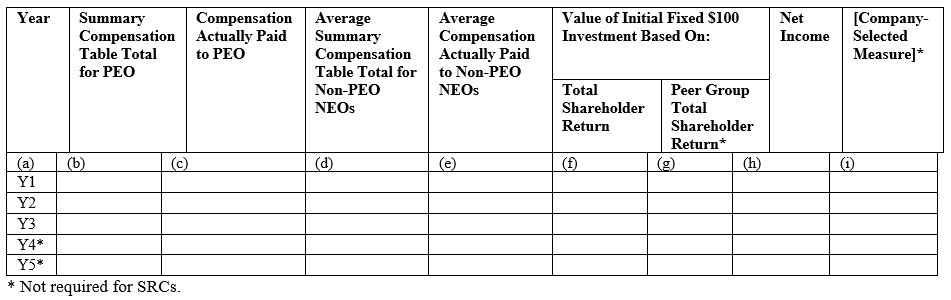
    Item 402(v) will require registrants to disclose, in tabular format, specified executive compensation and financial performance measures for the registrant’s five most recently completed fiscal years. The pay versus performance table must include:

    • A Summary Compensation Table measure of total compensation for the registrant’s principal executive officer (PEO) and, as an average, for the registrant’s other named executive officers (NEOs).
    • The executive compensation actually paid to the registrant’s PEO and, as an average, to the registrant’s other NEOs, calculated as prescribed by the rule.
    • The following specified financial performance measures:
      • Total shareholder return for the registrant
      • Total shareholder return for the registrant’s peer group
      • The registrant’s net income
      • A “Company-Selected Measure” chosen by and specific to the registrant that, in the registrant’s view, represents the most important financial performance measure they use to connect the compensation actually paid to their NEOs to company performance for the most recently completed fiscal year.

    A registrant will also be required to provide a clear description of the relationships between the executive compensation actually paid to its PEO and, as an average, its other NEOs and the registrant’s cumulative total shareholder return, net income and the company-selected measure over the registrant’s five most recently completed fiscal years. Registrants will also be required to include descriptions of the relationships between their total shareholder return and their peer group’s total shareholder return. Registrants will have discretion in formatting these descriptions, which may be in narrative or graphical form or a combination of the two.

    Additionally, a registrant will be required to list three to seven financial performance measures that they conclude are their most important measures. Registrants may, but will not be required to, include non-financial measures in this list if they determine that such measures are among their three to seven most important measures.

    The rules do not require the new pay versus performance disclosures to be in any particular section of a registrant’s proxy or information statement but Inline XBRL tagging will be required.

    PAY VERSUS PERFORMANCE TABLE

    For additional information about McDermott’s capital markets and public companies practice, please see our practice group page.

    Authors

    Thomas P. Conaghan

    Partner

    Washington, DC, New York – One Vanderbilt Avenue

    Andrew C. Liazos

    Partner

    Boston, New York – One Vanderbilt Avenue

    Eric Orsic

    Partner

    Chicago

    Heidi J. Steele

    Partner

    Chicago

    Brian J. Tratner

    Associate

    New York – One Vanderbilt Avenue

    More insights