













ARTICLE
Want health system transformation? Here’s what leaders say it takes
Jul 15, 2026
Read time: 7 min
The question is no longer whether to build, buy, or partner. The question is which approach best advances the organization’s long-term strategy.
This theme surfaced repeatedly in discussions among hospital and health system leaders at McDermott HealthEx 2026. In the face of market pressures, they are increasingly evaluating a broader range of options and deal structures to drive real system transformation – from partnerships and joint ventures (JVs) to acquisitions, affiliations, technology investments, and alternative capital structures.
Rather than pursuing isolated transactions or incremental improvements, healthcare delivery organizations are looking at how strategy, capital constraints, and new care delivery channels fit together to help them stand out in the market and sustain operations for the long-term.
Additional guidance and key takeaways from event discussions include:
Build strategic clarity into enterprise planning
Strategic clarity has become increasingly important as health systems balance growth against financial and operational constraints.
CEOs emphasize the importance of staying grounded in mission, community needs, and long-term enterprise priorities. As site-of-care migration accelerates and care delivery models evolve, organizations are evaluating opportunities through a broader enterprise lens rather than focusing on individual service lines or isolated growth initiatives. The discussion is shifting from where to grow to how growth supports long-term organizational objectives.
That perspective is also shaping transaction and investment decisions. Leadership teams are applying a more risk-adjusted framework when evaluating partnerships, acquisitions, and other strategic opportunities – considering not only financial returns, but also reimbursement exposure, capital requirements, execution risk, workforce implications, and long-term strategic fit. And as uncertainty surrounding Medicaid funding and regulatory policy persists, preserving flexibility has become just as important as pursuing growth.
Develop the right portfolio of partnerships
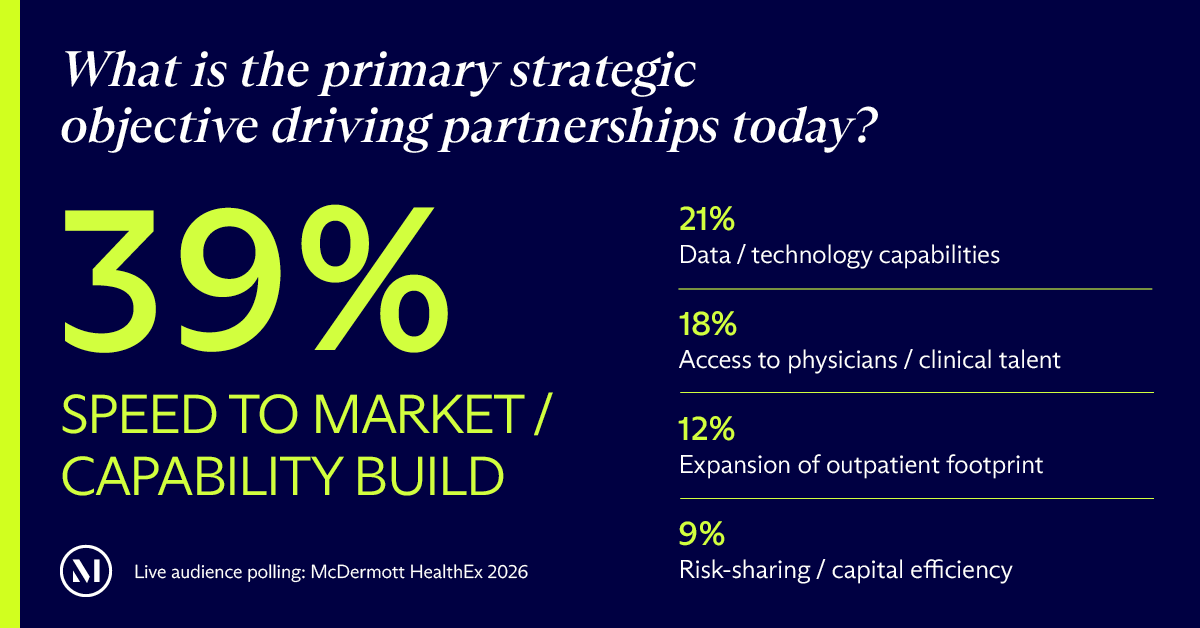
For hospitals and health systems, achieving growth is coming down to building the right portfolio. Organizations are increasingly investing in platforms and forging partnerships with outpatient service providers. These partnerships are vital for health systems looking to strengthen ambulatory networks, secure or improve physician alignment, expand behavioral health capabilities, improve patient access, and address other operational challenges that must be solved as a collective.
Health system leaders note that successful partnerships are rarely defined by transaction structure alone. Governance, cultural alignment, physician engagement, integration planning, and execution readiness frequently determine whether organizations achieve the value they envisioned at signing.
As transaction outcomes come under greater scrutiny, leadership teams are spending more time evaluating strategic fit and implementation risk before moving forward with major combinations or partnerships.
In a telling poll response at McDermott HealthEx, when we asked our audience where they expected to see the most M&A activity over the next 12 to 24 months, 100% of respondents chose outpatient services and ambulatory surgery centers (ASCs). Other response options had included platform-scale PPM, hospital/health system divestitures or carve outs, strategic partnerships/minority investments/JVs, and tech-enabled or services adjacent businesses.
Grow resilience through alignment strategies and creative financing
Health systems must deploy capital in ways that strengthen long-term sustainability, support revenue diversification, and maintain the flexibility needed to respond to a rapidly changing healthcare environment.
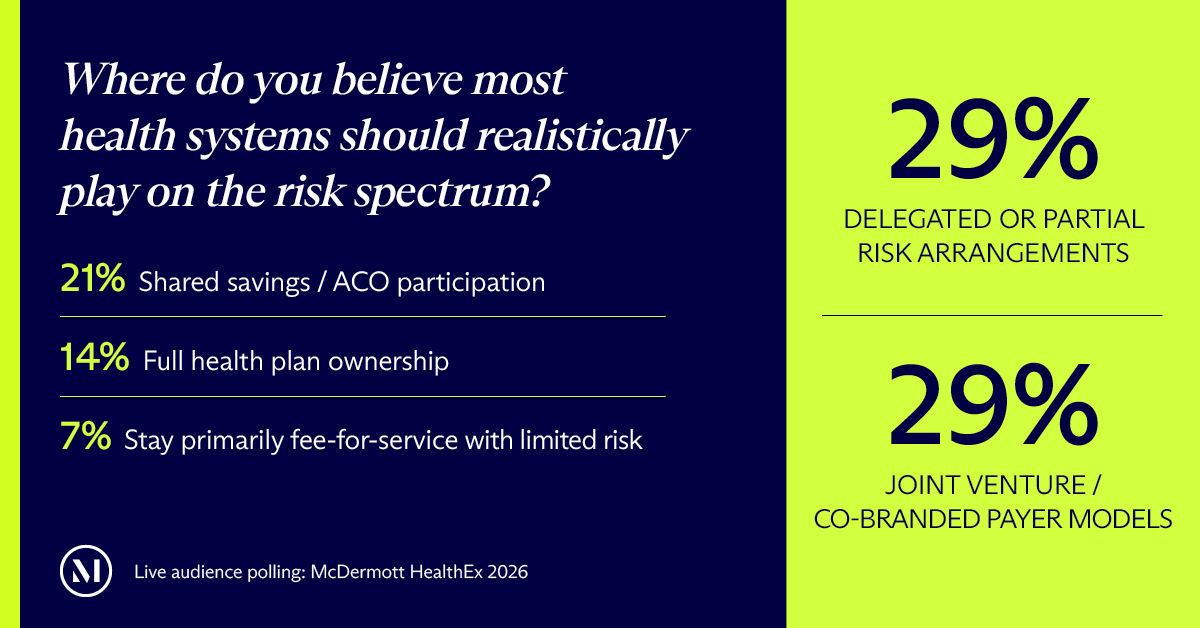
Revenue pressure is also accelerating conversations around value-based care and risk-bearing arrangements. As organizations strive to move closer to the premium dollar through payor partnerships, employer relationships, and population health strategies, success depends less on appetite for risk than on organizational readiness. Physician alignment, care management infrastructure, analytics capabilities, and operational discipline remain foundational requirements for organizations seeking to assume greater financial accountability.
When it comes to physician alignment, many effective approaches can be implemented with little to no incremental financial investment. Key strategies include leveraging clauses linking compensation to attaining in-network referral thresholds, developing an outpatient-focused growth strategy through innovative ambulatory surgery center (ASC) compensation models, and rethinking physician clinic compensation structures to better align incentives. In addition, the Stark Law’s value-based care exceptions provide greater flexibility in physician compensation design, enabling organizations to more effectively incentivize quality, outcomes, and care coordination. Collectively, these strategies can strengthen network integrity, improve care delivery, and drive better patient outcomes.
To go further in addressing budget challenges, hospital and health system leaders have shown growing interest in nontraditional financing approaches. Those options include JVs, monetizing non-core assets, off-balance-sheet financing structures, and other creative capital solutions designed to support strategic priorities while preserving balance-sheet flexibility, although ASC partnerships are still a priority focus.
AI implementation for a new operating model
Conversations around AI have shifted from exploring possibilities to implementing solutions that deliver measurable value. The challenge for health system leaders is no longer identifying use cases, but determining how to deploy AI safely and effectively at scale.
Generative AI continues to gain traction across administrative and clinical workflows. Much of the initial interest centers on automating time-intensive tasks, allowing clinicians and staff to spend less time on documentation and administrative work and more time on patient care and high-value activities.
As organizations move beyond pilots, leaders must be focused on both operational and governance questions: Who is accountable for AI-generated outputs? How should tools be validated before deployment? What level of human oversight is required? How can organizations ensure that patient data is protected and used appropriately?
Health systems must carefully evaluate vendor contracting terms, data ownership and use rights, privacy and cybersecurity safeguards, and the potential for inaccurate or biased outputs to affect clinical or administrative decision-making. Governance structures that define approval processes, monitoring requirements, and manage accountability for AI-related risks as adoption expands across the enterprise are vital components of any transformation strategy.
Playing the long game: Action items for health system leaders
Strategic clarity is a must, along with taking a portfolio approach to growth and transformation. Other key considerations for health system leaders seeking transformation include:
Reevaluate strategic assumptions:
- Reassess whether current growth, access, and care delivery strategies reflect where patients, providers, and reimbursement models are headed. Look ahead, not back.
- Identify which capabilities are most critical to building a competitive advantage, and determine where partnerships or organizational redesign can close gaps.
- Ensure major strategic decisions are grounded in a clear view of the organization’s long-term role within its market and communities. Healthcare is local, and it’s important for healthcare providers to be deeply familiar with the markets they serve.
Apply greater rigor to partnership and transaction decisions:
- Evaluate potential partnerships and transactions based on their ability to advance enterprise strategy, strengthen capabilities, and improve long-term sustainability, instead of focusing solely on size, scale, or financials.
- Incorporate governance, cultural alignment, physician engagement, integration readiness, and execution risk into diligence processes early.
- Establish clear success metrics and accountability structures before entering strategic partnerships or pursuing transformational transactions.
Pressure-test capital and risk strategies:
- Model multiple reimbursement, Medicaid, and regulatory scenarios when evaluating growth initiatives, capital investments, and operating plans.
- Assess organizational readiness before pursuing greater participation in risk-based arrangements, including physician alignment, care management capabilities, analytics infrastructure, and performance measurement.
- Evaluate whether current capital structures provide sufficient flexibility to fund strategic priorities while maintaining resilience in a volatile environment.
Build an infrastructure capable of transformation:
- Move beyond technology pilots and establish enterprise-wide governance frameworks for AI, digital transformation, and other tech modernization initiatives.
- Evaluate whether leadership structures, decision-making processes, and organizational incentives support execution at scale, along with physician alignment.
- Prioritize change-management capabilities as aggressively as technology investments.
Looking ahead
The conversations at McDermott HealthEx reflected a healthcare industry safeguarding for the future and preparing for what comes next. Healthcare organizations that combine strategic clarity, disciplined capital stewardship, operational readiness, and thoughtful partnership strategies will be better positioned to navigate uncertainty while advancing their mission over the long term.
Learn more about hospitals and health systems and find more resources in our Healthcare Transactions Law Center.