Content Type: Article

  • Gorilla Wars: Infringement but No Intent

    ARTICLE

    Gorilla Wars: Infringement but No Intent

    August 2, 2019

    Read time: 2 min

    Key takeaways
    Overview

    Katie Bukrinsky authored this bylined article summarizing the US Court of Appeals for the 11th Circuit’s decision to affirm a district court’s finding that a mark used by an indoor pull-up bar and accessory company infringed the mark of a children’s playset company.

    In depth
    Authors
    More insights

  • German Court Issues First-Ever Anti-Suit Injunction

    German Court Issues First-Ever Anti-Suit Injunction

    ARTICLE / CLIENT ALERT

    German Court Issues First-Ever Anti-Suit Injunction

    August 2, 2019

    Read time: 8 min

    Key takeaways
    Overview

    On July 11 2019, the Munich I District Court (Landgericht) issued an anti-suit injunction in patent litigation, preventing an automotive company from further pursuing proceedings in the United States. The Munich decision might become a landmark case because German courts have historically not been amenable to granting anti-suit injunctions.

    In depth

    Background

    This case arose against the backdrop of the emerging “internet of things,” which is bringing mobile connectivity to the automotive sector. Amid this disruption, members of the automotive supply chains and owners of mobile connectivity technology patents are having to deal with one another for the first time. Of particular pertinence are standard-essential patents (SEPs), which claim subject-matter that must be used for compliance with wireless communication standards such as 4G, 5G or WiFi. SEPs must be licensed to implementers on fair, reasonable and non-discriminatory (FRAND) terms—but the industries involved are still fighting hard to determine important details regarding what is considered FRAND and what is not.

    Former mobile phone giant Nokia holds patents for mobile connectivity technology. Nokia sought to license its alleged SEPs to Daimler. However, the parties could not agree on a license deal, or even on whether Daimler itself or Daimler’s suppliers should obtain any Nokia SEP licenses. Daimler and its suppliers alleged that Nokia’s licensing behaviour violated Nokia’s FRAND obligations and filed respective antitrust complaints with the European Commission.

    While the antitrust complaints before the European Commission were pending, Nokia filed a total of 10 patent infringement lawsuits against Daimler on 21 March 2019 before the Munich I District Court and further German courts. Nokia alleged that its patents in suit were standard-essential. Among other Daimler suppliers, two companies of the Continental group joined the patent infringement lawsuits as third-party interveners in support of Daimler.

    On 10 May 2019, Continental filed a lawsuit against the patent pool Avanci, Nokia and other Avanci members in the US District Court for the Northern District of California, alleging a violation of FRAND and antitrust obligations by the defendants. This lawsuit is pending before Judge Lucy Koh.

    As part of its US lawsuit against Avanci, Nokia and others, Continental requested on 12 June 2019, by way of an interim injunction (motion), an anti-suit injunction against Nokia. Continental requested that the US court enjoin Nokia from further pursuing the patent infringement lawsuits that Nokia had filed earlier in Germany against Continental’s customer Daimler. Continental also requested an order enjoining Nokia from instituting against Continental or any of its customers any action alleging infringement of Nokia’s global 2G, 3G and 4G SEPs during the pendency of the FRAND proceeding before the US court.

    On 9 July 2019, Nokia in turn filed a motion for preliminary injunction before the Munich I District Court for what could be called an “anti-anti-suit injunction”, this time prohibiting Continental from applying for any anti-suit injunction, or further pursuing the above mentioned anti-suit injunction for which Continental had already applied before the US court.

    Nokia told the Munich court that the US court had given Nokia an opportunity to respond to Continental’s request for an anti-suit injunction by 24 July 2019, and Nokia further submitted that the US court could grant the anti-suit injunction requested by Continental any day after 24 July 2019. In order to prevent such decision by the US court, the Munich court assigned particular urgency to Nokia’s Munich “anti-anti-suit injunction”. On 11 July 2019, the Munich court granted the preliminary injunction that Nokia had sought against Continental, and the Munich court did so in ex parte proceedings (without hearing Continental before the decision). It should be noted that this is not a final decision; Continental can appeal the preliminary injunction that the Munich court granted.

    Scope of the Munich Injunction

    The Munich I District Court ordered Continental to refrain from applying for an anti-suit injunction intended to directly or indirectly bar Nokia from pursuing its German patent infringement lawsuits, under penalty of a fine up to EUR 250,000 (approx. US$280,000) or detention for up to six months for each case of contravention (in case of repeated contravention for up to a total of two years). The Munich court also ordered Continental to withdraw its motion for an anti-suit injunction of 12 June 2019 before the US court.

    Reasoning of the Munich court

    From a procedural perspective, the Munich I District Court found that a decision in ex parte proceedings was necessary, as an exception, due to the particular urgency of the matter. Usually, under the principle of procedural equality of arms, the opposing party (here, Continental) must be heard before a court renders any decision. However, it is accepted that under exceptional circumstances a prior hearing can be dispensable in preliminary injunction proceedings, if a prior hearing would frustrate the purpose of the proceedings (for further information on the topic of ex parte proceedings, see IP Update, Vol. 21, No. 12 of December 2018).

    In the case at hand, the Munich I District Court stated that it could have scheduled an oral hearing for 19 July 2019 at the earliest. Filing, execution and service of any decision on Continental thus might not have been feasible prior to the expiry of the 24 July 2019 deadline for Nokia’s response in the US proceedings. After such date, the US court would have been able to issue an anti-suit injunction against Nokia, and Nokia therefore ran the risk of losing its rights. If Continental had been heard, it would have led to delay in the Munich preliminary injunction proceedings. Moreover, there would have been cause to fear that Continental, knowing of Nokia’s Munich injunction motion, would notify the US court of the Munich injunction motion and request preliminary measures against the Munich injunction motion. Nokia thus would risk its rights in Germany being thwarted. Continental’s right to be heard was to be remedied in possible appeal proceedings against the Munich injunction.

    The Munich court considered that if the anti-suit injunction sought by Continental before the US court were issued, it would interfere with Nokia’s interests in due protection of its patent rights, which interests are legally protected under § 823(1) German Civil Code (BGB). The granting of a US anti-suit injunction was sufficiently imminent to justify a Munich preliminary injunction against such US anti-suit injunction.

    The mere grant of a US anti-suit injunction would not directly prevent Nokia from further pursuing its German patent infringement lawsuits, because a US anti-suit injunction would not have legal effect or be enforceable in Germany. However, if Nokia continued its German patent infringement lawsuit after a US anti-suit injunction had been granted, the injunction would likely have far-reaching consequences and economic disadvantages for Nokia in the United States. Hence, there could at least be an indirect prejudice to Nokia’s legal interests as protected in Germany.

    Although the Munich court acknowledged that anti-suit injunctions are an admissible remedy under US law, the court still found that the particular anti-suit injunction Continental sought in the United States would be unlawful under German and European law because it was intended to deprive Nokia of its right of action in Germany. The injunction would thus jeopardise the rule of law, the proper course of justice and the freedom of parties to file necessary motions without any restriction.

    It is somewhat remarkable that the Munich court deemed the applied-for US anti-suit injunction unlawful because of its impact on German proceedings, only to then issue an anti-suit injunction of its own, with an impact on US proceedings. The Munich court did not expressly argue in this context that Nokia’s German patent infringement lawsuits, including the patent infringement lawsuits pending before the Munich court, were pending earlier than Continental’s US antitrust lawsuit.

    Concluding its decision, the Munich court clarified that its preliminary “anti-anti-suit injunction” (in contrast to the anti-suit injunction Continental requested in the United States) was not intended to deprive Continental of its rights to bring an action. The Munich injunction was not directed against Continental’s main proceedings in the United States, only against the motion for an anti-suit injunction in the United States.

    Continental’s Reaction and Remaining Questions

    Continental is reported to have replied in the US proceedings on 19 July 2019 that Nokia obtained the Munich injunction under false pretences, or by misleading the Munich court about the immediacy of the risk of an US anti-suit injunction being granted. Continental also claimed a lack of due process before the Munich court and that it was not properly served with the Munich injunction.

    It remains to be seen whether the Munich injunction will be upheld upon appeal and whether anti-suit injunctions will become an accepted remedy under German and European law. At least in view of proceedings before other European courts, anti-suit injunctions may still be inadmissible, under the European “Brussels Ia” Regulation on procedural law.

    Authors
    More insights

  • The Proposed GILTI High-Tax Exception

    ARTICLE

    The Proposed GILTI High-Tax Exception

    July / August 2019

    Read time: 2 min

    Key takeaways
    Overview

    Lowell Yoder authored this bylined article discussing the proposed tax regulations which provide a high-tax exception for GILTI tested income. The article also discusses the rules for applying the exception and when it might be beneficial to make the election.

    In depth
    Authors

    Lowell D. Yoder

    Partner

    Chicago

    More insights

  • Federal Banking Regulators Issue Joint Statement on BSA/AML Compliance Program Examinations

    Federal Banking Regulators Issue Joint Statement on BSA/AML Compliance Program Examinations

    ARTICLE / CLIENT ALERT

    Federal Banking Regulators Issue Joint Statement on BSA/AML Compliance Program Examinations

    August 1, 2019

    Read time: 4 min

    Key takeaways
    Overview

    On July 22, 2019, the Board of Governors of the Federal Reserve System, the Federal Deposit Insurance Corporation, the National Credit Union Administration, the Office of the Comptroller of the Currency and the Financial Crimes Enforcement Network (“FinCEN”) (collectively, the “Agencies”) issued a joint statement reaffirming their risk-based approach to their examinations of banks’ Bank Secrecy Act/anti-money laundering (“BSA/AML”) compliance programs (“Joint Statement”).[1]

    The Joint Statement does not establish new requirements for banks, but emphasizes the Agencies’ ongoing commitment to risk-focused safety and soundness examinations. The Joint Statement is intended to increase transparency in the planning and performance of BSA/AML examinations.

    BSA/AML Compliance Programs and Risk Profiles

    The Joint Statement reiterates that banks are required to establish and maintain risk-based BSA/AML compliance programs to ensure compliance with the BSA. These programs are statutorily subject to review by federal banking agencies during each examination cycle. Each bank is examined based on its individual risk profile, in addition to the bank’s compliance with applicable laws and regulations, and the examination scope may therefore vary.

    The Agencies advised against declining banking services to entire categories of risky customers and instead “encouraged” banks to mitigate risks with effective controls. A comprehensive risk assessment is a critical step in developing those controls.

    Risk-Focused Examinations

    The Joint Statement highlights that federal banking agencies gauge a bank’s individual risk profile in order to tailor the scope of the examination, as they tend to allocate more resources to higher risk areas. Factors contributing to this evaluation include the bank’s own BSA/AML risk assessment, independent audits and conclusions from previous examinations, among other information sources. The federal banking agencies may also contact the bank between examinations and consider the bank’s ability to identify, measure, monitor and control risk.

    The Joint Statement is the third statement resulting from a working group formed by the U.S. Department of the Treasury’s Office of Terrorism and Financial Intelligence, FinCEN and the federal banking agencies, aimed at improving the effectiveness and efficiency of the BSA/AML regime in the United States. On Oct. 3, 2018, the Agencies issued an Interagency Statement on Sharing Bank Secrecy Act Resources, noting that depository institutions may enter into collaborative arrangements to share resources to manage their BSA/AML compliance obligations more efficiently and effectively.[2] On Dec. 3, 2018, the Agencies issued a Joint Statement on Innovative Efforts to Combat Money Laundering and Terrorist Financing, emphasizing the importance of innovation in the private sector and the Agencies’ commitment to engaging with banks in promoting such innovation.[3]

    Authored by Donald J. Mosher, Joseph P. Vitale, Betty Santangelo and Melissa G.R. Goldstein.

    If you have any questions concerning this Alert, please contact your attorney at Schulte Roth & Zabel or one of the authors.


    [1] Joint Statement on Risk-Focused Bank Secrecy Act/Anti-Money Laundering Supervision (July 22, 2019), available here.

    [2] Interagency Statement on Sharing Bank Secrecy Act Resources (Oct. 3, 2018), available here.

    [3] Joint Statement on Innovative Efforts to Combat Money Laundering and Terrorist Financing (Dec. 3, 2018), available here.


    This communication is issued by Schulte Roth & Zabel LLP for informational purposes only and does not constitute legal advice or establish an attorney-client relationship. In some jurisdictions, this publication may be considered attorney advertising. ©2019 Schulte Roth & Zabel LLP.

    All rights reserved. SCHULTE ROTH & ZABEL is the registered trademark of Schulte Roth & Zabel LLP.

    In depth
    Authors

    Donald J. Mosher

    Partner

    New York – 919 Third Avenue

    Betty Santangelo

    Counsel

    New York – 919 Third Avenue

    Melissa G.R. Goldstein

    Partner

    New York – 919 Third Avenue

    More insights

  • Part 3: Data, Data Everywhere – Advanced Strategies for Analyzing Mobile Data

    Part 3: Data, Data Everywhere – Advanced Strategies for Analyzing Mobile Data

    ARTICLE

    Part 3: Data, Data Everywhere – Advanced Strategies for Analyzing Mobile Data

    July 30, 2019

    Read time: 2 min

    Key takeaways
    Overview

    Martha Louks co-authored this bylined article examining advanced strategies for analyzing device data and how to apply those strategies to cases.

    In depth
    Authors

    Martha K. Louks

    Director of Technology Services

    Washington, DC

    More insights

  • IP Update, Vol. 22, No. 7

    IP Update, Vol. 22, No. 7

    ARTICLE

    IP Update, Vol. 22, No. 7

    July 2019

    Read time: 1 min

    Key takeaways
    Overview

    Dive into the July 2019 issue of IP Update: Vol. 22, No. 7

    In depth
    Authors

    Amol Parikh

    Partner

    Chicago

    Paul Devinsky

    Senior Counsel

    Washington, DC

    More insights

  • No Jury Trial for Trademark Infringement Claims

    No Jury Trial for Trademark Infringement Claims

    ARTICLE

    No Jury Trial for Trademark Infringement Claims

    July 25, 2019

    Read time: 2 min

    Key takeaways
    Overview

    Sarah Bro authored this bylined article summarizing the US Court of Appeals for the 11th Circuit’s decision that a cosmetics company did not infringe on the trademark of another cosmetics company and the trademark plaintiff was not entitled to a trial by jury.

    In depth
    Authors

    Sarah Bro

    Partner

    Orange County, Los Angeles

    More insights

  • IRS Expands Scope of Preventive Care under Health Savings Account Rules

    IRS Expands Scope of Preventive Care under Health Savings Account Rules

    ARTICLE / CLIENT ALERT

    IRS Expands Scope of Preventive Care under Health Savings Account Rules

    July 23, 2019

    Read time: 4 min

    Key takeaways
    Overview

    A new IRS notice will allow many with chronic health conditions who participate in high-deductible health plans (HDHPs) with health savings accounts (HSAs) to receive necessary care that may otherwise be out of financial reach. The notice expands the list of preventive care benefits that can be covered by an HDHP prior to a participant meeting the minimum deductible without disqualifying them from making or receiving HSA contributions.

    In depth

    On July 17, the Internal Revenue Service (IRS), in consultation with the Department of Health and Human Services (HHS), issued Notice 2019-45 (Notice). The Notice expands the list of preventive care benefits that can be covered by a high-deductible health plan (HDHP) prior to a participant meeting the minimum deductible without disqualifying that participant from making or receiving health savings account (HSA) contributions. Several frequently used services and medications, such as statins, insulin and blood pressure monitors, are included in the Notice. This change will allow many people with chronic health conditions who participate in HDHPs with HSAs to receive necessary care that may otherwise be more difficult to afford.

    HSAs allow eligible individuals to use pre-tax dollars to pay for eligible health care expenses. One requirement to participate in an HSA is that an individual be covered under a HDHP and have no “disqualifying health coverage.” As a general rule, any benefits covered under the HDHP before the minimum deductible is satisfied constitute disqualifying health coverage. However, there is a limited exception for preventive care that allows coverage of certain services, procedures and medications to be covered by the HDHP before a participant meets their deductible without affecting the individual’s ability to contribute to an HSA. Under this exception, preventive care did not include any service or benefit intended to treat an existing illness, injury or condition.

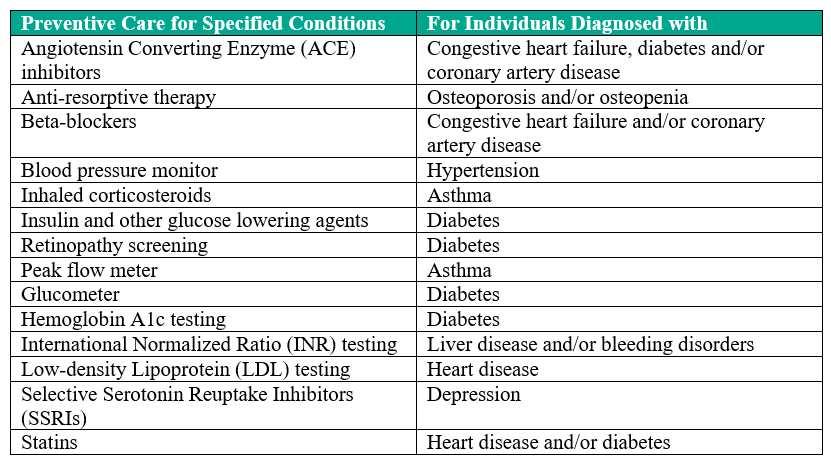
    The Notice expands the scope of what qualifies as preventive care to include medical expenses that treat an existing chronic condition but also prevent exacerbation of the condition and/or a future secondary condition. For example, preventive care now includes certain medications, such as insulin, for treatment of diabetes. The list of preventive care for specified conditions in the Notice is based on three criteria:

    1. The service or item is low cost;
    2. Medical evidence supporting high-cost efficiency (a large expected impact) of preventing exacerbation of a chronic condition or development of a secondary condition; and
    3. A strong likelihood, documented by clinical evidence, that with respect to the class of individuals prescribed the item or service, the specific service or use of the item will prevent exacerbation of the condition or development of a secondary condition that requires significantly higher cost treatments.

    It is important to note that the IRS has not expanded the scope of preventive care beyond what is listed in the Notice. Therefore, other services or items that meet the above criteria but are not on the list are not treated as preventive care for purposed of HSA eligibility. The IRS and HHS will periodically review the list and determine whether items should be added or removed (every five to 10 years). The specific medical care services or items listed in the Notice are as follows:

    Authors

    Jacob M. Mattinson

    Partner

    Chicago

    More insights

  • Innovations for the Early Renovation

    ARTICLE

    Innovations for the Early Renovation

    July 2019

    Read time: 2 min

    Key takeaways
    Overview

    Uwe Goetker authored this bylined article discussing “Innovation for Early Renovation,” the EU’s directive that will give debtors in situations of “probable insolvency” the ability to restructure themselves, while maintaining control of their assets and daily operations.

    In depth
    Authors

    Dr. Uwe Goetker

    Partner

    Düsseldorf

    More insights

  • SEC Staff Publishes Statement on LIBOR Transition

    SEC Staff Publishes Statement on LIBOR Transition

    ARTICLE / CLIENT ALERT

    SEC Staff Publishes Statement on LIBOR Transition

    July 18, 2019

    Read time: 13 min

    Key takeaways
    Overview

    On July 12, 2019, the staffs of several divisions (“Staff”) within the SEC published a statement (“Statement”) on the transition away from the London Interbank Offered Rate (“LIBOR”).[1] The panel banks which currently report information used to establish LIBOR for different currencies have committed to do so through 2021. After 2021, it is likely that LIBOR will cease to be reported, and, even if it is reported after 2021, it may no longer be a viable representation of interbank borrowing costs for the applicable tenors. In a July 15, 2019 speech, Andrew Bailey, chief executive of LIBOR’s regulator, the Financial Conduct Authority of the United Kingdom, stated that the “base case” assumption for firms’ planning should be no publication of LIBOR after the end of 2021.[2]

    Groups in the United States and other nations are working on replacements to LIBOR in order to avoid market disruptions. In the United States, the Alternative Reference Rates Committee (“ARRC”) convened by the Federal Reserve Board and the Federal Reserve Bank of New York has identified the Secured Overnight Financing Rate (“SOFR”) as its preferred replacement for U.S. Dollar LIBOR.[3]

    In the Statement, the Staff does not endorse the use of any particular reference rate but encourages market participants to begin managing their transition away from LIBOR and, for existing LIBOR-based transactions, to consider the following as they seek to analyze and mitigate the risks related to the transition from LIBOR:

    • Do you have, or are you or your customers exposed to, any contracts extending past 2021 that reference LIBOR? For companies considering disclosure obligations and risk management policies, are these contracts, individually or in the aggregate, material?
    • For each contract identified, what effect will the discontinuation of LIBOR have on the operation of the contract?
    • For contracts with no fallback language in the event LIBOR is unavailable, or with fallback language that does not contemplate the permanent discontinuation of LIBOR, do you need to take actions to mitigate risk, such as proactive renegotiation with counterparties to address the contractual uncertainty?
    • What alternative reference rate (for example, SOFR) might replace LIBOR in existing contracts? Are there fundamental differences between the methods of calculation of LIBOR and the alternative reference rate that could impact your profitability or costs? Does the alternative reference rate need to be adjusted (by the addition of a spread, for example) to maintain the anticipated economic terms of existing contracts?
    • For derivative contracts referencing LIBOR that are utilized to hedge floating rate investments or obligations, what effect will the discontinuation of LIBOR have on the company’s hedging strategy?
    • Does use of an alternative reference rate introduce new risks that need to be addressed? For example, if you have relied on LIBOR in pricing assets as a natural hedge against increases in costs of capital or funding, will the replacement rate behave similarly? If not, what actions should be taken to mitigate this new risk? 

    In addition, the Statement includes suggestions relating to new contracts and other business risks:

    • Market participants should also consider whether contracts entered into in the future should reference an alternative rate to LIBOR (such as SOFR) or, if such contracts reference LIBOR, include effective fallback language.
    • Market participants should identify, evaluate and mitigate other consequences of the discontinuation of LIBOR on their business, such as on strategy, products, processes and information systems.

    The Division of Corporation Finance stated that it is important to keep investors informed about the progress toward risk identification and mitigation and, in deciding which disclosures are relevant and appropriate, to consider the following guidance:

    • The evaluation and mitigation of risks related to the expected discontinuation of LIBOR may span several reporting periods. Consider disclosing the status of company efforts to date and significant matters yet to be addressed.
    • When a company has identified a material exposure to LIBOR but does not yet know or cannot yet reasonably estimate the expected impact, consider disclosing that fact.
    • Disclosures that allow investors to see this issue through the eyes of management are likely to be the most useful for investors. This may entail sharing information used by management and the board in assessing and monitoring how transitioning from LIBOR to an alternative reference rate may affect the company. This could include qualitative disclosures and, when material, quantitative disclosures, such as the notional value of contracts referencing LIBOR and extending past 2021.

    The Division of Investment Management is actively monitoring the impact of the expected discontinuation of LIBOR on investment companies (“funds”) and advisers, noting that:

    • For those funds that invest in instruments referencing LIBOR, the discontinuation of LIBOR may impact the functioning, liquidity and value of their investments.
    • Funds should consider assessing the impact on the liquidity of their investments, including how those investments are classified and, for registered funds, whether this could affect their liquidity risk management programs, to ensure compliance with Rule 22e-4 under the Investment Company Act of 1940.
    • Even funds that do not hold investments linked to LIBOR could be impacted if they have other contracts which reference LIBOR and extend beyond 2021.
    • In addition, funds that have received exemptive orders that reference LIBOR (such as interfund lending orders) should consider evaluating possible implications for terms and conditions of their relief.
    • Funds and advisers should consider whether the impacts discussed above, and other consequences of the discontinuation of LIBOR, are risks that they should disclose to investors. Whether disclosure is appropriate, and the content of such disclosure, will depend on the nature and significance of the investments or agreements that are linked to LIBOR. 
    • For the instruments extending past 2021 which reference LIBOR, advisers should consider the effect of the discontinuation of LIBOR when recommending them to clients or monitoring them for clients.

    The Division of Trading and Markets is actively monitoring the impact that the discontinuation of LIBOR will have on broker-dealers, central counterparties and exchanges, as these entities may be parties to transactions or hedges that reference LIBOR, issue instruments or own investments that reference LIBOR, underwrite, place or recommend securities or instruments that reference LIBOR or have listing and clearing standards that do not contemplate replacement benchmarks. The Statement encourages these entities to analyze how this change will impact them, and whether their clients and markets should be informed of the risks related to this change.

    Lastly, the Office of the Chief Accountant is actively monitoring the activities underway among preparers and auditors of financial statements, standard setters such as the Financial Accounting Standards Board and other regulators to address financial reporting issues that might arise in connection with any transition from LIBOR to an alternative benchmark rate. These issues could span a number of different areas, including, for example, the accounting and financial reporting for modifications of terms of debt instruments, hedging activities, inputs used in valuation models and potential income tax consequences.

    Authored by Phillip J. Azzollini, Douglas I. Koff, Anna Maleva-Otto, Paul N. Watterson, Jr., Kelly Koscuiszka, Anthony Lombardi and Atul Joshi.

    If you have any questions concerning this Alert or the LIBOR transition, please contact your attorney at Schulte Roth & Zabel or one of the authors.


    [1] The Statement notes that it is not a rule, regulation or statement of the SEC (and does not affect current applicable law or create new or additional obligations) but a statement reflecting the views of the respective staffs of the Divisions of Corporation Finance, Investment Management, Trading and Markets and the Office of the Chief Accountant.

    [2] See LIBOR: preparing for the end
    .

    [3] Get more information.


    This communication is issued by Schulte Roth & Zabel LLP for informational purposes only and does not constitute legal advice or establish an attorney-client relationship. In some jurisdictions, this publication may be considered attorney advertising. ©2019 Schulte Roth & Zabel LLP.

    All rights reserved. SCHULTE ROTH & ZABEL is the registered trademark of Schulte Roth & Zabel LLP.

    In depth
    Authors

    Phillip J. Azzollini

    Partner

    New York – 919 Third Avenue

    Douglas I. Koff

    Partner

    New York – 919 Third Avenue

    Paul N. Watterson, Jr.

    Of Counsel

    New York – 919 Third Avenue

    Kelly Koscuiszka

    Partner

    New York – 919 Third Avenue

    More insights