
ARTICLE / CLIENT ALERT
Foreign private issuer officers and directors required to file with the SEC under Section 16(a) of the Securities Exchange Act of 1934: March 2026
January 20, 2026
Read time: 5 min
On December 18, 2025, the Holding Foreign Insiders Accountable Act (the Act) was enacted as part of the 2026 National Defense Authorization Act.1
Effective March 18, 2026, the Act eliminates an exemption from the reporting requirements under Section 16(a) of the Securities Exchange Act of 1934, as amended, (the Exchange Act) for directors and officers of foreign private issuers (FPIs), thereby requiring these insiders to report their beneficial ownership in equity securities of FPIs as well as changes in their beneficial ownership of such securities beginning March 18, 2026. A FPI is generally a non-US issuer of securities which is listed on a US exchange such as Nasdaq or the NYSE, or which trades on OTC Markets, and is registered with the US Securities and Exchange Commission (the SEC). The Act will be effective March 18, 2026.
Summary of changes
Section 16(a) of the Exchange Act requires certain filings by officers and directors of issuers with a class of equity securities registered under Section 12 of the Exchange Act and beneficial owners of more than 10% of any class of equity securities registered under Section 12 of the Exchange Act. FPIs have historically been exempt from this requirement under Rule 3(a)12-3(b) promulgated pursuant to the Exchange Act, which states that “Securities registered by a foreign private issuer […] shall be exempt from sections 14(a), 14(b), 14(c), 14(f) and 16 of the [Exchange] Act.”2
The Act revises the Exchange Act such that Section 16(a) of the Exchange Act now explicitly includes officers and directors of FPIs and eliminates portions of the exemptions previously included in Rule 3(a)12-3(b).3 The Act makes officers and directors of FPIs subject only to Section 16(a) of the Exchange Act and not the other subsections of Section 16. Most notably, officers and directors of FPIs remain exempt from Section 16(b)’s profit disgorgement rules.4 In effect, the primary impact of the Act to officers and directors of FPIs is to impose the Section 16(a) reporting regime. The Act preserves the existing exemption from Section 16 for greater than 10% beneficial owners of FPIs and changes only the reporting requirements applicable to officers and directors.
“Director” is understood to refer to any person who serves on the board of directors of an issuer or performs similar functions with respect to the issuer.5 “Officer” is defined as any president, principal financial officer, principal accounting office, or anyone who oversees a business unit or performs significant policy-making functions for the issuer. 6
Details and next steps
Section 16(a) provides for three filings by officers and directors of FPIs.7 Initial statements of beneficial ownership required under Section 16(a) are generally required to be filed on Form 3 within 10 days of becoming an officer or director.8 Changes of beneficial ownership of equity securities are generally required to be filed on Form 4 within 2 business days of the change 9 or, in certain cases, changes may be reported on Form 5. It is important to note that option and other grants by an issuer to an officer or director are generally reportable on Form 4 and as a result, director and officer compensation by FPIs may become more visible. There are numerous nuances in the reporting regime and advice of counsel is often required.
Officers and directors of FPIs may need to make an initial Form 3 filing for any preexisting holdings as early as March 18, 2026. 10 The Act only states that it becomes effective 90 days after execution, and does not provide a hard deadline for an initial filing. 11 On or before March 18, 2026, the SEC is required to publish additional compliance guidelines and implementing regulations for the Act. 12 Potentially affected officers and directors of FPIs should monitor related SEC pronouncements.
The Act contains one notable possible exemption to the new FPI filing requirements. At its discretion, the SEC may make exemptions where “laws of a foreign jurisdiction apply substantially similar requirements to such person, security, or transaction.” 13 The SEC may in its sole discretion, determine which foreign regimes are “substantially similar.” To date, no such guidance has been published.
The forms required under Section 16(a) must be filed electronically via the EDGAR Next online system. 14 Each officer and director must obtain EDGAR credentials in order to submit filings via EDGAR Next and in order to do so must file a Form ID with the SEC. 15 Once a Form ID is filed, obtaining EDGAR credentials can take a week or more. The EDGAR credentials must be obtained by the individual who is required to make the filing in their individual capacity, and individuals bear direct responsibility for any representations made in their filings. 16 It is common practice for issuers to assist officers and directors with Section 16 filings.
The Act does not include standalone provisions specifying penalties for violations. Violations of Section 16(a) are enforceable under the Exchange Act’s existing enforcement framework. The SEC has authority to impose civil fines and other penalties for failures to comply with insider reporting requirements.






The new sheriff is in town – AMLA officially received supervisory powers from EBA
ARTICLE
The new sheriff is in town – AMLA officially received supervisory powers from EBA
January 20, 2026
Read time: 2 min
Dr. Cornelius Hille examines the formal handover of AML/CFT powers from the EBA to the new EU Anti-Money Laundering Authority (AMLA), outlining AMLA’s supervisory mandate and what the new EU-wide AML regime means for financial institutions and other obliged entities from 2026 onward.




AIFMD 2: Implementation deadline approaching
ARTICLE / CLIENT ALERT
AIFMD 2: Implementation deadline approaching
January 16, 2026
Read time: 12 min
With just under three months to go until the 16 April 2026 implementation deadline for AIFMD 2, Alternative Investment Funds Managers (AIFMs) should forge ahead with their implementation plans to ensure that their governance, policies, procedures, and controls, as well as applicable fund documents (including pre-contractual and periodic disclosures) are compliant with the new requirements.
Broadly speaking, AIFMD 2 introduces changes to authorisation conditions, delegation requirements, conflicts of interest rules, liquidity management requirements, investor pre-contractual and periodic disclosures, regulatory reporting, and depository requirements. It also introduces a specific regime for loan-originating alternative investment funds (AIFs) and loan-originating activities, as well as clarifying the conditions for third-country marketing in the EU.
While most of the supplementary Level 2 delegated regulations and technical standards have been finalised, not all of them will be formally adopted until after the implementation deadline. It is also unclear whether all Member States will have incorporated AIFMD 2 into local law by the deadline. Therefore, AIFMs will need to maintain a watching brief and take note of any local variations (including any gold plating provisions) introduced at the individual Member State level.
This alert identifies some of the key action points that AIFMs will need to address ahead of the fast-approaching implementation deadline.
What do AIFMs need to do?
Loan-origination activities and loan-originating AIFs
AIFMD 2 introduces a new loan-origination regime, with general rules applicable to all AIFs that originate loans, and more stringent requirements applicable to AIFs that qualify as loan-originating AIFs.
Key action points for AIFMs include:
- Assessing whether the AIFs they manage originate loans; and whether they qualify as loan-originating AIFs (i.e., an AIF whose investment strategy is mainly to originate loans; or whose originated loans have a notional value that represents at least 50% of its net asset value). The outcome of the assessment should be documented and appropriate records retained.
- For a loan-originating AIF:
- Ensuring that the AIF is structured as a closed-ended fund unless it can demonstrate that the AIF’s liquidity risk management arrangements are compatible with the AIF’s investment strategy and redemption policy. The Level 2 Delegated Regulation (the OE RTS), which has been finalised but will not be formally adopted until October 2027 (thereby creating a degree of unhelpful uncertainty), includes further guidance on how the AIFM should establish an appropriate redemption policy, undertake frequent stress tests, and conduct ongoing monitoring. In addition, the OE RTS has clarified that:
- the AIFM must have arrangements in place to ensure that the open-ended loan originating AIF has sufficient liquidity to honour redemption requests, as opposed to holding a specific amount of liquid assets (as originally proposed); and
- the AIFM must conduct liquidity stress tests at least annually rather than every quarter (as originally proposed). Note: AIFMs should assess whether stress tests should be undertaken more frequently than on an annual basis.
- Ensuring the AIF complies with the following leverage limits, calculated using the commitment method (i.e., taking into consideration netting and hedging arrangements, as opposed to the gross method): 175% for open-ended structures, and 300% for closed-ended structures.
- Ensuring that the AIF is structured as a closed-ended fund unless it can demonstrate that the AIF’s liquidity risk management arrangements are compatible with the AIF’s investment strategy and redemption policy. The Level 2 Delegated Regulation (the OE RTS), which has been finalised but will not be formally adopted until October 2027 (thereby creating a degree of unhelpful uncertainty), includes further guidance on how the AIFM should establish an appropriate redemption policy, undertake frequent stress tests, and conduct ongoing monitoring. In addition, the OE RTS has clarified that:
- For AIFs that originate loans:
- Ensuring that the AIF retains (at least) 5% of the notional value of the loans that it originates (subject to certain derogations, for instance in the case of an AIF’s liquidation or for the purposes of compliance with sanctions);
- Ensuring that the AIF is not established for the sole purpose of originating loans and selling them to third parties under a so-called “originate-to-distribute strategy”;
- Ensuring that lending to certain types of borrowers does not exceed 20% of the AIF’s capital (i.e., loans to other AIFs, UCITS or financial services firms such as banks, investment firms, and insurance companies). This limitation will apply no later than two years following the first subscription for units in the AIF. However, the limitation can be disapplied if the AIF is selling assets to meet redemption requests, or during the liquidation of the AIF. It can also be temporarily suspended for up to one year if the capital of the AIF is increased or decreased;
- Ensuring that the AIF does not lend to its AIFM, depositary or its delegates, or their respective employees and personnel (with the exception of affiliates who exclusively finance borrowers);
- Ensuring that the AIF does not lend or service loans to a retail consumer where this is prohibited in a specific Member State; and
- Implementing policies and procedures for granting loans (e.g., procedures for assessing the credit risk of the borrower and ongoing monitoring of the performance of the credit portfolio). These should be appropriately documented and records retained.
Fund liquidity management rules
AIFMD 2 (supplemented by Level 2 Delegated Regulation and Guidelines) introduces certain changes to the liquidity management requirements, including obliging AIFMs managing open-ended AIFs to:
- Select at least two liquidity management tools (LMTs) for each AIF that they manage, which should take account of the AIF’s investment strategy, liquidity profile, and redemption policy. These will include suspension of subscriptions/repurchases/redemptions, redemption gates, extension of notice periods, redemption fees, swing pricing, dual pricing, anti-dilution levies, redemptions in kind, and side pockets. The suspension of subscriptions/repurchases/redemptions and the use of side pockets are restricted to exceptional circumstances. In addition, the Level 2 Delegated Regulation clarifies that restricting subscriptions while continuing to allow repurchases and redemptions by existing investors (so-called “soft closure”) will not qualify as an LMT for Annex V purposes as it “does not serve the purpose of managing liquidity risks or addressing redemption pressure under stressed market conditions;
- Implement a policy governing the oversight and appropriate use of LMTs, which should form part of a broader fund liquidity risk management policy, and should capture the conditions for activating and deactivating LMTs; and
- Notify the home state regulator when activating or deactivating the LMTs within a reasonable timeframe.
Action points for AIFMs include:
- Identifying existing LMT arrangements and making any necessary amendments to reflect the new requirements;
- Reviewing and updating governance, policies, and procedures to oversee the use and appropriateness of the LMTs;
- Establishing a LMT plan, which sets out the steps required to be taken prior to and immediately after the activation and deactivation of an LMT;
- Updating investor disclosures to cover the selection and operation of LMTs; and
- Notifying their home state regulator of changes in the LMTs (both activations and deactivations).
Delegation
While AIFMD 2 does not impose any new substantive obligations on AIFMs in respect to delegation, it introduces enhanced reporting requirements and provides clarity around some of the delegation substance requirements.
It also explicitly clarifies that the AIFM is directly responsible for ensuring that the delegate complies with the requirements in the AIFMD irrespective of the regulatory status or location of any delegate, and extends the scope of the delegation rules to all AIFM functions and permitted ancillary activities (although there is a carve-out for certain marketing arrangements involving regulated distributors).
Key action points for AIFMs include:
- Ensuring that the business of the AIFM is conducted by at least two natural persons who are (a) employed on a full-time basis by the AIFM, or (b) executive members or members of the governing body of the AIFM, committed full-time to conducting the business of the AIFM; and are domiciled in the EU. This is consistent with general market practice in key onshore fund jurisdictions such as Luxembourg and Ireland;
- Updating existing policies and procedures on delegation arrangements to ensure they capture all delegated AIFM functions;
- Undertaking appropriate due diligence on delegates, ensuring that they are appropriately qualified, and subject to ongoing monitoring and oversight. AIFMs should ensure that they maintain an appropriate audit trail to evidence the ongoing appropriateness of delegation arrangements; and
- Reporting details of their delegation of portfolio management or risk management to their home state regulator (including the name, domicile and the amount and percentage of each AIF’s assets that are subject to delegation arrangements).
Regulatory reporting and investor disclosure
AIFMD 2 extends the scope of information that AIFMs are required to report to their home state regulator to include (a) data on the current risk profile of the AIF (including market, liquidity, counterparty and operational risk), (b) the total amount of leverage employed by the AIF, and (c) details of the delegation arrangements concerning portfolio management or risk management functions). The reports should be made using the applicable templates.
AIFMD 2 also expands the information that EU and non-EU AIFMs will be required to disclose to investors prior to investing in the fund (the so-called Article 23 disclosures) to include all fees, charges and expenses borne by the AIFM that will be allocated to the AIF, details on LMTs, and information on loans originated.
In addition, the AIF annual report will need to include all fees borne by investors and a list of parent companies, subsidiaries or special purpose vehicles used in connection with the AIF’s investments.
Key action points for AIFMs include:
- Identifying all new relevant data and information items;
- Updating procedures and processes to ensure compliance with reporting requirements; and
- Reviewing and updating pre-contractual investor disclosures and AIF periodic disclosures to capture the new disclosure items.
Depositaries
AIFMD 2 permits AIFMs to appoint depositaries outside their AIF’s home country provided that: (a) the AIFM can demonstrate a lack of depositary services in the AIF’s home state; (b) the aggregate amount of assets held by the depositaries in the AIF’s home state does not exceed EUR 50 billion; and (c) the AIF’s home state regulator provides consent on a case-by-case basis. While this additional flexibility is helpful, it would be unlikely to apply to AIFs established in jurisdictions such as Luxembourg and Ireland, which are well-serviced depositary markets.
Although proposals relating to a depositary “passport” were discussed during the legislative process, they were not ultimately adopted. However, this concept re-emerges in the latest market integration proposals published by the European Commission, so AIFMs should stay abreast of developments in this space.
AIFMD 2 updates the conditions for appointing depositories in a third country by a non-EU AIF by confirming that the third country must not be located in a high-risk country pursuant to the EU Anti-Money Laundering Directive and must not be mentioned in Annex I of the list of non-cooperative jurisdictions for tax purposes (an Excluded Jurisdiction). In the event that a depository is subsequently identified as being located in an Excluded Jurisdiction, a new depositary will have to be appointed within an appropriate timeframe, which must not be longer than two years.
Key action points for AIFMs include:
- Reviewing any existing third-country depositories to ensure that they are not located in an Excluded Jurisdiction, implementing a procedure to monitor this, and making any necessary changes to depositary arrangements if the depositary is in an Excluded Jurisdiction; and
- If appointing a depository outside the AIF’s home state, ensuring that this can be justified based on the relevant AIFMD 2 conditions and obtaining consent from the regulator.
Conflicts of interest and expansion of AIFM activities
AIFMD 2 requires AIFMs to implement more robust procedures around the management of conflicts of interest when they are appointed to manage an AIF by a third party. This will include submitting detailed explanations to their home state regulator on: (a) how such conflicts are managed in accordance with the AIFMD, and (b) the “reasonable steps” taken to prevent conflicts, and where such conflicts cannot be prevented, the steps taken to identify, monitor, manage, and disclose them.
AIFMD 2 also extends the scope of the activities that can be undertaken by AIFMs to include the administration of benchmarks and undertaking credit servicing activities. AIFM groups that have been required to establish separate legal entities to undertake these additional activities may wish to consider whether the performance of such activities should be folded into a single entity.
In addition, AIFMs will be required to implement robust conflicts of interest arrangements to: (a) prevent conflicts arising out of the extension in scope of their activities, or (b) identify, manage, and monitor such conflicts.
Key action points for AIFMs include:
- Reviewing and updating conflicts of interest policies and controls and notifying the home state regulator accordingly;
- Reviewing existing activities (including at a group level) and taking steps to obtain regulatory authorisation to cover any new activities (i.e., administering benchmarks and/or conducting credit servicing activities); and
- Considering whether to consolidate group structures into a single legal entity to achieve better regulatory capital and operational efficiency.
Third-country marketing
Unfortunately, AIFMD 2 fails to harmonise and facilitate improved access rights for third country marketing into the EU markets. Rather, it simply amends some of the conditions for third country marketing under the National Private Placement Regime. In particular, such marketing will only be allowed to be conducted by non-EU AIFMs that are not located in the following countries:
- A “high-risk third country” under the EU’s anti-money laundering framework. This replaces the current reference to the FATF list of non-cooperative countries and territories;
- A country which does not apply the standards laid down in the OECD Model Tax Convention on Income and on Capital or does not ensure an effective exchange of information in tax matters; and
- A country mentioned on the revised EU list of non-cooperative jurisdictions for tax purposes.
Grandfathering
In summary, AIFMD 2 includes the following transitional provisions:
- For AIFs incorporated before 15 April 2024: The requirements for open-ended loan-originating AIFs, the 20% single borrowing limitation, and the leverage limits will not apply until 16 April 2029.
- For AIFs incorporated before 15 April 2024 that do not raise additional capital after that date: There is no requirement to comply with the requirements referenced directly above.
- For AIFs that originated loans before 15 April 2024: The loans do not have to comply with the restrictions on granting loans to certain borrowers, the risk retention requirements, and the credit risk policies and procedures requirements.
The new regulatory reporting requirements will not apply until 16 April 2027.
Next steps
While AIFMD 2 has yet to be fully implemented in each Member State, further amendments to the AIFMD framework are already on the horizon following the adoption of a package of measures (the so-called “market integration package”) by the European Commission on 4 December 2025. We will provide further details on these measures in a subsequent client briefing.
In the meantime, AIFMs should be busily implementing their AIFMD 2 project plans, while maintaining a watchful brief on Member State implementation legislation and guidance.
If you would like to discuss the proposed changes introduced under AIFMD 2, please reach out to Partners, Karen Butler, Josh Dambacher, and Christopher Hilditch, and Associate, Michal Chajdukowski.





FTC increases 2026 thresholds for HSR filings and interlocking directorates
ARTICLE / CLIENT ALERT
FTC increases 2026 thresholds for HSR filings and interlocking directorates
January 15, 2026
Read time: 4 min
On January 14, 2026, the Federal Trade Commission (FTC) released increased jurisdictional thresholds, filing fee thresholds, and filing fee amounts for merger notifications made pursuant to the Hart-Scott-Rodino Antitrust Improvements Act of 1976 (HSR Act).
Merger notification threshold changes
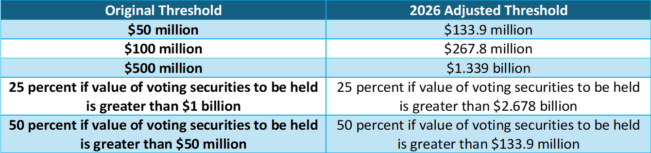
The HSR premerger notification regime requires transacting parties to notify the FTC and US Department of Justice (DOJ) of their intent to consummate a transaction that meets or exceeds certain jurisdictional thresholds, unless an exemption applies. The adjusted thresholds apply to all transactions that close on or after February 17, 2026.
The HSR thresholds are adjusted annually based on gross national product (GNP). The threshold changes are as follows:
- The base statutory size-of-transaction threshold, the lowest threshold requiring notification, will increase to $133.9 million.
- The upper statutory size-of-transaction test, requiring notification for all transactions that exceed the threshold (regardless of the size-of-person test being satisfied), will increase to $535.5 million.
- The statutory size-of-person lower and upper thresholds (which will apply to deals valued above $133.9 million but not above $535.5 million) will increase to $26.8 million and $267.8 million, respectively.
HSR notification thresholds for acquisitions of voting securities
After an HSR filing has been made, and the applicable waiting period has expired or been terminated, any additional acquisitions by the same acquiring person of the same issuer’s voting securities will be exempt from HSR notification, so long as:
- The acquiring person’s holdings crossed the notification threshold with respect to which the premerger notification was made within one year of the expiration or early termination of the HSR Act waiting period; and
- The subsequent acquisition is consummated within five years following the expiration or early termination of the HSR Act waiting period; and
- The subsequent acquisition will not meet or exceed a higher notification threshold (based on the adjusted thresholds in effect at the time of consummation).
HSR filing fee changes
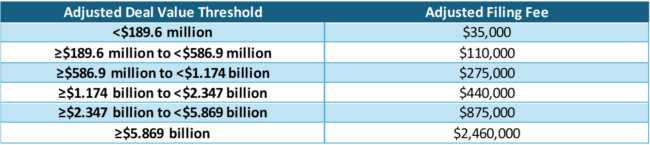
The FTC is also required to update filing fee thresholds and amounts on an annual basis. Filing fee thresholds are adjusted based on the percentage change in GNP and filing fee amounts are adjusted based on the percentage change in the Consumer Price Index. These changes will also take effect February 17, 2026.
The adjusted filing fee thresholds and fee amounts are provided in the table below.
Revised thresholds for interlocking directorates
The FTC also revised the thresholds for evaluating interlocking directorates, effective as of their date of publication in the Federal Register. Under certain circumstances, Section 8 of the Clayton Act prohibits one person from simultaneously serving as a director or officer of two competing corporations if each corporation has capital, surplus, and undivided profits aggregating more than $54,402,000.
The Clayton Act does not prohibit the interlock if (1) the competitive sales of either corporation are less than $5,440,200; (2) the competitive sales of either corporation are less than two percent of that corporation’s total sales; or (3) the competitive sales of each corporation are less than four percent of that corporation’s total sales.
Although Section 8 technically applies only to corporations, both the DOJ and the FTC have taken the position that they have the authority to enforce the same concept against non-corporate entities.





Year ahead in the UK for private fund managers
ARTICLE / CLIENT ALERT
Year ahead in the UK for private fund managers
January 15, 2025
Read time: 24 min
The private fund management sector will face unprecedented regulatory change in the UK in 2026 as new rules and regulations are introduced, which are designed to promote competition and growth, whilst supporting financial stability and maintaining an appropriate degree of investor protection. In addition, the UK government will continue its post-Brexit programme of revoking assimilated EU law and replacing it with rules (including with amendments), which will primarily be housed in the Prudential Regulation Authority Rulebook and the Financial Conduct Authority (FCA) Handbook.
Existing rules and regulations are expected to be streamlined and simplified and managers should also start to see improvements in the time it takes the FCA to respond to authorisation and registration applications. New rules will be introduced to support and facilitate the use of new technology and products (including digital assets).
Whilst the FCA has signalled that it will adopt a more proportionate approach to supervision and enforcement, managers should still expect enhanced scrutiny and engagement in relation to their governance, policies, procedures and controls, including through thematic reviews and the ongoing publication of examples of good and bad practice.
As the UK and EU governments and regulators continue to finesse the regulatory framework for their respective markets, managers will encounter growing divergence between UK and EU rules, which will have to be carefully navigated and managed (including at an IT and operational level). This will require firms to review their compliance arrangements and controls to ensure that they remain fit for purpose and compliant with regulatory requirements.
This year ahead paper highlights some of the key UK regulatory changes that are expected to apply to private fund managers during the course of 2026/early 2027, along with some commentary on regulatory changes at an EU level. The topics covered fall into the following categories: (a) authorisation, appointed representative regime, and prudential requirements; (b) fund, product, and marketing reforms; (c) digital assets regulation; (d) market reforms; (e) conduct and culture; and (f) sustainability.
Regulatory Change
Authorisation, Appointed Representative Regime and Prudential Requirements
Changes to the UK Authorisation Timings
In 2025, the Chancellor of the Exchequer announced new targets for the FCA to cut times for approving authorisations and registrations. In response, the FCA published its plan to speed up the process for approving authorisations and registrations for firms and individuals, which will apply from 2026 as follows:
- Statutory change: new firm authorisations and variations of permission (VOP) applications to be completed in four months (currently six) for complete applications, and ten months (currently twelve) for incomplete applications;
- Voluntary change: VOPs where the new permissions closely align with the firm’s existing business model: a three-month target for complete applications and six months for incomplete applications; and
- Voluntary/Statutory changes: senior manager regime (SMFs) applications: half of all applications targeted to be completed within thirty-five days, with a proposed statutory deadline of two months (currently three) for all applications.
This approach is still intended to give applicant firms sufficient time to respond to feedback from the FCA, thereby reducing the risk of outright rejection or refusal of authorisation and registration applications.
Managers should factor these new timescales into any proposed changes to their business activities and/or the appointment of new SMFs. That said, it would be prudent to prepare for the longer timescale.
UK appointed representative regime
On 11 August 2025, HM Treasury published a policy statement which proposes to introduce legislation to: (a) require authorised firms to have a specific permission from the FCA to act as a principal firm (the Principal Firm) of an appointed representative (the AR); and (b) extend the powers of the Financial Ombudsman Service to investigate the AR directly, where it has acted outside the scope of arrangements agreed with the Principal Firm.
Although existing Principal Firms are expected to be grandfathered across to the new regime, the FCA will still retain the power to revoke or vary the scope of a Principal Firm’s permissions should it have any concerns about its ability to oversee and monitor the ARs’ activities.
A manager which acts as a Principal Firm should monitor any further developments and details relating to the intended operation of the grandfathering provisions to determine whether any steps are required to be taken to retain the ability to register ARs. Equally, managers who operate as ARs should engage with their Principal Firms to ensure that they retain the necessary permissions.
UK MIFIDPRU Changes
On 15 October 2025, the FCA published its policy statement and final rules on proposed changes to the definition of capital for FCA investment firms, which will include collective portfolio management investment firms (i.e., AIFMs with MIFID top-up permissions). The new rules will apply from 1 April 2026.
The new rules: (a) clarify the types of instruments that qualify as “own funds” capital; (b) move away from an approval-based regime to a notifications-based regime for certain requirements (e.g., with respect to the treatment of verified interim profits as common equity tier 1 (CET1)); (c) provide greater clarification on the distinction between the different types of qualifying capital (i.e., CET1, additional Tier 1 and Tier 2); (d) clarify the application of the rules in the context of group treasury operations; and (e) introduce enhanced disclosure requirements for firms with non-standard capital structures (e.g., where non-CET1 instruments rank equally with CET1 instruments).
In the longer term, the FCA still intends to introduce an integrated prudential sourcebook for FCA investment firms.
Managers should: (a) consider whether any changes are required to be made to their prudential procedures and controls and make any necessary changes in advance of the 1 April 2026 deadline; and (b) continue to engage with the FCA consultation process on future changes to the prudential regulatory framework.
UK and EU Fund, Product, and Marketing Rules
UK AIFM Regulation
On 7 April 2025, HM Treasury consulted on proposed changes to the current UK alternative investment fund managers regulatory framework, which will result in the abolition of the “below-threshold registration regime”, and the FCA published a call for input on how to create a more proportionate, streamlined and simplified regime, which should reflect the size, nature and scale of the manager’s business. This is likely to be one of the most consequential changes to the UK regulatory framework in 2026.
Managers will be classified into three broad categories (i.e., large, medium and small), with larger managers being subject to more prescriptive obligations than smaller managers, and the rules will be better aligned to reflect the activities and strategy applied by the manager (e.g., a hedge fund manager would have risk limits as an integral part of its investment process, whereas a private market fund manager may not need to apply all of the risk limits contemplated in the rules).
The FCA is expected to publish a consultation paper and draft rules in the first half of 2026. These are expected to cover the following: (a) the appropriateness of the existing leverage and risk management rules, (b) the prudential capital rules; (c) regulatory reporting, (d) investor and regulatory disclosure, (e) distribution and marketing rules, (f) remuneration requirements, and (g) whether the current restriction on the activities that can be undertaken by an AIFM remains appropriate.
The FCA has indicated that it intends to retain the depository regime (at least) for larger and medium sized managers, unless market participants are able to propose appropriate alternatives during the course of the consultation process.
Whilst the consultation will be of most interest to UK AIFMs that manage UK AIFs, some of the changes will have extra-territorial application.
Managers should: (a) engage with the consultation process, including through industry bodies; (b) determine whether and how they will be classified under the proposed new regime; (c) undertake a gap analysis against the proposed new rules; (d) determine the changes that will be required to be made to the manager’s governance, policies, procedures and controls; and (e) ensure that senior management is actively engaged and informed throughout the entire consultation and implementation process.
EU AIFM
The proposed changes to the EU AIFM regime (known as AIFMD 2), which are required to be implemented in each EEA Member State by 16 April 2026, represents the first significant update to the AIFMD framework since it was introduced in 2011. AIFMD 2 includes changes to authorisation conditions, delegation, conflicts of interest, liquidity management, pre-contract and periodic disclosures, regulatory reporting, loan origination activities and controls, depositories, and provides some clarity around the conditions applicable to third-country marketing.
Some of the supplementary “level 2” technical standards and regulations will not be formally adopted until after the 16 April 2026 deadline, and it is unclear whether all EEA Member States will have incorporated AIFMD 2 into local law by that time. Accordingly, managers will need to maintain a watching brief and take note of any local nuances and variations (including any gold plating) at an individual EEA Member State level.
UK Retail Disclosure
On 8 December 2025, the FCA published a policy statement and final rules on the new retail disclosure regime that will replace the current UK packaged retail investment and insurance-based products regulations (UK PRIIPS), which required in-scope firms and products to, amongst other things, produce a key information disclosure document (known as the KID) for retail investors. This change is likely to be relevant to managers who are active in the private market space and either wish to (a) market to sophisticated retail investors who cannot be opted up to elective professional client status or (b) include certain “no retail investor” disclaimer language in their funds offering documents.
The new consumer composite investments regime (the CCIR): (a) will abolish the requirement to produce a KID under UK PRIIPS and replace it with a requirement to produce a product summary that highlights product features, costs, risks, returns, and performance information; (b) clarifies that manufacturers (e.g., fund sponsors) have the sole responsibility for providing and maintaining product summaries; (c) replaces the risk score concept with a risk and return metric with flexibility to disclose risk ratings for illiquid funds and ten-year standard deviation measures; (d) requires past performance to be disclosed using monthly data points rather than quarterly data points; and (e) introduces a new costs and charges disclosure requirement.
The CCIR will apply from 6 April 2026, with grandfathering applying until 8 June 2027.
Managers should: (a) assess the scope of the new regime; (b) determine whether any changes are required to be made to existing communications and disclosures; (c) update governance, policies, and procedures to facilitate compliance; and (d) continue to track pronouncements by the FCA on this topic.
EU Retail Disclosure
The EU has proposed changes to the existing EU PRIIPS regime pursuant to the Retail Investment Strategy (the RIS), with the final rules expected to be published in early 2026 and implemented by 2028. These reforms are expected to include: (a) adjustments to the scope of the regime; (b) revisions to the content of the KIDs, which should be provided in a machine-readable format; (c) limitations on the length of the KIDs (expected to be no more than four pages); and (e) detailed rules for multi-option products.
In the absence of the final text, it remains unclear whether these amendments, along with the other proposed changes flowing from the RIS, will contribute to the much discussed “democratisation” of private funds.
Managers should (a) await the publication of the final text to assess its impact on the fund’s distribution strategy, including whether to offer the fund to retail investors, (b) identify the steps required to ensure compliance with the new requirements.
Digital Assets Regulation
UK New Cryptoasset Framework
During 2025, the FCA published a series of consultation papers designed to introduce a comprehensive, tailored regulatory framework for firms undertaking activities relating to cryptoassets (e.g., issuing, operating a cryptoassets trading platform, dealing as principal or agent, arranging, lending and borrowing, staking, and safeguarding). The proposed rules are similar to those that apply to firms that operate in the traditional financial and capital markets space under UK Financial Services and Markets Act (with some tweaks to reflect the nature of digital assets). Further consultation papers, along with policy statements and final rules, are expected to be published during the course of 2026, with the new framework taking effect in 2027.
The authorisation gateway for those undertaking regulated cryptoasset activities is expected to be open during 2026 in order to provide firms with sufficient time to obtain the relevant authorisations.
Managers should: (a) engage with the consultation process, including through industry bodies; (b) assess whether they are required to apply for authorisation or a variation of permissions to conduct any new regulated cryptoasset activities; (c) take steps to prepare for the new rules, which will cover, amongst other things, regulatory capital, operational resilience, conduct (e.g., client classification, best execution, order handling), conflicts of interest, valuations, liquidity and volatility risk, market abuse, reporting, and record keeping; and (d) ensure that senior management have been properly briefed and informed.
Managers should also note that funds that have control or subsequently obtain control of FCA-authorised cryptoasset firms may be required to obtain a change-in-control approval from the FCA.
UK Fund Tokenisation
On 14 October 2025, the FCA published a consultation paper which sets out key proposals and guidelines on how the FCA intends to support the adoption of fund tokenisation and includes a roadmap for future regulatory developments in this space.
For these purposes, the FCA notes that: (a) tokenisation refers to the representation of an asset, or ownership of an asset, by recording it on distributed ledger technology (DLT); and (b) DLT is a digital system that records details of transactions in multiple locations at the same time, rather than on a centralised database.
The proposals confirm the possibility of operating a tokenised fund register under the existing legal framework, introducing an optional direct fund dealing model (so investors can deal directly with the fund); the use of tokenised funds as collateral; and a discussion on future tokenisation models and uses, including how regulation may need to change to support such efforts. The FCA is expected to publish a policy statement and final rules in the first half of 2026.
Whilst the consultation is primarily addressed to UK authorised funds, it may still be of interest to other funds.
Managers should consider whether and how a future tokenisation framework may impact their processes, procedures and compliance arrangements and continue to maintain a watching brief on further FCA consultations on this topic.
EU MICA
The EU implemented a comprehensive regime for the regulation of cryptoassets in 2024, known as the Markets in Crypto-Assets Regulation (known as MICA). This included an authorisation and passporting regime for cryptoasset service providers (e.g., trading platforms, exchange services, placement, reception and transmission of orders, portfolio management, custody, and transfer services), rules governing the issuance of asset-referenced tokens, and electronic money tokens, and the offering and trading in cryptoassets, alongside consumer protection rules and measures to prevent market abuse.
MICA includes grandfathering provisions which permit firms that provided cryptoasset services prior to 30 December 2024 (in accordance with local law) to continue to do so until 1 July 2026 or until they are granted or refused MICA authorisation.
Please see our previous client briefing on EU MICA.
Market Reforms
UK Short Selling
On 28 October 2025, the FCA published a consultation paper setting out proposed changes to the UK short selling regime, which are designed to “reduce unnecessary and disproportionate costs which may inhibit or discourage short selling activity”, whilst maintaining transparency of short selling activities in the UK market. The consultation closed on 16 December 2025. The FCA is expected to publish a policy statement and final rules during the course of 2026.
Managers should: (a) review and update their internal reporting processes to reflect the shares listed or removed from the FCA list, any new data requirements, the waiver provisions, and the extended reporting deadline; (b) update their procedures to reflect the new FCA reporting system, notification documents, and reporting forms; (c) make changes to “cover arrangements” to ensure compliance; (d) ensure that appropriate records are maintained of cover arrangements for at least five years; (e) continue to engage with the consultation process, including through industry bodies; (f) ensure that senior management are properly briefed and engaged; (g) prepare and apply for exemptions; and (h) engage with guidance that the FCA will publish, including in relation to group reporting, and make adjustments to ensure compliance.
Please see our previous client briefing for further details.
UK EMIR
The government has indicated that it intends to prioritise its review of the existing counterparty requirements in UK EMIR (e.g., risk mitigation, reporting and clearing). Proposed amendments are expected to be consulted on in Q1 2026.
In addition, on 5 November 2025, the government published a draft statutory instrument, which included provisions to make the intragroup exemptions for margin and clearing requirements permanent, and remove the link to equivalence decisions by replacing it with a requirement to notify the FCA of the intention to rely on the exemption (thirty-days prior notice will be required). Technical comments are due by 16 January 2026, and the new regime is intended to take effect by the end of 2026.
Managers should: (a) assess whether they or the funds that they manage currently rely on an intragroup exemption; (b) determine whether and notifications will be required to be made to the FCA; and (c) maintain a watching brief on FCA developments in this space.
UK MIFID
Changes flowing from the UK wholesale markets review will start to take effect during the course of 2026, including: (a) changes to certain transparency requirements; (b) the commencement of operations by consolidated tape providers (CTP); and (c) changes to the ancillary activities exemption (this exemption is of primary relevance to unregulated firms who trade in commodity derivatives and emission allowances). In addition, the FCA is expected to finalise its proposed changes to the transaction reporting regime during the course of 2026.
Managers should: (a) consider whether and how the changes will impact their trading activities; (b) consider what changes are required to be made to existing procedures (including any IT and operational implementation changes); (c) consider whether and how to use CTP data, including making arrangements to facilitate connection; and (d) ensure that senior managers are briefed and engaged.
EU EMIR
The changes to the EU EMIR framework will take effect in 2026, including: (a) the controversial active account regime; (b) changes to the clearing thresholds; (c) changes to margin transparency for cleared derivatives; and (d) margin requirements, with the publication of various “level 2” technical and delegated standards.
Managers should: (a) consider whether and how the changes will impact their trading activities; (b) consider what changes are required to be made to existing procedures (including any IT and operational implementation changes); (c) consider whether and how to use CTP data, including making arrangements to facilitate connection; and (d) ensure that all internal stakeholders are briefed and engaged.
Please see our previous client briefing for further details.
EU Securitisation Regulation
On 17 June 2025, the European Commission proposed various changes to the EU securitisation framework, including in relation to the due diligence requirements (e.g., by clarifying that investors will not be required to verify compliance with risk retention or reporting requirements or to check whether the STS criteria have been satisfied). The trialogue negotiations are ongoing and are not expected to conclude until 2027.
Managers should maintain a watching brief to understand the impact, if any, on their structures and activities. Please see our recent client briefings on the proposed changes to the EU securitisation regime and their impact on significant risk transfer (SRT) transactions.
Conduct and culture
UK FCA Conduct Reviews
In 2025, the FCA undertook a series of multi-firm reviews of firms’ practices and procedures in a range of areas, including private market valuations, conflicts of interest, financial advice, off-channel communications and consolidation, leading to the publication of good and bad practice guidance (the Guidance). Further reviews are expected to be undertaken by the FCA in 2026, and firms may be required to demonstrate how they have reflected the Guidance in their policies, procedures, and controls.
Managers should: (a) continue to review governance and control procedures and assess how they are operating in practice; (b) assess the adequacy of management information; (c) ensure risks are properly identified and mitigated; (d) expect enhanced engagement from the regulator; and (e) ensure that the senior management are properly briefed and engaged.
UK Senior Managers and Certification Regime and Non-Financial Misconduct
On 15 July 2025, the FCA consulted on proposed changes to the Senior Managers and Certification Regime (SMCR) as part of the first phase of changes. This included:
- Changing the twelve-week rule to give firms more time to submit applications for approving new senior managers (SMFs) when there has been an unexpected or temporary change (i.e., the twelve-week rule clock will start ticking from the date of submission of the SMF application to the FCA rather than the date of approval of the SMF application by the FCA). However, the FCA has emphasised that the twelve-week rule does not apply when a SMF’s departure is reasonably foreseen and that firms should have effective succession plans in place. In other words, reliance on the twelve-week rule should be the exception rather than the rule;
- Giving firms more time to report updates to any statement of responsibilities for SMFs;
- Increasing the validity period for criminal record checks for SMFs from three months to six months;
- Providing guidance on the definition of certain SMFs roles;
- Removing duplicate certification requirements for employees who are certified to undertake multiple certified functions;
- Providing guidance on how firms can streamline the annual fitness and propriety assessment;
- Giving firms more time to update the FCA directory that is maintained for certified individuals; and
- Issuing guidance, including in relation to on the allocation of prescribed responsibilities for SMFs, by emphasising that they can only be split where justified, the application of the Conduct Rules, and related regulatory reporting and reference requirements.
Under phase 2, legislation is expected to be published to permit more material changes to be made by the FCA under the SMCR, including the abolition of the certification regime, a reduction in SMF roles, and a relaxation of the SORs.
From 1 September 2026, non-financial misconduct (e.g., bullying, harassment, or violence) will be treated as a conduct issue for SMCR firms, and firms will be required to factor this into the annual fitness and propriety assessment for SMFs and certified individuals.
Managers should: (a) review the proposals to assess the impact; (b) update policies and procedures, including any internal disclosure requirements; (c) ensure that records are retained and audit trails remain robust; (d) provide training, when necessary; (e) ensure that senior management are briefed and actively engaged; and (f) maintain a watching brief on the changes in this space.
UK Enforcement
In 2025, the FCA updated its approach to supervision and enforcement by moving to one that is more data-driven, targeted, and measured focussing on high-risk areas such as financial fraud, anti-money laundering, and market abuse. That said, the fines imposed were significantly higher, and there was an increase in fines imposed on individuals. This trend is set to continue in 2026.
Managers should note that some of the key issues arising out of recent enforcement action have emphasised: (a) poor governance and oversight arrangements; (b) the failure to escalate issues and concerns to the appropriate level within the firm; (c) inadequate resources, including personnel and IT; (d) poor management information and data; and (e) ineffective policies, procedures, and controls (i.e., paper policies which have not been properly embedded). In addition, the FCA has emphasised that as firms grow in size and scale, they must ensure that their controls keep pace with such developments, and remain appropriate.
Recent Market Watch publications have emphasised the need for firms to improve oversight of market abuse surveillance and to more promptly implement remediation measures where breaches or issues have been identified.
In relation to AML, the FCA pointed to failures to properly implement effective procedures to undertake risk assessments, customer due diligence, transaction monitoring, and update risk assessments.
Managers should: (a) review existing financial crime policies, procedures and controls against regulations, as well as FCA expectations (including any lessons learnt from recent FCA enforcement action); (b) expect enhanced scrutiny from the FCA and ensure that they can evidence steps taken to manage and mitigate the risk of their business being used to further financial crime (including new threats); (c) ensure that senior management is appropriately briefed and actively engaged; and (d) stay abreast of developments in this space, including tracking FCA statements and pronouncements.
UK Client Classification Changes
On 8 December 2025, the FCA published a consultation paper on proposed changes to the client categorisation regime, which included replacing the current quantitative elective professional client test with a new test that will require: (a) a client to have net investable assets in excess of £10 million; or (b) the firm to confirm that the client has the requisite expertise, experience and knowledge to make their own investments decisions, and understand the risks involved, taking account of certain relevant factors (e.g., occupation, investment history, financial resilience, knowledge and understanding of risks, and objectives).
Importantly, firms will be required to exercise discretion and make judgement calls, and they will no longer be able to rely solely on client self-assessment/certifications. Firms will also be required to consider the impact of any adverse information, such as: (i) vulnerability, (ii) inconsistent or implausible information, (iii) responses that suggest a lack of knowledge and expertise, and (iv) historic trading settlement issues. In addition, the client must still request to be treated as an elective professional client (although firms can still bring this to their attention, where appropriate and without applying any pressure on the client to “opt-up”), and the firm must obtain informed consent (i.e., a signature) from the client in order to give effect to the opt-up.
Any decisions around client categorisation will have to be properly documented and evidence retained. Managers will be required to reassess all existing elective professional clients within a year of the new rules coming into effect, ensuring compliance with the updated criteria.
Additionally, the FCA is also simplifying and clarifying the per-se professional client test by making it clearer that any entity authorised or regulated in the UK, or a third country, to operate in the financial markets can be treated as a per se professional client, without firms needing to identify the specific sub-category that the client falls into (i.e., whether it is in the banking, investment firm, insurance sector etc).
The consultation closes on 2 February 2026.
Managers should: (a) engage with the consultation process; (b) review their client categorisation procedures to determine what changes will be required to be made once the rules are finalised; (c) consider what communications will be required to be made to existing and new clients, including any repapering exercise; and (d) ensure that senior management are briefed and engaged.
EU Client Categorisation Changes
The elective professional client test is also being recalibrated as part of the RIS. Under the proposed amendments, a client will qualify as an elective professional client where two out of the following three criteria have been met:
- The client has carried out either 15 significant transactions over the last three years, 30 transactions over the previous year, or 10 transactions over EUR 30,000 in unlisted companies in the past five years;
- The size of the client’s investment portfolio exceeds EUR 250,000;
- The client has worked and carried out related activities in the financial sector for at least one year or can provide proof of education or training in these activities and has the ability to evaluate risk.
Whilst the proposed changes are an improvement on the existing elective professional client test, they do not go far enough, are less flexible than the proposed UK changes, and raise more questions than they answer.
Managers should: (a) maintain a watching brief; (b) review their client categorisation procedures to determine what changes will be required to be made once the rules are finalised; (c) consider what communications will be required to be made to existing and new clients, including any repapering exercise; and (d) ensure that senior management are briefed.
Sustainability for asset managers
UK Progress Report
During 2025, in scope managers continued to embed the requirements in the FCA Sustainability Disclosure Requirements (SDR) into their processes, disclosures and reporting systems. On the basis of feedback from market participants regarding the challenges of complying with the label requirements in the SDR, the proposed extension of the SDR to portfolio managers and overseas funds appears to have been put on hold for now. That said, the expectation is that both HM Treasury and the FCA will provide further updates on its plans to amend and extend the SDR during 2026.
The FCA has indicated that it will consider amending the entity-level disclosure requirements in the SDR to reflect the UK Sustainability Reporting Standards (the SRS), which is currently being developed by the UK Government and the Transition Plan Taskforce Disclosure Framework. It may provide an update on progress in 2026 or early 2027.
Whilst the SDR is primarily directed at UK managers and UK funds (especially retail funds), some of the requirements have broader application, private fund managers should keep abreast of any future plans to expand the application of the regime.
EU Progress Report
The EU has proposed a significant overhaul of the EU SFDR, with the existing article 6, 8 and 9 framework set to be replaced by a new labelling regime, and the removal of certain product- and entity-level disclosure and reporting requirements. The negotiations to finalise the new regime will continue during 2026, which will give market participants the opportunity to provide input.
Please see our previous client briefing on the proposed changes to the EU SFDR.
Managers should: (a) maintain a watching brief on both UK and EU sustainability reforms, (b) actively engage with any upcoming consultation, and (c) assess the impact of such changes of their procedures and fund documentation and processes.
If you have any questions in relation to the issues raised in this client briefing, please do not hesitate to contact us.


FSR Guidelines 2026 | “Safe harbours” for call ins: Comfort, not a free pass
ARTICLE / CLIENT ALERT
FSR Guidelines 2026 | “Safe harbours” for call ins: Comfort, not a free pass
January 14, 2026
Read time: 7 min
The final FSR Guidelines, adopted on January 9, 2026, do not expand the Commission’s legal powers under the Foreign Subsidies Regulation (Regulation (EU) 2022/2560). What they do offer is a more calibrated, and more operational, statement of enforcement intent, particularly around when the Commission may require prior notification of otherwise non notifiable deals or tenders.
Why the call in mechanism matters
The call in power is one of the FSR’s most strategically important features because it allows the Commission to request a filing even where the transaction or procurement falls below the formal notification thresholds which in concentrations takes effect “at any time prior to implementation,” and in procurement, “before the award of the contract.”
In practice, that means the call in tool can introduce timing and deal certainty risk into situations that parties might otherwise have treated as “out of scope.” It is also, by design, a tool that is hard to fully “rule out” in the abstract, because the Guidelines explicitly confirm the Commission has a margin of discretion in deciding whether to exercise it when the legal conditions are met.
Two practical “comfort points” that reduce noise
Against that background, the most eye catching development in the final Guidelines is the addition of two practical comfort points that function as de facto safe harbors for the call in mechanism.
1) The €4 million de minimis (in effect, a call in backstop)
The Guidelines state the Commission will not request prior notification where it can determine with sufficient certainty (without a filing) that the aggregate suspected foreign subsidies in the relevant three year period do not exceed €4 million, or where they meet the conditions for subsidies that are “unlikely to distort” under Article 4(4).
This matters in two ways:
- It signals that below threshold suspected subsidies should not be pulled into an ex ante review via call in if the Commission is satisfied with the fact set
- It places a premium on credible, well documented internal mapping of foreign financial contributions (FFCs) and an ability to explain why the risk sits below that de minimis line.
2) A low value procurement indicator (linked to EU procurement directive thresholds)
For public procurement, the Commission holds that bids in procedures with an estimated value below the EU procurement directive thresholds are unlikely to have the level of “impact in the Union” that would merit an ex ante call in. The practical implication: routine, smaller tenders should be less likely to attract call in attention, helpful for contracting authorities and bidders who have been worried about the risk of an FSR “surprise” on relatively low value procedures.
Is this a “softening” from the Commission?
Importantly, nothing in the Regulation changes, but it is a softening in tone and enforcement position.
The Guidelines frame “impact in the Union” as an exercise in balancing effective protection of the internal market with the need to minimise administrative burden.
Read in context, the message is that the Commission wants to reserve call ins for matters that look material; meaningful EU impact plus a credible basis to suspect subsidies that could distort competition. Put differently, the Commission is trying to reduce the fear of “random” call ins, but without giving away the tool.
Why the safe harbors are not a free pass
It’s important not to over read the safe harbors. First, the €4 million point is conditional on what the Commission can determine with sufficient certainty without a notification.
That is a subtle but critical drafting choice. It means the “safe harbor” is not something companies can simply self certify into. If the Commission lacks reliable information, the comfort point may not bite.
Second, the Commission goes out of its way to preserve flexibility by spelling out that it can’t commit to a hard timing cut off in procurement call ins. It says it will endeavor to limit interference by taking account of how close the award date is, but also states it is unable to set a specific time limit.
That keeps some residual uncertainty for below threshold tenders, especially where the Commission only learns of a case late in the process.
Third, the Guidelines list a series of risk factors that can still justify a call in even where a case is below thresholds. In assessing whether a case merits ex ante review, the Commission highlights, among other things:
- Strategic or important sectors / assets, including critical infrastructure and innovative technologies
- Patterns of acquisitions, investments, or procurement participation that build influence or economic presence over time
- The fact that the Commission has previously adopted an FSR decision (or opened an in depth investigation) involving the same or related undertakings; and
- Other contextual indicators suggesting a distortion, including potential subsidies of the type “most likely to distort.”
This is where the “operational” feel of the final Guidelines comes through. There is more detail on how the Commission may think about case selection, while still retaining a wide enforcement perimeter.
A notable openness to third party input
One of the most practically significant (and, for many businesses, most consequential) passages is the explicit encouragement of market intelligence flowing to the Commission.
The Guidelines state that “Member States … and any natural or legal persons … may contact the Commission services” with information about a potentially distortive foreign subsidy.
The text is particularly pointed in procurement. Contracting authorities and competitors are expressly flagged as potential informants, and the Commission indicates it may rely on that information as a basis to request prior notification, subject to verifying accuracy and plausibility.
For companies, this is a reminder that call in risk is not only a question of what the Commission can see publicly. It is also about what rivals, customers and contracting authorities may choose to put on the Commission’s radar.
What should companies do now?
If you are advising on M&A or procurement involving parties with material non EU funding links, the Guidelines reinforce a few practical steps:
- Tighten your FFC fact gathering early. The safer you want to feel on the €4 million point, the more you need credible internal information that can be explained succinctly
- Pressure test “impact in the Union” beyond turnover. The Commission explicitly notes that apparent significance may not be captured by turnover alone, especially for strategic assets or future facing capabilities
- Assume competitors may engage. Build an external narrative that anticipates questions about subsidy linked advantages, particularly in strategic sectors or repeat procurement contexts.
- In procurement, manage timing risk. The absence of a bright line time limit means bidders and authorities should keep a contingency plan for last minute information requests or potential call in dynamics.
Bottom line
Compared with the consultation draft (and without attempting a line by line comparison), the final Guidelines read as more implementation minded. The Commission keeps its broad discretion, but introduces clearer guardrails that should improve predictability for stakeholders, especially through the €4 million de minimis comfort and the low value procurement indicator. At the same time, the Commission is careful to preserve a potent call in tool for strategically sensitive cases and it openly invites information from the market that can trigger scrutiny. In other words, comfort, not immunity.




New employment law trend: Restrictions on stay-or-pay provisions in employment agreements
ARTICLE / CLIENT ALERT
New employment law trend: Restrictions on stay-or-pay provisions in employment agreements
January 13, 2026
Read time: 5 min
California and New York recently enacted legislation aimed at prohibiting certain contract terms that impose financial obligations on workers if their work relationship terminates. Subject to limited exceptions, both New York’s “Trapped at Work Act,” effective December 19, 2025, and California’s Assembly Bill 692, effective January 1, 2026, prohibit contract terms commonly known as “stay-or-pay” provisions or training repayment agreement provisions (TRAPs). Such prohibited clauses will be considered void and against public policy as they restrain a person from engaging in a lawful profession, trade, or business.
These newly enacted laws, along with similar laws in states like Colorado, reflect a growing trend to limit contractual barriers to job changes and promote greater employee mobility in the labor market.
California’s Assembly Bill 692
Background
While the restrictions imposed by AB 692 do not impact contracts entered into before January 1, 2026, for contracts entered into on or after January 1, 2026, it is unlawful to include, or require a worker (which includes, but is not limited to, an employee or prospective employee) to execute, a contract term that:
- Requires the worker to repay the employer, trainer, or debt collector if they leave the job.
- Authorizes the employer, training provider, or debt collector to resume or initiate collecting previously accrued debts after the worker’s departure.
- Imposes any penalty, fee, or cost if the work relationship ends, regardless of which party initiates the termination.
That said, the law contains specific exceptions in limited circumstances, including:
- A contract entered into under a loan repayment or loan forgiveness program.
- A contract related to tuition repayment for a transferable credential, so long as it meets specific requirements.
- A contract for enrollment in an apprenticeship program.
- A contract involving a discretionary payment, if the payment is not tied to specific job performance and the following conditions are met:
- The terms are provided in a separate agreement.
- The employee is informed of their right to consult an attorney and given at least five business days to do so.
- The repayment obligation does not accrue interest and is prorated based on the remaining term, which cannot exceed two years from the date the payment is received.
- The employee has the option to defer receipt of the payment until the retention period is completed.
- Repayment is only required if the employee voluntarily resigns or is terminated for misconduct.
- A contract related to the lease, financing, or purchase of residential property.
Employer exposure
Employees may bring a civil action on behalf of themselves and “other persons similarly situated,” under Business and Professions Code section 16600 for contracts that violate the new law. If found liable, employers must pay either the actual damages suffered by the employee(s) or $5,000 per employee, whichever is greater. Employees may also pursue injunctive relief and recover reasonable attorneys’ fees and costs.
New York’s Trapped at Work Act
The New York Trapped at Work Act (the Act), bans “employment promissory notes,” defined as contract provisions requiring the worker to pay the employer a sum of money if the worker leaves, as well as contracts for repayment of training provided by the employer. Notably, the definition of “worker” under the Act expressly includes independent contractors, externs, interns, and volunteers. However, there remains an open question whether the law will apply retroactively to agreements signed before the effective date of December 19, 2025. That said, like California’s law, the Act contains specific exceptions in limited circumstances, including:
- A contract that requires the worker to repay any sum advanced by the employer that is unrelated to training.
- A contract requiring repayment for property that the employer has leased or sold to the worker.
- A contract requiring the worker to comply with the terms or conditions of sabbatical leave for educational employees.
- A contract entered into as part of a program agreed to by the worker’s collective bargaining representative.
Employer exposure
Employers can face fines by New York’s labor commissioner of at least $1,000, but no more than $5,000 for each violation, as well as attorneys’ fees. However, currently, workers are not permitted to bring a private right of action.
Next steps
While these new laws do not categorically ban all stay-or-pay contracts, employers should be thoughtful to structure these programs in a way that maximizes their effectiveness while remaining compliant. Employers should act now to review and update existing programs that require repayment and consult legal counsel, especially when it comes to training and education repayment and discretionary incentive programs. Importantly, employers should ensure that agreements comply with any particular statutory framework – for workers in California, for example, creating standalone agreements and providing workers with sufficient time to review and consult with counsel.
It is also important for employers to closely monitor how case law develops around these laws, as judicial interpretation may clarify the scope and enforceability of these programs.
Employers that conduct business across the country should also closely monitor state legislation relating to stay or pay contracts, as at least two other states – Minnesota and Ohio – have contemplated similar laws, but the bills have not yet been passed. These laws appear to be part of a growing trend, and employers should anticipate that other states will soon follow suit.





IRS roundup: December 12, 2025 – January 12, 2026
ARTICLE
IRS roundup: December 12, 2025 – January 12, 2026
Jan 13, 2026
Read time: 6 min
Check out our summary of significant Internal Revenue Service (IRS) guidance and relevant tax matters for December 12, 2025 – January 12, 2026.
December 12, 2025: The IRS issued Treasury Decision 10042, which modified and clarified the Internal Revenue Code (Code) Section 892 rules. The Treasury Decision contains final regulations regarding the taxation of income earned by foreign governments from investments in the United States. The regulations clarify how to determine when a foreign government is engaged in commercial activity and when an entity qualifies as a controlled commercial entity. These rules apply to foreign governments that earn income from US sources.
December 12, 2025: The IRS issued proposed regulations, which provided additional guidance under Section 892 and focus on:
- Determining when an acquisition of debt by a foreign government is treated as a commercial activity
- Determining when a foreign government has effective control of an entity engaged in a commercial activity
- Clarifying that partnerships, including partnerships wholly owned by a single foreign sovereign, are not controlled entities under Section 892 for US tax purposes.
December 15, 2025: The IRS issued proposed regulations, updating points of contact within the US Department of Justice (DOJ) and the IRS to identify points of contact for matters involving internal revenue laws following a reorganization within the DOJ. The regulations would also update points of contact at the IRS for taxpayers submitting administrative claims for civil damages related to certain unauthorized collection actions or awards of administrative costs in specified administrative proceedings.
December 15, 2025: The IRS withdrew two notices of proposed rulemaking regarding innocent spouse relief.
December 22, 2025: The IRS issued proposed updates, which set forth a clearer, more predictable system for its Voluntary Disclosure Practice and a more streamlined penalty framework. The IRS seeks public comment on the proposed updates by March 22, 2026.
December 29, 2025: The IRS released Internal Revenue Bulletin 2026-1, which includes the following:
- Revenue Procedure 2026-1, which contains the revised procedures for letter rulings and information letters issued by the different associate chief counsel offices. This revenue procedure also contains the revised procedures for determination letters issued by the Large Business and International Division, the Small Business/Self-Employed Division, the Wage and Investment Division, and the Tax Exempt & Government Entities (TE/GE) Division.
- Revenue Procedure 2026-2, which explains when and how associate chief counsel offices should provide advice in technical advice memoranda (TAM) as well as taxpayers’ rights when a field office requests a TAM.
- Revenue Procedure 2026-3, which provides a revised list of Code areas under the jurisdiction of the following associate chief counsel offices:
- Corporate
- Financial Institutions and Products
- Income Tax and Accounting
- Passthroughs and Special Industries
- Procedure and Administration
- Energy, Credits, and Excise Tax
- Employee Benefits, Exempt Organizations, and Employment Taxes.
These relate to matters in which the IRS will not issue letter rulings or determination letters.
- Revenue Procedure 2026-4, which provides guidance on the types of advice the IRS offers to taxpayers on issues under the jurisdiction of the IRS Commissioner, TE/GE Division, and Employee Plans Rulings and Agreements. It also details the procedures that apply to requests for determination letters and private letter rulings.
- Revenue Procedure 2026-5, which provides the procedures for issuing determination letters on issues under the jurisdiction of the Exempt Organizations Rulings and Agreements. It also explains the procedures for issuing determination letters on tax-exempt statuses for organizations applying under Code Section 501 or 521, private foundation status, and other determinations related to tax-exempt organizations. The revenue procedure applies to revocation or modification of determination letters and provides guidance on the exhaustion of administrative remedies for purposes of declaratory judgment under Code Section 7428.
December 29, 2025: The IRS released Notice 2026-10, which sets the optional 2026 standard mileage rates for calculating deductible automobile expenses for business, charitable, medical, and moving purposes effective January 1, 2026. The notice also updates the basis reduction amounts for depreciation, the maximum standard automobile cost for fixed and variable rate plans, and the maximum fair market value of employer-provided vehicles for applying the fleet-average valuation rule or the cents-per-mile valuation rule.
January 5, 2026: The IRS released Internal Revenue Bulletin 2026-2, which includes the following:
- Revenue Procedure 2026-6, which provides the procedure for a state to make an election to be a “covered state” before identifying scholarship granting organizations in accordance with Code Section 25F(g), as added by the One Big Beautiful Bill Act (OBBBA). This election is a prerequisite for states participating in the new scholarship credit program.
- Revenue Procedure 2026-7, which provides the areas under the jurisdiction of the associate chief counsel (international) in which letter rulings and determination letters will not be issued.
- Revenue Ruling 2026-1, which provides tables of covered compensation under Section 401(l)(5)(E) for qualified pension, profit-sharing, and stock bonus plans effective January 1, 2026.
- Notice 2026-2, which provides updates on the corporate bond monthly yield curve, the corresponding spot segment rates for November 2025 used under § 417(e)(3)(D), the 24-month average segment rates applicable for December 2025, and the 30-year Treasury rates, as reflected by the application of § 430(h)(2)(C)(iv).
- Notice 2026-3, which offers relief from additions to tax under Sections 6654 and 6655 for underpayment of estimated income tax. This guidance implements Section 70437 of the OBBBA, which introduces a new limited payment deferral election in Section 1062(a). The election applies to sales or exchanges of qualified farmland property to a qualified farmer. Under the notice, the IRS will waive a portion of the addition to tax under Sections 6654 and 6655 for transactions where a Section 1062 election is properly made. The amount of relief corresponds to the amount of tax deferred under the election.
- Notice 2026-5, which provides guidance on changes that generally expand the availability of health savings accounts as enacted by the OBBBA. The notice also answers common questions surrounding these changes.
- Notice 2026-6, which extends the transition period set out in Revenue Ruling 2025-4 by one additional year to calendar year 2026 for states that administer paid family and medical leave programs and participating employers. The notice gives states and employers additional time to make the necessary changes to their systems to comply with the tax and information reporting obligations set forth in Revenue Ruling 2025-4.
January 7, 2026: The IRS released Revenue Procedure 2026-10, which establishes a formal framework for passive foreign investment company shareholders to request private letter rulings for retroactive qualified electing fund elections. The guidance introduces structured eligibility criteria, documentation requirements, and user-fee rules to simplify and standardize the relief process.
January 7, 2026: The IRS released Announcement 2026-2, clarifying that the tax rate under Section 4611 for 2026 includes only the 18 cents per barrel Superfund financing tax. The “oil spill tax” (OST), which was 9 cents per barrel, expired on December 31, 2025, and will not apply to calendar year 2026 unless Section 4611(f)(2) is amended to extend the OST.
January 8, 2026: The IRS issued proposed regulations, which reflect changes from the OBBBA covering the regulations governing backup withholding. These changes affect third-party settlement organizations that make payments in settlements of third-party network transactions.
The IRS also released its weekly list of written determinations (e.g., Private Letter Rulings, Technical Advice Memorandums, and Chief Counsel Advice).




What’s up, 2026? – ESMA says Finfluencers
ARTICLE
What’s up, 2026? – ESMA says Finfluencers
January 8, 2026
Read time: 2 min
Annabelle Rau and Dr. Cornelius Hille analyze ESMA’s new Finfluencer factsheet and the growing regulatory focus on financial influencers, highlighting what the developments signal for financial regulation and investor protection in 2026.

Trending in Telehealth: December 2025
ARTICLE
Trending in Telehealth: December 2025
Jan 9, 2026
Read time: 4 min
Trending in Telehealth highlights monthly state legislative and regulatory developments that impact healthcare providers, telehealth and digital health companies, pharmacists, and technology companies that deliver and facilitate the delivery of virtual care.
Trending in December:
- Medicaid reimbursement policies
- Telehealth practice standards
- Behavioral health integration
A CLOSER LOOK
Proposed legislation & rulemaking:
- A proposed rule in Iowa would establish guidelines for the provision and reimbursement of certain services under Iowa Medicaid. This regulation would provide that in-person contact between a healthcare professional and a patient is not required as a condition for payment of otherwise covered services.
- The Wisconsin Physical Therapy Examining Board proposed amendments to define “telehealth” and remove an onsite requirement for patient assessments and reevaluations, allowing these tasks to be performed via telehealth under specified conditions. “Telehealth” would be defined as the practice of healthcare delivery, diagnosis, consultation, treatment, or transfer of medically relevant data by means of audio, video, or data communications that are used either during a patient visit or a consultation, or are used to transfer medically relevant data about a patient. “Telehealth” would include asynchronous telehealth services, interactive telehealth, and remote patient monitoring.
Finalized legislation & rulemaking activity:
- The Delaware Board of Pharmacy temporarily renewed emergency regulatory amendments permitting out-of-state pharmacists to practice in Delaware following widespread pharmacy closures. The renewal expired on December 31, 2025, and no subsequent renewal has been issued..
- The December 2025 Michigan Register published updated certificate of need review standards for psychiatric beds and services. Michigan’s certificate of need standards use a point system to evaluate applications, requiring applicants to meet a minimum threshold for approval. Projects receive three points if the applicant has or proposes a telehealth or telemedicine program to support inpatient psychiatric admissions or assist with diagnosis, treatment, or other inpatient services necessary for admission or retention.
- New York passed S4914B, which expands protections for people who provide or receive legally protected health activities, including reproductive and gender-affirming care, against out-of-state legal actions. Amendments include a revised definition of “reproductive healthcare” to include all medical, surgical, psychiatric, therapeutic, diagnostic, mental health, behavioral health, preventative, rehabilitative, supportive, consultative, referral, prescribing, or dispensing services relating to the reproductive system provided via telehealth.
- Ohio adopted a rule that allows individual pharmacists enrolled in Medicaid to receive payment for covered telehealth services.
- Oregon finalized its durable medical equipment, prosthetics, orthotics, and supplies (DMEPOS) face-to-face encounter requirements rule. Telehealth encounters used to satisfy the face-to-face encounter requirement for a DMEPOS item must meet the requirements outlined in the prioritized list of health services, telehealth, teleconsultations, and online/telephonic services ancillary guideline.
- The US Drug Enforcement Administration (DEA) extended pandemic-era flexibilities for prescribing controlled substances online for one year, through December 31, 2026. The DEA and the US Department of Health and Human Services also announced two rules effective December 31, 2025:
- Practitioners in the US Department of Veterans Affairs may prescribe controlled substances via telemedicine without an in-person evaluation (RIN 1117-AB40).
- Civilian doctors may prescribe up to a six-month supply of buprenorphine for opioid use disorder via audio-only consultation (RIN 1117-AB78).
Why it matters:
- States are broadening telehealth standards. States are redefining telehealth practice definitions and expanding their scope to include asynchronous services, remote monitoring, and audio-only consultations. Providers should review these nuances to ensure services are covered consistent with payor standards.
- Access and equity are driving policy shifts. By removing in-person requirements and enabling out-of-state practitioners, regulators are addressing care gaps, especially in behavioral health and pharmacy, while maintaining guardrails for patient safety and data security.
- Payment models are evolving alongside technology. Medicaid and other programs are increasingly reimbursing telehealth services, including pharmacy services and durable medical equipment. Organizations that align with these changes can unlock new revenue streams and improve patient engagement.
Telehealth is an important development in care delivery, but the regulatory patchwork is complicated. The McDermott Will & Schulte digital health team works alongside the industry’s leading providers, payors, and technology innovators to help them enter new markets, break down barriers to delivering accessible care, and mitigate enforcement risk through proactive compliance.