














CLIENT ALERT / US POLICY
June 12, 2026
Read time: 9 min

On May 29, 2026, the Office of Management and Budget (OMB), in coordination with other agencies and departments, proposed sweeping changes to the Guidance for Federal Financial Assistance, namely the regulations found at 2 CFR Part 200, commonly referred to as the Uniform Guidance. The proposed rule implements many of the adjustments called for by Executive Order (EO) 14332, Improving Oversight of Federal Grantmaking, including a pre-issuance review from political appointees, and the prohibitions set forth in the series of EOs on diversity, equity, and inclusion (DEI) and gender ideology issued in 2025 and 2026. The proposed rule goes further, however, proposing the elimination of all fixed-price awards and subawards and to elevate the Uniform Guidance from guidance to regulation such that any future notice and comment rulemaking by OMB will have automatic application to Federal grantmaking agencies on the date of OMB’s final rule.
The proposed rule has an established 45-day comment period, with public comments due July 13, 2026. OMB seeks a final rule effective date of October 1, 2026, to be implemented in all new awards and amendments in 2027.
The impact of the proposed rule on grants and other forms of Federal financial assistance will be significant. The proposed rule affects not only the review and approval process, inserting additional review from political appointees before the award of any grant, but also provides Federal agencies with significant discretionary authority to terminate a grant at any time. The proposed rule, which spans more than 400 pages, contains other particularly notable provisions, which we cover in detail below.
Implementing executive orders
As we outlined in our previous alert, EO 14332 directed OMB to revise the Uniform Guidance to provide for termination for convenience and to provide senior appointees to review and approve all new grant awards. As directed, OMB has incorporated both of these directives into the proposed rule.
Termination of grants
The proposed rule amends 2 C.F.R. § 200.340, Termination and Suspension, to provide Federal agencies the allowance to terminate a Federal award at its discretion, including “if a Federal award does not effectuate program goals, Federal agency priorities, or the national interest as they exist at the time of termination.” In a response to the multitude of lawsuits that followed the Trump administration’s attempt to mass terminate grants in 2025 and 2026, the proposed rule specifically addresses “discretionary termination,” separate from “termination for noncompliance,” expanding 2 C.F.R. § 200.430. The proposed rule further amends 2 C.F.R. § 200.341 to provide notice requirements for termination. The revision does not provide a minimum amount of notice required or an appeal process but does require written notice by the Federal awarding agency outlining the reasons that termination is in the interest of the Federal agency, which “may apply to an individual award or class of awards.” Comparable to the termination for convenience clause included in many government contracts (as set forth in the Federal Acquisition Regulation), the proposed changes would provide broad discretionary termination rights to the Federal agency at any point during the grant’s period of performance.
Pre-issuance review
The proposed rule provides significant amendments to 2 C.F.R. § 200.205 (Federal agency review of merit of proposals) which, if finalized, would include a “pre-issuance review” that requires all Federal agencies to designate a senior political appointee to conduct a pre-issuance review of all discretionary awards. The revisions further list the principles that must be considered as part of the pre-issuance review, including:
- Discretionary awards must “demonstrably advance the President’s policy priorities.”
- Discretionary awards may not be used to fund, promote, encourage, subsidize, or facilitate “racial preferences or other forms of racial discrimination,” “denial by the recipient of the sex binary in humans or the notion that sex is a chosen or mutable characteristic,” “illegal immigration,” or, broadly, “other initiatives that compromise public safety or promote anti-American values.”
- Applicants should “commit to complying with administration policies, procedures, and guidance respecting Gold Standard Science.”
Prior to the proposed rule, 2 C.F.R. § 200.205 outlined a requirement for all Federal awarding agencies to establish a merit review process for reviewing applications; the discretion for selecting awards rested in the agency. The proposed rule, if finalized, would not only eliminate a substantial amount of Federal agency discretion, but also insert a political position into the grant review process and an explicit requirement to award grants with political priorities in mind.
Indirect costs
EO 14332 also directed Federal agencies to prioritize discretionary awards to institutions with lower indirect cost rates. Other attempts by this administration to cap indirect rates at a designated percentage have largely been enjoined by various courts (and raised significant opposition from members of Congress from both sides of the aisle). Likely in an attempt to emphasize that this action is different, OMB directly notes in its proposed rule that it is not proposing updates to the indirect cost rate negotiation system. Rather, the pre-issuance review noted above includes, as a required principle, that “all else being equal, preference for discretionary awards should be given to institutions with lower indirect cost rates.”
DEI
In addition to the limitations on discretionary awards outlined in the pre-issuance review, the proposed rule also advances a series of new provisions or modifications to existing provisions aimed at DEI, gender ideology, and “disparate-impact liability”:
- 2 C.F.R. § 200.218: A prohibition against using Federal awards to promote or support theories of disparate-impact liability, which also prohibits Federal agencies, as well as recipients and subrecipients, from using disparate-impact liability in connection with the Federal award or adopting, issuing, or enforcing policies that promote or support disparate-impact liability. Disparate-impact liability is defined in the provision as “a theory under which a facially neutral policy or practice (for example, a merit-based employment policy or practice) gives rise to an automatic or near-insurmountable presumption of the existence of unlawful discrimination on the basis of federally protected characteristics (such as race or sex) where there are any differences or disparities in outcomes (for example, disproportionate effects) among different races, sexes, or similar groups.”
- 2 C.F.R. § 200.219: A prohibition against discriminatory event services, which also prohibits public entities from discriminating “on the basis of the viewpoint, content, or subject matter of speech” in providing services for events, meetings, or other expressive activities.
- 2 C.F.R. § 200.300: Covers statutory and national policy requirements and is amended to include additional limitations on authorized use of Federal award funds, including a prohibition on using Federal awards and subawards to fund, promote, encourage, subsidize, or facilitate the following: DEI, gender ideology as defined by EO 14168, or “transition” of a child under 19 years of age from one sex to another as defined in EO 14187.
Additional proposed changes
In addition to the provisions intended to enforce the EOs issued since inauguration, the proposed rule includes amendments intended to enforce other priorities of the current administration, including:
- Eliminating fixed-amount awards and fixed-amount subawards through revisions to definitions found at 2 C.F.R. § 200.201 (awards) and 2 C.F.R. § 200.333 (subawards).
- Underscoring domestic preference; 2 C.F.R. § 200.322 directs agencies “to the greatest extent practicable and consistent with law, to maximize use of goods, products, and materials produced in the United States.”
- Revising the cost principles found at 2 C.F.R. § 200 Subpart E to make certain types of costs unallowable, such as advertising or public relations costs, conferences, or publication costs, without pre-approval from the awarding agency.
- Clarifying that the Uniform Guidance (soon to be renamed the Uniform Grants Regulation) will have “regulatory effect in their own right” such that future notice and comment rulemaking by OMB will have automatic agency-wide application on the date of OMB’s final rule, negating the need for agencies to implement OMB requirements through secondary rulemaking procedures.
Next steps
The proposed rule has an established 45-day comment period, with public comments due July 13, 2026. The rule has already solicited an incredibly strong public response, with more than 14,800 comments to date. Under the Administrative Procedure Act (APA), an agency must generally respond to all “significant comments” received during the rulemaking process. Rules concerning “grants,” however, are exempt from this general procedural requirement. If OMB does not seek to take advantage of this exemption, the agency will not respond individually but the preamble of its final rule will group the comments together by the relevant material points raised by commenters and present the agency’s responses. Even if the rule is generally exempt from notice and comment procedures, OMB cannot completely disregard the comments it solicited. Instead, the general obligation to consider all important aspects of the problem and address relevant material still applies in judicial review. Thus, interested organizations are strongly encouraged to submit comments expressing their views. Judicial review under the APA and standing may be available even to those who have not submitted comments. But an agency’s obligation to respond to or consider comments is limited to the issues raised by commenters. If existing commenters have not adequately presented the issue on which an organization later wishes to base a legal challenge to the rule, it is possible that issue could be foreclosed. Filing a specific, well-supported comment is the best way to reliably ensure that your arguments are preserved and that a record exists to support them.
Conclusion
The proposed rule, if finalized, will have a significant impact on how grants are awarded, terminated, and managed. The proposed rule expands Federal oversight and increases political control over the grant process, both prior to award and during the period of performance. The Trump administration’s priorities focused on prohibiting “illegal DEI” and policies around gender ideology and gender-affirming care will be incorporated into every grant in an expansive way.
Whether the rule will be finalized as written remains a question. The rule has elicited a strong public response, and OMB cannot disregard the large volume of comments to date. Many changes proposed by the current administration have faced legal challenges as well, and given the substantial overhaul proposed, this proposed rule is likely to face similar challenges.
McDermott Will & Schulte’s Government Contracts Group can assist recipients in navigating the impact of the EO and the various changes that it directs to existing rules, terms, and conditions. For more information, reach out to the authors or your regular McDermott lawyer(s).







New executive order shifts US AI policy toward national security
CLIENT ALERT / US POLICY
June 9, 2026
Read time: 6 min
US President Donald Trump has issued an executive order (EO) that marks a notable evolution in the administration’s stance on artificial intelligence (AI). The EO balances national security and cybersecurity risks with innovation as AI capabilities continue to advance.
The EO calls for AI developers to voluntarily share certain new models with the federal government up to 30 days before providing access to other partners and directs national security agencies to create a framework for evaluating AI-related risks and establishing an AI-cybersecurity clearinghouse.
In this article, we summarize key provisions of the EO, provide an overview of the administration’s evolving stance on AI, and analyze what implementation of the EO means for stakeholders.
On June 2, 2026, President Trump issued an EO titled, Promoting Advanced Artificial Intelligence Innovation and Security, accompanied by a White House fact sheet. The EO’s substantive directives fall into four areas:
- Developing a secure frontier AI model process. Within 60 days, the US Department of the Treasury, the National Security Agency, and the Cybersecurity and Infrastructure Security Agency must develop and maintain a classified benchmarking process to assess the advanced cyber capabilities of AI models and to set the threshold at which a model becomes a “covered frontier model.” The three agencies must also design a voluntary framework through which developers can engage the federal government to determine whether a model meets that designation, with the stated goal of providing trusted partners with secure early access to strengthen cybersecurity and promote secure innovation.
- Strengthening government cybersecurity. Within 30 days, federal agencies are directed to quickly prioritize the cyber defense of National Security Systems and US Department of War information systems. Within the same window, the secretary of the US Department of Homeland Security must issue Binding Operational Directives (BODs) and other guidance to expedite the cyber defense of civilian federal systems; expand AI-enabled defensive tools; and facilitate access to cybersecurity tools and services, including (where appropriate) covered frontier models for agencies; state and local authorities; and operators of critical infrastructure such as rural hospitals, community banks, and local utilities.
- Creating an AI cybersecurity clearinghouse. Within 30 days, the secretary of the Treasury must establish a clearinghouse – in voluntary collaboration with the AI industry and critical infrastructure operators – to coordinate scanning for software vulnerabilities, discover and validate them, and prioritize remediation and distribution of vulnerability patches.
- Prioritizing enforcement against criminal actors. The US attorney general is directed to prioritize enforcement of federal criminal statutes against anyone who uses AI to illegally access or damage computer systems without authorization or who uses AI agents to unlawfully access data later used for criminal purposes.
How the Trump administration’s AI stance has evolved
The administration’s earlier actions were mostly focused on reducing regulation and limiting what it viewed as burdensome rules on AI development.
On January 23, 2025, President Trump issued EO 14179, Removing Barriers to American Leadership in Artificial Intelligence, which revoked the prior administration’s AI policies and directed agencies to remove barriers to US AI leadership. In July 2025, the White House released Winning the AI Race: America’s AI Action Plan, a three-pillar strategy focused on accelerating innovation, building AI infrastructure, and leading in international diplomacy and security, with a stated goal of removing “red tape and onerous regulation.” That same month, President Trump signed EO 14319, Preventing Woke AI in the Federal Government, which directed the federal government to only procure large language models adhering to “unbiased AI principles” of truth-seeking and ideological neutrality. Then, in December 2025, President Trump signed EO 14365, Ensuring a National Policy Framework for Artificial Intelligence, which sought to check state-level AI regulation by establishing an AI Litigation Task Force to challenge state AI laws and conditioning certain federal funding on the absence of “onerous” state laws.
The June 2026 EO presents a new affirmative national security and cybersecurity agenda and introduces considerations that require coordinated action across departments and agencies to actively harness and secure AI capabilities. While it does not abandon the Trump administration’s anti-regulation messaging, it leans into more government involvement by adding a stronger security-focused agenda that relies heavily on voluntary cooperation between the federal government and private sector.
What’s next
Over the next 30 days, federal agencies will roll out specific guidance, establish a cybersecurity clearinghouse, and expand protections for critical infrastructure. Organizations should calibrate their AI governance, cybersecurity, and government-engagement strategies accordingly.
- AI developers, particularly those building advanced or frontier models, should monitor the forthcoming classified benchmarking process and “covered frontier model” threshold, as well as the voluntary early-access framework. Although participation is framed as voluntary and the EO disclaims any licensing regime, the designation criteria and government engagement mechanisms may shape competitive positioning and government-partnership opportunities. The express disclaimer of mandatory licensing or pre-clearance is significant for developers concerned about regulatory drag, but companies should watch how the voluntary frameworks operate in practice as there is risk of eventual evolution into a standard of care.
- Critical infrastructure operators, including rural hospitals, community banks, and local utilities, as well as larger financial, healthcare, and energy enterprises should anticipate new federal guidance and BODs expanding access to AI-enabled cybersecurity tools and evaluate how to take advantage of and prepare for the planned AI cybersecurity clearinghouse and vulnerability-remediation coordination.
- Government contractors and vendors providing AI or cybersecurity products should track the rapidly developing agency directives and programs, which may create procurement opportunities and new contractual and compliance expectations.
- All organizations deploying AI should note the EO’s emphasis on criminal enforcement against malicious AI use, which signals heightened US Department of Justice attention to AI-enabled intrusions and AI-agent misuse and reinforces the importance of robust cybersecurity governance and incident-response planning.
We will continue to monitor implementation of the EO. If you have questions or would like to discuss how the EO may affect your organization, please reach out to one of the authors or your regular firm contact.
Margie Sosa, a summer associate in the Dallas office, also contributed to this article.







Merger enforcement under Trump 2.0: Challenges, crystallization, and criticism
REPORT
April 2026
Read time: 5 min
The Trump 2.0 antitrust agencies have changed how merger cases are being challenged and resolved. But the agencies’ tactics are not without criticism. States and lawmakers are scrutinizing recent Department of Justice (DOJ) decisions in several high-profile matters in which there are allegations of potential political interference, and conflicting views within the DOJ itself have resulted in the departures of several high-level officials. States and private parties are stepping in to fill perceived federal enforcement gaps. Meanwhile, a Fifth Circuit ruling has forced the regulators to revert to accepting the legacy Hart-Scott-Rodino (HSR) form while the Federal Trade Commission (FTC) appeals the decision.
FTC accepts old HSR form as Fifth Circuit hears challenge to new form
- Under the Biden administration, the FTC issued a final rule that adopted a new premerger notification form under the HSR Act. The 2025 HSR form expanded the categories of information that filers must furnish with their premerger notification, increasing the time and expense involved in preparing the filing.
- However, a legal challenge pending in the Fifth Circuit will decide the new HSR form’s fate. On February 12, 2026, a federal district court in Texas vacated and set aside the new HSR form as unlawful under the Administrative Procedure Act. The FTC appealed the decision to the Fifth Circuit, which on March 19, 2026, rejected the FTC’s bid to pause the lower court’s ruling pending the appeal. For now, federal regulators must accept the legacy, less burdensome form.
- Affirming their stance that the old HSR form is “insufficient to review modern mergers and acquisitions,” the FTC and DOJ are soliciting public comment on the effectiveness of the 2025 HSR form, suggesting that another round of HSR rulemaking might be on the horizon. The agencies’ requests signal an interest in using rulemaking to address “novel” transactions like “acquihires” that “may be structured to avoid” HSR reporting, as well as challenges posed by “late-proposed remedies” and “litigate the fix” strategies.
Trump 2.0 tactics for merger enforcement are taking shape
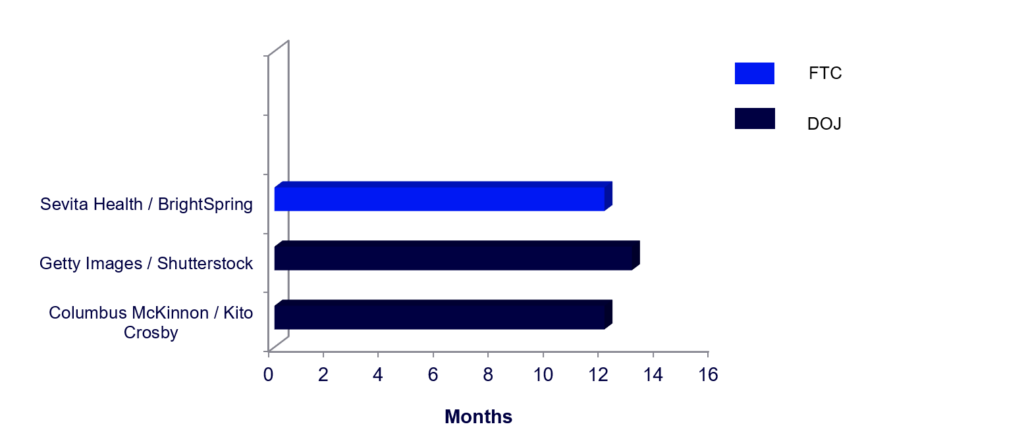
- FTC Chairman Ferguson emphasized that the FTC is open to negotiating settlements, which is a departure from policy under the Biden administration. The DOJ and FTC recently approved several transactions with settlements, including Sevita/BrightSpring, Columbus McKinnon/Kito Crosby, and Reddy Ice/Arctice Glacier. Ferguson expressed a distaste for “fake settlements ” that require extensive monitoring and noted a preference for “real settlements that fully protect competition” (which include divestitures of complete “lines of businesses,” with strong, upfront buyers). He also noted that behavioral remedies are disfavored and should be informed by the unique risks presented in different industries. Citing research suggesting that divestitures are “difficult” in retail and grocery contexts, Ferguson indicated that he will “require more” from parties in these sectors to show that their divestiture proposal preserves competition.
- For future FTC merger challenges, the FTC will attempt to litigate under the same standards as the DOJ. FTC Chairman Ferguson stated that his preference is to have the FTC challenge mergers by seeking a permanent injunction in federal court instead of the traditional FTC practice of seeking a preliminary injunction in federal court and then litigating on the merits in the FTC’s in-house administrative process. The FTC implemented this approach in its ongoing Loctite/Liquid Nails merger challenge.
- If Ferguson’s plan is put into practice, (1) the FTC will now have to meet the higher permanent injunction standard, (2) merging parties can expect lengthier timelines to trial on the merits, and (3) the commissioners can now engage in settlement negotiations during litigation because they are not in an adjudicative role.
States stepping up as DOJ shrinks and settles
- Twelve states and the District of Columbia continue to challenge a DOJ settlement approving Hewlett Packard Enterprise’s acquisition of Juniper Networks. The states’ intervention was prompted by reports from an ousted, formerly senior DOJ official that the settlement was a product of improper influence by lobbyists.
- Allegations of political interference have emerged again this quarter, related to the DOJ’s decision to clear, without a second request, the $1.6 billion merger of Compass and Anywhere, two of the largest real estate brokerages in the United States. The Wall Street Journal reported that Compass appealed to DOJ officials above Gail Slater, the former assistant attorney general of the Antitrust Division, who wanted to investigate the deal in-depth. Lawmakers have also raised concerns about Slater’s forced resignation in February 2026, given allegations that DOJ leadership overrode Antitrust Division officials in matters like HPE/Juniper and Compass/Anywhere.
- Parties should be aware that allegations of political influence may prompt intervention by state enforcers and private parties. For example, after Nexstar Media Group, Inc.’s, $6.2 billion acquisition of TEGNA Inc. received Federal Communications Commission (FCC) and DOJ approval – with a public endorsement from President Trump – a coalition of eight states filed a lawsuit to block the deal. Separately, DirecTV succeeded in obtaining an order to temporarily pause further integration efforts between the parties.
US Q1 2026 M&A activity: By the numbers
Number of enforcement actions in key industries1
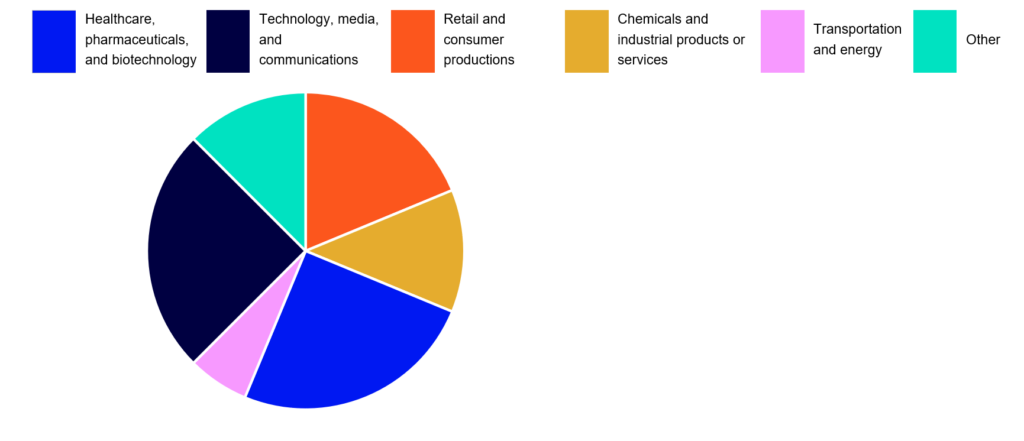
Snapshot of selected enforcement actions2
Time from signing to consent or investigation closing










Heard at the 2026 Antitrust Law Section Spring Meeting
ARTICLE / US POLICY
March 30, 2026
Read time: 8 min
The American Bar Association Antitrust Law Section’s annual Spring Meeting took place from March 25 – 27, 2026, in Washington, DC, this year. The Spring Meeting features updates from federal, state, and international antitrust enforcers as well as extensive discussion of antitrust issues and enforcement priorities affecting various industries. This client alert highlights key takeaways from the Spring Meeting.
Antitrust and the Trump 2.0 administration: One year later
- The US Federal Trade Commission (FTC) and Department of Justice (DOJ) have explicitly stated that they are not independent from the White House, embracing the top-down unitary executive theory of antitrust enforcement. Presidential priorities will continue to guide the focus of the antitrust agencies’ enforcement actions and litigation.
- Over the past year, the administration’s pro-business agenda has been furthered by the antitrust agencies. The agencies seek to reduce barriers to entry for transactions caused by regulations that affect market behavior. The agencies are also more willing to engage in settlements with structural and behavioral remedies.
- The new Hart-Scott-Rodino (HSR) rules have recently been struck down by the US Court of Appeals for the Fifth Circuit. The agencies have expressed a desire to maintain both the new HSR rules and the 2023 merger guidelines despite the fact that both policies were established by the previous administration. Practitioners suggest that in maintaining the new guidelines and rules, the FTC may be playing defense to make it more difficult for future agency actions to be challenged.
Here to stay: Scrutiny of labor, private equity, minority shareholders
- Anticompetitive labor practices, including no-poach and wage-fixing schemes, continue to face increased scrutiny from US and European regulators and courts. Some jurisdictions like Canada have even updated their laws to more explicitly pursue labor market cases, as many Canadian companies are still unaware of the problematic nature of some noncompetes. American noncompetes continue to attract scrutiny.
- Though private equity (PE) no longer garners the same amount of public criticism from the agencies as it did during Lina Khan’s tenure at the FTC, the private equity business model continues to pose concerns, particularly around affordability in healthcare and housing. The FTC has investigated several PE-backed healthcare transactions, and states are enacting premerger notification statutes aimed, in part, at private equity investment in healthcare and housing. Private equity investors should be aware of this developing body of state law that may impact transaction timelines and risk.
- The current administration continues to develop an enforcement interest in minority ownership. In response, practitioners are exploring solutions for minority investors concerned about antitrust scrutiny, including contracting away corporate government rights while maintaining economic rights in the investment.
Antitrust and AI
- Practitioners expressed concerns that traditional antitrust tools are not well suited to address modern forms of consolidation, and artificial intelligence (AI) has created a gap in antitrust enforcement. Certain agreements among AI and tech companies fall outside of traditional scrutiny under the Clayton and HSR acts, such as “acquihires” (instead of buying a company outright, a buyer will hire a key person from the target and license intellectual property (IP) from that company) and nonexclusive licensing. Nonetheless, the US agencies have expressed an interest in investigating such agreements.
- US monopolization theories are difficult to enforce due to the nascent nature of AI. Agencies struggle to define AI and how AI tools impact the market. That said, unlawful conduct by an AI would be illegal if, done by a human, it was unlawful as well. This leads to questions around whether information provided by AI tools could be considered illegal information sharing if a competitor used the same tool.
- In contrast, international agencies have additional tools in their belts to pursue enforcement against AI-specific agreements. Global enforcers have shifted from discussions on regulating AI toward taking action. The UK Competition and Markets Authority (CMA)’s share of supply and material influence tests allow for review where a target may have little to no revenue or where control is more flexible than US control tests, respectively. The EU European Commission uses the Digital Markets Act to fill enforcement gaps for AI and has launched several cases under this theory.
- AI platforms also create issues for cartel enforcement, as AI-informed collusion does not rely on conversations or words but can effectuate the same kind of traditional conspiracy. As a result, antitrust agencies struggle with how to properly investigate cartels based on algorithms or AI.
Pricing algorithms
- Despite difficulties with AI, there have been some developments in enforcement against anticompetitive pricing algorithms. Though the law is still developing, enforcers and plaintiffs have argued that when competing firms adopt an algorithmic pricing software, there exists an agreement among the parties who use the algorithm.
- It is not clear that the use of algorithmic pricing tools result in supracompetitive prices, but litigation on that question and others will continue as regulators and courts tease out the appropriate use of these algorithms.
Increased US and international attention on cartel enforcement
- The expansion of tariffs under the Trump administration has weakened traditional market pressures. Some US practitioners argue this has gone so far as to protect cartels from enforcement, as leniency programs lose effectiveness due to the erosion of trust in institutions and enforcement becomes more politicized in the United States. As a result, the United States is at risk of losing its status as a leader in cartel enforcement and other jurisdictions are stepping up to fill the gap, even creating alliances and cooperation agreements without the US antitrust agencies. However, the partnership between DOJ and the US Postal Service creates a strong whistleblower pathway for antitrust enforcement.
- Conversely, international enforcers from Mexico, Canada, Europe, Brazil, and Japan have collectively increased their efforts to prosecute anticompetitive cartels engaged in bid-rigging and no-poach agreements. International leniency schemes have seen an uptick in applications, and enforcers rely heavily on their leniency programs to incentivize whistleblowers; they have collectively agreed that staying ahead of cartel activity requires staying ahead of data technology and AI trends.
Strong state antitrust enforcement continues
- State enforcement priorities align with the populist antitrust goals of the Trump administration’s antitrust agencies, namely housing, healthcare, labor, food, and other consumer-facing sectors. States have a particular interest in conduct that directly affects local market conditions and their residents.
- States are increasingly staffing their attorney general (AG) offices with former federal enforcers, indicating a serious interest in evaluating complaints and remedies even where the state ultimately does not take enforcement action. States are also increasing penalties for antitrust violations in order to overcome the cost-prohibitive nature of bringing antitrust enforcement actions.
- Similarly, states continue to pass mini-HSR acts modeled after the Uniform Law Commission Act, which requires parties to make HSR filings to the states concurrently with federal HSR filings. These filings allow states increased visibility into transactions with local impacts.
- Washington and Colorado were the first states to pass these laws, with California the latest to follow (as of early March 2026).
Expanding merger control globally
- Foreign jurisdictions are expanding merger review powers. Australia added mandatory merger filings, with 100 filings reviewed in 2026 (as of this publication). Canada removed the efficiencies defense from its antitrust guidelines, and the EU has asked parties to engage on efficiencies earlier in the merger review process.
- Cross-border merger review remains strong despite divergent policies. The EU and Mexico have successfully coordinated with the United States on enforcement actions. International enforcers continue to encourage information-exchange waivers to allow for inter-agency coordination and to prevent conflicting remedy decisions.
- Some international agencies also ask parties to submit more information than required by merger review processes and to work alongside the agencies in order to ensure deal review quality persists.
Consumer protection
- Price transparency remains the center of gravity and states are driving the agenda. Expect continued dual-track enforcement under unfair or deceptive acts or practices (UDAP) and antitrust against “drip,” partitioned, and algorithmic pricing, with transparency as the touchstone. Panelists emphasized that neither all-in nor unbundled pricing is categorically better for consumers; the risk turns on deception and execution. Watch for divergent state disclosure regimes (e.g., New York’s algorithmic pricing disclosure law, effective November 2025) and active inquiries and sweeps (California AG; congressional letters), alongside growing scrutiny of vendor-provided pricing tools and potential “autonomous” tacit collusion.
- Deceptive influencer endorsements and their AI-driven variants remain top of mind for enforcers and plaintiffs. Plaintiffs are testing disclosure theories (placement, prominence, “material connection”) and pressing premium price/overpayment claims, while defendants are finding traction at the Rule 9(b) stage when complaints do not link specific posts to reliance. The FTC’s Endorsement Guides remain the roadmap; brands should hard wire compliance into influencer contracts, and disclosures should not be buried among a slew of hashtags.
- “Made in USA” claims are an active enforcement lane with parallel class action exposure. The FTC’s Labeling Rule enables monetary relief and is being used alongside Section 5, with recent matters underscoring substantiation, net impression, and prominence (including imagery) as recurring pitfalls. National Advertising Division (NAD) challenges continue to shape expectations for qualified origin claims, while California’s bright line statute and rising private actions elevate forum risk. Practical takeaways include inventorying claims across channels, verifying supply chain inputs, using precise qualified language, and aligning federal and state standards before marketing “US origin” themes.
David Koeller, a law clerk in the Los Angeles office, also contributed to this client alert.









DOJ further incentivizes corporate self-disclosures in first uniform policy
CLIENT ALERT / US POLICY
March 17, 2026
Read time: 4 min
On March 10, 2026, the US Department of Justice (DOJ) released its first-ever Corporate Enforcement and Voluntary Self-Disclosure Policy (CEP), which is the latest in a series of directives intended to offer a clearer path to criminal declinations for companies that self-report misconduct in a timely manner. The CEP sets out uniform department-wide guidelines for prosecutors’ treatment of self-disclosing corporate parties and reaffirms the DOJ’s emphasis on individual accountability, incentivizing the establishment of robust compliance programs that capture and appropriately escalate reports of misconduct and allow companies to self-report and remediate in a timely manner.
The CEP is divided into three parts, with specific policy prescriptions applying to defined categories of company conduct.
Under Part I, the DOJ provides that it will decline to prosecute a self-disclosing company for criminal conduct in the absence of aggravating circumstances, as long as the company takes the following actions:
- Voluntarily self-discloses the misconduct to the appropriate criminal component
- Fully cooperates with the investigation
- Remediates the misconduct in a timely and appropriate manner
Aggravating circumstances specifically include misconduct of a serious nature, egregious or pervasive misconduct within the company, severe harm caused by the misconduct, or corporate recidivism. However, as detailed below, even where aggravating circumstances are present, the new CEP makes clear that self-reporting misconduct will be rewarded.
Under Part II, the DOJ provides that a Non-Prosecution Agreement (NPA) will be available to a self-disclosing company that fails to otherwise meet the criteria for a declination under Part I – what the DOJ describes as a “near miss” – as long as the company takes the following actions:
- Fully cooperates with the investigation
- Remediates the misconduct in a timely and appropriate manner
As Part II makes clear, an NPA will be the default for a company that is ineligible for a declination because of a near miss in eligibility. And as the policy makes clear, this can occur when the reported misconduct was already known to the DOJ, the company had a preexisting obligation to self-disclose the misconduct, or the company delayed self-disclosing the misconduct for an unreasonable amount of time.
As the policy also makes clear, an NPA may also be available to a company when the presence of “aggravating circumstances” preclude the company from being eligible for a declination.
Under Part III, the DOJ affirms prosecutors’ discretion to determine appropriate criminal resolutions for all corporate entities that are not eligible for a declination or an NPA. But it also directs them to apply a presumption that monetary penalty reductions will be taken from the low end of the Sentencing Guidelines range for companies that fully cooperate and appropriately remediate misconduct in a timely manner.
Key takeaways
- The CEP – which will supplant any other existing policies at DOJ divisions or US Attorney’s Offices nationwide – promotes uniformity, transparency, and fairness in self-disclosure practices and incentivizes responsible corporate behavior.
- The CEP formalizes the DOJ’s increasing movement toward declinations as the default for companies that self-report misconduct in a timely manner, assuming appropriate cooperation and remediation steps are taken. While that trend has been under way, its formalization in the CEP represents a significant shift relative to the DOJ’s historical practices.
- The CEP also reflects the DOJ’s shift away from charging self-reporting companies generally, with Part II making an NPA the default for most companies that fail to qualify for a declination. In particular, the policy makes clear that the presence of aggravating circumstances will no longer mandate criminal prosecution, and companies can now expect to receive an NPA, assuming all other conditions are met, even when the disclosed misconduct is serious, pervasive, or severely harmful or the company is a repeat offender.
- In order to take full advantage of the benefits under the new CEP, companies should prioritize establishing and maintaining effective compliance programs with robust whistleblower protections to ensure that misconduct is reported in a timely manner and appropriately escalated. The CEP’s emphasis on individual accountability in both reporting and remediating identified misconduct ensures that investment in compliance programs will be amply rewarded.




The Supreme Court’s decision on IEEPA tariffs: What the Court decided and what it means for importers
CLIENT ALERT / US POLICY
February 20, 2026
Read time: 9 min
On February 20, 2026, the US Supreme Court invalidated all of President Trump’s so-called “reciprocal” and “fentanyl” tariffs imposed under the International Emergency Economic Powers Act (IEEPA). The Court found that the law does not allow the president to impose tariffs but did not address refunds for tariffs already paid by importers or the impact on trade deals between the United States and various countries that were negotiated under the reciprocal tariffs that have now been struck down. In an executive order dated February 20, 2026, the president recognized that the Supreme Court had invalidated the IEEPA tariffs, rescinded them, and directed the relevant government agencies to stop collecting them “as soon as practicable.” In a bulletin published on February 22, 2026, US Customs and Border Protection (Customs) announced it would cease collecting IEEPA tariffs as of February 24, 2026.
The question of whether refunds are available is still open, and the process for obtaining refunds is likely to be messy. However, the Supreme Court’s decision implies that importers seeking a refund should use the normal processes for such claims through Customs (such as post-summary corrections for unliquidated entries and protests for eligible liquidated entries) and potential litigation before the US Court of International Trade (CIT) for entries that have passed the protest deadline, even as the administration considers its options for reimposing the tariffs through some other presidential authority.
Background
Shortly after returning to office, President Trump imposed tariffs under IEEPA. That statute grants the president the power to “regulate . . . importation” to address an “extraordinary threat” that the president has declared to be a national emergency. President Trump declared a national emergency with respect to the influx of fentanyl and other illegal drugs from Canada, Mexico, and China, as well as to the “large and persistent” US trade deficits. These declarations were the basis for imposing the so-called “fentanyl” and “reciprocal” tariffs, respectively.
The tariffs were immediately challenged before the CIT and the US District Court for the District of Columbia. At the CIT, a three-judge panel found that IEEPA does not authorize any of the president’s tariffs because they do not address the problems identified in the president’s national emergency declarations. The US Court of Appeals for the Federal Circuit affirmed, and the government appealed to the Supreme Court.
After declining to transfer the case to CIT, the district court also found that IEEPA does not authorize the tariffs. The government bypassed the US Court of Appeals for the DC Circuit and petitioned the Supreme Court, which agreed to hear both cases together.
The Court’s ruling
In a 6-3 opinion written by Chief Justice Roberts, the Supreme Court found that IEEPA does not authorize the president to impose tariffs at all. The Court started with the proposition that the Constitution vests the power to tax – which the founders understood to include the power to impose tariffs – in Congress, not the executive. Congress therefore would have had to delegate tariff-imposing authority to the president. The Court stated that, had Congress intended to delegate such a power to the president, it would have done so expressly. The majority pointed to several examples of statutes where Congress did expressly delegate the authority to impose tariffs to the president.
With these principles in mind, the Court found that IEEPA’s text, while granting the president authority to “regulate . . . importation,” does not automatically include the power to tax. Further, the Court noted that IEEPA lists nine different ways for the president to exercise his authority, but does not include any revenue-raising power (such as taxes or tariffs). Finally, the Court noted that presidents have uniformly not found such a broad power to impose tariffs in IEEPA or its predecessor statute. Thus, the Court concluded that the president’s tariffs were unlawful and affirmed the decision of the Federal Circuit.
The Supreme Court’s decision to affirm the Federal Circuit means that, as of today, Customs may not lawfully collect duties under the IEEPA and the president’s “reciprocal” and “fentanyl” tariffs are permanently enjoined. Additionally, the Court vacated the decision of DC district court and remanded with instructions to dismiss that case for lack of jurisdiction. However, the majority did not address the questions of whether refunds are available or what process importers should use to obtain them, nor did it address the legality of trade deals negotiated with various countries while the tariffs were in place.
What happens next
On February 20, 2026, President Trump issued an executive order rescinding the IEEPA tariffs. Pursuant to that order, Customs announced in a bulletin published on February 22, 2026, that it would cease collection of IEEPA tariff duties as of February 24, 2026.
With regard to refunds, the only mention of this issue is found in Justice Kavanaugh’s dissent, where he adds very little other than noting the process will likely be a “mess.” However, the Court did provide some basic procedural guidance, discussed in more detail below. Additional litigation will likely determine the thorny question of whether, and to what extent, importers who paid tariffs can receive refunds. For the time being, though, the Court implied that parties should use the normal channels for challenging the amount or imposition of a tariff duty, depending on the status of each claim or entry (as discussed in more detail in the following section).
At a press conference convened hours after the Court released its opinion, President Trump vowed to reimpose the tariffs under different legal authorities. This comes after many weeks of telegraphing by the president and other administration officials that they would do so if the Court ruled against them. Since then, the president has taken several actions to fulfill that promise, even as he issued an executive order rescinding the IEEPA tariffs.
Tariffs under Section 122 of the Trade Act of 1974
On February 20, 2026, President Trump issued a proclamation imposing a 10% tariff under Section 122 of the Trade Act of 1974. It will take effect on February 24, 2026, and last for 150 days (until July 24, 2026). It applies to all articles imported into the United States, with several exceptions.
On February 21, 2026, the president announced he would issue another proclamation raising the tariff rate to 15%. As of February 24, 2026, that proclamation had not been issued, and the 10% tariff thus took effect. The White House has indicated that it is “still working” on implementing the increased rate.
Notably, the tariff does not apply to imports of the following items, among others: (i) goods considered to be of Canadian or Mexican origin under the US-Mexico-Canada Agreement (so-called “USMCA compliant” goods); (ii) goods listed in Annexes I and II to the February 20 proclamation, which include certain critical minerals, agricultural products, pharmaceuticals, and electronics (among other categories); or (iii) goods subject to Section 232 tariffs (meaning there will be no “stacking” of the new tariff on existing or future Section 232 tariffs).
Investigations under Section 301 of the Trade Act of 1974
Further, President Trump has directed Ambassador Greer and the Office of the US Trade Representative to initiate investigations under Section 301 of the Trade Act, which is the first step toward imposing tariffs or other trade restrictions under that statute. Administration officials have said in the recent past that “all of the United States’ major trading partners” could be subject to such investigations and eventually to tariffs if those investigations conclude the foreign trading partner’s policies are either “unreasonable” or “unjustifiable and discriminatory,” and that those policies “burden and restrict” US commerce. Ambassador Greer’s statement issued on February 20, 2026, confirms that “several” investigations will be initiated against “many” trading partners.
Avenues for refunds
As noted above, the Court’s majority did not discuss or decide the question of availability or process for refunds. Instead, by affirming the decision of the Federal Circuit, vacating the decision of the DC district court and instructing that court to dismiss for lack of jurisdiction, the Supreme Court has effectively directed that refund questions will be answered by the CIT in the first instance.
Importers should thus anticipate that the customs duty and tariff refund procedures, and CIT precedents applicable to those processes, will likely apply when seeking refunds of IEEPA tariffs. Importers should take a careful look at their import entry universe to determine which path they should take when claiming a refund. That path will vary based on the liquidation status of each entry. All importers should also be attentive to the tax implications of any refund obtained. Because duty refunds are prior-period cost recoveries, obtaining a refund could require income recognition in the year received, potential amended returns, and book-to-tax adjustments. For importers seeking refunds, then, alignment between legal and tax capabilities is necessary.
Importers with open entries
Importers with customs entries which Customs has not yet liquidated should theoretically have the simplest path to a refund. For such entries, importers should be able to revise the entries to exclude IEEPA tariffs by filing a post-summary correction (PSC). Customs would then presumably liquidate the entry without applying the IEEPA tariff and refund payment made upon entry. To ensure this option remains available, importers with entries that may be about to liquidate (typically around 315 days from entry) should consider requesting an extension of the liquidation period. If necessary, importers should first submit the liquidation extension request and obtain approval prior to submitting their PSC and then file the PSC at least 15 days before the new liquidated date, as obtaining refunds through PSCs would be the most efficient method.
Importers with liquidated entries within the statutory 180-day period
For entries already liquidated but still within 180 days of liquidation, importers should file customs protests to seek a refund. Customs will then decide the protest and presumably reliquidate the entry to remove the IEEPA duty. If Customs denies such a protest for whatever reason, the importer may then contest that denial before the CIT.
Importers with closed entries
For entries liquidated more than 180 days ago, the protest procedure does not apply. Thus, importers with such closed entries will need to seek relief through an action before the CIT. In a related case before the CIT, the government confirmed that it would not object to reliquidation of entries outside the protest period on which IEEPA tariffs were paid if the Supreme Court found the tariffs unlawful.





FinCEN, OFAC intensify efforts targeting Mexican cartel money laundering
CLIENT ALERT / US POLICY
February 20, 2026
Read time: 7 min
Through the provisions of the Bank Secrecy Act and various Office of Foreign Assets Control (OFAC) sanctions programs, the US Department of the Treasury (Treasury) has imposed certain compliance obligations on financial institutions, including money services businesses (MSBs). Among other things, financial institutions must block the property of sanctioned persons, take required “special measures” to guard against the financial risks posed by jurisdictions, financial institutions, transactions, or accounts identified as “primary money laundering concerns” pursuant to Section 311 of the USA PATRIOT Act (Section 311) and monitor transactions for suspicious activity. Financial institutions with potential exposure to Mexican cartels should be particularly cognizant of these requirements given Treasury’s apparent focus on cartel-related money laundering, reflected by recent enforcement actions.
On December 22, 2025, Treasury’s Financial Crimes Enforcement Network (FinCEN) “announced a multitiered operation targeting more than 100 US MSBs along [the nation’s] southwest border,” aimed at identifying noncompliance with anti-money-laundering regulations. This followed an announcement on November 13, 2025, regarding coordinated actions between FinCEN and OFAC that target the Hysa Organized Crime Group (HOCG) and various Mexican-based gambling establishments allegedly involved in cartel-related money laundering and criminal activities. In conjunction with the Mexican government, OFAC sanctioned 27 individuals and entities connected to HOCG, and FinCEN issued a finding and notice of proposed rulemaking (NPRM) that would identify transactions involving 10 Mexican gambling establishments as being of primary money laundering concern pursuant to Section 311. These November sanctions and designations came two days after the Mexican government suspended the operations of 13 Mexican casinos with potential connections to organized crime that were allegedly used to launder money overseas. Together, Treasury’s recent actions highlight the Trump administration’s continued focus on dismantling drug cartels and reflect an overall trend of increased enforcement in locations and industries with cartel exposure.
FinCEN’s data-driven southwest border operation
In an effort to eliminate Mexican-cartel-related money laundering from the US financial system, FinCEN is engaged in an ongoing operation examining more than 100 US MSBs operating along the US’s southwestern border with Mexico for possible noncompliance with the Bank Secrecy Act. FinCEN is employing a data-driven approach involving high-performance data processing to carry this out, with its actions being guided by a review of more than 1 million Currency Transaction Reports (CTRs) and 87,000 Suspicious Activity Reports (SARs).
As of December 22, 2025, FinCEN’s operation has involved the issuance of six notices of investigation, dozens of examination referrals to the Internal Revenue Service, and more than 50 compliance outreach letters. In addition, FinCEN has warned that it continues to closely coordinate with law enforcement and regulatory partners at the federal and state levels and will pursue enforcement actions or make criminal referrals when necessary.
OFAC sanctions on HOCG-related persons
Reflecting its focus on addressing cartel-related illicit activities, as well as the compliance risks for financial institutions with exposure to cartels, on November 13, 2025, Treasury designated HOCG as a foreign person constituting a significant transnational criminal organization pursuant to Executive Order (EO) 13581 based on its use of Mexico-based businesses, including gambling establishments, to launder the proceeds of narcotics trafficking reportedly with the consent of the Sinaloa Cartel. With this designation, 7 individuals and 20 entities were added to the list of Specially Designated Nationals and Blocked Persons under EO 13581 for their connections to HOCG. As a result, any property or interests in property of these 27 persons that comes within the United States or within the possession or control of a US person is blocked. This includes the property and interests in property of any entity owned, directly or indirectly, individually or in aggregate, 50% or more, by one or more of these blocked persons.
Transactions involving HOCG-related gambling institutions are a primary concern
Concurrently with the above sanctions, FinCEN issued the NPRM pursuant to Section 311 identifying transactions involving 10 Mexican gambling establishments ( Gambling Establishments) operated by HOCG as being of primary money-laundering concern. According to FinCEN, the Gambling Establishments and their leadership facilitated money laundering for the benefit of the Sinaloa Cartel for more than six years.
With this determination, the NPRM would prohibit covered financial institutions (as defined in 31 CFR § 1010.605(e)(1)) from opening or maintaining correspondent accounts for a foreign banking institution if such correspondent accounts are used to process transactions involving any Gambling Establishment and prevent the access of correspondent accounts by Gambling Establishments. Further, covered financial institutions would be required to apply special due diligence measures to foreign correspondent accounts that are reasonably designed to prevent such accounts from being used to process transactions involving any Gambling Establishment. Such special due diligence must include:
- Notifying foreign correspondent account holders that such correspondents cannot provide the Gambling Establishments access to any correspondent account maintained at the covered financial institution if the covered financial institution knows or has reason to believe such correspondents provide services to a Gambling Establishment
- Taking reasonable steps to identify the use of its foreign correspondent accounts by a Gambling Establishment, to the extent that this may be identified through transactional records kept in the normal course of the covered financial institution’s business
Covered financial institutions would also be required to take a risk-based approach to determining whether additional due diligence measures are required and to take all appropriate steps to investigate and prevent the access of correspondent accounts by the Gambling Establishments.
While the period for submitting written comments on the NPRM closed on December 17, 2025, the NPRM highlights Treasury’s determination of the increased risks of money laundering presented by the Gambling Establishments, and, as a result, financial institutions should assess their exposure to the Gambling Establishments and implement appropriate risk-based procedures in their anti-money-laundering programs.
Compliance takeaways
FinCEN’s ongoing operation targeting MSBs that appear to be noncompliant with the Bank Secrecy Act highlights the need for financial institutions to maintain adequate risk-based compliance programs that include processes for verifying customer identities, monitoring transactions for suspicious activity, filing timely SARs and CTRs, and overseeing agents, branches, and third-party service providers. This is especially true for MSBs along the US-Mexico border, which can face increased exposure to illicit activity, including the laundering of proceedings from drug and human trafficking.
Additionally, OFAC’s designation of the HOCG-related individuals and entities creates compliance risks for US and non-US persons. Beyond imposing civil or criminal penalties for sanctions violations, OFAC may also independently designate any person that has “materially assisted, sponsored, or provided financial, material, or technological support for, or goods or services to or in support of [blocked persons].” As a result, US persons must assess whether they are in possession or control of property that must be blocked, and non-US persons should evaluate whether they have business dealings with the sanctioned HOCG-related persons that should be discontinued.
Further, as noted above, FinCEN’s NPRM would impose additional compliance obligations on covered financial institutions, including banks and broker-dealers. If the NPRM is finalized as proposed, such financial institutions will need to incorporate the required special due diligence measures and assess whether further safeguards are required. Additionally, while the NPRM would not change SAR obligations, FinCEN has requested that for any filed SAR involving the identified gambling establishments, reporters should enter “FIN-311-Gambling-Establishments” in Field 2 and in the SAR narrative.
Finally, financial institutions should note that the coordinated nature of these actions reflects Treasury’s unified approach to combating money laundering and financial crimes. While this strategy includes OFAC and FinCEN acting jointly against criminal actors, it also involves Treasury working with international partners, as it did with Mexican government in these actions. Further, as indicated by FinCEN’s ongoing operation targeting MSBs in connection with cartel-related money laundering, Treasury is likely to increase enforcement going forward, strengthening the need for comprehensive anti-money-laundering and sanctions programs.
If your organization needs assistance in complying with the actions taken by Treasury, please contact one of the authors or your McDermott Will & Schulte lawyer.









Nuclear power projects gain momentum as federal tax incentives, data center demand transform financing landscape
CLIENT ALERT / US POLICY
January 15, 2026
Read time: 5 min
With electricity demand rising across the United States, nuclear power is receiving renewed attention from energy developers, investors, and financiers – both for existing facilities and new projects. As a clean and reliable resource, nuclear energy aligns well with carbon-neutral objectives and the significant load requirements of data centers and other energy-intensive users.
Combined with vocal federal support and access to federal tax incentives established under the Inflation Reduction Act of 2022 (IRA) and extended by the One Big Beautiful Bill Act (OBBBA), nuclear power is well positioned to play a larger role in the US energy market. Following a series of strong federal policy signals, market confidence in nuclear offtake has increased, with renewed interest in long-term procurement emerging from technology companies scaling data centers.
Headlines have focused on the life extension of existing light-water reactor (LWR) nuclear plants and the commercial advancement of small modular reactors (SMRs). Such projects are often supported by long-term data center offtake agreements or federal guarantees, and economics have been further strengthened by the availability of production tax credits (PTCs) and investment tac credits (ITCs) enacted under the IRA.
Existing nuclear plants: Section 45U PTC
To discourage retirement of existing nuclear facilities, the IRA added Section 45U (the zero-emission nuclear power PTC) to the Internal Revenue Code.
Section 45U provides an income tax credit for electricity that is (i) produced at a qualified nuclear power facility and (ii) sold to an unrelated person during the period from December 31, 2023, through January 1, 2033. A “qualified nuclear power facility” is one that was placed in service before enactment of the IRA and uses nuclear energy to generate electricity.
The credit is calculated by:
- Multiplying the number of megawatt-hours of electricity produced and sold during the taxable year by 0.3 cents (as adjusted annually for inflation)
- Subtracting the applicable “reduction amount”
- Multiplying the result by five if prevailing wage requirements are satisfied.
The reduction amount is the lesser of (i) the total credit amount otherwise available or (ii) 16% of the excess (if any) of gross receipts from electricity sales over a benchmark price of 2.5 cents per kilowatt-hour (adjusted for inflation). As a practical matter, no credit is available when the electricity sales price equals or exceeds approximately $43.75 per megawatt-hour.
New nuclear projects: Sections 45Y and 48E
The IRA also introduced Sections 45Y (the clean electricity PTC) and 48E (the clean electricity ITC) for electricity-generation facilities that achieve a zero-greenhouse-gas emissions rate. For facilities to qualify, they must be placed in service after December 31, 2024.
Proposed US Department of the Treasury regulations confirm that facilities using nuclear fission or fusion technologies are eligible for either the PTC under Section 45Y or the ITC under Section 48E (but generally not both). Project owners must elect which credit to claim.
If prevailing wage requirements are satisfied:
- The Section 48E ITC equals 30% of a project’s qualified basis.
- The Section 45Y PTC equals $15 per megawatt-hour of electricity generated, subject to annual inflation adjustments.
Both credits may be increased through additional “adders” if the facility is located in an energy community and/or meets domestic content requirements.
Importantly, ITCs under Section 48E and PTCs under Sections 45U and 45Y may be transferred for cash to unrelated taxpayers, providing flexibility for developers that cannot fully utilize the credits themselves.
Financing outlook
Public sentiment toward nuclear power has shifted meaningfully in many regions, with increasing recognition of (and enthusiasm for!) its potential to meet growing electricity demand. While significant hurdles remain, particularly development and construction capital intensity, the availability of federal tax credits for existing facilities and new SMR projects materially improves project feasibility.
As the policy landscape continues to evolve, the OBBBA’s enactment in July 2025 stands out as a pivotal moment for the nuclear sector. US Congress ultimately chose not to alter the Section 45U PTCs, a notable decision given earlier legislative drafts that sought to accelerate its repeal. While this inaction may appear uneventful, it is telling: The decision to leave nuclear untouched, even as wind, solar, and hydrogen incentives were substantially pared back, signals a firm and deliberate endorsement of nuclear energy’s long‑term role in the US energy mix. The legislation goes a step further by introducing a new nuclear‑specific energy community bonus for facilities located in metropolitan statistical areas with historical ties to nuclear employment, underscoring policymakers’ intention to support the technology and the communities that have sustained it. Together, these measures position nuclear power to play an increasingly consequential role in US energy’s future.
In the near term, LWR projects benefiting from long operating histories and proven technology are likely to remain the most financeable component of a nuclear resurgence. At the same time, interest from offtakers in advanced reactor technologies, including SMRs, continues to grow.
Any large-scale nuclear development will require innovative financial structures. These projects are likely to involve a combination of common equity, preferred equity, multiple debt tranches, and tax credit monetization, all within a complex regulatory framework that demands careful and sophisticated structuring.
If you have any questions about financing the next generation of nuclear projects, please reach out to the authors or your regular McDermott Will & Schulte lawyer.





New guidance on OISP’s publicly traded securities exception and the COINS Act
CLIENT ALERT / US POLICY
January 14, 2026
Read time: 7 min
On December 23, 2025, the US Department of the Treasury (Treasury) released additional guidance in the form of seven additional frequently asked questions (FAQs), clarifying certain aspects of the Outbound Investment Security Program (OISP). As a reminder, the OISP aims to restrict US persons from investing in “Covered Foreign Persons” (i.e., certain persons with a nexus to China, Hong Kong, or Macau that are engaged in specified activities in the artificial intelligence, quantum computing, or semiconductors sectors). Depending on the nature of the Covered Foreign Person’s activities in the relevant technology sectors, a US person is either prohibited from investing in such Covered Foreign Person or is required to report such investments to Treasury (Covered Transactions).
While the OISP applies to a variety of forms of investments in Covered Foreign Persons, including the acquisition of equity interests or contingent equity interests in a Covered Foreign Person and the conversion of such contingent equity interests into equity interests, the regulations contain exceptions for certain types of transactions. Five of Treasury’s most recent FAQs aim to clarify the scope of one such exception: the publicly traded securities exception. The remaining new FAQs address the Comprehensive Outbound Investment National Security Act of 2025 (COINS Act) that became law on December 18, 2025, which codifies and expands the scope of the OISP.
Guidance on the publicly traded securities exception
Revised guidance on standard minority shareholder protections
Under the publicly traded securities exception, any investment in publicly traded securities, with “security” defined under 15 USC § 78c(a), that trade on a securities exchange in any jurisdiction or over-the-counter is not considered a Covered Transaction, so long as the acquisition of such securities does not provide a US person with rights beyond “standard minority shareholder protections.” Significantly, prior to the new FAQs, Treasury took the position that the right to nominate a candidate for an issuer’s board of directors was not a standard minority shareholder protection.
During the 12 months since the OISP went into effect, stakeholders have requested that Treasury reconsider its position on nomination rights, and they have sought further guidance on the scope of the publicly traded securities exception, including whether the acquisition of securities in an initial public offering (IPO) are Covered Transactions. The new FAQs address these issues.
In FAQ X.5, Treasury reversed its prior stance and determined that the right to nominate directors would be considered a standard minority shareholder protection so long as the right is “generally available to similarly situated shareholders of that entity solely by virtue of their minority shareholding.” However, the right to appoint a director (as opposed to nominating or proposing a candidate for a shareholder vote) is not a minority shareholder protection. Thus, acquiring an appointment right would take an investment out of excepted status.
This is a notable change for US persons seeking to invest in publicly traded securities of Chinese incorporated companies, Hong Kong incorporated companies, or companies listed on the Taiwan Stock Exchange, as those jurisdictions generally provide the right to nominate directors to investors with very low thresholds of share ownership (i.e., 1% for China, 2.5% for Hong Kong, and 1% for Taiwan-listed companies). As a result, US persons are not prohibited from acquiring the publicly traded securities of Covered Foreign Persons solely because doing so will grant such investors the right to nominate directors for a shareholder vote. However, the publicly traded securities exception will not apply if the nomination right is not generally available to similarly situated shareholders.
Acquiring shares in an IPO pursuant to a subscription agreement entered into prior to the IPO
Treasury was asked to clarify whether a US person engages in a Covered Transaction by acquiring publicly traded securities in an IPO pursuant to a subscription agreement entered into before the listing date. During the notice and comment period for the OISP regulations, Treasury declined to modify the language of the regulations in response to a similar question, but Treasury has now published FAQ X.4 stating that such a transaction does fall under the publicly traded securities exception so long as “at the time of such acquisition the equity interest is publicly traded,” regardless of when the agreement was entered into. While the FAQ does not explicitly say so, it appears to suggest that US persons may participate in an IPO as a cornerstone investor or through a subscription agreement, so long as the securities are not acquired before the securities are publicly listed.
Additional clarifications of the publicly traded securities exception
- Follow-on offerings: Treasury clarifies in FAQ X.1 that acquiring securities in a follow-on offering from an issuer whose securities are already publicly traded is an excepted transaction if the securities acquired are of the same class as, and will be fungible with, the issuer’s securities that are already publicly traded.
- Contingent equity interest convertible into publicly traded securities: FAQ X.2 clarifies that the initial acquisition of a contingent equity interest “that is convertible into, or provides the right to acquire, only a publicly traded security” is excepted as an investment in such publicly traded security. However, Treasury warns that the conversion of such contingent equity interest into an equity interest must be assessed separately for whether it would be a Covered Transaction.
- Underwriting services to IPOs: FAQ X.3 confirms that providing underwriting services or other ancillary services to an IPO are not Covered Transactions so long as the financial institution does not acquire an equity interest in connection with such services. As explained in FAQ X.1, however, a US financial institution’s acquisition of securities in connection with providing underwriting services for a follow-on offering would be excepted under the publicly traded securities exception if the securities are fungible with the issuer’s already publicly traded securities.
US persons should note, however, that the publicly traded securities exception still does not apply to any investment that provides a US person with rights beyond standard minority shareholder protections, including investments in follow-on offerings or contingent equity interests.
Impact of the COINS Act
On December 18, 2025, the COINS Act was signed into law as Title LXXXV of the National Defense Authorization Act for Fiscal Year 2026. Among its provisions is a requirement that the Secretary of the Treasury issue within 450 days of the COINS Act’s enactment regulations that restrict outbound investments from the US into countries of concern involving certain technologies. While the regulations envisioned by the statute are similar to the current OISP, there are certain key differences, including the addition of Cuba, Iran, North Korea, Russia, and Venezuela as countries of concern and the expansion of technology sectors targeted to include high-performance computing and hypersonic systems.
In response to the COINS Act, Treasury issued FAQs XI.1 and XI.2 confirming that the new law does not alter the provisions of the current OISP or the obligation to fully comply with its requirements. Until Treasury issues new regulations superseding the existing OISP regulations, US persons should continue their current practices to comply with the OISP.
Compliance takeaways
For the time being, Treasury’s new FAQs addressing the publicly traded securities exception are generally favorable to investors, with guidance now confirming that certain transactions are not covered by the OISP. As a result, US persons should familiarize themselves with the FAQs and evaluate their investment strategies and OISP compliance programs accordingly.
Although the details of the regulations issued pursuant to the COINS Act will likely remain unclear for the foreseeable future, US persons should remain cognizant of the fact that their obligations under such regulations will likely increase, with the COINS Act expanding the countries and technology sectors it applies to, among other changes. While any regulations Treasury issues pursuant to the COINS Act will presumably alter the OISP, pursuant to FAQs XI.1 and XI.2, US persons should continue to comply with the current OISP regime, regardless of the passage of the COINS Act.
If you have any questions concerning this client alert, please contact your McDermott Will & Schulte lawyer or one of the authors.

Defense contractors face ban on stock buybacks and dividends
CLIENT ALERT / US POLICY
January 13, 2026
Read time: 10 min
On January 7, 2026, the White House issued a sweeping new executive order (EO) titled “Prioritizing the Warfighter In Defense Contracting.” It declares, “Effective immediately, [underperforming defense contractors] are not permitted in any way, shape, or form to pay dividends or buy back stock, until such time as they are able to produce a superior product, on time and on budget.” The EO and accompanying White House Fact Sheet seek to implement a government-wide policy to accelerate defense procurement and revitalize the defense industrial base, with specific mechanisms to identify and remediate contractor “underperformance.”
The EO needs to be understood in the context of the US Department of War’s[1] November 2025 Acquisition Transformation Strategy, which emphasizes three overarching priorities:
- Field technology and modernize systems at a rate that outpaces the nation’s adversaries;
- Increase production capacity and deliver wartime surge capacity for key capabilities, systems, weapons, and munitions to the US warfighter and priority allies and partners; and
- Put the entire acquisition system and the industrial base on a wartime footing with the urgency and mandate to accept more risk, transition from a culture of compliance to one of speed and execution, and rapidly tackle the strategic challenges facing the nation.
Shortly before and after the EO’s release, the president posted that defense contractors issuing “massive Dividends … and Stock Buybacks” were undermining plant and equipment investments, adding that “no Executive should be allowed to make in excess of $5 Million Dollars” until companies build new and modern production plants.
Key takeaways
1) Restriction on buybacks and dividends
- The EO targets “underperforming” contractors with a prohibition on dividends and stock buybacks. It states that “Many large contractors — while underperforming on existing contracts — pursue newer, more lucrative contracts, stock buy-backs, and excessive dividends to shareholders at the cost of production capacity, innovation, and on-time delivery.”
- The EO then mandates, in the next sentence, the following: “Effective immediately, they are not permitted in any way, shape, or form to pay dividends or buy back stock, until such time as they are able to produce a superior product, on time and on budget.” “They” appears to be a reference to the “large contractors” that are “underperforming on existing contracts;” however, as discussed below, it is unclear whether the prohibition is limited to contractors above any size threshold.
- The EO grants the Secretary of War (the Secretary) 60 days from the date of the EO to “take steps to ensure that any future contract … contains a provision prohibiting both any stock buy‑back and corporate distributions … [and] stipulate that executive incentive compensation … will not be tied to short‑term financial metrics, such as free cash flow or earnings per share driven by stock buy‑backs, and instead will be linked to on‑time delivery [and] increased production … ”
- The EO states that such measure will hold defense contractors to the “highest standards intended to ensure the advancement of core national interests, including with respect to the timeliness and quality of the defense items that they deliver.”
- According to the White House Fact Sheet, the Secretary is directed to include clauses in future contracts that “prohibit stock buybacks and corporate distributions during periods of underperformance, non-compliance, insufficient prioritization or investment, or insufficient production speed.”
2) Applicability to contractors
- The White House Fact Sheet and the EO refer to “defense contractors” and “major defense contractors,” and Section 1 contains a reference to “large contractors,” as discussed above. It is not clear, however, whether the EO only applies to contractors above a particular size threshold, contractors on “major defense programs” under 10 U.S.C. § 4201, or some other limitation. The term “major contractor” has been used in different contexts – with different dollar thresholds – in the FAR and proposed FAR rules over the years, but it is unclear whether the EO will be limited in such a manner.
- Neither the EO nor the Fact Sheet make distinctions based on organizational form, ownership or governance structure, or public or private status.
- According to the EO, buybacks and dividends are “not permitted in any way, shape, or form” for underperforming contractors, indicating that the restriction applies regardless of whether buybacks and dividends might otherwise be permitted under existing corporate policies or prior board authorizations.
- The EO does not distinguish between prime contractors and subcontractors, nor does it exempt subsidiaries or joint ventures.
- Unless additional guidance is provided, contractors should operate under the presumption that privately held companies, subsidiaries, joint ventures, and other non-public entities performing defense work are subject to the same restrictions as publicly traded firms.
- The Fact Sheet directs the Secretary of War to include clauses in future contracts prohibiting buybacks and other forms of corporate distributions “during any period of underperformance, non-compliance, insufficient investment, or inadequate production speed,” and subcontractors should prepare in the event that these clauses are flowed down in subcontracts.
3) Applicability to private and publicly traded companies
- The EO affirms its reach “across our economy,” noting that “Every firm … has a right to profit,” but underscoring that “the American defense industrial base also has the responsibility to ensure that America’s warfighters have the best possible equipment and weapons.”
- While stock buybacks are typically associated with public companies, the EO’s language extends to any form of “corporate distributions.” The term “corporate distributions” remains undefined but appears to extend beyond traditional dividends to include owner payments and other forms of payments to shareholders. The implications for limited liability company member draws, partnership distributions, and employee stock ownership plan‑related payments are unclear and may turn on future guidance from the Department of War.
4) Executive incentive compensation will be tied to delivery and production
- The EO mandates that executive incentive compensation for defense contractors must not be “tied to short-term financial metrics, such as free cash flow or earnings per share driven by stock buy-backs,” but instead must be “linked to on-time delivery, increased production, and all necessary facilitation of investments and operating improvements required to rapidly expand our United States stockpiles and capabilities.”
- In addition to limitations on performance-based incentives, the EO contemplates capping executive base salaries at their “current levels, with increases allowed for inflation.”
- The president’s Truth Social posts following release of the EO state that no executive should receive total compensation exceeding $5 million until their company has constructed new and modern production plants. As noted above, the EO itself does not specify a specific dollar ceiling and instead freezes compensation at “current levels,” leaving some ambiguity regarding enforcement and the interplay between the EO’s contractual requirements and the President’s public statements.
- Contractors should anticipate that future government contracts may include explicit provisions linking executive compensation to delivery and production outcomes and may also incorporate salary caps or other limits consistent with the administration’s stated priorities. Companies are advised to review current compensation structures and prepare to adjust incentive plans to align with these new requirements.
5) SEC safe harbor protections
- The EO directs the Chairman of the Securities and Exchange Commission (SEC) to consider whether to adopt amended regulations governing stock buybacks under 10b-18 that would prohibit use of the safe-harbor protections for underperforming defense contractors.
- If the SEC amends Rule 10b-18 as contemplated by the EO, underperforming defense contractors could lose the “safe harbor” that currently protects them from certain market manipulation liability when conducting stock buybacks. This would expose such contractors to increased risk of SEC enforcement actions or private litigation related to the timing, volume, or manner of their repurchases.
- These regulations could affect how defense contractors assess and implement stock repurchase plans in light of potential liability concerns and considerations. Contractors should consider updating compliance policies and enhancing documentation of the rationale for any repurchases to mitigate potential liability.
6) Enforcement of underperformance
- The EO authorizes the Secretary of War to identify defense contractors who are “underperforming.” The White House Fact Sheet characterizes “underperforming” contractors as those that “fail to invest their own capital in production capacity, insufficiently prioritize U.S. government contracts, or maintain inadequate production speed while spending money that could be spent on those critical needs on stock buybacks or corporate distributions.”
- The EO directs the Secretary to take into account the following “[w]hen considering whether to initiate any available enforcement action:”
- “The financial condition of the defense contractor,”
- “The economic viability of relevant programs,” and
- “The potential mutual benefits offered by robust and sustained growth opportunities from the United States Government coupled with capital investments by the contractor.”
- When a contractor is identified as underperforming, the EO directs the Secretary to issue a written notice “describing the nature of the underperformance or insufficient prioritization, investment, or production speed.” The contractor must then submit a board-approved remediation plan within 15 days of receiving the notice, detailing corrective actions and a timeline for improvement.
- If the Secretary determines that the remediation plan is inadequate, or if the contractor and the Secretary cannot resolve the dispute within the 15-day negotiation period, the EO empowers the Secretary to pursue remedies “to the maximum extent permitted by law, including through use of any voluntary agreement of the contractor, available enforcement actions under the Defense Production Act (50 U.S.C. 4501 et seq.), and any available contract enforcement mechanisms within the Federal Acquisition Regulations and Defense Federal Acquisition Regulations Supplement.”
- In addition, the EO empowers the Secretary, “in consultation with the Secretaries of State and Commerce,” to consider “whether it is appropriate to cease ongoing advocacy efforts or deny new advocacy cases for underperforming contractors competing for international Foreign Military or Direct Commercial Sales.”
- The EO specifies that these restrictions will remain in place until the contractor demonstrates “superior product, on time and on budget,” though it does not define these performance standards in detail. Contractors should anticipate further guidance on the metrics and evidence required to lift these restrictions.
What defense contractors should do now
1) Map potential exposure
- Inventory buybacks and dividends over the past 24 months.
- Review commitments under current board authorizations and planned actions in 2026 – 2027.
- Assess any ongoing or planned buyback programs and be prepared to suspend such activities in compliance with the new mandate.
- Review existing government contracts and evaluate those where EO‑driven clauses are likely.
- Review past and current performance metrics, with a focus on production levels and on-time delivery rates.
2) Evaluate existing guidance, disclosures and board authorizations
- Boards and management should assess whether the prohibition on stock repurchases affects previously issued earnings per share (EPS) guidance. Many companies’ EPS projections assume ongoing buybacks, which reduce the number of shares outstanding and can impact reported EPS. Management, the disclosure committee, and the board should evaluate whether current guidance remains accurate or if updates are needed.
- Companies should review their stated dividend policies, as disclosed in periodic reports, to determine if changes are warranted in light of the EO’s restrictions.
- Boards should consider whether it is prudent or necessary to formally cancel any existing authorizations for stock repurchase programs, given the new prohibitions under the EO and related commentary relating to the availability of Rule 10b-18 safe harbor.
3) Prepare a performance narrative
- Prepare to demonstrate performance using program‑specific metrics.
- Distinguish government‑driven changes or delays from contractor‑controlled factors and document approved baseline changes.
- If possible, prepare a narrative that shows month‑over‑month improvements to performance metrics.
- If distributions occurred, explain the board’s capital allocation rationale and any simultaneous investments that increase capacity and performance.
Why this matters: The EO creates a rebuttable posture; the Secretary may presume that distributions during performance shortfalls are misaligned. Contractors must be ready to prove that performance is being met or is improving and that capital allocation supports warfighter needs.