












ARTICLE
Merger enforcement under Trump 2.0: Challenges, crystallization, and criticism
April 2026
Read time: 5 min
The Trump 2.0 antitrust agencies have changed how merger cases are being challenged and resolved. But the agencies’ tactics are not without criticism. States and lawmakers are scrutinizing recent Department of Justice (DOJ) decisions in several high-profile matters in which there are allegations of potential political interference, and conflicting views within the DOJ itself have resulted in the departures of several high-level officials. States and private parties are stepping in to fill perceived federal enforcement gaps. Meanwhile, a Fifth Circuit ruling has forced the regulators to revert to accepting the legacy Hart-Scott-Rodino (HSR) form while the Federal Trade Commission (FTC) appeals the decision.
FTC accepts old HSR form as Fifth Circuit hears challenge to new form
- Under the Biden administration, the FTC issued a final rule that adopted a new premerger notification form under the HSR Act. The 2025 HSR form expanded the categories of information that filers must furnish with their premerger notification, increasing the time and expense involved in preparing the filing.
- However, a legal challenge pending in the Fifth Circuit will decide the new HSR form’s fate. On February 12, 2026, a federal district court in Texas vacated and set aside the new HSR form as unlawful under the Administrative Procedure Act. The FTC appealed the decision to the Fifth Circuit, which on March 19, 2026, rejected the FTC’s bid to pause the lower court’s ruling pending the appeal. For now, federal regulators must accept the legacy, less burdensome form.
- Affirming their stance that the old HSR form is “insufficient to review modern mergers and acquisitions,” the FTC and DOJ are soliciting public comment on the effectiveness of the 2025 HSR form, suggesting that another round of HSR rulemaking might be on the horizon. The agencies’ requests signal an interest in using rulemaking to address “novel” transactions like “acquihires” that “may be structured to avoid” HSR reporting, as well as challenges posed by “late-proposed remedies” and “litigate the fix” strategies.
Trump 2.0 tactics for merger enforcement are taking shape
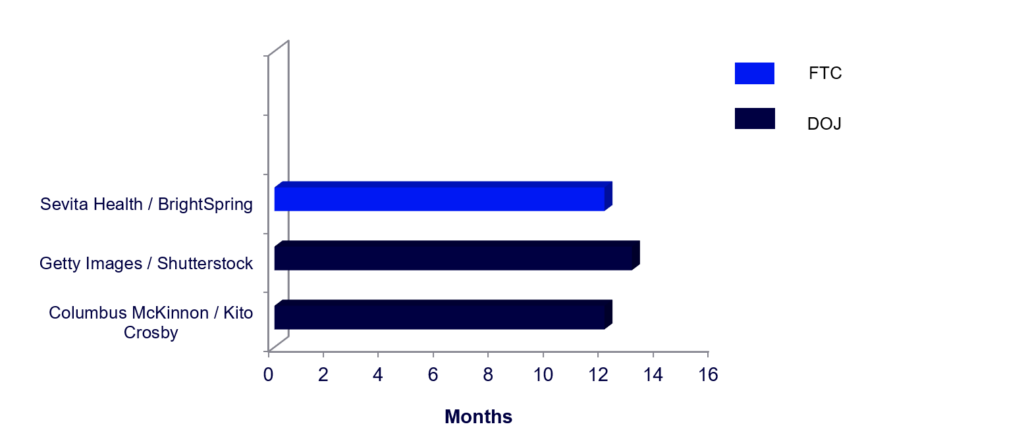
- FTC Chairman Ferguson emphasized that the FTC is open to negotiating settlements, which is a departure from policy under the Biden administration. The DOJ and FTC recently approved several transactions with settlements, including Sevita/BrightSpring, Columbus McKinnon/Kito Crosby, and Reddy Ice/Arctice Glacier. Ferguson expressed a distaste for “fake settlements ” that require extensive monitoring and noted a preference for “real settlements that fully protect competition” (which include divestitures of complete “lines of businesses,” with strong, upfront buyers). He also noted that behavioral remedies are disfavored and should be informed by the unique risks presented in different industries. Citing research suggesting that divestitures are “difficult” in retail and grocery contexts, Ferguson indicated that he will “require more” from parties in these sectors to show that their divestiture proposal preserves competition.
- For future FTC merger challenges, the FTC will attempt to litigate under the same standards as the DOJ. FTC Chairman Ferguson stated that his preference is to have the FTC challenge mergers by seeking a permanent injunction in federal court instead of the traditional FTC practice of seeking a preliminary injunction in federal court and then litigating on the merits in the FTC’s in-house administrative process. The FTC implemented this approach in its ongoing Loctite/Liquid Nails merger challenge.
- If Ferguson’s plan is put into practice, (1) the FTC will now have to meet the higher permanent injunction standard, (2) merging parties can expect lengthier timelines to trial on the merits, and (3) the commissioners can now engage in settlement negotiations during litigation because they are not in an adjudicative role.
States stepping up as DOJ shrinks and settles
- Twelve states and the District of Columbia continue to challenge a DOJ settlement approving Hewlett Packard Enterprise’s acquisition of Juniper Networks. The states’ intervention was prompted by reports from an ousted, formerly senior DOJ official that the settlement was a product of improper influence by lobbyists.
- Allegations of political interference have emerged again this quarter, related to the DOJ’s decision to clear, without a second request, the $1.6 billion merger of Compass and Anywhere, two of the largest real estate brokerages in the United States. The Wall Street Journal reported that Compass appealed to DOJ officials above Gail Slater, the former assistant attorney general of the Antitrust Division, who wanted to investigate the deal in-depth. Lawmakers have also raised concerns about Slater’s forced resignation in February 2026, given allegations that DOJ leadership overrode Antitrust Division officials in matters like HPE/Juniper and Compass/Anywhere.
- Parties should be aware that allegations of political influence may prompt intervention by state enforcers and private parties. For example, after Nexstar Media Group, Inc.’s, $6.2 billion acquisition of TEGNA Inc. received Federal Communications Commission (FCC) and DOJ approval – with a public endorsement from President Trump – a coalition of eight states filed a lawsuit to block the deal. Separately, DirecTV succeeded in obtaining an order to temporarily pause further integration efforts between the parties.
US Q1 2026 M&A activity: By the numbers
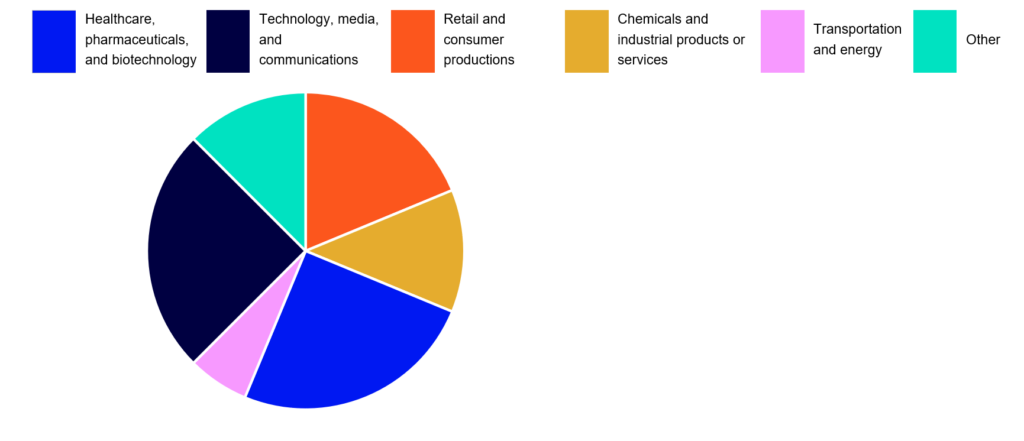
Number of enforcement actions in key industries1
Snapshot of selected enforcement actions2
Time from signing to consent or investigation closing