Content Type: Article

  • INSIGHT: Collaboration Among Unique Health-Care Providers to Drive Deals in 2019

    ARTICLE

    INSIGHT: Collaboration Among Unique Health-Care Providers to Drive Deals in 2019

    May 15, 2019

    Read time: 2 min

    Key takeaways
    Overview

    Stephen Bernstein, Kristian Werling and Eric Zimmerman authored this bylined article on how the health and life sciences fields have seen an explosion of vertical collaborations between unexpected partners looking to solve difficult challenges in health care, expand service offerings, and improve operational efficiencies.

    In depth
    Authors

    Kristian A. Werling

    Partner

    Chicago

    Eric Zimmerman

    Partner

    Washington, DC

    More insights

  • Focus on Innovation Centers: Understanding Pathways for Hospitals and Health Systems to Invest in Start-Ups

    ARTICLE

    Focus on Innovation Centers: Understanding Pathways for Hospitals and Health Systems to Invest in Start-Ups

    May 15, 2019

    Read time: 2 min

    Key takeaways
    Overview

    Investment in start-up biotech, digital health and medical device companies can help hospitals and health systems foster innovation and ensure access to cutting-edge technologies. This second installment in our Focus on Innovation Centers series dives into the various funding mechanisms available to hospitals and health systems when investing in innovative companies, including convertible notes, SAFEs, warrants, preferred stock and common stock.

    In depth
    Authors

    Kristian A. Werling

    Partner

    Chicago

    More insights

  • ‘Sutton 58 v. Pilevsky’: It’s Not All Bad News

    ARTICLE

    ‘Sutton 58 v. Pilevsky’: It’s Not All Bad News

    May 14, 2019

    Read time: 2 min

    Key takeaways
    Overview

    Jeffrey Steiner and Dino Fazlibegu authored this bylined article discussing the recent First Department Appellate Division decision Sutton 58 v. Pilevsky.

    In depth
    Authors
    More insights

  • Industrial Policy to Trump Competition? The Siemens/Alstom Railway Merger and its Aftermath

    ARTICLE

    Industrial Policy to Trump Competition? The Siemens/Alstom Railway Merger and its Aftermath

    May 2019

    Read time: 2 min

    Key takeaways
    Overview

    Jacques Buhart and David Henry co-authored this bylined article on Siemens/Alstom railway merger and how the political pressure played a role in relaxing competition rules.

    In depth
    Authors
    More insights

  • What the New DOJ Compliance Program Guidance Means to Health Systems and Their Boards

    ARTICLE

    What the New DOJ Compliance Program Guidance Means to Health Systems and Their Boards

    May 10, 2019

    Read time: 2 min

    Key takeaways
    Overview

    Michael Peregrine and Tony Maida co-authored this bylined article discussing the Department of Justice’s newest compliance program guidance.

    In depth
    Authors

    Tony Maida

    Partner

    New York – One Vanderbilt Avenue

    More insights

  • Update on the Real Estate Transfer Tax on Real Estate Share Deals

    Update on the Real Estate Transfer Tax on Real Estate Share Deals

    ARTICLE / CLIENT ALERT

    Update on the Real Estate Transfer Tax on Real Estate Share Deals

    May 10

    Read time: 2 min

    Key takeaways
    Overview

    On May 8, 2019, the Federal Ministry of Finance submitted the long awaited draft bill for the pending real estate transfer tax reform. This overview highlights the upcoming changes and is currently only available in German.

    Read the client alert, “Update zur Grunderwerbsteuer bei Immobilien-Share Deals.”

    In depth
    Authors

    Dr. Kian Tauser

    Partner

    Frankfurt

    Marcus Fischer

    Counsel

    Frankfurt

    Dr. Jens Ortmanns

    Partner

    Düsseldorf, Cologne

    More insights

  • INSIGHT: Marijuana, Excise Taxes, and the Black Market

    INSIGHT: Marijuana, Excise Taxes, and the Black Market

    ARTICLE

    INSIGHT: Marijuana, Excise Taxes, and the Black Market

    May 9, 2019

    Read time: 2 min

    Key takeaways
    Overview

    Robert Kline authored this bylined article comparing how states have approached taxing recreational marijuana and policy considerations as sales increase across the US.

    In depth
    Authors

    Robert M. Kline

    Counsel

    Miami

    More insights

  • OCR Corrects Past Misinterpretation of HIPAA Annual Penalty Limits, Signaling Potential Relief for Entities Facing Enforcement

    OCR Corrects Past Misinterpretation of HIPAA Annual Penalty Limits, Signaling Potential Relief for Entities Facing Enforcement

    ARTICLE / CLIENT ALERT

    OCR Corrects Past Misinterpretation of HIPAA Annual Penalty Limits, Signaling Potential Relief for Entities Facing Enforcement

    May 9, 2019

    Read time: 9 min

    Key takeaways
    Overview

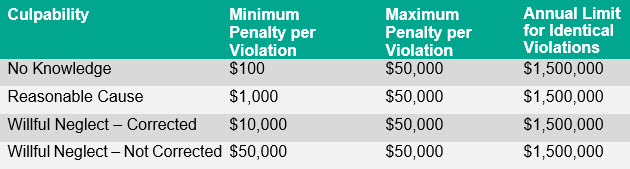
    On April 26, 2019, the US Department of Health and Human Services (HHS), Office for Civil Rights (OCR) issued a Notification of Enforcement Discretion Regarding HIPAA Civil Money Penalties (the Notice) to inform the public that OCR will exercise its discretion in assessing Civil Money Penalties (CMPs) as set forth by Congress in the Health Insurance Portability and Accountability Act of 1996 (HIPAA), as amended by the Health Information Technology for Economic and Clinical Health (HITECH) Act. Current OCR regulations erroneously apply the same cumulative annual CMP limit of $1.5 million across the four categories of violations based on the level of culpability, despite the statute setting four different annual limits. The Notice states that, as a matter of enforcement discretion, OCR will now apply a different cumulative annual CMP limit for each of the four penalties tiers in the HITECH Act, as Congress set forth, and will engage in rulemaking to further address this issue. In this article, we summarize the Notice and analyze its implications for HIPAA-covered entities and business associates.

    In depth

    Annual CMP Caps Prior to the Notification of Enforcement Discretion

    When enacting the HIPAA administrative simplification provisions, Congress authorized the Secretary of HHS or his designee to impose a maximum CMP of $100 for each violation, subject to a calendar year cap of $25,000 for all violations of an identical requirement or prohibition. In response, OCR issued a HIPAA enforcement final rule on February 16, 2006, which, among other things, incorporated penalties consistent with the $100 per violation cap and $25,000 annual cap under the statute. The HITECH Act, enacted in February 2009, increased the minimum and maximum potential CMPs for HIPAA violations. Specifically, Section 13410(d) of the HITECH Act established four categories for HIPAA violations, with increasing penalty tiers based on the level of culpability associated with the violation:

    1. Person did not know (and, by exercising reasonable diligence, would not have known) that the person violated the provision;
    2. Violation was due to reasonable cause, and not willful neglect;
    3. Violation was due to willful neglect that is timely corrected; and
    4. Violation was due to willful neglect that is not timely corrected.

    The penalty amounts under the HITECH Act corresponding to each culpability level or violation type above are as follows:

    1. $100 per violation, with a cap of $25,000 on violations of an identical requirement or prohibition during a calendar year (42 U.S.C. 1320d- 5(a)(3)(A));
    2. $1,000 per violation, with a cap of $100,000 on violations of an identical requirement or prohibition during a calendar year (42 U.S.C. 1320d-5(a)(3)(B));
    3. $10,000 per violation, with a cap of $250,000 on violations of an identical requirement or prohibition during a calendar year (42 U.S.C. 1320d-5(a)(3)(C)); and
    4. $50,000 per violation, with a cap of $1,500,000 on violations of an identical requirement or prohibition during a calendar year (42 U.S.C. 1320d-5(a)(3)(D)).

    Given that OCR has chosen to assess ongoing or repeated HIPAA violations (e.g., failure to conduct an accurate and thorough risk analysis) as one violation per day (365 days per year), these calendar year caps are highly relevant restrictions.

    On October 30, 2009, OCR issued an interim final rule (IFR) to implement the enhanced penalty provisions of the HITECH Act. At the time, OCR took the view that the HITECH Act’s penalty provisions were “conflicting” because they referenced two levels of penalties for three of the four violation types. Despite the fact that the HITECH Act provided four different annual penalty caps, the IFR concluded that “the most logical reading” of the law was to apply the highest annual cap of $1.5 million to all violation types, stating that this was “consistent with Congress’ intent to strengthen enforcement.”

    On January 25, 2013, OCR adopted the text of the IFR as a final rule (Enforcement Rule) without change to the penalty tiers and annual limits. OCR noted in the preamble that, “[i]n adopting the HITECH Act’s penalty scheme, the Department recognized that section 13410(d) contained apparently inconsistent language (i.e., its reference to two penalty tiers ‘for each violation,’ each of which provided a penalty amount ‘for all such violations’ of an identical requirement or prohibition in a calendar year). To resolve this inconsistency, with the exception of violations due to willful neglect that are not timely corrected, the IFR adopted a range of penalty amounts between the minimum given in one tier and the maximum given in the second tier for each violation and adopted the amount of $1.5 million as the limit for all violations of an identical provision of the HIPAA rules in a calendar year.” See 78 FR 5566, 5582 (Jan. 25, 2013).

    Commenters responded to the Enforcement Rule by expressing concern about the $1.5 million cap for all penalty tiers, arguing that because the outside limits were the same for all culpability categories, the Enforcement Rule “ignored the outside limits set forth by the HITECH Act within the lower penalty tiers, rendering those limits meaningless.” 78 FR at 5583. In responding to these comments, OCR stated that it continued to believe “that the penalty amounts are appropriate and reflect the most logical reading of the HITECH Act, which provides the Secretary with discretion to impose penalties for each category of culpability up to the maximum amount described in the highest penalty tier.” Id. As a result, the Enforcement Rule applies an annual upper limit of $1.5 million for each of the four culpability tiers, as shown below:
    Changes under the Notification of Enforcement Discretion

    As set forth in the Notice, upon further review of the statute by the HHS Office of the General Counsel, OCR has determined that the better reading of the HITECH Act is to apply annual limits follows, as they are set forth in the statute itself:
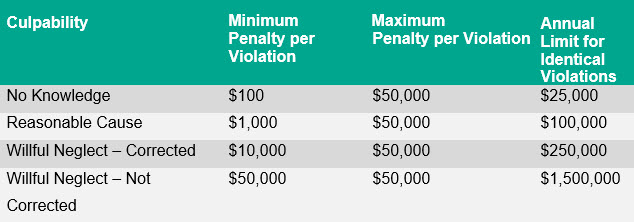
    OCR has announced that it will use this penalty tier structure, as adjusted for inflation, until further notice. OCR expects to engage in future rulemaking to revise the penalty tiers in the current regulation to “better reflect the text of the HITECH Act.” Among other things, the rulemaking may clarify how OCR will reconcile the discrepancy between the new $25,000 annual limit for identical violations in the first tier, which is half of the $50,000 maximum penalty per violation for this same tier.

    Analysis

    Since the passage of the Enforcement Rule, we have seen numerous multi-million dollar settlements CMPs imposed for alleged HIPAA violations. For example, in 2016, an Illinois health care system agreed to pay $5.55 million settle allegations that it violated HIPAA. At the time, the settlement was the biggest CMP involving a single entity. At the end of 2018, a major health insurance payor agreed to pay $16 million to settle alleged HIPAA violations.

    OCR’s revised enforcement approach may mean lower penalties for Covered Entities and Business Associates that have taken measures to comply with HIPAA. Because OCR’s budget for enforcement is derived from its recoveries, the lower penalties may also mean that OCR has fewer resources to pursue claims against Covered Entities and Business Associates.

    This correction is likely to be particularly galling for entities that have been assessed CMPs for HIPAA violations in the past. For example, a children’s hospital in Texas was assessed a $3,217,000 HIPAA penalty in 2017 based entirely on “Tier II” (i.e., reasonable cause level) violations, of which $2,410,000 (75%) was directly attributable to OCR’s prior misinterpretation of the HITECH Act. Now, OCR would impose just over $800,000 in penalties on the very same factual findings and legal conclusions.

    The same is true to a large extent for many of the nearly 60 entities that have settled alleged HIPAA violation findings with OCR to avoid the imposition of CMPs. Each time we have negotiated such a settlement with OCR, OCR has used the prior (erroneous) version of the CMP caps to threaten excessive penalties against our clients if settlement could not be reached. We have argued this very issue of statutory fidelity (and void contrary regulations) to OCR each time, but it fell on deaf ears with OCR stating that it is required to follow its own regulations.

    Markedly, the Notice comes on the heels of two actions that were recently filed by University of Texas MD Anderson Cancer Center against OCR: (1) a petition in the US Court of Appeals for the Fifth Circuit for review of the HHS Departmental Appeals Board Decision to impose CMPs on MD Anderson, and (2) a complaint for declaratory and injunctive relief filed in the US District Court for the Southern District of Texas. In 2018, MD Anderson experienced a breach involving the electronic protected health information of 34,883 patients. OCR subsequently investigated and alleged MD Anderson violated HIPAA and its implementing regulations by failing to use encryption, imposing a $4.348 million penalty for the alleged violations. MD Anderson is arguing that the penalty exceeds the maximum CMP for a HIPAA violation under the reasonable cause penalty tier, and further, that the penalty is in breach of the Eighth Amendment to the United States Constitution.

    At an International Association of Privacy Professionals Global Privacy Summit session last week, Timothy Noonan, OCR’s Acting Deputy Director for Health Information Privacy, explained that OCR issued the Notice as a result of HHS’ department-wide regulatory reform efforts that involve the reexamination of each HHS agency’s activities in light of its respective statutory authorities.

    It remains to be seen whether OCR will adjust its approach to pursuing enforcement actions or negotiating settlements in order to maximize its collections under the corrected penalty tier structure. For instance, OCR could prioritize cases involving alleged violations that fall within the “willful neglect—not corrected” level of culpability, for which the annual cap for identical violations remains $1.5 million. It is further possible that going forward, OCR will resolve a larger percentage of its investigations through enforcement actions as opposed to providing technical assistance or taking other corrective actions that do not involve monetary payments by covered entities or business associates. In addition, OCR may begin demanding monetary settlement amounts that reflect higher percentages of the maximum potential CMPs that can be assessed against entities.

    It will also be interesting to see whether OCR makes any effort to make this correction retroactive—but we are not holding our breath. We will continue to monitor further updates regarding OCR’s new, corrected interpretation of the HITECH Act and annual CMP limits, including further rulemaking on this topic.

    Authors
    More insights

  • Florida’s HB 1243 Stalls, but Restrictive Covenant Provisions Move Forward

    Florida’s HB 1243 Stalls, but Restrictive Covenant Provisions Move Forward

    ARTICLE / CLIENT ALERT

    Florida’s HB 1243 Stalls, but Restrictive Covenant Provisions Move Forward

    May 8, 2019

    Read time: 6 min

    Key takeaways
    Overview

    Florida’s HB 1243, with its proposed reporting requirements that would have directly affected timelines for health care transactions, particularly those involving hospitals or medical practices with four or more physicians, was withdrawn from consideration in the Florida Senate. However, a new bill – HB 843 – containing identical restrictive covenant provisions is expected to become law on July 1, 2019.

    In depth

    On May 3, 2019, the Florida Senate indefinitely postponed and withdrew from consideration HB 1243, which had caught the attention of providers and dealmakers since it passed the Florida House of Representatives on April 11, 2019. Had this bill passed the Senate and been signed into law by Florida’s governor, it would have directly affected timelines for health care transactions, particularly those involving hospitals or medical practices with four or more physicians.

    The bill contained two distinct sections. The first section would have imposed certain reporting requirements when a Florida hospital or group practice contemplated a transaction that would result in a material change to the health care market. The first section also would have required a Florida hospital or group practice to provide notice to the State of Florida any time it made a Hart-Scott-Rodino Act (HSR) filing with the Federal Trade Commission or the US Department of Justice, and, if requested, to allow the State to review the HSR filing and request additional information. The bill’s second section provided that if an entity employed all of the physicians who practice a certain medical specialty in one county, it could not restrict a physician from practicing that same specialty in the county (non-competition restriction).

    While the first section of the bill will not become law anytime soon, the second section, with its non-competition restriction, is waiting to be signed into law. On April 29, 2019, the Florida House and Senate approved HB 843, Section 10 of which contains identical language to HB 1243’s non-competition restriction. Assuming the Florida governor signs HB 843 into law, its provisions, including the invalidation of those restrictive covenants, are set to become effective on July 1, 2019.

    Although HB 1243 was indefinitely postponed and withdrawn, we will closely monitor new pieces of legislation in future legislative sessions. HB 1243 received unanimous support from the House, and therefore similar reporting requirements or other changes affecting dealmaking could resurface in the future.

    Required Reporting for Mergers and Acquisitions

    HB 1243 primarily caught dealmakers’ attention because of its proposed reporting requirements, which would have required notification to the State at least 90 days prior to the closing of most transactions involving hospitals or group practices with four or more physicians.

    Reporting Requirements

    The bill would have required group practices, hospitals and hospital systems with four or more physicians to provide advance notice of certain transactions to the Office of the Attorney General. Specifically, HB 1243 would have required Florida hospitals and group practices intending to go through a material change to provide information to the State, including the primary area served by the parties, a description of the proposed transaction, the physician specialty involved in the material change, and a description of any prior material change occurring in the five years before the date of notice.

    The notice was required to be submitted at least 90 days prior to the closing of the transaction.

    The proposed requirement also provided for a significant penalty in the event of non-compliance. Under HB 1243, failure to provide timely notice to the Office of the Attorney General within the prescribed 90-day period would have resulted in a fine of up to $500,000.

    Transactions Requiring Reporting

    The proposed bill required notice upon any material change, including:

    • A merger, consolidation or affiliation
    • The employment of all or substantially all of the physicians of a group practice
    •  The acquisition of all or substantially all of the properties and assets of a group practice; the capital stock, membership interest or other equity interests of a group practice; or one or more insolvent practices

    The notice requirement applied not just to mergers and acquisitions, but also to any “affiliation” between entities. The bill defined affiliation as “a relationship between two or more entities that allows the entity to jointly negotiate with one or more other parties over professional medical services or reduces the primary service area in which at least one of the entities provides professional services.” Unlike HSR, the bill did not include a dollar threshold for this notice requirement, and thus the hospital or group practice would have been required to report any transaction that fell into one of the enumerated categories above.

    Unenforceability of Certain Physician Restrictive Covenants

    While HB 1243 did not make it through the Senate this session, HB 843, which contained the same non-competition restriction, did. Section 10 of HB 843 amends Florida’s non-compete statute and invalidates restrictive covenants with licensed physicians in limited circumstances.

    Under HB 843, an entity that employs all of the physicians who practice a certain medical specialty in one county will not be able to restrict its physicians from practicing that specialty in the same county. If the entity entered into such a restrictive covenant with its physician, the restrictive covenant will be void and unenforceable. The restrictive covenant will remain void and unenforceable until three years after another entity enters the market in that county and begins offering those specialty services. It is unclear whether this provision would have retroactive application for agreements entered into prior to July 1, 2019.

    Key Takeaways

    If the Florida Governor approves HB 843, restrictive covenants with physicians in a specific practice area will be unenforceable if the entity employs all physicians of that certain specialty in one county, and will continue to be unenforceable for three years after another competing entity enters that county.

    Dealmakers and health care providers should continue to monitor Florida legislative activities to see if reporting requirements, or similar items that could affect deals, resurface in future legislative sessions.

    Authors

    Adam J. Rogers

    Partner

    Miami

    More insights

  • The Proposed FDII Regulations: Foreign Use of IP

    ARTICLE

    The Proposed FDII Regulations: Foreign Use of IP

    May 8, 2019

    Read time: 2 min

    Key takeaways
    Overview

    Lowell Yoder authored this bylined article discussing the proposed regulations for determining the foreign use of intangible property for purposes of qualifying for the 13.125% FDII tax rate.

    In depth
    Authors

    Lowell D. Yoder

    Partner

    Chicago

    More insights