
ARTICLE / CLIENT ALERT
Relaxation of EU Securitization Framework: Spotlight on Significant Risk Transfer (SRT) Transactions
October 20, 2025
Read time: 9 min
In this alert, we assess the impact of the proposed amendments to the EU securitization framework (which we discussed in detail in our previous article) on EU banks’ ability to reduce capital requirements using significant risk transfer (SRT) structures.
The announced measures, including the harmonization of the regulatory approval process with new principle-based criteria and a broader opening to insurers and multilateral development banks, are expected to positively influence the development of the SRT markets. However, given the controversy surrounding the proposals, the extent to which they will enter into force remains uncertain.
Background
The SRT transactions, often referred to in the U.S. as “credit risk transfer” transactions or “synthetic securitizations” and in the EU legislation as “on-balance-sheet securitizations”, are a tool that enables banks to reduce their regulatory capital requirements (broadly speaking, the amount of capital they must lock in, corresponding to the riskiness of the lending portfolio).
Although banks have been using SRT structures since the 1990s, recent developments have significantly increased their popularity. At the outset, the phased implementation of higher capital requirements stemming from the Basel III reforms has pushed lenders toward alternative capital relief structures, which are cheaper than issuing additional equity and do not force the banks to reduce the existing loan portfolios. This trend was further reinforced by the increase in interest rates which increased the overall costs of issuance of any of the commonly issued regulatory capital products (such as AT1 or CET1 instruments), following the spectacular write-off by the Swiss regulator of all AT1 bonds issued by Credit Suisse in 2023.
SRT structures exist in different variants. They may be funded or unfunded, involving traditional or synthetic securitization, with or without the use of an SPV. The most typical SRT structure is set out below and involves a bank (an originator or protection buyer), an SPV (a securitization vehicle), and an investor (a protection seller).

Illustration of a typical SRT structure.
In this structure:
- The bank selects loans to be included in the reference portfolio (usually comprising investment-grade corporate loans or those granted to small and medium-sized enterprises (SME) and divides them into three tranches: senior, mezzanine and first-loss tranche. The bank retains the senior and first-loss tranches.
- Regarding the mezzanine tranche, the bank enters into a financial guarantee or a credit default swap with the SPV, referencing the loans included in that tranche. Under that instrument, the SPV will compensate the bank for any losses stemming from these loans. In exchange, the bank will pay a protection fee to the SPV.
- At the final stage, the SPV issues a Credit-linked Note (the CLN) to investors (usually specialised credit funds, asset managers, public or multilateral development banks, or insurance companies) whose proceeds are held in a custody account and are used to fund the losses. The protection fee paid by the bank to the SPV is passed on to the investors as coupon payments under the CLN.
Contrary to traditional securitization, all portfolio loans remain on the bank’s balance sheet. However, for regulatory purposes, the mezzanine tranche with respect to the loans is treated as if removed from the balance sheet, thereby decreasing the capital the bank is required to hold against its loan portfolio.
Owing to regulatory constraints, only the mezzanine tranche can be utilized for the purposes of SRT. Among other things, these include the quantitative and qualitative criteria set out in Regulation (EU) 575/2014 (the CRR) and the risk retention requirements under Regulation (EU) 2017/2402 (the Securitization Regulation). Additionally, SRT structures remain subject to prior approval by the relevant competent authority, in compliance with the Public Guidance on the recognition of significant credit risk transfer (the SRT Guidance) issued by the European Central Bank (ECB).
New Securitization Rules Impacting SRT Transactions
The recent package of amendments to the EU securitization framework will introduce a number of changes to the existing SRT regime. Some of them aim to correct shortcomings identified by the European Banking Authority (the EBA) in the Report on SRT published in 2020. The EBA pointed to several flaws that contribute to market uncertainty, approval delays, and unjustified inconsistencies in the treatment of SRT securitizations with comparable characteristics across EU Member States. Other measures introduce additional incentives to the development of the SRT markets across the EU.
- New Harmonized Regulatory Approval ProcessAlthough the SRT approval process is currently governed by the SRT Guidance, the competent authorities of EU Member States have broad approval powers, including for certain SRT structures that do not satisfy the quantitative criteria under the CRR. This situation has resulted in significant differences between jurisdictions with varying local market practices.The amendments propose to harmonize the SRT approval process, to be enshrined in a new delegated regulation issued under the CRR, drawing on the fast-track process that is currently being implemented by the ECB. Further, the authorities would no longer have the power to approve non-compliant SRT structures (except for comprehensive reviews of complex and innovative transactions, to be further clarified in the delegated regulation).
- New Principle-Based Approach TestAs of now, in order to provide expected capital relief to the bank, the SRT needs to comply with the quantitative and qualitative tests set out in Articles 244 and 245 of the CRR. Often referred to as mechanical tests, they require, among other things, (i) the transfer of at least 50% of loans in the mezzanine tranche (in a three-tranche securitization), or at least 80% of the nominal amount of the first-loss position (in a two-tranche securitization), and (ii) that the capital relief obtained by the bank be less than the losses transferred. The new framework would replace these tests with a new principle-based approach (the PBA) test, requiring the bank to transfer at least 50% of the unexpected losses of the exposures of the underlying portfolio to investors. Additionally, to streamline regulatory assessment, the bank would need to submit a self-assessment demonstrating compliance with the PBA test, including under stress conditions, to be accompanied by a cash-flow model analysis. The details will be published in the delegated regulation.
- Increasing Access to SRT Transactions
- InsurersThe proposals will make several amendments to the Solvency II framework to incentivize insurers’ investment in SRT transactions.Among other things, the applicable risk factors for securitization investments will be reduced to align the insurance framework with the revised banking (CRR) rules. For instance, in securitizations qualifying as simple, transparent, and standardized (“STS“) under the Securitization Regulation, the prudential treatment of senior tranches will be aligned with the treatment of covered bonds. The STS label allows parties engaged in securitizations to apply lower capital requirements compared with non-STS securitizations.Further, the new rules will allow unfunded guarantees issued by insurers in the context of SRT transactions to satisfy the STS criteria (a possibility currently limited to specific public bodies and multilateral development banks).
- Multilateral Development BanksThe new regime will also increase the attractiveness of the SRT markets for multilateral development banks by waiving the risk retention and due diligence requirements under the Securitization Regulation for SRT securitizations whose first-loss tranche is guaranteed or held by such banks. This tranche will need to represent at least 15% of the nominal value of the securitized exposures.
- Investment LoansAs of now, for a securitization to qualify as an STS one, 100% of its underlying pool of exposures must consist of loans granted to SMEs. The amendments propose to lower this requirement to 70%, thereby opening the STS label and its benefits (i.e., lower capital requirements) to SRT transactions involving investment-grade corporate loans.
Assessment: Positive but Uncertain Change
The overall impact of the amendments on the development of SRT markets is expected to be unambiguously positive. On the structural level, the new regime would provide a streamlined approval process and greater market consistency, while offering banks necessary flexibility through the PBA test.
From a commercial perspective, the changes would increase access and the attractiveness of SRT structures, resulting in increased market liquidity. The proposed changes appear specifically tailored to support SRT market trends.
On one hand, insurers’ participation in SRT transactions remains limited, with their estimated share of the SRT market representing only 5% in 2023. Despite the fact that, as observed by the Commission, the insurance sector, “with trillions of assets under management,” remains a key institutional investor in the EU, SRT securitizations accounted for less than 1% of insurers’ portfolios in 2025. The amendments aim to incentivize EU insurers to engage in SRT transactions and, as a result, contribute to increasing EU banks’ lending capacity.
On the other hand, the participation of multilateral development banks in SRT transactions has been growing, with their share of the SRT market reaching 15% in 2023. European development banks, such as the European Investment Bank (EIB) (through its investment vehicle, the European Investment Fund (EIF)) or the European Bank for Reconstruction and Development (EBRD), are increasingly becoming significant players in the SRT markets. The Commission’s proposals reflect this trend and aim to encourage these institutions to continue expanding their activities in this area.
Controversy arises, however, around the need for reforms and their potential effects, with dissenting voices coming from within EU institutions, including bodies such as the EBA, the European Insurance and Occupational Pensions Authority (EIOPA) or the European Securities and Markets Authority (ESMA), as discussed in our previous article. More recently, this position was reinforced by Pedro Machado, Member of the ECB’s Supervisory Board, who expressed “fear that the proposals may have gone too far in reducing capital requirements for more complex transactions” and announced a detailed assessment of the measures in the upcoming opinion from the ECB. The extent to which, and when, the package will be implemented remains, therefore, uncertain.
Feel free to reach out to our team if you would like to learn more about the SRT markets or explore how you can benefit from the changes to the EU securitization framework.



3M Co. v. Commissioner: IRS shipwrecks hard on the shoals of Loper Bright
ARTICLE
3M Co. v. Commissioner: IRS shipwrecks hard on the shoals of Loper Bright
Oct 16, 2025
Read time: 6 min
3M Co. v. Commissioner, 136 AFTR 2d 2025-, (8th Cir.) (Oct.1, 2025), is perhaps the most significant tax case to date that implements Loper Bright’s instruction regarding evaluation of an agency’s exercise of delegated authority.[1] The unanimous panel held that:
- The Internal Revenue Services’ (IRS) adjustment imputing additional royalty income to 3M from its Brazilian affiliate was invalid because it was outside the authority delegated by Internal Revenue Code Section 482.
- The underlying regulation, Reg. § 1.482-1(h)(2) (the blocked income regulation), was invalid for the same reason.
The IRS’s change of tack
Those following the US Court of Appeals for the Eighth Circuit’s consideration of the case were aware that the Court had asked the parties to file supplemental briefing on the impact of the Loper Bright decision, which was handed down after the US Tax Court’s decision. The focus of the Tax Court dispute was whether the blocked income regulation was a valid implementation of the statute under Chevron and the Administrative Procedure Act. A plurality of that court agreed it was.
In its briefing before the Eighth Circuit, the IRS pivoted[2] and argued that even if the Court determined that the blocked income regulation was invalid, Code Section 482 provided direct authority to the IRS to make adjustments to income. The IRS maintained that it did not need a regulation to support the adjustment in the case. Moreover, the IRS argued, where adjustments relate to the transfer of intangible property (such as here), its authority was only constrained by the requirement that the adjustment conform to the income commensurate with that attributable to the intangible.[3] Because the parties agreed that the higher royalty would have been paid to an unrelated party, slip op. at 2, the IRS maintained it was authorized to make the adjustment to 3M’s income.
No one can be taxed on income they can’t have
The IRS’s maneuver did not deter the Eighth Circuit from carefully following the mandate it had received via Loper Bright to evaluate whether the agency’s exercise of authority was within its statutory mandate. In other words, even if the IRS could act without a regulation to make adjustments under Code Section 482, the exercise of its authority under that section must remain within the confines of the statute: “[I]t is still our job to ‘fix[] the boundaries of [that] delegated authority’ based on the statute’s text, as we have done today.” Slip. op. at 11 (quoting Loper Bright). Viewed through this lens, the Eighth Circuit found that the adjustments asserted by the IRS were well outside the authority granted by Code Section 482. Because the blocked income regulation purported to exercise the same extra-statute authority, it too was found deficient.
According to the Eighth Circuit, Code Section 482’s broad delegation to the IRS by its terms is limited to making adjustments where necessary to avoid evasion or distortion of income. However, in Comm’r v. First Sec. Bank of Utah, N.A., 405 U.S. 394 (1972), the Supreme Court of the United States determined that income for Code Section 482 purposes does not include what a taxpayer did not receive and was prohibited from receiving. In 3M’s case, Brazilian law prohibited 3M from receiving royalties from its Brazilian affiliate. Consequently, 3M was not evading income, and neither was its income being distorted because there was no income to distort for Code Section 482 purposes. Accordingly, the IRS’s adjustment under Code Section 482 was not a valid exercise of authority whether viewed as proceeding directly under the statute or through the blocked income regulation.
Additionally, the IRS’s appeal to section 482’s commensurate with income rule did not save its position either. The Eighth Circuit acknowledged that this rule was introduced into the statute after the Supreme Court decided in First Sec. Bank. However, the Eighth Circuit observed that when enacted, the rule became part of an existing framework of delegation which by its own terms allowed an adjustment only where income was being evaded or distorted. “The point is that, from a plain-and-ordinary-meaning standpoint shifting income to 3M here would not ‘clearly . . . reflect [its] income.’” Slip op. at 7.
Skidmore is fading
Loper Bright largely – if not completely – discarded deference as a judicial tool in statutory construction. The clear instruction from the Supreme Court was that the judiciary should independently determine what is the best reading of any law apart from what an agency’s rule might say. However, Loper Bright referred to Skidmore v. Swift & Co., 323 U.S. 134 (1944), as a possible guide for deciding that best reading. Loper Bright, 603 U.S. at 388.
Skidmore’s guidance to consider various factors relating to agency interpretations, such as the expertise of the agency, has been described as a type of deference generally asking whether the agency’s position is persuasive and, if so, a court should consider deferring to that position. In 3M, the Eighth Circuit declined the IRS’s appeal to its expertise and to Skidmore deference because the IRS’s position was recently invented and, more importantly, “the statute has another better reading.” Slip op. at 11. While Skidmore will still be relied upon by the IRS and other agencies, the 3M decision suggests its continuing vitality as a practical matter is fading, especially where a court decides it has a clear understanding of the meaning of a statute using ordinary statutory construction tools.



[1] Loper Bright Enters. v. Raimondo, 603 U.S. 369 (2024).
[2] The Eighth Circuit observed that “[w]hen the case started, it was all about the blocked-income regulation that it claimed was a reasonable interpretation of a silent statute.” Slip op. at 10. The Court then noted that the government moved with the “shifting sands” of administrative law by relegating the regulation it fought so hard to vindicate to the background in favor of its new Code Section 482 argument. Id.
[3] “In the case of any transfer (or license) of intangible property (within the meaning of Section 367(d)(4)), the income with respect to such transfer or license shall be commensurate with the income attributable to the intangible.” Code Section 482.

AB 1415 expands OHCA’s authority over PE, hedge fund investments
ARTICLE / CLIENT ALERT
AB 1415 expands OHCA’s authority over PE, hedge fund investments
October 14, 2025
Read time: 6 min
Days after signing Senate Bill (SB) 351, California Governor Gavin Newsom signed Assembly Bill (AB) 1415 into law on October 12, 2025, amending the California Office of Health Care Affordability (OHCA) implementing statute to bring healthcare investments by private equity (PE) groups and hedge funds more fully into the scope of the OHCA transaction review process. The statute also introduces new reporting obligations for management services organizations (MSOs) undergoing a sale or transfer of a material amount of assets or a change of control. The statute will take effect on January 1, 2026.
For more information on the implications of AB 1415 and SB 351, please consider attending our upcoming webinar, “Decoding California’s Private Equity Reform: Impacts of SB 351 and AB 1415,” on October 23, 2025.
Background
OHCA’s transaction review process took effect on April 1, 2024, and currently requires “health care entities” to report certain material transactions to OHCA at least 90 days before the closing of the transaction. Transactions subject to review by other agencies, as well as those that do not meet specified thresholds for revenue, assets, or change-of-control percentages, are exempt from the OHCA transaction review process. After reviewing the information provided in the transaction notification, OHCA has the right to conduct a more thorough cost and market impact review (CMIR), which can significantly delay the closing of a transaction by at least several months.
Following Governor Newsom’s veto of AB 3129 during the prior legislative session, legislators introduced AB 1415 to expand OHCA’s review authority, particularly as it applies to healthcare investments by PE groups and hedge funds, but the recently-signed statute will have implications for health systems and other stakeholders.
New notification requirements for “noticing entities” and transactions involving MSOs
Under the existing OHCA requirements, only certain “health care entities” are required to provide notice of material transactions. AB 1415 introduces a new reporting obligation for “noticing entities” and MSOs when they enter into agreements or transactions involving a sale of a material amount of assets or transfer of control of a health care entity or MSO. “Noticing entities” are defined to include PE groups, hedge funds, MSOs, newly formed business entities created to enter into agreements or transactions with health care entities, and entities that own or operate a provider.
New focus on MSOs
AB 1415 broadly defines an MSO as an entity that provides management and administrative support services for a provider in support of the delivery of healthcare services. However, management and administrative support services must include either provider rate negotiation, revenue cycle management, or both, which helps narrow the types of entities that are considered MSOs under AB 1415. The definition also includes a carve out for entities that own one or more general acute care or acute psychiatric hospitals, acknowledging that such entities are not traditionally considered MSOs.
In addition to being subject to the notification requirements outlined above as a designated “noticing entity,” MSOs may be subject to future data reporting requirements from OHCA. While the exact nature of these data reporting requirements is unclear, it is anticipated that OHCA will seek greater insight into the nature of MSOs’ relationships with other health care entities.
Key takeaways
- OHCA’s expanded authority would likely apply to transactions closing on or after January 1, 2026, and may capture certain transactions that are not reviewable by OHCA under the current requirements. Stakeholders entering into transactions that are anticipated to close after January 1, 2026, should closely review the updated statutory language to determine whether they will be required to provide notice to OHCA. Although OHCA does not have the power to approve or impose conditions on a transaction, OHCA’s decision to conduct a CMIR can significantly delay the closing of a transaction.
- OHCA will likely need to promulgate new regulations to effectuate the amendments made by AB 1415 and make corresponding changes to its submission portal. Those new regulations may provide additional clarity as to timing, revenue thresholds, contents of the notice, and other details for the new reporting requirements applicable to “noticing entities” and MSOs, although OHCA may simply apply its existing thresholds and standards for health care entity notices to “noticing entities” and MSOs. Stakeholders should closely monitor the development of those regulations and consider submitting comments during the applicable public comment periods.
- Transactions solely involving a sale of assets or change of control of an MSO would escape regulatory scrutiny under the existing OHCA notice process, but they may become reportable under the new requirements. Importantly, not all MSOs are captured by AB 1415, as the definition of an MSO is limited to entities that provide services to a “provider,” which has a specific definition under the OHCA statute. For example, MSOs that solely provide services to home health agencies, physician groups with fewer than 25 physicians, and other entities that are not considered “providers” would not be subject to the new requirements under AB 1415.
- Given that notifications to OHCA require a substantial amount of information regarding the reporting entities and their operations, the new reporting requirement applicable to “noticing entities” will likely allow OHCA to gain significantly more visibility into the operations of PE groups and hedge funds. The information required in the notice could include financial statements, organizational charts, and information regarding past healthcare transactions consummated by the PE group or hedge fund, among other things.
- Health systems and other stakeholders may be impacted by the AB 1415 provision that requires newly created business entities to provide notice to OHCA when they enter into transactions with health care entities or MSOs. This provision tightens a loophole in the current OHCA requirements, such that parties may no longer be able to avoid the notice requirements simply by using a newly formed entity to purchase the assets or equity of a health care entity.
- AB 1415 is one of two bills signed by Governor Newsom this month targeting PE and hedge fund involvement in healthcare. The other bill, SB 351, codifies California’s existing prohibitions on the corporate practice of medicine and dentistry as they apply to PE groups and hedge funds. For more information on SB 351, see our recent client alert, “Newsom Signs SB 351, Codifying Existing California CPOM Guidance.”






Trending in Telehealth: September 2025
ARTICLE
Trending in Telehealth: September 2025
Oct 13, 2025
Read time: 6 min
Trending in Telehealth highlights monthly state legislative and regulatory developments that impact healthcare providers, telehealth and digital health companies, pharmacists, and technology companies that deliver and facilitate the delivery of virtual care.
Trending in September:
- Telehealth disciplinary guidelines
- Telepharmacy
- Behavioral health
A CLOSER LOOK
Proposed legislation & rulemaking:
- The Florida Board of Nursing proposed rules would update its disciplinary guidelines for telehealth registrants to identify additional violations subject to disciplinary actions. The proposed rules address violations such as failing to remit funds owed to the state Medicaid program following a final order, judgment, stipulation, or settlement and failing to comply with statutory requirements for refunding overpayments to patients. Disciplinary actions for these violations range from a minimum of license denial or suspension with a corrective action plan, to a maximum penalty of license revocation.
- The Louisiana Addictive Disorder Regulatory Authority (ADRA) proposed to adopt and enact LAC 46:LXXX § 2101 to align with the Louisiana Telehealth Access Act. This rule would allow ADRA-licensed professionals to provide addiction counseling, prevention services, and compulsive gambling counseling via telehealth to clients physically located in Louisiana during sessions.
- Maine’s Board of Licensure in Medicine proposed to update the rules for physician licensure, registration, notification, and continuing medical education. This revision would update the definition of telehealth to include audio-only technology when necessary and appropriate under the circumstances and if in compliance with the applicable standard of care.
- The New Jersey Board of Medical Examiners proposed a new rule to allow physicians to authorize medical cannabis use via telemedicine, when the use of telemedicine or telehealth is consistent with the standard of care. The physician may require in-office consultations if additional consultations are necessary.
- The Ohio Board of Pharmacy proposed a new rule that would allow a pharmacy licensed as a terminal distributor of dangerous drugs to dispense drugs and provide patient counseling and other pharmacist care through a telepharmacy system.
- The Wisconsin Pharmacy Examining Board accepted comments for an economic impact analysis prior to holding a public hearing on a proposed rule that would allow pharmacies to receive prescription orders through a HIPAA-compliant secure texting platform.
Finalized legislation & rulemaking activity:
- California enrolled several bills in September that cover areas such as Medi-Cal improvements, scope of practice for tele-veterinary services, and pilot programs:
- SB 530 passed both chambers and reinforces patient choice by requiring managed care plans to offer in-person services (even when telehealth meets access standards) if the patient prefers face-to-face care.
- AB 260 passed both chambers and shields healthcare professionals and facilities in California from civil or criminal actions or disciplinary or other administrative proceedings (e.g., licensure denial, suspension, or revocation) solely related to the provision of medication abortions out-of-state, regardless of federal actions or legal conditions in other states.
- AB 1503 passed both chambers. This bill prohibits any person from furnishing or dispensing any dangerous drug or device on the internet for delivery to any person in California without a prescription issued pursuant to an “appropriate prior examination.” California changed the terminology from “good faith prior examination” to “appropriate prior examination” in its laws governing the furnishing or dispensing of dangerous drugs or devices via the internet to better align with modern standards of care and regulatory clarity.
- Colorado’s State Board of Pharmacy issued an emergency rule allowing pharmacists certified in immunization to administer vaccines in a telepharmacy setting, provided supervision standards are upheld. The rule notes that qualifying pharmacists are authorized to issue immunizations and vaccines pursuant to a standing order issued by the chief medical officer of the Colorado Department of Public Health and Environment. Chief Medical Officer Ned Calonge has issued a standing order to allow pharmacists to provide COVID-19 vaccines without individual prescriptions.
- The Kentucky Cabinet for Health and Family Services established new policies and operational requirements for providers under the 1915(i) RISE Initiative, a Medicaid-funded home and community-based services program. The newly adopted rule provides that, for participants receiving supervised residential care, at least one quarterly face-to-face visit must occur at the provider site. Telehealth is permitted for all other services outside the minimum in-person requirements (i.e., in-person visits every other month, and one home visit every three months).
- The Oregon Medicaid division adopted a rule that allows certified community behavioral health clinics to submit claims for telehealth services as billable encounters if they meet federal and state telehealth standards and are appropriately documented.
- The Washington, DC, Department of Behavioral Health updated its community support services rules to require prior authorization and limit reimbursement for certain behavioral health services that may be provided via telehealth. Community support services fall under the mental health rehabilitation services system, which is funded through Medicaid and includes behavioral health supports such as diagnostic assessments, counseling, and medication management.
Why it matters:
- Compliance is getting more complex – and more critical. As states tighten enforcement around licensing, reimbursement, and supervision standards, telehealth providers need to stay ahead of evolving rules to avoid penalties and protect their operations.
- Specialty care is going virtual, and pharmacy is leading the charge. From behavioral health and medical cannabis to veterinary services and vaccine administration, telemedicine is expanding into niche areas of care. Pharmacy boards are also embracing telepharmacy innovations, including secure texting. For businesses operating in these spaces, staying ahead of evolving regulations is key to scaling responsibly and staying compliant.
Telehealth is an important development in care delivery, but the regulatory patchwork is complicated. The McDermott Will & Schulte digital health team works alongside the industry’s leading providers, payors, and technology innovators to help them enter new markets, break down barriers to delivering accessible care, and mitigate enforcement risk through proactive compliance.






Original color scheme does not lead to distinctiveness of a 3D trademark
ARTICLE
Original color scheme does not lead to distinctiveness of a 3D trademark
October 10,2025
Read time: 2 min
In GRUR-Prax 19/2025, Dr. Laura Katharina Woll analyzes the General Court judgment of July 23, 2025 (T-432/24) on the distinctive character of 3D trademarks.


Key Takeaways from the Independent Patient Choice and Procurement Panel’s Reports
ARTICLE
Key Takeaways from the Independent Patient Choice and Procurement Panel’s Reports
October 10, 2025
Read time: 5 min
It has been nearly two years since NHS England established the Independent Patient Choice and Procurement Panel (the Panel), following the Provider Selection Regime (PSR) coming into force on 1 January 2024.
The Panel was created to advise on two areas:
- PSR processes – i.e., the procurement processes under the PSR which involve the relevant authority choosing one provider out of possible selection1; and
- Patient choice – i.e., where Direct Award Process B has been used.
So far, the Panel has published 16 reports. These reports contain key insights into how the PSR is working in practice, including with regard to:
Documenting decision-making
Echoing long-standing public procurement decisions under the Public Contracts Regulations 2015 (PCR), the Panel decisions have highlighted the importance of documenting decision making at every stage of the procurement process, whether in relation to the selection of the process itself or the evaluation of submissions2.
Disclosure obligations under Regulation 24
In light of the above, it is perhaps unsurprising that the Panel has also been very clear with regard to which documents the contracting authority should be providing in accordance with Regulation 24 of the PSR. In particular, the Panel has confirmed that in relation to a competitive process, the relevant authority should provide “at a minimum – individual evaluator comments and scores for both [the aggrieved bidder] and [the winner bidder] as well as recorded reasoning for the census decision on moderated comments and scores.”3
Fairness, transparency and proportionality
There was some concern that the PSR (and the amendment of Standing Rules) diluted the previous statutory obligation to act in a non-discriminatory manner and to treat providers equally4. However, the Panel has repeatedly emphasised that authorities must act fairly, transparently and proportionally, in accordance with Regulation 4 of the PSR, and have criticised unequal treatment of bidders.
Supporting competition
The introduction of the PSR raised concerns amongst independent sector providers that awards of healthcare contracts would lack transparency and be subject to manipulation by procuring authorities by favouring incumbents. However, it is encouraging to note that the Panel have been critical of the use of Direct Award Process C and Most-Suitable Provider Process, where in fact these processes are not suitable or the authority did not “take into account likely providers and all relevant information.”5
Practical observations
Interestingly, none of the published reports so far concern patient choice. In practice, it remains difficult to escalate such complaints to the Panel – a situation unlikely to change given the current demands on the NHS Choice Team in relation to the escalation of Indicative Activity Plans and Activity Management Plans.
As to the so-called “PSR” decisions: 29 complaints have been received, of which 19 have been accepted. Interestingly, the two most recently published reports by the Panel have been to explain why the Panel did not accept the complaints, despite them both fulfilling the eligibility criteria (both had raised issues previously considered by the Panel)6.
There is also a comment on the NHS England page with the Panel decision explaining that “complaints that have not been accepted for review have typically been those that have been submitted before the relevant authority has had the opportunity to complete its internal review.” We note that there are no fixed deadlines for authorities to disclose documents or reconsider decisions under Regulations 12 and 24 of the PSR – nor indeed for how long the authority may give a provider to consider any information received before a further decision is made.
Enforcement and remedies
It is important to note that the Panel is expressly given an advisory-only role and it is unclear whether the Panel’s role in any procurement, be it competitive or otherwise, is capable of challenge.
Unlike the Public Contracts Regulations 2015 or the Procurement Act 2023 (in force from February 2025), the PSR provides no express enforcement mechanism beyond referral to the Panel and we note that there has yet to be a published decision in relation to a procurement governed by the PSR7.
Without express remedy provisions in the PSR, it appears that challenges to healthcare procurement decisions can only be made by judicial review. In deciding whether there is merit to seek advice from the Panel, any aggrieved party will need to take careful account of the three-month time limit and may need to consider dual-tracking its complaints so as to avoid loss of remedy under judicial review8.
Key takeaway
The Panel’s early reports underline a simple truth: the PSR may be new, but the fundamentals of procurement remain the same, with a need for clear documentation, fair treatment and transparency. Authorities that cut corners risk reputational damage and costly do-overs. Providers should understand the process and use the Panel strategically to safeguard their position.



HPE Europe 2025: What to know, what’s next
ARTICLE
HPE Europe 2025: What to know, what’s next
September 25, 2025
Read time: 6 min
On September 25, hundreds of healthcare professionals, investors, and industry changemakers gathered in London for McDermott Will & Schulte’s annual Healthcare Private Equity (HPE) Europe conference.
Keynote speakers Steph McGovern and Robert Peston, hosts of the hit UK podcast The Rest Is Money covering money, politics, and the markets, kicked off a high-impact event with remarks from the main stage at the Hyde Park-adjacent Peninsula hotel. Additional insights on European healthcare investing trends flowed from panels throughout the day, including industry leaders’ thoughts on life sciences developments, value creation, and developing exit strategies.
As HPE Europe’s official knowledge partner, McKinsey & Company delivered sharp insights into the position of private capital in 2025 and the outlook for healthcare deal activity. The teams at McKinsey and McDermott Will & Schulte have compiled the following key takeaways from the event.

Shifting pressures in European life sciences
- Manufacturing and R&D pipelines: European life sciences business have faced significant cost pressures and shifting global market dynamics over the past 12 months, impacting manufacturing and research and development (R&D) pipelines.
- Biotech innovation: Attendees noted that global competition in this space continues to intensify, with significant innovation emerging from multiple markets. This dynamic is influencing European strategies, particularly in areas such as oncology and cell therapy, where cost pressures and the pace of discovery are creating a more competitive environment.
- Investor areas of interest: Despite shifting pressures, there are strong companies coming out of Europe. Panellists noted that investors are focusing on rare diseases and the supporting pharma services, along with cardiometabolic diseases, oncology, and neuroscience. Immunology and inflammation, and particularly autoimmune disorders, also continue to see meaningful early-stage investment.
- Biosimilars and generics: Given the constraints on budgets and pace of global innovation, attendees noted that biosimilars and generics are increasingly interesting to European investors, along with pharma services companies that service generics. In uncertain times, many European life sciences companies are looking to diversify portfolios as a means of derisking.
Opportunities in the next generation of European healthcare
- Outpatient care: This is an area of healthcare investment that attendees noted has many positive drivers. For example, despite population growth, US hospitals have half the number of beds than they did 50 years ago. Outpatient surgery use has grown across specialties, most notably cataract surgery, with huge potential savings for the healthcare system. In the right context, private capital can help deliver more affordable and efficient care in outpatient settings.
- Staffing shortage solutions: Staffing shortages are a critical factor in the European healthcare market, with Europe currently short of 1.2 million medical staff, almost 20% of the total. Solutions that address these shortages can create value, with opportunities for investment in emerging technologies like AI and automation to make systems more efficient and free up workers to focus on patient care or other key priorities.
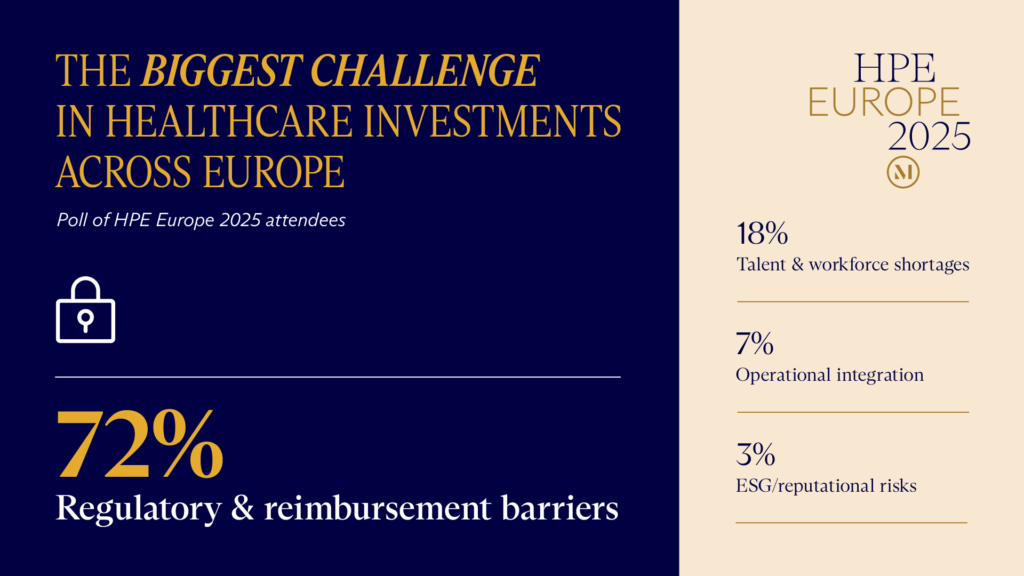
- Overcoming regulatory and reimbursement barriers: In a poll of HPE Europe attendees, 72% felt that regulatory and reimbursement barriers were the biggest challenge to healthcare investments across Europe today, followed by talent and workforce shortages (18%).
- Specialists and niche areas: Some of the most attractive investment hotspots today are in emerging niches like mental health, women’s health, AI-enabled care, and home care, according to 49% of the HPE Europe audience, followed by specialist clients like ophthalmology, fertility, orthopaedics, and dermatology (29%).
“European healthcare continues to draw strong interest from private capital. Investors seem especially focused on the growing importance of consumer-driven models and AI as a tool to spark innovation, improve care, and enhance portfolio efficiency.” – Michael Morley, partner in the London office of McKinsey

Financing: Creativity, certainty, and portability are front of mind
- Refinancing: So far, 2025 has been a busy year for the European financing markets, with a focus on refinancing activity. As we move towards Q4, more deals are starting to come to market, though processes are generally taking longer as the bid-ask spread remains an issue.
- Credit quality: For private credit funds, there is pressure to deploy and a need to find opportunities, but the overriding consideration is credit quality. Lenders are focused on documentation, structuring, amortisation, and getting to the table early in the event of difficulties. Truly understanding creditworthiness often comes down to having deep sector knowledge.
- Portability: In healthcare investment deals, portability from one deal to another has become a major point of negotiation. And those with the ability to commit to a deal faster than others often have a competitive edge.
- Private credit: This may continue to offer a more flexible solution to borrowers. Private credit is expanding its product suite to offer financing tools such as securitisation, equipment financing, or royalty financing. There is a growing focus on products that look to both cashflows and assets as collateral, and there may be yield to be found in lending into complexity.
“The current mood among healthcare investors and CEOs is one of cautious optimism. Financial conditions are improving, cost pressures are there, regulatory hurdles are there, but deals are getting done. We have been particularly active in Q3 and are excited about what is next.” – Ira Coleman, chairman of McDermott Will & Schulte
Conclusion
Conversation at HPE Europe was wide-ranging and diverse, reflecting the breadth and depth of the healthcare private equity opportunity set and the trends impacting capital flows.
We look forward to continuing these conversations with our clients and partners in the months ahead. Please reach out if you would like to explore any of these themes further.

IRS roundup: September 19 – October 1, 2025
ARTICLE
IRS roundup: September 19 – October 1, 2025
Oct 8, 2025
Read time: 3 min
Check out our summary of significant Internal Revenue Service (IRS) guidance and relevant tax matters for September 19, 2025 – October 1, 2025.
September 19, 2025: The US Department of the Treasury (Treasury) and the IRS issued proposed regulations, providing guidance on the “no tax on tips” provision of the One Big Beautiful Bill Act. The proposed regulations define “qualified tips” and identify which occupations customarily and regularly receive tips on or before December 31, 2024.
September 23, 2025: The IRS issued Notice 2025-54, providing guidance on the 2025 – 2026 special per diem rates for taxpayers when determining their ordinary and necessary business expenses incurred while traveling away from home, including meal and incidental expenses rates, rates for the incidental expenses only deduction, and rates for (and a list of) high-cost localities for purposes of the high-low substantiation method.
September 29, 2025: The IRS issued Revenue Procedure 2025-30, providing updated procedures for taxpayers requesting private letter rulings from the IRS after September 29, 2025, regarding transactions intended to qualify under Internal Revenue Code § 3551. This guidance specially provides details on the representations, information, and analysis taxpayers should submit when requesting these rulings.
September 30, 2025: The IRS issued Notice 2025-46 and Notice 2025-49, providing guidance on the application of the corporate alternative minimum tax (CAMT).
Notice 2025-46 provides interim guidance to domestic corporate transactions, financially troubled companies, and tax consolidated groups. This notice also announces the Treasury and the IRS’s intent to partially withdraw the CAMT Proposed Regulations (described in Section 2.03 of this notice) and instead issue revised proposed regulations with guidance similar to Sections 3 – 6 of this notice. The proposed regulations will reduce compliance burdens related to, and costs associated with, application of the CAMT.
Notice 2025-49 provides interim guidance regarding application of the CAMT as it relates to §§ 55, 56A, and 59. This notice also announced the Treasury and the IRS’s intent to partially withdraw the CAMT Proposed Regulations (described in Section 2.03 of this notice) and instead issue revised proposed regulations with guidance similar to Sections 3 – 10 of this notice.
October 1, 2025: The Treasury and the IRS issued final regulations, providing guidance on interest capitalization requirements on designated property. The final regulations specifically remove the associated property rule (including similar rules in existing regulations), modifies how “improvement” is defined when applying those similar rules, and primarily affects taxpayers making improvements to real or tangible personal property if those improvements are the production of designated property.
October 1, 2025: The US Court of Appeals for the Eighth Circuit released its opinion in 3M Company v. Commissioner. The Eighth Circuit reversed the US Tax Court’s decision that 3M must pay taxes on royalties – that it could not legally receive – from a Brazilian subsidiary and remanded the Tax Court’s decision with instructions to redetermine 3M’s tax liability. Relying upon Loper Bright, the Eighth Circuit rejected the IRS’s argument that 26 U.S.C. § 482 directly authorized the adjustments at issue.
The IRS also released its weekly list of written determinations (e.g., Private Letter Rulings, Technical Advice Memorandums, and Chief Counsel Advice).



Italy becomes the first in Europe to set national AI rules
ARTICLE / CLIENT ALERT
Italy becomes the first in Europe to set national AI rules
October 6, 2025
Read time: 10 min
On September 17, 2025, the Italian Parliament approved a new law on artificial intelligence (Law no. 132/2025, the “AI Law”), the first of its kind in the EU. The AI Law sets the core principles governing AI and its use, establishes the responsibilities for AI governance and supervision in Italy, providing for specific rules in critical sectors such as healthcare, public administration, justice, labour, IP and criminal law. The AI Law, which will enter into force on October 10, does not introduce any new compliance obligations beyond those established under Regulation 2024/1689 (“AI Act”). Rather, it provides more detailed and sector-specific provisions that build upon the existing framework, particularly in compliance, transparency, accountability, and governance.*
Principles underpinning the AI Law
Human-centered vision of AI
AI should enhance and not replace human decision-making and responsibility. AI systems must be designed to operate in compliance with fundamental rights, constitutional rights and EU law, while reflecting values such as transparency, fairness, safety, privacy, gender equality, and sustainability. The law also stresses that human oversight is not optional: people must remain in control, with the ability to understand, monitor, and intervene throughout the entire lifecycle of AI systems.
Protection of personal data
AI systems must handle data in a lawful, fair, and transparent way. Users must be clearly informed, in plain and accessible language, about how their data is being used, what risks may be involved, and how they can exercise their right to object. It explicitly safeguards freedom of expression and the pluralism of media, ensuring that AI systems do not compromise the objectivity, completeness, impartiality, or fairness of information.
Protection of the democratic debate
The AI Law explicitly prohibits the use of AI in ways that could interfere with democratic institutions or distort public debate. This reflects growing concerns about the use of AI to spread disinformation, manipulate opinions, or undermine trust in democratic processes.
AI as a key lever for economic growth
Public authorities actively support the development and use of AI to improve human-machine interaction, including through robotics, across production sectors and organizational processes. They encourage AI adoption to boost productivity along the entire value chain and help launch new businesses. Their efforts focus especially on strengthening Italy’s industrial base, which relies heavily on micro, small, and medium-sized enterprises.
Sectoral provisions
In healthcare, AI systems are designed to support and not replace medical professionals. They can assist with prevention, diagnosis, and treatment under strict medical supervision and ethical oversight. Patients must be clearly informed whenever AI technologies are involved in their care, reinforcing transparency and trust. The AI Law also promotes the development and adoption of AI solutions that improve the quality of life for people with disabilities, enhancing accessibility, independent mobility, safety, social inclusion, and enabling personalized life planning.
In the labor sector, AI is used to genuinely improve working conditions by protecting employees’ physical and mental well-being, while also supporting performance and productivity. Its deployment must be safe, transparent, and respectful of human dignity and privacy. Workers have the right to know whenever AI technologies are used, whether in recruitment, evaluation, or daily operations. Equally important, AI systems must uphold the fundamental rights of workers and cannot be applied in ways that lead to discrimination based on gender, age, ethnicity, religion, sexual orientation, political beliefs, or personal, social, or economic conditions.
In the public sector, public administrations can adopt AI to improve efficiency, reduce the time needed to complete procedures, and enhance the quality and accessibility of services. AI serves only as a support tool: all decisions and official acts remain under the full responsibility of human officials. Public bodies must also implement technical, organizational, and training measures that promote responsible adoption and strengthen the skills of those who interact with these technologies.
In the justice system, AI can be used to support the organization of judicial services, streamline administrative tasks, and ease the workload of courts. However, its role remains strictly auxiliary. All decisions regarding the interpretation and application of the law, the evaluation of facts and evidence, and the decision-making process rest exclusively with judges. The Ministry of Justice is responsible for regulating the deployment of AI in this context, with specific training for judges to foster their awareness of AI risks and benefits.
Supervisory and enforcement authorities
Italy’s new AI Law outlines the bodies that oversee and enforce AI at the national level. It aligns domestic responsibilities with the EU AI Act, while also reflecting Italy’s strategic priorities. The following authorities are responsible for oversight, coordination, and enforcement in the field of AI:
- The Presidency of the Council is responsible for AI national strategy. This is to be approved on a bi-annual basis by the Interministerial Committee for Digital Transition.
- The newly established Coordination Committee oversees strategic guidance and promotes research, experimentation, development, adoption, and application of AI systems and models by public or private entities under state supervision or receiving public funding. Representatives of the national AI Authorities may be invited to the meetings.
- Agency for Digital Italy (AgID) acts as the notifying authority. Its role includes promoting innovation and the development of AI. AgID is responsible for defining procedures and carrying out tasks related to notification, evaluation, accreditation, and monitoring of entities appointed to verify the conformity of AI systems. AgID exercises these responsibilities in accordance with both national and EU legislation, ensuring that AI systems meet the required standards before entering the market or being deployed.
- National Cybersecurity Agency (ACN) is designated as Italy’s surveillance and sanctioning authority for AI. It is responsible for overseeing AI systems in accordance with both national and EU legislation, to ensure the security and resilience of AI systems. ACN also works as single point of contact with the European Union.
- The AI law also requires close collaboration between the AI Authorities and existing regulators, including: the Bank of Italy; CONSOB (the National Commission for Companies and the Stock Exchange), and IVASS (the Institute for the Supervision of Insurance), AGCOM (Italian Communications Regulatory Authority) and the Data Protection Authority.
Changes to criminal and IP law
From the criminal law standpoint, the AI Law:
- Introduces a new offense for the unlawful dissemination of AI-manipulated content (so-called “deepfakes”), which may result in imprisonment.
- Establishes a general aggravating circumstance for crimes committed using AI tools, leading to higher penalties.
- Introduces special aggravating circumstances tightening the penalties for specific crimes – market manipulation, agiotage, infringement of political rights – to cover conduct committed through the use of AI systems.
- Introduces a new offense of unauthorized text-and-data mining (“TDM”), which consists of any automated technique aimed at analyzing text and data in digital form to generate information.
From a copyright perspective, the AI Law:
- Updates Article 171 of Law no. 633 of 22 April 1941 (“Italian Copyright Law”), punishing the reproduction or extraction of text or data from works or materials available online or in databases in violation of the Italian Copyright Law, even by means of AI systems.
- Explicitly clarifies that copyright protection applies to “works of human authorship” and to works created with the aid of AI tools, but only if they are the result of the author’s genuine intellectual labor. In other words, copyright does not extend to content generated solely by machines, without any creative human contribution.
The AI Law also allows TDM for the purpose of training AI models (including generative AI) if the user has lawful access. However, this must comply with Articles 70-ter and 70-quarter of the Italian Copyright Law, which regulate exceptions and limitations, including the rightsholder’s opt-out mechanism. As mentioned above, the AI Law also criminalizes unauthorized TDM.
Changes to jurisdiction
The AI Law amends the Italian Code of Civil Procedure, assigning exclusive jurisdiction to the tribunal for cases concerning the operation of AI systems. The Justice of Peace is explicitly excluded from handling such matters, centralizing competence in higher courts.
Legislative delegation
Within twelve months of the AI Law coming into effect, the government must issue one or more legislative decrees to:
- Align the Italian legal framework with the EU AI Act, including by granting the Authorities under para 3 above with all the relevant supervisory, investigative and sanctioning powers provided for under the EU AI Act.
- Introduce new specific crimes related to the insufficient adoption/implementation of safety measures for the creation, circulation or use of AI systems causing a risk for the life or public safety or for the security of the state.
- Introduce measures to prevent and remove unlawfully generated AI content, backed by effective, proportionate, and dissuasive sanctions.
- Define rules governing both individual criminal liability and administrative liability of organizations, based on the actual level of control exercised over AI systems. This includes clarifying the criteria for attributing responsibility in cases involving unlawful conduct linked to AI, ensuring that liability reflects the real influence and oversight of the person or entity involved.
- As to damages caused by AI, the government will allocate the burden of proof considering the type of AI systems listed under the EU AI Act. This approach seeks to guarantee fair compensation while recognizing the complexity of AI technologies.
Investment in AI and emerging technologies
To support the development of AI and cybersecurity companies, the government is providing up to €1 billion in public investment into “equity” and “quasi-equity” instruments, either directly or indirectly to companies. This will be targeted at: (i) innovative small and medium-sized enterprises with high growth potential, based in Italy and operating in the fields of artificial intelligence and cybersecurity or related technologies including quantum technologies and telecommunications; (ii) other highly innovative companies.
Implications for companies
While the debate on how to regulate AI is still ongoing, Italy has made its move by implementing new regulations that focus on its national priorities while complementing the EU AI Act.
Some of the changes have direct implications for companies, especially regarding criminal law. The AI Law changes certain predicate crimes that can make a company legally responsible – if suitable to trigger the administrative liability of the entity in case those crimes are committed or attempted in Italy or abroad in the interest or for benefit of the Company. Companies should therefore update and revise their organizational, management and control models under the 231/2001 Decree, to reflect on the changes and generally address AI-related risks, shielding the company from being held responsible in case of AI-related crimes.
Companies will also need to monitor the approval of decrees implementing the AI Law, which will address key issues such compensation for damages caused by AI, including easing the burden of proof for the damaged party. These changes will need to be properly addressed to mitigate risks, including in contracts, to reflect risk allocation and responsibilities, ensure indemnities or insurance coverage depending on the circumstances.
The coming changes will certainly have a significant impact and require careful consideration for all companies, not just those operating in the AI space.
*Trainee Valeria Kiseleva also contributed to this article.



“Mini-HSR” laws take effect in Washington and Colorado: Know when filings are required
ARTICLE / CLIENT ALERT
“Mini-HSR” laws take effect in Washington and Colorado: Know when filings are required
October 2, 2025
Read time: 4 min
Washington and Colorado are the first states to enact their own versions of the model Uniform Antitrust Pre-Merger Notification Act, which requires merging parties that make a federal filing under the Hart-Scott-Rodino (HSR) Act to also submit their HSR form (and in some case the entire HSR filing, including attachments) to the respective state attorneys general if there is sufficient nexus. At least five additional states – California, Hawaii, Nevada, Utah, and West Virginia – are also considering similar “mini-HSR” legislation.
Merging parties that file under the HSR Act and conduct business in Washington or Colorado should assess the relevant state’s additional filing requirements. Determining whether a filing is required can be highly specific and complex, and in some cases, the obligation may be on only one party to the transaction. If you have questions or need assistance with these new requirements, contact your regular McDermott Will & Schulte lawyer or the authors of this alert.
A party must make a filing in Washington and/or Colorado if they satisfy any of the following prongs:
- Principal place of business in the state. This generally refers to the headquarters address of the company making the filing. If a party is headquartered in Washington or Colorado, it will be required to make a submission to that state.
- More than $25.28 million in annual net sales in the state of “goods or services involved in the transaction.” The sales figure of $25.28 million represents 20% of the HSR filing threshold for 2025 ($126.4 million), which is specified as the threshold in these state statutes. The HSR filing threshold changes each year (typically in February and increasing). This threshold refers to sales in, into, and from Washington or Colorado. For the seller, the determination is based on the sales of the target. For the buyer, the determination is based only on the buyer’s sales of products that overlap with what it is acquiring from the target (i.e., products that derive revenue in overlapping North American Industry Classification System (NAICS) codes and/or products identified in the Overlap Description of the HSR form).
- WASHINGTON ONLY: A healthcare provider or provider organization conducting business in the state. Washington defines healthcare providers and provider organizations in sections 19.390.020 and 18.130.040 of the Revised Code of Washington.
A party that satisfies the first prong by having its principal place of business in Washington or Colorado must submit to the respective state its complete HSR filing (both the form and all attachments). Parties that only satisfy the other prongs need only submit the HSR form.
The mini-HSR laws in Washington and Colorado apply to all HSR-reportable transactions regardless of industry. Washington and Colorado, along with several other states, have passed separate merger notification requirements that apply specifically to healthcare transactions. These healthcare transaction notice laws can apply to transactions that are not HSR-reportable and may require submission of additional information and documents.