
ARTICLE / CLIENT ALERT
FDA Issues Draft Predetermined Change Control Plan for Machine-Learning-Enabled Device Software Functions
April 5, 2023
Read time: 10 min
On April 3, 2023, the US Food and Drug Administration (FDA) published its draft guidance, Marketing Submission Recommendations for a Predetermined Change Control Plan for Artificial Intelligence/Machine Learning (AI/ML)-Enabled Device Software Functions. The draft guidance sets forth principles and marketing submission recommendations for a subset of AI that the agency terms “machine learning-enabled device software functions” (ML-DSFs), which can learn through data without being explicitly programmed and for which modifications are implemented either automatically by software or manually with human input.
As discussed in our 2022 FDA Year in Review, FDA’s 2019 Proposed Regulatory Framework for Modifications to Artificial Intelligence/Machine Learning-Based Software as a Medical Device discussion paper introduced the concept of a predetermined change control plan (PCCP). A PCCP identifies anticipated modifications to an AI-based software as a medical device (SaMD) based on an algorithm’s intended use, retraining and model update strategy. Section 3308 of the Consolidated Appropriations Act, 2023, codified this concept by establishing section 515C of the Federal Food, Drug, and Cosmetic Act (FDCA). The new section authorizes FDA to approve a PCCP submitted in a premarket approval, de novo classification order or 510(k) that would describe planned changes that may be made without impacting the device’s safety or effectiveness (i.e., authorized PCCP). Section 515C also authorizes FDA to require that a PCCP include labeling for the safe and effective use of a device as the ML-DSFs change. Under the April 3 draft guidance, a successful PCCP submission may allow device manufacturers to pre-authorize future device modifications, such as to improve ML-DSFs’ performance on specific patient populations or enhance the safety of a device, without additional marketing submissions.
FDA’s approach to PCCPs in the draft guidance leverages public comments and feedback from the 2019 discussion paper, software risk management concepts from the International Medical Device Regulators Forum (IMDRF), and the total lifecycle principles envisioned in the Digital Health Software Precertification (Pre-Cert) Pilot Program. It also incorporates principles outlined in the White House’s Blueprint for an AI Bill of Rights and reflects FDA’s learnings from reviewing various AI/ML SaMD products. The draft guidance presents a comprehensive approach to help manufacturers and FDA navigate the regulatory complexity presented by AL/ML SaMD, and it sets the stage for FDA to address the new wave of rapidly evolving generative AI tools that have medical device functions and capabilities.
Data Sets
In the draft guidance, FDA differentiates the terms “training data,” “tuning data” and “testing data”:
- Training data is data used to build an ML model, including to define weights, connections and components. These should be representative of the proposed intended use populations.
- Tuning data (also known as validation data) is data used to evaluate a small number of trained ML-DSFs to explore, e.g., different architectures or parameters. FDA chose the term “tuning” rather than “validation” because the term, as it is used in the ML community, is not consistent with FDA’s definition of “validation” in the device quality system regulation (i.e., “confirmation by examination and provision of objective evidence that the particular requirements for a specific intended use can be consistently fulfilled”).
- Testing data is data used to establish a reasonable assurance of safety or effectiveness (performance). This data should be independent of training and tuning data and should come from multiple sites different from the training and tuning data.
Authorized PCCPs
By including and having a PCCP approved as part of a marketing submission, manufacturers can avoid the need to submit a premarket approval supplement, new de novo submission or new 510(k) for certain planned or expected device modifications that would otherwise normally necessitate such submissions under applicable regulations. For example, modifications to quantitative measures of ML-DSF performance specifications (e.g., improvements to analytical and clinical performance resulting from retraining based on a new or broader set of data), modifications related to device inputs to the ML-DSF (e.g., new models or versions of a data acquisition system), or limited modifications to the device’s use and performance (e.g., for use within specific subpopulations, such as by retraining on a larger data set) may be appropriate for a PCCP.
Changes that deviate from the PCCP or are not implemented in accordance with the methods and specifications described in the PCCP’s modification protocol would require a new marketing submission. Additionally, modifications that alter the original intended use and indications for use would require a new marketing submission. FDA includes a flowchart to assess whether modifications to a device fit within an authorized PCCP. Modifications to an authorized PCCP itself would necessitate a new marketing submission. For 510(k) submissions, any determinations of substantial equivalence will be made against the version of the device cleared or approved prior to any changes made under a PCCP.
A PCCP, which should be a standalone section within the marketing submission, should include the following:
- A range of FDA-authorized specifications for the characteristics and performance of the planned modifications (i.e., description of modifications)
- Associated verification and validation testing and acceptance criteria to ensure the device remains safe and effective when modified in accordance with the PCCP based on identified test methods, data and statistical analyses (i.e., the modification protocol)
- Documentation of the assessment of the benefits and risks of implementing a proposed PCCP (i.e., the impact assessment).
FDA notes that the PCCP should be described in sufficient detail and in the public-facing portions of the submission (e.g., 510(k) summary, de novo decision summary, premarket approval summary of safety and effectiveness or approval order) in order to support transparency. The PCCP should also comply with the quality system regulation at 21 CFR Part 820, particularly design controls (21 CFR § 820.30), nonconforming products (21 CFR § 820.90), and corrective and preventive action (21 CFR § 820.100).
As discussed below, the draft guidance includes additional information on what applicants should include within their description of modifications, modification protocol and impact assessment sections.
Description of Modifications
FDA expects a PCCP’s description of modification to identify the modifications to the ML-DSF that the manufacturer intends to implement. FDA recommends that a PCCP include only a limited number of modifications that are specific, can be verified and validated, and are described in sufficient detail to permit understanding of such modifications. This recommendation is consistent with the NIST AI Risk Management Framework’s emphasis on explainable and interpretable AI. The description of modifications should also clearly state the following:
- If the manufacturer intends to implement the proposed modification automatically (i.e., the modification will be implemented automatically by the software as in the case of self-supervised ML processes) or manually (i.e., the modification requires human input, action, review and/or decision-making before implementation, a technique known as reinforcement learning from human feedback)
- Whether the proposed modifications will be implemented uniformly across all devices on the market, or implemented differently on different products because of, for example, unique characteristics of a specific clinical site or individual patients.
Modification Protocol
The modification protocol section of the PCCP should describe the methods that will be followed when developing, validating and implementing the modifications described in the description of modifications section. FDA lists four primary components that should be included in the modification protocol:
- Data management practices (e.g., how input data and reference data will be collected, annotated, curated, stored, retained, controlled and used for the modifications)
- Retraining practices (e.g., the objective of the retraining process, a description of the ML model and components that may be modified, the practices that will be followed and triggers for retraining)
- Performance evaluation protocols (e.g., triggers for performance evaluation, application of sequestered test data for testing, performance metrics to be computed, the statistical analysis plans that will be used to test performance objectives for each modification, and confirmation that failures in performance evaluation will be recorded and the modification will not be implemented)
- Update procedures (e.g., confirmation that the verification and validation plans for modified devices are the same as those performed on the prior version of the device, a description of how software updates will be implemented, a description of how legacy users will be affected by the software update, and a description of how modifications will be communicated to users).
FDA recommends that each of the four primary components be addressed for each modification described in the description of modifications, and that the manufacturer include a description of how the proposed methods are different from or similar to other methods used elsewhere in the marketing submission.
Impact Assessment
The impact assessment section of the PCCP is intended to document the manufacturer’s assessment of the benefits and risks of implementing a PCCP for the ML-DSF, and the mitigations of those risks, using the manufacturer’s existing quality system as the framework to conduct the impact assessment. FDA expects the impact assessment to do the following:
- Compare the version of the device with each modification implemented to the version of the device without any modifications implemented
- Discuss the benefits and risks, including risks of social harm, of each modification
- Discuss how the activities proposed within the modification protocol continue to reasonably ensure the safety and effectiveness of the device
- Discuss how the implementation of one modification impacts the implementation of another
- Discuss the collective impact of implementing all modifications.
In addition to discussing the specific impacts of the modifications on the ML-DSF itself, FDA expects the impact assessment to discuss how each modification included in the PCCP impacts the overall functionality of the device (e.g., other device software functions and the device hardware). FDA notes that for some devices, it may be least burdensome to include the content of the impact assessment within the modification protocol section rather than as an independent section of the PCCP.
The draft guidance includes examples scenarios of ML-DSFs that employ PCCPs.
Takeaways
This long-awaited draft guidance provides a useful framework for manufacturers and developers to address anticipated modifications to AL/ML SaMDs. However, it also introduces potential implementation challenges that will require manufacturers to assess the impact of these recommendations on existing quality system processes such as design control, data management practices, risk management plans, adverse event reporting and labeling. The draft guidance also adds to a growing superset of perspectives on the ethical and appropriate design, development and deployment of AI/ML technologies in healthcare from industry coalitions, the World Health Organization, the European Union and the United Kingdom. These evolving frameworks and regulatory approaches suggest an imminent paradigm shift from oversight processes intended for AI/ML-enabled tools that were retrained and updated only occasionally to an approach that accounts for ML models that learn from data in real time or near real time.
Device manufacturers incorporating ML-DSFs into their medical devices should consider submitting comments to the draft guidance. FDA recommends that the public submit comments to the draft guidance (Docket No. FDA-2022-D-2628) within 90 days of publication in the Federal Register, by July 3, 2023.





CMS Finalizes Risk Adjustment Model in 2024 Rate Announcement for Medicare Advantage and Part D
ARTICLE / CLIENT ALERT
CMS Finalizes Risk Adjustment Model in 2024 Rate Announcement for Medicare Advantage and Part D
April 5, 2023
Read time: 10 min
On March 31, 2023, the US Centers for Medicare & Medicaid Services (CMS) issued its Announcement of Calendar Year (CY) 2024 Medicare Advantage (MA) Capitation Rates and Part C and Part D Payment Policies, otherwise known as the Rate Announcement (press release; fact sheet). The Rate Announcement is released on an annual basis and includes updates to the capitation and risk adjustment methodologies used to calculate payments to MA plans, as well as other payment policies that impact Part D. In one key decision, CMS finalized a proposal to significantly revise the Medicare Advantage risk adjustment model, which had been the subject of extensive commentary from stakeholders. However, CMS said it would phase in the new model over three years. The Rate Announcement estimated a 3.32% increase in payments, as compared to the 1.03% estimated increase in the Advance Notice.
Among other provisions, the Rate Announcement includes the following:
Payment Changes/Growth Rates: The effective growth rate for 2024 MA non-End-Stage Renal Disease (ESRD) rates is 2.28%, a slight increase from 2.09% in the Advance Notice. Accounting for the impact of the benchmark rate cap, MA rebate and other policies, the net impact on the Medicare Trust Funds for CY 2024 is expected to be $8.1 billion.
CMS estimates that the policies, as finalized, will increase average payments to MA organizations (MAOs) by 3.32% in CY 2024 (approximately $13.8 billion), compared to the 1.03% increase initially proposed. Below is the year-to-year percentage change in MAO payment, along with a comparison to the Advance Notice.
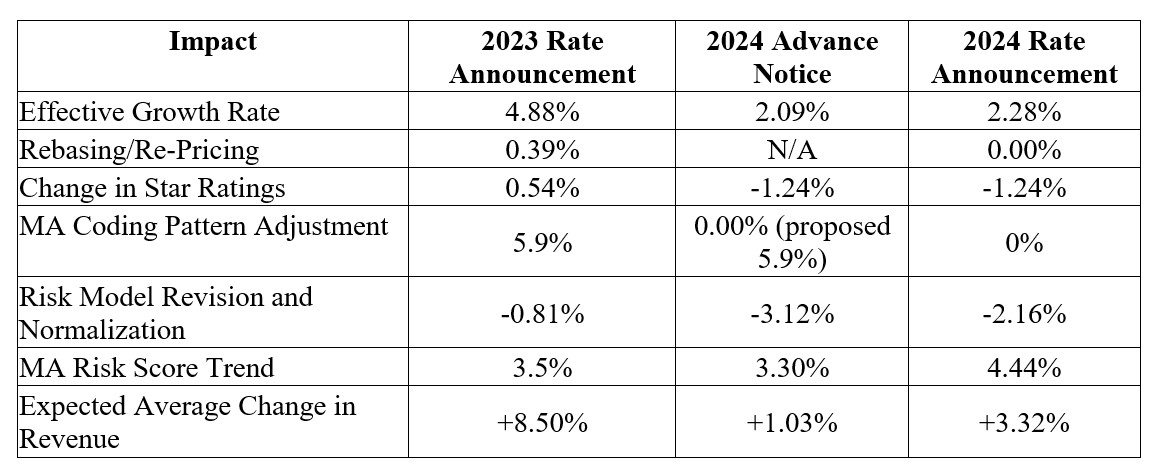
Treatment of Risk Score Trend: During the comment period, some stakeholders asserted that the Advance Notice amounted to a rate cut because the risk score trend was not a result of the Advance Notice policies and should not be included in the projections. CMS continued to include the risk score trend in its financial projections because it is a key factor in the overall level of payments. As discussed below, the estimated risk score trend increased compared to the estimate in the Advance Notice.
Part C Risk Adjustment Model Revision: CMS is finalizing proposed changes to the Hierarchical Condition Category (HCC) risk adjustment model but will phase in the changes over three years. For 2024, CMS will calculate risk scores by blending 67% of the risk scores as calculated under the current 2020 model and 33% of the risk scores as calculated under the updated 2024 model. For 2025, the blend will shift to 33% of risk scores calculated with the 2020 model and 67% calculated with the 2024 model. For 2026, CMS expects 100% of the risk scores to be calculated with the 2024 model. The phase-in is consistent with how CMS has implemented prior model updates.
CMS projects the payment impact of the finalized model with the phase-in to be -2.16%, which represents $7.6 billion in estimated net savings to the Medicare Trust Fund in 2024, less than the -3.12%, or $11 billion in savings, originally estimated in the Advance Notice without the phase-in. CMS also projects that the risk score trend will be higher than initially projected due to the decision to blend risk scores using both the 2020 and 2024 risk adjustment models, with an impact of 1.14%, as compared to the projected risk score increases had the new model been implemented immediately. As such, the combined estimated overall 2024 impact from the new model will be closer to -1%.
The Rate Announcement provided extensive additional discussion about the new model and asserted that the new model had a higher level of accuracy across multiple methods of evaluating its predictive power in forecasting expected costs.
Key changes in the new model include:
- Restructuring of condition categories using the International Classification of Diseases (ICD)-10 code classification system instead of the ICD-9 classification system
- Updating the fee-for-service (FFS) data years underlying the model from 2014 for diagnoses and 2015 for expenditures to 2018 for diagnoses and 2019 for expenditures
- Revising from 2015 to 2020 the denominator year that is used in determining the average per-capita predicted expenditures to create relative factors in the model
- Clinical revisions to the model adding constraints and removing several HCCs to reduce the effect of MA coding variation from FFS on risk scores.
Specifically, the Rate Announcement finalizes the following updates:
- Clinical Revisions: CMS explained in the Advance Notice that it reviewed conditions where coding variation in MA was highest relative to FFS with its clinical experts to identify conditions with discretionary coding variation. Pursuant to Risk Adjustment Model Principle 10, discretionary diagnostic categories that are “particularly subject to intentional or unintentional discretionary coding variation or inappropriate coding by health plans/providers, or that are not clinically or empirically credible as cost predictors,” should be excluded from the model. Under the revised model, CMS will constrain (e., apply equal coefficients) the values of all diabetes HCCs (HCCs 36, 37 and 38) and all congestive heart failure HCCs (HCCs 224, 225 and 226). It will also remove HCC 47 Protein-Calorie Malnutrition, HCC 230 Angina Pectoris and HCC 265 Atherosclerosis of Arteries of the Extremities, with Intermittent Claudication.
- Changing HCCs: The revised model will increase the number of payment HCCs from 86 to 115. This is because of newly created HCCs and the splitting of existing HCCs as a result of moving from ICD-9 to ICD-10. The number of ICD-10 diagnosis codes mapped to an HCC for payment would decrease from 9,797 to 7,770. The summary statistics reflecting the reclassifications can be found in Table III-3 of the Rate Announcement.
- ESRD Risk Adjustment Model: CMS will continue to use the 2023 ESRD risk adjustment models for MA plans and the 2019 ESRD risk adjustment model for Program of All-Inclusive Care for the Elderly (PACE) organizations.
- Frailty Adjustment for PACE Organizations and Fully Integrated Dual Eligible Special Needs Plans (FIDE SNPs): CMS must account for the frailty of the PACE population when establishing capitated payment amounts. It must also make a payment adjustment to account for the frailty of beneficiaries enrolled in FIDE SNPs if the average frailty level in the FIDE SNP is similar to the PACE program. For 2024, CMS will finalize frailty factors that do not include the Consumer Assessment of Healthcare Providers and Systems (CAHPS) survey weight to account for the potential of non-response bias. CMS will continue to use the frailty factors associated with the 2017 CMS-HCC model to calculate frailty scores for PACE organizations.
Treatment of Indirect Medical Education (IME) and Direct Graduate Medical Education (DGME) Costs: CMS finalized a technical change to the Fee-For-Service United States Per Capita Cost (FFS USPCC) baseline regarding MA-related medical education expenses, but the change will be phased in over three years. CMS will remove the medical education payments it makes to hospitals that are associated with services rendered to MA enrollees from the FFS USPCC estimates, which will reduce the MA county benchmarks. To minimize disruption, CMS will phase in the technical update to the data used to develop the USPCCs over a three-year period, with 33% of the adjustment to medical education costs applied in 2024, 67% applied in 2025 and 100% applied in 2026. CMS believes that this update will improve the accuracy of payments to MAOs.
Inflation Reduction Act of 2022 (IRA): The Rate Announcement implements several updates made by the IRA for 2024, including the following:
- Part D Drug Cost Sharing: Cost sharing for covered Part D drugs will be eliminated for beneficiaries in the catastrophic phase. This means Part D sponsors will be on the hook for 20% of the costs incurred after a Part D beneficiary’s costs exceed the annual out-of-pocket threshold, compared to roughly 15% of costs in prior years.
- Low-Income Subsidy (LIS) Program: The income limit for the full LIS benefit will increase from 135% to 150% of the federal poverty level (FPL). Individuals who earn between 135% and 150% of the FPL and meet certain resource requirements will now be eligible for the full low-income premium and cost-sharing subsidies, as well as a $0 deductible.
- Insulin Cost Sharing: In the initial coverage and coverage gap phases, cost-sharing may not exceed $35 for a month’s supply of covered insulin products. The deductible will not apply to Part D-covered insulin products.
- Adult Vaccine Cost Sharing: As before, the deductible will not apply to adult vaccines that are recommended by the Advisory Committee on Immunization Practices (ACIP). At any point in the benefit, these vaccines are exempt from cost sharing when administered consistent with ACIP’s recommendations. Part D sponsors will provide this coverage as a basic benefit, and such costs should be reflected in plan bids.
- Premium Stabilization: If average premiums increase by more than 6% following the submission of bids in June, the base beneficiary premium growth will be capped at 6%, as required by the IRA.
IRA provisions that take effect in 2025 or later will be addressed in future Advance Notices and Rate Announcements.
Part C and D Star Ratings: CMS includes the list of the measures that will be used to calculate the 2024 Star Ratings, as well as a list of the emergency areas that were affected by emergency declarations in 2022 for purposes of making adjustments under the extreme and uncontrollable circumstances policy. CMS also solicited comments in the Advance Notice on potential future policy changes to the Star Ratings. CMS continues to consider these proposals and provided insights in the Rate Announcement on initial comments received from stakeholders, including:
- Universal Foundation Measures: For the 2023 measurement year and beyond, CMS is considering a core set of measures that are aligned across quality rating and value-based care programs, in what CMS is calling a “Universal Foundation” of quality measures. Each program would add aligned or program-specific measures to this measurement base. The Advance Notice and Rate Announcement outline a preliminary set of measures that would be included in the Adult Universal Foundation, including Adult Immunization Status, Screening for Depression and Follow-Up Plan and Screening for Social Drivers of Health/Social Need Screening and Intervention, among others. CMS reports that there was overwhelming support from commenters to align measures across federal and private payors and to streamline measures across programs. However, there was mixed reaction to some of the measures currently listed in the Universal Foundation set. Any measures ultimately added to the Star Ratings would need to go through the rulemaking process.
- Substantive Measure Updates: CMS outlined in the Advance Notice potential updates to a number of measures, including possibly retiring the Care for Older Adults (COA)–Pain Assessment (Part C) measure, reevaluating the specifications of the Diabetes Care–Eye Exam and Diabetes Care–Blood Sugar Controlled (Part C) measures and revising the eligible population for the Breast Cancer Screening (Part C) measure, among other changes. CMS describes in the Rate Announcement that most commenters opposed the retirement of the COA-Pain Assessment measure until a replacement measure has been introduced and evaluated. Commenters had varied reactions to changes to the Diabetes Care–Eye Exam and Diabetes Care–Blood Sugar Controlled (Part C) measures; however, most commenters supported revising the eligible population for the Breast Cancer Screening (Part C) measure. CMS shared this feedback with the National Committee for Quality Assurance (the measure steward).
- New Measure Concepts: CMS also requested feedback in the Advance Notice on potential new measure concepts for future years, including Health Equity (Parts C and D), Chronic Pain Assessment and Follow-Up (Part C), Sexual Orientation and Gender Identity for Healthcare Effectiveness Data and Information Set (HEDIS) Measures (Part C), Identifying Chronic Conditions in HEDIS Measures (Part C), Blood Pressure Control Measures (Part C), Kidney Health (Part C) and more. Commenters generally supported these measure concepts but requested additional information regarding measure specifications and longer implementation timeframes.
Annual Adjustments to Part D Benefit Parameters: CMS is required to update the parameters for the defined standard Part D drug benefit each year. This is meant to ensure that the actuarial value of the drug benefit tracks changes in Part D expenses. For non-LIS beneficiaries, the Rate Announcement outlines the benefit parameters for defined standard benefits in 2024 as follows:
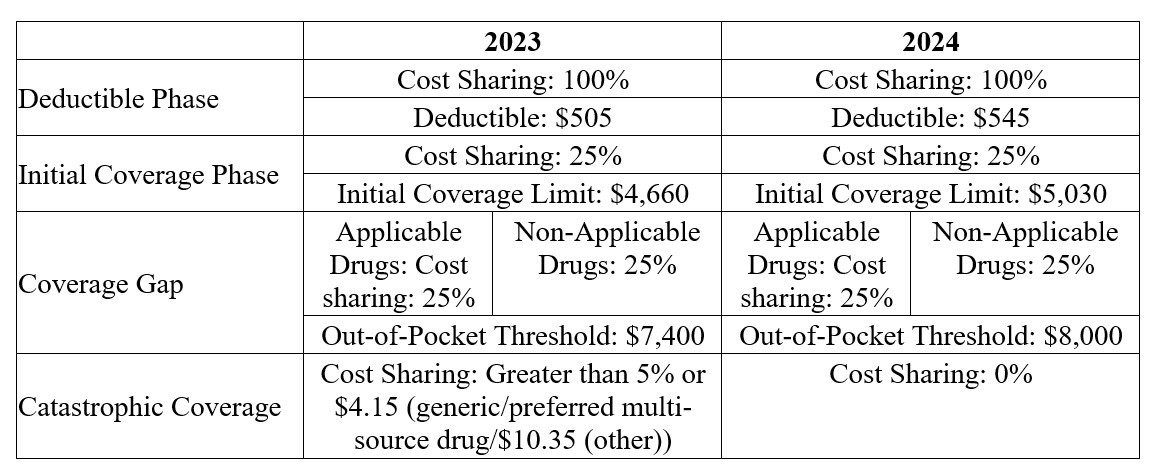
Additional detail can be found in the 2024 Rate Announcement.



UK Employment Rates and Compensation Increases Take Effect
ARTICLE
UK Employment Rates and Compensation Increases Take Effect
April 5, 2023
Read time: 4 min
With the clocks having gone forward and summer on the horizon, April also brings with it an increase in the National Minimum Wage, unfair dismissal compensation and certain other amounts payable under UK employment legislation.
Read on for information on the key changes and some of the important consequences for employers.
Key Points for Employers
The changes relating to statutory redundancy payments and unfair dismissal basic and compensatory award payments, as set out in the table below, take effect on 6 April 2023, and will apply to dismissals where the effective date of termination (EDT) occurs on or after that date.
It is important for employers to note:
- If an employee was given notice prior to 6 April 2023, but the notice period expires on or after 6 April 2023, the new limits will apply.
- If an employee’s employment is terminated by means of a payment in lieu of notice, the EDT is the actual date the dismissal takes effect, plus the amount of statutory notice applicable to the employee, e.g., one week per year of employment, up to a maximum of 12 weeks. If the statutory notice would take the EDT to or beyond 6 April 2023, the new limits will apply.
Changes from 1 April 2023
| National Minimum Wage | Old rate (per hour) | New rate (per hour) |
| 23 and over | £9.50 | £10.42 |
| 21-22 | £9.18 | £10.18 |
| 18-20 | £6.83 | £7.49 |
| 16-17 | £4.81 | £5.28 |
| Apprentices | £4.81 | £5.28 |
Changes from 2 April 2023
| Old maximum rate | New maximum rate | |
| Statutory maternity, adoption, paternity and shared parental pay | £156.66 per week | £172.48 per week |
Changes from 6 April 2023
| Old maximum rate | New maximum rate | |
| One week’s pay for calculating statutory redundancy payment and unfair dismissal basic award |
£571 | £643 |
| Maximum basic award for unfair dismissal and statutory redundancy pay | £17,130 | £19,290 |
| Maximum unfair dismissal compensatory award | £93,878 | £105,707 |
| Maximum total award for unfair dismissal i.e. maximum unfair dismissal compensatory award plus maximum unfair dismissal basic award |
£111,008 | £124,997 |
| Minimum basic award for certain unfair dismissals, including dismissals relating to trade union membership or activities and carrying out functions or activities as an employee representative |
£6,959 | £7,836 |
| Statutory sick pay | £99.35 per week | £109.40 per week |
Injury to feeling awards in discrimination cases
The “Vento Bands” are the levels of compensation that a successful claimant can be awarded for injury to feelings and psychiatric injury in discrimination, harassment and victimization cases in employment tribunals.
Although there is theoretically no limit on the compensation that may be awarded in discrimination and harassment cases, employment tribunals must follow official guidelines when making awards for injury to feelings. These guidelines set out three bands of compensation, depending on the seriousness of the discrimination and its effect on the victim.
The new bands, in respect of claims presented on or after 6 April 2023, are as follows:
| Band | Previous award range | New award range |
| Lowest band (less serious cases) | £990 – £9,900 | £1,100 – £11,200 |
| Middle band (cases that do not merit an award in the upper band) |
£9,900 – £29,600 | £11,200 – £33,700 |
| Highest band (the most serious cases) | £29,600 – £49,300 | £33,700 – £56,200 |




CMS Issues Medicare Drug Price Negotiation Initial Guidance, First Inflation Rebate List
ARTICLE / CLIENT ALERT
CMS Issues Medicare Drug Price Negotiation Initial Guidance, First Inflation Rebate List
April 4, 2023
Read time: 9 min
On March 15, 2023, the Centers for Medicare and Medicaid Services (CMS) issued initial program guidance related to implementation of the Medicare Drug Price Negotiation Program. CMS requested public comments on selected portions of the guidance by April 14, 2023. The criteria set forth in the guidance for selection of drugs subject to negotiation is final and not subject to comment, as the agency must select and publish the list of drugs subject to negotiation by September 1, 2023.
Authorized under Sections 11001 and 11002 of the Inflation Reduction Act (IRA), the Negotiation Program permits Medicare to negotiate the price of prescription drugs. In the March 15 guidance, CMS laid out the requirements and parameters of the Negotiation Program. It also announced the next steps for implementation of the Negotiation Program’s rates, which will take effect in 2026.
In a related development also on March 15, CMS released a list of the first Part B drugs to be subject to inflation rebates under the Medicare Prescription Drug Inflation Rebate Program, which targets prescription drugs whose prices have risen faster than the rate of inflation and will result in lower coinsurance amounts for Medicare beneficiaries. For more information on the Rebate Program guidance, click here.
Negotiation Program Guidance
Background
Prior to enactment of the IRA, the Secretary of the US Department of Health and Human Services was prohibited from interfering in drug manufacturer price negotiations with pharmacies and prescription drug plan sponsors under Medicare Part D (known as the “noninterference” clause). Similarly, the Secretary was not authorized to negotiate drug prices covered under Medicare Part B.
The IRA authorized Medicare to negotiate drug prices for certain high expenditure, single source brand-name drugs or biologics covered under Medicare Part D (starting in 2026) and Part B (starting in 2028) for the first time in the history of the Medicare program. Beginning in 2026, up to 10 Part D drugs will be subject to negotiation. Thereafter, CMS will select up to 15 Part D drugs for negotiation for 2027, up to 15 Part B or Part D drugs for 2028, and up to 20 Part B or Part D drugs for 2029 and subsequent years. Negotiated prices are referred to as the maximum fair price (MFP) of the drug. Manufacturers of drugs with negotiated MFPs will be required to provide pharmacies, mail order services and other dispensers access to the MFPs for drugs they dispense to individuals enrolled in a Part D plan. Part D plans will be required to provide their enrollees with access to the MFPs (plus a dispensing fee). Beginning in 2028, manufacturers will also be required to provide hospitals, physicians and other providers access to the MFPs for drugs they furnish or administer to individuals enrolled in Part B.
Drug Selection Criteria
In the Negotiation Program guidance, CMS discusses the requirements and procedures that it will use to select the subset of drugs that will be subject to price negotiation. Once the drugs are selected, the first round of negotiations will occur during 2023 and 2024, resulting in prices effective in 2026. CMS will publish the list of the first 10 selected Medicare Part D drugs on September 1, 2023.
Drugs eligible for inclusion on the list of drugs subject to negotiation include those approved by the US Food and Drug Administration (FDA) under a new drug application on or before September 1, 2016, and drugs that were not FDA-approved under an abbreviated new drug application. Also eligible are qualifying single source biologics under a biologics license application that have been licensed for at least 11 years and are not the reference product for any biologic that is licensed or marketed as a biosimilar. CMS will rank the qualifying drugs in order of most expenditures for the date of service between June 1, 2022, and May 31, 2023, and will select the top 10 drugs for drug price negotiations.
Excluded drugs include orphan drugs; low-spend Medicare drugs resulting in less than $200 million in combined Medicare Parts B and D expenditure for dates of service between June 1, 2022, and May 31, 2023; and plasma-derived products. CMS will also remove drugs that qualify under an exception for small biotech companies (generally applicable to manufacturers of drugs comprising less than 1% of total Part D drug expenditures and more than 80% of Part D expenditures for drugs marketed by the drug’s manufacturer).
Negotiation Process
For purposes of setting a price during the negotiation process, CMS intends to base the negotiations on a single price, rather than negotiate on multiple MFPs for the same drug. CMS seeks comment on its approach to identifying this single negotiating price, which CMS intends to base on the cost of a drug for a 30-day supply across all forms and strengths of the drug. The MFP for a drug is capped at a ceiling price. The ceiling for the MFP for a selected drug will be the lower of either an amount equal to the sum of the plan specific enrollment weighted amounts, or an amount equal to the applicable percent of the non-federal average manufacturer price. In order to determine which of the two methods of calculating the MFP ceiling will be used, CMS will aggregate the amounts determined for each applicable NDC-11 for the selected drug to calculate a single amount, separately for each methodology, across dosage forms, strengths and package sizes of the selected drug. The initial offer of the MFP will be at or below the ceiling price, based on factors set forth in the guidance, including clinical benefit and the availability of therapeutic alternatives. The ceiling price is set at the lower of the Part D net price or the average sales price of therapeutic alternatives for the selected drug.
CMS will make an initial written offer to the manufacturer with the proposal for the MFP no later than February 1, 2024. The initial offer will include a concise justification for the offer based on the factors described in the MFP development process, such as research and development costs, current unit costs of production and distribution, federal financial support for novel therapeutic discovery and development, data on pending and approved patent applications, and market data and revenue and sales volume data for the selected drug. The manufacturer may then prepare one optional written counteroffer, which must be submitted to CMS no later than 30 days after the date of receipt of CMS’s written initial offer. The manufacturer’s counteroffer must include a justification of the counteroffer based on the same factors. The manufacturer should describe reasons it believes the data it submits, or other available data related to the selected drug and its therapeutic alternatives, does not support CMS’s initial written offer. If CMS does not accept the manufacturer’s counteroffer, CMS will propose up to three possible in-person or virtual negotiation meetings between the manufacturer and CMS. After the negotiation meetings, CMS will prepare a final written offer. A final agreement will be reached upon the manufacturer’s acceptance of CMS’s initial written offer, or CMS’s acceptance of the manufacturer’s counteroffer. All negotiations must end by August 1, 2024.
Other Areas of Guidance
CMS also explains and seeks comment on several aspects of the Negotiation Program, including the terms and conditions contained in the manufacturer agreement, the process for the offer and counteroffer exchange between CMS and manufacturers, the dispute resolution process for specific issues, and the process for compliance monitoring and imposition of civil monetary penalties (CMPs) for violations.
The guidance addresses the negotiation process related to 340B drugs, stating that “a manufacturer with an agreement with the Secretary under the 340B program is not required to provide a 340B covered entity with access to the MFP of a selected drug with respect to an MFP-eligible individual who is eligible to be furnished, administered, or dispensed such selected drug at the covered entity if the 340B ceiling price is lower than the MFP for such selected drug.” However, a manufacturer subject to the 340B program is required to provide a 340B covered entity with access to the MFP of a selected drug if the MFP is below the 340B ceiling price for such selected drug. If it is later determined that the 340B ceiling price is lower than the MFP for the selected drug, the manufacturer would be required to provide the covered entity with the difference between the MFP and the 340B ceiling price.
The guidance also describes the process for the issuance of CMPs for violations under the Negotiation Program. CMS states that for any manufacturer that knowingly provides false information under certain procedures of the Negotiation Program, a CMP equal to $100 million will be issued for each item of such false information submitted. CMPs will also be issued to manufacturers that fail to provide access to a price that is less than or equal to the MFP, such as a CMP equal to 10 times the amount equal to the product of the number of units of such drug so furnished, dispensed or administered (during the relevant year) and the difference between the price for such drug made available and the MFP. Manufacturers will also be subject to a general CMP equal to $1 million for each day a manufacturer fails to comply with requirements that CMS determines to be necessary for the purposes of administering the Negotiation Program.
Manufacturers that fail to comply with certain Negotiation Program deadlines and other requirements of the Negotiation Program could face removal of Part D or Part B coverage and excise tax liability. The Internal Revenue Service is expected to issue guidance separately.
CMS solicits comments on the guidance by April 14, 2023. All comments can be submitted to IRARebateandNegotiation@cms.hhs.gov.
Inflation Rebate Drug List
Just a few hours before CMS released the Negotiation Program guidance, it also announced the list of the first 27 drugs to be subject to Medicare inflation rebates due to the drugs’ prices rising faster than the rate of inflation during the last quarter of 2022. As of April 1, 2023, drug manufacturers are required to pay inflation rebates for the Part B drugs listed, and in turn Medicare beneficiaries will have their coinsurance lowered for such drugs. Medicare beneficiaries will see a decrease in the out-of-pocket costs for the listed drugs. Decreases will range from $2 to as much as $390 per average dose.
CMS will update this list every quarter.
* * *
McDermott is closely monitoring all CMS developments under the IRA. Please do not hesitate to reach out to the McDermott team if you have any questions about either the IRA negotiation or rebate provisions, or if you would like assistance in preparing comments to the Negotiation Program guidance.







When Keeping Medication Safe May Lead to Increased Liability
ARTICLE / CLIENT ALERT
When Keeping Medication Safe May Lead to Increased Liability
April 3, 2023
Read time: 5 min
In a country that is still struggling with an opioid epidemic, and where there are enough rules and laws regulating the dispensing of medication to fill a tome, it makes sense that medical providers across the nation are turning to technology to monitor who is accessing narcotics and medicines. Federal and state laws require that healthcare facilities and providers store certain medications, and most importantly controlled substances, in locked cabinets. As technology has advanced, it has become commonplace for such cabinets to be secured by fingerprint or facial recognition access, and guidance recognizes cabinets secured by such biometric access systems as meeting the definition of a “locked” system. However, if you are a medical provider with employees located in Illinois, Texas or Washington, your use of biometric medical cabinet locks or dispensaries, such as the Pyxis or Omnicell systems, could lead to greater liability if you are not taking certain steps.
Illinois (740 ILCS 14/1 et seq.), Texas (Tex. Bus. & Com. §503.001) and Washington (Wash. Rev. Code § 19.375.010 et seq.) each have biometric collection laws that require companies to take certain actions before they collect biometrics from employees who are residents of those states (there is a limited exemption for patient biometrics). In general, the laws of Illinois, Texas and Washington require that companies first provide notice to employees (e.g., nurses, doctors and others with access to the lock/dispensary systems) of the fact that their biometrics may be collected. “May” is an important qualifier here because there is still an open legal question as to whether these systems actually collect biometrics. Plaintiffs’ lawyers and regulators will say they do, whereas defendant companies and device manufacturers will often take the opposite position. However, if the objective of compliance is to minimize risk, then the conservative approach in Illinois, Texas and Washington is to develop a policy that notifies your employees that you or your service providers may be collecting biometrics.
While that notice will be enough to satisfy Washington’s biometric law, those of Texas and Illinois require more. In Texas and Illinois, companies must also collect the consent of their employees before collecting their biometrics. In Illinois, companies also must make publicly available their biometric collection policy, which includes details on, for example, the purpose of the collection, the document retention rules applicable to the biometric information and the use and/or disclosure of biometrics.
Failure to comply with the biometric laws in Illinois, Texas and Washington brings with it varying degrees of risk. The Washington and Texas laws are exclusively enforced by the state attorneys general. To date, Washington’s attorney general has not initiated any public actions, and Texas’ attorney general only recently brought its first action. The Texas law, however, includes damages of up to $25,000 per violation. The very immediate risk, however, is Illinois, where there is a private right of action, statutory damages of as much as $5,000 per scan and a five-year limitations period. As a result, the Biometric Information Privacy Act (BIPA) has become one of the most active class action spaces in Illinois, with new putative class actions filed almost every working day, and the state and federal courts handling a docket of more than 1,000 biometric cases. In short, the risk of a class action for failing to comply with BIPA is extreme.
While HIPAA covered entities and business associates are used to being exempt from a wide variety of state privacy laws, courts in Illinois have interpreted the collection of employee biometrics—even for the dispensing of medication—to not be HIPAA-covered or -related activities, and thus outside the HIPAA carve-outs in Illinois’ biometric law. Moreover, every legislative cycle, other states consider enacting biometric statutes similar to the laws in Illinois, Texas and Washington. As a result, medical providers should take the following steps:
- Determine whether they are collecting fingerprint or other potential biometric information in the ordinary course of business (g., biometric medical dispensary systems, locks or even employee time clocks).
- If they are collecting such information, implement a biometric collection policy and notice.
- In Texas and Illinois, collect the consent of their employees.
- In Illinois, publicly post their biometric collection policy.
If you need assistance with any of these steps, please contact your regular McDermott Will & Emery lawyer or contact the authors of this article.



Preparing for the End of the COVID-19 Emergency: Tri-Agencies Issue FAQs to Assist Plans and Issuers
ARTICLE / CLIENT ALERT
Preparing for the End of the COVID-19 Emergency: Tri-Agencies Issue FAQs to Assist Plans and Issuers
April 3, 2023
Read time: 4 min
Our April 3, 2023, webinar explored the impacts that the end of the PHE and NE will have on employee benefit plans and what actions employers and benefit plan sponsors should be taking to prepare. Watch the “How Employers Should Prepare for the End of the Covid-19 National and Public Health Emergencies” webinar recording to learn more.
The Biden administration has announced its intention to end the COVID-19 National Emergency (NE) and the COVID-19 Public Health Emergency (PHE) on May 11, 2023 (read our series introduction for more information).
On March 29, 2023, the US Departments of Labor, Health and Human Services, and Treasury (the Departments) issued a set of Frequently Asked Questions, which answered questions from stakeholders relating to the various laws, regulations and other guidance enacted or adopted in connection with the NE and PHE. The FAQs include eight questions related to the anticipated end of the “Outbreak Period” on July 10, 2023, which is 60 days after the end of the NE and PHE on May 11 (rules regarding the Outbreak Period are set forth in our earlier client alerts “DOL issues clarification for ERISA-governed group health plans” and “DOL relaxes deadlines for ERISA-governed group health plans“). Below are the highlights:
- Following the end of the PHE, plans and issuers can impose cost-sharing, prior authorization or other medical management requirements for COVID-19 diagnostic tests, although the Departments encourage plans not to do so.
- Plans and issuers are encouraged to notify plan participants of changes regarding COVID-19 diagnosis, testing and treatment. Special rules apply under which Summaries of Benefits and Coverage (SBCs) need not be amended mid-year.
- While plans and issuers will no longer be required to post prices for diagnostic tests furnished after May 11, they are nevertheless encouraged to do so.
- Plans must continue to cover vaccines that qualify as preventive services, without cost-sharing, when provided in-network.
- The FAQs provide examples relating to the application and termination of extended time periods for elections under the Consolidated Omnibus Budget Reconciliation Act (COBRA) and the Health Insurance Portability and Accountability Act (HIPAA).
- In what is a welcome surprise, the FAQs confirm that individuals covered by a High-Deductible Health Plan (HDHP) will remain Health Savings Account (HSA)-eligible until further notice even if the HDHP in which they are enrolled provides medical care services and items purchased related to testing for and treatment of COVID-19 prior to the satisfaction of the HDHP’s applicable minimum deductible.
To keep employers apprised of the rules and to assist with providing notice to plan participants of the changes that will accompany the end of the NE and PHE, the Department of Labor has issued two blog posts.
Action Items: We urge plan sponsors to pay particular attention to notifying employees of the upcoming changes that will accompany the end of the PHE and NE and to ensure that participants covered under an HDHP understand that they may continue to contribute to their HSAs. Employers should consider communicating these changes to their employees.
For any questions regarding the end of the PHE and/or NE, please contact your regular McDermott lawyer or one of the authors.



Update for Employers Regarding Changes to Background Check Summary of Rights Form Coming Soon
ARTICLE / CLIENT ALERT
Update for Employers Regarding Changes to Background Check Summary of Rights Form Coming Soon
March 31, 2023
Read time: 5 min
The Consumer Financial Protection Bureau (CFPB) recently released an updated version of the “A Summary of Your Rights Under the Fair Credit Reporting Act” notice to job applicants and employees required in connection with conducting employment background checks (also known as the Summary of Consumer Rights). Starting on March 20, 2024, employers and consumer reporting agencies (third-party background check vendors) will need to provide the newly revised Summary of Consumer Rights to applicants and employees in connection with background checks to comply with the federal Fair Credit Reporting Act. This article analyzes the updates to the Summary of Consumer Rights and provides recommended next steps employers and consumer reporting agencies should take to be in compliance with the law.
THE LAW
The CFPB is an independent bureau within the Federal Reserve System that empowers consumers with the information they need to make financial decisions in the best interests of them and their families. It works in conjunction with the Federal Trade Commission to enforce the Fair Credit Reporting Act (FCRA). The FCRA governs access to consumer credit report records and promotes accuracy, fairness and the privacy of personal information assembled by credit reporting agencies. The FCRA also establishes specific notice requirements for employers seeking to obtain pre-hire and employment background checks.
The FCRA requires, among other things, that employers who use a consumer reporting agency (in other words, a third-party background check vendor) to acquire consumer reports (better known as background check reports) for employment purposes i) provide a standalone written disclosure to the employee or job applicant that the employer may obtain a consumer report for employment purposes, presented clearly and conspicuously, and ii) obtain written consent from the employee or job applicant before obtaining any consumer report. The FCRA also requires the consumer reporting agency to provide a copy of the Summary of Consumer Rights. In addition, employers are required to include the Summary of Consumer Rights with every adverse action notice under the FCRA and the Equal Credit Opportunity Act.
Many states, including but not limited to California, Colorado and New York, have additional notice and disclosure requirements in connection with obtaining background check reports. There is also a patchwork of fair chance laws around the country imposing additional notice and procedural requirements in connection with obtaining information about an individual’s criminal history in connection with an application for employment.
An employer who violates the FCRA, including by failing to provide a compliant Summary of Consumer Rights form, may be investigated by the Federal Trade Commission (FTC). Such an employer may face statutory damages ranging from $100 to $1,000 per violation. In addition, the employer may be liable for actual damages, attorney fees and court costs. In cases of willful violations, punitive damages may be awarded. Lastly, an employee may be able to sue in state or federal court for a violation of their rights under the FCRA.
THE CFPB’S UPDATES TO THE FCRA SUMMARY OF RIGHTS
On March 17, 2023, the CFPB released an updated version of the model “Summary of Consumer Rights,” notice, replacing the October 2018 edition that the majority of employers and background check vendors are currently using. The CFPB’s updates include changes to the contact information for various federal agencies included on the form, including the CFPB, the Office of the Comptroller of the Currency, the Federal Deposit Insurance Corporation and the National Credit Union Administration. The CFPB’s updates also include non-substantive technical corrections, such as updates to formatting. Lastly, the revised Summary of Consumer Rights removes references to financial institutions that are obsolete, such as the Federal Land Banks, Federal Land Bank Associations, Federal Intermediate Credit Banks and Production Credit Associations.
Both the English and Spanish versions of the Summary of Consumer Rights are now available on the CFPB’s website.
COMPLIANCE STRATEGIES AND NEXT STEPS
The final rule enacting this change is set to take effect on April 10, 2023, and employers and consumer reporting agencies will need to begin using the updated form by March 20, 2024. However, employers may want to hold on immediately updating their Summary of Consumer Rights notices at this time and continue to monitor anticipated additional comments and corrections to the Summary of Consumer Rights notice that may be forthcoming.
We recommend that employers conduct a general review of their background check packets, including all required notices and disclosures, to ensure continuing compliance with local, state and federal background check laws. We also recommend reviewing vendor agreements with background check vendors and communicating with them to ensure that they are aware of the change and intend to comply with the revised law by the applicable deadline.
For any questions regarding compliance with applicable background check laws in the states and municipalities where you might hire or employ individuals for your business, please contact your McDermott lawyer.


Montana Pump Fakes a Requirement for Money Transmitters
ARTICLE / CLIENT ALERT
Montana Pump Fakes a Requirement for Money Transmitters
March 31, 2023
Read time: 7 min
Against a backdrop of near-daily enforcement actions and constant regulatory changes, Montana inched into the fray by publishing a letter calling on money transmitters to make a submission to the Montana Department of Banking of Administration, Banking & Financial Institutions (the Department). The Department posted the letter requiring a submission, but that letter was withdrawn shortly thereafter.
Cryptocurrency exchanges and other crypto companies are most frequently registered and regulated as federal money service businesses (MSBs) and state money transmitters (MTLs), which requires seeking licensure for most state banking departments across the country. This requires an analysis of each state’s money transmitter laws, which usually turns on the definition of “money” to determine whether crypto exchanges and related business models need to obtain licensure. These licensing obligations can be found in state statutes, administrative codes, regulations, industry guidance, regulator press releases, regulator websites, Nationwide Multistate Licensing System (NMLS) checklists and client-specific “no action” determinations that licensure is not required. Montana is one of the few states in the country that does not maintain a money transmitter regime.
For years, money transmitters served Montanans by obtaining federal MSB registration. This was explicitly permitted by the Montana website, which stated “MONTANA DOES NOT REGULATE MONEY TRANSMITTERS. At this time, Montana does not regulate money transmitters. There is no licensing requirement in Montana for money transmitters.” Montana has long been an afterthought for crypto exchanges and other FinTech companies due to this statement and the lack of a state regulatory regime.
However, in this time of widespread increased regulatory scrutiny on crypto, on March 10, 2023, Montana issued a letter stating the following: “Money transmitters must email detailed business plans exactly describing their proposed activities in Montana and flow of funds structure at every point in the transaction (including who holds the funds and how) to the Division of Banking and Financial Institutions…” Montana went on to specifically describe what must be included in the business plan, which includes “all products and services,” “the domestic and foreign jurisdictions in which the applicant is engaging or has engaged in the business (including dates), the “schedule of fees charged” and a “description of any other revenue sources.” With respect to the flow of funds, Montana sought information about all transactions, including a description of “each step starting with the first encounter with the consumer,” a detailed diagram showing “all flows of funds, including virtual and fiat currency,” “the name and address of each entity the funds flow through,” the “title of each account,” the “ownership or control of the accounts and addresses” and “who or what entity is liable for the funds at all points.” These detailed requirements are similar to what crypto exchanges and other money transmitters are required to submit to other state regulators in connection with their respective money transmitter applications. This obligation oddly applied to “money transmitters,” even though, under Montana law, there is no such thing as a “money transmitter.” We were unable to locate any statutory authority explaining what, if any, authority exists to impose penalties for non-compliance with the stated obligation. Apparently, some market participants were confused. After evaluating this notice, we just learned from Montana that it is no longer requiring such a submission. In fact, the letter, issued on March 10, 2023, is no longer available on the Montana website.
We had thought that Montana may have been seeking this information to determine the volume of crypto trading and other money transmissions in Montana to evaluate the need for local regulations. But Montana quickly withdrew the letter. For crypto exchanges and other money transmitters, Montana remains one of the “Last Best Place[s]” (see William Kittredge, The Last Best Place: A Montana Anthology (1990)), and at least for now, Montana-specific MTLs are not required to serve Montanans.
McDermott’s crypto team consists of lawyers who spend 100% of their time serving the crypto industry. That team is one of the few that is Chambers ranked in crypto-asset disputes. We also have a sub-team of dedicated lawyers who focus exclusively on state crypto regulations and licensing that are ready to help you navigate state-by-state regulations.





Sixth Circuit Loosens the Anti-Kickback Statute’s Grip in False Claims Act Cases
ARTICLE / CLIENT ALERT
Sixth Circuit Loosens the Anti-Kickback Statute’s Grip in False Claims Act Cases
March 30, 2023
Read time: 7 min
The Anti-Kickback Statute (AKS) is a criminal statute that, in broad strokes, bars the payment or receipt of “remuneration” in exchange for referrals. It has become one of the most lucrative theories of civil liability under the False Claims Act (FCA). Many of the recent eye-popping FCA settlements and verdicts sprang from AKS theories. Drawn by the possibility of multimillion-dollar bounties, qui tam relators have been creative in alleging that a vast array of modern healthcare arrangements are tainted by improper remuneration.
On March 28, 2023, the US Court of Appeals for the Sixth Circuit issued a common-sense and textualist analysis that pushes back on some of the broadest interpretations of the AKS. United States ex rel. Martin v. Hathaway et al., No. 22-1463 began as a relator-initiated FCA case. The relator, an ophthalmologist named Dr. Martin, alleged that a small-town hospital rescinded its offer to hire her because her current employer (the other ophthalmologist in town) would stop sending referrals to the hospital if it hired Dr. Martin. She responded by filing a qui tam lawsuit alleging that the hospital’s decision not to hire her was “remuneration” to her current employer and that it tainted all referrals between her employer and the hospital going forward. The government declined to intervene, and the district court dismissed her claims twice—first for lack of specificity, then on the merits and with prejudice.
On appeal, the Sixth Circuit considered “(1) whether a hospital’s decision not to hire an ophthalmologist in return for a general commitment of continued surgery referrals from another ophthalmologist for patients from the local community counts as the kind of ‘remuneration’ covered by the Anti-Kickback Statute, and (2) whether claims from such continued referrals ‘result[] from’ violations of the statute.” In affirming the ruling dismissing the case, the Sixth Circuit answered “no” to both questions.
REMUNERATION IS NOT “ANYTHING OF VALUE TO ANOTHER”
The initial question the Sixth Circuit considered is how broadly to construe “remuneration.” (The AKS does not define this term.) Does remuneration cover “just payments and other transfers of value” or does it include “any act that may be valuable to another”? The Court meticulously reviewed the following:
- The plain language of the AKS
- How “remuneration” was defined in dictionaries contemporaneous to the enactment of the statute
- Other circumstances where Congress used the term “remuneration”
- The common-sense context of the word
- The Office of Inspector General’s (OIG) guidance and interpretation of the term
- The rule of lenity (given the dual criminal/civil context of the AKS)
- Perhaps most importantly, the pragmatic reality that hospitals and medical providers face.
On the last point, the Sixth Circuit pointed to the real-world problems that the broadest interpretations of “remuneration” would pose:
Consider the hospital that opens a new research center, purchases top of the line surgery equipment, or makes donations to charities in the hopes of attracting new doctors. Or consider the general practitioner who refuses to send patients for kidney dialysis treatment at a local health care facility until it obtains more state-of-the-art equipment. Are these all forms of remuneration? Unlikely at each turn.
The Sixth Circuit explained that each of these factors weighs against the sort of broad interpretations of “remuneration” on which many AKS/FCA qui tam complaints rely. In short, such interpretations fail because they “lack[] a coherent endpoint.”
There is a familiar refrain from relators and the government in FCA and AKS cases that turn on questions of statutory interpretation: they point to the remedial and anti-fraud purposes of these statutes and argue that any doubt or ambiguity should be resolved against the defendants they accuse of fraud. But the Sixth Circuit emphasized that the “statutory purpose is best gleaned from the four corners of the statute.” What Congress wrote was “remuneration” and a careful examination of the word’s meaning and context shows that this term is limited to “payments and other transfers of value,” not “any act that may be valuable to another.”
CAUSATION: WHAT THE AKS PROHIBITS ARE REFERRALS RESULTING FROM IMPROPER REMUNERATION
The Sixth Circuit found a second and independent problem with Dr. Martin’s theory: even if the decision not to hire her were “remuneration” (and the Court said it was not), her complaint did not identify claims to Medicare or Medicaid that resulted from that decision.
The facts of this case illustrate the problems inherent in the limitless interpretations of the words “resulting from” often championed by FCA plaintiffs. Under Dr. Martin’s theory, once the hospital decided not to hire her, every claim for reimbursement for medical care that the hospital referred to her employer or that her employer referred to the hospital was a violation of the AKS. Each time that a patient received treatment (from the only providers in town) amounted to a crime under Dr. Martin’s theory, as well as a basis for treble damages and penalties under the FCA.
The Sixth Circuit observed that Congress had codified the “resulting from” standard in the AKS in 2010 and did so “against the backdrop of a handful of cases” that required proof that the referral would not have happened but for the remuneration. But despite the backdrop, the Court reasoned that this does not mean “resulting from” should be read even more broadly than its ordinary meaning. In other words, it does not mean that “resulting from” should be read to say “tainted by” or “provided in violation of”—Congress could have used those terms, but it didn’t. In any event, the Court held that the legislative history was of no moment in construing the language of a criminal statute.
What this means for Dr. Martin is that evidence that her employer and the hospital referred cases to each other is not enough. In particular, the absence of a (1) temporal connection between the referrals and the hiring decision, and (2) a logical endpoint doomed Dr. Martin’s open-ended theory.
IMPLICATIONS FOR FCA CASES BASED ON KICKBACK THEORIES
This decision does not mean that the AKS no longer has teeth in the Sixth Circuit. The Court’s opinion makes clear that a “faithful interpretation of the ‘remuneration’ and ‘resulting from’ requirements still leaves plenty of room to target genuine corruption.” However, this decision reigns in overbroad and aggressive AKS theories. As the Court notes, “[m]uch of the workaday practice of medicine might fall within an expansive interpretation of the Anti-Kickback Statute. Worse still, the statute does little to protect doctors of good intent, sweeping in the vice-ridden and virtuous alike.”
The circuits continue to offer differing interpretations of important aspects of the AKS and FCA, and the Supreme Court has shown that it is willing to address these—with important FCA cases on its docket nearly every recent term. The Sixth Circuit’s opinion in Martin appears carefully tailored to appeal to the textualist tools that many of the justices on the Supreme Court favor, and it presents a powerful argument for a common-sense interpretation of the AKS that protects ordinary and benign practices while leaving room to address fraud.




Biden Administration and CMS Propose New Rule to Provide Greater Transparency for Nursing Home Ownership
ARTICLE / CLIENT ALERT / US POLICY
Biden Administration and CMS Propose New Rule to Provide Greater Transparency for Nursing Home Ownership
March 30, 2023
Read time: 5 min
Following the Biden administration’s efforts to promote nursing home safety, transparency, accountability and quality, the US Centers for Medicare & Medicaid Services (CMS) announced a proposed rule governing nursing home ownership reporting, with a focus on private equity and real estate investment trust (REIT) ownership.
Following the second State of the Union where President Biden reiterated his administration’s focus on nursing home reform, CMS proposed a new rule requiring nursing homes that participate in Medicare or Medicaid report if they are owned or managed by a private equity firm or REIT along with additional data elements not previously collected by CMS.
Data Reporting Requirements
Since the White House’s initial announcement on February 28, 2022, that it is focused on improving the safety and quality of care in the country’s nursing homes, the Biden administration has taken steps to ensure closer scrutiny when it comes to nursing facilities that are owned by private equity funds and other types of investment firms. The proposed rule would implement a portion of Section 6101(a) of the Affordable Care Act requiring nursing facilities to disclose additional information regarding the following:
- Each member of the governing body of the facility, including the name, title and period of service of each member;
- Each person or entity who is an officer, director, member, partner, trustee or managing employee of the facility, including the name, title and period of service of each such person or entity; and
- Each person or entity who has the following relationship(s) with the facility:
- Exercises operational, financial or managerial control over the facility, provides policies or procedures for the operations of the facility, or provides financial or cash management services to the facility;
- Leases or subleases real property to the facility, or owns a whole or part interest greater than or equal to 5% of the total value of the real property; or
- Provides management or administrative services, management or clinical consulting services, or accounting or financial services to the facility.
The proposed regulations would obligate disclosure of this data via a revised version of the CMS-855A (or equivalent state reporting forms), and facilities would not be required to disclose this information until the new form is finalized.
New Definitions
For purposes of the rule, a private equity company means “a publicly-traded or non-publicly traded company that collects capital investments from individuals or entities and purchases an ownership share of a provider.” A REIT means “a publicly-traded or non-publicly traded company that owns part or all of the buildings or real estate in or on which a provider operates.”
While Medicare regulations currently define managing employees, the proposed rule adds a separate definition of managing employees that applies only to skilled nursing facilities (SNFs) and would mean “an individual (including a general manager, business manager, administrator director or consultant) who directly or indirectly manages, advises, or supervises any element of the practices, finances or operations of the facility.”
These new definitions represent an effort by CMS to gain greater oversight of the types of entities that directly or indirectly own nursing facilities as well as the individuals who provide services to these facilities.
Public Posting of Data
CMS intends to make public the data it collects under the new rule. After publicly releasing data on nursing home facility mergers, acquisitions, consolidations and ownership changes in April 2022, this provision continues the administration’s push to increasing transparency in the nursing home industry. CMS believes this transparency will assist CMS and other regulators in holding nursing facilities accountable and will allow consumers to select facilities based on a better knowledge of their owners and operators.
CONCLUSION
While ownership and managerial control information is already required to be reported pursuant to existing CMS regulations and the current CMS-855A, the proposed rule includes a marked expansion in additional reporting obligations as well as identification of the types of ownership in these facilities. Failure to comply with enrollment reporting requirements can lead to adverse enrollment actions such as deactivation and revocation. As a result, nursing facilities should monitor the status of the proposed rule and any changes to the CMS-855A enrollment form implementing the heightened disclosure standards.