
ARTICLE / CLIENT ALERT
Finalized Nursing Staff Standards Will Impact Most Long-Term Care Facilities
April 30, 2024
Read time: 10 min
On April 22, 2024, the Centers for Medicare and Medicaid Services (CMS) released a final rule that will require long-term care facilities (LTCFs) to satisfy minimum nurse staffing standards with the goal of addressing patient quality of care and safety concerns. Over the next five years, Medicare- and Medicaid-certified LTCFs, with limited exceptions, must:
- Ensure that a registered nurse (RN) is onsite 24 hours per day, seven days per week, to provide skilled nursing care to all residents in accordance with resident care plans (with a temporary exemption possible).
- Provide, at a minimum, 3.48 hours per resident day (HPRD) of total nurse staffing hours.
- Ensure that RNs provide a minimum of 0.55 HPRD of direct patient services, and that nurse aides (NAs) provide a minimum of 2.45 HPRD, regardless of the individual LTCF’s patient case-mix.
- Continue to perform an annual facility-wide assessment of resources that are necessary to provide both routine and emergency care to residents and to adjust nurse staffing to meet acuity requirements of the resident population.
All LTCFs must comply with the assessment requirements within 90 days of the final rule’s publication. LTCFs located in urban areas must fully comply with the staffing requirements within three years of the final rule based on a staggered implementation schedule. Rural LTCFs will be allowed five years to fully comply.
The COVID-19 pandemic exposed material gaps in care for residents of nursing homes and senior services facilities. Enhancing safety and ensuring high-quality care in these facilities has been a major focus for the Biden administration. After reviewing more than 46,000 comments on its minimum nursing staff requirements proposed rule, CMS released a final rule on April 22, 2024, that is anticipated to result in approximately 80% of LTCFs needing to add nursing staff. LTCFs will also be required to conduct periodic assessments of their resources and capabilities and to make staffing adjustments as needed to address residents’ acuity.
Staffing Requirements
Under existing CMS LTCF nursing services regulations promulgated pursuant to the nursing home reform provisions of the Omnibus Budget Reconciliation Act of 1987, LTCFs must have “sufficient nursing staff with the appropriate competencies and skills sets to provide nursing and related services to assure resident safety and attain or maintain the highest practicable physical, mental, and psychosocial well-being of each resident, as determined by resident assessments and individual plans of care and considering the number, acuity and diagnoses of the facility’s resident population.” (42 CFR § 483.35). Based on nursing home staffing studies conducted in 2001 and 2023, public comments submitted in response to the FY 2023 skilled nursing facility prospective payment system proposed rule, and the LTCF staffing proposed rule, CMS added minimum requirements to what it considers to be “sufficient nursing staff.” Medicare- and Medicaid-certified LTCFs will need to meet four related but independent staffing obligations:
- Total nursing staff standard of 3.48 HPRD (total staff standard)
- RN standard of 0.55 HPRD (RN staff standard)
- NA standard of 2.45 HPRD (NA staff standard) (collectively, staff standards)
- Availability of an RN onsite 24 hours per day, seven days per week, to provide skilled nursing care to all residents in accordance with resident care plans (24-hour standard).
While licensed practical nurses (LPNs) and licensed vocational nurses (LVNs) will be counted toward the total staff standard, they cannot be counted in place of RNs and NAs. This is because NA means “any individual providing nursing or nursing-related services to residents in a facility, [including] an individual who provides these services through an agency or under a contract with the facility, but is not a licensed health professional, a registered dietitian, or someone who volunteers to provide such services without pay.” (42 CFR § 483.5). The final rule also clarifies that LTCFs may meet the NA staff standard through certified nurse aides, aides in training, medication aides and technicians, but not through paid feeding assistants.
The above standards apply irrespective of the facility’s case mix, meaning that LTCFs must also ensure that sufficient additional personnel, including LPNs, LVNs, and other clinical and non-clinical staff, are present to ensure safe and quality care, and facilities must provide additional staff beyond these minimum thresholds when necessary to accommodate the specific needs of the LTCF’s resident population.
Assessment Requirement
Under current CMS regulations (42 CFR § 483.70(e)), LTCFs must conduct and document a facility-wide assessment to determine the necessary resources that a facility’s resident population requires for day-to-day operations and emergencies. This assessment must be reviewed and updated annually and as necessary, including whenever any changes in the facility or its population dictate a re-evaluation of the resident population, the facility’s resources, or a facility-based or community-based all-hazards risk assessment.
The final rule retains this general obligation and clarifies that facilities must address in their facility assessment details regarding their resident population; care required by the population based on behavioral health issues, cognitive disabilities and overall acuity; and other pertinent facts such as ethnic, cultural or religious factors that may affect resident care. LTCFs will be required to include the input of several categories of facility staff in the annual assessment. Not all such individuals need to be responsible for final approval of the facility assessment, but CMS expects the facility’s medical director, governing board, direct care staff, residents, residents’ families and residents’ representatives to be afforded an opportunity to provide input. LTCFs must also engage representatives of direct care staff, which CMS suggests may include union representatives, safety and health specialists, worker advocacy groups and community organizations.
LTCFs must ensure that their staff have the appropriate competencies and skills and must develop and maintain a staffing plan, including appropriate training, that maximizes recruitment and retention of nursing staff. If the assessment determines that additional nursing staff are needed, a facility’s compliance with the staff standards may not suffice to avoid a deficiency citation issued by state and federal surveyors. Conversely, if the assessment determines that the facility requires fewer nursing staff than the staff standards, the facility must still comply with the federal requirements – and any state requirements to the extent the state imposes more stringent standards.
Temporary Hardship Exemptions
CMS will provide a temporary hardship exemption from the staff standards and modification of the 24-hour standard if the facility is surveyed for compliance with the LTCF participation requirements and meets the following:
- The facility is located in an area where RNs or NAs or total nurse staffing, as applicable for the particular staff standard, is not sufficient to meet the area’s needs based on a provider-to-population ratio that is at least 20% below the national average.
- The facility demonstrates that it has been unsuccessful in recruiting appropriate personnel despite diligent efforts, including offering wages at the community prevailing rate.
- Documentation shows that the facility has dedicated sufficient financial resources to nurse staffing relative to revenue.
- If granted an exemption from the staff standards, the facility must post a prominent notice of its exemption status, the extent to which it does not meet the minimum staffing requirements, and the timeframe in which the exemption applies. This notice must also be provided to each resident and prospective resident along with a statement reminding residents of their rights to contact advocacy and oversight entities, and the notice must be provided to the Office of the State Long-Term Care Ombudsperson.
A facility is not eligible for an exemption if it fails to submit data to the payroll based journal system, has been cited for having widespread staffing issues or a pattern of insufficient staffing that resulted in resident actual harm, has received an immediate jeopardy-level citation for staffing insufficiency within the preceding 12-month period, or is deemed a Special Focus Facility.
Facilities will retain an exemption until their next standard recertification survey unless they receive an immediate jeopardy-level citation or staffing insufficiency, fail to submit required data or are deemed a Special Focus Facility. The exemption may be extended on each standard recertification survey if the facility continues to meet the criteria.
Implementation
The final rule will become effective according to a staggered schedule that provides facilities with time to prepare and comply with the new requirements. Facilities are expected to take proactive steps promptly to recruit, retain and hire nursing staff to meet the staff standards as well as the needs identified in the facility’s assessment.
- Phase 1: All LTCFs must comply with the facility assessment requirements within 90 days of the final rule’s publication.
- Phase 2: LTCFs in urban areas must comply with the 24-hour standard within two years of the final rule’s publication. LTCFs in rural areas will have three years to comply.
- Phase 3: LTCFs in urban areas must comply with the staff standards within three years of the final rule’s publication. LTCFs in rural areas will have five years to comply.
Urban and rural definitions will follow those set forth by the US Census Bureau.
Enforcement
Specific instructions on how facilities’ compliance will be assessed will be forthcoming through subregulatory guidance published through CMS’s Quality, Safety and Oversight Group memoranda and the CMS State Operations Manual. CMS anticipates that its primary enforcement mechanism will be its existing survey and certification processes. LTCFs found not in substantial compliance with the aforementioned staff standards, 24-hour standard and self-assessment requirements may be found to violate Medicare and Medicaid conditions of participation. CMS and state Medicaid agencies have flexibility to impose myriad enforcement remedies, including but not limited to:
- Terminating an LTCF’s provider agreement.
- Temporarily controlling management operations.
- Denying Medicare and/or Medicaid payments for all services.
- Denying payment for new Medicare and/or Medicaid admissions.
- Imposing civil monetary penalties.
- Conducting ongoing monitoring for compliance efforts.
- Transferring residents to compliant facilities.
- Transferring residents and shuttering operations.
- Implementing a directed plan of correction.
- Mandating in-service trainings.
- Imposing alternative or additional remedies as approved by CMS.
The remedy that is chosen will reflect the scope and severity of deficiencies and how they impact residents’ health and safety.
Facilities’ survey and certification results will continue to be published on CMS’s public facing Care Compare website, with three individual star ratings reflecting a facility’s inspections, staffing and quality scores. CMS will also begin publishing specific staffing measurements, including total number of nurse staff HPRD, RN HPRD, LPN/LVN HPRD and NA HPRD.
Impact
CMS acknowledges in the final rule’s summary of cost and benefits that implementation of the new staffing requirements will cost LTCFs $43 billion over 10 years and notes that LTCFs are responsible for these costs. CMS notes that nonprofit nursing homes were three times more likely to be in compliance with the staff standards.
LTCFs in urban settings will need to fill approximately 10,500 RN positions (a 9.7% increase) and 35,300 NA positions (a 9.9% increase) to comply with the staff standards, and 3,267 LTCFs will need to hire RNs to meet the 24-hour standard. Louisiana has the greatest need for RNs to meet the RN staff standard statewide, with 730 of 1492 positions in need of filling. Delaware is the most understaffed state with regard to NA positions, requiring an 18.3% increase over its current NA staffing census.
In rural settings, approximately 2,100 additional RN positions (an 8% increase) and 8,800 NA positions (a 9.2% increase) are needed. Louisiana again has the greatest need for RNs in rural settings, with 262 of 454 RN positions filled. Georgia has the greatest need for NAs, requiring a 19.5% increase to meet the 2.45 HPRD NA staff standard state-wide.
To support LTCFs’ nursing staff needs, CMS has committed more than $75 million to launch an initiative to help increase the long-term care workforce. CMS’s funds will go towards tuition reimbursement and technical assistance through quality improvement organizations. Notwithstanding the foregoing, the $75 million dollar investment is far below the $43 billion cost projection for the new regulation, and the final rule is likely to be challenged in court.





Solar package I: Overview of the Main New Solar Regulation in Germany
ARTICLE / CLIENT ALERT
Solar package I: Overview of the Main New Solar Regulation in Germany
April 29, 2024
Read time: 14 min
The waiting has come to an end: after the German Federal Government adopted the first draft of the Solar Package I in August 2023 and a small selected part of Solar Package I already entered into force in December 2023, the German Parliament and the German Federal Council have now adopted the remaining (main) part of Solar Package I. The Solar Package I, which was significantly amended during the legislative process, contains a number of new regulations for solar energy in Germany, particularly in the Renewable Energy Sources Act (Erneuerbare-Energien-Gesetz – „EEG“) and in the Energy Industry Act (Energiewirtschaftsgesetz – „EnWG“). These new regulations are intended to facilitate and accelerate the expansion of solar energy in Germany and contain numerous changes for both ground-mounted and rooftop PV plants. Next to solar-related provisions, the Solar Package I also contains new regulations for the acceleration of grid connections as well as for the operation of electricity storage systems and introduces new or amended models for on-site electricity supply solutions.
In the following, we provide an overview of the main new regulations contained in Solar Package I:
The key Changes of the Solar Package I:
1. New regulations for ground-mounted plants (so-called solar plants of the first segment)
1.1 New financial support regime for special solar plants (besondere Solaranlagen)
The Solar Package I revises the financial support for the so-called “special solar plants” (e.g. agri-PV, floating-PV, moorland-PV and parking-PV). The previous bonuses that special solar plants received as a supplement on top of the EEG awarded tariff were not sufficient in the opinion of the legislator to increase the expansion of solar plants in this segment. In future, the financial support for special solar plants will be replaced by a new sub-segment in the EEG tender procedures for solar energy with an adjusted maximum bid value (2024: 9.5 ct./kWh; from 2025: average of the highest bids with a successful award from the last three bid dates plus a supplement of 8%, but not more than 9.5 ct./kWh). In addition, a new special two-stage award procedure has been introduced (Section 37d EEG): in the first instance, the Federal Network Agency (Bundesnetzagentur – “BNetzA”) will grant the awards for the special solar plants up to the legally defined volumes (2024: 300 MW; 2025: 800 MW; 2026: 1,200 MW; 2027: 1,500 MW; 2028: 2,000 MW and 2029: 2,075 MW) and only afterwards, in a second instance, the BNetzA will grant the awards for the remaining solar plants in the first segment up to the maximum bid volume:

1.2 New requirements for the compatibility of ground-mounted PV plants with nature and landscape conservation
The Solar Package I introduces new minimum nature protection criteria for all subsidized ground-mounted PV plants (with the exception of special solar plants), which are intended to improve the compatibility of ground-mounted PV plants with nature and landscape. For this purpose, Section 37 (1a) EEG provides for a catalog of five minimum criteria from which plant operators must meet at least three:
- Criterion 1: Limitation of the covered area of the ground-mounted PV plant to a maximum of 60% of the entire project area;
- Criterion 2: Implementation of biodiversity-promoting maintenance concepts;
- Criterion 3: Ensuring passages for animals;
- Criterion 4: Implementation of site-specific biotope elements on at least 10% of the area of the ground-mounted PV plant;
- Criterion 5: Soil-conserving operation of the ground-mounted PV plant (e.g. no use of fertilizers).
The choice of the respective three criteria to be met is in the sole discretion of the plant operator. It is also possible to select those minimum criteria that are already met due to technical or structural circumstances, e.g. such as not using pesticides or fertilizers on sealed surfaces. Plant operators are required to provide regular evidence to the grid operator (every 5 years) to demonstrate compliance with those criteria that are not plant-related but operation-related. Non-compliance with the minimum nature protection criteria is sanctioned under the EEG by penalty payments in the amount of EUR 2/kW of the installed capacity per month (Section 52 (1) No. 9a, (3) No. 2 EEG).
1.3 Increase in the maximum bid amount
The Solar Package I increases the maximum bid amount for the EEG tender procedures for ground-mounted PV plants from the previous 20 MW to 50 MW of installed capacity per bid. Equally, the maximum volume per bid for which a payment entitlement (Zahlungsberechtigung) can be issued to the plant operator has also been increased to 50 MW.
1.4 Disadvantaged regions: Conceptual switch from a “opt-in” to “opt-out” mechanism
Under the previous legal framework, the German federal states had to explicitly designate disadvantaged regions (benachteiligte Gebiete) within the meaning of Section 3 No. 7 EEG (areas with certain natural or site-related disadvantages) by means of a legal ordinance in the respective state territory so that a financial support under the EEG was made possible for ground-mounted PV plants on these areas. This previous practice of an “opt-in” authorization for the German federal states is replaced by an “opt-out” authorization under the Solar Package I: in future, the German federal states must explicitly exclude areas in disadvantaged regions (Section 3 No. 7 EEG) to prevent them from being included in the EEG tender procedures. This should increase the availability of areas in disadvantaged regions for solar energy.
2. New regulations for rooftop PV plants (co-called solar plants of the second segment)
2.1 Reduction of the threshold for the obligation to participation in EEG tender procedures
Previously, solar plants of the second segment with an installed capacity of up to and including 1 MW were exempt from participating in EEG tender procedures. This statutory threshold has now been reduced to 750 kW by the Solar Package I, so that in future all rooftop PV plants with an installed capacity of more than 750 kW are obliged to participate in the EEG tender procedure in order to receive any financial support under the EEG.
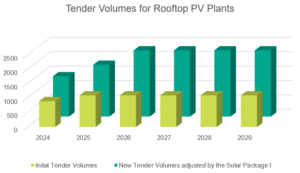
2.2 Increase of tender volumes for solar plants of the second segment
With the reduction of the threshold obligation to participate in the tendering procedure, the Solar Package I, on the other hand, also increases the tender volumes for rooftop solar plants. In particular, a significant increase is made for the tender procedures starting in 2026 by more than doubling the tender volumes. In detail, the annual tender volume for the years 2024 to 2029 is adjusted as follows:
3. New rules for energy storage systems
3.1 Strengthening the flexibility of energy storage operation
In the past, energy storage systems faced the legal difficulty that they could not be used for a mixed use (i.e. both with green electricity from RES plants and with grey electricity from the grid) while maintaining the eligibility for financial support under the EEG for the temporarily stored electricity from the EEG-subsidized RES plants. This was due to the “exclusivity criterion” requiring the storage operator to use exclusively renewable electricity. In order to enable a more flexible (mixed) and thus commercially sensible use of energy storage systems, the Solar Package I contains the following important new rules:
- Adjustment of the exclusivity criterion: In the past, the BNetzA already argued that an energy storage system that has been used for mixed purposes meanwhile can regain the status of an energy plant pursuant to Section 3 No. 1 Hs. 2 EEG at the beginning of a new calendar year if it is again used exclusively with renewable electricity. The legislator has now adopted the calendar year-based approach to the exclusivity criterion and introduces a respective clarification in the law (Section 19 (3) EEG).
- Switch between operating modes during the year: The Solar Package I further allows operators of energy storage systems to switch even during the year between the operating modes
- in which only renewable electricity is temporarily stored (“green electricity operating mode”), and
- those in which electricity not exclusively from renewable energy sources (e.g. also grid electricity) is temporarily stored (“mixed use operating mode”). The operator of the energy storage system is entitled to switch between the operating modes on a monthly basis, whereby the minimum duration for an operating mode is 2 months in each case and a maximum of 5 switches per year are possible. With the new rules under the Solar Package I, the entitlement of the plant operator to receive financial support under the EEG will continue to apply for the months for which the operator has selected the “green electricity operating mode” (Section 19 (3a) EEG).
- Mixed use eligible for EEG support: The Solar Package I also enables even greater flexibility in storage operation and for the first time introduces regulations for mixed use of an energy storage system (i.e. for the permanent selection of the “mixed use operating mode”) that is eligible for financial support under the EEG. In the case of a mixed use, the entitlement to receive payments under the EEG will in future be maintained for the so-called “eligible amount of electricity” (förderfähiger Anteil) (Section 19 (3b) EEG). More detailed requirements for determining and demonstrating the “eligible amount of electricity” will be set out by the BNetzA in a new determination (Festlegung) (Section 85d EEG). The new rules under the EEG on mixed use eligible for financial support will only enter into force however after the BNetzA has issued its new determination in this regard (Section 100 (34) EEG).
3.2 Strengthening the grid connection of energy storage systems
The Solar Package I contains important changes for the grid connection of energy storage systems. According to the new provision in Section 17 (2a) EnWG, the statutory grid connection priority for RES plants (Section 8 (1) sentence 1 EEG) and CHP plants (Section 3 (1) sentence 1 KWKG) will not apply against energy storage systems. With this rule, the legislator wants to ensure that energy storage systems have a priority connection to the grid (against any conventional plants) and thus creates a certain equality between energy storage systems and RES plants / CHP plants, as grid operators will no longer be allowed to give RES plants or CHP plants a priority grid connection against energy storage systems. However, this is unlikely to represent complete equality of treatment, as the legislator has not positively stipulated that the statutory grid connection priority of the EEG / KWKG should apply directly to energy storage systems. Thus, it still remains to be seen how the grid operators will actually deal with this new regulation in practice.
4. Strengthening of one-site electricity supply solutions
4.1 Expansion of the tenant electricity model (Mieterstrommodell)
The scope of the tenant electricity model, which has so far been limited to electricity produced by solar plants installed on, at or in residential buildings and its consumption within this residential building (or a residential building within the same building quarter), has been extended by the Solar Package I (Section 21 (3) EEG). In future, the tenant electricity regulations will also apply to electricity from solar plants installed on, at or in other buildings (including buildings or rooms used for commercial purposes) and on ancillary facilities of these buildings. The location at which the tenant electricity is consumed is also no longer restricted to residential buildings but can also take place in commercial rooms or buildings. This new legislation will thus increase the importance of the tenant electricity model in particular for the commercial sector. The legislator estimates that there is potential for 20,000 new tenant electricity agreements. However, according to the transitional provisions in the EEG, this expansion of the tenant electricity model only applies to new solar plants that are commissioned after the Solar Package I has entered into force (see Section 100 (24) EEG).
4.2 Introduction of the new on-site supply model „shared building supply“ (Gemeinschaftliche Gebäudeversorgung)
The Solar Package I introduces a new model for the on-site supply of electricity from solar plants, the so-called “shared building supply” (Section 42b EnWG). This new model is intended to enable the supply of solar electricity produced by landlords or third parties with a solar plant for the purpose of shared building supply (Gebäudestromanlage) to tenants (residential and commercial) or other end consumers (e.g. lessees) within the building and without any major bureaucracy. The practical relevance of the shared building supply is estimated by the legislator to be up to 80,000 buildings in Germany.
The shared building supply is a separate on-site supply model next to the tenant electricity model. In contrast to the tenant electricity model, however, the new shared building supply does not include the obligation of the plant operator to secure the entire supply of residual electricity to end consumers (which rather hast to be obtained by the end consumers themselves). In addition, the operator of the rooftop plant is not subject to any supplier obligations under the EnWG (e.g. billing and information obligations under Sections 40 and 40b EnWG).
The plant operators of the solar plants for the purpose of shared building supply have to enter into a so-called building electricity usage agreement (Gebäudestromnutzungsvertrag) with the end consumers in the building, the content of which is regulated in more detail by Section 42b (2) EnWG.
5. Acceleration of grid connections
5.1 Statutory right for the installation of cables (Section 11a EEG)
For the realization of grid connection cables, the Solar Package I establishes a new obligation for landowners to tolerate such installations. According to new Section 11a EEG, owners and other beneficiaries of a property owned by public landowners are now obliged to tolerate the laying, installation, maintenance/replacement and operation of electrical cables, control and communication lines and other facilities for connecting RES plants, energy storage systems or plants for the production or storage of green hydrogen to the public grid.
The obligation to tolerate such uses not only applies to public land, but also to public roads. There are exceptions to the right to lay lines if this usage conflicts with national and alliance defense interests. For the usage of the land, a one-off payment of 5% of the market value of the respective area of the protective strip used must be paid to the landowners.
Whereas the new obligation to tolerate such uses for the grid connection is important for project developments as it facilitates the process of securing land, its scope of application was considerably reduced during the legislative procedures by limiting the obligation publicly owned land only. The securing of areas of private land for grid connections, which often times proves time-consuming in practice, therefore remains unaffected by this new legal regulation and will still be required in the future.
5.2 Statutory right for crossing and overturning areas required for onshore wind projects (Section 11b EEG)
Similar to the obligation to tolerate the installation of electricity cables (see before), the Solar Package I introduces an obligation to tolerate in relation the realization of onshore wind projects. According to Section 11b EEG, owners and other authorized users of land are required to tolerate the crossing and the overturning of the land required for the construction and dismantling of wind turbines. To compensate for the crossing, a payment of EUR 28 per month and hectare as well as the obligation to restore the land to its original condition is provided for by law; overturning, on the other hand, is free of charge. Again, the obligation to tolerate only applies to public landowners.
5.3 Transparency and standardization of the Technical Connection Conditions (Technische Anschlussbedingungen – “TAB”)
The Solar Package I includes improvements to the technical regulations for grid connections:
- Publication of the TAB: Since 1 January 2023, the German distribution grid operators have been obliged to operate a joint internet platform (www.vnbdigital.de) and must now also publish the applicable TAB on this platform as of 1 January 2025, so that everyone has access to the TAB as well as the explanatory notes and possible amendments. These new transparency requirements are intended to simplify project developments and grid connection projects, as the relevant TAB can be found quickly and any special characteristics for the grid connection realization can be identified.
- Standardization of TAB: The new regulation of Section 19 (1a) EnWG introduces the statutory requirements for the permissible content of TAB in order to standardize the TAB (especially in view of the current 850 different distribution system operators in Germany). This standardization shall reduce the bureaucracy associated with grid connection projects.
We will be happy to assist you with legal advice on all aspects of renewable energies in Germany and the practical implementation of the new rules introduced by the Solar Package I.
Please do not hesitate to get in touch with us!
Learn more about our Energy & Infrastructure industry capabilities.





Bulletin Concurrence XI
ARTICLE
Bulletin Concurrence XI
April 2024
Read time: 2 min
We are delighted to share the eleventh Bulletin Concurrence which aims to keep you up to date with the key developments in competition law over the first quarter of 2024.
Read the full Bulletin (in French) here.



IRS Issues Final Regulations Addressing Ownership of Domestically Controlled REITs
ARTICLE / CLIENT ALERT
IRS Issues Final Regulations Addressing Ownership of Domestically Controlled REITs
April 29, 2024
Read time: 11 min
On April 24, 2024, the Internal Revenue Service (“IRS”) released final regulations (TD 9992) (“Final Regulations”) addressing the determination of whether a real estate investment trust (“REIT”) is “domestically controlled.” The Final Regulations finalize proposed regulations (REG-100442-22) (“Proposed Regulations”) under Section 897 of the Internal Revenue Code published on Dec. 29, 2022.[1]
The Final Regulations largely adopt the Proposed Regulations with certain modifications. Notably, the Final Regulations (i) look through a non-public domestic C corporation if foreign persons hold directly or indirectly more than 50 percent (revised from 25 percent or more in the Proposed Regulations) and (ii) include a 10-year transition period for existing structures with respect to the domestic corporation look-through rule.
The transition relief alleviates certain concerns of non-US investors related to existing investments in REITs that were previously thought to be domestically controlled REITs but that do not meet the requirements to be domestically controlled under the Proposed Regulations and the Final Regulations. However, monitoring of underlying ownership of a REIT and the asset holdings of a REIT is necessary to ensure the continued eligibility of such REITs for transition relief.
In addition, the Final Regulations provide clarity on which types of entities are “foreign persons” for purposes of determining domestically controlled status by finalizing, with minor changes, the definition outlined in the Proposed Regulations.
Background
Under the Foreign Investment in Real Property Tax Act of 1980 (“FIRPTA”), foreign corporations and nonresident aliens are generally subject to US federal income tax on any gain arising from the disposition of a US real property interest (“USRPI”). A USRPI includes an interest in a domestic corporation that was a United States real property holding corporation (“USRPHC”) at any time during the shorter of the five-year period ending on the date of the disposition of the interest or the period during which the taxpayer held the interest. A USRPHC is any corporation if the fair market value of its USRPIs equals or exceeds 50 percent of the sum of the fair market value of its real property interests and any other assets used or held for use in a trade or business. However, a USRPI does not include an interest in a REIT (or a regulated investment company (“RIC”) that is a USRPHC) that is “domestically controlled” (“DC REIT”). Accordingly, gain or loss on the disposition of stock in a DC REIT generally is not subject to tax under FIRPTA and ownership of DC REIT stock would not be considered ownership of a USRPI.
A REIT generally is considered “domestically controlled” if less than 50 percent of the value of the REIT’s stock is held “directly or indirectly” by foreign persons at all times during the five-year period ending on the date of the disposition of an interest in the REIT (or during the REIT’s existence if shorter).
The Proposed Regulations provided an interpretation of the phrase “directly or indirectly” with respect to the treatment of DC REIT ownership through partnerships and, in a departure from prior guidance, introduced a “foreign-owned” domestic corporation look-through rule (now modified to a “foreign-controlled” domestic corporation look-through rule in the Final Regulations, as discussed below). The Proposed Regulations would have applied to transactions occurring after the date final regulations were published, which, had transition relief not been included in the Final Regulations, would have potentially impacted existing structures as a result of the five-year look-back period.
Summary of the Final Regulations Under Section 897
General Approach
The Final Regulations generally follow the Proposed Regulations in adopting a partial look-through approach for purposes of determining whether a REIT is domestically controlled, dividing owners into “non-look-through persons” and “look-through persons.” Only non-look-through persons are taken into account in determining whether a REIT is domestically controlled.
Where a non-look-through person holds an interest in a REIT via a look-through person, the non-look-through person’s ownership of the REIT is determined based on the non-look-through person’s proportionate interest in the look-through person. The Final Regulations do not provide guidance regarding how to calculate ownership percentages for a situation in which the look-through person is a partnership with diverging capital and profits interests.
Non-look-through persons include the following categories:
- Individuals;
- Domestic C corporations (other than non-public “foreign-controlled” domestic C corporations discussed below);
- Certain tax exempt organizations and governmental entities;
- Foreign corporations (including foreign governments);
- Publicly traded partnerships (domestic or foreign);
- Certain public RICs;
- Estates (domestic or foreign);
- Certain international organizations;
- Certain public REITs;
- Qualified foreign pension funds and qualified controlled entities; and
- Any person that holds less than five percent of any class of stock of a REIT that is regularly traded on an established securities market (with such person treated as a US person unless the REIT (i) has actual knowledge to the contrary or (ii) has actual knowledge that such person is “foreign controlled” (as described further below)).
Look-through persons are any persons who are not non-look-through persons and include, for example, non-public REITs and RICs, S corporations, non-publicly traded partnerships (domestic and foreign) and trusts (domestic and foreign).
Domestic Corporation Look-Through Rule
The Final Regulations contain a look-through rule that requires looking through any non-public “foreign-controlled” domestic C corporation in which foreign persons hold directly or indirectly more than 50 percent of the fair market value of the corporation’s outstanding stock (the “Domestic Corporation Look-Through Rule”). The determination of whether a domestic C corporation is foreign-controlled is made by applying the same rules that apply for purposes of determining whether a REIT is domestically controlled. See Fig. 1 below for an illustration of the Domestic Corporation Look-Through Rule.
Actual Knowledge of Foreign Control
The Final Regulations include additional limitations that modify certain provisions if the REIT has “actual knowledge” that an entity is foreign controlled. As described above, the rule treating any person holding less than five percent of any class of stock of a regularly traded REIT as a US non-look-through person is turned off if the REIT has actual knowledge that such person is “foreign controlled” (treating any person that is not a non-public domestic C corporation as if it were a non-public domestic C corporation for this purpose). In addition, the Final Regulations treat public domestic C corporations, publicly traded partnerships and public RICs as look-through persons if the REIT has actual knowledge that such entity is foreign controlled.
Treatment of QFPFs
Consistent with the Proposed Regulations, under the Final Regulations, qualified foreign pension funds (“QFPFs”) and certain entities owned by QFPFs are considered foreign persons for purposes of determining whether a REIT is domestically controlled.
Applicability Dates and Transition Rule
The Final Regulations generally apply to transactions occurring on or after April 25, 2024, but include a transition rule that exempts existing structures from the Domestic Corporation Look-Through Rule for a period of ten years, provided that they meet certain requirements (“Transition Rule”).
Fig. 1, below, illustrates the domestic control analysis (i) under the Final Regulations (as applicable to new entities and existing entities that do not qualify for the Transition Rule), and (ii) under the Transition Rule (as applicable to entities that meet the requirements described below), which removes the application of the Domestic Corporation Look-Through Rule and instead treats foreign-controlled domestic C corporations as non-look-through persons.
The Transition Rule provides that, for a REIT in existence as of April 24, 2024, that is otherwise domestically controlled (without applying the Domestic Corporation Look-Through Rule) and satisfies the following requirements, the Domestic Corporation Look-Through Rule will not apply until the earlier of (i) April 24, 2034, or (ii) the date the REIT fails to meet either one of the following two requirements:
- Asset Requirement: The aggregate fair market value of any USRPIs acquired by the REIT after April 24, 2024, must not exceed 20 percent of the aggregate fair market value of the USRPIs held by the REIT as of April 24, 2024 (“Asset Requirement”).
- Ownership Requirement: The percentage of the stock of the REIT (determined by applying the final domestic corporation look-through rule and based on fair market value) held directly or indirectly by one or more non-look-through persons — whether US persons or non-US persons — must not increase by more than 50 percentage points in the aggregate over the percentage of stock of the REIT owned directly or indirectly by such non-look-through persons on April 24, 2024 (“Ownership Requirement”).
For purposes of the Asset Requirement and the Ownership Requirement, an acquisition of a USRPI or the stock of a REIT pursuant to a written agreement binding before April 24, 2024 (and at all times thereafter) or pursuant to certain tender offers is treated as occurring on April 24, 2024. For purposes of the ownership test, a REIT’s publicly traded stock owned by persons holding less than 5 percent is treated as owned by a single non-look-through person, except if the REIT has actual knowledge regarding the ownership of any person.
If the Transition Rule ceases to apply, analysis of the testing period to determine domestic control (i.e., the five-year look-back) still takes into account the Transition Rule for the period prior to failing to meet either of the above requirements (i.e., the Domestic Corporation Look-Through Rule applies prospectively).
The examples below in Fig. 2 and Fig. 3 illustrate the Asset Requirement and Ownership Requirement, respectively.
Key Takeaways
Existing REITs
Investment funds with private REITs in their structures should consider whether the Transition Rule will be applicable. If a REIT currently qualifies for transition relief, considerations regarding the REIT’s continued eligibility must be monitored when acquiring additional assets or changing the REIT’s ownership composition.
DC REITs looking to acquire additional USRPIs will need to evaluate the fair market value of their USRPIs as of April 24, 2024, and carefully monitor the aggregate fair market value of any newly acquired USRPIs. Fair market value is calculated without regard to debt. The threshold under the Asset Requirement is static and set as of April 24, 2024, such that subsequent changes in value of already-owned USRPIs have no effect. Additionally, there is no netting mechanism provided under the Asset Requirement, and so a DC REIT that acquires any additional USRPIs still must count the newly acquired assets under the Asset Requirement even in the event that the DC REIT also disposes of any existing USRPIs. Furthermore, USRPIs acquired by way of “like-kind” exchanges under Section 1031 were not addressed in the Final Regulations and, therefore, appear to be acquisitions that would be taken into account in determining whether the Asset Requirement has been breached.
In addition to transfers of DC REIT shares, funds will need to consider non-pro-rata issuances and redemptions to determine the increase in percentage ownership of a DC REIT under the Ownership Requirement. While an “F” reorganization of an owner of a DC REIT explicitly does not cause a change in ownership under the Final Regulations, other nonrecognition transactions and transfers by operation of law (e.g., at death or upon an entity’s dissolution) are not addressed. By negative implication, such transfers may be taken into account under the Ownership Requirement and result in a failure to qualify for transition relief.
Earlier guidance from the IRS in a Private Letter Ruling permitted restrictions on the liquidity of DC REIT stock imposed in order to maintain domestically controlled status, despite the general requirement under the REIT rules that REIT shares must be transferable.[2] Therefore, DC REITs needing the benefit of the Transition Rule in order to maintain status as a DC REIT would seem to be permitted to put restrictions into place against transfers that would cause the REIT to fail to satisfy the Ownership Requirement.
All REITs
Funds with REITs in their structures should consider their ability to solicit information from existing and prospective investors for purposes of determining DC REIT status. The preamble to the Final Regulations notes that a REIT must take appropriate measures to determine the identity of its direct and indirect shareholders in determining whether it is domestically controlled, but the Final Regulations do not prescribe a specific form or method.
Illustrative Examples
The following examples are adapted from Example 5 of the Final Regulations.


Please contact your Schulte Roth & Zabel LLP tax attorney for any questions about the potential consequences of the Final Regulations.
Authored by Philippe Benedict, David S. Griffel, Andi Mandell, Joseph Reich, Shlomo C. Twerski, Alan S. Waldenberg, David S. Wermuth, Christine Harlow, Bryson Kern and Hannah J. Wells.
[1] For further discussion of the Proposed Regulations, see our prior Alert “New Proposed Regulations Would Affect the Taxation of Foreign Investors in U.S. Real Estate”. Portions of the Proposed Regulations addressing Section 892 of the Internal Revenue Code are expected to be addressed in a separate rulemaking.
[2] IRS, Private Letter Ruling, PLR 9630016.
This communication is issued by Schulte Roth & Zabel LLP for informational purposes only and does not constitute legal advice or establish an attorney-client relationship. In some jurisdictions, this publication may be considered attorney advertising. © 2024 Schulte Roth & Zabel LLP. All rights reserved. SCHULTE ROTH & ZABEL is the registered trademark of Schulte Roth & Zabel LLP.









What California’s DOJ Said at the 2024 Antitrust Law Section Spring Meeting
ARTICLE / CLIENT ALERT
What California’s DOJ Said at the 2024 Antitrust Law Section Spring Meeting
April 26, 2024
Read time: 6 min
The American Bar Association Antitrust Law Section’s annual Spring Meeting earlier this month featured federal, state and international enforcers discussing a variety of antitrust and competition issues across jurisdictions. Paula Blizzard, the California Department of Justice’s antitrust chief, provided insights into the California attorney general office’s current and upcoming enforcement activities.
1. California’s Participation in Multistate Enforcement Actions
On November 6, 2023, California and three other states joined the US Department of Justice’s (DOJ) complaint against Agri Stats Inc., alleging Agri Stats violated Section 1 of the Sherman Act by facilitating exchange of competitively sensitive information among US meat processors.
- Agri Stats provides subscription and data analytics services that enable processors to upload and view sales figures and other competitive data. Agri Stats then generates detailed industry- and facility-level reports summarizing the data for participating processors to use in setting their prices and output. The participating processors account for a majority of meat sales in the United States.
- DOJ and the coalition of state attorney generals allege that Agri Stats’ data allowed the processors to engage in a coordinated effort to increase prices of chicken, pork and turkey. Agri Stats also allegedly encouraged the processors to use its reports for anticompetitive purposes.
- At the Spring Meeting, Blizzard highlighted the Agri Stats case as a high-profile multistate enforcement action that implicates key agricultural markets and impacts “the cost of putting dinner on the table.” Blizzard also implied that the California attorney general was looking at bringing information-sharing cases in California similar to the Agri Stats case.
2. California Passes Laws Expanding Protection of Labor Competition
In light of the heightened enforcement focus on competition in labor markets, Blizzard discussed two California statues that further expand California’s strong protection of open competition and employee mobility.
California currently voids “every contract by which anyone is restrained from engaging in a lawful profession, trade, or business of any kind,” including post-employment noncompete agreements and other restrictive covenants, subject to very narrow exceptions. See Cal. Bus. & Prof. Code § 16600.
- Senate Bill No. 699, codified as Section 16600.5, declares that any contract “that is void under [Section 16600]” is unenforceable, regardless of where and when the contract was signed. An employer who enters into, or attempts to enforce, a noncompete or restrictive covenant that is deemed void commits a civil violation. In addition to declaratory relief, employees may bring private actions against employers for violation of Section 16600 and can request injunctive relief, actual damages and attorney’s fees.
- According to Blizzard, this provision reaches noncompete agreements entered in California and outside of California. Future enforcement of the new statute is likely to raise the question of whether non-California noncompetes will be subject to Section 16600.5 even if noncompetes are legally permitted in that state.
- Blizzard also believes that this statute reaches no-poach agreements because the statute does not even require the employee to be a party to the anticompetitive arrangement.
- Assembly Bill No. 1076, codified as Section 16600.1, bans noncompete clauses in employment contracts and requires employers to notify all current and former California employees who had entered a noncompete agreement that such agreement is now void. The notification must be provided in written communications to the employee by February 14, 2024. A violation of Section 16600.1 also constitutes an act of unfair competition under Section 17200, California’s Unfair Competition Law.
Section 16600.5 and Section 16600.1 went into effect January 1, 2024. According to Blizzard, California’s enforcement of open competition and employee mobility helps fuel the strong California economy.
3. California Attorney General’s Office is Acquiring Resources to Perform Economic Analyses and Forecasting Amendments to the Cartwright Act
As part of the broader effort to effectively implement necessary antitrust enforcement, Blizzard remarked that the attorney general’s office, which is the largest attorney general’s office in the country, is onboarding an on-staff economist.
Additionally, Blizzard pointed out that the California Law Revision Commission reviewed and entertained the possibility of revising the Cartwright Act, California’s flagship antitrust statute. See Section § 16700 et seq. Blizzard believed that the recommendations resulting from the review were likely to be implemented through new California legislation in the next one to two years.
- Starting in 2022, the Commission began a comprehensive study to determine whether the Cartwright Act should be amended to (1) incorporate monopolization offenses, (2) place greater emphasis on reduction in innovation as a form of antitrust injury and (3) further highlight the benefits of free market competition.
- On April 1, 2024, several working groups in the Commission concluded their research and provided recommendations. They outlined the following potential changes to the Cartwright Act:
- Expanding the Cartwright Act’s scope to cover single-firm conduct, typically condemned under Section 2 of the Sherman Act
- Broadening the current standard on antitrust harm to include harm to suppliers, workers, growers, retailers and others
- Expanding current state merger review to possibly codify a separate merger notification requirement in California
- Enacting specific legislation related to the technology industry to give weight to consumer harm not already implicated by existing legal frameworks
- Taking more skeptical approaches to vertical agreements
What This Means
- California is increasing its antitrust enforcement activities in tandem with federal enforcers and in collaboration with other state attorneys general. Companies should revisit compliance guidelines as they relate to information sharing, noncompetes and no-poach arrangements.
- California takes the lead in enacting legislation banning noncompete and no-poach agreements in all instances, in parallel with the Federal Trade Commission’s promulgation of its own rule on noncompetes issued on April 23. Companies doing business in California involving Californian employees must ensure compliance with the state laws, in addition to the new federal one.
- The implications of the extraterritorial reach of Sections 16600.1 and 16600.5 to non-Californian employees and employers remain to be seen. Companies should consult with experienced counsel to discuss the ramifications of these new statutes for their preexisting and current employment contracts.
McDermott’s Los Angeles-based antitrust, litigation and employment teams are well-versed in these matters and look forward to assisting clients in navigating the California attorney general’s continued enforcement activities. The Firm’s Los Angeles office has an extensive history of helping technology industry clients as well as suppliers and retailers, all of whom are likely to be affected by the state’s enforcement initiatives in the antitrust space.









ICO Publishes New Transparency Guidance for Health and Social Care Sector
ARTICLE / CLIENT ALERT
ICO Publishes New Transparency Guidance for Health and Social Care Sector
April 26, 2024
Read time: 4 min
Healthcare sector organisations are increasingly deploying new technologies that use large amounts of personal information to support both direct care and secondary purposes, such as planning and research. Although these data-driven solutions offer many benefits to the public, often people are reluctant to agree to organisations sharing and using their information, especially where it is not clear how it will be used.
Following a consultation last year, the Information Commissioner’s Office (ICO) has published transparency guidance for organisations which deliver health and social care services or process health and social care information, including for secondary purposes such as research and planning. The guidance incorporates feedback from health and social care organisations across the UK.
What Are the Transparency-Related Requirements Under the UK GDPR?
Under the UK GDPR, organisations must (i) operate transparently (the transparency principle) and (ii) provide specific privacy information to individuals (the right to be informed). Since the transparency principle is less prescriptive than the right to be informed, the guidance correspondingly distinguishes between “privacy information” (which is required under Articles 13 and 14 of the UK GDPR) and “transparency information” which should be provided as a matter of best practice.
What Are Some of the Recommendations in the New Guidance?
The guidance states that to increase transparency and trust, in addition to providing the privacy information required by Articles 13 and 14, organisations should consider providing extra information, such as:
- confirmation of what the organisation will not do with people’s information;
- lists of information disclosed to researchers and the reasoning behind this; and
- information that challenges or proactively deals with contentious issues, for example when addressing misconceptions relating to third-party access to sensitive health information.
Further, given the co-existence of consents for different purposes in the healthcare and research sector (for example for data protection, common law duty of confidentiality, clinical trial participation and other purposes), the guidance emphasizes that it is important to set out the position in respect of consents and choice clearly. For example, an organisation must make clear for what purposes they are using consent. Is it as a lawful basis to process personal information, or for other purposes, such as consent to research participation?
The guidance also encourages organisations to consult with the public throughout the process of designing or updating transparency information, as it will improve the organisation’s understanding of data subjects’ needs, concerns and expectations, and to consider the most effective means to communicate transparency information.
What Are the Next Steps?
Although some sections of the guidance are written with the NHS organisations in mind, the guidance is highly relevant to life sciences and research organisations, and those providing services to NHS organisations. The next steps for organisations to consider include the following:
- Review what personal information they use and plan to use and why.
- Identify transparency issues and make improvements in response. For example, do they have any additional transparency material beyond privacy notice? Does it contain more than what is strictly required?
- Design an evaluation strategy to ascertain whether their communications raised awareness and understanding of their practice by patients/data subjects.


Sickness rates higher than ever: what can employers do?
ARTICLE
Sickness rates higher than ever: what can employers do?
April 25, 2024
Read time: 2 min
The HR News blog provides regular updates on recent developments in German employment law (in German). The latest blog post provides insights on “Sickness rates higher than ever: what can employers do?”.
Visit the blog and/or register now for regular HR NEWS updates (in German).

CMS issues guidance on usage of AI in making coverage determinations
ARTICLE
CMS issues guidance on usage of AI in making coverage determinations
April 25, 2024
Read time: 2 min
On February 6, 2024, the US Centers for Medicare & Medicaid Services (CMS) issued a letter to all Medicare Advantage (MA) organizations and Medicare-Medicaid plans. The letter covered frequently asked questions and answers related to the coverage criteria and utilization management requirements in the CMS Final Rule issued on April 5, 2023.
Among the FAQs was guidance related to the use of artificial intelligence (AI) and other technologies to assess coverage decisions. CMS wrote, “An algorithm or software tool can be used to assist MA plans in making coverage determinations, but it is the responsibility of the MA organization to ensure that the algorithm or artificial intelligence complies with all applicable rules for how coverage determinations by MA organizations are made.” For example, in a decision to terminate post-acute care services, an algorithm or software tool can be used to predict the potential length of stay, but that prediction alone cannot be used as the basis to terminate services.
CMS also expressed concern that algorithms and AI technologies can exacerbate discrimination and biases, emphasizing that MA organizations must comply with nondiscrimination requirements of Section 1557 of the Affordable Care Act.




FTC Issues Rule Banning Worker Noncompete Agreements
ARTICLE / CLIENT ALERT
FTC Issues Rule Banning Worker Noncompete Agreements
April 24, 2024
Read time: 10 min
What Happened?
On April 23, 2024, the Federal Trade Commission (FTC) voted 3-2 along party lines to ban all new noncompete agreements nationwide and render existing noncompete agreements binding most workers unenforceable. The Final Rule provides that employers’ use of noncompete agreements amounts to an “unfair method of competition” that runs afoul of Section 5 of the FTC Act.
As discussed below, the Final Rule does not render existing noncompete agreements with “senior executives” unenforceable.
When Does the Final Rule Go Into Effect?
The Final Rule is slated for publication in the Federal Register on May 7, 2024. It’s currently under public inspection. If not enjoined by a federal court, the effective date will be September 4, 2024.
What’s a Noncompete Agreement Under the Final Rule?
The Final Rule applies to all workers, including independent contractors and volunteers. It defines a “non-compete clause” as “a term or condition of employment that prohibits a worker from, penalizes a worker for, or functions to prevent a worker from (1) seeking or accepting work in the United States with a different person where such work would begin after the conclusion of the employment that includes the term or condition; or (2) operating a business in the United States after the conclusion of the employment that includes the term or condition.” A “term or condition of employment” includes, but is not limited to, a contractual term or workplace policy, whether written or oral.
What Does the Final Rule Prohibit?
As discussed below, the Final Rule draws a distinction between “workers” and “senior executives.”
Non-“Senior Executive” Workers
The Final Rule renders existing noncompete agreements with non-“senior executive” workers unenforceable. After the Final Rule’s effective date, subjecting such employees to noncompete agreements violates the Final Rule.
Additionally, the Final Rule provides that “[e]mployers must provide . . . workers with existing non-competes notice that they are no longer enforceable” by the effective date of the Final Rule. The FTC has provided model language that employers may use to communicate the required notice.
“Senior Executives”
Noncompete agreements entered into with “senior executives” before the Final Rule’s effective date remain enforceable. However, the Final Rule precludes new noncompete agreements with “senior executives” after the Final Rule becomes effective.
The Final Rule defines a “senior executive” as a worker who (i) received annual compensation of at least $151,164 in the preceding year and (ii) is in a “policy-making position.” A “policy-making position” means a business entity’s president, CEO or the equivalent, any other officer of a business entity who has policy-making authority, or any other natural person who has policy-making authority for the business entity similar to an officer with policy-making authority. “Policy-making authority” means final authority to make policy decisions that control significant aspects of a business entity or common enterprise and does not include authority limited to advising or exerting influence over such policy decisions or having final authority to make policy decisions for only a subsidiary or affiliate.
Will the Final Rule Be Challenged and on What Legal Bases?
Yes. Within hours of the vote, the US Chamber of Commerce (the Chamber) vowed to challenge the Final Rule in court and filed a lawsuit the next day in the US District Court for the Eastern District of Texas.
The Chamber, in a statement, argues that “the FTC has never been granted the constitutional and statutory authority to write its own competition rules” and seeks to “block [the] . . . rule and put other agencies on notice that such overreach will not go unchecked.” Additional litigation over the ban’s legality is anticipated.
Another lawsuit was filed in the US District Court for the Northern District of Texas by a private tax services firm, Ryan, LLC, challenging the Final Rule.
Does the Final Rule Materially Differ From the Proposed Rule?
Yes. The notice of proposed rulemaking (Proposed Rule) concerning noncompetes published on January 19, 2023, would have rendered all noncompete agreements unenforceable. As noted above, unlike the Proposed Rule, the Final Rule leaves existing noncompete agreements with “senior executives” undisturbed.
Additionally, as noted below, the Final Rule doesn’t impose an ownership threshold for its sale-of-business exception.
Is There a Sale-of-Business Exception?
Yes. There is a sale-of-business exception to the Final Rule’s prohibition against noncompete agreements.
Unlike the Proposed Rule, the Final Rule does not impose an ownership threshold for the exception to apply. The Final Rule “does not apply to non-competes entered into by a person pursuant to a bona fide sale of a business entity.”
What About Pending Litigation Involving Noncompetes?
The Final Rule provides that it “does not apply where a cause of action related to a non-compete accrued prior to the effective date.” This includes, for example, where an employer alleges that a worker accepted employment in breach of a noncompete if the alleged breach occurred prior to the effective date. The FTC explained that “[t]his provision responds to concerns that the final rule would apply retroactively by extinguishing or impairing vested rights acquired under existing law prior to the effective date.”
What Are the Implications of the Final Rule for Nonprofits?
Pursuant to Section 5 of the Federal Trade Commission Act (the Act), the FTC’s proffered authority for the Final Rule, the FTC may only enforce the Act against “persons, partnerships, or corporations.” The Act defines the term “corporation” as an entity “organized to carry on business for its own profit or that of its members.” Therefore, nonprofits, like many health systems and hospitals, may be beyond the enforcement ambit of the FTC and exempted from the Final Rule. Merely claiming tax-exempt status, however, does not suffice.
Specifically, the Final Rule warns that “[m]erely claiming tax-exempt status in tax filings is not dispositive.” Courts and administrative law judges have scrutinized actual private benefits being derived by an organization’s members to assess the FTC’s jurisdiction over tax-exempt organizations.
In assessing its jurisdiction to enforce the Final Rule, the FTC will likely examine:
- Whether there is “an adequate nexus between an organization’s activities and its alleged public purposes” and whether “its net proceeds [are] properly devoted to recognized public, rather than private, interests.”
- The “source of the income, i.e., … whether the corporation is organized for and actually engaged in business for only charitable purposes, and … the destination of the income, i.e., … whether either the corporation or its members derive a profit.”
For example, the FTC “has exercised jurisdiction … over a physician hospital organization [which consisted of over 100 private physicians and one non-profit hospital] because the organization engaged in business on behalf of for-profit physician members.” There, the nonprofit label did not shield the entity from the FTC’s jurisdictional reach because the entity was “organized for the pecuniary benefit of its for-profit members,” the FTC noted.
Further, the Final Rule explained that Internal Revenue Service (IRS) precedent examining purportedly tax-exempt nonprofit hospitals and other related entities that partner with for-profit entities found the entity loses tax-exempt status where the purportedly nonprofit entity “has ceded effective control” to a for-profit partner, thus “conferring impermissible private benefit.” Additionally, “the IRS has also rejected claims of nonprofit tax-exempt status for entities that pay unreasonable compensation, including percentage-based compensation, to founders, board members, their families, or other insiders.”
Within a nonprofit health system, additional scrutiny may be warranted for the following operations, among others:
- Physician hospital organizations, independent physician associations, clinically integrated networks and accountable care organizations
- Health plans
- Joint ventures with for-profit entities
- Taxable and for-profit subsidiaries
Overall, some nonprofit entities may be subject to the Final Rule’s ban on noncompetes; however, a case-by-case analysis is required to make a fact-specific determination of the FTC’s enforcement jurisdiction and a nonprofit organization’s exposure to the Final Rule.
How Can Corporations Protect Critical Business Interests That Have Long Been Safeguarded by Noncompetes?
There are alternatives to noncompete agreements that do not run afoul of the Final Rule and that firms should consider implementing or refining in anticipation of the Final Rule’s effective date, including:
- Nondisclosure agreements (NDAs)
- Training-repayment agreements (TRAPs)
- Customer and employee nonsolicit agreements
- Employee no-hire agreements
The Final Rule provides that the definition of a noncompete agreement “does not categorically prohibit other types of restrictive employment agreements,” including those listed above.
The restrictive covenants, however, cannot be so onerous that they function as a noncompete agreement in operation. A restrictive covenant may function as a noncompete that violates the Final Rule if it has the same effect as a noncompete – by, for example, substantially restricting worker mobility. This is a highly fact-specific inquiry. For example, a TRAP program that requires minimum wage workers to repay tens of thousands of dollars in training expenses or requires workers to repay all compensation earned over three years if they leave before a defined period of time “may be functional non-competes because, faced with significant out-of-pocket costs for leaving their employment . . . workers may be forced to remain in their current jobs, effectively preventing them from seeking or accepting other work or starting a business,” the Final Rule noted. A customer nonsolicit or employee no-hire agreement could similarly satisfy the definition of a noncompete under the Final Rule if it was so restrictive as to prevent a worker from seeking or accepting other work or starting a business after their employment ends.
State and Federal Laws Protecting Trade Secrets
Trade secrets are protected against misappropriation by state and federal statutes. The District of Columbia and 47 states have adopted the Uniform Trade Secrets Act (UTSA) or a version of UTSA. On the federal level, the Defend Trade Secrets Act (DTSA) of 2016 provides a civil cause of action under federal law for trade secret misappropriation. DTSA and most state trade secret statutes provide injunctive relief, compensatory and punitive damages and the recovery of attorneys’ fees.
Additionally, federal statutes such as the Computer Fraud and Abuse Act and the Economic Espionage Act provide an additional backstop to protect competitively sensitive information.
What Happens If the Final Rule Is Violated?
The FTC may either pursue an “adjudication” (an administrative complaint that is filed against an organization and redressed by an administrative law judge) under section 5(b) or seek an injunction in federal court under section 13(b). In both instances, the FTC bears the burden of proof. Final FTC decisions stemming from adjudications may be appealed to a US Court of Appeals.
The FTC cannot obtain civil penalties or other monetary relief against parties for violating the Final Rule, although it can obtain civil penalties in court if a party is ordered to cease and desist from a violation and fails to do so. Importantly, the FTC issued the Final Rule pursuant to the FTC Act, which does not provide for a private right of action for violations of the Act.
Companies should be aware that employees and competitors have the right to submit complaints to the FTC regarding noncompliance with the Final Rule, and the FTC has the authority to initiate investigations that are typically burdensome and costly. The FTC frequently issues civil investigative demands (CIDs) to investigation subjects to compel production of documents, data and information related to the investigation. CIDs are enforceable in court, and firms typically retain litigation counsel to ensure compliance and minimize exposure during investigations.
Companies should consult with counsel to assess their existing use of noncompetes and other restrictive covenants before the Final Rule’s effective date. They should also work with counsel to discuss additional strategies to protect competitive interests without running afoul of the Final Rule.
Immediate Next Steps
For any questions regarding the Final Rule, please contact your regular McDermott lawyer or one of the authors of this article. McDermott will report on additional developments as litigation challenging the Final Rule proceeds.





Protect Yourself: Action Steps Following the Largest-Ever IRS Data Breach
ARTICLE / CLIENT ALERT
Protect Yourself: Action Steps Following the Largest-Ever IRS Data Breach
April 24, 2024
Read time: 5 min
On January 29, 2024, Charles E. Littlejohn was sentenced to five years in prison for committing one of the largest heists in the history of the federal government. Littlejohn did not steal gold or cash, but rather, confidential data held by the Internal Revenue Service (IRS) concerning the United States’ wealthiest individuals and families.
Last week, more than four years after Littlejohn committed his crime, the IRS began notifying affected taxpayers that their personal data had been compromised. If you received a notice from the IRS, it means you are a victim of the data breach and should take proactive steps to protect yourself from fraud.
Littlejohn’s crime is the largest known data theft in the history of the IRS. He pulled it off while working for the IRS in 2020, using his access to IRS computer systems to illegally copy tax returns (and documents attached to those tax returns) filed by thousands of the wealthiest individuals in the United States and entities in which they have an interest. Upon obtaining these returns, Littlejohn sent them to ProPublica, an online nonprofit newsroom, which published more than 50 stories using the data.
Under federal law, the IRS was required to notify each taxpayer affected by the data breach “as soon as practicable.” However, the IRS did not send notifications to the affected taxpayers until April 12, 2024 – more than four years after the data breach occurred, and months after Littlejohn’s sentencing hearing.
Take Action
If you received a letter from the IRS (Letter 6613-A) enclosing a copy of the criminal charges against Littlejohn, it means you were a victim of his illegal actions. To protect yourself from this unprecedented breach of the public trust, we recommend the following actions:
- Consider Applying for an Identity Protection PIN. A common crime following data theft involves using a taxpayer’s social security number to file fraudulent tax returns requesting large refunds. An Identity Protection PIN (IP PIN) can help protect you from this scheme. After you obtain an IP PIN, criminals cannot file an income tax return under your name without knowing your identification number, which changes annually. Learn more and apply for an IP PIN here.
- Request and Review Your Tax Transcript. The IRS maintains a transcript of all your tax-related matters, including filings, payments, refunds, extensions and official notices. Regularly reviewing your tax transcript (e.g., every six to 12 months) can reveal fraudulent activity while there is still time to take remedial action. Request a copy of your tax transcript here. If you have questions about your transcript or need help obtaining it, we are available to assist you.
- Obtain Identity Protection Monitoring Services. Applying for an IP PIN and regularly reviewing your tax transcript will help protect you from tax fraud, but it will not protect you from other criminal activities, such as fraudulent loan applications. To protect yourself from these other risks, you should obtain identity protection monitoring services from a reputable provider.
- Evaluate Legal Action. Data breach victims should consider taking legal action against Littlejohn, the IRS and anyone else complicit in his wrongdoing. Justifiably, most victims will not want to suffer the cost, aggravation and publicity of litigation, but for those concerned with the public tax system’s integrity, litigation is an option.
In fact, litigation against the IRS is already underway. On December 13, 2022, Kenneth Griffin, the founder and CEO of Citadel, filed a lawsuit against the IRS in the US District Court for the Southern District of Florida after discovering his personal tax information was unlawfully disclosed to ProPublica. In his complaint, Griffin alleges that the IRS willfully failed to establish adequate safeguards over confidential tax return information – notwithstanding repeated warnings from the Treasury Inspector General for Tax Administration and the US Government Accountability Office that the IRS’s existing systems were wholly inadequate. Griffin is seeking an order directing the IRS “to formulate, adopt, and implement a data security plan” to protect taxpayer information.
The future of Griffin’s lawsuit is uncertain. Recently, the judge in his case dismissed one of his two claims and cast doubt on the theories underpinning his remaining claim. It could be years before a final decision is entered.
Although Griffin is leading the charge, joining the fight would bolster his efforts and promote the goal of ensuring the public tax system’s integrity. A final order in Griffin’s case will be appealable to the US Court of Appeals for the Eleventh Circuit. A decision there will be binding on both the IRS and taxpayers who live in Alabama, Florida and Georgia. However, the IRS could also be bound by orders entered by other federal courts arising from lawsuits filed by taxpayers who live elsewhere. Because other courts may disagree with the Eleventh Circuit, taxpayers living in other states could file their own lawsuits against the IRS in case Griffin does not prevail.
Victims of the IRS data breach who are interested in taking legal action should act quickly. Under the Internal Revenue Code, a lawsuit must be filed within two years after the date the taxpayer discovered the data breach. We are available to help you evaluate your legal options.