Content Type: Article

  • UK Taxation of Carried Interest – Request for Input

    UK Taxation of Carried Interest – Request for Input

    ARTICLE / CLIENT ALERT

    UK Taxation of Carried Interest – Request for Input

    January 14, 2025

    Read time: 8 min

    Key takeaways
    Overview

    In our Autumn Budget Statement 2024 webinar on 5th November[1], we discussed the government’s proposals for a revised regime for the taxation of carried interest in the UK, to be introduced with effect from April 2026. HM Treasury is now undertaking a technical consultation on the proposed regime, which focuses on how the line should be drawn between carried interest, which is income-based carried interest (“IBCI”), and ‘qualifying’ carried interest, which is non-IBCI.[2]

    Currently, the distinction between IBCI and non-IBCI is based on a test that looks at the weighted average holding period of the assets in the fund (the 36/40 month test). The government intends that this average asset holding period test should remain in place.[3] However, the consultation asks for views on whether there is a case for further conditions, which would need to be satisfied in order for carried interest to be non-IBCI. The two conditions proposed[4] are:

    1. A minimum co-investment requirement; and
    2. A minimum time period between a carried interest award and the receipt of carried interest.

    Schulte intends to submit a written response to the government’s consultation. In order that the views, insights and experience of our clients are accurately and fully represented, we invite you to share any contributions you may wish to make as we formulate our formal response. This can be on an anonymous or attributed basis. You can send your views by email, or if you prefer, please do not hesitate to call us. The closing date by which responses to the consultation must be submitted is 31 January 2025 and accordingly we would ask for your input by no later than 5pm GMT on 28 January 2025. We have set out below further details of the proposed conditions and the questions raised in the consultation.

    The aggregate minimum co-investment condition

    The proposal is that ‘qualifying’ non-IBCI treatment will only be available where the fund management team makes a minimum level of co-investment in the fund, so that fund managers are exposed to a material amount of risk in connection with the funds which they manage. Other jurisdictions typically apply a similar test by requiring the management team to co-invest a percentage of the total investor commitments. The government is not proposing an individual-by-individual co-investment requirement, recognizing that this would be difficult to implement in a way which is proportionate and fair, and would adversely impact those individual fund managers less able to raise the upfront capital to meet a minimum co-investment condition – in particular, more junior fund managers or new entrants to the market.

    The consultation also recognises that there are a number of practical challenges with implementing a minimum co-investment requirement (even on a team basis), such as the definitional challenge of identifying the “fund” in complex structures that might involve a range of different feeder, parallel and aggregator vehicles, and the difficulty of selecting an appropriate level for a universal minimum co-investment condition where an appropriate and feasible level of co-investment is likely to differ across different investment strategies. It is perhaps reasonable to say that a team minimum co-investment condition is currently not the government’s favoured option.

    Nevertheless, the questions on which the consultation welcomes representations are as follows (and we have glossed some of these with our own amplifications of the government’s questions):

    1. How to define the “fund” for the purposes of any new condition? – Given the difficulties where there are complex fund structures as described above;
    2. The minimum level(s) of [team] co-investment that should be required? – For example, should this be 1% of total investor commitments? Or 5%? Is there already a market requirement for “skin in the game” which requires a minimum level of co-investment from the management team? What level of such market-obligated co-investment is typical?
    3. What types of co-investment arrangements should count for the purpose of meeting the condition?
    4. The time period during which the condition must be satisfied? – Is this for the life of the fund?
    5. Is there a need for transitional arrangements for existing funds?

    The government also welcomes representations on any further risks or wider considerations that should be highlighted in this context.

    Minimum holding period for carried interest rights

    The government’s proposal is that there should be a minimum period between the grant of carried interest rights to an individual and the actual receipt of carried interest by that individual. This would be in addition to the average fund asset holding period which currently identifies IBCI and ‘qualifying’ non-IBCI (the 36/40 month test) which will remain in place. In contrast to any team-level minimum co-investment condition, a carried interest minimum holding period requirement would be assessed at the level of the individual fund manager.

    The consultation identifies that the fact that fund managers must generally wait a considerable period of time before receiving carried interest is one of the factors that gives carried interest its unique economic characteristics (and justifies it being more favourably taxed that other forms of performance related remuneration, such as employee bonuses). Accordingly, the government is seeking views on the merits and design of a minimum holding period condition. The specific questions on which views are sought (again, along with the gloss of our amplifications) are:

    1. How might the length of any new time-based condition best be designed to reflect the nature of carried interest rewards? – Is there already a period between grant and receipt that is required for management teams? Seven years is often cited as an average period – is this true for you, or could it be less? Are you aware that the typical period is more or less depending on the investment strategy followed for the fund?

    Separately, are there difficulties involved in applying a minimum time-based condition to certain individuals such as new joiners? Or individual managers who pick-up carried interest from leavers who have forfeited their carried interest (and so might not hold this newly-acquired carried interest for the required minimum period)?

    1. Do you foresee any unintended adverse consequences for fund managers in existing funds from a government decision not to introduce transitional arrangements on the introduction of a [minimum holding period] condition of this kind? – The government’s current view is that transitional rules for existing funds are not needed. But if you are aware of existing specific fact patterns to consider as part of any final determination, which would mean that transitional rules would be needed to ensure a fair result, we should make the government aware of them.

    Your contributions

    The consultation closes on 31 January 2025, so we would need to hear from you by 28 January 2025 in order to include your contributions in our response and make sure that all important views are represented. Please do not feel the need to respond on all aspects of the consultation – your views on the particular aspects that are most relevant and important to you in the actual context of your management business are very welcome. We look forward to hearing from you.

    Authored by Nick Fagge (+44 (0) 20 7081 8009) and Dan Roman (+44 (0) 20 7081 8033).

    If you have any questions concerning this Alert, please contact your attorney at Schulte Roth & Zabel or one of the authors.


    [1] Listen to the webinar recording.

    [2] Broadly, with effect from April 2026, all carried interest (IBCI and ‘qualifying’ non-IBCI) will be taxed as trading profits and so be subject to 45% income tax and 2% Class 4 NICs, but ‘qualifying’ carried interest that is non-IBCI will attract a 72.5% multiplier, reducing the overall effective rate of income tax and NICs on such ‘qualifying’ non-IBCI carried interest to 34.075%.

    [3] The government has also announced that the current “ERS exclusion”, under which carried interest that arises in respect of an employment-related security is automatically not IBCI, will be removed. Consequently, all carried interest will in the future need to meet the 36/40 month test in order to be regarded as ‘qualifying’ non-IBCI.

    [4] The consultation document indicates that the government may adopt both, or either one, of the two proposed conditions.


    This communication is issued by Schulte Roth & Zabel International LLP for informational purposes only and does not constitute legal advice or establish an attorney-client relationship. In some jurisdictions, this publication may be considered attorney advertising. © 2025 Schulte Roth & Zabel International LLP. All rights reserved. SCHULTE ROTH & ZABEL is the registered trademark of Schulte Roth & Zabel LLP.


    In depth
    Authors

    Nick Fagge

    Partner

    London – One Eagle Place

    More insights

  • New Requirements for Illinois Dental Practices Using Third-Party Financing Programs

    New Requirements for Illinois Dental Practices Using Third-Party Financing Programs

    ARTICLE / CLIENT ALERT

    New Requirements for Illinois Dental Practices Using Third-Party Financing Programs

    January 13, 2025

    Read time: 5 min

    Key takeaways
    Overview

    Third-party financing services are frequently used by patients to finance out-of-pocket dental expenses. Effective January 1, 2025, dental practices in Illinois are prohibited from facilitating or assisting with patient applications for third-party financing services. Further, dental practices must provide patients with a specific written notice when discussing third-party financing options.

    In depth

    Background

    Some dental practices have existing relationships with third-party financing programs or have historically assisted patients with signing up for third-party financing. In 2024, the Illinois State Dental Society and other interested parties worked with state legislators to develop legislation that implements consumer protections and limitations related to third-party financing applications. The new law focuses on transparency and disclosure requirements and seeks to limit how dental practices can facilitate third-party financing applications for patients. After the initial bill underwent significant revisions, Illinois Governor JB Pritzker signed the final bill into law on August 2, 2024, and the law became effective on January 1, 2025. Other states, such as California, have enacted similar laws.

    Prohibitions and Requirements

    Under the law, dental practices, including their employees, agents, contractors, management companies, and dental service organizations (DSOs), are prohibited from facilitating or brokering third-party financing services for their patients. Specifically, dental practices may not:

    • Arrange for, broker, establish, or submit a patient’s financing application to a third-party creditor, lender, or intermediary
    • Complete any part of a patient’s third-party financing application
    • Collect financing applications for submission to the third-party financer
    • Provide patients with software, links, URLs, or QR codes that direct them to a third-party financing application that is customized with the branding of the dental practice (in other words, the third-party application cannot look like it is part of the dental practice)
    • Provide patients with an electronic device, such as a tablet or a computer station, to apply for third-party financing
    • Advertise, promote, or provide third-party financing materials to patients if they (i) have received any kind of sedation or nitrous oxide, (ii) are currently receiving treatment, or (iii) are currently in a treatment area, such as an exam room or surgical room, unless a separate waiting area does not exist.

    However, the law does not prohibit dental practices from providing patients with general advertisements or materials. Dental practices may still do the following:

    • Provide patients with third-party marketing or advertising materials that are not customized or branded for the dental practice
    • Provide brochures, information, and other advertisements or promotional materials for third-party financing programs in waiting rooms
    • Discuss third-party financing options with patients and provide them with paper copies of applications.

    The law also includes a written notice requirement. When discussing or providing third-party financing applications to a patient, dental practices must provide a written notice that explains to the patient that they are applying for a credit card, line of credit, or loan. The Illinois Department of Financial and Professional Regulation (IDFPR) has released a printable copy of the required written notice, which dental practices can immediately start using. Dental practices may also create a copy of the notice with their own branding, but the precise language used in the law must be included in at least 14-point font for patients to review.

    Violations of the law are punishable by a fine of up to $500 for the first violation and up to $1000 for each subsequent violation. The law is enforced by the IDFPR, which may take additional disciplinary action (including suspension or termination of the dentist’s license) if the dental practice otherwise commits prohibited conduct under the Illinois Dental Practice Act. The IDFPR has not promulgated regulations or guidance regarding the statute but may adopt rules at a future date.

    Key Takeaways

    Dental practices and DSOs should promptly review their policies and workflows related to third-party financing applications and adjust their workflows as necessary to comply with the new law. Dental practices that have relationships with third-party financing companies should review their websites and patient-facing materials to ensure that such materials comply with the new law. For instance, if a practice’s website has a built-in, practice-branded application for third-party financing, the website should be revised to instead direct patients to the website of the third-party financer. Further, any third-party applications or promotional materials should be removed from exam rooms and treatment areas and should instead be kept at the front desk or in the waiting room.

    Front desk staff should be well-trained on the notice requirement. Dental practices may consider including the notice in their new patient paperwork, but the notice must also be provided any time third-party financing is discussed, which typically occurs at checkout and may occur at multiple visits.

    Notably, the law does not apply to in-house payment plans or financing programs offered directly by a dental practice. The law only applies to financing programs offered by a third party. Therefore, dental practices with their own payment plans may continue to provide patients with assistance and otherwise facilitate the completion of applications for their in-house payment plans.

    Authors

    Kristian A. Werling

    Partner

    Chicago

    Monica Wallace

    Partner

    Chicago

    Evelyn S. Atwater

    Associate

    Chicago

    More insights

  • FTC Publishes Annual Merger Notification Jurisdictional Threshold and Filing Fee Adjustments

    FTC Publishes Annual Merger Notification Jurisdictional Threshold and Filing Fee Adjustments

    ARTICLE

    FTC Publishes Annual Merger Notification Jurisdictional Threshold and Filing Fee Adjustments

    Jan 13, 2025

    Read time: 2 min

    Key takeaways
    Overview

    On January 10, 2025, the Federal Trade Commission (FTC) released increased jurisdictional thresholds, filing fee thresholds, and filing fee amounts for merger notifications made pursuant to the Hart-Scott-Rodino Antitrust Improvements Act of 1976 (HSR Act).

    In depth

    Merger Notification Threshold Changes

    The HSR premerger notification regime requires transacting parties to notify the FTC and US Department of Justice (DOJ) of their intent to consummate a transaction that meets or exceeds certain jurisdictional thresholds, unless an exemption applies. The adjusted thresholds apply to all transactions that close on or after the effective date, which will be 30 days after the notice is published in the Federal Register.

    The HSR thresholds are adjusted annually based on gross national product (GNP). The threshold changes are as follows:

    • The base statutory size-of-transaction threshold, the lowest threshold requiring notification, will increase to $126.4 million.
    • The upper statutory size-of-transaction test, requiring notification for all transactions that exceed the threshold (regardless of the size-of-person test being satisfied), will increase to $505.8 million.
    • The statutory size-of-person lower and upper thresholds (which will apply to deals valued above $126.4 million but not above $505.8 million) will increase to $25.3 million and $252.9 million, respectively.

    HSR Filing Fee Changes

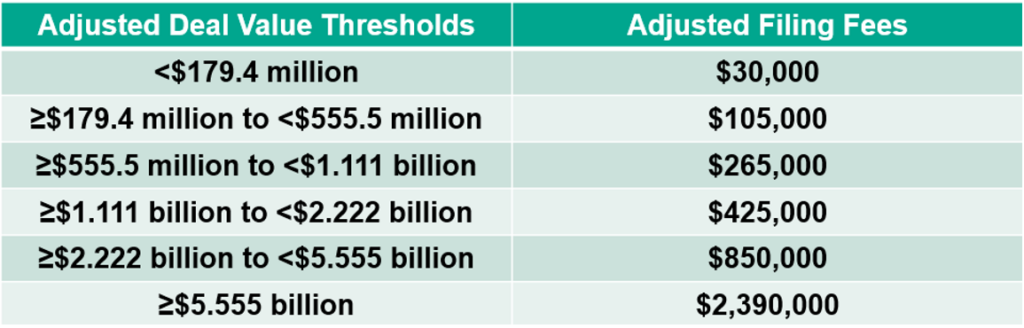
    The FTC is also required to update filing fee thresholds and amounts on an annual basis. Filing fee thresholds are adjusted based on the percentage change in GNP and filing fee amounts are adjusted based on the percentage change in the Consumer Price Index. These changes will also take effect 30 days after publication of the notice in the Federal Register.

    The adjusted filing fee thresholds and fee amounts are provided in the table below.

    hsr filing fee table antitrustalert
    Authors

    Gregory E. Heltzer

    Partner

    Washington, DC

    Graham J. Hyman

    Associate

    New York – One Vanderbilt Avenue

    Timothy (Ty) Carson

    Counsel

    Washington, DC

    More insights
    Endnotes

  • New Rules Simplify ACA Employer Shared Responsibility Reporting Obligations

    New Rules Simplify ACA Employer Shared Responsibility Reporting Obligations

    ARTICLE / CLIENT ALERT

    New Rules Simplify ACA Employer Shared Responsibility Reporting Obligations

    January 13, 2025

    Read time: 7 min

    Key takeaways
    Overview

    Under the Affordable Care Act’s (ACA) employer shared responsibility provisions, applicable large employers (ALEs) must either offer minimum essential coverage that is “affordable” and that provides “minimum value” to their full-time employees (and their dependents), or potentially make an employer shared responsibility payment to the Internal Revenue Service (IRS). These rules, and which entities must comply, are summarized below. The rules are complicated and demanding. Thankfully, compliance is now easier due to two recently passed laws:

    1. The Employer Reporting Improvement Act (HR 3801) (link here).
    2. The Paperwork Burden Reduction Act (HR 3797) (link here).

    Together, these bills modify provisions of the ACA that require employers and health insurance providers to prepare tax forms showing proof of minimum essential coverage (Forms 1095-B and 1095-C tax forms) and IRS enforcement of the ACA rules.

    In depth

    Background

    Under the ACA, ALEs may face excise taxes if they either fail to offer minimum essential coverage to at least 95% of their full-time employees, or if the coverage offered is unaffordable or does not provide minimum value. These excise taxes, known as employer shared responsibility payments, are triggered when an employee receives a premium tax credit through a state healthcare exchange for one or more months in the corresponding tax year.

    The ACA imposes on ALEs certain information-reporting responsibilities regarding minimum essential coverage offered to employees. Reporting is primarily accomplished using IRS Form 1095-C, which must be filed with the IRS and furnished to all full-time employees and employees receiving employer-sponsored coverage. Similar reporting rules apply to insurers and certain other employer-sponsored health plans, which are typically reported on Forms 1094-B and 1095-B. These reporting rules remained in place, despite the ACA’s individual mandate being reduced to $0 under the Tax Cuts and Jobs Act of 2017. Each ALE must also submit at least one Form 1094-C to the IRS. This is a “transmittal” form that reports the ALE’s general information, whether the ALE is an aggregated ALE, the total number of full-time employees in each month of the previous year, whether the ALE offered minimum essential coverage to its full-time employees, and the total number of all employees (i.e., full-time and non-full-time employees) in each month of the previous year.

    Generally, ALEs must submit these forms to the IRS by February 28 of the subsequent year if paper filed or by March 31 of the subsequent year if electronically filed. ALEs that have to file more than 250 Forms 1094-C or Forms 1095-C often must file electronically. ALEs may elect to meet this requirement by providing each employee with a copy of his or her specific Form 1095-C that the ALE submitted to the IRS. Each full-time employee must receive this information by January 31 of the subsequent year.

    The Paperwork Reduction Act

    The Paperwork Reduction Act amends Section 6056 of the Internal Revenue Code, which obligates ALEs and health insurers (carriers) to prepare and furnish Forms 1095-C/1095-B to employees. Significantly, ALEs no longer need to mail forms to employees if they meet certain requirements. Instead, if ALEs provide timely notice to individuals of their right to request these forms, ALEs must only provide these forms to employees upon request by the later of January 31 or 30 days after the request. The required notice must be clear and conspicuous and posted in a location that is reasonably accessible to all individuals, stating that responsible individuals may receive a copy of the form upon request.

    To apply for 2024 forms due in 2025, the required notice should be posted by January 31, 2025.  More guidance from the IRS on the manner of compliance, including good faith reliance for the current cycle, and a sample notice would be welcome.

    The Employer Reporting Improvement Act

    The relief provided by the Paperwork Reduction Act is narrowly targeted. In contrast, the Employer Reporting Improvement Act’s modifications are broader, though no less welcome. These are summarized below.

    Taxpayer Identification Number Reporting. Historically, the ACA forms generally required disclosure of each covered person’s social security number (SSN) or tax identification number (TIN). The new law allows ALEs to substitute a birthdate in instances where an SSN or TIN is available. This provision of the law codifies existing IRS practice.

    Letter 226-J Response Timing. ALEs now have 90 days to respond to Employer Shared Responsibility Penalty notices in Letter 226-J. The prior IRS standard was 30 days. While this should result in fewer extension requests, particularly as ALEs seemingly rarely received the Letter 226-J until near the end of the prior 30-day period, it is unclear how this extension will apply to any follow-up notices the IRS may send.

    Statute of Limitations. The law establishes a six-year statute of limitations on the IRS for returns due after December 31, 2024, for assessing employer shared responsibility payments, a change that is particularly welcome. The limit begins to run on the later of the due date for the underlying form or the date the return is actually filed. Under prior law, there was no statute of limitations.

    Electronic Delivery. ALEs may furnish any requested ACA forms to individuals electronically, provided such individual has consented to and not revoked their consent to electronic delivery.  Forms must be provided on paper to individuals who have not consented to electronic delivery.

    Action Items for ALEs

    1. Review new legislation: Ensure your benefits team is familiar with the new rules and understands the specific changes and how they impact your reporting obligations.
    2. Implement notice requirements: For plan sponsors that want to take advantage of the reporting relief, prepare and make available the required notice by January 31, 2025. Ensure the notice is clear, conspicuous, and accessible, providing all necessary contact information for employees to request a copy of their form.
    3. Update internal processes: Adjust your internal processes to align with the new reporting allowances to permit the use of birthdates instead of SSNs/TINs when you are unable to locate the SSN/TIN for a covered individual.
    4. Monitor compliance: Keep an eye out for an IRS Letter 226-J or related follow-up notices from the IRS and ensure you respond within the required 90 days or request an extension. If you are currently working on a response to a Letter 226-J, consider contacting the IRS to confirm they will automatically extend the response deadline to 90 days.
    5. Obtain consent for electronic disclosure: For plan sponsors that already do or wish to furnish ACA and other employee benefits documentation electronically, confirm you have valid consent or work through a process to obtain the required consent from employees. This can be somewhat challenging, as the IRS, US Department of Labor, and US Department of Health and Human Services often have different rules for electronic disclosure of forms and notices that fall under their purview.

    For more information on these changes, please contact your regular McDermott lawyer or one of the authors listed below.

    Authors

    Jacob M. Mattinson

    Partner

    Chicago

    Sarah G. Raaii

    Partner

    Chicago

    More insights

  • FTC Increases 2025 Thresholds for HSR Filings and Interlocking Directorates

    FTC Increases 2025 Thresholds for HSR Filings and Interlocking Directorates

    ARTICLE / CLIENT ALERT

    FTC Increases 2025 Thresholds for HSR Filings and Interlocking Directorates

    January 13, 2025

    Read time: 5 min

    Key takeaways
    Overview

    On Jan. 10, 2025, the Federal Trade Commission (“FTC”) announced increased reporting thresholds under the Hart-Scott-Rodino Antitrust Improvements Act of 1976, as amended (“HSR Act”) and an amended HSR filing fee schedule. The revised HSR thresholds and filing fee schedule will apply to all transactions that close on or after Feb. 21, 2025. The minimum size-of-transaction threshold was increased from $119.5 million to $126.4 million. Acquisitions below this threshold will not be reportable.

    The FTC also raised the thresholds for interlocking directorates under Section 8 of the Clayton Act, effective as of Jan. 22, 2025, and increased the maximum civil penalty for HSR violations to $53,088 per day of noncompliance, effective as of Jan. 17, 2025.

    Revised HSR Act Thresholds

    Generally, the HSR Act requires parties to acquisitions of voting securities, assets or non-corporate interests meeting certain thresholds to make a premerger notification to the FTC and the Antitrust Division of the Department of Justice (“DOJ”) unless an exemption applies. The parties to a reportable transaction must observe a waiting period (generally 30 days) before closing. The HSR Act thresholds are adjusted annually in accordance with changes in US gross national product (“GNP”).

    Under the revised thresholds, transactions valued up to and including $126.4 million are not reportable under the HSR Act. Transactions valued at more than $126.4 million may be reportable if they meet the following criteria and no exemption applies:

    HSR notification thresholds for acquisitions of voting securities. After an HSR filing has been made, and the applicable waiting period has expired or been terminated, any additional acquisitions by the same acquiring person of the same issuer’s voting securities will be exempt from HSR notification, so long as:

    • The acquiring person’s holdings crossed the notification threshold with respect to which the premerger notification was made within one year of the expiration or early termination of the HSR Act waiting period; and
    • The subsequent acquisition is consummated within five years following the expiration or early termination of the HSR Act waiting period; and
    • The subsequent acquisition will not meet or exceed a higher notification threshold (based on the adjusted thresholds in effect at the time of consummation).

    The following adjusted notification thresholds take effect as of Feb. 21, 2025:

    HSR filing fees. The current filing fee schedule, which becomes effective on Feb. 21, 2025, is as follows:

    The filing fees are increased annually (and rounded to the nearest $5,000) if the percentage increase in the Consumer Price Index (“CPI”) since the last fiscal year is greater than one percent. The size-of-transaction tiers are adjusted annually based on the percentage change in GNP compared to the prior fiscal year.

    HSR penalties. Any person (including the company and any of its officers, directors or partners) failing to comply with the HSR Act may be subject to a civil penalty for each day during which such person is in violation of the Act. The maximum civil penalty was increased from $51,744 per day to $53,088 per day of noncompliance, effective as of Jan. 17, 2025. The civil penalty amounts are adjusted by the FTC annually based on the percentage change in the CPI. 

    Revised Thresholds for Interlocking Directorates

    The FTC also revised the thresholds for evaluating interlocking directorates, effective as of their date of publication in the Federal Register. Under certain circumstances, Section 8 of the Clayton Act prohibits one person from simultaneously serving as a director or officer of two competing corporations if each corporation has capital, surplus and undivided profits aggregating more than $51,380,000 (up from $48,559,000).

    The Clayton Act does not prohibit the interlock if: (1) the competitive sales of either corporation are less than $5,138,000 (up from $4,855,900); (2) the competitive sales of either corporation are less than two percent of that corporation’s total sales; or (3) the competitive sales of each corporation are less than four percent of that corporation’s total sales.

    Although Section 8 technically applies only to corporations, both the DOJ and the FTC have taken the position that their broader antitrust authority allows them to enforce the same concept against non-corporate entities.

    Authored by Peter Jonathan Halasz and Ngoc Pham Hulbig.

    If you have any questions concerning this Alert, please contact your attorney at Schulte Roth & Zabel or one of the authors.


    This communication is issued by Schulte Roth & Zabel LLP for informational purposes only and does not constitute legal advice or establish an attorney-client relationship. In some jurisdictions, this publication may be considered attorney advertising. © 2025 Schulte Roth & Zabel LLP. All rights reserved. SCHULTE ROTH & ZABEL is the registered trademark of Schulte Roth & Zabel LLP.

    In depth
    Authors

    Peter Jonathan Halasz

    Of Counsel

    New York – 919 Third Avenue

    More insights

  • SBA’s Final Size Standard Recertification Rule: What Private Equity Companies Need to Know

    SBA’s Final Size Standard Recertification Rule: What Private Equity Companies Need to Know

    ARTICLE / CLIENT ALERT

    SBA’s Final Size Standard Recertification Rule: What Private Equity Companies Need to Know

    January 10, 2025

    Read time: 6 min

    Key takeaways
    Overview

    We previously discussed the US Small Business Administration’s (SBA) proposed rule updating the regulations regarding government contractor size and small business program status recertification. The SBA has now issued the final version of that rule.

    In finalizing the rule, the SBA elected to delay implementation of certain changes to the recertification process until January 17, 2026. These include the new blanket prohibition disqualifying contractors that hold set-aside multiple award contracts from being eligible for set-aside options or orders under that contract if the contractor has made a recertification that the contractor is no longer small. This delay provides a strong incentive to complete a transaction that would otherwise trigger a disqualifying certification prior to January 17, 2026, although there remain obstacles to the target small business maintaining its current revenue streams.

    This client alert provides more detail on the impact of the final rule on transactions involving small business government contractors.

    In depth

    The rule’s general policy revisions remain unchanged in the final version. It impacts small business government contractors who hold multiple award vehicle contracts, rather than single award contracts.

    Under the prior rule, which will now remain in effect until January 17, 2026, when a small business is awarded a multiple award contract set aside for small businesses, a change in the small business’s size status – such as following a transaction – does not automatically disqualify the business from receiving options and orders under the multiple award contract, even after the business no longer qualifies as small. Agencies are prohibited from counting spending on set-aside orders and options awarded to these “grandfathered” contractors toward their small business government contracting goals. This creates some disincentives for making such awards, but there was no blanket prohibition. Thus, the prior rule created a dynamic where small businesses were competing for orders set aside specifically for small businesses against contractors who may have once been small but had since become large businesses, either after being acquired or after simply growing. The SBA explained in the final rule that this dynamic was not how the agency intended the rule to operate:

    SBA never intended to allow a firm’s self-certification for the underlying unrestricted multiple award contract to control whether a firm is small at the time an order or agreement is set-aside for small business years after the multiple award contract was awarded.

    As discussed in more detail in our previous article, the key impact of the now final new rule is to end eligibility for future set-aside orders and options under a multiple award contract when a small business recertifies as other than small. Generally, such recertifications are required by the SBA regulation in one of three circumstances:

    1. Within 30 days of a merger, acquisition, or sale of or by a contractor or an affiliate of the contractor resulting in a change in controlling interest;
    2. No more than 120 days prior to the end of the fifth year of contracts or orders with a duration of more than five years and no more than 120 days prior to exercising any option thereafter. A contracting officer may also request where recertification prior to the 120-day point in the fifth year of a long-term contract or order; and
    3. When a contracting officer explicitly requires contractors to recertify their size or status in response to a solicitation for a set aside or reserved order or agreement.

    For example, if, following a transaction, a small business recertifies to the SBA that it is no longer small, the contractor may continue to perform the remainder of a contract’s current period of performance. However, under the new rule, the contractor will now be ineligible for future restricted orders and options under any multiple award contract or agreement. Similarly, if in response to the recertification requirement for long-term multiple award contracts a contractor recertifies as no longer small, that contractor is ineligible to bid for set-aside or reserved awards. However, in circumstances where a contracting officer requests recertification for a particular order or agreement and the contractor recertifies as no longer small, the contractor is only ineligible for award of that order or agreement. The contractor can continue to qualify as small for other orders or agreements where a contracting officer does not request recertification.

    In finalizing the new rule, the SBA made some important changes to what it initially proposed that will significantly impact transactions involving small business government contractors:

    1. As discussed above, the biggest change delays until January 17, 2026, implementation of the rule against receiving set-aside options and orders following a disqualifying recertification made either in response to a merger, acquisition, or sale, or prior to the end of the fifth year of a long-term contract. We expect this delayed implementation may incentivize small businesses contemplating a merger, acquisition, or sale, or large businesses contemplating acquiring a small business, to complete those transactions before the new rule goes into effect. As the SBA explained in the final rule, “a firm that has a disqualifying size or status recertification due to a merger, acquisition or sale that occurs prior to one year after the effective date of this final rule will remain eligible for orders issued under an underlying small business multiple award contract.”
    2. The second major change introduces an exception for transactions involving two small businesses. In the final version, a small business is only ineligible for future orders and options after a disqualifying certification following a merger, acquisition, or sale to a large business. As the SBA explains, “[w]here two business concerns individually qualify as small before a merger, acquisition or sale but do not in the aggregate after such occurrence, the final rule allows the contract holder to remain eligible for orders issued under an underlying small business multiple award contract.” Agencies are still prohibited from counting the order or option period as an award to a small business for purposes of small business contracting goals, but there is no blanket prohibition against making the award.
    3. Finally, the SBA chose to drop the provision requiring recertification in response to agreements in principle. The SBA recognized that agreements in principle may “never be finalized or the ultimate sale or merger may take a long time.” Thus, in the final rule, the recertification requirement is triggered only by a merger, sale, or acquisition, or because a contractor is in the fifth year of performance on a long-term contract.

    If you have questions or need assistance preparing for the rule’s implementation, please reach out to the authors.

    Authors

    Llewelyn M. Engel

    Partner

    Washington, DC

    Daniel P. Graham

    Partner

    Washington, DC

    More insights

  • Massachusetts H.5159 Seeks to Reshape Private Equity in Healthcare

    Massachusetts H.5159 Seeks to Reshape Private Equity in Healthcare

    ARTICLE / CLIENT ALERT

    Massachusetts H.5159 Seeks to Reshape Private Equity in Healthcare

    January 10, 2025

    Read time: 22 min

    Key takeaways
    Overview

    On December 30, 2024, both the Massachusetts House of Representatives and the Massachusetts Senate enacted House Bill 5159 (H.5159), and Governor Maura Healey signed it on January 8, 2025. The bill seeks to strengthen oversight of private equity investment within Massachusetts’ healthcare sector and enforce stricter penalties for noncompliance with reporting requirements and the state False Claims Act (FCA). H.5159 also imposes new obligations on private equity investment in healthcare providers in Massachusetts. These include mandatory notice requirements for transactions involving equity investors, annual financial reporting mandates in certain circumstances, strict penalties for missed deadlines, and penalties for failing to comply with the FCA. The bill will take effect 90 days following Governor Healey’s signature.

    Key Takeaways

    • The current requirement for providers and provider organizations (as defined under KEY DEFINITIONS below) to file notice at least 60 days before the date of a proposed material change has been revised to include additional types of transactions, such as private equity transactions and real estate sale leaseback arrangements. This change would also subject these types of transactions to a potential cost and market impact review (CMIR) process, under which the Massachusetts Health Policy Commission (HPC) assesses the transaction for its impact on cost, quality, and access to healthcare in the Commonwealth.
    • During its annual public hearing, the HPC may require “significant equity investors” (defined below under KEY DEFINITIONS) and real estate investment trusts (REITs) to provide testimony as witnesses regarding their impact on healthcare costs, prices, and trends.
    • A registered provider organization’s annual financial report to the Center for Health Information and Analysis (CHIA) must include, among other requirements, (1) ownership structures; (2) a comprehensive financial statement that includes significant equity investors, REITs, and management services organizations (MSOs); and (3) information regarding other assets and liabilities that may affect the financial condition of the provider organization or its facilities, including real estate sale leaseback arrangements with REITs.
    • Failure to comply with CHIA’s reporting requirements may result in a penalty of up to $25,000 per week for each week of delay after the two-week period following the reporting entity’s receipt of the written notice.
    • Private equity investors and other owners will be held accountable for state FCA violations if they become aware of such violations and do not timely address them.
    • A lessor of medical equipment must provide at least 60 days’ notice prior to repossession of any medical equipment or supplies necessary for the provision of patient care.
    In depth

    Analysis

    H.5159 creates additional obligations for private equity investments in the healthcare services industry in Massachusetts. Interested parties seeking to transact within Massachusetts’ healthcare landscape should closely monitor developments related to this law as the updated definition of “material change” will subject certain private equity investments in healthcare to the notice requirements as well as the potential for a CMIR process.

    This legislation is part of a growing trend, and private equity investors should take note of increasing momentum to reshape healthcare private equity in Massachusetts and across the United States. Visit McDermott’s Health Transactions Resource Center to monitor developments. Other developments in the law, including changes to hospital licensing and Determination of Need requirements and the development of licensure for urgent care centers and in-office surgery centers, will be the subject of future communications.

    Background

    On May 16, 2024, the Massachusetts House of Representatives passed House Bill 4653 (H.4653). Two months later, the Massachusetts Senate engrossed an amendment to the bill, S.2881, which would more fully transform the private equity investment landscape in Massachusetts’ healthcare industry.

    The House of Representatives rejected the Senate’s amendment and appointed a conference committee to reconcile differences between the two versions of the bill. The negotiators were unable to reach a consensus by the legislative session deadline of July 31, 2024.

    On December 30, 2024, the conference committee reviewed the bill again, which served as the basis for the most recent version: H.5159. On the same day, both the Massachusetts House of Representatives and the Massachusetts Senate enacted H.5159 and promptly presented the bill to Governor Healey, who signed it into law on January 8, 2025.

    Notable Differences Between H.5159 and H.4653

    H.5159 eliminated the following key aspects of H.4653:

    • The requirement that private equity firms deposit a bond with the Massachusetts Department of Public Health (DPH) upon submission of a notice of material change, including when seeking to acquire a provider organization.
    • The provision regarding a maximum debt-to-EBITDA ratio set by the Massachusetts HPC for provider organizations with private equity investors.
    • The boundaries established related to the relationship between a physician practice and an MSO.
    • The codified restriction on healthcare practice ownership, and the prohibition of healthcare entities and MSOs from exercising control over clinical decisions.

    Definition of Material Changes Expanded

    In Massachusetts, certain providers and provider organizations are required to give at least 60 days’ notice to the HPC before the date of a proposed material change, including mergers, acquisitions, affiliations, and certain joint ventures. Notably, H.5159 expanded the definition of “material change” to include transactions involving a significant equity investor that results in a change of ownership or control of a provider or provider organization and significant acquisitions, sales, or transfers of assets, including (but not limited to) real estate sale leaseback arrangements. There are other new transaction types that will now be included within the HPC’s material change notice process, including “significant expansions” in the provider or provider organization’s capacity and the conversion of a nonprofit provider or provider organization to a for-profit entity.

    If, within 30 days of receipt of a completed notice, the HPC finds that the material change is likely to have a significant impact on either Massachusetts’ ability to meet the healthcare cost growth benchmark or the competitive market, the HPC may conduct a CMIR. This process requires the parties involved in a given transaction to submit documents and information to the HPC for review and extends the timeframe for the transaction significantly. While all nonpublic information and documents the HPC receives are confidential, the copy of the filed material change notice and the completed CMIR report are available publicly on the HPC’s website. The HPC does not have the authority to prohibit a transaction or require conditions on its approval, but it may refer its CMIR report to the attorney general, DPH, or other state agencies for further action.

    H.5159 authorizes the HPC to adopt regulations for conducting CMIRs and for administering the new statute generally. This includes permitting the HPC to set filing thresholds so long as these thresholds are adjusted annually based on any inflation index established by the US Department of Health and Human Services or similarly reliable national index. Although H.5159 does not explicitly alter current regulations, the HPC will need to update its regulations to comply with H.5159’s new processes and definitions. It is unclear, however, when this update will occur.

    For any material change involving a significant equity investor, the HPC may require information regarding the significant equity investor’s capital structure, general financial condition, ownership and management structure, and audited financial statements. Further, the HPC may also require the submission of data and information necessary to assess the post-transaction impacts of a material change for up to five years following the completion of the material change. This post-closing reporting requirement applies to any material change, including those involving private equity transactions.

    Witness Requirement an Annual Public Hearing

    H.5159 provides that the HPC will hold annual public hearings no later than October 1 of each year to examine factors that contribute to cost growth within Massachusetts’ healthcare system, including any relevant impact of significant equity investors, healthcare REITs, and MSOs on such costs. The attorney general may intervene in such hearings.

    The HPC will identify, for the public hearing, a representative sample of witnesses, including significant equity investors, REITs, and MSOs. Witnesses will be required to provide testimony regarding the impact of their respective businesses on healthcare costs, prices, and trends under oath and be subject to examination and cross-examination by the HPC, the executive director of the CHIA, and the attorney general.

    Witnesses who are significant equity investors, healthcare REITs, or MSOs associated with a provider or provider organization may also be required to provide testimony concerning:

    • Health outcomes
    • Prices charged to insurers and patients
    • Staffing levels
    • Clinical workflow
    • Financial stability and the ownership structure of an associated provider or provider organization
    • Dividends paid out to investors
    • Compensation, including (but not limited to) base salaries, incentives, bonuses, stock options, deferred compensations, benefits, and contingent payments to officers
    • Managers and directors of provider organizations in the Commonwealth acquired, owned, or managed, in whole or in part, by said significant equity investors, healthcare REITs, or MSOs.

    Annual Financial Reporting Requirements

    H.5159 requires a provider organization (defined below under KEY DEFINITIONS) that is registered by the HPC to submit an annual report to help CHIA monitor the financial conditions, organizational structures, business practices, clinical services, and market share of each registered provider organization. Notably, the report must include (but will not be limited to):

    • Organizational charts showing the ownership, governance, and operational structure of the provider organization, including any clinical affiliations and community advisory boards.
    • A comprehensive financial statement, including information on parent entities; their out-of-state operations; and corporate affiliates, such as significant equity investors, healthcare REITs, and MSOs as applicable; and details regarding annual costs, annual receipts, realized capital gains and losses, accumulated surplus, and accumulated reserves.
    • Information regarding other assets and liabilities that may affect the financial condition of the provider organization or the provider organization’s facilities, including (but not limited to) real estate sale leaseback arrangements with healthcare REITs.

    Penalties for Failure to Comply With Financial Reporting Requirements

    H.5159 permits CHIA to inform an entity that misses a reporting deadline that failing to respond within two weeks of receiving the notice may lead to penalties. H.5159 also provides that CHIA may impose penalties up to $25,000 per week for each week of delay after the two-week period following the reporting entity’s receipt of the written notice. (Under current law, fines are up to $1,000 per week with a maximum annual penalty of $50,000.) There is no annual limit to the penalty imposed under H.5159.

    Attorney General Authorized to Compel Production of Documents, Answers, and Testimony

    H.5159 authorizes the attorney general to review and analyze any information submitted to CHIA by a provider, provider organization, significant equity investor, REIT, MSO, or payer. The attorney general may require that such entities produce documents, answer interrogatories, and provide testimony under oath related to healthcare costs and cost trends, factors that contribute to cost growth within the Commonwealth’s healthcare system, and the relationship between provider costs and payer premium rates.

    While all nonpublic information and documents are generally kept confidential, the attorney general may disclose such information or documents during (1) the annual HPC public hearing, (2) a rate hearing before the state’s Division of Insurance, or (3) in a case brought by the attorney general if the attorney general believes that such disclosure will promote the healthcare cost containment goals of the Commonwealth and that the disclosure would be in the public interest after taking into account any privacy, trade secret, or anticompetitive considerations.

    FCA Liability Expanded

    H.5159 expands state FCA liability to any person who has an ownership or investment interest (i.e., a private equity investor) in any person who violates the state FCA, knows about the violation, and fails to disclose the violation within 60 days. Violators will be liable for a civil penalty between $5,500 and $11,000 per violation, plus treble damages, including consequential damages.

    Notification Required Before Repossessing Medical Equipment

    Pursuant to H.5159, no contract between a facility and a lessor of medical equipment will authorize the repossession of medical equipment or supplies unless the lessor provides a notice of financial delinquency to DPH no less than 60 days before repossession of any medical equipment or supplies necessary for the provision of patient care.

    Key Definitions

    • Healthcare REIT: A real estate investment trust, as defined by 26 U.S.C. Section 856, whose assets consist of real property held in connection with the use or operations of a provider or provider organization.
    • MSO: A corporation that provides management or administrative services to a provider or provider organization for compensation.
    • Material change: Material changes shall include (but are not limited to) (1) significant expansions in a provider or provider organization’s capacity; (2) a corporate merger, acquisition, or affiliation of a provider or provider organization and a carrier; (3) mergers or acquisitions of hospitals or hospital systems; (4) acquisitions of insolvent provider organizations; (5) transactions involving a significant equity investor that result in a change of ownership or control of a provider or provider organization; (6) significant acquisitions, sales, or transfers of assets, including (but not limited to) real estate sale leaseback arrangements; (7) conversions of a provider or provider organization from a nonprofit entity to a for-profit entity; and (8) mergers or acquisitions of provider organizations that will result in a provider organization having a dominant market share in a given service or region.
    • Ownership or investment interest: Any (1) direct or indirect possession of equity in the capital, stock, or profits totaling more than 10% of an entity; (2) interest held by an investor or group of investors who engages in the raising or returning of capital and who invests, develops, or disposes of specified assets; or (3) interest held by a pool of funds by investors, including a pool of funds managed or controlled by private limited partnerships, if those investors or the management of that pool or private limited partnership employ investment strategies of any kind to earn a return on that pool of funds.
    • Private equity company: Any company that collects capital investments from individuals or entities and purchases, as a parent company or through another entity that the company completely or partially owns or controls, a direct or indirect ownership share of a provider, provider organization, or MSO; provided, however, that “private equity company” shall not include venture capital firms exclusively funding startups or other early-stage businesses.
    • Provider: Any person, corporation, partnership, governmental unit, state institution, or other entity qualified under the laws of the Commonwealth to perform or provide healthcare services.
    • Provider organization: Any corporation, partnership, business trust, association, or organized group of persons that is in the business of healthcare delivery or management, whether incorporated or not, and represents one or more healthcare providers in contracting with carriers for the payments of healthcare services (provided that “provider organization” shall include (but not be limited to) physician organizations, physician hospital organizations, independent practice associations, provider networks, accountable care organizations, and any other organization that contracts with carriers for payment for healthcare services).
    • Significant equity investor: (1) Any private equity company with a financial interest in a provider, provider organization, or MSO, or (2) an investor, group of investors, or other entity with a direct or indirect possession of equity in the capital, stock, or profits totaling more than 10% of a provider, provider organization, or MSO (provided that “significant equity investor” shall not include venture capital firms exclusively funding startups or other early-stage businesses).
    Authors

    Sarah Kitchell

    Partner

    Boston

    Joseph M. Parise

    Partner

    Boston

    Lauren B. Flynn

    Associate

    Boston

    More insights

  • Massachusetts Passes Act To Expand & Modernize Money Transmission Regulatory Regime

    Massachusetts Passes Act To Expand & Modernize Money Transmission Regulatory Regime

    ARTICLE / CLIENT ALERT

    Massachusetts Passes Act To Expand & Modernize Money Transmission Regulatory Regime

    January 10, 2025

    Read time: 10 min

    Key takeaways
    Overview

    On Jan. 1, 2025, Massachusetts Governor Maura Healey signed H4840,[1] also known as the Massachusetts Money Transmission Act (“MTA”), into law.[2] The MTA, closely modeled on the Money Transmission Modernization Act (“Model Law”), replaces the state’s previous laws governing the sale of checks and money transmission by non-banks. Historically, Massachusetts regulated only the sale and issuance of checks or money orders under Chapter 167F(4) (“Sale of Checks Law”) and foreign (cross-border) money transmission under Chapter 169 of the Massachusetts General Laws (“Foreign Transmittal Law” and collectively, the “Existing Laws”).[3] The new law significantly expands the authority of the Massachusetts Division of Banks (“DOB”) to regulate additional activities, namely domestic money transmission and the issuance and sale of stored value, neither of which are regulated under the Existing Laws.[4] As a result, entities engaging in money transmission activities in Massachusetts and not previously licensed under the Existing Laws will be required to obtain a money transmission license from the DOB.[5] Licensees operating under the Existing Laws will have their licenses converted to the license under the new MTA law as part of the license renewal process in 2025. The MTA is set to take effect on Oct, 1, 2025.[6]

    The MTA largely incorporates the key elements of the Model Law while making specific adjustments to suit Massachusetts’ regulatory framework. Below are the main features of the new law, including its adoption of certain Model Law provisions and departures from both the Model Law and the Existing Laws:

    • Expanded Definition of Money Transmission: The MTA adopts the Model Law’s broad definition of money transmission, including the sale or issuance of payment instruments or stored value, such as prepaid access cards, to individuals in Massachusetts, as well as receiving money for transmission within the state.[7] This represents a significant shift from the Existing Laws.[8]
    • Retains Exemption for Providing Money Transmission Services to Businesses: Unlike the Model Law, the MTA retains an existing exemption in the Foreign Transmittal Law for money transmission services provided to businesses or commercial customers by defining “money transmission” to only apply to “those transactions engaged in by a person for personal, family or household purposes” (the “Business Exemption”).[9] Notably, the MTA does not define “money transmission” to include payroll processing services like the Model Law, which would be consistent with the MTA’s Business Exemption.[10]
    • Surety Bond Requirements: The MTA adopts the Model Law’s framework for calculating surety bond amounts, requiring licensees to maintain a bond in the greater of $100,000 or 100% of their average daily money transmission liability in the state, calculated over the most recent three-month period, with a cap of $500,000.[11] This new bond requirement marks a significant departure from the existing Foreign Transmittal Law, which requires a bond equal to twice the average weekly amount transmitted to foreign countries (if that amount exceeded $50,000), with no cap.[12]
    • Did Not Adopt Model Law Virtual Currency Provisions: While the Model Law includes optional provisions for regulating the issuance, exchange, transfer, or storing of virtual currencies, the MTA does not adopt such provisions.[13]

    It is expected that the DOB will issue guidance prior to the law’s effective date to assist with compliance under the new regime. Entities currently licensed under the Existing Laws will retain their licenses; however, they will be required to submit their annual renewal applications in accordance with the new licensing framework.[14] Entities engaged in domestic money transmission not previously required to be licensed under the old law, including those engaged in the issuance and sale of stored value, will have a six-month window from the MTA’s effective date to apply for a license if they wish to continue engaging in money transmission activities in Massachusetts.[15] We recommend that entities potentially involved in money transmission in Massachusetts seek counsel to determine whether they are required to apply for licensure under the MTA.

    Schulte Roth & Zabel’s lawyers are available to assist you in addressing any questions you may have regarding these developments. Please contact the Schulte Roth & Zabel lawyer with whom you usually work, or any of the following attorneys:

    Donald J. Mosher – New York (+1 212.756.2187)

    Kara A. Kuchar – New York (+1 212.756.2734)Betty Santangelo – New York (+1 212.756.2587)

    Melissa G.R. Goldstein – Washington, DC (+1 202.729.7471)

    Adam J. Barazani – New York (+1 212.756.2519)

    Jessica Romano – New York (+1 212.756.2205)

    Jesse Weissman – New York (+1 212.756.2460)

    Julianna R. Pasquarello – New York (+1 212.756.2055)

    Jonice Q. Jackson – Washington, DC (+1 202.729.7479)


    [1] H4840 An Act Relative to the Regulation of Money Transmission by the Division of Banks (2023-2024), available at https://malegislature.gov/Bills/193/H1106.

    [2] Office of Maura Healey, Governor Healey Signs Money Transmission Bill that Protects Consumers Using Payment Apps like Venmo and PayPal (Jan. 2, 2025).

    [3] See generally Mass. Gen. Laws ch. 167F, § 4; ch. 169, § 1.

    [4] H.4840, 193rd Gen. Ct., § 1, at 1 ; § 3(1), at 5.

    [5] H.4840, 193rd Gen. Ct., § (4)(a-b), at 44.

    [6] H.4840, 193rd Gen. Ct., § 5-6, at 44.

    [7] H.4840, 193rd Gen. Ct., § 3(1), at 5.

    [8] Mass. Gen. Laws ch. 167F, § 1.

    [9] H.4840, 193rd Gen. Ct., § 3(1), at 5.

    [10] H.4840, 193rd Gen. Ct., § 3(1), at 5.

    [11]  H.4840, 193rd Gen. Ct., §10.02 (b)(2), at 35. However, Massachusetts did not adopt the Model Law’s provision that allows licensees with a tangible net worth exceeding 10% of total assets to maintain the minimum $100,000 bond amount in lieu of calculating the amount based on a licensee’s average daily money transmission liability in the state. Model Law §10.02(b)(2), at 35.

    [12] See generally Mass. Gen. Laws ch. 167F, § 4; ch. 169, § 2.

    [13] Model Law art. XIII, at 45-52. Selected opinions of the DOB analyzing various virtual currency arrangements under Existing Laws are available online. We would expect the DOB’s practice of analyzing requests involving virtual currency to continue under the MTA.

    [14] H.4840, 193rd Gen. Ct., § 4(a), at 43.

    [15] H.4840, 193rd Gen. Ct., § 4(b), at 43.


    This communication is issued by Schulte Roth & Zabel LLP for informational purposes only and does not constitute legal advice or establish an attorney-client relationship. In some jurisdictions, this publication may be considered attorney advertising. © 2025 Schulte Roth & Zabel LLP. All rights reserved. SCHULTE ROTH & ZABEL is the registered trademark of Schulte Roth & Zabel LLP.

    In depth
    Authors

    Donald J. Mosher

    Partner

    New York – 919 Third Avenue

    Betty Santangelo

    Counsel

    New York – 919 Third Avenue

    Melissa G.R. Goldstein

    Partner

    New York – 919 Third Avenue

    Adam J. Barazani

    Partner

    New York – 919 Third Avenue

    Julianna R. Pasquarello

    Associate

    New York – 919 Third Avenue

    Jonice Q. Jackson

    Associate

    Washington, DC

    More insights

  • Navigating the UTPR and ISDS: Implications in the EU

    Navigating the UTPR and ISDS: Implications in the EU

    ARTICLE / CLIENT ALERT

    Navigating the UTPR and ISDS: Implications in the EU

    January 8, 2024

    Read time: 7 min

    Key takeaways
    Overview

    The global tax landscape is experiencing a profound transformation as the OECD/G20’s Pillar Two rules are adopted. Among these, the Undertaxed Profits Rule (UTPR) has emerged as a pivotal mechanism designed to ensure that multinational enterprises are subject to a minimum effective tax rate of 15% on their global profits. For those companies operating within the European Union, the implementation of the UTPR presents both a significant compliance challenge and a strategic risk.

    In this client alert, we offer an analysis of the operational framework of the UTPR, examine its potential ramifications for businesses within the EU, and explain how Investor-State Dispute Settlement (ISDS) mechanisms can play a pivotal role in resolving disputes arising from this innovative tax measure for States and multinational enterprises.

    In depth

    What is the UTPR?

    The Undertaxed Profits Rules, integral to the broader Pillar Two framework, complements the Income Inclusion Rule (IIR) by addressing low-taxed profits that are otherwise not subject to taxation under the IIR. Its primary objective is to bridge gaps in the taxation of multinational enterprises, ensuring that all group entities contribute a minimum level of tax.

    Under the UTPR, jurisdictions may levy top-up taxes on low-taxed income that is not otherwise captured by the IIR. This mechanism functions by reallocating taxing rights among jurisdictions, effectively serving as a safeguard against base erosion and profit shifting.

    In the EU, the UTPR has been codified through the Directive on Global Minimum Taxation, which was adopted in December 2022. Member States were required to implement the directive into domestic law by December 31, 2023, with UTPR application commencing in 2025.

    The Role of Investor-State Dispute Settlement (ISDS)

    The implementation of the UTPR raises critical questions regarding its interplay with international investment law, particularly within the framework of bilateral investment treaties (BITs), multilateral investment treaties (such as the Comprehensive Economic and Trade Agreement), and other investment agreements.

    1. Understanding ISDS Protections

    Tax disputes have been a longstanding component of ISDS. According to the United Nations Conference on Trade and Development, from 1987 to 2021 more than 150 ISDS cases were initiated to challenge tax measures. During this period, the proportion of ISDS cases involving tax measures doubled. Additionally, some of the most substantial ISDS awards to date, notably those stemming from the Yukos saga, have originated from investors contesting taxation measures.

    ISDS mechanisms are designed to safeguard foreign investors from adverse actions by host states. They offer recourse to arbitration for claims arising from alleged breaches of investment treaty obligations, such as:

    • Fair and Equitable Treatment (FET): Investors might be able to challenge allegedly arbitrary or inconsistent enforcement of the UTPR as a violation of the FET standard.
    • Expropriation: Purportedly excessive taxation under the UTPR might be argued to constitute indirect expropriation of an investor’s assets.
    • Non-Discrimination: Investors might be able to allege breaches of non-discrimination clauses if the UTPR disproportionately impacts foreign entities compared to domestic businesses.

    Additionally, foreign investors may seek provisional measures designed to safeguard the parties’ rights pending a definitive resolution on the merits. For instance, Article 47 of the ICSID Convention provides that “the Tribunal may […] recommend any provisional measures which should be taken to preserve the respective rights of either party.” A comparable provision exists under the UNCITRAL Arbitration Rules as well.

    2. Potential Hurdles

    Investors bringing claims based on the UTPR may encounter several potential hurdles.

    First, the availability of a suitable treaty protecting foreign investments is not guaranteed. Despite the existence of thousands of BITs and other multilateral agreements globally, foreign investors from a particular country of origin may not enjoy protection in every jurisdiction in which they choose to invest. And even where a treaty exists, they are not all the same (as explained in more detail below) and, therefore, even where a treaty is otherwise available, it may not provide coverage. This lack of universal coverage can expose investors to significant risks, as they may find themselves without recourse to the protections typically afforded by such treaties. As a result, investors must conduct thorough due diligence to determine the existence and applicability of investment treaties in their target jurisdiction(s) to mitigate potential vulnerabilities and ensure that their investments are protected. Similarly, host States may be able to take measures to proactively address and resolve these disputes at an early stage.

    Second, certain BITs incorporate a tax carve-out, thereby excluding specific protections for tax matters under the relevant treaty. While older-generation investment treaties typically lack such provisions, contemporary BITs increasingly include them. Nevertheless, even with a tax carve-out, the precise wording of these provisions, alongside the factual circumstances triggering the dispute, remains crucial. Additionally, several tribunals have adjudicated that tax carve-outs may only pertain to “bona fide taxation actions,” which adds an additional layer of complexity.

    Third, BITs may impose procedural prerequisites on investors. For instance, some treaties feature a “fork-in-the-road” clause, permitting an investor to pursue claims either in domestic courts or through investment arbitration, but not both. Consequently, under certain conditions and depending on the exact language of the BIT, an investor might be precluded from initiating an ISDS claim if a domestic claim against the same tax measure has already been pursued. Conversely, other BITs mandate the exhaustion of local remedies prior to commencing arbitration.

    Fourth, investors might be able to lodge ISDS claims contingent upon the specific factual matrix involved. The success of such claims will hinge on how Pillar Two and the UTPR have been implemented by a particular State and the resultant impact on foreign investors. Similarly, the specific implementation of the UTPR by States in the coming years will also be a critical factor in determining the viability of an ISDS claim. Investors may also have a viable case if the implementation of Pillar Two contravenes their legitimate expectations regarding the applicable fiscal framework and its duration. However, States may present robust defenses. BITs not only may include a tax carve-out but also might intersect with other international agreements, such as double taxation treaties. A State confronted with an ISDS claim on these grounds will likely invoke its regulatory authority, which, although not absolute, may encompass the introduction of new, good-faith tax measures. All the above are also issues for States to consider in the implementation of their UTPR-related taxation measures.

    Conclusion

    The UTPR represents a paradigm shift in international taxation, with profound implications for multinational enterprises operating in the EU and States alike. As States advance with their implementation of the UTPR, businesses and States must navigate a complex and evolving landscape of compliance obligations, risks, and opportunities.

    Simultaneously, the intersection of the UTPR with international investment law underscores the critical importance of leveraging ISDS mechanisms for foreign investors to protect against the unfair or discriminatory application of these rules, and for host States to defend against such claims. By adopting proactive measures and seeking advice from counsel multinational enterprises can mitigate risks, safeguard their investments, and position themselves for long-term success in a rapidly changing tax environment. Similarly, host States can anticipate potential treaty claims raised by foreign investors and proactively address these disputes at an early stage.

    At McDermott, our team of exceptionally skilled international arbitration practitioners has cultivated profound experience in ISDS. We are well-equipped to navigate the complexities of international investment arbitration, delivering bespoke and efficient legal solutions tailored to your specific requirements. In collaboration with our preeminent Tax Practice Group, we ensure that our clients benefit from unparalleled knowledge at the confluence of investment arbitration and international taxation. For further assistance with ISDS matters or advice on investment strategies – including on the UTPR – please do not hesitate to contact us.

    Authors

    Lisa M. Richman

    Partner

    Washington, DC

    Maria Cristina Rosales del Prado

    Special Legal Consultant

    Washington, DC

    Maxime Delabarre

    Associate

    Paris

    More insights

  • New Paid Leave Requirement in New York

    New Paid Leave Requirement in New York

    ARTICLE / CLIENT ALERT

    New Paid Leave Requirement in New York

    January 8, 2025

    Read time: 3 min

    Key takeaways
    Overview

    Effective Jan. 1, 2025, all employers in New York must provide eligible full-time or part-time employees with 20 hours of paid prenatal personal leave per 52-week period. This paid time off for prenatal care is above and beyond existing paid leave entitlements.

    Prenatal leave can be used in increments of one hour at a time. Employers are not required to pay out any unused prenatal leave hours to an employee upon separation.

    The New York State Department of Labor (“NYDOL”) recently issued FAQ guidance to help employers navigate the paid prenatal personal leave mandate. The guidance clarifies a number of key issues:

    • No Accrual or Waiting Period: Employees qualify for paid prenatal leave immediately upon hire. Beginning on Jan. 1, 2025, all employees are automatically entitled to the 20-hour leave benefit.
    • Covered Healthcare Services: Paid prenatal leave may be used to attend healthcare appointments during pregnancy or related to such pregnancy. This includes physical examinations, medical procedures, monitoring and testing, and discussions with a healthcare provider related to the pregnancy. The law applies to fertility treatments (including in vitro fertilization), and end-of-pregnancy care appointments. This leave, however, does not apply to post-natal or postpartum appointments. Paid prenatal leave may only be used by the employee directly receiving prenatal healthcare (not spouses, partners, or other support persons).
    • Employee Confidentiality and Prohibition Against Retaliation: The NYDOL’s guidance emphasizes that employers may neither require disclosure of medical information as a condition for granting leave, nor can they penalize, discriminate or retaliate against employees for requesting or using it.

    Employers in New York should ensure that their current leave policies and employee handbooks are updated to reflect the new law. New York is the first state to establish paid prenatal leave. It is part of a broader trend in greater workplace protections for pregnant and postpartum employees. These expanded protections include the recent federal Pregnancy Workers Fairness Act and the PUMP Act, discussed here, as well as New York State’s and City’s lactation accommodation laws, discussed here and here.


    Authored by Mark E. Brossman, Donna K. Lazarus, Ronald E. Richman, Martin L. Schmelkin, and Scott A. Gold.

    If you have any questions concerning this client alert, please contact your lawyer or one of the authors.

    In depth
    Authors

    Mark E. Brossman

    Partner

    New York – 919 Third Avenue

    Donna K. Lazarus

    Partner

    New York – 919 Third Avenue

    Ronald E. Richman

    Partner

    New York – 919 Third Avenue

    Martin L. Schmelkin

    Partner

    New York – 919 Third Avenue

    More insights