






ARTICLE
Beyond growth: New priorities for healthcare private equity
Oct 28, 2026
Read time: 7 min
Healthcare private equity (PE) remains a compelling market for sponsors and operators that can turn growth opportunities into durable earnings and measurable value. Tech advances and increased AI adoption, evolving care models, and creative dealmaking structures offer companies new pathways to scale and avenues to performance improvement. To capture this potential, businesses and investors should increasingly prioritize strong operational execution, while relying on deep sector expertise and disciplined investment strategies for success.
For both PE investors and healthcare company operators, six priorities should guide investment and business strategies heading into 2027:
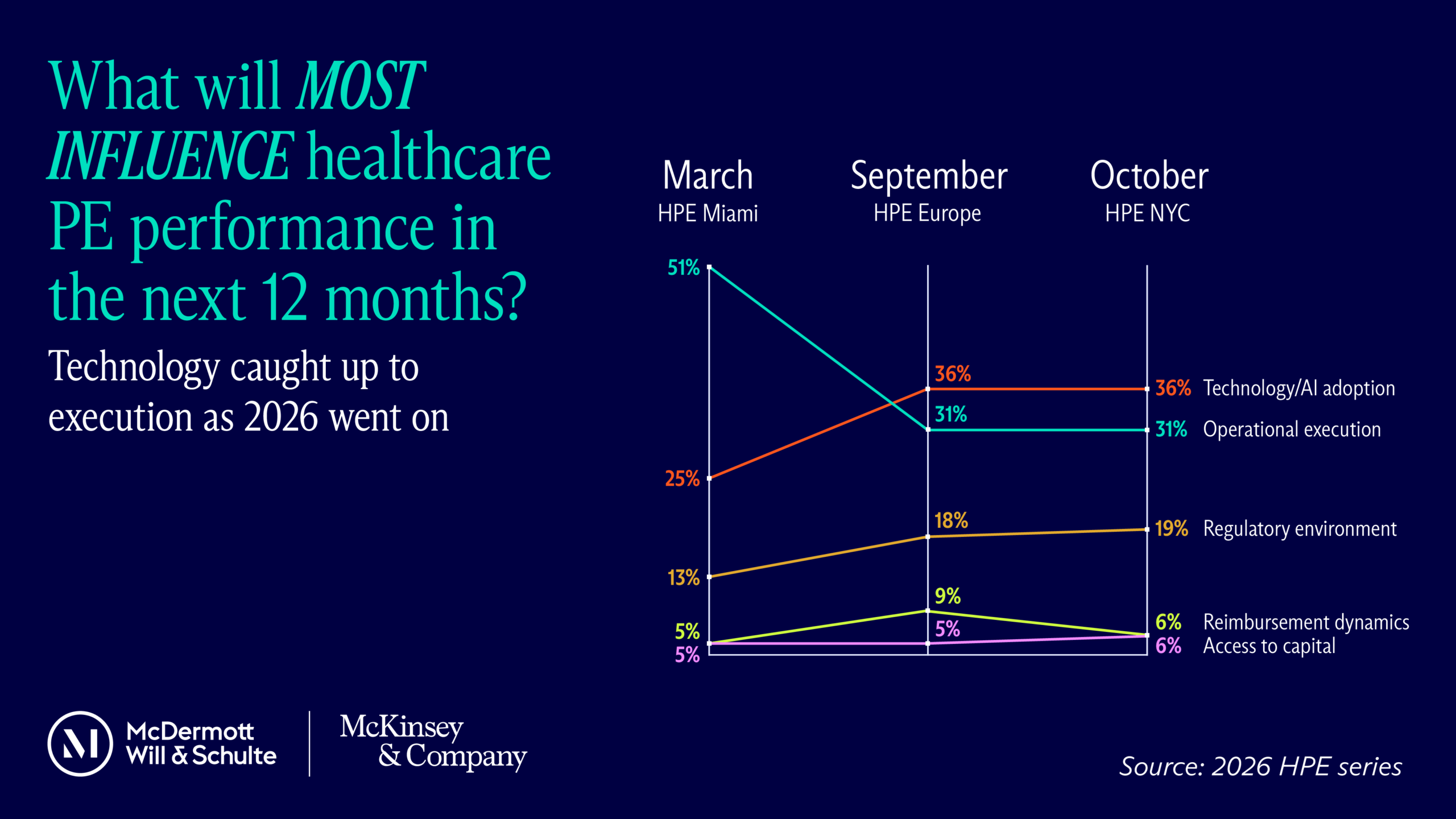
Across the 2026 HPE series, polling sentiment shifted from operational execution as the top influence on PE performance (51% in March) to technology and AI adoption (36% in September and October).
1. Underwrite the value-creation plan before signing
Transaction design matters, and value-creation planning can be one of the most effective ways to ensure earnings and expansion continues throughout the hold period. The most compelling value-creation plans identify timely improvements investors can influence and execute directly. With favorable financing conditions and higher exit multiples less dependable, the value-creation plan should be examined as rigorously as the asset itself. If anticipated returns or improvements depend on new capabilities, contracts, regulatory approvals, or operating changes that cannot realistically be delivered, projected upside may never materialize.
For buy-and-build platforms, expansion can introduce additional costs and complexities and affect expected returns. Acquiring additional businesses does not necessarily create value if management capacity, technology systems, or compliance infrastructure cannot support integration.
Take action: Sponsors should pressure-test key assumptions before signing, identify operational and financial dependencies, and establish a realistic post-close execution roadmap. Operators should demonstrate which initiatives are producing measurable results and build the infrastructure needed to support growth, acquisitions, and expansion needs.
2. Look for sector durability
Sector durability matters as much as a business’s growth potential. Operators in sectors seeing steady demand and more predictable cash flows with favorable reimbursement conditions are commanding returns.
Specialty pharmacy and infusion are prime examples of a subsector seeing incredible tailwinds. Expanding pipelines of complex therapies, recurring patient needs, and the shift toward outpatient and home-based care are supporting investment interest. Pharmaceutical services and technology-enabled healthcare companies are also attracting capital, as demand for specialized capabilities and more efficient care delivery channels creates opportunities for differentiated, scalable business models.
Yet strong market fundamentals can mask risks that may undermine returns. For specialty pharmacy and infusion businesses, access to therapies, payor contracting strategies, patient demand, and reimbursement terms can determine whether projected growth is achievable – and whether the economics of an acquisition hold up after closing.
Take action: Sponsors should test the durability of demand, reimbursement, and cash flow throughout the anticipated hold period and beyond. Operators should demonstrate what drives measurable growth, as well as address any concerns related to customer concentration, reimbursement exposure, and scalability weaknesses before going to market.
3. Make AI prove its value
AI is becoming a growth and scalability conduit across all sectors of the healthcare industry. Early, measurable gains in finance operations, the revenue cycle, human resources, administration, and procurement offer practical starting points. More deeply embedded AI solutions — including those that are customer facing, proven to deliver financial and productivity gains, and available enterprise wide — are also seeing increases in demand and improved efficacy as adoption continues.
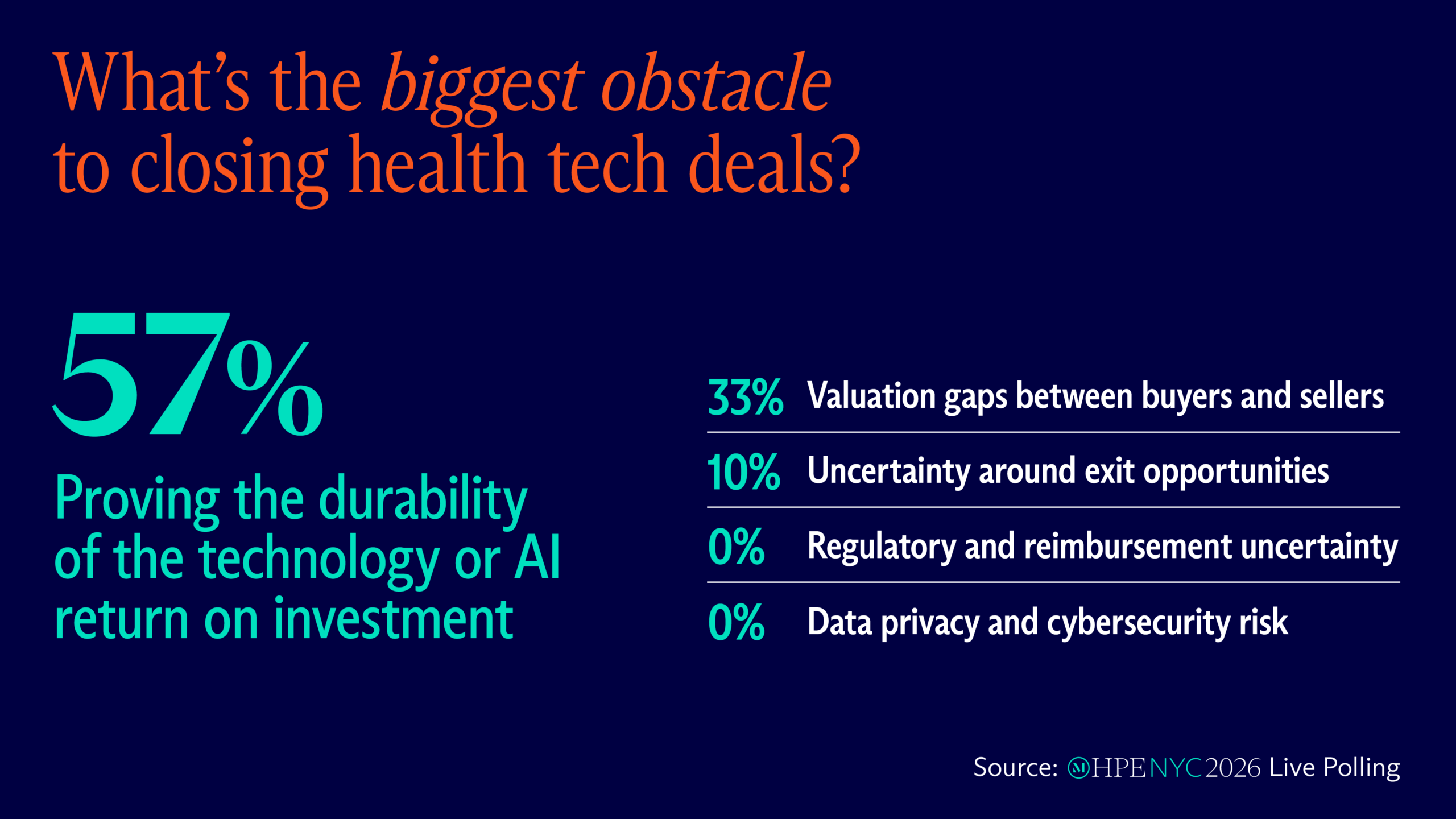
At HPE NYC, 57% of attendees said proving the durability of technology or AI return on investment is the biggest obstacle to closing health tech deals, well ahead of valuation gaps (33%).
But adoption alone does not create value: investors should assess whether those gains are sustainable and whether AI could disrupt the underlying business model. Businesses that depend on labor-intensive processes and services increasingly susceptible to automation may face margin compression or declining valuations. AI-driven opportunities must also be weighed against implementation costs and risks. Companies with defensible assets, established customer relationships, and the ability to pivot as technical requirements change will be better positioned to strengthen competitive advantage.
Take action: Sponsors should demand evidence of measurable AI gains while evaluating disruption risk, data rights, governance models, and regulatory exposure. Operators should connect technology investments to financial outcomes, strengthen governance alongside adoption, and identify where AI could threaten – and strengthen – their competitive position.
4. Rethink strategic partnerships and capital strategies
Creative deal structures and strategic partnerships are becoming increasingly attractive for operators and investors focused on expansion, liquidity, and transaction results — ones that conventional acquisitions may not offer. By aligning interests and combining complementary capabilities, sponsors, sellers, and strategic buyers can unlock value even when valuation expectations differ.
Strategic-PE partnerships, for example, are gaining traction. Corporate buyers may seek access to businesses that sponsors have already developed and de-risked, creating opportunities for collaboration that combines capital, operating experience, and commercial relationships. Health systems may similarly find opportunities to partner with sponsors to expand services or specialized capabilities, although differences in governance and financial priorities can complicate alignment.
Meanwhile, mergers of equals, carve-outs, earn-outs, structured equity, and continuation vehicles offer ways to bridge valuation gaps, build scale, or provide liquidity when conventional transactions are difficult to execute.
Take action: Sponsors should assess potential strategic partners, alternative capital sources, and transaction structures early, including their implications for control, returns, and exit options. Operators should evaluate whether proposed partnerships support their financial and operational objectives while preserving long-term flexibility.
5. Make regulatory and reimbursement diligence part of the investment thesis, not simply validate it
Regulatory and reimbursement expertise can help sponsors identify resilient business models, anticipate changes, and structure investments with greater confidence. Bringing these considerations into the investment thesis early also makes it easier to address challenges such as expanding state transaction oversight, uncertain reimbursement, and longer deal timelines. Drug-pricing reforms, pharmacy benefit manager (PBM) and payor contracting structures, and efforts to shift treatment into lower-cost settings – including in-home care options – are also changing the economics of healthcare investments. Growth strategies that appear attractive today may create new regulatory exposure or require operating changes that affect projected returns.
Take action: Sponsors should bring regulatory and reimbursement analysis forward, translate material findings into valuation and deal terms, and assess how planned expansion could change the risk profile. Operators should identify vulnerabilities before a transaction and ensure their infrastructure can support new markets, services, and acquisitions.
6. Prepare for the exit from the beginning
Sponsors can increase exit optionality by building the qualities future buyers prize: durable earnings, operational discipline, scalable infrastructure, and manageable risk. Planning for those outcomes from acquisition creates a clearer roadmap for management and helps demonstrate progress throughout the hold period, even when buyer demand is uneven.
Take action: Sponsors should establish what a successful exit requires at acquisition, identify potential buyers and exit paths early, and monitor progress against the investment thesis. They should resolve issues likely to surface in buyer diligence. Operators should maintain reliable financial reporting, demonstrate measurable value creation, and address compliance or operational weaknesses well before going to market.
The next phase of healthcare investment: 2027 and beyond
Healthcare private equity continues to offer meaningful opportunities for investors and operators with the means, expertise, and operational foundation to properly execute. Sponsors that combine disciplined underwriting, operational expertise, and creative investment strategies will be well positioned to build resilient businesses that attract capital, realize value at exit, and create long-term value.
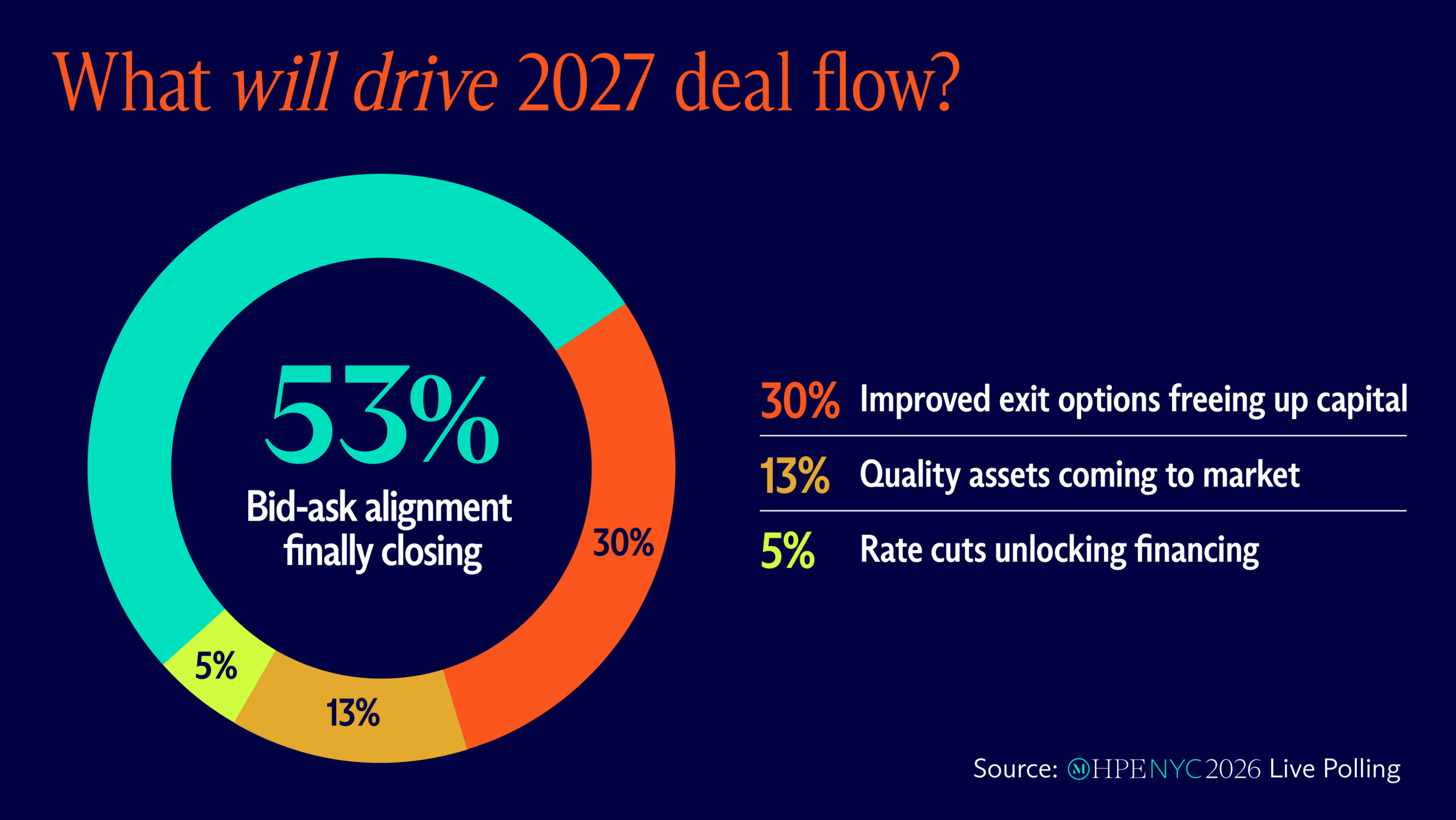
More than half of HPE NYC attendees (53%) expect bid-ask alignment to finally close and drive 2027 deal flow, with improved exit options freeing up capital next at 30%.
Continue the conversation at HPE Miami 2027, March 3 – 4 at The Ritz-Carlton South Beach.