














ARTICLE
3 takeaways from US antitrust M&A activity in Q2 2025
August 2025
Read time: 5 min
Under the second Trump administration, the Federal Trade Commission (FTC) and Department of Justice (DOJ) have signaled a significant departure from the antitrust enforcement policies of the Biden administration. This new approach is characterized by a renewed willingness to accept structural remedies, such as divestitures, to resolve competitive concerns in mergers. Alongside this, the agencies are actively working to accelerate the merger review process, reinstating early terminations of the Hart-Scott-Rodino waiting period to allow non-problematic deals to close more quickly.
Return of structural remedies
The Federal Trade Commission (FTC) and Department of Justice (DOJ) under President Donald Trump have made good on their promises to accept structural remedies, i.e., remedies involving divestitures, to resolve concerns with transactions. In recent months, the FTC announced a settlement regarding Synopsys’ acquisition of Ansys, while the DOJ entered into settlements allowing three transactions to proceed: Hewlett Packard Enterprise (HPE) / Juniper Networks, Safran / Raytheon, and Keystone / Spirent. This flurry of consent decrees stands in contrast to the Biden administration, which did not accept a prelitigation divestiture for the last two years of its administration and strongly disfavored merger remedies.
Despite the current agencies’ willingness to enter into settlements, they have emphasized the importance of “clean” divestitures and strong divestiture buyers. FTC Commissioner Melissa Holyoak, for example, has stated that the FTC will not hesitate to litigate when a proposed remedy is inadequate. In Synopsys / Ansys, FTC Chair Andrew Ferguson issued a statement, joined by the two other commissioners, outlining the FTC’s stance on merger remedies. Ferguson noted the benefits of merger settlements, including allowing the procompetitive aspects of a merger to proceed and conserving finite agency resources. Nevertheless, he emphasized that the FTC must be “clear-eyed” about the dangers of inadequate settlements. In particular, Ferguson stated that the FTC ordinarily will not accept a structural remedy unless it involves the sale of a standalone or discrete business, and the divestiture buyer has the resources and experience necessary to make that standalone business competitive. As for behavioral remedies, Ferguson said the FTC should approach such remedies with “substantial caution.” The Trump FTC did accept a behavioral remedy to resolve its concerns with Omnicom / Interpublic, but that was an atypical behavioral remedy aimed at addressing concerns about suppression of conservative speech.
Following the settlement of United Health / Amedisys and the withdrawal of the litigation against AMEX GBT / CWT, one merger challenge is proceeding to trial: GTCR BC Holdings, LLC / Surmodics, Inc.
Agencies continue to promote reaching merger decisions quickly
Consistent with the current, more business-friendly attitudes of the FTC and DOJ toward dealmaking, the two agencies also are making efforts to allow nonproblematic mergers to proceed more quickly. The FTC has brought back the practice of granting early termination of the Hart-Scott-Rodino (HSR) waiting period, a practice the FTC suspended under the Biden administration. FTC Commissioner Holyoak has stated that requests for early termination will help reduce the workload of FTC staff and help parties close transactions more quickly. Since restarting the early termination program, the FTC has granted more than 100 early termination requests. Assistant Attorney General (Antitrust Division) Gail Slater has stated that the DOJ has been looking for other ways to speed up the merger review process, as well. FTC Chair Ferguson said that the FTC “must get out of the way quickly” when a merger would not violate antitrust laws, to avoid bogging down innovation and interfering with the free market. These statements stand in contrast with the approach of Biden administration enforcers, which was to try to slow down dealmaking generally.
The rise of “America First Antitrust”
The FTC and DOJ appear willing to promote Trump administration goals through their antitrust enforcement programs. In her first public address as assistant attorney general of the Antitrust Division, Gail Slater discussed the concept of “America First Antitrust,” focused on the needs of “forgotten” workers and consumers, small businesses, manufacturing, and family-owned agribusiness. She went on to say that deregulation and transparency are key to these efforts.
In Omnicom / Interpublic, the FTC required an unusual behavioral remedy aimed at protecting conservative speech, a concern of the Trump administration. The settlement prohibits Omnicom from directing advertising spend toward or away any media publisher based on the publisher’s political or ideological viewpoints. The FTC entered into this settlement despite FTC Chair Ferguson’s statement in Synopsys / Ansys that the FTC should approach behavioral remedies with “substantial caution.”
US M&A activity: By the numbers
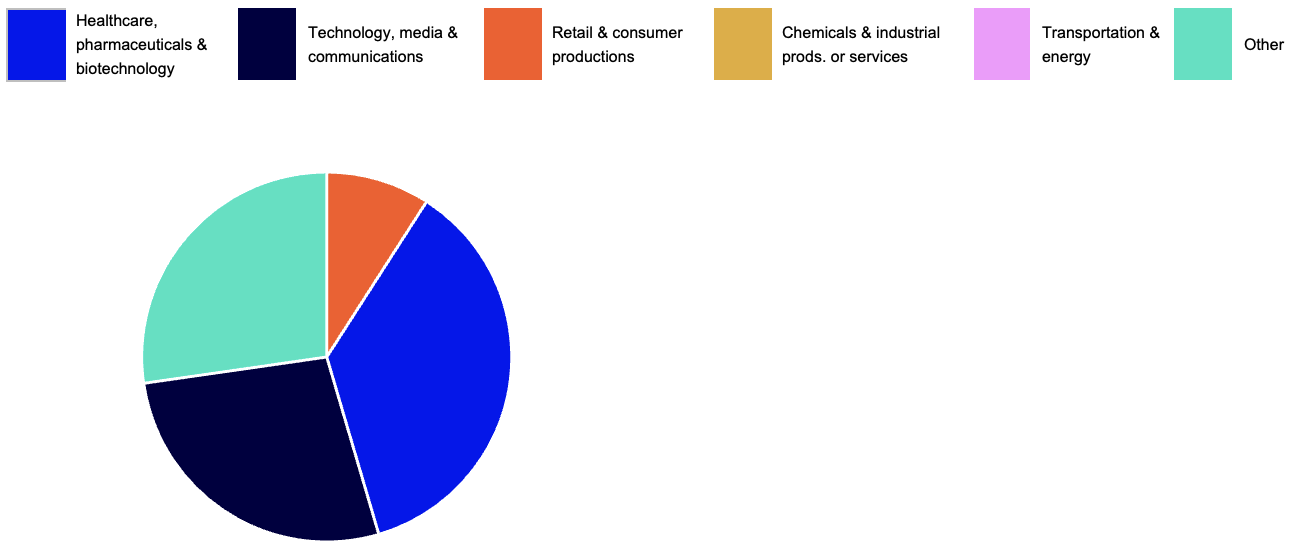
Number of enforcement actions in key industries1
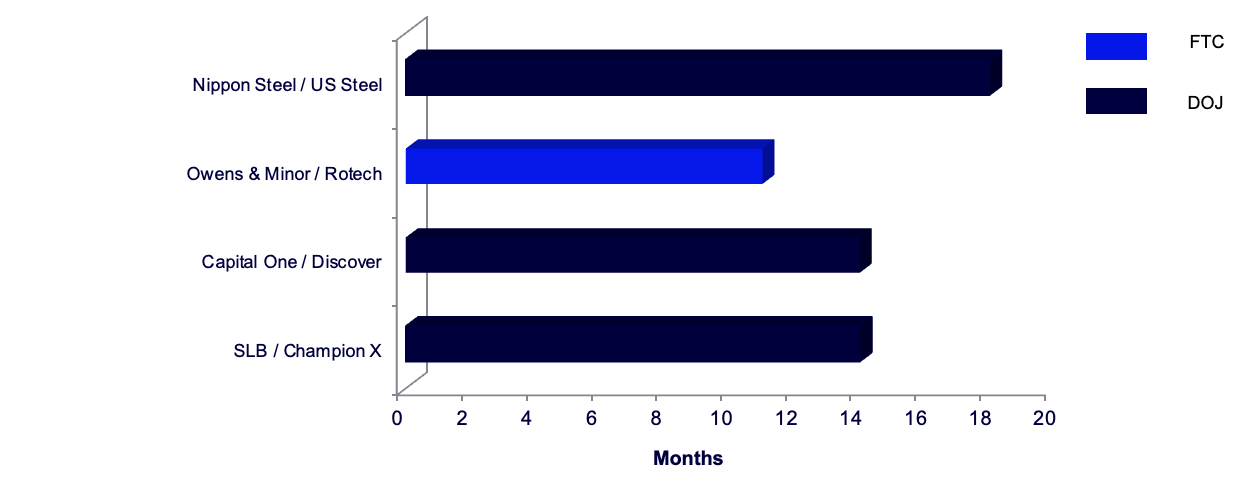
Snapshot of selected enforcement actions2
Time from signing to consent or investigation closing









NAIC Summer National Meeting: Financial Condition (E) Committee advances formation of new Reciprocal Exchanges (E) Working Group and proposal to amend Holding Company Model Act
ARTICLE / CLIENT ALERT
NAIC Summer National Meeting: Financial Condition (E) Committee advances formation of new Reciprocal Exchanges (E) Working Group and proposal to amend Holding Company Model Act
August 21, 2025
Read time: 5 min
Earlier this year, noting “the recent increase in the number of reciprocal exchanges being formed and challenges in assessing the fairness and reasonableness of attorney-in-fact fees being charged to the newly formed reciprocals,” the National Association of Insurance Commissioners’ (NAIC) Risk-Focused Surveillance (E) Working Group recommended that its parent body, the Financial Condition (E) Committee, create a new Reciprocal Exchanges (E) Working Group.
As originally proposed, the purpose of the new working group is to “modify the NAIC Insurance Holding Company System Regulatory Act (#440) (the Holding Company Model Act) [and/or Insurance Holding Company System Model Regulation with Form and Instructions (#450)] to clarify that regardless of definitions of control and affiliation, fees charged [to] insurers from the attorney-in-fact are subject to fair and reasonable standards and subject to approval by the Commissioner and under no circumstances should they exceed the cost of such services plus a modest profit.”
In their recommendation to the (E) Committee, regulators made the following points:
“1. The fee structure for management services is often based on a percentage of gross premiums written.
“2. Basing the management service fees on a percentage of premium volume creates a conflict of interest, i.e., a potential incentive for the attorney-in-fact to increase its fee revenue by underpricing or accepting risk that may be above its typical underwriting guidelines.
“3. Management service fees are also often included in the power of attorney agreement, as opposed to a separate service agreement, which can make the fees less transparent.
“4. It’s worth noting that the definition of control within Insurance Holding Company System Regulatory Act (#440) specifically provides that ‘…the power to cause the direction of the management and policies’ triggers control.”
More specifically, the Holding Company Model Act development project will entail amending Section 5 of the act to ensure that reciprocal insurance exchanges are subject to the requirements of Section 5, which currently reads as follows:
“Section 5. Standards and Management of an Insurer Within an Insurance Holding Company System
“A. Transactions Within an Insurance Holding Company System
“(1) Transactions within an insurance holding company system to which an insurer subject to registration is a party shall be subject to the following standards:
“(a) The terms shall be fair and reasonable;
“(b) Agreements for cost sharing services and management shall include such provisions as required by rule and regulation issued by the commissioner;
“(c) Charges or fees for services performed shall be reasonable;
“(d) Expenses incurred and payment received shall be allocated to the insurer in conformity with customary insurance accounting practices consistently applied;
“(e) The books, accounts and records of each party to all such transactions shall be so maintained as to clearly and accurately disclose the nature and details of the transactions including such accounting information as is necessary to support the reasonableness of the charges or fees to the respective parties…”
On August 13, 2025, during the recently concluded NAIC Summer National Meeting in Minneapolis, the (E) Committee voted unanimously to approve the proposal. Colorado moved the adoption; Iowa seconded the motion to adopt.
The NAIC circulated the proposed 2026 charge for the new working group on August 19, 2025, as follows:
“The Reciprocal Exchanges (E) Working Group will:
“Modify the NAIC Insurance Holding Company System Regulatory Act (Model #440) and/or the Insurance Holding Company System Model Regulation with Reporting Forms and Instructions (#450) to clarify that regardless of definitions of control and affiliation, fees charged by insurers from the attorney in fact are subject to fair and reasonable standards and subject to approval by the Commissioner and under no circumstances should they exceed the cost of such services plus a modest profit.”
Comments on the proposed charge are due by the close of business on October 2, 2025. Assuming the (E) Committee approves the new charge language later this year, the NAIC’s Executive Committee and full membership will need to confirm the approval during the NAIC’s final National Meeting of the year in December 2025.
McDermott Will & Schulte’s insurance transactions and regulation team has decades of experience with reciprocal exchange formations, licensing, financing, mergers and acquisitions, and regulation, with relationships across the regulator, investor, and operator communities.







IRS roundup: August 12 – August 20, 2025
ARTICLE
IRS roundup: August 12 – August 20, 2025
Aug 27, 2025
Read time: 4 min
Check out our summary of significant Internal Revenue Service (IRS) guidance and relevant tax matters for August 12, 2025 – August 20, 2025.
IRS guidance
August 15, 2025: The IRS issued Notice 2025-42, providing guidance consistent with Executive Order 14315, Ending Market Distorting Subsidies for Unreliable, Foreign-Controlled Energy. This notice specifically provided guidance on when construction of an applicable wind facility or solar facility has begun, which determines whether that facility is subject to the credit termination provisions added to Internal Revenue Code §§ 45Y and 48E by §§ 70512 and 70513 of Public Law 119-21, also known as the One Big Beautiful Bill Act.
August 18, 2025: The IRS issued Notice 2025-43, providing guidance on the corporate bond monthly yield curve, corresponding spot segment rates in Code § 417(e)(3), and the 24-month average segment rate in Code § 430(h)(2). This notice also provides guidance on the interest rate on 30-year Treasury securities in Code § 417(e)(3)(A)(ii)(II) for plan years commencing prior to 2008, as well as the 30-year Treasury weighted average rate in Code § 431(c)(6)(E)(ii)(I).
August 18, 2025: The IRS issued Revenue Ruling 2025-17, providing prescribed rates for federal income tax for September 2025, including:
- The short-, mid-, and long-term applicable federal rates (AFRs) for purposes of Code § 1274(d).
- The short-, mid-, and long-term adjusted AFRs for purposes of Code § 1288(b).
- The adjusted long-term rate and the long-term tax-exempt rate from Code § 382(f).
- The appropriate percentages for determining the low-income housing credit under Code § 42(b)(1) for buildings placed in service during September 2025.
- The federal rate for determining the present value of an annuity, an interest for life, a term of years, or a remainder or a reversionary interest under Code § 7520.
August 19, 2025: The IRS issued Notice 2025-45, announcing its intent to issue proposed regulations under Code §§ 897(d) and (e), which would modify the application of Treas. Regs. §§ 1.897-5T and 1.897-6T to certain transactions involving the transfer of US real property interests. The proposed regulations would also revise rules applying to inbound asset reorganizations in Code § 368(a)(1)(F). This notice also announced the US Department of the Treasury and IRS’s intent to issue proposed regulations, revising Treas. Reg. § 1.368-2(m) and clarifying that qualification as a potential F reorganization under § 368(a)(1)(F) would not be affected by a disposition of stock.
August 20, 2025: The IRS issued Notice 2025-44, requesting comments on certain dual consolidated loss (DCL) rules and announcing its intent to issue proposed regulations removing (see our discussion of the notice in this On the Subject):
- The disregarded payment loss rules in Treas. Reg. § 1.1503(d)-1(d).
- Recent modifications to the DCL rules in Code § 1503(d) as they relate to the deemed ordering rules under Trea. Reg. § 1.1503(d)-3(c)(3).
The proposed regulations would also extend the transition relief related to applying the DCL rules in Code § 1503(d) to certain taxes covered by Pillar Two as described in “Tax Challenges Arising from the Digitalisation of the Economy – Global Anti-Base Erosion Model Rules (Pillar Two).” (See footnote 1 in Notice 2025-44 for links to these rules).
The IRS also released its weekly list of written determinations (e.g., Private Letter Rulings, Technical Advice Memorandums, and Chief Counsel Advice).






No specifics, no case? DTSA trade secret disclosure timing differs from CUTSA
ARTICLE
No specifics, no case? DTSA trade secret disclosure timing differs from CUTSA
Aug 21, 2025
Read time: 4 min
The US Court of Appeals for the Ninth Circuit found that a district court abused its discretion by striking several of the plaintiff’s trade secrets, concluding that the court improperly relied on Rule 12(f) and failed to support dismissal as a discovery sanction under Rule 37. The Court emphasized that the fact-specific question of “reasonable particularity” in Defend Trade Secrets Act (DTSA) cases is generally reserved for summary judgment or trial, not for resolution at the discovery stage. Quintara Biosciences, Inc. v. Ruifeng Biztech, Inc., et al., Case No. 23-16093 (9th Cir. Aug. 12, 2025) (VanDyke, Johnstone, JJ., Christensen, Dist. J.)
Quintara and Ruifeng are DNA sequencing analysis companies that engaged in a business arrangement. The relationship soured when Quintara alleged that Ruifeng locked Quintara out of its office, took possession of its equipment, and hired Quintara employees. Quintara sued Ruifeng under the DTSA for misappropriating nine trade secrets.
During discovery, Ruifeng moved for a protective order to pause proceedings until Quintara identified its trade secrets with reasonable particularity, as required by the California Uniform Trade Secrets Act (CUTSA), Cal. Civ. Pro. Code § 2019.210, the California version of the DTSA. The district court agreed with Ruifeng and ordered Quintara to disclose each allegedly misappropriated trade secret with reasonable particularity. Quintara filed an amended trade secret disclosure, but Ruifeng found it deficient and again moved to halt discovery. To resolve the impasse, the district court gave Ruifeng a choice: either accept the disclosure and proceed with discovery, or move to strike the disclosure, withhold discovery, and risk consequences if the motion failed. Ruifeng chose the latter and moved to strike Quintara’s trade secrets in the disclosure under Fed. R. Civ. Pro. 12(f).
Citing its broad discretion over discovery and Fed. R. Civ. Pro. 16, the district court granted Ruifeng’s motion, holding that Quintara failed to comply with § 2019.210. As a result, the court struck nine of the 11 trade secrets from the disclosure, effectively dismissing Quintara’s misappropriation claims as to those trade secrets. Quintara appealed.
The question before the Ninth Circuit was when in the litigation, and with what level of particularity, a plaintiff under the DTSA must identify its alleged trade secrets. The Court began by noting that CUTSA requires a plaintiff to identify the alleged trade secret with “reasonable particularity” before discovery begins. In contrast, the federal DTSA imposes no such requirement regarding the timing or scope of trade secret identification. Instead, DTSA cases proceed under the Federal Rules of Civil Procedure, which do not require plaintiffs to specify their trade secrets with particularity at the outset of the case. The Court explained that under the DTSA, a plaintiff must demonstrate that the claimed trade secret is described with sufficient particularity to distinguish it from general knowledge in the industry or from the specialized knowledge of those skilled in the trade. At an early stage of litigation, particularly when no discovery has yet occurred, it is not fatal to a plaintiff’s claim if the trade secret disclosure uses hedging language or leaves room to expand its identifications later. The Court explained that whether a plaintiff has identified a trade secret with sufficient particularity under the DTSA is a question of fact, typically suited for resolution at summary judgment or trial. The Court found that in striking Quintara’s trade secrets, the district court improperly relied on the California procedural rule that does not govern federal trade secret claims.
The Ninth Circuit further determined that even if Quintara’s trade secret disclosure could be construed as a pleading, the district court did not identify any “strikable” material under Rule 12(f). The Ninth Circuit noted that even assuming that some of Quintara’s disclosures failed to meet the district court’s “reasonable particularity” order, this alone did not constitute the kind of extreme circumstance that would justify dismissal under Rule 26 or 16. Because Rule 12(f) did not support striking any of Quintara’s trade secrets, the district court’s order amounted to an abuse of discretion.




Data breach litigation targets wine company: Lessons for alcohol industry players
ARTICLE / CLIENT ALERT
Data breach litigation targets wine company: Lessons for alcohol industry players
August 21, 2025
Read time: 5 min
On July 30, 2025, a wine producer was sued in connection with a cyberattack that allegedly compromised the data of at least 26,000 customers. Among other things, the complaint alleges that the company failed to implement reasonable security measures and failed to provide timely and sufficient notice of the data breach.
This incident underscores the vulnerability of companies handling sensitive customer information. Alcohol companies – especially those selling direct to consumer – collect and store high-value personal data to verify age, process payments, manage memberships, and ship products across state lines. This case highlights the need for alcohol companies to evaluate and strengthen their cybersecurity and privacy programs today to minimize legal risk and reputational harm tomorrow.
On July 30, 2025, Plaintiff Joanne Kaplan filed a class action complaint in California Superior Court in Napa County against Crimson Wine Group, Ltd. (CWG). The complaint alleges that a cyberattack between June 26 and June 30, 2024, compromised the personal data of at least 26,000 CWG customers, including names, addresses, Social Security numbers, driver’s license numbers, financial information, medical information, and dates of birth. CWG sent data breach notices to affected individuals and state regulators (including the Texas and Vermont attorneys general) on or about December 13, 2024.
Key allegations include:
- Inadequate security practices: The complaint alleges CWG failed to properly implement basic data security measures and follow Federal Trade Commission (FTC) guidelines, National Institute of Standards and Technology (NIST) cybersecurity standards, and industry best practices.
- Delayed notification: The complaint alleges CWG waited nearly six months to inform affected customers of the breach. According to CWG’s notice to the Vermont attorney general, CWG became aware of the cybersecurity incident on June 30, 2024, and determined on or around December 9, 2024, that some of the affected information included personal data.
- Data breaches can implicate multiple state laws and federal and state consumer protection standards. The timeframe for providing notice of a personal data breach varies widely across jurisdictions. The clock typically starts when the company discovers that the compromised data includes personal data, not when the incident occurs or even when the company becomes aware of the cyberattack. The question of whether CWG provided timely notification would therefore depend on the facts of when CWG actually discovered that the compromised data included consumers’ personal data.
- Breach of the privacy policy: The complaint alleges that the privacy policy was provided to the plaintiff in a manner in which it became part of the agreement of the services. The complaint further alleges that CWG committed in its privacy policy to protecting the privacy and security of customer data and that this promise was breached by its failure to protect this data.
Steps alcohol and direct-to-consumer companies can take to reduce litigation risk
- Align your security program with industry and regulatory standards. This could include following FTC, NIST, and other guidance on protecting personal data, including encryption at rest and in transit, multifactor authentication, and continuous vulnerability monitoring.
- Tighten data governance. Limit the collection of sensitive personal data to what is necessary for operations and compliance. Regularly purge outdated or unnecessary customer records; holding onto such data increases your potential liability and notification obligations in the event of a data breach.
- Evaluate and strengthen incident response protocols. Maintain a breach response plan with clear timelines for forensic investigation, containment, regulatory notifications, and consumer outreach. Conduct annual tabletop exercises simulating cyberattacks to test readiness. Be prepared to comply with the shortest notification deadline among applicable jurisdictions.
- Perform due diligence on vendor security. Require third-party service providers (e.g., payment processors, logistics partners) to meet rigorous cybersecurity requirements and periodically audit compliance. Ensure appropriate indemnity for breaches at the vendor, where feasible.
- Review your privacy disclosures. Take care to review your privacy policy to ensure that you do not inadvertently allow for a breach of contract claim in the event of a data breach.
- Review your insurance coverage. Evaluate whether your insurance policy covers cyber liability, including litigation defense, regulatory investigations, and notification and remediation costs.
- Conduct cyber assessments under privilege. Ensure that counsel oversee cybersecurity assessments to help preserve privilege over findings. Use privileged assessments to proactively identify and remediate weaknesses before regulators or plaintiffs uncover them.
- Assess your Payment Card Industry Data Security Standard (PCI DSS) compliance. PCI DSS 4.0.1, the new standard governing payment card security, became fully effective April 1, 2025. Its security, policy, and other obligations are robust and severe, and apply to any merchant or business that processes, transmits, or stores credit or debit cards, including corporate cards from suppliers and others. Many companies remain unaware of these new obligations.
If you need help reducing your litigation risk, please contact Alva Mather.

Partner

Fourth Circuit strikes down Maryland’s digital ad tax “pass-through” ban
ARTICLE
Fourth Circuit strikes down Maryland’s digital ad tax “pass-through” ban
Aug 19, 2025
Read time: 3 min
Maryland’s attempt to stop businesses from telling customers about a controversial tax has hit a constitutional wall. On August 15, 2025, the US Court of Appeals for the Fourth Circuit ruled that the state’s “pass-through” provision in its Digital Advertising Gross Revenues Tax violates the First Amendment.
In Chamber of Commerce et al. v. Lierman, Case No. 24-1727 (4th Cir. Aug. 15, 2025), a unanimous panel held that Maryland’s “pass-through” provision is facially unconstitutional because it restricts how companies can talk about price increases tied to the tax.
The provision at issue
Maryland’s first-of-its-kind digital advertising tax applies to large companies earning more than $100 million in global revenue from online ads. The controversial “pass-through” provision provided that those companies “may not directly pass on the cost of the tax … by means of a separate fee, surcharge, or line-item.” Businesses could still raise prices to cover the tax, they just had to do it without saying so.
The Fourth Circuit’s reasoning
Writing for a unanimous panel, Judge Julius N. Richardson opened the opinion with a striking historical parallel. Just as colonists objected to Britain’s Stamp Act of 1765, which taxed printed materials and chilled political expression, Maryland’s rule targeted modern equivalents: internet companies and their speech about taxation. “We agree,” Richardson wrote. “As much today as 250 years ago, criticizing the government—for taxes or anything else—is important discourse in a democratic society. The First Amendment forbids Maryland to suppress it.”
The Court found that the pass-through provision regulated protected speech – not conduct –because it dictated how companies communicate price changes attributable to the tax, forbidding certain methods while allowing others. This made the provision a content-based restriction subject to heightened constitutional scrutiny.
Maryland argued that the provision was designed to ensure companies bear the tax’s economic and legal burden, but the Court found that justification hollow. Since businesses could still raise prices silently, the law did nothing to prevent cost-shifting. It only restricted speech about it. Accordingly, the Court found that “[t]he pass-through provision of Maryland’s digital advertising tax is unconstitutional in all of its applications.”
What’s next
The Fourth Circuit reversed the district court’s ruling and remanded the case to determine the appropriate remedy, noting that recent Supreme Court of the United States precedent limits the scope of injunctive relief. The broader tax itself remains in effect for now, with separate challenges pending in the Maryland Tax Court.
For businesses, the ruling lifts Maryland’s ban on explicitly itemizing the tax on invoices or contracts and stands as a reminder that states can’t sidestep political accountability by limiting how regulated entities talk about their regulations. For Maryland and other states, the decision sends a clear message: Governments may tax, but they cannot silence the businesses they tax when those businesses tell customers what’s driving prices.




SEC charges PE firm for alleged disclosure failures related to fee offsets
ARTICLE / CLIENT ALERT
SEC charges PE firm for alleged disclosure failures related to fee offsets
August 19, 2025
Read time: 5 min
On August 15, 2025, the US Securities and Exchange Commission (SEC) charged a New York-based private equity adviser (the Firm) with breaching its fiduciary duties by failing to adequately disclose its practices regarding the receipt of interest on deferred transaction fees and the resulting conflicts of interest. The SEC alleged that the Firm duplicated transaction fee reductions when calculating certain fee offsets. The SEC also alleged that such conduct violated the Firm’s fiduciary duties and therefore violated Section 206(2) of the Investment Advisers Act of 1940. The SEC did not charge any violation of Rule 206(4)-8 or Rule 206(4)-7 or any individual.
Without admitting or denying the SEC’s findings, the Firm settled with the SEC, paying more than $683,000 in disgorgement, penalties, and prejudgment interest.
Overview
The SEC charged the Firm with breaching its fiduciary duties in two ways:
- The Firm failed to disclose receipt of interest payments from five portfolio companies in connection with deferred transaction fees and failed to include such interest payments in a management fee offset calculation.
- The Firm failed to correctly allocate transaction fees among multiple funds that invested in the same portfolio company.
Interest on deferred fees
The SEC found that the Firm entered into management services agreements with certain portfolio companies that allowed the Firm to defer transaction fee payments either at the Firm’s discretion or if a related loan agreement required deferral. The SEC noted that, on several occasions, the Firm deferred transaction fees to allow a portfolio company to increase cash flows. If transaction fees were deferred, the Firm earned interest on the deferred payment pursuant to agreements between the limited partnership and the portfolio company.
The SEC alleged that the Firm breached its fiduciary duty to its limited partners when (1) it failed to disclose that it collected interest on deferred transaction fees and the related conflicts of interest, and (2) the Firm applied an offset to the management fees for the deferred transaction fee payments without offsetting the interest it received.
With respect to its conflicts of interest allegations, the SEC noted that the relevant limited partnership agreements (LPAs) allowed the Firm to collect transaction fees but required it to offset 100% of those transaction fees against its management fees. Although management services agreements between the Firm and the funds’ portfolio companies allowed the Firm to defer transaction fees on a discretionary basis, the terms of those agreements were not disclosed to the funds’ limited partners (other than to certain co-investors). As a result, the Firm did not disclose the conflict of interest that arose because the Firm could choose to defer payments and receive interest that would not offset management fees. During the period that the transaction fees were deferred, there was no corresponding management fee offset, and, as a result, the Firm received approximately $423,000 in management fees that were not reduced by the interest on the deferred fees. Such an arrangement, noted the SEC, effectively resulted in “interest-free loans” from the funds to the Firm.
Allocation conduct
With respect to at least one portfolio company, the SEC found that the Firm improperly allocated transaction fees among multiple funds that invested in the same portfolio company. The SEC concluded that the Firm failed to follow the calculation methodology set forth in the relevant LPAs and applied the allocation inconsistently, amounting to improper double counting, and improperly lowering each fund’s fee offset. Additionally, according to the SEC, the Firm only allocated a portion of the transaction fees. As a result of this conduct, the Firm allegedly received approximately $79,000 in excessive management fees.
Key takeaways for private equity sponsors
These charges demonstrate the SEC’s continued focus on fees and expenses charged by advisers. A perennial topic of examination and enforcement interest, undisclosed compensation, and inaccurate fee and expense calculations were highlighted in the SEC’s Fiscal Year 2025 Examination Priorities. This action calls attention to the SEC’s increasingly nuanced scrutiny of fee calculations. Even though the transaction fees were authorized and the fee deferral was in the discretion of the Firm, the SEC faulted the Firm for excluding the interest earned on the deferred fees from the fee offset, as well as for failing to follow the precise allocation mechanics.
It is noteworthy that the charges here were brought under Section 206(2) without the additional charges under Section 206(4), Rule 206(4)-7 (compliance policies and procedures), and Rule 206(4)-8 (statements to limited pooled investment vehicle investors) that have been charged in some of the prior cases involving private fund fees and expenses, potentially suggesting a more targeted enforcement approach. The penalty of $175,000 was relatively modest compared to prior actions involving negligence-based conduct related to fee calculations, even when the adviser did not voluntarily reimburse the allegedly excessive fees.
In light of this action, advisers are reminded to compare the fee provisions in LPAs to fees actually received by the funds, including the role of offsets and exclusions. Advisers should consider the conflicts of interest raised by fee calculations that allow discretion and evaluate the fee disclosure and conflicts language (even in circumstances where the conflict may seem obvious to limited partners).









Carried interest in the UK: The new average holding period (AHP) condition for credit funds
ARTICLE / CLIENT ALERT
Carried interest in the UK: The new average holding period (AHP) condition for credit funds
August 18 2025
Read time: 6 min
The UK tax regime for carried interest is being substantially revised from April 2026.1 This Alert focuses on one particular aspect: the changes to how credit funds should calculate the average holding period (AHP) of their investments for purposes of determining whether carried interest paid by the fund should be treated as ‘qualifying carried interest’. Broadly, carried interest will be qualifying carried interest only where the AHP is 40 months or more (the ‘40 month AHP condition’).
This is important because carried interest holders receiving qualifying carried interest will pay income tax/National Insurance contributions (NICs) at an effective rate of 34.1%.2 Carried interest holders receiving non-qualifying carried interest will (as now) pay income tax/NICs at an overall rate of 47%.
To date, the difficulties for credit funds of meeting the 40-month AHP condition have not caused significant issues because of the employment-related securities (ERS) exception, by which carried interest granted to an employee (which was an ERS) was automatically qualifying carried interest. However, the ERS exception is abolished with effect from 6 April 2026, and from that date the distinction between qualifying and non-qualifying carried interest will be drawn, in every case, by the application of the 40-month AHP condition.
The changes to the calculation of the AHP for credit funds should make it significantly easier for credit funds to meet the 40-month AHP condition in appropriate cases. The main changes are as follows:
The T1/T2 rule
The new T1/T2 rule is intended to address the difficulties caused by the fact that a credit fund will typically make its investment (often both a debt and an equity investment) in a borrower group in a number of different tranches over time, and also dispose of that investment in a number of separate disposals over time. Under the current rules, each of those acquisitions and disposals is treated as the acquisition/disposal of a separate investment, which can significantly shorten the fund’s AHP for purposes of the carried interest rules.
The new rules address this by identifying a single date, T1, on which all investments in a borrower group are made, and a date, T2, on which all disposals of those investments in that borrower group are made.
T1 is the date at which the credit fund first makes a ‘significant debt investment’ of at least £1 million in the borrower group. All debt and equity investments in the borrower group made after T1 – the significant debt investments and all such other investments are together referred to as ‘associated investments’ – are backdated and treated as made on T1.
T2 is the date on which the credit fund has disposed of at least 50% of the greatest amount it had invested at any one time in associated investments. Any associated investments disposed of before T2 are treated as disposed of on T2.
A further helpful change is that T1 is backdated to the date upon which the credit fund assumes an unconditional obligation to advance a loan where this pre-dates the date upon which the loan is actually made.
Commercial override for debt restructuring transactions
Under the existing rules, debt restructurings and debt-for-equity swaps can have the effect of significantly shortening a credit fund’s AHP as the restructuring event is treated as a disposal of the original debt investment for purposes of calculating the AHP, notwithstanding that there may be no change, commercially, in the credit fund’s exposure in relation to the borrower group.
The legislative changes try to address this. Where a new loan is extended to the same borrower group on substantially the same terms as an existing loan, or where, as a result of a transaction undertaken for commercial purposes, the credit fund is exposed to substantially the same risks and rewards in respect of the borrower group before and after the transaction, then the credit fund will not be treated as disposing of the original loan for purposes of calculating the AHP.
Prepayment extension
A credit fund’s AHP can also be shortened where a borrower chooses to make early repayment or otherwise prepay a loan. The existing AHP rules do acknowledge this by treating a credit fund as holding a loan for 40 months where the term of the loan was more than 40 months but the loan has been repaid early, but only for primary loans and only for primary loans that met certain qualifying conditions – and it could be difficult for a credit fund to identify whether a loan it had advanced was such a qualifying loan.
The new rules will treat a credit fund as holding any debt investment, whether a primary loan or a secondary loan acquisition, for more than 40 months where (i) the loan is repaid by the borrower less than 40 months after the date upon which the credit fund acquired the loan; and (ii) at the time that the credit fund acquired the loan, the loan had a remaining term of at least 40 months and the credit fund had a positive intention and ability to hold the loan to term. The concept of a ‘qualifying loan’ is also abolished.
Conclusion
There are of course some remaining imperfections in the draft legislation, but generally we see these changes to the calculation of the AHP as very beneficial to credit funds, many of which would have been in significant difficulties in establishing a 40-month AHP under the existing rules and following the abolition of the ERS exception.
The change to the T1/T2 basis for determining a single date of acquisition and single date of disposal is a valuable recognition of the way in which credit funds in practice build and dispose of their investments, and the removal of the arbitrary distinction between primary lending and secondary loan acquisitions (and abolition of the difficult-to-apply concept of the qualifying loan) is hugely welcome. The recognition that restructuring transactions in the debt of a borrower group are not, in commercial terms, disposals, is also important.
Overall, it is expected that these legislative changes will materially increase the chances that a credit fund is able to meet the 40-month AHP condition, and so grant qualifying carried interest (at a 34.1% tax rate) to its carried interest holders.



Unpacking the Trump administration’s new EO on Federal grantmaking: What applicants and recipients need to know
CLIENT ALERT / US POLICY
Unpacking the Trump administration’s new EO on Federal grantmaking: What applicants and recipients need to know
August 15, 2025
Read time: 7 min
On August 7, 2025, the White House issued an executive order (EO) titled “Improving Oversight of Federal Grantmaking.” The EO calls for significant changes to the process of making and administering grants, cooperative agreements, loans, loan guarantees, and other awards of Federal financial assistance:
- Sections 3 and 4 of the EO requires “senior appointees” or their designees to review and approve awards and funding opportunity announcements (FOAs) to ensure alignment with the president’s policy priorities
- Section 4 of the EO further requires that awarding agencies establish a preference for “institutions with lower indirect cost rates”
- Section 5 of the EO directs changes to the Uniform Guidance at 2 C.F.R. Part 200 to “clarify and require all discretionary grants to permit termination for convenience,” and Section 6 requires awarding agencies to ensure that their standard grant terms and conditions permit termination for convenience
The impact of the EO on current and prospective recipients of Federal awards will be significant. The most immediate impact of the EO will likely be further delay to many new awards as the Office of Management and Budget (OMB) and awarding agencies review and modify applicable rules, terms, and conditions as directed by the EO.
Moreover, requiring senior appointees or their designees to review and approve new awards and FOAs will likely create bottlenecks that will further delay both the issuance of FOAs and the issuance of awards against those FOAs. The EO requires these officials to “use their independent judgment” in reviewing all new awards and apply the seven principles outlined in the EO in all assessments of grant proposals. These principles are consistent with many other EOs, as an attempt to limit any grants not perceived to be consistent with the president’s policy priorities including an open rejection of grants which promote or facilitate “racial preferences,” “illegal immigration,” or “denial of the sex binary in humans.”
The EO’s provisions on indirect cost rates and terminations for convenience will likely be even more important. Several agencies have sought to cap indirect cost rates at 15%, which is the current “de minimis” rate at 2 C.F.R. 200.414(f). At least one agency – the US Department of Energy – has gone further and mandated a 15% indirect cost rate that is inclusive of fringe expenses, eliminating the ability of recipients to apply the de minimis rate to a modified total direct cost base that includes fringe expenses. See Policy Flash 2025-27, Adjusting Department of Energy Financial Assistance Policy for For-Profit Organizations’ Financial Assistance Awards (May 8, 2025). The EO arguably supersedes these efforts, instructing agencies to apply a set of “principles” when making awards, one of which is: “All else being equal, preference for discretionary awards should be given to institutions with lower indirect cost rates.” This principle contemplates that recipients will compete for new awards based, in part, on their proposed indirect rates, which is entirely inconsistent with agency attempts to mandate a single rate for all recipients.
In our view, the most significant aspect of the EO is the direction to revise the Uniform Guidance to provide for “terminations for convenience.” The phrase “termination for convenience” is a term of art used in procurements under the Federal Acquisition Regulation (FAR). That phrase, however, is not used in the Uniform Guidance in connection with the termination of grants. An example of language permitting termination for convenience is FAR 52.249-1, Termination for Convenience of the Government (Fixed Price) (Short Form), which states: “The Contracting Officer, by written notice, may terminate this contract, in whole or in part, when it is in the Government’s interest.”
The Uniform Guidance, by contrast, allows for termination of a Federal award “pursuant to the terms and conditions of the Federal award, including, to the extent authorized by law, if an award no longer effectuates the program goals or agency priorities.” 2 C.F.R. 200.340(a)(4). Agencies across the Federal Government have invoked this provision to terminate grants en masse based on the agencies’ conclusion that the terminated grants do not effectuate the new administration’s priorities. These agencies have effectively treated Section 200.340(a)(4) as establishing a broad right to terminate for convenience. The language of Section 200.340(a)(4), however, imposes at least three limitations on the Government’s right to terminate:
- The “terms and conditions of the Federal award” must provide for termination, and this limitation arguably is not satisfied by generic cross references to the Uniform Guidance
- The ability to terminate has to otherwise be “authorized by law”
- The Government must determine that the award “no longer effectuates the program goals or agency priorities”
With respect to the third limitation, the text and history of Section 200.340(a)(4) arguably only allow an agency to terminate a grant when the grant no longer effectuates the program goals or agency priorities at the time the grant was issued and that the grant was intended to effectuate, and does not permit the Government to change its priorities and goals and then terminate a grant on the basis of those changed priorities and goals.
The EO, of course, does not concede any of these points. Instead, Section 5(a) of the EO directs OMB to “revise the Uniform Guidance and other relevant guidance to . . . clarify and require all discretionary grants to permit termination for convenience, including when the award no longer advances agency priorities or the national interest.” And Section 6(b) directs agencies to “take steps to revise the terms and conditions of existing discretionary grants to permit immediate termination for convenience, or clarify that such termination is permitted, including if the award no longer advances agency priorities or the national interest.”
By acknowledging that the Uniform Guidance and agency terms and conditions require “clarification,” however, the new EO actually supports the many recipients that are challenging the termination of their grants under Section 200.340(a)(4). Grant instruments are almost always drafted by the Government, and, as the EO recognizes, are usually based on standard agency terms and conditions. Under established principles of contract interpretation, ambiguities in terms and conditions drafted by the Government are resolved against the Government. See, e.g., Metric Constructors, Inc. v. NASA, 169 F.3d 747, 751 (Fed. Cir. 1999). The EO’s acknowledgment that current rules, terms, and conditions require clarification arguably is an acknowledgement that those rules, terms, and conditions are, at best, ambiguous. That acknowledgment, in turn, arguably precludes the Government from relying on its expansive interpretation of those terms under existing awards and instead requires courts to adopt the narrower interpretation of the recipients.
McDermott Will & Schulte’s Government Contracts Group can assist recipients in navigating the impact of the EO and the various changes that it directs to existing rules, terms, and conditions. For more information, reach out to the authors or your regular McDermott Will & Schulte lawyer(s).


IRS roundup: July 12 – July 29, 2025
ARTICLE
IRS roundup: July 12 – July 29, 2025
Aug 15, 2025
Read time: 5 min
Check out our summary of significant Internal Revenue Service (IRS) guidance and relevant tax matters for July 12, 2025 – July 29, 2025.
IRS guidance
July 15, 2025: The IRS issued Revenue Ruling 2025-14, providing prescribed rates for federal income tax purposes for August 2025, including but not limited to:
- Short-, mid-, and long-term applicable federal rates for August 2025 for purposes of Internal Revenue Code (Code) Section 1274(d).
- Short-, mid-, and long-term adjusted applicable federal rates for August 2025 for purposes of Code Section 1288(b).
- The adjusted federal long-term rate and the long-term tax-exempt rate, as described in Code Section 382(f).
- The appropriate percentages for determining the low-income housing credit described in Section 42(b)(1) for buildings placed in service during the current month.
- The federal rate for determining the present value of an annuity, an interest for life, a term of years, a remainder, or a reversionary interest for purposes of Code Section 7520.
July 15, 2025: The IRS issued Notice 2025-39, providing guidance on the corporate bond monthly yield curve, corresponding spot segment rates under Code Section 417(e)(3), and the 24-month average segment rates under Code Section 430(h)(2). The notice also provides guidance on the interest rate for 30-year Treasury securities under Code Section 417(e)(3)(A)(ii)(II) (for plan years in effect before 2008) and the 30-year Treasury weighted average rate under Code Section 431(c)(6)(E)(ii)(I).
July 16, 2025: The IRS issued Revenue Ruling 2025-15, clarifying certain withholding and reporting requirements with respect to uncashed retirement plan distribution checks. The IRS held that no adjustment or refund is available under Sections 6413 and 6414 with respect to amounts withheld and remitted when more than the correct amount of tax was not withheld or paid.
July 16, 2025: The IRS issued Notice 2025-40, providing updated static mortality tables for defined benefit pension plans under Code Section 430(h)(3)(A) and Section 303(h)(3)(A) of the Employee Retirement Income Security Act of 1974 (ERISA). These updated static mortality tables apply for purposes of calculating the funding target and other items for valuation dates occurring during the 2026 calendar year.
The notice also includes a modified unisex version of the mortality tables for determining the minimum present value under ERISA Sections 417(e)(3) and 205(g)(3) for distributions with annuity starting dates that occur during stability periods beginning in the 2026 calendar year.
July 21, 2025: The IRS issued Notice 2025-36, identifying and making obsolete 83 Internal Revenue Bulletin guidance documents. The notice cites Executive Order 14192, Unleashing Prosperity Through Deregulation, which directed agencies to identify regulations to be repealed and other guidance that are appropriate for withdrawal. The 83 obsolete regulations span multiple contexts and Code sections.
July 21, 2025: The IRS issued Notice 2025-37, which includes the inflation adjustment factors and applicable amounts for calendar year 2025 for the zero-emission nuclear power production credit under Code Section 45U. It also includes the adjustment factors for the clean hydrogen production credit under Section 45V and the clean fuel production credit under Section 45Z.
- For Section 45U, the inflation adjustment factor for calendar year 2025 is 1.0242.
- For Section 45V, the inflation adjustment factor for calendar year 2025 is 1.0611.
- For Section 45Z, the inflation adjustment factor for calendar year 2025 is 1.0611.
July 22, 2025: The IRS issued Revenue Procedure 2025-26, with indexing adjustments for the applicable dollar amounts under Sections 4980H(c)(1) and (b)(1). These indexed amounts are used to calculate the employer shared responsibility payments under Sections 4980H(a) and (b)(1). The US Department of Health and Human Services published the premium adjustment percentage for 2026 back in June.
July 23, 2025: The IRS issued guidance to improve the Large Business & International Examination Process. The guidance is intended to reduce case cycle times for corporate taxpayers, making examinations more consistent and efficient. The memo specifically provides guidance on:
- Phasing out the Acknowledgement of Facts Information Document Request process in examinations by 2026.
- Clarifying that Accelerated Issue Resolution applies to large corporate cases.
- Improving the Fast Track Settlement (FTS) process to require further internal reviews and approvals before a taxpayer’s FTS request is denied.
July 29, 2025: The IRS issued Notice 2025-28, providing interim guidance to reduce compliance burdens and costs associated with applying the corporate alternative minimum tax (CAMT) to partnerships and CAMT entity partners. The US Department of the Treasury and the IRS also announced their intention to partially withdraw the CAMT proposed regulations and issue revised proposed regulations. The proposed regulations will include rules similar to the interim guidance provided in Sections 3 to 7 of Notice 2025-28 as it relates to the application of Sections 56A(c)(2)(D) and 56A(c)(15)(B).
The IRS also released its weekly list of written determinations (e.g., Private Letter Rulings, Technical Advice Memorandums, and Chief Counsel Advice).