ARTICLE / CLIENT ALERT
IRS Postpones Virtually All Deadlines Until July 15, 2020, in Response to COVID-19
April 10, 2020
Read time: 7 min
In Notice 2020-23, the Internal Revenue Service further expanded relief for taxpayers in response to the Coronavirus (COVID-19) pandemic. Individuals, corporations, trusts, estates and other taxpayers that ordinarily would have had a filing, payment or other deadline between April 1, 2020, and July 15, 2020, now qualify for an extension.
Following President Trump’s March 13, 2020, Emergency Declaration in response to the Coronavirus (COVID-19) pandemic, the Internal Revenue Service (IRS) provided relief for certain income tax payment and filing deadlines in Notices 2020-17, 2020-18 and 2020-20. Prior coverage of these notices can be found in our client alert, “IRS significantly expands COVID-19 tax deferral relief.” The IRS has now further amplified the relief for taxpayers in Notice 2020-23.
Notice 2020-23 grants virtually all individuals, corporations, trusts, estates and other taxpayers that ordinarily would have had a filing, payment or other tax deadline between April 1, 2020, and July 15, 2020, a filing and payment extension until July 15, 2020. The new extension applies to the second quarter estimated tax payments that would have been due on June 15, 2020, one month before the extended due date for first quarter payments. The Notice also postpones due dates for certain government acts and the application date for the Annual Filing Season Program.
The automatic extension to July 15, 2020, applies to “Specified Forms” and to “Specified Time-Sensitive Actions” due between April 1, 2020, and July 15, 2020. The relief covers all schedules, returns and other forms that are filed as attachments to the Specified Forms. Elections made on Specified Forms (or as an attachment to a Specified Form) will be timely made if filed by July 15, 2020.
Relief is also granted for Specified Time-Sensitive Actions, such as filing a petition with the Tax Court or requesting review of a decision rendered by the Tax Court, filing a claim for a credit or refund of any tax, or bringing suit upon a claim for credit or refund of any tax. An expansive set of actions listed in Revenue Procedure 2018-58 are also Specified Time-Sensitive Actions that qualify for relief. The list of Specified Time-Sensitive Actions spans more than 100 pages of guidance grouped into categories such as:
- Accounting Methods and Periods
- Business and Individual Tax Issues
- Corporate Issues
- Employee Benefits Issues
- Estate Gift and Trust Issues
- Exempt Organization Issues
- Excise Tax Issues
- International Issues
- Partnership and S Corporation Issues Procedure and Administration Issues
- Tax Credit Issues
- Tax-Exempt Bond Issues
- 1031 Exchanges.
Notice 2020-23 also provides that investing in an Opportunity Zone is a Specified Time-Sensitive Action.
The Specified Forms include:
- Individual income tax payments and return filings:
- 1040, U.S. Individual Income Tax Return
- 1040-SR, U.S. Tax Return for Seniors
- 1040-NR, U.S. Nonresident Alien Income Tax Return
- 1040-NR-EZ, U.S. Income Tax Return for Certain Nonresident Aliens With No Dependents
- 1040-PR, Self-Employment Tax Return – Puerto Rico
- 1040-SS, U.S. Self-Employment Tax Return 4 (Including the Additional Child Tax Credit for Bona Fide Residents of Puerto Rico)
- Calendar year or fiscal year corporate income tax payments and return filings:
- 1120, U.S. Corporation Income Tax Return
- 1120-C, U.S. Income Tax Return for Cooperative Associations
- 1120-F, U.S. Income Tax Return of a Foreign Corporation
- 1120-FSC, U.S. Income Tax Return of a Foreign Sales Corporation
- 1120-H, U.S. Income Tax Return for Homeowners Associations
- 1120-L, U.S. Life Insurance Company Income Tax Return
- 1120-ND, Return for Nuclear Decommissioning Funds and Certain Related Persons
- 1120-PC, U.S. Property and Casualty Insurance Company Income Tax Return
- 1120-POL, U.S. Income Tax Return for Certain Political Organizations
- 1120-REIT, U.S. Income Tax Return for Real Estate Investment Trusts
- 1120-RIC, U.S. Income Tax Return for Regulated Investment Companies
- 1120-S, U.S. Income Tax Return for an S Corporation
- 1120-SF, U.S. Income Tax Return for Settlement Funds
- Calendar year or fiscal year partnership return filings:
- 1065, U.S. Return of Partnership Income
- 1066, U.S. Real Estate Mortgage Investment Conduit (REMIC) Income Tax Return
- Estate and trust income tax payments and return filings:
- 1041, U.S. Income Tax Return for Estates and Trusts
- 1041-N, U.S. Income Tax Return for Electing Alaska Native Settlement Trusts
- 1041-QFT, U.S. Income Tax Return for Qualified Funeral Trusts
- Estate and generation-skipping transfer tax payments and return filings:
- 706, United States Estate (and Generation-Skipping Transfer) Tax Return
- 706-NA, United States Estate (and Generation-Skipping Transfer) Tax Return
- 706-A, United States Additional Estate Tax Return
- 706-QDT, U.S. Estate Tax Return for Qualified Domestic Trusts
- 706-GS(T), Generation-Skipping Transfer Tax Return for Terminations
- 706-GS(D), Generation-Skipping Transfer Tax Return for Distributions
- 706-GS(D-1), Notification of Distribution from a Generation Skipping Trust (including the due date for providing such form to a beneficiary)
- Estate and generation-skipping transfer tax return:
- 706, United States Estate (and Generation-Skipping Transfer) Tax Return, filed pursuant to Revenue Procedure 2017-34
- Information regarding beneficiaries acquiring property from a decedent:
- 8971, Information Regarding Beneficiaries Acquiring Property from a Decedent
- Any supplemental Form 8971, including all requirements contained in section 6035(a) of the Code
- Gift and generation-skipping transfer tax payments and return filings:
- 709, United States Gift (and Generation-Skipping Transfer) Tax Return that are due on the date an estate is required to file Form 706 or Form 706-NA
- Estate tax payments of principal or interest due as a result of an election by the taxpayer
- Exempt organization business income tax and other payments and return filings
- 990-T, Exempt Organization Business Income Tax Return (and proxy tax under section 6033(e) of the Code)
- Excise tax payments on investment income and return filings:
- 990-PF, Return of Private Foundation or Section 4947(a)(1) Trust Treated as Private Foundation
- Excise tax payments and return filings on Form 4720, Return of Certain Excise Taxes under Chapters 41 and 42 of the Internal Revenue Code
- Quarterly estimated income tax payments:
- 990-W, Estimated Tax on Unrelated Business Taxable Income for Tax-Exempt Organizations
- 1040-ES, Estimated Tax for Individuals
- 1040-ES (NR), U.S. Estimated Tax for Nonresident Alien Individuals
- 1040-ES (PR), Estimated Federal Tax on Self Employment Income and on Household Employees (Residents of Puerto Rico)
- 1041-ES, Estimated Income Tax for Estates and Trusts
- 1120-W, Estimated Tax for Corporations.
This relief also includes any installment payments under section 965(h) due on or after April 1, 2020, and before July 15, 2020.
Notice 2020-23 extends the time to request an automatic six-month filing extension through July 15, 2020. However, that extension will only be to October 15, 2020, six months from the initial due date of April 15. Automatic filing extensions will not extend the time to pay federal income taxes beyond July 15, 2020.
In addition to relief for taxpayers, Notice 2020-23 grants the IRS additional time to take Time-Sensitive IRS Actions. Generally, the IRS is granted a 30-day postponement to assess tax, give or make a notice of demand for payment, collect or levy any tax liability, bring a suit by the United States in respect of any liability in respect of any tax, allow a credit or refund, and take other actions specified by US Department of the Treasury guidance.
Finally, Notice 2020-23 grants return preparers additional time to complete continuing education classes as part of the Annual Filing Season Program.
The IRS relief only extends to federal tax payment and filing deadlines, and does not affect state or local deadlines. Individuals and businesses may need information from their federal returns in order to complete their state filings. Taxpayers should check with their state department of revenue or other state government authority to determine their filing and payment deadline. For more information, see McDermott’s chart tracking the latest state and local tax developments in response to COVID-19.
For more information about the tax impact of the COVID-19 emergency declaration, see our recent insights.





Videoconferencing: Tips for Fund Managers to Navigate Security, Privacy and Compliance Risks
ARTICLE / CLIENT ALERT
Videoconferencing: Tips for Fund Managers to Navigate Security, Privacy and Compliance Risks
April 10, 2020
Read time: 21 min
The COVID-19 pandemic has resulted in a dramatic increase in the use of web-based video and audio conferencing (“WC”) services by private fund managers, as most, if not all, employees are working from home. While the availability of this technology is not new, and in fact has been widespread in some industries for many years, many fund managers are adopting WC for the first time or relying on it in new ways. With its expanded adoption and use, the security and privacy issues associated with the use of WC technology have come into the spotlight. For example, Zoom has become the subject of attorney general inquiries in New York, Connecticut and Florida as well as several lawsuits citing security and privacy concerns. In addition, several government entities, private businesses and schools have told their personnel to stop using Zoom.[1]
On March 30, 2020, the FBI’s Boston field office issued a warning after numerous accounts of WC hijacking, colloquially referred to as “Zoombombing” or “Zoom raiding.”[2] Instances of hijacking reported in the media have focused on the use of WC by schools, religious groups and public service organizations such as AA, where intruders have posted hateful, pornographic or otherwise offensive and disruptive content, often by exploiting a publicly-posted meeting link.[3] These alarming developments highlight the serious concerns presented by the use of WC services for meetings, where unauthorized access (either during the course of the meeting or, if recordings are made, thereafter) could compromise confidential and other sensitive business information. Unauthorized access also has implications for the privacy rights of meeting attendees or other persons, such as a manager’s employees, clients and investors, whose personal information may be discussed or displayed during a meeting.
Chat features offered by some WC providers also present compliance issues for managers, specifically challenges in meeting their books and records obligations under Rule 204-2 of the Investment Advisers Act (“Books and Records Rule”) or under their internal document preservation and other compliance policies.
As discussed in this Alert, there are a variety of measures private fund managers can take to mitigate the security, privacy and compliance risks associated with business conducted through the use of WC services.
WC Services Technology
Generally speaking, WC services use software and hardware to permit remote users to connect and exchange live video, audio and written content, through laptops, desktops, smart phones and similar computerized devices. WC service providers, such as Zoom, LoopUp, Cisco WebEx, GoToMeeting, Slack and Skype, provide users with the software and hardware that enables such communications. WC software offers users various features, which vary across service providers, but typically include access controls (used by a host to manage participant access to a meeting), meeting recording, screen sharing and live chat among the users.
Books and Records Retention Considerations
Some WC services offer chat features that allow some or all participants to send chat messages. Managers should ensure that they are considering the implications of this technology in light of their obligations under the Books and Records Rule and their compliance policies. For example, some managers are advising personnel to host video conferencing only via Slack, which is already set up to capture and retain communications. All managers should consider providing guidance for using chat features on externally hosted WC services. Managers, for example, could advise personnel not to use the chat feature on any WC service that the manager does not have the ability to capture, or require any participant who uses a chat feature to download a copy of the chat and send via firm email.[4]
Best Practices for WC Platforms
Irrespective of the platform utilized, private fund managers should evaluate their use of WC services and adopt reasonable measures to protect the security and privacy of WC communications. Below is a list of best practices, compiled based on guidance from the FBI and IT experts, that can serve as points of reference:
1. Run the Latest Version of WC Software. WC service providers periodically release new versions of, and updates to, WC software that are intended to address security vulnerabilities, fix known bugs or provide new features or functions (some of which may be useful in improving the security of the WC services). Updating to the latest version of software is critical to keeping in step with bad actors as they find new ways to hack or disrupt WC services.
2. Configure the WC Software with Robust Security Controls. Although specific features vary by service provider, WC software generally contains controls that give a meeting host substantial control over an invited participant’s access to and use of the WC services. When setting up an account, consider establishing defaults that enhance the security of meetings and don’t allow the default settings to be changed, such as:
A. Use Unique Meeting IDs. A meeting ID is one piece of information that is used to gain access to a particular meeting. In some WC configurations, meeting IDs are associated with specific users rather than with specific meetings (so all meetings initiated by a user have the same meeting ID). To prevent unauthorized access by persons who received the meeting ID for a prior meeting held by the same host, configure the WC software to generate a unique meeting ID every time a new meeting is created.
B. Require Passwords. Some WC services may permit participant access to a meeting without a password. Require strong passwords for meeting access and do not allow passwords to be disabled by individual users.
C. Use Multifactor Authentication. If available, use multifactor authentication for the meeting host.
D. Use Meeting Access Controls. WC services allow the host to control participants’ access to a WC meeting. Wherever feasible, hosts should leverage these controls to enhance meeting security as follows:
i. Waiting Rooms. Waiting rooms allow a host to virtually assemble participants before starting a meeting. Using this feature allows the host the opportunity to validate that only invited participants have joined the meeting before any information is shared.
ii. Meeting Locks. Meeting locks allow the host to restrict a participant’s access to a meeting until the host has started the meeting and to prevent any new participants from joining a meeting after a meeting has started.
iii. Other Tools. Some WC services allow a host to mute specific participants or remove them altogether from a meeting. Hosts should be prepared to use those tools as necessary to protect the integrity of a meeting.
E. Turn off Screen Sharing. WC services allow participants to share their screens during a meeting. Consider disabling the screen sharing function for all participants except for the host unless it is required.
F. Turn off Recording. If a WC service allows a meeting to be recorded for playback, disable this feature. If a meeting needs to be recorded, to retain for purposes such as training, consider disabling the recording feature for all participants except for the host.[5]
G. Turn off Chat. Many WC services permit participants to chat by live text. Disable this feature unless it is necessary for the meeting. If chat is enabled, it should be configured so that only messaging among the host and all participants (versus private messaging between participants) is permitted and the host can save and download the chat at the end for recordkeeping purposes.
3. Use an Enterprise Solution with Sufficient Security Features. WC vendors provide both personal (or “consumer”) and enterprise versions of their software. Fund managers should purchase an enterprise solution that supports a sufficient number of participants and provides the necessary functionality, including features designed to enhance security and privacy. Free or lower-cost consumer versions often lack a full set of security controls and embed advertising that increases the risk of a security breach and unauthorized collection of personal information.
4. Claim and Manage Your Domain. If a WC service allows, claim your organization’s email address domain (such as @srz.com) when adding users to your WC services account. Users with the specified domain (e.g., your employees) will be prompted to join your WC services account and therefore held to the security and privacy configurations set at an enterprise level.
5. Educate Personnel. Send a communication to personnel about potential risks associated with WC services and best practices, including with respect to the controls discussed above. Send updates and reminders to personnel, particularly if the risk may be elevated (e.g., reports of a pervasive hacking scheme).
WC Vendor Diligencing and Monitoring
Diligencing Vendors. Fund managers should, of course, conduct and document the findings of cyber diligence on all new WC vendors, as for any other information technology vendors.[6] In February, the SEC’s Office of Compliance Inspections and Examinations (“OCIE”) issued guidance for vendor management that can serve as an outline of topics.[7] However, diligence should not be considered to be a “one time” event; cyber diligence on vendors should be refreshed on a periodic basis, and cyber measures should not be allowed to become overly stale.
Monitoring WC Vendor Security and Privacy Issues. WC-related security and privacy issues tend to arise with relative frequency and, similarly, are addressed by vendors on an ongoing basis. Since the COVID-19 pandemic hit, many WC vendors have changed or clarified their privacy practices and issued tips for enhanced security. Fund managers should stay up-to-date on threat communications and responses from WC vendors and ensure that they are implementing the latest security and privacy measures.
Documenting Oversight
All private fund managers are subject to regulatory oversight and to client and investor diligence inquiries, which makes it important to document, as completely and as contemporaneously as possible, the efforts undertaken to respond to changes in the overall environment and to vendor-specific WC issues and challenges. While this is difficult in a time of stress, all managers should be dedicating some resources to preparing for the discussions that will follow the end of the pandemic.
Authored by Marc E. Elovitz, Brian T. Daly, Edward H. Sadtler, Kelly Koscuiszka, John C. Garces and Scott M. Kareff.
If you have any questions concerning this Alert, please contact your attorney at Schulte Roth & Zabel or one of the authors.
[1] See, e.g., “States probe Zoom for possible privacy violations after officials’ calls are Zoombombed
.”
[2] See “FBI Warns of Teleconferencing and Online Classroom Hijacking During COVID-19 Pandemic.”
[3] See, e.g., https://www.nytimes.com/2020/04/03/technology/zoom-harassment-abuse-racism-fbi-warning.html.
[4] See, generally, “OCIE Focusing on Safeguarding of Customer Information and Books and Records Retention,” SRZ Private Funds Regulatory Update (August 2019), regarding Risk Alerts OCIE has previously issued regarding electronic messaging.
[5] Managers should consider providing guidance to personnel about whether/when to record videoconferences, as well as how copies of videoconferences are stored, for how long and who can access them based on the nature of the meeting.
[6] For example, managers should review the service provider’s terms of use and privacy policies to confirm they contain limited use rights that state the service provider has access to the content only to the extent needed to provide the WC service to the organization. Most WC service providers, including Zoom, Cisco WebX and GoToMeeting, have user policies that make clear that, as between the vendor and the customer, the customer owns and controls (and is responsible for) the content of the meetings. Additionally, managers that plan to store recordings with the service provider should review the service provider’s terms of use to understand how long the service provider will maintain a copy of the recordings (typically 30 days) and the user’s rights, if any, to obtain copies of those recordings.
[7] See “Cybersecurity and Resiliency Observations.” OCIE suggested measures such as (a) ensuring vendors meet security requirements and that appropriate safeguards are implemented by leveraging questionnaires based on reviews of industry standards (e.g., SOC 2, SSAE 18) as well as independent audits; (b) understanding all contract terms, including rights, responsibilities, expectations and other specific terms, to ensure that all parties have the same understanding of how risk and security is addressed; (c) understanding and managing the risks related to vendor outsourcing, including vendor use of cloud-based services; and (d) monitoring the vendor relationship to ensure that the vendor continues to meet security requirements and to be aware of changes to the vendor’s services or personnel.
This is a fast-moving topic and the information contained in this Alert is current as of the date it was published.
This communication is issued by Schulte Roth & Zabel LLP for informational purposes only and does not constitute legal advice or establish an attorney-client relationship. In some jurisdictions, this publication may be considered attorney advertising. ©2020 Schulte Roth & Zabel LLP.
All rights reserved. SCHULTE ROTH & ZABEL is the registered trademark of Schulte Roth & Zabel LLP.





SEC Form CRS: OCIE Announces Examination Focus
ARTICLE / CLIENT ALERT
SEC Form CRS: OCIE Announces Examination Focus
April 10, 2020
Read time: 7 min
On April 7, 2020, the U.S. Securities and Exchange Commission’s Office of Compliance Inspections and Examinations announced in a Risk Alert[1] that, after the June 30, 2020 compliance date for the recently adopted Form CRS, “OCIE will begin examinations to assess compliance with Form CRS.”
Private fund managers will only have to file and deliver Form CRS if, in addition to private investment fund clients, they also have clients who are natural persons with separately managed accounts. (Individuals who invest in pooled investment vehicles but have no direct advisory relationship with the manager are not clients and therefore, not covered by Form CRS.) The SEC Staff has, in published guidance, specifically indicated that advisers to pooled investment vehicles are not required to file and deliver Form CRS:
Q: My firm is an investment adviser to pooled investment vehicles, such as a hedge funds, private equity funds and venture capital funds. The investors in these funds include natural persons who may be “retail investors” as defined in Form CRS. Am I required to deliver a relationship summary to these funds?
A: An investment adviser must initially deliver a relationship summary to each retail investor before or at the time the adviser enters into an investment advisory contract with the retail investor. “Retail investor” is defined as “a natural person, or the legal representative of such natural person, who seeks to receive or receives services primarily for personal, family or household purposes.” In the staff’s view, the types of pooled investment vehicles described above would not meet this definition and a relationship summary would not be required to be delivered. (Posted Nov. 26, 2019)[2]
In contrast, advisers with managed accounts should assess whether and how Form CRS applies to their businesses as soon as possible.
Background. Form CRS, or Part 3 of Form ADV, is a “relationship summary” that was part of a package of updates and guidance published by the SEC in June 2019. Initial Form CRS filings are required by June 30, 2020, and must be delivered to (i) existing retail investors by July 30, 2020; and (ii) new retail investors before or at the time of entering into an advisory agreement. Unlike other filings for which the SEC has provided relief, the SEC has not extended the compliance date for Form CRS, nor does it intend to, as reflected in public statements made by the SEC Chairman.[3]
For Form CRS purposes, a “retail investor” is defined as a natural person (or the legal representative of a natural person) who “seeks or receives services primarily for personal, family or household purposes.”[4] Put differently, wealthy and sophisticated natural persons with separately managed accounts are “retail investors” for Form CRS purposes. Accordingly:
- Advisers that only manage private finds will not be required to complete Form CRS;[5] and
- Advisers with separately managed account clients should carefully examine the scope of coverage of the new form to determine if they have “natural person” clients.
Advisers that find they are covered by Form CRS should also keep in mind that their “retail investor” clients are likely to be sophisticated in financial matters and may find some of the required disclosures in the form to be more simplified than they would otherwise expect (which may generate questions to the adviser). Covered advisers may want to proactively explain what Form CRS requires them to do and why the disclosures in the form are presented in such a basic manner.
OCIE Examination Focus. In its recent Risk Alert, OCIE announced that examinations commenced after June 30, 2020 may include an assessment of Form CRS compliance. OCIE identified several areas of likely focus, including (i) delivery and filing; (ii) content and formatting; and (iii) policies, processes and recordkeeping.
Delivery and Filing. Examiners may seek to confirm that advisers have timely filed and delivered Form CRS (and posted it on any public website). Advisers will have to demonstrate compliance with the initial filing and delivery dates described above. However, Form CRS delivery requirements can also be triggered by actions taken with existing retail clients, such as an existing retail investor opening a new account or any recommendation of a new service or investment that does not necessarily involve the opening of a new account. Tracking Form CRS delivery in these instances may be an involved undertaking.
Content and Formatting. The examination staff is expected to review the disclosure in the Form CRS for accuracy and completeness, focusing on descriptions of an adviser’s services; how accounts are monitored; how fees and expenses are described; how advisory personnel are compensated; conflicts of interest; and legal and disciplinary history. Examiners may seek to confirm that the Form CRS is written in “plain English” and incorporates the exact wording required by the instructions.
Policies, Processes and Recordkeeping. Examiners may review an adviser’s policies and procedures to assess, among other things, whether they include processes for timely filing and delivery of Form CRS; timely updating and delivery of Form CRS when information therein becomes materially inaccurate; and how material changes in the form are highlighted to retail investors. Further, examiners may also review an adviser’s recordkeeping obligations with respect to Form CRS, confirming that advisers are maintaining records related to when Form CRS is delivered to clients and prospective clients (who later become clients).
The OCIE announcement is a reminder of the SEC’s ongoing focus on the standard of conduct required of investment advisers and broker dealers, and its use of the examination staff to confirm that advisers are fulfilling their duties to clients. Advisers that will be covered by Form CRS delivery requirements need to prepare, now, for the June 30, 2020 deadline, notwithstanding the other demands on their resources imposed by the ongoing coronavirus.
Authored by Brian T. Daly, Marc E. Elovitz and Tarik M. Shah.
If you have any questions concerning this Alert, please contact your attorney at Schulte Roth & Zabel or one of the authors.
[1] Securities and Exchange Commission, Office of Compliance Inspections and Examinations, Risk Alert: Examinations that Focus on Compliance with Form CRS (April 7, 2020).
[2] Securities and Exchange Commission, Division of Investment Management: Frequently Asked Questions on Form CRS (April 7, 2020).
[3] Securities and Exchange Commission, Chairman Jay Clayton Statement: Investors Remain Front of Mind at the SEC: Approach to Allocation of Resources, Oversight and Rulemaking; Implementation of Regulation Best Interest and Form CRS (April 2, 2020). The statement of the Chairman seems to suggest that registrants facing particular delays related to the pandemic should seek relief on an individual basis.
[4] 17 CFR 275.204-5(d)(2)
[5] The SEC staff has confirmed this in recent guidance: “pooled investment vehicles … would not meet [the retail investor] definition and a relationship summary would not be required to be delivered[.]” Securities and Exchange Commission, Division of Investment Management: Frequently Asked Questions on Form CRS (April 7, 2020).
This communication is issued by Schulte Roth & Zabel LLP for informational purposes only and does not constitute legal advice or establish an attorney-client relationship. In some jurisdictions, this publication may be considered attorney advertising. ©2020 Schulte Roth & Zabel LLP.
All rights reserved. SCHULTE ROTH & ZABEL is the registered trademark of Schulte Roth & Zabel LLP.

CARES Act Reforms to Address Drug and Device Shortages and Updates to the OTC Drug Monographs
ARTICLE / CLIENT ALERT
CARES Act Reforms to Address Drug and Device Shortages and Updates to the OTC Drug Monographs
April 9, 2020
Read time: 7 min
On March 27, 2020, President Trump signed the Coronavirus Aid, Relief, and Economic Security Act, or CARES Act, into law in response to the COVID-19 pandemic. Among other healthcare-related provisions, the CARES Act addresses topics relevant to the US Food and Drug Administration (FDA), summarized here.
Drug Shortages and Device Shortages
The CARES Act amends section 506C of the Federal Food, Drug, and Cosmetic Act (FDCA) to require manufacturers of either (1) any “drug that is critical to the public health during a public health emergency” and (2) active pharmaceutical ingredients (APIs) used in any such drug to notify FDA of a “permanent discontinuance of the manufacture” or “interruption in the manufacture” of the drug or API, respectively. FDA previously only required manufacturers of drugs characterized as “life-supporting” drugs, “life-sustaining,” or “intended for use in the prevention or treatment of a debilitating disease or condition” to report drug shortages. At a minimum, manufacturers must identify:
- The reasons for the discontinuation or interruption (and, where API is the cause, the source of the API and known alternative sources).
- Whether “any associated device used for preparation or administration included in the drug” is the reason for the discontinuation or interruption.
- The expected duration of the discontinuation or interruption.
Additionally, manufacturers of the above-described categories of drugs (including biologics) or APIs must create and maintain a redundancy risk management plan. This plan, subject to inspection by FDA, must identify and evaluate risks to the supply of the drug for each establishment.
As discussed below, the CARES Act also amends section 506C(g) of the FDCA to require FDA to expedite and prioritize the review of drugs if the agency concludes there is, or there is likely to be, a drug shortage.
Device Shortages
Notably, the CARES Act creates a new section 506J of the FDCA, which requires medical device manufacturers to report potential shortages or supply chain disruptions. As we previously discussed, there had been no analog to the drug shortage reporting requirements under FDCA 506C. Manufacturers of devices (1) “critical to public health during a public health emergency, including devices that are life-supporting, life-sustaining, or intended for use in emergency medical care or during surgery” or (2) for which FDA determines that “information on potential meaningful supply disruptions is needed during or before a public health emergency” now must report permanent discontinuances (except to the extent they result from an approved modification to the device) or interruptions likely to lead to a meaningful disruption in the supply of that device in the United States. Manufacturers must submit the notification, which includes reasons for the discontinuance or interruption, at least six months before the date of discontinuance or interruption or, if that is not possible, as soon as practicable.
As with drugs, FDA may prioritize and expedite inspections, premarket reviews or other submissions to FDA in the event of a shortage and may make a device shortage list available to the public.
Coverage of Testing and Preventative Services
The CARES Act contains provisions intended to ensure rapid access to COVID-19 diagnosis and prevention services, discussed in depth here.
OTC Drug Review
The CARES Act establishes section 505G of the FDCA, which clarifies the FDA approval process for certain over-the-counter (OTC) drugs marketed without an approved drug application under section 505 of the FDCA.
The CARES Act establishes a mechanism for FDA to issue administrative orders determining whether there are conditions under which drug products are either:
- Exempt from the requirement under section 503(b)(1) of the FDCA that the drug be dispensed under the professional supervision of a licensed practitioner, or
- The subject of minor changes in dosage form, where the applicant has satisfactorily demonstrated that the changes will not (1) affect the safety and effectiveness of the drug, or (2) materially affect the extent of absorption or other exposure to the active ingredient in comparison to a suitable reference product.
The administrative orders mechanism is meant to speed up the OTC Drug Review process, which previously involved a time-intensive three-phase rulemaking process to evaluate the safety and effectiveness of OTC drug products marketed in the United States before May 11, 1972. The advisory review panel for the first phase classified these OTC drugs as Category I (generally recognized as safe and effective (GRASE) for the claimed therapeutic use), Category II (not GRASE or unacceptable for the claimed indication) and Category III (those for which insufficient data was available to permit final classification).
The second phase involved FDA’s review of active ingredients in each class of drugs. Based on this, the agency published its conclusions in a tentative final monograph (TFM), subject to public notice and comment. The third and final phase was publication of final regulations in the form of OTC drug monographs. Any product containing active ingredients or indications not within this monograph require an approved new drug application (NDA) for marketing.
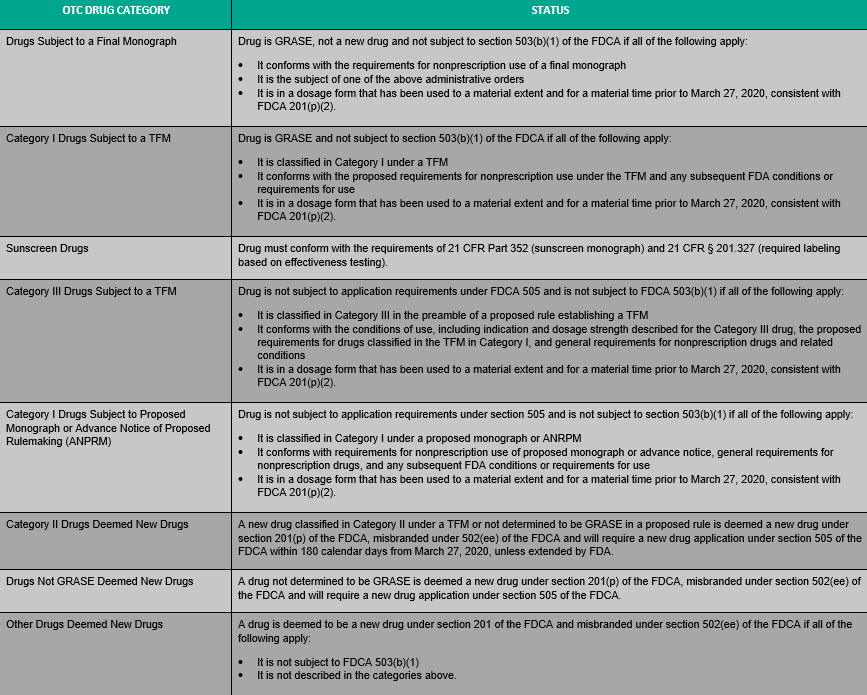
The CARES Act also adds other OTC drug-related provisions:
- It amends section 502 of the FDCA so that an OTC drug product is considered misbranded if it (1) does not comply with the requirements under the newly established section 505G of the FDCA (including the requirement for OTC drugs to comply with any final OTC monographs) and (2) it is made in a facility for which there are outstanding fees required under section 744M of the FDCA.
- It clarifies that the new section 505G of the FDCA does not apply to any nonprescription drug that was previously excluded by FDA from OTC Drug Review.
- It clarifies that sponsors of sunscreen ingredients with pending orders have the option to seek review in accordance with the Sunscreen Innovation Act (SIA) or to seek review under the new monograph review process. The election must be made within 180 calendar days of the date of enactment of the CARES Act (March 27, 2020).
- It requires an annual Congressional report to the Committee on Energy and Commerce of the House of Representatives and Committee on Health, Education, Labor, and Pensions of the Senate describing FDA’s progress in “evaluating the cough and cold monograph . . . with respect to children under 6” and “as appropriate, revising such cough and cold monograph to address such children through the [administrative] order process.”
OTC Drug User Fees
The CARES Act established an OTC Drug User Fee, subject to reauthorization in 2025. The new sections 744L to 744N apply to facilities identified as “OTC monograph drug facilit[ies]” and contract manufacturers of OTC drugs, as well as to those that submit an OTC monograph order request. The provision is a longstanding agency priority to improve oversight of OTC drugs through additional resources.
Innovation
Under the CARES Act, manufacturers of OTC drugs could obtain 18 months of market exclusivity for their products, which could spur OTC drug innovation.
The CARES Act also creates section 512A of the FDCA, which allows expedited review of animal drugs through the new Priority Zoonotic Animal Drug designation. The designation is intended to address zoonotic diseases, diseases that spread from non-human animals to humans, before they cause harm to humans. This may be significant, as several of the most serious epidemics and pandemics of the 21st Century have been or are thought to be zoonotic diseases, e.g., swine flu, avian flu, severe acute respiratory syndrome (SARS), Ebola and COVID-19.




Collaboration Among Competitors & Covid-19: The Impact on EU And National Case Laws
ARTICLE
Collaboration Among Competitors & Covid-19: The Impact on EU And National Case Laws
April 9, 2020
Read time: 1 min



Navigating the Turbulent Waters of COVID-19: Top Tips for Heads of Tax
ARTICLE
Navigating the Turbulent Waters of COVID-19: Top Tips for Heads of Tax
April 8, 2020
Read time: 5 min
During the Coronavirus (COVID-19) crisis, business may slow down or even completely shut down, sales are down or next to zero, cost cutting programs have already started, and nobody knows exactly when the recovery will begin.
How can the Head of Tax contribute?
CASH, CASH, CASH
Firstly, look at the upcoming tax payments in April, May and June 2020, as they could be reduced, mainly because of the following two reasons:
- Many Governments have issued specific decrees allowing to defer most of these payments (generally without application of late-payment interests); this is mainly in favour of small-medium sized companies but can apply also to large companies under certain circumstances (in particular, see USA, Canada, Germany, UK , France and Italy). Nothing is entirely free, though, and in some cases the benefit of the deferral is conditional upon a commitment by the companies not to distribute dividends or buy back shares (e.g. France).
- Profit in Q1 has been affected by the COVID-19 economic impact and following Qs will likely be affected: tax prepayments of Corporate Income Tax can be reduced accordingly under various schemes.
Point of attention: All those measures affect your tax cash out in 2020, but not your tax line in the P&L.
Secondly, now is a good time to review all your refundable tax credits, as guidelines to accelerate the refund have been issued in some countries, e.g. France. Furthermore, illiquid tax credits/assets may be unlocked (e.g., in Italy through the conversion of certain DTAs into a tax credit available when baddebts are sold; in USA exceptional carry-back of tax losses has been allowed).
Thirdly, when cash becomes a priority, you may be asked to swap accounting ETR savings with lower cash tax savings.
Finally, dividend distributions from affiliates may be accelerated, to also benefit from current FX rates (e.g. Euro/USD). There is nothing particularly notable about this, but just be mindful that the application of reduced WHTs requires due fulfilment of certain requirements and, more importantly, a firm position to be taken with respect to cases which may have been put on hold because of uncertainties on the applicable regime in light of BEPS (Principal Purpose test etc). Ensure you are prepared!
WORK CLOSELY WITH HUMAN RESOURCE (HR) AND TREASURY DEPARTMENTS
HR is working hard on obtaining subsidies by governments with respect to labour costs. The Head of Tax should assist in finding ways and opportunities to defer payments of withholding taxes on salaries and/or social contribution charges. Such measures are also available to large size enterprises (USA and Italy), and may affect not only your cash out, but also your P&L (e.g., reduction in China of 50% social contributions for 3 months).
State guaranteed loan programs have been launched (amongst others, in Italy, Germany, Switzerland and The Netherlands). The Treasury Department should be looking into these: make sure you are involved and tax collateral impacts are duly evaluated.
BE PREPARED FOR SPECIAL REQUESTS FROM YOUR CFO OR CEO SUCH AS PURCHASING MASKS OR MAKING DONATIONS
These transactions may appear as ordinary business. However given the top managements involvement and the media exposure, the Head of Tax should be on top of them. In particular, many special rules have recently been approved to speed up customs procedures and/or provide VAT exemptions and special tax credits (among others, this is the case for Brazil, China, Ireland, Italy and Spain).
Gifts in support of COVID-19 related initiatives are increasing. Make sure you are up to date on the latest tax rules aimed at incentivizing these actions and in full control of tax buffers for deductible donations.
BE (INTERNATIONALLY) CONNECTED
Now more than ever (given the need to make decisions in very short time frames with limited visibility), it is important to learn from others’ experience, pool the different views and be on top of “market” trends. The ongoing COVID-19 crisis also raises interesting questions with respect to international principles (e.g., the impact of “stay at home” requirements on PE, residency, employees’ taxation) and transfer pricing (still ground for a routine stable profit of distributors under the TNMM in a crisis scenario?).
Tax Clubs, pooling Head of Tax’s representative, are a very useful instrument to take informed/quick decisions, and be a source of valuable information to your CEO/CFO.
NURTURE YOUR TEAM
Working remotely should not loosen ties within your team nor make them feel disconnected. Make sure contact and interactions are preserved, and that usual reactivity is kept high.
* * *
These are difficult times to navigate, in which full strength and responsiveness are expected from the Head of Tax, more than ever.


Recent Decisions Shed Light on Foreign Investments in France
ARTICLE / CLIENT ALERT
Recent Decisions Shed Light on Foreign Investments in France
April 9, 2020
Read time: 4 min
The Conseil d’Etat recently ruled on disclosure requirements for transactions by foreign investment funds. In a separate case, the French Ministry of Finance issued a verbal notice rejecting a US company’s proposed acquisition of a French technology enterprise.
Two separate decisions on foreign investments drew scrutiny in France recently: a Conseil d’Etat ruling on disclosure requirements for transactions by foreign investment funds, and a verbal notice issued by the French Ministry of Finance rejecting the acquisition of a strategic small to mid-size enterprise (SME) by a US company.
According to its statement to the US Securities and Exchange Commission (SEC), the US regulatory body for the securities industry, US company Teledyne Technologies Inc. received verbal notice on 31 March 2020 of the French Ministry of Finance’s unfavourable position regarding Teledyne’s proposed acquisition of Photonis, a leading French company for night vision devices. This decision has yet to be confirmed in writing, and the Ministry announced that no such notice would be issued before the end of the Coronavirus (COVID-19) pandemic. This vague timeline might spare the Ministry of Finance from having to issue a formal veto, a measure that has not yet been used under the foreign investment control regime. The delay also gives the French government additional time to find an alternative solution for the acquisition of Photonis.
Teledyne’s plan to acquire Photonis had been strongly contested by high-ranking officials in the Ministries of the Economy and Armed Forces—including the counter-intelligence services—as well as members of the parliament, who argued that French control of Photonis represents a matter of sovereignty. Photonis plays a strategic role in the French military industry: it is the leading company for the design and manufacture of light intensifier tubes worldwide using innovative digital technology, and is a supplier for the special forces of NATO members. Photonis also provides detection instruments for the Megajoule laser project, a key element of the French nuclear deterrence policy. The French government has encouraged French companies to take over Photonis, with little success so far, and it is uncertain whether the current COVID-19 crisis will lead Ardian to lower its asking price, which has deterred other companies.
In a separate case, on 3 April 2020, the Conseil d’Etat ruled that a foreign investment fund seeking authorisation for direct investments in France must disclose in its application the identities of the fund manager and the persons controlling it, but is not required to disclose the identities of all investors. By decision of 16 December 2015 and in accordance with article L. 151-3 of the Monetary and Financial Code, the Ministry of the Economy allowed FII Co, a company incorporated under Luxembourg Law indirectly owned by two investment funds managed by Warwick Capital Partners LLP, a company incorporated under English Law, to acquire control of B. Industries, a company manufacturing various fibres for the automotive industry. Ms and Mr B. sought the annulment of the authorisation before the Administrative Court of Paris, which denied their request. The Administrative Court of Appeals of Paris affirmed the ruling.
The matter was then brought to the Conseil d’Etat, the highest administrative court, which found that “the Court of Appeals did not in any way err in law by deciding that the applicant seeking authorisation for a transaction by an investment fund is required to disclose the identity of the fund manager and, when the fund manager is a legal entity, the identities of the natural persons or public bodies that control the fund, and by observing that no provision requires all the investors of the fund to disclose their identity.”



COVID-19 Checklist for Publicly Listed Companies in France
ARTICLE / CLIENT ALERT
COVID-19 Checklist for Publicly Listed Companies in France
April 9, 2020
Read time: 20 min
- On January 30, 2020, the World Health Organization (WHO) has qualified the Covid-19 epidemic as a “global public health emergency”.
- On March 3, 2020, French Minister of Economy and Finance Bruno Le Maire, pronounced a “state of economic emergency” due to the Covid-19 epidemic in France. By this date, French companies had already suffered losses estimated at more than one billion euros according to the Ministry of Economy.
- On March 16, 2020, President Emmanuel Macron and Home Secretary Christophe Castaner announced a stay-at-home order to contain the Covid-19 epidemic for a period of at least fifteen days (Decree No. 2020-260 of 16 March 2020 regulating movements as part of the fight against the spread of the covid-19 virus).
- On March 23, 2020, the French Parliament voted Law No. 2020-290 declaring the state of emergency for a period of two months (until May 24, 2020) and enabling the Government to adopt certain measures in order to deal with the emergency situation resulting from the Covid-19 epidemic and the imposed containment measures. Law No. 2020-290, among others, authorizes the Government to adapt and simplify certain corporate laws and regulations relating to the holding of shareholders’ and board meetings, reporting obligations and dividend distributions.
- On March 25, 2020, the French Government adopted Order (Ordonnance) No. 2020-321 in order to temporarily adapt the rules for convening, informing, meeting, and deliberating, applicable to shareholders’ and Board meetings with a view to enable companies to continue to carry out their activity despite the measures taken to fight the Covid-19 epidemic (“Order No. 2020-321”). These measures enter into force retroactively as of March 12, 2020, and will apply until July 31, 2020, provided that such delay may be extended by the French Conseil d’Etat until, at the latest, November 30, 2020.
- On March 25, 2020, the French Government also adopted Order (Ordonnance) No. 2020-318 on the establishment, audit, review, and approval of the accounts and other documents and information companies shall file or disclose in the context of the Covid-19 epidemic (“Order No. 2020-318”).
- Given the tense situation on the stock markets, the French stock exchange authority (Autorité des marchés financiers – “AMF”) also published a series of press releases in particular with respect to the holding of shareholders’ meetings, as well as regarding the disclosure rules applicable to listed companies.
- The AMF also published a general ban on short selling of equity stocks on all the Euronext Paris markets from March 17 to April 16, 2020.
Preparation and approval of annual accounts
Approval of annual accounts – Pursuant to article 3 of Order 2020 318, the delays for (i) approving the annual accounts and the documents attached thereto, and (ii) convening the shareholders’ meeting approving such accounts, are extended by three months for companies having closed their annual accounts between September 30, 2019 and the expiry of a one-month delay after the termination of the health emergency situation enacted under the March 23,2020 Law (i.e. at least on June 24,2020).
Such extended delays do not apply in case the company’s statutory auditor(s) has(ve) already issued its (their) report(s) on the annual accounts prior to March 12,2020.
Companies will be able to hold their annual shareholders’ meeting on the approval of their annual accounts until September 30, 2020 (instead of June 30), subject to the aforementioned exceptions. Listed company choosing to postpone their shareholders’ meeting shall immediately inform the market via a press release.
n any case, a shareholders’ meeting can always be postponed (ajourné) even after publication of the meeting notice. In such case, the information relating to the postponement shall be published in the French public notice journal (BALO).
Other accounting documents and forecasts (comptabilité prévisionnelle) – Companies having more than 300 employees or with net sales (chiffres d’affaires net) exceeding 18 millions euros) shall prepare certain other accounting documents defined by Article L232-2 of the Code of commerce, including P&L forecasts. Pursuant to Order 2020-318 the delay for preparing such documents has been extended by two months for the documents relating to the accounts or semesters closed between November 30, 2019 and the expiry of a one-month delay after the termination of the health emergency situation (i.e. at least on June 24, 2020).
Sociétés anonymes having a management board (directoire) and a supervisory board (conseil de surveillance) – The delay for the management board to provide the annual accounts to the supervisory board has been extended by three months. This extension applies to companies having closed their annual accounts between September 30, 2019 and the expiry of a one-month delay after the health emergency situation (i.e. at least on June 24, 2020).
Private companies benefiting from public subsidies allocated to specific expenses (subventions affectées à une dépense déterminée) – Companies benefiting from public subsidies allocated to specific expenses shall prepare a report on the use of such subsidies within six months from the termination of the financial year. The delay for preparing such report has been extended by three months provided such report relates to the accounts or semesters closed between November 30, 2019 and the expiry of a one-month delay after the termination of the health emergency situation (i.e. at least on June 24, 2020).
Holding of Shareholders’ and Board meetings
Virtual shareholders’ meetings can temporarily be held. Pursuant to French corporate law, shareholders’ meetings in must be physically held.
However, due to the Covid-19 epidemic, Order 2020-321 allows the Board to decide that general shareholders’ meeting will be held without shareholders, auditors and employee representatives being present physically or by any mean of communication, provided the meeting is convened at a place, where on the convening date, collective gatherings are prohibited for health reasons.
Order 2020-321 further provides that shareholders participating in the meeting by means of a conference call or audio-visual conference allowing their identification will be deemed to be present for the calculation of quorum and majority. In practice, listed companies are not expected to hold their shareholders’ meetings by videoconference due to technical issues regarding the identification of shareholders.
Listed companies choosing to go for one of the two aforementioned options shall publish as soon as possible a press release in order to inform their shareholders accordingly.
The AMF recommends that listed companies broadcast their general meetings live on their website and communicate widely in this respect.
Shareholders’ meetings can be held behind closed doors (i.e. without the shareholders being either physical or remotely present), or through video- or teleconference means.
Shareholder vote possible without being physically present – Under existing laws and regulations shareholders may already vote either by correspondence (vote par correspondence) or by proxy (procuration), or directly through a secure voting platform on the Internet (for issuers having allowed such a method of voting). In case of proxy given without any indication of the representative, any resolution proposed by the board will be voted positively and other resolutions not proposed by the board will be voted negatively.
If the Board decides so, shareholders may also vote through video- or teleconference.
In a press release dated March 27, 2020, the AMF provided some guidance and good practices for the organization by listed companies of their shareholders’ meeting given the exceptional measures taken by French authorities (see page 7). Such good practices aim at providing the shareholders with a clear, precise and accessible information notably on the shareholders’ meeting, the access to the documents submitted to the shareholders or the various available means to vote.
Shareholders’ Meetings
Is it possible to amend the agenda and the draft resolutions (texte des resolutions) once the meeting notice (avis de réunion) has been published in the BALO? Yes. The agenda and the draft resolutions provided in the meeting notice are not final. Shareholders remain entitled to ask written questions relating to the shareholders’ meeting, and subject to certain conditions, to request the board to add an item on the meeting’s agenda. The applicable minimum threshold enabling shareholders to request that an item be added on the meeting’s agenda depends on the share capital of the company and is calculated on a sliding scale (at least 5% if the share capital is less than €750,000 and in the very largest companies, it may approach 0.50%).
For companies listed on a regulated market, such a request shall be submitted to the company at least 25 days prior to the date of the shareholders’ meeting, but not later than 20 days following the date of publication of the meeting notice (avis de réunion) in the Bulletin des annonces légales obligatoires – “BALO”).
Communication of documents or information per email. Pursuant to article 3 of the Order 2020-321, companies which are required to provide their shareholders with certain documents and information in view of a shareholders’ meeting can send such documents by email, provided that the shareholder has requested that the document be communicated to his email address.
Can a company opt for a remote shareholders’ meeting even if the meeting has already been convened? Yes, according to article 7 of Order 2020-321, in case the general meeting has already been convened, and the board decides to allow the shareholders’ meeting to be held remotely, the shareholders shall be informed of such a decision as soon as possible via the publication of a press release.
In such case, the remaining formalities to be complied with the purpose of convening the shareholders’ meeting shall still be undertaken. Formalities which have already been done before the decision to hold the shareholders’ meeting remotely will remain valid and will not have to be renewed.
Consequence of the impossibility to send a convenience letter to the shareholders per mail. According to article 2 of Order 2020-321, a shareholders’ meeting will not be deemed null and void if a listed company required to send a convening letter to its shareholders by physical mail, was unable to mail such a letter due to circumstances external to the company.
Recommendations of the AMF
On March 27, 2020, the AMF published a range of good practices that publicly listed issuers should keep in mind when organizing their shareholders’ meetings, among which in particular:
- Set up, as soon as possible before the shareholders’ meeting, clear, precise and accessible communication for all shareholders concerning: (i) the holding of the meeting (indicating if it will be held without the presence of shareholders), (ii) the ways to inform shareholders (in particular the consultation of documents and information relating to the meeting); (iii) the available means to participate to the meeting (possibility to ask question before the meeting, impossibility, as the case may be, to ask oral question and to propose new resolutions during the meeting); and (iv) the available means to vote.
- Highlight, on the home page of the issuer’s website, a link to the website’s pages dedicated to the shareholders’ meeting.
- Allow shareholders to vote though Internet via a secure voting platform, if the issuer has enough time to set up such a voting system prior to the shareholders’ meeting.
- Broadcast the shareholders’ meeting live on the issuer’s website and communicate widely in this respect, and keep the record of the meeting available on the website.
- If applicable, when publishing the press release announcing that the shareholders’ meeting will be held behind closed doors, remind the shareholders’ of the different possibilities they have to vote without being physically present.
- Inform shareholders directly by email of the specific voting and meeting procedures (when the email address is known to the issuer). This information does not exempt the issuer from its obligations to provide information to shareholders by post.
- Enable shareholders to exercise their right to information and provide them with a copy of the documents they are entitled to review at the company’s registered office, if such documents are not available on the company’s website.
- As meetings behind closed doors do not allow shareholders to ask oral questions during the meeting, agree to receive and handle, to the extent possible, shareholders’ written questions sent after the deadline provided for by applicable law.
- Use electronic means of communication whenever possible in connection with the company‘s procedures and communications relating to shareholders’ meetings. In this respect, the AMF recommends that issuers create an email address dedicated to shareholders’ questions regarding the meeting and to communicate on their website that such an address has been created.
- Inform the public as soon as possible of the specific measures put in place for the voting and holding of shareholders’ meetings.
Board Meetings
Shall Board meetings be held physically? Pursuant to French corporate law, the Board’s rules of procedure (règlement intérieur) may provide that the Board members may attend meetings using videoconferencing or telecommunications facilities, unless otherwise provided in the company’s articles of association and except for Board meetings held to approve the company’s annual accounts.
In order to take into account the difficulties to hold physical meetings due to the current mobility restrictions, article 9 of Order 2020-321 states that even if not provided in the Board’s rules of procedure, videoconferencing or telecommunications facilities may be used to attend Board meetings notwithstanding a prohibition of the articles of association and even for Board meetings held to approve the annual accounts. Pursuant to Order 2020-321, Board may also adopt its decisions through written consultation.
Board meetings for the approval of the annual accounts may be held remotely.
Dematerialized Formalities
The minutes of a general meeting shall in any case be recorded and signed in a hard copy (no electronic signature). However, as of today most of Commercial courts accept that companies proceed to the legal formalities with scanned copies of such minutes.
Disclosure rules applying to listed companies
Permanent Information
Obligation to publish non-public information that is likely to have a significant influence on stock prices By way of a press release published on February 28, 2020 which was completed by a press released dated March 23, 2020, the AMF recalled that the Market Abuse Regulation requires that issuers disclose, as soon as possible, all inside information that concerns them directly or indirectly, i.e. all precise, non-public information that is likely to have a significant influence on stock prices. Therefore, any knowledge of the Covid-19 epidemic’s significant impact on the activity, performance or outlook must therefore be disclosed without delay.
The ESMA also stated in its communication dated March 11, 2020 that issuers should disclose as soon as possible any relevant significant information concerning the impacts of COVID-19 on their fundamentals, prospects or financial situation.
Given the uncertainty surrounding the future development of this outbreak, the AMF recommends that issuers periodically re-assess the epidemic’s estimated and anticipated impact on their company’s activity and outlook with respect to its materiality and/or amount. According to the AMF, such a reassessment shall in any case be undertaken upon filing of the universal registration document (document d’enregistrement universel – “URD”) (please see slide 10 for further information in this respect).
The AMF further recommends that: (i) issuers communicate this information when presenting their annual results, and (ii) issuers disclosing their forecast for 2020 to the market when publishing their annual results, communicate which assumptions they used in preparing this forecast, with respect to the potential impacts of the epidemic.
However, an issuer may always on its own responsibility, delay disclosure to the public of inside information provided that all of the following conditions are met: (i) immediate disclosure is likely to prejudice the legitimate interests of the issue; (ii) delay of disclosure is not likely to mislead the public, and (iii) the issuer is able to ensure the confidentiality of that information.
Any knowledge of the Covid-19 epidemic’s significant impact on the activity, performance or prospects of the company must be disclosed without delay.
Periodical Information
Publicly listed companies which closed their financial year on December 31, 2019 shall submit their annual financial report (rapport financier annuel) including their management report, which must include a description of the main risks and uncertainties faced by the company, before 30 April 2020.
Taken into account the difficulties encountered by issuers in preparing financial reports and the challenges faced by auditors in carrying out timely audits of accounts due to the COVID-19, the ESMA recommended to national competent authorities to “apply forbearance powers towards issuers who need to delay publication of financial reports beyond the statutory deadline” (with a two-month maximum delay for annual financial reports, and a one-month maximum delay for half-yearly financial report).
Further to the ESMA communication, the AMF issued a press release on March 30, 2020 to inform that (i) any delay to publish financial reports beyond the statutory deadline shall be disclosed to the market with the reasons for such delay and an estimated date for such publication and (ii) the AMF will postpone any of its invitation vis-à-vis defaulting issuers to comply with such publication with a two-month delay for annual financial reports and a one-month maximum delay for half-yearly financial report.
The AMF recommends that issuers include the information that “they deem appropriate in the light of the coronavirus outbreak as of the date of filing their annual financial report”. For issuers publishing an URD, the “Risk Factors” section should where necessary, deal more specifically with the economic exposure of the listed company to this epidemic, as well as any measures that may have been taken with this regard.
A description of the main risks and uncertainties faced by a company before 30 April 2020 shall be included in the annual financial report. For issuers publishing a URD; the “Risk Factors” section should deal more specifically with the economic exposure of the company to the epidemic.
When filing their URD, issuers shall in particular reassess whether the current Covid-19 epidemic will affect their previously announced financial forecasts. Pursuant to the AMF, the URD shall expressly indicate, as the case may be, whether previously disclosed forecasts are not relevant anymore and, if applicable, that a new forecast cannot be provided for the moment due to the global uncertainty.
Further, the AMF states that when a significant impact of Covid-19 is identified or anticipated, previous prospective communications not taking into account the epidemic must be reviewed and amended.
Finally, the AMF recalls that changes to forecasts which have been provided in already filed URDs shall be disclosed through a press release.
Issuers meeting the thresholds requiring them to publish a statement on their extra-financial performance should also describe in the dedicated section “Security and health at work” the measures they have taken in order to ensure the security of the employees in the context of the Covid-19 epidemic.
The AMF further recommends that “impacts of this epidemic should also be considered, if necessary, in the financial statements of 31 December 2019, as a post-closing event requiring disclosures”. However, no adjustment to the financial statements as at December 31, 2019 will be necessary, as only an event related to circumstances already existing at the date of closure can lead to an adjustment of the accounts.
Equity short selling ban by AMF for one month and closer monitoring of short selling during three months
- Following the sharp decline of equity markets in March 2020 the Italian, Spanish, French and Belgian securities regulators took in mid-March 2020 emergency measures to ban short selling for periods ranging from one month (France, Spain, Belgium and Greece) to three months (Italy) on all stocks listed on the respective local markets over which such regulators have jurisdiction.
- An emergency short-selling prohibition, for a period of one month (from March 18 to April 16, 2020) was enacted by the AMF on all transactions that might constitute or increase net short positions on shares admitted to trading on Euronext French trading venues (Euronext regulated market, Euronext Growth and Euronext Access) for which the AMF is the relevant competent authority as well as to all related instruments relevant for the calculation of the net short position.
- The ban applies to transactions executed both on a trading venue or over the counter (OTC) and applies to any natural or legal person domiciled or established within the EU or in a third country.
- This measure does not, however, apply to market-making activities, trading in index-related instruments or short positions entered into hedge positions on convertible bond or subscription rights.
- The European Securities and Markets Authority (ESMA), for the first time ever considered that these extended-period bans by were “justified by current adverse events or developments which constitute a serious threat to market confidence and financial stability” and “appropriate and proportionate to address the existing threat to market confidence” in these respective national markets.
Temporary lowering of short selling mandatory notifications threshold from 0.2 to 0.1% until June 17, 2020
- Pursuant to the 2012 EU Short Selling Regulation, ESMA also, and for the first time, made use of its emergency powers under Article 28 of said regulation to temporarily lower short selling reporting thresholds throughout the EU.
- Considering that lowering the reporting threshold is a precautionary action that, under the exceptional circumstances linked to the ongoing COVID-19 pandemic, is essential for authorities to monitor developments in markets, ESMA required during a three-month period starting on March 16, 2020, the holders of net short positions in shares traded on an EU-regulated market to notify the relevant national securities regulator (i.e. in France, the AMF) if the position reaches or exceeds 0.1% of the issued share capital after the entry into force of the decision (against 0.2% under existing regulations).
- The temporary transparency obligations apply to any natural or legal person, irrespective of their country of residence.
- They do not, however, apply to shares admitted to trading on a regulated market where the principal venue for the trading of the shares is located in a third country, to market making or stabilization activities
Protective Measures against hostile takeover bids
Extreme dislocation and a major sell-off in our equity markets have led to many public companies finding their stock prices at severely depressed levels, often over 50% off last twelve month highs. While most companies and investors are in crisis management mode, these markets may nevertheless present attractive opportunities for opportunistic strategic or financial bidders, encouraging them to launch a takeover bid (TOB). The French Minister of Economy and Finance said that he was ready to use “without any hesitation all the instruments available” to protect French companies which would be destabilized by the violent stock market turbulence.
Existing provisions to be considered
- Declaration of crossing : any 5% threshold in share capital or voting rights must be made by any investor crossing alone or in concert such threshold, to the company and the AMF : such declaration will inform the company and the public on any position taken by an investor ; it may be recommended to modify the bylaws to include any lower threshold to be declared (2 or 3%) ;
- TOB mandatory minimum acceptance threshold : a bidder must reach at least 50% of the capital or voting rights of the target at the closing of the offer (referred to as “mandatory minimum acceptance threshold”). If the mandatory minimum acceptance threshold is not reached, then the offer automatically lapses ; therefore, ‘friendly’ significant shareholder(s) may protect the company against a TOB ;
- Squeeze out threshold : bidders will try to acquire as many shares as possible to reach a 90% threshold in shares and voting rights, in order to squeeze out the remaining shareholders and delist a company ; therefore, ‘friendly’ shareholder(s) with a 10% stake may discourage a bidder to launch a TOB ;
- Change of control clauses : strategic contracts/collaboration agreements could refrain a potential bidder to launch a TOB, should strategic contracts and collaboration agreements entered into by the company provide for such change of control clauses.
- Foreign Investment Control : in case of a foreign bidder, the existing foreign investment control regulation by the French State could potentially be applicable. Pursuant to such regime, a prior approval of the French State could be necessary (possible broad interpretation by the French authorities of the protected areas entering into the scope of foreign investment control).
- In guidelines published on March 25, 2020, the European Commission has called upon EU Member States to make full use of their foreign direct investment (FDI) screening mechanisms to take into account the risks arising in connection with the Covid-19 crisis with respect to critical health infrastructures, supply of critical inputs, and other critical sectors. The Commission further recommended that those Member States that currently do not have a FDI screening mechanism adopt a “full fledged screening mechanism”.

Businesses with 10,000 or Fewer Employees: Federal Reserve Publishes Details on CARES Act Loans
ARTICLE / CLIENT ALERT
Businesses with 10,000 or Fewer Employees: Federal Reserve Publishes Details on CARES Act Loans
April 9, 2020
Read time: 5 min
On April 9, 2020, the Board of Governors of the Federal Reserve System (“Federal Reserve”) took additional action to facilitate lending to small- and medium-sized businesses. The Federal Reserve will provide up to $600 billion under both the Main Street New Loan Facility and the Main Street Expanded Loan Facility (collectively, the “Main Street Lending Program”) using funds appropriated to it under the Coronavirus Aid, Relief, and Economic Security Act (“CARES Act”).
The CARES Act was signed into law on March 27, 2020 with the goal of providing $2 trillion in aid to financially support individuals and businesses that have been affected by the coronavirus pandemic. Under Title IV of the CARES Act, referred to as the “Coronavirus Economic Stabilization Act of 2020,” the Secretary of the Treasury (“Treasury Secretary”) was authorized to make loans, guarantees and “other investments” to support certain eligible businesses, as well as state and local governments, of up to $500 billion in the aggregate. Today, the Federal Reserve took action within its authority under section 13(3) of the Federal Reserve Act, with approval of the Secretary, to significantly expand the amount of financial aid available under the Main Street Lending Program.
This Alert provides a brief overview of the terms of the Main Street Lending Program. For more information on the relief provided under the CARES Act, please see our March 30, 2020 Alert for mid-sized businesses and our March 30, 2020 Alert for small businesses.
Eligible Borrowers
The Main Street Lending Program will provide enhanced support for small- and mid-sized businesses that (i) were in good financial standing before the crisis caused by the COVID-19 pandemic; (ii) are U.S. entities and have significant operations in and a majority of their employees based in the United States; and (iii) (a) have up to 10,000 employees or (b) have up to $2.5 billion in revenue.[1] Eligible businesses will also be required to attest to certain statements concerning eligibility and the use of loan proceeds, including that:
- The business requires financing due to the exigent circumstances presented by the COVID-19 pandemic, and that it will make reasonable efforts to maintain its payroll and retain its employees during the term of the loan; and
- The business will follow compensation, stock repurchase and capital distribution restrictions that apply to direct loan programs under section 4003(c)(3)(A)(ii) of the CARES Act (for more information on these restrictions, please see our prior Alert).
Eligible businesses must choose only one of the Main Street Loan Program facilities in which to participate. Moreover, those that participate may not also participate in the Primary Market Corporate Credit Facility, but may also participate in the Paycheck Protection Program.
Loan Overview
To provide this enhanced support, the Federal Reserve will issue four-year loans to these eligible businesses, with principal and interest payments deferred for one year after the loan is disbursed. Loans will be made for a minimum of $1 million and may not exceed either:
- For the Main Street New Loan Facility, the lesser of (a) $25 million; or (b) an amount that, when added to the eligible business’ existing outstanding and committed but undrawn debt, does not exceed four times the eligible business’ 2019 earnings before interest, taxes, depreciation and amortization (“EBITDA”); or
- For the Main Street Expanded Loan Facility, the lesser of (a) $150 million; (b) 30% of the eligible business’ existing outstanding and committed but undrawn bank debt; or (c) an amount that, when added to the eligible business’ existing outstanding and committed but undrawn debt, does not exceed six times the eligible business’ 2019 EBITDA. Under either program, there will be no prepayment penalty.
Such loans will be facilitated by eligible lenders,[2] which may either originate new loans or expand existing loans to eligible businesses. The Federal Reserve, through a special purpose vehicle, will purchase 95% of Main Street Lending Program loans from eligible lenders, up to $600 billion, with eligible lenders required to retain a 5% share of the loans it originates.
For more information, please see the Main Street New Loan Facility term sheet here or the Main Street Expanded Loan Facility here.
Authored by Joseph P. Vitale, Andrew J. Fadale, Stuart D. Freedman and Jessica Romano.
If you have any questions concerning this Alert, please contact your attorney at Schulte Roth & Zabel or one of the authors.
[1] While the Federal Reserve’s press release indicated that businesses “with revenues of less than $2.5 billion,” would be eligible, the terms sheets published state the threshold as “up to $2.5 billion.”
[2] Eligible lenders are U.S. insured depository institutions, U.S. bank holding companies and U.S. savings and loan holding companies. Eligible lenders will be required to make certain certifications, including that it (i) will not cancel or reduce any existing lines of credit outstanding to the borrower, and (ii) will not use the proceeds of the loan or upsized tranche of the loan, as applicable, to repay or refinance pre-existing loans or lines of credit made by the lender to the borrower.
This is a fast-moving topic and the information contained in this Alert is current as of the date it was published.
This communication is issued by Schulte Roth & Zabel LLP for informational purposes only and does not constitute legal advice or establish an attorney-client relationship. In some jurisdictions, this publication may be considered attorney advertising. ©2020 Schulte Roth & Zabel LLP. All rights reserved. SCHULTE ROTH & ZABEL is the registered trademark of Schulte Roth & Zabel LLP.
More Than $800M in Stabilization Funds for Massachusetts Medicaid Providers – Additional Details Released
ARTICLE / CLIENT ALERT
More Than $800M in Stabilization Funds for Massachusetts Medicaid Providers – Additional Details Released
April 22, 2020
Read time: 9 min
This alert was originally published on April 8, 2020, and was updated on April 22, 2020, to reflect new developments.
MassHealth stabilization funds, in excess of $800 million, will be divided among hospitals, nursing facilities and other healthcare providers dealing with the effects of the Coronavirus (COVID-19) pandemic. The funds are expected to be available from April through July 2020. MassHealth has released additional details about the allocation of funds.
On April 7, 2020, Massachusetts Governor Charlie Baker announced $800 million in MassHealth funds that will serve as “stabilization funding” aimed at assisting Massachusetts Medicaid (MassHealth) providers hard-hit by the Coronavirus (COVID-19) pandemic. Recent announcements have clarified that the allocation of funds to MassHealth providers will likely be in excess of $800 million. Below is a summary of the stabilization funding details and developments to date, as well as key insights on the information provided thus far.
MassHealth anticipates making these funds available beginning in April 2020 and will provide the funding through July 2020. The $800+ million in stabilization funding will be divided among hospitals, nursing facilities and other healthcare providers.
1. Support to Hospitals
More than $400 million of the $800+ million in MassHealth funds will be allocated to hospitals, with the majority of funding designated to support 28 “safety-net and high Medicaid hospitals.” The governor’s announcement does not enumerate these 28 hospitals. In addition, MassHealth’s summary of the funding indicates that the $400 million to hospitals will also support Hospital Licensed Health Centers, such as Brookside Community Health Center; MGH – Back Bay Health Center; Codman Square Health Center; East Boston Neighborhood Health Center; and East Cambridge Health Center.
The roughly $400 million allocated to hospitals includes a 20% rate increase for COVID-19 care to Medicaid beneficiaries, as well as a 7.5% increase in rates for all MassHealth care provided. The 20% rate increase for COVID-19 care is not defined. While recent MassHealth Guidance indicates that COVID-19 care includes home visits related to the virus, quarantine in hospital, and diagnostic lab services with respect to testing for the virus, providers will need further guidance on what additional specific care is actually subject to the rate increase. Updates likely will be posted to the MassHealth Provider Guidance page along with relevant COVID-19 billing codes as they are generated.
2. Support to Nursing Facilities
Governor Baker’s press conference on April 15, 2020, revealed that $130 million from the stabilization funding will be allocated to nursing facilities, an increase of $50 million above what Baker initially announced for these providers, including $50 million in the form of a 10% MassHealth rate increase available to all nursing homes effective April 1. Nursing facilities do not need to request supplemental payments; all eligible providers will automatically receive these payments, and such payments will be distributed by the 15th calendar day of each month. MassHealth will use the nursing facility provider’s current bank information on file to distribute supplemental payments. Details on the calculation of the supplemental payments to nursing facilities can be found here. In addition, the following support is available to nursing facilities from MassHealth:
- Long-Term Care Staffing Portal and Signing Bonuses: To address long-term care staffing shortages at facilities, MassHealth has created a portal for facilities to identify staffing needs, and for healthcare professionals, including nurses, aides, social workers, and occupational and physical therapists, to apply for positions at those facilities. According to MassHealth, the portal matches supply to demand and fills the “high priority” locations first; however, demand is far outpacing supply thus far. In order to incentivize use of the portal, MassHealth has allocated approximately $1 million to fund signing bonuses of $1,000 each, which nursing facilities pay to each staff member hired through the portal since its launch on April 8 through May 15, 2020. This includes staff hired as W-2 employees or individual independent contractors, but does not apply to individuals engaged through temporary staffing agencies. The nursing facility must submit documentation 30 days after the individual’s start date to verify that the bonus was paid and that the individual worked for at least 128 hours within 30 days of the employee’s start date. Notably, these staff (and facilities that hire them) do not need to be dedicated to providing COVID-19 care.
- Nursing Facilities with Dedicated Isolated COVID-19 Wings and Units: Nursing facilities that create dedicated COVID-19 wings and units are eligible for an additional 15% rate increase in the form of $30 per MassHealth member per day to support additional staffing, infection control and supply costs throughout the duration of the state emergency. This applies to all residents in the nursing facility, not just those in the COVID-19 isolation space. To qualify as a nursing facility with a dedicated COVID-19 unit or wing, the nursing facility must submit a form attesting to meeting the criteria for an isolated COVID-19 unit. Monthly lump sum payments to facilities with COVID-19 units and wings will be paid for the duration of the state of emergency, effective on the date MassHealth receives an attestation of compliance with the requirements. Payments are subject to inspections and audits of compliance with the requirements.
- Skilled Nursing Facilities That Are Dedicated COVID-19 Sites of Care: Finally, $30 million of the stabilization funds will be used to support skilled nursing facilities that are designated by the state as dedicated COVID-19 sites of care. Supplemental Rates (not less than $600 per MassHealth member per day) for residents in the COVID-19 dedicated facilities will be in place until the last COVID-19 resident is transferred or discharged from the facility. Details on calculation of the supplemental payments can be found here.
3. Support to Other Healthcare Providers
The stabilization funding also includes more than $300 million designated for “other health care providers that are delivering medical care for COVID-19 or providing services that keep residents safe in their homes”:
- Physicians and Physician Practices: MassHealth has allocated $15 million of these funds to support increased rates for MassHealth-covered surgery, anesthesia, medicine and radiology services provided by physicians and group practices. For dates of service from April 1, 2020, through July 31, 2020, MassHealth will increase rates by 15% for certain of the top 100 CPT physician codes with established MassHealth rates/fees and all home-based evaluation and management services for new and established patients (CPT codes 99341-99350). MassHealth acknowledges that providing these services in-person may be difficult in the current environment and encourages providers to deliver services via telehealth when appropriate, as outlined in its guidance here.
- Personal Care Attendants and Home Health Agencies: Approximately $30 million of the funds is allocated to personal care attendants (PCAs), and $13 million is allocated for home health agencies, in the form of higher rates for services provided to MassHealth beneficiaries. MassHealth has acknowledged that while the public health emergency has increased the need for home-based care, the emergency has also made the delivery of these services more difficult and costly. Accordingly, MassHealth has established higher rates from April 1, 2020, through July 31, 2020, to ensure the continued delivery of these critical services. See the updated rates here for PCA services, here for home health services, and here for CSN services. These rates are available for any MassHealth patient being treated by these providers and does not need to be related to COVID-19 care specifically.
- Long-Term Services and Supports: For providers of long-term services and supports (LTSS), $42 million is allocated to Adult Day Health programs and $39 million is allocated to Day Habilitation programs that have converted from group programs to actively serving members via alternative means. Guidance for MassHealth LTSS Providers can be found here. LTSS providers receive an add-on rate intended to address costs incurred that are associated with COVID-19 in the amount of 10% of the provider’s average monthly state funding for the months of November 2019 through January 2020. A listing of the specific supports and services that receive this add-on can be found here.
- Behavioral Health: Community behavioral health providers, including Early Intervention (EI) Program, Children’s Behavioral Health Initiative (CBHI), Program of Assertive Community Treatment (PACT) and Applied Behavioral Analysis (ABA) providers, will receive more than $100 million in stabilization funds. For dates of service from April 1, 2020, through July 31, 2020, payment for certain MassHealth-covered services will be increased by 10% above current rates. For more information on these rate updates, visit the guidance for EI providers here, CBHI providers here, PACT providers here and ABA providers here.
- Substance Abuse: To support certain substance-related and addictive disorders programs that include acute treatment services (ATS), clinic stabilization services (CSS), substance use disorder (SUD) outpatient services and Opioid Treatment Program (OTP) providers during the COVID-19 emergency, MassHealth will increase rates for certain MassHealth-covered services by 10% above current rates. An administrative bulletin listing the updated rates can be found here for ATS and CSS service providers, here for SUD outpatient services providers and here for OTP programs.
- Community Health Center: More than $50 million will be allocated to community health centers from the stabilization funds. MassHealth will pay each community health center a monthly supplemental payment from April through July 2020. A community health center’s monthly supplemental payment will be equal to certain percentages of that community health center’s average monthly claims paid by MassHealth and MassHealth Managed Care Entities for services provided in certain categories in fiscal year 2019. For more details on these supplemental payments, see the administrative bulletin here.
- Ambulance Providers: To support transportation providers during the COVID-19 emergency, for dates of service from April 1, 2020, through July 31, 2020, MassHealth will increase the rates of certain ambulance services by 50% above current rates. The updated rates for ambulance services can be found here. Additionally, for dates of service beginning April 10, 2020, MassHealth has established a rate for ambulance services related to the transport of specimens from congregate group sites for COVID-19 testing, performing diagnostic testing and communicating test results in the amount of $305. See the rate update here.
4. Key Takeaways
The stabilization funding is in addition to the previously unveiled $290 million in cash relief and $550 million in accelerated payments announced last month. The governor’s announcement did not foreclose the government from providing additional funding at a later date, and stated that the Executive Office of Health and Human Services will “continue to monitor and evaluate the situation.”
The stabilization funding comes as healthcare providers are reeling financially from their inability to perform elective procedures in order to reserve capacity to address the coming surge of COVID-19 patients. The Governor noted that MassHealth is able to provide the relief package because of “savings MassHealth is seeing by not paying for those elective procedures, along with increases in federal reimbursement rates to deal with COVID-19 treatment.” For this reason, deploying the aid package will not require a supplemental budget or legislation.