Content Type: Article

  • Section 1031 Exchanges and Qualified Opportunity Zone Investments: IRS Extends Filing Deadlines

    Section 1031 Exchanges and Qualified Opportunity Zone Investments: IRS Extends Filing Deadlines

    ARTICLE / CLIENT ALERT

    Section 1031 Exchanges and Qualified Opportunity Zone Investments: IRS Extends Filing Deadlines

    April 17, 2020

    Read time: 5 min

    Key takeaways
    Overview

    In response to the COVID-19 pandemic and resulting market slowdown, the IRS has granted a filing extension to taxpayers involved in Qualified Opportunity Zone investments and Section 1031 exchanges. The IRS notice, dated April 9, 2020, extends the filing deadline to July 15, 2020. This extension will help taxpayers avoid significant capital gains taxes caused by closing delays. However, it is unclear whether the Section 1031 deadline may actually be extended further than the July 15, 2020 deadline provided in the IRS’s most recent notice.

    Last month, the IRS extended the 2019 tax filing and payment deadline for taxpayers to July 15, 2020.  Pursuant to the subsequent Notice 2020-23, dated April 9, 2020 (“Notice”), the IRS applied the extension more broadly to all taxpayers, including individuals, trusts, estates, corporations and other non-corporate tax filers that have a filing or payment deadline falling on or after April 1, 2020 and before July 15, 2020. Therefore, taxpayers involved in a Section 1031 exchange or a Qualified Opportunity Zone investment that is due to be performed on or after April 1, 2020 and before July 15, 2020, qualify for the July 15, 2020 deadline extension. The Notice does not specifically reference these transactions, but the Notice broadly refers to time-sensitive actions, a category which includes Section 1031 exchanges or Qualified Opportunity Zone investments.

    Deadline for Section 1031 Exchanges

    In a Section 1031 exchange, an investor who sells an investment property may defer payment of capital gains taxes by purchasing a “like-kind property” with the profits from the sale. Typically, the investor has 45 days from the sale of the investment property to identify a like-kind property and 180 days from the sale of the investment property to close the sale of the like-kind property.

    Pursuant to the Notice, if the 45-day deadline to identify a property falls between April 1 and July 15, 2020, the deadline to identify will become July 15, 2020. In this case, the 180-day deadline would remain the same, as it would fall outside of the April 1 — July 15, 2020 range. Alternatively, if the 180-day deadline to close the sale of the like-kind property falls between April 1 and July 15, 2020, the deadline will become July 15, 2020.

    However, the current Section 1031 extension is shorter than previous Section 1031 extensions under Revenue Procedure 2018-58, Section 17. Pursuant to Procedure 2018-58, the IRS may extend the 45- and 180-day deadlines by 120 days if a federally declared disaster occurs. In addition to providing more time, the 120-day extension provides more uniform relief than the Notice, while Section 1031 investors could receive extensions ranging from a few weeks to a few months under the Notice, all investors would receive 120 days of relief under Procedure 2018-58. Finally, the 120-day extension would provide relief to more taxpayers, as transactions with deadlines before April 1, 2020 but occurring during the pandemic may qualify.

    Some argue that despite the broad language of the Notice, Procedure 2018-58 applies to Section 1031 exchanges in place of the Notice because Procedure 2018-58 may have been triggered by the IRS’s issuance of a notice for a federally declared disaster. Even if the Notice does supersede Procedure 2018-58, the broad language of the Notice leaves open the possibility that the IRS could provide more specific guidance permitting a longer extension in the future, or could invoke Procedure 2018-58, although the IRS has not expressed any intention to do so.

    Deadline for Qualified Opportunity Zone Investments

    In a Qualified Opportunity Zone investment, an investor who sells a property may potentially defer payment of capital gains taxes or exclude the gains from the investor’s income if the gains are invested in a Qualified Opportunity Fund within 180 days of the sale. Pursuant to the Notice, if the deadline to invest in the Qualified Opportunity Fund falls between April 1 and July 15, 2020, the deadline to invest will become July 15, 2020.

    Authored by Julian M. Wise.

    If you have any questions concerning this Alert, please contact your attorney at Schulte Roth & Zabel or the author.


    This is a fast-moving topic and the information contained in this Alert is current as of the date it was published.

    This communication is issued by Schulte Roth & Zabel LLP for informational purposes only and does not constitute legal advice or establish an attorney-client relationship. In some jurisdictions, this publication may be considered attorney advertising. ©2020 Schulte Roth & Zabel LLP.

    All rights reserved. SCHULTE ROTH & ZABEL is the registered trademark of Schulte Roth & Zabel LLP.

    In depth
    Authors

    Julian M. Wise

    Partner

    New York – 919 Third Avenue

    More insights

  • Defense Industry Lessons from UTC-Raytheon Deal Review

    ARTICLE

    Defense Industry Lessons from UTC-Raytheon Deal Review

    April 16, 2020

    Read time: 1 min

    Key takeaways
    Overview
    In depth
    Authors

    Jon B. Dubrow

    Partner

    Washington, DC

    Anthony S. Ferrara

    Partner

    Washington, DC

    More insights

  • COVID-19 – FAQs for Landlords and Tenants in the United Kingdom

    COVID-19 – FAQs for Landlords and Tenants in the United Kingdom

    ARTICLE / CLIENT ALERT

    COVID-19 – FAQs for Landlords and Tenants in the United Kingdom

    April 16, 2020

    Read time: 7 min

    Key takeaways
    Overview

    A number of important questions arise for landlords and tenants following the series of Coronavirus (COVID-19) emergency measures the UK government introduced on 25 March 2020 under the Coronavirus Act 2020.

    Read on for our answers to some of the most important questions.

    In depth

    1. Are business and residential tenancies affected by the new COVID-19 measures?

    Yes. In the case of business tenancies, landlords will be unable to forfeit a lease and commence possession proceedings if a tenant fails to pay rent (or other sums, including service charges and insurance rent) until 30 June 2020.

    In the case of residential tenancies, landlords will be required to give at least three months’ notice for any notice seeking possession or notice to quit until 30 September 2020.

    These dates are subject to review and may be extended. It is not thought that these suspension and notice provisions afford protection to all those occupying premises pursuant to licences or general commercial contracts.

    2. Is a tenant therefore entitled to withhold rental payments in the next three months?

    No – unless the terms of the lease allow the tenant to withhold payment of rent. Therefore, although it will be rare for a tenant to be entitled to withhold rent as a direct result of COVID-19, it is important that tenants (or their solicitors) carefully review their leases (and ancillary documents) to confirm the position.

    It is also important to note that although landlords are prevented from bringing possession proceedings in at least the next three months, rent will continue to accrue (with interest) during this period. As the legislation currently stands, landlords can bring proceedings for non-payment of rent after June (in the case of business tenancies) or September (in the case of residential tenancies) in circumstances where rent arrears remain outstanding.

    Tenants may request rent review/deferral talks with landlords to reduce the likelihood of rent disputes in the aftermath of the current pandemic. If so, landlords and tenants should ensure that any agreement is documented so as to be legally binding.

    3. As a landlord, do I have to waive rent during the COVID-19 outbreak?

    No. Landlords are under no legal obligation to waive rent during these unprecedented times – in most circumstances, tenants will continue to pay rent in accordance with their lease. However, there is no “one-size-fits-all” approach, and landlords should engage in productive discussions with tenants to ensure rent is paid or that alternative arrangements are in place when rent falls due.

    Both landlords and tenants should review their insurance policies to offset the risk caused by business interruption or loss of rent as a result of COVID-19.

    4. Can I evict a tenant if I have already served on them notice of possession proceedings?

    No. A notice will not usually be sufficient to evict a tenant; a court order or warrant is required. The UK government has suspended existing notices seeking possession until 30 June 2020 for business tenancies, and for 90 days from 27 March 2020 for residential tenancies.

    These dates are again subject to review and may be extended.

    5. What can I do if I am struggling to make my mortgage repayments because of COVID-19?

    Some mortgage lenders have agreed to offer payment holidays of up to three months to residential homeowners and buy-to-let landlords. In general, the payment holiday will work by the usual monthly payments changing to zero and interest accruing for that period.

    Banks have yet to specifically commit to providing payment holidays to all landlords of commercial property, but each application will be assessed on a case-by-case basis. Borrowers should discuss the specific details of their payment holidays with individual mortgage lenders.

    6. How will COVID-19 alter my repair obligations under the lease?

    It will not. The emergency COVID-19 measures do not alter a tenant’s or landlord’s existing repair obligations under a lease. Repairs should therefore be carried out where necessary if required under the lease. However, in accordance with the published guidance for landlords and tenants, residential landlords should only carry out repairs when urgent and should ensure that they take all the necessary precautions to keep safe (including ensuring compliance with occupational health and safety requirements).

    If a tenant or landlord is unable to meet their repair obligations, it will be best practice to engage in productive talks with the other party as soon as reasonably possible. There is no legal safeguard that prevents a landlord or tenant from bringing proceedings against the other for unreasonably refusing to comply with their contractual obligations in the aftermath of the pandemic.

    Nonetheless, commercial landlords should be aware of the restrictions placed on them by the Leasehold Property (Repairs) Act 1938. Under the 1938 Act, an action for damages for a tenant’s failure to meet their repairing obligations can only be brought if a landlord gives the tenant at least one months’ notice that complies with the statutory requirements. The 1938 Act will apply to all leases for a term of not less than seven years, provided there are three years or more to run from the date damages proceedings are commenced.

    The government has not introduced further legislation to change this provision or similar provisions in light of COVID-19.

    7. Am I still required to comply with my health and safety obligations?

    Yes. Landlords and tenants still must comply with their health and safety obligations under the law. For example, landlords must provide tenants with all necessary gas and electrical safety certifications at the beginning of a tenancy, while some tenants who are employers will have an implied duty of mutual trust and confidence to their employees. Additional health and safety obligations may of course exist under the lease itself, none of which are diluted by the COVID-19 crisis.

    That said, when complying with their contractual or statutory health and safety duties, landlords should act in accordance with the published guidance on social distancing and ensure that they take all the necessary precautions to keep safe. If a landlord or tenant is unable to meet their obligations they should document this in writing and engage in productive talks with those to whom the duty is owed. Failure to comply with these requirements can have serious consequences.

    8. As a landlord, am I required to provide additional cleaning facilities during the outbreak?

    No. There is no legal obligation for landlords to provide additional cleaning services due to COVID-19. Nonetheless, some landlords have taken proactive steps to do so (such as installing additional washing facilities or increasing the frequency of cleaning services) to ensure the safety and wellbeing of their tenants.

    Commercial landlords who choose to provide additional cleaning services should be aware of existing service charge provisions to determine if they can recoup the reasonable costs of enhanced cleaning services.

    9. Can I argue that COVID-19 frustrated my lease?

    The COVID-19 outbreak is unlikely to be a frustration event. The bar is high – a person must show that the lease obligations are now impossible to perform because of the disease, or that such obligations are radically different to those contracted to. It will not be enough to show that the lease has become harder to perform because of financial difficulties or temporary disruption. Although it is unknown when the lockdown will end, COVID-19 is unlikely to result in tenants being permanently unable to occupy their premises.

    10. Is COVID-19 a case of force majeure?

    Force majeure provisions are uncommon in leases (they are more commonly seen in agreements for a lease, or building contracts), and in any event disputes will be assessed on a case-by-case basis. Should a lease contain a force majeure provision, it may potentially be possible for landlords or tenants to avoid their contractual obligations by relying on such clauses; however this will need to be an express provision, and much will depend on the drafting (e.g., specific reference to a pandemic). For example, landlords may try to rely on this type of clause to relieve themselves of their obligations to provide services where it is not reasonable to do so.

    Authors
    More insights

  • Remote Witnessing and Lifetime Estate Planning Opportunities — Updates in the Wake of COVID-19

    Remote Witnessing and Lifetime Estate Planning Opportunities — Updates in the Wake of COVID-19

    ARTICLE / CLIENT ALERT

    Remote Witnessing and Lifetime Estate Planning Opportunities — Updates in the Wake of COVID-19

    April 16, 2020

    Read time: 4 min

    Key takeaways
    Overview

    We at SRZ hope that you and your loved ones are staying safe and healthy during this difficult time. While the COVID-19 pandemic has required our firm to adapt to new working conditions, we are committed to providing our clients with quality legal services while our attorneys are working remotely. Understandably, updating your estate plan may not be on your mind at this time. However, if you are thinking about how the current economic environment affects your plans, we want you to know that our attorneys remain connected to our work, connected to each other and fully able to address your legal needs. This Alert includes updates and information about remote witnessing and current lifetime estate planning opportunities you should consider in the wake of the COVID-19 crisis.

    Remote Witnessing and Remote Notarization

    • Because witnessing documents in person is not currently an available or advisable practice for most people, Governor Cuomo issued an Executive Order on April 7, 2020, authorizing the witnessing of certain documents, including wills, trusts, health care proxies and powers of attorney, by live videoconference through May 7, 2020, provided that specific technical criteria are met. For example, the person requesting that his or her signature be witnessed must (i) present valid photo ID to the witness during the videoconference (if not personally known to the witness) and (ii) transmit by fax or electronic means a legible copy of the signature page to the witness on the same date that it was signed. Please consult your SRZ attorney before utilizing remote witnessing to ensure that all requirements will be met.
    • See SRZ Alert Tax and Estate Planning Considerations in Light of COVID-19 for information regarding Governor Cuomo’s Executive Order of March 20, 2020, authorizing remote notarization of documents during the pandemic.

    Estate Planning Opportunities

    • If you own assets that have decreased in value due to current economic conditions, this may be an opportune time to consider making lifetime gifts, in trust or outright, which take advantage of the increased gift and generation-skipping transfer tax exemptions that are scheduled to expire at the end of 2025 (unless Congress acts sooner).
    • Because interest rates are currently low, there are several estate planning techniques that are appropriate to implement at this time.

    Please proceed to the Individual Client Services Resources section of the SRZ COVID-19 Resource Center for more detailed information about strategies that may be appropriate to implement with respect to gifting and/or taking advantage of low interest rates.

    Reviewing Life Insurance Policies

    The COVID-19 pandemic may result in an increase in life insurance premiums and expense charges and restrictions on the amount of premiums that can be paid, depending on the type of life insurance product being purchased. If you are currently considering purchasing new insurance, you should inquire about any potential changes and consider moving quickly before any changes go into effect. You should also review existing insurance policies to determine how any potential changes may affect your policies in the long term.

    Charitable Planning

    The recently enacted Coronavirus Aid, Relief, and Economic Security Act (“CARES Act”) includes enhanced income tax benefits to encourage charitable giving during this pandemic. To learn more about these benefits, and to find resources and suggestions on how you, your private foundation or your donor advised fund can provide philanthropic support in response to the COVID-19 crisis, please visit the Individual Client Services Resources section of the SRZ COVID-19 Resource Center.

    Please contact your Schulte Roth & Zabel attorney at your earliest convenience if you wish to discuss these or other estate or charitable planning opportunities as they relate to your specific financial and personal situation.


    This is a fast-moving topic and the information contained in this Alert is current as of the date it was published.

    This communication is issued by Schulte Roth & Zabel LLP for informational purposes only and does not constitute legal advice or establish an attorney-client relationship. In some jurisdictions, this publication may be considered attorney advertising. ©2020 Schulte Roth & Zabel LLP.

    All rights reserved. SCHULTE ROTH & ZABEL is the registered trademark of Schulte Roth & Zabel LLP.

    In depth
    Authors
    More insights

  • Short-Selling — Austria, Belgium, France, Greece and Spain Extend Their Short-Selling Bans

    Short-Selling — Austria, Belgium, France, Greece and Spain Extend Their Short-Selling Bans

    ARTICLE / CLIENT ALERT

    Short-Selling — Austria, Belgium, France, Greece and Spain Extend Their Short-Selling Bans

    16 April 2020

    Read time: 2 min

    Key takeaways
    Overview

    The regulators in Austria, Belgium, France, Greece and Spain have announced an extension of their short-selling bans until the end of the day on 18 May 2020.

    The bans apply to the creation of new and increases of existing net short positions. The prohibitions cover net short positions held via depository receipts, swaps, options and other derivatives if they relate to securities in scope of the bans. Indices and baskets are also covered by the bans if the restricted securities exceed the relevant weighting threshold specified in the ban.

    The announcements are available here: Austria; Belgium; France; Greece; Spain.

    In Italy, the short-selling ban remains in effect until 18 June 2020.

    Please see EU Short-Selling Regulation — Short-Sale Bans for the details of the bans.

    Authored by Anna Maleva-Otto and Brian T. Daly.

    If you have any questions concerning this Alert, please contact your attorney at Schulte Roth & Zabel or one of the authors.


    This is a fast-moving topic and the information contained in this Alert is current as of the date it was published.

    This communication is issued by Schulte Roth & Zabel LLP and Schulte Roth & Zabel International LLP for informational purposes only and does not constitute legal advice or establish an attorney-client relationship. In some jurisdictions, this publication may be considered attorney advertising. ©2020 Schulte Roth & Zabel LLP and Schulte Roth & Zabel International LLP.

    All rights reserved. SCHULTE ROTH & ZABEL is the registered trademark of Schulte Roth & Zabel LLP.

    In depth
    Authors
    More insights

  • Trade Secret Claim Premised on Patent Inventorship Assertion Did Not Warrant Removal to Federal Court

    Trade Secret Claim Premised on Patent Inventorship Assertion Did Not Warrant Removal to Federal Court

    ARTICLE

    Trade Secret Claim Premised on Patent Inventorship Assertion Did Not Warrant Removal to Federal Court

    April 15, 2020

    Read time: 3 min

    Addressing a decision by California district court denying a motion to remand a trade secret case back to the California state court where it was originally filed, the US Court of Appeals for the Federal Circuit held that the removal to federal court was improper and vacated the district court’s decision. Intellisoft Ltd. v. Acer America Corp., Case No. 19-1522 (Fed. Cir. Apr. 3, 2020) (Dyk, J.).

    Intellisoft and its president, Bruce Bierman, sued Acer in California state court alleging various state law claims, including a trade secret misappropriation claim premised on an Acer patent allegedly containing Intellisoft trade secrets conceived by Bierman. During the case, Acer filed an untimely counterclaim, without seeking leave of court, requesting declaratory judgment that Bierman was not an inventor of its patent. Acer then removed the case to federal court based on the assertion that the inventorship issues arose under the patent laws. Intellisoft moved the district court to remand the case back to state court. After the motion was denied, both Intellisoft and Bierman appealed.

    On appeal, the Federal Circuit found the remand denial to be improper. The Court found no basis for removal of Intellisoft’s trade secret misappropriation action and explained that the claim did not necessarily raise patent law issues, even though Intellisoft’s theory was solely premised on Bierman’s alleged inventorship of Acer’s patent. The Court further ruled that Acer’s inventorship counterclaim did not support removal because Acer had not moved for leave to file its counterclaim out of time, and thus, the assertion in issue was not made in an operative pleading. The Court remanded the case to the district court with instructions to remand to California state court.

    Authors
    More insights

  • CARES Act: Tax Deferral Opportunities for Employers

    CARES Act: Tax Deferral Opportunities for Employers

    ARTICLE

    CARES Act: Tax Deferral Opportunities for Employers

    April 2020

    Read time: 1 min

    Key takeaways
    Overview

    Reproduced with permission from Copyright 2020 The Bureau of National Affairs, Inc. (800-372-1033) www.bloombergindustry.com.

    In depth
    Authors
    More insights

  • Individual Loss Carryback Refunds Under the CARES Act

    Individual Loss Carryback Refunds Under the CARES Act

    ARTICLE / CLIENT ALERT

    Individual Loss Carryback Refunds Under the CARES Act

    April 15, 2020

    Read time: 3 min

    Key takeaways
    Overview

    The CARES Act allows individuals, estates and taxable trusts with certain business losses in 2018, 2019 and 2020, including losses from pass-through entities, to obtain refunds of taxes paid in the prior five years.

    In depth

    Prior to the Tax Cuts and Jobs Act of 2017 (TCJA), individuals, estates and taxable trusts that realized losses from their businesses, either conducted directly or through pass-through entities, could generally offset those losses against non-business income and carry a resulting net operating loss (NOL) back to obtain refunds of taxes paid during the prior two years. The TCJA introduced, in Internal Revenue Code section 461(l), a limitation that prevented individuals from using more than $250,000 in business losses, or $500,000 in the case of joint filers, to offset their non-business income, and eliminated the NOL carryback.

    Section 2304 of the Coronavirus Aid, Relief, and Economic Security (CARES) Act amended Code section 461(l) so that the excess business loss limitation now only applies to taxable years beginning after December 31, 2020. Consequently, individuals, estates and taxable trusts may offset their business losses for taxable years 2018, 2019 and 2020 against available non-business income for those years with any remaining business losses treated as NOLs. Section 2303 of the CARES Act amended the NOL carryback rules so that NOLs from taxable years beginning after December 31, 2017, and before January 1, 2021, can be carried back to each of the five preceding taxable years, unless the taxpayer elects to forego the carryback.

    Prior law limits on losses, including taxpayers’ shares of losses from LLCs, partnerships and S corporations, remain in effect. Thus losses are allowable only if properly allocated to the taxpayer, only if the taxpayer has sufficient tax basis and amounts at risk to use the loss, and only if the losses are not suspended under rules preventing the use of losses from passive activities against active and investment income. Carrying losses back may have collateral consequences that affect the amount of the refund, such as reducing deductions that are affected by net income.

    Practice Points: The CARES Act allows taxpayers with one-time income from foreign subsidiaries in 2017 to elect to exclude 2017 from the carryback years. This election may be advantageous to taxpayers who benefit from lower tax rates or deferred tax payment dates applicable to deemed dividends from foreign subsidiaries in 2017.

    Refunds attributable to 2018 and 2019 are available on an expedited basis under procedures announced by the Internal Revenue Service (IRS). For more information, see our prior discussion of CARES Act refund guidance issued by the IRS.

    Authors

    Gary C. Karch

    Counsel

    Chicago

    More insights

  • COVID-19 Relief Law Includes Major Changes to Substance Use Disorder Confidentiality Law

    COVID-19 Relief Law Includes Major Changes to Substance Use Disorder Confidentiality Law

    ARTICLE / CLIENT ALERT

    COVID-19 Relief Law Includes Major Changes to Substance Use Disorder Confidentiality Law

    April 15, 2020

    Read time: 16 min

    Key takeaways
    Overview

    As part of the CARES Act signed into law on March 27, 2020, Congress included a provision directing the secretary of Health and Human Services (HHS) to modify long-standing regulatory restrictions under the federal substance use disorder confidentiality rules at 42 C.F.R. Part 2 (Part 2) to permit disclosures of substance use disorder treatment records for treatment, payment and health care operations purposes under a general consent. Congress coupled these changes with additional privacy protections, including a prohibition on using the records in legal proceedings against a patient absent the patient’s consent or a court order, and the establishment of new civil money penalties for violations of Part 2. The provision requires HHS to issue conforming amendments to Part 2 effective for disclosures of records on or after March 27, 2021.

    In depth

    On March 27, 2020, as part of the Coronavirus Aid, Relief and Economic Security Act (CARES Act), Congress amended the Public Health Service Act to direct HHS to modify long-standing restrictions under 42 C.F.R. Part 2 (Part 2), which govern the confidentiality of substance use disorder patient records (Part 2 Records) created by certain federally assisted substance use disorder treatment programs (Part 2 Programs). The CARES Act Part 2 modifications were taken from legislation, S.3374, introduced March 3, 2020 by US Senators Shelley Moore Capito (R-WV) and Joe Manchin (D-WV), entitled the “Protecting Jessica Grubb’s Legacy Act” (the Legacy Act). According to the Senators, “[T]he goal of the legislation is to save lives by ensuring that medical providers do not accidentally give opioids to individuals in recovery like in the case of Jessica Grubb.” The language included in the CARES Act reflects changes from an earlier version of the Legacy Act.

    HHS must now issue regulations that amend Part 2 to permit Part 2 Programs and recipients of Part 2 Records to disclose Part 2 Records for treatment, payment and health care operations purposes without first having to obtain a specific written consent for each disclosure. Once adopted, the amendments will better align Part 2 with the HIPAA Privacy Rule exception for disclosures of protected health information (PHI) for treatment, payment and health care operations.

    Background

    Prior to the passage of the CARES Act, the Public Health Service Act required with only limited exceptions that Part 2 Programs obtain a prior written consent before disclosing records related to a patient’s treatment for substance use disorder. Unlike HIPAA, which permits health care providers to use and disclose PHI for treatment, payment and health care operations without prior written consent, the Public Health Service Act previously did not include such an exception for Part 2 Records. As a result, Part 2, which implements the Public Health Service Act provision, requires Part 2 Programs to seek a written consent from the patient before disclosing Part 2 Records for treatment, payment or health care operations. The written consent must meet stringent requirements, including a requirement to list the specific name of the individual or entity authorized to receive the records and an expiration date.

    Due to these consent requirements, the Part 2 Program cannot currently obtain a general consent at the beginning of care to disclose Part 2 Records to other health care providers or health plans for treatment, payment or health care operations purposes. Stakeholders have expressed concerns that in the wake of the Coronavirus (COVID-19) public health crisis, where many health care providers have moved to remote care, Part 2 Programs and other recipients of Part 2 Records would be unable to obtain the required written consents needed to coordinate patient care. Even in the absence of a global pandemic, the consent requirement can be a barrier to coordination of care among the patient’s health care providers and interfere with appropriate disclosures of Part 2 Records by health plans.

    Overview of Changes to the Public Health Services Act Included in the CARES Act

    Congress has modified the Public Health Service Act to permit the following uses and disclosures of Part 2 Records:

    • The use and disclosure of Part 2 Records for treatment, payment and health care operations pursuant to a single prior written consent from the patient, unless the patient revokes the consent in writing. Notably, however, Congress indicated in the CARES Act that for the purpose of this amendment, HHS should not interpret “health care operations” to include de-identification or the creation of limited data sets for research or public health purposes.
    • The use of Part 2 records to create de-identified information for disclosure to public health authorities.

    Congress also modified the Public Health Service Act to include the following additional confidentiality protections for Part 2 Records:

    • Prohibiting the use or disclosure of Part 2 Records for civil, criminal or legislative proceedings, including entering Part 2 Records into evidence or using Part 2 Records for a warrant application, absent a court order or written consent from the patient.
    • Prohibiting recipients of federal funds from discriminating against patients based on Part 2 Records intentionally or inadvertently disclosed to the recipient.
    • Requiring Part 2 Programs that are not covered entities under HIPAA to comply with the HIPAA breach notification requirements in the event of a breach of Part 2 Records.
    • Making violations of the confidentiality requirements for Part 2 Records subject to the same civil money penalties that apply to violations of HIPAA.
    • Requiring covered entity health care providers under HIPAA and Part 2 Programs to update their notices of privacy practices to clarify that patients may specifically request restrictions on how the covered entity or Part 2 Program uses or discloses Part 2 Records, and describe each purpose for which the covered entity or Part 2 Program may use or disclose Part 2 Records without the patient’s written authorization.

    We discuss these modifications further below.

    When will the CARES Act provisions become effective?

    Importantly, the CARES Act requires HHS to modify Part 2 in accordance with these amendments to the Public Health Services Act by March 27, 2021, for disclosures of Part 2 Records occurring on and after that date. Until HHS (or the Substance Abuse and Mental Health Administration (SAMHSA), the HHS agency that administers Part 2) finalizes an amendment to Part 2, the current Part 2 policies will continue to apply. As a result, Part 2 Programs, other health care providers that receive Part 2 Records and health plans must wait for HHS to issue regulations before implementing the new general disclosure pathway.

    To date, SAMHSA has issued guidance on the medical emergency exception to the Part 2 consent requirements in response to COVID-19. In this guidance, SAMHSA clarified that if a health care provider cannot obtain written consent because they are engaging with the patient through telehealth services and the provider determines that a bona-fide medical emergency exists, the health care provider may disclose Part 2 Records to other medical personnel without written consent. While this guidance provides some assurance to providers that are currently using telehealth to engage with patients that they may share Part 2 Records in response to bona-fide medical emergencies, SAMHSA will need to issue additional guidance or engage in rulemaking to implement the flexibilities outlined in the CARES Act.

    The CARES Act also requires HHS to make modifications to HIPAA to implement the new requirements related to the HIPAA notice of privacy practices. This will presumably require the HHS Office for Civil Rights (OCR), in addition to SAMHSA, to engage in rulemaking to implement the changes mandated by Congress.

    Benefits and Limitations of New Treatment, Payment and Health Care Operations Pathway

    The modifications pursuant to the CARES Act could potentially make it easier for covered entities and their business associates to incorporate Part 2 Records they receive from Part 2 Programs into their general medical records. Previously, health care providers often set apart Part 2 Records from other medical records to prevent inadvertent disclosure of Part 2 Records without a written consent. Some health systems and accountable care organizations, for example, have actively excluded Part 2 Records from mechanisms they have established to exchange health information among participants in order to avoid non-compliance with Part 2.

    Once SAMHSA implements the CARES Act modifications, Part 2 Programs may obtain a general consent from the patient at the beginning of treatment to allow the Part 2 Program, as well as any covered entities or business associates under HIPAA, to use or disclose the patient’s Part 2 Records for all future treatment, payment and health care operations purposes. If a Part 2 Program obtains such a general consent, Part 2 compliance will be greatly simplified for covered entities (such as coordinating health care providers and the patient’s health plan) that receive Part 2 Records from Part 2 Programs and need to re-disclose them for treatment, payment and health care operations.

    The CARES Act does not fully align Part 2 with HIPAA, however. For example, covered entities and their business associates would still need to exercise caution before disclosing any records to federal, state and local government agencies, as well as law enforcement agents. While the HIPAA Privacy Rule permits covered entities to respond to subpoenas from government agencies and third parties if the subpoena meets certain conditions, Part 2 only permits holders of Part 2 Records to disclose such records pursuant to a special court order indicating that the court considered other ways of obtaining the information and determined that the public interest of obtaining the information outweighs the potential injury to the patient. HIPAA also includes additional exceptions permitting disclosure without written authorization, including disclosures to public health authorities and family members involved in the patient’s care (when the patient is not present to object).

    Since the CARES Act maintains these remaining discrepancies between the HIPAA Privacy Rule and Part 2, health care providers and health plans will need to continue to maintain procedures for specially protecting the confidentiality of Part 2 Records. It may be easier, however, for health care providers and health plans to maintain different procedures for these types of uses and disclosures as they typically require more manual effort. For example, disclosures to public health authorities or law enforcement are typically one-off disclosures rather than day-to-day treatment or payment disclosures through an electronic health record or health information exchange.

    To the extent, however, that a health care provider or health plan relies on automatic processes (e.g., health information exchange or view, download, transmit capabilities of an electronic health records system) to send information for purposes outside of treatment, payment or health care operations, compliance with Part 2 may remain a challenge. Although the Office of the National Coordinator for Health Information Technology has developed certification criteria for applying metadata tags to sensitive information such as Part 2 Records, health information technology developers have not widely adopted the criteria. Additionally, if sensitive information such as Part 2 Records are unstructured, it can be difficult to identify and appropriately tag the sensitive information with metadata. As a result, some health care providers and health plans may continue keeping Part 2 Records separate from other health information to avoid inadvertently disclosing them for non-treatment, payment or health care operations purposes without consent.

    De-Identification of Part 2 Records

    Currently, confidentiality protections under Part 2 only apply to “patient identifying information,” which Part 2 defines as “the name, address, social security number, fingerprints, photograph, or similar information by which the identity of a patient, as defined in this section, can be determined with reasonable accuracy either directly or by reference to other information.” Part 2 does not contain any restrictions preventing Part 2 Programs or other holders of Part 2 Records from removing identifiers so that the records no longer contain “patient identifying information.”

    Congress included two provisions in the CARES Act, however, that call into question Part 2’s current policy towards de-identification. First, Congress amended the Public Health Service Act to permit the disclosure of de-identified information from Part 2 Records to public health authorities. Since SAMHSA stated in a 2019 rulemaking that disclosures of de-identified information to public health authorities are permissible, Congress was perhaps simply codifying SAMHSA’s guidance into statute.

    The second provision that Congress included in the CARES Act, however, suggests that Congress intended a broader change to Part 2 that would limit the use of Part 2 Records to create de-identified information. CARES Act Section 3221(k) indicates that it is the “sense of Congress” that the definition of “health care operations” as applied to permissible uses and disclosures of Part 2 Records under the general consent pathway “shall not include” the portion of the HIPAA definition that permits covered entities to de-identify protected health information, create limited data sets or conduct fundraising activities. This sense of Congress provision suggests that in implementing the CARES Act, SAMHSA should create a new restriction preventing recipients of Part 2 Records under the general consent pathway from using the Part 2 Records to create de-identified information or limited data sets, unless the intended purpose is a permissible treatment, payment or health care operations purpose. However, it is important to note that a “sense of Congress” resolution only reflects the opinion of Congress, and is not necessarily legally binding on SAMHSA.

    Congress may have included this provision due to concerns that the descriptions of an individual’s substance use disorder treatment could potentially be used to re-identify the patient even if the information is de-identified in accordance with the HIPAA de-identification standard or by removing “patient identifying information” as defined by Part 2. Alternatively, Congress may be opposed to entities leveraging de-identified Part 2 Records for research or other activities outside of the definition of “treatment” or “health care operations” without obtaining further consent from the patient.

    Depending on how SAMHSA interprets and implements Congress’s directive, there is a risk that absent technology to segment or carve out Part 2 Records when de-identifying patient or plan member records, covered entities and business associates would violate Part 2 when de-identifying records. This could limit needed research on substance use disorder treatment, and cause health care providers and health plans that regularly de-identify PHI for research purposes to keep Part 2 Records separate from other patient information. Part 2 Programs, covered entities and their business associates should therefore examine their technological capabilities to determine if they can segment Part 2 Records from any de-identification processes for research or other purposes to prevent violation of Part 2.

    New Breach Notification Requirements

    Part 2 does not currently contain any obligation to notify affected patients or SAMHSA of any unauthorized uses or disclosures of Part 2 Records. The majority of Part 2 Programs are covered entities under HIPAA and therefore must comply with the HITECH Act’s breach notification requirements, which OCR implemented as part of the HIPAA regulations. Some Part 2 Programs are not covered entities under HIPAA, however, because they only accept out-of-pocket payments from patients and do not engage in HIPAA-standardized transactions. Despite not accepting payment from Medicare or Medicaid, these cash pay providers nevertheless meet the definition of “federally assisted” and are therefore Part 2 Programs if they have a license to prescribe and/or dispense medication-assisted treatment to patients. Part 2 Programs that are not covered entities under HIPAA do not currently have federal breach notification requirements, but may be required under state law to notify patients in the event of a breach affecting Part 2 Records.

    In the CARES Act, Congress made the breach notification provisions of the HITECH Act applicable to all Part 2 Programs, regardless of whether or not they are covered entities under HIPAA. Under the HITECH Act, covered entities must notify affected individuals and HHS of all breaches of unsecured protected health information, and must notify prominent media outlets serving a state or jurisdiction if the breach affects more than 500 residents of the state or jurisdiction. Under HIPAA, OCR is responsible for receiving notifications directed to HHS. Under the CARES Act, HHS could potentially delegate breach notification enforcement for Part 2 Programs to OCR or SAMHSA. A delegation to OCR would require it to issue regulations that expand HIPAA’s breach notification rule to include Part 2 Programs that are not covered entities. A delegation to SAMHSA would require SAMHSA to add breach notification provisions to Part 2. In either delegation scenario, Part 2 Programs that were not already subject to HIPAA’s breach notification reporting obligations will need to review their privacy and security incident response plans or draft new plans to account for the applicability of HIPAA’s breach notification requirements to Part 2 Programs.

    Notice of Privacy Practices

    The CARES Act requires HHS to consult with legal, clinical, privacy and civil rights experts and update the content of the HIPAA notices of privacy practices so that both covered entities and Part 2 Programs that maintain Part 2 Records provide a notice in plain language that describes their privacy practices with respect to Part 2 Records. The required notice must include at minimum a statement of the patient’s rights with respect to PHI, and a description of each purpose for which the covered entity is permitted or required to use or disclose PHI without written authorization.

    It is important to note that Congress instructed HHS to update HIPAA to accomplish this rather than Part 2. Although covered entities must already provide a notice of privacy practices that includes the two elements specified in the CARES Act (patient rights and a description of permissible disclosures), it may be that Congress intends for covered entities to specifically address these elements as they relate to the covered entity’s use and disclosure of Part 2 Records. Covered entities that receive Part 2 Records may be required to indicate, for example, that they may use or disclose such records for treatment, payment or health care operations unless the patient revokes his or her general consent.

    Also, as the statute discusses updating the notice of privacy practices provision in HIPAA and not Part 2, it is unclear whether Part 2 Programs that are not covered entities will need to create a new notice of privacy practices to provide their patients that meets HIPAA’s requirements. Stakeholders will need to monitor how HHS addresses this requirement through its rulemaking to amend Part 2.

    New Penalties for Violations of Part 2

    The Public Health Services Act currently does not permit SAMHSA to issue civil money penalties for violations of Part 2. Instead, the US Attorney of the appropriate jurisdiction could initiate criminal charges against persons or entities that violate Part 2 and seek fines under the US Criminal Code, which limits fines for infractions to $5,000 per violation for individuals and $10,000 per violation for organizations. We are not aware of any criminal prosecution under Part 2 by a US Attorney.

    Under the CARES Act, Congress gave HHS the authority to issue civil money penalties for violations of Part 2 in accordance with the civil money penalty provisions established for HIPAA violations, ranging from $100 to $50,000 per violation depending on the level of culpability. If HHS elects to use this enforcement authority similarly to how it enforces HIPAA, Part 2 Programs and recipients of Part 2 Records will face a greater risk of financial penalty from Part 2 violations. Currently, SAMHSA does not have an enforcement infrastructure like OCR to carry out enforcement of Part 2, and Congress would likely need to appropriate additional funds to SAMHSA to create such an infrastructure. HHS could potentially solve this by delegating enforcement authority to OCR, as many of the entities that would potentially be subject to Part 2 enforcement are also covered entities or business associates under HIPAA. Stakeholders will need to watch rulemaking activity by OCR and SAMHSA to see which agency will take the lead to implement this new enforcement tool. This may provide clues as to how actively HHS will issue civil monetary penalties for violations of Part 2.

    If you would like assistance planning procedural changes to comply with the modifications to Part 2, please contact one of the authors or your regular McDermott lawyer.

    Authors

    Daniel F. Gottlieb

    Partner

    Chicago

    Karen S. Sealander

    Counsel

    Washington, DC

    More insights

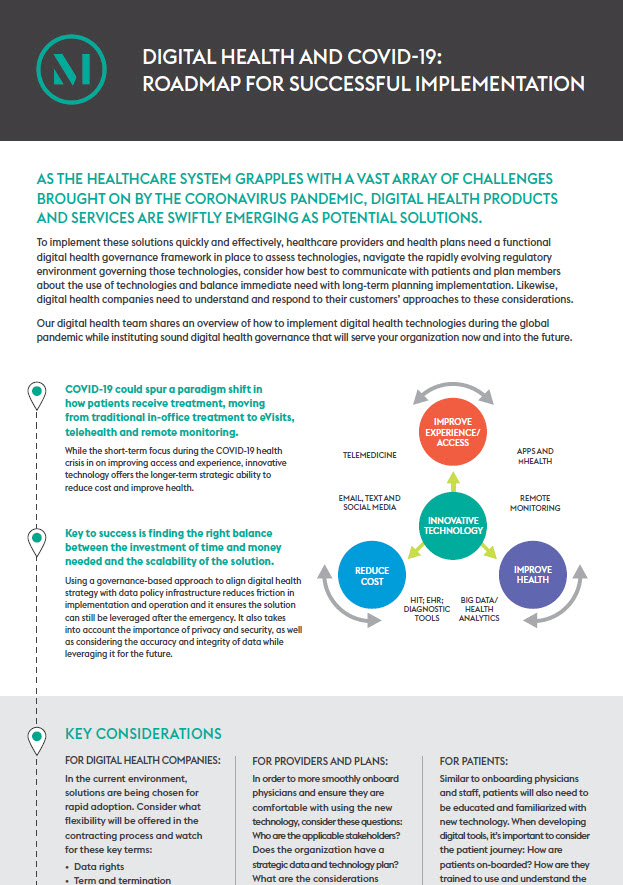
  • Infographic: Digital Health and COVID-19: Roadmap to Successful Implementation

    ARTICLE

    Infographic: Digital Health and COVID-19: Roadmap to Successful Implementation

    April 2020

    Read time: 2 min

    Key takeaways
    Overview

    As the healthcare system grapples with a vast array of challenges brought on by the Coronavirus (COVID-19) pandemic, digital health products and services are swiftly emerging as potential solutions. Our digital health team shares an overview of how to implement digital health technologies during the global pandemic while instituting sound digital health governance that will serve your organization now and into the future.

    Click the image to view the full infographic.


    In depth
    Authors
    More insights