














ARTICLE / CLIENT ALERT
Proposed JOBS Credit Act Would Significantly Expand CARES Act Employee Retention Tax Credits
May 12, 2020
Read time: 6 min
A bill titled Jumpstarting Our Businesses’ Success Credit Act of 2020, which would make significant changes to the employee retention tax credits available under the CARES Act, is currently under consideration in the US House of Representatives. In this article, we outline the proposed changes, which are generally designed to increase the availability, scope and amount of the credits.
The US House of Representatives is currently considering a bill titled Jumpstarting Our Businesses’ Success Credit Act of 2020 (the JOBS Credit Act), which would make significant changes to the employee retention tax credits available under the Coronavirus Aid, Relief, and Economic Security Act (the CARES Act). The changes are generally designed to increase the availability, scope and amount of the credits. If the JOBS Credit Act is enacted, the changes will be effective retroactive to March 27, 2020, when the CARES Act was enacted.
For general information on the CARES Act employee retention credits, please see our client alert, “CARES Act Social Security tax deferral and employee retention credits.”
Changes under the Proposed JOBS Credit Act
The proposed JOBS Credit Act would make the following changes to the CARES Act employee retention credits:
- Amount of Credits. The credits currently equal 50% of up to $10,000 in qualified wages that an eligible employer pays in a calendar quarter. The JOBS Credit Act would increase the amount of the credits to 80% of up to $15,000 in qualified wages per calendar quarter with a new annual cap of $45,000 in qualified wages. The maximum credit for wages paid to any employee would therefore increase from $5,000 under the CARES Act to $36,000 under the increased limits of the JOBS Credit Act.
- Large Employers. What constitutes qualified wages for which the employee retention credits can be claimed depends on the size of the employer’s average full-time workforce in 2019, with more stringent criteria for larger businesses. The JOBS Credit Act would increase the threshold for determining a large employer from 100 employees under the CARES Act to employers with more than 1,500 employees and more than $41.5 million in gross receipts in 2019. This change would allow more employers to be considered small employers and claim the credits on all wages paid to employees, even if the employees are providing services during the period for which the credits are claimed.
- Governmental Employers’ Eligibility. The proposed JOBS Credit Act would make the credits available to state or Indian tribal governments and any agency, instrumentality or political subdivision thereof that were ineligible for the credits under the CARES Act. This would include hospitals that are government instrumentalities or affiliated with state universities.
- Gross Receipts Test. An employer’s initial eligibility for the credits is triggered if either of two COVID-19 economic hardships arise within a calendar quarter for 2020. The second of these economic hardships is a significant decline in gross receipts, which occurs during a calendar quarter when the employer’s gross receipts are less than 50% of the employer’s gross receipts for the same calendar quarter in 2019. The JOBS Credit Act increases the threshold to 80% of gross receipts, making it easier for employers to satisfy this requirement.
- Health Plan Expenses. Qualified wages also include qualified health plan expenses as are properly allocable to an employee’s wages. After initially concluding in FAQs that the credits were not available for health plan expenses if an employer was not paying other wages to an employee, the IRS reversed its position and concluded that an employer could claim the credits for health plan expenses paid for furloughed employees who are not receiving other compensation from the employer. The JOBS Credit Act reaffirms this and allows the credits to be claimed on health plan expenses for furloughed employees.
Improved Coordination with Paycheck Protection Program (PPP)
The PPP under the CARES Act allows eligible employers to borrow up to $10 million at a fixed interest rate of 1% for a two-year term if the loan is used to pay certain business expenses, including payroll and employee benefits. PPP loans are forgivable if they are used to retain and pay employees, rent, utilities and interest on mortgage obligations during the eight-week period following loan origination. For general information on the PPP, please see our our client alert, “Small business relief in the CARES Act.”
Employers that received a loan under the PPP are ineligible for the employee retention tax credits under the CARES Act. The JOBS Credit Act would allow an employer that properly received a PPP loan to claim the credits on qualifying wages to the extent that the employer’s PPP loan could not be forgiven due to the employer not incurring expenses qualifying for loan forgiveness during an eight-week period after the origination date of the loan.
Comparing the CARES Act and the JOBS Credit Act
| CARES Act | JOBS Credit Act | |
| Amount of Credits | The credits equal 50% of up to $10,000 in qualified wages that an eligible employer pays in a calendar quarter. The maximum credit is $5,000. | The credits equal 80% of up to $15,000 in qualified wages that an eligible employer pays per calendar quarter, subject to an annual cap of $45,000 in qualified wages. The maximum credit is $36,000. |
| Large Employers | A large employer for purposes of determining qualified wages is an employer who averaged more than 100 full-time employees in 2019. | A large employer for purposes of determining qualified wages is an employer who averaged more than 1,500 full-time employees in 2019 and had more than $41.5 million in gross receipts for 2019. |
| Governmental Employers’ Eligibility | Governmental employers are not eligible for the credits. | A state government, Indian tribal government or any agency, instrumentality or political subdivision thereof may be eligible for the credits. |
| Gross Receipts Test | An employer is eligible for the credits if the employer’s gross receipts are less than 50% of gross receipts for the same calendar quarter in 2019. | An employer is eligible for the credits if the employer’s gross receipts are less than 80% of gross receipts for the same calendar quarter in 2019. |
| Health Plan Expenses | Qualified wages include qualified health plan expenses that are properly allocable to an employee’s wages. | Qualified wages include qualified health plan expenses. The JOBS Credit Act eliminates the requirement under the CARES Act that the health plan expenses be allocable to an employee’s wages. |





INSIGHT: Reverse Loophole Exploited by IRS Threatens Economic Revitalization
ARTICLE
INSIGHT: Reverse Loophole Exploited by IRS Threatens Economic Revitalization
May 12, 2020
Read time: 1 min

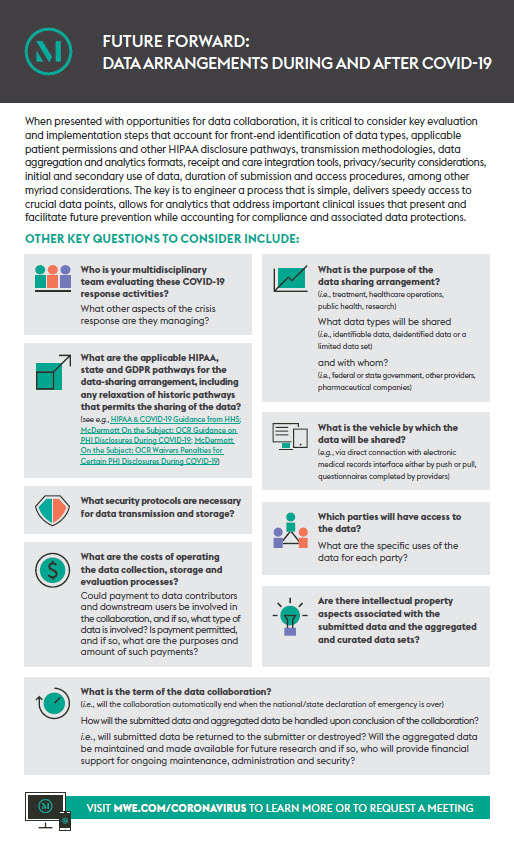
Future Forward: Data Arrangements During and After COVID-19
ARTICLE
Future Forward: Data Arrangements During and After COVID-19
May 11, 2020
Read time: 2 min
The need for speedy and more complete access to data is instrumental for healthcare providers, researchers, pharmaceutical, biotech and device companies and public health authorities as they work to quickly identify infection rates, disease trends, outcomes, including antibodies, and opportunities for treatments and vaccines for COVID-19.
A variety of data sharing and collaborations have emerged in the wake of this crisis, such as:
- Requests and mandates by public health authorities, either directly or via providers’ business associates requesting real time information on infections and bed and equipment availability
- Data sharing collaborations among providers for planning, anticipating and tracking COVID-19 caseloads
- Data sharing among providers, professional societies and pharmaceutical, biotech and medical device companies in search of testing options, treatment and vaccine solutions, and evaluation of co-morbidities
CLICK HERE TO VIEW THE FULL INFOGRAPHIC.




New York State Administrative Procedures Act and Emergency Authority During COVID-19
ARTICLE / CLIENT ALERT
New York State Administrative Procedures Act and Emergency Authority During COVID-19
May 11, 2020
Read time: 9 min
New York State law allows agencies and departments to adopt certain rules on an emergency basis, without following the strict requirement of the State Administrative Procedures Act. These emergency regulations can be a powerful tool for businesses and agencies alike, but are not immune to challenge.
In light of the Coronavirus (COVID-19) pandemic, New York agencies and departments have issued various emergency measures, including amendments to health, insurance and tax regulations. While state agencies and departments usually cannot issue, suspend or modify rules without following the strict requirements of the State Administrative Procedures Act (SAPA), state law provides for adoption of certain rules on an “emergency basis.” SAPA § 202(6). This article describes the powers and limitations of that rulemaking authority—concerns that will come to the fore as regulated parties consider either advocating for emergency rules or challenging measures adopted pursuant to these emergency powers. What action a company takes in response to proposed or implemented emergency regulations will of course depend on whether the regulations favorably or negatively affect its business. Emergency regulations can be a powerful tool for agencies and companies alike, but even in the time of COVID-19, these regulations are not immune to challenge.
Emergency Powers
SAPA generally applies to “any department, board, bureau, commission, division, office, council, committee or officer of the state” or to any “public benefit corporation or public authority” that has at least one member who is appointed by the governor and is authorized by law to make regulatory rules. SAPA § 102(1). The statute delegates to these state executive departments and administrative agencies certain “rule making powers,” in turn allowing these entities to promulgate and enforce rules and regulations consistent their mandates from the state legislature. Issuance of a new rule is a multi-step process. The agency must draft the text of the proposed rule, prepare supporting materials (such as a statement discussing the impact of the proposed rule on regulated parties), submit the proposed rule for public comment, and draft a fulsome response to those comments that summarizes the issues raised and explains why various suggestions were either incorporated into the rule or not. Given these steps, it often takes an agency many months to issue a new rule.
SAPA recognizes, however, that certain emergency situations may require rapid action. Section 202(6) allows agencies to immediately adopt rules that are “necessary for the preservation of the public health, safety or general welfare.” Although “general welfare” is not defined in the statute, courts have interpreted it broadly. See, e.g., Korean Am. Nail Salon Ass’n of New York, Inc. v. Cuomo, 50 Misc. 3d 731, 735 (N.Y. Sup. Ct. Albany Co. 2015) (agency’s demonstration that nail salon workers were being deprived legally due wages satisfied requirement to show that emergency regulation was necessary for the preservation of public health, safety or general welfare).
SAPA’s emergency adoption power is not without limitation. Unless provided otherwise by statute, an agency’s emergency rules may not remain in effect for longer than 90 days after being filed with the secretary of state, unless within that time the agency submits a notice of proposed rulemaking and a notice of adoption in accordance with the Act. §§ 139, 140; §§ 157, 158. In other words, for an emergency regulation to become permanent, the agency still must comply with SAPA’s requirements to publish the proposed amendment in the state register and invite public comment.
Depending on a company’s interest, this timing limitation may pose either a risk or a strategic opening. Companies that benefit from continued use of an emergency regulation should diligently monitor the agency’s actions to ensure that the emergency regulation is finalized and adopted. On the other hand, a company negatively affected by an emergency regulation has grounds to challenge that regulation if the agency continues to enforce it beyond the 90-day period without completing the full SAPA process.
Justifying Immediate Action
While there need not be a declared state of emergency for an agency to use § 202(6), Governor Cuomo’s March 7, 2020, Executive Order declaring a state of emergency in response to the COVID-19 pandemic will surely be cited in support of any emergency rules implemented during this time. In fact, several agencies already have adopted emergency measures under § 202(6) in response to the pandemic. For example:
- The Public Service Commission entered an order, pursuant to SAPA § 202(6), to postpone electric and gas price increases. See Proceeding on Motion of the Comm’n As to the Rates, Charges, Rules & Regulations of Niagara Mohawk Power Corp. Dba Nat’l Grid for Elec. Serv., 2020 WL 1531010 (Mar. 25, 2020).
- The Department of Financial Services amended insurance laws under § 202(6) in response to the COVID-19 pandemic. It recently issued an emergency measure stating that health insurers must cover telehealth provided by an in-network provider if the insurer’s policies and contracts would have covered the service if provided at an in-network provider’s office.
- The Education Department issued a series of emergency regulations meant to ease the burden on students and educators who must teach and learn from home.
While courts are unlikely to question the emergency nature of the pandemic, the key to successfully implementing an emergency regulation is the agency’s ability to articulate the connection between the emergency measure and COVID-19’s impact. SAPA requires the agency to “fully describe[e]” the nature of the public health, safety or general welfare need being addressed by the emergency rule, and provide an explanation of why it would be contrary to the public interest to comply with the usual notice and comment period. SAPA § 202(6)(iv). This requirement is meant to ensure that emergency rules are promulgated only when there is an “immediate necessity, emergency, or undue delay.” Law Enf’t Officers Union Dist. Council 82, AFSCME, AFL-CIO by Engelhardt v. State, 643 N.Y.S.2d 301, 303 (N.Y. Sup. Ct. Albany Co. 1995). A desire to “preserve the status quo” or “a potential concern about a disruption is not sufficient to justify the use of SAPA’s administrative procedures for emergency rulemaking.” Staff v. Reardon, 2018 WL 4616294, at *5 (N.Y. Sup. Ct. N.Y. Co. Sep. 25, 2018).
The New York Supreme Court has vacated emergency rules where the agency failed to sufficiently justify the emergency nature of the rule, as “[t]he mere parroting of the phrase ‘the public health, safety, or general welfare’ with no specific facts,” will not be considered an adequate justification for an emergency regulation. Brodsky v. Zagata, 165 Misc. 2d 510, 515, 629 N.Y.S.2d 373, 377 (N.Y. Sup. Ct. Albany Co. 1995). For example, in Law Enforcement Officers Union District Council 82, AFSCME, AFL-CIO by Engelhardt v. State, the New York Supreme Court annulled an emergency rule implemented by the Department of Corrections that allowed double occupancy in prison cells. 643 N.Y.S.2d at 303-04. Although the court acknowledged that prison overcrowding is a “challenge,” there was no showing by the Department of Corrections that the challenge needed to be dealt with immediately and without the regular public notice and comment procedure mandated under SAPA.
Similarly, in New York State Association of Homes & Services for Aging Inc. v. Perales, the New York Appellate Division discussed an emergency regulation implemented by the Department of Social Services that reduced Medicaid rates for so-called “bed holds” to 85% of the regular rate. Although not an issue on appeal, the court noted with approval the lower court’s holding that the regulation was improperly adopted on an emergency basis because “a long simmering fiscal crisis within the State budget was not an emergency contemplated by State Administrative Procedure Act § 202(6).” 179 A.D.2d 296, 297 (N.Y. App. Div. 1992).
In contrast, in Korean Am. Nail Salon Ass’n of New York, Inc. v. Cuomo, the New York Supreme Court found that an emergency regulation was necessary to preserve the public health, safety and general welfare of nail salon workers. 50 Misc. 3d 731, 735 (N.Y. Sup. Ct. Albany Co. 2015). The New York Department of State had issued an emergency regulation requiring certain nail salons and other “appearance enhancement businesses” to purchase wage bonds as security for unpaid wages. The Court held that the emergency regulation was justified because urgent action was needed to protect workers in the nail salon industry from unsafe working conditions and unfair labor practices, and because it furthered the legislative intent behind a recent law signed by Governor Cuomo that established penalties for operating an appearance enhancement business without appropriate wage coverage.
Conclusions
While the COVID-19 pandemic and the governor’s emergency declaration offer support for emergency regulations that state agencies implement during the official emergency period, agencies still must be able to articulate the connection between the pandemic and their emergency action. COVID-19 will not justify all regulations, only those that are immediately necessary to address health, safety or the general welfare.
This justification requirement may become more difficult for agencies to meet as New York moves out of the “state of emergency” period and into the recovery aftermath, particularly as agencies and stakeholders rush to address the economic toll the pandemic has taken. Companies that believe an emergency regulation might be helpful in assisting their businesses to recover might consider lobbying agencies to modify, suspend or add to existing rules. Such companies should pay particular attention to the justification for immediate action—perhaps taking lessons from Korean American Nail Salon—to ensure that the regulation withstands scrutiny.
Conversely, a company adversely affected by an emergency regulation implemented pursuant to SAPA § 202(6) has several avenues of attack. The company should monitor the promulgation process to determine whether the agency properly justified its emergency action and whether it either stopped enforcing the emergency rule after 90 days or properly finalized the rule. If all else fails, the company should avail itself of the public comment period to make its concerns known.



Gift of a Remainder Interest in a Personal Residence or Farm to Charity – Why Now?
ARTICLE / CLIENT ALERT
Gift of a Remainder Interest in a Personal Residence or Farm to Charity – Why Now?
May 11, 2020
Read time: 5 min
The Gift of a Remainder Interest in a Personal Residence Or Farm to Charity is a special technique that fits a small set of charitable donors. For those to whom it does apply, historically low interest rates make now the time to implement.
A Gift of a Remainder Interest in a Personal Residence or Farm (GRIPROF) to Charity is a statutorily sanctioned transaction that produces a current income tax charitable deduction for the donor with no current out-of-pocket cost. The GRIPROF to Charity has been on the books for a very long time, but now may be a particularly good time for this transaction because interest rates are so low.
The Internal Revenue Service (IRS) 7520 rate (the monthly rate declared by the IRS for calculating various partial interests in property) has fallen to 0.8% as of May 2020. In May 2019, the 7520 rate was 2.8%. We explain below why that big drop is so significant for a GRIPROF. But first, what exactly is a GRIPROF, and which donors are candidates for its use?
How Does a GRIPROF Work?
As the name suggests, the donor in a GRIPROF transaction transfers her residence to charity, retaining the right to live in the residence for the rest of her life. After the transfer, the donor continues to pay all the expenses that she previously paid, just as if the transfer had never taken place. At the donor’s death, the charity will own the residence free and clear.
Under tax law, the donor is allowed a federal income tax charitable deduction equal to the actuarial value of the charity’s interest in the property. The size of that income tax deduction depends on a number of variables:
- Value of the land on which the residence sits
- Value of the residence
- Useful life of the residence in years
- Salvage value of the residence at the end of its useful life
- Donor’s age at the time of the gift
- IRS 7520 rate at the time of the gift.
The prime candidate for a GRIPROF to Charity is a donor who is committed to leaving a large portion of her estate to charity. For that donor, the GRIPROF is a “prepayment” on that commitment, but a prepayment that requires no immediate or future outlay of cash or securities. While the cost to the donor of maintaining the residence remains the same, the transaction produces an immediate charitable income tax deduction that provides a cash benefit to the donor. Below are two examples:
Example 1: Tom and Brenda are both 70 years old. Their home was appraised recently at $10 million. Half the value is in the land, and half is in the residence. The appraiser opined that the useful life of the residence is 35 years, and at the end of that time the residence will have a salvage value of 20%, or $1 million. Tom and Brenda transfer their residence to their alma mater, retaining the right to live in the residence until the second of them dies. Based on these assumptions and a 0.8% 7520 rate, the charitable income deduction is $6.82 million. If Tom and Brenda’s effective federal income tax rate is, for example, 28%, and they can deduct all of that amount on their current tax year return (and if they cannot, the unused deduction can be carried over for up to five years), then their 2020 income tax savings is $1.9 million.
If instead of age 70 Tom and Brenda were both 80, then the income tax deduction jumps to $7.95 million and the corresponding 2020 income tax savings to $2.2 million.
Example 2: Violet, age 70, owns a cattle ranch worth $10 million (exclusive of the minimal improvements and the cattle). Violet transfers the ranch to her alma mater, retaining the right to possession of the ranch during her lifetime. Based on these assumptions and a 0.8% 7520 rate, the charitable income deduction is $8.94 million. If Violet’s effective federal income tax rate is, for example, 28%, and she can deduct all of that amount on her current tax year return (and if she cannot, the unused deduction can be carried over for up to five years), then her 2020 income tax savings is $2.5 million.
If instead of age 70 Violet was 80, then the income tax deduction jumps to $9.36 million and the corresponding 2020 income tax savings to $2.6 million.
If, instead of engaging in the GRIPROF to charity, the donor retains the entire property, leaving it to charity at death, there is no charitable income tax deduction or savings.
Why Consider a GRIPROF Now?
The lower the applicable interest rate, the lower the value of the donor’s retained life interest and the higher the value of the charity’s remainder. It’s no surprise then that today’s 7520 rate of 0.8% when compared to the 2.8% rate from a year ago produces markedly better results, as the table below illustrates. Today’s results are more than 40% better for the joint life example and almost 30% better for the single life example.
| Donor | Age | Deduction at current AFR – 0.8% | Deduction at AFR of one year ago – 2.8% | Percentage benefit at 0.8% |
| Tom & Brenda | 70 | 68.19% | 48.55% | 40.45% |
| Violet | 70 | 89.42% | 68.96% | 29.67% |
The GRIPROF to Charity is a special technique that fits a small set of charitable donors. But for those to whom it does apply, the historic dip in interest rates makes now the time to implement.


PIPEs Update: Nasdaq Provides Temporary Relief from Certain Shareholder Approval Requirements for PIPEs (COVID-19)
ARTICLE / CLIENT ALERT
PIPEs Update: Nasdaq Provides Temporary Relief from Certain Shareholder Approval Requirements for PIPEs (COVID-19)
May 11, 2020
Read time: 7 min
On May 4, 2020, the U. S. Securities and Exchange Commission approved Listing Rule 5636T (“Temporary Shareholder Approval Exemption”) proposed by The Nasdaq Stock Market LLC (“Nasdaq”) to provide Nasdaq-listed companies with a temporary limited exception through June 30, 2020, to certain shareholder approval requirements under Nasdaq Listing Rule 5635(d)[1] (Transactions other than Public Offerings) and Listing Rule 5635(c)[2] (Equity Compensation) in an effort to streamline access to capital amidst the market uncertainty, reduced access to capital and new cash needs for issuers caused by COVID-19.[3]
Current Discounted Issuance Rules
Nasdaq Listing Rule 5635(d) requires shareholder approval for certain discounted private placements. Nasdaq Listing Rule 5635(c) requires shareholder approval for certain sales to officers, directors, employees or consultants that could be considered a form of “equity compensation.” The Temporary Shareholder Approval Exemption provides an exception to these shareholder approval requirements through June 30, 2020 for issuers upon application to Nasdaq’s Listing Qualifications Department (or automatically for issuers that qualify for the Safe Harbor described below). Nasdaq adopted this temporary rule recognizing that investors willing to deploy capital today will likely require a discounted price to compensate for the risk of investing in the current environment with issuers’ sudden, unexpected cash needs to address the loss of business and supply shortages caused by COVID-19. Such investors may also require that an issuer’s insiders put up capital as well.
A financial hardship exception to the shareholder approval requirements is already available within Nasdaq’s rules when an issuer’s financial viability is in serious jeopardy. However, many issuers that are in need of capital to continue to pay employees during this period may not qualify for this exception because their financial viability may not otherwise be in jeopardy. Furthermore, the financial viability exception requires issuers to mail notice to all shareholders ten days prior to issuing securities, but reduced operations and the need for capital quickly may make it impracticable for issuers to satisfy these requirements.
The Temporary Shareholder Approval Exemption
The Temporary Shareholder Approval Exemption is available to issuers that:
- Execute a binding agreement governing the issuance of securities;
- Submit a Listing of Additional Shares notification form and a supplement related to the requirements of the exception to the Nasdaq Listing Qualifications Department; and
- Obtain approval from the Nasdaq Listing Qualifications Department (unless they qualify for the Safe Harbor described below) no later than June 30, 2020.
The actual issuance of the securities may take place after June 30, 2020, as long as the issuance occurs no later than 30 calendar days after the date of the binding agreement governing the issuance of the securities.
Issuers relying on this exception must demonstrate that:
- The transaction is needed due to circumstances related to COVID-19;
- The issuer undertook a process designed to ensure that the proposed transaction represents the best terms available to the issuer;
- The issuer’s audit committee or a comparable body of the board of directors comprised solely of independent, disinterested directors has: (A) expressly approved reliance on this exception; and (B) determined that the transaction is in the best interests of the issuer’s shareholders; and
- Delay in the transaction to secure shareholder approval would:
- Have a material adverse impact on the issuer’s ability to maintain operations under its pre-COVID-19 business plan;
- Result in workforce reductions;
- Adversely impact the issuer’s ability to undertake new initiatives in response to COVID-19; or
- Seriously jeopardize the financial viability of the enterprise.
Safe Harbor
Issuers will not be required to obtain approval from the Nasdaq Listing Qualifications Department prior to issuing securities if they meet the following requirements (“Safe Harbor”):
- The maximum amount of common stock, or securities convertible into common stock, issuable in the transaction is less than 25% of the total shares outstanding and less than 25% of the voting power outstanding before the transaction;
- The maximum discount to the Minimum Price (discussed in footnote 1) is 15%; and
- No warrants to purchase common stock are included in the transaction.
Public Disclosure Requirement
No later than two business days before the issuance of the securities relying on this exemption, Issuers must make a public announcement by filing a Form 8-K, where required by SEC rules, or by issuing a press release disclosing:
- The terms of the transaction (including the number of shares of common stock that could be issued and the consideration received);
- That shareholder approval would ordinarily be required under Nasdaq rules but for the fact that the issuer is relying on this temporary exception to the shareholder approval rules; and
- That the audit committee or a comparable body of the board of directors comprised of independent, disinterested directors expressly approved reliance on the exception and determined that the transaction is in the best interest of shareholders.
Insider Participation in These Offerings
Listing Rule 5636T temporarily amends Listing Rule 5635(c) to allow affiliates of the issuer to participate in such transactions, provided that affiliates participating in the transaction may not participate in negotiating the economic terms of the transaction and must have been specifically required to participate in the transaction by unaffiliated investors. In addition, each affiliate’s participation must be limited to less than 5% of the transaction and affiliates may not collectively participate for 10% or more of the transaction.
The Temporary Shareholder Approval Exemption does not apply to Nasdaq Listing Rule 5635(b) (Change of Control). Accordingly, any issuance that would lead to an investor or group of investors owning 20% or more the stock or voting power of an issuer will still require shareholder approval.
As noted in our April 7, 2020 Alert, the New York Stock Exchange has also provided certain limited temporary relief to its shareholder approval rules through June 30, 2020, subject to certain conditions.
Authored by Eleazer Klein, Adriana Schwartz and Clara Zylberg.
If you have any questions concerning this Alert, please contact your attorney at Schulte Roth & Zabel or one of the authors.
[1] Listing Rule 5635(d) requires shareholder approval prior to a 20% Issuance at a price that is less than the Minimum Price. The “Minimum Price” is defined in Rule 5635(d)(1)(A) as the lower of (i) the Nasdaq Official Closing Price (as reflected on Nasdaq.com) immediately preceding the signing of the binding agreement for the issuance; or (ii) the average Nasdaq Official Closing Price of the common stock (as reflected on Nasdaq.com) for the five trading days immediately preceding the signing of the binding agreement for the issuance. A “20% Issuance” is defined in Rule 5635(d)(1)(B) as a transaction, other than a public offering as defined in IM-5635-3, involving the sale, issuance or potential issuance by the issuer of common stock (or securities convertible into or exercisable for common stock), which alone or together with sales by officers, directors or substantial shareholders of the issuer, equals 20% or more of the common stock or 20% or more of the voting power outstanding before the issuance.
[2] Listing Rule 5635(c) requires shareholder approval, with certain exceptions, prior to the issuance of securities when a stock option or purchase plan is to be established or materially amended or other equity compensation arrangement made or materially amended, pursuant to which stock may be acquired by officers, directors, employees or consultants.
[3] SEC Release No. 34-88805 (May 4, 2020), available here.
This is a fast-moving topic and the information contained in this Alert is current as of the date it was published.
This communication is issued by Schulte Roth & Zabel LLP for informational purposes only and does not constitute legal advice or establish an attorney-client relationship. In some jurisdictions, this publication may be considered attorney advertising. ©2020 Schulte Roth & Zabel LLP.
All rights reserved. SCHULTE ROTH & ZABEL is the registered trademark of Schulte Roth & Zabel LLP.


New PTC and ITC Deadlines Expected for Renewable Energy Projects
ARTICLE / CLIENT ALERT
New PTC and ITC Deadlines Expected for Renewable Energy Projects
May 8, 2020
Read time: 4 min
Renewable energy project developers utilizing federal tax credits will likely get more time to complete work on projects. While more formal guidance is forthcoming, the renewables industry may see an extension of the safe harbor from four to five years for projects that began construction in 2016 or 2017.
In a letter sent on May 7, the Office of Legislative Affairs at the Department of the Treasury (Treasury) issued a letter to Charles Grassley, the chairman of the Senate Committee on Finance, stating that Treasury intends to issue relief to the wind and solar industries regarding certain production tax credit (PTC) and investment tax credit (ITC) deadlines.
The letter is in response to Grassley’s April 23, 2020, letter to Treasury requesting that the four-year safe harbor for the continuous construction and continuous efforts test for the PTC and ITC be extended to a five-year safe harbor period. The rule changes were requested due to the project disruptions caused by the COVID-19 pandemic.
According to Grassley, “Projects that have been waylaid by the economic disruptions of this pandemic can now proceed with more certainty. That means more certainty for American businesses and families at a time when stability is in short supply.” (See https://www.grassley.senate.gov/news/news-releases/treasury-modify-guidance-energy-production-investment-tax-credits-light-health)
Per the current IRS rules, taxpayers can claim the PTC for electricity produced or the ITC for qualifying energy property if either: (a) significant physical work is started on the project or (b) 5% or more of the total cost of the project is paid or incurred, and in the case of both (a) and (b), the project is placed in service within four years. If the project is not placed in service within four years, the taxpayer must instead demonstrate continuous progress on the project since the time (a) or (b) was satisfied – a standard many taxpayers are struggling with following unexpected manufacturing and other delays in 2020. The scope and timing of the Treasury relief is still unknown, but taxpayers are optimistic it will follow the suggestions in Grassley’s letter. The requested rule change would allow renewable energy projects that began construction in 2016 and 2017 to be completed in five years, rather than the four years allotted under current Treasury regulations. Ideally, the extension will be automatic for any project that otherwise began construction in 2016 or 2017, and not be tied to whether the delay is related to COVID-19. Otherwise, taxpayers will be left with the challenge of determining whether a project delay is related to COVID-19. While some delays (such as manufacturing and supply chain delays) can be clearly traced to COVID-19, other delays are more indirect. For instance, projects that completed physical work in 2016 or 2017 may have voluntarily stopped construction upon notice of a potential force majeure delay, even if the project might still have been placed in service in 2020 on the chance equipment is timely delivered in 2020. Given the complexity and questions surrounding each project’s particular facts, the safe harbor extension should apply to all projects.
Ultimately, the Treasury relief is welcomed by the renewable energy industry. This rule change could prove critical to the industry in light of the fact that many projects are facing significant delays and setbacks due to disrupted supply chains, construction delays, missed permitting timelines and other related delays.





USPTO: Artificial Intelligence Systems Cannot Legally Invent
ARTICLE / CLIENT ALERT
USPTO: Artificial Intelligence Systems Cannot Legally Invent
May 8, 2020
Read time: 6 min
In a key decision (that seems unlikely to be the final answer on the topic), the US Patent and Trademark Office determined that an artificial intelligence (AI) system can’t be an inventor of a patent. This ruling follows similar rulings by the European Patent Office and the UK Intellectual Property Office.
In a decision published April 27, 2020, the US Patent and Trademark Office (USPTO) ruled that artificial intelligence (AI) systems cannot be listed or credited as inventors on a US patent (DABUS decision). In re Application of Application No.: 16/524,350. The DABUS decision stated that an “inventor” under current patent law can only be a “natural person.” This ruling follows similar stances adopted by the European Patent Office and the UK Intellectual Property Office.
Normally, USPTO decisions on patent appeals do not generate widespread press, but the decision on Application No. 16/524,350 is an exception. As AI systems continue to advance and begin to look more like human creators, the DABUS decision likely will not be the last time the USPTO addresses the issue of inventorship by machine.
The Artificial Inventor Project (AIP) comprises a team of international patent attorneys dedicated to exploring the concept of AI patentability. On July 29, 2019, the AIP filed patents with the DABUS AI system listed as the inventor. The application (which remains sealed, despite the publication of the USPTO’s DABUS decision) described “Devices and Methods for Attracting Enhanced Attention” (DABUS application). Specifically, the DABUS application listed the inventor’s name as “[DABUS] and the family name ‘(Invention generated by artificial intelligence.’” The application also listed the applicant as the assignee “Stephen L. Thaler.” Mr. Thaler submitted a substitute statement under 37 CFR 1.64, enabling the application to proceed without the signature of the inventor. The application also contained assignment documentation, assigning the entire right, title and interest of “DABUS, the Creativity machine that has produced the . . . invention” to Mr. Thaler himself. Mr. Thaler executed said document on behalf of DABUS, as the legal representative of the assignor, and on behalf of himself.
After reviewing the filing, the USPTO issued a “Notice to File Missing Parts of Nonprovisional Application” on August 8, 2019, flagging the fact that the DABUS application “does not identify each inventor by his or her legal name.” Seemingly setting the stage to attack the question of AI inventorship, Mr. Thaler filed a petition under 37 CFR 1.181 on August 29, 2019, requesting supervisory review and a vacation of the August 8, 2019, notice. The USPTO dismissed the August 29, 2019, petition on December 17, 2019. Mr. Thaler filed the instant petition on January 20, 2020, requesting reconsideration. The DABUS application and the DABUS decision teed up a core question: can a machine invent under US patent law?
The USPTO formed a clear opinion on the matter, ruling that an inventor “must be a natural person.” Mr. Thaler posed the argument that DABUS, as a “creativity machine,” is “programed as a series of neural networks that have been trained with general information in the field of endeavor to independently create the invention.” More simply put, Mr. Thaler argued that DABUS is a machine designed to invent, and because DABUS itself recognized the novelty of its invention, DABUS should be attributed as the inventor, not Mr. Thaler. “Petitioner asserts that DABUS was not created to solve any particular problem, and it was not trained on any special data relevant to the instant invention. Instead, it was the machine, not a person, which recognized the novelty and salience of the instant invention.”
In analyzing Mr. Thaler’s assertion, the USPTO sidestepped the forward-looking issue of machine thought, firmly rooting its decision in existing statutes and case law. The agency stated that the patent statutes themselves preclude a broad interpretation of inventorship going beyond natural persons. Title 35 of the US Code refers to inventors as “natural persons,” using the words “whoever” (suggesting a natural person) and “himself” and “herself” (again suggesting that inventorship is limited to natural persona). Following that argument, the USPTO held that interpreting the patent statutes broadly to encompass machines as well as natural persons would be contrary to the text of the law.
The USPTO also referenced the fact that federal courts refer to inventors as natural persons as well. In Univ. of Utah v. Max-Planck-Gesellschaft zur Förderung der Wissenschaflen e.V., the US Court of Appeals for the Federal Circuit held that a state could not be an inventor. The court wrote that mental gymnastics are required to invent, and in order to perform these intellectual somersaults, inventors must be “natural persons and cannot be corporations or sovereigns.” The Max-Planck decision was not the first time the Federal Circuit weighed in on the issue: in Beech Aircraft Corp. v. EDO Corp., the Court held that “only natural persons can be ‘inventors’” as well.
Finally, the USPTO pointed to Title 37 of the Code of Federal Regulations, which references an inventor as a “person,” as well as the Manual of Patent Examining Procedure, which closely hews to Federal Circuit case law. The USPTO stated that both determine that the invention “conception” must come from a natural person. Specifically, the Manual of Patent Examining Procedure continuously references the “mind of the inventor.” The USPTO opined that continued references to “mental” state and the “mind” imply that a natural person must conceive an invention.”
Mr. Thaler argued that the European Patent Office and the UK Intellectual Property Office acknowledged that DABUS created the invention (but did not name the machine as the inventor). The USPTO brushed this argument aside, noting that foreign law applied and that the application was still undergoing review for completeness. In response to Mr. Thaler’s assertion that the principle of inventorship should not be a substantial condition for the grant of patents, the USPTO again summarily dismissed Mr. Thaler’s argument, noting that inventorship has long been a concept of patentability rooted in case law and statutes. While the USPTO previously issued patents relating to DABUS, the agency did not agree with Mr. Thaler’s reasoning that those patents then allowed DABUS to become an inventor. Finally, the USPTO dismissed all of Mr. Thaler’s public policy considerations supporting a machine being named as an inventor, including his argument that doing so would incentivize the use of AI systems.




Significant Increase in Ransomware Attacks on Healthcare Industry – OCR Offers Guidance
ARTICLE
Significant Increase in Ransomware Attacks on Healthcare Industry – OCR Offers Guidance
June 2020
Read time: 1 min




Six Takeaways: Shifting Market Dynamics in Corporate PPAs
ARTICLE
Six Takeaways: Shifting Market Dynamics in Corporate PPAs
May 7, 2020
Read time: 3 min
On Thursday, May 7, McDermott Partners Ed Zaelke and Carl Fleming were joined by Christen Blum, head of the Renewable & Analytics Advisory practices at Edison Energy, to hear her thoughts on the current effects of COVID-19 on the corporate power purchase agreement (PPA) market.
Below are six takeaways from this week’s webinar:
- Despite COVID-19, there is still a strong appetite for corporate renewable procurement: market leaders (such as tech, pharma, and food and beverage companies) have been less impacted by COVID-19 and remain interested in renewable procurement. On the other hand, companies that have been hit the hardest by COVID-19 (such as services and hospitality businesses) have traditionally demonstrated limited interest in renewables; but industrial companies have seen the largest effect of COVID-19—they remain interested in renewables, but are delaying their procurement as they focus on their core business.
- Although the trend for buyer-friendly PPA terms remains strong, the market has seen a recent uptick in prices over 2019 such that they no longer remain as buyer-friendly as they have been in the recent past, but the impact of COVID-19 on these prices remains to be seen.
- In order to maintain more competitive PPA prices, developers are employing a number of price mitigation strategies, including price collars, upside sharing and developers bearing more merchant risk.
- Most corporate buyers are less time-sensitive than more traditional buyers; as such near-term wind projects are often losing out on opportunities to cheaper solar projects which are coming online later.
- Force majeure terms have become a major emphasis in PPA negotiations now.
- The best advice for developers is to treat their relationships with corporate partners as a long-term partnership and to act accordingly in negotiations.
Listen to the full webinar here.
To begin receiving Energy updates, including invitations to the Renewables Roundtable and Q&A Webinar Series, please click here.
To access past webinars, please click here.