













ARTICLE / CLIENT ALERT / US POLICY
Biden Administration Proposals Will Greatly Enhance IRS’ Ability to Identify Cryptocurrency Transactions
May 26, 2021
Read time: 4 min
The Biden Administration and the Internal Revenue Service (IRS) continue to focus heavily on cryptocurrency tax enforcement issues. On May 20, 2021, the US Department of the Treasury (Treasury) released the American Families Plan Tax Compliance Agenda, a 22-page report detailing tax compliance measures that are to be included as part of US President Joe Biden’s American Families Plan. The report sets forth a number of initiatives designed to “close the tax gap,” identify the underreporting of tax liabilities and detect tax evasion. These measures, which are part of an $80 billion proposal for the IRS, would significantly enhance the agencies’ ability to address the challenges involved with finding taxes that result from virtual currency transactions.
The Treasury’s report notes that “[c]ryptocurrency already poses a significant detection problem by facilitating illegal activity broadly including tax evasion.” To address this issue, the Biden Administration is proposing “additional resources for the IRS to address the growth of cryptoassets.”
Most notably, the Biden Administration is proposing enhanced reporting requirements for domestic and foreign financial accounts that specifically address cryptocurrency. Financial institutions, including “cryptoasset exchange accounts and payment service accounts that accept cryptocurrencies” would be required to submit third-party annual reports of all “gross inflows and outflows” from business and personal accounts to the IRS using a form similar to the IRS 1099-INT. Additionally, “businesses that receive cryptoassets with a fair market value of more than $10,000 would be reported on” in a manner similar to how cash transactions are reported on Currency Transaction Reports. These new reporting requirements would dramatically increase the IRS’ ability to identify and detect unreported cryptocurrency transactions.
The report also reemphasizes the need to devote additional funding to the IRS. The Biden Administration is seeking $80 billion in additional funding so that the Treasury and IRS can, among other things, hire “new specialized enforcement staff” and “revitalize[e] the IRS’s examination of large corporations, partnerships, and global high-wealth and high-income individuals.”
Additionally, the Biden Administration plans to overhaul the IRS’ IT systems and capabilities. These IT enhancements are designed to “help support a staff capable of deploying new analytical techniques” and “developing machine learning capabilities [that] will enable the IRS to leverage the information it collects to better identify tax returns for compliance review.” Given the inherent difficulties in identifying cryptocurrency users who have failed to comply with the internal revenue laws, increased data collection and analytics capabilities would be invaluable for the IRS.
The IRS has already been ramping up its cryptocurrency tax enforcement efforts by issuing John Doe summons to various cryptocurrency exchanges, working with industry experts and foreign law enforcement. If implemented, the American Families Plan Tax Compliance Agenda would provide the IRS with extensive new tools and resources for these ongoing enforcement activities.
Practice Point: If you have engaged in cryptocurrency transactions, now is the time to analyze whether you have any civil or criminal exposure and prepare for a government inquiry by gathering all of your transaction records. For example, you will need to know and be able to prove things such as the dates the crypto was bought and sold, the amount transacted, the exchanges used and whether you had a hard or soft fork. You should also consider whether you need to seek legal advice and analysis to bolster the position you did or did not take on your tax returns, Foreign Bank Account Report (FBAR) filings, etc., and whether you should amend your returns to take a different tax position or seek forgiveness under the IRS’ voluntary disclosure program. Preparation is the key to a successful and efficient resolution of tax issues.





Gategroup: What’s the Fuss About?
ARTICLE
Gategroup: What’s the Fuss About?
May 26, 2021
Read time: 1 min




Power Balance – Settlor Reserved Trust Powers Following Webb
ARTICLE
Power Balance – Settlor Reserved Trust Powers Following Webb
May 26, 2021
Read time: 1 min


Biden Administration Advances California Offshore Wind Development
ARTICLE / CLIENT ALERT / US POLICY
Biden Administration Advances California Offshore Wind Development
May 26, 2021
Read time: 5 min
On May 25, 2021, the Biden Administration announced an agreement to lease almost 400 miles off California’s northern and central coasts for offshore wind development. The announcement expands on the recent approval of the first major offshore wind project in US waters. In an effort to decarbonize US power generation, the administration noted, “These initial areas for offshore wind development in the Pacific Ocean could bring up to 4.6 gigawatts of clean energy to the grid, enough to power 1.6 million American homes.”
Furthering the Biden Administration’s “whole-of-government approach” to clean energy, the US Department of Interior in connection with the US Department of Defense identified an area northwest of Morro Bay that will support three gigawatts of offshore wind. The Humboldt Call Area is also being considered as a potential offshore wind location, which would bring 4.6 gigawatts of energy to California. The Department of Defense played a significant role in identifying areas for offshore wind development, as they take part in significant training and operations off the coast of California that are essential to national security. Both the Department of Defense and Department of Interior plan to work closely together to ensure protection of military operations while pursuing new domestic clean energy resources.
To support this development in the deep Pacific Coast waters, new floating offshore wind technology will be deployed. The US Department of Energy (DOE) has invested more than $100 million in researching, developing and demonstrating floating offshore wind technology. Floating turbine technology will likely be a prime candidate for DOE Loan Programs Office support because it is (1) large enough in scale, (2) has a long lead time to develop and (3) is not commercially scalable in the same way as offshore technology that utilizes bottom anchoring. Lenders will have questions about the technology and having that guaranty could significantly aid project financing.
Ahead of yesterday’s announcement, California invested millions into its budget for environmental needs, including funding port upgrades and power lines that will carry electricity to California homes. We expect further developments in California from a legislative perspective to further offshore development.
On May 25, 2021, the Biden Administration announced an agreement to lease almost 400 miles off California’s northern and central coasts for offshore wind development. The announcement expands on the recent approval of the first major offshore wind project in US waters. In an effort to decarbonize US power generation, the administration noted, “These initial areas for offshore wind development in the Pacific Ocean could bring up to 4.6 gigawatts of clean energy to the grid, enough to power 1.6 million American homes.”
Furthering the Biden Administration’s “whole-of-government approach” to clean energy, the US Department of Interior in connection with the US Department of Defense identified an area northwest of Morro Bay that will support three gigawatts of offshore wind. The Humboldt Call Area is also being considered as a potential offshore wind location, which would bring 4.6 gigawatts of energy to California. The Department of Defense played a significant role in identifying areas for offshore wind development, as they take part in significant training and operations off the coast of California that are essential to national security. Both the Department of Defense and Department of Interior plan to work closely together to ensure protection of military operations while pursuing new domestic clean energy resources.
To support this development in the deep Pacific Coast waters, new floating offshore wind technology will be deployed. The US Department of Energy (DOE) has invested more than $100 million in researching, developing and demonstrating floating offshore wind technology. Floating turbine technology will likely be a prime candidate for DOE Loan Programs Office support because it is (1) large enough in scale, (2) has a long lead time to develop and (3) is not commercially scalable in the same way as offshore technology that utilizes bottom anchoring. Lenders will have questions about the technology and having that guaranty could significantly aid project financing.
Ahead of today’s announcement, California invested millions into its budget for environmental needs, including funding port upgrades and power lines that will carry electricity to California homes. We expect further developments in California from a legislative perspective to further offshore development.






Third Circuit Holds Film Production Contract Was Not Executory in Bankruptcy Case
ARTICLE / CLIENT ALERT
Third Circuit Holds Film Production Contract Was Not Executory in Bankruptcy Case
May 26, 2021
Read time: 10 min
“[B]ankruptcy inevitably creates harsh results for some players,” explained the U.S. Court of Appeals for the Third Circuit on May 21, 2021, when it denied a film producer’s claim for contractual cure payments. In re Weinstein Company Holdings, LLC, 2021 WL 2023058, *9 (3d Cir. May 21, 2021). Affirming the lower courts, it held that a “work-made-for hire” production agreement (“Agreement”) with the debtor (“TWC”) was “a non-executory contract that is in essence … a liability for [TWC] that can be sold” to an asset purchaser “under … Code § 363 without the need to cure existing defaults.” Id. In practical terms, the decision means that the buyer of this valuable contract only had to “satisfy post-closing obligations but need not worry about [the debtor’s] pre-closing breaches or defaults, which typically remain unsecured claims against the debtor’s estate.” Id. at *1.
“[W]hether a contract is classified as executory or non-executory,” said the court, “has significant implications for its treatment in a bankruptcy sale.” Id. “[A]n executory contract [ordinarily] can be ‘assumed’ and then ‘assigned’ to a buyer under § 365 of the Bankruptcy Code provided all existing defaults are cured.” Id. “At stake” in TWC was whether the buyer of the debtor’s contract (“B”) had to “cure existing defaults and pay around $400,000 owed to” the non-debtor contracting party (“C”) “before the sale’s closing,” but only if the contract was executory. Id. TWC owed the $400,000 to C under the Agreement, but C had “no material obligations left to perform,” having produced and released the relevant film years prior to bankruptcy. Id. at *9.
Relevance
Code § 365(a) governs the treatment of executory contracts, but “does not define that term.” The bankruptcy trustee or a Chapter 11 debtor in possession may, subject to court approval, assume or reject any executory contract. To sell or “assign” an executory contract, the debtor’s estate or buyer must “assume” it and cure prior defaults, but not if the contract is “non-executory.”
Commentators and courts have struggled with a workable definition for “executory.” The Third Circuit had previously held that “unless both parties have unperformed obligations that would constitute a material breach if not performed, the contract is not executory under § 365.” In re Columbia Gas Sys. Inc., 50 F.3d 233, 239 (3d Cir. 1995). Courts determine whether “material unperformed” obligations exist as of the date of bankruptcy, but applicable state law determines the existence of any “material unperformed obligation.” Id. at *4. Thus, said the court, the test is “whether, under the relevant state law governing the contract, each side has at least one material unperformed obligation as of the bankruptcy petition date.” Id. “Only where a contract has at least one material unperformed obligation on each side — that is, where there can be uncertainty if the contract is a net asset or liability for the debtor — do we invite the debtor’s business judgment on whether the contract should be assumed or rejected.” Id., citing Mission Prod. Holdings, Inc., v. Tempnology, LLC, 139 S. Ct. 1652, 1658 (2019); In re Penn Traffic Co., 524 F.3d 373, 382 (2d Cir. 2008).
Facts
C, a production company entered into an agreement with TWC that was structured as a “work-made-for-hire” contract, meaning C owned none of the intellectual property in the critically acclaimed film (“Film”) here. 2021 WL 2023 058, at *1. As a producer, C was essentially a project manager for the Film, “overseeing various aspects of production such as developing a script, and ensuring [the] film is delivered on time and within budget, and marketing the finished product.” Id., n.1. In exchange, TWC agreed to pay C a fixed initial compensation plus “contingent future compensation equal to” a percentage of the Film’s net profits. TWC purportedly owned “all the rights pertaining to the Film [including, the Agreement with C].” Id. at *1.
TWC filed its chapter 11 petition in March, 2018. With bankruptcy court approval, it sold its assets to B who assumed certain executory contracts and cured defaults. But B declined to cure any defaults under C’s production agreement on the ground that it was not executory. Id. at *2. It would thus avoid $400,000 in “previously unpaid contingent compensation.” By purchasing C’s production agreement “as a non-executory contract,” B “would be responsible only for obligations on a go-forward basis after the sale closed.” Id.
“The stakes became even higher” when other parties with similar work-made-for-hire contracts joined C’s dispute with B. They also argued, that their contracts were executory, implying that B had to pay them millions of dollars in additional contingent compensation. Id. at *3.
The district court had affirmed the bankruptcy court’s holding that the Agreement was not executory, could be sold to B, and that B was not liable for any cure amounts. Id. The parties later stipulated to joint briefing of all the appeals.
The Third Circuit
The parties agreed on appeal that the Agreement was part of the asset sale. “If it is executory, then it [had to be] assumed and then assigned to” B, and, under the court-approved sale, B had to cure any pre-bankruptcy defaults. Id., n.5. If it was not executory, then B “purchased the rights … under § 363,” and only had to pay post-closing compensation. Id.
Applicable New York Law. The court first had to determine whether the agreement “contained at least one obligation for both [TWC] and [C] that would constitute a material breach under New York law if not performed.” Id. at *5, quoting In re Exide Techs., 607 F.3d 957, 962 (3d Cir. 2010). Under New York law, “[a] material breach is a failure to do something that is so fundamental to a contract that the failure to perform that obligation defeats the essential purpose of the contract.” Id., quoting Feldmann v. Scepter Grp. Pte. Ltd., 185 A.D. 3d 449, 450 (N.Y. App. Div. 2020).
TWC “had a least one material obligation left to perform under” its agreement with C: “to pay contingent compensation … .” 2021 WL 2023 058 at *5. But C’s remaining obligations were not executory after the Film was made because C had completed its contractual duties. The Agreement essentially required C to “produce the [Film] in exchange for money,” which meant that C “contributed almost all [its] value when [it] produced the movie.” Id. at *6. On the date of bankruptcy, the Film had already been “released for six years and [C] had not done any further work on it.” Id.
The remaining obligations of C were “all ancillary after-thoughts” in the Agreement. Id. (e.g., agreeing not to seek injunctive relief; to indemnify against third-party claims; and granting TWC a right of first refusal if C assigned its right to receive contingent compensation). According to the court, “none of [C’s] remaining obligations go to the ‘root of the contract’ or ‘defeat the purpose of the entire transaction’ if breached.” Id., quoting Exide, 607 F.3d at 962-963.
Substantial Performance Rule Not Violated. The Third Circuit rejected C’s argument that the parties had agreed that all of C’s obligations were material. Id. at *6. Essentially, C argued that “even [its] breach of a technical provision would excuse [TWC’s] obligation to pay contingent compensation.” Id. But, held the court, “the parties did not clearly … avoid the substantial performance rule for evaluating executory contracts” Id. at *7. C relied on a “nine-word phrase buried in a long covenant provision.” Id. Covenants in a contract merely “address the party’s obligations (i.e., what they must and must not do) and typically are not a natural place to look when determining which of those obligations the parties consider to be material.” Id. (emphasis in original). In other words, “the requirement that [C] not be in breach or default may be better viewed as a condition precedent to TWC’s payment obligation … .” Id.
Bankruptcy Code Protections. The Court of Appeals also rejected C’s implied argument that its agreement “would be an executory contract forever, no matter how much [it] has already performed.” Id. at *8. This position “would contravene the protections” given debtors by the Code, said the court. Id. The Code “facilities the debtor’s rehabilitation by treating non-executory contracts where only the debtor has material obligations to perform as liabilities of the estate, so the debtor does not accidentally assume them without good reason.” Id. Thus, “substantial performance” is an essential element in analyzing whether a contract is executory. Id., citing In re Interstate Bakeries Corp., 751 F.3d 955, 963-964 (8th Cir. 2014) (en banc) (8-3) (contract not executory because debtor substantially performed its obligations under agreement; remaining obligations of debtor relatively minor and do not relate to central purpose of asset sale agreement). Because C’s agreement did not “avoid … New York’s substantial performance rule,” C’s remaining obligations were “immaterial and ancillary to the purpose of the contract … .” 2021 WL 2023058, at *8.
Comments
- TWC is consistent with Third Circuit precedent. See In re Exide Technologies, 607 F.3d 957 (3d Cir 2010) (trademark license agreement not an executory contract when it was part of a set of related agreements delivered by debtor when it sold one of its businesses a decade before seeking bankruptcy relief; under applicable state law, neither party had any remaining unperformed material obligations).
- TWC is also consistent with other appellate decisions. Seeg, In re Interstate Bakeries Corp., 51 F3d. 955, 964 (8th Cir. 2014) (en banc) (8-3) (debtor’s license agreement not “executory,” barring debtor from rejecting it under Code § 365(a); in reversing lower courts, court explained that debtor had “substantially performed its obligations under [relevant agreements], and its failure to perform any of its remaining obligations would not be a material breach of [those agreements].”).
- The definition of an executory contract relied on in TWC referred to the so-called “Countryman test,” based on a Harvard law professor’s 1973 law review article. V. Countryman, “Executory Contracts and Bankruptcy: Part I,” 57 Minn. L Rev. 439, 460 (1973). See also Countryman, “Executory Contracts and Bankruptcy: Part II,” 58 Minn. L. Rev. 479 (1974). According to Countryman, only a contract with substantial performance due from both parties raises the issues relevant to assumption or rejection. Thus, a debtor’s guarantee (i.e., a mere obligation to pay money) to a creditor is simply a claim under Code § 101(5). See In re Grayson-Robinson Stores, Inc., 321 F.2d 500 (2d Cir. 1963) (Act case). See also, e.g., Emps.’ Ret. Sys. of the State of Haw v. Osborne, 686 F.2d 799 (9th Cir. 1982) (indemnity agreement merely a claim) (Act case); In re Foothills Tex., Inc., 2012 Bankr. LEXIS 3322, at *31 (Bankr. D. Del. July 20, 2012) (contract not executory when counterparty only had to collect payments); In re Calpine Corp., 2008 Bankr. LEXIS 2152, at *15 [Bankr. S.D.N.Y. Aug. 4, 2008) (loan agreement not executory after loan made; no remaining performance required).
Authored by Michael L. Cook.
If you have any questions concerning this Alert, please contact your attorney at Schulte Roth & Zabel or one of the authors.
This communication is issued by Schulte Roth & Zabel LLP for informational purposes only and does not constitute legal advice or establish an attorney-client relationship. In some jurisdictions, this publication may be considered attorney advertising. ©2021 Schulte Roth & Zabel LLP.
All rights reserved. SCHULTE ROTH & ZABEL is the registered trademark of Schulte Roth & Zabel LLP.
Column: Defense Contractors in Hawaii Must Defend against Attackers
ARTICLE
Column: Defense Contractors in Hawaii Must Defend against Attackers
May 4, 2021
Read time: 1 min


Five Things a CFO of a Recently De-SPAC’ed Company Should Know About the Biden Made in America Tax Plan
ARTICLE / CLIENT ALERT
Five Things a CFO of a Recently De-SPAC’ed Company Should Know About the Biden Made in America Tax Plan
May 20, 2021
Read time: 5 min
CFOs of recently de-SPAC’ed* and newly public companies face significant challenges. High on the list is the recently released Made in America Tax Plan, through which the Biden administration proposed significant changes to the US corporate tax system. More details on President Biden’s proposed tax changes are expected at the end of May.
There are five things your CFO should know:
1. The Made in America Tax Plan proposes increasing the US corporate tax rate from 21% to 28%, but the more likely increase may be around 25%. The 2017 Tax Cuts and Jobs Act reduced the corporate rate from 35% to 21%, and President Biden’s proposal is to roll back half of that reduction by bringing the corporate rate up to 28%. Due to the close margins in Congress, it may be difficult for such a large increase to pass although some increase may be likely, given that key Democrats have publicly expressed support for increasing the rate to 25%.
2. Not all of the Made in America Tax Plan proposals are likely to be enacted, but it is likely that some of them will be. In addition to the rate increase, the Made in America Tax Plan proposed a number of additional changes to corporate taxes to raise revenue. These changes include three modifications to strengthen the global intangible low-taxed income (GILTI) regime:
- Doubling the tax rate from 10.5% to 21%
- Removing the exemption for a 10% return on qualified business asset investment (QBAI)
- Calculating GILTI income and foreign tax credits on a country-by-country basis
The changes also include repealing the deduction for foreign derived intangible income (FDII) (which provides an effective 13.125% tax rate) and replacing it with an unspecified R&D/innovation incentive; imposing a 15% minimum tax on highly profitable companies with book income of $2 billion or more; and replacing the base erosion and anti-abuse tax (BEAT) with a provision disallowing US deductions for cross-border related-party payments that are subject to a low rate of foreign tax. Though it may be challenging to enact all of these changes, it is likely that some of the changes may occur in some form, given the desire to raise revenue to fund the infrastructure and other investments proposed in President Biden’s American Jobs Plan.
3. The impact of different proposals varies significantly across companies, even within the same industry. For example, companies that own significant amounts of tangible property offshore, such as real estate, machinery, or hardware, may be significantly impacted by the proposal to remove the GILTI exemption for QBAI, while other companies within the same industry, such as ones that instead lease property abroad, may not be affected at all. Modeling the potential impacts of alternative scenarios is essential to evaluating the potential impact of the various proposals on your company.
4. Now is a good time to build coalitions and raise your voice. After you’ve understood the anticipated impact of potential tax changes on your company, it may be worthwhile connecting with other companies both inside and outside of your industry to identify companies that are similarly situated and willing to proactively work with congressional members on key design features of the plan. It may be helpful to communicate to legislators and the Treasury Department the impact that various tax proposals would have on your company, and provide recommendations on how tax changes could be implemented in a way that achieves both policy and revenue objectives.
5. Specifics of the Made in America Tax Plan have not yet been released, but certain tax planning actions can be undertaken now. More details on the Made in America Tax Plan will be contained in the Biden administration’s Green Book to be released at the end of May. In the meantime, in anticipation of a prospective rate increase and the possible repeal of FDII, companies are exploring ways to accelerate income into this year and defer deductions into next year. It may be prudent to consider various tax planning ideas and make plans now, but wait until legislation has passed (or proposed effective dates are known), or at least until there is more certainty about what changes will be enacted, to execute these plans.
* De-SPACs are companies that become public as the result of a merger with a special purpose acquisition company (SPAC).





Key Takeaways | The Energy Market in 2021: Legislative Update on Renewable Energy Tax Incentive
ARTICLE
Key Takeaways | The Energy Market in 2021: Legislative Update on Renewable Energy Tax Incentive
May 20, 2021
Read time: 5 min
The energy market has undergone significant change in the past 12 months, with even more on the horizon. Our webinar series explores how these changes have shaped—and will continue to impact—the energy industry, including discussions of what’s to come.
Our latest webinar featured McDermott partners Philip Tingle and Heather Cooper and Carol Wuerffel, Senior Director, Tax at Ameren.
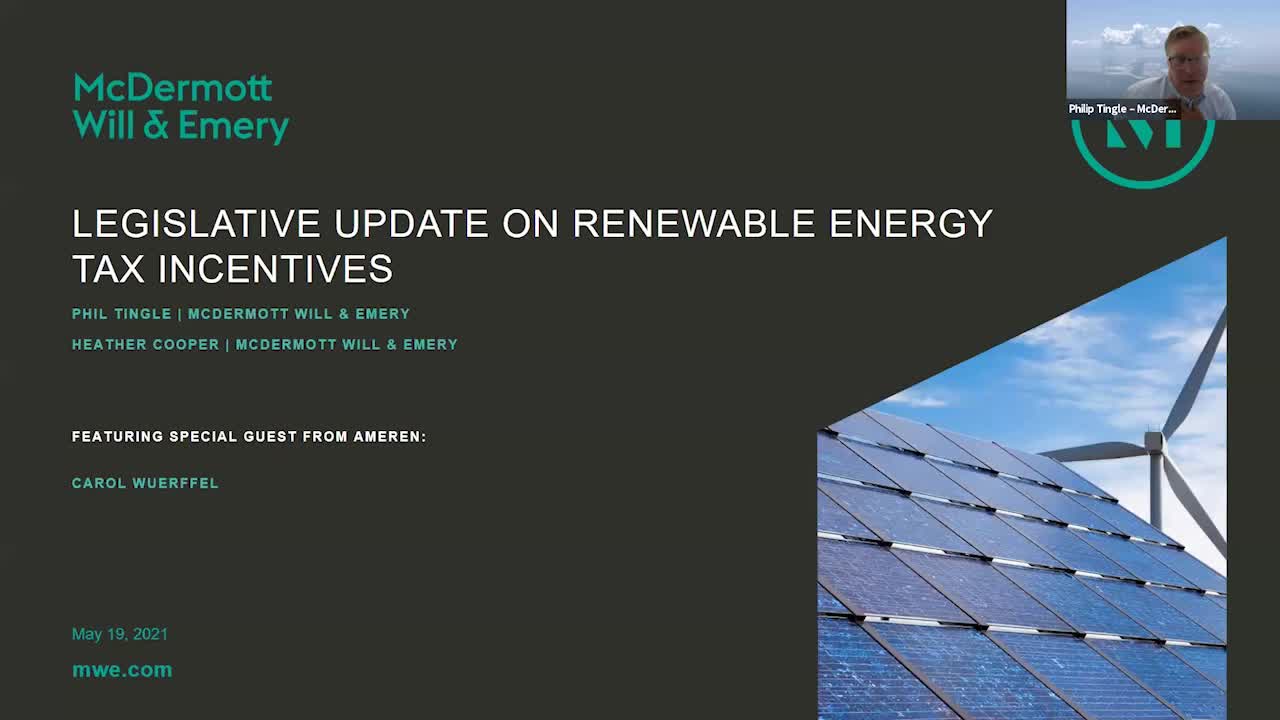
Below are key takeaways from the webinar:
- Tech Neutral Credit. The Clean Energy for America Act introduced by Senator Ron Wyden (D-OR) would replace existing renewable energy incentives with technology-neutral tax investment and production credits for facilities with zero net or net negative carbon emissions. In coordination with the Environmental Protection Agency, the US Department of the Treasury would be responsible for promulgating regulations specifying qualifying technologies. The credit would be provided to partnerships and not individual partners for renewable investments made by pass-through entities.
- Direct Pay. In early 2021, House Democrats reintroduced the Growing Renewable Energy and Efficiency Now (GREEN) Act. In addition to extending and expanding the existing investment tax credit (ITC) and production tax credit (PTC), the GREEN Act would permit taxpayers to elect to claim 85% of the expanded ITC and PTC amounts as a refundable credit, even if they do not have sufficient tax liabilities to otherwise use the credits. The Wyden bill likewise would offer a direct pay election but without any discount against the tax credit. The timing of payments under the refundable credit may impact whether developers will shift from current tax-equity structures. If a developer must file a return and wait to resolve any examinations or other ongoing proceedings to receive the benefit, the refundability could be of limited value.
- Net Zero 2050. US President Joe Biden has set an aggressive climate goal of reducing greenhouse gas emissions by at least 50% below 2005 levels by 2030 and to net zero by 2050. Developers and utilities need additional certainty around the scheduled phaseouts in the ITC and PTC in order to build renewable resources to meet climate goals. While the White House has yet to back a specific package of renewable tax incentives, the proposals introduced by congressional Democrats are a likely starting place for negotiations.
To access past webinars in this series and to begin receiving Energy updates, including invitations to the webinar series, please click here.
The energy market has undergone significant change in the past 12 months, with even more on the horizon. Our webinar series explores how these changes have shaped—and will continue to impact—the energy industry, including discussions of what’s to come.
Our latest webinar featured McDermott partners Philip Tingle and Heather Cooper and Carol Wuerffel, Senior Director, Tax at Ameren.
Below are key takeaways from the webinar:
- Tech Neutral Credit. The Clean Energy for America Act introduced by Senator Ron Wyden (D-OR) would replace existing renewable energy incentives with technology-neutral tax investment and production credits for facilities with zero net or net negative carbon emissions. In coordination with the Environmental Protection Agency, the US Department of the Treasury would be responsible for promulgating regulations specifying qualifying technologies. The credit would be provided to partnerships and not individual partners for renewable investments made by pass-through entities.
- Direct Pay. In early 2021, House Democrats reintroduced the Growing Renewable Energy and Efficiency Now (GREEN) Act. In addition to extending and expanding the existing investment tax credit (ITC) and production tax credit (PTC), the GREEN Act would permit taxpayers to elect to claim 85% of the expanded ITC and PTC amounts as a refundable credit, even if they do not have sufficient tax liabilities to otherwise use the credits. The Wyden bill likewise would offer a direct pay election but without any discount against the tax credit. The timing of payments under the refundable credit may impact whether developers will shift from current tax-equity structures. If a developer must file a return and wait to resolve any examinations or other ongoing proceedings to receive the benefit, the refundability could be of limited value.
- Net Zero 2050. US President Joe Biden has set an aggressive climate goal of reducing greenhouse gas emissions by at least 50% below 2005 levels by 2030 and to net zero by 2050. Developers and utilities need additional certainty around the scheduled phaseouts in the ITC and PTC in order to build renewable resources to meet climate goals. While the White House has yet to back a specific package of renewable tax incentives, the proposals introduced by congressional Democrats are a likely starting place for negotiations.
To access past webinars in this series and to begin receiving Energy updates, including invitations to the webinar series, please click here.



Santa Clara County Issues New Health Order and Directives Following Move to Yellow Tier
ARTICLE / CLIENT ALERT
Santa Clara County Issues New Health Order and Directives Following Move to Yellow Tier
May 20, 2021
Read time: 10 min
On May 19, 2021, Santa Clara County moved from the orange tier to the yellow tier of California’s color-coded reopening plan. Entering the yellow tier allows the County to expand capacity in businesses, gyms, movie theatres, restaurants and other indoor operations. Coinciding with the move to the yellow tier, the County issued a new Order of the Health Officer of the County of Santa Clara Establishing Focused Safety Measures to Protect the Community from COVID-19. This Order is effective May 19, 2021.
The new Order (and the Directives and Guidance it references) requires employers to:
- Determine the vaccination status by June 1, 2021, of all personnel (including employees, contractors, vendors, volunteers and all other individuals who regularly provide services onsite) who perform any work at their facility or worksite in the County;
- Report within 24 hours to the County Public Health Department after learning of any personnel who tested positive for COVID-19 and were at the workplace within a certain timeframe;
- Continue to implement safety measures;
- Follow industry-specific guidance from the State and
- Provide all personnel who are not fully vaccinated with information on how to get vaccinations.
As expected, the Order also ends the work-from-home mandate previously in place in Santa Clara County, which required all businesses to maximize the number of people working remotely. Finally, the Order states that a fully vaccinated workplace will not be required to wear masks indoors or follow social distancing guidelines, but a mixed vaccinated staff will have to follow more complex restrictions. This is, however, subject to California/the Occupational Safety and Heath Administration’s (OSHA) COVID-19 Prevention Emergency Temporary Standards and the California Department of Public Health’s Guidance on the Use of Face Coverings, which continue to require face coverings in a workplace setting. We anticipate changes to these requirements soon, but for now employers should continue to require face coverings in the workplace.
The Order does not impose a mandatory vaccination requirement.
The new Order requires reference to other Orders/Directives/Guidance, including the Mandatory Directive on the Use of Face Coverings, Mandatory Directive for Unvaccinated Personnel and the California Department of Public Health’s (CDPH) Guidance for the Use of Face Coverings. Therefore, employers should be very careful in navigating through the complexities associated with compliance with the new Order.
In the Order, the County recognizes that “[t]he public health threat from COVID-19 is decreasing in the County” but cautions that “COVID-19 continues to pose a risk especially to residents of Santa Clara County who are not fully vaccinated.” Therefore, certain safety measures are necessary to protect against COVID-19 cases and deaths.
WHO DOES THE ORDER APPLY TO?
This Order applies to “[a]ll individuals, businesses, and other entities in the County,” and it requires that “individuals who do not currently reside in the County must comply with all applicable requirements of the Order when they are in the County.” This includes employers of all sizes, including those working remotely or in-person.
For purposes of this Order, an employer’s “personnel” is defined to mean employees, contractors, subcontractors, independent contractors (such as “gig workers” who perform work via a business’s application or other online interface), vendors who sell goods onsite, volunteers and all other individuals who regularly provide services onsite at the request of the business.
WHAT DOES THE ORDER REQUIRE?
The Order requires and encourages the following:
- Face Coverings. The Order requires following the Health Officer’s Mandatory Directive on the Use of Face Coverings, which was also issued on May 18, 2021 (see below).
- Activities Encouraged to Occur Outdoors. Businesses and governmental entities “should consider moving operations and activities outdoors” where the risk of transmission is low, especially if the patrons are unlikely to be vaccinated. For restaurants with outdoor seating capabilities, for example, continued availability of outdoor seating would be important, especially if patrons are unlikely to be vaccinated.
- Reporting Personnel Contracting COVID-19. Businesses and governmental entities must require that their personnel immediately alert the business or the governmental entity if they test positive for COVID-19 and were at the workplace (1) within 48 hours prior to the onset of symptoms or within 10 days after the onset of symptoms if they were asymptomatic, or (2) within 48 hours prior to the date on which they tested or within 10 days after the day they were tested if they were asymptomatic. If the business or governmental entity learns of a confirmed positive case in this timeframe, that entity is required to report the case within 24 hours to the County Public Health Department at https://covid19.sccgov.org/business-guidance#employee.
- Ascertaining Vaccination Status of Personnel. Businesses and governmental entities are required to determine the vaccination status of all personnel (which includes employees, onsite contractors and volunteers) who perform any work at their facility or worksite in the County and they are also encouraged (but not required) to determine the vaccination status of all other personnel (such as remote workers). Until the status is determined, the personnel must be treated as unvaccinated. Those who decline to provide their vaccination status are to similarly be treated as unvaccinated. Businesses and governmental entities must complete the assessment of the vaccination status of their personnel within 14 days of the date of the effective date (May 19, 2021) of this Order, or June 1, 2021. The businesses and governmental entities must also maintain appropriate records (such as self-certification forms) to demonstrate that they are complying with this provision. Employers may choose to use the County’s Self-Certification of Vaccination Status form for purposes of ascertaining the vaccination status of their employees. For more information on ascertaining the vaccination status of personnel, employers should consult the FAQ on ascertainment of vaccination status.
- Social Distancing Protocols. Businesses and governmental entities no longer need to submit their Social Distancing Protocols to the County’s Public Health Department; however, they must continue to comply with requirements imposed by Cal/OSHA’s COVID-19 Emergency Prevention Regulations, which has not yet lifted the physical distancing requirement but is expected to do so soon. Employers are required to follow the stricter of the two requirements. Currently, Cal/OHSA does not distinguish on the basis of a person’s vaccination status for physical distancing requirements.
- Rules for Personnel Not Fully Vaccinated. For those who are not fully vaccinated (or do not disclose their vaccination status), they must:
- Comply with the applicable provisions of the Health Officer’s Mandatory Directive on the Use of Face Coverings (see below).
- Comply with the applicable provisions of the Health Officer’s Mandatory Directive for Unvaccinated Personnel (see below).
- What is “Fully Vaccinated?” The Order defines “fully vaccinated” to mean two weeks after completion of the entire recommended series of vaccination with a vaccine authorized to prevent COVID-19 by the US Food and Drug Administration.
Importantly, this Order does not impose a mandatory vaccination requirement on employers. In addition, fully vaccinated staff in a workplace will not be required to wear masks indoors or follow social distancing or quarantine guidelines, subject to Californiat/OSHA’s COVID-19 Prevention Emergency Temporary Standards and the California Department of Public Health’s Guidance on the Use of Face Coverings, which still require the use of face coverings in a workplace setting. However, we expect changes to this requirement to follow soon.
WHAT DO THE OTHER DIRECTIVES THE ORDER REFERENCES REQUIRE?
The Health Officer’s Mandatory Directive on the Use of Face Coverings requires all businesses and governmental entities to follow CDPH’s Guidance for the Use of Face Coverings. CDPH’s guidance sets forth the following rules for face coverings:
- Fully vaccinated. For fully vaccinated persons, face coverings are not required outdoors except when the person is attending crowded outdoor events. As further defined in the CDPH’s Fully Vaccinated Persons Guidance, a fully vaccinated person may (1) visit, without wearing a mask or physical distancing, with other fully vaccinated people indoors or outdoors (outside of a workplace setting), and (2) visit, without masks or physical distancing, unvaccinated people from a single household who are at low risk of severe COVID-19 disease in indoor and outdoor settings.
- Unvaccinated. For unvaccinated persons, face coverings are required outdoors any time physical distancing cannot be maintained.
- Indoor settings (regardless of vaccination status). In indoor settings outside of a person’s home, including on public transportation, face coverings are required regardless of a person’s vaccination status.
- Exemptions. The following individuals and settings are exempt from the CDPH’s Guidance:
- Persons who are alone in a car or solely with members of their own households;
- Persons who are working alone in a closed office or room;
- Persons who are obtaining a medical or cosmetic service involving the nose or face for which the temporary removal of a face covering is necessary to perform the service;
- Workers who wear respiratory protection or
- Persons who are specifically exempted from wearing face coverings by other CDPH guidance.
- Persons who are younger than two years old; persons with a medical condition, a mental health condition, or a disability that prevents wearing a face covering; persons who are hearing impaired or communicating with a person who is hearing impaired; persons for whom wearing a face covering creates a risk to the person related to their work, as determined by local, state, or federal regulators or workplace safety guidelines. This group of individuals are exempt from face covering requirements at all times. Persons who are exempt from wearing a face covering because of a medical condition but employed in a job involving regular contact with others must wear a non-restrictive alternative, such as a face shield or a drape, as long as their condition permits this.
Finally, the Health Officer’s Mandatory Directive for Unvaccinated Personnel requires that businesses and governmental entities ensure that all persons not fully vaccinated:
- Working onsite wear face coverings in accordance with the Directive on the Use of Face Coverings;
- Who are a “close contact” to a confirmed case, or who have been confirmed to have COVID-19, be excluded from the workplace for the quarantine and/or isolation period and
- Be provided with information on how to receive a vaccination, whether they are working onsite or remotely.
Through this Directive, the Health Officer urges (but does not require) businesses and governmental entities to prohibit all personnel not fully vaccinated from engaging in any work-related travel (especially greater than 150 miles from the County) and urges employers to require all personnel not fully vaccinated to obtain weekly PCR testing for COVID-19 or daily antigen testing with COVID PCR confirmation of any positives.
In relationship to the Order and Directives, the County has also provided a FAQ page to address questions.
WHAT ARE THE PENALTIES FOR FAILING TO COMPLY?
A violation of a provision of this Order constitutes a public nuisance and is punishable by fine, imprisonment or both. Any business that fails to ask about the vaccination status of its workers by June 1, 2021, may be required to pay fines of up to $5,000 per violation per day.
We are here to help. Our McDermott Will & Emery employment team of lawyers are tracking the latest state and local developments and are here to assist you with practical and protective guidance for navigating these complex workplace and business issues.




Reverse Confusion Suit Not Ironclad, but SmartSync Lives On
ARTICLE
Reverse Confusion Suit Not Ironclad, but SmartSync Lives On
May 19, 2021
Read time: 1 min



