Content Type: Article

  • Guidance Issued on NYC Salary Disclosure Law

    Guidance Issued on NYC Salary Disclosure Law

    ARTICLE / CLIENT ALERT

    Guidance Issued on NYC Salary Disclosure Law

    April 6, 2022

    Read time: 5 min

    Key takeaways
    Overview

    The New York City Commission on Human Rights (“NYCCHR”) recently released a fact sheet regarding New York City’s upcoming salary disclosure law, previously discussed in this Alert. The new law amends the New York City Human Rights Law (“NYCHRL”) to make it an unlawful discriminatory practice for covered employers to advertise a job posting for any position located within New York City without including a “good faith” minimum and maximum salary for the job. The law goes into effect on May 15, 2022.[1] The fact sheet provides additional guidance, discussed below, on the new law.

    Covered Employers

    The law applies to employers that have four or more employees, or one or more domestic workers, as long as one of those employees works in New York City. Employment agencies are also covered, regardless of their size. Although temporary help firms are not independently subject to the new law, employers that work with such firms are required to comply. 

    Covered Job Advertisements

    Any advertisement for a job, promotion or transfer opportunity that would be performed in New York City is covered by the law. Advertisement is defined as “a written description of an available position that is publicized to a pool of potential applicants.” This includes postings on internal bulletin boards, internet advertisements, printed flyers, and newspaper advertisements. Employers are not prohibited from hiring without the use of an advertisement.

    According to the fact sheet, “covered employers should follow the new law when advertising for positions that can or will be performed, in whole or in part, in New York City, whether from an office, in the field, or remotely from the employee’s home.” If the job must be performed outside of New York City, it would not be covered by the new law, even if advertised by a New York City employer. The fact sheet indicates that the NYCCHR will take the position that covered employers must comply with the new law, even if located outside of New York City, when advertising for positions allowing any remote work as the job could be performed in New York City if an applicant lives and would work remotely in New York City. The relevant question for determining whether a job advertisement is covered is where the employee can perform the work, not where the employee lives. Advertisements are covered regardless of whether they are seeking full or part-time employees, interns, domestic workers, independent contractors, or any other category of worker protected by the NYCHRL.

    Necessary Information to Include in Covered Job Advertisements

    Employers must state the minimum and maximum salary they in “good faith” believe they are willing to pay. To be in “good faith,” the posted salary range should be the amount the employer honestly believes it is willing to pay at the time of listing the job advertisement.

    Salary includes the base wage or rate of pay, regardless of the frequency of payment. For example, it would include an hourly wage of $15 per hour or an annual salary of $50,000 per year. The salary range cannot be open ended. For example, “$15 per hour and up” or “maximum $50,000 per year” does not comply. An employer, however, may post an exact wage or salary in lieu of a range. When an advertisement covers multiple positions, each position must include a specific salary range.

    For purposes of this law, salary does not include other forms of compensation or benefits offered in connection with the advertised position, such as health insurance, paid or unpaid time off, retirement plan offerings, severance pay, overtime pay, commissions, tips, bonuses, stocks or the value of employer-provided meals or lodging. 

    Enforcement

    Employers that are found to have violated the NYCHRL may have to pay monetary damages to affected employees and civil penalties of up to $250,000. Employers may also be required to amend postings, update policies, conduct trainings, provide notices of rights to employees or applicants, and engage in other forms of affirmative relief.

    In anticipation of the salary disclosure law’s implementation date, covered employers should review their job advertisements to ensure compliance.

    Authored by Mark E. Brossman, Ronald E. Richman, Max Garfield, Scott A. Gold and Donna K. Lazarus.

    If you have any questions concerning this Alert, please contact your attorney at Schulte Roth & Zabel or one of the authors.


    [1] A bill was recently introduced in the New York City Council that would, if enacted, move the effective date of the salary disclosure law to Nov. 1, 2022. The bill also would: (i) exclude employers with fewer than 15 employees, (ii) clarify that the law does not apply to notices that an employer is hiring without specifying a particular position and (iii) confirm the law does not apply to positions that are not required to be performed in New York City.


    This communication is issued by Schulte Roth & Zabel LLP for informational purposes only and does not constitute legal advice or establish an attorney-client relationship. In some jurisdictions, this publication may be considered attorney advertising. ©2022 Schulte Roth & Zabel LLP.

    All rights reserved. SCHULTE ROTH & ZABEL is the registered trademark of Schulte Roth & Zabel LLP.

    In depth
    Authors

    Mark E. Brossman

    Partner

    New York – 919 Third Avenue

    Ronald E. Richman

    Partner

    New York – 919 Third Avenue

    Max Garfield

    Partner

    New York – 919 Third Avenue

    Donna K. Lazarus

    Partner

    New York – 919 Third Avenue

    More insights

  • Inflation and ERISA Penalties: Hand in Hand for 2022

    Inflation and ERISA Penalties: Hand in Hand for 2022

    ARTICLE / CLIENT ALERT

    Inflation and ERISA Penalties: Hand in Hand for 2022

    April 5, 2022

    Read time: 5 min

    Key takeaways
    Overview

    2022 INFLATION-ADJUSTED PENALTIES ANNOUNCED BY THE DEPARTMENT OF LABOR

    The Federal Civil Penalties Inflation Adjustment Act of 2015 directs the US Department of Labor (DOL) to make annual inflation adjustments to specified Employee Retirement Income Security Act (ERISA) violations. The increased penalties generally apply to reporting and disclosure failures if the penalty is assessed after January 15, 2022, and if the violation occurred after November 2, 2015. The table below compares penalty amounts assessed for violations after January 15, 2021, through January 15, 2022 (the column labeled 2021 Penalty Amount), to penalty amounts assessed after January 15, 2022 (the column labeled 2022 Penalty Amount).

    DOL PENALTIES
    ERISA Penalty Statute Description of ERISA Violations Subject to Penalty 2021 Penalty Amount 2022 Penalty Amount
    ERISA §209(b) Failure to furnish reports (e.g., pension benefit statements) to certain former participants and beneficiaries or maintain records. $31 per affected participant and beneficiary $33 per affected participant and beneficiary
    ERISA §502(c)(2) Failure or refusal to properly file annual report (Form 5500) required by ERISA §104; and

    Failure of a multiemployer plan to certify endangered or critical status under ERISA §305(b)(3)(C) treated as a failure to file annual report.

    Up to $2,259 per day Up to $2,400 per day
    ERISA §502(c)(4) Failure to notify participants under ERISA §10(j) of certain benefit restrictions and/or limitations arising under Internal Revenue Code §436;

    Failure to furnish certain multiemployer plan financial and actuarial reports upon request under ERISA §101(k); Failure to furnish estimate of withdrawal liability upon request under ERISA §101(l); and

    Failure to furnish automatic contribution arrangement notice under ERISA §514(e)(3).

    Up to $1,788 per day per affected participant Up to $1,899 per day per affected participant
    ERISA §502(c)(5) Failure of a multiple employer welfare arrangement to file report required by regulations issued under ERISA §101(g). Up to $1,644 per day Up to $1,746 per day
    ERISA §502(c)(6) Failure to furnish information requested by the Secretary of Labor under ERISA §104(a)(6). Up to $161 per day, not to exceed $1,613 per request Up to $171 per day, not to exceed $1,713 per request
    ERISA §502(c)(7) Failure of a defined contribution plan to furnish a blackout notice under ERISA §101(i) or a notice of the right to divest employer securities under ERISA §101(m). Up to $143 per day per affected participant Up to $152 per day per affected participant
    ERISA §502(c)(8) Failure by a plan sponsor of a multiemployer plan in endangered status to adopt a funding improvement plan or a multiemployer plan in critical status to adopt a rehabilitation plan. Penalty also applies to a plan sponsor of an endangered status plan (other than a seriously endangered plan) that fails to meet its benchmark by the end of the funding improvement period. Up to $1,419 per day Up to $1,507 per day
    ERISA §502(c)(9)(A) Failure by an employer to inform employees of Children’s Health Insurance Program (CHIP) coverage opportunities under ERISA §701(f)(3)(B)(i)(l). Up to $120 per day per affected employee Up to $127 per day per affected employee
    ERISA §502(c)(9)(B) Failure by a plan administrator to timely provide to any state the information required to be disclosed regarding coverage coordination under ERISA §701(f)(3)(B)(ii). Up to $120 per day per affected participant and beneficiary Up to $127 per day per affected participant and beneficiary
    ERISA §502(c)(10)(B)(i) Failure by any plan sponsor of a group health plan, or any health insurance issuer offering health insurance coverage in connection with the plan, to meet the requirements of ERISA §§702(a)(1)(F), (b)(3), (c) or (d); or §701; or §702(b)(1) with respect to genetic information. $120 per day during non-compliance period $127 per day during non-compliance period
    ERISA §502(c)(10)(C)(i) Minimum penalty for de minimis failures to meet genetic information requirements not corrected prior to notice from the Secretary of Labor. $3,005 minimum $3,192 minimum
    ERISA §502(c)(10)(C)(ii) Minimum penalty for failures to meet genetic information requirements which are not corrected prior to notice from the Secretary of Labor and are more than de minimis. $18,035 minimum $19,157 minimum
    ERISA §502(c)(10)(D)(iii)(ll) Cap on penalty for unintentional failures to meet genetic information requirements. $601,152 maximum $638,556 maximum
    ERISA §502(c)(12) Failure of Cooperative and Small Employer Charity Act (CSEC) plan sponsor to establish or update a funding restoration plan. Up to $110 per day Up to $117 per day
    ERISA §502(m) Defined benefit distribution prohibited by ERISA §206(e) due to an impermissible forfeiture following withdrawal of a participant’s contributions. Amount distributed but not more than $17,416 per distribution Amount distributed but not more than $18,500 per distribution
    ERISA §715 Failure by a group health plan to provide Summary of Benefits Coverage under Public Health Services Act §2715(f), as incorporated into ERISA §715 and 29 CFR 2590.715-2715(e). Up to $1,190 per failure Up to $1,264 per failure

    For more information on any of these potential penalties, please contact your McDermott lawyer or the author listed below.

    In depth

    The Federal Civil Penalties Inflation Adjustment Act of 2015 directs the US Department of Labor (DOL) to make annual inflation adjustments to specified Employee Retirement Income Security Act (ERISA) violations. The increased penalties generally apply to reporting and disclosure failures if the penalty is assessed after January 15, 2022, and if the violation occurred after November 2, 2015. The table below compares penalty amounts assessed for violations after January 15, 2021, through January 15, 2022 (the column labeled 2021 Penalty Amount), to penalty amounts assessed after January 15, 2022 (the column labeled 2022 Penalty Amount).

    Authors
    More insights

  • EEOC Issues New Guidance on Caregiver Discrimination and COVID-19

    EEOC Issues New Guidance on Caregiver Discrimination and COVID-19

    ARTICLE / CLIENT ALERT

    EEOC Issues New Guidance on Caregiver Discrimination and COVID-19

    April 4, 2022

    Read time: 5 min

    Key takeaways
    Overview

    On March 14, 2022, the U.S. Equal Employment Opportunity Commission (“EEOC”) issued guidance on caregiver discrimination under federal employment discrimination laws with respect to the COVID-19 pandemic. The EEOC also updated its general COVID-19 guidance to include a section on “Caregivers/Family Responsibilities” (collectively, the “Caregiver Guidance”). The Caregiver Guidance describes unlawful discrimination against applicants and employees that can arise based on caregiving responsibilities during the COVID-19 pandemic. 

    The EEOC noted that the COVID-19 pandemic “significantly impacted employees’ work and personal obligations, creating concurrent, and at times, competing job and caregiving demands.” Millions of Americans with “children, spouses, partners, older relatives, individuals with disabilities,” etc. had to adjust to “vastly changed circumstances.” The EEOC recognized that the “challenge of juggling work and caregiver obligations” remains even as the pandemic continues to evolve.

    The Caregiver Guidance makes clear that caregiver status is not a protected class under federal employment discrimination law[1] and that federal employment discrimination laws do not prohibit employment discrimination based solely on caregiver status. In general, employees do not have a right under federal discrimination laws to reasonable accommodations such as telework or flexible schedules because they are caregivers, nor are employers required to excuse poor performance resulting from employees’ caregiving duties during the COVID-19 pandemic. 

    Caregiver discrimination violates federal employment discrimination laws when it is based on an applicant’s or employee’s sex (including pregnancy, sexual orientation or gender identity), race, color, religion, national origin, age (40 or older), disability, or genetic information (such as family medical history). Caregiver discrimination also is unlawful if it is based on an applicant’s or employee’s association with an individual with a disability or on the race, ethnicity or other protected characteristic of the individual receiving care.

    The Caregiver Guidance provides several examples of how unlawful discrimination may arise, noting that such discrimination is often connected to stereotypes about caregiving responsibilities or roles. For instance, an employer may not decline to assign female caregivers certain projects based on the employer’s assumptions regarding the female employees’ caregiving obligations or refuse to hire pregnant applicants based on assumptions that the applicants should be focused on ensuring safe and healthy pregnancies. It would also be unlawful for an employer to deny men or LGBTQ+ employees leave or permission to work a flexible schedule to care for a family member with COVID-19 or other pandemic-related caregiving duties if the employer grants the same requests when made by similarly situated women. Female employees with school-age children cannot be given more favorable treatment than male employees because of gender-based stereotypes regarding caregiving responsibilities.

    Employers are permitted, but not required, to provide accommodations to employees to enable employees to balance work and personal obligations without impairing performance or productivity, such as telework, modified schedules or leave to enable them to care for family members, as long as they are not treating employees differently based on sex, race or other protected characteristics.

    Workplace harassment related to employees’ COVID-19 pandemic caregiving responsibilities may also be unlawful and can occur both in-person and remotely. For example, comments regarding an employee’s choices during the COVID-19 pandemic based on gender stereotypes may constitute sexual harassment. Such conduct becomes unlawful harassment where: 1) enduring the offensive conduct becomes a condition of continued employment or 2) the conduct is severe or pervasive enough to create a work environment that a reasonable person would consider intimidating, hostile or abusive

    In response to the Caregiver Guidance, employers should be cognizant of how their actions may be interpreted as caregiver discrimination, and should continue to apply their policies consistently, respond promptly to harassment and discrimination related claims, take appropriate corrective action if harassment or discrimination occurs, and train all employees with managerial responsibilities on their obligations under applicable employment discrimination laws.

    Authored Mark E. Brossman, Ronald E. Richman, Max Garfield, Scott A. Gold, Donna K. Lazarus and Abdulrahman Alwattar.

    If you have any questions concerning this Alert, please contact your attorney at Schulte Roth & Zabel or one of the authors.


    [1] Although federal employment discrimination laws do not prohibit discrimination based solely on caregiver status, some state or local laws provide explicit protections for workers with caregiving responsibilities. In New York State, for example, employers cannot discriminate against an employee because they have a child under 18. See N.Y. Human Rights Law § 296.1.  New York City law goes further, altogether banning employment discrimination based on an employee’s status as a caregiver. See N.Y.C. Admin. Code § 8-101.


    This communication is issued by Schulte Roth & Zabel LLP for informational purposes only and does not constitute legal advice or establish an attorney-client relationship. In some jurisdictions, this publication may be considered attorney advertising. ©2022 Schulte Roth & Zabel LLP.

    All rights reserved. SCHULTE ROTH & ZABEL is the registered trademark of Schulte Roth & Zabel LLP.


    In depth
    Authors

    Mark E. Brossman

    Partner

    New York – 919 Third Avenue

    Ronald E. Richman

    Partner

    New York – 919 Third Avenue

    Max Garfield

    Partner

    New York – 919 Third Avenue

    Donna K. Lazarus

    Partner

    New York – 919 Third Avenue

    Abdulrahman Alwattar

    Associate

    New York – 919 Third Avenue

    More insights

  • Climate Change Regulatory Update for US Insurers

    Climate Change Regulatory Update for US Insurers

    ARTICLE / CLIENT ALERT

    Climate Change Regulatory Update for US Insurers

    March 31, 2022

    Read time: 16 min

    Key takeaways
    Overview

    After a variety of promises concerning climate change-related regulatory development activity last year, forward movement has been relatively slow. The leading exception has been the New York Department of Financial Services (NYDFS), which, last year, became the first US financial regulator to develop and finalize a comprehensive climate change risk regulatory framework for “domestic” insurers (for which it is the primary solvency regulator). However, all this changed a week ago.

    In depth

    On March 21, 2022, the US Securities and Exchange Commission (SEC) proposed new standardized climate change-related disclosure rules. With the release of the proposed rules, are we about to see a reacceleration of climate change regulatory activity in the United States or will the SEC’s action be simply an isolated “one step forward” to be followed by one or more steps backward? As always, time will tell. We’ve been waiting to see when federal banking regulators would begin to publish their climate change risk regulatory frameworks and whether they would act via joint rulemaking or would individual regulators proceed at different speeds and develop individualized rules that reflect, for example, the considerable financial and operational differences between credit unions and money centers/larger regional banks? It appears that the latter will be the case, however, all we’ve seen to date are high-level statements of principles from federal banking regulators.

    Perhaps of most interest to insurers is the US Department of the Treasury’s (Treasury) Federal Insurance Office’s (FIO) August 31, 2021 Notice in which it summarized its climate change risk analysis tasks as (1) conducting a gap analysis of state regulation with respect to climate change, (2) assessing the potential for major disruptions in areas susceptible to the impacts of focusing on mitigation and resilience and (3) “leverage[ing] the insurance sector’s ability to help achieve climate-related goals.” However, questions remain. When will insurers see an official report from the FIO? How will the SEC’s proposed rules as well as additional anticipated federal rulemaking and related activity impact future state insurance regulatory activities? Will state insurance regulators be able to create a national consensus with respect to devising a regulatory framework to integrate climate change risks?

    The pace of change has been considerably brisker outside Washington, DC, and state capitals. Barely a day passes without a climate-related announcement from a bank, insurer/reinsurer or a fund manager as to the latest climate change pledges, goals or timetables to stop insuring new (or any) coal- and oil and gas-related operations or to achieve “net zero” by a specific target date. On the investment side, in a recent report from Conning, 79% of insurers surveyed said that during the past two years they started to incorporate environmental, social and corporate governance (ESG) factors into investment decisions while 67% said they had already done so. Why? Corporate reputations. Of those surveyed, 92% of respondents said reputation was an important or very important motivator.

    The leading rating agencies for the insurance industry have all jumped on the climate change bandwagon and will continue to add their scrutiny and voices to the marketplace of climate change analysis and debate. Whether insurers are subject to SEC reporting or required to file annual National Association of Insurance Commissioners (NAIC) Climate Risk Disclosure Surveys has yet to be determined, however, rating agencies (and others) will be watching, analyzing and assessing company-specific developments with respect to climate change risk management—primarily on the underwriting side but also with respect to the investment activities of insurers.

    Acknowledging the leading role that international re/insurers will continue to play on the underwriting side with respect to assessing the varying evolving impacts of climate change on books of business, the impact that insurers might have with their climate change investment decisions need to be kept in some perspective.

    First, at some point, regulators will presumably be concerned that individual insurers (or types of insurers) might need to temper the elevated levels of enthusiasm they have for climate change “impact” investments to mitigate the effects of climate change or support adaptation efforts—bearing in mind that insurer investments must not jeopardize claims-paying ability. Regulators will presumably pay attention to differing investment horizons for property/casualty insurers versus life and annuity insurers.

    Second, the amount of funds available for insurers to invest in “green” funds or in projects to mitigate the effects of climate change or adapt to it pales in comparison to the significant sums of investable cash held by the largest fund managers. According to the Insurance Information Institute, at year-end 2020, the nearly 3,000 US property and casualty insurers had about $2 trillion in cash and invested assets. The country’s 1800+ life and health insurers held $4.7 trillion (plus $3 trillion in life insurer separate accounts). In contrast, consider the assets maintained at the following:

    • BlackRock, Inc. is approaching $10 trillion.
    • Vanguard is at $7.1 trillion (in 2020).
    • Charles Schwab Corporation is at nearly $7.6 trillion.
    • Fidelity Investments is at $4.2 trillion (among many others with more than $1 trillion of investable assets).

    Aggregate amounts of assets managed by leading fund managers far outstrip aggregate investable assets controlled by insurers. Add in the investable funds held in hedge, family office, endowments and pension funds (and not managed by fund managers like those just named) at banks and by non-financial companies and it’s clear that insurers are in a different, lower league when it comes to financing the huge costs of achieving the Paris Agreement goal of keeping global warming to less than 2°C. above pre-industrial levels.

    SEC-MANDATED CLIMATE DISCLOSURE VS. NAIC CLIMATE DISCLOSURE PLANS: COMPETITION OR COORDINATION…OR CONFLICT?

    In 2013, then NYDFS Superintendent Benjamin Lawsky delivered an address at Fordham University School of Law, during which he spoke of the benefits of “a dose of healthy competition among regulators.” He was referring perhaps both to competition with federal banking regulators and with state insurance regulators throughout the country. Lawsky also stressed the advantage of a nimble, agile regulator who is able to spot situations or conditions that require attention and provide regulatory attention quicker than larger or more bureaucratic competitors. Proof of the pudding? Consider the NYDFS’ first-in-the-country cryptocurrency “bit licensing” regime, cybersecurity rules and, most recently, development of a comprehensive climate change regulatory framework. The current NYDFS Superintendent, Adrienne Harris (the first non-prosecutor in the position), recently spoke less about competition and more about the advisability of regulator coordination, particularly with respect to climate change that has national and international impacts that highlight the need for coordination and cooperation with other regulators. At the same time, however, Harris spoke about expanding the NYDFS’ climate change regulatory activities even as other financial services industry regulators (at least in Washington, DC) have yet to move beyond the very beginning stages of constructing regulatory frameworks for regulated entities that fully integrate climate change risks into enterprise management. While the NYDFS has published final climate change regulatory compliance rules for insurers, it has yet to do so for the banks it regulates.

    It is fascinating to compare and contrast the SEC’s proposed “one-size-fits-all-industries” approach to climate disclosures with the evolving NAIC approach to climate disclosure, starting with a decade-old insurance industry-specific survey that is now being reinforced with Task Force for Climate-Related Financial Disclosure (TCFD) concepts and elements.

    First, the timetables for both efforts seem to have converged, at least for the moment. Last week, coincidentally, the NAIC’s Climate & Resiliency Task Force met to adopt its revised climate risk disclosure framework—in development for more than a year—so that it coalesces with the TCFD’s efforts, just as the SEC’s proposed disclosure approach is patterned on the TCFD precedent.

    Second, while neither approach is final, the SEC will be accepting comments on its proposed rules for at least the next 30 days before finalizing, and the NAIC’s Executive Committee and Plenary still need to approve the proposed disclosure during its upcoming National Meeting in early April. That said, it appears that both will be finalized sometime this year. However, insurers obligated to respond to the NAIC Climate Disclosure Survey will need to do so in 2022. Adherence to the SEC’s proposed rules will not be required until 2024 (assuming the rules are finalized in 2022).

    Third, consider the respective scopes of application. There are roughly 110 insurers who are subject to SEC jurisdiction and will, depending on the sizes of the various entities, be required to disclose “material” climate-related factors sooner or later. For NAIC disclosure purposes, of the nearly 6000 insurers in the United States, only those (x) domiciled in one of the 15 states (plus the District of Columbia) that have, to date, required insurers to submit climate disclosures and (y) with more than $100 million in annual direct written premium will be required to file disclosures by the end of November 2022 (extended from August 31, 2022, for 2022 filings only).

    The NAIC maintains that the universe of reporting companies accounts for roughly 80% of the country’s insurance premium. The California Insurance Department’s website page summarizing the NAIC Climate Disclosure Survey states that “nearly 1000 companies” respond. In short, according to the SEC’s proposed rules release, there are currently 66 insurers who will be required to comply with both the SEC’s rules and the NAIC’s requirements. For those 66 insurers, it will be critical to map SEC versus NAIC disclosure requirements. The SEC’s release asserts that “… registrants in the insurance industry may also face lower incremental costs due to their existing disclosure practices…. [A] large subset of insurance firms are required to disclose their climate-related risk assessment and strategy via the NAIC Climate Disclosure Survey. A comment by a state insurance commissioner stated that because this survey overlaps extensively with the TCFD recommendations, these firms should be able to easily switch to reporting via the TCFD disclosure framework. This is because the proposed rules are broadly consistent with the TCFD. We expect that registrants in the insurance industry may be able to adapt more easily to providing disclosure under these rules.” (footnote omitted) One can’t help but wonder if each of the 66 insurers will agree completely with the SEC’s assertion!

    As for SEC registrants subject to filing NAIC disclosure surveys—or embraced within state-specific climate change regulatory requirements, e.g., for those SEC registrants who are domiciled in New York—it will apparently be necessary for those companies to explain the state regulatory requirements in SEC disclosures.

    The fact remains that thousands of US insurers are not currently subject to climate change disclosure requirements and will not be required to provide disclosures in the future. When the FIO completes its “gap analysis” report, presumably this gap will be addressed. Having said this, insurance holding companies that must submit enterprise risk management (ERM) reports or insurers (or groups of insurers) that meet the minimum size thresholds for submitting Own Risk Solvency Assessments (ORSA) and are not otherwise required by their domicile states to prepare and submit NAIC climate risk disclosures may end up disclosing the same or similar substantive information in their ERM or ORSA reports.

    So, what are some of the differences between the SEC’s proposed climate risk disclosure rules versus the NAIC’s climate disclosure requirements?

    MATERIALITY

    As McDermott’s recent article notes, the SEC “reaffirmed adherence to the definition of materiality set forth in both its rules and past Supreme Court of the United States opinions: Information is material if there is a substantial likelihood that a reasonable investor would consider it important in deciding how to vote or make an investment decision, or, put another way, if the information would significantly alter the total mix of available information to investors.”

    In contrast, the NAIC climate risk disclosure regime and the NYDFS’s November 2021 “Guidance for New York Domestic Insurers on Managing the Financial Risks from Climate Change” (NYDFS Guidance) considers materiality from the perspective of insurance regulation. In short, the relevant insurance regulatory materiality standard is 5% of policyholder surplus (or an insurer’s net worth) or 0.5% of total assets. But as the NYDFS Guidance goes on to explain, “a risk may also be considered material where knowledge of the risk could influence the decisions or judgment of an insurer’s board, management, regulators, or other relevant stakeholders.” The NYDFS Guidance encourages insurers to “… regularly assess their materiality assumptions. Depending on the nature, scale, and complexity of its business, an insurer should conduct this assessment at least annually…” To be fair, the SEC’s proposed rules also reflect its appreciation of “the dynamic nature of materiality determinations that registrants must make under US securities laws, particularly with regard to potential future events.”

    ATTESTATION

    One of the more controversial aspects of the SEC’s proposed rules are the requirements for certain larger registrants to include third-party attestations as to the disclosure of Scope 1 and Scope 2 emissions. The NAIC Climate Disclosure Survey also calls for disclosure of Scope 1 and Scope 2 emissions, however, all NAIC respondents avoid attestation complications—at least for now.

    SCOPE 3 EMISSIONS

    As McDermott’s article notes, “[l]arger registrants would be required to disclose data regarding their Scope 3 emissions (those that are the result of activities from assets not owned or controlled by the registrant, but that the registrant indirectly impacts in its upstream or downstream value chains through its activities) if material to them, or if they have set a [greenhouse gas] GHG emissions reduction target or goal that includes its Scope 3 emissions.” The SEC makes clear that Scope 3 emissions can include investments, assuming investing is material to an enterprise. For many insurers, it would be difficult to imagine that investing was not material. The NAIC’s Climate Disclosure Survey simply calls for all respondents to disclose Scope 3 emissions “if appropriate.”

    SCENARIO ANALYSIS

    As McDermott’s article explains, if reporting companies utilize scenario analysis, they will need to describe “the scenarios used, including the parameters, assumptions, analytical choices and projected principal financial impacts.”

    Compare the SEC’s stark disclosure requirements and explain with the NAIC’s gentler “best efforts” approach:

    “In describing how processes for identifying, assessing, and managing climate-related risks are integrated into the insurer’s overall risk management, insurers should consider including the following:

    • Discuss the climate scenarios utilized by the insurer to analyze its underwriting risks, including which risk factors the scenarios consider, what types of scenarios are used, and what timeframes are considered.
    • Discuss the climate scenarios utilized by the insurer to analyze risks on its investments, including which risk factors are utilized, what types of scenarios are used, and what timeframes are considered.”

    TARGETS AND GOALS

    McDermott’s article notes that for SEC reporting companies that have publicized “climate-related targets or goals”—as so many insurers have done and continue to do—they will have to explain:

    • “The scope of the activities and emissions included in the target, the defined time horizon by which the target is intended to be achieved and any interim targets.
    • How the registrant intends to meet its climate-related targets or goals.
    • Relevant data to indicate whether the registrant is making progress toward meeting the target or goal and how such progress has been achieved, with updates each fiscal year….”

    The NAIC Climate Disclosure Survey requires simply to: “[d]escribe the targets used by the insurer to manage climate-related risks and opportunities and performance against targets.”

    REGULATORY CONFLICT?

    As to the possibility of “conflict” between and among regulators and policymakers, consider the following recent developments:

    In mid-March, US President Joe Biden withdrew Sarah Bloom Raskin’s nomination to be Vice Chair of the Federal Reserve Board, primarily because of her well-known views with respect to the systemic risks for financial institutions posed by climate change.

    European commentators began to discuss the impact of inflation on investment in climate change mitigation and adaptation projects.

    The obvious negative impacts of Russia’s invasion of Ukraine for international cooperation in a variety of areas, including ESG generally and climate change.

    Last week, Texas Comptroller Glenn Hegar sent a letter to some 19 large asset managers, seeking information about their investment policies vis-à-vis fossil fuels, specifically inquiring as to alleged boycotts of new investments in such companies. It is said that letters to an additional 100 asset managers are to follow. At stake? Access to managing hundreds of billions of dollars in Texas pensions and similar funds.

    Governor Jim Justice (R-WV) just signed a bill into law that will create a Mining Mutual Insurance Company, designed to ensure that West Virginia coal mine operators (existing and future) are able to procure the performance bonds needed to obtain and maintain licenses to mine coal.

    While publication of authoritative reports by climate scientists, such as the United Nations’ most recent comprehensive and massive Intergovernmental Panel on Climate Change (IPCC) report card on the state of the global environment, always prompt commentary and discussion, the effects seem to be transitory. Should regulators be able to redirect investment flows away from coal and oil and gas producers and users or should they be able to force banks to withhold credit or insurers to not to do business with such companies? These are the questions that will occupy governments on both sides of the Atlantic for years, probably even decades, to come.

    STATE LEGISLATION

    Finally, most climate change regulatory commentators tend not to focus on the states. Yet, for insurers, what states think and how they approach climate change in general and climate change regulatory compliance specifically matters greatly. While the 2022 state legislative season is nearing an end and with mid-term elections coming up in less than eight months, we will likely see a fair amount of climate-related legislative activity in 2023. States such as Kansas, West Virginia and Wyoming recently considered (but did not enact) legislation to bar financial institutions from using ESG scores or metrics. There is reportedly a group of state financial officers from 15 states, organized by West Virginia Treasurer Riley Moore, that seeks to cut back—possibly to zero—business with banks that “adopt corporate policies to cut off financing for the coal, oil and natural gas industries.” Legislation that is consistent with Texas Comptroller Hegar’s recent letter writing campaign to establish whether the largest asset managers have policies vis-à-vis fossil fuel producers is expected.

    On the opposite side of the ledger, there will likely be state legislative calls for expanded climate risk disclosure, at least by larger companies and some insurers. In 2022, California Senate Bill (S.B.) 449, still under consideration, would require companies with a license or certificate to operate in California with more than $500 million in revenue to annually file a climate risk disclosure report that addresses “material risk of harm to immediate and long-term financial outcomes due to climate change, including, but not limited to, risks to corporate operations, provision of goods and services, real estate, supply chains, employee health and safety, capital and financial investments, institutional investments, financial standing of loan recipients and borrowers, shareholder value, insured assets, consumer demand, and financial markets and economic health.”

    More focused is California S.B. 1694, introduced by California State Assemblyman Marc Levine who coincidentally is challenging incumbent Insurance Commissioner Ricardo Lara for the Democratic nomination for Insurance Commissioner. If enacted, the bill would require the approximately 1500 insurers with licenses in the state to disclose the underwriting of and investments in fossil fuel companies and projects.

    Authors

    Thomas M. Dawson

    Partner

    New York – One Vanderbilt Avenue

    More insights

  • When Are Cryptocurrencies Appropriate Investments for Retirement Plans and IRAs? DOL Cautions 401(k) Plan Fiduciaries to Exercise Extreme Care

    When Are Cryptocurrencies Appropriate Investments for Retirement Plans and IRAs? DOL Cautions 401(k) Plan Fiduciaries to Exercise Extreme Care

    ARTICLE / CLIENT ALERT

    When Are Cryptocurrencies Appropriate Investments for Retirement Plans and IRAs? DOL Cautions 401(k) Plan Fiduciaries to Exercise Extreme Care

    March 31, 2022

    Read time: 10 min

    Key takeaways
    Overview

    Cryptocurrencies and digital assets—such as bitcoin, ether and non-fungible tokens (NFTs)—have become some of the hottest investment products in recent years. The growing interest has inevitably led to retirement plan participants and individual retirement account (IRA) owners wanting to invest their tax-deferred retirement assets (plan assets) in cryptocurrency. Investing plan assets in cryptocurrency is complicated, however, because of the complex rules that federal law imposes on fiduciaries of retirement plans and IRAs.

    On March 10, 2022, the US Department of Labor (DOL) issued guidance for the first time on the investment of retirement plan assets in cryptocurrencies. Compliance Assistance Release No. 2022-01 cautions 401(k) plan fiduciaries to “exercise extreme care” before allowing participants to invest plan assets in cryptocurrencies because cryptocurrencies “present significant risks and challenges to participants’ retirement accounts, including significant risks of fraud, theft, and loss.” The DOL expects to investigate 401(k) plans that allow participants to invest their plan accounts in cryptocurrencies in order to protect participants and beneficiaries from the risks inherent to investing in cryptocurrencies.

    In depth

    WHAT IS CRYPTOCURRENCY?

    Virtual currency (also referred to as “cryptocurrency,” “digital assets,” “tokens” and “digital currency”) is said to have been created in 1998, but it was not until bitcoin’s introduction in 2009 that virtual currency gained international notice. The virtual currency definition varies among regulators and government entities. The Financial Action Tax Force, the Securities Exchange Commission (SEC) and the Internal Revenue Service (IRS) all define virtual currency as “a digital representation of value that can be digitally traded and functions as (1) a medium of exchange; and/or (2) a unit of account; and/or (3) a store of value.”

    In this article, we use “cryptocurrency,” “virtual currency” and “digital assets” interchangeably. The IRS and the Commodity Futures Trading Commission (CFTC) tend to use the term “virtual currency or digital assets. The SEC generally uses the terms “digital assets,” “coins” or “tokens,” and the popular press almost always uses the term “cryptocurrency.” Popular cryptocurrencies include bitcoin (BTC), ether (ETH), and many thousands more, including cryptocurrencies that are not frequently traded.

    WHAT ARE NFTS?

    NFTs are unique digitized tokens that are recorded and transferred on a blockchain. An NFT can be a representation of something (a work of art, a photograph, a piece of music, a game or a collectible), or it can be an original creation that exists only in digital form. NFTs also include access to events and experiences available only to the NFT holder. NFTs are typically purchased and sold using the type of cryptocurrency or digital token (collectively referred to as tokens) used or accepted on that particular blockchain. Initially, NFTs were almost exclusively created on the Ethereum blockchain and purchased with ETH, which is the native token of that blockchain. But now, NFTs are created on other blockchains, and NFTs can be purchased for US currency, other cryptocurrencies and tokens native on those blockchains.

    As a “smart contract,” each NFT has embedded metadata that allows relevant information to be visible and stored on the blockchain in a transparent and immutable way. The metadata verifies ownership, transferability (and, if so, under what circumstances), links to other digital assets, license fees, royalties and any other payment obligations. Upon transfer, an NFT’s metadata assures that required payments are accepted and confirmed, the correct payment amount is transferred to the seller, and any license fee or royalty amount is deducted from the payment made to the seller and transferred to the owner of the intellectual property.

    GENERAL TAX RULES FOR CRYPTOCURRENCY

    We do not have much official guidance directly on point with respect to NFTs and nonconvertible cryptocurrency. The first point of reference is Notice 2014-21 (2014-16 I.R.B. 938) and the 2019 Frequently Asked Questions (FAQs), which were the IRS’s first attempts to address convertible cryptocurrency taxation (IRS, “Frequently Asked Questions, 2019,” most recently updated March 2021). Convertible cryptocurrency has an equivalent value in real currency, can be purchased for or exchanged into real currency, and can be used to buy goods and services. For example, BTC and ETC are convertible cryptocurrencies. The IRS treats convertible cryptocurrency as property, not currency. As a result, the general tax principles that apply to property transactions apply to convertible virtual currency.

    We must next consider applying these general tax rules to nonconvertible cryptocurrency and NFTs. Although Notice 2014-21 does not address non-convertible cryptocurrencies or NFTs, it is likely—although not free from doubt—that many other cryptocurrencies and tokens (including NFTs) are the same as convertible cryptocurrency. They would be treated as property for tax purposes.

    ERISA REQUIREMENTS FOR RETIREMENT PLAN AND IRA FIDUCIARIES

    The Employee Retirement Income Security Act of 1974, as amended (ERISA) requires a plan fiduciary to discharge his or her duties solely in the interest of the plan’s participants and beneficiaries. The plan fiduciary must act with the care, skill, prudence and diligence that a prudent person familiar with such matters would use in similar circumstances. This “prudent expert standard of care” requires plan fiduciaries to consult with appropriate experts when making investment decisions if the fiduciary lacks the necessary expertise. Plan fiduciaries also owe an ongoing duty of care, which requires them to continuously monitor a plan’s investments and remove imprudent investments. Plan fiduciaries must diversify plan investments to protect the plan from the risk of large losses, unless it is clearly prudent not to do so under the circumstances.

    Retirement plan fiduciaries are held accountable for complying with the ERISA fiduciary standards by the DOL. In addition, plan participants can sue plan fiduciaries for failing to comply with their ERISA fiduciary duties by selecting imprudent investments or for failing to monitor or replace imprudent investments under a defined contribution plan.

    COLLECTIBLES

    As of the date of this writing, the only explicit restriction on permissible investments for qualified retirement plans and IRAs is with respect to “collectibles.” Collectible are defined in §408 of the Internal Revenue Code of 1986, as amended (the Code). They include artwork, rugs, antiques, metals or gems, stamps and coins (with certain exceptions for gold, silver and platinum coins), alcoholic beverages, musician instruments, historical objects or other tangible personal property identified by the IRS. A retirement plan investment in a collectible is automatically treated as a taxable distribution to the participant or IRA owner at the time the collectible investment is made. This deemed tax distribution applies for tax purposes, even if an actual distribution is not available to the plan participant or IRA owner. Virtual currencies can be distributed in-kind, or they can be sold, and the cash received can be distributed. Regardless of the form of distribution, however, the trustee of the retirement plan or the custodian of the IRA is required to issue a Form 1099-R to the participant/owner to report the fair market value of the collectible as taxable income in the year it is acquired by the retirement plan or IRA.

    Convertible virtual currencies (such as BTC and ETH) are not “collectibles” under Code §408 because they are fungible and can be purchased and sold for cash or certain other virtual currencies in the same manner as stocks and other investments. Certain types of NFTs are like artwork, however, and are more likely to meet the definition of a collectible. They are unique, can be art works, cannot be easily valued and cannot be traded like convertible virtual currency.

    To date, the IRS has not issued any guidance to clarify whether certain types of NFTs are collectibles that would prohibit retirement plans and IRAs from investing in them.

    RETIREMENT PLANS

    Compliance Assistance Release No. 2022-01 is the first guidance from the DOL on the appropriateness of cryptocurrencies or NFTs as plan investments. While the DOL did not outright ban retirement plans from investing in cryptocurrencies, the DOL cautioned 401(k) plan fiduciaries to “exercise extreme care” before allowing participants to invest plan assets in cryptocurrencies because cryptocurrencies “present significant risks and challenges to participants’ retirement accounts, including significant risks of fraud, theft, and loss.”

    The DOL questions whether 401(k) plan fiduciaries can act consistent with their ERISA fiduciary duties if participants are allowed to invest their plan accounts in cryptocurrencies because of the “highly speculative” nature of cryptocurrencies and the “extreme price volatility” that cryptocurrencies have experienced in recent years.

    Many plan participants are now aware of cryptocurrency and its reputation for “outsized profits” but lack sufficient knowledge to evaluate the risks and make informed decisions about investing retirement plan assets in cryptocurrencies. Cryptocurrencies can be particularly problematic investment if they are included as an option on a 401(k) plan’s investment menu (as opposed to being a permissible investment through a plan’s brokerage window) because inclusion on the investment menu can lead plan participants to infer that cryptocurrencies are a prudent means of investing their retirement savings despite the significant risks noted by the DOL.

    Cryptocurrencies can pose unique challenges for custodying and recordkeeping. Custodying virtual currencies requires a sophisticated technology platform that is different from the custody capabilities required to hold physical assets and more traditional investments. In addition, cryptocurrencies can be difficult to reliably and accurately value.

    Plan fiduciaries should also take the evolving regulatory framework for cryptocurrencies into account when deciding whether cryptocurrencies are a prudent plan investment.

    To protect the interests of 401(k) plan participants and beneficiaries, the DOL announced that it intends to conduct an investigation initiative for 401(k) plans that offer cryptocurrency investments. This initiative will focus on whether including cryptocurrencies as an option on a plan’s investment menu or allowing participants to invest in cryptocurrencies through the plan’s brokerage window is consistent with the fiduciary duties that ERISA requires of plan fiduciaries.

    As of the date of this writing, virtual currencies do not make up a significant amount of qualified retirement plan investments. This is true, whether they are investment options under participant-directed defined contribution plans (that is, 401(k) plans or 403(b) plans) or as investments under defined benefit plans (that is, pension plans). The DOL’s guidance and upcoming investigation initiative is likely to reduce interest in using cryptocurrencies as retirement plan investments.

    IRAS

    Virtual currencies are currently seen by many IRA owners as attractive investments. As with other investments, earnings on virtual currencies held by IRAs can grow tax-deferred (under traditional IRAs) or tax-free (under Roth IRAs).

    While IRA owners must act in a fiduciary capacity when selecting investments for their IRAs, the DOL’s recent guidance does not appear to extend to IRAs invested in cryptocurrencies. Nevertheless, IRA owners should exercise caution in selecting cryptocurrencies as investments for their IRAs given the risks noted by the DOL.

    An added challenge for IRA owners is ensuring the trustee or custodian for their IRA meets the IRS’ custody requirements for holding IRA assets. Nonbank entities or trust companies that want to custody virtual currencies for IRAs need special approval from the IRS to do so. Code §408 and its related regulations set out the type of information that such an entity must demonstrate to the IRS to be approved to hold assets for an IRA.

    CONCLUSION

    As interest in investing in cryptocurrencies grows, retirement plan fiduciaries need to understand the fiduciary duties owed to the plan’s participants and beneficiaries. Investment of retirement plan assets in cryptocurrencies must be carefully evaluated by plan fiduciaries in light of the risks inherent in cryptocurrency investments in the current market. In addition, plan fiduciaries must be aware of any new tax developments.

    Authors

    Brian J. Tiemann

    Partner

    Chicago

    More insights

  • An Analysis of the Auxin Petition and Commerce Investigation and Their Impact on the Solar Industry

    An Analysis of the Auxin Petition and Commerce Investigation and Their Impact on the Solar Industry

    ARTICLE / CLIENT ALERT

    An Analysis of the Auxin Petition and Commerce Investigation and Their Impact on the Solar Industry

    March 30, 2022

    Read time: 11 min

    Key takeaways
    Overview

    On February 8, 2022, Auxin Solar Inc. filed a petition[i] requesting that the US Department of Commerce (Commerce) initiate a circumvention investigation into whether imports of crystalline silicon photovoltaic cells (CSPs) imported from Cambodia, Malaysia, Thailand or Vietnam (the third countries) are circumventing antidumping and countervailing duty orders (the orders) on CSPs from China.[ii] On March 25, 2022, pursuant to allegations in the petition, Commerce initiated a circumvention investigation (the initiation memorandum) that could profoundly affect the companies that import or rely on imported CSPs in the United States.[iii]

    In this article, we provide information regarding (1) the possibility that Commerce will retroactively assess antidumping and countervailing duties on subject entries[iv] entered on or after March 31, 2022, or October 19, 2021, (2) the issues that Commerce will investigate and (3) the participation that may be necessary if parties wish to preserve the right to appeal.

    In short:

    1. If Commerce issues an affirmative preliminary circumvention determination, importers will be required to pay antidumping and countervailing duties on subject entries (cells and modules subject to the petition) entered into the United States on or after March 31, 2022 (when we assume that Commerce will publish the notice of initiation in the Federal Register).
    2. This date, March 31, 2022, is important to solar developers since this is the default date for retroactive application of the tariffs.
    3. If Commerce issues an affirmative preliminary circumvention determination, the default rule will allow Commerce to apply such determination as far back as March 31, 2022. Additionally, an exception may permit Commerce to apply such determination as far back as October 19, 2021.
    4. According to our research, Commerce has not yet relied on the exception in the regulation permitting it to assess duties on entries entered prior to the date the Federal Register notice was published. This is likely because the relevant regulatory provision (19 C.F.R. § 351.225(l)(2)–(3)) went into effect on November 4, 2021.
    5. The amount of tariffs contemplated under the petition range from 19% to 525%.
    6. Commerce will investigate the following issues, among others, in the administrative proceeding: (1) whether the subject entries are of the same class or kind of merchandise as the subject merchandise (e., merchandise covered under the orders), (2) whether the subject entries were completed in the third countries before being imported into the United States, and (3) whether the process of assembly or completion of the subject entries in the third countries was minor or insignificant.
    7. Throughout the circumvention investigation, and as set forth in Annex A, Commerce will provide interested parties with opportunities to participate.
    8. A certain level of participation in the administrative proceedings may be necessary to preserve the right to appeal Commerce’s final determination to the US Court of International Trade.
    In depth

    Detailed analysis

    1. Potential for Retroactive Application of an Affirmative Circumvention Determination

    In the event that Commerce issues an affirmative preliminary circumvention determination, it will begin ordering the suspension of and requiring cash deposit rates[v] for all unliquidated[vi] subject entries that have entered since Commerce published the notice of initiation in the federal register (which we assume will be March 31, 2022).[vii] In other words, importers will be required to pay antidumping and countervailing duties on subject entries (cells and modules subject to the petition) entered into the United States on or after March 31, 2022. March 31, 2022 is an important date to solar developers because, if Commerce relies on the default rule, it is the earliest date that Commerce will be able to apply an affirmative preliminary determination. If Commerce relies on the exception to the default rule, it could apply an affirmative determination as far back October 19, 2021. The amount of the tariffs contemplated under the petition range from 19% to 525%.

    Additionally, an affirmative preliminary or final determination will open the door for Commerce to (at its own discretion or at the request of a party) require importers pay the applicable cash deposit rates for subject entries entered prior to the publication of the Federal Register notice.[viii] Below are the different points in the proceeding at which Commerce may collect or refund duties.

    Following publication of the Federal Register notice, Commerce will order the continued suspension of liquidation and require cash deposit rates for the entries that would be covered in the event of an affirmative circumvention determination and for which liquidation is already suspended.[ix]

    Following a preliminary affirmative determination, Commerce will require cash deposit rates for all unliquidated subject entries that were entered on or after the date of publication of the investigation in the Federal Register (i.e., March 31, 2022).[x] Additionally, following a preliminary affirmative determination, Commerce may (at its own discretion or at the request of a party) require cash deposit rates for unliquidated subject entries entered prior to the date on which the Federal Register notice was published (the earliest possible date being October 19, 2021).[xi] If an interested party makes such a request, Commerce may only consider an alternative date for retroactivity that is supported by evidence and specific argument.[xii] Our research indicates that Commerce has not yet had occasion to address the exception because the regulatory provision providing for the exception only recently went into effect.

    Following a final affirmative determination, Commerce will take the same measures as it does for a preliminary determination.[xiii] A final affirmative determination also gives Commerce and an interested party a second opportunity to impose cash deposit rates on subject entries entered prior to the date on which the Federal Register notice was published.[xiv]

    Following a negative final determination, Commerce will order US Customs and Border Protection (Customs) to terminate the suspension of liquidation and refund any cash deposits for subject entries.[xv]

    2. Issues Commerce Will Consider in Its Circumvention Investigation

    As set out in 19 U.S.C. § 1667j and discussed in the initiation memorandum, Commerce will investigate the following issues in the administrative proceeding:

    1. Whether the subject entries are of the same class or kind of merchandise as the subject merchandise (e., merchandise covered under the orders).
    2. Whether the subject entries were completed in the third countries before being imported into the United States.
    3. Whether the process of assembly or completion of the subject entries in the third countries was minor or insignificant; in analyzing this issue, Commerce will look at:
      1. The level of investment in the third countries by companies in China subject to the orders.
      2. The level of research and development performed by the processors in the third country compared to the companies in China covered by the orders.
      3. The nature of production process in the third countries compared to the production process in China.
      4. The size and production capacity of facilities in the third countries compared to those in China.
      5. The proportion of the value of merchandise resulting from the production process performed in the third countries.
    4. Additional factors that Commerce will consider in this case include:
      1. The pattern of trade and sourcing between China and the third countries, and the value of US imports of solar cells and modules.
      2. Whether the companies in the third countries are affiliated with the manufacturers and exporters in China that are subject to the orders.
      3. Whether the imports of merchandise shipped to the third countries for completion increased after the initiation of the investigations that resulted in the orders.

    In the initiation memorandum, Commerce relied on information provided in the petition to determine that each of the factors above could be satisfied. For example, with respect to item (3)(a), Commerce cited information that the level of investment in China for polysilicon enrichment facilities was between $643 million and $2.1 billion from 2015 to 2020, whereas Chinese investments in the third countries ranged from $7.7 million to $160 million during the same period.[xvi] Similarly, with respect to item (3)(e), Commerce discussed information indicating that 70% of the value of solar panels accrues in China, not the third countries.[xvii]

    3. Timing of the Investigation

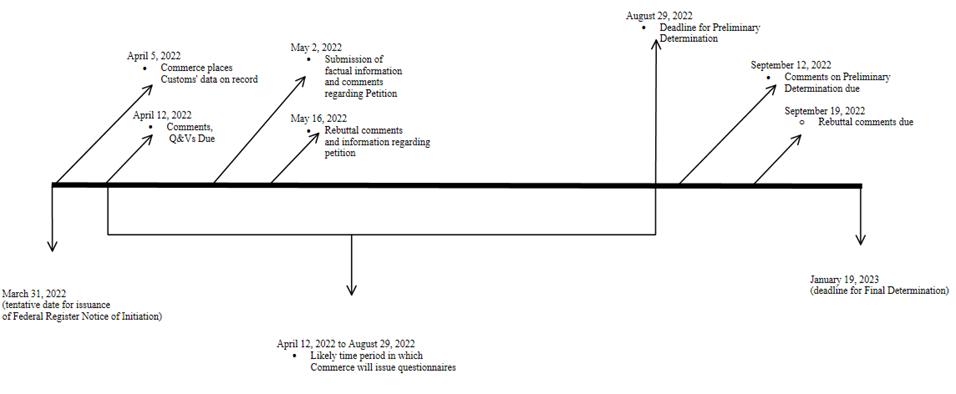
    Throughout the circumvention investigation, and as set forth in Annex A, Commerce will provide interested parties with opportunities to participate. A certain level of participation in the administrative proceedings may be necessary to preserve the right to appeal Commerce’s final determination to the US Court of International Trade.[xviii] Below, we identify several relevant events in the administrative proceeding, including some that may afford domestic interested parties[xix] the opportunity to participate in the administrative proceedings.

    Again, in calculating certain dates below, we assume that Commerce will publish the notice on March 31, 2022. Additionally, it is important to keep in mind that Commerce may, at its discretion, “alter or extend any time limits” with respect to the submission of comments and factual information.[xx]

    Preliminary and Final Determinations (August 29, 2022, and January 19, 2023). The two most important deadlines are Commerce’s deadlines for issuing the preliminary determination and the final determination. The regulations require Commerce to issue the preliminary determination within 150 days from the date of publication of the Federal Register notice.[xxi] Tentatively,[xxii] the deadline for the preliminary determination would be August 29, 2022. The statute provides that Commerce must, “to the maximum extent practicable[,]” make a final circumvention determination within 300 days of initiating the circumvention investigation.[xxiii] According to the unpublished Federal Register notice and the initiation memorandum, Commerce initiated the circumvention inquiries on March 25, 2022.[xxiv] Accordingly, the deadline for Commerce’s final determination is January 19, 2023.

    Respondent Selection (April 5, 2022, to April 12, 2022). Five days after Commerce publishes the Federal Register notice, it will begin the process of respondent selection by putting Customs’ data on the record.[xxv] Using Customs’ data and “quantity and value questionnaires[,]” Commerce will select respondents.[xxvi] While the unpublished Federal Register notice states that comments may be submitted concerning Customs’ data, it does not specify which parties are eligible to submit comments.[xxvii] If Commerce follows its practice from antidumping and countervailing duty administrative proceedings, it will allow any interested party to comment on the selection of respondents, which would provide domestic interested parties an opportunity to participate in the proceeding. The quantity and value questionnaires and any other comments on Customs’ data or respondent selection must be submitted within seven days of Commerce placing Customs’ data on the record.[xxviii]

    Questionnaires (likely between April 12, 2022, and August 29, 2022). At any time after initiating the investigation, Commerce may issue questionnaires to a “reasonable number of respondents” and verify any submissions it received.[xxix] Deadlines for responses to the questionnaires will be provided in the questionnaires themselves.[xxx] Fourteen days after Commerce receives questionnaire responses, an interested party (that is not the original submitter of the questionnaire response) may submit comments and factual information to rebut, clarify or correct information in the questionnaire response.[xxxi] Domestic interested parties may use the opportunity to comment on factual information and participate in the proceeding if they disagree with information provided in a questionnaire. Seven days after Commerce receives any such comments or information in rebuttal, the original submitter may submit additional comments and information in surrebuttal.[xxxii] While Commerce may issue these questionnaires at any point during the investigation, it is likely to issue most (if not all) questionnaires after selecting respondents but before issuing the preliminary determination.

    Comments and Information Regarding the Petition (May 2, 2022, and May 16, 2022). Within 30 days of publication of the Federal Register notice, interested parties may submit comments and factual information that rebuts, clarifies or corrects factual information in the petition.[xxxiii] Domestic interested parties may submit such comments or information and participate in the proceeding. The comments and information would tentatively be due on May 2, 2022. Fourteen days after the submission of comments and information, the petitioner is allowed an opportunity to submit comments and factual information in rebuttal.[xxxiv] Such comments and information would, tentatively, be due on May 16, 2022.

    Comments on the Preliminary Determination (September 12, 2022, and September 19, 2022). Unless Commerce specifies otherwise, 14 days after Commerce issues a preliminary determination, interested parties may submit comments on the preliminary determination.[xxxv] This represents yet another opportunity for domestic interested parties to participate in the proceeding. Seven days after Commerce receives any such comments, interested parties may submit comments in rebuttal.[xxxvi] Tentatively, those dates would be September 12, 2022, and September 19, 2022.

    Conclusion

    Given the material impact of the proposed tariff increase, the scope of suppliers impacted and the length of time of uncertainty before Commerce will indicate its decision as whether to apply retroactive tariffs to solar modules subject to the petition, we advise analyzing both (1) your current project portfolio and any projects that may be relying upon shipments of modules after October 19, 2021, to evaluate the potential impact of the petition on those projects and (2) future procurement strategy, as domestic producers of solar modules, while limited, are not subject to the potential retroactive tariffs.

    McDermott is currently assisting its clients with the aforementioned analysis and also working with its domestic supplier clients to ascertain module availability for its existing developer clients as a potential “pivot” for those impacted by Commerce’s decision.

    ANNEX A

    Authors

    Carl J. Fleming

    Partner

    Washington, DC

    David J. Levine

    Senior Counsel

    Washington, DC

    More insights

  • Current State of COVID-19 Protocols for Employers

    Current State of COVID-19 Protocols for Employers

    ARTICLE / CLIENT ALERT

    Current State of COVID-19 Protocols for Employers

    March 29, 2022

    Read time: 8 min

    Key takeaways
    Overview

    New York COVID-19 Updates

    End of COVID-19 Designation Under the New York State HERO Act

    On March 17, 2022, the New York State Commissioner of Health ended the designation of COVID-19 as an airborne infectious disease that presents a serious risk of harm to the public health under the New York Health and Essential Rights Act (“HERO Act”). Although New York employers are no longer required to implement or enforce their airborne infectious disease exposure prevention plan (“Prevention Plan”), employers must continue to comply with other requirements under the HERO Act. Employers must routinely review and update their Prevention Plan to incorporate information, guidance, and requirements issued by federal, state, and local governments. Employers must continue to ensure that each employee was given a copy of the Prevention Plan within thirty (30) days after it was created, including to new employees upon hiring, in English and in the language identified by each employee as his or her primary language. While employers are not currently obligated to re-circulate their Prevention Plan to each employee every time the Prevention Plan is updated, employers must continue to ensure that the most updated version of their Prevention Plan is included in their employee handbooks or manuals and posted in a visible and prominent location within their work sites. The HERO Act’s workplace safety committee provision (described in a previous SRZ Alert) remains unchanged and in effect. More information about the HERO Act’s requirements can be found in the New York State Department of Labor’s FAQ.

    New York’s Mask and Vaccine Mandates

    New York State lifted its Determination on Indoor Masking (“Mask Mandate”) on Feb. 10, 2022, thereby eliminating the requirement for individuals to wear a mask or provide proof of vaccination to enter indoor public places. Masks continue to be required for all healthcare settings regulated by the Department of Health and related state agencies.[1] More information about New York State’s lifting of the Mask Mandate can be found in a previous SRZ Alert.

    New York City’s COVID-19 vaccine mandate for private-sector workers (the “NYC Vaccine Mandate”) remains in effect. The NYC Vaccine Mandate, detailed in a previous SRZ Alert, requires employers to: (i) prohibit unvaccinated workers from entering their workspaces, with limited exceptions, and (ii) obtain and confidentially maintain records of COVID-19 vaccinations for each of their workers. 

    New York State lifted its statewide mask requirement and made masks optional for public and non-public schools and daycare programs on Mar. 2, 2022, and on March 7, 2022, New York City lifted its mask requirement for New York City public school students five (5) years old and older. On March 22, 2022, Mayor Eric Adams announced that he plans to make masks optional for children two (2) to four (4) years old in New York City public schools and daycare programs, effective Apr. 4, 2022.

    Federal COVID-19 Update

    OSHA

    On Jan. 26, 2022, the Occupational Health and Safety Administration (“OSHA”) withdrew its COVID-19 Vaccination and Testing Emergency Temporary Standard (“ETS”) for employers with 100 or more employees (the ETS is described in a previous SRZ Alert). Additionally, on Dec. 27, 2021, OSHA released a statement announcing that it is (i) withdrawing the non-recordkeeping requirements of a separate COVID-19 Healthcare ETS for healthcare workers, and (ii) planning to issue a final rule on protecting healthcare workers from COVID-19.[2] Otherwise, there are currently no binding federal COVID-19 protocols for most employers.

    Authored by Mark E. Brossman, Ronald E. Richman, Max Garfield, Scott A. Gold, Donna K. Lazarus and Abdulrahman Alwattar.

    If you have any questions concerning this Alert, please contact your attorney at Schulte Roth & Zabel or one of the authors.


    [1] Masks continue to be required in public transit and transportation hubs, nursing homes, adult care facilities, correctional facilities, detention centers, homeless shelters and domestic violence shelters.

    [2] On March 22, 2022, OSHA began seeking comments to be submitted online by April 22, 2022, and by a public hearing on April 27, 2022.


    This communication is issued by Schulte Roth & Zabel LLP for informational purposes only and does not constitute legal advice or establish an attorney-client relationship. In some jurisdictions, this publication may be considered attorney advertising. ©2022 Schulte Roth & Zabel LLP.

    All rights reserved. SCHULTE ROTH & ZABEL is the registered trademark of Schulte Roth & Zabel LLP.

    In depth
    Authors

    Mark E. Brossman

    Partner

    New York – 919 Third Avenue

    Ronald E. Richman

    Partner

    New York – 919 Third Avenue

    Max Garfield

    Partner

    New York – 919 Third Avenue

    Donna K. Lazarus

    Partner

    New York – 919 Third Avenue

    Abdulrahman Alwattar

    Associate

    New York – 919 Third Avenue

    More insights

  • New CFPB UDAAP Examination Manual Announces Anti-Discrimination Agenda

    New CFPB UDAAP Examination Manual Announces Anti-Discrimination Agenda

    ARTICLE / CLIENT ALERT

    New CFPB UDAAP Examination Manual Announces Anti-Discrimination Agenda

    March 24, 2022

    Read time: 12 min

    Key takeaways
    Overview

    The Consumer Financial Protection Bureau revised its Examination Manual to announce that the Bureau will pursue discrimination as an “unfair” practice under its authority to address unfair, deceptive or abusive acts or practices (“UDAAPs”). These revisions preserve all of the prior edition’s guidance while adding the Bureau’s view that discrimination qualifies as an unfair practice it has the power to correct. Although the CFPB has several nondiscrimination statutes in its toolkit, the Bureau intends to leverage its UDAAP authority to reach “situations where fair lending laws may not apply.”[1] This follows the CFPB’s commitment last year to exert its full statutory authority to root out “abusive” practices.[2] 

    The Dodd-Frank Act gave the CFPB expansive power to pursue UDAAPs in connection with consumer financial products or services.[3] An act or practice is unfair when (1) it is likely to cause substantial injury to consumers, (2) consumers cannot reasonably avoid the injury and (3) countervailing benefits to consumers or competition do not outweigh the injury.[4] 

    The Examination Manual illustrates how discrimination fits into this rubric and underscores along the way that the CFPB will take an expansive approach to UDAAP enforcement in all areas. Previously, injury meant economic harm that consumers had suffered or were likely to suffer if the act or practice continued. The revised Examination Manual highlights that the “emotional impacts or dignitary harms” of discrimination also qualify, as well as the “denial of access to products or services.”[5] The Manual states conclusively that “Consumers cannot reasonably avoid discrimination.”[6] The Manual does not specifically address how the Bureau will weigh countervailing benefits in discrimination cases, suggesting that there is no balancing to perform.

    The Examination Manual makes clear that the CFPB will use this authority to target discrimination directly, even where no other statute would allow the CFPB to intervene. “A discriminatory act or practice is not shielded from the possibility of being unfair, deceptive or abusive even when fair lending laws do not apply to the conduct. For example, not allowing African-American consumers to open deposit accounts, or subjecting African-American consumers to different requirements to open deposit accounts, may be an unfair practice even in those instances when [the Equal Credit Opportunity Act] ECOA does not apply.”[7] Where other statutes do apply, the CFPB is likely to seek relief for each violation. As an example, the Manual advises that “a discriminatory act or practice that is unfair, deceptive, or abusive may also violate other antidiscrimination laws, such as ECOA.”[8]

    Starting now, CFPB exams will collect information specifically directed at uncovering discrimination in consumer financial products and services. Among other things, all exams will gather any customer demographic information the financial institution collects, including “any demographic research or analysis related to marketing or advertising” consumer financial products and services.[9] Transaction testing is more likely to follow in the exam where there are demographic differences in the offers, terms, or availability of the entity’s products or services, marketing or customer service.[10] The CFPB will look for discriminatory outcomes regardless of whether there is any evidence of discriminatory intent.[11]

    All exams will also gather “documentation regarding the use of models, algorithms, and decision-making processes.”[12] This puts in focus algorithmic bias as a key CFPB priority. Director Chopra has asserted that “we should never assume that algorithms will be free of bias.”[13] He forecasted that the Bureau would work to uncover how algorithms work in order to root out bias in automated decision-making. “When consumers and regulators do not know how decisions are made by the algorithms, consumers are unable to participate in a fair and competitive market free from bias.”[14] The CFPB also recently released guidance on steps financial institutions can take to prevent algorithmic bias in home valuations.[15] In this regard, financial institutions are well served to conduct their own analysis to test for and address discriminatory outcomes in their products and services, including how they reach out to consumers in the first place such as digital advertising.[16]

    Financial institutions should also review their written policies and procedures ahead of their next exam. Examiners will expect financial institutions to have policies and procedures in place “to prevent discrimination” in its products and services including evaluating “all policies, procedures, and processes for discrimination prior to implementation or making changes” and on an ongoing basis.[17] Examiners will also expect financial institutions to train their customer service personnel to prevent discrimination, and ensure that the institution has the ability to take calls from consumers, including consumers with limited English proficiency.[18] Financial institutions will also be expected to demonstrate they have “a process to take prompt corrective action if the decision-making processes it uses produce deficiencies or discriminatory results.”[19]

    This relatively modest revision of the examination manual calls for financial institutions to pay close attention to traditional UDAAP concerns and now also disparate outcomes the Bureau will pursue as discrimination. The Manual calls for financial institutions to demonstrate “established policies and procedures to review, test, and monitor any decision-making processes it uses for potential UDAAP concerns” of any nature, as well as policies to mitigate the concerns it uncovers.[20] Examinations will also evaluate financial institutions’ third-party service providers, especially those who service or collect debts in ways “that lead to differential treatment or disproportionately adverse impacts on a discriminatory basis.”[21] Financial institutions should review and update their policies and compliance programs to meet these new expectations. This wave of examinations may produce enforcement actions by which the CFPB will seek to stop certain industry practices under this expansive UDAAP umbrella.

    Authored by Douglas I. Koff, Kara A. Kuchar and Noah N. Gillespie.

    If you have any questions concerning this Alert, please contact your attorney at Schulte Roth & Zabel or one of the authors.


    [1] Press Release, CFPB, CFPB Targets Unfair Discrimination in Consumer Finance (Mar. 16, 2022).

    [2] CFPB Policy Rescission Stakes Out Broad Enforcement Authority, SRZ Client Alert (Mar. 22, 2021), available at /insights/cfpb-policy-rescission-stakes-out-broad-enforcement-authority/.

    [3] Dodd-Frank Act of 2010 § 1031 (codified at 12 U.S.C. § 5531).

    [4] CFPB, UDAAP Examination Manual at 1-2 (3d ed. 2022) (“Manual”).

    [5] Id. at 2.

    [6] Id.

    [7]  Id. at 10.

    [8]  Id.

    [9]  Id. at 12.

    [10] Id. at 15.

    [11] See id. at 2 (past injury not required, only a likelihood of future injury), 7 (intent to deceive unnecessary for deception to exist).

    [12] Id. at 12.

    [13] Remarks of Director Rohit Chopra at a Joint DOJ, CFPB, and OCC Press Conference on the Trustmark National Bank Enforcement Action (Oct. 22, 2021).

    [14] Id.

    [15] CFPB, Consumer Financial Protection Bureau Outlines Options To Prevent Algorithmic Bias In Home Valuations (Feb. 23, 2022).

    [16] Manual at 16.

    [17] Id. at 13.

    [18] Id. at 14, 18.

    [19] Id. at 18.

    [20] Id. at 14.

    [21] Id. at 18.


    This communication is issued by Schulte Roth & Zabel LLP for informational purposes only and does not constitute legal advice or establish an attorney-client relationship. In some jurisdictions, this publication may be considered attorney advertising. ©2022 Schulte Roth & Zabel LLP.

    All rights reserved. SCHULTE ROTH & ZABEL is the registered trademark of Schulte Roth & Zabel LLP.


    In depth
    Authors

    Douglas I. Koff

    Partner

    New York – 919 Third Avenue

    More insights

  • OSHA Reaffirms Arrival of Permanent Healthcare Industry COVID-19 Standard

    OSHA Reaffirms Arrival of Permanent Healthcare Industry COVID-19 Standard

    ARTICLE / CLIENT ALERT

    OSHA Reaffirms Arrival of Permanent Healthcare Industry COVID-19 Standard

    March 23, 2022

    Read time: 4 min

    Key takeaways
    Overview

    On March 22, 2022, the US Occupational Safety and Health Administration (OSHA) announced a limited reopening of the rulemaking record for the COVID-19 emergency temporary standard for the healthcare industry, originally published on June 21, 2021 (the Healthcare ETS), and OSHA’s intention to hold an informal public hearing to gather certain additional information from healthcare industry stakeholders. With the announcement, OSHA reaffirmed its plans to publish a permanent COVID-19 safety standard (i.e., regulation) for the healthcare industry later this year.

    In depth

    PRACTICAL IMPLICATIONS

    As with the Healthcare ETS, the permanent regulation is intended to protect healthcare and healthcare support service workers from occupational exposure to COVID-19 in settings where people with COVID-19 can be reasonably expected to be present.

    Currently, OSHA does not have any COVID-19 focused regulations as the Healthcare ETS expired in December 2021. OSHA voluntarily withdrew its controversial “vax-or-test” ETS after the Supreme Court of the United States enjoined its enforcement in January 2022.

    However, the 2021 Healthcare ETS’s recordkeeping obligations remain in effect, which require healthcare employers to record all workplace instances of COVID-19 on the OSHA 300 logs.

    NO FURTHER CLARITY ON OSHA’S COVID-19 ENFORCEMENT INITIATIVE

    OSHA did not provide further clarification on how the permanent standard might overlap with its new enforcement initiative, effective March 9, 2022, through June 9, 2022, to increase OSHA’s presence in healthcare settings at high risk for COVID-19 transmission. It is expected that the permanent COVID-19 standard and the enforcement initiative will remain separate.

    PUBLIC COMMENTS

    OSHA will reopen the regulation for public comment from March 23, 2022, through April 22, 2022. Public comments on this rulemaking (Docket Number OSHA-2020-0004) can be submitted via the Federal e-Rulemaking Portal.

    PUBLIC HEARINGS

    The hearing will begin on April 27, 2022, and will be held virtually.

    Interested persons who intend to provide oral testimony or documentary evidence at the hearing must file a written notice of intention to appear prior to the hearing using the Notice of Intention to Appear (NOITA) web form no later than 14 days after the publication of the Federal Register Notice.

    Before the hearing, OSHA will make the hearing procedures and hearing schedule available on its website and in the rulemaking docket.

    STATE OSHA PLANS

    As with all other OSHA standards, the 22 states with OSHA-approved State Plans will be required to adopt a healthcare industry COVID-19 safety standard that is at least as protective as OSHA’s standard.

    NEXT STEPS

    Healthcare and healthcare support service employers should continuously monitor their COVID-19 safety procedures to avoid falling behind on preparations for the upcoming permanent COVID-19 safety standard. In keeping with existing standards—such as the bloodborne pathogens standard, personal protective equipment (PPE) standard, respirator rules and others—this permanent COVID-19 safety standard is expected to require employers to maintain a safety plan, provide periodic training for employees on COVID-19 safety in the workplace, and clarify PPE expectations in the COVID-19 context, among other requirements.

    Affected employers should consult with their McDermott lawyer to ensure they remain in compliance with the latest COVID-19 safety standards under OSHA and other applicable laws.

    Authors

    Abigail M. Kagan

    Partner

    New York – One Vanderbilt Avenue

    Evelyn S. Atwater

    Associate

    Chicago

    More insights

  • New York State Ends COVID-19 HERO Act Designation

    New York State Ends COVID-19 HERO Act Designation

    ARTICLE / CLIENT ALERT

    New York State Ends COVID-19 HERO Act Designation

    March 23, 2022

    Read time: 3 min

    Key takeaways
    Overview

    On March 17, 2022, New York State’s Commissioner of Health ended the designation of COVID-19 as an airborne infectious disease that presents a serious risk of harm to public health under the New York Health and Essential Rights (HERO) Act. As of that date, private sector employers in New York State are no longer required to implement their workforce safety plans.

    In depth

    The HERO Act was signed into law on May 5, 2021, and began to apply to COVID-19 as an airborne infectious disease on September 6, 2021. Employers were required to implement extensive new workplace health and safety protections in response to the COVID-19 pandemic. The purpose of the NY HERO Act was to protect employees against exposure and disease during a potential airborne infectious disease outbreak.

    Although COVID-19 is no longer designated as an airborne infectious disease covered by the HERO Act’s protections, the HERO Act technically remains available for New York State to choose to reactivate its application to COVID-19, or to apply the HERO Act to any other future airborne infectious disease that presents a serious risk of harm to public health.

    NEXT STEPS

    With COVID-19 cases continuing to rise and fall, employers should continue to watch for developments in state, local, and federal workplace health and safety regulations. As of this publication, New York City’s COVID-19 vaccine mandate for private employers remains in effect, and New York City Mayor Eric Adams has not provided any further guidance on when this mandate may be withdrawn.

    Authors

    Abigail M. Kagan

    Partner

    New York – One Vanderbilt Avenue

    More insights