













ARTICLE / CLIENT ALERT
CMS Announces Regulatory Flexibility for CLIA Laboratories
March 29, 2020
Read time: 5 min
The Centers for Medicare and Medicaid Services has temporarily modified certain operational and regulatory requirements that may help Clinical Laboratory Improvement Amendments (CLIA) certified laboratories adapt their operations in response to the Coronavirus (COVID-19) pandemic. These modifications are only in effect for the duration of the public health emergency, and all other CLIA requirements continue to apply.
On March 26, 2020, the Centers for Medicare and Medicaid Services (CMS) issued a memorandum (CLIA Laboratory Guidance During COVID-19 Public Health Emergency (QSO-20-21-CLIA)) outlining certain modifications to its implementation and enforcement of Clinical Laboratory Improvement Amendments (CLIA) requirements for clinical laboratories during the Coronavirus (COVID-19) public health emergency.
In the memorandum, CMS confirms that it does not have the authority to waive CLIA regulatory requirements, which apply to most facilities performing clinical laboratory testing for patients in the United States. As a result, the memorandum does not create a pathway for facilities to offer diagnostic testing without first receiving a CLIA certificate (and/or any clinical laboratory license that may be required under applicable state law) and complying with CLIA requirements. Nor does it modify the CLIA requirement that a facility be certified to perform high-complexity testing before performing a laboratory-developed test. However, the memorandum does temporarily modify certain operational and/or regulatory requirements that may help CLIA-certified laboratories adapt their operations in response to the pandemic.
Key takeaways from the memorandum include the following:
- Expediting Review of CLIA Applications. While a CLIA certificate continues to be required to perform diagnostic testing (including COVID-19 testing) for patients, CMS will review applications for a CLIA certificate on an expedited basis. Specifically, once a laboratory has identified a qualified laboratory director and submitted a complete CMS-116 application, CMS will issue a CLIA number. Although laboratories typically must wait to start testing until a physical copy of the CLIA certificate arrives in the mail, CMS will temporarily allow testing to begin as soon as a CLIA number is assigned to the laboratory, provided that applicable CLIA requirements have been met (i.e., performance specifications for all tests offered to patients have been established or verified, as applicable).
- Allowing Remote Review of Cytology Slides. In general, CLIA requires a separate certificate for each location where cytology slides are reviewed. To facilitate remote review of slides during the pandemic, CMS will temporarily allow pathologists to review cytology slides from a location without its own CLIA certification (e.g., a pathologist’s home), provided that the laboratory’s primary site or home base has an appropriate CLIA certification, and the work performed at the temporary location falls within the primary site’s certificate (among other requirements).
- Modifying Proficiency Testing Requirements. While laboratories must continue to comply with proficiency testing (PT) requirements, they will not be penalized for lack of PT results if a laboratory suspends performing a specific test because of a shortage of supplies, reagents or personnel, provided the laboratory documents the timeframe during which the test was not performed, and notifies the inspecting agency and the PT program of the reason for the suspension. If a PT provider postpones, cancels or suspends a PT event during the public health emergency, the laboratory will not be penalized provided the cancelation is documented (e.g., the laboratory retains the notification letter from the PT program) and PT is conducted in a timely manner once the emergency ends. Notwithstanding the above, CMS encourages laboratories to perform their own self-assessments until PT resumes as usual.
- Modifying Inspection Priorities (to Focus Primarily on “Immediate Jeopardy” Situations). CMS will generally exercise enforcement discretion for technical violations that do not put patients, laboratory professionals or the general public in “immediate jeopardy.” Under CLIA, “immediate jeopardy” means a situation where immediate corrective action is necessary because the laboratory’s noncompliance with one or more requirements has already caused, is causing or is likely to cause, at any time, serious injury or harm, or death, to individuals served by the laboratory, or to the health or safety of the general public.
CMS emphasizes that these changes to CLIA regulations are only applicable during the public health emergency. Otherwise, all CLIA regulations, except as described herein, remain in effect.






Precautions for Healthcare Providers Sourcing Personal Protective Equipment From Foreign Suppliers
ARTICLE / CLIENT ALERT
Precautions for Healthcare Providers Sourcing Personal Protective Equipment From Foreign Suppliers
March 29, 2020
Read time: 5 min
While US healthcare providers are turning to foreign suppliers and domestic middlemen to secure personal protective equipment and medical supplies (PPE), they must remain mindful and take steps to avoid fraud, ensure compliance with Foreign Corrupt Practices Act requirements, address potential import restrictions and follow good supply chain procurement practices.
As US healthcare providers scramble to secure personal protective equipment and medical supplies (PPE) in the midst of global shortages, they often are forced to transact business with foreign suppliers and domestic middlemen with which they previously have not had contact. In many cases, purchasing decisions need to be made quickly. In light of these challenging circumstances, there are a number of things that healthcare providers should be mindful of when sourcing PPE.
1. Some Suppliers Do Not Have Capacity to Fulfill Large Orders or Are Fraudulent
In some countries, factories that manufacture non-medical products are being converted quickly to manufacture medical supplies. These suppliers may not have the resources, capacity or experience to fulfill large orders. In some countries, government authorities have taken control of privately owned PPE manufacturing operations and imposed controls on exports. (For example, while the government of China has taken official action to help facilitate and control the distribution of PPE from the country through contracts with foreign governments, it has not yet entered into agreements with the United States or Canada.) Consequently, purchasers should request confirmation of the actual location of the products.
There also are real risks of fraud. Suppliers who ask for the wire of funds without documentation are likely to be fraudulent. In some countries, background checks can be run on entities to better understand their operating history and the amount of capital that has been invested in them. A company that, until two weeks ago, manufactured watch batteries and had $50,000 of capital invested in it is unlikely to be able to fulfill an order for $3,000,000 of PPE.
2. The FCPA Applies to the Procurement of PPE
The Foreign Corrupt Practices Act of 1977 (the FCPA; 15 U.S.C. §§ 78dd-1, et seq.) prohibits paying foreign government officials to assist in obtaining or retaining business, and also prohibits paying to induce a foreign official to take an official act or to act in violation of his or her lawful duty.
In order to demonstrate a healthcare provider’s compliance with the FCPA, both due diligence on the third parties facilitating the transaction (brokers, foreign suppliers, etc.) and full documentation of the purchase transaction are critical. Due diligence should include reviews of the third party’s legal status, regulatory compliance, and potential political connections.
Documentation of the transaction is extremely important for FCPA purposes, as several countries operate state-owned entities (SOEs) that control healthcare supply production and distribution and fall squarely within the ambit of the FCPA. Entering into signed contracts and issuing purchase orders that clearly show the amount of specific PPE purchased, along with the purchase price, is important. The documentation also should specify that the third parties acknowledge the existence of, understand and agree to abide by all applicable anti-bribery and anti-corruption laws, including the FCPA. If monies are paid that are not clearly accounted for and documented, the concern raised by US law enforcement will be that some of the funds could have been or were diverted to bribe foreign officials in order to obtain the PPE and its export.
One additional requirement on cross-border transactions is an OFAC Sanctions check to confirm that the recipient of any payments is not prohibited from receiving them by the US Department of Treasury. Sanctions checks should be conducted on specific entities involved in the transaction, as well as their senior officers.
3. Healthcare Providers Need to Be Mindful of Import Restrictions
If PPE is shipped but cannot be imported into the United States, it will not help a healthcare provider. When the PPE being purchased includes FDA-regulated medical devices, it is helpful to source it from companies that are currently registered with the FDA and have a history of complying with FDA regulations. Although the FDA has relaxed legal requirements to allow the importation of medical devices and PPE without an FDA clearance, sourcing products from FDA-registered entities may provide greater assurance of quality and make it easier for shipments from the supplier to clear customs.
Prior to purchasing PPE, request photographs of the actual product, the package and the shipping container. Request photographs or evidence to confirm that products meet applicable US safety standards (e.g., US FDA 510(k) clearance, certificate of manufacture demonstrating compliance with NIOSH standards). Background checks on suppliers also can be conducted to determine whether the manufacturer has an active FDA registration, has been subject to FDA compliance issues (such as recalls, warning letters and import alerts), and whether the FDA has been satisfied with the manufacturer’s responses to inspections.
4. Follow Good Supply Chain Procurement Practices to the Greatest Extent Possible
To the greatest extent possible, healthcare providers should continue to press for contractual specificity in terms of the quality and composition of the PPE that they order, requesting samples of products in advance. This includes contractual commitments to insurance, risk of loss during shipment, the timing of delivery, and the process for the return and replacement of PPE that does not meet stated specifications (including those represented in the manufacturer’s FDA clearance).

CARES Act Five-Year NOL Carryback Rules Will Have Significant Impact on M&A Transactions
ARTICLE / CLIENT ALERT
CARES Act Five-Year NOL Carryback Rules Will Have Significant Impact on M&A Transactions
March 27, 2020
Read time: 5 min
The CARES Act bring changes to the net operating loss rules that may impact completed and future corporate transactions.
The US Congress enacted The Coronavirus Aid, Relief, and Economic Security Act (the CARES Act) on March 27, 2020. This article describes the changes to the net operating loss (NOL) rules as a result of the CARES Act and the impact these changes may have on completed and future corporate transactions.
Amendments to NOL Usability
The CARES Act provides a temporary five-year NOL carryback for most taxpayers, which may entitle taxpayers to significant tax refunds. The Tax Cuts and Jobs Act of 2017 (TCJA) repealed the carryback of NOLs (but enabled taxpayers to carry forward NOLs indefinitely) and limited the deduction of NOLs to 80 percent of taxable income. Prior to the TCJA, taxpayers could carry back NOLs for two years and carry forward NOLs for 20 years to offset up to 100% of taxable income in each year.
The CARES Act provides that NOLs incurred in 2018, 2019, and 2020 may be carried back to offset taxable income earned during the five-year period prior to the year in which the NOL was incurred. The CARES Act also temporarily removes the taxable income limitation, therefore allowing taxpayers utilize NOLs to offset 100 percent of taxable income in tax years 2018, 2019, and 2020. This change affects taxpayers who are otherwise profitable but, as a result of the current COVID-19 crisis, will have a NOL for the current year. Those taxpayers will be able to carry back the current year NOL up to five years and recover income taxes paid in those years. Losses incurred in tax years beginning before January 1, 2018 may be carried forward to tax years beginning after December 31, 2020 without being subject to the 80% income limitation. In addition, as discussed below, the change may provide an opportunity for corporations that have been sold since January 1, 2018 – and, by reason of deductible transaction-related expenses, had an NOL for the year of the sale – to carry that NOL back as well.
| Prior to TCJA | TCJA | CARES Act | |
| Carryback | Two taxable years | Disallowed | NOLs incurred in 2018, 2019 and 2020 may be carried back five taxable years |
| Carryforward | Twenty taxable years | No limitation | No limitation |
| Taxable Income Limitation | NOL deduction up to 100 percent of taxable income | NOL Deduction limited to 80 percent of taxable income | In 2018-2020, NOL deduction up to 100 percent of taxable income; after 2020, NOL deduction limited to 80 percent of taxable income |
Impact on Mergers and Acquisitions
In the typical sale of a corporation in a stock purchase or merger transaction, there are many transaction-related expenses that are deductible for federal income tax purposes, including transaction-related bonuses, option cash-out payments, and portions of a corporation’s investment banker fees and legal fees. Depending on when the sale closes during the year, these deductible transaction-related expenses will often cause the corporation (which might otherwise be profitable) to have an NOL for the year. Although it is not unusual for there to be provisions in the transaction agreement that entitle the sellers to the tax benefits of these deductions – by providing that any income tax refunds relating to taxable periods ending on or before the closing date will be for the sellers’ account – these provisions had limited impact on transactions that closed after December 31, 2017. This is because of, as noted above, the changes made by the TCJA that disallowed the carryback of an NOL incurred in 2018 or thereafter. For post-January 1, 2018 transactions, any NOL attributable to deductible transaction-related expenses could only be carried forward such that, absent an agreement of the buyer to pay the seller for the benefit of any pre-closing NOLs that were utilized post-closing, the tax benefits associated with this NOL would automatically accrue to the buyer.
The CARES Act now allows for the NOL in the year of the sale (assuming the sale took place in 2018, 2019 or 2020) to be carried back up to five taxable years. Depending on the provisions in the applicable transaction agreement, sellers may now be entitled to additional cash refunds that were not previously anticipated at the time of the closing. Moreover, being able to carry back an NOL up to five years also means that some or all of taxes that are recoverable will be in years when the corporate tax rate was 35 percent rather than 21 percent, thereby increasing the value of the NOL.
Transactions involving the purchase and sale of partnerships and limited liability companies taxed as partnerships, S corporations, or, in most cases, subsidiaries of a larger consolidated group, as well as transactions structured for federal income tax purposes as asset purchases, typically will not be affected by the modification of the NOL rules in the CARES Act.
Businesses and their owners should evaluate the potential benefits of carrying back any recent NOLs and review past transaction agreements to determine how any tax refunds resulting from these CARES Act provisions should be allocated between buyers and sellers.






FDA Opens Submissions for COVID-19 IND Applications
ARTICLE / CLIENT ALERT
FDA Opens Submissions for COVID-19 IND Applications
March 27, 2020
Read time: 4 min
As part of its initiatives to expedite access to investigational drugs or biologics for the treatment of Coronavirus (COVID-19), on March 24, 2020, the US Food and Drug Administration announced that healthcare providers may seek approval to use investigational COVID-19 convalescent plasma under a single patient emergency investigational new drug application. This On the Subject looks at patient and donor eligibility and other FDA requirements.
On March 24, 2020, the US Food and Drug Administration (FDA) announced that healthcare providers (HCPs) may seek approval to use investigational Coronavirus (COVID-19) convalescent plasma under a single patient emergency investigational new drug (IND) application. Convalescent plasma, which is collected from recovered patients and contains antibodies to SARS-CoV-2, the virus that causes COVID-19, may be effective to treat COVID-19, but has not been the subject of the clinical trials required to support FDA approval.
This announcement, which follows on the heels of FDA announcements intended to facilitate access to ventilators (read more here), diagnostic tests (read more here) and vaccines (read more here) for COVID-19, is notable because it represents the agency’s first effort to expedite access to an investigational drug or biologic for the treatment of COVID-19. In the short term, however, uptake of this option may be limited as access to the diagnostic tests required to confirm donor eligibility continues to be limited.
Eligible Patients
To be eligible to receive convalescent plasma under a single patient emergency use IND, patients must have:
- Laboratory-confirmed COVID-19
- Severe or immediately life-threatening conditions, as defined by FDA for these purposes:
- “severe” is defined as involving one or more of the following:
- dyspnea
- respiratory frequency ≥ 30/min
- blood oxygen saturation ≤ 93%
- partial pressure of arterial oxygen to fraction of inspired oxygen ratio < 300
- lung infiltrates > 50% within 24 to 48 hours
- “life-threatening” is defined as involving one or more of the following:
- respiratory failure
- septic shock
- multiple organ dysfunction or failure
- “severe” is defined as involving one or more of the following:
- Provided informed consent.
HCPs who need emergency authorization (i.e., a response in less than four hours) may call FDA’s Office of Emergency Operations at 1-866-300-4374 for a verbal authorization and then must submit an expanded access application (Form 3926) to FDA at CBER_eIND_Covid-19@fda.hhs.gov within 15 working days. HCPs who need a response within four to eight hours should complete and submit a Form 3926, which includes (1) a brief clinical history (diagnosis, current therapy, rationale for the request) and (2) a description of where the HCP will obtain the donor plasma.
Eligible Donors
FDA is working with the National Institutes of Health (NIH) and the Centers for Disease Control and Prevention (CDC) to develop protocols regarding the collection and use of COVID-19 convalescent plasma. Under FDA regulations, COVID-19 convalescent plasma may be collected from recovered individuals only if they are otherwise eligible to donate blood under 21 CFR §§ 630.10 and 630.15 (e.g., the donor must be in good health and free from transfusion-transmitted infections) and the donation is found suitable under 21 CFR § 630.30 (e.g., the blood is tested in accordance with the requirements of 21 CFR § 610.40 and found negative or nonreactive and does not have bacterial contamination).
Additional considerations for donor eligibility include:
- Prior diagnosis of COVID-19, documented by a laboratory test
- Complete resolution of symptoms at least 14 days prior to donation
- Negative results for COVID-19 from at least one nasopharyngeal swab specimen or a molecular diagnostic test for blood
- Defined SARS-CoV-2 neutralizing antibody titers, if testing can be conducted
- Female donors negative for human leukocyte antigen (HLA) antibodies or male donors
Plasma containers must be labeled with “Caution: New Drug–Limited by Federal (or United States) law to investigational use.”

President Signs the CARES Act into Law
ARTICLE / CLIENT ALERT
President Signs the CARES Act into Law
March 27, 2020
Read time: 10 min
The President signed into law the CARES Act to provide tax relief, cash flow, and liquidity to businesses along with benefits to individuals. Learn how these changes will impact your business.
The President signed into law today the Coronavirus Aid, Relief and Economic Security Act (the CARES Act) to relieve economic impacts of the novel coronavirus (COVID-19), approving a number of corporate tax changes that raise planning considerations. The legislative package also provides an estimated $2.2 trillion of assistance for individuals and businesses, including direct cash payments to most Americans and multi-billion dollar loans for certain businesses.
The CARES Act includes numerous tax changes that grant tax relief and provide cash flow and liquidity to businesses. The majority of the provisions will accelerate and magnify corporate refunds for overpayments in prior years.
New Employee Retention Tax Credit
New to the final text of the Act is a refundable, one-year only credit against an employer’s 6.2 percent share of Social Security payroll taxes. Section 2301 provides that the credit will be equal to 50 percent of the qualified wages paid to each employee for an eligible quarter, capped at $10,000 of qualified wages to each employee for the duration of 2020. Eligible employers are those that carry on a trade or business during calendar year 2020 and that, with respect to a given calendar quarter, either fully or partially suspended the operation of that trade or business during the calendar quarter due to orders from an appropriate governmental authority limiting commerce, travel or group meetings (for commercial, social, religious, or other purposes) due to the COVID-19. Taxpayers may also qualify as an eligible employer if they have a trade or business during calendar year 2020 that suffers a significant decline in gross receipts, such that their gross receipts for a calendar quarter in 2020 are less than 50 percent of its gross receipts for the same calendar quarter in 2019. If a business qualifies under the gross receipts test, then it will remain qualified until it has a quarter where its gross receipts exceed 80 percent of its gross receipts for the same calendar quarter in 2019. In all cases, qualified wages will include qualified health plan expenses allocable to the wages, including amounts paid to maintain group health plans.
The definition of qualified wages hinges on the average number of full-time employees (as defined by section 4980H of the Internal Revenue Code (the “Code”)) employed by the eligible employer during 2019. For employers with more than 100 such employees, qualified wages include wages paid to an employee ONLY for the time that the employee is not providing services due to either A) a full or partial suspension of operations by order of a governmental authority or B) a significant decline in gross receipts. For employers with 100 or fewer such employees, qualified wages include wages paid to all employees, including wages paid to employees that continue to work.
Expanding Usage of Net Operating Losses
One of the more notable provisions expands the usage of net operating losses (NOLs). This expansion can provide significant immediate cash flow to certain taxpayers by relaxing limitations on taxpayers that were put in place as part of the 2017 Tax Cuts and Jobs Act (TCJA). Beginning in 2018 under the TCJA, NOLs were able to be carried forward for an indefinite period of time but were not allowed to be carried back to prior tax years. A carryback would be especially valuable to a corporate taxpayer because the applicable tax rate in tax years prior to 2018 was 35 percent (instead of the 21 percent corporate rate that applied in tax years 2018 forward). Additionally, the TCJA limited the use of NOLs to an amount that was 80 percent of taxable income, determined without regard to the NOL deduction itself.
Section 2303 of the Act provides that NOLs arising in a tax year beginning in 2018, 2019 or 2020 can be carried back five years. Unfortunately, this carryback does not apply to real estate investment trusts. For all other taxpayers, NOLs can be carried back to as far as tax year 2013, a year in which the corporate tax rate was 35 percent. It also temporarily removes the taxable income limitation, allowing an NOL to fully offset corporate-level income for years 2018, 2019 and 2020. Importantly, the 80 percent limitation is permanently eliminated for losses generated prior to 2018 and carried forward to future years. Corporations that have NOLs arising in 2018 or 2019 should be able to claim large refunds, and those that forecast an NOL for 2020 can expect additional refunds from NOLs generated.
The Act provides that if the taxpayer can carryback an NOL to a year with section 965 income, the taxpayer will be treated as having made the section 965(n) election, which excludes section 965 income from determining the amount of NOL for that year. This election was put in place to allow a taxpayer with an NOL in the section 965 year to take the foreign tax credits in such year and preserve the NOL for a future year. Alternatively, a taxpayer may elect to exclude from the carryback period any year to which section 965 applies.
In the case of a corporate taxpayer that generates foreign derived intangible income (FDII), the Act did not modify the application of NOLs to such income. That is, when calculating a taxpayer’s NOL for the years 2018 and forward the Section 250 deduction is inapplicable. Similarly, the Act has not modified the method in which NOLs interact with the calculation of the base erosion and anti-abuse tax (the BEAT). Specifically, the rules limiting the use of NOLs to calculate taxable income for BEAT purposes and the rules applicable to adding back certain NOLs to calculate modified taxable income remain applicable.
Modified Limitation of Losses for Pass-Through Entities and Individuals
The Act allows non-corporate taxpayers to fully utilize their excess business losses by temporarily – and retroactively – turning off section 461(l) for tax years beginning after December 31, 2017 and before January 1, 2021. The TCJA’s enactment of section 461(l) disallowed deductions for “excess business losses,” which were defined as the excess of the taxpayer’s deductions over their aggregate gross income plus $250,000 ($500,000 if married filing jointly). These excess losses were converted to NOL carryovers under section 172, which often did not allow for efficient loss utilization. Note that the loss limitation applies to partnerships and S corporations at the partner or shareholder level.
Section 2304’s retroactive halt on section 461(l) will allow taxpayers that had losses limited in 2018 or 2019 to file an amended return to claim a refund. The Act also provides that any deductions, gross income or gains attributable to a trade or business of performing services as an employee shall be disregarded when computing excess business losses, effectively legislating that wages will not be considered business income – an issue that the IRS and the Joint Committee on Taxation had disagreed upon.
Relaxed Section 163(j) Interest Expense Limitation
The Act increases the amount of interest expense businesses are allowed to deduct under section 163(j). This will allow businesses to incur more debt enabling them to pay employees and maintain cash flow during the pandemic without incurring a limitation on the amount of interest deducted. Specifically, for tax years 2019 and 2020, section 163(j) is modified to allow taxpayers to deduct 50 percent, as opposed to 30 percent, of an amount that approximates the taxpayer’s EBITDA. Specifically, section 163(j) allows a deduction for interest expense for the years 2019 and 2020 to the extent the expense does not exceed 50 percent of the taxpayer’s EBITDA, business interest, and certain floor plan financing interest. Additionally, the Act provides a special rule for partners of partnerships that were allocated excess business interest for tax year 2019. This could be especially beneficial to private equity and venture capital fund investors who were allocated excess business interest in tax year 2019. In such case, 50 percent of the 2019 allocated excess business interest income would not be subject to Code Section 163(j) limitations. Finally, recognizing that the amount of EBITDA in the year 2020 may be little or non-existent due to the COVID-19 global pandemic, the Act allows taxpayers to use their 2019 tax year EBITDA to determine the 50 percent interest deduction limitation. Presumably, a taxpayer’s 2019 EBITDA would be significantly greater than its 2020 EBITDA so that more interest expense would be deductible.
Modification to Qualified Improvement Property
Section 2307 of the Act corrects the so-called “retail glitch,” allowing restaurants, retail shops and hotels the ability to immediately deduct costs associated with their qualified improvement property (QIP). The TCJA intended to allow these businesses immediate write-offs for costs associated with their QIP; instead, the final text mistakenly failed to classify such property as having a 15-year recovery period, causing companies to depreciate their improvement costs on a 39-year depreciation schedule.
The Act includes technical corrections that clarify that QIP is classified as 15-year property under the modified accelerated cost recovery system (20-year property for alternative depreciation system) and eligible for 100 percent bonus depreciation. In addition, this Section will take effect as though it were originally enacted in the TCJA. As a result, subject to certain requirements, businesses can immediately amend their 2018 and 2019 tax returns to claim the one-time QIP deductions that were disallowed for their 2018 and 2019 tax years.
Delayed Payment of Employer Payroll Tax and Self-Employment Tax
Section 2302 of the Act allows deferral of an employer’s and a self-employed individual’s payment of the employer share of the social security tax they otherwise are responsible for paying to the federal government with respect to their employees or self-employment activities. Employers are generally responsible for paying a 6.2 percent social security tax on employee wages. The deferral period lasts from the date of the enactment of the Act until December 31, 2020. The provision requires that the deferred social security tax be paid over the following two years, with half of the amount required to be paid by December 31, 2021 and the other half by December 31, 2022. Provided these taxes are paid by these deadlines, the employer will be treated as having made timely payments. Importantly, the social security tax trust funds will be held harmless under this provision.
Other Provisions
Section 2305 allows corporations to elect to immediately claim the entirety of their outstanding alternative minimum tax (AMT) credits, a portion of which would not have otherwise been available until 2021. The Act also temporarily suspends the excise tax applied on alcohol used to produce hand sanitizer.
The Act also includes a number of individual income tax provisions. Among others, the Act waives early withdrawal penalties for COVID-19 related distributions from qualified retirement accounts, removes the required minimum distribution rules for certain defined contribution plans and IRAs, allows above-the-line deductions for up to $300 of charitable contributions, and entirely removes the charitable contribution limitations for individuals that itemize.
In addition to the tax relief provisions, the Act includes specific economic relief for businesses, offering $377 billion in federally guaranteed loans to small businesses to cover their debt obligations and guaranteeing $500 billion in loans and loan guarantees for at-risk industries, including airlines and cargo carriers.
The Act also includes relief measures for individuals. It authorizes the Internal Revenue Service to issue checks of as much as $1,200 per person ($2,400 for joint-filers). Payments would be phased in for low-income taxpayers and phased out for individuals with adjusted gross income over $75,000 ($150,000 for joint filers). It also provides for an additional $500 per child. In addition, Senate Democrats successfully negotiated for key unemployment provisions, offering an additional 13 weeks of federally sponsored benefits and extending payments to freelancers and gig workers.
The final text of the Act does not address several key provisions that Senate Republicans had initially proposed, including the restoration of certain downward attribution rules under Section 958(b)(4) that had been removed by the TCJA. If that technical correction had been included, it would have significantly decreased the number of companies that are treated as controlled foreign corporations for U.S. tax purposes, generally reducing the effective tax rate for multinationals based in the U.S. Separately, although Republican’s initial proposal had called for the delay of certain corporate and individual estimated tax payments, the IRS has since issued Notice 2020-18, which obviates the need for that provision.



FDA Issues Enforcement Policies for Face Masks and Respirators; Emergency Use Authorization for Ventilators
ARTICLE / CLIENT ALERT
FDA Issues Enforcement Policies for Face Masks and Respirators; Emergency Use Authorization for Ventilators
March 27, 2020
Read time: 13 min
This post was updated on April 9, 2020 to include recent developments.
In a series of notices and enforcement-policy statements, the FDA has announced additional efforts to address the critical shortage of face masks, filtering facepiece respirators (FFRs) and ventilators in response to the Coronavirus (COVID-19) public health emergency. This On the Subject reviews these recent policy announcements, to help healthcare providers understand which devices may or may not be used for medical and non-medical purposes, and to clarify certain product labeling requirements, the criteria for requesting emergency use authorizations, and other issues.
On March 25, 2020, the US Food and Drug Administration (FDA) announced additional efforts to address the critical shortage of face masks, filtering facepiece respirators (FFRs) and ventilators in response to the Coronavirus (COVID-19) public health emergency. On April 2, 2020, FDA issued a revised Enforcement Policy for Face Masks and Respirators During the Coronavirus Disease (COVID-19) Public Health Emergency (Revised) (“Enforcement Policy”) to increase access to face masks, face shields, surgical masks, and particulate FFRs (including N95 respirators) for healthcare professionals (HCPs). The agency also published an updated FAQ that outlines the agency’s efforts in plain language. FDA will allow individuals and healthcare providers to distribute certain non-FDA-cleared, non-medical face masks and respirators when no FDA-cleared alternatives are available. Perhaps most notably, the agency explicitly states that for the duration of the pandemic, when FDA-cleared or NIOSH-approved N95 respirators are not available, FDA does not intend to object to the importation and use of alternative respirators, including KN95 respirators, if they are on the Centers for Disease Control and Prevention’s (CDC) list of respirator alternatives. FDA is not enforcing premarket clearance requirements and other FDA requirements for FDA-regulated medical face masks, face shields or surgical masks, provided the masks meet certain labeling, technical and safety requirements. The agency also is not enforcing premarket clearance for surgical masks intended to provide liquid and particular barrier protection, provided they meet specified labeling, technical and safety requirements.
In addition, FDA described the criteria for obtaining Emergency Use Authorizations (EUAs) for reprocessing single-use or otherwise disposable FFRs and distributing surgical face masks and N95 respirators. On March 28, 2020, the agency also issued a Notice to Manufacturers of Imported, Non-NIOSH-Approved Disposable Filtering Facepiece Respirators to allow importation of certain FFRs that are not approved by the Centers for Disease Control and Prevention’s (CDC) National Institute for Occupational Safety and Health (NIOSH). As a follow-up to its previous Ventilator Enforcement Policy, FDA provided information on how to obtain an Emergency Use Authorization for ventilators, anesthesia gas machines modified for use as ventilators, and positive pressure breathing devices modified for use as ventilators.
Enforcement Policy for Face Masks and Respirators
Face Masks and N95 Respirators Not Intended for a Medical Purpose
FDA clarifies that it does not have jurisdiction over face masks, face shiels and respirators that are marketed to the general public for general, non-medical purposes (e.g., construction, industrial use) and, as such, the requirements of the Federal Food, Drug, and Cosmetic Act (FDCA) and its implementing regulations do not apply to such masks, shields and respirators. FDA also clarifies that it intends to exercise enforcement discretion to permit “individuals, including healthcare professionals” (but not companies) to distribute and use improvised personal protective equipment (PPE) when no alternatives, such as FDA-cleared masks or respirators, are available.
Face masks and FFRs that are intended for medical purposes are FDA-regulated devices (e.g., those regulated under 21 C.F.R. §§ 878.4040 and 880.6260). FDA will consider factors, such as labeling and promotional claims, intended users and modifications (e.g. anti-microbial agents), to determine whether face masks and FFRs are intended for medical purposes. Factors associated with a medical purpose include:
- The product is labeled, marketed or distributed for use by a HCP.
- The product is labeled, marketed or distributed for use in a healthcare facility or environment.
- The product includes any drugs, biologics, or anti-microbial or anti-viral agents.
Therefore, manufacturers and distributors should pay particular attention to labeling, promotional claims and other representations to avoid confusion between face masks for personal use and FDA-regulated masks for medical settings. FDA clarifies that the policy does not apply to other categories of FDA-regulated face masks, such as those used for oxygen, gas or for humidifier purposes.
Face Masks, Face Shields and Surgical Masks Intended for a Medical Purpose
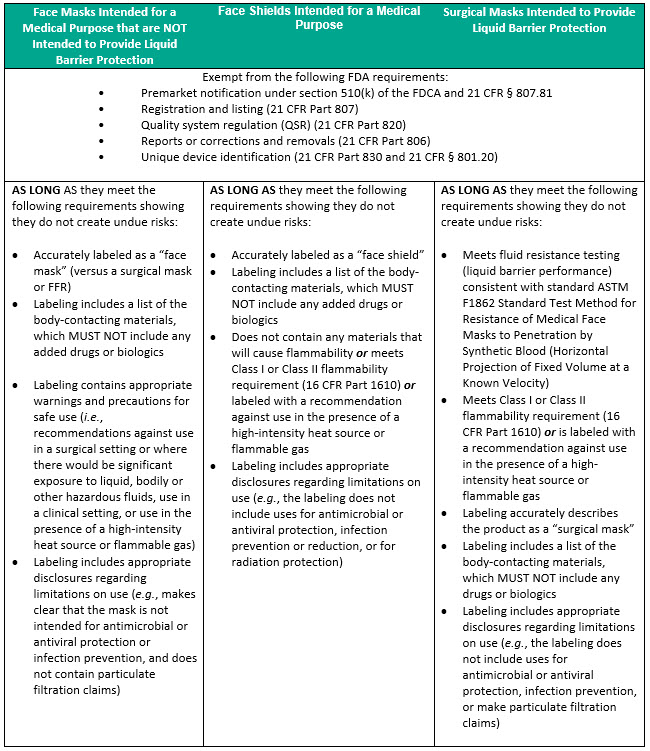
FDA is allowing the distribution and use of certain medical device requirements for FDA-regulated face masks, with or without a face shield (not including respirators), face shields and surgical masks if manufacturers and distributors implement defined measures to prevent undue risks. FDA will not enforce premarket notification (510k), registration and listing, quality system regulation (QSR) requirements, reports or corrections and removals requirements, or unique device identification (UDI) requirements for medical face masks and surgical face masks if the masks contain appropriate warnings and meet other criteria to prevent undue risks to health. For face shields, FDA clarifies that the face shields are “class I devices exempt from premarket notification requirements under 510(k)” and that FDA will not enforce registration and listing, QSR requirements or UDI requirements for the shields.
The enforcement policy applies to (1) face masks intended for a medical purpose (whether used by the general public or health care professionals) that are not intended to provide liquid barrier protection (not including respirators), (2) face shields intended for a medical purposes, and (3) surgical masks intended to provide a liquid and particulate materials barrier protection provided the masks do not provide undue risk as defined by the agency (see below):
Emergency Use Authorizations (EUAs) for Masks and Respirators
FDA also sets forth its intended approach to EUAs for masks and respirators, specifically (1) EUAs for decontaminating otherwise disposable face masks, and (2) EUAs for face masks intended for a medical purpose, surgical face masks and N95 respirators. Prospective applicants should carefully review FDA’s suggested information for submission to the CDRH-COVID19-SurgicalMasks@fda.hhs.gov email address.
FDA EUA Notice Regarding Non-NIOSH-Approved Disposable FFRs
In order to address the respirator shortage in light of the COVID-19 public health emergency, FDA has issued two EUAs allowing non-NIOSH-approved disposable filtering facepiece respirators (see Non-NIOSH-Approved Disposable Filtering Facepiece Respirators (Non-NIOSH-Approved FFRs EUA) and Non-NIOSH-Approved Disposable Filtering Facepiece Respirators Manufactured in China (Non-NIOSH-Approved Chinese FFRs EUA)).
Non-NIOSH-Approved Disposable Filtering Facepiece Respirators
The Non-NIOSH-Approved FFRs EUA only applies to those authorized respirators listed in Exhibit 1 of the EUA or authorized respirators in Exhibit 1 that have been decontaminated. In order to be added to Exhibit 1, the respirators must meet one of the two criteria outlined in the Non-NIOSH-Approved FFRs EUA:
- Criteria 1: Disposable FFRs that have been designed, evaluated and validated to meet a given performance standard and have corresponding acceptable product classifications, as follows:
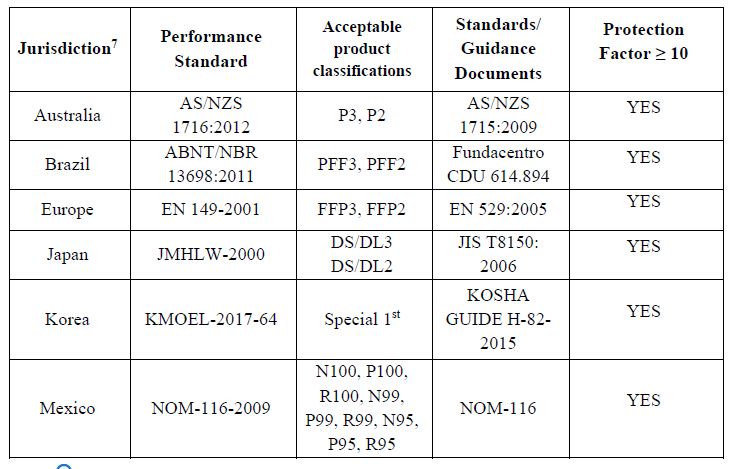
(See EUA, Table 1)
- Criteria 2: Disposable FFRs which have a marketing authorization in one of the following regulatory jurisdictions:
- European CE Mark
- Australian Register of Therapeutic Goods (ARTG) Certificate of Inclusion
- Health Canada Licence
- Japan Pharmaceuticals and Medical Device (PMDA)/Ministry of Health Labour and Welfare (MHLW)
If a manufacturer or importer wants to add an authorized respirator to Exhibit 1, the entity must send a request to FDA by email to CDRH-NonDiagnosticEUA-Templates@fda.hhs.gov of their intent to import non-NIOSH-approved disposable respirators that are eligible for authorization under either (or both) of the two criteria described in the EUA. Manufacturers or importers of non-NIOSH-approved FFRs should carefully review the EUA for the information required for submission via email to the FDA. Notably, the EUA did not include FFRs manufactured in China.
FDA also provides a mechanism to ask FDA to include other non-NIOSH-approved masks by emailing CDRH-NonDiagnosticEUA-Templates@fda.hhs.gov with the following information: manufacturer, model number(s), marketing authorizations (if any), applicable performance standards, estimated number for import, certificate(s) of conformity (if applicable) and a copy of product labeling.
Non-NIOSH-Approved Disposable Filtering Facepiece Respirators Manufactured in China
In response to a continued shortage of respirators, on April 3, 2020, FDA issued a new EUA for Non-NIOSH-Approved Disposable Filtering Facepiece Respirators Manufactured in China. Under this Non-NIOSH-Approved Chinese FFRs EUA, additional respirators, including KN95 respirators, are eligible for authorization if certain criteria are met. The Non-NIOSH-Approved Chinese FFRs EUA only applies to those authorized respirators listed in Appendix A of the EUA or authorized respirators in Appendix A that have been decontaminated. In order to be added to Appendix A, the respirator must meet one of the following criteria outlined in the Non-NIOSH-Approved Chinese FFRs EUA:
- Manufactured by an entity that holds one or more NIOSH approvals for other models of FFRs produced in accordance with the applicable standards of authorization in other countries that can be verified by FDA
- Has a regulatory authorization under a jurisdiction other than China that can be authenticated and verified by FDA
- Demonstrates acceptable performance to applicable testing standards as documented by test reports from a recognized independent test laboratory that can be verified by FDA
If a manufacturer or importer would like to add respirators to Appendix A as an authorized respirator under this EUA, they must send a request to FDA with the subject line “FFRS Made in China” to CDRH-NonDiagnosticEUATemplates@fda.hhs.gov. The request must contain the information outlined in the EUA, so interested entities should carefully review the EUA to determine what information must be submitted to FDA.
General EUA Information
For both EUAs, manufacturers must have a process in place for handling adverse event reports and sending these reports to FDA as well as for maintaining records that can be held for inspection by FDA upon request. The FDA notice also includes specific requirements for importers who repackage or relabel the product. Finally, labeling should be consistent with CDC recommendations for use during the COVID-19 public health emergency and not represent or suggest the product is safe or effective for the prevention of COVID-19.
Alternatives When FDA-Cleared or NIOSH-Approved N95 Respirators Are Not Available
Under the revised Enforcement Policy, when FDA-cleared or NIOSH-approved N95 respirators are not available, FDA is allowing the distribution (including importation) and use of respirators identified in the CDC recommendations (e.g., KN95 respirators) without compliance with the following FDA requirements: premarket notification (510k), registration and listing, QSR, reports or corrections and removals, or UDI. Notably, the respirators allowed under the revised Enforcement Policy now include KN95 and KP95 respirators from China. For a full list of alternative acceptable products, see CDC’s Strategies for optimizing the Supply of N95 Respirators; Crisis//Alternate Strategies. FDA encourages importers to take appropriate steps to confirm the authenticity of their imported products.
Steps for Manufacturers or Importers of Respirators
Based on our review of the revised Enforcement Policy and EUAs, we suggest the following steps for manufacturers or importers seeking to import respirators into the United States.
First, the interested entity should determine if the respirator is covered under the Enforcement Policy by checking if it is identified by product classification in CDC’s recommendations for alternatives to NIOSH-approved respirators. If the respirator is included in the CDC’s recommendations, the entity can import the product to the United States without further action during the COVID-19 public health emergency.
If the entity is an importer and the respirator is not included in the CDC’s recommendations, the importer should then review the appropriate EUA to determine whether the manufacturer and respirator are listed in the EUA. If they are listed, the importer will be able to import the respirators into the United States.
- For respirators manufactured anywhere other than China, the importer should review Exhibit 1 of the Non-NIOSH-Approved Disposable Filtering Facepiece Respirators EUA.
- For respirators manufactured in China, entities should review Appendix A of the Non-NIOSH-Approved Disposable Filtering Facepiece Respirators Manufactured in China.
If the respirators are not listed in the EUAs, manufacturers or importers interested in importing the products to the United States should review the criteria in the appropriate EUA to determine if the respirator would be eligible for authorization under the EUA. If the respirators meet the criteria in the applicable EUA, the entity may then submit a request to FDA with the required information to have the products authorized under the EUA. Once FDA reviews the information and authorizes the respirators under the EUA, the entity can import them to the United States.
Emergency Use Authorization for Ventilators
FDA also announced its EUA for ventilators, “authorizing the emergency use of ventilators, anesthesia gas machines modified for use as ventilators, and positive pressure breathing devices modified for use as ventilators (collectively referred to as ‘ventilators’).” The EUA is limited to specifically listed authorized ventilators, ventilator tubing connectors, and ventilator accessories listed in Appendix B of the EUA. The current version of the EUA does not contain Appendix B. FDA is aware of the omission and we expect that the agency will update the guidance soon.
The only ventilator products that are currently eligible under the EUA are (1) those that are not currently marketed in the United States, or (2) those that are currently marketed in the United States but to whom a modification would normally trigger the requirement for a new 510(k) premarket notification. (In a separate communication, FDA noted that they remain open to the possibility of approving an EUA for companies that do not currently manufacture any medical devices, but such products would not appear eligible under the current version of the EUA).
Manufacturers may ask FDA to add additional ventilators, ventilator tubing connectors or ventilator accessories to the EUA by submitting information to CDRH-COVID19-Ventilators@fda.hhs.gov for FDA’s assessment. Submissions should include the following information:
- Contact information, general information about the device, and marketing authorizations in other countries, including country of origin (if any)
- A copy of product labeling
- Whether the device currently has a marketing authorization in another regulatory jurisdiction
- Whether the device has been designed, evaluated and validated in accordance with FDA-recognized standards for such devices
- Whether the device is manufactured in compliance with FDA’s Quality System Regulation (QSR), or ISO 13485, or other internationally recognized quality management systems
- Whether the device is designed with a US-compatible power supply (i.e., voltage, frequency, plug type standards) or is accompanied with an appropriate adapter
- Information sufficient to demonstrate that the device meets the criteria for safety performance and labeling set forth by FDA.
Additionally, ventilators must be accompanied by a fact sheet for HCPs and a fact sheet for patients, respectively, regarding the emergency use of the ventilators during the COVID-19 pandemic, collectively known as “authorized labeling.” Manufacturers must also have a process in place for collecting and reporting adverse events to FDA under the reporting requirements in 21 CFR Part 803, and they must maintain records associated with the EUA (e.g., inventory control, distribution records) which they must make available to FDA for inspection upon request. The requirements to provide authorized labeling and maintain records also apply to authorized distributors of the devices.
Any advertising for ventilators, ventilator tubing connectors, or ventilator accessories must clearly and conspicuously state each of the following:
- “This ventilator, ventilator tubing connector, or ventilator accessory (as applicable) has not been FDA cleared or approved”
- “This ventilator, ventilator tubing connector, or ventilator accessory (as applicable) has been authorized by FDA under an EUA”
- “This ventilator, ventilator tubing connector, or ventilator accessory (as applicable) is authorized only for the duration of the declaration that circumstances exist justifying the authorization of the emergency use of ventilators, ventilator tubing connectors, and ventilator accessories under section 564(b)(1) of the Act, 21 U.S.C. § 360bbb-3(b)(1), unless the authorization is terminated or revoked sooner.”
Quarantining Deal Risk in the COVID-19 Era: A Buyer’s Checklist
ARTICLE / CLIENT ALERT
Quarantining Deal Risk in the COVID-19 Era: A Buyer’s Checklist
March 27, 2020
Read time: 5 min
As the effects of the Coronavirus (COVID-19) crisis ripple through the global economy, buyers contemplating—or in the process of negotiating—an acquisition can and should take measures to contain and handle deal risk prior to signing.
The outbreak and rapid spread of Coronavirus (COVID-19) has affected businesses across a plethora of industries and threatened the global economy. As health organizations and governments around the world are working to contain COVID-19 and cure the infected, what measures can buyers take to contain and treat deal risk prior to signing?
Given current uncertainty regarding both the short-term and long-term effects of COVID-19, below is a checklist of key considerations for buyers with respect to COVID-19 era transactions.
_____Extensive Diligence: Take the Target’s Temperature
1. Analyze key contracts with respect to termination and force majeure clauses in order to understand the circumstances under which the target (or counterparty) may suspend or terminate performance as a result of COVID-19’s impact.
2. Perform a detailed review of supply chains (for example, raw material suppliers, distributors, wholesalers, retailers and end consumers) to understand their geographic scope and to assess exposure to potential disruption.
3. Review the target’s existing insurance policies for business interruption terms.
4. Evaluate compliance with existing and new regulations relating to the epidemic, including with respect to employment matters. Seek to understand potential relevant changes in law.
_____Attempt to Cure Purchase Price Uncertainty
1. The potential short-term and long-term impact of COVID-19 creates an extra challenge when valuing a target.
2. To help mitigate uncertainty, consider purchase price mechanisms such as earnouts, milestone payments, coronavirus-related holdbacks, adjustments to net working capital and rollover equity.
_____Provide Protection through Representations and Warranties
1. Require disclosure of all material impacts to the business relating to the virus.
2. Examples of such impacts may include the status of material contracts, customers, suppliers and other business relationships, the accuracy of financial statements (including the adequacy of reserves), data privacy controls (notably, with respect to an increase in remote working), employee layoffs, regulatory compliance, pending litigation, inventory, and any current precautions or business continuity plan as a response to the pandemic.
_____“Social Distance” from Representation and Warranty Insurance Policy Exclusions
1. Expect that insurers will exclude losses arising from COVID-19. Attempt to narrowly tailor the language of any proposed exclusions, including by limiting them to specific concerns and jurisdictions.
2. Should a policy exclude such losses, consider excluding coronavirus-related representations and warranties from indemnification deductibles and caps or adding a special escrow.
_____MAC Carve-outs: Stop the Spread
1. A well-drafted material adverse condition (MAC) clause should provide the buyer with a broad walk-away right from the transaction if the target’s business suffers materially due to the impact of the virus.
2. Leave no ambiguity and explicitly reference COVID-19 as a MAC, or include terms such as “pandemic,” “epidemic,” “outbreak of disease” or “public health event.” Push back if the seller includes any of the above terms as a carve-out to the MAC clause.
3. Potential compromises may include accepting a coronavirus carve-out except to the extent it has a disproportionate effect on the target as compared to other participants in the target’s industry, deciding how long or the extent to which the negative impact of the virus on the target’s business must continue in order to constitute a MAC. or the buyer accepting the level of harm caused by the pandemic at the time the deal is signed, but not a material worsening of such harm after signing.
_____Diagnose Risk in Interim Operating Covenants
1. Expect that sellers will negotiate heavily any interim operating covenants to take into account any steps taken in response to or in anticipation of the outbreak or worsening of the virus.
2. Resist any major changes to ensure that the target is operating consistently with past practices and normal, day-to-day operations, or otherwise that such carve-outs are minimal in scope.
_____Prescribe Appropriate Closing Conditions
1. In addition to including the nonoccurrence of a MAC as an express closing condition, consider other relevant closing conditions that will protect you if the business of the target deteriorates before closing.
2. Examples may include no termination of or receipt of notice to terminate under the target’s most significant contracts, no government interference in the business of the target (for example, through the invocation of the Defense Production Act), no closure of key facilities of the target or of key members of the target’s supply chain, or no adoption of any law imposing restrictions on the operations of the target or a target’s major customer or supplier related to COVID-19.
_____Treat Deal Timelines with Flexibility
1. Expect that, more likely than not, your deal timeline will be delayed and be prepared for such a delay. Possible sources of delay include travel restrictions and delays in obtaining financing or regulatory approvals.
2. Limit or eliminate in-person meetings in favor of conference calls or video conferences. Evaluate the necessity of site visits and the possibility of virtual site visits. Request an “outside date” that is further out or provide for its extension.



Preparing for the Aftermath of COVID-19: The Investigations
ARTICLE / CLIENT ALERT
Preparing for the Aftermath of COVID-19: The Investigations
March 27, 2020
Read time: 9 min
As the US federal government dedicates trillions of dollars toward containing and treating Coronavirus (COVID-19) and stimulating the national economy, it is also waiving many federal health program requirements to allow providers greater flexibility in addressing the pandemic. When the dust settles, however, the use of these dollars and actions taken under loosened restrictions will likely come under increased scrutiny. Providers should practice good compliance hygiene now to stave off potential False Claims Act claims and other alleged violations of federal and state rules and regulations.
Introduction
In recent weeks, the federal government has dedicated trillions of dollars toward containing and treating Coronavirus (COVID-19) and stimulating the economy in response to the pandemic. It also has waived many federal health program requirements to allow providers to have greater flexibility in combatting the virus. When the dust settles, however, government actors will scrutinize the use of those dollars with the help of potential relators who witness provider misconduct. During these challenging times, healthcare providers must remember to practice good compliance hygiene. With federal funds comes federal scrutiny, so providers should be ever vigilant about complying with governmental rules and regulations to stave off potential allegations of false claims in the future.
Impending Governmental Scrutiny
The federal False Claims Act (FCA) has been an often-used tool for relators and governmental enforcement authorities to bring claims against recipients following national crises—whether to penalize universities that received funds from the Department of Veterans Affairs under the post-9/11 GI Bill or contractors failing to perform work for which they receive Hurricane Katrina relief funds.
Healthcare fraud and abuse has been an area of focus for FCA enforcement for many years. In 2019, of the $3 billion recovered by the Department of Justice due to FCA settlements and judgments, $2.6 billion was related to the healthcare, life sciences and pharmaceutical industries, making it the 10th year in a row that healthcare-related recoveries exceeded $2 billion. We anticipate this will continue in 2020 and expand to include COVID-19 due to $2 million allocated to the Department of Health and Human Services (HHS) Office of Inspector General (OIG) for oversight of activities supported with funds appropriated to HHS as part of the Coronavirus Preparedness and Response Supplemental Appropriations Act.
That money may have already been put to use. On March 20, 2020, Attorney General Barr urged the public to report COVID-19-related fraud schemes by calling the National Center for Disaster Fraud, and all US Attorneys were directed to appoint a coronavirus fraud coordinator to serve as the legal counsel overseeing the prosecution of district COVID-19-related crimes and to conduct outreach and awareness. Almost immediately thereafter, on March 22, DOJ filed its first enforcement action in the Western District of Texas against Austin-based operators of “coronavirusmedicalkit.com,” alleging that the website was a wire fraud scheme that offered customers access to COVID-19 vaccine kits in exchange for a $4.95 shipping fee, which would be charged to customers’ credit cards. And on March 23, OIG published a fraud alert warning beneficiaries about “fraudsters” targeting them for fraudulent tests or other services.
Keeping the “Care” in Healthcare
On March 3, 2020, the DOJ announced the launch of a National Nursing Home Initiative to investigate nursing home complaints about providing substandard care to nursing home residents. With increasing public scrutiny of nursing homes during the COVID-19 pandemic, especially as it relates to the quality of care provided, providers are at higher risk of investigations or whistleblower suits under the FCA. One potential FCA claim that DOJ and relators have explored in recent years is the “worthless services” claim. As we discussed previously, claimants bringing a “worthless services” claim under the FCA must establish that the services were of such a quality that they were equivalent to no services. Although “worthless services” continue to receive serious court scrutiny, and claimants face high hurdles, at least one court has held that a provider may violate the FCA by making a “knowing request of federal reimbursement for a procedure with no medical value.” (See U.S. ex rel. Mikes v. Strauss, 274 F.3d 687, 702 (2nd Cir. 2001)).
Following the deaths of several individuals from COVID-19 in the Life Care Center in Kirkland, Washington, CMS Administrator Seema Verma posed several questions that the federal government may ask providers where adverse outcomes were excessive: “Were there some breaches of protocol? Was this facility following the guidelines that are in place? Was there handwashing? Were they changing gloves? Were they doing laundry appropriately? Was food handled appropriately?” Under Medicare rules, hospitals, nursing homes, and other facilities are obligated to provide a sanitary environment to avoid the transmission of infections and communicable diseases. (See, e.g., 42 CFR § 482.42; 42 CFR § 483.80). Medicare Conditions of Participation (CoPs) impose certain quality of care standards that providers must meet to participate in the program. Failure to adhere to CoPs may result in administrative sanctions, exclusion from federal health care programs, corrective action plans and other reporting requirements. CMS also imposes emergency preparedness obligations on providers and suppliers as a Medicare CoP. (See Appendix Z of the Medicare State Operations Manual.)
It is unclear whether a violation of a CoP relating to emergency preparedness could constitute the basis for a false claim. As we have reported previously, a court reviewing this issue would ask if CMS would consider the violation to be material to its decision to make payment. (See Universal Health Services v. United States ex rel. Escobar, 136 S. Ct. 1989 (2016)). Based on past experience, a Medicare provider’s lack of emergency preparedness compliance is not, alone, likely to give rise to FCA liability. Still, evidence that a facility met the emergency preparedness CoPs should be a strong defense against any such allegations. Furthermore, CMS has instructed surveyors not to cite facilities based on emergency preparedness CoPs for the three weeks that began on March 20, 2020.
Provider and Contracting Matters
Following President Trump’s declaration of a national emergency, the Secretary of HHS issued a broad Section 1135 waiver that authorized certain blanket waivers of requirements related to Medicare, Medicaid and the Children’s Health Insurance Program (CHIP). The current 1135 waiver treats Stark Law as a “case-by-case” waiver, meaning individual providers need to apply for a waiver. However, CMS has publically stated that it is considering issuing a blanket national Stark Law waiver soon.
As we discussed previously in our On the Subject: Section 1135 Waivers Now Available, But Some Waivers May Require Approval, CMS may approve other waivers on a case-by-case basis. CMS typically will review individual waiver requests and respond within three days, but given the volume of waiver requests in response to COVID-19, the process may take longer. Stakeholders such as the American Hospital Association have recommended that enforcement of the Anti-Kickback Statute (AKS) should be temporarily suspended during these challenging times as well.
This situation is very fluid, with developments every day from the government. The problem, of course, is that providers who submit a case-by-case waiver request may face the difficult decision of whether to take action to address medical emergencies before CMS’s final approval. As CMS and other agencies continue to promulgate guidance related to COVID-19, and as states also apply for Section 1135 waivers, there may be confusion about which requirements are still in effect and which ones are waived. Further, even if a provider receives a federal waiver, there may also be state laws or regulations that are as restrictive, if not more stringent, that would need to be waived to proceed. Providers should continue to monitor the changing landscape of regulations to prevent violations of federal requirements that may give rise to FCA claims later on.
Finally, as we discussed previously in our On the Subject: Executive and Physician Compensation, Benefits and Contract Issues in the COVID-19 Era, hospitals and health systems should be prepared for rapid decision-making on physician employment issues, including compensation adjustments, retention arrangements and hiring decisions. Organizations may need to consider executing agreements to retain current healthcare workers and hire new ones to manage the expected surge in hospital capacity. In addition, physicians are starting to request rent abatements or forgiveness for space leases and other financial assistance from health systems due to the dramatic drop in patient services, especially elective procedures.
When decisions are made quickly, it can be tempting to deviate from traditional guidelines and approval processes. However, organizations should continue to maintain compensation discipline and document the reasons behind deviating from the established compensation practices or making changes to existing arrangements, even during an emergency. Contemporaneous documentation explaining why an arrangement was necessary to deliver care, or why an arrangement needed to be changed due to these exigent circumstances, is critical preparation for the inevitable inquiries by the government and relators in the future. This does not mean every request by a physician or other provider or supplier can be granted without risk under the Stark Law and AKS. Organizations need to properly evaluate the reasonableness of the request or arrangement in light of the existing regulatory framework.
Furthermore, some valuation firms have been considering applying a “hazard pay” concept to physicians and other health care practitioners who are placing themselves in harm’s way by treating patients during the pandemic. Obtaining guidance on this issue contemporaneously can help avoid or blunt inquiries in the future.
Mitigation Steps
As the dust settles, enforcement and scrutiny will follow. For these reasons, providers should continue to practice good compliance hygiene:
- Maintain diligent, contemporaneous records regarding accounting and spending of federal funds.
- Document, in real-time, deviations from policies. Demonstrate when actions were taken to save lives or continue care delivery because there was no reasonable alternative.
- Follow government instructions. When an oral instruction or answer to a question is provided, document the details of the conversation contemporaneously, including the name of the government official.
- Adhere to proper billing and coding rules when submitting claims for COVID-19 tests and treatments.
- When possible, revise policies and procedures to address the changing circumstances of COVID-19.
- Consider seeking permission (e.g., Section 1135 waivers).
- Make information accessible to employees and contractors on proper fraud, waste and abuse compliance and provide key compliance training to new providers as needed.
- Build up the internal audit function to monitor claims for appropriateness before submission and evaluate audit plans to take into account changed circumstances during COVID-19.
Taking such measures will help providers ensure that they have a road map of the action that they took and why—precisely the kind of road map that will prove useful to stave off government investigations and whistleblowers.



COVID-19 – FAQ’s for Landlords and Tenants in Germany
ARTICLE / CLIENT ALERT
COVID-19 – FAQ’s for Landlords and Tenants in Germany
March 27. 2020
Read time: 7 min
A number of important questions arise for landlords and tenants following last week’s approval by the German Federal Council of certain planned changes in tenancy and insolvency law as part of the COVID-19 pandemic package of measures. In our FAQ’s we have answered what we consider to be the most important questions.
1. Is the tenant entitled to withhold rental payments due to the COVID-19 pandemic?
No. The “Law to mitigate the consequences of the COVID-19 pandemic” (“Gesetz zur Abmilderung der Folgen der COVID-19-Pandemie“), passed on March 27 2020, does not provide for a moratorium regarding lease agreements.
2. Can the landlord terminate the lease agreement if the tenant does not pay the rent or does not pay it in full due to the COVID-19 pandemic?
At first, no. The landlord’s right of termination for rent arrears occurring in the period of April 1 2020 to June 30 2020 is excluded until June 30 2022 if the rent arrears are due to economic effects of the COVID-19 pandemic. Starting from June 30 2020, tenants have two years to make up any rent arrears. Termination due to any outstanding rent arrears is only possible from July 1 2022. Termination due to arrears of payment from earlier periods or for other reasons is still possible.
3. Can the landlord make use of the rent security provided by the tenant if the tenant does not pay the rent due to the COVID-19 pandemic?
Yes. The legal moratorium does not apply to rental claims, i.e. in general the tenant still has to pay the rent regularly. If the tenant does not pay on time, default interest becomes due and the tenant must compensate the landlord for any damage caused by the default. In the event of late payment, the landlord may also make use of his rent securities (bank guarantee, landlord’s lien et seq.). For entrepreneurs, the statutory default interest rate per year for rental debts is nine percentage points above the base rate, i.e. currently 8.12 % p.a.
4. What regulatory instruments are available to the parties of a lease agreement for temporary adjustments during the Corona crisis?
The economic impact of the COVID-19 pandemic affects both landlords and tenants. From the landlord’s point of view, the main criticism is that there is no legal moratorium on commercial real estate financing. At the same time, tenants are threatened with insolvency. There are various conceivable regulatory instruments to make the effects of the COVID-19 pandemic more manageable for both parties. These include deferral of rent payments, a temporary reduction of rent, possibly combined with graduated or turnover-related rent or the agreement of additional rent securities (e.g. group guarantees).
5. Does a deferral of rent or a reduction of rent require an addendum to the lease agreement or is a simple letter sufficient?
A deferral or reduction of rent should be documented in a formal addendum to the lease agreement in order to exclude any termination risks due to written form defects. A deferral agreement does not only affect the rent payment modalities, which may be adjusted for a short period of time even without a formal addendum, but also temporarily restricts the landlord’s right to terminate the lease agreement for cause. In this respect, an addendum should be concluded in order to comply with the statutory written form requirement.
The McDermott team will be happy to assist you with the preparation and implementation of appropriate addenda to the lease agreement.
6. Can the landlord demand additional rent securities from the tenant in case of a crisis?
In general, no. The landlord may be entitled to a right to refuse performance with regard to the handover of the leased premises if the handover has not yet taken place. However, in order to do so, it must have become apparent after conclusion of the lease agreement that the tenant will not be able to pay the rent. The tenant may avert the landlord’s right to refuse performance by providing a security.
7. Can the tenant demand an adjustment of his lease agreement due to the COVID-19 crisis?
At most, the lease agreement may be adjusted based on the legal institution of the “Disturbance of the basis of the agreement” (“Störung der Geschäftsgrundlage“). In particular, an adjustment would require that the circumstances that have become the basis of the lease agreement and have seriously changed are not attributable to the risk area of one party. Taking into account that the tenant as operator of his business generally bears the risk of use as well as the entrepreneurial risk, and the hitherto rather negative or reserved attitude of the Federal Supreme Court (“Bundesgerichtshof“) towards the application of this legal institution, a corresponding adjustment of the lease agreement should be viewed rather critically. Either way, a case-by-case assessment is necessary. It cannot be ruled out that – at least in the event of a further aggravation of the COVID-19 crisis – the view that an adjustment of the lease agreement is worth considering may prevail.
8. In case of lease agreements that are subject to value added tax (“VAT”): Does the landlord have to pay the VAT to the tax authority even if the rent is not paid?
In principle, the landlord must first pay the VAT to the tax authority even if the tenant does not pay the rent. If the tenant does not pay permanently (e.g. due to insolvency) or if the rent is reduced, the landlord can reclaim the VAT considering certain formalities. It is still unclear whether the (potentially interest-free) partial deferral of tax payments, which are to be granted on application due to the COVID-19 pandemic, also a plies to the landlord’s VAT. The same applies to the deferral of enforcement measures for defaulting VAT.
9. Is the Corona pandemic a case of force majeure?
The case law on travel agreements affirmed cases of force majeure in the event of epidemics. It is therefore likely that the prevailing COVID-19 pandemic may also be classified as force majeure. In its decree of March 23 2020 on issues arising in construction agreements in connection with the COVID-19 pandemic, the Federal Ministry of the Interior (“Bundesinnenministerium“) also states that the COVID-19 pandemic can be considered as a case of force majeure. However, this does not apply in general and should be examined individually. In case of affirmation, force majeure would not automatically lead to, for example, an extension or adjustment of rental time limits or obligations. This would require a corresponding contractual provision.
10. What action can tenants take against the closure orders?
Tenants can lodge appeals against the closure orders of the federal states (“Bundesländer“) and municipalities. However, the lodging of such appeals would not automatically lead to closure orders being temporarily suspended until clarification.
Even in the case of lawful closure orders, tenants may be entitled to certain compensation claims against the public authorities in individual cases and under specific conditions. These compensations may cover, for example, ongoing operating and remuneration costs.
11. Does the tenant have to file for insolvency if they can no longer meet their payment obligations due to the COVID-19 crisis?
The draft of the “Law to mitigate the consequences of the COVID-19 pandemic” provides (in principle) for a suspension of the obligation to file for insolvency until September 30 2020. This does not apply if the insolvency is not due to consequences of the COVID-19 pandemic or there is no chance of eliminating the inability to pay. In these cases, the obligation to file for insolvency and the (criminal) legal consequences of late filing remain in force. The law provides for a (rebuttable) presumption that the insolvency is based on the effects of the COVID-19 pandemic and that there is a chance of eliminating the inability to pay if the company was not illiquid as of December 31 2019.




COVID-19 Considerations for US and European Public Companies
ARTICLE / CLIENT ALERT
COVID-19 Considerations for US and European Public Companies
March 27, 2020
Read time: 24 min
The Coronavirus (COVID-19) pandemic and the responses of governments and societies to the crisis are having a profound impact on public companies and capital markets worldwide. Such companies, including those in the United States and the European Union, must make real-time decisions regarding shareholder meetings, proxy statements, securities filings and other matters informed by relevant regulatory bodies. The following provides an in-depth examination of many of these issues.
The outbreak of the Coronavirus (COVID-19) pandemic, as well as governmental and societal responses, is having a profound impact on public companies and capital markets around the world. As circumstances continue to evolve on an hour-by-hour basis, the following is intended to provide a general list of disclosure requirements and guidance that public companies should consider.
Considerations for US Companies
COVID-19 has directly impacted the ability of many domestic public companies to complete annual reports on Form 10-K and has dramatically impacted annual shareholder meeting planning and proxy statement preparation. The anticipated impact of the virus on 2020 results is also leading public companies to withdraw or update guidance and revisit management discussion and analysis (MD&A), risk factor and any other forward-looking disclosure in their upcoming periodic reporting. Real-time decisions being made by reporting companies in response to this crisis may also trigger Form 8-K disclosure. General counsel and chief legal officers are also quickly revisiting insider trading plans and considering closing trading windows that might otherwise be open given the anticipated impacts of the virus.
SEC Relief Regarding Inability to Make Timely Exchange Act Filings
On March 25, 2020, the Securities and Exchange Commission (the SEC) issued an Order (the SEC Order) under Section 36 of the Securities Exchange Act of 1934 (the Exchange Act) providing conditional relief for certain publicly traded companies and other persons from specified obligations to file or furnish information to the SEC. As a result, public companies may seek an extension on their filing deadlines, if, as a result of the circumstances surrounding COVID-19, they are unable to timely file a Form 10-K, Form 10-Q, proxy materials or other specified Exchange Act filings.
The conditional relief is granted with regard to requirements to file or furnish materials with the SEC for the period from and including March 1, 2020, to July 1, 2020, and applies to obligations under Exchange Act Sections 13(a), 13(f), 13(g), 14(a), 14(c), 14(f), 15(d) and Regulations 13A, 14A, 14C and 15D, and Exchange Act Rules 13f-1 and 14f-1, as applicable. Relief is not available with regard to persons required to file a Schedule 13D or amendments to Schedule 13D. The relief provides a 45-day extension to the original filing date.
In order to qualify for the relief, a company or person must be unable to meet the applicable filing deadline due to circumstances related to COVID-19. Further, if a company is seeking relief, that company should furnish the following information or exhibits to the SEC on a Form 8-K or a Form 6-K, as applicable, by the filing deadline:
- A statement that the company is relying on the SEC Order
- A brief description of the reasons why the company could not meet its filing obligations, which reasons should be based on circumstances related to COVID-19
- An estimated date by which the company expects to meet its filing obligation
- If appropriate, a risk factor explaining the impact of COVID-19 on the company’s business, to the extent such impact would be materialIf the company’s inability to meet its filing obligation is related to the inability of a person other than the company to provide an opinion, report or certification that is required in order to meet such filing obligation, a signed statement by such person stating the reasons why such required opinion, report or certification cannot be provided in time to meet the filing obligation, which the company shall have attached as an exhibit to the Form 8-K or Form 6-K as applicable.
When a registered company or other person relying on the relief makes a filing under the extended deadline, such filing should include disclosure including a statement that the filer is relying on the SEC Order and the reasons why the filer could not meet its filing obligations by the original filing date. A public company relying on the SEC Order would not need to file a Form 12b-25 so long as the filing is made within the time period prescribed by the SEC Order. In addition, those companies may further rely on Rule 12b-25 if they are unable to file a required report on or before its extended due date.
The SEC Order supersedes an Order issued by the SEC on March 4, 2020, that provided the same conditional relief from filing obligations but only covered the period from and including March 1, 2020, to April 30, 2020.
SEC Guidance Regarding Shareholder Engagement and Virtual Annual Meetings
On March 13, 2020, the SEC issued guidance to public companies and other market participants with regard to upcoming annual shareholder meetings. The guidance addresses certain scenarios and circumstances whereby a public company may decide to change the date, time or location of its annual meeting or forgo an in-person meeting in favor of a virtual meeting. The guidance is intended to promote the timely dissemination of accurate and clear proxy disclosures as required by the federal securities laws while preserving shareholder voting rights.
Specifically, to the extent that a public company has not yet mailed and filed its definitive proxy materials, it should consider whether to include disclosures regarding the possibility that the date, time or location of the annual meeting may change due to COVID-19.
If a public company has already mailed and filed its proxy materials, a change in the date, time or location of such annual meeting, or a change from an in-person meeting to a virtual or hybrid meeting, can be effected by completing the following steps:
- Issuing a press release that announces the change
- Filing the announcement as definitive additional soliciting material on EDGAR
- Taking all reasonable steps necessary to inform proxy service providers, the appropriate national securities exchange and other relevant agents and participants of such change.
The SEC staff will take the position that such actions, if taken promptly and sufficiently in advance of the meeting, constitute adequate notice to shareholders of the changes. In other words, the public company would not be required to take further action such as amending its proxy materials and mailing additional soliciting materials.
In addition, the SEC emphasized that the conduct of a company’s shareholder meetings, including the propriety of holding a virtual or hybrid meeting, is generally governed by state law and the governing documents of the company. Thus, public companies contemplating a virtual or hybrid meeting should, as an initial matter, confirm the applicable requirements under state law. If, due to hardships resulting from the outbreak of COVID-19, a shareholder proponent or representative is not able to present in person a shareholder proposal that otherwise meets the timeliness and procedural requirements for consideration at such meeting, the staff, pursuant to Exchange Act Rule 14a-8(h), will likely consider such hardship as “good cause” for the proponent’s absence and will not consider such absence as a basis for exclusion of proposals submitted by the proponent for consideration at future meetings.
SEC Relaxing Signature Requirements of Rule 302(b) of Regulation S-T
On March 24, 2020, the staff of the SEC’s Division of Corporation Finance, the Division of Investment Management, and the Division of Trading and Markets announced that, in light of the COVID-19 outbreak, it will ease enforcement of the signature retention requirements of Rule 302(b) of Regulation S-T. Rule 302(b) requires that each signatory to an electronically filed document manually sign such document. The electronic filer must retain the manually signed document for five years and provide the SEC with copies of such document upon request. The staff stated that, although all persons subject to Rule 302(b) of Regulation S-T should continue to comply with its requirements to the fullest extent practicable, due to circumstances arising from COVID-19 the staff understands that some persons may experience difficulties satisfying such requirements.
Thus, the staff stated that it will not recommend enforcement action with respect to the signature requirements of Rule 302(b) if the following conditions are met:
- A signatory retains the manually signed document and provides such document, as promptly as reasonably practicable, to the filer
- The document specifies the date and time when the signature was executed
- The filer establishes and maintains policies and procedures governing this process.
The statement also suggested that a signatory provide to the filer an electronic record (such as a photograph or PDF) of such document when it is signed, with the manual signature being provided to the filer as soon as practicable.
SEC Guidance Regarding COVID-19-Related Disclosure
On March 25, 2020, the SEC’s Division of Corporation Finance issued CF Disclosure Guidance: Topic No. 9, which addresses COVID-19-related disclosure. Among other topics, the guidance provides questions for public companies to consider when assessing and disclosing the impact of COVID-19 on their businesses, including:
- How has COVID-19 impacted your financial condition and results of operations? In light of changing trends and the overall economic outlook, how do you expect COVID-19 to impact your future operating results and near- and long-term financial condition? Do you expect that COVID-19 will impact future operations differently than how it affected the current period?
- How has COVID-19 impacted your capital and financial resources, including your overall liquidity position and outlook? Has your cost of or access to capital and funding sources, such as revolving credit facilities or other sources, changed, or is it reasonably likely to change? Have your sources or uses of cash otherwise been materially impacted? Is there a material uncertainty about your ongoing ability to meet the covenants of your credit agreements? If a material liquidity deficiency has been identified, what course of action has the company taken or proposed to take to remedy the deficiency? Consider the requirement to disclose known trends and uncertainties as it relates to your ability to service your debt or other financial obligations, access the debt markets, including commercial paper or other short-term financing arrangements, maturity mismatches between borrowing sources and the assets funded by those sources, changes in terms requested by counterparties, changes in the valuation of collateral, and counterparty or customer risk. Do you expect to disclose or incur any material COVID-19-related contingencies?
- How do you expect COVID-19 to affect assets on your balance sheet and your ability to timely account for those assets? For example, will there be significant changes in judgments in determining the fair-value of assets measured in accordance with US Generally Accepted Accounting Principles (GAAP) or International Financial Reporting Standards (IFRS)?
- Do you anticipate any material impairments (e.g., with respect to goodwill, intangible assets, long-lived assets, right of use assets, investment securities), increases in allowances for credit losses, restructuring charges, other expenses or changes in accounting judgments that have had or are reasonably likely to have a material impact on your financial statements?
- Have COVID-19-related circumstances such as remote work arrangements adversely affected your ability to maintain operations, including financial reporting systems, internal control over financial reporting, and disclosure controls and procedures? If so, what changes in your controls have occurred during the current period that materially affect or are reasonably likely to materially affect your internal control over financial reporting? What challenges do you anticipate in your ability to maintain these systems and controls?
- Have you experienced challenges in implementing your business continuity plans or do you foresee requiring material expenditures to do so? Do you face any material resource constraints in implementing these plans?
- Do you expect COVID-19 to materially affect the demand for your products or services?
- Do you anticipate a material adverse impact of COVID-19 on your supply chain or the methods used to distribute your products or services? Do you expect the anticipated impact of COVID-19 to materially change the relationship between costs and revenues?
- Will your operations be materially impacted by any constraints or other impacts on your human capital resources and productivity?
- Are travel restrictions and border closures expected to have a material impact on your ability to operate and achieve your business goals?
Disclosure responding to these questions and other narrative disclosure regarding the impact COVID-19 may be most appropriate in sections of an annual and/or quarterly report dealing with business operations and financial performance. Item 303 of Regulation S-K, which is incorporated into MD&A, requires a public company to discuss its financial condition, changes in financial condition and results of operations. It further requires a discussion of events, trends or uncertainties that are reasonably likely to have a material effect on its results of operations, liquidity or financial condition, or that would cause reported financial information not to be necessarily indicative of future operating results or financial condition.
Many companies are focusing on disclosures relating to liquidity, not only with regard to continuing operations but also with maintaining covenant compliance under credit facilities. The guidance addresses a broader scope of activities impacted by COVID-19. Companies are encouraged to consider the broader impact that may result from current and expected trends, including travel restrictions, interrupted supply chains, shelter-in-place requirements, paid leave for workers and closure of corporate offices. Each company should closely consider the trends that it can identify and the potential impact on business operations.
The guidance also addressed areas where COVID-19 will likely have an impact on the ability of public companies to report their earnings and financial results. Accordingly, public companies are encouraged to proactively address financial reporting issues. Where a GAAP financial measure is not available at the time of an earnings release because of COVID-19 related issues, companies may reconcile a non-GAAP financial measure to preliminary GAAP results that include either (1) provisional amounts based on a reasonable estimate, or (2) a range of reasonably estimated GAAP results. However, in filings where a GAAP financial measure is required (Form 10-K or 10-Q), companies should reconcile to GAAP without the provisional amounts or range of reasonably estimated results.
Risk Factor Disclosure
Many companies are reconsidering their risk factor disclosure in light of COVID-19.
Much like other risks to a business, the risks posed by COVID-19 and the response to COVID-19 depend upon the business of each reporting company and the range of harm that such incidents could cause to such company. Such risk disclosure should specifically consider the nature, extent and magnitude of the company’s exposure to the effects of COVID-19. While the materiality of COVID-19 risks and incidents at this point is likely unquestionable, the SEC staff generally expects public companies tailor and contextualize their risk disclosure and avoid using boilerplate or generic language that could apply to any company.
It is also important to remember the lessons learned from the SEC’s settled enforcement action against Mylan in October 2019. In that case, the SEC reinforced that it was misleading to portray things as “risks” that are already actually occurring. Therefore, companies that are currently experiencing the impacts of COVID-19 on their operations, including through supply chain disruptions, should be clear not to characterize such impacts as “potential,” if they are, in fact, actual.
Companies should also consider whether COVID-19 has a material impact on other risk factors that may have already been included as part of its Form 10-K disclosures. For example, the response to COVID-19 has led to a sharp rise in telecommuting that has placed a tremendous strain on company IT systems.
Risk factor disclosure is required in Form 10-Ks and may be included in Form 10-Qs as well. As discussed above, the SEC Order providing filing deadline extensions also asks companies to consider risk factor disclosure in the Form 8-Ks or Form 6-Ks that they file to perfect such relief, and several companies so far have included COVID-19 risk factors in the Form 8-Ks filed to announce the delay in filing their Form 10-Ks.
Other Disclosure Considerations
- Corrections and updates. As circumstances related to COVID-19 change on an hour-by-hour basis, companies should consider whether they have a duty to correct statements if it is determined that they were untrue (or omitted a material fact necessary to make the disclosure not misleading) at the time (for example, if the company subsequently discovers contradictory information that existed at the time of the initial disclosure), or a duty to update disclosure that becomes materially inaccurate after it is made (for example, when the original statement is still being relied on by reasonable investors).
- Forward-looking information. The SEC has emphasized that statements, to the extent they contain “forward-looking statements,” would be subject to the safe harbor under Exchange Act, Section 21E. This would include statements regarding known trends or uncertainties regarding COVID-19.
- Insider trading. Given the rapid pace of developments related to COVID-19, the SEC has repeatedly emphasized the obligations of reporting companies and corporate insiders with regard to trading in a company’s securities. On March 23, 2020, co-directors of the SEC’s Division of Enforcement issued a statement warning public companies with knowledge of material non-public COVID-19 risks or incidents to refrain from trading in their own securities and to implement procedures to prevent corporate insiders from trading. Many GCs and chief legal officers are considering event-driven blackouts for insider trading in light of COVID-19.
- Regulation FD. The SEC staff has also repeatedly emphasized the prohibitions of Regulation Fair Disclosure (FD) with regard to selective disclosure of material non-public information and warned companies to avoid the selective disclosure of COVID-19 risks or incidents. Accordingly, companies should seek the advice of counsel prior to communicating with stakeholders about COVID-19 and its impact on business.
Form 8-K Disclosure Events Precipitated by COVID-19
Companies should keep in mind that the following actions taken in response to COVID-19 may trigger a disclosure obligation under Form 8-K:
- Material drawdowns under lines of credit or other borrowing facilities (Item 2.03 –Creation of Direct Financial Obligations)
- Plant closures or layoffs (Item 2.05 – Costs Associated with Exit or Disposal Activities)
- Intra-period asset or goodwill impairment determinations (Item 2.06 – Material Impairments).
Takeover Considerations – Poison Pills
The drop in stock prices has many corporate raiders gearing up for an increase in their hostile takeover activities. Companies should analyze their vulnerability to potential activist threats and the adequacy of their takeover defenses. One solution includes putting a poison pill plan “on the shelf” to deploy in response to an unwanted rapid accumulation of the company’s stock in the market or via tender offer. A poison pill, or stockholders’ rights plan, is also designed to protect the company’s stockholders from coercive or abusive takeover tactics and to seek to ensure that stockholders will receive a fair and adequate price if the company is sold. A rights plan accomplishes this goal by giving negotiating leverage to a company’s board of directors and giving the board more control over the timing of responses to unsolicited bids. Because the adoption of a poison pill can adversely impact a company’s ISS rating, many companies prepare the documentation for a rights plan and put the plan “on the shelf” to be adopted in the face of an active threat.
Impact on Capital Markets
For the first time since 1997, severe market volatility triggered multiple uses of circuit breakers that halted trading across the entire stock markets. In addition, for the first time in its history and in an effort to adjust to the COVID-19 pandemic, the New York Stock Exchange (the NYSE) moved to fully electronic trading on March 23, 2020, and closed the iconic Wall Street floor. The NYSE emphasized that all trading and regulatory oversight of all NYSE-listed securities will continue without interruption.
The Nasdaq, which is already a fully electronic stock exchange, published a response to the SEC Order on March 6, 2020, clarifying that Nasdaq-listed companies impacted by the pandemic that satisfy the conditions in the SEC Order will not be deemed to be deficient under certain Nasdaq rules.
Stock Plan Issues – Grant Practices
For an analysis of the impact COVID-19 will have on 2020 equity grant practices, please see the document posted on our Coronavirus Resource Center, COVID-19 FAQs: For Employee Benefits & Executive Compensation.
Considerations for European Companies
The same issues apply in respect of companies listed in Europe generally, including on the Euronext markets, the London Stock Exchange and other European markets. Companies must continue to comply with their fundamental obligations and must continue to maintain systems and control disclosures in respect of inside information to the public as soon as possible through the correct regulatory channels.
Relief Regarding Inability to Make Timely Filings
In Europe, pursuant to the Market Abuse Regulation, which is applicable throughout the EU, any knowledge of the epidemic’s significant impact on activity, performance or outlook must also be disclosed immediately. Given the uncertainty surrounding the future development of COVID-19, several EU regulators recommended that issuers periodically re-assess their estimated and anticipated impact on their activity and outlook with respect to their materiality and/or amount and that the newly sensitive nature of certain information (e.g., geographical areas of activity, production, outsourcing, supply, employees concerned) be communicated when issuers present their annual results.
In Germany, stock corporations need to assess the extent to which actual and potential effects of COVID-19 need to be included in commercial financial reporting. It may be necessary to include a supplementary report in the appendix to the financial reporting or a risk report in the (consolidated) management report. The preparation of the annual financial statements may be delayed.
Guidance Regarding Annual Meetings
Considerable simplifications were agreed upon for German and French stock corporations, respectively, by the German and French governments for the annual general meeting. For example, in Germany the companies now have the entire fiscal year to hold the annual meeting instead of the eight months otherwise required. In France, an additional delay of up to three months has been granted to issuers expected to publish their accounts for the periods ended December 31, 2019, or, at the latest, one month after the end of the COVID-19 crisis period, as such sanitary crisis period is determined by the French government. In addition, in both countries, the annual meeting can now also be held virtually with no physical meetings being required. The conditions for convening shareholders and board meetings have also been simplified and the possibilities for appeals due to formal defects have been greatly reduced.
Risk Disclosure
Analysis will need to be conducted in the context of fundraisings on European markets, where companies will need to have an understanding of the impact of COVID-19 on the company’s business to ensure that the prospectus includes all information that is material to an investment decision and to ensure that that information is accurate in all material respects. Regulators will expect risks to be specific to the issuer (and not simply generic boilerplate) and drafted on the basis of the material risks and strengths identified in due diligence. In volatile markets, issuers should also pay particular attention to their undertakings in relation to the information contained in the prospectus and any associated termination rights in underwriting agreements.
In this context, the German federal financial supervisory authority, for example, has issued a statement warning potential investors to review whether the information on COVID-19 contained in market letters and other advertising publications is accurate.
Financial Support
Companies with international operations should inform themselves about financing and other support made available by authorities in individual countries where they operate. For instance, in the United Kingdom, the government and the Bank of England have announced the Covid Corporate Financing Facility, under which the Bank of England will purchase commercial paper with a maturity up to one year issued by domestic or foreign companies that make a material contribution to the United Kingdom’s economy, provided they were in sound financial health before the crisis.
Further, the European Central Bank has announced that it will provide additional funds in the amount of EUR 750 billion via an emergency purchase program for bonds (Pandemic Emergency Purchase Programme, PEPP) in order to mitigate the economic consequences of COVID-19. The program runs until the end of 2020 and concerns securities of the public and private sector.
Other Disclosure Considerations
- In the context of companies listed on the London Stock Exchange, issuers must bear in mind that their obligations remain even if there are significant falls in share prices across the market. The obligation to disclose price-sensitive information captures upward price changes as well as downward changes and so companies should consider whether they are better prepared for, or less susceptible to, the impact of coronavirus than the market understands (for example, because they are diversifying or re-purposing products or services).
Like all other companies listed on EU markets, German listed companies are obliged to publish information that is not publicly known and which has the potential to have a significant impact on the share price. The German federal financial supervisory authority published, with regard to COVID-19, that in case an issuer must assume with sufficient probability that existing forecasts will be significantly missed, it must be assumed that this qualifies as insider information. If there are identifiable effects on the net assets, financial position or results of operations such that the business figures deviate significantly from their relevant benchmark, this may be subject to a filing requirement. The German federal financial supervisory authority pointed out that due to the current strong price fluctuations, it may be more difficult to examine the considerable potential for influencing the share price.
In France, the French Securities regulator (Autorité des marchés financiers, AMF) also indicated that even if there is no precise information to be disclosed, issuers disclosing their outlook for 2020 to the market are invited to communicate which assumptions they used in preparing this outlook, in respect of the potential impacts of COVID-19. Also, it indicated that the impacts of COVID-19 should be considered, if necessary, in the financial statements for the year ended December 31, 2019, as a post-closing event requiring disclosures, and where applicable, on the issuers’ future financial statements, for example, with regard to the valuation of their inventories.
Impact on Capital Markets
Following several 24-hour short-selling bans imposed, respectively, by the Italian, Spanish, French and Belgian securities regulators solely on certain issuers’ stock that had fallen by more than 10% in the previous day, the same local securities regulators took in mid-March 2020 unprecedented emergency measures to ban short selling for periods ranging from one month (France, Spain, Belgium and Greece) to three months (Italy) on all stocks listed on the respective local markets over which such regulators have jurisdiction.
An emergency short-selling prohibition, for a period of one month (from March 18 to April 16, 2020) was, for example, enacted by the AMF of France on all transactions that might constitute or increase net short positions on shares admitted to trading on Euronext French trading venues for which the AMF is the relevant competent authority as well as to all related instruments relevant for the calculation of the net short position. The ban applies to transactions executed both on a trading venue or over the counter (OTC) and applies to any natural or legal person domiciled or established within the EU or in a third country. This measure does not, however, apply to market-making activities, trading in index-related instruments or short positions entered into hedge positions on convertible bond or subscription rights.
The pan-European securities regulator that oversees the work of the EU local securities regulator, the European Securities and Markets Authority (ESMA), for the first time ever considered in separate opinions that these extended-period proposed bans by, respectively, the Italian, Spanish, French, Belgian and Greek local securities regulators were “justified by current adverse events or developments which constitute a serious threat to market confidence and financial stability” and “appropriate and proportionate to address the existing threat to market confidence” in these respective national markets.
Separately, under the 2012 EU Short Selling Regulation, ESMA also and for the first time made use of its emergency powers under Article 28 of said regulation to temporarily lower short selling reporting thresholds throughout the EU. Considering that lowering the reporting threshold is a precautionary action that, under the exceptional circumstances linked to the ongoing COVID-19 pandemic, is essential for authorities to monitor developments in markets, ESMA required during a three-month period starting on March 16, 2020, the holders of net short positions in shares traded on an EU-regulated market to notify the relevant national securities regulator if the position reaches or exceeds 0.1% of the issued share capital after the entry into force of the decision (against 0.2% under existing regulations).
The temporary transparency obligations apply to any natural or legal person, irrespective of their country of residence. They do not, however, apply to shares admitted to trading on a regulated market where the principal venue for the trading of the shares is located in a third country, to market making or stabilisation activities.
The German federal financial supervisory authority has also issued a note on the scope of the short-selling bans of other authorities in Europe and exempted instruments relating to the indices Euro STOXX 50®, STOXX® Europe 600, MSCI Europe, MSCI EMU and the Index Euro STOXX® Banks. The rationale is that the responsibility for these instruments lies with the German financial supervisory authority and other EU authorities may not include these instruments in their short-selling measures.
From a more general perspective, the German financial supervisory authority has announced that it will adapt its supervisory practices and measures in light of COVID-19. It is intended to adopt a flexible approach and relieve banks in particular at an operational level. This shall enable banks to focus on the operational maintenance of their business operations and on lending to the real economy.




