














ARTICLE / CLIENT ALERT
Algorithms, AI and Proxy Discrimination: Insurance Regulators Continue to Examine Private Passenger Auto Insurance; Homeowners and Life Insurance Up Next
July 21, 2022
Read time: 6 min
As insurers and managing general agents (MGAs) increasingly use artificial intelligence (AI), machine learning (ML) and various forms of Big Data in decision-making related to product design, marketing, rating/underwriting, fraud detection and claims handling, the National Association of Insurance Commissioners (NAIC) and state regulators are continuing to take a closer look at how insurers and other regulated entities are using new technology and data sources, as well as how regulators should establish a framework to monitor these rapidly evolving tools.
Insurers and licensees should also keep an eye on federal developments, including the US Department of Justice (DOJ) and Meta’s settlement agreement resolving allegations that Meta’s algorithms discriminated against Facebook users based on characteristics protected under the Fair Housing Act; the Federal Trade Commission’s (FTC) report to US Congress warning about the use of AI to combat online problems; and the FTC’s rulemaking consideration to “ensure that algorithmic decision-making does not result in unlawful discrimination.” (See also federal legislative proposals including the American Data Privacy and Protection Act (HR 8152) and the Health Equity and Accountability Act of 2022 (HR 7585).)
BIG DATA AND ARTIFICIAL INTELLIGENCE (H) WORKING GROUP
The NAIC’s Innovation, Cybersecurity and Technology (H) Committee—the first new “letter committee” established by the NAIC in roughly 20 years—consists of several working groups, including the captioned (the Working Group). The Working Group met on July 14, 2022, to relay a preliminary analysis of industry responses to its Artificial Intelligence and Machine Learning (AI/ML) Survey. The initial survey, which focused on private passenger auto insurance, was conducted under the auspices of nine states and was limited to larger auto insurance writers (in excess of $75 million gross written premium annually), indicated that almost 90% of respondents are applying AI/ML to one or more business functions. Insurers reported that AI/ML is used most frequently in claims, followed by fraud detection, marketing, rating, underwriting and loss prevention, in that order. Full survey results may be released during the upcoming NAIC Summer National Meeting in Portland, Oregon when the Working Group meets on August 10, 2022. Regulators plan to leverage the initial AI/ML survey and will conduct surveys on homeowner and life insurance lines later this year. In addition to its survey work, the Working Group is also evaluating the activities of third-party data and model vendors and is developing a recommended regulatory framework for monitoring and overseeing the industry’s use of said vendors.
STATE REGULATORS’ ACTIVITY
Washington, DC, Hearing
On June 29, 2022, the District of Columbia Department of Insurance, Securities & Banking (DISB) held a hearing with stakeholders to discuss developing a process through which DISB will gather and evaluate data related to unintentional bias in private passenger auto insurance. The data will be used to inform DISB’s diversity, equity and inclusion initiative on insurers’ use of non-driving factors in underwriting and rating. DISB Commissioner Karima Woods explained that 27 insurance groups are writing private passenger auto insurance, comprising $387 million in premiums, in the District of Columbia, with the top five groups writing 85% of the premiums.
California Bulletin 2022-5
On June 30, 2022, Insurance Commissioner Ricardo Lara issued Bulletin 2022-5 (the Bulletin) “to remind all insurance companies [including nonadmitted/surplus lines insurers] and licensees of their obligation to market and issue insurance, charge premiums, investigate suspected fraud, and pay insurance claims in a manner that treats all similarly-situated persons alike.” The Bulletin discusses the need to “avoid both conscious and unconscious bias or discrimination that can and often does result from the use of artificial intelligence, as well as other forms of ‘Big Data.’” The Bulletin also highlights growing concern with “the use of purportedly neutral individual characteristics as a proxy for prohibited characteristics that results in racial bias, unfair discrimination, or disparate impact.”
The Bulletin explains that “before utilizing any data collection method, fraud algorithm, rating/underwriting or marketing tool, insurers and licensees must conduct their own due diligence to ensure full compliance with all applicable laws” and “provide transparency to Californians by informing consumers of the specific reasons for any adverse underwriting decisions.” The Bulletin also directs “all persons engaged in the business of insurance in California,” in the broadest terms possible, “to review all applicable laws and train their staffs on the proper application of all laws applicable to insurance.” Finally, the Bulletin asserts that the California Department of Insurance “reserves the right to audit and examine all insurer business practices including an insurer’s marketing, rating, claim, and underwriting criteria, programs, algorithms, and models.”
Connecticut Requires Insurers to Certify Compliance Annually
As previously reported, the Connecticut Insurance Department (CID) also published a reminder (Notice) that the state expects insurers and other licensees to be in full compliance with applicable state and federal laws respecting discrimination. Although not explicit, the CID requires annual certification by domestic insurers; the first such certification is due by September 1, 2022. The Notice reminds insurers that, as the California Bulletin above recites, the CID will be including anti-discrimination compliance in periodic examinations of insurers. The Notice also reminds insurers that, with respect to AI and ML, the CID will be examining technology whether developed internally or purchased from third parties. As to the scope of the CID’s reviews of the use of Big Data, in particular, the entire ecosystem of Big Data—from social media to the Internet of things—will be within scope.
KEY TAKEAWAYS
The above activity provides examples of increased scrutiny by insurance regulators concerning the use of new technology, including AI, ML and Big Data, and insurance regulators’ determination to confirm compliance with applicable state and federal anti-discrimination standards. The industry will continue to be asked (if not required) to provide survey responses as regulators review the usage of AI, ML and Big Data in various classes of business and for various other purposes. Regulators are beginning to serve notice that periodic financial and market conduct examinations will include these tools, as will presumably rate filings using algorithms developed with such tools. From an overall compliance perspective, all insurers and licensees should be thinking about the advisability of staff training, particularly in states such as California and Connecticut that will require filing periodic compliance certifications.
McDermott’s fully integrated Insurance Transactions and Regulation team represent a wide and diverse number of clients innovating in the insurance industry. Please do not hesitate to contact the authors of this article or your regular McDermott contact with any questions.






EEOC Potentially Limits Employer’s Right to Mandate COVID-19 Testing
ARTICLE / CLIENT ALERT
EEOC Potentially Limits Employer’s Right to Mandate COVID-19 Testing
July 21, 2022
Read time: 4 min
On July 12, 2022, the US Equal Employment Opportunity Commission (EEOC) revised its guidance on compliance with disability discrimination law during the COVID-19 pandemic. While previous guidance, initially published on December 14, 2021, provided that COVID-19 viral testing was permissible for on-site employees and did not run afoul of the Americans with Disability Act (ADA) due to health and safety priorities of the pandemic, the recent EEOC updates now only permit screening and viral testing measures when such measures are job-related and consistent with business necessity, holding COVID-19 testing to the same standard as other workplace medical tests. The July 12 update “makes clear that going forward employers will need to assess whether current pandemic circumstances and individual workplace circumstances justify viral screening of employees to prevent workplace transmission of COVID-19,” the EEOC said.
The updated EEOC guidance explains that to remain in compliance with the ADA, any viral testing program, which is considered a medical examination under the ADA, must be “job-related and consistent with business necessity.” This is consistent with the EEOC’s pre-pandemic guidance about subjecting employees to medical examinations. The EEOC’s latest guidance clarifies that implementing viral testing to screen employees before they return to the office after exposure to or contracting COVID-19 will typically meet the “business necessity” requirement, as long as testing procedures are consistent with the current guidance from the US Occupational Safety and Health Administration (OSHA), the Centers for Disease Control and Prevention (CDC), the Food and Drug Administration (FDA) and other public health authorities. Additionally, the EEOC lists certain factors employers may consider, including:
- The level of community transmission;
- The vaccination status of employees;
- The accuracy and speed of obtaining test results;
- The possibility of breakthrough infections among vaccinated employees;
- The transmissibility of the current COVID-19 variant;
- The possibility of severe illness resulting from infection with the current variant;
- The nature of contacts employees may have in the workplace or any other location where they are required to work (e.g., assisted living or retirement facilities, hospitals or other medical centers with a high number of medically vulnerable individuals); and
- The impact on operations if an employee infected with COVID-19 is present in the workplace.
Employers must also consider reasonable accommodation obligations, if applicable, before making any decisions.
SCOPE OF THE UPDATED GUIDANCE
Importantly, the updated guidance pertains only to viral testing. Employers remain prohibited from requiring antibody tests in order for employees to return to work. The EEOC’s guidance does not distinguish between at-home and lab-verified results.
TAKEAWAYS
After this most recent update to the EEOC guidance on COVID-19, employers will need to reevaluate any mandated viral testing policies before employees return to work, unless these policies are implemented in response to OSHA, CDC or other similar obligations. Employers also need to be mindful of their obligations under relevant state or local law; for employers with a multi-location workforce, they may need to implement various testing requirements based on applicable law and community transmission rates.
Moreover, the updates prompt employers to make individual assessments under the ADA and take certain factors into account when carrying out this fact-based analysis. Employers should contact their McDermott lawyer to discuss how the EEOC’s “business necessity” analysis may be implicated with ongoing COVID-19 waves.
Laura Sabia, a Summer Associate in the Boston office, also contributed to this article.




General Court Upholds European Commission’s Power to Review Illumina-Grail Despite Untriggered Turnover Thresholds
ARTICLE / CLIENT ALERT
General Court Upholds European Commission’s Power to Review Illumina-Grail Despite Untriggered Turnover Thresholds
July 21, 2022
Read time: 12 min
In Illumina v Commission, the General Court has confirmed the authority of the European Commission (EC) under Article 22 EU Merger Regulation (EUMR) to examine a transaction that does not have a European dimension, but which is the subject of a referral request made by a Member State – even if the transaction is not notifiable in that Member State.
Introduction
Article 22 EUMR includes a referral mechanism whereby one or more Member States may request the EC to examine any transaction insofar as it does not have an EU dimension but affects trade between Member States and threatens to significantly affect competition within the territory of the Member State or States making the request (Article 22 Conditions).
With a view to ensuring that non-notifiable yet potentially problematic mergers do not fly under the radar of merger control review, in March 2021 the EC issued practical guidance (Article 22 Guidance) on when it might be appropriate for a Member State to refer such mergers to the Commission. The EC referred in particular to the digital and pharmaceutical sectors (see our client alert on the Article 22 Guidance).
In Illumina v Commission, which concerns a transaction in the pharma sector, the General Court has confirmed that the EC has the authority to examine transactions that do not have a European dimension nor fall within the scope of the national merger control rules of EU or EFTA Member States.
Procedural Background
On September 21, 2020, Illumina, an American company specializing in genomic sequencing, announced its intention to acquire sole control of Grail, an American biotechnology company which relies on genomic sequencing to develop cancer screening tests, to “Launch New Era of Cancer Detection” (the Transaction).
The EUMR thresholds were not met by the Transaction, nor were any EU or EFTA Member State thresholds. The Transaction was therefore not notified to the EC nor any of the EU or EFTA Member States. However, on December 7, 2020, the EC received a complaint concerning the Transaction and, on investigation, reached the preliminary conclusion that the Transaction appeared to satisfy the Article 22 Conditions for referral to the EC by a national competition authority. The EC subsequently on February 19, 2021 sent a letter to the Member States (the Invitation Letter) to inform them of the Transaction and to invite them to submit a referral request under Article 22. The French competition authority obliged and other Member States subsequently requested, each in its own right, to join.
On March 11, 2021, the EC informed Illumina and Grail of the referral request (the Information Letter) and about a month later, on April 19, 2021, it accepted the referral request, along with the respective requests to join (the Contested Decisions). This prompted Illumina, supported by Grail, to file suit before the General Court (against the Contested Decisions and the Information Letter).
On substance, Illumina argued that (i) the EC lacked the competence to initiate, under Article 22 EUMR, an investigation into a transaction which does not satisfy the conditions enabling the Member State which has requested its referral to the Commission to examine it under its national merger control rules, (ii) the referral of the Transaction was requested belatedly and, in the alternative, that the EC’s delay in sending the Invitation Letter undermines the principle of legal certainty and the right to good administration, and (iii) the EC infringed the principles of legal certainty and the protection of legitimate expectations, since the Vice-President of the EC had stated that the EC’s policy would not change until the Article 22 Guidance was in place.
The Judgment
On July 13, 2022, the General Court dismissed Illumina’s action in its entirety (Judgment).
(i) Alleged lack of EC Competence
On the basis of a literal, historical, teleological and contextual interpretation of Article 22 EUMR, the General Court confirmed the EC’s authority under that Article to examine a transaction which is the subject of a referral request made by a Member State, even if the transaction does not fall within the scope of the Member State’s national legislation. In particular, the General Court found that:
- Transactions subject to Article 22 EUMR do not need to fall within the scope of the merger control rules of the Member State requesting the referral, nor does the Member State requesting the referral to the EC need to have such a control system in place to be able to request a referral. The wording of Article 22 EUMR, specifically, the use of the expression “any transaction”, makes it clear that a Member State is entitled to refer any transaction which satisfies the Article 22 Conditions to the Commission, irrespective of the existence or scope of national merger control rules.
- It is apparent from the EUMR that its objective is “to permit effective control of all [transactions] with significant effects on the structure of competition in the European Union”. While the EC’s power of examination depends primarily on the exceeding of the turnover thresholds laid down in the EUMR, these thresholds are supplemented “with rules governing the referral of [transactions] which must constitute ‘effective corrective mechanisms.” (para. 140-141) Those mechanisms create a subsidiary power of the EC which “confers on it the flexibility necessary to achieve the objective of that regulation, which is to permit the control of [transactions] likely significantly to impede effective competition in the internal market.” This could indeed be the case for transactions that are “likely significantly to impede effective competition in the internal market which, because the turnover thresholds have not been exceeded, would otherwise escape control under the merger control systems of both the European Union and the Member States.” (para. 142-143)
(ii) Alleged Belated Request of the Referral
The General Court dismissed Illumina’s argument that the referral request was submitted out of time, holding that:
- The phrase “made known to the Member State concerned” in Article 22 EUMR – which constitutes the starting point of the 15 working day time limit for submitting the referral request (in a situation where the transaction does not require a notification) – “requires the relevant information to be actively transmitted to that Member State, enabling it to assess, in a preliminary manner, whether the conditions for a referral request under that article have been satisfied.” (para. 211, emphasis added). As per the General Court, only this interpretation is compatible with the principle of legal certainty as Member States can be sure that the 15 working day time limit has been triggered and that the submission of a referral request is no longer possible after its expiry. Thus, as per the General Court, this interpretation ensures foreseeability and clarity. This would not be the case if – as Illumina tried to argue – it would be sufficient to trigger the 15 working day limit by simply becoming aware of the transaction via publicly available information, such as press releases.
- Contrary to what Illumina tried to argue, in the absence of evidence of the active transmission of relevant information, either by the undertakings concerned or by other sources or means, to the French competition authority or to those of the Member States that made the requests to join the referral, the question of whether the Invitation Letter, the referral request and/or the Information Letter were based on information which was already known to the public on September 21, 2020 is irrelevant.
- The Invitation Letter is to be considered the piece of information that enabled the Member States to carry out a preliminary assessment of whether the Article 22 Conditions were met. Therefore, the Invitation Letter constituted the ‘making known’ referred to in Article 22 EUMR. As the Invitation Letter was sent on February 19, 2021 and France’s referral request was submitted on March 9, 2021, the period of 15 working days was complied with.
Illumina alleged that even if it were considered that the transaction at issue had been ‘made known’ by the Invitation Letter, the EC’s delay in sending that letter was contrary to the fundamental principle of legal certainty and to the obligation to act within a reasonable time under the principle of “good administration”. The General Court agreed, holding that:
- The EC became aware of the existence of the transaction in question on December 7, 2020 after a complaint was lodged. From that date, a period of 47 working days therefore elapsed until the Invitation Letter was sent. This period of 47 working days did not appear to be justified as “the period of the preliminary examination phase of a [transaction] [under the EUMR] is 25 working days, during which the [EC] is required to take a decision on whether that [transaction] raises serious doubts as to its compatibility with the internal market. In view of the fact that the [EC] must, where appropriate, carry out a fairly comprehensive substantive examination of the [transaction] during that phase, it can reasonably be expected that an examination preceding the sending of an invitation letter under Article 22 [EUMR], which implies only a preliminary assessment of the criteria set out in paragraph 1 of that article, does not exceed such a period of 25 working days.” (para. 234)
- The parties to a transaction that does not require notification would suffer a considerable disadvantage compared with the parties to a transaction which has to be notified if the period between, first, informing the EC on the existence of the transaction and, second, the adoption by the EC of the decision on the acceptance of a referral request was the same length as the detailed examination phase under Article 8 EUMR, which involves complex economic assessments as to the compatibility of a transaction with the internal market.
- The mere fact that the EC has demonstrated continuous activity in the investigation of the case is not sufficient for it to be considered that that period constituted a reasonable period of time.
However, the General Court recalled that the infringement of the reasonable time principle, justifies the annulment of a decision taken at the end of an administrative procedure concerning competition only in so far as it also constitutes an infringement of the rights of defence of the undertaking concerned. As Illumina, according to the General Court, failed to demonstrate that was the case here – inter alia because it was the Contested Decisions, and not the Invitation Letter, which adversely affected them, and in relation to which the undertakings concerned had the right to be heard – the General Court’s findings in relation to the infringement of the reasonable period of time principle did not have any consequences.
(iii) Alleged Breach of the Principles of the Protection of Legitimate Expectations and Legal Certainty
The General Court dismissed Illumina’s argument that the EC infringed the principles of legal certainty and the protection of legitimate expectations (given that the Vice-President of the EC had stated that the EC’s policy would not change until the Article 22 Guidance was in place), holding, inter alia that:
- The right to rely on the principle of the protection of legitimate expectation presupposes that precise, unconditional and consistent assurances originating from authorised, reliable sources have been given to the person concerned by the competent authorities of the European Union – which was not the case here.
- Given the position that the EC set out in the Invitation Letter, adopted specifically with regard to the Transaction at issue, Illumina could not rely on those documents to prove that specific assurances that an alleged policy to the contrary would be maintained were made.
Conclusion
With Illumina v Commission, the General Court has confirmed the EC’s authority under Article 22 EUMR to examine a transaction that does not have a European dimension, but which is the subject of a referral request made by a Member State even if the transaction is not notifiable in that Member State. That said, as is also outlined in the General Court’s judgment, the EC has in principle always had these powers. However, following the publication of its Article 22 Guidance, the EC now no longer discourages Member States not having jurisdiction from submitting a referral request, and by virtue of the General Court’s Judgment, the EC’s far-reaching powers under the Article 22 Guidance are now solidified.
However, perhaps the more striking element to highlight from the circumstances in Illumina v Commission, is that the EC invited the Member States to make a referral request after having received a complaint. In light of the Judgment, and the EC’s Article 22 Guidance, it may well be expected that complaints regarding mergers will become (even) more frequent and – especially in the digital and pharmaceutical sectors – will encourage the EC to invite Member States to make referral requests more frequently going forward so it can take jurisdiction over the case in a situation where it would otherwise have not been able to do so.
The Illumina v Commission judgment therefore paves the way for more uncertainty for companies seeking to engage in M&A activities in the European Union especially those active in the digital and pharma sectors. At the stage when M&A deals are being signed, when ordinarily an assessment has already been made whether filings in or across the European Union are needed, no guarantees can be made that the deal will not eventually end up on the EC’s desk. This obviously has significant consequences in relation to the timing and implementation of the deal (given the standstill obligation – which prohibits the deal from being implemented before clearance has been received) and will need to be carefully factored in. In that respect, it is worth pointing to the fact that the EC is set to charge Illumina for “gun-jumping” and closing the Grail deal prematurely (in August 2021) whilst it was still under review by the EC. As the past has demonstrated, gun-jumping fines can be very hefty in the EU – with the biggest fine to date being the EUR 124.5 million fine imposed on Altice.
Illumina v Commission quashes the hopes of those that perhaps thought Judgment may have provided an opportunity for the General Court to scale back the EC’s power of authority. However, Illumina has announced it will appeal the Judgment, so the saga is not entirely over yet.



SEC Rescinds Certain Rules Governing Proxy Voting Advice
ARTICLE / CLIENT ALERT
SEC Rescinds Certain Rules Governing Proxy Voting Advice
July 21, 2022
Read time: 5 min
On July 13, 2022, the Securities and Exchange Commission (the “SEC”) voted to adopt certain amendments to its rules governing proxy voting advice (the “2022 Amendments”). The 2022 Amendments aim to address concerns investors and other market participants had with the previous version of the rules, adopted in 2020 (the “2020 Rules”). Following their approval, the 2020 Rules were the subject of significant concern both from proxy voting advice businesses and their investor clients, including with regard to the potential adverse effects that the rules could have on the independence, cost and timeliness of proxy voting advice.
As discussed in more detail in an earlier Alert that we authored, in adopting the 2020 Rules, the SEC formally confirmed its position that proxy voting advice is considered a “solicitation” within the meaning of Section 14(a) of the Securities Exchange Act of 1934 and is subject to the federal proxy rules. The SEC also imposed certain new disclosure requirements on proxy voting advice businesses that wished to avoid the information and filing requirements applicable to participants in a traditional proxy solicitation.
Through the 2022 Amendments, the SEC reversed two portions of the 2020 Rules setting forth conditions to the availability of certain exemptions to the proxy rules’ information and filing requirements. Those conditions required that:
- Companies that are the subject of proxy voting advice have such advice made available to them at or prior to the time when such advice is disseminated to the proxy advisory firm’s clients; and
- Proxy voting advice businesses provide their clients with a mechanism by which they can reasonably be expected to become aware of a subject company’s written statements about such advice in a timely manner before a shareholder meeting.
The SEC rescinded both of the above conditions (the “Rescinded Conditions”) along with the associated safe harbors and exclusions from such conditions (previously adopted pursuant to the 2020 Rules under Rule 14a-2(b)(9)(ii)). Notably, however, proxy voting advice businesses will continue to be subject to conflicts of interest disclosure requirements under Rule 14a-2(b)(9), as contemplated by the 2020 Rules.
The 2022 Amendments also rescinded the changes made by the 2020 Rules to the proxy rules’ liability provision (specifically, Note (e) to Rule 14a-9), which had been added to provide that the failure to disclose material information regarding proxy advice could be considered misleading and omissive under Rule 14a-9 (also known as the “anti-fraud rule”). The rescission was made to address investor concern that the addition of Note (e) would heighten litigation risk for proxy voting advice businesses, which, in turn, could lead to the impairment of the independence and quality of the proxy voting advice given by such firms. Notwithstanding its decision to abandon Note (e), the SEC reaffirmed its stance that proxy voting advice constitutes a “solicitation” under the proxy rules and continues to be subject to the anti-fraud provisions that prohibit false and misleading statements or omissions in soliciting material.
Further, as discussed in an earlier Alert, in connection with the 2020 Rules, the SEC issued supplemental guidance suggesting that investment advisers consider disclosing the circumstances surrounding their use of automated voting and how their policies address such voting when they become aware the issuer intends to make additional solicitation materials available in advance of a vote. That supplemental guidance has now been rescinded as part of the 2022 Amendments.[1]
We note that, following the rescissions discussed above, Institutional Shareholder Services stated that it would continue to pursue its litigation challenging the 2020 Rules and the guidance on which they are based, reiterating its view that the SEC’s “decision to regulate a form of independent investment advice as though it were a solicitation of a specific outcome in a shareholder vote exceeds the agency’s statutory authority, is contrary to law, and is arbitrary and capricious.” Oral arguments in the case are scheduled for later this month.
In conclusion, the SEC, in an effort to address market concern and “strike a more appropriate balance,” has scaled back key components of the 2020 Rules. And while the effects of the surviving rules, such as those related to conflicts of interest disclosure, remain to be seen, it appears that the nature and processes by which proxy voting advice businesses dispense, and investor clients receive, proxy voting recommendations may not be materially different going forward.
Authored by Marc E. Elovitz, Eleazer Klein, Kelly Koscuiszka, Adriana Schwartz, Sean W. Brownridge, Joseph E. Daly, Arelys Reyes and Abraham Schwartz.
If you have any questions concerning this Alert, please contact your attorney at Schulte Roth & Zabel or one of the authors.
[1] The 2020 proxy guidance was a supplement to detailed proxy voting guidance that the SEC issued in 2019, which remains in effect and is addressed in this SRZ Memorandum.
This communication is issued by Schulte Roth & Zabel LLP for informational purposes only and does not constitute legal advice or establish an attorney-client relationship. In some jurisdictions, this publication may be considered attorney advertising. ©2022 Schulte Roth & Zabel LLP.
All rights reserved. SCHULTE ROTH & ZABEL is the registered trademark of Schulte Roth & Zabel LLP.






CMS Proposes Key Details for Payment Methodology, Quality Measures and Enrollment Policies for Rural Emergency Hospitals
ARTICLE / CLIENT ALERT
CMS Proposes Key Details for Payment Methodology, Quality Measures and Enrollment Policies for Rural Emergency Hospitals
July 20, 2022
Read time: 10 min
Rural emergency hospitals (REHs) are a new Medicare provider type that will allow Medicare to pay for emergency department and other outpatient hospital services in rural areas beginning on January 1, 2023, without requiring the facility providing the services to meet the current Medicare definition of “hospital.”
As part of the Calendar Year 2023 Outpatient Prospective Payment System proposed rule, the Centers for Medicare & Medicaid Services (CMS) has provided additional detail on the proposed payment methodology for REHs and how REHs will be treated under the Stark Law. CMS previously issued a separate proposed rule that sets forth the REH Conditions of Participation (CoPs). Please see our prior article here. We have also previously provided additional information about the statutory REH provisions and CMS’s prior request for comments on the REH CoPs and payment methodology in the following article here.
Background
Under current Medicare program rules, Medicare does not recognize “freestanding emergency departments” or other non-hospital providers of emergency department services. Medicare will only pay for these services at facilities that meet the Medicare definition of “hospital,” which requires the provision of inpatient services, among other requirements that are often difficult for low-volume facilities to meet. This limitation has presented particular challenges for rural communities, where there may be insufficient patient volume or resources to support inpatient services, but where access to emergency services and higher-level outpatient services is still necessary and may otherwise require travel to distant communities.
General acute care hospitals with no more than 50 beds located in a rural area and critical access hospitals (CAHs) are eligible to convert to REHs.
Proposed REH Services Eligible for Increased Reimbursement
“Rural emergency hospital services” (REH Services) are now a category of services eligible for reimbursement by Medicare. By statute, REH Services include emergency services and other medical and health services. REH Services must be paid by Medicare at the OPPS rate plus 5%.
The statute provides considerable flexibility for CMS to define the “other medical and health services” that may be reimbursed as REH Services. CMS is proposing to broadly define REH Services to include all services that are eligible for reimbursement under the OPPS. CMS is defining REH services broadly, providing REHs with considerable flexibility to tailor the services they will offer (provided the REH CoPs are met). The definition as proposed will in effect provide the higher reimbursement level for any outpatient service that is eligible for reimbursement under the OPPS. Facilities that enroll as REHs are not eligible for reimbursement for acute care inpatient services. As a result, the regulatory definition proposed by CMS will exclude acute inpatient services from the definition of “REH Services.”
The proposed CoPs for REHs would require REHs to provide basic laboratory services and certain diagnostic services. In addition, REHs may (but are not required to) provide other outpatient services, including radiology, outpatient rehabilitation, surgical, maternal health and behavioral health services. CMS is proposing that any outpatient service that does not meet the definition of an REH Service will be paid at the same rate as if the service was furnished in a hospital outpatient department and paid under a fee schedule other than the OPPS. In effect, a laboratory service furnished by an REH will be paid under the clinical laboratory fee schedule and other non-REH Services furnished by an REH will be paid under the otherwise applicable fee schedule.
Following statutory changes implemented in 2017, most off-campus hospital departments are subject to a site-neutral payment methodology that reduced payments to hospitals for services at off-campus locations that began billing Medicare after November 1, 2015. CMS interprets the site-neutral provisions such that REH Services are not subject to this payment reduction. CMS is proposing to pay for REH Services at 105% of the OPPS rate, regardless of the location or original date of Medicare billing. CMS is, however, seeking comments on alternative interpretations of the laws, such as applying the site-neutral payment reductions only to off-campus locations of non-CAH hospitals converting to REHs and to off-campus locations opened after REH conversion.
Proposed REH Reimbursement Methodology
Medicare payments for REHs will be made at the OPPS rate for services provided, plus a 5% add-on to the OPPS rate and a fixed monthly payment. By statute, this must be calculated by reference to the 2019 reimbursement for CAHs.
CMS is proposing to calculate the monthly facility payment, which is based on reimbursement to CAH through claims paid for dates of service in 2019, by including both amounts paid by the Medicare program and from beneficiary copayments. In addition to relying on the CAH claims data, CMS is proposing adjustments for certain supplemental payments Medicare makes to CAHs, including new technology payments, outlier claims payments, indirect medical education payments, disproportionate share hospital (DSH) payments, uncompensated care payments and low-volume hospital payments.
CMS estimates that the monthly REH add-on payment for 2023 will be $268,294. The monthly payment amount for REHs in future years will be based on the 2023 payment, increased by the hospital market basket percentage increase.
CMS is seeking comments on its proposed calculation methodology, including whether beneficiary copayment amounts should be included.
REH Enrollment Provisions
To facilitate enrollment of REHs, CMS is proposing that REHs would enroll through the “change of information” process, rather than having to terminate the current CAH or hospital enrollment and then submit a new enrollment as an REH. CMS does not address in the proposed rule how the process would work for CAHs or hospitals that closed since the date of enactment of the REH laws or how the specific effective date will be determined for REHs converting after January 1, 2023.
REH Quality Reporting Standards
As required by statute, CMS is proposing to establish quality measure reporting requirements for REHs. Under the proposed REH Quality Reporting Program (REHQR), REHs would submit data to the Secretary each year beginning in 2023 through the QualityNet website. Reported information would be publicly available. To ease the burden that may accompany REHQR requirements for REHs, CMS is considering utilizing Medicare claims data, and it may further consider utilizing digital quality measures and aligning requirements across government and commercial payors to minimize overly burdensome reporting requirements.
The proposed rule broadly contemplates including quality reporting categories recommended by the National Advisory Committee on Rural Health and Human Services and quality measures calculated using administrative data from Medicare claims and enrollment data.
CMS is seeking comments on the currently contemplated reporting categories as well as the proposed administrative process. CMS is also seeking comments on telehealth quality reporting generally, quality reporting for maternal health, rural emergency services, mental health and how each of these categories may intersect with telehealth quality measures, health equity reporting measures and recommendations for addressing any low volume issues.
Proposed Stark Law Exception for REHs
As noted, CMS recently proposed the conditions of participation that will apply to REHs. This proposal, if finalized, will require REHs to provide radiology and certain imaging services, clinical laboratory services and outpatient prescription drugs. Each of these services are considered to be “designated health services” within the meaning of the federal self-referral law (the Stark Law). With respect to services furnished to Medicare beneficiaries, an REH would be an entity that furnishes designated health services (a DHS Entity).
There are several regulatory Stark Law exceptions that apply to physician-owned entities and that may currently be relied on by small rural hospitals and CAHs for purposes of Stark Law compliance, such as the rural provider exception and the whole hospital exception. However, once a CAH or a small rural hospital converts to an REH, the entity will no longer qualify as a “hospital” for purposes of the physician self-referral law and will not be able to qualify for the whole hospital exception. The rural provider exception, in contrast, will remain available.
CMS is concerned that the Stark Law could serve as an impediment to the enrollment of entities that are owned by or invested in by physicians that are eligible to become REHs. Accordingly, CMS is proposing to create a new REH exception (the REH Exception) that will permit physicians to own and invest in REHs, provided the elements of the exception are met.
Of note, CMS is not proposing to incorporate into the REH Exception certain limitations analogous to the limits Congress incorporated in the Affordable Care Act (ACA) that apply specifically to physician-owned hospitals, including strict limits on expansion of size and additional physician ownership or investment interests. CMS is seeking comment as to whether CMS should incorporate requirements for public disclosures of physician ownership and investment or an annual report to CMS in the REH Exception, but these are not included in the proposed regulation.
In addition to proposing the REH Exception, CMS is proposing to revise certain exceptions applicable to compensation arrangements between certain types of DHS entities and physicians to apply to REHs. Because REHs are not a hospital within the meaning of the Stark Law or its implementing regulation, these changes are necessary to ensure REHs can qualify for certain regulatory compensation exceptions. Specifically, CMS is proposing to modify the exceptions for the following types of arrangements to incorporate REHs as entities eligible to rely on the exception, when all elements of the exception are met:
- Physician recruitment;
- Obstetrical malpractice insurance subsidies;
- Retention payments in rural and underserved areas;
- Electronic prescribing items and services;
- Assistance to compensate a non-physician practitioner; and
- Timeshare arrangements.
CMS is seeking comment on whether revisions to the exception for medical staff incidental benefits are necessary to explicitly clarify that REHs are eligible to utilize the exception, although CMS notes that an REH could use the existing exception even absent modification. CMS is also seeking comment on the need for REHs to recruit physicians to establish or join medical practices in the geographic area served by the REH and how CMS should define an REH’s geographic service area for purposes of physician and non-physician practitioner recruitment.
Practical Implications
CMS has proposed expansive definitions that will enable REHs to provide a wide variety of services eligible for payment as “REH Services” and has generally proposed to take an REH-favorable approach to calculating the fixed monthly payment amount, although CMS could finalize a less favorable methodology. Similarly, CMS appears to have opted for an enrollment process for REHs that is less burdensome than the standard enrollment process for new providers.
Beyond the payment and enrollment proposals, CMS has proposed a relatively broad regulatory exception that would permit physicians to own and invest in REHs, without many of the restrictions that are generally applicable to physician-owned hospitals. This appears to be grounded in CMS’s concern that limitations on facility expansion or the amount of physician investment or ownership in an REH could unduly impact access to services furnished in rural and underserved areas.
Importantly, the statute establishing REHs as a provider type explicitly excludes administrative and judicial review of the REH conditions of participation, the determination of payment amounts for REHs, and the determination of whether a facility meets the statutory requirements for participation in Medicare as an REH. Accordingly, providers and other interested stakeholders should not miss this opportunity to influence the policy that will determine the payment methodology and enrollment requirements that will be applicable to REHs.
CMS is obligated to propose and finalize regulations establishing and governing REHs in time for the statutorily required effective date of January 1, 2023.



Updated EEOC Guidance on Employer COVID-19 Testing
ARTICLE / CLIENT ALERT
Updated EEOC Guidance on Employer COVID-19 Testing
July 20, 2022
Read time: 3 min
On July 12, 2022, the U.S. Equal Employment Opportunity Commission (“EEOC”) updated its previously published guidance entitled “What You Should Know About COVID-19 and the ADA, the Rehabilitation Act, and Other EEO Laws,” which has been the subject of previous Alerts. The updated guidance primarily addresses issues related to disability-related inquiries and medical exams.
Previously, the EEOC’s guidance provided that mandatory COVID-19 testing for on-site employees was legal in virtually any instance. Now, under the EEOC’s interpretation of the Americans with Disabilities Act (“ADA”), an employer may administer a COVID-19 test when evaluating an employee’s initial or continued presence in the workplace only “if the employer can show it is job-related and consistent with business necessity.” Possible considerations in meeting the “business necessity” standard include, but are not limited to, the level of community transmission, the vaccination status of employees, the ease of transmissibility of the current variant and the potential impact on workplace operations. The EEOC further noted that the change in its guidance “acknowledges that evolving pandemic circumstances will require an individualized assessment by employers to determine whether such testing is warranted consistent with the requirements of the ADA.”
Additionally, the EEOC clarified that employers cannot require antibody testing before permitting employees to re-enter the workplace, unless the antibody test is proven to be job-related and consistent with business necessity. As of July 2022, the U.S. Centers for Disease Control and Prevention has explained that antibody testing should not be used to determine whether an employee may enter the workplace because it “may not show whether an employee has a current infection, nor establish that an employee is immune to infection.”
Settlement in Case Regarding Unlawful Collection of COVID-19 Test Results
Earlier this month, following an investigation, the EEOC reached a settlement with a Florida-based medical practice, Brandon Dermatology, with respect to the employer’s collection of its employees’ family members’ COVID-19 testing results. The EEOC determined that such collection violated the Genetic Information Non-Discrimination Act of 2008 (“GINA”), which prohibits employers from discriminating against employees or applicants based on genetic information. GINA defines “genetic information” to include the “manifestation of a disease or disorder in an employee’s family members.” In connection with this settlement, the employer agreed to: cease collecting employees’ family members’ COVID-19 test results, compensate affected employees, review its COVID-19 policies, conduct training on equal employment opportunity laws as they relate to COVID-19 and post a notice in its workplace.
Authored by Mark E. Brossman, Ronald E. Richman, Scott A. Gold, Donna K. Lazarus, and Abdulrahman Alwattar.
If you have any questions concerning this Alert, please contact your attorney at Schulte Roth & Zabel or one of the authors.







Is There a Doctor in the House? Helping Physician Non-Competes Survive Challenges
ARTICLE / CLIENT ALERT
Is There a Doctor in the House? Helping Physician Non-Competes Survive Challenges
July 19, 2022
Read time: 5 min
Many non-compete agreements face challenges in both execution and enforcement. Each state has its own standards for what is permissible regarding duration and scope. And many states layer on additional restrictions and requirements when imposing a non-compete on a healthcare practitioner.
Here are five questions you should consider before entering into a non-compete with a physician.
1. WHAT STATE LAW GOVERNS THE NON-COMPETE?
Acceptable terms within an employment agreement non-compete vary widely from state to state:
- Some states, including Hawaii, New Jersey and New York, follow the same general “reasonableness” tests that they do for other non-healthcare employees.
- Others have codified specific terms that must be drafted into physician non-competes (such as Texas’s requirement to include a buy-out clause), or specific exceptions where they cannot be imposed (such as Florida’s ban on physician non-competes where “one entity employs or contracts with, either directly or through related or affiliated entities, all physicians who practice such specialty.”)
- In some states, such as Delaware, physician non-competes cannot be specifically enforced. Liquidated damages are the only remedy for a breach.
- And in other states, including California and Massachusetts, non-competes are simply prohibited in the physician employment context.
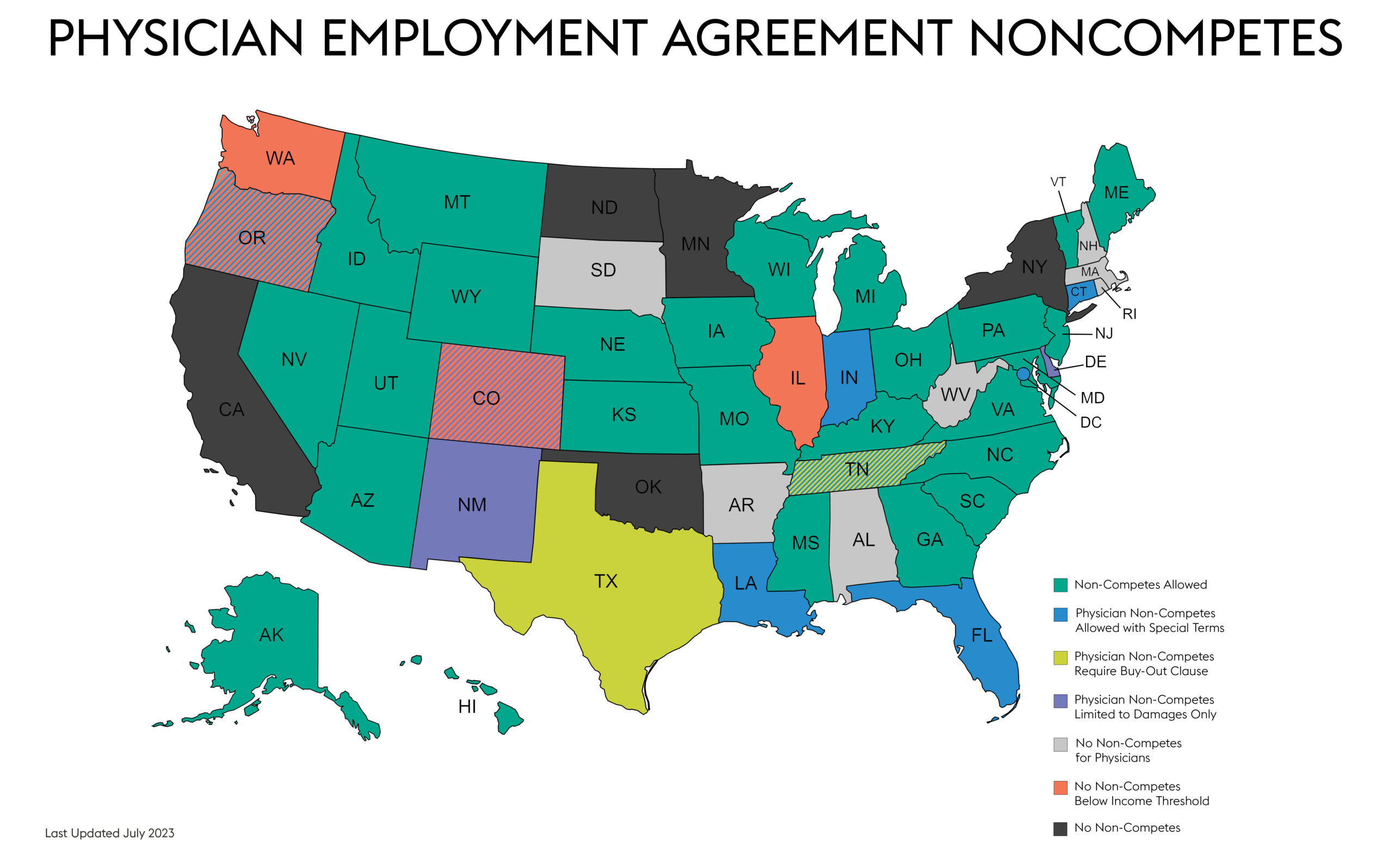
Map current as of July 2023.
Therefore, the state law that governs the physician’s employment agreement is incredibly important to the analysis of what restrictions are permissible.
2. DOES THIS NON-COMPETE RESTRICT AN EMPLOYEE OR THE SELLER OF A BUSINESS?
Non-competes are not one-size-fits-all, even within one state. The context is important.
Consider the nature of the relationship and transaction when drafting non-competes for physicians. As a general rule, non-competes are more broadly enforceable in the sale-of-business context than they are in the context of an employment contract, and can be broader in duration and scope for a sale of business. Even in the state of California (notorious for being anti-restrictive-covenant), Business and Professions Code section 16601 permits the seller of a business to enter into a reasonable non-compete to protect for the buyer the value of the goodwill of the business being sold. Make sure your non-competes are properly tailored for each context.
3. WHAT TYPE OF PHYSICIAN ARE YOU WORKING WITH?
Some states differ even in how they apply non-compete restrictions for “physicians.” For example, in Nevada, a specialist may be restricted from practicing general medicine for a certain amount of time, but must be permitted to continue to practice her specialty without restrictions (see Ellis v. McDaniel). Meanwhile, in New Jersey, a restrictive covenant against a specialist may be upheld for a reasonable amount of time and geographic range (see Community Hospital Group, Inc. v. More).
Keep in mind that many states have not only taken a special interest in monitoring non-competes for physicians generally, but also apply additional carve-outs for specialists.
4. DOES YOUR STATE ALLOW BLUE PENCILING?
Even where physician non-competes are drafted in a way that the parties deem reasonable, courts may still find that the terms are too broad. Some states allow courts to “blue pencil” unenforceable terms, which typically means that a court may strike out offensive terms but will not rewrite the provision. Other states permit courts to reasonably reform a non-compete if, for example, the duration or geographic scope is unenforceable.
Before entering into a non-compete with a physician, consult with legal counsel on whether the jurisdiction allows for blue penciling or reformation, and whether it is discretionary or mandatory for a court to do so. In a state that will blue pencil, depending on your strategy and goal for that restriction, you may consider building in step-downs to permit the court to more easily revise the provision.
5. WHAT ARE THE NEEDS OF YOUR BUSINESS?
The best defense is a good offense. The best way to ensure that your noncompete with a physician is enforced is to take a critical look at the reasonable needs of your business. While every state has its standard of “reasonable,” it helps to know in advance where exactly your patients and clients live, how far-reaching your practice or hospital is, and for how long your business will reasonably need to restrict a physician from competing or interfering with your business. All of those facts are pertinent to eventual enforcement of a non-compete, which means you will need them in the first instance when drafting the agreement. Corporate and employment counsel can assist you with understanding what is “market” (typical and reasonable) in the current transactional landscape and industry. But no one knows your business better than you, and because of this, your input is necessary to effectively tailor the non-compete to meet your business’s needs.
THE MCDERMOTT DIFFERENCE
For any business transaction or issue involving non-competes with physician sellers, employers or owners, please feel free to contact our M&A healthcare and employment teams, who can help you draft an appropriately tailored noncompete to meet your needs.



Responsible Financial Innovation Act: Proposed Tax and Reporting for Digital Assets
ARTICLE / CLIENT ALERT
Responsible Financial Innovation Act: Proposed Tax and Reporting for Digital Assets
July 15, 2022
Read time: 6 min
On June 7, 2022, Senators Cynthia Lummis (R-WY) and Kirsten Gillibrand (D-NY) introduced the highly anticipated Responsible Financial Innovation Act (the bill), which sets out to create the first complete regulatory and bipartisan framework for digital assets. The bill is intended to establish some legal clarity for regulators and the industry and to protect consumers by providing a range of disclosures and clarifying settlement conditions and rights over digital ownership. The bill would also treat all digital assets that are not treated as securities as commodities regulated by the Commodity Futures Trading Commission. This article discusses key tax considerations raised by the bill concerning taxation and reporting requirements for participants in the digital asset industry.
IRS GUIDANCE AND DE MINIMIS EXCLUSION
The bill requires that the Internal Revenue Service (IRS) adopt guidance or clarify important issues involving digital assets, including mining and staking activities. Currently, the only government guidance on virtual currency mining is IRS Notice 2014-12 (2014-16 I.R.B. 938, Q&A-8, 9), which does not have the force of law and may be disregarded by courts. In Notice 2014-12, the IRS asserts that by performing Proof of Work validation services, the fees that miners receive in virtual currency units are ordinary income and taxable at the fair market value as of the date they receive the units (for a discussion on Proof of Work mining activities, see “Taxation of Virtual Currency Mining Activities.”) The government has been silent on the tax treatment of staking activities that support blockchain networks or verify payments (for a discussion on staking activities, see “Taxation of Virtual Currency Staking Activities.”) The bill allows cryptocurrency miners and stakers to defer taxes with respect to such activities until those assets are disposed of.
The bill also instructs the IRS to issue guidance that (1) classifies forks, airdrops and similar transactions that qualify as “subsidiary value” taxable events contingent upon the claim and disposition of the “subsidiary value” by the taxpayers; (2) implements the broker reporting and cash reporting rules enacted by the Infrastructure Investment and Jobs Act (HR 3684); (3) allows for charitable contributions greater than $5,000 without the need for a qualified appraisal; and (4) characterizes stablecoins as debt. The bill does not, however, clarify what a “subsidiary value” is. The bill also exempts from taxation up to $200 of gains or losses from the disposition of virtual currencies in personal transactions and treats a series of “related transactions” as part of the same transaction for purposes of this exemption but does not provide further clarity on what constitutes a related transaction.
BROKER CLARIFICATION
The bill clarifies that the term “broker,” as used in HR 3684, excludes miners and stakers as well as wallet providers and developers, thereby relieving them from certain IRS reporting requirements.
Under current law, those who are involved in mining, staking or providing digital asset hardware or software wallets may fall under the definition of “broker” for tax purposes and be subject to reporting requirements. Code Section 6045 generally imposes reporting requirements on “every person doing business as a broker” with respect to sales affected by the broker on behalf of its clients, where “broker” is defined to include a “dealer, a barter exchange, and any other person who (for consideration) regularly acts as a middleman with respect to property or services” and “any person who (for consideration) is responsible for regularly providing any service effectuating transfers of digital assets on behalf of another person.”
The bill defines a “broker” as any person who stands ready in the ordinary course of a trade or business to effect sales of digital assets to customers for consideration, which likely indicates that miners, wallet providers and software developers will not fall under this definition. This definition also relieves them of reporting requirements imposed by current law.
LENDING AGREEMENTS AND TRADING SAFE HARBORS
The bill assures that digital asset lending agreements would be taxed along the lines of existing rules for securities loans, where gain or loss is not realized in the exchange—if certain conditions are met—by expanding the definition of “securities” to include digital assets (solely for US federal income tax purposes related to lending transactions).
The bill also extends the current trading safe harbors under Code Section 864(b)(2), which currently covers securities and commodities trading activity made by non-US persons, to include trading digital assets through a US broker, custodian, commission agent, digital asset exchange or other independent agent without the risk of being treated as engaging in a US trade or business. Additionally, trading in digital assets for a non-US person’s own account, whether by the taxpayer, the taxpayer’s employees or through an agent, would not be treated as engaging in US trade or business, provided the taxpayer is not a dealer in digital assets. Notwithstanding the above, the safe harbor does not apply if the non-US person has an office or other fixed place of business in the United States through which, or by the direction of which, the transactions in digital assets are affected.
DECENTRALIZED AUTONOMOUS ORGANIZATIONS
The bill declares that certain incorporated decentralized autonomous organizations (DAOs) are, by default, business entities for tax purposes by including them under Code Section 7701. It defines a DAO as an organization that utilizes smart contracts to conduct business, commercial or charitable activities which is governed primarily on a distributed basis and is incorporated or organized under the laws of a state or foreign jurisdiction. By classifying DAOs as business entities, the bill seeks to tax them as a corporation or partnership for US federal income tax purposes and provides them with tax benefits that are generally unavailable to unincorporated associations.
RETIREMENT ACCOUNTS
The bill requires the US Government Accountability Office (GAO) to explore the potential opportunities and risks associated with retirement investing in digital assets and to report to US Congress, the US Department of the Treasury and the US Department of Labor. More specifically, it instructs the GAO to investigate potential benefits to the diversification and return of an investor’s retirement portfolio, appropriate asset allocations, digital asset consumer education and financial literacy, risks and barriers to effective retirement investing in digital assets.
CONCLUSION
While generally viewed as “friendly” legislation to the digital asset industry, the bill attempts to strike a balance between responsible innovation and consumer and investor protection. It also sets out to create the first digital asset regulatory framework for the industry by providing a framework for the integration of digital assets into existing US tax laws. Time will tell if any (or all of) these provisions are ultimately enacted into law.
Sama Kaseer, a summer associate in the Miami office, also contributed to this article.





Post-Roe Mitigation Checklist
ARTICLE / REPORT
Post-Roe Mitigation Checklist
July 14, 2022
Read time: 3 min
The Dobbs decision has triggered widespread legal uncertainty concerning the delivery of reproductive and family planning services. About half of the U.S. states already prohibit or heavily limit abortion services or are expected to prohibit or limit abortion services in short order. These laws largely regulate healthcare providers and patients, although some state laws explicitly capture other parties that “aid and abet” the violation of these laws. Many of these state laws are criminal in nature and other criminal aiding, abetting or conspiracy theories may also be relevant. However, state abortion laws are being challenged in state and federal courts on various legal grounds, the U.S. President signed an executive order on July 8, 2022, aimed at protecting abortion rights, and many states are following suit by passing legislation to protect patients who seek abortion services.
Any organization whose operations touch on reproductive health services in any way (e.g., healthcare delivery organizations, including fertility providers, investors, payors, insurance carriers, employers that provide such benefits) should immediately examine whether the organization is at risk of violating these state laws and the extent to which the organization can address or mitigate this risk. This requires examining the precise nature of the organization’s services and data, geographic footprint, corporate structure and organizational priorities.
We are here to help. Our multi-disciplinary team of lawyers have the latest information and practical steps for navigating the complex issues surrounding a post-Roe reality. We are working closely with clients across industry sectors to answer their most pressing questions and to develop customized compliance and risk mitigation
strategies.
Stormy Weather Ahead: Lack of Causation Evidence Rains Out Appeal
ARTICLE
Stormy Weather Ahead: Lack of Causation Evidence Rains Out Appeal
Jul 14, 2022
Read time: 4 min
The US Court of Appeals for the Tenth Circuit found that a trade secret owner lacked “non-speculative and sufficiently probative evidence of a causal nexus between Defendants’ alleged bad acts and [the trade secret owner’s] asserted damages,” and upheld a lower court’s summary judgment ruling for defendants. GeoMetWatch Corp. v. Hall, et. al, Case No. 19-4130 (10th Cir. June 29, 2022) (Holmes, Kelly, Lucero, JJ.)
GeoMetWatch (GMW) alleged misappropriation of trade secrets and multiple other complaints against several different groups of defendants, including the Hall defendants, Utah University Advanced Weather Systems Foundation (AWSF) defendants, and Utah State University Research Foundation (USURF) defendants. The lower court granted summary judgment to all defendants based on lack of non-speculative causation relating to lost profits, to the USURF and AWSF defendants based on governmental immunity under Utah law, and to AWSF on its contractual counterclaim. GMW appealed.
Background
GMW launched a venture for a new satellite-based weather-detecting senor system developed by USURF. GMW entered into a cooperation agreement with AsiaSat, a foreign commercial satellite operator on which GMW relied to secure funding from Export-Import Bank. There were two conditions precedent before AsiaSat would seek the loan: a guarantee for the loan and a convertible note. The Hall defendants were brought in to possibly provide the guarantee, and with the understanding that Hall would maintain confidentiality of GMW’s information. After reviewing the confidential information, Hall entered into a nondisclosure agreement (NDA) with GMW. Despite the NDA, Hall launched a competing company and sent a series of inflammatory emails regarding the state of GMW to AsiaSat. These actions became the basis for GMW’s complaint of trade secret appropriation. After failing to make payments to AWSF for the construction of the senor, and despite finding a replacement manufacturer, GMW never satisfied either of the conditions precedent and AsiaSat never applied for the loan. GMW eventually ran out of money and filed the underlying suit.
GMW argued that its lost profits stemmed from its failure to secure a loan with AsiaSat and Export-Import Bank because of the defendants’ trade secrets misappropriation and other bad acts. GMW relied on evidence such as a series of inflammatory emails from Hall stating that “GMW is in Trouble,” along with an invitation to do business with a new company that the Hall defendants launched reviewing GMW’s confidential information. The lower court found that GMW had failed to provide more than speculative evidence that the defendants’ actions, with or without GMW’s confidential information, caused GMW’s lost profits.
The Tenth Circuit’s Ruling
At the Tenth Circuit, GMW argued that the lower court ignored “non-speculative” evidence from which it could be inferred that the defendants’ actions were the cause of lost profits. The Court noted that the district court found that none of GMW’s experts actually opined that any of the defendants’ actions caused the lost profits. Although one expert put forth a theory based on GMW losing its “first-mover advantage,” the Court found that no specific facts were offered to support this theory. The Court distinguished between speculation (no facts) and inference (underlying facts) and concluded that there was no factual basis presented on which to base inferences, but only the speculation of a former GMW CFO acting as an expert. The Court found GMW’s own failure to meet the conditions precedent led to its inability to secure a loan with AsiaSat and Export-Import Bank. The Court also noted that GMW did not identify with any level of specificity the evidence purportedly disregarded by the lower court in its summary judgment ruling. The Court pointed out AsiaSat’s delay in submitting the loan application was due to GMW’s failure to meet the conditions precedent, an event that predated the introduction of Hall by nearly two months. Ultimately, the Court found that GMW offered only speculation devoid of contested facts and sustained the summary judgment.


