














ARTICLE / CLIENT ALERT
Updated Cybersecurity Assessment Requirements for Federal Contractors
October 6, 2020
Read time: 6 min
On September 29, 2020, the US Department of Defense (DoD) released the highly anticipated interim rule (“Interim Rule”) amending the Defense Federal Acquisition Regulation Supplement (DFARS) to implement the DoD Assessment Methodology and Cybersecurity Maturity Model Certification (CMMC). This new Interim Rule is effective November 30, 2020, in advance of promulgation of a future final rule. (DFARS Case 2019-D041; 85 FR 61505.)
New Interim Compliance Obligation: Compliance Certification under NIST 800-171
The most significant change in the Interim Rule is the introduction of the new obligation for federal contractors to either self-certify or obtain a third-party assessment methodology to certify contractor compliance with cybersecurity requirements. (Read McDermott’s analysis in our client alert, “Tackling increased cybersecurity requirements in the defense industrial base.”) Pursuant to the Interim Rule, beginning November 30, 2020, all contractors and subcontractors who accept contracts containing DFARS clause 252.204-7012 will need to comply with the National Institute of Standards and Technology (NIST) Assessment methodology for initial assessments, and update those assessments every three years.
This framework expands on existing requirements for federal contractors, as set forth by DFARS Clause 242.204-7012 and NIST Special Publication (SP) 800-171.
NIST SP 800-171 Assessment Methodology
The NIST Assessment Methodology is designed to enable the federal government to assess its prime contractors and for the prime contractors to assess their subcontractors.
To qualify for new contract awards after the implementation date of the Interim Rule, contractors and subcontractors are required to have an assessment on record within the last three years (or more recently for certain contracts). (Interim Rule, 85 FR at 61506.)
The methodology provides for three types of assessments. (Assessment Methodology at 3-5.)
- Basic. Basic Assessments are self-assessments performed by the contractor or the subcontractor against the 110 controls of NIST SP 800-171. A Basic Assessment provides only a minimum level of confidence in the resulting score because it is a self-assessment.
- Medium. Medium Assessments are performed by DoD-trained personnel, who assess the contractor’s system security plan to determine how each requirement is met and identify any measures that may not properly address security requirements. These assessments provide a medium level of confidence in the resulting score.
- High. High Assessments are performed by DoD-trained personnel using NIST SP 800-171A. The assessors review evidence and demonstrations of compliance with the 110 controls of NIST SP 800-171. On-site assessments are preferred, but the methodology allows for virtual assessment with the same methodology as the on-site assessment with added data protections. These assessments provide the highest confidence level in the resulting score.
All contractors (and applicable subcontractors) will be required to execute a self-assessment of compliance at the Basic Assessment level. The federal government will determine if an additional Medium or High Assessment will be necessary. The results of all applicable assessments are recorded in the Supplier Performance Risk System and are valid for up to three years.
All levels of NIST Assessment use the same scoring system. A score of 110 represents full implementation of the NIST SP 800-171 controls, regardless of the method of implementation. Deductions from 110 are made for each control not implemented at the time of the assessment, with weights assigned to different controls. (Assessment Methodology at 7; 48 CFR 252.204-7020 (85 FR 61521–22).)
Each assessment begins with the contractor’s System Security Plan(s) (SSP). The SSP is a document that defines the controls applicable to a system with a given boundary. A contractor may define one SSP for its entire technical environment or may define multiple SSPs if controls differ across segments of the environment. The multiple SSP approach allows a contractor to designate a specific technical environment for processing controlled unclassified information (CUI) and thus limits the scope of the assessment. The NIST Assessment methodology requires the existence of an SSP. Without an SSP, no assessment can proceed, even at the basic level.
Phase-in of CMMC Certification Requirements
Between November 30, 2020, and October 1, 2025, federal contracts will phase in requirements for CMMC certification in place of the NIST Assessment. By October 1, 2025, all applicable federal contractors and subcontractors will be required to have CMMC certification. (Interim Rule 85 FR at 61511.)
The Interim Rule also introduces DFARS subpart 204.75, which specifies the policy and procedures for awarding a contract requiring CMMC certification during the CMMC phase-in period. The CMMC certification process for contractors and assessors as CMMC Third-Party Assessment Organizations (C3PAO) are managed by the CMMC Accreditation Body (CMMC AB). There are five levels of CMMC certification, with level 3 aligning closely to the NIST SP 800-171 framework (read the full discussion in our client alert, “Tackling increased cybersecurity requirements in the defense industrial base“). The Interim Rule clarifies that for applicable contracts, CMMC certification must be provided at the time of the award. (Interim Rule 85 FR at 61406–7.) Further public comment has been requested on this timing, as the government contemplated requiring certification at the time of the proposal or after the award.
Conclusion
All new prime contractors and applicable subcontractors who contract under DFARS clause 252.204-7012 will need to be fully prepared to fulfill the Basic Assessment requirement as of November 30, 2020, to qualify for future contract awards.
The government may require Medium and/or High Assessments for any contract. Contractors should begin to prepare for the self-assessment process immediately, as remediation activities could result in significant time and costs in light of the more stringent requirements associated with higher levels of compliance. Current contractors involved in classified or sensitive contracting environments would be well served to ensure that an assessment team is in place, SSP(s) have been completed for every relevant environment and the team, including counsel, has a thorough understanding of the assessment requirements in preparing for future contract opportunities.
Federal contractors and subcontractors should continue to monitor the CMMC process and leverage the self-assessment process to prepare for their anticipated level of CMMC certification. Although CMMC certification is not required until the contract is awarded, just as with the self-assessments, remediation activities can be costly, and should not be allowed to delay acceptance of contract awards.
Contractors who are ready to be certified will have a competitive advantage for the growing number of CMMC-requiring contracts over the next five years.







New California Law: Notice of COVID-19 Exposure in Workplace and Imminent Hazards in Worksites
ARTICLE
New California Law: Notice of COVID-19 Exposure in Workplace and Imminent Hazards in Worksites
October 6, 2020
Read time: 1 min



ESG Disclosure for Funds Becomes More Concrete and Complicated
ARTICLE / CLIENT ALERT
ESG Disclosure for Funds Becomes More Concrete and Complicated
October 5, 2020
Read time: 6 min
The European Union has expedited the ESG disclosure regulation and released detailed drafts for investor documentation of ESG funds. In order to ensure comparable disclosures for all affected financial products, the specifications are detailed and compulsory. This article explains how the level 2 drafts regulate the pre-contractual disclosure obligations of fund managers in different documents and media.
Read the full article in German here.
1. EU-Regulierung nimmt konkretere Formen an
Nachdem Ende 2019 die EU-Offenlegungsverordnung erlassen wurde, stand in diesem Jahr ihre Konkretisierung durch die sog. „Level 2-Maßnahmen“ an. Von April bis Anfang September stellte der gemeinsame Ausschuss der EU-Finanzaufseher den Entwurf einer Durchführungsverordnung zur Konsultation:
https://www.esma.europa.eu/press-news/consultations/joint-esa-consultation-esg-disclosures
Noch fehlende, aber wesentliche Anlagen hierzu in Form von Musterdokumenten wurden Ende September mit einer kurzen Konsultationsfrist bis zum 16. Oktober 2020 nachgereicht:
https://ec.europa.eu/eusurvey/runner/ESGtemplatesSFDR
Die ESG-Offenlegungspflichten in vorvertraglichen Dokumenten, also Verkaufsprospekten und Anlegerinformationen, gelten ab dem 10. März 2021. Angesichts des aktuellen Standes der Entwürfe und Konsultationen erscheint jedoch fraglich, ob die umfangreichen Detailvorgaben der EU bis dahin final und verabschiedet sind.
Wie im Finanzsektor häufig, beschränken sich die Level 2-Entwürfe nicht darauf, die Offenlegungsverordnung auszulegen, sondern es werden darüber hinaus zusätzliche Anforderungen an die Marktteilnehmer aufgestellt. Zudem mangelt es – wie leider ebenfalls häufiger zu beobachten – an einer Abstimmung mit den fondsspezifischen Vorschriften für Prospekte und Anlegerinformationen.
Im Einzelnen:
2. ESG-Informationen sollen nicht integriert werden
Die OffenlegungsVO legt fest, dass bestimmte Angaben zur Berücksichtigung von Nachhaltigkeitsrisiken sowie ggf. zu nachhaltigen Investitionen oder ESG-Merkmalen eines Fonds in die Verkaufsprospekte bzw.die Informationen gemäß § 307 Abs. 1 KAGB für Spezialfondsanleger aufzunehmen sind. Man würde daher erwarten, dass diese Angaben vollständig in die bestehende, durch das KAGB vorgegebene Gliederung der Dokumente integriert werden. Beispielsweise könnte die Prospektpassage mit Risikohinweisen um Aussagen zu Nachhaltigkeitsaspekten ergänzt werden und in der Passage zu Anlagestrategie und -zielen könnten (soweit nicht schon vorhanden) Ausführungen zu Nachhaltigkeitszielen oder –merkmalen des Fonds gemacht werden. Sobald ein Fonds jedoch eine nachhaltige Investitionsstrategie verfolgt („sustainable investment“) oder bei seinen Anlagen ESG-Merkmale mit berücksichtigt, sieht der Level 2-Entwurf für die dann erforderlichen weiteren Angaben einen separaten Textteil vor.
Die Durchführungsverordnung bestimmt, dass solche Fonds „in summary format in the order and made up of the following sections“ über die ESG-Aspekte ihrer Anlagestrategie zu informieren haben. Es gibt dazu ein sechsseitiges Muster als Verordnungsanhang, das Layout und Gliederung zwingend vorgibt. Dieses Muster ähnelt äußerlich einem längeren KID; die darin enthaltenen Angaben sollen / dürfen offenbar nicht verteilt in den passenden Kapiteln des bestehenden Dokuments verortet werden. Es bleibt daher wohl nur die Lösung, die „ESG-Informationen“ als separaten Anhang zum Prospekt bzw. §307er-Dokument zu nehmen. Allerdings dürfte das nicht zur Übersichtlichkeit der gesamten Unterlage beitragen. Denn viele Themen, die die ESG-Informationen behandeln, müssen auch im sonstigen Prospekt / Informationsdokument erwähnt werden, so dass Wiederholungen und Überschneidungen unvermeidbar sind. Soweit ersichtlich, darf in den ESG-Informationen nicht auf Passagen im restlichen Prospekt verwiesen werden. Umgekehrt wäre ein Verweis in anderen Prospektteilen auf die ESG-Informationen wohl unproblematisch.
3. Homepage-Angaben versus Prospektangaben
Hinzu kommt, dass in den ESG-Informationen zwingend ein Verweis auf die Homepage der Kapitalverwaltungsgesellschaft enthalten sein muss. Dort sind ebenfalls fondsbezogene Angaben zu der verfolgten Nachhaltigkeitsstrategie oder den ESG-Merkmalen zu machen. Diese sollen zusätzlich in einem Text zusammengefasst werden, der ausgedruckt nicht länger als zwei DIN A4-Seiten lang ist. Er muss für deutsche Fonds auf deutsch und englisch verfasst werden (Amtssprache des Heimatlandes und eine Sprache, die in internationalen Finanzkreisen üblich ist). Da diese Zusammenfassung nur elektronisch auf der Homepage zur Verfügung gestellt werden muss, ist sie nicht Teil oder Zusatz der Verkaufsprospekte bzw. §307er-Informationen und fällt auch nicht unter den Begriff der Verkaufsunterlagen im Sinne des KAGB. Für Spezialfonds ist derzeit noch offen, ob die zwingenden ESG-Angaben auf der Homepage einschließlich der Zusammenfassung auch in einem passwortgeschützten Bereich erfolgen dürfen, der den Anlegern des Fonds vorbehalten bleibt.
Im Ergebnis stellt sich die künftige Prospektlandschaft für Sustainable Investment-Fonds und für Fonds, die (auch) ESG-Kriterien beachten, damit wie folgt dar:
Ein Publikumsfonds hat wie bisher einen Verkaufsprospekt und wesentliche Anlegerinformationen. Im Prospekt sind insbesondere bei den Risikohinweisen Angaben zu Nachhaltigkeitsrisiken integriert. Teil des Verkaufsprospekts ist außerdem ein Anhang gemäß Offenlegungs-Muster mit bestimmten ESG-bezogenen Informationen. In diesen Informationen wird auf die Homepage der KVG verwiesen, wo u.a. eine zweiseitige Zusammenfassung der dort veröffentlichten, weiteren ESG-Informationen in zwei Sprachen zum Ausdruck bereitsteht.
Für einen Spezialfonds sind wie bisher die Informationen gemäß § 307 Abs. 1 KAGB, und ggf. wesentliche Anlegerinformationen gemäß Abs. 5 zur Verfügung zu stellen. Insbesondere bei den Risikohinweisen sind Angaben zu Nachhaltigkeitsrisiken integriert. Das Informationsdokument wird ergänzt um einen Anhang oder Zusatz mit den ESG-Informationen gemäß Offenlegungs-Muster. In diesen Informationen wird auf die Homepage der KVG verwiesen, wo u.a. eine zweiseitige Zusammenfassung der dort veröffentlichten, weiteren ESG-Informationen in zwei Sprachen zum Ausdruck bereitsteht.
4. Fazit
Die Entwürfe zur vorvertraglichen ESG-Offenlegung stehen neben den bereits sehr umfangreichen fondsspezifischen Informationspflichten und sollen größtenteils nicht in diese integriert werden. Das ist insoweit verständlich, als sie für eine Vielzahl von verschiedenen Finanzprodukten verfasst wurden und eine Abstimmung mit existierenden Regeln daher nur begrenzt möglich ist. Es wäre dann aber vorteilhaft gewesen, Form und Ort der Informationspflichten flexibler zu halten, damit für jedes Produkt eine einheitliche, übersichtliche Gestaltung der gesamten Dokumentation möglich bleibt. Dies ist leider nicht der Fall, was u. E. die Transparenz und Praktikabilität der Informationen nicht erhöht. Für die betroffenen Kapitalverwaltungsgesellschaften bedeutet dies einmal mehr – mehr Aufwand.
Wir unterstützen Sie gerne bei der individuellen Umsetzung – sprechen Sie uns an!


FinCEN and Banking Agencies Provide Clarification on PEP Screening Best Practices
ARTICLE / CLIENT ALERT
FinCEN and Banking Agencies Provide Clarification on PEP Screening Best Practices
October 5, 2020
Read time: 13 min
On Aug. 21, 2020, in response to inquiries from various banks, the Financial Crimes Enforcement Network (“FinCEN”), a bureau of the U.S. Department of the Treasury (“Treasury”) and four U.S. banking agencies (“Agencies”)[1] released joint guidance on anti-money laundering (“AML”) due diligence expectations for bank customers who may be considered “politically exposed persons” or “PEPs” (“Statement”).[2] The Statement does not create any new regulatory or supervisory requirements but rather provides an interpretive gloss that largely reaffirms best practices in this area. While it applies predominately to banks and their customers, it will no doubt be followed by broker-dealers. It is also relevant to private equity and hedge fund managers, most of which presently have procedures for conducting enhanced due diligence for PEPs and Senior Foreign Political Figures (“SFPFs”)[3] either directly or through their administrators. Moreover, such fund managers are often counterparties to financial transactions with regulated entities, such as banks and broker-dealers, and may therefore be subject to enhanced due diligence resulting from any PEPs invested (directly or indirectly) in the funds.
Background
Since at least 2001, the Agencies have focused on a bank’s treatment of foreign political figures. In their January 2001 Guidance on Enhanced Scrutiny for Transactions that May Involve the Proceeds of Foreign Corruption, Treasury and the banking agencies (together with the U.S. Department of State) outlined their expected approach to “working closely with the financial services industry to develop guidance for financial institutions to conduct enhanced scrutiny of those customers and their transactions that pose a heightened risk of money laundering and other financial crimes” such as senior foreign political figures.[4] The Bank Secrecy Act (“BSA”) implementing regulations issued in 2005 under Section 312 of the USA PATRIOT Act [5] prescribed requirements relating to certain accounts for SFPFs, for example “enhanced scrutiny of such account[s] that is reasonably designed to detect and report transactions that may involve the proceeds of foreign corruption.” [6] And in 2013, the Financial Action Task Force (“FATF”) issued Recommendation 12 which requires countries to ensure that financial institutions implement policies and procedures to detect and stop abuse of the financial system by PEPs.[7] FATF’s guidance defines a PEP as an “individual who is or has been entrusted with a prominent public function.” [8] Although the BSA and its implementing regulations[9] do not use the term PEPs, as the Statement notes, firms sometimes refer generally to “foreign individuals who are or have been entrusted with a prominent public function, as well as their immediate family members and close associates” as PEPs.[10]
In 2016, FinCEN released the Customer Due Diligence (“CDD”) rule which requires certain financial institutions[11] to adopt risk-based procedures for conducting CDD that enables those financial institutions to: (i) understand the nature and purpose of customer relationships for the purpose of developing a customer risk profile (i.e., information “gathered about a customer at account opening used to develop a baseline against which customer activity is assessed for suspicious activity reporting”); and (ii) conduct ongoing monitoring to identify and report suspicious transactions and, on a risk basis, to maintain and update customer information.[12] In some instances, legal entity customers may be controlled by PEPs; banks have therefore requested clarification of the application of a risk-based approach to conducting CDD on PEPs consistent with the CDD rule’s requirements.
All bank accounts, including those of PEPs, are subject to the BSA and other AML regulatory requirements.[13] Because of their connections and authority, PEPs present a relatively high subject of AML concern from a risk-based perspective, as PEPs are especially suited to use financial services firms and other persons as conduits for laundering misappropriated public funds or the proceeds of bribery and corruption.[14] The federal AML laws, applicable to all financial services firms and all other persons, make it a crime to knowingly engage in a transaction with the proceeds of official corruption.[15] This includes not only violations of U.S. bribery laws (including the Foreign Corrupt Practices Act), but also offenses under foreign laws involving bribery of a public official or misappropriation of public funds.[16]
While not mentioned in the Statement, the Federal Financial Institutions Examination Council’s BSA/AML Examination Manual[17](“BSA Manual”), which guides banking examiners’ review of banks’ compliance with the BSA, already acknowledges the importance of CDD for PEPs.[18] The BSA Manual recognizes that “not all PEPs present the same level of risk” and that due diligence and risk mitigation measures may be proportionate with the level of risk posed by the PEP’s particular circumstances, such as “geographic location, industry, or sector, position, and level or nature of influence or authority” and “[r]isk may also vary depending on factors such as the purpose of the account, the actual or anticipated activity, products and services used, and size or complexity of the account relationship.”[19] The BSA Manual also provides that, “[a]s a result of these factors, some PEPs may be lower risk and some may be higher risk for foreign corruption or money laundering.”[20] Accordingly, a general expectation applies that financial institutions will engage in a risk assessment, as well as corresponding and ongoing CDD for PEPs insofar as this may be necessary to establish a customer risk profile, that reflects the risk the PEP relationship presents.
The Statement’s Clarification
As noted, the Statement emphasizes that the Agencies are not altering existing BSA and AML legal or regulatory requirements and are not establishing new supervisory procedures. Moreover, the Statement does not impact the regulatory obligation of financial institutions to do enhanced due diligence on SFPFs using private banking accounts under Section 312 of the PATRIOT ACT, although it would appear that the guidance sheds some light on the thinking of the regulators with respect to SFPFs. Nor does the Statement diminish the serious concern of corruption posed by PEPs, including SFPFs, who engage in illicit acts.
At the outset, while recognizing that PEPs present significant AML concerns, the Statement notes “[t]here is no regulatory requirement in the CDD rule, nor is there a supervisory expectation, for banks to have unique, additional due diligence steps for PEPs.”[21] Moreover, banks are not required “to screen for or otherwise determine whether a customer or beneficial owner of a legal entity customer may be considered a PEP.”[22] The Statement acknowledges that PEP relationships vary in their level of risk, and that “not all PEPs are automatically higher risk” individuals.[23] Accordingly, the “level and type of CDD should be commensurate with the risks presented by the PEP [customer] relationship.”[24] The Statement’s point of clarification is that there is no need for “banks to have unique, additional due diligence steps for PEPs.”[25] Rather “the level and type of CDD should be appropriate for the customer risk.”[26] The Statement notes with respect to banks’ AML programs that:
- “Banks may leverage existing processes for assessing geographic-specific money laundering, corruption, and terrorist financing risks when developing the customer risk profile, which may also take into account the jurisdiction’s legal and enforcement frameworks, including ethics reporting and oversight requirements.”
- “When developing the customer risk profile, and determining when and what additional customer information to collect, banks may take into account such factors as a customer’s public office or position of public trust (or that of the customer’s family member or close associate), as well as any indication that the PEP may misuse his or her authority or influence for personal gain.”
- “A bank may also consider other factors in assessing the risk of these relationships, including the type of products and services used, the volume and nature of transactions, geographies associated with the customer’s activity and domicile, the customer’s official government responsibilities, the level and nature of the customer’s authority or influence over government activities or officials, the customer’s access to significant government assets or funds, and the overall nature of the customer relationship.”[27]
Further, the Statement notes that SFPFs are a subset of PEPs and that the term PEP does not “include U.S. public officials”[28] and describes certain relevant characteristics of PEPs that the bank should consider, such as:
- “PEPs with a limited transaction volume, a low-dollar deposit account with the bank, known legitimate source(s) of funds, or access only to products or services that are subject to specific terms and payment schedules could reasonably be characterized as having lower customer risk profiles.”
- “For a PEP who is no longer in active government service, banks may also consider the time that the customer has been out of office, and the level of influence he or she may still hold.”[29]
Customers that are nominally PEPs but who have lower indicia of risk may not require exceptional investigative procedures and research, and might be adequately accommodated by less extensive, and more routine, AML diligence. For example, a PEP who has been out of office for many years and previously served in a governmental role in a jurisdiction with a relatively strong AML regime may present a subject of relatively reduced concern and require only marginally more investigation than a standard investor.
Although PEPs should be evaluated on a risk basis, there is no automatic requirement for PEPs to be subject to intensive AML review or become the subject of an extensive research dossier. But banks are still required to have appropriate risk-based procedures for conducting CDD on PEPs and the Statement does not suggest dispensing with any preexisting enhanced procedures they view as reasonably necessary.
Banks are reminded in the Statement of the history of PEPs in high profile cases over the years in using banks as conduits for illegal activities, including corruption, bribery, money laundering and related crimes and further of their obligation to identify and report suspicious activity including transactions that may involve the proceeds of corruption. The customer information and risk profile may impact how the bank complies with these requirements, as well as its monitoring obligations.
Key Takeaways
As noted, although the Statement provides some insight into how a regulated financial institution should assess the risk profile of a PEP, the Agencies’ guidance does not create new AML requirements. Rather, it clarifies that there is not a supervisory expectation for banks to have unique, additional due diligence steps for PEPs. Banks and broker-dealers should deal cautiously with PEPs. So should managers of hedge funds and private equity funds, to protect themselves from charges of laundering corruption proceeds, even though they, unlike banks and broker-dealers, are not yet directly subject to an AML program requirement under the BSA.[30] The Agencies’ guidance affirms that any such enhanced diligence need not consist of automatically applied, exceptionally deep research and review procedures, but may be reasonably tailored to the circumstances of the individual investor. As a practical matter, the policies and procedures that guide the process for banks and broker-dealers for screening for PEPs and SFPFs are unlikely to change as a result of the Statement and should continue to reflect an appreciation for the special risks posed by these investors. Likewise Fund managers subject to U.S. criminal money laundering laws should continue (either themselves or through their administrators) to screen for PEPs and SFPFs and subject such individuals to enhanced due diligence.
Authored by Betty Santangelo, Gary Stein, Joseph P. Vitale, Melissa G.R. Goldstein, Kyle B. Hendrix, Hannah M. Thibideau and Joshua B. Wright.
If you have any questions concerning this Alert, please contact your attorney at Schulte Roth & Zabel or one of the authors.
[1] The banking Agencies are the Board of Governors of the Federal Reserve System, the Federal Deposit Insurance Corporation, the National Credit Union Administration, and the Office of the Comptroller of the Currency (“OCC”).
[2] Joint Statement on Bank Secrecy Act Due Diligence Requirements for Customers Who May Be Considered Politically Exposed Persons (Aug. 21, 2020), available here.
[3] The term “senior foreign political figure” or “SFPF” is defined in the USA PATRIOT ACT and its implementing regulations, 31 C.F.R. § 1010.605(p), as “(i) A current or former: (A) Senior official in the executive, legislative, administrative, military, or judicial branches of a foreign government (whether elected or not); (B) Senior official of a major foreign political party; or (C) Senior executive of a foreign government-owned commercial enterprise; (ii) A corporation, business, or other entity that has been formed by, or for the benefit of, any such individual; (iii) An immediate family member of any such individual; and (iv) A person who is widely and publicly known (or is actually known by the relevant covered financial institution) to be a close associate of such individual.”
[4] Treasury, Guidance on Enhanced Scrutiny for Transactions that May Involve the Proceeds of Foreign Corruption (January 2001), available here. By issuing the Statement, the Agencies rescinded the 2001 Guidance.
[5] 31 C.F.R. §§ 1010.605, 1010.610 – 1010.620.
[6] 31 C.F.R. § 1010.620(c).
[7] FATF, International Standards on Combating Money Laundering and the Financing of terrorism & Proliferation (June 2019), available here; see also, FATF Guidance: Politically Exposed Persons (Recommendations 12 and 22) (June 2013), available here; FinCEN, Advisory on Human Rights Abuses Enabled by Corrupt Senior Foreign Political Figures and their Financial Facilitators (June 12, 2018), available here.
[8] International Standards on Combating Money Laundering and the Financing of terrorism & Proliferation at 123 (defining the term “PEP” in its entirety as follows, “Foreign PEPs are individuals who are or have been entrusted with prominent public functions by a foreign country, for example Heads of State or of government, senior politicians, senior government, judicial or military officials, senior executives of state owned corporations, important political party officials. Domestic PEPs are individuals who are or have been entrusted domestically with prominent public functions, for example Heads of State or of government, senior politicians, senior government, judicial or military officials, senior executives of state owned corporations, important political party officials. Persons who are or have been entrusted with a prominent function by an international organisation refers to members of senior management, i.e. directors, deputy directors and members of the board or equivalent functions. The definition of PEPs is not intended to cover middle ranking or more junior individuals in the foregoing categories.”); see also FATF Guidance: Politically Exposed Persons (Recommendations 12 and 22) at 3.
[9] 31 U.S.C. §§ 5311-5330; 31 C.F.R. Chapter X.
[10] Statement, p. 1.
[11] See Customer Due Diligence Requirements for Financial Institutions, 81 Fed. Reg. 29,398 (May 11, 2016), which applies to banks, brokers and dealers in securities, mutual funds, futures commission merchants and introducing brokers in commodities.
[12] Id.
[13] Statement, p. 2.
[14] Id., p. 4.
[15] See 18 U.S.C. §§ 1956-1957.
[16] See 18 U.S.C. § 1956(c)(7)(B)(iv).
[17] See BSA/AML Examination Manual (last accessed Aug. 24, 2020; sections subject to incremental updates), available here.
[18] BSA/AML Examination Manual (“Politically Exposed Persons — Overview”) (Feb. 27, 2015), p.291-292.
[19] Id.
[20] Id.
[21] Statement, p. 2.
[22] Id.
[23] Id., p. 1.
[24] Id., p. 2.
[25] Id., p. 1-2 (emphasis added).
[26] Id., p. 2.
[27] Id., p. 3.
[28] Id., p. 1.
[29] Id., p. 3.
[30] See e.g., 18 U.S.C. §§ 1956-1957.
This communication is issued by Schulte Roth & Zabel LLP for informational purposes only and does not constitute legal advice or establish an attorney-client relationship. In some jurisdictions, this publication may be considered attorney advertising. ©2020 Schulte Roth & Zabel LLP.
All rights reserved. SCHULTE ROTH & ZABEL is the registered trademark of Schulte Roth & Zabel LLP.





Key Takeaways | Return to Work Virtual Toolkit for Employers | Considerations as the School Year Commences – For Remote and In-Person Workers
ARTICLE
Key Takeaways | Return to Work Virtual Toolkit for Employers | Considerations as the School Year Commences – For Remote and In-Person Workers
October 2, 2020
Read time: 5 min
As students begin a new school year, employers in the United States face a new challenge–childcare-related leave and accommodation requests by employees. With widespread remote learning and evolving legal obligations to provide paid leave to working parents, employers must navigate unique staffing challenges while complying with the Families First Coronavirus Response Act (FFCRA) and other state and local leave laws. In our webinar, we outlined some of the current leave requirements regarding childcare obligations and practical solutions to navigate these uncharted waters.
View the full webinar here.
- The FFCRA remains in effect through December 31, 2020, for employers with up to 500 employees. Under the FFCRA there are two types of leave—Emergency Paid Sick Leave (EPSL) and Expanded Family and Medical Leave (EFMLA). EPSL provides up to 80 hours of paid leave in addition to any leave available under federal, state or local law. EFMLA provides up to 12 weeks of leave, depending on how much FMLA leave the employee has already used during the employer’s 12-month measurement period. There are six qualifying reasons for leave under the FFCRA:
1. Employee is subject to a quarantine or isolation order
2. Employee is advised by healthcare provider to self-quarantine
3. Employee is experiencing COVID-19 symptoms and seeking medical diagnosis
4. Employee is caring for an individual described in 1 or 2 above
5. Employee is experiencing a substantially similar medical condition
6. Employee is caring for a child whose school or place of care is closed (or childcare provider is unavailable) for reasons related to COVID-19.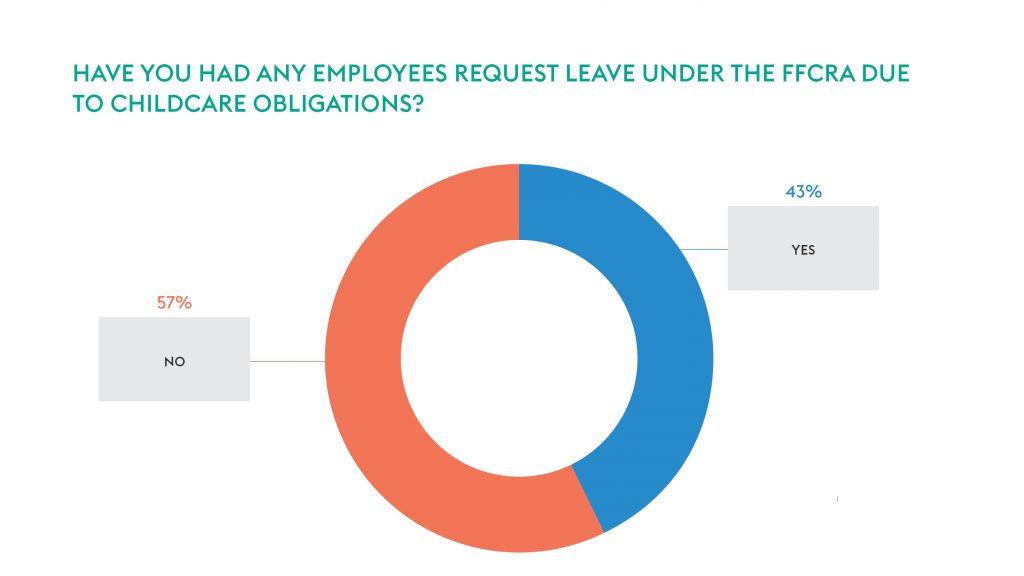
- Several states have enacted laws providing paid sick leave to employees not covered by the FFCRA, generally for employers with 500+ employees. The California COVID-19 Supplemental Paid Sick Leave Act is one such example, which is explained in depth in McDermott’s recent insight, California COVID-19 Supplemental Paid Sick Leave Act (AB 1867): Paid Leave, Notice and Posting Requirements Effective Immediately.
- The Department of Labor (DOL) recently revised rules regarding the FFCRA, specifically the employer option to exclude “health care providers” from FFCRA benefits. On September 11, 2020, the DOL modified its prior rule in several areas, including narrowing its definition of “health care provider” whom an employer may exclude from being eligible for FFCRA leave. More information on the revised definition and the impact on employers can be read in our recent insight here.
- For employees who are eligible for childcare leave under the FFCRA, the employee may use either EPSL or EFMLA if they are unable to work or telework due to the need to care for a child whose school or place of care is “closed” for reasons related to COVID-19. A school is considered “closed” if they offer virtual learning only, or in some cases, a hybrid learning model (in-person and virtual). If a parent opts for virtual learning and the school district is open for full-time in-person learning, the school is not considered closed. If the child has an underlying medical condition, then traditional FMLA leave or EPSL may apply. In addition, intermittent leave under FFCRA requires employer approval. For example, if a child attends in-person classes for half of each school day, and the employee takes FFCRA leave to care for the child during the half-days in which the child is not attending classes, this is considered intermittent leave that requires approval.
- There are a number of legal issues to consider when granting an employee leave or accommodating a telework request for childcare, including privacy considerations; meal break compliance; tax implications if the employee teleworks out of state/moves; and predictive scheduling laws. All leave/telework decisions should be handled through one person or a single department to ensure consistency and that all decisions are made in a fair, non-discriminatory manner. Tracking charts may be helpful to ensure fair and justified decisions, but may also be discoverable in litigation. Employers should consider ways to maintain privilege and confidentiality by working with the legal department as part of the decision-making process.
- Employers should also consider the practical aspects of employees who request childcare-related leave or teleworking. Preparing a telework agreement can ensure mutual understanding of an employee’s duties and hours when working remotely. All schedule and intermittent leave arrangements should be documented along with performance expectations and issues. Employers should strive to create an understanding but professional atmosphere during this time, and may want to offer flexible work hours, alternative work schedules or collaborative working to provide flexibility for employees with childcare responsibilities. Other options may include unpaid leave or subsidized childcare costs, which can help retain quality employees and eliminate employee turnover costs.


Issues In Representations and Warranties Insurance Claim Disputes
ARTICLE
Issues In Representations and Warranties Insurance Claim Disputes
October 2, 2020
Read time: 1 min


Exceeding Client Objectives for a Consensual Resolution to Complex Bankruptcy Proceedings
ARTICLE / OTHER
Exceeding Client Objectives for a Consensual Resolution to Complex Bankruptcy Proceedings
October 2, 2020
Read time: 2 min
After years of selling services at a loss to grow its customer base, Agera Energy—a retail electricity and natural gas provider for commercial, industrial and residential customers in 16 states—realized its business was no longer viable. The company decided to file for chapter 11 bankruptcy protection after evaluating strategic alternatives.
SEC Brings Enforcement Action Against Fund Manager for Single 13D Violation
ARTICLE / CLIENT ALERT / US POLICY
SEC Brings Enforcement Action Against Fund Manager for Single 13D Violation
October 2, 2020
Read time: 4 min
The SEC brought charges against a fund manager for 13D violations, in yet another reminder that it will pursue enforcement actions against filers for Schedule 13D violations even without a pattern of repeat violations.
On Sept. 17, 2020, the SEC announced the settlement of charges brought against an investment manager of certain private funds (“IM”) for failure to timely amend a statement of beneficial ownership report on Schedule 13D (Administrative Proceeding File No. 3-20020).[1]
The 13D Requirements
Section 13(d) of the Securities Exchange Act of 1934 requires a “beneficial owner”:
- That acquires more than 5%;
- Of a class of any voting, equity securities registered under Section 12 of the Exchange Act;
- To file with the SEC within ten days of any such acquisition; and
- A statement on Schedule 13D describing such acquisition and containing certain other information, including a description of any plans or proposals that the beneficial owner may have with respect to certain enumerated matters regarding the issuer.
After the initial filing of a Schedule 13D, Rule 13d-2(a) requires the Schedule 13D to be amended “promptly” in the event of any “material change” in the information set forth therein. “Promptly” is not defined under the rules but is generally understood to be within two business days. Under Rule 13d-2(a), an increase or decrease in beneficial ownership of 1% or more is deemed to be “material,” but Schedule 13D filers must keep in mind that an amendment must also be filed promptly upon any material change to any of the other information disclosed in the Schedule 13D, including, without limitation, the filer’s plans or proposals.
The Facts
The IM filed an initial Schedule 13D with respect to its holdings in Hanger Inc. (“Issuer”) on July 22, 2016, disclosing that it beneficially owned 6.7% of the Issuer’s outstanding shares and that it may explore a possible acquisition or restructuring of the Issuer. The IM also included certain standard “boilerplate” language reserving the right to change its intentions. The IM did not amend its Schedule 13D until Sept. 6, 2019, after it had sold out of its entire position, which it accomplished through sales on July 1, 2019 and Aug. 8, 2019.
The SEC’s Findings
The SEC found that the IM failed to amend its original Schedule 13D:
- First, when it determined that it was no longer interested in pursuing a possible acquisition or restructuring of the Issuer and that it would liquidate its position; and
- Second, when it reduced its beneficial ownership by 1%.
Without admitting or denying the SEC’s findings, the IM agreed to a cease and desist order and to pay a penalty of $100,000.
Takeaways
This administrative proceeding serves as a reminder that:
- The SEC remains focused on enforcing beneficial ownership reporting obligations, even when a filer is not engaged in a pattern of recurring delinquent behavior;
- The value of boilerplate language reserving the right to change a filer’s intentions or take certain actions is limited once a filer has made a definitive determination to abandon or pursue a specific action; and
- Investment firms, even those that do not frequently file on Schedule 13D, need to have compliance procedures in place to properly monitor filing requirements and changes and events around their outstanding filings to properly update their filings in a timely manner.
Authored by Eleazer Klein, Adriana Schwartz, and Clara Zylberg.
If you have any questions concerning this Alert, please contact your attorney or one of the authors.




Current Lifetime Estate Planning Opportunities in Light of Possible 2021 Tax Law Changes and Current Low Interest Rates
ARTICLE / CLIENT ALERT
Current Lifetime Estate Planning Opportunities in Light of Possible 2021 Tax Law Changes and Current Low Interest Rates
October 2, 2020
Read time: 5 min
Preparing for Possible 2021 Tax Law Changes to Exemption Amounts
Current Tax Law. The current federal estate, gift and generation-skipping transfer (“GST”) tax exemptions allow an individual to transfer $11.58 million during his or her lifetime or at death, reduced by lifetime gifts already made that did not qualify for the annual exclusion or another exemption from gift tax. These exemptions are scheduled to expire at the end of 2025, absent further legislation.
Possible 2021 Tax Law Changes. If the 2020 elections result in Democratic control of the presidency and Congress, these exemptions could be reduced. It has been reported that Vice President Biden may seek to reduce the estate and GST tax exemptions to as low as $3.5 million and the gift tax exemption to as low as $1 million. Also, even without changes in the presidency and Congress, these exemptions could be reduced in order to cover increasing federal deficits. Any reduction in these exemptions could be retroactive to as early as Jan. 1, 2021.
2020 Planning Opportunities. If you have not yet used all of your gift and GST tax exemptions, we strongly recommend that you consider making lifetime gifts, in trust or outright, before 2020 year-end. Today, a married couple establishing GST-exempt trusts can shield assets worth up to $23.16 million (plus all future appreciation) from wealth transfer taxes for approximately 100 years in New York or longer (or in perpetuity) in certain other jurisdictions. One option is for married couples to establish Spousal Lifetime Access Trusts (“SLATs”) for each other and their descendants, by which they can remove assets from their taxable estates while maintaining access to those assets (through the spouses as beneficiaries) if their financial circumstances change. SLATs are one of several planning opportunities we can discuss as you consider making lifetime gifts before the 2020 year-end. We can also discuss your individual circumstances and whether there are specific considerations for where you live (for instance, the gift tax in Connecticut).
2020 Timing Considerations. We are already experiencing an increased demand from our clients with respect to these planning opportunities. We understand that appraisers are similarly busy valuing assets and that bankers anticipate a rush on account opening requests that may become hard to satisfy as the end of the year approaches. In order to ensure that you receive the necessary legal, appraisal and banking assistance before 2020 year-end, we strongly recommend that you implement these planning techniques as soon as possible.
Taking Advantage of Current Low Interest Rates
Creating New Short Term GRATs. Possible 2021 tax law changes may significantly limit the advantages of Grantor Retained Annuity Trusts (“GRATs”), including by imposing minimum terms and minimum retained interests which would make GRATs less beneficial. Because of these possible changes and since interest rates are currently so low, this is a good time to create and fund a new GRAT. The donor of a GRAT gifts assets that he or she feels will appreciate in the trust while retaining the right to receive an annuity payment from the GRAT for a specified period of time. At the conclusion of that period, the remaining assets in the GRAT pass to specified beneficiaries — usually the donor’s descendants (outright or in trust) — free of any gift tax. A GRAT is successful when the appreciation of and income from the assets in the GRAT exceeds the IRS’s “hurdle rate,” which is only 0.4% for GRATs created in October 2020.
Low Interest Intra-Family Loans. Making loans to individuals or trusts is a simple but effective way to shift “excess” income and appreciation to other family members. The IRS minimum rate varies based on the term of the loan. (The IRS minimum rate for three to nine-year loans made in October 2020 is 0.38%.) You can currently make loans at a very low rate, and if the loan is structured with a balloon principal payment at the expiration of the term, all of the principal can remain invested during the term of the loan, maximizing the amount of “excess” income and appreciation that can pass to family members in a tax-efficient way.
Refinancing Existing Promissory Notes. Because interest rates are now very low, it may be advantageous to refinance existing promissory notes to current rates.
Please contact your Schulte Roth & Zabel attorney at your earliest convenience if you wish to discuss these or other estate planning opportunities as they relate to your specific financial and personal situation.
This communication is issued by Schulte Roth & Zabel LLP for informational purposes only and does not constitute legal advice or establish an attorney-client relationship. In some jurisdictions, this publication may be considered attorney advertising. ©2020 Schulte Roth & Zabel LLP.
All rights reserved. SCHULTE ROTH & ZABEL is the registered trademark of Schulte Roth & Zabel LLP.



California COVID-19 Supplemental Paid Sick Leave Act Effective Immediately
ARTICLE
California COVID-19 Supplemental Paid Sick Leave Act Effective Immediately
September 30, 2020
Read time: 1 min