ARTICLE
USPTO Examination Guide: Post-Booking.Com, ‘Generic.Com’ Terms Still Face Uphill Battle for Registration
December 8, 2020
Read time: 1 min
Key takeaways
Overview

ARTICLE
December 8, 2020
Read time: 1 min

ARTICLE
December 8, 2020
Read time: 1 min


ARTICLE
6. Dezember 2020
Read time: 2 min
Why does Minister Olaf Scholz resist Corona aid, which almost everyone likes?
Prof. Dr. Wilhelm Haarmann with a guest article, published on December 6, 2020 as first print in the F.A.S., Frankfurter Allgemeine Sonntagszeitung.


ARTICLE
December 5, 2020
Read time: 1 min






ARTICLE
December 2020
Read time: 1 min

ARTICLE
December 3, 2020
Read time: 2 min
Increasingly, utilities are replacing older generation fleets with more cost-effective generation technologies. Renewables are cost-competitive alternatives in this effort for a number of reasons, including the current tax incentives. A utility’s acquisition of a renewable asset presents many issues not otherwise present in a non-utility acquisition, particularly if the utility intends to include its investment in rate base.
In our webinar, we discussed the legal and tax issues associated with renewable energy transactions based on our experience representing both utilities and developers.
Below are key takeaways from this week’s webinar:









ARTICLE
December 4, 2020
Read time: 1 min


ARTICLE / CLIENT ALERT
December 4, 2020
Read time: 7 min
The Centers for Medicare & Medicaid Services (CMS) Innovation Center announced a Letter of Interest (LOI) for a new geographic model option within the Direct Contracting portfolio. The geographic model would transfer full financial risk for a minimum of 30,000 Original Medicare beneficiaries in a defined geographic market to interested entities such as health plans, accountable care organizations (ACOs), health systems or healthcare providers.
Below we outline key considerations for those evaluating the Geographic Direct Contracting Model opportunity. CMS plans to begin the first three-year performance period for this model on January 1, 2022, and anticipates a second three-year performance period starting January 1, 2025.
Action Items for Interested Entities
The LOI was released December 3, 2020, and must be submitted by 11:59 pm PST on December 21, 2020. The LOI form includes basic information about the applicant, an opportunity to rank interest in the 15 specific target regions, information about the applicant’s capabilities and a maximum three-page narrative about how the applicant can use certain functions to advance value-based care in the region.
The LOI is non-binding, and organizations are not obligated to participate in the model if they submit the LOI. Also, for the geographic model, entities will have the option to apply even if they do not submit an LOI, which differs from many previous Innovation Center models where an LOI was required in order to participate. CMS expects the Request for Applications to be released in January 2021.
Key Takeaway: The LOI is a fairly light lift to submit, but with only two weeks to complete it, interested entities will need to move quickly.
Types of Entities
CMS appears to be casting a wide net and a number of different entities are mentioned as potential Geographic Direct Contracting Entities (Geo DCEs): ACOs, health systems, healthcare provider groups, health plans and innovative partnerships between health plans and healthcare providers.
One potential area where interested entities may seek clarification from CMS is around the agency’s statement in its Fact Sheet that participants in the model must be covered entities under Health Insurance Portability and Accountability Act (HIPAA). This could potentially preclude the participation of some entities, such as ACOs, if they do not qualify as a covered entity. This requirement may end up being moot in states that require a Geo DCE to be a licensed insurer or health maintenance organization (HMO) due to the extent of financial risk involved.
Key Takeaway: CMS wants to make the program available for a broad range of entities, but the structure of the program and financial risk involved will likely act as a practical limit on the number and type of entities able to qualify as a Geo DCE.
Selection of Regions
The LOI identifies 15 geographic regions and asks organizations potentially interested in participating to rank their interest in these regions. Based on feedback, the Innovation Center expects to narrow this list down and to solicit participants in four to 10 regions in the first performance period. The 15 regions are:
CMS expects to have between three to seven Geo DCEs per region, depending on the number of beneficiaries in a region. CMS estimates that each region has between 150,000 and 700,000 Original Medicare beneficiaries. Each Geo DCE will be aligned with a minimum of 30,000 beneficiaries, and there is no maximum.
Key Takeaway: Entities with a strong interest in a specific region should consider submitting the LOI to improve the likelihood their region is selected.
Bringing Features of Medicare Advantage Program to Original Medicare
Geo DCEs would be permitted to reduce cost-sharing below standard Original Medicare cost-sharing when beneficiaries use providers that are contracted with the Geo DCE. This would allow Geo DCEs to develop de facto provider networks and encourage utilization of their preferred providers even though beneficiaries would maintain freedom of choice consistent with all other Original Medicare models.
In addition, Geo DCEs would be able to employ prior authorization and other utilization management mechanisms that are common in Medicare Advantage as long as coverage determinations are made consistent with Original Medicare coverage standards.
Key Takeaway: Allowing Geo DCEs to create preferred provider networks and perform utilization management brings two tools typically associated with the Medicare Advantage program to Original Medicare. This also makes it more likely that entities interested in becoming Geo DCEs will be health plans or health systems with their own provider-sponsored health plan because of their ability to leverage their existing claims processing and utilization management infrastructure.
Significant Financial Commitment
Geo DCEs would be required to provide a financial guarantee equal to 10% of their aggregate benchmark. This would require a much larger financial guarantee than under the Global or Professional tracks of the Direct Contracting Model, both because it’s a significantly higher percentage of the benchmark (10% vs. 2.5% to 4%) and because the minimum number of aligned beneficiaries for a Geo DCE is much greater. Using rough math for illustrative purposes, if we assume a Geo DCE has the minimum 30,000 aligned beneficiaries in a region and the benchmark is set at $10,000 annually per beneficiary, the DCE would need to provide a $30 million guarantee through escrowed funds, a line of credit or a surety bond. The amount would increase proportionally if the DCE’s number of aligned beneficiaries exceed the minimum.
Although not addressed by CMS, Geo DCEs will need to consider state laws governing risk-bearing entities, which could subject the Geo DCE to risk-based capital and financial solvency requirements in addition to the CMS financial guarantee described above. CMS historically has not preempted the application of state insurance licensing standards under CMS Innovation Center models, so we expect that Geo DCEs would likely need to comply with any applicable state standards. Because Geo DCEs will be taking risk from the federal government, rather than directly from consumers or employers, and the federal government remains ultimately responsible for the provision of Medicare benefits to applicable beneficiaries, there may be a substantial degree of ambiguity about the applicability of existing state regulatory frameworks to Geo DCEs. Many states have not yet addressed whether any state licensure or regulatory requirements apply to entities participating in the Global and Professional Direct Contracting Models, so we may anticipate similar delays in clarity around these issues for Geo DCEs.
Key Takeaway: Because of the significant financial commitment required of a Geo DCE, well-capitalized large companies such as health plans and potentially large health systems are better positioned to finance participation in the program.
New Administration
As part of the transition to a new presidential administration, we expect new leadership at the Department of Health and Human Services, CMS and the CMS Innovation Center, who will want to advance their own priorities and dictate the direction of model development. This may have significant implications for the further refinement and advancement of the geographic model, especially with many details of the model still in development.
Note that we expect the Global and Professional Direct Contracting Models available for an April 1, 2021, start date to continue as planned.
Key Takeaway: Stakeholders with a specific perspective on this model’s development should share those thoughts with the CMS Innovation Center as there is potential to continue to inform the design of this model.







ARTICLE / CLIENT ALERT
December 4, 2020
Read time: 7 min
A lender’s state law tort claims against “non-debtor third-parties for tortious interference with a contract” were “not preempted” by “federal bankruptcy law,” held the New York Court of Appeals on Nov. 24, 2020. Sutton 58 Associates LLC v. Pilevsky, 2020 WL 6875979, *1 (N.Y. Ct. Appeals, Nov. 24, 2020) (4-3). In a split opinion, the Court of Appeals reversed the Appellate Division’s dismissal of a lender’s complaint against the debtors’ non-debtor insiders. The lender will still have to prove its case at trial.
The insiders had allegedly interfered with the borrower debtors’ loan agreements with the lender. According to the lender, the defendants wrongfully caused the debtors to breach “covenants in … loan agreements prohibiting …. borrowers from incurring non-permitted indebtedness, owning other assets, and transferring any interest in …. borrowers.” Id. at *2. The insiders had also caused the borrower debtors to breach provisions requiring the borrowers to remain special purpose bankruptcy remote entities.” Id. Therefore, asserted the lender, the defendant insiders had delayed the lender’s “ability to exercise its contractual remedies” causing the bankruptcy case to be “more protracted” when the borrower debtors had no longer qualified “as single asset real estate entities and [had] taken on another creditor.” Id. These acts allegedly resulted in “significant loss in value of the [debtor’s] development site.” Id.
No “controlling precedent” existed under New York law, explained the Court of Appeals. Id., at 3. By providing commercial lenders in New York with a state law remedy against a debtor’s non-debtor insiders, the court has given them additional leverage in pre-bankruptcy restructuring negotiations. In New York, at least, a debtor’s insiders will no longer be able to hide behind the ample protections given to debtors under the Bankruptcy Code (“Code”). Less than a week after the Sutton decision, though, a California federal appellate court affirmed the bankruptcy court’s disallowance of a lender’s abuse of process and tortious interference claims, holding that “the Bankruptcy Code preempted the state law [claims] because they arose from the” debtor’s filing of an affiliate’s bankruptcy petition. In re Bral, 2020 WL 7025096, *1 (9th Cir. BAP Nov. 30, 2020).
The borrower debtors in Sutton had explicitly agreed in the relevant loan documents to preserve their “bankruptcy remote” status — not incurring indebtedness; not acquiring “unrelated assets”; and not transferring any interest in the debtors or their property. These provisions were intended, explained the court, to minimize the likelihood of the borrowers’ seeking bankruptcy relief or, if they did, to expedite the “bankruptcy process.” Id., at *1.
Bankruptcy remote special purpose entities (“SPEs”) are often created in real estate transactions and structured finance deals to isolate the assets covered by the loan or financing. This structure enables lenders to deal only with the assets securing the loan. More important, the structure minimizes the risk of a bankruptcy filing by the SPE. Because parties cannot contract away the right to seek bankruptcy relief, they typically require, among other things, separate assets, liabilities, books and operations, as was done in Sutton.
To mitigate its losses, the lender in Sutton cooperated during the course of the borrowers’ bankruptcy cases and recovered part of its claim. But the lender never waived its contractual rights against the non-debtor insiders.
The trial court denied the defendant insiders’ motion for summary judgment dismissing the complaint, reasoning that the lender’s suit did “not involve the bankruptcy” and that the insiders had allegedly interfered with “separate contractual agreements.” Id., at *3. On appeal, however, the Appellant Division reversed and ordered the complaint dismissed, reasoning that the lender’s claims were preempted by federal law because its damages arose “only because of the bankruptcy filings.” Id., quoting 168 A.D. 3d 477 (1st Dept. 2019).
The court rejected the defendant insiders’ argument that the lender’s claims were preempted by federal bankruptcy law because the defendants had identified no specific Code provisions that had preemptive effect. Id., at *6. In its view, the lender’s claims were “peripheral to, and do not impugn, the bankruptcy process.” Id. Further, resolution of the lender’s “claims in state court does not risk interference with the Bankruptcy Court’s control over, or disposition of, the bankruptcy estate [because] the present suit does not impair the debtors’ estates.” Id., at *7. The debtors would be “unaffected by whether plaintiff prevails on its tort claims against defendants, and the state action has no impact on the [debtors’] ability to obtain a ‘fresh start.’” Id. After trial in the state court, the defendants “may be found to have tortiously interfered with plaintiff’s contractual rights prior to the bankruptcy [case] without any inquiry by the state court into whether any provision of the Bankruptcy Code was violated.” Id.
Federal courts faced with claims like those here distinguish “between those claims that are based on conduct that occurs during bankruptcy, and conduct undertaken by a third party before commencement of a bankruptcy [case].” Id., at *8. For example, in Davis v. Yageo Corp., 481 F.3d 661, 678-79 (9th Cir. 2007), the Ninth Circuit held that only “state law causes of action for abuse of process and malicious prosecution involving conduct that occurred during bankruptcy are preempted.” The claims in Davis were not preempted because they “concern[ed] conduct that occurred prior to bankruptcy” and did “not require the adjudication of rights and duties of creditors and debtors under the Bankruptcy Code.” 481 F.3d at 678-679. According to the New York Court of Appeals in Sutton, Davis “recognized that it is the nature of the legal claim, not the measure of damages, that is relevant to determining whether a state law claim is preempted.” 2020 WL 6875979, at *8. In fact, the insider defendants in Sutton effectively conceded that no “remedy was available to [the lender] in the bankruptcy [case] to compensate [the lender] for [insider] defendants’ alleged wrongdoing.” Id.
Finally, the court rejected arguments by defendants and certain “amici” who argued that permitting the lender’s tort claims “to proceed will open the floodgates of litigation against attorneys who facilitate bankruptcy filings or provide other legal advice to debtors.” Id. at *9. Not only are “these concerns … overstated,” said the court, but they also can be “addressed through the proper application of [New York] tort law.” Id. “New York courts have been skeptical of the viability of claims that attorneys, acting as agents of their clients, may be liable for tortious interference based on the provision of legal advice.” Moreover, “many potential bankruptcy petitioners are financially bereft and close to breaching contracts with creditors, if not already in breach, due to their inability to satisfy their financial obligations.” Id. A potential tort plaintiff would thus be unable to show causation.
The dissent strenuously argued that “federal law preempts plaintiff’s workaround of the bankruptcy system.” Id. at *10. In the view of the three dissenting judges, the state law tort claims here were “entirely predicated upon the filing and prosecution of” the bankruptcy petitions. Id. at *23, quoting In re Miles, 430 F.3d 1083, 1093 (9th Cir. 2005).
The Nov. 30, 2020 Bral decision in California, noted earlier, may have reached a different result in holding the lender’s claim to have been preempted by the Code, but its reasoning is consistent with Sutton. In Bral, the lender had not asserted “prepetition state law [claims] divorced from the Bankruptcy Code.” 2020 WL 7025096, at *8. “Rather, its claims arose from” the “bankruptcy filing itself” by the debtor’s affiliate. Id. The “gravamen” of the lender’s claim in Bral sought “damages for [papers] filed in the bankruptcy court.” Id. And the lender litigated in the bankruptcy court, not the state court.
Sutton and Bral may not be the last word on the preemption issue under federal law. The defendants in Sutton may seek review by the U.S. Supreme Court and the lenders in Bral may appeal to the Ninth Circuit.
Authored by Michael L. Cook.
If you have any questions concerning this Alert, please contact your lawyer or one of the authors.

ARTICLE / CLIENT ALERT
December 3, 2020
Read time: 8 min
Regulation of crypto-ventures and crypto-tokens remains a murky area, with differing regulatory approaches globally and a shifting landscape that makes doing business more complex and increases the risks that market participants face. This note aims to clarify the current state of crypto regulation in the United Kingdom to help those seeking to establish new crypto-ventures or transact in crypto-tokens comply with the law and avoid any regulatory pitfalls.
Understanding the Landscape – Types of Crypto-tokens and Crypto-Ventures, and are they Regulated?
Fortunately for crypto-market participants, UK legislators and regulators have recognised the benefits of clear rules to promote the growth of the market, encourage innovation and ensure best outcomes for customers. The Financial Conduct Authority (FCA) remains the main regulator for crypto-ventures and crypto-tokens in the United Kingdom. To come under the FCA’s regulatory perimeter under the Regulated Activities Order (RAO), a crypto-venture must be 1) transacting in “specified investments”* , 2) undertaking a “specified activity” 3) operating as a business and 4) conducting activities in the United Kingdom. Where a crypto-venture meets all of these requirements, the business must obtain FCA authorisation before commencing the regulated activity. Failing to do so would constitute a criminal offense.
It is important to keep in mind that some crypto-tokens are not regulated investments and therefore crypto-ventures dealing with them would not require authorisation for their crypto-activities (although such ventures may still be regulated and require authorisation for other purposes). Likewise, authorisation would not be required if the activity is conducted by an individual, rather than a business, or if the activity is conducted wholly outside of the United Kingdom.
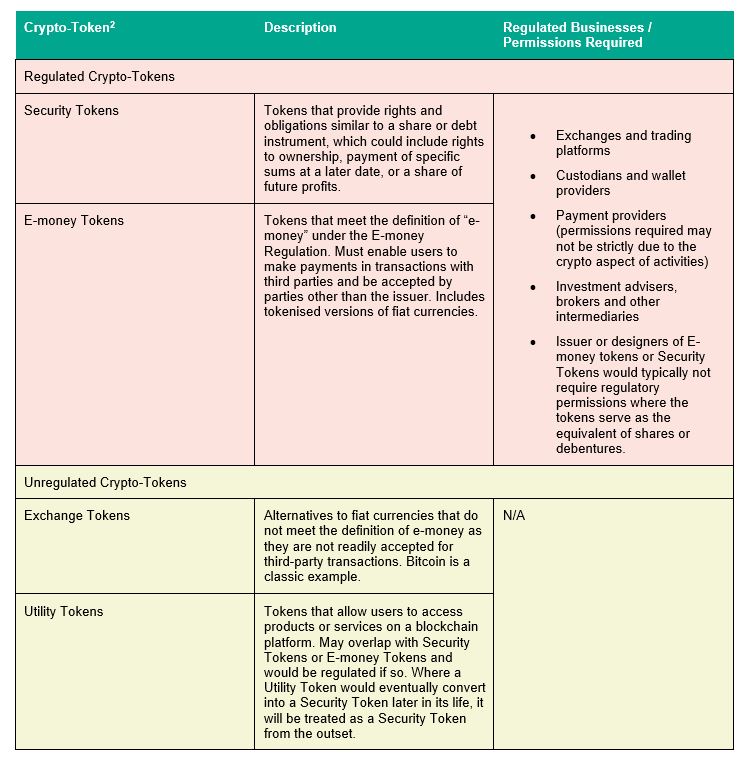
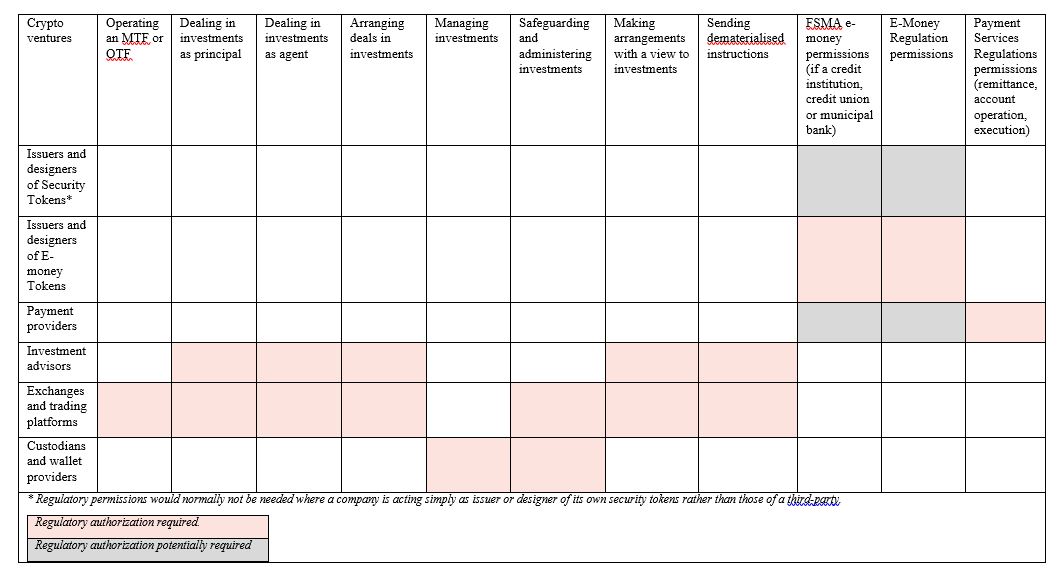
The table below sets out the four different types of crypto-tokens as specified by FCA and its guidance on whether they are regulated or not. It also covers the types of businesses associated with those tokens that would typically require FCA authorisation. Keep in mind that the FCA’s regulatory perimeter covers underlying specified activities rather than the overall business. For simplicity we don’t detail the underlying specified activities in the below table. Instead we list the businesses that are likely to be conducting activities that would be regulated. The underlying specified activities and permissions that could be required are set out in the table in Part 2 of this note.
In the Hot Zone: If a Crypto Venture is Regulated, what Rules Apply?
Basic Requirements
Even if the crypto-tokens are not regulated, if the business otherwise requires FCA authorisation, certain requirements will also apply to its crypto activities, including:
Regulatory Authorisations
If the business involves both regulated investments and regulated activities, it must obtain authorisation from the FCA before commencing activity. The permissions required could span a variety of regulations, including the Financial Services and Markets Act (FSMA), E-money Regulations and Payment Services Regulations. The business will need to obtain specific authorisation from the FCA for each of the regulated activities it intends to pursue, and failure to do so would constitute a criminal offense. In practice, these authorisations would all fall within one application and the requirements to be satisfied would overlap, including:
Financial Promotions
The financial promotions restrictions under FSMA apply to the marketing of regulated crypto-tokens irrespective of whether the crypto-venture requires FCA authorisation to operate, although various exemptions may apply. These restrictions also apply to unregulated crypto-tokens if they are advertised together with a regulated product or service. Generally, if the crypto-venture is unregulated but wishes to promote a regulated crypto-token, the promotion must be done in conjunction with a firm that has received FCA authorisation and has approved the communication. The content of the communication must also comply with the FCA’s rules on financial promotions, with the main requirement being that the promotion is clear, fair and not misleading. Marketing crypto-tokens in breach of these restrictions is a criminal offense.
One important point to keep in mind with respect to these rules and restrictions is that where a crypto-venture is FCA authorised but is marketing an unregulated crypto-token, such as Bitcoin, the venture cannot imply in the communication that its authorisation extends to the unregulated crypto-token.
Other Rules and Regulations
A variety of other regulations may also apply to crypto-ventures depending on the activities they undertake, including the Prospectus Regulation, Market Abuse Regulation, Money Laundering Regulations, Disclosure Guidance and Transparency Rules, Listing Rules, trading exchange/platform rules, and local laws in jurisdictions where an offer is made available internationally. These are outside the scope of this note, but should be kept in mind as they could be relevant.
Navigating the Minefield: How to Determine if You are Regulated
As a threshold matter, the FCA’s regulatory perimeter applies only where a business is dealing with regulated investments and conducting a regulated activity. It is important in the first instance to perform a thorough analysis of the crypto-tokens at issue to determine whether they should properly be considered regulated Security Tokens or E-money Tokens, or whether instead they would be considered unregulated Utility Tokens or Exchange Tokens. Once that assessment has been concluded, it is necessary to consider the nature of the business’ activities and whether they would be regulated as per the types of business and activities set out in the table in Part 2. Other factors to consider are whether the activity involves a business at all (vs being conducted by an individual in their personal capacity) and whether it is being conducted wholly outside of the United Kingdom, if either of these factors holds true then again the FCA’s regulatory perimeter would not apply.
Many crypto-ventures have unique business propositions that do not neatly fit into the FCA’s categories for regulated activities. Because of the rising numbers of these types of business, in 2014 the FCA launched Project Innovate, which provides direct support to innovative businesses to help them understand the FCA’s rules and processes. A crypto-venture may be eligible to submit a request for guidance to the FCA’s Direct Support Team where it can prove that its business model is genuinely innovative and likely to provide a benefit to customers, and that the firm has a genuine need for support.*
The Project Innovate support process is designed to be easily accessible and comprehensible, and it would be possible for firms to access and complete the guidance request materials even without the involvement of a solicitor, although professional advice may help a firm to more easily complete the submission and make a credible case with the FCA. If the FCA confirms that its regulatory perimeter does not apply, there would be no need to seek authorisation, and the reverse would apply where it disagrees with that assessment.
Conclusion
While the regulated status of crypto-tokens and crypto-ventures remains murky, the United Kingdom—in contrast to many jurisdictions—has attempted to put in place a framework that helps to clarify ambiguity and provide firms with support in the event there is any doubt. While the regulatory approach in this space likely will continue to evolve over time, there are at least some ground rules in place in the United Kingdom to help navigate this uncertain landscape. Where a firm falls within the FCA’s regulatory perimeter, it will need to seek authorisation for each of its regulated activities before commencing operations. Failure to do so is a criminal offense in the United Kingdom, making this an assessment of great import.
*1 The concepts of “specified investments” and “specified activities” are defined in the Financial Services and Markets Act 2000 (Regulated Activities) Order 2001 (SI 2001/544). For purposes of this note, we will use “regulated activity” and “regulated investment” to simplify the parlance.
*2 Stablecoins could be classified as Security Tokens, E-money Tokens or Exchange Tokens depending on the nature of the underlying asset and the stabilisation techniques used.
*3 The FCA’s Innovation Hub support materials are available here.