












CLIENT ALERT
FDA finalizes guidance on prescription drug use-related software
November 3, 2026
Read time: 4 min
On October 20, 2026, the US Food and Drug Administration (FDA) issued final guidance titled Regulatory Considerations for Prescription Drug Use-Related Software, finalizing a September 2023 draft. The guidance describes how FDA intends to apply its drug labeling authorities to software, such as mobile apps, that drug sponsors distribute for use with their prescription drugs and Center for Drug Evaluation and Research (CDER)-led or Center for Biologics Evaluation and Research (CBER)-led combination products. It addresses when software output is FDA-required or promotional labeling, when software should be described in a drug’s prescribing information (PI), and what sponsors should submit to FDA.
The guidance covers “prescription drug use-related software,” which is software that:
- Is disseminated by or on behalf of a drug sponsor, which can include a software developer working under an agreement with the sponsor; and
- Produces “end-user output” that supplements, explains, or is otherwise textually related to the sponsor’s drug products, regardless of whether the software is regulated as a device.
End-user output is any content presented to a patient, caregiver, or healthcare practitioner, and FDA considers it prescription drug labeling. Software not disseminated by or on behalf of a drug sponsor, and output that is entirely disease-state-focused, generally fall outside the guidance. Because the definition can reach apps built by technology partners, sponsors may want to address content review and FDA submission responsibilities in those contracts.
Within that scope, the guidance distinguishes “device-connected” software functions, which rely on data from a device or device constituent part of a combination product (e.g., an app paired with an inhaler), from “standalone” functions, such as those relying on user-entered data.
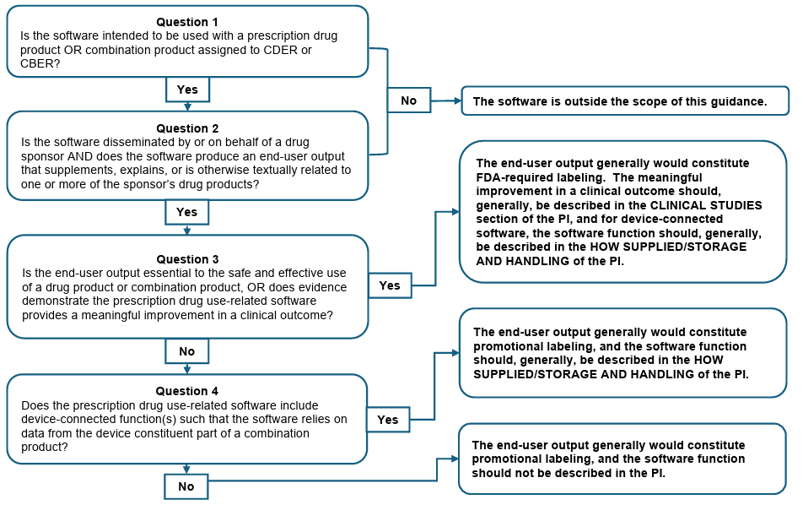
To determine how end-user output is treated and whether the software belongs in the PI, FDA will consider whether:
- The software is essential to safe and effective use of the product;
- Use of the software leads to a meaningful improvement in a clinical outcome; and
- The software relies on device data.
If the software is essential, or if FDA determines that adequate and well-controlled studies show a meaningful clinical improvement, then the end-user output generally would be FDA-required labeling, and certain post-approval changes to it should be reviewed and approved by FDA, consistent with the procedures for changes to an approved new drug application or biologics license application (certain information may instead be submitted in an annual report). Where there is such evidence, FDA generally recommends describing the studies in the PI’s “clinical studies” section. Otherwise, device-connected functions should be briefly described in the PI, with nothing beyond that description. However, while output from such software would be considered promotional labeling, standalone functions generally would produce promotional labeling and thus would not need to be described in the PI. Where software is not necessary for safe and effective use, the PI should say so.
For sponsors, this creates a tradeoff: Clinical evidence can support PI claims about an app’s benefit, but it brings the app’s content under FDA-required labeling, which may slow content updates. Without such evidence, sponsors retain more flexibility to update content, subject to promotional labeling requirements.
The labeling classification also drives what sponsors must submit to FDA. Promotional end-user output, and updates to it, must be submitted on Form FDA 2253 at the time of initial dissemination (accelerated approval products are generally subject to earlier submission requirements). Updates that do not alter previously submitted output, such as certain security patches, need not be resubmitted. Sponsors should therefore track which software updates change user-facing content. Form FDA 2253 does not replace a device marketing submission where one is required.
FDA also recommends that sponsors engage early with the relevant review division when considering generating clinical evidence to support PI claims or to support a new or significantly modified device-connected function involving a new or modified device constituent part.
Although the guidance was developed in coordination with the Center for Devices and Radiological Health (CDRH) and is designed to align with the agency’s broader digital health initiatives, its reach is limited. It does not alter the device framework or address whether a given software function is a device; it addresses only how drug labeling authorities apply to software output. Sponsors whose software also meets the device definition should therefore expect to address CDRH requirements in parallel with the labeling considerations discussed above.