













ARTICLE
5 things healthcare investors and operators should know about tech-enabled services
September 4, 2026
Read time: 15 min
Health tech adoption is outpacing the governance frameworks operators have built to manage it and the diligence playbooks investors rely on to price it. Tech-enabled services companies have become a magnet for capital, but there remains a gap between genuine enterprise value and well-marketed hype – and closing it requires disciplined judgment about how AI and other emerging technologies are actually deployed, not just whether they exist at an organization.
Here are five considerations that separate durable, profitable models from expensive missteps. Investors and operators should keep these in mind:
What’s happening
AI has moved from novelty to infrastructure across healthcare delivery, but standalone AI tools are no longer enough. Investors are shifting their attention – and their capital – toward platforms that embed AI directly into provider workflows: clinical documentation, revenue cycle management, scheduling, utilization management, patient engagement, and operational decision support. And providers want AI that increases productivity without compromising compliance, data privacy and security, or clinical oversight.
Why it matters for operators
A scattering of pilots is not a strategy. Operators need an enterprise-wide plan for AI deployment that includes clear governance frameworks, alignment with clinical and operational workflows, defined data ownership and oversight, and a way to prove the value AI is actually creating. Without that proof, AI initiatives stall at the pilot stage and never reach the balance sheet.
Why it matters for investors
AI functionality is becoming table stakes, not a differentiator. The real diligence questions: Is AI embedded into core business processes? Backed by proprietary data assets? Governed by mature compliance frameworks? Is it capable of producing sustained improvements in EBITDA, labor efficiency, revenue capture, and provider capacity? If not, it might be time to walk away. Just as important: confirm that the AI layer isn’t inadvertently adding regulatory or cybersecurity risk.
Where McDermott helps
We advise healthcare operators and investors across the full life cycle of tech-enabled services. Our capabilities include:
- AI governance
- Healthcare regulatory compliance
- Privacy and cybersecurity
- Data rights
- EHR integration
- Commercial contracting
- Reimbursement
- Diligence of AI-enabled provider platforms
- Implementation strategy
What’s happening
Buyers are moving away from point solutions and toward enterprise platforms that plug directly into EHRs and existing technology stacks. Vendors that can consolidate documentation, coding, scheduling, patient engagement, and operational intelligence into a single platform are capturing a disproportionate share of both provider attention and investor interest. That’s largely because it is cumbersome and costly for providers and health systems to manage a dozen vendor relationships to do what one platform could (and should).
Why it matters for operators
Fragmented point solutions are becoming harder to justify in costs and efficiency. Prioritize enterprise platforms that integrate with existing EHRs and operational systems, reduce vendor complexity, improve interoperability, and scale across the organization rather than requiring a new contract for every new use case.
Why it matters for investors
Platform consolidation favors interoperability, proprietary data, strong implementation capabilities, and long-term customer relationships, not just a broad feature list. In diligence, test platform stickiness, true integration costs (not just the sales pitch), and expansion opportunities across workflows. That’s what separates a durable market position from a good demo.
Where McDermott helps
We advise on the transactions, partnerships, and governance structures that define enterprise platform strategies:
- Technology transactions
- Strategic partnerships
- Interoperability
- Commercial contracting
- AI governance
- Antitrust
- Platform acquisitions
What’s happening
More AI-powered platforms mean increased risk and more investor scrutiny – especially for tools like AI scribes that capture voice, transcripts, and patient interactions in real time. The exposure here goes well beyond HIPAA. State privacy and recording laws, business associate and subcontractor controls, information blocking rules, cybersecurity resilience, and vendor data-use rights all come into play, often in ways that aren’t obvious until diligence is well underway.
Why it matters for operators
As your organization adopts generative AI, privacy, cybersecurity, and vendor governance need to mature in step with it. Define data ownership and permitted uses clearly, and implement consistent, enterprise-wide controls for AI-generated content before it proliferates across departments with no consistent standards.
Why it matters for investors
Data governance gaps delay deals, compress valuations, and increase post-close indemnity exposure. During diligence, probe vendor oversight structures, BAAs and subcontractor controls, incident response readiness, consent practices, retention rules, and vendor rights to use patient data for model training or analytics. What you find, or fail to find, should directly shape deal structure and pricing.
Where McDermott helps
We help investors unlock enterprise value while proactively managing HIPAA, state privacy, and platform-level risk exposure. We also help providers and sponsors evaluate AI vendor contracts, data rights, BAAs, privacy/cyber issues, transaction risk, and post-close remediation.
What’s happening
Investors still favor workflow-enabled provider services, but AI is quietly redefining what “workflow-enabled” means. Platforms that embed AI directly into clinical and operational workflows are winning: Automated documentation, coding, prior authorization, denials management, and revenue cycle operations have become baseline expectations rather than premium features. As these capabilities fold into broader platforms, isolated automation point tools are losing pricing power and differentiation fast.
Why it matters for operators
AI is changing not just the tools your organization uses, but how the work itself gets done. Embedding AI into scheduling, documentation, coding, prior authorization, and revenue cycle workflows drives real gains in productivity, workforce efficiency, throughput, and financial performance. Standalone tools bought piecemeal won’t get you there, and may leave you paying premium prices for commodity functionality.
Why it matters for investors
Businesses that use AI to do genuinely more with less will expand margins. Businesses that were simply charging for labor that AI can now automate will see those fees compressed. The diligence task is telling the two apart: Evaluate how deeply AI is integrated into workflows, implementation maturity, customer retention, and – most importantly – whether efficiency gains are actually showing up in the financials. Back the platforms connecting all the dots, not the ones assembling a checklist of AI features.
Where McDermott helps
We advise on the legal and structural complexities of AI-enabled provider services:
- Stark Law/Anti-Kickback Statute review
- Reimbursement diligence
- Licensure analysis
- Commercial contracting
- Post-close integration support
- MSO/PC structuring
- CPOM
- Provider alignment
- AI vendor contracting
- Data-use rights
- RCM arrangements
- Payor contracting
- Integration planning
What’s happening
AI-assisted documentation and coding can meaningfully improve productivity and revenue capture – but reimbursement still depends on accurate clinical documentation, physician oversight, audit readiness, and regulatory compliance. Automation doesn’t relax those requirements; if anything, it raises the stakes, since errors introduced by AI at scale multiply faster than errors introduced by individual clinicians.
Why it matters for operators
AI should strengthen clinical oversight, not substitute for it. Providers using AI documentation tools need to actively check outputs, hold coding accuracy to a high standard, and confirm that reimbursement practices remain audit-ready as automation expands – not assume the technology is self-correcting.
Why it matters for investors
Reimbursement is only as reliable as the documentation underneath it. In diligence, examine whether AI-supported documentation and coding practices are consistent, supervised, and auditable, and confirm that clear policies, training, and vendor controls are actually in place – particularly for PPMs and ASCs, where reimbursement risk tends to concentrate. A platform that has scaled coding volume without scaling oversight is a recipe for scrutiny and liability.
Where McDermott helps
We advise on the compliance, reimbursement, and contracting issues that come with AI-assisted documentation and coding:
- Value-based care structuring
- Coding and coverage diligence
- Reimbursement analysis
- Payor-provider contracting
- Audit defense
- CMS/regulatory compliance advisory support
We also support diligence on revenue quality, documentation workflows, AI-assisted coding and charge capture, medical necessity, payor audits, compliance maturity, and reimbursement risk.
The companies attracting capital are the ones embedding technology, including AI, across clinical and business processes as part of a coherent operating model – not the ones bolting on the flashiest feature. Human oversight remains essential to regulatory compliance, reimbursement integrity, and clinical judgment, and the platforms that treat oversight as an afterthought are the ones that eventually generate the compliance headlines nobody wants.
For operators, the next move is building a consolidated, tech-enabled, AI-powered operating model: Integrate AI into core clinical and administrative workflows; establish clear governance and accountability; and continuously measure adoption, productivity, quality, and financial performance. Done well, this makes an organization both more efficient and harder to displace.
For investors, the lesson is the same from a different angle: Deploying technology, including generative AI, is not a sustainable competitive advantage when taken alone – everyone can buy the same models. What matters is how deeply the technology and/or AI is embedded into enterprise operations, whether adoption is measurable rather than anecdotal, and whether a platform can keep compounding productivity gains over time. Proprietary data, implementation capability, and genuine customer integration are the signals that separate a lasting advantage from a feature that a competitor will replicate within a year.
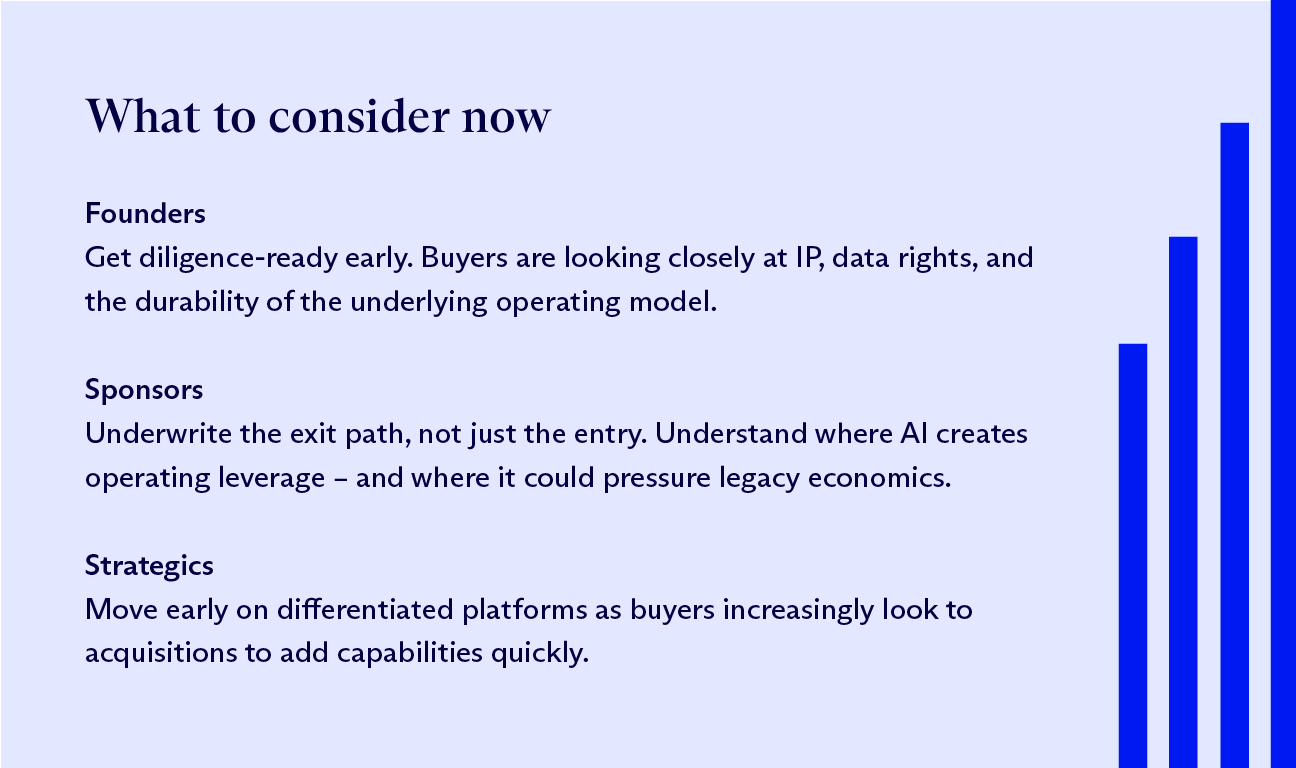
McDermott provides regulatory, transactional, and operational support across AI-enabled and tech-enabled services platforms, advising providers, sponsors, and strategic investors.