













REPORT
US M&A activity: Failing-firm standard reaffirmed, merger reviews streamlined, and behavioral remedies
November 5, 2026
Read time: 6 min
Recent developments at the Federal Trade Commission (FTC) and US Department of Justice (DOJ) show the agencies easing the burden of regulatory review for mergers with discrete issues, while continuing to thoroughly investigate mergers that present more significant competitive concerns. In the healthcare sector, FTC staff objected to OhioHealth’s proposed acquisition of financially distressed Fairfield Medical Center and pressed Fairfield to conduct a more rigorous search for alternative buyers that presented fewer competitive issues. In doing so, FTC leadership reaffirmed the failing-firm standard and emphasized that financial distress does not allow parties to circumvent merger review. Separately, the DOJ has returned to a “quick look” style mechanism offering a potential path to streamline review timelines during second requests by focusing on specific, dispositive issues that may resolve matters without a more-burdensome substantial compliance process. Yet, a $12 million HSR penalty against Edwards and Genesis signals that procedural HSR violations remain an enforcement priority. Finally, agency decisions and leadership commentary underscore the return of behavioral remedies.
FTC reaffirms failing-firm sale process standards
- Coordinating with the Ohio attorney general (AG), FTC staff raised competitive concerns about OhioHealth, Ohio’s largest health system, acquiring Fairfield Medical Center (FMC), a financially distressed, rural hospital. FMC would have been OhioHealth’s 17th acute-care hospital and its fifth acquisition in about three years. Staff questioned the thoroughness of FMC’s search for buyers that would not create competitive concerns and encouraged a more-robust sales process, which drew interest from multiple potential buyers. FMC abandoned the OhioHealth deal and joined Adena Health, which has no hospital in the area, preserving competition without litigation.
- In their joint statement following the decision to sell to Adena Health, FTC Chairman Ferguson and Commissioner Meador spelled out the elements of an adequate shop process for a seller seeking to use the failing-firm defense and warned that “financial distress is not a blank check” for anticompetitive mergers. Instead, staff will look to whether a seller (1) solicited a full set of potential buyers, (2) gave buyers adequate time to evaluate a potential deal, (3) offered a sufficient and equal amount of information across buyers, (4) engaged with buyers in good faith, and (5) earnestly considered offers from buyers that did not raise competitive concerns.
Regulators attempt to streamline merger compliance, but signal strong enforcement on HSR process violations
- On July 23, 2026, the DOJ’s Antitrust Division announced it was returning to an approach for prioritizing key information in some second requests, intending to speed up merger review. Under this approach, the merging parties first produce a smaller set of priority materials. After review, the DOJ may close its investigation, narrow the request, or require full compliance. DOJ leadership has touted the streamlined process, with Associate Attorney General Stanley Woodward stating it has worked “extremely well” in allowing the DOJ to “make informed decisions faster.”
- Indeed, some second requests appear to be resolving on an expedited timeline. For example, on August 19, the DOJ announced that it closed its investigation into the proposed merger between Seismic Software, Inc., and Highspot Inc. after a three-month second request.
- Still, regulators remain active on procedural HSR enforcement. In July, the FTC fined Edwards and Genesis $12 million for failing to make a required HSR filing for Edwards’ acquisition of JC Medical. The FTC alleged the parties intentionally structured the purchase to fall below the filing threshold, adding that companies trying to “sneak deals through without lawful FTC review should take notice.”
Federal and state agencies are increasingly engaging in behavioral remedies
- In a September keynote address at the International Bar Association’s Annual Competition Conference, Chairman Ferguson touched on the value of well-built behavioral remedies in vertical mergers: “[A] settlement with appropriately structured behavioral remedies is sometimes the best approach to vertical-merger problems.” While he tempered his openness to behavioral solutions by warning that they can be difficult to enforce and may expire before the threat to competition does, Chairman Ferguson added that rejecting behavioral remedies can force agencies into a false binary where they must choose between either “killing a deal or doing nothing.”
- Further, developments in Paramount Skydance’s proposed acquisition of Warner Bros. Discovery suggest that states may also be increasingly receptive to behavioral remedies. Just a few months after challenging the transaction, a coalition of state attorneys general, led by California Attorney General Rob Bonta, reached a settlement with Paramount. The settlement imposes several behavioral commitments, including minimum annual film-release requirements, oversight to preserve newsroom editorial independence, and safeguards to maintain separation in cable-provider negotiations. The film-quota provisions do contain structural divestiture backstops in case Paramount is unable to meet the required thresholds, however, the settlement remains framed almost entirely on behavioral grounds.
- Chairman Ferguson’s comments coupled with recent enforcement outcomes suggest that behavioral remedies are increasingly back on the table, and not just for federal enforcers. Regulators seem more willing to consider tailored commitments to resolve competitive concerns rather than pursue litigation to block a transaction outright.
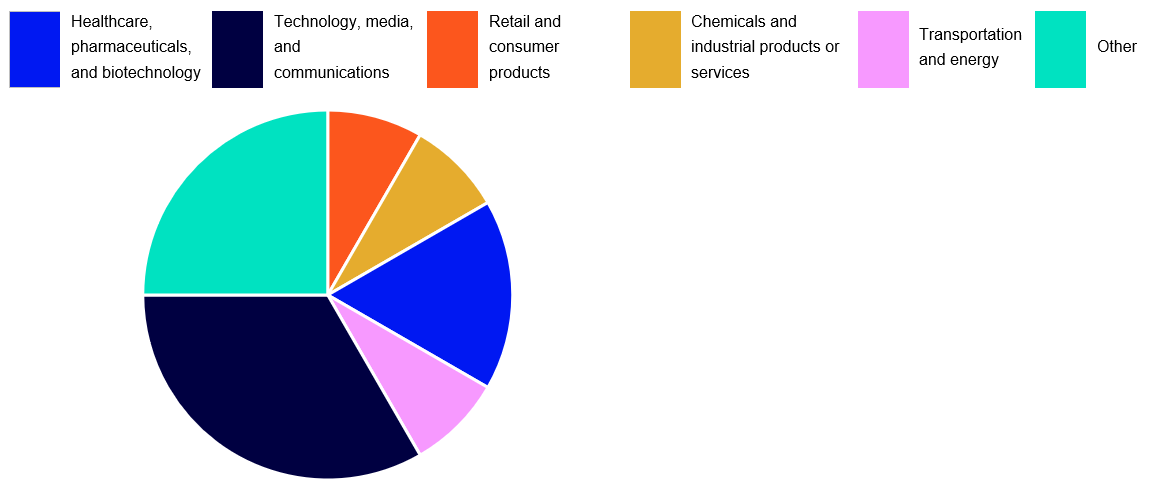
Number of enforcement actions in key industries1
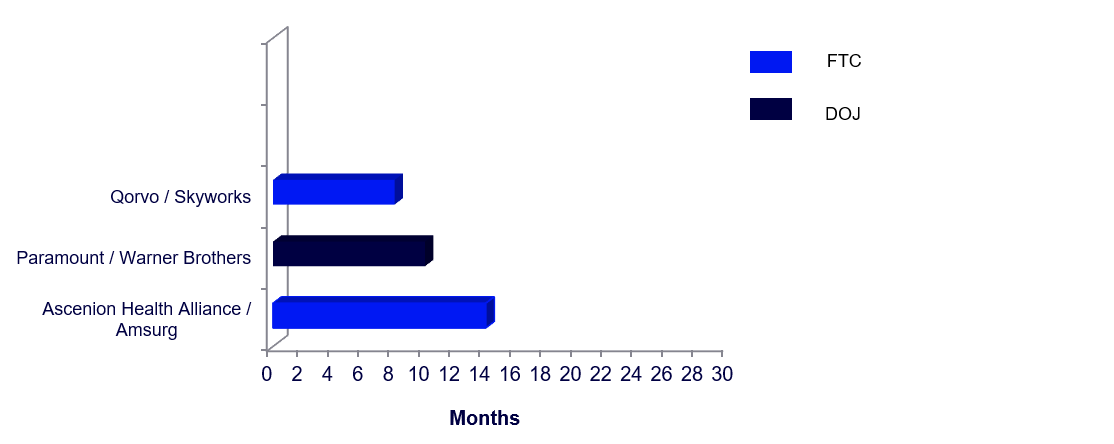
Snapshot of selected enforcement actions2
Time from signing to consent or investigation closing

Associate









1. For the United States, the graphs include cases we are aware of in which an antitrust enforcement agency issued a second request at some point and the investigation remained ongoing during the quarter, the agencies accepted a consent order or issued a complaint initiating litigation against the transaction, or the transaction was abandoned after an antitrust investigation.
2. These graphs are based on McDermott internal analysis and public press reports and filings. These graphs do not represent a complete list of all matters within a jurisdiction.