













REPORT
EU and UK merger control trends point to greater flexibility, continued scrutiny
November 5, 2026
Read time: 8 min
Q3 2026 saw several developments that shape the practical environment for M&A dealmakers in the European Union and the United Kingdom. The European Commission is seeking to reduce the regulatory burden without diluting substantive enforcement, while pressing ahead with its review of the Merger Guidelines. At the national level, France’s new, higher merger control thresholds have entered into force. UK enforcement data and survey results paint a picture of fewer formal investigations alongside limited business awareness of the merger-control regime.
Streamlining notification requirements across the EU while preserving enforcement reach
- Authorities are streamlining and recalibrating notification obligations and procedural requirements in an attempt to ease compliance costs. However, they explicitly preserve their substantive enforcement tools. Deal teams can look forward to upwardly revised thresholds but should still consider whether substantive issues arise that may cause authorities to call in deals.
- The Commission published its first review of the Foreign Subsidies Regulation (FSR) on July 14, 2026, covering three years of enforcement. Market participants have raised concerns about administrative burden, particularly the collection and aggregation of foreign financial contribution data across group entities and jurisdictions. The Commission acknowledged these concerns and indicated that it may consider adjustments to the procedural framework, to reduce administrative burden and facilitate compliance. Nonetheless, it concluded that “the FSR does not merit structural changes” and stressed that any procedural adjustments should not undermine the FSR’s effectiveness.
- France’s new merger-control thresholds, effective September 1, represent the first adjustment to these thresholds since 2008 and the most significant jurisdictional recalibration in recent years. The general combined worldwide turnover threshold rises from €150 million to €250 million, while the individual French turnover threshold, which must be met by at least two of the parties, increases from €50 million to €80 million. Retail-specific thresholds also increase from €75 million to €100 million for the combined worldwide turnover and from €15 million to €20 million for the French turnover. The practical effect is that an estimated 20 – 30% of transactions that were notifiable under the previous thresholds will fall outside the new ones.
- The turnover threshold increase thus reduces administrative burden for clearly unproblematic deals but does not eliminate jurisdictional risk for transactions that may raise competitive concerns in concentrated or innovation-driven markets.
- However, parties should still consider the competitive impact of below-threshold transactions. Deals that fall below the revised thresholds are not immune from scrutiny. Following the Court of Justice’s Towercast judgment (C-449/21), a below-threshold acquisition by a dominant firm may be reviewed ex post under Article 102 TFEU, and several Member States have call-in powers allowing their authorities to review below-threshold deals ex ante. The French, Belgian, Swedish, and Dutch competition authorities have recently examined whether below-threshold acquisitions could amount to an abuse of a dominant position. Separately, with a view to providing parties with greater legal certainty than ex post Article 102 review, the French Competition Authority has been advocating for the introduction of a targeted ex ante call-in power.
Merger Guidelines review: Spotlight on efficiency claims and dynamic merger effects
- The European Commission’s public consultation on its draft revised Merger Guidelines closed in June. In August, the Commission published the Economic Study on the Dynamic Effects of Mergers, prepared by Oxera together with three academic economists acting as lead researchers and advisers. Drawing on more than 450 publications, the study is intended to inform the Commission’s revised approach to assessing the impact of mergers on innovation, investment, market entry, and future product-market competition.
- The study proposes evaluating dynamic merger effects under an expected consumer welfare (ECW) standard that weighs both the probability and the magnitude of uncertain future outcomes. A key finding is that horizontal mergers, absent spillovers and synergies, are likely to reduce ECW, meaning that the prospect of greater post-merger market power (and the higher returns to innovation it may bring) is not, in itself, a sound basis for an “innovation defence.” The study identifies channels through which mergers may generate procompetitive dynamic effects, including technology diffusion, economies of scale and complementarities in R&D, and the easing of financial constraints. Such effects must satisfy the established three-limb efficiencies test – merger specificity, verifiability, and benefit to consumers – and the study recommends a sliding-scale approach requiring stronger evidence of benefits where the expected harm is more significant.
- In addition, a joint Directorate-General for Competition/Organisation for Economic Co-operation and Development conference on “Modernising merger control for an evolving world” was held in September and addressed the draft Merger Guidelines among other topics. Taken together, these initiatives reflect the Commission’s broader effort to update its analytical framework to give more weight to dynamic competition, global constraints, and efficiency considerations. For deal teams, the direction of travel is clear: Innovation and efficiency claims will need to be supported by robust, verifiable evidence from the outset, and the evidentiary bar will rise with the magnitude of the expected harm.
Tailored enforcement and limited business awareness
- Competition and Markets Authority (CMA) merger control statistics show an authority that is screening as many deals as before but intervening in far fewer. Transparency data published by the CMA for the calendar year shows that the CMA reviewed 881 mergers formally or informally in 2025 compared with 848 in 2023. During the same time, Phase 1 investigations dropped from 56 in 2023 to 39 in 2025, while Phase 2 cases fell from 10 in 2023 to 4 in 2025. Moreover, as a result of the Phase 2 investigations, resulted in only one deal boclked and one deal cleared subject to remedies (compared to six deals prohibited, cancelled or, cleared subject to remedies in 2023).
- At a roundtable with antitrust professionals in Q3, the CMA attributed the lower number of formal investigations to its “4Ps” (pace, predictability, proportionality, and process) agenda and its stated focus on prioritizing cases with the greatest potential UK impact. At the same time, the CMA highlighted that statistics should be read in the context of an overall lower global deal volume, and potentially fewer deals that impact UK competition. Overall, the CMA remains focused on tailoring its enforcement to deals that impact the UK, particularly where high share estimates impact end consumers.
- The CMA’s 2026 Business Perception Survey, published in July 2026, highlights a significant awareness gap. Only 38% of businesses with 10 or more employees reported a good understanding of UK merger rules. While 61% of businesses felt protected by merger regulation, only 30% knew who to contact if they had concerns about a merger. Larger businesses (53%) and those trading internationally (59%) showed greater awareness, but smaller and domestically focused firms appeared significantly less informed.
- The intersection of reduced case volumes and limited business awareness is worth monitoring. Given the voluntary nature of the UK regime, the awareness gap matters: Businesses that do not understand the rules may complete transactions without considering CMA review, exposing themselves to post-completion scrutiny, interim enforcement orders and, ultimately, the risk of unwinding. A lower caseload may also free up resources for the CMA’s mergers-intelligence function to follow up on third-party complaints and to engage with parties to non-notified transactions at an early stage. Parties to transactions affecting UK markets should therefore not assume that reduced enforcement volumes signal a lower probability of scrutiny in cases that raise genuine competition concerns.
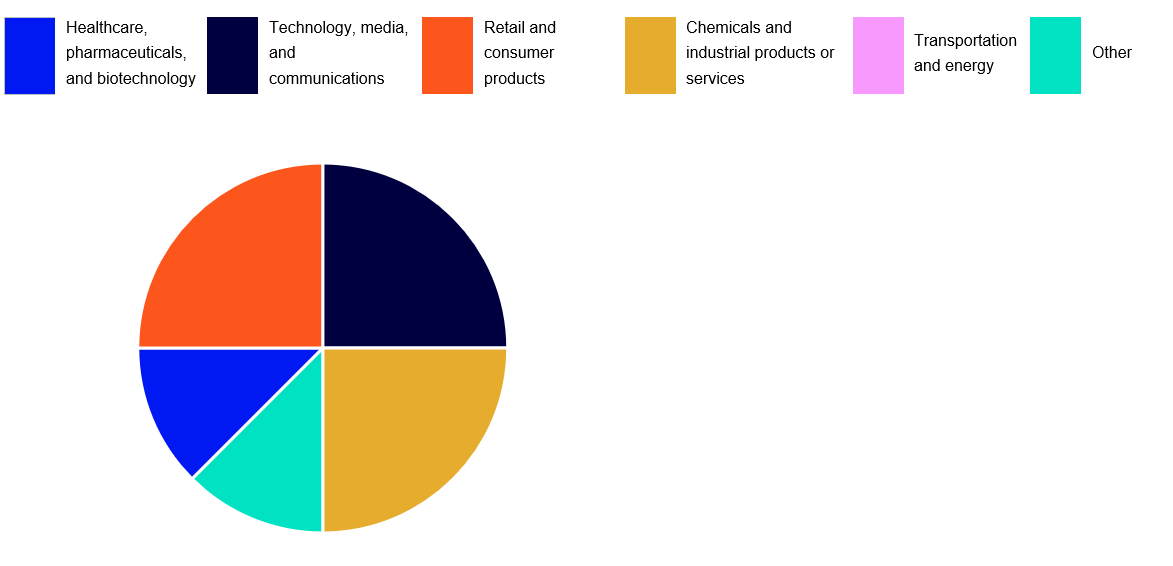
Number of enforcement actions in key industries1
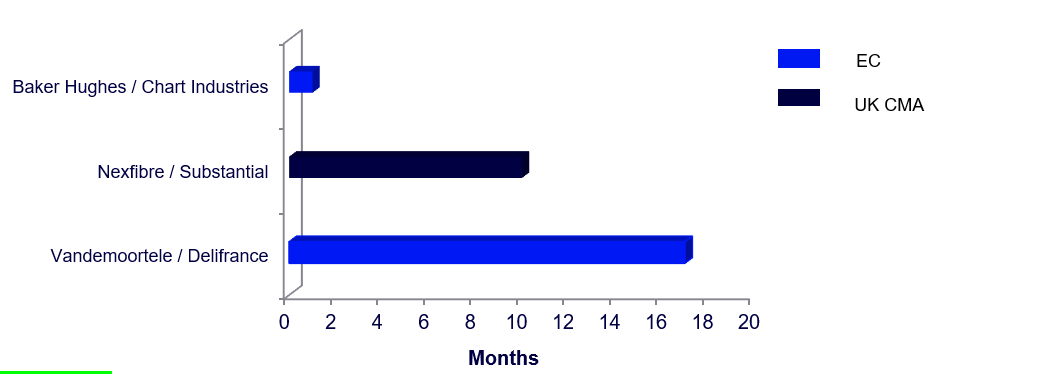
Snapshot of selected enforcement actions2
Time from signing to clearance
Time from signing to clearance

Associate









1. For Europe and the United Kingdom, the graphs include cases where an antitrust enforcement agency issued a Phase 2 process or a clearance decision, or challenged the transactions, or the transaction was abandoned after an antitrust investigation.
2. These graphs are based on McDermott internal analysis and public press reports and filings. These graphs do not represent a complete list of all matters within a jurisdiction.