












ARTICLE
August 2025
Read time: 6 min

In a parallel push to modernize antitrust oversight, key European regulators, including the European Commission (EC) and the United Kingdom’s Competition and Markets Authority (CMA), are simultaneously reforming their merger control frameworks. Both agencies have launched public consultations aimed at updating their guidelines to better address contemporary economic challenges, such as digitalization, supply chain resilience, and geopolitical shifts, with the shared goal of ensuring their rules remain effective and provide greater legal certainty in a rapidly evolving global market.
European Commission launches public consultation on EU merger guidelines review
On May 8, 2025, the EC initiated a comprehensive public consultation aimed at revisiting and modernizing the two EU merger guidelines. These guidelines serve as the core framework for how the EC evaluates the competitive impact of mergers and acquisitions within the European Union. The review is timely, given the rapidly evolving economic landscape shaped by digitalization, sustainability imperatives, geopolitical shifts, and the increasing strategic importance of certain sectors.
The review encompasses the 2004 horizontal merger guidelines, which govern concentrations between actual or potential competitors, and the 2008 non-horizontal merger guidelines, which cover vertical and conglomerate mergers. While the EC has already adapted its enforcement practice in response to structural market changes – such as globalization, digitalization, and technological innovation – this formal review seeks to ensure that the substantive assessment framework remains fully aligned with contemporary market dynamics. This formal review, however, is intended to preserve the effectiveness and legal certainty of EU merger control in addressing present and emerging market challenges.
A key feature of the EC’s initiative is the publication of seven focused discussion papers, each addressing a distinct and strategically significant area of merger control. These papers delve into a broad spectrum of contemporary issues, including:
- Economic resilience and supply chain security
- Evolving competitive dynamics and market concentration
- The role of technological innovation in shaping market structures
- Environmental sustainability and the green transition
- Digital transformation and data-driven business models
- Efficiencies and their assessment in merger analysis
- Defense and security-related considerations in light of geopolitical developments and labor-market impacts and the intersection of competition and employment policy
Among the key themes explored in the discussion papers are the challenges the EC faces in assessing innovation and efficiencies – two areas that have become increasingly central to merger analysis in dynamic and fast-evolving markets. The EC has recognized the challenges inherent in assessing the impact of mergers on innovation within the framework of the guidelines reform, as these effects are fundamentally less predictable than conventional pricing effects. Mergers may foster innovation by combining complementary research and development (R&D) capabilities, but they can also suppress it by removing competitive pressure between innovators – especially in sectors like technology and pharmaceuticals. A central challenge lies in defining the appropriate counterfactual – what the innovation landscape would look like absent the merger – which is often speculative and uncertain. To address these complexities, the EC is working to develop a more structured analytical framework that can better capture dynamic innovation effects alongside more immediate competitive concerns.
Similarly, the EC is reexamining how efficiencies are assessed under the current merger guidelines. While efficiencies can play a critical role in offsetting potential anticompetitive effects, they must meet strict criteria: they must be merger-specific, verifiable, and demonstrably beneficial to consumers. In practice, however, the EC deems these benefits often uncertain, long-term, and harder to quantify, especially in comparison to more immediate and tangible harms to competition. This asymmetry can present analytical challenges, particularly in vertical and conglomerate mergers where the assessment of efficiencies tends to be more complex.
The consultation process is designed to be inclusive and participatory, inviting input from a wide range of stakeholders, including individual citizens, businesses, industry associations, legal practitioners, economists, and academics. Feedback can be submitted through two channels: a general questionnaire aimed at the broader public, and a more technical, in-depth questionnaire intended for stakeholders with specialized knowledge or experience in competition law and economics.
The deadline for submitting responses is September 3, 2025. This inclusive approach reflects the EC’s commitment to transparency and stakeholder engagement in shaping future competition policy.
CMA advances merger control reform with new public consultation
Building on its March 2025 initiatives, the UK CMA continued to modernize its merger control regime throughout the second quarter of the year. Following the launch of a review into merger remedies and the introduction of the Mergers Charter, the CMA has now turned its focus to broader procedural and jurisdictional reforms.
The updated guidance, effective from January 1, 2025, introduces higher turnover thresholds, a safe harbor within the share of supply test, and a hybrid jurisdictional test. These changes aim to better reflect the realities of digital and platform-based markets while providing greater legal certainty for merging parties.
In June 2025, the CMA launched a public consultation to further refine its merger guidance and notification procedures. This initiative complements the earlier introduction of the Mergers Charter and seeks to embed its principles – pace, predictability, proportionality, and process – more deeply into the CMA’s operational framework. The consultation explores how the merger review process can be made more efficient and transparent, including proposed changes to the merger notice template and clarifications on the assessment of material influence and share of supply. The CMA is also considering adjustments to the Phase 1 review process to streamline engagement and reduce administrative burdens.
These developments reflect a broader strategic effort to modernize UK merger control in response to digital transformation, geopolitical shifts, and the increasing importance of economic resilience. While the CMA has already adapted its enforcement practices to address these challenges, the current reforms aim to codify those adaptations and provide greater legal certainty for businesses and their advisors.
The consultation remains open to a wide range of stakeholders, with feedback expected to inform further guidance and policy proposals later in 2025.
EU and UK M&A activity: By the numbers
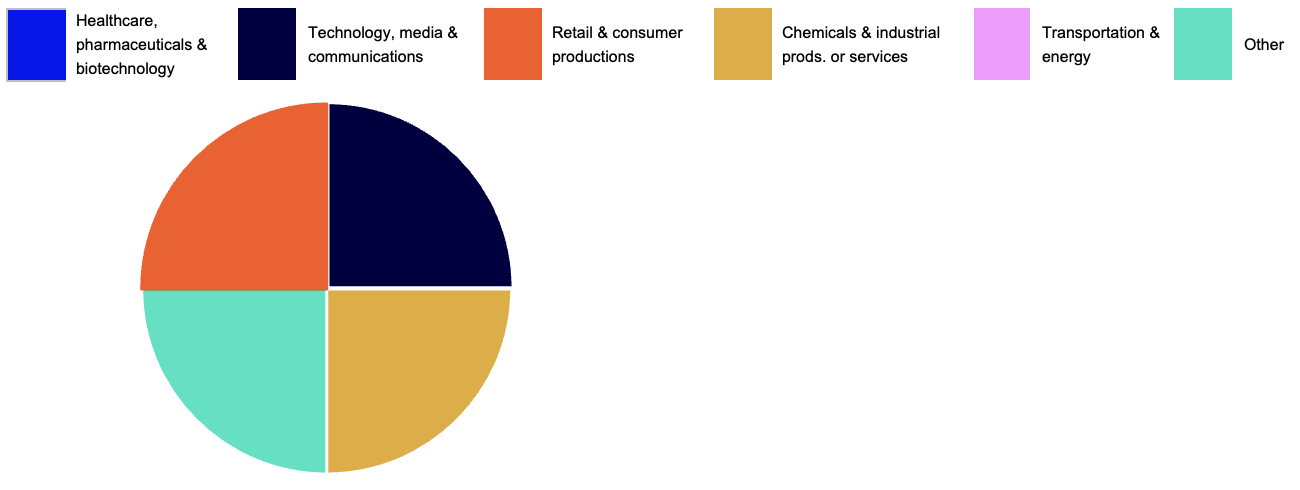
Number of enforcement actions in key industries1
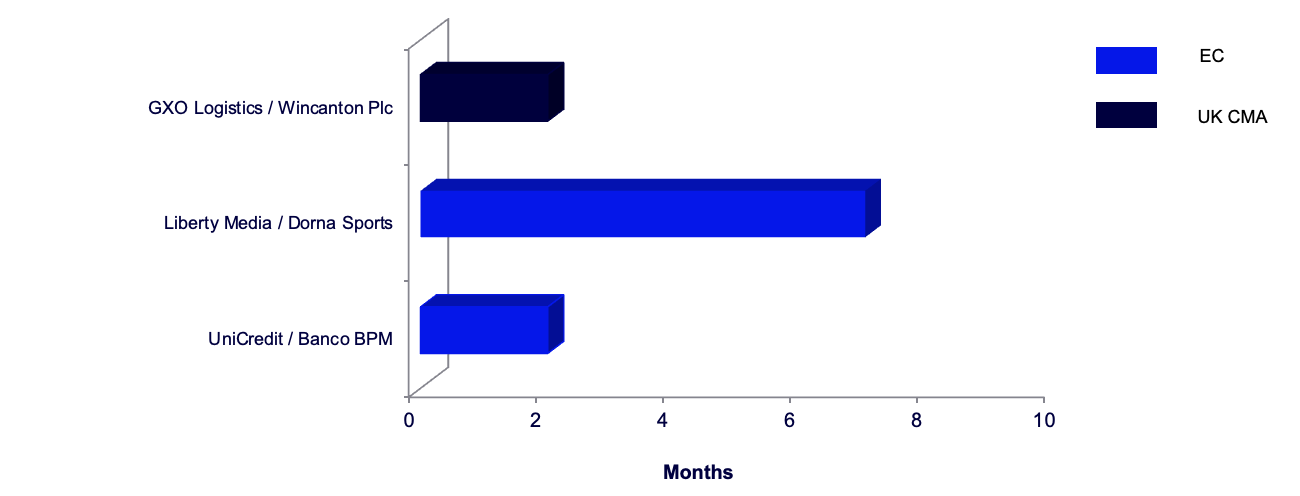
Snapshot of selected enforcement actions2
Time from signing to clearance











3 takeaways from US antitrust M&A activity in Q2 2025
ARTICLE
August 2025
Read time: 5 min
Under the second Trump administration, the Federal Trade Commission (FTC) and Department of Justice (DOJ) have signaled a significant departure from the antitrust enforcement policies of the Biden administration. This new approach is characterized by a renewed willingness to accept structural remedies, such as divestitures, to resolve competitive concerns in mergers. Alongside this, the agencies are actively working to accelerate the merger review process, reinstating early terminations of the Hart-Scott-Rodino waiting period to allow non-problematic deals to close more quickly.
Return of structural remedies
The Federal Trade Commission (FTC) and Department of Justice (DOJ) under President Donald Trump have made good on their promises to accept structural remedies, i.e., remedies involving divestitures, to resolve concerns with transactions. In recent months, the FTC announced a settlement regarding Synopsys’ acquisition of Ansys, while the DOJ entered into settlements allowing three transactions to proceed: Hewlett Packard Enterprise (HPE) / Juniper Networks, Safran / Raytheon, and Keystone / Spirent. This flurry of consent decrees stands in contrast to the Biden administration, which did not accept a prelitigation divestiture for the last two years of its administration and strongly disfavored merger remedies.
Despite the current agencies’ willingness to enter into settlements, they have emphasized the importance of “clean” divestitures and strong divestiture buyers. FTC Commissioner Melissa Holyoak, for example, has stated that the FTC will not hesitate to litigate when a proposed remedy is inadequate. In Synopsys / Ansys, FTC Chair Andrew Ferguson issued a statement, joined by the two other commissioners, outlining the FTC’s stance on merger remedies. Ferguson noted the benefits of merger settlements, including allowing the procompetitive aspects of a merger to proceed and conserving finite agency resources. Nevertheless, he emphasized that the FTC must be “clear-eyed” about the dangers of inadequate settlements. In particular, Ferguson stated that the FTC ordinarily will not accept a structural remedy unless it involves the sale of a standalone or discrete business, and the divestiture buyer has the resources and experience necessary to make that standalone business competitive. As for behavioral remedies, Ferguson said the FTC should approach such remedies with “substantial caution.” The Trump FTC did accept a behavioral remedy to resolve its concerns with Omnicom / Interpublic, but that was an atypical behavioral remedy aimed at addressing concerns about suppression of conservative speech.
Following the settlement of United Health / Amedisys and the withdrawal of the litigation against AMEX GBT / CWT, one merger challenge is proceeding to trial: GTCR BC Holdings, LLC / Surmodics, Inc.
Agencies continue to promote reaching merger decisions quickly
Consistent with the current, more business-friendly attitudes of the FTC and DOJ toward dealmaking, the two agencies also are making efforts to allow nonproblematic mergers to proceed more quickly. The FTC has brought back the practice of granting early termination of the Hart-Scott-Rodino (HSR) waiting period, a practice the FTC suspended under the Biden administration. FTC Commissioner Holyoak has stated that requests for early termination will help reduce the workload of FTC staff and help parties close transactions more quickly. Since restarting the early termination program, the FTC has granted more than 100 early termination requests. Assistant Attorney General (Antitrust Division) Gail Slater has stated that the DOJ has been looking for other ways to speed up the merger review process, as well. FTC Chair Ferguson said that the FTC “must get out of the way quickly” when a merger would not violate antitrust laws, to avoid bogging down innovation and interfering with the free market. These statements stand in contrast with the approach of Biden administration enforcers, which was to try to slow down dealmaking generally.
The rise of “America First Antitrust”
The FTC and DOJ appear willing to promote Trump administration goals through their antitrust enforcement programs. In her first public address as assistant attorney general of the Antitrust Division, Gail Slater discussed the concept of “America First Antitrust,” focused on the needs of “forgotten” workers and consumers, small businesses, manufacturing, and family-owned agribusiness. She went on to say that deregulation and transparency are key to these efforts.
In Omnicom / Interpublic, the FTC required an unusual behavioral remedy aimed at protecting conservative speech, a concern of the Trump administration. The settlement prohibits Omnicom from directing advertising spend toward or away any media publisher based on the publisher’s political or ideological viewpoints. The FTC entered into this settlement despite FTC Chair Ferguson’s statement in Synopsys / Ansys that the FTC should approach behavioral remedies with “substantial caution.”
US M&A activity: By the numbers
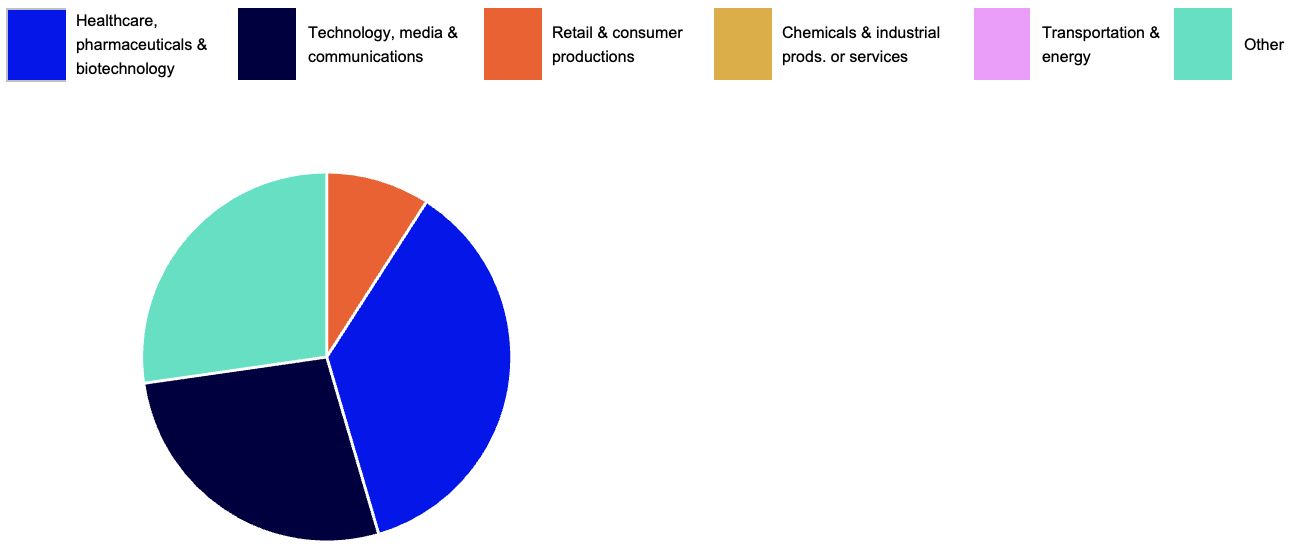
Number of enforcement actions in key industries1
Snapshot of selected enforcement actions2
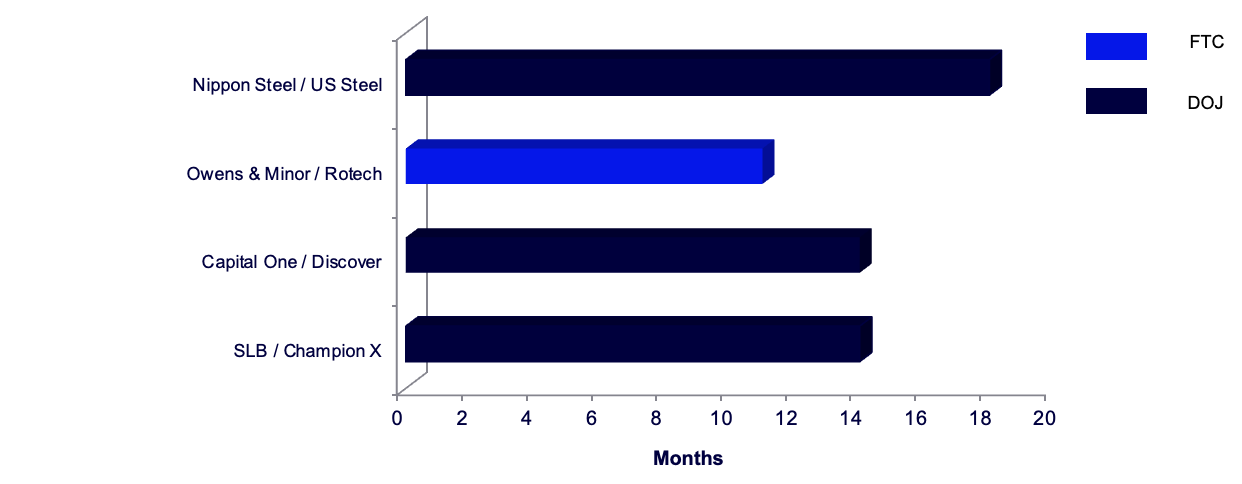
Time from signing to consent or investigation closing

Antitrust M&A Snapshot | Q1 2025
REPORT
May 2, 2025
Read time: 2 min
McDermott’s global competition practice can assist clients with antitrust M&A issues in various jurisdictions around the world. Feel free to contact one or more of our partners in our various offices. The individuals below can assist or can refer you to one of our many other lawyers in our competition team who can help with a specific question.
United States: Jon Dubrow, Joel Grosberg, Ray Jacobsen, Stephen Wu, Ryan Tisch, Lisa Rumin, and Elai Katz
Europe: Jacques Buhart, Christian Krohs, Hendrik Viaene, Frédéric Pradelles, Stéphane Dionnet, and Axel Schulz




Antitrust M&A Snapshot | Q4 2024
REPORT
January 24, 2025
Read time: 2 min
McDermott’s global competition practice can assist clients with antitrust M&A issues in various jurisdictions around the world. Feel free to contact one or more of our partners in our various offices. The individuals below can assist or can refer you to one of our many other lawyers in our competition team who can help with a specific question.
United States: Jon Dubrow, Joel Grosberg, Ray Jacobsen, Stephen Wu, Ryan Tisch, Lisa Rumin, and Elai Katz
Europe: Jacques Buhart, Christian Krohs, Hendrik Viaene, Frédéric Pradelles, Stéphane Dionnet, and Axel Schulz



Antitrust M&A Snapshot | Q3 2024
REPORT
October 31, 2024
Read time: 2 min
McDermott’s global competition practice can assist clients with antitrust M&A issues in various jurisdictions around the world. Feel free to contact one or more of our partners in our various offices. The individuals below can assist or can refer you to one of our many other lawyers in our competition team who can help with a specific question.
United States: Jon Dubrow, Joel Grosberg, Ray Jacobsen, Stephen Wu, Ryan Tisch, Lisa Rumin, and Elai Katz
Europe: Jacques Buhart, Christian Krohs, Hendrik Viaene, Frédéric Pradelles, Stéphane Dionnet, and Axel Schulz


Antitrust M&A Snapshot | Q2 2024
REPORT
July 25, 2024
Read time: 2 min
McDermott Will & Emery’s global competition practice can assist clients with antitrust M&A issues in various jurisdictions around the world. Feel free to contact one or more of our partners in our various offices. The individuals below can assist or can refer you to one of our many other lawyers in our competition team who can help with a specific question.
United States: Jon Dubrow, Joel Grosberg, Ray Jacobsen, Stephen Wu, Ryan Tisch and Elai Katz
Europe: Jacques Buhart, Christian Krohs, Hendrik Viaene, Frédéric Pradelles, Stéphane Dionnet and Axel Schulz

Antitrust M&A Snapshot | Q1 2024
REPORT
May 2, 2024
Read time: 2 min
McDermott Will & Emery’s global competition practice can assist clients with antitrust M&A issues in various jurisdictions around the world. Feel free to contact one or more of our partners in our various offices. The individuals below can assist or can refer you to one of our many other lawyers in our competition team who can help with a specific question.
United States: Jon Dubrow, Joel Grosberg, Ray Jacobsen, Stephen Wu, Ryan Tisch and Elai Katz
Europe: Jacques Buhart, Christian Krohs, Hendrik Viaene, Frédéric Pradelles, Stéphane Dionnet and Axel Schulz



Antitrust M&A Snapshot | Q4 2023
REPORT
February 14, 2024
Read time: 2 min
McDermott Will & Emery’s global competition practice can assist clients with antitrust M&A issues in various jurisdictions around the world. Feel free to contact one or more of our partners in our various offices. The individuals below can assist or can refer you to one of our many other lawyers in our competition team who can help with a specific question.
United States: Jon Dubrow, Joel Grosberg, Ray Jacobsen, Stephen Wu, Ryan Tisch, and Elai Katz
Europe: Jacques Buhart, Christian Krohs, Hendrik Viaene, Frédéric Pradelles, Stéphane Dionnet, and Axel Schulz


Antitrust M&A Snapshot | Q3 2023
REPORT
November 2, 2023
Read time: 2 min
McDermott Will & Emery’s global competition practice can assist clients with antitrust M&A issues in various jurisdictions around the world. Feel free to contact one or more of our partners in our various offices. The individuals below can assist or can refer you to one of our many other lawyers in our competition team who can help with a specific question.
United States: Jon Dubrow, Joel Grosberg, Ray Jacobsen, Stephen Wu, Ryan Tisch and Elai Katz
Europe: Jacques Buhart, Christian Krohs, Hendrik Viaene, Frédéric Pradelles and Stéphane Dionnet


Antitrust M&A Snapshot | Q1 2023
REPORT
April 20, 2023
Read time: 2 min
McDermott Will & Emery’s global competition practice can assist clients with antitrust M&A issues in various jurisdictions around the world. Feel free to contact one or more of our partners in our various offices. The individuals below can assist or can refer you to one of our many other lawyers in our competition team who can help with a specific question.
United States: Jon Dubrow, Joel Grosberg, Ray Jacobsen and Stephen Wu
Europe: Jacques Buhart, Christian Krohs, Hendrik Viaene, Frédéric Pradelles and Stéphane Dionnet