













CLIENT ALERT
No redesign on rehearing: Federal Circuit leaves Egyptian Goddess framework intact
August 24, 2026
Read time: 10 min
In Range of Motion Prods. v. Armaid Co., the US Court of Appeals for the Federal Circuit denied rehearing en banc, leaving intact a prior panel decision affirming summary judgment of noninfringement in a design patent case involving the role of functional aspects in claim construction and the infringement analysis. The denial preserves the Federal Circuit’s existing framework for determining design patent infringement, including the Court’s role in identifying functional from ornamental aspects of a patented design when defining the scope of the claim.
Range of Motion Products (RoM) owns a design patent covering a “Body Massaging Apparatus.” RoM sued Armaid, alleging its Armaid2 massager infringed the patent. Under the ordinary observer test established in Gorham Co. v. White, infringement generally turns on whether an ordinary purchaser would view the patented and accused designs as substantially the same in overall appearance. The district court granted summary judgment to Armaid, and a Federal Circuit panel affirmed, concluding that no reasonable jury could find infringement after considering the similarities and differences between the claimed and accused designs and the effect of functional aspects on the scope of the claimed design. RoM then sought rehearing by the full Federal Circuit but rehearing en banc was denied.
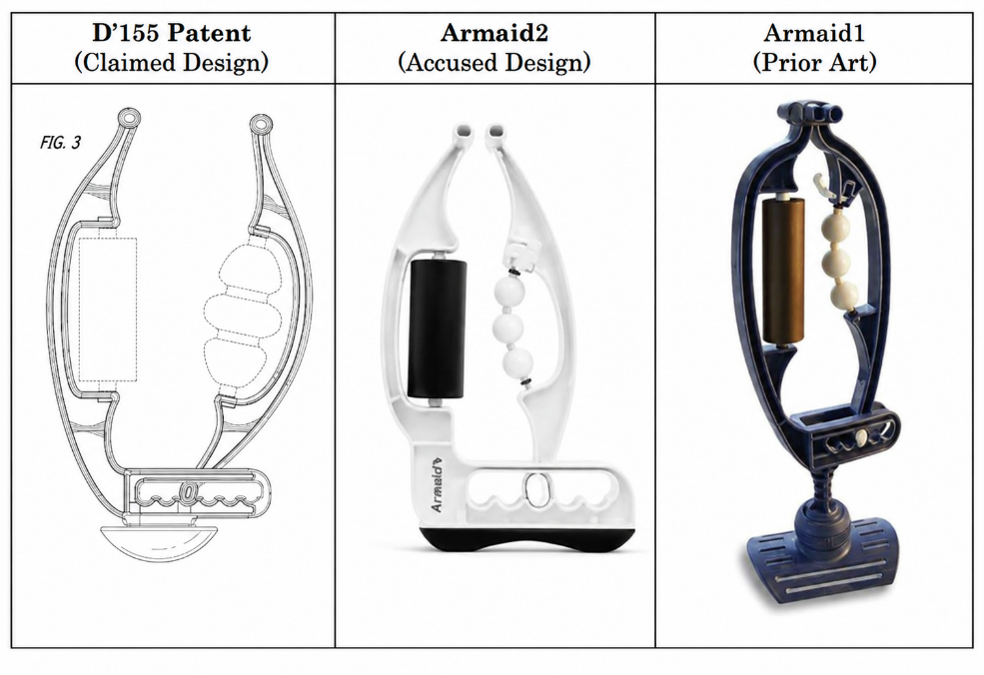
Judge Kevin P. Cunningham, joined by Judge Todd M. Hughes, concurred in the denial and addressed two arguments for reconsidering the Federal Circuit’s design patent law. First, the concurrence rejected the contention that Egyptian Goddess, Inc. v. Swisa, Inc. improperly shifted the infringement inquiry from whether two designs are substantially the same to a focus on their differences. Egyptian Goddess recognizes that, in some instances, the claimed and accused designs may be sufficiently distinct that it is clear, without more, that the patentee cannot establish substantial similarity under the ordinary observer test. According to the concurrence, determining whether designs are substantially the same necessarily requires considering both their similarities and differences, with the overall visual effect remaining controlling. The concurrence explained that this approach is consistent with the Supreme Court of the United States’ decision in Gorham, which contemplated the consideration of differences while making the designs’ overall effect the controlling consideration.
The concurrence also considered this case a poor vehicle for revisiting Egyptian Goddess. It explained that Egyptian Goddess permits a finding of noninfringement without comparison to the prior art when the claimed and accused designs are sufficiently distinct that no ordinary observer could find them substantially the same. Here, however, the district court did not rely solely on that analysis. It also conducted a three-way comparison of the patented design, Armaid2, and the prior art and determined under that analysis that no reasonable jury could find infringement. The Federal Circuit panel affirmed on both grounds. Thus, the concurrence reasoned that revisiting the Egyptian Goddess standard would not affect the outcome of this case, making it an unsuitable vehicle for en banc review.
The concurrence rejected the dissent’s argument that a jury, rather than a judge, should determine functionality as part of design patent claim construction. The concurrence explained that claim construction is a question of law for the court, and that Egyptian Goddess specifically recognized that courts construing design patent claims may distinguish ornamental features from purely functional ones. In the concurrence’s view, identifying functional aspects helps define the scope of the claimed design rather than removing those aspects from the infringement comparison. The concurrence analogized the court to a “trail guide” placing “flags and signposts” to delineate the boundaries of the claimed design before the jury determines infringement.
Chief Judge Kimberly A. Moore, joined by Judge Jimmie V. Reyna, dissented, arguing that Federal Circuit precedent has improperly shifted quintessential factual questions from juries to judges. Chief Judge Moore emphasized that design patents generally consist of drawings rather than written claim language, requiring the type of judicial interpretation addressed in utility patent claim construction. In her view, determining whether aspects of a design are functional or ornamental requires evaluating evidence and making factual judgments that should be entrusted to the jury as part of the infringement analysis. She further observed that functionality is treated as a factual question in analogous contexts, including design patent validity and trade dress law, and argued that applying the same functionality considerations during claim construction should not transform those factual determinations into questions for the Court.
Chief Judge Moore also renewed her criticism of Egyptian Goddess, arguing that its “plainly dissimilar” or “sufficiently distinct” formulation improperly reframed the infringement inquiry from Gorham’s focus on whether two designs are substantially the same in overall appearance to a focus on their differences. In her view, this shortcut has expanded beyond truly easy-to-decide cases and risks, allowing courts to resolve fact-intensive infringement questions at summary judgment without sufficient consideration of the prior art. She explained that the proper inquiry remains whether, in light of the prior art, an ordinary observer would find the claimed and accused designs substantially similar in overall appearance.
Practice note: The denial of rehearing en banc leaves the Egyptian Goddess framework, including the “plainly dissimilar” shortcut and judicial determination of functionality in claim construction, as governing law. The disagreement within the Federal Circuit remains significant, however: Four judges, including the chief judge, dissented from the denial, with two joining a written dissent that questioned the allocation of functionality determinations to judges and the application of the “plainly dissimilar” framework. The participation of multiple amicus support for rehearing reflects substantial interest in these issues and suggests that the debate may continue.