












ARTICLE
EU and UK merger control in transition: Innovation, sustainability, and cross-border coordination
April 2026
Read time: 6 min
The European Union (EU) is recalibrating its merger-control regime to respond to structural economic shifts driven by digitalization, decarbonization, and intensifying global competition. Policymakers are increasingly seeking to balance traditional competition principles with broader industrial, sustainability, and strategic autonomy objectives. Several initiatives illustrate this transition: First, the Commission is preparing updated merger guidelines that place greater emphasis on innovation, dynamic market analysis, and efficiency considerations aimed at strengthening European competitiveness. At the same time, proposed legislation, such as the Industrial Accelerator Act, introduces an additional review mechanism for foreign investments in strategic sectors, signaling a stronger industrial policy dimension. Finally, merger assessments are progressively incorporating public interest considerations, particularly environmental and social sustainability.
The United Kingdom (UK) is reshaping its merger-control framework as part of a broader strategy to strengthen economic competitiveness and improve regulatory predictability. Guided by the government’s 2025 “strategic steer,” reforms aim to modernize the institutional structure and operational approach of the Competition and Markets Authority (CMA) while ensuring that enforcement remains proportionate and business friendly. Key proposals include changes to decision-making structures, new operational priorities designed to accelerate reviews, and clearer jurisdictional rules to reduce uncertainty for merging parties. The new EU-UK Competition Cooperation Agreement introduces a formal information-sharing framework that enhances coordination between the CMA and European competition authorities.
EUROPEAN UNION
Modernizing EU merger control: Updates to the European Commission’s merger guidelines
- The Commission is committed to modernizing the EU merger guidelines to address the transformational challenges of digitalization, globalization, and decarbonization. A formal draft is expected by spring 2026, including the following key substantive shifts:
- Innovation shield: A protective framework for startups and innovators, focusing on long-term competitive dynamics rather than short-term price effects.
- Broadened policy criteria: Formal integration of sustainability, labor markets, and national security, alongside supply chain resilience in strategic sectors such as aerospace.
- Efficiency flexibility: A proposed lowering of the evidentiary bar for efficiency claims, allowing mergers that significantly enhance regional industrial competitiveness.
- Dynamic analysis: Extending assessment timeframes beyond the typical three-year window to capture delayed benefits in disruptive technology sectors.
- Legal presumptions: Introducing rebuttable presumptions to distinguish harmful transactions from those creating necessary scale for “European Champions.”
Expanding the toolkit: The potential introduction of the IAA
- The new Industrial Accelerator Act (IAA), proposed on March 4, 2026, and aiming to strengthen EU industrial capacity, reduce strategic dependencies, and accelerate clean and low-carbon technologies, introduces a parallel review process for mergers and acquisitions involving foreign investors in strategic sectors. This system operates alongside existing EU competition law, including the EU Merger Regulation, without replacing it. Key developments include:
- Mandatory and suspensory regime: Transactions exceeding EUR 100 million in sectors such as batteries or critical raw materials require prior notification to designated national investment authorities.
- Lowered control thresholds: Notification is triggered at 30% ownership or voting rights, widening the concept of control beyond the traditional “decisive influence.”
- Value-added substantive test: Approval depends on meeting specific criteria, such as establishing joint ventures or ensuring at least 50% of the workforce is located within the EU.
- Strict enforcement: Implementing transactions before approval (gun-jumping) faces administrative fines of at least 5% of the investor’s average daily turnover (5% of what the company earns on average for a single day based on annual revenue). This indicates a major shift toward strategic autonomy.
Bringing in public interest grounds
- EU merger control is undergoing a polycentric shift, moving beyond traditional price-centric analysis to integrate environmental and social sustainability. The Commission increasingly treats sustainability as a core differentiator in market definition and competitive assessments. However, this creates a potential “green catch-22”: identifying narrower, more sustainable markets increases the likelihood of the Commission challenging mergers between innovative “green” firms.
- To mitigate this, policy developments emphasize a holistic rethink of the efficiency defense. This includes explicitly considering out-of-market benefits and extending assessment timeframes to capture long-term environmental gains currently excluded by the traditional three-to-five-year window. Furthermore, there is a growing trend toward using investment-centric remedies to legally guarantee that claimed sustainability efficiencies actually materialize. These changes aim to align merger enforcement with broader EU objectives such as the European Green Deal and strategic resilience.
UNITED KINGDOM
Reforming UK merger control: The CMA’s revised approach to merger assessment
- UK merger control is currently undergoing a significant transformation driven by the government’s 2025 “strategic steer” to enhance international competitiveness and long-term economic growth.
- Restructuring decision-making: A major legislative proposal involves abolishing independent Phase 2 panels and replacing them with CMA board committees to improve democratic accountability. However, some experts caution that this structural shift could consolidate executive authority and risk future political influence in individual merger assessments.
- The “4Ps” operational strategy: The CMA is embedding pace, predictability, proportionality, and process across all operations to attract investment and foster business confidence. This involves deprioritizing multijurisdictional deals without specific UK impact and establishing ambitious targets for completing straightforward Phase 1 investigations.
- Narrowing jurisdictional scope: Reforms aim to limit CMA discretion by establishing specific criteria for jurisdictional tests like “share of supply.”
- Remedy evolution: Enforcement trends indicate greater flexibility for behavioral commitments and extended statutory timeframes for finalizing Phase 1 remedies.
Strengthening cross-border enforcement: The EU’s information-sharing framework with the CMA
- The EU-UK Competition Cooperation Agreement, signed on February 25, 2026, represents a major shift toward structured cross-border competition enforcement. As a supplement to the Trade and Cooperation Agreement, it replaces informal dialogue with a formal legal framework intended to improve predictability and legal certainty. A central innovation is the introduction of a new information-sharing mechanism allowing the UK CMA and European authorities to exchange confidential data. Where domestic law permits, information may be shared without the provider’s consent.
- The agreement also promotes cooperation between the CMA and national competition authorities across EU Member States through mutual notification and coordinated investigations, reducing the likelihood of conflicting rulings. Parallel domestic reforms reinforce this goal by extending the CMA’s Phase 1 merger remedy period to 20 working days and clarifying jurisdictional tests through closed statutory lists.
EU and UK Q1 2026 M&A activity: By the numbers
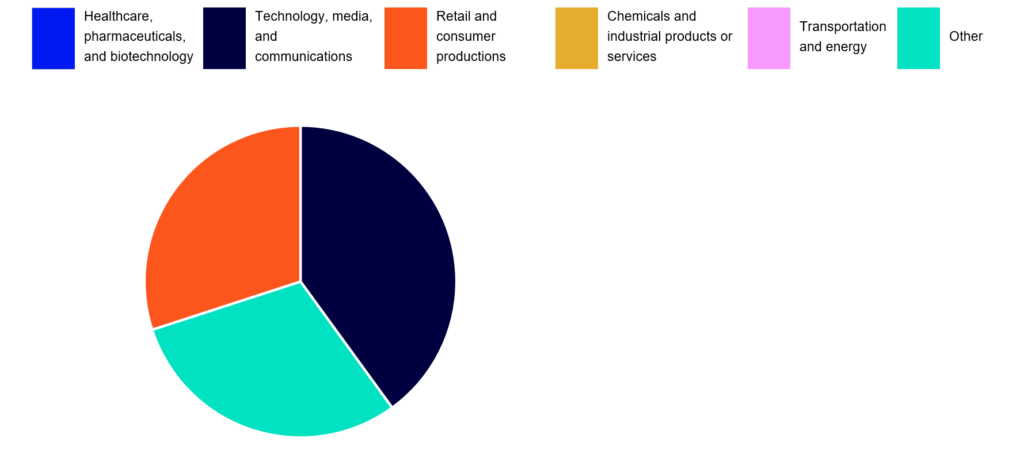
Number of enforcement actions in key industries1
Snapshot of selected enforcement actions2
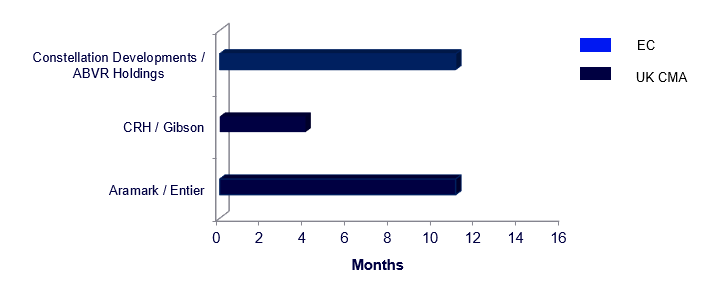
Time from signing to clearance